
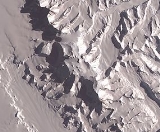
Vinson Massif is the highest
mountainA mountain is a large landform that stretches above the surrounding land in a limited area usually in the form of a peak. A mountain is generally steeper than a hill. The adjective montane is used to describe mountainous areas and things associated with them...
of
Antarctica| style="border-top:solid 1px #ccd2d9; padding:0.4em 1em 0.4em 0; vertical-align:top;" | 14,000,000 km
2 280,000 km
2 13,720,000 km
2 |-! style="border-top: solid 1px #ccd2d9; padding: 0.4em 1em 0.4em 0; vertical-align: top;...
, located about 1,200 km (750 mi) from the
South PoleThe South Pole, also known as the Geographic South Pole or Terrestrial South Pole, is one of the two points where the Earth's axis of rotation intersects the surface. It is the southernmost point on the surface of the Earth and lies on the opposite side of the Earth from the North Pole...
. The mountain is about long and wide. At the highest point is
Mount Vinson, which was named in 2006 by
US-ACANThe Advisory Committee on Antarctic Names is an advisory committee of the United States Board on Geographic Names responsible for recommending names for features in Antarctica...
. The southern end of the
massifIn geology, a massif is a section of a planet's crust that is demarcated by faults or flexures. In the movement of the crust, a massif tends to retain its internal structure while being displaced as a whole. The term is also used to refer to a group of mountains formed by such a structure...
ends at Hammer Col, which joins it to the Craddock Massif, of which the highest point is
Mount RutfordMount Rutford is a sharp peak that rises to and marks the highest point on Craddock Massif in the Sentinel Range, Ellsworth Mountains. The peak stands just north of Bugueño Pinnacle and 2.1 mi north of Mount Craddock, with which this naming is associated...
(4477 m).
The massif lies in the
Sentinel RangeThe Sentinel Range is a major mountain range situated northward of Minnesota Glacier and forming the northern half of the Ellsworth Mountains in Antarctica. The range trends NNW-SSE for about and is 24 to 48 km wide...
of the
Ellsworth MountainsThe Ellsworth Mountains are the highest mountain ranges in Antarctica, forming a 360 km long and 48 km wide chain of mountains in a north to south configuration on the western margin of the Ronne Ice Shelf....
, which stand above the Ronne Ice Shelf near the base of the
Antarctic PeninsulaThe Antarctic Peninsula is the northernmost part of the mainland of Antarctica. It extends from a line between Cape Adams and a point on the mainland south of Eklund Islands....
.
A high mountain, provisionally known as 'Vinson' was long suspected to be in this part of West Antarctica, but it was not actually seen until January 1958, when it was spotted by US Navy aircraft from
Byrd StationByrd Station refers to a research station established by the United States during the International Geophysical Year by the U.S. Navy in West Antarctica. It was commissioned on January 1, 1957. The original station lasted about four years before it began to collapse under the snow. Construction of...
.
Vinson Massif is the highest
mountainA mountain is a large landform that stretches above the surrounding land in a limited area usually in the form of a peak. A mountain is generally steeper than a hill. The adjective montane is used to describe mountainous areas and things associated with them...
of
Antarctica| style="border-top:solid 1px #ccd2d9; padding:0.4em 1em 0.4em 0; vertical-align:top;" | 14,000,000 km
2 280,000 km
2 13,720,000 km
2 |-! style="border-top: solid 1px #ccd2d9; padding: 0.4em 1em 0.4em 0; vertical-align: top;...
, located about 1,200 km (750 mi) from the
South PoleThe South Pole, also known as the Geographic South Pole or Terrestrial South Pole, is one of the two points where the Earth's axis of rotation intersects the surface. It is the southernmost point on the surface of the Earth and lies on the opposite side of the Earth from the North Pole...
. The mountain is about long and wide. At the highest point is
Mount Vinson, which was named in 2006 by
US-ACANThe Advisory Committee on Antarctic Names is an advisory committee of the United States Board on Geographic Names responsible for recommending names for features in Antarctica...
. The southern end of the
massifIn geology, a massif is a section of a planet's crust that is demarcated by faults or flexures. In the movement of the crust, a massif tends to retain its internal structure while being displaced as a whole. The term is also used to refer to a group of mountains formed by such a structure...
ends at Hammer Col, which joins it to the Craddock Massif, of which the highest point is
Mount RutfordMount Rutford is a sharp peak that rises to and marks the highest point on Craddock Massif in the Sentinel Range, Ellsworth Mountains. The peak stands just north of Bugueño Pinnacle and 2.1 mi north of Mount Craddock, with which this naming is associated...
(4477 m).
The massif lies in the
Sentinel RangeThe Sentinel Range is a major mountain range situated northward of Minnesota Glacier and forming the northern half of the Ellsworth Mountains in Antarctica. The range trends NNW-SSE for about and is 24 to 48 km wide...
of the
Ellsworth MountainsThe Ellsworth Mountains are the highest mountain ranges in Antarctica, forming a 360 km long and 48 km wide chain of mountains in a north to south configuration on the western margin of the Ronne Ice Shelf....
, which stand above the Ronne Ice Shelf near the base of the
Antarctic PeninsulaThe Antarctic Peninsula is the northernmost part of the mainland of Antarctica. It extends from a line between Cape Adams and a point on the mainland south of Eklund Islands....
.
A high mountain, provisionally known as 'Vinson' was long suspected to be in this part of West Antarctica, but it was not actually seen until January 1958, when it was spotted by US Navy aircraft from
Byrd StationByrd Station refers to a research station established by the United States during the International Geophysical Year by the U.S. Navy in West Antarctica. It was commissioned on January 1, 1957. The original station lasted about four years before it began to collapse under the snow. Construction of...
. It was named after
Carl VinsonCarl Vinson was a United States Representative from Georgia. He was a Democrat and the first person to serve for more than 50 years in the United States House of Representatives.-Early years:...
(also the namesake of an
aircraft carrierThe USS Carl Vinson is the third a United States Navy Nimitz class supercarrier and is named after Carl Vinson, a Congressman from Georgia. Carl Vinson's callsign is "Gold Eagle"...
), a
United StatesThe United States of America is a federal constitutional republic comprising fifty states and a federal district...
GeorgiaGeorgia is a state in the United States. One of the original Thirteen Colonies that revolted against British rule in the American Revolution, it had been the last of the Thirteen Colonies to be established, in 1733. Georgia was the fourth state to ratify the United States Constitution, on January...
Congressman who was a key supporter of funding for Antarctic research.
Measurement
The first measurement of the Vinson Massif was established in 1959 at the elevation of . In the 1979-80 climbing season, a U.S.S.R. party consisting of two Germans and a Soviet climber reached the top and placed a red USSR flag and ski pole which assisted ground parties in establishing a more accurate height of .
In January 2001, a team sponsored by
NOVANova is a popular science television series from the U.S. produced by WGBH Boston. It can be seen on the Public Broadcasting Service in the United States, and in more than 100 other countries...
made the first ascent of the east face and after running
GPSThe Global Positioning System is a U.S. space-based global navigation satellite system. It provides reliable positioning, navigation, and timing services to worldwide users on a continuous basis in all weather, day and night, anywhere on or near the Earth.GPS is made up of three parts: between 24...
on the summit for 20 minutes, established a new height of .
The current height (4,892 m) resulted from a GPS survey by the 2004 Omega Foundation team comprising Damien Gildea of Australia (leader) and Rodrigo Fica and Camilo Rada of Chile. Since 1998 and continuing through 2007, the Omega Foundation has placed a GPS receiver on the summit for a suitable period of time to obtain accurate satellite readings.
The climate on Vinson is generally controlled by the polar ice cap's high-pressure system, creating predominantly stable conditions but, as in any arctic climate, high winds and snowfall are a possibility. Though the annual snowfall on Vinson is low, high winds can cause base camp accumulations up to 18 inches in a year. During the summer season, November through January, there is 24 hours of sunlight. While the average temperature during these months is -20ºF, the intense sun will melt snow on dark objects.
First ascent
In 1963, two groups within the
American Alpine ClubThe American Alpine Club, or AAC, was founded in 1902 by Charles Ernest Fay, and is the leading national organization in the United States devoted to mountaineering, climbing, and the multitude of issues facing climbers...
, one led by Charles Hollister and Samuel C. Silverstein, M.D., then in New York, and the other led by Peter Schoening of
Seattle, WashingtonSeattle is located in the Pacific Northwest region of the United States. Situated in the western part of Washington State on an isthmus between Puget Sound and Lake Washington, about south of the Canada – United States border, it is named after Chief Sealth, of the Duwamish and Suquamish tribes...
, began lobbying the
National Science FoundationThe National Science Foundation is a United States government agency that supports fundamental research and education in all the non-medical fields of science and engineering. Its medical counterpart is the National Institutes of Health...
to support an expedition to climb Vinson. The two groups merged in spring 1966 at the urging of the National Science Foundation and the American Alpine Club, and Nicholas Clinch (Pasadena, CA) was recruited by the American Alpine Club to lead the merged expeditions. Named officially the American Antarctic Mountaineering Expedition 1966/67, the expedition was sponsored by the American Alpine Club and the National Geographic Society, and supported in the field by the U.S. Navy and the National Science Foundation Office of Antarctic Programs. Ten scientists and mountaineers participated in AAME 1966/67. In addition to Clinch they were Barry Corbet (Jackson Hole, WY), John Evans (University of Minnesota, Minneapolis, MN), Eiichi Fukushima (University of Washington, Seattle, WA), Charles Hollister, Ph.D. (Columbia University, New York, NY), William Long, Ph.D. (Alaska Methodist University, Anchorage, AK), Brian Marts (Seattle, WA), Peter Schoening (Seattle, WA), Samuel Silverstein, M.D. (Rockefeller University, New York, NY) and Richard Wahlstrom (Seattle, WA).
In the months prior to its departure for Antarctica the expedition received considerable press attention, primarily because of the reports that Woodrow Wilson Sayre was planning to fly in a Piper Apache piloted by Max Conrad, the "flying Grandfather", with four companions into the Sentinel Range to climb the Vinson Massif. Sayre had a reputation for problematic trips as a result of his unauthorized, unsuccessful, and nearly fatal attempt to climb Mt. Everest from the North in 1962. His unauthorized incursion into Tibet led China to file an official protest with the U.S. State Department. In the event, the purported race did not materialize. Conrad had difficulties with his plane. According to press reports, he and Sayre were still in Buenos Aires on the day the first four members of AAME 1966/67 reached Vinson's summit.
In December 1966 the Navy transported the expedition and its supplies from Christchurch, New Zealand to the U.S. base at McMurdo Sound, Antarctica, and from there in a ski-equipped
C-130 HerculesThe Lockheed C-130 Hercules is a four-engine turboprop military transport aircraft built by Lockheed. Capable of takeoffs and landings from unprepared runways, the C-130 was originally designed as a troop, medical evacuation, and cargo transport aircraft...
to the Sentinel Range. All members of the expedition reached the summit of the Vinson Massif. The first group of four climbers summited on December 18, 1966, four more on December 19, and the last three on December 20.
On August 18, 2006, from nomination by Damien Gildea of the Omega Foundation, US-ACAN approved naming the subsidiary peaks south of Mt. Vinson for the AAME 1966/67 members Nicholas Clinch, Barry Corbet, Eiichi Fukushima, Charles Hollister, Brian Marts, Samuel Silverstein, Peter Schoening and Richard Wahlstrom. Other peaks in the Sentinel Range had previously been named for John Evans and William Long.
Later ascents
The climb of Vinson offers little technical difficulty beyond the usual hazards of travel in Antarctica, and as one of the
Seven SummitsThe Seven Summits are the highest mountains of each of the seven continents. Summiting all of them is regarded as a mountaineering challenge, first postulated as such in the 1980s by Richard Bass .- Seven Summits definitions:...
, it has received much attention from well-funded climbers in recent years. Between 1985 and 2000 Adventure Network International, the only private guide to Vinson Massif, brought over 450 climbers to the summit. Several companies now guide clients up Vinson Massif.
First ascent from East Face
While the vast majority of prior climbs to the summit have used the western side of the massif from the
Branscomb GlacierThe Branscomb Glacier is an Antarctic glacier, 9.5 km long, flowing west from the north-west side of Vinson Massif into Nimitz Glacier, in the Sentinel Range of the Ellsworth Mountains. The glacier was mapped by the USGS from surveys and USN aerial photographs between 1957 and 1960.It was named...
, the first ascent from the east side was successfully completed by an eight-person team sponsored by
NOVANova is a popular science television series from the U.S. produced by WGBH Boston. It can be seen on the Public Broadcasting Service in the United States, and in more than 100 other countries...
in January 2001. The team consisted of:
- Conrad Anker
Conrad Anker is an American rock climber, mountaineer, and author famous for his challenging ascents in the high Himalaya and Antarctica. He is a member of The North Face climbing team and also works closely with Timex Expedition as brand ambassador...
- expedition leader
- Jon Krakauer
Jon Krakauer is an American writer and mountaineer, well-known for outdoor and mountain-climbing writing.-Early life:Krakauer was born in Brookline, Massachusetts as the third of five children and was raised in Corvallis, Oregon from the age of two. His father introduced him to mountaineering as...
- mountaineer and author
- Dave Hahn - mountain guide with 19 ascents from the established route
- Andrew Mclean - extreme skier
- Dan Stone - glaciologist
Glaciology Glaciology Glaciology (from Middle French dialect (Franco-Provençal): glace, "ice"; or Latin: glacies, "frost, ice"; and Greek: λόγος, logos, "speech" lit...
- Lisel Clark - producer (who also became the first woman to make an ascent from this side)
- John Armstrong - cameraman
- Rob Raker - assistant cameraman and sound recording
The team not only made the first ascent from the east side but also performed scientific research into snow accumulation at different elevations as well as taking the first ground based
GPSThe Global Positioning System is a U.S. space-based global navigation satellite system. It provides reliable positioning, navigation, and timing services to worldwide users on a continuous basis in all weather, day and night, anywhere on or near the Earth.GPS is made up of three parts: between 24...
reading from the summit. The GPS reading gave the elevation of the highest point in Antarctica as , eclipsing the earlier established heights recorded in 1959 and 1979.
Another first was the successful aircraft landing of a
Twin OtterThe DHC-6 Twin Otter is a 20-passenger STOL utility aircraft developed by de Havilland Canada. The aircraft's fixed tricycle undercarriage, STOL abilities and high rate of climb have made it a successful cargo, regional passenger airliner and MEDEVAC aircraft...
on the Upper
Dater GlacierThe Dater Glacier is a steep valley glacier in Antarctica, long and from 1.6 km to 4.8 km wide, flowing NE in a sinuous course from the eastern slopes of Vinson Massif to Rutford Ice Stream which borders the eastern flank of the Sentinel Range, Ellsworth Mountains...
on the eastern slopes of Vinson Massif.
NOVA named the production "Mountain of Ice", which first aired on
PBSThe Public Broadcasting Service is an American non-profit public broadcasting television service with 354 member TV stations in the United States which hold collective ownership. However, its operations are largely funded by the Corporation for Public Broadcasting...
in February 2003.