
All Topics  
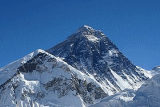
Mount Everest

 
Mount Everest

   Email Print
   Bookmark   Link


Mount Everest


Mount Everest, also called Sagarmatha ( meaning Head of the Sky) or Chomolungma, Qomolangma or Zhumulangma (in , in Chinese
Standard Mandarin

Standard Mandarin, or Standard Chinese, is the official modern Spoken Chinese used in People's Republic of China and Republic of China, and is one of the four official languages of Languages of Singapore....
: ????? Zhumùlangma Feng) is the highest mountain
List of highest mountains

The following is a list of the world's 100+ highest mountains per height above sea level, all of which are located in Asia. Only those summits are included that, by an objective measure, may be considered individual mountains as opposed to subsidiary peaks....
 on Earth
Earth

Earth is the third planet from the Sun. Earth is the largest of the terrestrial planets in the Solar System in diameter, mass and density. It is also referred to as the World and Wiktionary:Terra.Note that by International Astronomical Union convention, the term "Terra" is used for naming extensive land masses, rather...
, as measured by the height of its summit above sea level
Sea level

Mean sea level is the average height of the sea, with reference to a suitable reference surface. Defining the reference level , however, involves complex measurement, and accurately determining MSL can prove difficult....
, which is . The mountain, which is part of the Himalaya range in High Asia, is located on the border between Sagarmatha Zone
Sagarmatha Zone

Sagarmatha zone is a Zones of Nepal in eastern Nepal. This zone includes mountain districts of the Himalayas in the north, hill districts in the center, and Inner Terai Valleys of Nepal of the Terai in the south....
, Nepal
Nepal

Nepal , officially the Federal Democratic Republic of Nepal, is a landlocked country in South Asia and is the world's youngest republic. It is bordered to the north by the People's Republic of China, and to the south, east, and west by India....
, and Tibet
Tibet

Tibet is a Tibetan Plateau in Asia, north of the Himalayas, and the home to the indigenous Tibetan people and its related ethnic groups. With an average elevation of 4,900 metres , it is the highest region on Earth and has in recent decades increasingly been referred to as the "Roof of the World"....
, China
China

China is a Culture of China, an ancient civilization, and, depending on perspective, a national or multinational entity extending over a large area in East Asia....
.

In 1856, the Great Trigonometric Survey
Great Trigonometric Survey

The Great Trigonometric Survey was a project of the Survey of India throughout most of the 19th century. It was piloted in its initial stages by William Lambton, and later by George Everest....
 of India established the first published height of Everest at , although at the time Everest was known as Peak XV.


Discussion
Ask a question about 'Mount Everest'
Start a new discussion about 'Mount Everest'
Answer questions from other users
Full Discussion Forum


Recent Posts


Encyclopedia


Mount Everest, also called Sagarmatha ( meaning Head of the Sky) or Chomolungma, Qomolangma or Zhumulangma (in , in Chinese
Standard Mandarin

Standard Mandarin, or Standard Chinese, is the official modern Spoken Chinese used in People's Republic of China and Republic of China, and is one of the four official languages of Languages of Singapore....
: ????? Zhumùlangma Feng) is the highest mountain
List of highest mountains

The following is a list of the world's 100+ highest mountains per height above sea level, all of which are located in Asia. Only those summits are included that, by an objective measure, may be considered individual mountains as opposed to subsidiary peaks....
 on Earth
Earth

Earth is the third planet from the Sun. Earth is the largest of the terrestrial planets in the Solar System in diameter, mass and density. It is also referred to as the World and Wiktionary:Terra.Note that by International Astronomical Union convention, the term "Terra" is used for naming extensive land masses, rather...
, as measured by the height of its summit above sea level
Sea level

Mean sea level is the average height of the sea, with reference to a suitable reference surface. Defining the reference level , however, involves complex measurement, and accurately determining MSL can prove difficult....
, which is . The mountain, which is part of the Himalaya range in High Asia, is located on the border between Sagarmatha Zone
Sagarmatha Zone

Sagarmatha zone is a Zones of Nepal in eastern Nepal. This zone includes mountain districts of the Himalayas in the north, hill districts in the center, and Inner Terai Valleys of Nepal of the Terai in the south....
, Nepal
Nepal

Nepal , officially the Federal Democratic Republic of Nepal, is a landlocked country in South Asia and is the world's youngest republic. It is bordered to the north by the People's Republic of China, and to the south, east, and west by India....
, and Tibet
Tibet

Tibet is a Tibetan Plateau in Asia, north of the Himalayas, and the home to the indigenous Tibetan people and its related ethnic groups. With an average elevation of 4,900 metres , it is the highest region on Earth and has in recent decades increasingly been referred to as the "Roof of the World"....
, China
China

China is a Culture of China, an ancient civilization, and, depending on perspective, a national or multinational entity extending over a large area in East Asia....
.

In 1856, the Great Trigonometric Survey
Great Trigonometric Survey

The Great Trigonometric Survey was a project of the Survey of India throughout most of the 19th century. It was piloted in its initial stages by William Lambton, and later by George Everest....
 of India established the first published height of Everest at , although at the time Everest was known as Peak XV. In 1865, Everest was given its official English name by the Royal Geographical Society
Royal Geographical Society

The Royal Geographical Society is a United Kingdom learned society founded in 1830 with the name Geographical Society of London for the advancement of geographical sciences, under the patronage of William IV of the United Kingdom....
 upon recommendation of Andrew Waugh
Andrew Scott Waugh

Major General Sir Andrew Scott Waugh was a British people Officer and Surveying now remembered as the man who named Mount Everest after Sir George Everest, his predecessor in the post of :Category:Surveyors General of India....
, the British
United Kingdom

The United Kingdom of Great Britain and Northern Ireland, commonly known as the United Kingdom , the UK or Britain,is a sovereign state located off the northwestern coast of continental Europe....
 Surveyor General of India at the time. Waugh was unable to propose an established local name because Nepal and Tibet were closed to foreigners at the time, although Chomolungma had been in common use by Tibetans for centuries.

The highest mountain in the world attracts climbers of all levels, from well experienced mountaineers to novice climbers willing to pay substantial sums to professional mountain guides to complete a successful climb. The mountain, while not posing substantial technical climbing difficulty on the standard route (other eight-thousander
Eight-thousander

The eight-thousanders are the fourteen independent mountains on Earth that are more than high above sea level. They are all located in the Himalayan and Karakoram mountain ranges in Asia....
s such as K2
K2

K2 is the second-List of highest mountains mountain on Earth . With a peak elevation of , K2 is part of the Karakoram segment of the Himalayan mountain range, and is located on the border between Pakistan's northern territories, and the Taxkorgan Tajik Autonomous County of Xinjiang, China....
 or Nanga Parbat
Nanga Parbat

Nanga Parbat is the List of highest mountains mountain on Earth. Nanga Parbat means "Naked Mountain" in Urdu, parbat deriving from the Sanskrit word parvata meaning "mountain, rock", and nanga from the Sanskrit word nagna meaning "naked, bare"....
 are much more difficult), still has many inherent dangers such as altitude sickness
Altitude sickness

Altitude sickness, also known as acute mountain sickness , altitude illness, or soroche, is a pathological condition that is caused by acute exposure to low air pressure ....
, weather and wind. By the end of the 2007 climbing season, there had been 3,679 ascents to the summit by 2,436 individuals. Climbers are a significant source of tourist revenue for Nepal, whose government also requires all prospective climbers to obtain an expensive permit, costing up to US$
United States dollar

The United States dollar is the unit of currency of the United States and was defined by the Coinage Act of 1792 to be between 371 and 416 grains of silver ....
25,000 per person. Everest has claimed 210 lives, including eight who perished during a 1996 storm high on the mountain. Conditions are so difficult in the death zone
Death zone

The death zone, in mountaineering, refers to altitudes above a certain point where the amount of oxygen cannot sustain human life. The point is generally tagged as between ....
 that most corpses have been left where they fell, some of which are visible from standard climbing routes.

Identifying the highest mountain

In 1808, the British began the Great Trigonometric Survey
Great Trigonometric Survey

The Great Trigonometric Survey was a project of the Survey of India throughout most of the 19th century. It was piloted in its initial stages by William Lambton, and later by George Everest....
 of India to determine the location and names of the world's highest mountains. Starting in southern India, the survey teams gradually moved northward using giant 1100 pound (500 kg) theodolite
Theodolite

A theodolite is an instrument for measuring both horizontal and vertical angles, as used in Triangulation. It is a key tool in surveying and engineering work, particularly on inaccessible ground, but theodolites have been adapted for other specialized purposes in fields like meteorology and rocket launch technology....
s (each requiring 12 men to carry) to measure heights as accurately as possible. They reached the Himalayan foothills by the 1830s, but Nepal was unwilling to allow the British to enter the country because of suspicions of political aggression and possible annexation. Several requests by the surveyors to enter Nepal were turned down.

The British were forced to continue their observations from Terai
Terai

The Terai is a belt of marshy grasslands, savannas, and forests at the base of the Himalaya range in India, Nepal, and Bhutan, from the Yamuna River in the west to the Brahmaputra River in the east....
, a region south of Nepal which is parallel to the Himalayas. Conditions in Terai were difficult owing to torrential rains and malaria
Malaria

Malaria is a Vector -borne infectious disease caused by protozoan parasites. It is widespread in Tropics and subtropical regions, including parts of the Americas, Asia, and Africa....
 — three survey officers died from malaria while two others had to retire owing to failing health.

Nonetheless, in 1847, the British pressed on and began detailed observations of the Himalayan peaks from observation stations up to away. Weather restricted work to the last three months of the year. In November 1847, Andrew Waugh
Andrew Scott Waugh

Major General Sir Andrew Scott Waugh was a British people Officer and Surveying now remembered as the man who named Mount Everest after Sir George Everest, his predecessor in the post of :Category:Surveyors General of India....
, the British
United Kingdom

The United Kingdom of Great Britain and Northern Ireland, commonly known as the United Kingdom , the UK or Britain,is a sovereign state located off the northwestern coast of continental Europe....
 Surveyor General of India made a number of observations from Sawajpore station located in the eastern end of the Himalayas. At the time, Kangchenjunga
Kangchenjunga

Kangchenjunga SewaLungma is the third highest mountain in the world , with an elevation of 8,586 metres . Kangchenjunga translated means "The Five Treasures of Snows", as it contains five peaks, four of them over 8,450 metres....
 was considered the highest peak in the world
List of past presumed highest mountains

The following is a list of mountains that have been presumed, at one time, to be the highest mountain in the world. How general the following presumptions were is unclear....
, and with interest he noted a peak beyond it, some away. John Armstrong, one of Waugh's officials, also saw the peak from a location further west and called it peak 'b'. Waugh would later write that the observations indicated that peak 'b' was higher than Kangchenjunga, but given the great distance of the observations, closer observations were required for verification. The following year, Waugh sent a survey official back to Terai to make closer observations of peak 'b', but clouds thwarted all attempts.

In 1849, Waugh dispatched James Nicolson to the area. Nicolson was able to make two observations from Jirol, away. Nicolson then took the largest theodolite and headed east, obtaining over 30 observations from five different locations, with the closest being away from the peak.

Nicolson retreated to Patna
Patna

Pa?na is the capital city of the Indian States and territories of India of Bihar, and one of the oldest continuously inhabited places in the world....
 on the Ganges to perform the necessary calculations based on his observations. His raw data gave an average height of for peak 'b', but this did not take into account light refraction which distorts heights. The number clearly indicated, however, that peak 'b' was higher than Kangchenjunga. Unfortunately, Nicolson came down with malaria and was forced to return home, calculations unfinished. Michael Hennessy, one of Waugh's assistants, had begun designating peaks based on Roman Numerals
Roman numerals

Roman numerals are a numeral system of ancient Rome based on letters of the alphabet, which are combined to signify the sum of their values. The system is decimal but not directly Positional notation and does not include a zero....
, with Kangchenjunga named Peak IX, while peak 'b' now became known as Peak XV.

In 1852, stationed at the survey's headquarters in Dehradun
Dehradun

, is the capital city of the States and territories of India of Uttarakhand in India, and the headquarters of Dehradun District.It is located in the Doon valley, 230 kilometers north of India's capital New Delhi and the Delhi metropolitan area....
, Radhanath Sikdar
Radhanath Sikdar

Radhanath Sikdar was a Bengal Indian mathematician who calculated the height of Peak XV in the Himalaya and discovered it to be the tallest mountain above sea level....
, an Indian mathematician and surveyor from Bengal
Bengal

Bengal , is a historical and geographical region in the northeast of South Asia. Today it is mainly divided between the independent sovereign nation of the Bangladesh and the state of West Bengal in India, although some regions of the previous kingdoms of Bengal are now part of the neighboring Indian states of Bihar, Assam, Tripura and Oris...
, was the first to identify Everest as the world's highest peak, using trigonometric
Trigonometry

Trigonometry is a branch of mathematics that deals with triangle s, particularly those plane triangles in which one angle has 90 degrees . Trigonometry deals with relationships between the sides and the angles of triangles and with the trigonometric functions, which describe those relationships....
 calculations based on Nicolson's measurements. An official announcement that Peak XV was the highest was delayed for several years as the calculations were repeatedly verified. Waugh began work on Nicolson's data in 1854, and along with his staff spent almost two years working on the calculations, having to deal with the problems of light refraction, barometric pressure, and temperature over the vast distances of the observations. Finally, in March 1856 he announced his findings in a letter to his deputy in Calcutta
Kolkata

, Indian renaming controversy , is the Capital of the Indian States and territories of India of West Bengal. It is located in East India on the east bank of the River Hooghly....
. Kangchenjunga was declared to be , while Peak XV was given the height of . Waugh concluded that Peak XV was "most probably the highest in the world". In actuality, Peak XV was found to be exactly high, but was publicly declared to be . The arbitrary addition of 2 feet (60 cm) was to avoid the impression that an exact height of 29,000 feet was nothing more than a rounded estimate.

Naming

With the height now established, what to name the peak was clearly the next challenge. While the survey was anxious to preserve local names if possible (e.g., Kangchenjunga and Dhaulagiri
Dhaulagiri

Dhaulagiri is the seventh highest mountain in the world. It forms the eastern anchor of the Dhaulagiri Himal, a mountain range of the Himalaya in the Dhawalagiri Zone of north central Nepal....
 were local names), Waugh argued that he was unable to find any commonly used local name. Waugh's search for a local name was hampered by Nepal and Tibet being closed to foreigners at the time. Many local names existed, with perhaps the best known in Tibet for several centuries being Chomolungma, which had appeared on a 1733 map published in Paris by the French geographer D'Anville
Jean Baptiste Bourguignon d'Anville

Jean Baptiste Bourguignon d'Anville , perhaps the greatest Geography author of the 18th century, was born at Paris on the 11th of July 1697. Both a geographer and Cartography, he greatly improved the standards of map-making....
. However, Waugh argued that with the plethora of local names, it would be difficult to favour one specific name over all others. So, he decided that Peak XV should be named after George Everest
George Everest

Colonel Sir George Everest was a Wales surveying, geographer and :Category:Surveyors General of India from 1830 to 1843.Sir George was largely responsible for completing the section of the Great Trigonometric Survey of India along the meridian arc from the south of India extending north to Nepal, a distance of approximately 2400 kilometres...
, his predecessor as Surveyor General of India. He wrote:
I was taught by my respected chief and predecessor, Colonel Sir George Everest to assign to every geographical object its true local or native appellation. But here is a mountain, most probably the highest in the world, without any local name that we can discover, whose native appellation, if it has any, will not very likely be ascertained before we are allowed to penetrate into Nepal. In the meantime the privilege as well as the duty devolves on me to assign…a name whereby it may be known among citizens and geographers and become a household word among civilized nations.


George Everest opposed the name suggested by Waugh and told the Royal Geographical Society
Royal Geographical Society

The Royal Geographical Society is a United Kingdom learned society founded in 1830 with the name Geographical Society of London for the advancement of geographical sciences, under the patronage of William IV of the United Kingdom....
 in 1857 that Everest could not be written in Hindi
Hindi

Standard Hindi, also known as High Hindi, Nagari Hindi or Literary Hindi is a Standard language register of Hindi. It is one of the 22 official languages of India, and is used, along with English language, for administration of the central government....
 nor pronounced by "the native of India". Waugh's proposed name prevailed despite the objections, and in 1865, the Royal Geographical Society officially adopted Mount Everest as the name for the highest mountain in the world.

The Tibetan
Tibetan language

The Tibetan languages are a cluster of mutually unintelligible Tibeto-Burman languages spoken primarily by Tibetan peoples who live across a wide area of eastern Central Asia bordering South Asia, including the Tibetan Plateau and the northern Indian subcontinent in Baltistan, Ladakh, Nepal, Sikkim, and Bhutan....
 name for Mount Everest is Chomolungma or Qomolangma (which means "Saint
Saint

A saint in Christianity is a human being who has been called to holiness. The term is used differently by various denominations, with some, such as the Anglicans, Methodists, and Lutherans distinguishing between Saints and saints....
 Mother"), and the Chinese
Chinese language

Chinese or the Sinitic language is a language family consisting of language mutually unintelligible to varying degrees. Originally the indigenous languages spoken by the Han Chinese in China, it forms one of the two branches of Sino-Tibetan languages of languages....
 transliteration is , which refers to Earth Mother; the Chinese translation is Shèngmu Feng , which refers to Holy Mother. According to English accounts of the mid-19th century, the local name in Darjeeling
Darjeeling

Darjeeling is a town in the Indian state of West Bengal.It is the headquarters of Darjeeling district, in the Siwalik Hills on the lower range of the Himalaya, at an average elevation of ....
 for Mount Everest was Deodungha, or "Holy Mountain".

In 1865, the mountain was officially given its English
English language

English is a West Germanic language that originated in Anglo-Saxon England and has lingua franca status in many parts of the world as a result of the military, economic, scientific, political and cultural influence of the British Empire in the 18th, 19th and early 20th centuries and that of the United States from the mid 20th century onwa...
 name by the Royal Geographical Society after being proposed by Andrew Waugh
Andrew Scott Waugh

Major General Sir Andrew Scott Waugh was a British people Officer and Surveying now remembered as the man who named Mount Everest after Sir George Everest, his predecessor in the post of :Category:Surveyors General of India....
, the British
United Kingdom

The United Kingdom of Great Britain and Northern Ireland, commonly known as the United Kingdom , the UK or Britain,is a sovereign state located off the northwestern coast of continental Europe....
 Surveyor General of India. Waugh chose to name the mountain after George Everest
George Everest

Colonel Sir George Everest was a Wales surveying, geographer and :Category:Surveyors General of India from 1830 to 1843.Sir George was largely responsible for completing the section of the Great Trigonometric Survey of India along the meridian arc from the south of India extending north to Nepal, a distance of approximately 2400 kilometres...
, first using the spelling Mont Everest, and then Mount Everest. However, the modern pronunciation of Everest is in fact different from Sir George's own pronunciation of his surname, which was .

In the late 19th century, many European cartographers
Cartography

File:Mediterranean chart fourteenth century2.jpgCartography is the study and practice of making Geography Map. Combining science, aesthetics, and technique, cartography builds on the premise that we can model reality in ways that communicate spatial information effectively....
 incorrectly believed that a native name for the mountain was "Gaurisankar". This was a result of confusion of Mount Everest with the actual Gauri Sankar
Gauri Sankar

Gauri Sankar is a mountain in the Himalayas, the second highest peak of the Rolwaling Himal, behind Menlungtse . The name comes from Sanskrit for the Goddess and her Consort, denoting the sacred regard to which is afforded it by the peoples of Tibet and Nepal....
, which, when viewed from Kathmandu
Kathmandu

Kathmandu is the Capital and the largest metropolis city of Nepal. The city is situated in Kathmandu Valley that also contains two other cities - Patan, Nepal and Bhaktapur....
, stands almost directly in front of Everest.

In the early 1960s, the Nepalese government
Nepal

Nepal , officially the Federal Democratic Republic of Nepal, is a landlocked country in South Asia and is the world's youngest republic. It is bordered to the north by the People's Republic of China, and to the south, east, and west by India....
 gave Mount Everest the official name Sagarmatha (???????). This name had not previously been used; the local inhabitants knew the mountain as Chomolungma. The mountain was not known and named in ethnic Nepal (that is, the Kathmandu valley
Kathmandu Valley

The Kathmandu Valley , located in the Nepal, lies at the crossroads of ancient civilizations of Asia, and has at least 130 important monuments, including several places of pilgrimage for the Hindus and the Buddhists....
 and surrounding areas). The government set out to find a Nepalese name for the mountain because the Sherpa/Tibetan name Chomolangma was not acceptable, as it would have been against the idea of unification (Nepalization) of the country.

In 2002, the Chinese People's Daily
People's Daily

The People's Daily , a daily newspaper, is the organ of the Central Committee of the Communist Party of China of the Communist Party of China , published worldwide with a circulation of 3 to 4 million....
 newspaper published an article making a case against the continued use of the English name for the mountain in the Western world
Western world

The term Western world, the West or the Occident can have multiple meanings dependent on its context . Accordingly, the basic definition of what constitutes "the West" varies, expanding and contracting over time, in relation to various historical circumstances....
, insisting that it should be referred to by its Tibetan name. The newspaper argued that the Chinese (in nature a Tibetan) name preceded the English one, as Mount Qomolangma was marked on a Chinese map more than 280 years ago.

Measurement

Mt Everest Aerial
In 1856, Andrew Waugh announced Everest (then known as Peak XV) as high, after several years of calculations based on observations made by the Great Trigonometric Survey
Great Trigonometric Survey

The Great Trigonometric Survey was a project of the Survey of India throughout most of the 19th century. It was piloted in its initial stages by William Lambton, and later by George Everest....
.

More recently, the mountain has been found to be high, although there is some variation in the measurements. On 9 October 2005, after several months of measurement and calculation, the PRC's State Bureau of Surveying and Mapping officially announced the height of Everest as 8,844.43 m ± 0.21 m (29,017.16 ± 0.69 ft). They claimed it was the most accurate and precise measurement to date. This height is based on the actual highest point of rock and not on the snow and ice covering it. The Chinese team also measured a snow/ice depth of 3.5 m, which is in agreement with a net elevation of 8,848 m. The snow and ice thickness varies over time, making a definitive height of the snow cap impossible to determine.

The elevation of was first determined by an Indian survey in 1955, made closer to the mountain, also using theodolite
Theodolite

A theodolite is an instrument for measuring both horizontal and vertical angles, as used in Triangulation. It is a key tool in surveying and engineering work, particularly on inaccessible ground, but theodolites have been adapted for other specialized purposes in fields like meteorology and rocket launch technology....
s. It was subsequently reaffirmed by a 1975 Chinese measurement. In both cases the snow cap, not the rock head, was measured. In May 1999 an American Everest Expedition, directed by Bradford Washburn
Bradford Washburn

Henry Bradford Washburn, Jr. was an explorer, mountaineering, photography, and cartography. He established the Boston Museum of Science, served as its director from 1939-1980, and from 1985 until his death served as its Honorary Director ....
, anchored a GPS
Global Positioning System

The Global Positioning System is a global navigation satellite system developed by the United States Department of Defense and managed by the United States Air Force 50th Space Wing....
 unit into the highest bedrock. A rock head elevation of 8,850 m (29,035 ft), and a snow/ice elevation 1 m (3 ft) higher, were obtained via this device. Although it has not been officially recognized by Nepal, this figure is widely quoted. Geoid
Geoid

The geoid is that equipotential surface which would coincide exactly with the mean ocean surface of the Earth, if the oceans were in equilibrium, at rest, and extended through the continents ....
 uncertainty casts doubt upon the accuracy claimed by both the 1999 and 2005 surveys.

A detailed photogrammetric
Photogrammetry

Photogrammetry is the first remote sensing technology ever developed, in which geometric properties about objects are determined from photographic images....
 map (at a scale of 1:50,000) of the Khumbu
Khumbu

Khumbu is one of three subregions of the main Sherpa settlement of the Himalaya, the other two being Solu and Pharak. Khumbu is part of the Solukhumbu_District located in northeastern Nepal and includes the town of Namche Bazaar as well as the villages of Thami, Khumjung, Pangboche, Pheriche and Kunde....
 region, including the south side of Mount Everest, was made by Erwin Schneider as part of the 1955 International Himalayan Expedition, which also attempted Lhotse
Lhotse

Lhotse is the fourth highest mountain on Earth and is connected to Everest via the South Col. In addition to the main summit at 8,516 metres above sea level, Lhotse Middle is 8,414 metres and Lhotse Shar is 8,383 metres....
. An even more detailed topographic
Topography

Topography is the study of Earth's surface shape and features or those ofplanets, Natural satellite, and asteroids. It is also the description of such surface shapes and features ....
 map of the Everest area was made in the late 1980s under the direction of Bradford Washburn, using extensive aerial photography
Aerial photography

Aerial photography is the taking of photographs of the ground from an elevated position. The term usually refers to images in which the camera is not supported by a ground-based structure....
.

It is thought that the plate tectonics
Plate tectonics

Plate tectonics describes the large scale motions of Earth's lithosphere. The theory encompasses the older concepts of continental drift, developed during the first decades of the 20th century by Alfred Wegener, and seafloor spreading, understood during the 1960s....
 of the area are adding to the height and moving the summit northeastwards. Two accounts suggest the rates of change are per year (upwards) and 3-6 mm (0.12-0.25 in) per year (northeastwards), but another account mentions more lateral movement , and even shrinkage has been suggested.

Comparisons

Everest is the mountain whose summit attains the greatest distance above sea level
Sea level

Mean sea level is the average height of the sea, with reference to a suitable reference surface. Defining the reference level , however, involves complex measurement, and accurately determining MSL can prove difficult....
. Several other mountains are sometimes claimed as alternative "tallest mountains on Earth". Mauna Kea
Mauna Kea

Mauna Kea is a volcano#volcanic activity in the U.S. state of Hawaii, one of five volcanoes which together form the Hawaii . Mauna kea means "white mountain" in the Hawaiian language, a reference to its summit being regularly covered by snow in winter....
 in Hawaii
Hawaii

File:Pahoehoe and Aa flows at Hawaii.jpgThe State of Hawaii is a U.S. state in the United States, located on an archipelago in the central Pacific Ocean southwest of the continental United States, southeast of Japan, and northeast of Australia....
 is tallest when measured from its base; it rises over when measured from its base on the mid-ocean floor, but only attains above sea level.

By the same measure of base to summit, Mount McKinley
Mount McKinley

Mount McKinley or Denali in Alaska is the Extremes on Earth mountain peak in North America, at a height of approximately . It is the centerpiece of Denali National Park and Preserve....
, in Alaska
Alaska

Alaska is the largest U.S. state of the United States by area; it is situated in the northwest extremity of the North American continent, with Canada to the east, the Arctic Ocean to the north, and the Pacific Ocean to the west and south, with Russia further west across the Bering Strait....
, is also taller than Everest. Despite its height above sea level of only , Mount McKinley sits atop a sloping plain with elevations from 300-900 m (1,000-3,000 ft), yielding a height above base in the range of 5,300-5,900 m (17,300-19,300 ft); a commonly quoted figure is . By comparison, reasonable base elevations for Everest range from on the south side to on the Tibetan Plateau
Tibetan Plateau

The Tibetan Plateau , also known as the Qinghai-Tibetan Plateau is a vast, elevated plateau in Central Asia covering most of the Tibet Autonomous Region and Qinghai Province in China and Ladakh in Kashmir, India....
, yielding a height above base in the range of 3,650 m (12,000 ft) to 4,650 m (15,300 ft).

The summit of Chimborazo
Chimborazo (volcano)

The inactive stratovolcano Chimborazo is Ecuador highest summit. Its last eruption is thought to have occurred some time in the first millennium AD....
 in Ecuador
Ecuador

Ecuador , officially the , literally, "Republic of the equator") is a representative democratic republic in South America, bordered by Colombia on the north, by Peru on the east and south, and by the Pacific Ocean to the west....
 is farther from the Earth's centre (6,384.4 km or 3,967.1 mi) than that of Everest (6,382.3 km or 3,965.8 mi), because the Earth bulges at the Equator. However, Chimborazo attains a height of only above sea level, and by this criterion it is not even the highest peak of the Andes
Andes

The Andes form the world's longest exposed mountain range. They lie as a continuous chain of highland along the western coast of South America. The range is over 7,000 km long, 200-700 km wide , and of an average height of about 4,000 m ....
.

Climbing routes

Image:Himalaya_annotated.jpg|thumb|250px|left|Southern and northern climbing routes as seen from the International Space Station
International Space Station

The International Space Station is a research facility Assembly of the International Space Station in outer space. On-orbit construction of the station began in 1998, and is scheduled to be complete by 2011, with operations continuing until around 2015....
. rect 58 14 160 49 Chomo Lonzo
Chomo Lonzo

Chomo-Lonzo is a mountain in Tibet, 5 km northeast of Makalu in the Mahalangur Himal or Khumbu Himalayas.Chomo-Lonzo has three distinct summits....
rect 200 28 335 52 Makalu
Makalu

Makalu is the fifth highest mountain in the world and is located east of Mount Everest, on the border between Nepal and China. One of the eight-thousanders, Makalu is an isolated peak whose shape is a four-sided pyramid....
rect 378 24 566 45 Mount Everest
Mount Everest

Mount Everest, also called Sagarmatha or Chomolungma, Qomolangma or Zhumulangma is the List of highest mountains on Earth, as measured by the height of its Topographical summit above sea level, which is ....
rect 188 581 920 656 Tibetan Plateau
Tibetan Plateau

The Tibetan Plateau , also known as the Qinghai-Tibetan Plateau is a vast, elevated plateau in Central Asia covering most of the Tibet Autonomous Region and Qinghai Province in China and Ladakh in Kashmir, India....
rect 250 406 340 427 Rong River rect 333 149 409 186 Changtse
Changtse

Changtse is a mountain situated between the Main Rongbuk and East Rongbuk Glaciers in Tibet immediately north of Mount Everest. It is connected to Mount Everest via the North Col....
rect 550 284 677 303 Rongbuk Glacier
Rongbuk Glacier

Image:Himalaya_annotated.jpg|thumb|250px|right|Rongbuk Glacier and Mount Everest as seen from the International Space Station.rect 58 14 160 49 Chomo Lonzo...
rect 478 196 570 218 North Face
Mount Everest

Mount Everest, also called Sagarmatha or Chomolungma, Qomolangma or Zhumulangma is the List of highest mountains on Earth, as measured by the height of its Topographical summit above sea level, which is ....
rect 237 231 346 267 East Rongbuk Glacier rect 314 290 536 309 North Col north ridge route
Mount Everest

Mount Everest, also called Sagarmatha or Chomolungma, Qomolangma or Zhumulangma is the List of highest mountains on Earth, as measured by the height of its Topographical summit above sea level, which is ....
rect 531 79 663 105 Lhotse
Lhotse

Lhotse is the fourth highest mountain on Earth and is connected to Everest via the South Col. In addition to the main summit at 8,516 metres above sea level, Lhotse Middle is 8,414 metres and Lhotse Shar is 8,383 metres....
rect 582 112 711 130 Nuptse
Nuptse

Nuptse is a mountain in the Khumbu region of the Mahalangur Himal, in the Nepalese Himalaya. It lies two kilometres WSW of Mount Everest. Nuptse is Tibetan language for "west peak", as it is the western segment of the Lhotse-Nuptse massif....
rect 603 232 733 254 South Col route
South Col

The South Col usually refers to the southern mountain pass between Mount Everest and Lhotse, the first and fourth highest mountains in the world....
rect 716 165 839 206 Gyachung Kang
Gyachung Kang

Gyachung Kang is a mountain in the Mahalangur Himal, a subrange of the Himalaya, and is the highest peak between Cho Oyu and Mount Everest . It lies on the border between Nepal and Tibet....
rect 882 147 967 183 Cho Oyu
Cho Oyu

Cho Oyu is the sixth highest mountain in the world. Cho Oyu lies in the Himalayas and is 20 km west of Mount Everest, at the border between China and Nepal....
rect 1 1 999 661
Himalaya Annotated
desc bottom-left


Mt. Everest has two main climbing routes, the southeast ridge from Nepal and the northeast ridge from Tibet
Tibet

Tibet is a Tibetan Plateau in Asia, north of the Himalayas, and the home to the indigenous Tibetan people and its related ethnic groups. With an average elevation of 4,900 metres , it is the highest region on Earth and has in recent decades increasingly been referred to as the "Roof of the World"....
, as well as many other less frequently climbed routes. Of the two main routes, the southeast ridge is technically easier and is the more frequently-used route. It was the route used by Edmund Hillary
Edmund Hillary

Sir Edmund Percival Hillary Order of the Garter, Order of New Zealand, Order of the British Empire was a New Zealand mountaineering and explorer....
 and Tenzing Norgay
Tenzing Norgay

Tenzing Norgay George Medal , born Namgyal Wangdi, often referred to as Sherpa Tenzing, was a Nepalese / Tibetan mountaineering, who later settled in India....
 in 1953 and the first recognised of fifteen routes to the top by 1996. This was, however, a route decision dictated more by politics than by design as the Chinese border was closed to the western world in the 1950s after Communist China
People's Republic of China

The People's Republic of China , commonly known as China, is the largest country in East Asia and the List of countries by population in the world with over 1.3 billion people, approximately a fifth of the world's population....
 took over the control Tibet from the Republic of China
Republic of China

The Republic of China , also known as Nationalist China is a country in East Asia that has evolved from a single-party state with full global recognition into a multi-party democratic state with Political status of Taiwan....
.

Most attempts are made during May before the summer monsoon
Monsoon

A monsoon is a seasonal prevailing wind that lasts for several months. The term was first used in English in India, Bangladesh, Pakistan, and neighboring countries to refer to the big seasonal winds blowing from the Indian Ocean and Arabian Sea in the southwest bringing heavy rainfall to the region....
 season. As the monsoon season approaches, a change in the jet stream
Jet stream

Jet streams are fast flowing, narrow thermal winds found at the tropopause, the transition between the troposphere and the stratosphere ,and are located at 10-15 kilometers above the surface of the Earth....
 at this time pushes it northward, thereby reducing the average wind speeds high on the mountain. While attempts are sometimes made after the monsoons in September and October, when the jet stream is again temporarily pushed northward, the additional snow deposited by the monsoons and the less stable weather patterns (tail end of the monsoon) makes climbing more difficult.

Southeast ridge

The ascent via the southeast ridge begins with a trek to Base Camp
Everest Base Camp

There are two base camps on opposite sides of Mt. Everest: to the South in Nepal, and to the North in Tibet. Located at the altitude of is South Base Camp in Nepal , and at is the North Base Camp in Tibet....
 at on the south side of Everest in Nepal. Expeditions usually fly into Lukla
Lukla

Lukla is a town in the Khumbu region of eastern Nepal where most people visiting the Himalayas near Mount Everest start their journey. Lukla, at 2,860 metres , contains a small Lukla Airport where most people begin and end their adventure in the region....
 (2,860 m) from Kathmandu
Kathmandu

Kathmandu is the Capital and the largest metropolis city of Nepal. The city is situated in Kathmandu Valley that also contains two other cities - Patan, Nepal and Bhaktapur....
 and pass through Namche Bazaar
Namche Bazaar

Namche Bazaar is a village and Village Development Committee in Solukhumbu District in the Sagarmatha Zone of north-eastern Nepal. It is located within the Khumbu area at , populating the sides of a hill....
. Climbers then hike to Base Camp, which usually takes six to eight days, allowing for proper altitude acclimatization in order to prevent altitude sickness
Altitude sickness

Altitude sickness, also known as acute mountain sickness , altitude illness, or soroche, is a pathological condition that is caused by acute exposure to low air pressure ....
. Climbing equipment and supplies are carried by yak
Yak

The yak is a long-haired bovine found throughout the Himalayan region of south Central Asia, the Qinghai-Tibetan Plateau and as far north as Mongolia....
s, dzo
Dzo

A dzo is a Hybrid of a yak and domestic cattle. The word dzo technically refers to a male hybrid, while a female is known as a dzomo or zhom....
pkyos (yak hybrids) and human porters to Base Camp on the Khumbu Glacier
Khumbu Glacier

The Khumbu Glacier is located in the Khumbu region of northeastern Nepal and flows down from the Khumbu Icefall on the southern slopes of Mount Everest....
. When Hillary and Tenzing climbed Everest in 1953, they started from Kathmandu Valley, as there were no roads further east at that time.

Climbers will spend a couple of weeks in Base Camp, acclimatizing to the altitude. During that time, Sherpas and some expedition climbers will set up ropes and ladders in the treacherous Khumbu Icefall
Khumbu Icefall

The Khumbu Icefall is an icefall at the head of the Khumbu Glacier.The icefall is found at 5,486 metres on the Nepali slopes of Mount Everest not far above Everest Base Camp and southwest of the summit....
. Serac
Serac

A serac is a block or column of ice formed by intersecting crevasses on a glacier. Often house-sized or larger, they are dangerous to mountaineers since they may topple with little warning....
s, crevasses and shifting blocks of ice make the icefall one of the most dangerous sections of the route. Many climbers and Sherpas have been killed in this section. To reduce the hazard, climbers will usually begin their ascent well before dawn when the freezing temperatures glue ice
Ice

Ice is a solid phases of matter, usually crystalline solid, of a non-metallic substance that is liquid or gas at room temperature, such as ammonia ice or methane ice....
 blocks in place. Above the icefall is Camp I at .

From Camp I, climbers make their way up the Western Cwm
Western Cwm

Often called the "Valley of Silence," the Western Cwm is a broad, flat, gently undulating glacial valley basin terminating at the foot of the Lhotse Face of Mount Everest....
 to the base of the Lhotse
Lhotse

Lhotse is the fourth highest mountain on Earth and is connected to Everest via the South Col. In addition to the main summit at 8,516 metres above sea level, Lhotse Middle is 8,414 metres and Lhotse Shar is 8,383 metres....
 face, where Camp II or Advanced Base Camp (ABC) is established at . The Western Cwm is a relatively flat, gently rising glacial valley, marked by huge lateral crevasse
Crevasse

A crevasse is a fracture in a glacier caused by a large tensile stress at or near the glacier's surface. Accelerations in glacier speed cause extension and can initiate a crevasse....
s in the centre which prevent direct access to the upper reaches of the Cwm. Climbers are forced to cross on the far right near the base of Nuptse
Nuptse

Nuptse is a mountain in the Khumbu region of the Mahalangur Himal, in the Nepalese Himalaya. It lies two kilometres WSW of Mount Everest. Nuptse is Tibetan language for "west peak", as it is the western segment of the Lhotse-Nuptse massif....
 to a small passageway known as the "Nuptse corner". The Western Cwm is also called the "Valley of Silence" as the topography of the area generally cuts off wind from the climbing route. The high altitude
High altitude

High altitude are regions on the Earth's surface that are high above mean sea level. The pressure and temperature of the atmosphere at high altitude is substantially different than at sea level....
 and a clear, windless day can make the Western Cwm unbearably hot for climbers.

From ABC, climbers ascend the Lhotse face on fixed rope
Fixed rope

Fixed rope is the practice of fixing in place bolted ropes to assist climbers and walkers in exposed mountain locations. They are used widely on American and European climbing routes but disdained by purist Mountaineering....
s up to Camp III, located on a small ledge at . From there, it is another 500 metres to Camp IV on the South Col
South Col

The South Col usually refers to the southern mountain pass between Mount Everest and Lhotse, the first and fourth highest mountains in the world....
 at . From Camp III to Camp IV, climbers are faced with two additional challenges: The Geneva Spur and The Yellow Band. The Geneva Spur is an anvil shaped rib of black rock named by a 1952 Swiss expedition. Fixed ropes assist climbers in scrambling
Scrambling

Scrambling is a method of ascending rocky faces and ridges. It is an ambiguous term that lies somewhere between hillwalking and Climbing. It is often distinguished from hillwalking by defining a scramble as a route where hands must be used in the ascent....
 over this snow covered rock band. The Yellow Band is a section of interlayered marble
Marble

Marble is a nonfoliated metamorphic rock resulting from the metamorphism of limestone, composed mostly of calcite . It is extensively used for Marble sculpture, as a architecture material, and in many other applications....
, phyllite
Phyllite

Phyllite is a type of Foliation metamorphic rock primarily composed of quartz, sericite mica, and Chlorite group; the rock represents a gradiation in the degree of metamorphism between slate and mica schist....
, and semischist
Schist

The schists form a group of Erins metamorphic rocks, chiefly notable for the preponderance of lamellar minerals such as micas, Chlorite group, talc, hornblende, graphite, and others....
 which also requires about 100 metres of rope for traversing it.

On the South Col, climbers enter the death zone
Death zone

The death zone, in mountaineering, refers to altitudes above a certain point where the amount of oxygen cannot sustain human life. The point is generally tagged as between ....
. Climbers typically only have a maximum of two or three days they can endure at this altitude for making summit bids. Clear weather and low winds are critical factors in deciding whether to make a summit attempt. If weather does not cooperate within these short few days, climbers are forced to descend, many all the way back down to Base Camp.
Everest Base Camp
From Camp IV, climbers will begin their summit push around midnight with hopes of reaching the summit (still another 1,000 metres above) within 10 to 12 hours. Climbers will first reach "The Balcony" at , a small platform where they can rest and gaze at peaks to the south and east in the early dawn light. Continuing up the ridge, climbers are then faced with a series of imposing rock steps which usually forces them to the east into waist deep snow, a serious avalanche
Avalanche

An avalanche is a rapid flow of snow down a slope, from either natural triggers or human activity. Typically occurring in mountainous terrain, an avalanche can mix air and water with the descending snow....
 hazard. At , a small table-sized dome of ice and snow marks the South Summit.

From the South Summit, climbers follow the knife-edge southeast ridge along what is known as the "Cornice traverse" where snow clings to intermittent rock. This is the most exposed section of the climb as a misstep to the left would send one 2,400 m (8,000 ft) down the southwest face while to the immediate right is the 3,050 m (10,000 ft) Kangshung face. At the end of this traverse is an imposing 12 m (40 ft) rock wall called the "Hillary Step" at .

Hillary and Tenzing were the first climbers to ascend this step and they did it with primitive ice climbing equipment and without fixed ropes. Nowadays, climbers will ascend this step using fixed ropes previously set up by Sherpas. Once above the step, it is a comparatively easy climb to the top on moderately angled snow slopes - though the exposure on the ridge is extreme especially while traversing very large cornices of snow. With increasing numbers of people climbing the mountain in recent years, the Step has frequently become a bottleneck
Bottleneck

Bottleneck literally refers to the top narrow part of a bottle. Figuratively, it may also refer:* Bottleneck * Bottleneck * Bottleneck * Bottleneck guitar, also known as slide guitar...
, with climbers forced to wait significant amounts of time for their turn on the ropes, leading to problems in getting climbers efficiently up and down the mountain. After the Hillary Step, climbers also must traverse a very loose and rocky section that has a very large entanglement of fixed ropes that can be troublesome in bad weather. Climbers will typically spend less than a half-hour on the "top of the world" as they realize the need to descend to Camp IV before darkness sets in, afternoon weather becomes a serious problem, or supplemental oxygen tanks run out.

Northeast ridge

The northeast ridge route begins from the north side of Everest in Tibet. Expeditions trek to the Rongbuk Glacier
Rongbuk Glacier

Image:Himalaya_annotated.jpg|thumb|250px|right|Rongbuk Glacier and Mount Everest as seen from the International Space Station.rect 58 14 160 49 Chomo Lonzo...
, setting up Base Camp
Everest Base Camp

There are two base camps on opposite sides of Mt. Everest: to the South in Nepal, and to the North in Tibet. Located at the altitude of is South Base Camp in Nepal , and at is the North Base Camp in Tibet....
 at on a gravel plain just below the glacier. To reach Camp II, climbers ascend the medial moraine of the east Rongbuk Glacier up to the base of Changtse
Changtse

Changtse is a mountain situated between the Main Rongbuk and East Rongbuk Glaciers in Tibet immediately north of Mount Everest. It is connected to Mount Everest via the North Col....
 at around . Camp III (ABC - Advanced Base Camp) is situated below the North Col
North Col

The North Col refers to the pass or mountain pass connecting Mount Everest and Changtse in Tibet. Also known as Chang La or Beiao La ....
 at 6,500 m (21,300 ft). To reach Camp IV on the north col, climbers ascend the glacier to the foot of the col where fixed ropes are used to reach the North Col at . From the North Col, climbers ascend the rocky north ridge to set up Camp V at around . The route crosses the North Face in a diagonal climb to the base of the Yellow Band reaching the site of Camp VI at . From Camp VI, climbers will make their final summit push. Climbers face a treacherous traverse from the base of the First Step: 27,890 feet - 28,000 feet, to the crux of the climb, the Second Step: 28,140 feet - 28,300 feet. (The Second Step includes a climbing aid called the "Chinese ladder", a metal ladder placed semi-permanently in 1975 by a party of Chinese climbers. It has been almost continuously in place since, and is used by virtually all climbers on the route.) Once above the Second Step the inconsequential Third Step is clambered over: 28,510 feet - 28,870 feet. Once above these steps, the summit pyramid is climbed by means of a snow slope of 50 degrees, to the final summit ridge along which the top is reached.

Ascents


Early expeditions

Mount Everest From Rombok Gompa, Tibet
In 1885, Clinton Thomas Dent
Clinton Thomas Dent

Clinton Thomas Dent Fellowship of the Royal College of Surgeons was an England surgeon, author and mountaineering....
, president of the Alpine Club
Alpine Club (UK)

The Alpine Club was founded in London in 1857 and was probably the world's first Alpine Club. It is UK mountaineering's acknowledged 'senior club'....
, suggested that climbing Mount Everest was possible in his book Above the Snow Line.

The northern approach to the mountain was discovered by George Mallory
George Mallory

George Herbert Leigh Mallory was an England mountaineer who took part in the first three British expeditions to Mount Everest in the early 1920s....
 on the first expedition in 1921. It was an exploratory expedition not equipped for a serious attempt to climb the mountain. With Mallory leading (and thus becoming the first European to set foot on Everest's flanks) they climbed the North Col . From there, Mallory espied a route to the top, but the party was woefully unprepared for the enormity of climbing any further and descended.

The British returned for a 1922 expedition
British Mount Everest Expedition 1922

The British Mount Everest Expedition 1922 was the first mountaineering expedition with the express aim of making the first ascent of Mount Everest....
. George Finch ("The other George") climbed using oxygen for the first time. He ascended at a remarkable speed — per hour, and reached an altitude of , the first time a human climbed higher then 8,000m. This feat was entirely lost on the British climbing establishment — except for its "unsporting" nature. Mallory and Col. Felix Norton made a second unsuccessful attempt. Mallory was faulted for leading a group down from the North Col which got caught in an avalanche. Mallory was pulled down too, but seven native porters were killed.

The next Expedition was in 1924
British Mount Everest Expedition 1924

The British Mount Everest Expedition 1924 was?after the British Mount Everest Expedition 1922?the second expedition with the goal of achieving the first ascent of Mount Everest....
. The initial attempt by Mallory and Bruce, was aborted when weather conditions precluded the establishment of Camp VI. The next attempt was that of Norton and Somervell who climbed without oxygen and in perfect weather, traversing the North Face into the Great Couloir. Norton managed to reach , though he ascended only or so in the last hour. Mallory rustled up oxygen equipment for a last-ditch effort. He chose the young Andrew Irvine as his partner.

On 8 June 1924 George Mallory and Andrew Irvine
Andrew Irvine (mountaineer)

Andrew "Sandy" Comyn Irvine was an England Mountaineering who took part in the third British Expedition to the world's highest mountain, Mount Everest, in 1924....
 made an attempt on the summit via the North Col/North Ridge/Northeast Ridge route from which they never returned. On 1 May 1999 the Mallory and Irvine Research Expedition
Mallory and Irvine Research Expedition

The goal of the Mallory and Irvine Research Expedition of 1999 was to discover evidence of whether George Mallory and Andrew Irvine had been the first to summit Mount Everest in their ill-fated attempt of 8?9 June 1924....
 found Mallory's body on the North Face in a snow basin below and to the west of the traditional site of Camp VI. Controversy has raged in the mountaineering community as to whether or not one or both of them reached the summit 29 years before the confirmed ascent (and of course, safe descent) of Everest by Sir Edmund Hillary
Edmund Hillary

Sir Edmund Percival Hillary Order of the Garter, Order of New Zealand, Order of the British Empire was a New Zealand mountaineering and explorer....
 and Tenzing Norgay
Tenzing Norgay

Tenzing Norgay George Medal , born Namgyal Wangdi, often referred to as Sherpa Tenzing, was a Nepalese / Tibetan mountaineering, who later settled in India....
 in 1953. The general consensus among climbers has been that they did not.

In 1933, Lady Houston
Lucy, Lady Houston

Lucy, Lady Houston, Order of British Empire , born Fanny Lucy Radmall, was an English benefactor, philanthropist, adventuress and patriot....
, a British
United Kingdom

The United Kingdom of Great Britain and Northern Ireland, commonly known as the United Kingdom , the UK or Britain,is a sovereign state located off the northwestern coast of continental Europe....
 millionaire
Millionaire

A millionaire is an individual whose net worth or wealth exceeds one million units of currency. It can also be a person who owns one million units of currency in a bank account or savings account....
 ex-showgirl
Showgirl

A showgirl is a dancer or performer in a stage entertainment show."Showgirl" is often used as a term for a promotional model in trade fairs and car shows, etc....
, funded the Houston Everest Flight of 1933, which saw a formation of aircraft
Westland Wallace

The Westland Wallace was a United Kingdom two-seat, general-purpose biplane of the Royal Air Force, developed by Westland Aircraft as a follow-on to their successful Westland Wapiti....
 led by the Marquess of Clydesdale
Douglas Douglas-Hamilton, 14th Duke of Hamilton

Air Commodore Douglas Douglas-Hamilton, 14th Duke of Hamilton and 11th Duke of Brandon, Order of the Thistle, Royal Victorian Order, Air Force Cross , Privy Council of the United Kingdom, Deputy Lieutenant, Royal College of Surgeons of Edinburgh, FRGS, was a Scotland nobleman and pioneering aviator....
 fly over the summit
Summit (topography)

In topography, a summit is a point on a surface that is higher in elevation than all points immediately adjacent to it. Mathematics, a summit is a local Maxima and minima in elevation....
 in an effort to deploy the British Union Flag
Union Flag

The Union Flag, also known as the Union Jack, is the national Flag of the United Kingdom. Historically, the flag was used throughout the former British Empire....
 at the top.

Early expeditions — such as Bruce's in the 1920s and Hugh Ruttledge
Hugh Ruttledge

Hugh Ruttledge was an England mountaineer, and leader of two expeditions to Mount Everest in 1933 and 1936....
's two unsuccessful attempts in 1933 and 1936 — tried to make an ascent of the mountain from Tibet
Tibet

Tibet is a Tibetan Plateau in Asia, north of the Himalayas, and the home to the indigenous Tibetan people and its related ethnic groups. With an average elevation of 4,900 metres , it is the highest region on Earth and has in recent decades increasingly been referred to as the "Roof of the World"....
, via the north face. Access was closed from the north to western expeditions in 1950, after the Chinese asserted control over Tibet. In 1950, Bill Tilman
Bill Tilman

Major Harold William "Bill" Tilman, Order of the British Empire, Distinguished Service Order, Military Cross was an England mountaineering and explorer, renowned for his Himalayan climbs and sailing voyages....
 and a small party which included Charles Houston, Oscar Houston and Betsy Cowles undertook an exploratory expedition to Everest through Nepal along the route which has now become the standard approach to Everest from the south.

In the spring of 1952 a Swiss expedition, lead by Edouard Wyss-Dunant was granted permission to attempt a climb from Nepal. The expedition established a route through the Khumbu ice fall and ascended to the South Col at an elevation of . Raymond Lambert
Raymond Lambert

Raymond Lambert was a Switzerland mountaineer, who with Sherpa Tenzing Norgay reached an altitude of 8611 metres of Mount Everest in May 1952....
 and Sherpa Tenzing Norgay
Tenzing Norgay

Tenzing Norgay George Medal , born Namgyal Wangdi, often referred to as Sherpa Tenzing, was a Nepalese / Tibetan mountaineering, who later settled in India....
 were able to reach a height of about on the southeast ridge, setting a new climbing altitude record. Tenzing's experience was useful when he was hired to be part of the British expedition in 1953. He was born in the Tibet
Tibet

Tibet is a Tibetan Plateau in Asia, north of the Himalayas, and the home to the indigenous Tibetan people and its related ethnic groups. With an average elevation of 4,900 metres , it is the highest region on Earth and has in recent decades increasingly been referred to as the "Roof of the World"....
an village of Moyez and raised in Nepal
Nepal

Nepal , officially the Federal Democratic Republic of Nepal, is a landlocked country in South Asia and is the world's youngest republic. It is bordered to the north by the People's Republic of China, and to the south, east, and west by India....
.

First successful ascent by Tenzing and Hillary

In 1953, a ninth British expedition, led by John Hunt, returned to Nepal. Hunt selected two climbing pairs to attempt to reach the summit. The first pair (Tom Bourdillon
Tom Bourdillon

Thomas Duncan Bourdillon in Bernese Oberland, Switzerland) was an England mountaineer, a member of the team which made the first ascent of Mount Everest in 1953....
 and Charles Evans
Charles Evans

Sir Robert Charles Evans M.D., DSc, , was a British mountaineer, surgeon, and educator.Born in Liverpool, he was raised in Wales and became a fluent Welsh speaker....
) came within 100 m (300 feet) of the summit on 26 May 1953, but turned back after becoming exhausted. As planned, their work in route finding and breaking trail and their caches of extra oxygen were of great aid to the following pair. Two days later, the expedition made its second and final assault on the summit with its second climbing pair, the New Zealander Edmund Hillary
Edmund Hillary

Sir Edmund Percival Hillary Order of the Garter, Order of New Zealand, Order of the British Empire was a New Zealand mountaineering and explorer....
 and Tenzing Norgay
Tenzing Norgay

Tenzing Norgay George Medal , born Namgyal Wangdi, often referred to as Sherpa Tenzing, was a Nepalese / Tibetan mountaineering, who later settled in India....
 from Nepal. They reached the summit at 11:30 a.m. local time on 29 May 1953 via the South Col Route. At the time, both acknowledged it as a team effort by the whole expedition, but Tenzing revealed a few years later that Hillary had put his foot on the summit first. They paused at the summit to take photographs and buried a few sweets and a small cross in the snow before descending.

News of the expedition's success reached London
London

London is the capital of both England and the United Kingdom, and the most populous municipality in the European Union. An important settlement for two millennia, History of London goes back to its founding by the Roman Empire....
 on the morning of Queen Elizabeth II's
Elizabeth II of the United Kingdom

Elizabeth II is the queen regnant of sixteen independent states known as the Commonwealth realms: Monarchy of the United Kingdom, Monarchy of Canada, Monarchy of Australia, Monarchy of New Zealand, Monarchy of Jamaica, Monarchy of Barbados, the Bahamas, Grenada, Papua New Guinea, the Monarchy of the Solomon Islands, Tuvalu, Saint Lucia, Sain...
 coronation
Coronation

A coronation is a ceremony marking the investiture of a monarch with regal power, specifically involving the placement of a coronation crown upon his or her head, and the presentation of other items of regalia....
. Returning to Kathmandu
Kathmandu

Kathmandu is the Capital and the largest metropolis city of Nepal. The city is situated in Kathmandu Valley that also contains two other cities - Patan, Nepal and Bhaktapur....
 a few days later, Hunt (a Briton) and Hillary (a subject of Elizabeth, through her role as head of state
Head of State

Head of state is the generic term for the individual or collective office that serves as the chief public representative of a monarchic or republican nation-state, federation, commonwealth or any other political state....
 of New Zealand) discovered that they had been promptly knighted in the Order of the British Empire
Order of the British Empire

The Most Excellent Order of the British Empire is a United Kingdom order of chivalry established on 4 June 1917 by George V of the United Kingdom....
, a KBE, for the ascent. Tenzing (a subject of the King of Nepal) was granted the George Medal
George Medal

The George Medal is the second level civil decoration of the United Kingdom and Commonwealth of Nations.The GM was instituted on 24 September1940 by George VI of the United Kingdom....
 by the UK. Hunt was ultimately made a life peer
Life peer

In the United Kingdom, life peers are appointed members of the Peerage whose titles may not be inherited. Nowadays life peerages, always of baronial rank, are created under the Life Peerages Act 1958 and entitle the holders to seats in the House of Lords, presuming they meet qualifications such as age and citizenship....
 in Britain, while Hillary became a founding member of the Order of New Zealand
Order of New Zealand

The Order of New Zealand is the highest honour in New Zealand's Orders, decorations, and medals of New Zealand, created "to recognise outstanding service to the Crown and people of New Zealand in a civil or military capacity"....
.

First ascents without supplemental oxygen

On 8 May 1978, Reinhold Messner
Reinhold Messner

Reinhold Messner is an Italy mountaineer and explorer from South Tyrol, often cited as the greatest mountain climbing of all time. He is renowned for making the first solo ascents of Mount Everest without supplemental oxygen and for being the first climber to ascend all fourteen "eight-thousanders" ....
 (Italy) and Peter Habeler
Peter Habeler

Peter Habeler is an Austrian mountaineer. He was born in Mayrhofen, Austria.Among his accomplishments as a mountaineer are his first ascents in the Rocky Mountains ....
 (Austria) made the first ascent without supplemental oxygen, using the southeast ridge route. On 20 August 1980, Messner reached the summit of the mountain solo for the first time, without supplementary oxygen or support, on the more difficult Northwest route via the North Col to the North Face and the Great Couloir. He climbed for three days entirely alone from his base camp at .

1996 disaster

During the 1996 climbing season, fifteen people died trying to come down from the summit, making it the deadliest single year in Everest history. Eight of them died on 11 May alone. The disaster gained wide publicity and raised questions about the commercialization of Everest.

Journalist Jon Krakauer
Jon Krakauer

Jon Krakauer is an United States writer and mountaineer, well-known for outdoors and mountain-climbing writing....
, on assignment from Outside
Outside (magazine)

Outside is a magazine focused on the outdoors. The first issue debuted in September 1977 with its mission statement declaring that the publication was "dedicated to covering the people, sports and activities, politics, art, literature, and hardware of the outdoors..."...
 magazine, was in one of the affected parties, and afterwards published the bestseller Into Thin Air
Into Thin Air

Into Thin Air: A Personal Account of the Mt. Everest Disaster is a bestseller non-fiction book written by Jon Krakauer. It details the author's May 10, 1996 ascent of Mount Everest, which turned 1996 Everest Disaster when eight climbers were killed and several others were stranded by a 'rogue storm'....
 which related his experience. Anatoli Boukreev
Anatoli Boukreev

Anatoli Nikoliavich Boukreev, , was a Russian climber who made seven ascents of Eight-thousander without supplemental oxygen. In total he has made 18 successful ascensions on peaks above 8000 m ....
, a guide who felt impugned by Krakauer's book, co-authored a rebuttal book called The Climb
The Climb (book)

The Climb is an account by Russian mountaineer Anatoli Boukreev of the 1996 Everest Disaster, during which eight climbers lost their lives on Mount Everest....
.
The dispute sparked a large debate within the climbing community. In May 2004, Kent Moore, a physicist, and John L. Semple, a surgeon, both researchers from the University of Toronto
University of Toronto

The University of Toronto is a public university research university in Toronto, Ontario, Canada, situated a mile north of the city's Financial District, Toronto on grounds that surround Queen's Park ....
, told New Scientist
New Scientist

New Scientist is a liberal weekly international science magazine and website covering recent developments in science and technology for a general English language-speaking audience....
 magazine that an analysis of weather conditions on 11 May suggested that freak weather caused oxygen levels to plunge approximately 14%.

The storm's impact on climbers on the mountain's other side, the North Ridge, where several climbers also died, was detailed in a first hand account by British filmmaker and writer Matt Dickinson
Matt Dickinson

Matt Dickinson is a film director and writer who specialises in the wild places and people of the world.He was educated at Gresham's School. He joined the BBC in 1984, training as a researcher and production manager and working on programmes as diverse as Wogan, Jim'll Fix It and Ever Decreasing Circles....
 in his book The Other Side of Everest.

2005 - Helicopter landing

On 14 May 2005, pilot Didier Delsalle of France landed a Eurocopter AS 350 B3 helicopter on the summit of Mount Everest (without any witness) and took off after about four minutes. (His rotors were continually engaged, constituting a "hover landing", and avoiding the risks of relying on the snow to support the aircraft.) He thereby set rotorcraft
Rotorcraft

A rotorcraft is a heavier-than-air flying machine that uses lift generated by Airfoil, called rotor blades, that revolve around a mast. Several rotor blades mounted to a single mast is referred to as a helicopter rotor....
 world records, for highest of both landing (de facto) and take-off (formally).

Delsalle had also performed, two days earlier, a take-off from the South Col; some press reports suggested that the report of the summit landing was a misunderstanding of a South Col one.

2006 - David Sharp controversy

Double-amputee climber Mark Inglis
Mark Inglis

Mark Joseph Inglis is a mountaineer, researcher, winemaker and motivational speaker. He holds a degree in Human Biochemistry from Lincoln University, New Zealand, and has conducted research in Leukemia....
 revealed in an interview with the press on 23 May 2006, that his climbing party, and many others, had passed a distressed climber, David Sharp
David Sharp

David Sharp was an English mountaineer who died near the summit of Mount Everest. His death caused controversy and debate, because he was passed by a number of other climbers heading for the summit, including motivational speaker Mark Inglis, who made no attempt at a rescue....
, on 15 May, sheltering under a rock overhang 450 metres below the summit, without attempting a rescue. The revelation sparked wide debate on climbing ethics, especially as applied to Everest. The climbers who left him said that the rescue efforts would be useless and only cause more deaths because of how many people it would have taken to pull him off.

Much of this controversy was captured by the Discovery Channel
Discovery Channel

The Discovery Channel is an United States satellite and cable TV channel , founded by John Hendricks and distributed by Discovery Communications....
 while filming the television program Everest: Beyond the Limit
Everest: Beyond the Limit

Everest: Beyond the Limit is a Discovery Channel reality television television series about yearly attempts to summit Mount Everest organized and led by New Zealander Russell Brice....
. A crucial decision affecting the fate of Sharp is shown in the program, where an early returning climber (Max Chaya) is descending and radios to his base camp manager (Russell Brice) that he has found a climber in distress. He is unable to identify Sharp, and Sharp had chosen to climb solo without any support, so he did not identify himself to other climbers. The base camp manager assumes that Sharp is part of a group that has abandoned him, and informs his climber that there is no chance of him being able to help Sharp [at 8000+ meters in altitude, barely anyone has the strength to help another man who is only semi conscious, and Max Chaya is only an amateur mountaineer]. As Sharp's condition deteriorates through the day and other descending climbers pass him, his opportunities for rescue diminish: his legs and feet curl from frost-bite, preventing him from walking; the later descending climbers are lower on oxygen and lack the strength to offer aid; time runs out for any Sherpas to return and rescue him. Most importantly, Sharp's decision to forgo all support leaves him with no margin for recovery.

As this debate raged, on 26 May, Australian climber Lincoln Hall
Lincoln Hall (climber)

Lincoln Hall is a veteran Australian Mountaineering and author.Hall is the author of White Limbo, the story of the first Australian team to climb Mount Everest....
 was found alive, after being declared dead the day before. He was found by a party of four climbers (Dan Mazur, Andrew Brash, Myles Osborne and Jangbu Sherpa) who, giving up their own summit attempt, stayed with Hall and descended with him and a party of 11 Sherpas sent up to carry him down. Hall later fully recovered. Similar actions have been recorded since, including on 21 May 2007, when Canadian climber Meagan McGrath initiated the successful high-altitude rescue of Nepal
Nepal

Nepal , officially the Federal Democratic Republic of Nepal, is a landlocked country in South Asia and is the world's youngest republic. It is bordered to the north by the People's Republic of China, and to the south, east, and west by India....
i Usha Bista.

2008 - Summer Olympic torch summit

China paved a dirt road from Tingri County
Tingri County

Tingri County or Dhringgri County is a county of the Xigaz? Prefecture in the Tibet Autonomous Region....
 to its Base Camp in order to accommodate growing numbers of climbers on the north side of the mountain. It will become the highest asphalt-paved road in the world. Construction began on 18 June 2007 at a cost of 150 million yuan (US$19.7 million). China also routed the 2008 Olympic Torch Relay over Everest, going up the South Col route and back down the North Col route, on the way to the 2008 Summer Olympics
2008 Summer Olympics

The 2008 Summer Olympic Games, officially known as the Games of the XXIX Olympiad, was a major international multi-sport event that took place in Beijing, People's Republic of China, from August 8 to August 24, 2008....
 in Beijing
Beijing

is a metropolis in northern China and the Capital of the People's Republic of China. It is one of the four municipality of China, which are equivalent to province in China's Political divisions of China....
. A China Telecom
China Telecom

China Telecom Corp. Ltd. is the largest fixed line service and mobile telecommunication provider in the People's Republic of China....
 cellular tower near the Base Camp provides phone coverage all the way to the summit.

Various records

According to the Nepalese government, the youngest person to climb Mount Everest was a 15-year-old Sherpa girl, and the youngest foreigner was 18-year-old Californian Samantha Larson
Samantha Larson

Samantha Larson is an United States mountain climber from Long Beach, California. On May 16, 2007, at the age of 18, she became the youngest non-Nepalese woman to summit Mount Everest....
 in 2007.

The fastest ascent over the northeast ridge was accomplished in 2007 by Austrian climber Christian Stangl
Christian Stangl

Christian Stangl is an alpine style professional mountain climber. He practices what he calls "skyrunning": rapidly climbing or running up very high mountains, directly from the base camp to the summit and back, alone, without supplementary oxygen, intermediate camps, resupplies by Sherpas, or other external help....
, who needed 16h 42min for the 10km distance from Camp III to the summit, just barely beating Italian Hans Kammerlander's record of 17 hours, accomplished in 1996. Both men climbed alone and without supplementary oxygen. The fastest oxygen-supported ascent over the southeast ridge was Nepalese Pemba Dorjie Sherpa's 2004 climb, using 8h 10min for the 17km route. The fastest ascent without supplementary oxygen over the southeast ridge was accomplished by French Marc Batard who needed 22h 30min in 1988.

The oldest climber to successfully reach Mt. Everest's summit is 76-year-old Min Bahadur Sherchan, who did so 25 May 2008 from the Nepal side. Sherchan beat the previous record set in 2007 by 71 year old Katsusuke Yanagisawa.

Death zone

While conditions classifying an area as a death zone apply to Mount Everest (altitudes higher than 8,000 m/26,246 ft), it is significantly more difficult for a climber to survive at the death zone
Death zone

The death zone, in mountaineering, refers to altitudes above a certain point where the amount of oxygen cannot sustain human life. The point is generally tagged as between ....
 on Mount Everest. Temperatures can dip to very low levels, resulting in frostbite
Frostbite

Frostbite is the medical condition wherein localized damage is caused to skin and other biological tissue due to extreme cold.Frostbite is most likely to happen in body parts farthest from the heart and those with large exposed areas....
 of any body part exposed to the air. Since temperatures are so low, snow is well-frozen in certain areas and death by slipping and falling can also occur. High winds at these altitudes on Everest are also a potential threat to climbers. The atmospheric pressure at the top of Everest is about a third of sea level pressure, meaning there is about a third as much oxygen available to breathe as at sea level. In May 2007, the Caudwell Xtreme Everest undertook a medical study of oxygen levels in human blood at extreme altitude. Over 200 volunteers climbed to Everest Base Camp where various medical tests were performed to examine blood oxygen levels. A small team also performed tests on the way to the summit.

Even at base camp the low level of available oxygen had direct effect on blood oxygen saturation levels. At sea level these are usually 98% to 99%, but at base camp this fell to between 85% and 87%. Blood samples taken at the summit indicated very low levels of oxygen present. A side effect of this is a vastly increased breathing rate, from 20-30 breaths per minute to 80-90 breaths, leading to exhaustion just trying to breathe.

Lack of oxygen, exhaustion, extreme cold, and the dangers of the climb all contribute to the death toll.

People who die during the climb are typically left behind. About 150 bodies have never been recovered. It is not uncommon that corpses are visible from the standard climbing routes.

Using bottled oxygen


Most expeditions use oxygen mask
Oxygen mask

An oxygen mask provides a method to transfer breathing oxygen gas from a storage tank to the lungs. Oxygen masks may cover the nose and mouth or the entire face ....
s and tanks above 8,000 m (26,246 ft). Everest can be climbed without supplementary oxygen but this increases the risk to the climber. Humans do not think clearly with low oxygen, and the combination of severe weather
Weather

Weather is a set of all the Phenomenon occurring in a given atmosphere at a given time. Weather phenomena lie in the hydrosphere and troposphere....
, low temperature
Temperature

In physics, temperature is a physical property of a Physical system that underlies the common notions of hot and cold; something that feels hotter generally has the greater temperature....
s, and steep slopes often require quick, accurate decisions.

The use of bottled oxygen to ascend Mount Everest has been controversial. George Mallory
George Mallory

George Herbert Leigh Mallory was an England mountaineer who took part in the first three British expeditions to Mount Everest in the early 1920s....
 himself described the use of such oxygen as unsportsmanlike, but he later concluded that it would be impossible to summit without it and consequently used it. When Tenzing
Tenzing Norgay

Tenzing Norgay George Medal , born Namgyal Wangdi, often referred to as Sherpa Tenzing, was a Nepalese / Tibetan mountaineering, who later settled in India....
 and Hillary made the first successful summit in 1953, they used bottled oxygen. For the next twenty-five years, bottled oxygen was considered standard for any successful summit.

Reinhold Messner
Reinhold Messner

Reinhold Messner is an Italy mountaineer and explorer from South Tyrol, often cited as the greatest mountain climbing of all time. He is renowned for making the first solo ascents of Mount Everest without supplemental oxygen and for being the first climber to ascend all fourteen "eight-thousanders" ....
 was the first climber to break the bottled oxygen tradition and in 1978, with Peter Habeler
Peter Habeler

Peter Habeler is an Austrian mountaineer. He was born in Mayrhofen, Austria.Among his accomplishments as a mountaineer are his first ascents in the Rocky Mountains ....
, made the first successful climb without it. Although critics alleged that he sucked mini-bottles of oxygen - a claim that Messner denied - Messner silenced them when he summited the mountain solo, without supplemental oxygen or any porters or climbing partners, on the more difficult northwest route, in 1980.

The aftermath of the 1996 disaster
1996 Everest Disaster

The 1996 Everest disaster refers to a single day of the 1996 climbing season, May 11, 1996, when eight people died on Mount Everest during summit attempts....
 further intensified the debate. Jon Krakauer
Jon Krakauer

Jon Krakauer is an United States writer and mountaineer, well-known for outdoors and mountain-climbing writing....
's Into Thin Air
Into Thin Air

Into Thin Air: A Personal Account of the Mt. Everest Disaster is a bestseller non-fiction book written by Jon Krakauer. It details the author's May 10, 1996 ascent of Mount Everest, which turned 1996 Everest Disaster when eight climbers were killed and several others were stranded by a 'rogue storm'....
 (1997) expressed the author's personal criticisms of the use of bottled oxygen. Krakauer wrote that the use of bottled oxygen allowed otherwise unqualified climbers to attempt to summit, leading to dangerous situations and more deaths. The 11 May 1996 disaster was partially caused by the sheer number of climbers (34 on that day) attempting to ascend, causing bottlenecks at the Hillary Step and delaying many climbers, most of whom summited after the usual 2 p.m. turnaround time. He proposed banning bottled oxygen except for emergency cases, arguing that this would both decrease the growing pollution on Everest—many bottles have accumulated on its slopes—and keep marginally qualified climbers off the mountain.

The 1996 disaster also introduced the issue of the guide's role in using bottled oxygen. Guide Anatoli Boukreev
Anatoli Boukreev

Anatoli Nikoliavich Boukreev, , was a Russian climber who made seven ascents of Eight-thousander without supplemental oxygen. In total he has made 18 successful ascensions on peaks above 8000 m ....
's decision not to use bottled oxygen was sharply criticized by Jon Krakauer. Boukreev's supporters (who include G. Weston DeWalt, who co-wrote The Climb
The Climb (book)

The Climb is an account by Russian mountaineer Anatoli Boukreev of the 1996 Everest Disaster, during which eight climbers lost their lives on Mount Everest....
) state that using bottled oxygen gives a false sense of security. Krakauer and his supporters point out that, without bottled oxygen, Boukreev was unable to directly help his clients descend. They state that Boukreev said that he was going down with client Martin Adams, but just below the South Summit, Boukreev determines that Adams was doing fine on the descent and so descends at a faster pace, leaving Adams behind. Adams states in The Climb: "For me, it was business as usual, Anatoli's going by, and I had no problems with that."

Thefts and other crimes

Some climbers have reported life-threatening thefts from supply caches. Vitor Negrete
Vitor Negrete

Vitor Negrete was a prominent mountaineer and the first Brazil to reach the summit of Mount Aconcagua, the highest peak outside Asia and one of the Seven Summits, from its south face....
, the first Brazilian to climb Everest without oxygen and part of David Sharp's party, died during his descent, and theft from his high-altitude camp may have contributed.

In addition to theft, the 2008 book High Crimes by Michael Kodas describes unethical guides and sherpas, prostitution and gambling at the Tibet Base Camp, fraud related to the sale of oxygen bottles, and climbers collecting donations under the pretense of removing trash from the mountain.

Flora and fauna

Euophrys omnisuperstes

Euophrys omnisuperstes is a small black jumping spider that lives at elevations of up to 6,700 meters on Mount Everest, making it possibly the highest known permanent resident on earth....
, a minute black jumping spider
Jumping spider

The jumping spider family contains more than 500 described genera and over 5,000 species, making it the largest family of spiders with about 13% of all species ....
, has been found at elevations as high as , possibly making it the highest confirmed non microscopic permanent resident on Earth. They lurk in crevices and possibly feed on frozen insects that have been blown there by the wind. It should be noted that there is a high likelihood of microscopic life at even higher altitudes.

Bird
Bird

Birds are wing, Bipedalismal, endothermic , vertebrate animals that lay egg . There are around 10,000 living species, making them the most numerous tetrapod vertebrates....
s, such as the bar-headed goose
Bar-headed Goose

The Bar-headed Goose is a goose which breeds in Central Asia in colonies of thousands near mountain lakes. It lays 3-8 eggs in a ground nest....
, have been seen flying at the higher altitudes of the mountain, while others such as the Chough
Chough

The Red-billed Chough or Chough , Pyrrhocorax pyrrhocorax, is a bird in the crow family; it is one of only two species in the genus Pyrrhocorax....
 have been spotted as high as the South Col (7,920 m), scavenging on food, or even corpses, left over by climbing expeditions.

Geology


Geologists have subdivided the rocks comprising Mount Everest into three units called "formations
Geologic formation

A formation or geological formation is the fundamental unit of lithostratigraphy. A formation consists of a certain number of rock stratum that have a comparable lithology, sedimentary facies or other similar properties....
". Each of these formations are separated from each other by low-angle faults, called “detachments
Detachment fault

Detachment faulting is associated with large-scale Lithosphere extensional tectonics. Detachment Geologic fault often have very large displacements and juxtapose unmetamorphosed hanging walls against medium to high-grade Metamorphic rock footwalls....
”, along which they have been thrust over each other. From the summit of Mount Everest to its base these rock units are the Qomolangma Formation, the North Col Formation, and the Rongbuk Formation.

From its summit to the top of the Yellow Band, about 8,600 m above sea level, the top of Mount Everest consists of the Qomolangma Formation, which has also been designated as either the Everest Formation or Jolmo Lungama Formation. It consists of grayish to dark gray or white, parallel laminated and bedded limestone
Limestone

File:Limestone Formation In Waitomo.jpgLimestone is a sedimentary rock composed largely of the mineral calcite . The deposition of limestone strata is often a by-product and indicator of biological activity in the geology record....
 interlayered with subordinate beds of recrystallized dolomite
Dolomite

Dolomite is the name of a sedimentary carbonate rock and a mineral, both composed of calcium magnesium carbonate calciummagnesium2 found in crystals....
 with argillaceous laminae and siltstone
Siltstone

Siltstone is a sedimentary rock which has a composition intermediate in Particle size between the coarser sandstones and the finer mudstones and shales....
. Gansser reported finding visible fragments of crinoid
Crinoid

Crinoids, also known as sea lilies or feather-stars, are marine animals that make up the class Crinoidea of the echinoderms . They live both in shallow water and in depths as great as 6,000 meters....
s in these limestones. Petrographic analysis of samples of this Ordovician
Ordovician

The Ordovician is a geologic period, the second of six of the Paleozoic era , and covers the time between 488.3?1.7 to 443.7?1.5 million years ago ....
 limestone from near the summit revealed them to be composed of carbonate pellets and finely fragmented remains of trilobite
Trilobite

Trilobites are extinction marine arthropods that form the class Trilobita. They appeared in the Early Cambrian period and flourished throughout the lower Paleozoic era before beginning a drawn-out decline to extinction when, during the Late Devonian extinction, all trilobite orders, with the sole exception of Proetida, died out....
s, crinoids, and ostracods. Other samples were so badly sheared and recrystallized that their original constituents could not be determined. The Qomolangma Formation is broken up by several high-angle faults that terminate at the low angle thrust fault, the Qomolangma Detachment. This detachment separates it from the underlying Yellow Band. The lower five metres of the Qomolangma Formation overlying this detachment are very highly deformed.

The bulk of Mount Everest, between 7,000 and 8,600 m, consists of the North Col Formation, of which the Yellow Band forms its upper part between 8,200 to 8,600 m. The Yellow Band consists of intercalated beds of diopsite-epidote-bearing marble
Marble

Marble is a nonfoliated metamorphic rock resulting from the metamorphism of limestone, composed mostly of calcite . It is extensively used for Marble sculpture, as a architecture material, and in many other applications....
, which weathers a distinctive yellowish brown, and muscovite-biotite phyllite
Phyllite

Phyllite is a type of Foliation metamorphic rock primarily composed of quartz, sericite mica, and Chlorite group; the rock represents a gradiation in the degree of metamorphism between slate and mica schist....
 and semischist
Schist

The schists form a group of Erins metamorphic rocks, chiefly notable for the preponderance of lamellar minerals such as micas, Chlorite group, talc, hornblende, graphite, and others....
. Petrographic analysis of marble collected from about 8,300 m found it to consist as much as five percent of the ghosts of recrystallized crinoid ossicles. The upper five metres of the Yellow Band lying adjacent to the Qomolangma Detachment is badly deformed. A 5–40 cm thick fault breccia
Breccia

Breccia is a rock composed of angular fragments of several minerals or rocks in a Matrix , that is a Cementation material, that may be similar or different in composition to the fragments....
 separates it from the overlying Qomolangma Formation.

The remainder of the North Col Formation, exposed between 7,000 to 8,200 m on Mount Everest, consists of interlayered and deformed schist, phyllite, and minor marble. Between 7,600 and 8,200 m, the North Col Formation consists chiefly of biotite-quartz phyllite and chlorite-biotite phyllite intercalated with minor amounts of biotite-sericite-quartz schist. Between 7,000 and 7,600 m, the lower part of the North Col Formation consists of biotite-quartz schist intercalated with epidote-quartz schist, biotite-calcite-quartz schist, and thin layers of quartzose marble. These metamorphic rocks appear to the result of the metamorphism of deep sea flysch
Flysch

Flysch is a sequence of sedimentary rocks that is deposited in a deep marine sedimentary facies in the foreland basin of a developing orogen. Flysch is typically deposited during an early stage of the orogenesis, when the orogen evolves the foreland basin will become shallower and molasse will be deposited on top of the flysch....
 composed of interbedded, mudstone
Mudstone

Mudstone is a fine grained sedimentary rock whose original constituents were clays or muds. Particle size is up to 0.0625 mm with individual grains too small to be distinguished without a microscope....
, shale
Shale

Shale is a fine-grained sedimentary rock whose original constituents were clay minerals or muds. It is characterized by thin laminae breaking with an irregular curving fracture, often splintery and usually parallel to the often-indistinguishable bedding plane....
, clayey sandstone
Sandstone

Sandstone is a sedimentary rock composed mainly of sand-size mineral or rock Particle size . Most sandstone is composed of quartz and/or feldspar because these are the most common minerals in the Earth's crust ....
, calcareous sandstone, graywacke, and sandy limestone. The base of the North Col Formation is a regional thrust fault called the “Lhotse detachment”.

Below 7,000 m, the Rongbuk Formation underlies the North Col Formation and forms the base of Mount Everest. It consists of sillminite-K-feldspar grade schist and gneiss
Gneiss

Gneiss is a common and widely distributed type of Rock formed by high-grade regional metamorphic rock processes from pre-existing formations that were originally either igneous rock or Sedimentary rock rocks....
 intruded by numerous sills
Sill (geology)

In geology, a sill is a tabular pluton that has Intrusion between older stratum of sedimentary rock, beds of volcanic lava or tuff, or even along the direction of Foliation in metamorphic rock....
 and dikes
Dike (geology)

A dike or dyke in geology is a type of sheet intrusion referring to any geologic body that cuts discordantly across* planar wall rock structures, such as bedding or foliation...
 of leucogranite
Granite

Granite is a common and widely occurring type of Intrusion , felsic, igneous rock rock . Granite has a medium to coarse texture, occasionally with some individual crystals larger than the groundmass forming a rock known as Porphyry ....
 ranging in thickness from one cm to 1,500 m.

See also

  • Everest Base Camp
    Everest Base Camp

    There are two base camps on opposite sides of Mt. Everest: to the South in Nepal, and to the North in Tibet. Located at the altitude of is South Base Camp in Nepal , and at is the North Base Camp in Tibet....
  • Geology of the Himalaya
    Geology of the Himalaya

    The geology of the Himalaya is a record of the most dramatic and visible creations of modern plate tectonic forces. The Himalayas, which stretch over 2400 km between the Namche Barwa syntaxis in Tibet and the Nanga Parbat syntaxis in Pakistan, are the result of an ongoing orogeny ? the result of a collision between two continenta...
  • Kangshung Face, Mount Everest
    Kangshung Face, Mount Everest

    The Kangshung Face is the East Face of Mount Everest, one of the Tibetan sides of the mountain. It is 3,350 metres from its base on the Kangshung Glacier to the summit....
  • List of deaths on eight-thousanders
    List of deaths on eight-thousanders

    The eight-thousanders are the fourteen mountains that rise more than above sea level; they are all in the Himalayas and Karakoram mountain ranges.This is a list of some of the notable mountain climbers who have Death on these mountains....
  • North Col
    North Col

    The North Col refers to the pass or mountain pass connecting Mount Everest and Changtse in Tibet. Also known as Chang La or Beiao La ....
  • South Col
    South Col

    The South Col usually refers to the southern mountain pass between Mount Everest and Lhotse, the first and fourth highest mountains in the world....
  • Rongbuk Glacier
    Rongbuk Glacier

    Image:Himalaya_annotated.jpg|thumb|250px|right|Rongbuk Glacier and Mount Everest as seen from the International Space Station.rect 58 14 160 49 Chomo Lonzo...
  • Rongbuk Monastery
    Rongbuk Monastery

    Rongbuk Monastery or Rongphu is a Tibetan Buddhism monastery of the Nyingma sect in Basum Township, Tingri County, Xigaz? Prefecture of the Tibet Autonomous Region, People's Republic of China....
  • Sagarmatha National Park
    Sagarmatha National Park

    Sagarmatha National Park, is located in eastern Nepal, containing parts of the Himalayas and the southern half of Mount Everest. The park was created July 19, 1976 and in 1979 was inscribed as a World Heritage List....


Bibliography

  • American Alpine Journal 2005, p. 393.
  • Irving, R. L. G.
    Robert Lock Graham Irving

    Robert Lock Graham Irving , was an English schoolmaster, writer and mountaineer. As an author, he used the name R. L. G. Irving, while to his friends he was Graham Irving....
    , Ten Great Mountains (London, J. M. Dent & Sons, 1940)


External links

  • , , Virtual panoramas * *
  • from Discovery Channel