
All Topics  
Coca

 
Coca

   Email Print
   Bookmark   Link


Coca


Coca is a plant
Plant

Plants are Life organisms belonging to the Kingdom Plantae. They include familiar organisms such as trees, herbs, bushes, grasses, vines, ferns, mosses, and green algae....
 in the family
Family (biology)

In biological classification, family is a taxonomic rank. Exact details of formal nomenclature depend on the Nomenclature Codes which applies....
 Erythroxylaceae
Erythroxylaceae

The Erythroxylaceae is a family of flowering plants consisting of 4 genus and at least 250 species. The best-known species is the coca plant , the source of the drug cocaine....
, native to north-western South America
South America

South America is the southern continent of the Americas, situated entirely in the Western Hemisphere and mostly in the Southern Hemisphere, with a relatively small portion in the Northern Hemisphere....
. The plant plays a significant role in traditional Andean culture
Andean culture

Andean culture may refer to:* Inca society* Andean regionExcess long comment to prevent listing on...
. Coca leaves contain cocaine alkaloids, a basis for the drug cocaine
Cocaine

Cocaine is a crystalline tropane alkaloid that is obtained from the leaves of the coca plant. The name comes from "coca" in addition to the alkaloid suffix -ine, forming cocaine....
, which is a powerful stimulant
Stimulant

Stimulant drugs are drugs that temporarily increase alertness and awareness. They usually have increased side-effects with increased effectiveness, and the more powerful variants are therefore often prescription medicines or illegal drugs....
.

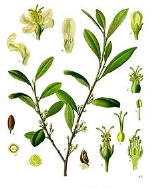
The plant resembles a blackthorn bush
Blackthorn

Prunus spinosa is a species of Prunus native to Europe, western Asia, and locally in northwest Africa.It is a deciduous large shrub or small tree growing to 5 m tall, with blackish bark and dense, stiff, spiny branches....
, and grows to a height of 2–3 m (7–10 ft). The branches are straight, and the leaves
Leaf

In botany, a leaf is an above-ground plant Organ specialized for photosynthesis. For this purpose, a leaf is typically flat and thin, to expose the cells containing chloroplast to light over a broad area, and to allow light to penetrate fully into the tissues....
, which have a green tint, are thin, opaque, oval, and taper at the extremities. A marked characteristic of the leaf is an areolated portion bounded by two longitudinal curved lines, one line on each side of the midrib, and more conspicuous on the under face of the leaf.

The flower
Flower

A flower, sometimes known as a bloom or blossom, is the reproduction structure found in flowering plants . The biological function of a flower is to mediate the union of male sperm with female ovum in order to produce seeds....
s are small, and disposed in little clusters on short stalks; the corolla is composed of five yellowish-white petal
Petal

A petal is one member or part of the Corolla of a flower. The corolla is the name for all of the petals of a flower; the inner perianth whorl, term used when this is not the same in appearance as the outermost whorl and is used to attract pollinators based on its advertising coloration....
s, the anthers are heart-shaped, and the pistil consists of three carpels united to form a three-chambered ovary.


Discussion
Ask a question about 'Coca'
Start a new discussion about 'Coca'
Answer questions from other users
Full Discussion Forum


Encyclopedia


Coca is a plant
Plant

Plants are Life organisms belonging to the Kingdom Plantae. They include familiar organisms such as trees, herbs, bushes, grasses, vines, ferns, mosses, and green algae....
 in the family
Family (biology)

In biological classification, family is a taxonomic rank. Exact details of formal nomenclature depend on the Nomenclature Codes which applies....
 Erythroxylaceae
Erythroxylaceae

The Erythroxylaceae is a family of flowering plants consisting of 4 genus and at least 250 species. The best-known species is the coca plant , the source of the drug cocaine....
, native to north-western South America
South America

South America is the southern continent of the Americas, situated entirely in the Western Hemisphere and mostly in the Southern Hemisphere, with a relatively small portion in the Northern Hemisphere....
. The plant plays a significant role in traditional Andean culture
Andean culture

Andean culture may refer to:* Inca society* Andean regionExcess long comment to prevent listing on...
. Coca leaves contain cocaine alkaloids, a basis for the drug cocaine
Cocaine

Cocaine is a crystalline tropane alkaloid that is obtained from the leaves of the coca plant. The name comes from "coca" in addition to the alkaloid suffix -ine, forming cocaine....
, which is a powerful stimulant
Stimulant

Stimulant drugs are drugs that temporarily increase alertness and awareness. They usually have increased side-effects with increased effectiveness, and the more powerful variants are therefore often prescription medicines or illegal drugs....
.

The plant resembles a blackthorn bush
Blackthorn

Prunus spinosa is a species of Prunus native to Europe, western Asia, and locally in northwest Africa.It is a deciduous large shrub or small tree growing to 5 m tall, with blackish bark and dense, stiff, spiny branches....
, and grows to a height of 2–3 m (7–10 ft). The branches are straight, and the leaves
Leaf

In botany, a leaf is an above-ground plant Organ specialized for photosynthesis. For this purpose, a leaf is typically flat and thin, to expose the cells containing chloroplast to light over a broad area, and to allow light to penetrate fully into the tissues....
, which have a green tint, are thin, opaque, oval, and taper at the extremities. A marked characteristic of the leaf is an areolated portion bounded by two longitudinal curved lines, one line on each side of the midrib, and more conspicuous on the under face of the leaf.

The flower
Flower

A flower, sometimes known as a bloom or blossom, is the reproduction structure found in flowering plants . The biological function of a flower is to mediate the union of male sperm with female ovum in order to produce seeds....
s are small, and disposed in little clusters on short stalks; the corolla is composed of five yellowish-white petal
Petal

A petal is one member or part of the Corolla of a flower. The corolla is the name for all of the petals of a flower; the inner perianth whorl, term used when this is not the same in appearance as the outermost whorl and is used to attract pollinators based on its advertising coloration....
s, the anthers are heart-shaped, and the pistil consists of three carpels united to form a three-chambered ovary. The flowers mature into red berries
Berry

In everyday English, a berry is a broad term for any small edible fruit. Most berries are juicy, round or semi-oblong, brightly coloured, sweet or sour, and don't have a stone or pit....
.

The leaves are sometimes eaten by the larva
Larva

A larva is a young form of animal with indirect developmental biology, going through or undergoing metamorphosis .The larva can look completely different from the adult form, for example, a caterpillar differs from a butterfly....
e of the moth
Moth

A moth is an insect closely related to the butterfly, both being of the Order Lepidoptera. The differences between butterflies and moths are more than just taxonomy....
 Eloria noyesi
Eloria noyesi

Eloria noyesi is a beige moth whose larva feasts on coca plants. It is found mostly in Peru and Colombia. The government of Colombia has proposed a plan to release large numbers of these moths to destroy the coca crops in their country....
.

Species and classification

There are twelve main species and varieties. Two subspecies, Erythroxylum coca var. coca and E. coca var. ipadu, are almost indistinguishable phenotypically; a related high cocaine-bearing species has two subspecies, E. novogranatense var. novogranatense and E. novogranatense var. truxillense that are phenotypically similar, but morphologically distinguishable. Under the older Cronquist system
Cronquist system

A list of systems of plant taxonomy, the Cronquist system is a scheme for the classification of flowering plants . This system was developed by Arthur Cronquist in his texts An Integrated System of Classification of Flowering Plants and The Evolution and Classification of Flowering Plants ....
 of classifying flowering plant
Flowering plant

The flowering plants or angiosperms are the most widespread group of Embryophytes. The flowering plants and the gymnosperms are the only extant groups of Spermatophyte....
s, this was placed in an order
Order (biology)

In Biological classification used in biology, the order is a taxonomic rank between class and family . The superorder is a rank between class and order....
 Linales
Linales

Linales is a botanical name of an order of flowering plants. The Cronquist system used this name for an order placed in subclass Rosidae with the following wiktionary:circumscription :...
; more modern systems place it in the order Malpighiales
Malpighiales

The Malpighiales are a large order of flowering plants, included in the group named eurosids I in the recent Angiosperm Phylogeny Group classification....
.

Cultivation

Erythroxylum Coca
Coca is traditionally cultivated
Agriculture

Agriculture refers to the production of food and goods through farming and forestry. Agriculture was the key development that led to the rise of civilization, with the animal husbandry of domestication animals and plants creating food surpluses that enabled the development of more Population density and Social stratification societies....
 in the lower altitudes of the eastern slopes of the Andes
Andes

The Andes form the world's longest exposed mountain range. They lie as a continuous chain of highland along the western coast of South America. The range is over 7,000 km long, 200-700 km wide , and of an average height of about 4,000 m ....
, or the highlands depending on the species grown. Since ancient times, its leaves have been an important trade commodity between the lowlands where it is grown and the higher altitudes where it is widely consumed by the Andean peoples of Peru
Peru

Peru , officially the Republic of Peru , is a country in western South America. It is bordered on the north by Ecuador and Colombia, on the east by Brazil, on the southeast by Bolivia, on the south by Chile, and on the west by the Pacific Ocean....
, Colombia
Colombia

Colombia , officially the Republic of Colombia , is a country in north-western South America. Colombia is bordered to the east by Venezuela and Brazil; to the south by Ecuador and Peru; to the north by the Caribbean Sea; to the north west by Panama; and to the west by the Pacific Ocean....
, Ecuador
Ecuador

Ecuador , officially the , literally, "Republic of the equator") is a representative democratic republic in South America, bordered by Colombia on the north, by Peru on the east and south, and by the Pacific Ocean to the west....
, Venezuela
Venezuela

Venezuela , officially the Bolivarian Republic of Venezuela , is a country on the northern coast of South America.The country comprises a continental mainland and numerous islands located off the Venezuelan coastline in the Caribbean Sea....
, and Bolivia
Bolivia

The Republic of Bolivia , named after Sim?n Bol?var, is a landlocked country in central South America. It is bordered by Brazil on the north and east, Paraguay and Argentina on the south, and Chile and Peru on the west....
.

Fresh samples of the dried leaves are uncurled, are of a deep green on the upper, and a grey-green on the lower surface, and have a strong tea
Tea

Tea refers to the agricultural products of the leaves, leaf buds, and internodes of the Camellia sinensis plant, prepared and cured by various methods....
-like odor
Odor

An odor or odour is a volatilized chemical compound, generally at a very low concentration, that humans or other animals perceive by the sense of olfaction....
; when chewed they produce a pleasurable numbness in the mouth, and have a pleasant, pungent taste
Taste

Sorry, no overview for this topic
. They are traditionally chewed with lime
Lime (mineral)

Lime is a general term for calcium-containing inorganic materials, in which carbonates, oxides and hydroxides predominate. Strictly speaking, lime is calcium oxide or calcium hydroxide....
 to increase the release of cocaine from the leaf. Older specimens have a camphor
Camphor

Camphor is a waxy, white or transparent solid with a strong, aromatic odor. It is a terpenoid with the chemical formula carbon10hydrogen16oxygen....
aceous smell and a brownish color, and lack the pungent taste.

The seed
Seed

A seed is a small Plant embryogenesis plant enclosed in a covering called the seed coat, usually with some Food storage. It is the product of the ripened ovule of gymnosperm and angiosperm plants which occurs after fertilization and some growth within the mother plant....
s are sown from December to January in small plots (almacigas) sheltered from the sun
Sun

The Sun , a G V star, is the star at the center of the Solar System. The Earth and other matter orbit the Sun, which by itself accounts for about 98.6% of the Solar System's mass....
, and the young plants when at 40–60 cm in height are placed in final planting holes (aspi), or if the ground is level, in furrows (uachos) in carefully weed
WEED

WEED is a radio station broadcasting a Gospel format. Licensed to Rocky Mount, North Carolina, USA, it serves the area. The station is currently owned by Northstar Broadcasting Corporation....
ed soil. The plants thrive best in hot, damp and humid situations, such as the clearings of forest
Forest

File:Stara planina suma.jpgA forest is an area with a high density of trees. There are many definitions of a forest, based on various criteria....
s; but the leaves most preferred are obtained in drier localities, on the sides of hills. The leaves are gathered from plants varying in age from one and a half to upwards of forty years, but only the new fresh growth is harvested. They are considered ready for plucking when they break on being bent. The first and most abundant harvest is in March after the rain
Rain

Rain is liquid precipitation . On Earth, it is the condensation of atmospheric water vapor into droplet heavy enough to fall, often making it to the surface....
s, the second is at the end of June, and the third in October or November. The green leaves (matu) are spread in thin layers on coarse wool
Wool

Wool is the fiber derived from the specialized skin cells, called follicles, of animals in the Caprinae family, principally domestic sheep, but the hair of certain species of other Mammalia such as cashmere goat, llamas, rabbits and keeshonds may also be called wool....
len cloths and dried in the sun; they are then packed in sacks, which must be kept dry in order to preserve the quality of the leaves.

Pharmacological aspects


The pharmacologically
Pharmacology

Pharmacology is the study of drug action. More specifically it is the study of the interactions that occur between a living organism and exogenous chemicals that alter normal biochemical function....
 active ingredient of coca is the alkaloid
Alkaloid

Alkaloids are naturally occurring chemical compounds containing base nitrogen atoms. The name derives from the word alkaline and was used to describe any nitrogen-containing base....
 cocaine
Cocaine

Cocaine is a crystalline tropane alkaloid that is obtained from the leaves of the coca plant. The name comes from "coca" in addition to the alkaloid suffix -ine, forming cocaine....
, which is found in the amount of about 0.3 to 1.5%, averaging 0.8%, in fresh leaves. Besides cocaine
Cocaine

Cocaine is a crystalline tropane alkaloid that is obtained from the leaves of the coca plant. The name comes from "coca" in addition to the alkaloid suffix -ine, forming cocaine....
, the coca leaf contains a number of other alkaloid
Alkaloid

Alkaloids are naturally occurring chemical compounds containing base nitrogen atoms. The name derives from the word alkaline and was used to describe any nitrogen-containing base....
s, including methylecgonine cinnamate
Methylecgonine cinnamate

Methylecgonine cinnamate is a natural tropane alkaloid found within the Coca plant. Its more common name, cinnamoylcocaine, reflects its close structural similarity to cocaine....
, benzoylecgonine
Benzoylecgonine

Benzoylecgonine is the primary metabolite of cocaine. It is formed in the liver by the metabolism of cocaine, catalysed by carboxylesterases, and subsequently excreted in the urine....
, truxilline, hydroxytropacocaine
Hydroxytropacocaine

Hydroxytropacocaine is a tropane alkaloid found in Erythroxylum coca.References ...
, tropacocaine, ecgonine
Ecgonine

Ecgonine is an organic chemical and tropane alkaloid found naturally in coca leaves. It is has a close structural relation to cocaine: it is both a metabolite and a wiktionary:Precursor, and as such, it is a controlled substance, as are all known substances which can be used as precursors to ecgonine itself....
, cuscohygrine
Cuscohygrine

Cuscohygrine is a pyrrolidine alkaloid found in coca. It can be extracted from plants of the family Solanaceae as well, including Atropa belladonna , Datura inoxia and Datura stramonium ....
, dihydrocuscohygrine, nicotine
Nicotine

Nicotine is an alkaloid found in the nightshade family of plants which constitutes approximately 0.6?3.0% of dry weight of tobacco, with biosynthesis taking place in the roots, and accumulating in the leaves....
 and hygrine
Hygrine

Hygrine is a pyrrolidine alkaloid, found mainly in coca leaves . It was first isolated by Carl Liebermann in 1889 as an alkaloid accompanying cocaine in coca....
. When chewed, coca acts as a mild stimulant and suppresses hunger, thirst, pain, and fatigue.

Absorption of cocaine from the leaf is much less rapid and efficient than from the purified forms of cocaine
Cocaine

Cocaine is a crystalline tropane alkaloid that is obtained from the leaves of the coca plant. The name comes from "coca" in addition to the alkaloid suffix -ine, forming cocaine....
, and it does not cause the euphoric and psychoactive effects associated with use of the drug. Some proponents have claimed that cocaine itself is not an active ingredient when unprocessed coca leaf is chewed or brewed as an infusion. However, studies have shown that small but measurable amounts of cocaine are present in the bloodstream after consumption of coca tea. Addiction or other deleterious effects from the consumption of the leaf in its natural form have not been documented.

History

Traces of coca have been found in mummies dating to 3000 years ago. Extensive archeological evidence for the chewing of coca leaves dates back at least to the sixth century A.D. Moche
Moche

The 'Moche' civilization flourished in northern Peru from about 100 C.E. to 800 C.E., during the Cultural periods of Peru. While still the subject of some debate, many scholars contend that the Moche were not politically organized as a monolithic empire or state but rather as a group of autonomous polities that shared a common elite cu...
 period, and the subsequent Inca
Inca

The Inca civilization began as a tribe in the Cuzco area, where the legendary first Sapa Inca, Manco Capac founded the Kingdom of Cuzco around 1200....
 period, based on mummies found with a supply of coca leaves, pottery depicting the characteristic cheek bulge of a coca chewer, spatulas for extracting alkali and figured bags for coca leaves and lime made from precious metals, and gold representations of coca in special gardens of the Inca
Inca

The Inca civilization began as a tribe in the Cuzco area, where the legendary first Sapa Inca, Manco Capac founded the Kingdom of Cuzco around 1200....
 in Cuzco Coca chewing may originally have been limited to the eastern Andes
Andes

The Andes form the world's longest exposed mountain range. They lie as a continuous chain of highland along the western coast of South America. The range is over 7,000 km long, 200-700 km wide , and of an average height of about 4,000 m ....
 before its introduction to the Incas. As the plant was viewed as having a divine origin, its cultivation became subject to a state monopoly and its use restricted to nobles and a few favored classes (court orators, couriers, favored public workers, and the army) by the rule of the Topa Inca (1471-1493). As the Incan empire declined, the leaf became more widely available. After some deliberation, Philip II of Spain
Philip II of Spain

Philip II was King of Spain from 1556 until 1598, List of monarchs of Naples from 1554 until 1598, king consort of England, as husband of Mary I of England, from 1554 to 1558, lord of the Seventeen Provinces from 1556 until 1581, holding various titles for the individual territories, such as Duke or Count; and King of Portugal as Philip I...
 issued a decree recognizing the drug as essential to the well-being of the Andean Indians but urging missionaries to end its religious use. The Spanish are believed to have effectively encouraged use of coca by an increasing majority of the population to increase their labor output and tolerance for starvation, but it is not clear that this was planned deliberately.

Coca was first introduced to Europe in the 16th century, but did not become popular until the mid-19th century, with the publication of an influential paper by Dr. Paolo Mantegazza
Paolo Mantegazza

Paolo Mantegazza was a prominent Italy neurology, physiologist and anthropologist, noted for the isolation of cocaine from coca leaves and his experimental investigation into its effects on the human psyche....
 praising its stimulating effects on cognition. This led to invention of cocawine
Cocawine

Coca wine was an alcoholic beverage that combined wine and cocaine. The most popular brand was Vin Mariani developed in 1863 by Corsican entrepreneur Angelo Mariani....
 and the first production of pure cocaine
Cocaine

Cocaine is a crystalline tropane alkaloid that is obtained from the leaves of the coca plant. The name comes from "coca" in addition to the alkaloid suffix -ine, forming cocaine....
. Cocawine
Cocawine

Coca wine was an alcoholic beverage that combined wine and cocaine. The most popular brand was Vin Mariani developed in 1863 by Corsican entrepreneur Angelo Mariani....
 (of which Vin Mariani
Vin Mariani

Vin Mariani was a tonic created circa 1863 by Angelo Mariani, a chemist who became intrigued with coca and its economic potential after reading Paolo Mantegazza?s paper on coca's effects....
 was the best-known brand) and other coca-containing preparations were widely sold as patent medicines and tonics, with claims of a wide variety of health benefits. The original version of Coca-cola
Coca-Cola

Coca-Cola is a carbonation soft drink sold in stores, restaurants and vending machines worldwide . It is produced by The Coca-Cola Company in Atlanta, Georgia, and is often referred to simply as Coke or as Cola or Pop....
 was among these. These products became illegal in most countries outside of South America in the early 20th century, after the addictive nature of cocaine was widely recognized.

In recent times (2007), the governments of several South American countries, such as Peru, Bolivia and Venezuela, have defended and championed the traditional use of coca, as well as the modern uses of the leaf and its extracts in household products such as teas and toothpaste. (see Industrial Use below)

Traditional uses


Traditional medical uses of coca are foremost as a stimulant to overcome fatigue, hunger, and thirst. It is considered particularly effective against altitude sickness
Altitude sickness

Altitude sickness, also known as acute mountain sickness , altitude illness, or soroche, is a pathological condition that is caused by acute exposure to low air pressure ....
. It also is used as an anaesthetic to alleviate the pain of headache, rheumatism
Rheumatism

Rheumatism or Rheumatic disorder is a non-specific term for medical problems affecting the heart, bones, joints, kidney, skin and lung. The study of, and therapeutic interventions in, such disorders is called rheumatology....
, wounds and sores, etc. Before stronger anaesthetics were available, it also was used for broken bones, childbirth, and during trephining operations on the skull. Because cocaine constricts blood vessels, the action of coca also serves to oppose bleeding, and coca seeds were used for nosebleeds. Indigenous use of coca has also been reported as a treatment for malaria
Malaria

Malaria is a Vector -borne infectious disease caused by protozoan parasites. It is widespread in Tropics and subtropical regions, including parts of the Americas, Asia, and Africa....
, ulcer
Ulcer

An ulcer is a discontinuity of the skin exhibiting complete loss of the epidermis and often portions of the dermis and even subcutaneous fat....
s, asthma
Asthma

Asthma is a common chronic obstructive pulmonary disease, in which the Lung constrict, become inflammation, and are lined with excessive amounts of thickened mucus, often in response to one or more triggers....
, to improve digestion
Digestion

Digestion is the mechanical and chemical breaking down of food into smaller components, to a form that can be Absorption, for instance, by a blood stream....
, to guard against bowel laxity, as an aphrodisiac
Aphrodisiac

An aphrodisiac is a substance which is used in the belief that it increases sexual desire. The name comes from Aphrodite, the Greek mythology of sensuality....
, and credited with improving longevity
Longevity

The word longevity is sometimes used as a synonym for "life expectancy" in demography. However, this is not the most popular or accepted definition....
. Modern studies have supported a number of these medical applications.

Coca has also been a vital part of the religious cosmology of the Andean peoples of Peru, Bolivia, Ecuador, Colombia and northern Argentina and Chile from the pre-Inca period through the present. Coca leaves play a crucial part in offerings to the apus
Apus

Apus is a faint constellation in the southern sky, first defined in the sixteenth century. Its name means "no feet" in Latin, and it represents a Birds of Paradise ....
 (mountains), Inti
Inti

According to the Inca mythology, Inti is the sun god, as well a patron deity of Tahuantinsuyu. His exact origin is not known. The most common story says he is the son of Viracocha, the god of civilization....
 (the sun), or Pachamama
Pachamama

Pachamama is a goddess revered by the indigenous people of the Andes. Pachamama is usually translated as "Mother Earth" but a more literal translation would be "Mother Universe" ...
 (the earth). Coca leaves are also often read in a form of divination
Divination

Divination is the attempt to gain insight into a question or situation by way of a standardized process or ritual. Diviners ascertain their interpretations of how a querent should proceed by reading signs, events, or omens, or through alleged contact with a supernatural agency....
 analogous to reading tea leaves in other cultures. As one example of the many traditional beliefs about coca, it is believed by the miners of Cerro de Pasco
Cerro de Pasco

Cerro de Pasco is a city in central Peru. It is the capital of the Pasco region, and an important mining center. It is connected by rail to the city of Lima....
 to soften the veins of ore
Ore

An ore is a type of Rock that contains minerals such as gemstones and metals that can be extracted through mining and refined for use. Samples of ore in the form of exceptionally beautiful crystals, exotic layering visible when sectioned or polished or metallic presentations such as large nuggets or crystalline formations of metals suc...
, if masticated (chewed) and thrown upon them (see also Cocomama).

Coca
The activity of chewing coca is called mambear, chacchar or acullicar, borrowed from Quechua
Quechua

Quechua is a Native American language of South America. It was already widely spoken across the Central Andes long before the time of the Inca Empire, who established it as the official language of administration for their Empire, and is still spoken today in various regional forms by some 10 million people through much of South America, in...
, or in Bolivia, picchar, derived from the Aymara
Aymara

The Aymara or Aimara are a native ethnic group in the Andes and Altiplano regions of South America; about 2 million live in Bolivia, Peru and Norte Grande, Chile....
 language. The Spanish masticar is also frequently used, along with the slang term "bolear," derived from the word "bola" or ball of coca pouched in the cheek while chewing. Typical coca consumption is about two ounces per day, and contemporary methods are believed to be unchanged from ancient times. Coca is kept in a woven pouch (chuspa or huallqui). A few leaves are chosen to form a quid (acullico) held between the mouth and gums. Doing so usually causes users to feel a tingling and numbing sensation in their mouths. (The common dental anaesthetic Novocaine
Procaine

Procaine is a local anesthetic drug of the amino ester group. It is used primarily to reduce the pain of intramuscular injection of penicillin, and is also used in dentistry....
 has a similar effect.) Chewing coca leaves is most common in indigenous communities across the central Andean region, particularly in places like the highlands of Colombia
Colombia

Colombia , officially the Republic of Colombia , is a country in north-western South America. Colombia is bordered to the east by Venezuela and Brazil; to the south by Ecuador and Peru; to the north by the Caribbean Sea; to the north west by Panama; and to the west by the Pacific Ocean....
, Ecuador
Ecuador

Ecuador , officially the , literally, "Republic of the equator") is a representative democratic republic in South America, bordered by Colombia on the north, by Peru on the east and south, and by the Pacific Ocean to the west....
, Bolivia
Bolivia

The Republic of Bolivia , named after Sim?n Bol?var, is a landlocked country in central South America. It is bordered by Brazil on the north and east, Paraguay and Argentina on the south, and Chile and Peru on the west....
 and Peru
Peru

Peru , officially the Republic of Peru , is a country in western South America. It is bordered on the north by Ecuador and Colombia, on the east by Brazil, on the southeast by Bolivia, on the south by Chile, and on the west by the Pacific Ocean....
, where the cultivation and consumption of coca is as much a part of the national culture
Culture

Culture is difficult to define. For example, in 1952, Alfred Kroeber and Clyde Kluckhohn compiled a list of 164 definitions of "culture" in Culture: A Critical Review of Concepts and Definitions....
 similar to chicha
Chicha

Chicha is a term used in some regions of Latin America for several varieties of fermentation, particularly those derived from maize, but which also describes similar non-alcoholic beverage beverages....
, like wine
Wine

Wine is an alcoholic beverage often made of fermentation grape juice. The natural chemical balance of grapes is such that they can ferment without the addition of sugars, acids, enzymes or other nutrients....
 is to France
France

France , officially the French Republic , is a country whose Metropolitan France is located in Western Europe and that also comprises various Overseas departments and territories of France....
 or beer
Beer

Beer is the world's oldest and most widely consumed alcoholic beverage and the third most popular drink overall after water and tea. It is produced by the brewing and Fermentation of starches, mainly derived from cereal?the most common of which is malted barley, although wheat, maize , and rice are widely used....
 is to Germany
Germany

Germany , officially the Federal Republic of Germany , is a country in Central Europe. It is bordered to the north by the North Sea, Denmark, and the Baltic Sea; to the east by Poland and the Czech Republic; to the south by Austria and Switzerland; and to the west by France, Luxembourg, Belgium, and the Netherlands....
. It also serves as a powerful symbol of indigenous cultural and religious identity, amongst a diversity of indigenous nations throughout South America. Bags of coca leaves are sold in local market
Market

A market is any one of a variety of different systems, institutions, procedures, social relations and infrastructures whereby persons trade, and goods and services are exchanged, forming part of the economy....
s and by street vendors. Commercially manufactured coca tea
Coca tea

Coca tea, also called mate de coca, is a tisane made using the leaves of the Coca. It is made either by submerging the coca leaf or dipping a tea bag in hot water....
s are also available in most stores and supermarket
Supermarket

A supermarket is a self-service Retailing#Retail types offering a wide variety of food and household merchandise, organized into departments....
s, including upscale suburban supermarkets.

Coca is still chewed in the traditional way, with a tiny quantity of ilucta (a preparation of the ashes of the quinoa
Quinoa

Quinoa is a species of goosefoot grown as a agriculture primarily for its edible seeds. It is a pseudocereal rather than a true cereal as it is not a Poaceae....
 plant) added to the coca leaves; it softens their astringent
Astringent

An astringent substance is a chemical that tends to shrink or constrict body tissues, usually locally after topical medicinal application. The word "astringent" derives from Latin adstringere, meaning "to bind fast"....
 flavor
Flavor

Flavor or flavour is the sensory impression of a food or other chemical substance, and is determined mainly by the chemical senses of taste and olfaction....
 and activates the alkaloids. Other names for this basifying substance are llipta in Peru and the Spanish
Spanish language

Spanish or Castilian is a Romance languages that originated in northern Spain, and gradually spread in the Kingdom of Castile and evolved into the principal language of government and trade....
 word lejía, lye in English. The consumer carefully uses a wooden stick (formerly often a spatula of precious metal) to transfer an alkaline component into the quid without touching his flesh with the corrosive substance. The alkali component, usually kept in a gourd (ishcupuro or poporo), can be made by burning limestone
Limestone

File:Limestone Formation In Waitomo.jpgLimestone is a sedimentary rock composed largely of the mineral calcite . The deposition of limestone strata is often a by-product and indicator of biological activity in the geology record....
 to form unslaked quicklime, burning quinoa
Quinoa

Quinoa is a species of goosefoot grown as a agriculture primarily for its edible seeds. It is a pseudocereal rather than a true cereal as it is not a Poaceae....
 stalks, or the bark from certain trees, and may be called ilipta, tocra or mambe depending on its composition. Many of these materials are salty in flavor, but there are variations. The most common base in the La Paz
La Paz

Nuestra Se?ora de La Paz is the administrative Capital of Bolivia, as well as the departmental capital of La Paz Department, Bolivia. As of the 2001 census, the city of La Paz had a population of 789,585, and together with the neighboring cities of El Alto and Viacha, make the biggest urban area of Bolivia, with a population of over 1.6 mill...
 area of Bolivia is a product known as lejía dulce (sweet lye), which is made from quinoa ashes mixed with anise and cane sugar, forming a soft black putty with a sweet and pleasing licorice flavor. In some places, baking soda is used under the name bico.

In the Sierra Nevada de Santa Marta
Sierra Nevada de Santa Marta

The Sierra Nevada de Santa Marta is an isolated mountain range apart from the Andes chain that runs through Colombia. Reaching an altitude of 5,700 metres above sea level just 42 km from the Caribbean coast, the Sierra Nevada is the world's highest coastal range....
, on the Caribbean
Caribbean

The Caribbean is a region consisting of the Caribbean Sea, its islands , and the surrounding coasts. The region is located southeast of the Gulf of Mexico and Northern America, east of Central America, and to the north of South America....
 Coast of Colombia
Colombia

Colombia , officially the Republic of Colombia , is a country in north-western South America. Colombia is bordered to the east by Venezuela and Brazil; to the south by Ecuador and Peru; to the north by the Caribbean Sea; to the north west by Panama; and to the west by the Pacific Ocean....
, coca is consumed by the Kogi, Arhuaco and Wiwa
WIWA

WIWA is a radio station broadcasting a Spanish language Christian radio format. Licensed to St. Cloud, Florida, USA, it serves the greater Orlando area....
 by using a special device called poporo
Poporo

Poporo is a device used for Indigenous peoples of the Americas cultures in present and pre-Columbian South America for storage of small amounts of lime ....
. The poporo is the mark of manhood. It represents the womb and the stick is a phallic symbol. The movements of the stick in the poporo symbolize the sexual act. For a man the poporo is a good companion that means "food", "woman", "memory" and "meditation". Women are prohibited from using coca. It is important to stress that poporo is the symbol of manhood. But it is the woman who gives men their manhood. When the boy is ready to be married, his mother will initiate him in the use of the coca. This act of initiation is carefully supervised by the mama, a traditional priest-teacher-leader.

Although coca leaf chewing is common only among the indigenous populations, the consumption of coca tea (Mate de coca) is common among all sectors of society in the Andean countries, and is widely held to be beneficial to health, particularly in the high altitudes. Coca leaf is sold packaged into teabags in most grocery stores in the region, and establishments that cater to tourists generally feature coca tea.

In the city of Salta, in northern Argentina, one can buy a cup of Coca tea for 4 pesos at the cafe inside the Museo De Arqueologia De Alta Montana (MAAM) in the city center. This is one of the biggest museums in Northern Argentina with a focus on Inca culture in the Andes.

Industrial use

Coca is used industrially in the cosmetics
Cosmetics

Cosmetics are substances used to enhance or protect the appearance or odor of the human body. Cosmetics include skin-care Cream , lotions, Powder , perfumes, lipsticks, fingernail and toe nail polish, eye and facial makeup, permanent waves, colored contact lenses, hair colors, hair sprays and gels, deodorants, baby products, bath oils, bubb...
 and food industries
Industry

An industry is the manufacturing of a Good or Service within a category. Although industry is a broad term for any kind of economic production, in economics and urban planning industry is a synonym for the secondary sector, which is a type of economic activity involved in the manufacturing of raw materials into goods and products....
. A de-cocainized extract of coca leaf is reportedly one of the flavoring ingredients in Coca-Cola
Coca-Cola

Coca-Cola is a carbonation soft drink sold in stores, restaurants and vending machines worldwide . It is produced by The Coca-Cola Company in Atlanta, Georgia, and is often referred to simply as Coke or as Cola or Pop....
. Coca tea
Coca tea

Coca tea, also called mate de coca, is a tisane made using the leaves of the Coca. It is made either by submerging the coca leaf or dipping a tea bag in hot water....
 is produced industrially from coca leaves in South America by a number of companies, including Enaco S.A. (National Company of the Coca) a government enterprise in Peru. Coca leaves are also found in a brand of herbal liqueur
Liqueur

A liqueur is an alcoholic beverage that has been flavored with fruit, herbs, Nut , spices, flowers, or cream and bottled with added sugar. Liqueurs are typically quite sweet; they are usually not aged for long but may have resting periods during their production to allow flavors to marry....
 called "Agwa de Bolivia" (grown in Bolivia and de-cocainized in Amsterdam
Amsterdam

Amsterdam is the Capital of the Netherlands and List of cities in the Netherlands with over 100,000 people of the Netherlands, located in the Provinces of the Netherlands of North Holland in the west of the country....
), and a natural flavouring ingredient in Red Bull Cola
Red Bull Cola

Red Bull Cola is a cola beverage from Red Bull GmbH, makers of the energy drink Red Bull. The cola, which contains natural flavoring and caffeine, was introduced in 2008 in several countries....
, that was launched in March 2008.

Beginning in the early 21st century, there has been a movement in Bolivia
Bolivia

The Republic of Bolivia , named after Sim?n Bol?var, is a landlocked country in central South America. It is bordered by Brazil on the north and east, Paraguay and Argentina on the south, and Chile and Peru on the west....
, Peru
Peru

Peru , officially the Republic of Peru , is a country in western South America. It is bordered on the north by Ecuador and Colombia, on the east by Brazil, on the southeast by Bolivia, on the south by Chile, and on the west by the Pacific Ocean....
, and Venezuela
Venezuela

Venezuela , officially the Bolivarian Republic of Venezuela , is a country on the northern coast of South America.The country comprises a continental mainland and numerous islands located off the Venezuelan coastline in the Caribbean Sea....
 to promote and expand legal markets for the crop. The presidents of these three countries have personally identified with this movement. In particular, Evo Morales
Evo Morales

Juan Evo Morales Ayma , popularly known as Evo , has been the President of Bolivia of Bolivia since 2006. He has been declared the country's first fully Indigenous peoples of the Americas head of state in the 470 years since the Spanish colonization of the Americas....
 of Bolivia (elected in December 2005) was a coca growers union leader. Morales asserts that "la coca no es cocaína"—the coca leaf is not cocaine. During to the General Assembly of the United Nations on September 19 2006, he held a coca leaf in his hand to demonstrate its innocuity.

Alan García, president of Peru, has recommended its use in salads and other edible preparations. A Peruvian-based company has announced plans to market a modern version of Vin Mariani
Vin Mariani

Vin Mariani was a tonic created circa 1863 by Angelo Mariani, a chemist who became intrigued with coca and its economic potential after reading Paolo Mantegazza?s paper on coca's effects....
, which will be available in both natural and de-cocainized varieties.

In Venezuela
Venezuela

Venezuela , officially the Bolivarian Republic of Venezuela , is a country on the northern coast of South America.The country comprises a continental mainland and numerous islands located off the Venezuelan coastline in the Caribbean Sea....
, president Hugo Chávez
Hugo Chávez

Hugo Rafael Ch?vez Fr?as is the current President of Venezuela. As the leader of the Bolivarian Revolution, Ch?vez promotes a political doctrine of participatory democracy, socialism and Latin American and Caribbean cooperation....
 said in a speech on January 2008 that he chews coca every day, and that his "hook up" is Bolivian president Evo Morales. Chávez reportedly said "I chew coca every day in the morning... and look how I am" before showing his biceps
Biceps

Biceps may refer to:* The two-headed Biceps brachii muscle on the inside of each upper arm.* The biceps femoris, one of the hamstring muscles of the underside of each thigh....
 to his audience, the Venezuelan National Assembly.

On the other hand, the Colombian government has recently moved in the opposite direction. For years, Bogotá
Bogotá

Bogot? ? officially named Bogot?, D.C. , formerly called Santa Fe de Bogot? ? is the capital city of Colombia, as well as the most populous city in the country, with 6,776,009 inhabitants ....
 has allowed indigenous coca farmers to sell coca products, promoting the enterprise as one of the few successful commercial opportunities available to recognized tribes like the Nasa
Paez people

The Paez, also known as the Nasa, are a Indigenous peoples of the Americas people who live in the Andes Mountains of Colombia....
, who have grown it for years and regard it as sacred. In December 2005, the Paeces, a Tierradentro (Cauca
Cauca

Cauca may refer to:* Cauca Department, an administrative division of Colombia* Valle del Cauca, an administrative division of Colombia* Cauca language...
) indigenous community, started in December to produce a carbonated soft drink called "Coca Sek
Coca Sek

Coca Sek is a carbonated beverage that the P?ez people of south-western Colombia began selling in December, 2005. The drink is based on coca leaves, which native Colombian peoples have been consuming for centuries....
". The production method belongs to the resguardos of Calderas (Inzá) and takes about 150 kg of coca per 3,000 produced bottles. The drink was never sold widely in Colombia, the efforts to do so ended in May 2007 when it was abruptly banned by the Colombian government.

Literary references

Probably the earliest reference to coca in English literature is Abraham Cowley
Abraham Cowley

Abraham Cowley , England poet, was born in the City of London late in 1618. He was one of the leading English poets of the seventeenth century with 14 printings of his Works published between 1668 and 1721....
's poem "The Legend of Coca" in his 1662 collection of poems "Six Books of Plants".

One of the best known examples of coca's reference in fiction is Patrick O'Brian's character, Stephen Maturin
Stephen Maturin

Stephen Maturin is a fictional character in the Aubrey-Maturin series of novels by Patrick O'Brian. The series portrays his career as a physician, naturalist and spy in the Royal Navy during the Napoleonic Wars, and the long pursuit of his beloved Diana Villiers....
. In many of the more than twenty book series, a.k.a. Aubrey-Maturin series, Maturin expounds the benefits of coca. However, the reader is made aware of the truly addictive effects of the drug when rats, who have found the coca (Erythroxylum coca) and become seriously addicted, scour the ship looking for it.

Legal status

Coca leaf is the raw material for the manufacture
Manufacturing

Manufacturing is the use of machine, tool and labor to make things for use or sale. The term may refer to a range of human activity, from handicraft to high tech, but is most commonly applied to Industry production, in which raw material are transformed into finished good on a large scale....
 of the drug
Psychoactive drug

A psychoactive drug or psychotropic substance is a chemical substance that acts primarily upon the central nervous system where it alters brain function, resulting in temporary changes in perception, mood , consciousness and behaviour....
 cocaine
Cocaine

Cocaine is a crystalline tropane alkaloid that is obtained from the leaves of the coca plant. The name comes from "coca" in addition to the alkaloid suffix -ine, forming cocaine....
, a powerful stimulant
Stimulant

Stimulant drugs are drugs that temporarily increase alertness and awareness. They usually have increased side-effects with increased effectiveness, and the more powerful variants are therefore often prescription medicines or illegal drugs....
 and anaesthetic extracted chemically from large quantities of coca leaves. Today, since it has mostly been replaced as a medical anaesthetic by synthetic analogues such as procaine
Procaine

Procaine is a local anesthetic drug of the amino ester group. It is used primarily to reduce the pain of intramuscular injection of penicillin, and is also used in dentistry....
, cocaine is best known as an illegal recreational drug. The cultivation, sale, and possession of unprocessed coca leaf (but not of any processed form of cocaine
Cocaine

Cocaine is a crystalline tropane alkaloid that is obtained from the leaves of the coca plant. The name comes from "coca" in addition to the alkaloid suffix -ine, forming cocaine....
) is generally legal in the countries – such as Bolivia, Peru, Chile and Argentina – where traditional use is established, although cultivation is often restricted in an attempt to prevent the production of cocaine.

The prohibition of the use of the coca leaf except for medical or scientific purposes was established by the United Nations
United Nations

The United Nations is an international organization whose stated aims are to facilitate cooperation in international law, international security, economic development, Social change, human rights and achieving world peace....
 in the 1961 Single Convention on Narcotic Drugs
Single Convention on Narcotic Drugs

The Single Convention on Narcotic Drugs is an international treaty to prohibit production and supply of specific drugs and of drugs with similar effects except under licence for specific purposes, such as medicine treatment and research....
. The coca leaf is listed on Schedule I
Single Convention on Narcotic Drugs

The Single Convention on Narcotic Drugs is an international treaty to prohibit production and supply of specific drugs and of drugs with similar effects except under licence for specific purposes, such as medicine treatment and research....
 of the 1961 Single Convention together with cocaine
Cocaine

Cocaine is a crystalline tropane alkaloid that is obtained from the leaves of the coca plant. The name comes from "coca" in addition to the alkaloid suffix -ine, forming cocaine....
 and heroin
Heroin

Heroin is a opioid synthesized from morphine, a derivative of the opium poppy. It is the 3,6-acetate ester of morphine . The white crystalline form is commonly the hydrochloride salt diacetylmorphine hydrochloride, however heroin Freebase may also appear as a white powder....
. The Convention determined that “The Parties shall so far as possible enforce the uprooting of all coca bushes which grow wild. They shall destroy the coca bushes if illegally cultivated” (Article 26), and that, “Coca leaf chewing must be abolished within twenty-five years from the coming into force of this Convention” (Article 49, 2.e).

The rationale for including the coca leaf in the 1961 Single Convention is mainly rooted in a report requested of the United Nations by the permanent representative of Peru that was prepared by a commission that visited Bolivia and Peru briefly in 1949 to “investigate the effects of chewing the coca leaf and the possibilities of limiting its production and controlling its distribution.” The Commission of Enquiry on the Coca Leaf study, published in 1950, concluded that the effects of chewing coca leaves were negative, even though chewing coca was defined as a habit, not an addiction.

The report was sharply criticised for its arbitrariness, lack of precision and racist connotations. The team members’ professional qualifications and parallel interests were also criticised, as were the methodology used and the incomplete selection and use of existing scientific literature on the coca leaf. Nowadays, a similar study would never pass the scrutiny and critical review to which scientific studies are routinely subjected.

Despite the legal restriction, coca chewing and drinking of coca tea is carried out daily by millions of people in the Andes
Andes

The Andes form the world's longest exposed mountain range. They lie as a continuous chain of highland along the western coast of South America. The range is over 7,000 km long, 200-700 km wide , and of an average height of about 4,000 m ....
 as well as considered sacred within indigenous cultures. They claim that most of the information provided about the traditional use of the coca leaf and its modern adaptations are erroneous. This has made it impossible to shed light on the plant’s positive aspects and its potential benefits for the physical, mental and social health of the people who consume and cultivate it.

In an attempt to obtain legal recognition for the traditional use of coca, Peru
Peru

Peru , officially the Republic of Peru , is a country in western South America. It is bordered on the north by Ecuador and Colombia, on the east by Brazil, on the southeast by Bolivia, on the south by Chile, and on the west by the Pacific Ocean....
 and Bolivia
Bolivia

The Republic of Bolivia , named after Sim?n Bol?var, is a landlocked country in central South America. It is bordered by Brazil on the north and east, Paraguay and Argentina on the south, and Chile and Peru on the west....
 negotiated paragraph 2 of Article 14 into the 1988 United Nations Convention Against Illicit Traffic in Narcotic Drugs and Psychotropic Substances
United Nations Convention Against Illicit Traffic in Narcotic Drugs and Psychotropic Substances

The 1988 United Nations Convention Against Illicit Traffic in Narcotic Drugs and Psychotropic Substances is one of three major drug control treaties currently in force....
, stipulating that measures to eradicate illicit cultivation and to eliminate illicit demand “should take due account of traditional licit use, where there is historic evidence of such use.” Bolivia also made a formal reservation to the 1988 Convention, which required countries to adopt measures to establish the use, consumption, possession, purchase or cultivation of the coca leaf for personal consumption as a criminal offence. Bolivia stated that “the coca leaf is not, in and of itself, a narcotic drug or psychotropic substance” and stressed that its “legal system recognizes the ancestral nature of the licit use of the coca leaf, which, for much of Bolivia’s population, dates back over centuries.”

However, the International Narcotics Control Board
International Narcotics Control Board

The International Narcotics Control Board is the independent and Quasi-judicial body control organ for the implementation of the United Nations drug conventions....
 (INCB) – the independent and quasi-judicial control organ for the implementation of the United Nations drug conventions – denied the validity of article 14 in the 1988 Convention over the requirements of the 1961 Convention, or any reservation made by parties, since it does not "absolve a party of its rights and obligations under the other international drug control treaties."

In recent years the current legal status of the coca leaf is more and more questioned. Even the INCB stated in its 1994 Annual Report that "mate de coca, which is considered harmless and legal in several countries in South America, is an illegal activity under the provisions of both the 1961 Convention and the 1988 Convention, though that was not the intention of the plenipotentiary conferences that adopted those conventions." It implicitly also dismissed the original report of the Commission of Enquiry on the Coca Leaf by recognizing that "there is a need to undertake a scientific review to assess the coca-chewing habit and the drinking of coca tea."

Nevertheless, the INCB on other occasions did not show signs of an increased sensitivity towards the Bolivian claim on the rights of their indigenous population, and the general public, to consume the coca leaf in a traditional manner by chewing the leaf, and even goes as far as to consider drinking coca tea, as "not in line with the provisions of the 1961 Convention." The Board considered Bolivia, Peru and a few other countries that allow such practises to be in breach with their treaty obligations, and insisted that “each party to the Convention should establish as a criminal offence, when committed intentionally, the possession and purchase of coca leaf for personal consumption.”

In reaction to the 2007 Annual Report of the INCB, the Bolivian government announced that it would formally issue a request to the United Nations to unschedule the coca leaf of List 1 of the 1961 UN Single Convention.

Legal status by country

Outside of South America, most countries' laws make no distinction between the coca leaf and any other substance containing cocaine, so the possession of coca leaf (except for de-cocainized leaf) is prohibited.

In the Netherlands
Netherlands

The Netherlands is a country that is part of the Kingdom of the Netherlands. It is a parliamentary democratic constitutional monarchy. The Netherlands is located in North-West Europe, and bordered by the North Sea to the north and west, Belgium to the south, and Germany to the east....
, coca leaf is legally in the same category as cocaine, both are List I drugs of the Opium Law
Opium Law

The Opium Law is the section of the Dutch Law which covers nearly all psychotropic drugs. All non-psychotropic, but prescription-only drugs are covered by the Medicine Act....
. The Opium Law specifically mentions the leafs of the plants of the species Erythroxylon. However, the possession of living plants of the species Erythroxylon are not actively prosecuted, even though they are legally forbidden.

In the United States, the Stepan Company of Maywood, New Jersey has the only license to legally import coca leaf. The company manufactures pure cocaine for medical use and also produces a cocaine-free extract of the coca leaf, which is used as a flavoring ingredient in Coca-Cola
Coca-Cola

Coca-Cola is a carbonation soft drink sold in stores, restaurants and vending machines worldwide . It is produced by The Coca-Cola Company in Atlanta, Georgia, and is often referred to simply as Coke or as Cola or Pop....
. According to the Bolivian press, Coca-Cola legally-imported 204 tons of coca leaf in 1996.

Since the 1980s, the countries in which coca is grown have come under political and economic pressure from the United States to restrict the cultivation of the crop, in order to reduce the supply of cocaine
Cocaine

Cocaine is a crystalline tropane alkaloid that is obtained from the leaves of the coca plant. The name comes from "coca" in addition to the alkaloid suffix -ine, forming cocaine....
 on the international market.

Article 26 of the Single Convention on Narcotic Drugs
Single Convention on Narcotic Drugs

The Single Convention on Narcotic Drugs is an international treaty to prohibit production and supply of specific drugs and of drugs with similar effects except under licence for specific purposes, such as medicine treatment and research....
 requires nations that allow the cultivation of coca to designate an agency to regulate said cultivation and take physical possession of the crops as soon as possible after harvest, and to destroy all coca which grows wild or is illegally cultivated. The effort to enforce these provisions, referred to as coca eradication
Coca eradication

Coca eradication is a controversial strategy strongly promoted by the United States Federal government of the United States as part of its "War on Drugs" to eliminate the cultivation of coca, a plant whose leaves are not only traditionally used by Indigenous peoples of the Americas cultures but also, in modern society, in the manufacture of c...
, has involved many strategies, ranging from aerial spraying of herbicides on coca crops to assistance and incentives to encourage farmers to grow alternate crops.

This effort has been politically controversial, with proponents claiming that the production of cocaine is several times the amount needed to satisfy legal demand, and inferring that the vast majority of the coca crop is destined for the illegal market, which not only contributes to the major social problem of drug abuse, but also financially supports insurgent groups that collaborate with drug traffickers in some cocaine-producing territories. Critics of the effort claim that it creates hardship primarily for the coca growers, many of whom are poor and have no viable alternative way to make a living, causes environmental problems, that it is not effective in reducing the supply of cocaine, in part because cultivation can move to other areas, and that any social harm created by drug abuse is only made worse by the war on drugs
War on Drugs

The War on Drugs is a controversial prohibition campaign undertaken by the United States government with the assistance of participating countries, intended to reduce the illegal drug trade?to curb supply and diminish demand for specific psychoactive substances deemed immoral, harmful, dangerous, or undesirable....
.

More recently, coca has been reintroduced to the U.S. as a flavoring agent in the herbal liqueur Agwa
Agwa de Bolivia (liqueur)

Agwa de Bolivia Distilled and produced in Holland, AGWA de Bolivia is an Alco-Jolt made from the Bolivian coca leaf and contains Guarana and ginseng....
. Coca tea and coca flour are available in the U.S. and Europe through Amazon.com, , &. Since early 2009, Coca Tea Premium Organic Products are developed and produced in Monroe, North Carolina by NovoAndina International and distributed to the United States and Europe by trade company headquarted in Charlotte, NC

External links

  • (A private museum in La Paz, Bolivia)
  • website of the Transnational Institute (TNI)
  • Transnational Institute
  • Peruvian Enterprise of the Coca, Official Website
  • Transnational Institute (TNI), Drugs & Conflict Debate Paper 13, May 2006
  • Alcohol and Drugs History Society
    Alcohol and Drugs History Society

    The Alcohol and Drugs History Society is a scholarly organization whose members study the history of a variety of illegal, regulated, and unregulated drugs such as opium, alcohol, and coffee....


Photographs


Videos