


Kangchenjunga

Encyclopedia
Kangchenjunga is the third highest mountain
of the world with an elevation of 8586 m (28,169.3 ft) and located along the India-Nepal border in the Himalayas
.
Kangchenjunga is also the name of the section of the Himalayas and means "The Five Treasures of Snows", as it contains five peaks, four of them over 8450 m (27,723.1 ft). The treasures represent the five repositories of God, which are gold
, silver
, gems
, grain
, and holy books.
Three of the five peaks – main, central, and south – are on the border of North Sikkim
in India
and Taplejung District
of Nepal
, while the other two are completely in Taplejung District. The Kangchenjunga Himal includes twelve more peaks over 7000 m (22,965.9 ft).
Until 1852, Kangchenjunga was assumed to be the highest mountain in the world, but calculations made by the Great Trigonometric Survey
of India in 1849 came to the conclusion that Mount Everest (known as Peak XV at the time) was the highest and Kangchenjunga the third-highest. Kangchenjunga was first climbed on May 25, 1955 by Joe Brown
and George Band
, who were part of a British
expedition. The British expedition honoured the beliefs of the Sikkimese, who hold the summit sacred, by stopping a few feet short of the actual summit. Most successful summit parties since then have followed this tradition.
, A.M. Kellas, and the Royal Geographical Society
that gives the best indication of the Tibetan
pronunciation.
The name Kangchenjunga stems from Bhutia and Tibetan languages. Its name in Nepali
is कञ्चनजङ्घा Kanchanjaŋghā. Its name in the local Limbu language
is Sewalungma, meaning Mountain that we offer greetings to. Sewalungma is considered sacred in the Kirant
religion.
There are a number of alternative spellings which include Kangchen Dzö-nga, Khangchendzonga, Kanchenjanga, Kachendzonga, Kanchenjunga or Kangchanfanga. The final word on the use of the name Kangchenjunga came from His Highness Sir Tashi Namgyal
, the Maharaja
or chogyal
of Sikkim, who stated that "although junga had no meaning in Tibetan, it really ought to have been Zod-nga (treasure, five) Kang-chen (snow, big) to convey the meaning correctly". Following consultations with a Lieutenant-Colonel J.L.R. Weir (British political agent to Sikkim), he agreed that it was best to leave it as Kangchenjunga, and thus the name remained so by acceptance and usage.
, China
, India
and Nepal, and comprises 14 protected areas with a total of 6032 km² (2,329 sq mi): Kanchenjunga Conservation Area
located in Nepal, Kanchenjunga Biosphere Reserve
, Barsey Rhododendron Sanctuary, Fambong Lho Wildlife Sanctuary, Kyongnosla Alpine Sanctuary
, Mainam Wildlife Sanctuary, Singhba Rhododendron Sanctuary, Pangolakha Wildlife Sanctuary located in Sikkim
, Jorepokhari Salamander Sanctuary, Singhalila National Park, Senchel Wildlife Sanctuary, Mahananda Wildlife Sanctuary
, Neora Valley National Park
located in Darjeeling
, and Toorsa Strict Nature Reserve located in Bhutan. These protected areas are habitats for many globally significant plant
species such as rhododendron
s and orchids and many endangered
flagship species such as snow leopard
, Asiatic black bear
, red panda
, Himalayan musk deer
, blood pheasant
and chestnut-breasted partridge
.
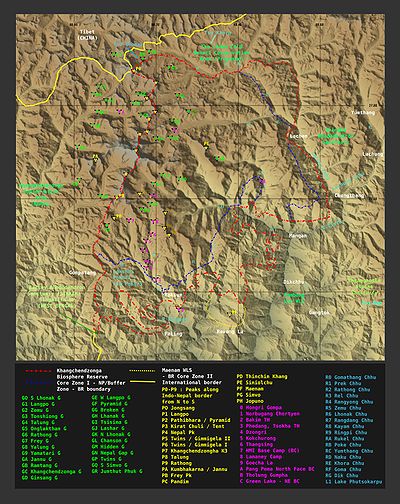 The five peaks of Kangchenjunga are as follows:
The huge massif of Kangchenjunga is buttressed by great ridges running roughly due east to west and north to south, forming a giant 'X'. These ridges contain a host of peaks between 6,000 and 8,000 metres. On the east ridge in Sikkim, is Siniolchu
(6,888 m/22,600 ft). The west ridge culminates in the magnificent Jannu
(7,710 m/25,294 ft) with its imposing north face. To the south, clearly visible from Darjeeling, are Kabru
North (7,338 m/24,075 ft), Kabru South (7,316 m/24,002 ft) and Rathong peaks (6,678 m/21,910 ft). The north ridge, after passing through the minor subpeak Kangchenjunga North (7741 m/25,397 ft), contains The Twins and Tent Peak, and runs up to the Tibetan border by the Jongsong La, a 6120 m (20,078.7 ft) pass.
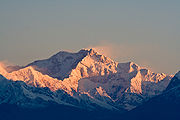 Some of the most famous views of Kangchenjunga are from the hill station
of Darjeeling. On a clear day, it presents an image not as much of a mountain but of a white wall hanging from the sky. The people of Sikkim revere Kangchenjunga as a sacred mountain. Permission to climb the mountain from the Indian side is rare, but sometimes allowed.
Because of its remote location in Nepal and difficult access from India, the Kangchenjunga region is not much explored by trekkers. It has, therefore, retained much of its pristine beauty. In Sikkim too, trekking into the Kangchenjunga region has just been permitted. The Goecha La
trek is gaining popularity amongst tourists. It goes to the Goecha La Pass, located right in front of the huge southeast face of Kangchenjunga. Another trek to Green Lake Basin has recently been opened for trekking. This goes to the Northeast side of Kangchenjunga along the famous Zemu Glacier
.


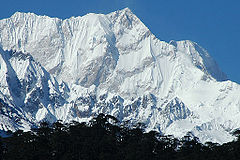
and George Band made the first ascent on May 25, followed by Norman Hardie and Tony Streather on May 26. The full team also included John Clegg (team doctor), Charles Evans (team leader), John Angelo Jackson
, Neil Mather, and Tom Mackinnon.
The ascent proved that Aleister Crowley
's 1905 route (also investigated by the 1954 reconnaissance) was viable. The route starts on the Yalung Glacier to the southwest of the peak, and climbs the Yalung Face, which is 3000 metres (9,842.5 ft) high. The main feature of this face is the "Great Shelf", a large sloping plateau at around 7500 metres (24,606.3 ft), covered by a hanging glacier. The route is almost entirely on snow, glacier
, and one icefall
; the summit ridge itself can involve a small amount of travel on rock. The first ascent expedition made six camps above their base camp, two below the Shelf, two on it, and two above it. They started on April 18, and everyone was back to base camp by May 28.
or rakshasa
. A British geological expedition in 1925 spotted a bipedal creature which they asked the locals about, who referred to it as the "Kangchenjunga Demon".
 Some titles are no longer in print but are easily locatable on the Internet.
The above Himalayan Journal References were all also reproduced in the "50th Anniversary of the First Ascent of Kangchenjunga" The himalayan Club, Kollkata Section 2005.
Mountain
Image:Himalaya_annotated.jpg|thumb|right|The Himalayan mountain range with Mount Everestrect 58 14 160 49 Chomo Lonzorect 200 28 335 52 Makalurect 378 24 566 45 Mount Everestrect 188 581 920 656 Tibetan Plateaurect 250 406 340 427 Rong River...
of the world with an elevation of 8586 m (28,169.3 ft) and located along the India-Nepal border in the Himalayas
Himalayas
The Himalaya Range or Himalaya Mountains Sanskrit: Devanagari: हिमालय, literally "abode of snow"), usually called the Himalayas or Himalaya for short, is a mountain range in Asia, separating the Indian subcontinent from the Tibetan Plateau...
.
Kangchenjunga is also the name of the section of the Himalayas and means "The Five Treasures of Snows", as it contains five peaks, four of them over 8450 m (27,723.1 ft). The treasures represent the five repositories of God, which are gold
Gold
Gold is a chemical element with the symbol Au and an atomic number of 79. Gold is a dense, soft, shiny, malleable and ductile metal. Pure gold has a bright yellow color and luster traditionally considered attractive, which it maintains without oxidizing in air or water. Chemically, gold is a...
, silver
Silver
Silver is a metallic chemical element with the chemical symbol Ag and atomic number 47. A soft, white, lustrous transition metal, it has the highest electrical conductivity of any element and the highest thermal conductivity of any metal...
, gems
Gemstone
A gemstone or gem is a piece of mineral, which, in cut and polished form, is used to make jewelry or other adornments...
, grain
GRAIN
GRAIN is a small international non-profit organisation that works to support small farmers and social movements in their struggles for community-controlled and biodiversity-based food systems. Our support takes the form of independent research and analysis, networking at local, regional and...
, and holy books.
Three of the five peaks – main, central, and south – are on the border of North Sikkim
North Sikkim
North Sikkim is a district of the Indian state of Sikkim. Its district headquarters is Mangan. It is the seventh least populous district in the country .-Geography:The district is the largest of the four districts of Sikkim....
in India
India
India , officially the Republic of India , is a country in South Asia. It is the seventh-largest country by geographical area, the second-most populous country with over 1.2 billion people, and the most populous democracy in the world...
and Taplejung District
Taplejung District
Taplejung District of 134,698.The name Taplejung is derived from the words "Taple" and "Jung". Taple was the medieval Limbu King who used to rule the area and "Jung" in Limbu language means Fort. Literally, Taplejung means Fort of King Taple....
of Nepal
Nepal
Nepal , officially the Federal Democratic Republic of Nepal, is a landlocked sovereign state located in South Asia. It is located in the Himalayas and bordered to the north by the People's Republic of China, and to the south, east, and west by the Republic of India...
, while the other two are completely in Taplejung District. The Kangchenjunga Himal includes twelve more peaks over 7000 m (22,965.9 ft).
Until 1852, Kangchenjunga was assumed to be the highest mountain in the world, but calculations made by the Great Trigonometric Survey
Great Trigonometric Survey
The Great Trigonometric Survey was a project of the Survey of India throughout most of the 19th century. It was piloted in its initial stages by William Lambton, and later by George Everest. Among the many accomplishments of the Survey were the demarcation of the British territories in India and...
of India in 1849 came to the conclusion that Mount Everest (known as Peak XV at the time) was the highest and Kangchenjunga the third-highest. Kangchenjunga was first climbed on May 25, 1955 by Joe Brown
Joe Brown (climber)
Joseph Brown, CBE is an English climber, born the seventh and last child of a family in the Manchester suburb of Ardwick. He became famous for climbing during the 1950s, and was a member of the Valkyrie climbing club and founding member of the Rock and Ice climbing club. An early climbing partner...
and George Band
George Band
George Christopher Band OBE ) was an English mountaineer.Band was born in Taiwan and educated at Eltham College...
, who were part of a British
United Kingdom
The United Kingdom of Great Britain and Northern IrelandIn the United Kingdom and Dependencies, other languages have been officially recognised as legitimate autochthonous languages under the European Charter for Regional or Minority Languages...
expedition. The British expedition honoured the beliefs of the Sikkimese, who hold the summit sacred, by stopping a few feet short of the actual summit. Most successful summit parties since then have followed this tradition.
Names
Kangchenjunga is the official spelling adopted by Douglas FreshfieldDouglas Freshfield
Douglas William Freshfield was a British lawyer, mountaineer and author, who edited the Alpine Journal from 1872 to 1880...
, A.M. Kellas, and the Royal Geographical Society
Royal Geographical Society
The Royal Geographical Society is a British learned society founded in 1830 for the advancement of geographical sciences...
that gives the best indication of the Tibetan
Tibetan language
The Tibetan languages are a cluster of mutually-unintelligible Tibeto-Burman languages spoken primarily by Tibetan peoples who live across a wide area of eastern Central Asia bordering the Indian subcontinent, including the Tibetan Plateau and the northern Indian subcontinent in Baltistan, Ladakh,...
pronunciation.
The name Kangchenjunga stems from Bhutia and Tibetan languages. Its name in Nepali
Nepali language
Nepali or Nepalese is a language in the Indo-Aryan branch of the Indo-European language family.It is the official language and de facto lingua franca of Nepal and is also spoken in Bhutan, parts of India and parts of Myanmar...
is कञ्चनजङ्घा Kanchanjaŋghā. Its name in the local Limbu language
Limbu language
Limbu is a Tibeto-Burman language spoken in Nepal, Bhutan, Sikkim, Kashmir and Darjeeling district, West Bengal, India, by the Limbu community. Virtually all Limbus are bilingual in Nepali....
is Sewalungma, meaning Mountain that we offer greetings to. Sewalungma is considered sacred in the Kirant
Kirant
Kirat or Kirati are indigenous ethnic groups of the Himalayas extending eastward from Nepal into India, Burma and beyond. They migrated to their present locations via Assam, Burma, Tibet and Yunnan in ancient times...
religion.
There are a number of alternative spellings which include Kangchen Dzö-nga, Khangchendzonga, Kanchenjanga, Kachendzonga, Kanchenjunga or Kangchanfanga. The final word on the use of the name Kangchenjunga came from His Highness Sir Tashi Namgyal
Tashi Namgyal
Tashi Namgyal was the ruling Chogyal of Sikkim from 1914 to 1963...
, the Maharaja
Maharaja
Mahārāja is a Sanskrit title for a "great king" or "high king". The female equivalent title Maharani denotes either the wife of a Maharaja or, in states where that was customary, a woman ruling in her own right. The widow of a Maharaja is known as a Rajamata...
or chogyal
Chogyal
The Chogyal were the monarchs of the former kingdoms of Sikkim and Ladakh, which were ruled by separate branches of the Namgyal family. The Chogyal, or divine ruler, was the absolute potentate of Sikkim from 1642 to 1975, when its monarchy was abrogated and its people voted to make Sikkim India's...
of Sikkim, who stated that "although junga had no meaning in Tibetan, it really ought to have been Zod-nga (treasure, five) Kang-chen (snow, big) to convey the meaning correctly". Following consultations with a Lieutenant-Colonel J.L.R. Weir (British political agent to Sikkim), he agreed that it was best to leave it as Kangchenjunga, and thus the name remained so by acceptance and usage.
Protected areas
The Kangchenjunga transboundary landscape is shared by BhutanBhutan
Bhutan , officially the Kingdom of Bhutan, is a landlocked state in South Asia, located at the eastern end of the Himalayas and bordered to the south, east and west by the Republic of India and to the north by the People's Republic of China...
, China
China
Chinese civilization may refer to:* China for more general discussion of the country.* Chinese culture* Greater China, the transnational community of ethnic Chinese.* History of China* Sinosphere, the area historically affected by Chinese culture...
, India
India
India , officially the Republic of India , is a country in South Asia. It is the seventh-largest country by geographical area, the second-most populous country with over 1.2 billion people, and the most populous democracy in the world...
and Nepal, and comprises 14 protected areas with a total of 6032 km² (2,329 sq mi): Kanchenjunga Conservation Area
Kanchenjunga Conservation Area
The Kanchenjunga Conservation Area is a protected area in the Himalayas of eastern Nepal. Established in 1997 it covers in the Taplejung District. In the north it adjoins the Qomolangma Feng National Nature Reserve in Tibet, and in the east the Kanchanjunga Biosphere Reserve in Sikkim...
located in Nepal, Kanchenjunga Biosphere Reserve
Khangchendzonga National Park
Khangchendzonga National Park also Kanchenjunga Biosphere Reserve is a National Park and a Biosphere reserve located in North Sikkim district in the Indian state of Sikkim....
, Barsey Rhododendron Sanctuary, Fambong Lho Wildlife Sanctuary, Kyongnosla Alpine Sanctuary
Kyongnosla Alpine Sanctuary
The Kyongnosla Alpine Sanctuary is a National Park of India, located in East Sikkim. It is situated around the area adjoining the Tsomgo lake along the Nathula Road...
, Mainam Wildlife Sanctuary, Singhba Rhododendron Sanctuary, Pangolakha Wildlife Sanctuary located in Sikkim
Sikkim
Sikkim is a landlocked Indian state nestled in the Himalayan mountains...
, Jorepokhari Salamander Sanctuary, Singhalila National Park, Senchel Wildlife Sanctuary, Mahananda Wildlife Sanctuary
Mahananda Wildlife Sanctuary
Mahananda Wildlife Sanctuary is located on the foothills of the Himalayas, between the Teesta and Mahananda rivers.-Location and History:Mahananda Wildlife Sanctuary is situated in the Darjeeling district of West Bengal, India. It comes under Darjeeling Wildlife division and can be reached from...
, Neora Valley National Park
Neora Valley National Park
Neora Valley National Park is situated in the Kalimpong subdivision under Darjeeling District, West Bengal, India and was established in 1986. It spreads over an area of 88 km² and is one of the richest biological zones in the entire Northeast...
located in Darjeeling
Darjeeling district
Darjeeling District is the northernmost district of the state of West Bengal in eastern India in the foothills of the Himalayas. The district is famous for its beautiful hill stations and Darjeeling tea. Darjeeling is the district headquarters...
, and Toorsa Strict Nature Reserve located in Bhutan. These protected areas are habitats for many globally significant plant
Plant
Plants are living organisms belonging to the kingdom Plantae. Precise definitions of the kingdom vary, but as the term is used here, plants include familiar organisms such as trees, flowers, herbs, bushes, grasses, vines, ferns, mosses, and green algae. The group is also called green plants or...
species such as rhododendron
Rhododendron
Rhododendron is a genus of over 1 000 species of woody plants in the heath family, most with showy flowers...
s and orchids and many endangered
Endangered species
An endangered species is a population of organisms which is at risk of becoming extinct because it is either few in numbers, or threatened by changing environmental or predation parameters...
flagship species such as snow leopard
Snow Leopard
The snow leopard is a moderately large cat native to the mountain ranges of South Asia and Central Asia...
, Asiatic black bear
Asiatic Black Bear
The Asian black bear , also known as the moon bear or white-chested bear is a medium-sized species of bear, largely adapted for arboreal life, which occurs through much of southern Asia, Korea, northeastern China, the Russian far east and Honshū and Shikoku islands of Japan...
, red panda
Red Panda
The red panda , is a small arboreal mammal native to the eastern Himalayas and southwestern China. It is the only species of the genus Ailurus. Slightly larger than a domestic cat, it has reddish-brown fur, a long, shaggy tail, and a waddling gait due to its shorter front legs...
, Himalayan musk deer
Himalayan Musk Deer
The Himalayan Musk Deer is a species of musk deer. It used to be considered a subspecies of the Alpine musk deer.It is found in parts of northern Afghanistan, Pakistan, Tibet, Bhutan, Nepal, and in northern parts of India such as Kashmir, Kumaon and Sikkim. It inhabits high alpine environments,...
, blood pheasant
Blood Pheasant
The Blood Pheasant is the only species in genus Ithaginis of the pheasant family. This relatively small, short-tailed pheasant is widespread and fairly common in northern Southasia...
and chestnut-breasted partridge
Chestnut-breasted Partridge
The Chestnut-breasted Partridge is a species of partridge endemic to the eastern Himalayas north of the Brahmaputra, and is known from Bhutan, West Bengal , Sikkim and Arunachal Pradesh, north-east India, Nepal Himalaya and south-east Tibet.It is a distinctive partridge with chestnut breast-band...
.
Geography
| Name of peak | Height (m) | Height (ft) | Prominence (m) | Prominence (ft) | Nearest Higher Neighbor |
|---|---|---|---|---|---|
| Kangchenjunga Main | 8,586 | 28,169 | 3,922 | 12,867 | Mount Everest - South Summit |
| Kangchenjunga West (Yalung Kang) | 8,505 | 27,904 | 135 | 443 | Kangchenjunga |
| Kangchenjunga Central (Middle) | 8,482 | 27,828 | 32 | 105 | Kangchenjunga South |
| Kangchenjunga South | 8,494 | 27,867 | 119 | 390 | Kangchenjunga |
| Kangbachen | 7,903 | 25,928 | 103 | 337 | Kangchenjunga West |
The huge massif of Kangchenjunga is buttressed by great ridges running roughly due east to west and north to south, forming a giant 'X'. These ridges contain a host of peaks between 6,000 and 8,000 metres. On the east ridge in Sikkim, is Siniolchu
Siniolchu
Siniolchu is one of the tallest mountains of the Indian state of Sikkim. The mountain is considered to be a particularly beautiful mountain, having been described by Douglas Freshfield as "the most superb triumph of mountain architecture and the most beautiful snow mountain in the world"...
(6,888 m/22,600 ft). The west ridge culminates in the magnificent Jannu
Jannu
Jannu or Kumbhakarna is the 32nd highest mountain in the world. It is an important Western outlier of Kangchenjunga, the world's third highest peak. Jannu is a large and steep peak in its own right, and has numerous challenging climbing routes.The official name of this peak is Kumbhakarna, but the...
(7,710 m/25,294 ft) with its imposing north face. To the south, clearly visible from Darjeeling, are Kabru
Kabru
Kabru is a mountain in the Himalayas on the border of India and eastern Nepal. It is part of a ridge that extends south from Kangchenjunga.The main features of this ridge are as follows :* Kangchenjunga south top, 8476 m, at...
North (7,338 m/24,075 ft), Kabru South (7,316 m/24,002 ft) and Rathong peaks (6,678 m/21,910 ft). The north ridge, after passing through the minor subpeak Kangchenjunga North (7741 m/25,397 ft), contains The Twins and Tent Peak, and runs up to the Tibetan border by the Jongsong La, a 6120 m (20,078.7 ft) pass.
Hill station
A hill station is a town located at a higher elevation than the nearby plain or valley. The term was used mostly in colonial Asia , but also in Africa , for towns founded by European colonial rulers as refuges from the summer heat, up where temperatures are cooler...
of Darjeeling. On a clear day, it presents an image not as much of a mountain but of a white wall hanging from the sky. The people of Sikkim revere Kangchenjunga as a sacred mountain. Permission to climb the mountain from the Indian side is rare, but sometimes allowed.
Because of its remote location in Nepal and difficult access from India, the Kangchenjunga region is not much explored by trekkers. It has, therefore, retained much of its pristine beauty. In Sikkim too, trekking into the Kangchenjunga region has just been permitted. The Goecha La
Goecha La
Goecha La is a high mountain pass in Sikkim, India in the Himalaya range.The southeast face of Kanchenjunga, the world's third highest mountain, is viewable from the pass, which is also a base camp for those aspiring to scale the mountain....
trek is gaining popularity amongst tourists. It goes to the Goecha La Pass, located right in front of the huge southeast face of Kangchenjunga. Another trek to Green Lake Basin has recently been opened for trekking. This goes to the Northeast side of Kangchenjunga along the famous Zemu Glacier
Zemu Glacier
Zemu Glacier is the largest glacier in the Eastern Himalaya.It is about in length and found at the base of the Kangchenjunga in the Sikkim Himalaya, India. It may be one of the sources for the Teesta River.-Purported Yeti Sighting:...
.
Climbing history
Early reconnaissance and attempts
- In 1848/49, Joseph Dalton HookerJoseph Dalton HookerSir Joseph Dalton Hooker OM, GCSI, CB, MD, FRS was one of the greatest British botanists and explorers of the 19th century. Hooker was a founder of geographical botany, and Charles Darwin's closest friend...
explored parts of the eastern Nepal previously completely unknown to Europeans. He made repeated tours of the river valleys into the foothills leading up to Kangchenjunga, reaching within 22 km (13.7 mi) of the peak and passes into Tibet. - In 1855, Hermann SchlagintweitHermann SchlagintweitHermann Schlagintweit, Sakünlünski , also known as Hermann Rudolph Alfred von Schlagintweit-Sakünlünski, was a German explorer of Central Asia....
from Germany was put in charge of the Magnetic Survey of India, exploring the vicinity and painting a panorama of Everest and Kangchenjunga, prior to being turned back by Nepalese soldiers. - In 1883, a party of William Woodman GrahamWilliam Woodman GrahamWilliam Woodman Graham was a British mountaineer who led the first pure mountaineering expedition to the Himalayas and may have set a world altitude record on Kabru....
, the British pioneer of Himalayan mountaineering, claimed to have circumnavigated the mountain in March 1882. After climbing an 18000 ft (5,486.4 m) peak, they were forced to return to Darjeeling after only a week. They returned in July 1883 with two Swiss guides for a purported attempt whilst climbing other peaks in the area and hunting snow leopardSnow LeopardThe snow leopard is a moderately large cat native to the mountain ranges of South Asia and Central Asia...
. - In 1899, British mountaineer Douglas Freshfield set out with his party comprising the Italian photographer Vittorio SellaVittorio SellaVittorio Sella was an Italian photographer and mountaineer, who took photographs of mountains which are regarded as some of the finest ever made....
. They were the first mountaineers to examine the lower and upper ramparts, and the great western face of Kangchenjunga, rising from the Kangchenjunga Glacier. - In 1905, a party headed by Aleister CrowleyAleister CrowleyAleister Crowley , born Edward Alexander Crowley, and also known as both Frater Perdurabo and The Great Beast, was an influential English occultist, astrologer, mystic and ceremonial magician, responsible for founding the religious philosophy of Thelema. He was also successful in various other...
was the first attempt at climbing the mountain. Aleister Crowley had been part of the team attempting the 1902 ascent of K2K2K2 is the second-highest mountain on Earth, after Mount Everest...
. The team reached an estimated altitude of 6500 m (21,325.5 ft) on the southwest side of the mountain before turning back. The exact height reached is somewhat unclear; Crowley stated that on August 31, "We were certainly over 21000 ft (6,400.8 m) and possibly over 22000 ft (6,705.6 m)", when the team was forced to retreat to Camp 5 by the risk of avalanche. On September 1, they evidently went further; some members of the team (Reymond, Pache and Salama) "got over the bad patch" that had forced them to return to Camp 5 the day before, and progressed "out of sight and hearing" before returning to Crowley and the men with packs, who could not cross the dangerous section unassisted with their burdens. It is not clear how far Reymond, Pache and Salama had ascended - but in summarizing, Crowley ventured "We had reached a height of approximately 25000 ft (7,620 m)." Attempting a "mutinous" late-in-the-day descent from Camp 5 to Camp 4, climber Alexis Pache (who earlier that day had been one of three to ascend possibly higher than any before), and three local porters, were killed in an avalanche. Despite the insistence of one of the men that "The demon of Kangchenjunga was propitiated with the sacrifice", Crowley decided enough was enough and that it was inappropriate to continue. - In 1929, a German expedition led by Paul Bauer reached 7400 m (24,278.2 ft) on the northeast spur before being turned back by a five-day stormStormA storm is any disturbed state of an astronomical body's atmosphere, especially affecting its surface, and strongly implying severe weather...
. - In 1930, an international expedition led by George Dyhrenfurth, German Uli Wieland, Austrian Erwin Schneider and Englishman Frank SmytheFrank SmytheFrancis Sydney Smythe better known as Frank Smythe was a British mountaineer, author, photographer and botanist. He is best remembered for his mountaineering in the Alps and the Himalayas. He identified a region that he named the "Valley of Flowers", now a protected park...
(who published "The Kangchenjunga Adventure" in the same year). The attempt failed due to poor weather and snow conditions. - In 1931, a second German expedition, led again by Paul Bauer, attempted the northeast spur before being turned back by bad weather, illnesses, and deaths. The expedition retreated after climbing only a little higher than the 1929 attempt.
- In 1954, a reconnaissance of Kangchenjunga's southwest side was made by John Kempe (leader), J.W. Tucker, Ron Jackson, Trevor H. Braham, G.C. Lewis, and Dr. D.S. Mathews. This reconnaissance led to the route used by the successful 1955 expedition.
First ascent
In 1955, Joe BrownJoe Brown (climber)
Joseph Brown, CBE is an English climber, born the seventh and last child of a family in the Manchester suburb of Ardwick. He became famous for climbing during the 1950s, and was a member of the Valkyrie climbing club and founding member of the Rock and Ice climbing club. An early climbing partner...
and George Band made the first ascent on May 25, followed by Norman Hardie and Tony Streather on May 26. The full team also included John Clegg (team doctor), Charles Evans (team leader), John Angelo Jackson
John Angelo Jackson
John Angelo Jackson was an English mountaineer, explorer and educationalist.-Early life:He was brought up and educated in Nelson, Lancashire. Before World War II, he was apprenticed in pharmacy. However, at the outbreak of war, he left to volunteer for the R.A.F. in which he served for six...
, Neil Mather, and Tom Mackinnon.
The ascent proved that Aleister Crowley
Aleister Crowley
Aleister Crowley , born Edward Alexander Crowley, and also known as both Frater Perdurabo and The Great Beast, was an influential English occultist, astrologer, mystic and ceremonial magician, responsible for founding the religious philosophy of Thelema. He was also successful in various other...
's 1905 route (also investigated by the 1954 reconnaissance) was viable. The route starts on the Yalung Glacier to the southwest of the peak, and climbs the Yalung Face, which is 3000 metres (9,842.5 ft) high. The main feature of this face is the "Great Shelf", a large sloping plateau at around 7500 metres (24,606.3 ft), covered by a hanging glacier. The route is almost entirely on snow, glacier
Glacier
A glacier is a large persistent body of ice that forms where the accumulation of snow exceeds its ablation over many years, often centuries. At least 0.1 km² in area and 50 m thick, but often much larger, a glacier slowly deforms and flows due to stresses induced by its weight...
, and one icefall
Icefall
An icefall is a portion of some glaciers characterized by rapid flow and a chaotic crevassed surface. Perhaps the most conspicuous consequence of glacier flow, icefalls occur where the glacier bed steepens and/or narrows...
; the summit ridge itself can involve a small amount of travel on rock. The first ascent expedition made six camps above their base camp, two below the Shelf, two on it, and two above it. They started on April 18, and everyone was back to base camp by May 28.
Other notable ascents
- 1973 Climbers Yutaka Ageta and Takeo Matsuda of the Japanese expedition summitted Kangchenjunga West (Yalung Kang) by climbing the SW Ridge.
- 1977 The second ascent of Kangchenjunga, by an Indian Army team led by Colonel Narinder Kumar. They completed the northeast spur, the difficult ridge that defeated the German expeditions in 1929 and 1931.
- 1978 Polish teams made the first successful ascents of the summits Kangchenjunga South (Wojciech Wróż and Eugeniusz Chrobak, 19 May) and Kangchenjunga Central (Wojciech Brański, Zygmunt Andrzej Heinrich, Kazimierz Olech, 22 May).
- 1979 The third ascent, on May 15, and the first without oxygen, by Doug ScottDoug ScottDouglas Keith Scott CBE, known as Doug Scott , is an English mountaineer noted for the first ascent of the south-west face of Mount Everest on 24 September 1975. Scott and Dougal Haston were the first Britons to climb Everest during this expedition...
, Peter BoardmanPeter BoardmanPeter Boardman was a British climber, Everest summiteer, and author of several mountaineering books.-Early life:...
and Joe TaskerJoe TaskerJoe Tasker was one of the most talented British climbers during the late 1970s and early 1980s. Born into a traditional Roman Catholic family, he was one of ten children and spent his early childhood in Port Clarence, Middlesbrough then attended Ushaw Seminary, County Durham between the ages of 13...
establishing a new route on the North Ridge - 1983 Pierre Beghin made the first solo ascent. It was accomplished without the use of supplemental oxygen.
- 1986 On January 11, Krzysztof WielickiKrzysztof WielickiKrzysztof Wielicki is a Polish retired alpine and high-altitude climber. He is the fifth man to climb all fourteen eight-thousanders and the first ever to climb Mount Everest, Kangchenjunga, and Lhotse in the winter. He is a member of The Explorers Club...
and Jerzy KukuczkaJerzy KukuczkaJerzy Kukuczka , born in Katowice, Poland, was a Polish alpine and high-altitude climber. On 18 September 1987, he became the second man, after Reinhold Messner, to climb all fourteen eight-thousanders in the world....
, PolishPolandPoland , officially the Republic of Poland , is a country in Central Europe bordered by Germany to the west; the Czech Republic and Slovakia to the south; Ukraine, Belarus and Lithuania to the east; and the Baltic Sea and Kaliningrad Oblast, a Russian exclave, to the north...
climbers, made the first winter ascent. - 1991 Marija Frantar and Joze Rozman attempted the first ascent by a woman but their bodies were later found below the summit headwall.
- 1991 Andrej Stremfelj and Marko PrezeljMarko PrezeljMarko Prezelj is a Slovenian mountaineer and photographer.Prezelj received two Piolet d'Or awards. He won the inaugural "Oscar of mountaineering" in 1992 with Andrej Štremfelj for their new route on the south ridge of Kangchenjunga South in alpine style...
completed an alpine-style climb up the south ridge of Kangchenjunga to the south summit (8,494 m). - 1992 Carlos CarsolioCarlos CarsolioCarlos Carsolio Larrea is a Mexican mountain climber. Carsolio is known for being the fourth man and the second youngest to climb the world's 14 eight-thousander mountain peaks, all of them without supplementary oxygen .- Early years :Carsolio, the eldest of...
made the only summit that year. It was in a solo climb without supplementary oxygen. - 1992 Wanda RutkiewiczWanda RutkiewiczWanda Rutkiewicz was a Polish mountain climber. She was the first woman to successfully summit K2.-Early life:Rutkiewicz was born in Plungė, Lithuania...
, the first woman to ascend and descend K2K2K2 is the second-highest mountain on Earth, after Mount Everest...
and a respected PolishPolesthumb|right|180px|The state flag of [[Poland]] as used by Polish government and diplomatic authoritiesThe Polish people, or Poles , are a nation indigenous to Poland. They are united by the Polish language, which belongs to the historical Lechitic subgroup of West Slavic languages of Central Europe...
climber, died after she declined to descend in the face of an incoming storm. - 1995 Benoît ChamouxBenoît ChamouxBenoît Chamoux was a French Alpinist, who climbed 10 of the Eight-thousanders in the Himalayas.Chamoux was born in La Roche-sur-Foron near Mont Blanc in the department of Haute-Savoie, France...
, Pierre Royer and their Sherpa guide disappeared on October 6 near the summit. - 1998 Ginette HarrisonGinette HarrisonGinette Harrison was a professional climber of British origin. She also lived in Australia and the United States....
became the first woman to reach the summit. Until then Kangchenjunga was the only eight-thousander that had not seen a female ascent. - 2005 Alan HinkesAlan HinkesAlan Hinkes OBE is an English mountaineer from Northallerton in North Yorkshire. Hinkes is the first British mountaineer to have summited all 14 mountains with elevations greater than 8000 metres, the so-called Eight-thousanders; however, this claim is disputed.He was awarded an Honorary...
, a British climber, was the only person to summit in the 50th anniversary of first ascent year. - 2006 Gerlinde KaltenbrunnerGerlinde KaltenbrunnerGerlinde Kaltenbrunner is an Austrian mountaineer. In August 2011, she became the second woman to climb the fourteen eight-thousanders, and the first woman to do so without the use of supplementary oxygen....
, an Austrian mountaineer, was the second woman to reach the summit. - 2009 Jon Gangdal and Mattias Karlsson reached the summit, becoming, respectively, the first Norwegian and Swedish mountaineer to summit this mountain.
- 2009 Edurne PasabanEdurne PasabanEdurne Pasaban Lizarribar is a Basque Spanish mountaineer, from the province of Gipuzkoa in the Basque Country. On May 17, 2010, she became the 21st person and the first woman to climb all of the fourteen eight-thousander peaks in the World...
, a Spanish mountaineer, reached the summit, becoming the first woman to summit 12 eight-thousands. - 2009 Kinga BaranowskaKinga BaranowskaKinga Baranowska - - Polish mountaineer. Currently living in Warsaw.She summited her first eight-thousander - Cho Oyu - in 2003. Failed on attempt to reach one of the most difficult seven-thousander Jengish Chokusu in Tian-Shan range. In 2006 she successfully reached the top of Broad Peak...
became the first Polish woman climber to reach the Summit of Kangchenjunga. - 2011 Tunc Findik became the first Turkish man to reach the peak of Kangchenjunga, his 7th 8000er, with Swiss partner Guntis Brandts via the British 1955 SW Face route.
- 2011 Indian Mountaineers [ Basanta Singha Roy and Debasish Biswas ] of Mountaineers' Association of Krishnanagar,{MAK}, West Bengal, India, successfully scaled Kangchenjunga [Main] on 20.05.2011.
In myth
The area around Kangchenjunga is said to be home to the "Kangchenjunga Demon", a type of yetiYeti
The Yeti or Abominable Snowman is an ape-like cryptid said to inhabit the Himalayan region of Nepal, and Tibet. The names Yeti and Meh-Teh are commonly used by the people indigenous to the region, and are part of their history and mythology...
or rakshasa
Rakshasa
A Rakshasa or alternatively rakshas, is a race of mythological humanoid beings or unrighteous spirit in Hindu and Buddhist religion...
. A British geological expedition in 1925 spotted a bipedal creature which they asked the locals about, who referred to it as the "Kangchenjunga Demon".
In literature
- In the Swallows and Amazons series of books by Arthur RansomeArthur RansomeArthur Michell Ransome was an English author and journalist, best known for writing the Swallows and Amazons series of children's books. These tell of school-holiday adventures of children, mostly in the Lake District and the Norfolk Broads. Many of the books involve sailing; other common subjects...
, a high mountain (unnamed in the book, but clearly based on the Old Man of ConistonOld Man of ConistonThe Old Man of Coniston is a fell in the Furness Fells in the English Lake District. It is high, and lies to the west of the village of Coniston and the lake of the same name, Coniston Water. The fell is sometimes known by the alternate name of Coniston Old Man, or simply The Old Man...
in the English Lake DistrictLake DistrictThe Lake District, also commonly known as The Lakes or Lakeland, is a mountainous region in North West England. A popular holiday destination, it is famous not only for its lakes and its mountains but also for its associations with the early 19th century poetry and writings of William Wordsworth...
) is given the name "Kanchenjunga" by the children when they climb it in 1931.
- In The Epic of Mount Everest, first published in 1926, Sir Francis YounghusbandFrancis YounghusbandLieutenant Colonel Sir Francis Edward Younghusband, KCSI, KCIE was a British Army officer, explorer, and spiritual writer...
: " For natural beauty Darjiling (Darjeeling) is surely unsurpassed in the world. From all countries travellers come there to see the famous view of Kangchenjunga, 28150 feet (8,580.1 m) in height, and only 40 miles (64.4 km) distant. Darjiling (Darjeeling) itself is 7000 feet (2,133.6 m) above sea-level and is set in a forest of oaks, magnolia, rhododendrons, laurels and sycamores. And through these forests the observer looks down the steep mountain-sides to the Rangeet River only 1000 feet (304.8 m) above sea-level, and then up and up through tier after tier of forest-clad ranges, each bathed in a haze of deeper and deeper purple, till the line of snow is reached; and then still up to the summit of Kangchenjunga, now so pure and ethereal we can scarcely believe it is part of the solid earth on which we stand; and so high it seems part of the very sky itself."
- In 1999, official James BondJames BondJames Bond, code name 007, is a fictional character created in 1953 by writer Ian Fleming, who featured him in twelve novels and two short story collections. There have been a six other authors who wrote authorised Bond novels or novelizations after Fleming's death in 1964: Kingsley Amis,...
author Raymond BensonRaymond BensonRaymond Benson is an American author best known for being the official author of the adult James Bond novels from 1997 to 2003. Benson was born in Midland, Texas and graduated from Permian High School in Odessa in 1973...
published High Time to KillHigh Time to KillHigh Time to Kill, published in 1999, is the fourth novel by Raymond Benson featuring Ian Fleming’s secret agent, James Bond . This is the first James Bond novel copyrighted by Ian Fleming Publications...
. In this story, a microdotMicrodotA microdot is text or an image substantially reduced in size onto a 1mm disc to prevent detection by unintended recipients. Microdots are normally circular around one millimetre in diameter but can be made into different shapes and sizes and made from various materials such as polyester...
containing a secret formula for aviation technology is stolen by a society called the Union. During their escape, their plane crashes on the slopes of Kangchenjunga and James Bond becomes part of a climbing expedition in order to retrieve the formula.
- The Inheritance of LossThe Inheritance of LossThe Inheritance of Loss is the second novel by Indian author Kiran Desai. It was first published in 2006. It won a number of awards, including the Man Booker Prize for that year, the National Book Critics Circle Fiction Award in 2007, and the 2006 Vodafone Crossword Book Award.It was written over a...
by Kiran DesaiKiran DesaiKiran Desai is an Indian author who is a citizen of India and a permanent resident of the United States. Her novel The Inheritance of Loss won the 2006 Man Booker Prize and the National Book Critics Circle Fiction Award...
, which won the 2006 Man Booker PrizeMan Booker PrizeThe Man Booker Prize for Fiction is a literary prize awarded each year for the best original full-length novel, written in the English language, by a citizen of the Commonwealth of Nations, Ireland, or Zimbabwe. The winner of the Man Booker Prize is generally assured of international renown and...
, is set partly in Kalimpong, a hill stationHill stationA hill station is a town located at a higher elevation than the nearby plain or valley. The term was used mostly in colonial Asia , but also in Africa , for towns founded by European colonial rulers as refuges from the summer heat, up where temperatures are cooler...
situated near Kangchenjunga.
Background reading
- Joseph Dalton HookerJoseph Dalton HookerSir Joseph Dalton Hooker OM, GCSI, CB, MD, FRS was one of the greatest British botanists and explorers of the 19th century. Hooker was a founder of geographical botany, and Charles Darwin's closest friend...
Himalayan Journals, 1855. Assistant-director of the Royal Botanic Gardens, Kew. - Maj Laurence Waddell, Among The Himalayas, 1899; Travels in Sikkim. Book includes the exploration of the south of Kangchenjunga.
- Aleister CrowleyAleister CrowleyAleister Crowley , born Edward Alexander Crowley, and also known as both Frater Perdurabo and The Great Beast, was an influential English occultist, astrologer, mystic and ceremonial magician, responsible for founding the religious philosophy of Thelema. He was also successful in various other...
The Confessions of Aleister Crowley, Chapters 51, 52 & 53, Tells of the 1905 Kangchenjunga Expedition by he and Dr. Jacot-Guillarmod. - Douglas FreshfieldDouglas FreshfieldDouglas William Freshfield was a British lawyer, mountaineer and author, who edited the Alpine Journal from 1872 to 1880...
Round Kangchenjunga - A Narrative of Mountain Travel and Exploration, published by Edward Arnold 1903 (Publisher to the H.M. India Office). - Paul Bauer Himalayan Campaign (Blackwell, 1937) is the story of Bauer’s two attempts in 1929 and 1931, republished as Kangchenjunga Challenge (William Kimber, 1955).
- Paul Bauer The German Attack on Kangchenjunga, The Himalayan Journal, 1930 Vol. II.
- Lieut. Col. H.W. Tobin Exploration and Climbing in The Sikkim Himalaya The Himalayan Journal, April 1930 Vol. II. Provides the early exploration and climbing attempts on Kangchenjunga.
- F.S. Smythe The Kangchenjunga Adventure, 1930 to 1931. Victor Gollancz, Ltd. Smythe was the team member responsible for writing and sending the dispatches to The StatesmanThe StatesmanThe Statesman is an Indian English-language broadsheet daily newspaper founded in 1875 and published simultaneously in Kolkata, New Delhi, Siliguri and Bhubaneswar. The Statesman is owned by The Statesman Ltd., its headquarters at Statesman House, Chowringhee Square, Calcutta and its national...
in Calcutta, (Mr. Alfred Watson Editor), who transmitted the dispatches to The TimesThe TimesThe Times is a British daily national newspaper, first published in London in 1785 under the title The Daily Universal Register . The Times and its sister paper The Sunday Times are published by Times Newspapers Limited, a subsidiary since 1981 of News International...
(editors Deakin & Bogaerde), during the expedition of 1930 * example. - Prof. G.O. DyhrenfurthGünther DyhrenfurthGünther Oskar Dyhrenfurth was a German-born, German and Swiss mountaineer, geologist and Himalayan explorer. He led the International Himalaya Expedition 1930 to Kangchenjunga, and another one, IHE 1934, to the Baltoro-region in the Karakorams, especially to explore the Gasherbrum-Group...
The International Himlayan Expedition, 1930, The Himalayan Journal, April 1931, Vol. III. Details their attempt on Kangchenjunga. - H.W. TilmanBill TilmanMajor Harold William "Bill" Tilman, CBE, DSO, MC and Bar was an English mountaineer and explorer, renowned for his Himalayan climbs and sailing voyages.-Early years and Africa:...
The ascent of Nanda Devi, June 7, 1937,Cambridge University Press. Relates the story of their intention to climb Kangchenjunga. - Irving, R. L. G.Robert Lock Graham IrvingRobert Lock Graham Irving , was an English schoolmaster, writer and mountaineer. As an author, he used the name R. L. G. Irving, while to his friends he was Graham Irving.-Life and family:...
, Ten Great Mountains (London, J. M. Dent & Sons, 1940) - John Angelo JacksonJohn Angelo JacksonJohn Angelo Jackson was an English mountaineer, explorer and educationalist.-Early life:He was brought up and educated in Nelson, Lancashire. Before World War II, he was apprenticed in pharmacy. However, at the outbreak of war, he left to volunteer for the R.A.F. in which he served for six...
More than Mountains 1955. Book containing data on the 1954 Kangchenjunga reconnaissance. Jackson was also a team member of the 1st ascent of Kangchenjunga in 1955, also relates the Daily MailDaily MailThe Daily Mail is a British daily middle-market tabloid newspaper owned by the Daily Mail and General Trust. First published in 1896 by Lord Northcliffe, it is the United Kingdom's second biggest-selling daily newspaper after The Sun. Its sister paper The Mail on Sunday was launched in 1982...
"Abominable Snowman" or YetiYetiThe Yeti or Abominable Snowman is an ape-like cryptid said to inhabit the Himalayan region of Nepal, and Tibet. The names Yeti and Meh-Teh are commonly used by the people indigenous to the region, and are part of their history and mythology...
Expedition, when the first trek from EverestMount EverestMount Everest is the world's highest mountain, with a peak at above sea level. It is located in the Mahalangur section of the Himalayas. The international boundary runs across the precise summit point...
to Kangchenjunga was accomplished * http://www.cabernet.demon.co.uk/JAJ/. Relevant pages 97 onwards with two detailed maps. - Charles Evans Kangchenjunga The Untrodden Peak, Hodder & Stoughton, Leader of the 1955 expedition. Principal of the University College of North Wales, Bangor. Foreword by His Royal Highness the Duke of Edinburgh, K.G.
- Joe BrownJoe Brown (climber)Joseph Brown, CBE is an English climber, born the seventh and last child of a family in the Manchester suburb of Ardwick. He became famous for climbing during the 1950s, and was a member of the Valkyrie climbing club and founding member of the Rock and Ice climbing club. An early climbing partner...
, The Hard Years, tells his version of the first ascent of Kangchenjunga in 1955. - Colonel Narinder Kumar, Kangchenjunga: First ascent from the north-east spur, 1978, Vision books. Includes the second ever ascent of Kangchenjunga and the first from the North-East Spur on the Indian side of the mountain. See also Himalayan Journal Vol. 36 and 50th Anniversary Edition
- Peter BoardmanPeter BoardmanPeter Boardman was a British climber, Everest summiteer, and author of several mountaineering books.-Early life:...
, Doug ScottDoug ScottDouglas Keith Scott CBE, known as Doug Scott , is an English mountaineer noted for the first ascent of the south-west face of Mount Everest on 24 September 1975. Scott and Dougal Haston were the first Britons to climb Everest during this expedition...
, Sacred Summits – A Climber's Year, 1982; Includes the 1979 ascent of Kangchenjunga with Joe TaskerJoe TaskerJoe Tasker was one of the most talented British climbers during the late 1970s and early 1980s. Born into a traditional Roman Catholic family, he was one of ten children and spent his early childhood in Port Clarence, Middlesbrough then attended Ushaw Seminary, County Durham between the ages of 13...
and Doug Scott. Also in The Himalayan Journal Vol 36. - John Angelo JacksonJohn Angelo JacksonJohn Angelo Jackson was an English mountaineer, explorer and educationalist.-Early life:He was brought up and educated in Nelson, Lancashire. Before World War II, he was apprenticed in pharmacy. However, at the outbreak of war, he left to volunteer for the R.A.F. in which he served for six...
Adventure Travels in the Himalaya Indus Publishing 2005, Recounts in more detail the first ascent of Kangchenjunga. - Simon Pierse, Kangchenjunga: Imaging a Himalayan Mountain, University of Wales, School of Art Press, 2005. ISBN 978-1899095223. An anthology of word and image published to coincide with the 50th anniversary of the first ascents of Kangchenjunga. Well illustrated with reproductions of paintings, prints and photographs describing the climbing history and cultural significance of the mountain. Preface by George BandGeorge BandGeorge Christopher Band OBE ) was an English mountaineer.Band was born in Taiwan and educated at Eltham College...
.
The above Himalayan Journal References were all also reproduced in the "50th Anniversary of the First Ascent of Kangchenjunga" The himalayan Club, Kollkata Section 2005.
- Khangchendzonga: Sacred Summit, a book by Pema Wangchuk and Mita Zulca published from Sikkim. The book details the stories and legends celebrated by the communities living in the Kangchenjunga's shadow, goes over the exploits of the early explorers and mountaineers. Chapters cover what Khangchendzonga means to Buddhism, mapping, early explorers, Alexander Kellas, early expeditions, the first ascent in 1955, the Indian Army ascent (1977), the first British ascent (1979), women climbers, the Tiger climbers, the yeti, and more. Profusely illustrated with many period photos.
Articles, reviews and media
- The Geographer at High Altitudes, "Climbing on the Himalaya and other Mountain Ranges", By J. Norman Collie, F.R.S. Edinburgh: David Douglas. 1902.
- The Glaciers of Kangchenjunga Douglas FreshfieldDouglas FreshfieldDouglas William Freshfield was a British lawyer, mountaineer and author, who edited the Alpine Journal from 1872 to 1880...
The Geographical Journal, Vol. 19, No. 4 Apr., 1902, pp. 453–472 - Round Kangchenjunga. A Narrative of Mountain Travel and Exploration, Douglas W. Freshfield Bulletin of the American Geographical Society, Vol. 36, No. 2 1904
- The Mount Everest Expedition, C. K. Howard-Bury. The Geographical Journal, Vol. 59, No. 2 Feb., 1922, pp. 81–99. see also YetiYetiThe Yeti or Abominable Snowman is an ape-like cryptid said to inhabit the Himalayan region of Nepal, and Tibet. The names Yeti and Meh-Teh are commonly used by the people indigenous to the region, and are part of their history and mythology...
. pp. 97 onwards with good detailed maps. - "General Bruce's Illness a Serious handicap" "The Times", (British) World Copyright, Lt. R.F.Norton, April 19, 1924. Expedition in the Kangchenjunga area.
- Account of a Photographic Expedition to the Southern Glaciers of Kangchenjunga in the Sikkim Himalaya, N. A. Tombazi, The Geographical Journal, Vol. 67, No. 1 Jan., 1926, pp. 74–76
- An Adventure to Kangchenjunga, Hugh Boustead, The Geographical Journal, Vol. 69, No. 4 (Apr., 1927), pp. 344–350
- The Times Literary SupplementThe Times Literary SupplementThe Times Literary Supplement is a weekly literary review published in London by News International, a subsidiary of News Corporation.-History:...
, Thursday, December 11, 1930. "The Kangchenjunga Adventure", F.S. Smythe. - Im Kampf um den Himalaja, Paul Bauer. The Kangchenjunga Adventure, F. S. Smythe, Himalaya: Unsere Expedition, G. O. Dyhrenfurth. 1930
- The Times Literary SupplementThe Times Literary SupplementThe Times Literary Supplement is a weekly literary review published in London by News International, a subsidiary of News Corporation.-History:...
, Thursday, April 9, 1931. "Kangchenjunga", Paul Bauer. - The Imperial Gazetteer of India. Vol. XXVI, The Geographical Journal, Vol. 79, No. 1 Jan., 1932, pp. 53–56
- Recent Heroes of Modern Adventure, T. C. Bridges; H. Hessell Tiltman, The Geographical Journal, Vol. 81, No. 6 Jun., 1933, p. 568
- Um Den Kantsch: der zweite deutsche Angriff auf den Kangchendzönga, Paul Bauer, 1931. The Geographical Journal, Vol. 81, No. 4 Apr., 1933, pp. 362–363
- Himalayan Campaign: The German Attack on Kangchenjunga, Paul Bauer; Sumner Austin The Geographical Journal, Vol. 91, No. 5 May 1938, p. 478
- The Times Literary SupplementThe Times Literary SupplementThe Times Literary Supplement is a weekly literary review published in London by News International, a subsidiary of News Corporation.-History:...
, Friday, December 21, 1956. "Kangchenjunga: The Untrodden Peak", Charles Evans. - Kangchenjunga Climbed, Charles Evans; George Band, The Geographical Journal, Vol. 122, No. 1 Mar., 1956, pp. 1–12.
External links
- Aleister Crowley's detailed account of the 1905 attempt on Kangchenjunga
- Kangchenjunga History for a more detailed up to date account of the mountain's history and ascents.
- Kangchenjunga on Peakware - photos
- 50th Kangchenjunga Reunion 2005 - The Hindu
- The Alpine Club Kangchenjunga Exhibition
- Kanchendzönga (German)
- Glacier Research Image Project presents photos tracking 24 years of changes in glaciers at Kangchenjunga.