
All Topics  
Chives

 
Chives

   Email Print
   Bookmark   Link


Chives


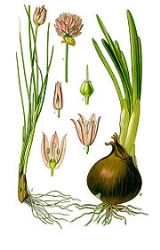
Chives (Allium schoenoprasum) are the smallest species
Species

In biology, a species is one of the basic units of biological classification and a taxonomic rank. A species is often defined as a group of organisms capable of interbreeding and producing fertile offspring....
 of the onion
Onion

Onion is a term used for many plants in the genus Allium. They are known by the common name "onion" but, used without qualifiers, it usually refers to Allium cepa....
 family Alliaceae
Alliaceae

Alliaceae is a Family of herbaceous perennial plant flowering plants. They are monocots, part of Order Asparagales. The family has been widely but not universally recognised; in the past, the plants involved were often treated as belonging to the family Liliaceae, and still are by some botanists....
, native to Europe
Europe

Europe is, conventionally, one of the world's seven continents. Comprising the westernmost peninsula of Eurasia, Europe is generally divided from Asia to its east by the water divide of the Ural Mountains, the Ural , the Caspian Sea, and by the Caucasus Mountains to the southeast....
, Asia
Asia

Asia is the world's largest and most populous continent. It covers 8.6% of the Earth's total surface area and, with over 4 billion people, it contains more than 60% of the world's current human population....
 and North America
North America

North America is the northern continent of the Americas, situated in the Earth's northern hemisphere and almost totally in the western hemisphere....
. They are referred to only in the plural, because they grow in clumps rather than as individual plants. Allium schoenoprasum is also the only species of Allium native to both the New
New World

The New World is one of the names used for the non-Eurasian/non-African parts of the Earth, specifically the Americas and Australasia. When the term originated in the late 15th century, the Americas were new to the Europeans, who previously thought of the world as consisting only of Europe, Asia, and Africa ....
 and the Old World
Old World

The Old World consists of those parts of Earth known to Europeans, Asians, and Africans in the 15th century....
.

Its species name derives from the Greek
Greek language

Greek is an Indo-European languages native to the southern Balkan peninsula, the language of the Greek people. It forms an independent branch within Indo-European....
 skhoinos (sedge
Cyperaceae

The family Cyperaceae, or the sedges, is a taxon of monocotyledon flowering plants that superficially resemble Poaceae or Juncaceae. The family is large, with some 4,000 species described in about 70 genera....
) and prason (onion).


Nutrition Facts


Discussion
Ask a question about 'Chives'
Start a new discussion about 'Chives'
Answer questions from other users
Full Discussion Forum


Encyclopedia


Chives (Allium schoenoprasum) are the smallest species
Species

In biology, a species is one of the basic units of biological classification and a taxonomic rank. A species is often defined as a group of organisms capable of interbreeding and producing fertile offspring....
 of the onion
Onion

Onion is a term used for many plants in the genus Allium. They are known by the common name "onion" but, used without qualifiers, it usually refers to Allium cepa....
 family Alliaceae
Alliaceae

Alliaceae is a Family of herbaceous perennial plant flowering plants. They are monocots, part of Order Asparagales. The family has been widely but not universally recognised; in the past, the plants involved were often treated as belonging to the family Liliaceae, and still are by some botanists....
, native to Europe
Europe

Europe is, conventionally, one of the world's seven continents. Comprising the westernmost peninsula of Eurasia, Europe is generally divided from Asia to its east by the water divide of the Ural Mountains, the Ural , the Caspian Sea, and by the Caucasus Mountains to the southeast....
, Asia
Asia

Asia is the world's largest and most populous continent. It covers 8.6% of the Earth's total surface area and, with over 4 billion people, it contains more than 60% of the world's current human population....
 and North America
North America

North America is the northern continent of the Americas, situated in the Earth's northern hemisphere and almost totally in the western hemisphere....
. They are referred to only in the plural, because they grow in clumps rather than as individual plants. Allium schoenoprasum is also the only species of Allium native to both the New
New World

The New World is one of the names used for the non-Eurasian/non-African parts of the Earth, specifically the Americas and Australasia. When the term originated in the late 15th century, the Americas were new to the Europeans, who previously thought of the world as consisting only of Europe, Asia, and Africa ....
 and the Old World
Old World

The Old World consists of those parts of Earth known to Europeans, Asians, and Africans in the 15th century....
.

Its species name derives from the Greek
Greek language

Greek is an Indo-European languages native to the southern Balkan peninsula, the language of the Greek people. It forms an independent branch within Indo-European....
 skhoinos (sedge
Cyperaceae

The family Cyperaceae, or the sedges, is a taxon of monocotyledon flowering plants that superficially resemble Poaceae or Juncaceae. The family is large, with some 4,000 species described in about 70 genera....
) and prason (onion). Its English
English language

English is a West Germanic language that originated in Anglo-Saxon England and has lingua franca status in many parts of the world as a result of the military, economic, scientific, political and cultural influence of the British Empire in the 18th, 19th and early 20th centuries and that of the United States from the mid 20th century onwa...
 name, chive, derives from the French
French language

French is a Romance language spoken around the world by around 80 million people as first language, by 190 million as second language, and by about another 200 million people as an acquired tongue, with significant speakers in 54 countries....
 word cive, which was derived from cepa, the Latin
Latin

Latin is an Italic language, historically spoken in Latium and Ancient Rome. Through the Military history of the Roman Empire, Latin spread throughout the Mediterranean and a large part of Europe....
 word for onion.

Culinary uses for chives involve shredding its leaves (straws) for use as condiment for fish
Fish

A fish is any marine biology vertebrate animal that is typically ectothermic , covered with scale , and equipped with two sets of paired fins and several unpaired fins....
, potato
Potato

The potato is a starchy, tuberous crop from the perennial plant Solanum tuberosum of the Solanaceae family. The word potato may refer to the plant itself as well....
es and soup
Soup

Soup is a food that is made by combining ingredients such as meat and vegetables in Stock or hot/boiling water, until the flavor is extracted, forming a broth....
s. Because of this, it is a common household herb
Herb

A herb is a plant that is valued for qualities such as medicinal properties, flavor, scent, or the like....
, frequent in gardens as well as in grocery stores. It also has insect-repelling properties which can be used in gardens to control pests.

Biology


The chive is a bulb
Bulb

A bulb is an underground vertical shoot that has modified leaf that are used as food storage organs by a dormancy plant.A bulb's leaf bases generally do not support leaves, but contain food reserves to enable the plant to survive adverse conditions....
-forming herbaceous
Herbaceous

A herbaceous plant is a plant that has leaf and stem that die down at the end of the growing season to the soil level. A herbaceous plant may be Annual plant, Biennial plant or Perennial plant....
 perennial plant
Perennial plant

A perennial plant or perennial is a plant that lives for more than two years. When used by gardeners or horticulturalists, this term applies specifically to perennial herbaceous plants....
, growing to 30-50 cm tall. The bulbs are slender conical, 2-3 cm long and 1 cm broad, and grow in dense clusters from the root
Root

In vascular plants, the root is the organ of a plant body that typically lies below the surface of the soil. This is not always the case, however, since a root can also be aerial root or aerating ....
s. The leaves
Leaf

In botany, a leaf is an above-ground plant Organ specialized for photosynthesis. For this purpose, a leaf is typically flat and thin, to expose the cells containing chloroplast to light over a broad area, and to allow light to penetrate fully into the tissues....
 are hollow tubular, up to 50 cm long, and 2-3 mm in diameter
Diameter

In geometry, a diameter of a circle is any straight line segment that passes through the center of the circle and whose endpoints are on the circle....
, with a soft texture, although, prior to the emergence of a flower from a leaf, it may appear stiffer than usual. The flower
Flower

A flower, sometimes known as a bloom or blossom, is the reproduction structure found in flowering plants . The biological function of a flower is to mediate the union of male sperm with female ovum in order to produce seeds....
s are pale purple, star-shaped with six tepal
Tepal

Tepals are elements of the perianth, or outer part of a flower, which include the petals or sepals. The term tepal is usually used when all segments of the perianth are of similar shape and color, or undifferentiated....
s, 1-2 cm wide, and produced in a dense inflorescence
Inflorescence

An inflorescence is a group or cluster of flowers arranged on a Plant stem that is composed of a main branch or a complicated arrangement of branches....
 of 10-30 together; before opening, the inflorescence is surrounded by a papery bract
Bract

In botany, a bract is a modified or specialized leaf. Bracts are ordinarily associated with reproductive structures . They are ordinarily reduced in size relative to foliage leaves, or of a different color or texture from foliage leaves, or both....
. The seed
Seed

A seed is a small Plant embryogenesis plant enclosed in a covering called the seed coat, usually with some Food storage. It is the product of the ripened ovule of gymnosperm and angiosperm plants which occurs after fertilization and some growth within the mother plant....
s are produced in a small three-valved capsule, maturing in summer. The herb flowers from April to May in the southern parts of its habitat zones and in June in the northern parts.

Chives are the only species of Allium native to both the Old World and New
New World

The New World is one of the names used for the non-Eurasian/non-African parts of the Earth, specifically the Americas and Australasia. When the term originated in the late 15th century, the Americas were new to the Europeans, who previously thought of the world as consisting only of Europe, Asia, and Africa ....
. Sometimes, the plants found in North America are classified as A. schoenoprasum var. sibiricum, although this is disputed. There have been significant differences among specimens: one example was found in northern Maine
Maine

The State of Maine is a U.S. state in the New England region of the northeastern United States of America, bordering the Atlantic Ocean to the southeast, New Hampshire to the southwest, the Canadian provinces of Quebec to the northwest and New Brunswick to the northeast....
 growing solitary, instead of in clumps, also exhibiting dingy grey flowers.

Albeit repulsive to insects in general, due to its sulfur
Sulfur

Sulfur or sulphur is the chemical element that has the atomic number 16. It is denoted with the symbol S. It is an abundant Valence non-metal....
 compounds, its flowers are attractive to bee
Bee

Bees are flying insects closely related to wasps and ants. Bees are a monophyly lineage within the superfamily Apoidea, presently classified by the unranked taxon name Anthophila....
s, and it is sometimes kept to increase desired insect life.

Uses


Culinary


Chives are grown for their leaves, which are used for culinary purposes as flavoring herb, and provide a somewhat milder flavour than those of its neighbouring Allium species.

Chives have a wide variety of culinary uses, such as in traditional dishes in France
France

France , officially the French Republic , is a country whose Metropolitan France is located in Western Europe and that also comprises various Overseas departments and territories of France....
 and Sweden, among others. In his 1806 book Attempt at a Flora (Försök til en flora), Retzius describes how chives are used with pancakes, soups, fish and sandwiches. It is also an ingredient of the gräddfil sauce served with the traditional herring
Herring

Herring are small, oily fish of the genus Clupea found in the shallow, temperate waters of the North Pacific Ocean and the North Atlantic Ocean, including the Baltic Sea....
 dish served at Swedish midsummer
Midsummer

Many people say that the fairies dance on midsummer's eve, and those in Ireland may even stay up all night watching for them. They re said to dance after huge feasts, then sing and play music and tell stories....
 celebrations. The flowers may also be used to garnish dishes.

Chives are one of the "fines herbes
Fines herbes

Fines herbes is a culinary mainstay in French cuisine. The ingredients of fines herbes are fresh parsley, chives, tarragon and chervil. These "fine herbs" are not the pungent and resinous herbs that appear in a bouquet garni ? which, unlike fines herbes, release their flavour in long cooking....
" of French cuisine, which also include tarragon
Tarragon

Tarragon or dragon's-wort is a perennial plant herb in the family Asteraceae related to Artemisia . Corresponding to its species name, a common term for the plant is "dragon herb." It is native to a wide area of the Northern Hemisphere from easternmost Europe across central and eastern Asia to India, western North America, and south to...
, chervil
Chervil

Chervil is a delicate annual plant herb related to parsley. Sometimes called garden chervil, it is used to season mild-flavoured dishes and is a constituent of the French herb mixture fines herbes....
 and/or parsley
Parsley

Parsley is a bright green, biennial plant herb, also used as spice. It is very common in Middle Eastern cuisine, European cuisine, and American cuisine cooking....
.

Chives can be found fresh at most markets year-round, making it a readily available herb; it can also be dry-frozen without much impairment to its taste, giving home growers the opportunity to store large quantities harvested from their own garden.

In cultivation

Retzius also describes how farmers would plant chives between the rocks making up the borders of their flowerbeds, to keep the plants free from pests (such as Japanese beetle
Japanese beetle

The beetle species Popillia japonica is commonly known as the Japanese beetle. It is about 1.5 cm long and 1 cm wide, with iridescent copper-colored elytra and green thorax and head....
s). While the growing plant repels unwanted insect life, the juice of the leaves can be used for the same purpose, as well as fighting fungal infections, mildew
Mildew

Mildew refers to certain kinds of mold or fungus. In Old English, it meant honeydew , and later came to mean mildew in the modern senses.*The term mildew is often used generically to refer to mold growth, usually with a flat growth habit....
 and scab
Fusarium ear blight

Fusarium ear blight , is a fungus disease in plants. It is responsible for the most common damaging disease that affects golf course grass. From an economic stand point, it is one of the major cereal diseases, being responsible for significant grain yield reduction in wheat and oats....
.

Its flowers are attractive to bees, which are important for gardens with an abundance of plants in need of pollination
Pollination

Pollination in flowering plants and gymnosperms is the process that transfers pollen, which contain the male gametes to where the female gamete are contained within the carpel; in gymnosperms the pollen is directly applied to the ovule itself....
.

Medical uses

The medical properties of chives are similar to those of garlic
Garlic

Allium sativum L., commonly known as garlic, is a species in the onion family Alliaceae. Its close relatives include the onion, shallot, leek, and chive....
, but weaker; the faint effects in comparison with garlic are probably the main reason for its limited use as a medicinal herb. Containing numerous organisulplide compounds such as allyl sulfides and alkyl sulfoxides, chives have a beneficial effect on the circulatory system
Circulatory system

The circulatory system is an organ that moves nutrients, gases, and wastes to and from cells to help fight diseases and help stabilize body temperature and pH to maintain homeostasis....
, acting upon it by lowering the blood pressure. As chives are usually served in small amounts and never as the main dish, negative effects are rarely encountered, although digestive problems may occur following over-consumption.

Chives are also rich in vitamins A
Vitamin A

Vitamin A, a bi-polar molecule formed with bi-polar covalent bonds between carbon and hydrogen, is linked to a family of similarly shaped molecules, the retinoids, which complete the remainder of the vitamin sequence....
 and C
Vitamin C

Vitamin C or ascorbic acid is an essential nutrient for humans, a large number of simian species, a small number of other mammalian species , a few species of birds, and some fish....
, and contain trace amounts of sulfur and iron
Iron

Iron is a chemical element with the symbol Fe and atomic number 26. Iron is a Group 8 element and period 4 element. Iron is lustrous and silvery in color....
.

Cultivation

Chives are cultivated both for its culinary uses as well as its ornamental value; the violet flowers are often used in ornamental dry bouquets.

Chives thrive in well drained soil, rich in organic matter, with a pH
PH

pH is a measure of the Acid or Base of a solution. It is defined as the cologarithm of the Activity of dissolved hydrogen ions . Hydrogen ion activity coefficients cannot be measured experimentally, so they are based on theoretical calculations....
 of 6-7 and full sun.

Chives can be grown from seed and mature in summer, or early the following spring. Typically, chives need to be germinated
Germination

Germination is the process whereby growth emerges from a period of dormancy. The most common example of germination is the sprouting of a seedling from a seed of an flowering plant or gymnosperm....
 at a temperature of 15 °C to 20 °C and kept moist. They can also be planted under a cloche
Row cover

In horticulture, row cover is any material used as a protective covering to shield plants, usually vegetables, primarily from the undesirable effects of cold and wind, and also from insect damage....
 or germinated indoors in cooler climates, then planted out later. After at least four weeks, the young shoots should be ready to be planted out.

Chives are also easily propagated by division.

In cold regions, chives die back to the underground bulbs in winter, with the new leaves appearing in early spring.

Chives starting to look old can be cut back to about 2-5 cm. When harvesting, the needed number of stalks should be cut to the base.. During the growing season, the plant will continually regrow leaves, allowing for a continuous harvest.

History and cultural importance


Chives have been cultivated in Europe since the Middle Ages
Middle Ages

File:Karl 1 mit papst gelasius gregor1 sacramentar v karl d kahlen.jpgThe Middle Ages of European history are a period in history which lasted for roughly a millennium, commonly dated from the fall of the Roman Empire in the 5th century to the beginning of the Early Modern Period in the 16th century, marked by the division of Western Christi...
, although signs of its usage date back to 5000 years ago.

The Romans believed chives could relieve the pain from sunburn
SunBurn

SunBurn is a regional event held in Florida. Although SunBurn has its roots in the annual Burning Man festival in Nevada, it is not an official Burning Man event, because the organizers of SunBurn do not condone the direction that the Burning Man Organization has taken over the years....
 or a sore throat. They believed that eating chives would increase blood pressure
Blood pressure

Blood pressure is the pressure exerted by circulating blood on the walls of blood vessels, and constitutes one of the principal vital signs. The pressure of the circulating blood decreases as it moves away from the heart through artery and capillary, and toward the heart through veins....
 and acted as a diuretic
Diuretic

A diuretic is any drug that elevates the rate of urination and thus provides a means of forced diuresis. There are several categories of diuretics....
.

Romanian Gypsies have used chives in fortune telling.

It was believed that bunches of dried chives hung around a house would ward off disease and evil.

Gallery


See also

  • Chinese chives


External links