

Germanic paganism

Encyclopedia
Germanic paganism refers to the theology and religious practices
of the Germanic peoples
of north-western Europe from the Iron Age
until their Christianization during the Medieval
period. It has been described as being "a system of interlocking and closely interrelated religious worldviews and practices rather than as one indivisible religion" and as such consisted of "individual worshippers, family traditions and regional cults within a broadly consistent framework".
Germanic paganism took various forms in different areas of the Germanic world. The best documented version was that of 10th and 11th century Norse paganism
, although other information can be found from Anglo-Saxon and Continental Germanic sources. Scattered references are also found in the earliest writings of other Germanic peoples and Roman descriptions. The information can be supplemented with archaeological finds and remnants of pre-Christian beliefs in later folklore
.
Being pagan in nature, Germanic paganism was polytheistic
, with some underlying similarities to other Indo-Germanic traditions
. Many of the deities found in Germanic paganism appeared under similar names across the Germanic peoples, most notably the god known to the Germans as Wodan or Wotan, to the Anglo-Saxons as Woden
, and to the Norse as Odin
, as well as the god Thor
– known to the Germans as Donar, to the Anglo-Saxons as Þunor and to the Norse as Þórr.
ic La Tene culture
to the south, growing out of earlier traditions of the Nordic Bronze Age
. Early Germanic history remains in the prehistoric period until the earliest descriptions in Roman ethnography in the 1st century BC.
's Commentarii de Bello Gallico
. He contrasts the elaborate religious custom of the Gauls with the simpler Germanic traditions.
Caesar's description contrasts with other information on the early Germanic tribes and is not given much weight by modern scholars. It is worth mentioning his note that Mercury
(Lugus
) is the principal god of the Gauls:
The worship of deities identified by the Romans with Mercury (Woden) seems to have been prominent among the northerly tribes.
's Germania
, dating to the 1st century.
Tacitus describes both animal
and human sacrifice
. He identifies the chief Germanic god with the Roman Mercury
, who on certain days receives human sacrifices, while gods identified by Tacitus with Hercules
and Mars
receive animal sacrifice. The largest Germanic tribe, Suebians, also make sacrifices, allegedly of captured Roman soldiers, to a goddess
who is identified by Tacitus with "TYR"
Another goddess, Nerthus
, is revered by Reudignians, Aviones, Angles
, Varinians, Eudoses, Suardones and Nuithones
. Nerthus is believed to directly interpose in human affairs. Her sanctuary is on an island, specifically in a wood called Castum. A chariot
covered with a curtain is dedicated to the goddess, and only the high priest may touch it. The priest is capable of seeing the goddess enter the chariot. Drawn by cows, the chariot travels through the countryside, and wherever the goddess visits, a great feast is held. During the travel of the goddess, the Germanic tribes cease all hostilities, and do not lay their hands upon arms. When the priest declares that the goddess is tired of conversation with mortals, the chariot returns and is washed, together with the curtains, in a secret lake. The goddess is also washed. The slaves who administer this purification are afterwards thrown into the lake.
According to Tacitus, the Germanic tribes think of temples as unsuitable habitations for gods, and they do not represent them as idols in human shape. Instead of temples, they consecrate woods or groves to individual gods.
Divination
and augur
y was very popular:
The reputation of Tacitus' Germania is somewhat marred as a historical source by the writer's rhetorical tendencies. The main purpose of his writing seems to be to hold up examples of virtue and vice for his fellow Romans rather than give a truthful ethnographic or historical account. While Tacitus' interpretations are sometimes dubious, the names and basic facts he reports are credible; Tacitus touches on several elements of Germanic culture known from later sources. Human and animal sacrifice is attested by archaeological evidence and medieval sources. Rituals tied to natural features are found both in medieval sources and in Nordic folklore. A ritual chariot or wagon as described by Tacitus was excavated in the Oseberg find. Sources from medieval times until the 19th century point to divination by making predictions or finding the will of the gods from randomized phenomena as a tradition among Germanic cultures.
While there is rich archaeological and linguistic evidence of earlier Germanic religious ideas, these sources are all mute, and cannot be interpreted with much confidence. Seen in light of what we know about the medieval survival of the Germanic religions as practiced by the Nordic nations, some educated guesses may be made. However, the presence of marked regional differences make generalization of any such reconstructed belief or practice a risky venture.
We do know, however, that in Tacitus' day the Germans discerned a divinity of prophecy in women, and virgin prophetesses, such as Veleda
, were honored as true and living goddesses.
.jpg) During the Migration Period
During the Migration Period
, Germanic religion was subject to syncretic
influence from Christianity
and Mediterranean culture.
Jordanes
' Getica is a 6th century account of the Goths
, written a century and a half after Christianity largely replaced the older religions among the Goths. According to the Getica, the chief god of the Goths was Mars, who they believed was born among them:
Saint Columbanus in the 6th century encountered a beer sacrifice
to Woden
in Bregenz
.
In the 8th century, the Germanic Saxons
venerated an Irminsul
(see also Donar's Oak). Charlemagne
is reported to have destroyed the Saxon Irminsul in 772.
The Old High German
Merseburg Incantations
, the only pre-Christian testimony in the German language, contains a Sinthgunt
who is the sister of the sun maiden Sunna (Sól). She is not known by name in Nordic mythology, and if she refers to the moon, she is then different from the Scandinavian (Mani
), who is male. Further, Nanna
is mentioned.
The Goths were converted to Arianism
in the 4th century, contemporaneous to the adoption of Christianity by the Roman Empire
itself (see Constantinian shift
).
Unfortunately, due to their early conversion to Christianity, little is known about the particulars of the religion of the East Germanic peoples
, separated from the remaining Germanic tribes during the Migration period. Such knowledge would be suited to distinguish Proto-Germanic elements from later developments present in both North and West Germanic.
The Franks
, Alamanni
, Anglo-Saxons
, Continental Saxons
, and Frisians
were Christianized
between the 6th and the 10th century. By the end of the 10th century, only the Scandinavians and the Finnish tribes remained pagan.
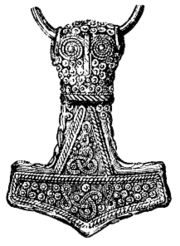 Early medieval North Germanic Scandinavian (Viking Age
) paganism is much better documented than its predecessors, notably via the records of Norse mythology
in the Prose Edda
and the Poetic Edda
, as well as the saga
s, written in Iceland
during 1150 - 1400.
Sacrifices were known as blót
, seasonal celebrations where gifts were offered to appropriate gods, and attempts were made to predict the coming season. Similar events were sometimes arranged in times of crisis, for much the same reasons.
The goddess Frijja
seems to have split into the two different, clearly related goddesses Frigg
and Freyja. In Nordic mythology there are certain vestiges of an early stage where they were one and the same, such as husbands Óðr
/Óðinn, their shamanistic skills and Freyja/Frigg's infidelity.
and Ingold I) and would sometimes force the lord to rescind his conversion (e.g. Haakon the Good).
The attempt of the deposed Christian monarch Olaf II of Norway
to retake the throne resulted in a bloody civil war in Norway, which ended in the battle of Stiklestad
(1030). In Sweden, in the early 1080s, Inge I
was deposed by popular vote for not wanting to sacrifice to the gods, and replaced by his brother-in-law Blot-Sweyn
(literally "Sweyn the Sacrificer"). After three years of exile, Inge returned in secret to Old Uppsala and during the night the Christians surrounded the royal hall with Blot-Sweyn inside and set it on fire. However, Inge did not immediately regain his throne and the pagan Eirik Arsale briefly came into power before being usurped by Inge.
In France
, the French King Louis d'Outremer
crushes a revolt by pagan Normans
led by a certain Thormod (Tormod, Turmod), a renegade
Christian who sought to make a pagan of the young duke Richard of Normandy (943).
During the High Middle Ages
, Scandinavian paganism became marginalized and blended into rural folklore
. In folklore and legend, elements of Germanic mythology survived, and appears in the guise of fairy tales such as those collected by the Brothers Grimm
and other folk tales and customs (see Walpurgis Night
, Holda
, Berchta, Weyland
, Krampus
, Lorelei
, Nix
), as well as in medieval courtly literature (Nibelung
s).
there is substantial literature, namely the Nordic Sagas and the Eddas, relating to the pagan period, but most of this was written long after Iceland's conversion to Christianity. Some information is found in the Nibelungenlied
. The literary source closest to the pagan period may be Beowulf
, which some scholars believe was composed as early as the eighth century, and therefore within living memory of Anglo-Saxon paganism. Limited information also exists in Tacitus
' ethnographic work Germania
.
Further material has been deduced from customs found in surviving rural folk traditions that have either been mildly superficially Christianized or lightly modified, including surviving laws and legislature (Althing
, Anglo-Saxon law
, the Grágás), calendar dates, customary folktales
and traditional symbolism
found in folk art
.
A great deal of information has been unearthed by recent archaeology, including the Anglo-Saxon pagan Sutton Hoo
royal funerary site in East Anglia and the royal pagan temple at Gefren/Yeavering in Northumberland. The traditional ballads of the Northumbrian/Scottish borders, and their European counterparts, have also preserved many aspects of Germanic pagan belief. As York Powell wrote, "The very scheme on which the ballads and lays are alike built, the hapless innocent death of a hero or heroine, is as heathen as the plot of any Athenian tragedy can be."
Although perhaps singularly most responsible for the destruction of pagan sites, including massacres, such as the Massacre of Verden and the subsequent dismantling of ancient tribal ruling systems, the Frankish
emperor Charlemagne
of The Holy Roman Empire
is said to have acquired a substantial collection of Germanic pagan songs, which was deliberately destroyed after his death by his successor, Louis the Pious
.
, revolving around the veneration of various deities. Some deities were worshipped widely across the Germanic lands, albeit under different names. Other deities were simply local to a specific locality, and are mentioned in both Anglo-Saxon and Icelandic texts, in the latter of which they are described as being "the land spirits that live in this land".
The Ansiwiz similar to the Roman Dii Consentes
appear as a limited circle of powerful beings, deities or remote ancestors.
Heavenly bodies may have been deified, including Sowilo the Sun, Mænon
the Moon, and perhaps Auziwandilaz
the evening star.
did not "confine the gods within walls... but that they worshipped outdoors in sacred woods and groves", and similarly there is evidence from later continental Europe, Anglo-Saxon England and Scandinavia that the pagans worshipped out of doors at "trees, groves, wells, stones, fences and cairns". In some later cases, temples
would be built on such sites, the most notable being the Swedish Temple at Uppsala
which, according to Adam of Bremen
, writing in the 11th century, was built around a grove which was "so holy that each tree is itself regarded as sacred".
Images of the various gods played a part in worship, although Tacitus noted that whilst amongst the early Germans "effigies" were used and even taken into battle, they were not "human [in] appearance". Surviving examples of Germanic effigies, such as the phallic idol recovered in a bog in Broddenbjerg, Denmark
, show that amongst some of the continental Germanic peoples at least, religious idols were naturally anthropomorphic wooden shapes that had been roughly carved to make their appearance more humanoid.
At their sacred sites, Germanic pagans widely practiced ritual sacrifice to their deities. This was often in the form of a blood sacrifice such as that of an animal
, but also sometimes that of a human being
. Tacitus
recorded that the early German tribes in the 1st century practiced public human sacrifices "in a grove hallowed by auguries of the fathers". The practice of human sacrifice, often associated with sacred groves or trees, would continue amongst the pagan Germanic peoples for at least the next millennia, for there are several surviving accounts of animal sacrifice amongst the Norse, for instance, Adam of Bremen stated that at the temple of Uppsala
in Sweden
:
tribe in which a willing female slave who had belonged to the deceased was treated like royalty, becoming drunk and having sex with whichever men she chose, before she was simultaneously strangled and stabbed to death and then burned upon her master's pyre.
Tacitus relates that the early Germans celebrated only three seasons, the equivalents to spring
, summer
and winter
, whilst the Law Book of Iceland, from a thousand years later, indicates that the pagan Germanic Icelanders divided the year only into summer and winter.
, and in the names of the days of the week
. It has also played an influence in the 18th century artistic movement known as Romanticism
, as well as the founding of several 20th century Neopagan religions which take their basis from historical Germanic paganism.
, Dutch
, and the Nordic languages, and four of the seven days of the week in German
and Finnish
are named after the old Germanic deities. For instance, in English, the day Wednesday
is named after the god Woden
, having originated from the Old English Wodnesdæg, meaning Woden's Day. Similarly, in modern Norwegian, Wednesday is known as Onsdag, named after Woden's Norse counterpart, Odin
.
, Wansdyke
, Wednesbury
and Thundersley
.
Scandinavia has many theophoric placenames, in particular named after Odin or after Thor.
West Germanic
North Germanic
South Germanic
Modern
Other
Myth and ritual
In traditional societies, myth and ritual are two central components of religious practice. Although myth and ritual are commonly united as parts of religion, the exact relationship between them has been a matter of controversy among scholars...
of the Germanic peoples
Germanic peoples
The Germanic peoples are an Indo-European ethno-linguistic group of Northern European origin, identified by their use of the Indo-European Germanic languages which diversified out of Proto-Germanic during the Pre-Roman Iron Age.Originating about 1800 BCE from the Corded Ware Culture on the North...
of north-western Europe from the Iron Age
Iron Age
The Iron Age is the archaeological period generally occurring after the Bronze Age, marked by the prevalent use of iron. The early period of the age is characterized by the widespread use of iron or steel. The adoption of such material coincided with other changes in society, including differing...
until their Christianization during the Medieval
Middle Ages
The Middle Ages is a periodization of European history from the 5th century to the 15th century. The Middle Ages follows the fall of the Western Roman Empire in 476 and precedes the Early Modern Era. It is the middle period of a three-period division of Western history: Classic, Medieval and Modern...
period. It has been described as being "a system of interlocking and closely interrelated religious worldviews and practices rather than as one indivisible religion" and as such consisted of "individual worshippers, family traditions and regional cults within a broadly consistent framework".
Germanic paganism took various forms in different areas of the Germanic world. The best documented version was that of 10th and 11th century Norse paganism
Norse paganism
Norse paganism is the religious traditions of the Norsemen, a Germanic people living in the Nordic countries. Norse paganism is therefore a subset of Germanic paganism, which was practiced in the lands inhabited by the Germanic tribes across most of Northern and Central Europe in the Viking Age...
, although other information can be found from Anglo-Saxon and Continental Germanic sources. Scattered references are also found in the earliest writings of other Germanic peoples and Roman descriptions. The information can be supplemented with archaeological finds and remnants of pre-Christian beliefs in later folklore
Folklore
Folklore consists of legends, music, oral history, proverbs, jokes, popular beliefs, fairy tales and customs that are the traditions of a culture, subculture, or group. It is also the set of practices through which those expressive genres are shared. The study of folklore is sometimes called...
.
Being pagan in nature, Germanic paganism was polytheistic
Polytheism
Polytheism is the belief of multiple deities also usually assembled into a pantheon of gods and goddesses, along with their own mythologies and rituals....
, with some underlying similarities to other Indo-Germanic traditions
Proto-Indo-European religion
Proto-Indo-European religion is the hypothesized religion of the Proto-Indo-European peoples based on the existence of similarities among the deities, religious practices and mythologies of the Indo-European peoples. Reconstruction of the hypotheses below is based on linguistic evidence using the...
. Many of the deities found in Germanic paganism appeared under similar names across the Germanic peoples, most notably the god known to the Germans as Wodan or Wotan, to the Anglo-Saxons as Woden
Woden
Woden or Wodan is a major deity of Anglo-Saxon and Continental Germanic polytheism. Together with his Norse counterpart Odin, Woden represents a development of the Proto-Germanic god *Wōdanaz....
, and to the Norse as Odin
Odin
Odin is a major god in Norse mythology and the ruler of Asgard. Homologous with the Anglo-Saxon "Wōden" and the Old High German "Wotan", the name is descended from Proto-Germanic "*Wodanaz" or "*Wōđanaz"....
, as well as the god Thor
Thor
In Norse mythology, Thor is a hammer-wielding god associated with thunder, lightning, storms, oak trees, strength, the protection of mankind, and also hallowing, healing, and fertility...
– known to the Germans as Donar, to the Anglo-Saxons as Þunor and to the Norse as Þórr.
Pre-Migration Period
The Common Germanic period begins with the European Iron Age, contemporary to the CeltCelt
The Celts were a diverse group of tribal societies in Iron Age and Roman-era Europe who spoke Celtic languages.The earliest archaeological culture commonly accepted as Celtic, or rather Proto-Celtic, was the central European Hallstatt culture , named for the rich grave finds in Hallstatt, Austria....
ic La Tene culture
La Tène culture
The La Tène culture was a European Iron Age culture named after the archaeological site of La Tène on the north side of Lake Neuchâtel in Switzerland, where a rich cache of artifacts was discovered by Hansli Kopp in 1857....
to the south, growing out of earlier traditions of the Nordic Bronze Age
Nordic Bronze Age
The Nordic Bronze Age is the name given by Oscar Montelius to a period and a Bronze Age culture in Scandinavian pre-history, c. 1700-500 BC, with sites that reached as far east as Estonia. Succeeding the Late Neolithic culture, its ethnic and linguistic affinities are unknown in the absence of...
. Early Germanic history remains in the prehistoric period until the earliest descriptions in Roman ethnography in the 1st century BC.
Caesar
The earliest forms of the Germanic religion can only be speculated on based on archaeological evidence and comparative religion. The first written description is in Julius CaesarJulius Caesar
Gaius Julius Caesar was a Roman general and statesman and a distinguished writer of Latin prose. He played a critical role in the gradual transformation of the Roman Republic into the Roman Empire....
's Commentarii de Bello Gallico
Commentarii de Bello Gallico
Commentarii de Bello Gallico is Julius Caesar's firsthand account of the Gallic Wars, written as a third-person narrative. In it Caesar describes the battles and intrigues that took place in the nine years he spent fighting local armies in Gaul that opposed Roman domination.The "Gaul" that Caesar...
. He contrasts the elaborate religious custom of the Gauls with the simpler Germanic traditions.
The Germans differ much from these usages, for they have neither Druids to preside over sacred offices, nor do they pay great regard to sacrifices. They rank in the number of the gods those alone whom they behold, and by whose instrumentality they are obviously benefited, namely, the sun, fire, and the moon; they have not heard of the other deities even by report. — The Gallic War (6.21)
Caesar's description contrasts with other information on the early Germanic tribes and is not given much weight by modern scholars. It is worth mentioning his note that Mercury
Mercury (mythology)
Mercury was a messenger who wore winged sandals, and a god of trade, the son of Maia Maiestas and Jupiter in Roman mythology. His name is related to the Latin word merx , mercari , and merces...
(Lugus
Lugus
Lugus was a deity of the Celtic pantheon. His name is rarely directly attested in inscriptions, but his importance can be inferred from placenames and ethnonyms, and his nature and attributes are deduced from the distinctive iconography of Gallo-Roman inscriptions to Mercury, who is widely believed...
) is the principal god of the Gauls:
They worship as their divinity, Mercury in particular, and have many images of him, and regard him as the inventor of all arts, they consider him the guide of their journeys and marches, and believe him to have great influence over the acquisition of gain and mercantile transactions. — The Gallic War (6.17)
The worship of deities identified by the Romans with Mercury (Woden) seems to have been prominent among the northerly tribes.
Tacitus
A much more detailed description of Germanic religion is TacitusTacitus
Publius Cornelius Tacitus was a senator and a historian of the Roman Empire. The surviving portions of his two major works—the Annals and the Histories—examine the reigns of the Roman Emperors Tiberius, Claudius, Nero and those who reigned in the Year of the Four Emperors...
's Germania
Germania (book)
The Germania , written by Gaius Cornelius Tacitus around 98, is an ethnographic work on the Germanic tribes outside the Roman Empire.-Contents:...
, dating to the 1st century.
Tacitus describes both animal
Animal sacrifice
Animal sacrifice is the ritual killing of an animal as part of a religion. It is practised by many religions as a means of appeasing a god or gods or changing the course of nature...
and human sacrifice
Human sacrifice
Human sacrifice is the act of killing one or more human beings as part of a religious ritual . Its typology closely parallels the various practices of ritual slaughter of animals and of religious sacrifice in general. Human sacrifice has been practised in various cultures throughout history...
. He identifies the chief Germanic god with the Roman Mercury
Mercury (mythology)
Mercury was a messenger who wore winged sandals, and a god of trade, the son of Maia Maiestas and Jupiter in Roman mythology. His name is related to the Latin word merx , mercari , and merces...
, who on certain days receives human sacrifices, while gods identified by Tacitus with Hercules
Hercules
Hercules is the Roman name for Greek demigod Heracles, son of Zeus , and the mortal Alcmene...
and Mars
Mars (mythology)
Mars was the Roman god of war and also an agricultural guardian, a combination characteristic of early Rome. He was second in importance only to Jupiter, and he was the most prominent of the military gods worshipped by the Roman legions...
receive animal sacrifice. The largest Germanic tribe, Suebians, also make sacrifices, allegedly of captured Roman soldiers, to a goddess
Goddess
A goddess is a female deity. In some cultures goddesses are associated with Earth, motherhood, love, and the household. In other cultures, goddesses also rule over war, death, and destruction as well as healing....
who is identified by Tacitus with "TYR"
Another goddess, Nerthus
Nerthus
In Germanic paganism, Nerthus is a goddess associated with fertility. Nerthus is attested by Tacitus, the first century AD Roman historian, in his Germania. Various theories exist regarding the goddess and her potential later traces amongst the Germanic tribes...
, is revered by Reudignians, Aviones, Angles
Angles
The Angles is a modern English term for a Germanic people who took their name from the ancestral cultural region of Angeln, a district located in Schleswig-Holstein, Germany...
, Varinians, Eudoses, Suardones and Nuithones
Nuithones
The Nuithones were one of the Nerthus-worshipping Germanic tribes mentioned by Tacitus in Germania. Schütte remarks that the name is probably corrupt and suggests that the correct forms were Teutones or Euthiones ....
. Nerthus is believed to directly interpose in human affairs. Her sanctuary is on an island, specifically in a wood called Castum. A chariot
Chariot
The chariot is a type of horse carriage used in both peace and war as the chief vehicle of many ancient peoples. Ox carts, proto-chariots, were built by the Proto-Indo-Europeans and also built in Mesopotamia as early as 3000 BC. The original horse chariot was a fast, light, open, two wheeled...
covered with a curtain is dedicated to the goddess, and only the high priest may touch it. The priest is capable of seeing the goddess enter the chariot. Drawn by cows, the chariot travels through the countryside, and wherever the goddess visits, a great feast is held. During the travel of the goddess, the Germanic tribes cease all hostilities, and do not lay their hands upon arms. When the priest declares that the goddess is tired of conversation with mortals, the chariot returns and is washed, together with the curtains, in a secret lake. The goddess is also washed. The slaves who administer this purification are afterwards thrown into the lake.
According to Tacitus, the Germanic tribes think of temples as unsuitable habitations for gods, and they do not represent them as idols in human shape. Instead of temples, they consecrate woods or groves to individual gods.
Divination
Divination
Divination is the attempt to gain insight into a question or situation by way of an occultic standardized process or ritual...
and augur
Augur
The augur was a priest and official in the classical world, especially ancient Rome and Etruria. His main role was to interpret the will of the gods by studying the flight of birds: whether they are flying in groups/alone, what noises they make as they fly, direction of flight and what kind of...
y was very popular:
To the use of lots and auguries, they are addicted beyond all other nations. Their method of divining by lots is exceedingly simple. From a tree which bears fruit they cut a twig, and divide it into two small pieces. These they distinguish by so many several marks, and throw them at random and without order upon a white garment. Then the Priest of the community, if for the public the lots are consulted, or the father of a family about a private concern, after he has solemnly invoked the Gods, with eyes lifted up to heaven, takes up every piece thrice, and having done thus forms a judgment according to the marks before made. If the chances have proved forbidding, they are no more consulted upon the same affair during the same day: even when they are inviting, yet, for confirmation, the faith of auguries too is tried. Yea, here also is the known practice of divining events from the voices and flight of birds. But to this nation it is peculiar, to learn presages and admonitions divine from horses also. These are nourished by the State in the same sacred woods and groves, all milk-white and employed in no earthly labour. These yoked in the holy chariot, are accompanied by the Priest and the King, or the Chief of the Community, who both carefully observed his actions and neighing. Nor in any sort of augury is more faith and assurance reposed, not by the populace only, but even by the nobles, even by the Priests. These account themselves the ministers of the Gods, and the horses privy to his will. They have likewise another method of divination, whence to learn the issue of great and mighty wars. From the nation with whom they are at war they contrive, it avails not how, to gain a captive: him they engage in combat with one selected from amongst themselves, each armed after the manner of his country, and according as the victory falls to this or to the other, gather a presage of the whole.
The reputation of Tacitus' Germania is somewhat marred as a historical source by the writer's rhetorical tendencies. The main purpose of his writing seems to be to hold up examples of virtue and vice for his fellow Romans rather than give a truthful ethnographic or historical account. While Tacitus' interpretations are sometimes dubious, the names and basic facts he reports are credible; Tacitus touches on several elements of Germanic culture known from later sources. Human and animal sacrifice is attested by archaeological evidence and medieval sources. Rituals tied to natural features are found both in medieval sources and in Nordic folklore. A ritual chariot or wagon as described by Tacitus was excavated in the Oseberg find. Sources from medieval times until the 19th century point to divination by making predictions or finding the will of the gods from randomized phenomena as a tradition among Germanic cultures.
While there is rich archaeological and linguistic evidence of earlier Germanic religious ideas, these sources are all mute, and cannot be interpreted with much confidence. Seen in light of what we know about the medieval survival of the Germanic religions as practiced by the Nordic nations, some educated guesses may be made. However, the presence of marked regional differences make generalization of any such reconstructed belief or practice a risky venture.
We do know, however, that in Tacitus' day the Germans discerned a divinity of prophecy in women, and virgin prophetesses, such as Veleda
Veleda
Veleda was a völva of the Germanic tribe of the Bructeri who achieved some prominence during the Batavian rebellion of AD 69–70, headed by the Romanized Batavian chieftain Gaius Julius Civilis, when she correctly predicted the initial successes of the rebels against Roman...
, were honored as true and living goddesses.
Migration Period
Migration Period
The Migration Period, also called the Barbarian Invasions , was a period of intensified human migration in Europe that occurred from c. 400 to 800 CE. This period marked the transition from Late Antiquity to the Early Middle Ages...
, Germanic religion was subject to syncretic
Syncretism
Syncretism is the combining of different beliefs, often while melding practices of various schools of thought. The term means "combining", but see below for the origin of the word...
influence from Christianity
Christianity
Christianity is a monotheistic religion based on the life and teachings of Jesus as presented in canonical gospels and other New Testament writings...
and Mediterranean culture.
Jordanes
Jordanes
Jordanes, also written Jordanis or Jornandes, was a 6th century Roman bureaucrat, who turned his hand to history later in life....
' Getica is a 6th century account of the Goths
Goths
The Goths were an East Germanic tribe of Scandinavian origin whose two branches, the Visigoths and the Ostrogoths, played an important role in the fall of the Roman Empire and the emergence of Medieval Europe....
, written a century and a half after Christianity largely replaced the older religions among the Goths. According to the Getica, the chief god of the Goths was Mars, who they believed was born among them:
Now Mars has always been worshipped by the Goths with cruel rites, and captives were slain as his victims. They thought that he who is the lord of war ought to be appeased by the shedding of human blood. To him they devoted the first share of the spoil, and in his honor arms stripped from the foe were suspended from trees. And they had more than all other races a deep spirit of religion, since the worship of this god seemed to be really bestowed upon their ancestor. — Getica
Saint Columbanus in the 6th century encountered a beer sacrifice
Symbel
Symbel and sumbl are Germanic terms for "feast, banquet".Paul C. Bauschatz in 1976 suggested that the term reflects a pagan ritual which had a "great religious significance in the culture of the early Germanic people"....
to Woden
Woden
Woden or Wodan is a major deity of Anglo-Saxon and Continental Germanic polytheism. Together with his Norse counterpart Odin, Woden represents a development of the Proto-Germanic god *Wōdanaz....
in Bregenz
Bregenz
-Culture:The annual summer music festival Bregenzer Festspiele is a world-famous festival which takes place on and around a stage on Lake Constance, where a different opera is performed every second year.-Sport:* A1 Bregenz HB is a handball team....
.
In the 8th century, the Germanic Saxons
Saxons
The Saxons were a confederation of Germanic tribes originating on the North German plain. The Saxons earliest known area of settlement is Northern Albingia, an area approximately that of modern Holstein...
venerated an Irminsul
Irminsul
An Irminsul was a kind of pillar which is attested as playing an important role in the Germanic paganism of the Saxon people. The oldest chronicle describing an Irminsul refers to it as a tree trunk erected in the open air...
(see also Donar's Oak). Charlemagne
Charlemagne
Charlemagne was King of the Franks from 768 and Emperor of the Romans from 800 to his death in 814. He expanded the Frankish kingdom into an empire that incorporated much of Western and Central Europe. During his reign, he conquered Italy and was crowned by Pope Leo III on 25 December 800...
is reported to have destroyed the Saxon Irminsul in 772.
The Old High German
Old High German
The term Old High German refers to the earliest stage of the German language and it conventionally covers the period from around 500 to 1050. Coherent written texts do not appear until the second half of the 8th century, and some treat the period before 750 as 'prehistoric' and date the start of...
Merseburg Incantations
Merseburg Incantations
The Merseburg Incantations are two medieval magic spells, charms or incantations, written in Old High German. They are the only known examples of Germanic pagan belief preserved in this language...
, the only pre-Christian testimony in the German language, contains a Sinthgunt
Sinthgunt
Sinthgunt is a figure in Germanic mythology, attested solely in the Old High German 9th or 10th century "horse cure" Merseburg Incantation. In the incantation, Sinthgunt is referred to as the sister of the personified sun, Sunna , and the two sisters are cited as both producing charms to heal...
who is the sister of the sun maiden Sunna (Sól). She is not known by name in Nordic mythology, and if she refers to the moon, she is then different from the Scandinavian (Mani
Mani (god)
In Norse mythology, Máni is the moon personified. Máni, personified, is attested in the Poetic Edda, compiled in the 13th century from earlier traditional sources, and the Prose Edda, written in the 13th century by Snorri Sturluson...
), who is male. Further, Nanna
Nanna (Norse deity)
In Norse mythology, Nanna Nepsdóttir or simply Nanna is a goddess associated with the god Baldr. Accounts of Nanna vary greatly by source. In the Prose Edda, written in the 13th century by Snorri Sturluson, Nanna is the wife of Baldr and the couple produced a son, the god Forseti. After Baldr's...
is mentioned.
The Goths were converted to Arianism
Arianism
Arianism is the theological teaching attributed to Arius , a Christian presbyter from Alexandria, Egypt, concerning the relationship of the entities of the Trinity and the precise nature of the Son of God as being a subordinate entity to God the Father...
in the 4th century, contemporaneous to the adoption of Christianity by the Roman Empire
Roman Empire
The Roman Empire was the post-Republican period of the ancient Roman civilization, characterised by an autocratic form of government and large territorial holdings in Europe and around the Mediterranean....
itself (see Constantinian shift
Constantinian shift
Constantinian shift is a term used by Anabaptist and Post-Christendom theologians to describe the political and theological aspects of the 4th-century process of Constantine's legalization of Christianity. The term was popularized by the Mennonite theologian John H...
).
Unfortunately, due to their early conversion to Christianity, little is known about the particulars of the religion of the East Germanic peoples
East Germanic tribes
The Germanic tribes referred to as East Germanic constitute a wave of migrants who may have moved from Scandinavia into the area between the Oder and Vistula rivers between the years 600 and 300 BC. Later they went to the south...
, separated from the remaining Germanic tribes during the Migration period. Such knowledge would be suited to distinguish Proto-Germanic elements from later developments present in both North and West Germanic.
The Franks
Franks
The Franks were a confederation of Germanic tribes first attested in the third century AD as living north and east of the Lower Rhine River. From the third to fifth centuries some Franks raided Roman territory while other Franks joined the Roman troops in Gaul. Only the Salian Franks formed a...
, Alamanni
Alamanni
The Alamanni, Allemanni, or Alemanni were originally an alliance of Germanic tribes located around the upper Rhine river . One of the earliest references to them is the cognomen Alamannicus assumed by Roman Emperor Caracalla, who ruled the Roman Empire from 211 to 217 and claimed thereby to be...
, Anglo-Saxons
Anglo-Saxons
Anglo-Saxon is a term used by historians to designate the Germanic tribes who invaded and settled the south and east of Great Britain beginning in the early 5th century AD, and the period from their creation of the English nation to the Norman conquest. The Anglo-Saxon Era denotes the period of...
, Continental Saxons
Saxons
The Saxons were a confederation of Germanic tribes originating on the North German plain. The Saxons earliest known area of settlement is Northern Albingia, an area approximately that of modern Holstein...
, and Frisians
Frisians
The Frisians are a Germanic ethnic group native to the coastal parts of the Netherlands and Germany. They are concentrated in the Dutch provinces of Friesland and Groningen and, in Germany, East Frisia and North Frisia, that was a part of Denmark until 1864. They inhabit an area known as Frisia...
were Christianized
Germanic Christianity
The Germanic people underwent gradual Christianization in the course of Late Antiquity and the Early Middle Ages. By the 8th century, England and the Frankish Empire were Christian, and by AD 1100 Germanic paganism had also ceased to have political influence in Scandinavia.-History:In the 4th...
between the 6th and the 10th century. By the end of the 10th century, only the Scandinavians and the Finnish tribes remained pagan.
Viking age
Viking Age
Viking Age is the term for the period in European history, especially Northern European and Scandinavian history, spanning the late 8th to 11th centuries. Scandinavian Vikings explored Europe by its oceans and rivers through trade and warfare. The Vikings also reached Iceland, Greenland,...
) paganism is much better documented than its predecessors, notably via the records of Norse mythology
Norse mythology
Norse mythology, a subset of Germanic mythology, is the overall term for the myths, legends and beliefs about supernatural beings of Norse pagans. It flourished prior to the Christianization of Scandinavia, during the Early Middle Ages, and passed into Nordic folklore, with some aspects surviving...
in the Prose Edda
Prose Edda
The Prose Edda, also known as the Younger Edda, Snorri's Edda or simply Edda, is an Icelandic collection of four sections interspersed with excerpts from earlier skaldic and Eddic poetry containing tales from Nordic mythology...
and the Poetic Edda
Poetic Edda
The Poetic Edda is a collection of Old Norse poems primarily preserved in the Icelandic mediaeval manuscript Codex Regius. Along with Snorri Sturluson's Prose Edda, the Poetic Edda is the most important extant source on Norse mythology and Germanic heroic legends, and from the early 19th century...
, as well as the saga
Norse saga
The sagas are stories about ancient Scandinavian and Germanic history, about early Viking voyages, the battles that took place during the voyages, about migration to Iceland and of feuds between Icelandic families...
s, written in Iceland
Iceland
Iceland , described as the Republic of Iceland, is a Nordic and European island country in the North Atlantic Ocean, on the Mid-Atlantic Ridge. Iceland also refers to the main island of the country, which contains almost all the population and almost all the land area. The country has a population...
during 1150 - 1400.
Sacrifices were known as blót
Blót
The blót was Norse pagan sacrifice to the Norse gods and the spirits of the land. The sacrifice often took the form of a sacramental meal or feast. Related religious practices were performed by other Germanic peoples, such as the pagan Anglo-Saxons...
, seasonal celebrations where gifts were offered to appropriate gods, and attempts were made to predict the coming season. Similar events were sometimes arranged in times of crisis, for much the same reasons.
The goddess Frijja
Frige
*Frijjō is the reconstructed name or epithet of a hypothesized Common Germanic love goddess giving rise to both Frigg and Freyja....
seems to have split into the two different, clearly related goddesses Frigg
Frigg
Frigg is a major goddess in Norse paganism, a subset of Germanic paganism. She is said to be the wife of Odin, and is the "foremost among the goddesses" and the queen of Asgard. Frigg appears primarily in Norse mythological stories as a wife and a mother. She is also described as having the power...
and Freyja. In Nordic mythology there are certain vestiges of an early stage where they were one and the same, such as husbands Óðr
Óðr
In Norse mythology, Óðr or Óð, sometimes angliziced as Odr or Od, is a figure associated with the major goddess Freyja...
/Óðinn, their shamanistic skills and Freyja/Frigg's infidelity.
Middle ages
In 1000 AD, Iceland became nominally Christian, although continuation of pagan worship in private was tolerated. Most of Scandinavia was Christianized during the 11th century. Adam von Bremen gives the last report of vigorous Norse paganism. Sometimes, the subjects of a lord who converted to Christianity refused to follow his lead (this happened to the Swedish kings Olof of Sweden, Anund GårdskeAnund Gårdske
Anund Gårdske or Anund of Gårdarike, English exonym: Anwynd, was the king of Sweden c. 1070 according to Adam of Bremen's Gesta Hammaburgensis ecclesiae pontificum. According to this source, Anund came from Kievan Rus', presumably from Aldeigjuborg. Gårdske means that he came from Gardariki which...
and Ingold I) and would sometimes force the lord to rescind his conversion (e.g. Haakon the Good).
The attempt of the deposed Christian monarch Olaf II of Norway
Olaf II of Norway
Olaf II Haraldsson was King of Norway from 1015 to 1028. He was posthumously given the title Rex Perpetuus Norvegiae and canonised in Nidaros by Bishop Grimkell, one year after his death in the Battle of Stiklestad on 29 July 1030. Enshrined in Nidaros Cathedral...
to retake the throne resulted in a bloody civil war in Norway, which ended in the battle of Stiklestad
Battle of Stiklestad
The Battle of Stiklestad in 1030 is one of the most famous battles in the history of Norway. In this battle, King Olaf II of Norway was killed. He was later canonized...
(1030). In Sweden, in the early 1080s, Inge I
Inge I of Sweden
Inge the Elder was a King of Sweden.-Biography:Inge was the son of the former King Stenkil and a Swedish princess. Inge shared the rule of the kingdom with his probably elder brother Halsten Stenkilsson, but little is known with certainty of Inge's reign...
was deposed by popular vote for not wanting to sacrifice to the gods, and replaced by his brother-in-law Blot-Sweyn
Blot-Sweyn
Sweyn was a Swedish king c. 1080, who replaced his Christian brother-in-law Inge as King of Sweden, when Inge had refused to administer the blóts at the Temple at Uppsala. There is no mention of Sweyn in the regnal list of the Westrogothic law, which suggests that his rule did not reach...
(literally "Sweyn the Sacrificer"). After three years of exile, Inge returned in secret to Old Uppsala and during the night the Christians surrounded the royal hall with Blot-Sweyn inside and set it on fire. However, Inge did not immediately regain his throne and the pagan Eirik Arsale briefly came into power before being usurped by Inge.
In France
France
The French Republic , The French Republic , The French Republic , (commonly known as France , is a unitary semi-presidential republic in Western Europe with several overseas territories and islands located on other continents and in the Indian, Pacific, and Atlantic oceans. Metropolitan France...
, the French King Louis d'Outremer
Louis IV of France
Louis IV , called d'Outremer or Transmarinus , reigned as King of Western Francia from 936 to 954...
crushes a revolt by pagan Normans
Normans
The Normans were the people who gave their name to Normandy, a region in northern France. They were descended from Norse Viking conquerors of the territory and the native population of Frankish and Gallo-Roman stock...
led by a certain Thormod (Tormod, Turmod), a renegade
Turncoat
A turncoat is a person who shifts allegiance from one loyalty or ideal to another, betraying or deserting an original cause by switching to the opposing side or party...
Christian who sought to make a pagan of the young duke Richard of Normandy (943).
During the High Middle Ages
High Middle Ages
The High Middle Ages was the period of European history around the 11th, 12th, and 13th centuries . The High Middle Ages were preceded by the Early Middle Ages and followed by the Late Middle Ages, which by convention end around 1500....
, Scandinavian paganism became marginalized and blended into rural folklore
Folklore
Folklore consists of legends, music, oral history, proverbs, jokes, popular beliefs, fairy tales and customs that are the traditions of a culture, subculture, or group. It is also the set of practices through which those expressive genres are shared. The study of folklore is sometimes called...
. In folklore and legend, elements of Germanic mythology survived, and appears in the guise of fairy tales such as those collected by the Brothers Grimm
Brothers Grimm
The Brothers Grimm , Jacob Grimm and Wilhelm Grimm , were German academics, linguists, cultural researchers, and authors who collected folklore and published several collections of it as Grimm's Fairy Tales, which became very popular...
and other folk tales and customs (see Walpurgis Night
Walpurgis Night
Walpurgis Night is a traditional spring festival on 30 April or 1 May in large parts of Central and Northern Europe. It is often celebrated with dancing and with bonfires. It is exactly six months from All Hallows' Eve.-Name:...
, Holda
Holda
In Germanic folklore as established by Jacob Grimm, Frau Holda or Holle is the supernatural matron of spinning, childbirth and domestic animals, and is also associated with winter, witches and the Wild Hunt...
, Berchta, Weyland
Weyland
In Germanic and Norse mythology, Wayland the Smith is a legendary master blacksmith. In Old Norse sources, Völundr appears in Völundarkviða, a poem in the Poetic Edda, and in Þiðrekssaga, and his legend is also depicted on the Ardre image stone VIII...
, Krampus
Krampus
Krampus is a mythical creature recognized in Alpine countries. According to legend, Krampus accompanies St. Nicholas during the Christmas season, warning and punishing bad children, in contrast to St. Nicholas, who gives gifts to good children....
, Lorelei
Lorelei
The Lorelei is a rock on the eastern bank of the Rhine near St. Goarshausen, Germany, which soars some 120 metres above the waterline. It marks the narrowest part of the river between Switzerland and the North Sea. A very strong current and rocks below the waterline have caused many boat...
, Nix
Nix
The Neck/Nixie are shapeshifting water spirits who usually appear in human form. The spirit has appeared in the myths and legends of all Germanic peoples in Europe....
), as well as in medieval courtly literature (Nibelung
Nibelung
The German Nibelungen and the corresponding Old Norse form Niflung is the name in Germanic and Norse mythology of the royal family or lineage of the Burgundians who settled at Worms....
s).
Sources
Most sources documenting Germanic paganism have presumably been lost. From IcelandIceland
Iceland , described as the Republic of Iceland, is a Nordic and European island country in the North Atlantic Ocean, on the Mid-Atlantic Ridge. Iceland also refers to the main island of the country, which contains almost all the population and almost all the land area. The country has a population...
there is substantial literature, namely the Nordic Sagas and the Eddas, relating to the pagan period, but most of this was written long after Iceland's conversion to Christianity. Some information is found in the Nibelungenlied
Nibelungenlied
The Nibelungenlied, translated as The Song of the Nibelungs, is an epic poem in Middle High German. The story tells of dragon-slayer Siegfried at the court of the Burgundians, how he was murdered, and of his wife Kriemhild's revenge....
. The literary source closest to the pagan period may be Beowulf
Beowulf
Beowulf , but modern scholars agree in naming it after the hero whose life is its subject." of an Old English heroic epic poem consisting of 3182 alliterative long lines, set in Scandinavia, commonly cited as one of the most important works of Anglo-Saxon literature.It survives in a single...
, which some scholars believe was composed as early as the eighth century, and therefore within living memory of Anglo-Saxon paganism. Limited information also exists in Tacitus
Tacitus
Publius Cornelius Tacitus was a senator and a historian of the Roman Empire. The surviving portions of his two major works—the Annals and the Histories—examine the reigns of the Roman Emperors Tiberius, Claudius, Nero and those who reigned in the Year of the Four Emperors...
' ethnographic work Germania
Germania (book)
The Germania , written by Gaius Cornelius Tacitus around 98, is an ethnographic work on the Germanic tribes outside the Roman Empire.-Contents:...
.
Further material has been deduced from customs found in surviving rural folk traditions that have either been mildly superficially Christianized or lightly modified, including surviving laws and legislature (Althing
Althing
The Alþingi, anglicised variously as Althing or Althingi, is the national parliament of Iceland. The Althingi is the oldest parliamentary institution in the world still extant...
, Anglo-Saxon law
Anglo-Saxon law
Anglo-Saxon law is a body of written rules and customs that were in place during the Anglo-Saxon period in England, before the Norman conquest. This body of law, along with early Scandinavian law and continental Germanic law, descended from a family of ancient Germanic custom and legal thought...
, the Grágás), calendar dates, customary folktales
Folklore
Folklore consists of legends, music, oral history, proverbs, jokes, popular beliefs, fairy tales and customs that are the traditions of a culture, subculture, or group. It is also the set of practices through which those expressive genres are shared. The study of folklore is sometimes called...
and traditional symbolism
Religious symbolism
Religious symbolism is the use of symbols, including archetypes, acts, artwork, events, or natural phenomena, by a religion. Religions view religious texts, rituals, and works of art as symbols of compelling ideas or ideals...
found in folk art
Folk art
Folk art encompasses art produced from an indigenous culture or by peasants or other laboring tradespeople. In contrast to fine art, folk art is primarily utilitarian and decorative rather than purely aesthetic....
.
A great deal of information has been unearthed by recent archaeology, including the Anglo-Saxon pagan Sutton Hoo
Sutton Hoo
Sutton Hoo, near to Woodbridge, in the English county of Suffolk, is the site of two 6th and early 7th century cemeteries. One contained an undisturbed ship burial including a wealth of Anglo-Saxon artefacts of outstanding art-historical and archaeological significance, now held in the British...
royal funerary site in East Anglia and the royal pagan temple at Gefren/Yeavering in Northumberland. The traditional ballads of the Northumbrian/Scottish borders, and their European counterparts, have also preserved many aspects of Germanic pagan belief. As York Powell wrote, "The very scheme on which the ballads and lays are alike built, the hapless innocent death of a hero or heroine, is as heathen as the plot of any Athenian tragedy can be."
Although perhaps singularly most responsible for the destruction of pagan sites, including massacres, such as the Massacre of Verden and the subsequent dismantling of ancient tribal ruling systems, the Frankish
Frankish Empire
Francia or Frankia, later also called the Frankish Empire , Frankish Kingdom , Frankish Realm or occasionally Frankland, was the territory inhabited and ruled by the Franks from the 3rd to the 10th century...
emperor Charlemagne
Charlemagne
Charlemagne was King of the Franks from 768 and Emperor of the Romans from 800 to his death in 814. He expanded the Frankish kingdom into an empire that incorporated much of Western and Central Europe. During his reign, he conquered Italy and was crowned by Pope Leo III on 25 December 800...
of The Holy Roman Empire
Holy Roman Empire
The Holy Roman Empire was a realm that existed from 962 to 1806 in Central Europe.It was ruled by the Holy Roman Emperor. Its character changed during the Middle Ages and the Early Modern period, when the power of the emperor gradually weakened in favour of the princes...
is said to have acquired a substantial collection of Germanic pagan songs, which was deliberately destroyed after his death by his successor, Louis the Pious
Louis the Pious
Louis the Pious , also called the Fair, and the Debonaire, was the King of Aquitaine from 781. He was also King of the Franks and co-Emperor with his father, Charlemagne, from 813...
.
Deities
Germanic paganism was polytheisticPolytheism
Polytheism is the belief of multiple deities also usually assembled into a pantheon of gods and goddesses, along with their own mythologies and rituals....
, revolving around the veneration of various deities. Some deities were worshipped widely across the Germanic lands, albeit under different names. Other deities were simply local to a specific locality, and are mentioned in both Anglo-Saxon and Icelandic texts, in the latter of which they are described as being "the land spirits that live in this land".
The Ansiwiz similar to the Roman Dii Consentes
Dii Consentes
The Dii Consentes were a list of twelve major deities, six gods and six goddesses, in the pantheon of Ancient Rome. Their gilt statues stood in the Forum, later apparently in the Porticus Deorum Consentium....
appear as a limited circle of powerful beings, deities or remote ancestors.
- Teiwaz, god of war, "Germanic Mars", Norse Tyr, Old English Tiw, Old High German Ziu, continues Indo-European DyeusDyeus*Dyēus is the reconstructed chief deity of the Proto-Indo-European pantheon. He was the god of the daylight sky, and his position may have mirrored the position of the patriarch or monarch in society....
. - WōdanazWodanazor is the reconstructed Proto-Germanic name of a god of Germanic paganism, known as in Norse mythology, in Old English, or in Old High German and in Lombardic...
, "lord of poetic/mantic inspiration", "Germanic MercuryMercury (mythology)Mercury was a messenger who wore winged sandals, and a god of trade, the son of Maia Maiestas and Jupiter in Roman mythology. His name is related to the Latin word merx , mercari , and merces...
", Norse ÓðinnOdinOdin is a major god in Norse mythology and the ruler of Asgard. Homologous with the Anglo-Saxon "Wōden" and the Old High German "Wotan", the name is descended from Proto-Germanic "*Wodanaz" or "*Wōđanaz"....
(Odin), Old English WodenWodenWoden or Wodan is a major deity of Anglo-Saxon and Continental Germanic polytheism. Together with his Norse counterpart Odin, Woden represents a development of the Proto-Germanic god *Wōdanaz....
, Old High German Wuotan. - FrijjōFrijjō*Frijjō is the reconstructed name or epithet of a hypothesized Common Germanic love goddess giving rise to both Frigg and Freyja....
, wife of Wodanaz, Norse FriggFriggFrigg is a major goddess in Norse paganism, a subset of Germanic paganism. She is said to be the wife of Odin, and is the "foremost among the goddesses" and the queen of Asgard. Frigg appears primarily in Norse mythological stories as a wife and a mother. She is also described as having the power...
. "wife", c.f. Sanskrit "mistress, wife". Probably also addressed as Frawjō "lady" (Norse FreyaFreyaIn Norse mythology, Freyja is a goddess associated with love, beauty, fertility, gold, seiðr, war, and death. Freyja is the owner of the necklace Brísingamen, rides a chariot driven by two cats, owns the boar Hildisvíni, possesses a cloak of falcon feathers, and, by her husband Óðr, is the mother...
). - FraujazFraujaz*Fraujaz or *Frauwaz , feminine *Frawjō *Fraujaz or *Frauwaz (Old High German frô for earlier frôjo, frouwo, Old Saxon frao, frōio, Gothic frauja, Old English frēa, Old Norse freyr), feminine *Frawjō *Fraujaz or *Frauwaz (Old High German frô for earlier frôjo, frouwo, Old Saxon frao, frōio, Gothic...
. "lord", c.f. Norse FreyrFreyrFreyr is one of the most important gods of Norse paganism. Freyr was highly associated with farming, weather and, as a phallic fertility god, Freyr "bestows peace and pleasure on mortals"... - ÞunarazThorIn Norse mythology, Thor is a hammer-wielding god associated with thunder, lightning, storms, oak trees, strength, the protection of mankind, and also hallowing, healing, and fertility...
, "thunder", "Germanic JupiterJupiter (mythology)In ancient Roman religion and myth, Jupiter or Jove is the king of the gods, and the god of the sky and thunder. He is the equivalent of Zeus in the Greek pantheon....
", Norse ÞórrThorIn Norse mythology, Thor is a hammer-wielding god associated with thunder, lightning, storms, oak trees, strength, the protection of mankind, and also hallowing, healing, and fertility...
(Thor), West Germanic Donar, Old English Thunor. - possibly Austrō, goddess of dawn and springtime.
Heavenly bodies may have been deified, including Sowilo the Sun, Mænon
Mani
Mani is a name or word occurring in several etymologically unrelated languages and cultures, including:* Maní - a legend of the indigenous tribe Tupi in Brazil.* Mani , the founder of Manichaeism....
the Moon, and perhaps Auziwandilaz
Aurvandil
The names Aurvandil or Earendel are cognate Germanic personal names, continuing a Proto-Germanic reconstructed compound *Auziwandilaz "luminous wanderer", in origin probably the name of a star or planet, potentially the morning star ....
the evening star.
Worship and sacrifice
Across the Germanic world, there was some variation in the places where pagans worshipped, however, it was common for sites displaying prominent natural features to be used. Tacitus claimed that the 1st century tribes of GermanyGermany
Germany , officially the Federal Republic of Germany , is a federal parliamentary republic in Europe. The country consists of 16 states while the capital and largest city is Berlin. Germany covers an area of 357,021 km2 and has a largely temperate seasonal climate...
did not "confine the gods within walls... but that they worshipped outdoors in sacred woods and groves", and similarly there is evidence from later continental Europe, Anglo-Saxon England and Scandinavia that the pagans worshipped out of doors at "trees, groves, wells, stones, fences and cairns". In some later cases, temples
Heathen hofs
Heathen hofs or Germanic pagan temples were the temple buildings of Germanic paganism; there are also a few built for use in modern Germanic neopaganism...
would be built on such sites, the most notable being the Swedish Temple at Uppsala
Temple at Uppsala
The Temple at Uppsala was a religious center in Norse paganism once located at what is now Gamla Uppsala , Sweden attested in Adam of Bremen's 11th century work Gesta Hammaburgensis ecclesiae pontificum and in Heimskringla, written by Snorri Sturluson in the 13th century...
which, according to Adam of Bremen
Adam of Bremen
Adam of Bremen was a German medieval chronicler. He lived and worked in the second half of the eleventh century. He is most famous for his chronicle Gesta Hammaburgensis Ecclesiae Pontificum .-Background:Little is known of his life other than hints from his own chronicles...
, writing in the 11th century, was built around a grove which was "so holy that each tree is itself regarded as sacred".
Images of the various gods played a part in worship, although Tacitus noted that whilst amongst the early Germans "effigies" were used and even taken into battle, they were not "human [in] appearance". Surviving examples of Germanic effigies, such as the phallic idol recovered in a bog in Broddenbjerg, Denmark
Denmark
Denmark is a Scandinavian country in Northern Europe. The countries of Denmark and Greenland, as well as the Faroe Islands, constitute the Kingdom of Denmark . It is the southernmost of the Nordic countries, southwest of Sweden and south of Norway, and bordered to the south by Germany. Denmark...
, show that amongst some of the continental Germanic peoples at least, religious idols were naturally anthropomorphic wooden shapes that had been roughly carved to make their appearance more humanoid.
At their sacred sites, Germanic pagans widely practiced ritual sacrifice to their deities. This was often in the form of a blood sacrifice such as that of an animal
Animal sacrifice
Animal sacrifice is the ritual killing of an animal as part of a religion. It is practised by many religions as a means of appeasing a god or gods or changing the course of nature...
, but also sometimes that of a human being
Human sacrifice
Human sacrifice is the act of killing one or more human beings as part of a religious ritual . Its typology closely parallels the various practices of ritual slaughter of animals and of religious sacrifice in general. Human sacrifice has been practised in various cultures throughout history...
. Tacitus
Tacitus
Publius Cornelius Tacitus was a senator and a historian of the Roman Empire. The surviving portions of his two major works—the Annals and the Histories—examine the reigns of the Roman Emperors Tiberius, Claudius, Nero and those who reigned in the Year of the Four Emperors...
recorded that the early German tribes in the 1st century practiced public human sacrifices "in a grove hallowed by auguries of the fathers". The practice of human sacrifice, often associated with sacred groves or trees, would continue amongst the pagan Germanic peoples for at least the next millennia, for there are several surviving accounts of animal sacrifice amongst the Norse, for instance, Adam of Bremen stated that at the temple of Uppsala
Uppsala
- Economy :Today Uppsala is well established in medical research and recognized for its leading position in biotechnology.*Abbott Medical Optics *GE Healthcare*Pfizer *Phadia, an offshoot of Pharmacia*Fresenius*Q-Med...
in Sweden
Sweden
Sweden , officially the Kingdom of Sweden , is a Nordic country on the Scandinavian Peninsula in Northern Europe. Sweden borders with Norway and Finland and is connected to Denmark by a bridge-tunnel across the Öresund....
:
- The sacrifice is like this: Of all the living beings that are male, nine head are offered; by whose blood it is the custom to appease the gods. Their bodies, however, are hung in a grove which is beside the temple. The grove is so sacred to the heathen that the individual trees in it are believed to be holy because of the death or putrefaction of the sacrifical victims. There, even dogs and horses dangle beside people, their bodies hanging jumbled together.
Burial
In certain cases, slaves were killed alongside their masters at death. Such cases have been found from Anglo-Saxon England, and are also recorded in the 10th century account of Ibn Fadlan, who witnessed a ship burial amongst the RusRus' (people)
The Rus' were a group of Varangians . According to the Primary Chronicle of Rus, compiled in about 1113 AD, the Rus had relocated from the Baltic region , first to Northeastern Europe, creating an early polity which finally came under the leadership of Rurik...
tribe in which a willing female slave who had belonged to the deceased was treated like royalty, becoming drunk and having sex with whichever men she chose, before she was simultaneously strangled and stabbed to death and then burned upon her master's pyre.
Festivals
There was no singular unifying set of festivals across the pagan Germanic world. Despite this, these festivals likely all held a similar function and structure, described by Thor Ewing as being "a public celebration of the divine, where the local community or the nation renewed its bonds through sacred worship... In renewing the people's pact with the divine, they also renewed their sense of community".Tacitus relates that the early Germans celebrated only three seasons, the equivalents to spring
Spring (season)
Spring is one of the four temperate seasons, the transition period between winter and summer. Spring and "springtime" refer to the season, and broadly to ideas of rebirth, renewal and regrowth. The specific definition of the exact timing of "spring" varies according to local climate, cultures and...
, summer
Summer
Summer is the warmest of the four temperate seasons, between spring and autumn. At the summer solstice, the days are longest and the nights are shortest, with day-length decreasing as the season progresses after the solstice...
and winter
Winter
Winter is the coldest season of the year in temperate climates, between autumn and spring. At the winter solstice, the days are shortest and the nights are longest, with days lengthening as the season progresses after the solstice.-Meteorology:...
, whilst the Law Book of Iceland, from a thousand years later, indicates that the pagan Germanic Icelanders divided the year only into summer and winter.
Modern influence
Elements of Germanic paganism have survived for centuries after Christianisation, particularly in Germanic given names, in toponymyToponymy
Toponymy is the scientific study of place names , their origins, meanings, use and typology. The word "toponymy" is derived from the Greek words tópos and ónoma . Toponymy is itself a branch of onomastics, the study of names of all kinds...
, and in the names of the days of the week
Days of the week
The names of the days of the week from the Roman period have been both named after the seven planets of classical astronomy and numbered, beginning with Monday. In Slavic languages, a numbering system was adopted, but beginning with Monday. There was an even older tradition of names in Ancient...
. It has also played an influence in the 18th century artistic movement known as Romanticism
Romanticism
Romanticism was an artistic, literary and intellectual movement that originated in the second half of the 18th century in Europe, and gained strength in reaction to the Industrial Revolution...
, as well as the founding of several 20th century Neopagan religions which take their basis from historical Germanic paganism.
Days of the week
Five of the seven days of the week in EnglishEnglish language
English is a West Germanic language that arose in the Anglo-Saxon kingdoms of England and spread into what was to become south-east Scotland under the influence of the Anglian medieval kingdom of Northumbria...
, Dutch
Dutch language
Dutch is a West Germanic language and the native language of the majority of the population of the Netherlands, Belgium, and Suriname, the three member states of the Dutch Language Union. Most speakers live in the European Union, where it is a first language for about 23 million and a second...
, and the Nordic languages, and four of the seven days of the week in German
German language
German is a West Germanic language, related to and classified alongside English and Dutch. With an estimated 90 – 98 million native speakers, German is one of the world's major languages and is the most widely-spoken first language in the European Union....
and Finnish
Finnish language
Finnish is the language spoken by the majority of the population in Finland Primarily for use by restaurant menus and by ethnic Finns outside Finland. It is one of the two official languages of Finland and an official minority language in Sweden. In Sweden, both standard Finnish and Meänkieli, a...
are named after the old Germanic deities. For instance, in English, the day Wednesday
Wednesday
Wednesday is a day of the week in the Gregorian calendar. According to international standard ISO 8601, it is the third day of the week. This day is between Tuesday and Thursday...
is named after the god Woden
Woden
Woden or Wodan is a major deity of Anglo-Saxon and Continental Germanic polytheism. Together with his Norse counterpart Odin, Woden represents a development of the Proto-Germanic god *Wōdanaz....
, having originated from the Old English Wodnesdæg, meaning Woden's Day. Similarly, in modern Norwegian, Wednesday is known as Onsdag, named after Woden's Norse counterpart, Odin
Odin
Odin is a major god in Norse mythology and the ruler of Asgard. Homologous with the Anglo-Saxon "Wōden" and the Old High German "Wotan", the name is descended from Proto-Germanic "*Wodanaz" or "*Wōđanaz"....
.
Toponyms
Theophoric toponyms in England include Woodway HouseWoodway House
Woodway House is in Teignmouth, South Devon, England. It was at one time a farm on lands held by the Bishops of Exeter. In around 1815 a thatched 'cottage' in the 'cottage orne' style of Horace Walpole's Thames-side villa, Strawberry Hill, was built here by Captain James Spratt R.N.Walpole built...
, Wansdyke
Wansdyke
Wansdyke may refer to:*Wansdyke *Wansdyke *Wansdyke...
, Wednesbury
Wednesbury
Wednesbury is a market town in England's Black Country, part of the Sandwell metropolitan borough in West Midlands, near the source of the River Tame. Similarly to the word Wednesday, it is pronounced .-Pre-Medieval and Medieval times:...
and Thundersley
Thundersley
Thundersley is a district in the north west of the Castle Point Borough, in south east Essex, England, about 35 miles east of London.-Toponymy:...
.
Scandinavia has many theophoric placenames, in particular named after Odin or after Thor.
Romanticism
The religion of the Germanic pagans, and in particular their mythologies, provided the basis for much of the artistic endeavours of the Romanticist movement. For instance, Wagner's Ring Cycle is based upon Germanic mythology.See also
- List of Germanic deities
West Germanic
- VeledaVeledaVeleda was a völva of the Germanic tribe of the Bructeri who achieved some prominence during the Batavian rebellion of AD 69–70, headed by the Romanized Batavian chieftain Gaius Julius Civilis, when she correctly predicted the initial successes of the rebels against Roman...
- West Germanic deitiesWest Germanic deitiesContinental Germanic mythology is a subset of Germanic mythology, going back to Germanic polytheism of the Migration period as practiced in parts of Central Europe before gradual Christianization during the 6th to 8th centuries, and continued in the legends, and Middle High German epics during the...
- Anglo-Saxon polytheismAnglo-Saxon polytheismAnglo-Saxon paganism, or as it has also been known, Anglo-Saxon heathenism,The religion has been referred to as "paganism" by most scholars, such as David M. Wilson and Martin Carver , but as "heathenism" by some others, like Brian Branston...
- Dutch mythology
North Germanic
- Norse paganismNorse paganismNorse paganism is the religious traditions of the Norsemen, a Germanic people living in the Nordic countries. Norse paganism is therefore a subset of Germanic paganism, which was practiced in the lands inhabited by the Germanic tribes across most of Northern and Central Europe in the Viking Age...
- Norse mythologyNorse mythologyNorse mythology, a subset of Germanic mythology, is the overall term for the myths, legends and beliefs about supernatural beings of Norse pagans. It flourished prior to the Christianization of Scandinavia, during the Early Middle Ages, and passed into Nordic folklore, with some aspects surviving...
- Norse gods
South Germanic
- Paganism in the Alpine region
Modern
- Germanic NeopaganismGermanic NeopaganismGermanic neopaganism is the contemporary revival of historical Germanic paganism. Precursor movements appeared in the early 20th century in Germany and Austria. A second wave of revival began in the early 1970s...
- Germanic mysticismGermanic mysticismGermanic mysticism or Germanic occultism may refer to* Ariosophy* more generally, various schools of Esotericism in Germany and Austria* various modern systems of runic magic...
- Germanic folkloreGermanic folkloreGermanic folklore is recorded folklore of the Germanic speaking peoples. It is often used as a starting point for the reconstruction of a Common Germanic mythology:*Dutch folklore*English folklore*German folklore*Scandinavian folklore...
- UrglaaweUrglaaweUrglaawe is a tradition within Heathenism and bears some affinity with Asatru and other traditions related to historical Germanic paganism. It derives its core from the Deitsch healing practice of Braucherei, from Deitsch folk lore and customs, and from other Germanic and Scandinavian sources...
Other
- Germanic ChristianityGermanic ChristianityThe Germanic people underwent gradual Christianization in the course of Late Antiquity and the Early Middle Ages. By the 8th century, England and the Frankish Empire were Christian, and by AD 1100 Germanic paganism had also ceased to have political influence in Scandinavia.-History:In the 4th...