
Encyclopedia
- This article is about the sport. For other uses, see horserace or horse race .
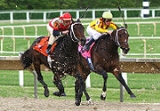
Horse racing is an
equestrian sport which has been practiced over the centuries; the
chariot races of
Roman times are an early example, as is the contest of the steeds of the god
Odin and the giant Hrungnir in
Norse mythology. It is often inextricably associated with
gambling. The common nickname for horse racing is
The Sport of Kings.
Forms of horse racing
- For more details on this topic, see Harness racing and Thoroughbred horse racing.
One of the principal forms of horse racing, which is popular in many parts of the world, is thoroughbred racing.
Harness racing is also popular in the eastern United States, Canada and parts of Europe.
Quarter horse and Arabian racing are also popular in the western United States and
Florida.
The breeding, training and racing of
horses in many countries is now a significant economic activity as, to a greater extent, is the gambling industry which is largely supported by it. Exceptional horses can win millions of dollars and make millions more by providing stud services, such as
horse breeding.
Horse racing in North America
The style of racing, the distances and the type of events varies very much by the country in which the race is occurring, and many countries offer different types of horse races.
In the
United States, races can occur on flat surfaces of either dirt or grass, generally thoroughbred racing; other tracks offer
quarter horse racing and
harness racing, or combinations of these three types of racing. Racing with other breeds, such as
Arabian horse racing, is found on a limited basis. American thoroughbred races are run at a wide variety of distances, most commonly from 4.5
furlongs to 1½ miles ; with this in mind, breeders of thoroughbred race horses are able to breed horses to excel at a particular distance .
The high point of US horse racing has traditionally been the
Kentucky Derby which, together with the Preakness Stakes and the
Belmont Stakes, form the
Triple Crown for three-year-olds. However, in recent years the Breeders' Cup races, held at the end of the year, have been challenging the Triple Crown events, held early in the year, as determiners of the three-year-old champion. They also have an important effect on the selection of other annual champions. The corresponding standard-bred event is the Breeders' Crown. There are also a Triple Crown of Harness Racing for Pacers and a Triple Crown of Harness Racing for Trotters.
American betting on horse racing is sanctioned and regulated by state governments, almost always through legalized parimutuel gambling. Thoroughbred horse racing in the United States has its own Hall of Fame for horses, jockeys, and trainers.
The most famous horses from
Canada are
Northern Dancer, who after winning the Kentucky Derby and Preakness went on to become the most successful Thoroughbred sire ever, and his son
Nijinsky II. In Canada, however,
harness racing is more popular than Thoroughbred racing. Woodbine Racetrack in Toronto, home of the Queen's Plate, Canada's premier thoroughbred stakes race, and the North America Cup, Canada's premier standard-bred stakes race, is the only race track in North America which stages Thoroughbred and Standard-bred meetings on the same day. The North America Cup has the largest purse of any Canadian horse race.
Horse racing in Australia
Racing in
Australia has enjoyed great success with races such as the world famous
Melbourne Cup, the so-called
race that stops a nation, which has recently attracted many international entries. In
Australia, the most famous horse was
Phar Lap, who raced from 1928-1932 . In 2003-2005
Makybe Diva became the first and only horse to ever win the
Melbourne Cup three times. In
harness racing,
Paleface Adios became a household name during the 1970s, while
Cardigan Bay, a pacing horse from
New Zealand, enjoyed great success at the highest levels of American harness racing in the 1960s.
Horse racing in Europe
In the
United Kingdom, there are races which involve obstacles called National Hunt racing and those which are unobstructed races over a given distance . The UK has provided many of the sport's greatest ever jockeys, most notably
Gordon Richards. See also United Kingdom horse-racing.
In
Ireland, noted for its racing history, the Derby-winning thoroughbred Shergar was kidnapped on February 8, 1983. He has never been found. The multiple Gold Cup winner Best Mate also hails from Ireland, while the great Red Rum was bred there, before moving across the
Irish Sea to be trained.
Pedigree
While the attention of horse racing fans and the media is focused almost exclusively on the horse's performance on the racetrack, or for male horses possibly its success as a sire, little publicity is given to brood mares. Such is the case of La Troienne, one of the most important mares of the 20th century to whom many of the greatest thoroughbred champions, and dams of champions, can be traced.
In most horse races, not including steeplechases, the pedigree of the horse is one of the things that allow it to race. In a normal flat race, the horse must have a sire who is a pure thoroughbred and a dam who is also a pure thoroughbred. In a normal harness race, the horses sire and dam must both be pure standardbreds.
A stallion who has won many races will usually be put up to stud when he is retired. This means that the owner of a mare can pay to breed his mare to that stallion. The more successful a stallion has been, the more expensive it is to breed the mare. An owner who is serious about racing will strive for the best, and will usually pay the expensive amount, so an owner who has had a successful colt will probably make more money than an owner with a filly.
Betting
At all official horse races, there is a gambling station, where gamblers can stake money on a horse.
The three most common ways to bet money are: bet to win, bet to place, and bet to show. Bet to win means that you stake money on the horse, and if it comes in first place, the bet is a winner. In bet to place, you are betting on your horse to finish either first or second and 'show' is first, second or third. Since it is much easier to select a horse to finish first, second or third than it is to select a horse just for first, the 'show' payoffs will be much lower on average than win payoffs. Betting 'show' is really playing it safe while win betting is a bit more risky, yet the rewards are better.
In the UK and Europe, betting to show is less commonplace since the number of "payout places" varies depending on the size of the field that takes part in the race. For example, in a race with seven or less runners in the UK, only the first two finishers would be considered winning bets with most bookmakers. Three places are paid for eight or more runners, whilst 16 runners or more will see the first four places being classed as "placed". Betting to place takes on a different meaning in the UK and Europe for this reason. In the US a place bet would only pay out if the horse in question finished first or second, whilst in the UK, a place bet would be deemed a winner based on the aforementioned criteria.
The term "Each Way" bet is used across the globe, but again has a different meaning depending on your location. An each way bet sees your total bet being split in two, with half being placed on the win, and half on the place. US bettors would only see a payout for a first or second place finish with this type of bet, whilst European and British bettors would receive a payout if the horse either wins, or is placed based on the place criteria as stated above. Most UK bookmakers cut the odds considerably for an each bet, offering the full odds if the horse wins but only a third, a quarter or a fifth of the odds if only the place section of the bet is successful.
Dangers
There are many dangers in horse racing for both horse and jockey: a horse can stumble and fall, exposing both jockey and horse to the danger of being trampled and possibly killed. Horses can also fall when jumping a hedge.
See also
- Controversy in horse racing
- Equestrian property
- List of horse racing tracks
- List of jockeys