


Night on Bald Mountain

Encyclopedia
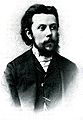
Modest Mussorgsky
Modest Petrovich Mussorgsky was a Russian composer, one of the group known as 'The Five'. He was an innovator of Russian music in the romantic period...
that exists in, at least, two versions—a seldom performed 1867 version or a later (1886) and very popular "fantasy for orchestra
Fantasia (music)
The fantasia is a musical composition with its roots in the art of improvisation. Because of this, it seldom approximates the textbook rules of any strict musical form ....
" arranged by Nikolai Rimsky-Korsakov
Nikolai Rimsky-Korsakov
Nikolai Andreyevich Rimsky-Korsakov was a Russian composer, and a member of the group of composers known as The Five.The Five, also known as The Mighty Handful or The Mighty Coterie, refers to a circle of composers who met in Saint Petersburg, Russia, in the years 1856–1870: Mily Balakirev , César...
, A Night on the Bare Mountain , based on the vocal score of the "Dream Vision of the Peasant Lad" (1880) from The Fair at Sorochyntsi with some revisions, most notably the omission of the choir. There is also a version orchestrated by twentieth-century conductor Leopold Stokowski
Leopold Stokowski
Leopold Anthony Stokowski was a British-born, naturalised American orchestral conductor, well known for his free-hand performing style that spurned the traditional baton and for obtaining a characteristically sumptuous sound from many of the great orchestras he conducted.In America, Stokowski...
; this is the version used in the now-classic 1940 Walt Disney
Walt Disney
Walter Elias "Walt" Disney was an American film producer, director, screenwriter, voice actor, animator, entrepreneur, entertainer, international icon, and philanthropist, well-known for his influence in the field of entertainment during the 20th century. Along with his brother Roy O...
animated film Fantasia
Fantasia (film)
Fantasia is a 1940 American animated film produced by Walt Disney and released by Walt Disney Productions. The third feature in the Walt Disney Animated Classics series, the film consists of eight animated segments set to pieces of classical music conducted by Leopold Stokowski, seven of which are...
.
Inspired by Russian literary works and legend, Mussorgsky made a witches' sabbath the theme of the original tone poem, completed on 23 June 1867 (St. John's Eve
St. John's Eve
The evening of June 23, St John's Eve, is the eve of celebration before the Feast Day of St John the Baptist. The Gospel of Luke states that John was born about six months before Jesus, therefore the feast of John the Baptist was fixed on June 21~24, six months before Christmas...
). St. John's Night on the Bare Mountain and Rimsky-Korsakov's "musical picture" Sadko
Sadko (musical tableau)
Nikolai Rimsky-Korsakov wrote his "musical tableau" Sadko, Op. 5, in 1867 but revised the work in 1869 and 1892. It has sometimes been called the first symphonic poem written in Russia...
(also composed in 1867) share the distinction of being the first tone poems by Russian composers.
As with so much of Mussorgsky's music, the work had a tortuous compositional history and was arranged after his death in 1881 by his friend and fellow member of The Mighty Handful
The Five
The Five, also known as The Mighty Handful or The Mighty Coterie , refers to a circle of composers who met in Saint Petersburg, Russia, in the years 1856–1870: Mily Balakirev , César Cui, Modest Mussorgsky, Nikolai Rimsky-Korsakov and Alexander Borodin...
Rimsky-Korsakov. It was never performed in any form during Mussorgsky's lifetime. The Rimsky-Korsakov edition premiered in 1886, and has become a concert favorite.
Note on the title: The Russian word "" (lïsaya) literally means "bald", but is used in this case figuratively for a mountain supposedly barren of trees. In English, the titles A Night on the Bare Mountain or Night on Bald Mountain are used.
History
Composition history
The following list traces the evolution of the Night on Bald Mountain music:
Opera Project: St. John's Eve (1858)
A sheet of paper apparently found among Mussorgsky's manuscripts contains the following statement: "Program of the opera St. John's Night, in three acts, after the tale by Gogol, written by P. Boborykin, in the presence and with the help of Modest Mussorgsky, Yevgeny Mussorgsky, and Vasily. Witness to the proceedings: Mily Balakirev." This curious fragment, dated 25 December 1858, has been interpreted as an indication of Mussorgsky's intention of writing an opera on the subject of Gogol's short story St. John's Eve
St. John's Eve (short story)
"St. John's Eve" is the second tale in the collection Evenings on a Farm Near Dikanka by Nikolai Gogol. It was first published in 1830 in the literary Russian periodical Otechestvennye Zapiski in February and March issues, and in the book form in 1831....
. Gogol's tale contains the elements of witchcraft
Witchcraft
Witchcraft, in historical, anthropological, religious, and mythological contexts, is the alleged use of supernatural or magical powers. A witch is a practitioner of witchcraft...
common to other stories in the Evenings on a Farm near Dikanka
Evenings on a Farm Near Dikanka
Evenings on a Farm Near Dikanka is a collection of short stories by Nikolai Gogol, written from 1831-1832. They appeared in various magazines and were published in book form when Gogol, who had spent his life in Ukraine up to the age of nineteen, was twenty two. He put his early impressions and...
collection, but does not, as is often claimed, feature a witches' sabbath. Although Mussorgsky may have composed thematic sketches for this project, his plans were not mentioned.
Opera Project: The Witch (1860)
The theme of a witches' sabbath
Sabbath (witchcraft)
The Witches' Sabbath or Sabbat is a supposed meeting of those who practice witchcraft, and other rites.European records indicate cases of persons being accused or tried for taking part in Sabbat gatherings, from the Middle Ages to the 17th century or later.- Etymology :The English word “sabbat”...
, the central theme in all subsequent Night on Bald Mountain projects, appears to have been derived from the nonextant play The Witch by Baron Georgy Mengden, a military friend of the composer. In 1860 Mussorgsky informed Balakirev that he had been commissioned to write one act of an opera on this subject. However, as with the previous project, it is unknown whether any materials were composed, and if so, whether they were transferred to subsequent projects.
Work for piano and orchestra (early 1860s)
Rimsky-Korsakov declares in his memoirs (Chronicle of My Musical Life) that in the early 1860s Mussorgsky had written a version of the Night on Bald Mountain music for piano and orchestra, under the influence of Franz Liszt
Franz Liszt
Franz Liszt ; ), was a 19th-century Hungarian composer, pianist, conductor, and teacher.Liszt became renowned in Europe during the nineteenth century for his virtuosic skill as a pianist. He was said by his contemporaries to have been the most technically advanced pianist of his age...
's Totentanz
Totentanz (Liszt)
Totentanz : Paraphrase on Dies irae , S.126, is the name of a symphonic piece for solo piano and orchestra by Franz Liszt, which is notable for being based on the Gregorian plainchant melody Dies Irae as well as for daring stylistic innovations...
. However, it is believed that Mussorgsky did not hear Liszt's work until 1866, by which time he was planning the orchestral tone poem St. John's Night on the Bare Mountain (see below). No trace of a work for piano and orchestra has survived outside Rimsky-Korsakov's recollections, so it is assumed that the score was lost, or, more likely, that it had never existed.
Tone Poem: St. John's Night on the Bare Mountain (1867)
In 1866 Mussorgsky wrote to Balakirev expressing a desire to discuss his plans for The Witches, his informal name for his Night on Bald Mountain music. In early June 1867, he began composing the orchestral version of the piece, and finished the score on 23 June (St. John's Eve). He described the event in a letter to Vladimir Nikolsky:
"My St. John's Night on the Bare Mountain (a far better title than The Witches) is, in form and character, RussiaRussiaRussia or , officially known as both Russia and the Russian Federation , is a country in northern Eurasia. It is a federal semi-presidential republic, comprising 83 federal subjects...
n and original; and I want to feel sure that it is thoroughly in keeping with historic truth and Russian folk tradition — otherwise it would not be good enough. I wrote it quickly, straight away in full score without preliminary rough drafts, in twelve days. It seethed within me, and I worked day and night, hardly knowing what was happening within me. And now I see in my wicked prank an independent Russian product, free from German profundity and routine, and, like my Savishna, grown on our country's soil and nurtured on Russian bread."
He also stated — wrongly, as it turned out — that he would never re-model it: "with whatever shortcomings, it is born; and with them it must live if it is to live at all." Having finally completed the work, Mussorgsky was crushed when his mentor Mily Balakirev
Mily Balakirev
Mily Alexeyevich Balakirev ,Russia was still using old style dates in the 19th century, and information sources used in the article sometimes report dates as old style rather than new style. Dates in the article are taken verbatim from the source and therefore are in the same style as the source...
was savagely critical of it. The score of this 'first version' was put aside, and did not appear in print until 1968.
Unfinished Opera: Mlada
Mlada
Mlada was a project originally envisioned as a ballet to be composed by Alexander Serov and choreographed by Marius Petipa. The project was later revised in 1872 as an opera-ballet in four acts, with the composition of the score to be divided between César Cui, Léon Minkus, Modest Mussorgsky,...
(1872)
The first re-modelling of the work took place in 1872, when Mussorgsky revised and recast it for chorus
Choir
A choir, chorale or chorus is a musical ensemble of singers. Choral music, in turn, is the music written specifically for such an ensemble to perform.A body of singers who perform together as a group is called a choir or chorus...
and orchestra
Orchestra
An orchestra is a sizable instrumental ensemble that contains sections of string, brass, woodwind, and percussion instruments. The term orchestra derives from the Greek ορχήστρα, the name for the area in front of an ancient Greek stage reserved for the Greek chorus...
as part of Act III that he was assigned to contribute to the collaborative opera-ballet Mlada
Mlada
Mlada was a project originally envisioned as a ballet to be composed by Alexander Serov and choreographed by Marius Petipa. The project was later revised in 1872 as an opera-ballet in four acts, with the composition of the score to be divided between César Cui, Léon Minkus, Modest Mussorgsky,...
. In this new version the music was to form the basis of the Night on Mt. Triglav scene. Mussorgsky referred to this piece under the title Glorification of Chornobog in a list of his compositions given to Stasov. Mlada was a project doomed to failure, however, and this 'second version' languished along with the first.
Unfinished Opera: The Fair at Sorochyntsi (1880)
The work's 'third version', the Dream Vision of the Peasant Lad , came into existence eight years later when the composer revived and revised the second version (see Night on Mount Triglav above) to function as a 'dream intermezzo
Intermezzo
In music, an intermezzo , in the most general sense, is a composition which fits between other musical or dramatic entities, such as acts of a play or movements of a larger musical work...
' in his opera The Fair at Sorochyntsi (1874–80), a work which was still incomplete at the time of his death in 1881. Mussorgsky originally chose the end of Act I of the opera as the location for his choral intermezzo. It is now generally performed in the Shebalin version (1930) of the opera, where it is more logically relocated to Act III, just after the peasant lad's dumka. The theme of the dumka also serves as one of the main themes of the new quiet ending in this version (which also finds its way into the Rimsky-Korsakov edition), thus forming a musical frame to the intermezzo.
Performance history
- Mussorgsky's original tone poem St. John's Night on the Bare Mountain (1867) was not performed until the 20th century. Gerald Abraham makes the claim that this version was performed by Nikolai MalkoNikolai Malko-Biography:Malko was born in Semaky, Ukraine. His father was Ukrainian, his mother Russian. He studied philology at St Petersburg University. He published articles on music criticism in the Russian press and performed as a pianist and later a conductor. In 1906 he completed his studies in history...
on 3 February 1932, apparently in EnglandEnglandEngland is a country that is part of the United Kingdom. It shares land borders with Scotland to the north and Wales to the west; the Irish Sea is to the north west, the Celtic Sea to the south west, with the North Sea to the east and the English Channel to the south separating it from continental...
. Calvocoressi gives the year as 1933. According to the Grove Dictionary of Music this version premiered in Moscow in 1968. This was presumably in Kirkor's edition (see below).
- The score of Glorification of Chornobog (1872) from Mlada has not survived and the piece was never performed.
- The Dream Vision of the Peasant Lad (1880) was first performed as part of Shebalin's performing edition of The Fair at Sorochyntsi, which premiered in 1931 in LeningradLeningradLeningrad is the former name of Saint Petersburg, Russia.Leningrad may also refer to:- Places :* Leningrad Oblast, a federal subject of Russia, around Saint Petersburg* Leningrad, Tajikistan, capital of Muminobod district in Khatlon Province...
at the Maly Theater, conducted by Samuil SamosudSamuil SamosudSamuil Abramovich Samosud |Georgia]], — Moscow, 6 November 1964) was a Russian conductor. He started his musical career on the cello, before conducting in the Mariinsky Theater, Petrograd in 1917. From 1918 to 1936 he conducted at the Maly Operny, Leningrad. In 1936 he became musical...
.
- Rimsky-Korsakov's edition of A Night on the Bare Mountain (1886) received its premiere on 15 October 1886, in St. Petersburg, at Kononov Hall. It was performed by the orchestra of the Russian Symphony Concerts conducted by Rimsky-Korsakov himself.
Publication history
- The original tone poem St. John's Night on the Bare Mountain was composed and orchestrated by Mussorgsky in 1867. A new edition was prepared by Georgiy Kirkor and published in 1968.
- The score of Glorification of Chornobog (1872) from Mlada has not survived and was never published.
- Mussorgsky's piano-vocal score of the Dream Vision of the Peasant Lad, intended as an intermezzo in the opera The Fair at Sorochyntsi, was finished in 1880. It was edited and orchestrated by Vissarion ShebalinVissarion ShebalinVissarion Yakovlevich Shebalin was a Soviet composer.-Biography:Shebalin was born in Omsk, where his parents were school teachers. He studied in the musical college in Omsk. He was 20 years old when, following the advice of his professor, he went to Moscow to show his first compositions to...
, and was published by Muzgiz in 1934.
- Rimsky-Korsakov's recomposition of Mussorgsky's work, titled A Night on the Bare Mountain, was completed in 1886, and was published that year by V. Bessel and Co.V. Bessel and Co.V. Bessel and Co. was a musical firm founded in 1869 in St Petersburg by Vasily Vasil’yevich Bessel . His brother N. V. Bessel was a co-owner of the firm....
.
Instrumentation
Original Tone Poem (1867)- Strings: Violins, Violas, Cellos, Double Basses
- Woodwinds: 1 Piccolo, 2 Flutes, 2 Oboes, 2 Clarinets, 2 Bassoons
- Brass: 4 Horns, 2 Cornets, 2 Trumpets, 3 Trombones, 1 Tuba
- Percussion: Timpani, Bass Drum, Snare Drum, Triangle, Tambourine, Cymbals, Tam-tam
Rimsky Korsakov Edition (1886)
- Strings: Violins, Violas, Cellos, Double Basses
- Woodwinds: 1 Piccolo, 2 Flutes, 2 Oboes, 2 Clarinets, 2 Bassoons
- Brass: 4 Horns, 2 Trumpets, 3 Trombones, 1 Tuba
- Percussion: Timpani, Bass Drum, Cymbals, Tam-tam, Bell
- Other: Harp
Program
Original Tone Poem (1867)Setting:
Russian legend tells of a witches' sabbath taking place on St. John's Night (June 23–24) on the Lysa Hora
Lysa Hora
Lysa Hora ; literally "Barren Mount", Featureless Mount, or Bald Mount) is a large woody hill in the Ukrainian capital Kiev , near the confluence of the Dnipro and Lybid' rivers...
(Bald Mountain), near Kiev.
Program:
The following program is taken from the score:
- Сбор ведьм, их толки и сплетни (Assembly of the witches, their chatter and gossip)
- Поезд Сатаны (Cortège of Satan)
- Чёрная служба, Messe noire (Black service, Black mass)
- Шабаш (Sabbath)
More details and a variation to this program may be found in a letter written by the composer to Vladimir Nikolsky:
"So far as my memory doesn't deceive me, the witches used to gather on this mountain, gossip, play tricks and await their chief — SatanSatanSatan , "the opposer", is the title of various entities, both human and divine, who challenge the faith of humans in the Hebrew Bible...
. On his arrival they, i.e. the witches, formed a circle round the throne on which he sat, in the form of a kid, and sang his praise. When Satan was worked up into a sufficient passion by the witches' praises, he gave the command for the sabbath, in which he chose for himself the witches who caught his fancy. –So this is what I've done. At the head of my score I've put its content: 1. Assembly of the witches, their talk and gossip; 2. Satan's journey; 3. Obscene praises of Satan; and 4. Sabbath... The form and character of the composition are both Russian and original".
Glorification of Chornobog from Mlada (1872)
Mussorgsky's score for the Glorification of Chornobog portion of Mlada has not survived. The following scenario is taken from Rimsky-Korsakov's later (1890) 'magic opera-ballet' based on the same libretto.
Setting:
Mlada is set in the 9th or 10th century city of Retra, in the (formerly) Slavic lands between the Baltic Sea
Baltic Sea
The Baltic Sea is a brackish mediterranean sea located in Northern Europe, from 53°N to 66°N latitude and from 20°E to 26°E longitude. It is bounded by the Scandinavian Peninsula, the mainland of Europe, and the Danish islands. It drains into the Kattegat by way of the Øresund, the Great Belt and...
coast and the Elbe River. This would be the land of the pre-Christian
Christian
A Christian is a person who adheres to Christianity, an Abrahamic, monotheistic religion based on the life and teachings of Jesus of Nazareth as recorded in the Canonical gospels and the letters of the New Testament...
Polabian Slavs
Polabian Slavs
Polabian Slavs - is a collective term applied to a number of Lechites tribes who lived along the Elbe river, between the Baltic Sea to the north, the Saale and the Limes Saxoniae to the west, the Ore Mountains and the Western Sudetes to the south, and Poland to the east. They have also been known...
, in the region corresponding to the modern German areas of Vorpommern, Mecklenburg
Mecklenburg
Mecklenburg is a historical region in northern Germany comprising the western and larger part of the federal-state Mecklenburg-Vorpommern...
, or Holstein
Holstein
Holstein is the region between the rivers Elbe and Eider. It is part of Schleswig-Holstein, the northernmost state of Germany....
.
The Mlada scenario is the only Night on Bald Mountain setting that mentions a 'Mt. Triglav', where the supernatural events of Act III take place. It is reasonable to assume that this Mt. Triglav is not the famous peak
Triglav
Triglav is the highest mountain in Slovenia and the highest peak of the Julian Alps. While its name, meaning "three-headed", can describe its shape as seen from the Bohinj area, the mountain was most probably named after the Slavic god Triglav. The mountain is the preeminent symbol of the Slovene...
in Slovenia
Slovenia
Slovenia , officially the Republic of Slovenia , is a country in Central and Southeastern Europe touching the Alps and bordering the Mediterranean. Slovenia borders Italy to the west, Croatia to the south and east, Hungary to the northeast, and Austria to the north, and also has a small portion of...
, some 750 kilometers distant. It is certainly not the Lysa Hora near Kiev
Kiev
Kiev or Kyiv is the capital and the largest city of Ukraine, located in the north central part of the country on the Dnieper River. The population as of the 2001 census was 2,611,300. However, higher numbers have been cited in the press....
, as is often mentioned in program and liner notes. However, the description of it in the libretto
Libretto
A libretto is the text used in an extended musical work such as an opera, operetta, masque, oratorio, cantata, or musical. The term "libretto" is also sometimes used to refer to the text of major liturgical works, such as mass, requiem, and sacred cantata, or even the story line of a...
, as possessing a snow-covered peak, gorges, and glaciers, makes it difficult to place it among the low mountains and hills of northeast Germany. Incidentally, the name Triglav
Triglav (mythology)
Triglav also sometimes called troglav is a deity in Slavic mythology.It is generally believed that Triglav, the highest mountain in Slovenia and Troglav, highest peak of Dinara in Bosnia and...
['tri'(three) + 'glav'(heads)] happens to be the name of an ancient three-headed Slavic deity or a trinity of deities.
Plot:
Voyslava and her father Mstivoy, the Prince of Retra, have poisoned Mlada, the betrothed of Yaromir, Prince of Arkona
Cape Arkona
Cape Arkona is a cape on the island of Rügen in Mecklenburg-Vorpommern, Germany. Cape Arkona is the tip of the Wittow peninsula, just a few kilometres north of the Jasmund National Park....
. Voyslava sells her soul to Morena, an evil goddess, to obtain her aid in making Yaromir forget Mlada so she may have him to herself. In Act III, the shade
Shade (mythology)
In literature and poetry, a shade can be taken to mean the spirit or ghost of a dead person, residing in the underworld....
(ghost
Ghost
In traditional belief and fiction, a ghost is the soul or spirit of a deceased person or animal that can appear, in visible form or other manifestation, to the living. Descriptions of the apparition of ghosts vary widely from an invisible presence to translucent or barely visible wispy shapes, to...
) of Mlada leads Yaromir up the slopes of Mt. Triglav to a pine wood in a gorge on top of the mountain. Mlada's shade joins a gathering of the spirits of the dead. She expresses in mime
Mime
The word mime is used to refer to a mime artist who uses a theatrical medium or performance art involving the acting out of a story through body motions without use of speech.Mime may also refer to:* Mime, an alternative word for lip sync...
to Yaromir the wish to be reunited with him in the kingdom of dead souls. He is eager to join her. However, there is a rumbling sound announcing the appearance, apparently from underground, of the following fantastic characters:
| Russian | Transliteration | Description |
|---|---|---|
| Злые духи | Zlïye dukhi | Evil spirits |
| Ведьмы | Ved'mï | Witches Witchcraft Witchcraft, in historical, anthropological, religious, and mythological contexts, is the alleged use of supernatural or magical powers. A witch is a practitioner of witchcraft... |
| Кикиморы | Kikimorï Kikimora Kikimora is a legendary creature, a female house spirit in Slavic mythology, fin: Kikke Mörkö , sometimes said to be married to the Domovoi... |
Female hobgoblin Hobgoblin Hobgoblin is a term typically applied in folktales to describe a friendly but troublesome creature of the Seelie Court.The most commonly known hobgoblin is the character Puck in Shakespeare's A Midsummer Night's Dream. Puck, however, is only another name given to a much older character named Robin... s |
| Чёрнобог | Chornobog Chernobog Chernobog is a Slavic deity, about whom much has been speculated but little can be said definitively. The name may also be given as Crnobog, Czernobóg, Černobog, Црнобог, Zernebog and Чернобог, meaning black god... |
'Chorno'(black) + 'bog'(god), an infernal Slavic deity, in the form of a goat |
| Морена | Morena Marzanna Maržanna, Mara, Maržena, Morana, Moréna, Mora, Marmora or Morena is a Slavic goddess associated with death, winter and nightmares. Some sources equate her with the Latvian goddess Māra, who takes a person's body after their death... |
An infernal Slavic deity |
| Кащей | Kashchey | An ogre Ogre An ogre is a large, cruel, monstrous, and hideous humanoid monster, featured in mythology, folklore, and fiction. Ogres are often depicted in fairy tales and folklore as feeding on human beings, and have appeared in many classic works of literature... familiar from Russian folktales; plays a gusli |
| Червь | Cherv | Worm, god of famine Famine A famine is a widespread scarcity of food, caused by several factors including crop failure, overpopulation, or government policies. This phenomenon is usually accompanied or followed by regional malnutrition, starvation, epidemic, and increased mortality. Every continent in the world has... |
| Чума | Chuma | Plague, god of pestilence |
| Топелец | Topelets | 'Drowner', god of floods |
The evil spirits sing in a strange demonic language. Morena calls on Chornobog to help make Yaromir forsake Mlada. Kashchey determines that Morena and Chornobog will be successful if Yaromir is seduced by another. Chornobog commands Yaromir's soul to separate from his body, and for Queen Cleopatra to appear. Instantly the scene changes to a hall in Egypt, where the shade of Cleopatra attempts to entice Yaromir's soul to her side with a seductive dance. She almost succeeds in doing so when a cock crow announcing the break of day causes the entire infernal host to vanish. Yaromir awakens and ponders the mysterious events he has witnessed.
Dream Vision of the Peasant Lad from The Fair at Sorochyntsi (1880)
Setting:
The Fair at Sorochyntsi is set in and around the Ukrainian
Ukraine
Ukraine is a country in Eastern Europe. It has an area of 603,628 km², making it the second largest contiguous country on the European continent, after Russia...
village of Velyki Sorochyntsi
Velyki Sorochyntsi
Velyki Sorochyntsi is a village in the Poltava Oblast of central Ukraine. It can be translated as the Grand Sorochyntsi. The village is located in the Myrhorodsky Raion of the oblast, at around , and is famous as both the birthplace of the great writer Nikolai Gogol and the location of the...
, some 500 kilometers east of Kiev and the famous 'Bald Mountain' (Lysa Hora), in the year 1800.
Plot:
The peasant Solopy Cherevik, his domineering wife Khivrya, and pretty daughter Parasya are visiting the Sorochintsi Fair. Parasya is wooed by Gritsko Golopupenko, the "peasant lad" of the title. Gritsko desires Cherevik's consent to marry his daughter. Although Cherevik is not against the match, his wife objects because Gritsko had thrown mud in her face on the way to the fair. Gritsko strikes a bargain with a gypsy to assist him in winning Parasya. They exploit the superstitious fears of the fairgoers, who believe that the location of the fair this year is ill-chosen, it being the haunt of a devil who was thrown out of hell, took to drinking, went broke, pawned his jacket, and has returned to claim it. After various pranks and comic circumstances, Gritsko achieves his goal and all ends happily.
At the end of Act 1, Gritsko falls asleep some distance from the fair, and, because there has been talk of devilry, has a dream of a witches' sabbath. The following remarks are taken from the score, which is dated 10 May 1880:
Act I, Scene II – Dream Vision of the Peasant Lad
- A hilly desolate area. An approaching subterranean choir of infernal forces.
- Witches and devils surround the sleeping peasant lad.
- On a hill appear fiery serpents. The approach of Chornobog.
- Chornobog climbs up from underground. Following him are Kashchey, Cherv, Chuma, Topelets, Smert, and the remaining members of his retinue.
- Worship of Chornobog: dwarfs begin to circle Chornobog and bow down. Behind them are also visible demons. Chornobog gives the signal for general earthly worship.
- Sabbath.
- Ballet.
- Stroke of a morning bell.
- Satan and his retinue vanish. The scene is covered by clouds.
Surviving the transfer from Glorification of Chornobog are the same supernatural characters, although Morena has been replaced by Death . Chornobog and his accomplices form a kind of Six Horsemen of the Apocalypse
Four Horsemen of the Apocalypse
The Four Horsemen of the Apocalypse are described in the last book of the New Testament of the Bible, called the Book of Revelation of Jesus Christ to Saint John the Evangelist at 6:1-8. The chapter tells of a "'book'/'scroll' in God's right hand that is sealed with seven seals"...
. The demon language the characters sing, of which Mussorgsky was contemptuous in a letter, is preserved. Interestingly, Mussorgsky does not differentiate Satan from Chornobog clearly, in either this scenario or the next.
Mussorgsky sent the following program to Vladimir Stasov about three months after its composition in 1880:
"The peasant lad sleeps at the foot of a hillock at some distance from the hut where he should have been. In his sleep appear to him:
- Subterranean roar of non-human voices, uttering non-human words.
- The subterranean kingdom of darkness comes into its own—mocking the sleeping peasant lad.
- Foreshadowing of the appearance of Chornobog and Satan.
- The peasant lad left by the spirits of darkness. Appearance of Chornobog.
- Worship of Chornobog and the black mass
Black MassA Black Mass is a ceremony supposedly celebrated during the Witches' Sabbath, which was a sacrilegious parody of the Catholic Mass. Its main objective was the profanation of the host, although there is no agreement among authors on how hosts were obtained or profaned; the most common idea is that...
.- Sabbath.
- At the wildest moment of the sabbath the sound of a Christian
ChristianA Christian is a person who adheres to Christianity, an Abrahamic, monotheistic religion based on the life and teachings of Jesus of Nazareth as recorded in the Canonical gospels and the letters of the New Testament...
church bell. Chornobog suddenly disappears.- Suffering of the demons.
- Voices of the clergy in church.
- Disappearance of the demons and the peasant lad's awakening."
Rimsky Korsakov Edition (1886)
Setting:
For Rimsky-Korsakov's edition we apparently return to the 'Bald Mountain' (Lysa Hora) in or near Kiev.
Program:
“Subterranean sounds of unearthly voices. Appearance of the Spirits of Darkness, followed by that of Chornobog. Glorification of Chornobog and celebration of the Black Mass. Witches’ Sabbath. At the height of the orgy
Orgy
In modern usage, an orgy is a sex party where guests engage in promiscuous or multifarious sexual activity or group sex. An orgy is similar to debauchery, which refers to excessive indulgence in sensual pleasures....
, the bell of the little village church is heard from afar. The Spirits of Darkness are dispersed. Daybreak.”
Rimsky Korsakov edition (1886)
In the years after Mussorgsky's death, his friends prepared his manuscripts for publication and created performing editions of his unfinished works to enable them to enter the repertoire. The majority of the editorial work was done by Rimsky-Korsakov, who in 1886 produced a redacted edition of A Night on the Bare Mountain from the Dream Vision of the Peasant Lad vocal scoreVocal score
A vocal score or piano-vocal score is a music score of an opera, or a vocal or choral composition with orchestra such as an oratorio or cantata, in which the vocal parts are written out in full but the accompaniment is reduced and adapted for keyboard...
and premiered at the first of the Russian Symphony Concerts
Russian Symphony Concerts
The Russian Symphony Concerts were a series of Russian classical music concerts hosted by timber magnate and musical philanthropist Mitrofan Belyayev in St. Petersburg as a forum for young Russian composers to have their orchestral works performed...
:
He apparently did not make use of the original tone poem of 1867 in making his revision. The published score of his edition states "Completed and orchestrated by N. Rimsky-Korsakov, 1886". If he had the score of the 1867 tone poem at hand, he would have noticed that it was both completed and orchestrated. He also did not remember Mussorgsky's letter to him announcing that he had finished the work on St. John's Day, and had composed the work directly into full orchestral score, a practice unusual for him. Mussorgsky's manuscript is believed to have been in the keeping of Balakirev at the time.
However, Rimsky-Korsakov remembered that an orchestral score was Mussorgsky's original intention, and because he had no manuscript of that score, he orchestrated what he considered as an "unfinished" vocal score of the Dream Vision of the Peasant Lad, omitting the vocal parts. Rimsky-Korsakov has made some "corrections" typical of him (as he did with Boris Godunov, Khovanshchina, etc.), which means that he preserved the thematic structure, but occasionally added or omitted bars and changed harmonic structures.
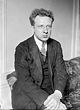
Stokowski arrangement (1940)
Millions of twentieth-century listeners owe their initial acquaintance with Mussorgsky's tone-poem to the use within Walt DisneyWalt Disney
Walter Elias "Walt" Disney was an American film producer, director, screenwriter, voice actor, animator, entrepreneur, entertainer, international icon, and philanthropist, well-known for his influence in the field of entertainment during the 20th century. Along with his brother Roy O...
's 1940 film Fantasia
Fantasia (film)
Fantasia is a 1940 American animated film produced by Walt Disney and released by Walt Disney Productions. The third feature in the Walt Disney Animated Classics series, the film consists of eight animated segments set to pieces of classical music conducted by Leopold Stokowski, seven of which are...
of a specially produced version made by Leopold Stokowski
Leopold Stokowski
Leopold Anthony Stokowski was a British-born, naturalised American orchestral conductor, well known for his free-hand performing style that spurned the traditional baton and for obtaining a characteristically sumptuous sound from many of the great orchestras he conducted.In America, Stokowski...
. Stokowski stated that he based it on the Rimsky-Korsakov arrangement in form and content (though notably without the 'fanfare' that marks the entrance of the black god Chernobog
Chernobog
Chernobog is a Slavic deity, about whom much has been speculated but little can be said definitively. The name may also be given as Crnobog, Czernobóg, Černobog, Црнобог, Zernebog and Чернобог, meaning black god...
) but Mussorgsky's original in orchestration. However, like Rimsky-Korsakov himself, Stokowski had no copy of the original tone poem from 1867, so he did what he felt Mussorgsky would have done. Stokowski was familiar to some extent with Mussorgsky's style, having conducted the U.S. premiere of the original version of Boris Godunov
Boris Godunov (opera)
Boris Godunov is an opera by Modest Mussorgsky . The work was composed between 1868 and 1873 in Saint Petersburg, Russia. It is Mussorgsky's only completed opera and is considered his masterpiece. Its subjects are the Russian ruler Boris Godunov, who reigned as Tsar during the Time of Troubles,...
in 1929 and subsequently produced a symphonic synthesis of Boris for concert purposes. Stokowski went on to produce an even more drastic adaptation of Night for concert performance. The Stokowski arrangements are only rarely heard today, Rimsky-Korsakov's orchestration being the concert favorite, and the one most often programmed.
In popular culture
- Stern-Combo MeißenStern-Combo MeißenStern-Combo Meißen is a German rock band founded in 1964 in Meißen, East Germany. - External links :* * *...
, an experimental progressive rock band from East Germany, adapted Mussorgsky's original version in 1977 as Eine Nacht auf dem kahlen Berg on their first full length LP. The recording of SCM's Eine Nacht auf dem kahlen Berg occurred during a time permeating their late 1970s to early 1980s period albums when the band abstained from using guitar instrumentation. - Isao TomitaIsao Tomita, often known simply as Tomita, is a Japanese music composer, regarded as one of the pioneers of electronic music and space music, and as one of the most famous producers of analog synthesizer arrangements...
's synthesised realisation appeared alongside his electronic interpretation of StravinskyIgor StravinskyIgor Fyodorovich Stravinsky ; 6 April 1971) was a Russian, later naturalized French, and then naturalized American composer, pianist, and conductor....
's Firebird Suite in 1975. - Bob JamesBob James (musician)Robert McElhiney James is a jazz keyboardist, arranger and producer.-Biography:During the 1970s, Bob James played a major role in establishing the smooth jazz genre. "Angela", the instrumental theme from the sitcom Taxi, is probably Bob James' most well-known work to date...
' jazz-funk infused rendition of the song appears on his 1974 album, OneOne (Bob James album)One is the debut solo album by jazz musician Bob James released in 1974.-Reception:Released in April 1974 this album charted at number two on the Jazz Album Charts.-Track listing:#"Valley Of The Shadows" -...
. - Film composer Douglas GamleyDouglas GamleyDouglas Gamley was an Australian film composer, who worked on British and American films.He was particularly influenced by Modest Mussorgsky, creating a full orchestral version of his Pictures at an Exhibition, and adapting his Night on Bald Mountain for his score for Asylum...
's score to the 1972 film Asylum. - There is a discoDiscoDisco is a genre of dance music. Disco acts charted high during the mid-1970s, and the genre's popularity peaked during the late 1970s. It had its roots in clubs that catered to African American, gay, psychedelic, and other communities in New York City and Philadelphia during the late 1960s and...
version performed by David ShireDavid ShireDavid Lee Shire is an American songwriter and the composer of stage musicals, film and television scores. The soundtrack to the movie The Taking of Pelham 123 and parts of the Saturday Night Fever soundtrack such as Night on Disco Mountain, an adaptation of Modest Mussorgsky's Night on Bald...
available on the Saturday Night FeverSaturday Night FeverSaturday Night Fever is a 1977 drama film directed by John Badham and starring: John Travolta as Tony Manero, an immature young man whose weekends are spent visiting a local Brooklyn discothèque; Karen Lynn Gorney as his dance partner and eventual friend; and Donna Pescow as Tony's former dance...
soundtrack titled "Night on Disco Mountain". In 2007, this version was sampled by electro house duo JusticeJustice (French band)Justice is a French electronic music duo consisting of Gaspard Augé and Xavier de Rosnay . The duo is one of the most successful groups on Ed Banger Records and is managed by the label's head, Pedro Winter...
for their song "Stress" - The German progressiveProgressive metalProgressive metal is a subgenre of heavy metal originating in the United Kingdom and North America in the late 1980s...
/thrash metalThrash metalThrash metal is a subgenre of heavy metal that is characterized usually by its fast tempo and aggression. Songs of the genre typically use fast percussive and low-register guitar riffs, overlaid with shredding-style lead work...
band Mekong DeltaMekong Delta (band)Mekong Delta is a German progressive/thrash metal band, formed in 1985.-History:The band was founded by a group of German metal musicians with the goal to 'musically outshine' all then-current, independent releases. The line-up and the history of the group was to be "the best kept secret in the...
performed the metal version of the poem on their album Dances of Death (and other Walking Shadows) in 1990, it also appears in its entirety on their live album Live at an Excibition (1991) and the compilation Classics (1993). - Stokowski's Fantasia version was adapted by Yoko ShimomuraYoko Shimomurais a Japanese video game composer. She has been described as "the most famous female video game music composer in the world". She has worked in the video game music industry since graduating from Osaka College of Music in 1988...
for use in the video game Kingdom HeartsKingdom Heartsis an action role-playing game developed and published by Square in 2002 for the PlayStation 2 video game console. The first game in the Kingdom Hearts series, it is the result of a collaboration between Square Enix and The Walt Disney Company. The game combines characters and settings from Disney...
, in which Chernabog appears as a boss. A version of it also appeared on the JapanJapanJapan is an island nation in East Asia. Located in the Pacific Ocean, it lies to the east of the Sea of Japan, China, North Korea, South Korea and Russia, stretching from the Sea of Okhotsk in the north to the East China Sea and Taiwan in the south...
ese rerelease of Kingdom HeartsKingdom Heartsis an action role-playing game developed and published by Square in 2002 for the PlayStation 2 video game console. The first game in the Kingdom Hearts series, it is the result of a collaboration between Square Enix and The Walt Disney Company. The game combines characters and settings from Disney...
, titled Kingdom Hearts Final Mix. The track plays as the player fights Chernabog from Walt DisneyWalt DisneyWalter Elias "Walt" Disney was an American film producer, director, screenwriter, voice actor, animator, entrepreneur, entertainer, international icon, and philanthropist, well-known for his influence in the field of entertainment during the 20th century. Along with his brother Roy O...
's movie Fantasia 1942Fantasia (film)Fantasia is a 1940 American animated film produced by Walt Disney and released by Walt Disney Productions. The third feature in the Walt Disney Animated Classics series, the film consists of eight animated segments set to pieces of classical music conducted by Leopold Stokowski, seven of which are...
at End of the World. - In DisneylandDisneyland Park (Anaheim)Disneyland Park is a theme park located in Anaheim, California, owned and operated by the Walt Disney Parks and Resorts division of the Walt Disney Company. Known as Disneyland when it opened on July 18, 1955, and still almost universally referred to by that name, it is the only theme park to be...
's show, Fantasmic!Fantasmic!Fantasmic! is a Disney nighttime show at Disneyland in the Disneyland Resort, Disney's Hollywood Studios in Walt Disney World and Tokyo DisneySea in Tokyo Disney Resort. The show features fireworks, live actors, water effects, fire, music, several boats, decorated rafts and projections onto large...
, excerpts from the song are used during a segment using footage from the Night on Bald Mountain segment of Fantasia. - An a cappellaA cappellaA cappella music is specifically solo or group singing without instrumental sound, or a piece intended to be performed in this way. It is the opposite of cantata, which is accompanied singing. A cappella was originally intended to differentiate between Renaissance polyphony and Baroque concertato...
version by SpiralmouthSpiralmouthSpiralmouth is an a cappella group. The group is most famous for their original music for Vivendi Games's Crash Twinsanity. They also co-performed the soundtrack for Crash Tag Team Racing along with Marc Baril, and have a self-titled album featuring covers of songs by the Beatles, Sheryl Crow,...
can be sometimes heard during the "Evilocity" racetrack in the video game Crash Tag Team RacingCrash Tag Team RacingCrash Tag Team Racing is a racing video game published by Sierra Entertainment and developed by Vancouver-based Radical Entertainment for the PlayStation 2, Nintendo GameCube, Xbox and PlayStation Portable. A Nintendo DS version, which was to be developed by Sensory Sweep Studios rather than...
. - Another abbreviated version appears in the video game Earthworm JimEarthworm JimEarthworm Jim is a run and gun platform video game starring an earthworm named Jim in a robotic suit who battles evil. Created by Doug TenNapel and designed by David Perry, the game was developed by Shiny Entertainment and Playmates Interactive Entertainment, released by Sega for the Mega...
, as the background music for "What the Heck!?", alternating with elevator musicElevator musicElevator music refers to instrumental arrangements of popular music designed for playing in shopping malls, grocery stores, department stores, telephone systems , cruise ships, airports, doctors' and dentists' offices, and elevators...
. - The piece appears in the soundtrack to David BrabenDavid BrabenDavid John Braben is a British computer programmer, best known for co-writing Elite, a hugely popular and influential space trading computer game, in the early 1980s.-Life and work:...
's game Frontier: Elite II, alongside extracts from Mussorgsky's Pictures At An ExhibitionPictures at an ExhibitionPictures at an Exhibition is a suite in ten movements composed for piano by Russian composer Modest Mussorgsky in 1874.The suite is Mussorgsky's most famous piano composition, and has become a showpiece for virtuoso pianists...
. - New Trolls Atomic SystemNew Trolls Atomic SystemNew Trolls Atomic System were an Italian progressive rock band which released one record in the early 1970s, New Trolls Atomic System. The album spawned a single, "Una notte sul Monte Calvo", a symphonic rock cover of Modest Mussorgsky's A Night on Bare Mountain.They were an offshoot from the band...
released a symphonic rockSymphonic rockSymphonic rock is a sub-genre of progressive rock. Since early in progressive rock's history, the term has been used sometimes to distinguish more classically influenced progressive rock from the more psychedelic and experimental forms of progressive rock....
single based on Mussorgsky's version in the early 1970s. It is also found on their self-titled album.- The Italian progressive rockItalian progressive rockThe Italian progressive rock scene was born in the early 70s, mostly inspired by the progressive movement in Britain, but with certain features of its own that makes some sources mention it as a separate musical genre....
band Buon Vecchio Charlie recorded a track in 1971 loosely based on Mussorgsky's piece, called All'uomo che raccoglie i cartoni.
- The Italian progressive rock
- SwedishSwedenSweden , officially the Kingdom of Sweden , is a Nordic country on the Scandinavian Peninsula in Northern Europe. Sweden borders with Norway and Finland and is connected to Denmark by a bridge-tunnel across the Öresund....
black metalBlack metalBlack metal is an extreme subgenre of heavy metal music. Common traits include fast tempos, shrieked vocals, highly distorted guitars played with tremolo picking, blast beat drumming, raw recording, and unconventional song structure....
band MardukMarduk (band)Marduk is a black metal band from Norrköping, Sweden. The band formed in 1990 and released their first record in 1991. Their name is derived from the Babylonian god Marduk, patron deity of Babylon.-Musical style:...
reworked themes from the piece into riffs for the song "Glorification of the Black God" on the album Heaven Shall Burn... When We Are GatheredHeaven Shall Burn... When We Are GatheredHeaven Shall Burn... When We Are Gathered is the fourth studio album by Swedish black metal band Marduk. It was recorded and mixed at The Abyss in January 1996 and released on July 1 that year by Osmose Productions. It was re-released in digipak format with bonus tracks on June 27, 2006. Heaven...
and the EP GlorificationGlorification (album)Glorification is the first EP by Swedish black metal band Marduk. It was recorded and mixed at The Abyss in May 1996 and released that September by Osmose Productions.-Track listing:-Personnel:Marduk* Legion – vocals...
.- Swedish band Pär Lindh ProjectPär LindhPär Lindh is a founding member of the Swedish symphonic prog group Pär Lindh Project.Before turning to working in a band Pär had several careers: church organist, as a touring classical pianist, as a solo harpsichordist, as drummer, as Hammond organist, as jazz & ragtime entertainer etc.During 1977...
released a 14-minute piece based on Mussorgsky's piece on their record Gothic Impressions (1994). http://www.parlindh.com/
- Swedish band Pär Lindh Project
- In The Wizard of OzThe Wizard of Oz (1939 film)The Wizard of Oz is a 1939 American musical fantasy film produced by Metro-Goldwyn-Mayer. It was directed primarily by Victor Fleming. Noel Langley, Florence Ryerson and Edgar Allan Woolf received credit for the screenplay, but there were uncredited contributions by others. The lyrics for the songs...
, an arranged version is played during the scene where the ScarecrowScarecrow (Oz)The Scarecrow is a character in the fictional Land of Oz created by American author L. Frank Baum and illustrator William Wallace Denslow. In his first appearance, the Scarecrow reveals that he lacks a brain and desires above all else to have one. In reality, he is only two days old and merely...
, the Tin Man, and the Cowardly LionCowardly LionThe Cowardly Lion is the main character in the fictional Land of Oz created by American author L. Frank Baum. He is a Lion, but he talks and interacts with humans....
rescue DorothyDorothy GaleDorothy Gale is the protagonist of many of the Oz novels by American author L. Frank Baum, and the best friend of Oz's ruler Princess Ozma. Dorothy first appears in Baum's classic children's novel The Wonderful Wizard of Oz and reappears in most of its sequels...
from the Wicked Witch of the WestWicked Witch of the WestThe Wicked Witch of the West is a fictional character and the most significant antagonist in L. Frank Baum's children's book The Wonderful Wizard of Oz...
's castle. - RapRapRap may refer to:*Rapping, performance in which rhyming lyrics are used, with or without musical accompaniment ; while an MC performs spoken verses in time to a beat/ melody**Hip hop subculture**Hip hop music...
artist Remy MaRemy MaReminisce Smith , better known by her stage name Remy Ma, formerly known as Remy Martin, is a Grammy nominated American rapper and former member of Fat Joe's rap crew, Terror Squad...
sampledSampling (music)In music, sampling is the act of taking a portion, or sample, of one sound recording and reusing it as an instrument or a different sound recording of a song or piece. Sampling was originally developed by experimental musicians working with musique concrète and electroacoustic music, who physically...
a piece of "Bald Mountain" in her song "Whutever", which was produced by Swizz Beats. - Troma films used a version of this piece for the theme to The Toxic AvengerThe Toxic AvengerThe Toxic Avenger is a 1984 comedy horror film released by Troma Entertainment, known for producing low budget B-movies with campy concepts. Virtually ignored upon its first release, The Toxic Avenger caught on with filmgoers after a long and successful midnight movie engagement at the famed...
in 1984. - Fractal Rock recorded a progressive rockProgressive rockProgressive rock is a subgenre of rock music that developed in the late 1960s and early 1970s as part of a "mostly British attempt to elevate rock music to new levels of artistic credibility." John Covach, in Contemporary Music Review, says that many thought it would not just "succeed the pop of...
single titled "The Cyclone", based on Mussorgsky's original. It can be streamed from their website: Fractal Rock - Parts of the opening segment can be heard in various parts of Freddy's Dead: The Final NightmareFreddy's Dead: The Final NightmareFreddy's Dead: The Final Nightmare is a 1991 American slasher film. It is the sixthand as the title suggests, intended to be the lastfilm in the series of films featuring Freddy Krueger...
. - A version by the Fauxharmonic OrchestraFauxharmonic OrchestraThe Fauxharmonic Orchestra is an orchestra made up of digital orchestral instruments, some including the Vienna Symphonic Library conducted by Paul Henry Smith using a Wii Remote controller instead of a baton and a Wii balance board instead of a podium, both of which are programmed to modify the...
is available for download in the Rock BandRock BandRock Band is a music video game developed by Harmonix Music Systems, published by MTV Games and Electronic Arts. It is the first title in the Rock Band series. The PlayStation 3 and Xbox 360 versions were released in the United States on November 20, 2007, while the PlayStation 2 version was...
series. Can be downloaded from the Rock Band NetworkRock Band NetworkThe Rock Band Network is a downloadable content service designed by Harmonix Music Systems with the help of Microsoft to allow musical artists and record labels to make their music available as playable tracks for the Rock Band series of rhythm video games, starting with Rock Band 2...
. - The final boss battle music for Little King's StoryLittle King's Storyis a life simulation/role-playing video game co-developed by Cing and Town Factory for the Wii. The game was published by Rising Star Games in PAL regions on April 24, 2009, by Xseed Games in North America on July 21, 2009, and by Marvelous Entertainment in Japan on September 3, 2009.The player...
is an excerpt from Night on Bald Mountain, used as the main character fights off a gang of giant rats that threaten to destroy his storybook home. - In My Gym Partner's A MonkeyMy Gym Partner's a MonkeyMy Gym Partner's a Monkey is an American animated television series created by Timothy and Julie McNally Cahill and produced by Cartoon Network Studios. It premiered on December 26, 2005 and ended in November 27, 2008 following a marathon of its final regular-run episodes...
episode "Shark Attack" the music is heard when Bull Sharkowski makes his entrance in the show. - In The Lantern 3: Blood Season at the beginning of the movie, the song was heard during the cops sirens of an emergency alert at the Slade house.
- The rap group Axe Murder BoyzAxe Murder BoyzAxe Murder Boyz are an American hip hop duo from Denver, Colorado. The group consists of brothers Mike and James Garcia, who perform under the names Bonez Dubb and Otis.-Biography:...
sampled a part of this piece for their 2010 halloween song, "My House" - Used in a commercial for the 6000 SUX during the movie RobocopRoboCopRoboCop is a 1987 American science fiction-action film directed by Paul Verhoeven. Set in a crime-ridden Detroit, Michigan in the near future, RoboCop centers on a police officer who is brutally murdered and subsequently re-created as a super-human cyborg known as "RoboCop"...
. - This was referenced in Grim Adventures of Billy and Mandy's episode: Dream a Little Dream.
- Stokowski's version of the song can be heard in Richard Williams' film The Thief and the CobblerThe Thief and the CobblerThe Thief and the Cobbler is an animated feature film, famous for its animation and its long, troubled history. The film was conceived by Canadian animator Richard Williams, who worked 28 years on the project. Beginning production in 1964, Williams intended The Thief and the Cobbler to be his...
, when the Thief attempts to steal a priceless desert ruby by means of flight (using two palm tree leaf "wings" to do so.) This is possibly more of a parody of the Fantasia "Night on Bald Mountain" section, though, as the Thief unfurls his wings in much the same way Chernabog does in that segment. - The piece was used by American band Beastie BoysBeastie BoysBeastie Boys are an American hip hop trio from New York City. The group consists of Mike D who plays the drums, MCA who plays the bass, and Ad-Rock who plays the guitar....
as an intro for the song "Intergalactic" on the Hello NastyHello NastyHello Nasty is the fifth studio album by the Beastie Boys. It was released on July 14, 1998 via Capitol Records and sold 681,000 copies in its first week, debuting at #1 on the Billboard 200 album sales chart...
album. - In the 1992 live actionLive actionIn filmmaking, video production, and other media, the term live action refers to cinematography, videography not produced using animation...
/animatedAnimationAnimation is the rapid display of a sequence of images of 2-D or 3-D artwork or model positions in order to create an illusion of movement. The effect is an optical illusion of motion due to the phenomenon of persistence of vision, and can be created and demonstrated in several ways...
Ralph BakshiRalph BakshiRalph Bakshi is an Israeli-American director of animated and live-action films. In the 1970s, he established an alternative to mainstream animation through independent and adult-oriented productions. Between 1972 and 1992, he directed nine theatrically released feature films, five of which he wrote...
film Cool WorldCool WorldCool World is a 1992 American live-action/animated film directed by Ralph Bakshi, and starring Kim Basinger, Gabriel Byrne, and Brad Pitt. It tells the story of a cartoonist who finds himself in the animated world he created, and is seduced by one of his characters, a comic strip vamp who wants to...
, after Holli Would takes The Spike Of Power, a scene of ghostGhostIn traditional belief and fiction, a ghost is the soul or spirit of a deceased person or animal that can appear, in visible form or other manifestation, to the living. Descriptions of the apparition of ghosts vary widely from an invisible presence to translucent or barely visible wispy shapes, to...
s rising out of their graves in a cemetery can be seen as a clear reference to FantasiaFantasia (film)Fantasia is a 1940 American animated film produced by Walt Disney and released by Walt Disney Productions. The third feature in the Walt Disney Animated Classics series, the film consists of eight animated segments set to pieces of classical music conducted by Leopold Stokowski, seven of which are...
. - The song was heard in the remake as an opening intro in the movie.
- Part of the song was heard in Dracula 2000Dracula 2000Dracula 2000, also known internationally as Dracula 2001, is a 2000 horror film written and directed by Patrick Lussier. The film stars Gerard Butler, Christopher Plummer, Jonny Lee Miller, Justine Waddell, Omar Epps, Colleen Fitzpatrick, Jeri Ryan, and Jennifer Esposito.Dracula 2000, the...
.
Discography
Original tone poem (1867)- 1971, Lloyd-JonesDavid Lloyd-JonesDavid Matthias Lloyd-Jones is a British conductor who has specialised in British and Russian music. He is also an editor and translator, especially of Russian operas.- Biography :...
, London Philharmonic OrchestraLondon Philharmonic OrchestraThe London Philharmonic Orchestra , based in London, is one of the major orchestras of the United Kingdom, and is based in the Royal Festival Hall. In addition, the LPO is the main resident orchestra of the Glyndebourne Festival Opera... - 1980, AbbadoClaudio AbbadoClaudio Abbado, Cavaliere di Gran Croce OMRI , is an Italian conductor. He has served as music director of the La Scala opera house in Milan, principal conductor of the London Symphony Orchestra, principal guest conductor of the Chicago Symphony Orchestra, music director of the Vienna State Opera,...
, London Symphony OrchestraLondon Symphony OrchestraThe London Symphony Orchestra is a major orchestra of the United Kingdom, as well as one of the best-known orchestras in the world. Since 1982, the LSO has been based in London's Barbican Centre.-History:... - 1991, DohnanyiChristoph von DohnányiChristoph von Dohnányi is a German conductor of Hungarian ancestry.- Youth and World War II :Dohnányi was born in Berlin, Germany to jurist Hans von Dohnányi and Christine Bonhoeffer. His uncle on his mother's side was Dietrich Bonhoeffer, a Lutheran pastor and theologian/ethicist...
, Cleveland OrchestraCleveland OrchestraThe Cleveland Orchestra is an American orchestra based in Cleveland, Ohio. It is one of the five American orchestras informally referred to as the "Big Five". Founded in 1918, the orchestra plays most of its concerts at Severance Hall... - 1991, Kitayenko, Bergen Philharmonic OrchestraBergen Philharmonic OrchestraThe Bergen Philharmonic Orchestra is one of the world's oldest orchestral institutions. It performs some 110 concerts a year, and is based at the 1,500-seat Grieg Hall in Bergen, Norway.-History:...
- 1993, Abbado, Berliner Philharmoniker
- 2003, KucharTheodore KucharTheodore Kuchar is a Ukrainian American conductor of classical music and a violist.-Biography:Kuchar was born in 1960 in New York City. He started to learn to play the violin at ten years of age, later switching to viola...
, National Symphony Orchestra of the Ukraine - 2006, SalonenEsa-Pekka SalonenEsa-Pekka Salonen is a Finnish orchestral conductor and composer. He is currently Principal Conductor and Artistic Advisor of the Philharmonia Orchestra in London and Conductor Laureate of the Los Angeles Philharmonic.-Early career:...
, Los Angeles Philharmonic Orchestra
Dream Vision of the Peasant Lad (1880)
As part of The Fair at Sorochyntsi:
- 1969, Aranovich, MoscowMoscowMoscow is the capital, the most populous city, and the most populous federal subject of Russia. The city is a major political, economic, cultural, scientific, religious, financial, educational, and transportation centre of Russia and the continent...
Radio Orchestra and Chorus - 1983, Esipov, Chorus and Orchestra of the Stanislavsky Theater
Concert version:
- 1997, Polyansky, Russian State Symphony Orchestra
- 1997, Abbado, Berliner Philharmoniker
- 1997, Macal, New Jersey Symphony Orchestra
Rimsky-Korsakov edition (1886)
Recordings of Rimsky-Korsakov's revision are too numerous to catalog in this article.
Stokowski arrangement (1940)
- Stokowski, various orchestras
- 1992, Kunzel, Cincinnati Pops OrchestraCincinnati Pops OrchestraThe Cincinnati Pops Orchestra is a pops orchestra based in Cincinnati, Ohio, United States, founded in 1977 out of the Cincinnati Symphony Orchestra. Its members are also the members of the Cincinnati Symphony, and the Pops is managed by the same administration...