


Sintra

Encyclopedia
Sintra (ˈsĩtɾɐ) is a town within the municipality of Sintra
in the Grande Lisboa
subregion (Lisbon Region) of Portugal
. Owing to its 19th century Romantic
architecture and landscapes, becoming a major tourist centre, visited by many day-tripper
s who travel from the urbanized suburbs and capital of Lisbon
.
In addition to the Sintra Mountains and Sintra-Cascais Nature Park
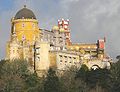
, the parishes of the town of Sintra are dotted by royal retreats, estates, castles and buildings from the 8th-9th century, in addition to many buildings completed between the 15th and 19th century, including the Castelo dos Mouros, the Pena National Palace
and the Sintra National Palace
, resulting in its classification by UNESCO
as a World Heritage Site
in 1995.
 The earliest documents describe a built-up town in the 11th century by the Arab geographer Al-Bacr
(who was later supported by the poets Luís de Camões
and Lord Byron). The Moors built their castle atop a nearby promontory around the 8th-9th century. When Afonso Henriques finally captured Sintra (after the fall of Lisbon) in 1147, he ordered the construction of the Church of São Pedro de Canaferrim, within the castle walls.
In 1493, Christopher Columbus
sailing for the Spanish crown, was blown off course by gale force winds and fearing for the survival of his ship, spotted the rock of Sintra. Despite the awkwardness of seeking safe harbor in Portugal
, Columbus had no choice under the circumstances and sailed from there into the port of Lisbon
.
In 1507, Diogo Boitac built the Hieronymite monastery of Nossa Senhora da Pena in a nearby hilltop. In 1527, King Manuel I
commissioned Nicolau Chanterene
to build an altarpiece for the chapel; this retable
was considered one of his finest work.
In 1808, it was the site of the signing of the controversial Convention of Sintra
, which ended the first French invasion of Portugal.
In 1809 Lord Byron
wrote to his friend Francis Hodgson
, "I must just observe that the village of Cintra in Estremadura is the most beautiful in the world."
are essentially residential suburbs already in conurbation
with Amadora
, Odivelas
.
With a population of approximately 33000 inhabitants, the town of Sintra falls in the middle of the three civil parishes: Santa Maria e São Miguel, São Martinho and São Pedro de Penaferrim
. These parishes have been the centre of demographic and economic growth during the late 20th century, primarily influenced by the influx of tourism into the region.
Sintra Municipality
Sintra , located in the central Lisbon Region, is a municipality consisting of several civil parishes and two urbanized cities and known for many of its 19th century Romantic architecture, which resulted in its classification as a UNESCO World Heritage Site...
in the Grande Lisboa
Grande Lisboa
Grande Lisboa is a Portuguese NUTS III subregion integrated in the Lisboa Region. It includes the capital city of Portugal - Lisbon . It is the main economical subregion of the country. It covers 1,376 km² and is the most populated and densely populated Portuguese subregion...
subregion (Lisbon Region) of Portugal
Portugal
Portugal , officially the Portuguese Republic is a country situated in southwestern Europe on the Iberian Peninsula. Portugal is the westernmost country of Europe, and is bordered by the Atlantic Ocean to the West and South and by Spain to the North and East. The Atlantic archipelagos of the...
. Owing to its 19th century Romantic
Romanticism
Romanticism was an artistic, literary and intellectual movement that originated in the second half of the 18th century in Europe, and gained strength in reaction to the Industrial Revolution...
architecture and landscapes, becoming a major tourist centre, visited by many day-tripper
Day-tripper
A day-tripper is a person who visits a tourist destination or visitor attraction from his/her home and returns home on the same day.- Definition :In other words, this excursion does not involve a night away from home such as experienced on a holiday...
s who travel from the urbanized suburbs and capital of Lisbon
Lisbon
Lisbon is the capital city and largest city of Portugal with a population of 545,245 within its administrative limits on a land area of . The urban area of Lisbon extends beyond the administrative city limits with a population of 3 million on an area of , making it the 9th most populous urban...
.
In addition to the Sintra Mountains and Sintra-Cascais Nature Park
Sintra-Cascais Natural Park
The Sintra-Cascais Natural Park is one of the 13 Natural Parks of Portugal. While only established in 1994 as a Natural Park by the Portuguese Government, it has been protected since 1981. Its area is approximately 145km². It includes the Serra de Sintra Mountain Range but extends all the way to...
, the parishes of the town of Sintra are dotted by royal retreats, estates, castles and buildings from the 8th-9th century, in addition to many buildings completed between the 15th and 19th century, including the Castelo dos Mouros, the Pena National Palace
Pena National Palace
The Pena National Palace is a Romanticist palace in São Pedro de Penaferrim, municipality of Sintra, Portugal. The palace stands on the top of a hill above the town of Sintra, and on a clear day it can be easily seen from Lisbon and much of its metropolitan area. It is a national monument and...
and the Sintra National Palace
Sintra National Palace
The Sintra National Palace , also called Town Palace is located in the town of Sintra, in Portugal near Lisbon....
, resulting in its classification by UNESCO
UNESCO
The United Nations Educational, Scientific and Cultural Organization is a specialized agency of the United Nations...
as a World Heritage Site
World Heritage Site
A UNESCO World Heritage Site is a place that is listed by the UNESCO as of special cultural or physical significance...
in 1995.
History
Abu Abdullah al-Bakri
', or simply Al-Bakri was an Andalusian-Arab geographer and historian.-Life:Al-Bakri was born in Huelva, the son of the sovereign of the short lived principality of Huelva. When his father was deposed by al-Mu'tadid he moved to Córdoba where he studied with the geographer al-Udri and the...
(who was later supported by the poets Luís de Camões
Luís de Camões
Luís Vaz de Camões is considered Portugal's and the Portuguese language's greatest poet. His mastery of verse has been compared to that of Shakespeare, Vondel, Homer, Virgil and Dante. He wrote a considerable amount of lyrical poetry and drama but is best remembered for his epic work Os Lusíadas...
and Lord Byron). The Moors built their castle atop a nearby promontory around the 8th-9th century. When Afonso Henriques finally captured Sintra (after the fall of Lisbon) in 1147, he ordered the construction of the Church of São Pedro de Canaferrim, within the castle walls.
In 1493, Christopher Columbus
Christopher Columbus
Christopher Columbus was an explorer, colonizer, and navigator, born in the Republic of Genoa, in northwestern Italy. Under the auspices of the Catholic Monarchs of Spain, he completed four voyages across the Atlantic Ocean that led to general European awareness of the American continents in the...
sailing for the Spanish crown, was blown off course by gale force winds and fearing for the survival of his ship, spotted the rock of Sintra. Despite the awkwardness of seeking safe harbor in Portugal
Portugal
Portugal , officially the Portuguese Republic is a country situated in southwestern Europe on the Iberian Peninsula. Portugal is the westernmost country of Europe, and is bordered by the Atlantic Ocean to the West and South and by Spain to the North and East. The Atlantic archipelagos of the...
, Columbus had no choice under the circumstances and sailed from there into the port of Lisbon
Lisbon
Lisbon is the capital city and largest city of Portugal with a population of 545,245 within its administrative limits on a land area of . The urban area of Lisbon extends beyond the administrative city limits with a population of 3 million on an area of , making it the 9th most populous urban...
.
In 1507, Diogo Boitac built the Hieronymite monastery of Nossa Senhora da Pena in a nearby hilltop. In 1527, King Manuel I
Manuel I of Portugal
Manuel I , the Fortunate , 14th king of Portugal and the Algarves was the son of Infante Ferdinand, Duke of Viseu, , by his wife, Infanta Beatrice of Portugal...
commissioned Nicolau Chanterene
Nicolau Chanterene
Nicolau Chanterene was a French sculptor and architect who worked mainly in Portugal and Spain....
to build an altarpiece for the chapel; this retable
Retable
A retable is a framed altarpiece, raised slightly above the back of the altar or communion table, on which are placed the cross, ceremonial candlesticks and other ornaments....
was considered one of his finest work.
In 1808, it was the site of the signing of the controversial Convention of Sintra
Convention of Sintra
The Convention of Cintra was an agreement signed on August 30, 1808 during the Peninsular War. By the agreement, the defeated French were allowed to evacuate their troops from Portugal without further conflict...
, which ended the first French invasion of Portugal.
In 1809 Lord Byron
George Gordon Byron, 6th Baron Byron
George Gordon Byron, 6th Baron Byron, later George Gordon Noel, 6th Baron Byron, FRS , commonly known simply as Lord Byron, was a British poet and a leading figure in the Romantic movement...
wrote to his friend Francis Hodgson
Francis Hodgson
Francis Hodgson , was a reforming Provost of Eton, educator, cleric, writer of verse, and friend of Byron....
, "I must just observe that the village of Cintra in Estremadura is the most beautiful in the world."
Geography
Sintra is located at the foot of the Sintra Mountains, 18 kilometres east of the Atlantic Ocean. Some areas of the municipality close to LisbonLisbon
Lisbon is the capital city and largest city of Portugal with a population of 545,245 within its administrative limits on a land area of . The urban area of Lisbon extends beyond the administrative city limits with a population of 3 million on an area of , making it the 9th most populous urban...
are essentially residential suburbs already in conurbation
Conurbation
A conurbation is a region comprising a number of cities, large towns, and other urban areas that, through population growth and physical expansion, have merged to form one continuous urban and industrially developed area...
with Amadora
Amadora
Amadora is a city and a municipality in Portugal, in the northwest of the Lisbon Metropolitan Area. The city and municipality population is 175,872 in eleven freguesias . With an area of 23.77 km², it is the most densely populated municipality of Portugal...
, Odivelas
Odivelas
Odivelas is a civil parish in Odivelas Municipality in Lisbon Metropolitan Area, Portugal.. The city has a population of 50,846. The municipality is composed of 7 parishes, and is located in the District of Lisbon....
.
With a population of approximately 33000 inhabitants, the town of Sintra falls in the middle of the three civil parishes: Santa Maria e São Miguel, São Martinho and São Pedro de Penaferrim
São Pedro de Penaferrim
São Pedro de Penaferrim is a Portuguese civil parish, located in the municipality of Sintra. Many of Sintra's historical monuments are located in São Pedro de Penaferrim, including the Pena Palace andthe Castle of the Moors....
. These parishes have been the centre of demographic and economic growth during the late 20th century, primarily influenced by the influx of tourism into the region.
Transportation
According to recent statistics, Sintra's suburban railway is the most crowded suburban train system in Europe and IC19 (the highway from Lisbon to Sintra) is the most traffic-congested in Europe. Sintra's problems include major pendular movements to Lisbon, with terrible traffic during rush hour on the IC19 road to Lisbon.Architecture
- Quinta da RegaleiraQuinta da RegaleiraQuinta da Regaleira is an estate located near the historic center of Sintra, Portugal. It is classified as a World Heritage Site by UNESCO within the "Cultural Landscape of Sintra". Along with other palaces in this area , it is one of the principal tourist attractions of Sintra...
including the Palace and the Chapel - Pena National PalacePena National PalaceThe Pena National Palace is a Romanticist palace in São Pedro de Penaferrim, municipality of Sintra, Portugal. The palace stands on the top of a hill above the town of Sintra, and on a clear day it can be easily seen from Lisbon and much of its metropolitan area. It is a national monument and...
- Sintra National PalaceSintra National PalaceThe Sintra National Palace , also called Town Palace is located in the town of Sintra, in Portugal near Lisbon....
- Monserrate PalaceMonserrate PalaceThe Monserrate Palace is an exotic palatial villa located near Sintra, Portugal, the traditional summer resort of the Portuguese court. It was built in 1858 for Sir Francis Cook, an English baronet created visconde de Monserrate by King Luís. Monserrate turned to an English architect, James...
- Seteais PalaceSeteais PalaceThe Seteais Palace is a neoclassical palace located in Sintra, Portugal. The palace is nowadays a luxury hotel, restaurant and a tourist attraction included in the Cultural Landscape of Sintra, listed as World Heritage Site by UNESCO.-History:...
- Castle of the Moors (Castelo dos Mouros)