
|
|
|
|
Seattle, Washington
|
| |
|
| |
History Founding What is now Seattle has been inhabited since the end of the last ice age. Archaeological excavations at West Point in Discovery Park, Magnolia, confirm that the Seattle area has been inhabited by humans for at least 4,000 years. tohl-AHL-too ("herring house") and later hah-AH-poos ("where there are horse clams") at the mouth of the Duwamish River in what is now the Industrial District has been inhabited since the 6th century BC. By the time the first European settlers arrived in the area, the Dkhw'Duw'Absh and Xachua'Bsh people (now called the Duwamish Tribe) occupied at least seventeen villages in the areas around Elliott Bay.(2) (3)
The first Europeans to attempt settlement in the area were the Collins Party, who filed legal claim to land at the mouth of the Duwamish River on September 14, 1851.

Discussion
Ask a question about 'Seattle, Washington'
Start a new discussion about 'Seattle, Washington'
Answer questions from other users
|
Timeline
|
|
1851 The Denny Party lands at Alki Point, the first settlers of what will become Seattle, Washington.
1853 The first plat for Seattle, Washington is laid out.
1897 Klondike Gold Rush begins when first successful prospectors arrive in Seattle.
1907 Pike Place Market in Seattle, Washington officially opened for business.
1907 UPS was founded by James E. (Jim) Casey in Seattle, Washington.
1909 The Alaska-Yukon-Pacific Exposition opens in Seattle.
1909 Launching of The Rosicrucian Fellowship at Seattle, Washington. Later, in October 28 1911, its international headquarters, till today, were physically launched at Mount Ecclesia, Oceanside, California (United States) and the Healing Temple, "The Ecclesia", was launched in December 25 1920.
1911 Foundation of The Rosicrucian Fellowship's international headquarters at Mount Ecclesia, Oceanside, California. It had been preceded by its formal constitution in August 8 1909 at Seattle, Washington.
1916 In Seattle, Washington, William Boeing incorporates Pacific Aero Products (later renamed Boeing).
1962 The Century 21 World's Fair opens in Seattle, Washington.
|

Encyclopedia
History
Founding What is now Seattle has been inhabited since the end of the last ice age. Archaeological excavations at West Point in Discovery Park, Magnolia, confirm that the Seattle area has been inhabited by humans for at least 4,000 years. tohl-AHL-too ("herring house") and later hah-AH-poos ("where there are horse clams") at the mouth of the Duwamish River in what is now the Industrial District has been inhabited since the 6th century BC. By the time the first European settlers arrived in the area, the Dkhw'Duw'Absh and Xachua'Bsh people (now called the Duwamish Tribe) occupied at least seventeen villages in the areas around Elliott Bay.(2) (3)
The first Europeans to attempt settlement in the area were the Collins Party, who filed legal claim to land at the mouth of the Duwamish River on September 14, 1851. Thirteen days later, members of the Collins Party were on the way to their claim when they passed the scouts of the group of settlers that would eventually found Seattle, the Denny Party. The scouts for the Denny Party, Terry Lee, David Denny, and John Low, would lay claim to land on Alki Point on September 28, 1851, with Terry Low returning to Portland, Oregon carrying a message from David Denny telling his brother, Arthur Denny, to "Come at once." Following the instructions of David Denny, the rest of the Denny Party set sail from Portland and landed on Alki during a rainstorm on November 13, 1851. The landing party's first sight of their new homestead was the roofless cabin that David had been unable to complete because of a fever.
After spending a winter of frequent rainstorms and high winds on Alki Point, most of the Denny Party moved across Elliott Bay and settled on land where present day Pioneer Square is located and established the village of "Dewamps" or "Duwamps." The only members of the party that did not migrate to the eastern shore of Elliott Bay were Charles Terry and John Low, who remained at the original landing location and established a village they initially called "New York," after Terry's hometown, until April 1853 when they renamed it "Alki," a Chinook word meaning, roughly, by and by or someday. The villages of New York-Alki and Duwamps would compete for dominance in the area for the next few years, but in time Alki was abandoned and its residents moved across the bay to join the rest of the settlers.
David Swinson ("Doc") Maynard, one of the village's founders, was the primary advocate for renaming the village to "Seattle" after Chief Sealth (si'áb Si'ahl) of the Duwamish and Suquamish tribes.Includes bibliography. (2) (3) Morgan (1951, 1982), p.20 Doc Maynard's advocacy bore fruit, because when the first plats for village were filed on May 23, 1853, it was for the Town of Seattle. In 1855, nominal legal land settlement were established and the city was incorporated in 1865 and again in 1869, after having existed as an unincorporated town from 1867 to 1869.
Major events Major events in Seattle's history include:
Economic history Seattle has a history of boom and bust cycles, common to cities near large areas of natural and mineral resources. Seattle has several times risen as a company town or through economic specialization, then gone into precipitous decline, but it has typically used those periods to successfully rebuild infrastructure.
The first such boom, covering the early years of the city, was fueled by the lumber industry. (During this period the road now known as Yesler Way was nicknamed "Skid Road" after the timber skidding down the hill to Henry Yesler's sawmill. The term later entered the wider American vocabulary as Skid Row.) This boom was followed by the construction of an Olmsted-designed park system.
The second and most dramatic boom was the direct result of the Klondike Gold Rush of 1896, which ended the national depression that had begun with the Panic of 1893. On July 14, 1897, the S.S. Portland docked with its famed "ton of gold", and Seattle became the main transport and supply point for those heading north. The boom lasted well into the early part of the 20th century and funded many new Seattle companies and products. Finance company Washington Mutual was founded in 1889, in an attempt to save Seattle's economy after the Great Seattle fire. In 1907, 19-year-old James E. Casey borrowed $100 from a friend and founded the American Messenger Company (later UPS). Other Seattle companies founded during this period include Nordstrom and Eddie Bauer.
Next came the shipbuilding boom in the early part of the 20th century, followed by the unused city development plan of Virgil Bogue. Seattle was the major point of departure during World War II for troops heading to the North Pacific, and Boeing manufactured many of the war's bombers.
The local economy dipped after the war, but rose again with the expansion of Boeing, fueled by the growth of the commercial aviation industry. When this particular cycle went into a major downturn in the late 1960s and early 1970s, many left the area to look for work elsewhere, and two local real estate agents put up a billboard reading "Will the last person leaving Seattle – Turn out the lights."
Seattle remained the corporate headquarters of Boeing until 2001, when the company announced a desire to separate its headquarters from its major production facilities. Following a bidding war among a number of major cities, Boeing moved its corporate headquarters to Chicago. The Seattle area is still home to Boeing's Renton narrow-body plant (where the 707, 720, 727, and 757 were assembled, and the 737 is assembled today) and Everett wide-body plant (assembly plant for the 747, 767, 777 and the upcoming 787 Dreamliner), as well as BECU, formerly the Boeing Employees Credit Union.
Next, technology companies, including Microsoft, Amazon.com, RealNetworks, McCaw Cellular (now part of AT&T Mobility), VoiceStream (now T-Mobile USA), and biomedical corporations such as HeartStream (later purchased by Philips), Heart Technologies (later purchased by Boston Scientific), Physio-Control (later purchased by Medtronic), ZymoGenetics, ICOS (later purchased by Eli Lilly & Co.) and Immunex (later purchased by Amgen), found homes in Seattle and its suburbs. This success brought an influx of new citizens with a population increase within city limits of almost 50,000 between the 1990 and 2000 Census and saw Seattle's real estate become some of the most expensive in the country. Many of these companies remain relatively strong, but the frenzied dot-com boom years ended in early 2001.
Geography
Topography Seattle is located between an inlet of the Pacific Ocean to the west called Puget Sound and Lake Washington to the east. The city's chief harbor, Elliott Bay, is an inlet of the Sound. West beyond the Sound are the Kitsap Peninsula and Olympic Mountains, on the Olympic Peninsula; east beyond Lake Washington and the eastside suburbs are Lake Sammamish and the Cascade Range. Lake Washington flows through the Lake Washington Ship canal, a series of two man made canals and Lake Union, to the Hiram C. Chittenden Locks and into Salmon Bay, which is part of Puget Sound. The sea, rivers, forests, lakes, and fields were once rich enough to support one of the world's few sedentary hunter-gatherer societies. Opportunities for sailing, skiing, bicycling, camping, and hiking are nearby and accessible almost year-round.
The city itself is hilly, though not uniformly so. Like Rome, the city is said to lie on seven hills; the lists vary, but typically include Capitol Hill, First Hill, West Seattle, Beacon Hill, Queen Anne, Magnolia, and the former Denny Hill. The Wallingford and Mount Baker neighbourhoods are technically located on hills as well. Many of the hilliest areas are near the city center, with Capitol Hill, First Hill, and Beacon Hill collectively constituting something of a ridge along an isthmus between Elliott Bay and Lake Washington. The topography of the city center has been reshaped by regrading projects, a seawall, and the construction of an artificial island, Harbor Island (completed 1909), at the mouth of the city's industrial Duwamish Waterway.
The man-made Lake Washington Ship Canal incorporates four natural bodies of water: Lake Union, Salmon Bay, Portage Bay, and Union Bay, connecting Puget Sound to Lake Washington.
Seattle is in an earthquake zone and has experienced a number of significant quakes, most recently (as of 2007) the magnitude 6.8 Nisqually Earthquake, February 28, 2001, which did significant architectural damage, especially in the Pioneer Square area (built on reclaimed land, as are the Industrial District and part of the city center), but caused no fatalities. Other strong quakes occurred on December 14, 1872 (estimated at 7.3 or 7.4 magnitude), April 13, 1949 (7.1), and April 29, 1965 (6.5). The 1949 quake caused eight known deaths, all in Seattle; the 1965 quake caused three deaths in Seattle directly, and one more by heart failure. Although the Seattle Fault passes just south of the city center, neither it nor the Cascadia subduction zone has caused an earthquake since the city's founding. The Cascadia subduction zone poses the threat of an earthquake of magnitude 9.0 or greater, capable of seriously damaging the city and collapsing many buildings, especially in zones built on fill.
According to the United States Census Bureau, the city has a total area of 369.2 km² (142.5 mi²), 217.2 km² (83.9 mi²) of which is land and 152.0 km² (58.7 mi²) water. The total area is 41.16% water.
Climate Seattle's mild climate is usually classified as Marine west coast (Cfb). However, its wet-winter/dry-summer pattern shows some characteristics of a Mediterranean climate (Csb), and it is sometimes classified this way. Temperature extremes are moderated by adjacent Puget Sound, the greater Pacific Ocean, and Lake Washington. The region is partially protected from Pacific storms by the Olympic Mountains and from Arctic air by the Cascade Range. Despite being on the margin of the rain shadow of the Olympic Mountains, the city has a reputation for frequent rain. Despite its relatively frequent rainfall, the so-called "rainy city" receives a smaller quantity of actual precipitation annually, at , than New York City, Atlanta, Houston, and most cities of the Eastern Seaboard of the United States. Seattle was also not listed in a study that revealed the 10 Rainiest Cities in the continental United States. Seattle's reputation for rain derives from this frequency of precipitation as well as the fact that it is cloudy an average of 226 days per year (cf. 132 in New York City). Most of the precipitation falls as drizzle or light rain, with only occasional downpours. Spring, late fall, and winter are filled with days when it does not rain but looks as if it might because of cloudy, overcast skies. As for temperature, winters are cool and wet with average lows around 35–40 °F (2–4 °C) on winter nights. Colder weather can occur, but seldom lasts more than a few days. Summers are dry and warm, with average daytime highs around 73–80 °F (22.2–26.7 °C). Hotter weather usually occurs only during a few summer days. Seattle's hottest official recorded temperature was on July 20, 1994; the coldest recorded temperature was 0 °F (-18 °C) on January 31, 1950.
Eighty miles (130 km) to the west, the Hoh Rain Forest in Olympic National Park on the western flank of the Olympic Mountains receives an annual average rainfall of , and the state capital, Olympia—south of the rain shadow—receives an annual average rainfall of 52 inches (132 cm). Snowfall is very infrequent, especially at lower altitudes and near the coast, and is usually light and fleeting, lasting only a few days. Average annual snowfall, as measured at Sea–Tac Airport, is 13 inches (33 cm). Seattle's record snowfall was on January 13, 1950. Sunnier and drier "California weather" typically dominates from mid-July to mid-September. An average of of rain falls in July and in August. Although the summer climate is considerably drier and less humid than in areas with humid continental climates, a slight dampness can be occasionally felt, usually when temperatures reach above . This dampness is typically more noticeable during the evening when the temperatures have dropped. Because of this, Seattle experiences occasional summer thunderstorms.
The Puget Sound Convergence Zone is an important feature of Seattle's weather. In the convergence zone, air arriving from the north meets air flowing in from the south. Both streams of air originate over the Pacific Ocean; airflow is split by the Olympic Mountains to Seattle's west, then reunited by the Cascade Mountains to the east. When the air currents meet, they are forced upward, resulting in convection.
Thunderstorms caused by this activity can occur north and south of town, but Seattle itself rarely receives worse weather than occasional thunder and ice-pellet showers. Nonetheless, the Hanukkah Eve Wind Storm in December 2006 brought heavy rain and winds gusting up to . One Seattleite drowned in her collapsed and flooded basement; power failures were widespread, with some left without power for up to eleven days.
An exception to Seattle's dampness often occurs in El Niño years, when the marine weather systems track as far south as California and little precipitation falls in the Puget Sound area. Since the region's water comes from mountain snowpacks during the drier summer months, El Niño winters can not only produce substandard skiing but can result in water rationing and a shortage of hydroelectric power the following summer.
Neighborhoods
Seattle has grown through a series of annexations of smaller neighboring communities. On May 3, 1891, Magnolia, Wallingford, Green Lake, and the University District (then known as Brooklyn) were annexed. The town of South Seattle was annexed on October 20 1905. Between January 7 and September 12, 1907, Seattle nearly doubled its land area by annexing six incorporated towns and areas of unincorporated King County, including Southeast Seattle, Ravenna, South Park, Columbia, Ballard, and West Seattle. Three years later, after having difficulties paying a $10,000 bill from the county, the town of Georgetown merged with Seattle. Finally, on January 4, 1954, the area between N. 85th Street and N. 145th Street was annexed, including the neighborhoods of Maple Leaf, Lake City, and Northgate.
Seattle mayor Greg Nickels is among those who have called Seattle "a city of neighborhoods," although the boundaries (and even names) of those neighborhoods are often open to dispute. For example, a Department of Neighborhoods spokeswoman reported that her own neighborhood has gone from "the 'CD' to 'Madrona' to 'Greater Madison Valley' and now 'Madrona Park.'"
Over a dozen Seattle neighborhoods have Neighborhood Service Centers, originally known in 1972 as "Little City Halls" and many having street fairs and parades during the summer months. The largest of the city's street fairs feature hundreds of craft and food booths and multiple stages with live entertainment, and draw more than 100,000 people over the course of a weekend. In addition, at least half a dozen neighborhoods have weekly farmers' markets, some with as many as fifty vendors.
The residents of White Center, an unincorporated neighborhood between Seattle and Burien, are in the process of deciding by which of the two cities they will be annexed.
Cityscape
Landmarks
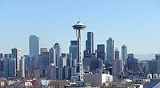
The Space Needle, dating from the Century 21 Exposition (1962), is Seattle's most recognizable landmark, having been featured in the logo of the television show Frasier and the backgrounds of the television series Grey's Anatomy and iCarly, and films such as Sleepless in Seattle. The fairgrounds surrounding the Needle have been converted into Seattle Center, which remains the site of many local civic and cultural events, such as Bumbershoot, Folklife, and the Bite of Seattle. Seattle Center plays multiple roles in the city, ranging from a public fair grounds to a civic center, though recent economic losses have called its viability and future into question. The Seattle Center Monorail was also constructed for Century 21 and still runs from Seattle Center to Westlake Center, a Downtown shopping mall, a little over a mile to the southeast.
The Smith Tower was the tallest building on the West Coast from its completion in 1914 until the Space Needle overtook it in 1962. The late 1980s saw the construction of Seattle's two tallest skyscrapers: the 76 story Columbia Center (completed 1985) is the tallest building in the Pacific Northwest and the fourth tallest building west of the Mississippi River; the Washington Mutual Tower (completed 1988) is Seattle's second tallest building. Other notable Seattle landmarks include Pike Place Market, the Fremont Troll, the Experience Music Project (at Seattle Center), and the Seattle Central Library.
Starbucks has been at Pike Place Market since the coffee company was founded there in 1971. The first store is still operating a block south of its original location. Starbucks Center, the company's current headquarters, is the largest building in Seattle by volume at just over . The building, once Sears' Northwest catalog distribution center, also contains a Sears and an OfficeMax store.
The National Register of Historic Places has over a hundred and fifty Seattle listings.
Culture Seattle has been a regional center for the performing arts for many years. The century-old Seattle Symphony Orchestra is among the world's most recorded and performs primarily at Benaroya Hall. The Seattle Opera and Pacific Northwest Ballet, which perform at McCaw Hall (opened 2003 on the site of the former Seattle Opera House at Seattle Center), are comparably distinguished, with the Opera being particularly known for its performances of the works of Richard Wagner and the PNB School (founded in 1974) ranking as one of the top three ballet training institutions in the United States. The Seattle Youth Symphony Orchestras (SYSO) is the largest symphonic youth organization in the United States.
The 5th Avenue Theatre, built in 1926, stages Broadway-style musical shows featuring both local talent and international stars.(1)
(2)
(3)
(4) Seattle has "around 100" theatrical production companies and over two dozen live theatre venues, many of them associated with fringe theatre;(2) This article mentions five fringe theater groups that were new at that time, each with a venue. Seattle is probably second only to New York for number of equity theaters(28 Seattle theater companies have some sort of Actors' Equity contract). In addition, the 900-seat Romanesque Revival Town Hall on First Hill hosts numerous cultural events, especially lectures and recitals..
Seattle is considered the home of grunge music because it was home to artists such as Nirvana, Pearl Jam, Foo Fighters, Soundgarden, and Alice in Chains, all of whom reached vast audiences in the early 1990s. The city is also home to such varied musicians as avant-garde jazz musicians Bill Frisell and Wayne Horvitz, rapper Sir Mix-a-Lot, smooth jazz saxophonist Kenny G, Heart, heavy metal bands Queensryche and Nevermore, underground rap duos Blue Scholars and Common Market, and such poppier rock bands as Harvey Danger, Goodness and the Presidents of the United States of America. Such musicians as Jimi Hendrix, Duff McKagan, Nikki Sixx, and Quincy Jones spent their formative years in Seattle.
Since the grunge era, the area has hosted a diverse and influential alternative music scene. The Seattle record label Sub Pop—the first to sign Nirvana—has signed such non-grunge bands as Band of Horses, Modest Mouse, Murder City Devils, Sunny Day Real Estate, Death Cab for Cutie and The Postal Service.
Earlier Seattle-based popular music acts include the collegiate folk group The Brothers Four; The Wailers, a 1960s garage band; The Ventures, an instrumental rock band; the Allies and the Heaters (later "the Heats"), 1980s teen-pop bands; from that same era, the more sophisticated pop of the short-lived Visible Targets and the still-performing Young Fresh Fellows and Posies; and the pop-punk of The Fastbacks and the outright punk of The Fartz (later 10 Minute Warning), The Gits, and Seven Year Bitch.
Spoken word and poetry are staples of Seattle arts, paralleling the explosion of the independent music scene during the late 1980s and early 1990s. Seattle's performance poetry blossomed with the importation of the poetry slam from Chicago (its origin) by Paul Granert. This and the proliferation of weekly readings, open mics, and poetry-friendly club venues like the Weathered Wall, the OK Hotel, and the Ditto Tavern (all now defunct), allowed spoken-word/performance poetry to take off. Seattle annually sends a team of slammers to the National Poetry Slam and considers itself home of some of the most talented performance poets in the world: Buddy Wakefield, two-time Individual World Poetry Slam Champ; Anis Mojgani, two-time National Poetry Slam Champ; and Danny Sherrard, 2007 National Poetry Slam Champ. Seattle also hosted the 2001 national Poetry Slam Tournament. The Seattle Poetry Festival is a biennial poetry festival that (launched first as the Poetry Circus in 1997) has featured local, regional, national, and international names in poetry.
The city also has a large number of movie houses showing both Hollywood productions and works by independent filmmakers. Among these, the Seattle Cinerama stands out as one of only three movie theaters in the world still capable of showing three-panel Cinerama films.
Tourism Among Seattle's known annual cultural events and fairs are the 24-day Seattle International Film Festival, Northwest Folklife over the Memorial Day week, numerous Seafair events throughout July and August (ranging from a Bon Odori celebration to hydroplane races), and the Bite of Seattle. Bumbershoot programs music over the Labor Day weekend, as well as other arts and entertainment. All are typically attended by 100,000 people annually, as are Hempfest and two separate Independence Day celebrations.
Other significant events include numerous Native American powwows, a Greek Festival hosted by St. Demetrios Greek Orthodox Church in Montlake, and numerous ethnic festivals (many associated with Festál at Seattle Center).
There are other annual events, ranging from the Seattle Antiquarian Book Fair & Book Arts Show; an anime convention, Sakura-Con; Penny Arcade Expo, a gaming convention; and specialized film festivals, such as the Seattle Gay and Lesbian Film Festival, to a two-day, 9,000-rider Seattle to Portland bicycle ride and a Gay Pride parade and festival. In the past, the Gay Pride parade and festival have been centred on Capitol Hill. Since 2006, festivities have been held city-wide, and the parade has followed a route in Downtown to the Seattle Center amusement park.
The Henry Art Gallery opened in 1927, the first public art museum in Washington. The Seattle Art Museum (SAM) opened in 1933; SAM opened a museum downtown in 1991 (expanded and reopened 2007); since 1991, the 1933 building has been SAM's Seattle Asian Art Museum (SAAM). SAM also operates the Olympic Sculpture Park (opened 2007) on the waterfront north of the downtown piers. The Frye Art Museum is a free museum on First Hill.
Regional history collections are at the Loghouse Museum in Alki, Klondike Gold Rush National Historical Park, the Museum of History and Industry and the Burke Museum of Natural History and Culture. Industry collections are at the Center for Wooden Boats, the Seattle Metropolitan Police Museum, and the Museum of Flight. Regional ethnic collections include the Nordic Heritage Museum and the Wing Luke Asian Museum.
Seattle has artist-run galleries, including 10-year veteran Soil Art Gallery, and the newer Crawl Space Gallery.
Woodland Park Zoo opened as a private menagerie in 1889, but was sold to the city in 1899. The Seattle Aquarium has been open on the downtown waterfront since 1977 (undergoing a renovation 2006). The Seattle Underground Tour, an exhibit of places that existed before the Great Fire, is also popular. There are also many community centers for recreation, including Rainier Beach, Van Asselt, Rainier, and Jefferson south of the Ship Canal and Green Lake, Laurelhurst, Loyal Heights north of the Canal, and Meadowbrook.
Sports
| |