


List of kings of Persia

Encyclopedia
The following is a list of kings and queens of Main Dynasties of Greater Iran, which includes all of the empires ruling over geographical Greater Iran
and their rulers.
For more comprehensive lists of kings, queens, sub-kings and sub-queens of Iran please see:
, covering part of Iran and neighbouring Central Asia.
For more comprehensive lists of kings and sub-kings of this Era see:
Mongol Empire
For more comprehensive lists of kings and sub-kings of this Era see:
Sarbadars
Jalayirids
Injuids
Muzaffarids
Kara Koyunlu
Ak Koyunlu
Timurid dynasty
Rulers in Transoxiana
:
Rulers in Khurasan
:
Abu Sa'id
, agreed to divide Iran with the Black Sheep Turcomans
under Jahan Shah
, but the White Sheep Turcomans
under Uzun Hassan
defeated and killed first Jahan Shah and then Abu Sa'id.
After Abu Sa'id's death a fourth era of fragmentation follows. While the White Sheep Turcomans dominated in the western parts until the ascent of the Safavid dynasty, the Timurides could maintain their rule in Samarkand
and Herat
.
Rulers in Samarkand:
conquered by the Uzbeks
Rulers in Herat:
conquered by the Uzbeks
, later recaptured by the Safavids
Greater Iran
Greater Iran refers to the regions that have significant Iranian cultural influence. It roughly corresponds to the territory on the Iranian plateau and its bordering plains, stretching from Iraq, the Caucasus, and Turkey in the west to the Indus River in the east...
and their rulers.
For more comprehensive lists of kings, queens, sub-kings and sub-queens of Iran please see:
- List of rulers of Pre-Achaemenid kingdoms of Iran
- List of rulers of Elam
- List of rulers of Parthian sub-kingdoms
- Muslim dynasties of Iran
Ancient Empires, c. 2700-550 BC
For more comprehensive lists of kings, queens, sub-kings and sub-queens of this Era see:| Throne Name | Original Name | Portrait | Title | Born-Died | Entered office | Left office | Family Relations | Note | |
|---|---|---|---|---|---|---|---|---|---|
| Aratta Aratta Aratta is a land that appears in Sumerian myths surrounding Enmerkar and Lugalbanda, two early and possibly mythical kings of Uruk also mentioned on the Sumerian king list.-Role in Sumerian literature:Aratta is described as follows in Sumerian literature:... kingdom, c.2700BC |
|||||||||
| 1 | In-Su-Kush-Siranna | ? - ? | c. 2700 BC | c. 2700 BC | ? | contemporary with Enmerkar Enmerkar Enmerkar, according to the Sumerian king list, was the builder of Uruk in Sumer, and was said to have reigned for "420 years" .... king of Uruk Uruk Uruk was an ancient city of Sumer and later Babylonia, situated east of the present bed of the Euphrates river, on the ancient dry former channel of the Euphrates River, some 30 km east of modern As-Samawah, Al-Muthannā, Iraq.Uruk gave its name to the Uruk... |
|||
| Early Elamite kings, c. 2700- c. 2600 BC | |||||||||
| 2 | Humbaba Humbaba In Akkadian mythology Humbaba or Huwawa , also Humbaba the Terrible was a monstrous giant of immemorial age raised by Utu, the Sun... |
? - c. 2680 BC | c. 2700 BC | c. 2680 BC | ? | contemporary with Gilgamesh Gilgamesh Gilgamesh was the fifth king of Uruk, modern day Iraq , placing his reign ca. 2500 BC. According to the Sumerian king list he reigned for 126 years. In the Tummal Inscription, Gilgamesh, and his son Urlugal, rebuilt the sanctuary of the goddess Ninlil, in Tummal, a sacred quarter in her city of... king of Uruk Uruk Uruk was an ancient city of Sumer and later Babylonia, situated east of the present bed of the Euphrates river, on the ancient dry former channel of the Euphrates River, some 30 km east of modern As-Samawah, Al-Muthannā, Iraq.Uruk gave its name to the Uruk... |
|||
| 3 | Humban-Shutur (or Khumbastir) | ? - ? | ? | ? | ? | ||||
| First Awan dynasty Awan dynasty The Awan Dynasty was the first dynasty of Elam of which anything is known today, appearing at the dawn of historical record. The Elamites were likely major rivals of neighboring Sumer from remotest antiquity; they were said to have been defeated by Enmebaragesi of Kish The Awan Dynasty was the... , c. 2600-2550 BC |
|||||||||
| 4 | The unnamed King of Awan | King of Awan | ? - ? | c. 2580 BC | ? | ? | contemporary with Ur-Nungal king of Uruk Uruk Uruk was an ancient city of Sumer and later Babylonia, situated east of the present bed of the Euphrates river, on the ancient dry former channel of the Euphrates River, some 30 km east of modern As-Samawah, Al-Muthannā, Iraq.Uruk gave its name to the Uruk... |
||
| 5 | ...Lu | King of Awan | ? - ? | ? | ? | ? | |||
| 6 | Kur-Ishshak | King of Awan | ? - ? | ? | c. 2550 BC | ? | 36 years. contemporary with Lugal-Anne-Mundu Lugal-Anne-Mundu Lugal-Anne-Mundu was the most important king of the city-state Adab in Sumer. The Sumerian king list claims he reigned for 90 years, following the defeat of Meskiaj-nanna of Ur... king of Adab & Ur-Nanshe Ur-Nanshe Ur-Nanshe was the first king of the dynasty of Lagash, probably in the first half of the 24th century BC .He ascended after Lugal-Sha-Gen-Sur , who was the ensi, or high priest.... king of Lagash Lagash Lagash is located northwest of the junction of the Euphrates and Tigris rivers and east of Uruk, about east of the modern town of Ash Shatrah. Lagash was one of the oldest cities of the Ancient Near East... |
||
| Second Awan dynasty Awan dynasty The Awan Dynasty was the first dynasty of Elam of which anything is known today, appearing at the dawn of historical record. The Elamites were likely major rivals of neighboring Sumer from remotest antiquity; they were said to have been defeated by Enmebaragesi of Kish The Awan Dynasty was the... , c. 2550-2270 BC |
|||||||||
| 7 | Peli | King of Awan | ? - ? | c. 2500 BC | ? | ? | |||
| 8 | Tata I | King of Awan | ? - ? | ? | ? | ? | |||
| 9 | Ukku-Tanhish | King of Awan | ? - ? | ? | ? | ? | |||
| 10 | Hishutash | King of Awan | ? - ? | ? | ? | ? | |||
| 11 | Shushun-Tarana | King of Awan | ? - ? | ? | ? | ? | |||
| 12 | Napi-Ilhush | King of Awan | ? - ? | ? | ? | ? | |||
| 13 | Kikku-Siwe-Temti | King of Awan | ? - ? | ? | ? | ? | |||
| 14 | Hishep-Ratep I | King of Awan | ? - ? | ? | ? | ? | |||
| 15 | Luh-Ishshan | King of Awan | ? -c. 2325 BC | ? | c. 2325 BC | Son of Hishep-Ratep I | |||
| 16 | Hishep-Ratep II | King of Awan | ? - ? | c. 2325 BC | ? | Son of Luh-Ishshan | |||
| 17 | Emahsini | King of Awan | ? - 2311 BC | c. 2315 BC | 2311 BC | ||||
| 18 | Helu | King of Awan | ? - ? | ? | ? | ? | |||
| 19 | Hita | King of Awan | ? - ? | c. 2270 BC | c. 2270 BC | ? | contemporary of Naram-Sin king of Akkad Akkad The Akkadian Empire was an empire centered in the city of Akkad and its surrounding region in Mesopotamia.... |
||
| Kuti kingdom, c.2256–c.2120 BC | |||||||||
| 20 | Erridupizir Erridupizir Erridupizir was a Gutian ruler in Sumer from ca. 2141 BC to 2138 BC . His reign is attested by a royal inscription at Nippur where he calls himself "King of Guti, King of the Four Quarters."-See also:*Chronology of the ancient Near East... |
King of Kutians | ? - ? | c.2256 BC | c.2251 BC | ? | |||
| 21 | Imta Imta Imta or Nibia was a Gutian ruler in Sumer from ca. 2138 BC to 2135 BC .-See also:*Chronology of the ancient Near East*Sumerian king list*Gutian dynasty of Sumer... or Nibia |
King of Kutians | ? - ? | c.2250 BC | c.2246 BC | ? | |||
| 22 | Inkishush Inkishush Inkishush or Inkicuc was a Gutian ruler in Sumer from ca. 2135 BC to 2129 BC. Inkishush is the first Gutian ruler mentioned in the Sumerian King List.-See also:*Chronology of the ancient Near East*Sumerian king list... |
King of Kutians | ? - ? | c.2245 BC | c.2240 BC | ? | |||
| 23 | Zarlagab | King of Kutians | ? - ? | c.2239 BC | c.2234 BC | ? | |||
| 24 | Shulme Shulme Shulme was a Gutian ruler in Sumer from ca. 2126 BC to 2120 BC.-See also:*Chronology of the ancient Near East*Sumerian king list*Gutian dynasty of Sumer... |
King of Kutians | ? - ? | c.2233 BC | c.2228 BC | ? | |||
| 25 | Elulmesh or Silulumesh | King of Kutians | ? - ? | c.2227 BC | c.2222 BC | ? | |||
| 26 | Duga | King of Kutians | ? - ? | c.2221 BC | c.2216 BC | ? | |||
| 27 | Iluan | King of Kutians | ? - ? | c.2215 BC | c.2213 BC | ? | |||
| 28 | Inimabakesh | King of Kutians | ? - ? | c.2212 BC | c.2208 BC | ? | |||
| 29 | Inkishush Inkishush Inkishush or Inkicuc was a Gutian ruler in Sumer from ca. 2135 BC to 2129 BC. Inkishush is the first Gutian ruler mentioned in the Sumerian King List.-See also:*Chronology of the ancient Near East*Sumerian king list... |
King of Kutians | ? - ? | c.2207 BC | c.2202 BC | ? | |||
| 30 | Yarlagab Yarlagab Yarlagab was a Gutian ruler of Sumer.Yarlagab was preceded by Ilu-An and succeeded by Ibate.... |
King of Kutians | ? - ? | c.2201 BC | c.2187 BC | ? | |||
| 31 | Ibate | King of Kutians | ? - ? | c.2186 BC | c.2184 BC | ? | |||
| 32 | Yarlagab Yarlagab Yarlagab was a Gutian ruler of Sumer.Yarlagab was preceded by Ilu-An and succeeded by Ibate.... or Yarla |
King of Kutians | ? - ? | c.2183 BC | c.2181 BC | ? | |||
| 33 | Kurum | King of Kutians | ? - ? | c.2180 BC | c.2180 BC | ? | |||
| 34 | Apilkin | King of Kutians | ? - ? | c.2179 BC | c.2177 BC | ? | |||
| 35 | La-erabum | King of Kutians | ? - ? | c.2176 BC | c.2175 BC | ? | |||
| 36 | Irarum | King of Kutians | ? - ? | c.2174 BC | c.2173 BC | ? | |||
| 37 | Ibranum | King of Kutians | ? - ? | c.2172 BC | c.2172 BC | ? | |||
| 38 | Hablum | King of Kutians | ? - ? | c.2171 BC | c.2170 BC | ? | |||
| 39 | Puzur-Suen | King of Kutians | ? - ? | c.2169 BC | c.2163 BC | ? | |||
| 40 | Yarlaganda Yarlaganda Yarlaganda , and was a Gutian.He was preceded by Puzur-Suen and succeeded by Si-Um.... |
King of Kutians | ? - ? | c.2162 BC | c.2156 BC | ? | |||
| 41 | Si'um or Si'u | King of Kutians | ? - ? | c.2155 BC | c.2121 BC | ? | |||
| 42 | Tirigan | King of Kutians | ? - ? | c.2120 BC | c.2120 BC | ? | 40 days | ||
| Third Awan dynasty Awan dynasty The Awan Dynasty was the first dynasty of Elam of which anything is known today, appearing at the dawn of historical record. The Elamites were likely major rivals of neighboring Sumer from remotest antiquity; they were said to have been defeated by Enmebaragesi of Kish The Awan Dynasty was the... , c. 2100 BC |
|||||||||
| 43 | Kutik-Inshushinak Kutik-Inshushinak Kutik-Inshushinak was king of Elam from about 2240 to 2220 BC , and the last from the Awan dynasty.... |
King of Awan | ? - ? | c. 2100 BC | c. 2100 BC | son of Shinpi-hish-huk | contemporary of Ur-Nammu Ur-Nammu Ur-Nammu founded the Sumerian 3rd dynasty of Ur, in southern Mesopotamia, following several centuries of Akkadian and Gutian rule... king of Ur Ur Ur was an important city-state in ancient Sumer located at the site of modern Tell el-Muqayyar in Iraq's Dhi Qar Governorate... . Susa Susa Susa was an ancient city of the Elamite, Persian and Parthian empires of Iran. It is located in the lower Zagros Mountains about east of the Tigris River, between the Karkheh and Dez Rivers.... conquered by Ur Ur Ur was an important city-state in ancient Sumer located at the site of modern Tell el-Muqayyar in Iraq's Dhi Qar Governorate... troops in 2078 and 2016 BC. After him, kings of Simashki took the leadership of Elam. |
||
| Simashki dynasty, c. 2070- c. 1975 BC | |||||||||
| 44 | Gir-Namme I | king of Simashki | ? - ? | ? | ? | ? | |||
| 45 | Tazitta I | king of Simashki | ? - ? | c. 2040 BC | c. 2037 BC | ? | |||
| 46 | Eparti I | king of Simashki | ? - ? | ? | c. 2033 BC | ? | |||
| 47 | Gir-Namme II | king of Simashki | ? - ? | c. 2033 BC | ? | ? | |||
| 48 | Tazitta II | king of Simashki | ? - ? | ? | ? | ? | |||
| 49 | Lurak-Luhhan | king of Simashki | ? - 2022 BC | c. 2028 BC | 2022 BC | ? | |||
| 50 | Hutran-Temti | king of Simashki | ? - ? | ? | ? | ? | |||
| 51 | Indattu-Inshushinak I | king of Simashki | ? - 2016 BC | ? | 2016 BC | son of Hutran-Temti | |||
| 52 | Kindattu | king of Simashki | ? - ? | before 2006 BC | after 2005 BC | son of Tan-Ruhuratir | conqueror of Ur Ur Ur was an important city-state in ancient Sumer located at the site of modern Tell el-Muqayyar in Iraq's Dhi Qar Governorate... |
||
| 53 | Indattu-Inshushinak II | king of Simashki | ? - ? | c. 1980 BC | ? | son of Pepi | cont. Shu-ilishu king of Isin Isin Isin was an ancient city-state of lower Mesopotamia about 20 miles south of Nippur at the site of modern Ishan al-Bahriyat in Iraq's Al-Qādisiyyah Governorate.-History:... & Bilalama king of Eshnunna Eshnunna Eshnunna was an ancient Sumerian city and city-state in central Mesopotamia. Although situated in the Diyala Valley north-east of Sumer proper, the city nonetheless belonged securely within the Sumerian cultural milieu.The tutelary deity of the city was Tishpak .- History :Occupied from the Jemdet... |
||
| 55 | Tan-Ruhuratir I | king of Simashki | ? - ? | c. 1965 BC | ? | son of Indattu-Inshushinnak II | cont. Iddin-Dagan king of Isin Isin Isin was an ancient city-state of lower Mesopotamia about 20 miles south of Nippur at the site of modern Ishan al-Bahriyat in Iraq's Al-Qādisiyyah Governorate.-History:... |
||
| 56 | Indattu-Inshushinak III | king of Simashki | ? - ? | ? | ? | son of Tan-Ruhuratir I | more than 3 years | ||
| Epartid dynasty, c. 1975- c. 1500 BC | |||||||||
| 54 | Eparti II | king of Simashki, king of Anshan & Susa, Sukkalmah | ? - ? | c. 1973 BC | ? | Married with a daughter of Iddin-Dagan king of Isin Isin Isin was an ancient city-state of lower Mesopotamia about 20 miles south of Nippur at the site of modern Ishan al-Bahriyat in Iraq's Al-Qādisiyyah Governorate.-History:... in 1973 BC. |
cont. Iddin-Dagan king of Isin Isin Isin was an ancient city-state of lower Mesopotamia about 20 miles south of Nippur at the site of modern Ishan al-Bahriyat in Iraq's Al-Qādisiyyah Governorate.-History:... |
||
| 57 | Shilhaha | king of Anshan & Susa, Sukkalmah | ? - ? | ? | ? | son of Eparti II | |||
| 58 | Kuk-Nashur I | Sukkalmah | ? - ? | ? | ? | son (ruhushak) of Shilhaha | |||
| 59 | Atta-hushu | Sukkal and Ippir of Susa, Shepherd of the people of Susa Susa Susa was an ancient city of the Elamite, Persian and Parthian empires of Iran. It is located in the lower Zagros Mountains about east of the Tigris River, between the Karkheh and Dez Rivers.... , Shepherd of Inshushinak |
? - after 1894 BC | ?1928 BC | after 1894 BC | son of Kuk-Nashur I (?) | |||
| 60 | Tetep-Mada | Shepherd of the people of Susa Susa Susa was an ancient city of the Elamite, Persian and Parthian empires of Iran. It is located in the lower Zagros Mountains about east of the Tigris River, between the Karkheh and Dez Rivers.... |
? - ? | after c. 1890 BC | ? | son of Kuk-Nashur I (?) | |||
| 61 | Palar-Ishshan | Sukkalmah | ? - ? | ? | ? | ? | |||
| 62 | Kuk-Sanit | ? - ? | ? | ? | son of Palar-Ishshan (?) | ||||
| 63 | Kuk-Kirwash | Sukkalmah, Sukkal of Elam and Simashki and Susa | ? - ? | ? | ? | son of Lan-Kuku & nephew of Palar-Ishshan | |||
| 64 | Tem-Sanit | ? - ? | ? | ? | son of Kuk-Kirwash | ||||
| 65 | Kuk-Nahhunte | ? - ? | ? | ? | son of Kuk-Kirwash | ||||
| 66 | Kuk-Nashur II | Sukkalmah, Sukkal of Elam, Sukkal of Elam and Simashki and Susa | ? - ? | ? | ? | son of Kuk-Nahhunte (?) | |||
| 67 | Shirukduh | Sukkalmah | ? - ? | c. 1790 BC | ? | ? | cont. Shamshi-Adad I Shamshi-Adad I Shamshi-Adad I Shamshi-Adad I Shamshi-Adad I (fl. late 18th century BC (short chronology) was an Assyrian king. He rose to prominence when he carved out an empire encompassing much of Mesopotamia, Syria and Asia Minor... king of Assyria Assyria Assyria was a Semitic Akkadian kingdom, extant as a nation state from the mid–23rd century BC to 608 BC centred on the Upper Tigris river, in northern Mesopotamia , that came to rule regional empires a number of times through history. It was named for its original capital, the ancient city of Assur... |
||
| 68 | Shimut-Wartash I | ? - ? | ? | ? | son of Shirukduh | ||||
| 69 | Siwe-Palar-Hupak | Sukkalmah, Sukkal of Susa, Prince of Elam | ? - ? | before 1765 BC | after 1765 BC | son of Shirukduh | |||
| 70 | Kuduzulush I | Sukkalmah, Sukkal of Susa | ? - ? | ? | ? | son of Shirukduh | |||
| 71 | Kutir-Nahhunte I | Sukkalmah | ? - ? | c. 1710 BC | ? | son of Kuduzulush I | |||
| 72 | Atta-Merra-Halki | ? - ? | ? | ? | son of Kuduzulush I (?) | ||||
| 73 | Tata II | Sukkal | ? - ? | ? | ? | brother of Atta-Merra-Halki | |||
| 74 | Lila-Irtash | ? - ? | ? | ? | son of Kuduzulush I | ||||
| 75 | Temti-Agun | Sukkalmah, Sukkal of Susa | ? - ? | ? | ? | son of Kutir-Nahhunte I | |||
| 76 | Kutir-Shilhaha | Sukkalmah, Sukkal | ? - ? | ? | ? | son of Temti-Agun | |||
| 77 | Kuk-Nashur III | Sukkal of Elam, Sukkal of Susa | ? - ? | before 1646 BC | after 1646 BC | son of Kutir-Shilhaha | |||
| 78 | Temti-Raptash | ? - ? | ? | ? | son of Kutir-Shilhaha | ||||
| 79 | Shimut-Wartash II | ? - ? | ? | ? | son of Kuk-Nashur III | ||||
| 80 | Shirtuh | King of Susa | ? - ? | ? | ? | son of Kuk-Nashur III | |||
| 81 | Kuduzulush II | Sukkalmah, King of Susa | ? - ? | ? | ? | son of Shimut-Wartash II | |||
| 82 | Tan-Uli | Sukkalmah, Sukkal | ? - ? | ? | ? | ? | |||
| 83 | Temti-Halki | Sukkalmah, Sukkal of Elam and Simashki and Susa | ? - ? | ? | ? | son of Tan-Uli | |||
| 84 | Kuk-Nashur IV | Sukkalmah | ? - ? | ? | ? | son of Tan-Uli | |||
| 85 | Kutik-Matlat | ? - ? | c. 1500 BC | ? | son of Tan-Uli | ||||
| Kidinuid dynasty, c. 1500- c. 1370 BC | |||||||||
| 86 | Kidinu | king of Anshan & Susa | ? - ? | 15th century BC | ? | ? | |||
| 87 | Inshushinak-Sunkir-Nappipir | king of Anshan & Susa | ? - ? | ? | ? | ? | |||
| 88 | Tan-Ruhuratir II | king of Anshan & Susa | ? - ? | 15th century BC | ? | ? | |||
| 89 | Shalla | king of Anshan & Susa | ? - ? | ? | ? | ? | |||
| 94 | Temti-Ahar | king of Anshan & Susa | ? - ? | c. 1370 BC | ? | ? | cont. Kadashman-Enlil I Kadashman-Enlil I Kadašman-Enlil ITypically rendered mka-dáš-man-dEN.LÍL in contemporary inscriptions. was a Kassite King of Babylon from ca. 1374 BC to 1360 BC , perhaps the 18th of the dynasty. He is known to have been a contemporary of Amenhotep III of Egypt, with whom he corresponded... Kassite Kassites The Kassites were an ancient Near Eastern people who gained control of Babylonia after the fall of the Old Babylonian Empire after ca. 1531 BC to ca. 1155 BC... king of Babylon Babylon Babylon was an Akkadian city-state of ancient Mesopotamia, the remains of which are found in present-day Al Hillah, Babil Province, Iraq, about 85 kilometers south of Baghdad... |
||
| Igehalkid dynasty, c. 1400 – c. 1200 BC | |||||||||
| 90 | Pahir-Ishshan I | king of Anshan & Susa | ? - ? | c. 1390 BC | ? | son of Ige-Halki | cont. Kurigalzu I Kurigalzu I Kurigalzu I , the seventeenth king of the Kassite dynasty that ruled over Babylon, was responsible for one of the most extensive and widespread building programs for which evidence has survived in Babylonia. The autobiography of Kurigalzu is one of the inscriptions which record that he was the son... Kassite Kassites The Kassites were an ancient Near Eastern people who gained control of Babylonia after the fall of the Old Babylonian Empire after ca. 1531 BC to ca. 1155 BC... king of Babylon Babylon Babylon was an Akkadian city-state of ancient Mesopotamia, the remains of which are found in present-day Al Hillah, Babil Province, Iraq, about 85 kilometers south of Baghdad... |
||
| 91 | Kidin-Hutran I | king of Anshan & Susa | ? - ? | ? | ? | son of Pahir-Ishshan I | |||
| 92 | Attar-Kittah II | king of Anshan & Susa | ? - ? | ? | ? | son of Ige-Halki | |||
| 93 | Humban-Numena I | king of Anshan & Susa | ? - ? | c. 1370 BC | ? | son of Attar-Kittah II | cont. Burna-Buriash II Kassite Kassites The Kassites were an ancient Near Eastern people who gained control of Babylonia after the fall of the Old Babylonian Empire after ca. 1531 BC to ca. 1155 BC... king of Babylon Babylon Babylon was an Akkadian city-state of ancient Mesopotamia, the remains of which are found in present-day Al Hillah, Babil Province, Iraq, about 85 kilometers south of Baghdad... |
||
| 95 | Untash-Napirisha Untash-Napirisha Untash-Napirisha was king of Elam from about 1275 to 1240 BC.He was the son of the previous king, Khumban-Numena. His original name was 'Untash-Khumban', but out of respect, he later changed the last half of his name to napirisha... or Untash-Humban |
king of Anshan & Susa | ? - ? | c. 1340 BC | ? | son of Humban-Numena I | |||
| 96 | Kidin-Hutran II | king of Anshan & Susa | ? - ? | ? | ? | son of Untash-Naprisha | |||
| 97 | Napirisha-Untash or Humban-Untash | king of Anshan & Susa | ? - ? | ? | ? | son of Kidin-Hutran II | |||
| 98 | Pahir-Ishshan II | king of Anshan & Susa | ? - ? | ? | ? | ? | |||
| 99 | Unpatar-Napirisha or Unpatar-Humban | king of Anshan & Susa | ? - ? | ? | ? | son of Pahir-Ishshan II | |||
| 100 | Kidin-Hutran III | king of Anshan & Susa | ? - ? | c. 1224 BC | c. 1217 BC | son of Pahir-Ishshan II | cont. Enlil-nadin-shumi & Adad-shuma-iddina Kassite Kassites The Kassites were an ancient Near Eastern people who gained control of Babylonia after the fall of the Old Babylonian Empire after ca. 1531 BC to ca. 1155 BC... kings of Babylon Babylon Babylon was an Akkadian city-state of ancient Mesopotamia, the remains of which are found in present-day Al Hillah, Babil Province, Iraq, about 85 kilometers south of Baghdad... |
||
| Shutrukid dynasty, c. 1200 – c. 970 BC | |||||||||
| 101 | Hallutush-Inshushinak | king of Anshan & Susa | ? - ? | c. 1200 BC | ? | ? | |||
| 102 | Shutruk-Nahhunte I Shutruk-Nakhunte Shutruk-Nakhunte was king of Elam from about 1185 to 1155 BC , and the second king of the Shutrukid Dynasty.Elam amassed an empire that included most of Mesopotamia and western Iran.... |
king of Anshan & Susa | ? - ? | before c. 1158 BC | after c. 1158 BC | son of Hallutush-Inshushinak | |||
| 103 | Kutir-Nahhunte II | king of Anshan & Susa | ? - ? | before c. 1155 BC | after c. 1155 BC | son of Shutruk-Nahhunte I | |||
| 104 | Shilhak-Inshushinak I | king of Anshan & Susa | ? - ? | ? | ? | son of Shutruk-Nahhunte I | |||
| 105 | Hutelutush-Inshushinak | king of Anshan & Susa | ? - ? | before c. 1110 BC | after c. 1110 BC | son of Kutir-Nahhunte II | |||
| 106 | Shilhina-Hamru-Lakamar | king of Anshan & Susa | ? - ? | after 1110 BC | ? | son of Shilhak-Inshushinak I | |||
| 107 | Humban-Numena II | king of Anshan & Susa | ? - ? | early 11th century BC | ? | ? | |||
| 108 | Shutruk-Nahhunte II | king of Anshan & Susa | ? - ? | middle of 11th century BC | ? | son of Humban-Numena II | |||
| 109 | Shutur-Nahhunte I | king of Anshan & Susa | ? - ? | middle of 11th century BC | ? | son of Humban-Numena II | |||
| 110 | Mar-biti-apla-usur | "son" of Elam | ? - ? | before 983 BC | after 978 BC | ? | |||
| ? | Akshir-Shimut | king of Anshan & Susa | ? - ? | ? | ? | ? | |||
| ? | Akshir-Nahhunte | king of Anshan & Susa | ? - ? | ? | ? | ? | |||
| ? | Kara-Indash | king of Elam | ? - ? | ? | ? | ? | |||
| Humban-Tahrid (Neo-Elamite) dynasty, c. 830– c. 640 BC | |||||||||
| 114 | The unnamed king of Elam | king of Elam | ? - ? | before c. 821 BC | after c. 821 BC | ? | cont. Shamshi-Adad V Shamshi-Adad V Shamshi-Adad V was the King of Assyria from 824 to 811 BC.-Biography:He was the son and successor of Shalmaneser III, the husband of Shammuramat , and the father of Adad-nirari III, who succeeded him as king.... king of Assyria Assyria Assyria was a Semitic Akkadian kingdom, extant as a nation state from the mid–23rd century BC to 608 BC centred on the Upper Tigris river, in northern Mesopotamia , that came to rule regional empires a number of times through history. It was named for its original capital, the ancient city of Assur... |
||
| 115 | Humban-Tahrah I | king of Elam | ? - 743 BC | ? | 743 BC | ? | |||
| 116 | Humban-Nikash I | king of Elam | ? - 717 BC | 743 BC | 717 BC | son of Humban-Tahrah I | |||
| 117 | Shutur-Nahhunte II | king of Anshan & Susa | ? - 699 BC | 717 BC | 699 BC | son (Ruhushak) of Humban-Nikash I | |||
| 118 | Hallushu-Inshushinak | king of Anshan & Susa | ? - oct. 693 BC | 699 BC | oct. 693 BC | brother of Shutur-Nahhunte II | |||
| 119 | Kutir-Nahhunte III | king of Anshan & Susa | ? - July 692 BC | oct. 693 BC | July 692 BC | son of Hallushu-Inshushinak | |||
| 120 | Humban-Numena III | king of Anshan & Susa | ? - feb. 688 BC | July 692 BC | feb. 688 BC | son of Hallushu-Inshushinak | |||
| 121 | Humban-Haltash I | king of Anshan & Susa | ? - oct. 681 BC | feb. 688 BC | oct. 681 BC | son of Humban-Numena III (?) | |||
| 122 | Humban-Haltash II | king of Anshan & Susa | ? - sept. 675 BC | oct. 681 BC | sept. 675 BC | son of Humban-Haltash I | |||
| 124 | Urtak-Inshushinak | king of Anshan & Susa | ? - 663 BC | sept. 675 BC | 663 BC | brother of Humban-Haltash II | |||
| 125 | Temti-Humban-Inshushinak I | king of Anshan & Susa | ? - sept. 653 BC | 663 BC | sept. 653 BC | brother of Urtak-Inshushinak | |||
| 126 | Humban-Nikash II | king of Anshan & Susa | ? - 651 BC | sept. 653 BC | 651 BC | son of Urtak-Inshushinak | |||
| 127 | Tammaritu | king of Anshan & Susa | ? - after 645/4 BC | 652 BC | 649 BC | son of Humban-Hapua son of Urtak-Inshushinak | |||
| 129 | Indabibi | king of Anshan & Susa | ? - after July 648 BC | 649 BC | after July 648 BC | ? | |||
| 130 | Humban-Haltash III | king of Anshan & Susa | ? - after 645/4 BC | after July 648 BC | 645/4 BC | son of Atta-hamiti-Inshushinak | He was defeated and then captured by Assyrians. | ||
| 127 | Tammaritu | king of Anshan & Susa | ? - after 645/4 BC | 647 BC | 647 BC | son of Humban-Hapua son of Urtak-Inshushinak | |||
| 131 | Humban-Nikash III | king of Anshan & Susa | ? - after 645/4 BC | 647 BC | 647 BC | son of Atta-Merra-Halki | |||
| 132 | Umhuluma | king of Anshan & Susa | ? - ? | 647 BC | 647 BC | ? | |||
| 133 | Indattu-Inshushinak IV | king of Anshan & Susa | ? - ? | 647 BC | after autumn 646 BC | ? | |||
| 134 | Humban-Hapua | king of Anshan & Susa | ? - ? | 647 BC | 647 BC | ? | |||
| 135 | Pa'e | king of Anshan & Susa | ? - after 645/4 BC | autumn 646 | after 645/4 BC | ? | |||
| 136 | Shutur-Nahhunte III | king of Anshan & Susa | ? - ? | after autumn 646 BC | ? | son of Indattu-Inshushinak IV | After him, kingdom of Anshan Anshan (Persia) Anshan - History :Before 1973, when it was identified as Tall-i Malyan, Anshan had been assumed by scholars to be somewhere in the central Zagros mountain range.... transferred to Achaemenids |
||
| First Median dynasty Medes The MedesThe Medes... , 674–652 BC |
|||||||||
| 123 | Xšaθrita Phraortes Phraortes , son of Diyako, was the second king of the Median Empire.... |
Phraortes (?) | King of Medes | ? - 652 BC | 674 BC | 652 BC | son of Deioces Deioces Deioces, Diyako or Deiokes was the first king of the Medes according to Herodotus. In the late 8th century BC there was a Daiukku or Dayukku who was a Mannaean provincial governor... |
Killed in battle with Assyrians and Scythians. Domination of Scythian kingdom 652–625 BC | |
| Scythian kingdom, 652–625 BC | |||||||||
| 128 | Madea Madius Madius or Madya was a Scythian king. He conquered and ruled the Median Empire from c.625-653 BCE.... |
King of Scythians | ? - 625 BC | 652 BC | 625 BC | son of Partatua Bartatua Bartatua or Partitava , was a Scythian king, who established friendly relations with Assyria. He married a daughter of Assyrian king Essarhaddon.... |
king of Scythian kingdom from c. 658/9 BC | ||
| Second Median dynasty Medes The MedesThe Medes... , 625–550 BC |
|||||||||
| 137 | Cyaxares Cyaxares Cyaxares, Cyaxares the Great or Hvakhshathra , the son of King Phraortes, was the first king of Media. According to Herodotus, Cyaxares, grandson of Deioces, had a far greater military reputation than his father or grandfather, therefore he is often being described as the first official Median... |
Huvaxšaθra | King of Medes | ? - 585 BC | 625 BC | 585 BC | son of Xšaθrita Phraortes Phraortes , son of Diyako, was the second king of the Median Empire.... |
||
| 138 | Astyages Astyages Astyages Astyages Astyages (spelled by Herodotus as Ἀστυάγης - Astyages; by Ctesias as Astyigas; by Diodorus as Aspadas; Akkadian: Ištumegu, was the last king of the Median Empire, r... |
Ishtuvigu | King of Medes | ? - 585 BC | 585 BC | 550 BC | son of Cyaxares Cyaxares Cyaxares, Cyaxares the Great or Hvakhshathra , the son of King Phraortes, was the first king of Media. According to Herodotus, Cyaxares, grandson of Deioces, had a far greater military reputation than his father or grandfather, therefore he is often being described as the first official Median... |
Deposed and later killed | |
Old Persian Empire, 550–329 BC
| Throne Name | Original Name | Portrait | Title | Born-Died | Entered office | Left office | Family Relations | Note | |
|---|---|---|---|---|---|---|---|---|---|
| Achaemenid dynasty, 550–329 BC | |||||||||
| 139 | Cyrus the Great Cyrus the Great Cyrus II of Persia , commonly known as Cyrus the Great, also known as Cyrus the Elder, was the founder of the Achaemenid Empire. Under his rule, the empire embraced all the previous civilized states of the ancient Near East, expanded vastly and eventually conquered most of Southwest Asia and much... |
The great king, King of Persia, King of Anshan, King of Media, King of Babylon, King of Sumer and Akkad, King of the four corners of the World | 600 BC - 530 BC | 550 BC | 530 BC | Son of Cambyses I or (II) Cambyses I of Anshan Cambyses I or Cambyses the Elder was king of Anshan in Iran from c. 580 to 559 BC and the father of Cyrus the Great . He should not be confused with his better-known grandson Cambyses II.Cambyses was an early member of the Achaemenid dynasty... king of Anshan Anshan (Persia) Anshan - History :Before 1973, when it was identified as Tall-i Malyan, Anshan had been assumed by scholars to be somewhere in the central Zagros mountain range.... and Mandana daughter of Astyages Astyages Astyages Astyages Astyages (spelled by Herodotus as Ἀστυάγης - Astyages; by Ctesias as Astyigas; by Diodorus as Aspadas; Akkadian: Ištumegu, was the last king of the Median Empire, r... |
King of Anshan Anshan (Persia) Anshan - History :Before 1973, when it was identified as Tall-i Malyan, Anshan had been assumed by scholars to be somewhere in the central Zagros mountain range.... from 559 BC. Killed in battle with Massagetes |
||
| 140 | Cambyses | Khshayathiya Khshayathiyanam, The Great King | ? - 521 BC | 530 BC | 522 BC | Son of Cyrus the Great Cyrus the Great Cyrus II of Persia , commonly known as Cyrus the Great, also known as Cyrus the Elder, was the founder of the Achaemenid Empire. Under his rule, the empire embraced all the previous civilized states of the ancient Near East, expanded vastly and eventually conquered most of Southwest Asia and much... |
Died while en route to put down a rebellion. | ||
| 141 | Bardiya Bardiya Bardiya was a son of Cyrus the Great and the younger brother of Cambyses II, both Persian kings. There are sharply divided views on his life, he may have ruled the Achaemenid Empire for a few months in 522 BCE, or he may have been impersonated by a magus called Gaumata. -Name and sources:The... |
Tanyoxarces | The Great King, Pharaoh of Egypt | ? - 522 BC | 522 BC | 522 BC | Son of Cyrus the Great Cyrus the Great Cyrus II of Persia , commonly known as Cyrus the Great, also known as Cyrus the Elder, was the founder of the Achaemenid Empire. Under his rule, the empire embraced all the previous civilized states of the ancient Near East, expanded vastly and eventually conquered most of Southwest Asia and much... |
Killed by Persian aristocrats | |
| 142 | Darius I Darius I of Persia Darius I , also known as Darius the Great, was the third king of kings of the Achaemenid Empire... |
Arsames (?) | 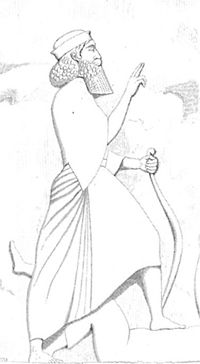 |
The Great King, King of Kings | 550 BC - 486 BC | 522 BC | 486 BC | Son of Hystaspes Hystaspes (father of Darius I) Vishtaspa , known under his Hellenized name Hystaspes , was a Persian satrap of Bactria and Persis, and the father of Darius I of Persia.... son of Arsames Arsames of Persia Arsames was the son of Ariaramnes and perhaps briefly the king of Persia during the Achaemenid dynasty, but gave up the throne and declared loyalty to Cyrus II of Persia... son of Ariaramnes Ariaramnes of Persia Ariaramnes was a great uncle of Cyrus the Great and the great-grandfather of Darius I, and perhaps the king of Parsa, the ancient core kingdom of Persia.... son of Teispes (II) Teispes of Anshan Teispes lived from 675-640 BCE. He was the son of Achaemenes and an ancestor of Cyrus the Great. There is evidence that Cyrus I and Ariaramnes were both his sons. Cyrus I is the grandfather of Cyrus the Great, whereas Ariaramnes is great grandfather of Darius the Great... |
|
| 143 | Xerxes I Xerxes I of Persia Xerxes I of Persia , Ḫšayāršā, ), also known as Xerxes the Great, was the fifth king of kings of the Achaemenid Empire.-Youth and rise to power:... |
The Great King, King of Kings | 519 BC - 465 BC | 485 BC | 465 BC | Son of Darius I Darius I of Persia Darius I , also known as Darius the Great, was the third king of kings of the Achaemenid Empire... |
Killed | ||
| 144 | Artaxerxes I | 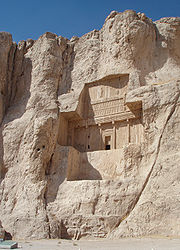 |
The Great King, King of Kings, Longimanus | ? - 424 BC | 465 BC | 424 BC | Son of Xerxes I Xerxes I of Persia Xerxes I of Persia , Ḫšayāršā, ), also known as Xerxes the Great, was the fifth king of kings of the Achaemenid Empire.-Youth and rise to power:... |
||
| 145 | Xerxes II Xerxes II of Persia Xerxes II was a Persian king and the son and successor of Artaxerxes I. After a reign of forty-five days, he was assassinated in 424 BC by his brother Sogdianus, who in turn was murdered by Darius II. He is an obscure historical figure known primarily from the writings of Ctesias. He was... |
Artaxerxes | The Great King, King of Kings | ? - 424 BC | 424 BC | 424 BC | Son of Artaxerxes I | Killed by Sogdianus Sogdianus of Persia Sogdianus , died 423 BC, king of Persia . He was an obscure historical figure known primarily from the writings of Ctesias. He was reportedly an illegitimate son of Artaxerxes I by his concubine Alogyne of Babylon.... |
|
| 146 | ? | Sogdianus Sogdianus of Persia Sogdianus , died 423 BC, king of Persia . He was an obscure historical figure known primarily from the writings of Ctesias. He was reportedly an illegitimate son of Artaxerxes I by his concubine Alogyne of Babylon.... |
The Great King, King of Kings | ? - 423 BC | 424 BC | 423 BC | Son of Artaxerxes I | Killed by Darius II Darius II of Persia Darius II , was king of the Persian Empire from 423 BC to 405 BC.Artaxerxes I, who died on December 25, 424 BC, was followed by his son Xerxes II. After a month and a half Xerxes II was murdered by his brother Secydianus or Sogdianus... |
|
| 147 | Darius II Darius II of Persia Darius II , was king of the Persian Empire from 423 BC to 405 BC.Artaxerxes I, who died on December 25, 424 BC, was followed by his son Xerxes II. After a month and a half Xerxes II was murdered by his brother Secydianus or Sogdianus... |
Ochus | 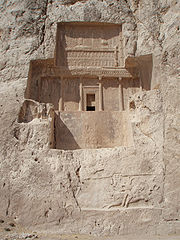 |
The Great King, King of Kings | ? - 404 BC | 423 BC | 404 BC | Son of Artaxerxes I | |
| 148 | Artaxerxes II Artaxerxes II of Persia Artaxerxes II Mnemon was king of Persia from 404 BC until his death. He was a son of Darius II of Persia and Parysatis.-Reign:... |
Arsaces | The Great King, King of Kings | 436 BC - 358 BC | 404 BC | 358 BC | Son of Darius II Darius II of Persia Darius II , was king of the Persian Empire from 423 BC to 405 BC.Artaxerxes I, who died on December 25, 424 BC, was followed by his son Xerxes II. After a month and a half Xerxes II was murdered by his brother Secydianus or Sogdianus... |
||
| 149 | Artaxerxes III | Ochus |  |
The Great King, King of Kings | ? - 338 BC | 358 BC | 338 BC | Son of Artaxerxes II Artaxerxes II of Persia Artaxerxes II Mnemon was king of Persia from 404 BC until his death. He was a son of Darius II of Persia and Parysatis.-Reign:... |
Killed |
| 150 | Artaxerxes IV Arses of Persia Artaxerxes IV Arses was king of Persia between 338 BC and 336 BC. He was the youngest son of King Artaxerxes III and Atossa and was not expected to succeed to the throne of Persia... |
Arses | The Great King, King of Kings | ? - 336 BC | 338 BC | 336 BC | Son of Artaxerxes III | Killed | |
| 151 | Darius III Darius III of Persia Darius III , also known by his given name of Codomannus, was the last king of the Achaemenid Empire of Persia from 336 BC to 330 BC.... |
Artashata | 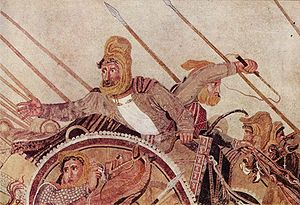 |
The Great King, King of Kings | 380 BC - 330 BC | 336 BC | 330 BC | Son of Arsanes son of Ostanes son of Darius II Darius II of Persia Darius II , was king of the Persian Empire from 423 BC to 405 BC.Artaxerxes I, who died on December 25, 424 BC, was followed by his son Xerxes II. After a month and a half Xerxes II was murdered by his brother Secydianus or Sogdianus... |
Killed by Artaxerxes V Bessus Artaxerxes V, also known as Bessus was a prominent Persian nobleman and satrap of Bactria, and later self-proclaimed king of Persia... |
| 152 | Artaxerxes V Bessus Artaxerxes V, also known as Bessus was a prominent Persian nobleman and satrap of Bactria, and later self-proclaimed king of Persia... |
Bessus | The Great King, King of Kings | ? - 329 BC | 330 BC | 329 BC | Probably a descendant of Artaxerxes II Artaxerxes II of Persia Artaxerxes II Mnemon was king of Persia from 404 BC until his death. He was a son of Darius II of Persia and Parysatis.-Reign:... |
Killed by Alexander I | |
Macedonian Empire, 330–129 BC
| Throne Name | Original Name | Portrait | Title | Born-Died | Entered office | Left office | Family Relations | Note | |
|---|---|---|---|---|---|---|---|---|---|
| Argead Dynasty Argead dynasty The Argead dynasty was an ancient Greek royal house. They were the ruling dynasty of Macedonia from about 700 to 310 BC. Their tradition, as described in ancient Greek historiography, traced their origins to Argos, in southern Greece... , 330–312 BC |
|||||||||
| 153 | Alexander I | 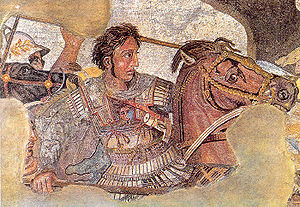 |
the Great | 356 - June 13, 323 BC | 330 BC | 323 BC | son of Philip II of Macedonia | King of Macedonia from 336 BC as Alexander III | |
| 154 | Philip Philip III of Macedon Philip III Arrhidaeus was the king of Macedonia from after June 11, 323 BC until his death. He was a son of King Philip II of Macedonia by Philinna of Larissa, allegedly a Thessalian dancer, and a half-brother of Alexander the Great... |
Arrhideus | c. 359 - 317 BC | June 323 BC | 317 BC | son of Philip II of Macedonia | King of Macedonia as Philip III. Killed by Olympias Olympias Olympias was a Greek princess of Epirus, daughter of king Neoptolemus I of Epirus, the fourth wife of the king of Macedonia, Philip II, and mother of Alexander the Great... |
||
| 155 | Alexander II Alexander IV of Macedon Alexander IV Aegus was the son of Alexander the Great and Princess Roxana of Bactria.-Birth:... |
Egus | Sept. 323 - 309 BC | Sept. 323 BC | 317 BC | son of Alexander The Great | King of Macedonia as Alexander IV until 310 BC, Killed by Cassander Cassander Cassander , King of Macedonia , was a son of Antipater, and founder of the Antipatrid dynasty... son of Antipater Antipater Antipater was a Macedonian general and a supporter of kings Philip II of Macedon and Alexander the Great. In 320 BC, he became Regent of all of Alexander's Empire. Antipater was one of the sons of a Macedonian nobleman called Iollas or Iolaus and his family were distant collateral relatives to the... |
||
| Perdiccas Perdiccas Perdiccas was one of Alexander the Great's generals. After Alexander's death in 323 BC he became regent of all Alexander's empire.Arrian tells us he was son of Orontes, a descendant of the independent princes of the Macedonian province of Orestis... |
? - 321 BC | June 323 BC | 321 BC | Regent, prince of Orestis | |||||
| Peithon Peithon Peithon or Pithon was the son of Crateuas, a nobleman from Eordaia in western Macedonia. One of the bodyguards of Alexander the Great, later satrap of Media and one of the diadochi.... |
c. 355-314 BC | 321 BC | 321 BC | son of Crateuas | Regent | ||||
| Arrhidaeus Arrhidaeus Arrhidaeus , one of Alexander the Great's generals, was entrusted with the conduct of Alexander's funeral to Egypt in 323 BC... |
? -319 BC | 321 BC | 321 BC | Regent | |||||
| Antipater Antipater Antipater was a Macedonian general and a supporter of kings Philip II of Macedon and Alexander the Great. In 320 BC, he became Regent of all of Alexander's Empire. Antipater was one of the sons of a Macedonian nobleman called Iollas or Iolaus and his family were distant collateral relatives to the... |
?398-319 BC | 321 BC | 319 BC | son of Iollas | Regent, Killed by Seleucus I Seleucus I Nicator Seleucus I was a Macedonian officer of Alexander the Great and one of the Diadochi. In the Wars of the Diadochi that took place after Alexander's death, Seleucus established the Seleucid dynasty and the Seleucid Empire... |
||||
| Polysperchon | 394–303 BC | 319 BC | 316 BC | son of Simmias | Regent | ||||
| 156 | Olympias Olympias Olympias was a Greek princess of Epirus, daughter of king Neoptolemus I of Epirus, the fourth wife of the king of Macedonia, Philip II, and mother of Alexander the Great... |
c. 375–316 BC | 317 BC | 316 BC | daughter of king Neoptolemus I of Epirus Neoptolemus I of Epirus Neoptolemus I of Epirus was a king of Epirus and son of Alcetas I, and father of Alexander I of Epirus and Queen Olympias. He was a maternal grandfather of Alexander the Great... and mother of Alexander I. |
Killed by Cassander Cassander Cassander , King of Macedonia , was a son of Antipater, and founder of the Antipatrid dynasty... son of Antipater Antipater Antipater was a Macedonian general and a supporter of kings Philip II of Macedon and Alexander the Great. In 320 BC, he became Regent of all of Alexander's Empire. Antipater was one of the sons of a Macedonian nobleman called Iollas or Iolaus and his family were distant collateral relatives to the... |
|||
| 157 | Antigonus | .jpg) |
Monophthalmus | 382-301 BC | 316 BC | 312 BC | son of Philip of Elymiotis | King of Anatolia, Syria and Macedonia as Antigonus I until 301 BC. Killed by Seleucus I Seleucus I Nicator Seleucus I was a Macedonian officer of Alexander the Great and one of the Diadochi. In the Wars of the Diadochi that took place after Alexander's death, Seleucus established the Seleucid dynasty and the Seleucid Empire... |
|
| Seleucid dynasty Seleucid dynasty The Seleucid dynasty or the Seleucidae was a Greek Macedonian royal family, founded by Seleucus I Nicator , which ruled the Seleucid Kingdom centered in the Near East and regions of the Asian part of the earlier Achaemenid Persian Empire during the Hellenistic period.-History:Seleucus was an... , 312–129 BC |
|||||||||
| 158 | Seleucus I Seleucus I Nicator Seleucus I was a Macedonian officer of Alexander the Great and one of the Diadochi. In the Wars of the Diadochi that took place after Alexander's death, Seleucus established the Seleucid dynasty and the Seleucid Empire... |
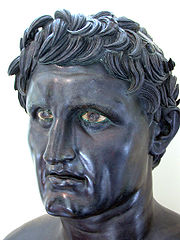 |
Nicator | c. 358–281 BC | 312 BC | 281 BC | son of Antiochus son of Seleucus | Assumed title of "King" from 306 BC. Killed by Ptolemy Ceraunus | |
| 159 | Antiochus I Antiochus I Soter Antiochus I Soter , was a king of the Hellenistic Seleucid Empire. He reigned from 281 BC - 261 BC.... |
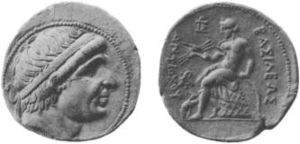 |
Soter | ? - 261 BC | 281 BC | 261 BC | son of Seleucus I Seleucus I Nicator Seleucus I was a Macedonian officer of Alexander the Great and one of the Diadochi. In the Wars of the Diadochi that took place after Alexander's death, Seleucus established the Seleucid dynasty and the Seleucid Empire... |
co-ruler from 291 | |
| 160 | Antiochus II Antiochus II Theos Antiochus II Theos was a king of the Hellenistic Seleucid Kingdom who reigned 261 BC – 246 BC). He succeeded his father Antiochus I Soter in the winter of 262–61 BC... |
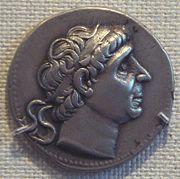 |
Theos | 286–246 BC | 261 BC | 246 BC | son of Antiochus I Antiochus I Soter Antiochus I Soter , was a king of the Hellenistic Seleucid Empire. He reigned from 281 BC - 261 BC.... |
||
| 162 | Seleucus II Seleucus II Callinicus Seleucus II Callinicus or Pogon , was a ruler of the Hellenistic Seleucid Empire, who reigned from 246 to 225 BC... |
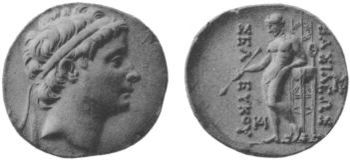 |
Callinicus | ? - 225 BC | 246 BC | 225 BC | son of Antiochus II Antiochus II Theos Antiochus II Theos was a king of the Hellenistic Seleucid Kingdom who reigned 261 BC – 246 BC). He succeeded his father Antiochus I Soter in the winter of 262–61 BC... |
||
| 163 | Seleucus III Seleucus III Ceraunus Seleucus III Soter, called Seleucus Ceraunus , was a ruler of the Hellenistic Seleucid Kingdom, the eldest son of Seleucus II Callinicus and Laodice II. His birth name was Alexander and was named after his great uncle the Seleucid official Alexander... |
Alexander | 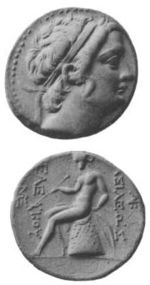 |
Soter, Ceraunus | c. 243-223 BC | 225 BC | 223 BC | son of Seleucus II Seleucus II Callinicus Seleucus II Callinicus or Pogon , was a ruler of the Hellenistic Seleucid Empire, who reigned from 246 to 225 BC... |
|
| 164 | Antiochus III Antiochus III the Great Antiochus III the Great Seleucid Greek king who became the 6th ruler of the Seleucid Empire as a youth of about eighteen in 223 BC. Antiochus was an ambitious ruler who ruled over Greater Syria and western Asia towards the end of the 3rd century BC... |
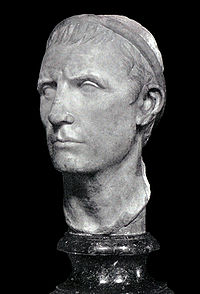 |
Megas | c. 241–187 BC | 223 BC | 187 BC | son of Seleucus II Seleucus II Callinicus Seleucus II Callinicus or Pogon , was a ruler of the Hellenistic Seleucid Empire, who reigned from 246 to 225 BC... |
||
| 166 | Seleucus IV Seleucus IV Philopator Seleucus IV Philopator , ruler of the Hellenistic Seleucid Empire, reigned from 187 BC to 175 BC over a realm consisting of Syria , Mesopotamia, Babylonia and Nearer Iran . He was the second son and successor of Antiochus III the Great and Laodice III... |
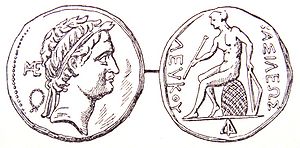 |
Philopator | ? - 175 BC | 187 BC | 175 BC | son of Antiochus III Antiochus III the Great Antiochus III the Great Seleucid Greek king who became the 6th ruler of the Seleucid Empire as a youth of about eighteen in 223 BC. Antiochus was an ambitious ruler who ruled over Greater Syria and western Asia towards the end of the 3rd century BC... |
||
| 168 | Antiochus IV Antiochus IV Epiphanes Antiochus IV Epiphanes ruled the Seleucid Empire from 175 BC until his death in 164 BC. He was a son of King Antiochus III the Great. His original name was Mithridates; he assumed the name Antiochus after he ascended the throne.... |
Epiphanes | c. 215-163 BC | 175 BC | 163 BC | son of Antiochus III Antiochus III the Great Antiochus III the Great Seleucid Greek king who became the 6th ruler of the Seleucid Empire as a youth of about eighteen in 223 BC. Antiochus was an ambitious ruler who ruled over Greater Syria and western Asia towards the end of the 3rd century BC... |
Killed in Elymais | ||
| 171 | Antiochus V | Eupator | c. 172-161 BC | 163 BC | 161 BC | son of Antiochus IV Antiochus IV Epiphanes Antiochus IV Epiphanes ruled the Seleucid Empire from 175 BC until his death in 164 BC. He was a son of King Antiochus III the Great. His original name was Mithridates; he assumed the name Antiochus after he ascended the throne.... |
|||
| 172 | Demetrius I Demetrius I Soter Demetrius I , surnamed Soter , was a ruler of the Hellenistic Seleucid Empire.... |
Soter | 185-150 BC | 161 BC | 150 BC | son of Seleucus IV Seleucus IV Philopator Seleucus IV Philopator , ruler of the Hellenistic Seleucid Empire, reigned from 187 BC to 175 BC over a realm consisting of Syria , Mesopotamia, Babylonia and Nearer Iran . He was the second son and successor of Antiochus III the Great and Laodice III... |
|||
| 173 | Alexander III Alexander Balas Alexander Balas , ruler of the Greek Seleucid kingdom 150-146 BC, was a native of Smyrna of humble origin, but gave himself out to be the son of Antiochus IV Epiphanes and Laodice IV and heir to the Seleucid throne... |
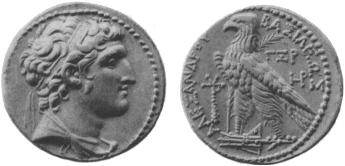 |
Balas, Theopator, Euergetes | ? - 146 BC | 150 BC | 146 BC | son of Antiochus IV Antiochus IV Epiphanes Antiochus IV Epiphanes ruled the Seleucid Empire from 175 BC until his death in 164 BC. He was a son of King Antiochus III the Great. His original name was Mithridates; he assumed the name Antiochus after he ascended the throne.... (?) |
Seleucid king of Syria As Alexander I | |
| 174 | Demetrius II Demetrius II Nicator For the similarly named Macedonian ruler, see Demetrius II of Macedon. For the Macedonian prince, see Demetrius the Fair.Demetrius II , called Nicator , was one of the sons of Demetrius I Soter, brother of Antiochus VII Sidetes and his mother could have been Laodice V... |
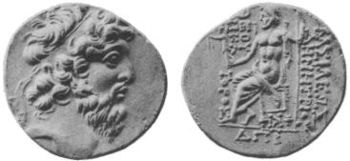 |
Nicator | ? - 139 BC | 146 BC | 139 BC | son of Demetrius I Demetrius I Soter Demetrius I , surnamed Soter , was a ruler of the Hellenistic Seleucid Empire.... |
Defeated and captured by Parthians. He married to Rhodogune daughter of Mithridates I Mithridates I of Parthia Mithridates or Mithradates I was the "Great King" of Parthia from ca. 171 BC - 138 BC, succeeding his brother Phraates I. His father was King Phriapatius of Parthia, who died ca. 176 BC). Mithridates I made Parthia into a major political power by expanding the empire to the east, south, and west... |
|
| 175 | Antiochus VII Antiochus VII Sidetes Antiochus VII Euergetes, nicknamed Sidetes , ruler of the Hellenistic Seleucid Empire, reigned from 138 to 129 BC. He was the last Seleucid king of any stature.... |
Euergetes, Sidetes | ? - 129 BC | 139 BC | 129 BC | son of Demetrius I Demetrius I Soter Demetrius I , surnamed Soter , was a ruler of the Hellenistic Seleucid Empire.... |
Killed in battle with Phraates II Phraates II of Parthia Phraates II of Parthia, son of Mithridates I of Parthia , the conqueror of Babylon, ruled the Parthian Empire from 138 BC to 128 BC. He was attacked in 130 BC by Antiochus VII Sidetes , ruler of the Seleucid Empire... |
||
Middle Iranian Empire, 247 BC–c. 670 AD
For more comprehensive lists of kings, queens, sub-kings and sub-queens of this Era see:| Throne Name | Original Name | Portrait | Title | Born-Died | Entered office | Left office | Family Relations | Note | |
|---|---|---|---|---|---|---|---|---|---|
| Arsacid dynasty, 247 BC–228 AD | |||||||||
| 161 | Arsaces I Arsaces I of Parthia Arsaces I was the founder of the Arsacid dynasty, and after whom all 30+ monarchs of the Arsacid empire officially named themselves. A celebrated descent from antiquity begins with Arsaces.A 1st century AD tradition casts Arsaces as descending from the 5th-century BC Achaemenid monarch... |
Tiridates I Tiridates I of Parthia Tiridates, or Teridates is a Persian name, given by Arrian in his Parthica to the brother of Arsaces I, the founder of the Parthian kingdom, whom he is said to have succeeded in about 246 BC... or Arsaces |
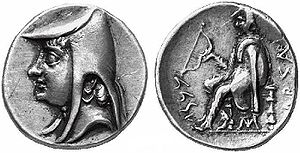 |
King, Karen, Autocrator | ? - 211 BC | 247 BC | 211 BC | A descendant of Arsaces son of Phriapatius who was probably son of Artaxerxes II Artaxerxes II of Persia Artaxerxes II Mnemon was king of Persia from 404 BC until his death. He was a son of Darius II of Persia and Parysatis.-Reign:... |
|
| 165 | Arsaces II Arsaces II of Parthia Arsaces II, also Artabanus I, of the Arsacid dynasty was King of Parthia between 211 BC and 191 BC. Greek 'Arsaces' appears as 'Artabanus' in Latin sources, and both forms appear in history books.... |
Arsaces | 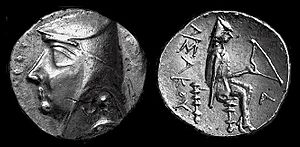 |
? - 185 BC | 211 BC | 185 BC | Son of Arsaces I Arsaces I of Parthia Arsaces I was the founder of the Arsacid dynasty, and after whom all 30+ monarchs of the Arsacid empire officially named themselves. A celebrated descent from antiquity begins with Arsaces.A 1st century AD tradition casts Arsaces as descending from the 5th-century BC Achaemenid monarch... |
||
| 167 | Arsaces III | Phriapatius Phriapatius of Parthia Phriapatius , sometimes called Phriapites, ruled the Parthian Empire from 191 BC to 176 BC. He was the grandson of Tiridates I of Parthia , the brother of Arsaces I of Parthia , the founder of the Parthian Empire.He ruled in the period following the invasion of Parthia by the Seleucid king... |
? - 170 BC | 185 BC | 170 BC | Grandson of Tiridates I Tiridates I of Parthia Tiridates, or Teridates is a Persian name, given by Arrian in his Parthica to the brother of Arsaces I, the founder of the Parthian kingdom, whom he is said to have succeeded in about 246 BC... |
|||
| 169 | Arsaces IV | Phraates I Phraates I of Parthia Phraates I of Parthia, ruler of the Parthian Empire from 176-171 BCE, succeed his father Phriapatius on the throne. Died relatively young, and appointed as his successor not one of his sons, but his brother Mithridates I .... |
? - 167 BC | 170 BC | 167 BC | Son of Phriapatius Phriapatius of Parthia Phriapatius , sometimes called Phriapites, ruled the Parthian Empire from 191 BC to 176 BC. He was the grandson of Tiridates I of Parthia , the brother of Arsaces I of Parthia , the founder of the Parthian Empire.He ruled in the period following the invasion of Parthia by the Seleucid king... |
|||
| 170 | Arsaces V | Mithridates I Mithridates I of Parthia Mithridates or Mithradates I was the "Great King" of Parthia from ca. 171 BC - 138 BC, succeeding his brother Phraates I. His father was King Phriapatius of Parthia, who died ca. 176 BC). Mithridates I made Parthia into a major political power by expanding the empire to the east, south, and west... |
The Great King, Theos, Theopator, Philhellene | ? - 132 BC | 167 BC | 132 BC | Son of Phriapatius Phriapatius of Parthia Phriapatius , sometimes called Phriapites, ruled the Parthian Empire from 191 BC to 176 BC. He was the grandson of Tiridates I of Parthia , the brother of Arsaces I of Parthia , the founder of the Parthian Empire.He ruled in the period following the invasion of Parthia by the Seleucid king... |
||
| 176 | Arsaces VI | Phraates II Phraates II of Parthia Phraates II of Parthia, son of Mithridates I of Parthia , the conqueror of Babylon, ruled the Parthian Empire from 138 BC to 128 BC. He was attacked in 130 BC by Antiochus VII Sidetes , ruler of the Seleucid Empire... |
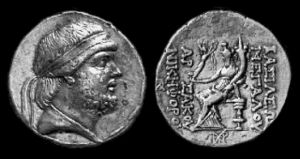 |
The Great King, Philopator, Theopator, Nikephoros | ? - 127 BC | 132 BC | 127 BC | Son of Mithridates I Mithridates I of Parthia Mithridates or Mithradates I was the "Great King" of Parthia from ca. 171 BC - 138 BC, succeeding his brother Phraates I. His father was King Phriapatius of Parthia, who died ca. 176 BC). Mithridates I made Parthia into a major political power by expanding the empire to the east, south, and west... |
Killed in battle with Scythians |
| 177 | Arsaces VII | Artabanus I Artabanus I of Parthia Artabanus I of Parthia ruled the Parthian Empire from c. 128 to 124 BC. He succeeded his nephew Phraates II and died, just like his predecessor, in battle against the Tochari - a name commonly identified with the Yuezhi of the Chinese sources, who had fled from Gansu in northwest China, via the Ili... |
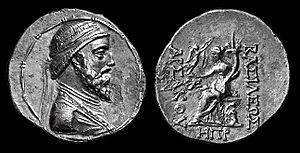 |
King | ? - 126 BC | 127 BC | 126 BC | Son of Phriapatius Phriapatius of Parthia Phriapatius , sometimes called Phriapites, ruled the Parthian Empire from 191 BC to 176 BC. He was the grandson of Tiridates I of Parthia , the brother of Arsaces I of Parthia , the founder of the Parthian Empire.He ruled in the period following the invasion of Parthia by the Seleucid king... |
Killed in battle with Tocharians |
| 178 | Arsaces VIII | Vologases (I) | The Great King, Theopator, Philadelphos, Philhellene, Epiphanes | ? - 122 BC | 126 BC | 122 BC | Son of Phriapatius Phriapatius of Parthia Phriapatius , sometimes called Phriapites, ruled the Parthian Empire from 191 BC to 176 BC. He was the grandson of Tiridates I of Parthia , the brother of Arsaces I of Parthia , the founder of the Parthian Empire.He ruled in the period following the invasion of Parthia by the Seleucid king... |
He was the first Arsacid king of Media, Arran and Iberia | |
| 179 | Arsaces IX | Artabanus (II) | The Great King, King of kings, Epiphanes, Philhellene | ? - 121 BC | 122 BC | 121 BC | Son of Artabanus I Artabanus I of Parthia Artabanus I of Parthia ruled the Parthian Empire from c. 128 to 124 BC. He succeeded his nephew Phraates II and died, just like his predecessor, in battle against the Tochari - a name commonly identified with the Yuezhi of the Chinese sources, who had fled from Gansu in northwest China, via the Ili... |
Killed in battle with Medians | |
| 180 | Arsaces X | Mithridates II Mithridates II of Parthia Mithridates II the Great was king of Parthian Empire from 123 to 88 BC. His name invokes the protection of Mithra. He adopted the title Epiphanes, "god manifest" and introduced new designs on his extensive coinage.... |
The Great King, The Great King of Kings, Epiphanes, Soter | ? - 91 BC | 121 BC | 91 BC | Son of Artabanus I Artabanus I of Parthia Artabanus I of Parthia ruled the Parthian Empire from c. 128 to 124 BC. He succeeded his nephew Phraates II and died, just like his predecessor, in battle against the Tochari - a name commonly identified with the Yuezhi of the Chinese sources, who had fled from Gansu in northwest China, via the Ili... |
||
| 181 | Arsaces XI | Gotarzes I Gotarzes I of Parthia Gotarzes I of Parthia ruled parts of the Parthian Empire c. 95–90 BC. He was the grandson of Phriapatius and came to power during the troubled times around the end of the reign of Mithridates II. He is mentioned on some astronomical tablets from Babylon and appears to have reigned for some... |
 |
The Great King, Epiphanes, Philhellene, Euergetes, Autocrator | ? - 87 BC | 91 BC | 87 BC | Son of Mithridates II Mithridates II of Parthia Mithridates II the Great was king of Parthian Empire from 123 to 88 BC. His name invokes the protection of Mithra. He adopted the title Epiphanes, "god manifest" and introduced new designs on his extensive coinage.... |
|
| 182 | Arsaces XII | Artabanus (III) | The Great King, Theopator, Nicator | ? - 77? BC | 91 BC | 77? BC | Son of Vologases (I) | ||
| 183 | Arsaces XIII | Mithridates (III) | The Great King, The Great King of Kings, Dikaios, Euergetes, Philhellene, Autocrator, Philopator, Epiphanes | ? - 67 BC | 88 BC | 67 BC | Son of Mithridates II Mithridates II of Parthia Mithridates II the Great was king of Parthian Empire from 123 to 88 BC. His name invokes the protection of Mithra. He adopted the title Epiphanes, "god manifest" and introduced new designs on his extensive coinage.... |
||
| 184 | Arsaces XIV | Orodes I Orodes I of Parthia King Orodes I of Parthia ruled the Parthian Empire from c. 90 to 80 BC in succession to Gotarzes I. Until 88 BC his reign coincided with that of Mithridates II, the rival king against whom Gotarzes had revolted... |
The Great King, Euergetes, Epiphanes, Philhellene | ? - 75 BC | 80 BC | 75 BC | Son of Mithridates II Mithridates II of Parthia Mithridates II the Great was king of Parthian Empire from 123 to 88 BC. His name invokes the protection of Mithra. He adopted the title Epiphanes, "god manifest" and introduced new designs on his extensive coinage.... |
||
| 185 | Arsaces XV | Sanatruces I Sanatruces of Parthia King Sanatruces of Parthia ruled the Parthian Empire from c. 77 to c. 70 BC. He was a member of the Arsacid house, who, according to work attributed to Lucian, in the troubled times after the death of Mithridates II in ca... |
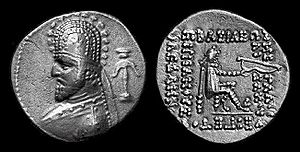 |
The Great King, Theopator, Euergetes, Epiphanes, Philhellene | 157 BC - 70 BC | 77 BC | 70 BC | Son of Vologases (I) | |
| 186 | Arsaces XVI | ? | The Great King, Theopator, Euergetes, Epiphanes, Philhellene, Eusebes | ? - 66 BC | 77 BC | 66 BC | ? | ||
| 187 | Arsaces XVII | Phraates III Phraates III of Parthia King Phraates III of Parthia succeeded his father Sanatruces and ruled the Parthian Empire from 70 to 57 BC. He was called "the God" because of his coins, that were ideal for sailors because they were polished with gold dust, so that people from other countries considered their value higher than... |
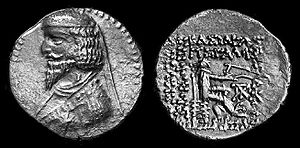 |
The Great King, Theos, Euergetes, Epiphanes, Philhellene | ? - 57 BC | 70 BC | 57 BC | Son of Sanatruces I Sanatruces of Parthia King Sanatruces of Parthia ruled the Parthian Empire from c. 77 to c. 70 BC. He was a member of the Arsacid house, who, according to work attributed to Lucian, in the troubled times after the death of Mithridates II in ca... |
Killed by Orodes II Orodes II of Parthia Orodes II of Parthia ruled the Parthian Empire from 57 to 38 BC. Orodes was a son of Phraates III, whom he murdered in 57 BC, assisted by his brother Mithridates... |
| 188 | Arsaces XVIII | ? | The Great King, Philopator, Euergetes, Epiphanes, Philhellene | ? - 63 BC | 66 BC | 63 BC | Son of Arsaces XVI | ||
| 189 | Arsaces XIX | Mithridates III Mithridates III of Parthia King Mithridates III of Parthia ruled the Parthian Empire c. 57–54 BC. With the assistance of his brother Orodes he murdered his father Phraates III. He was made king of Media and waged war against his brother, but was soon deposed on account of his cruelty. He took refuge with Aulus Gabinius, the... (or IV) |
The Great King, The Great King of Kings, Dikaios, Epiphanes, Theos, Eupator, Theopator, Philhellene | ? - 54 BC | 65 BC | 54 BC | Son of Phraates III Phraates III of Parthia King Phraates III of Parthia succeeded his father Sanatruces and ruled the Parthian Empire from 70 to 57 BC. He was called "the God" because of his coins, that were ideal for sailors because they were polished with gold dust, so that people from other countries considered their value higher than... |
Killed by Orodes II Orodes II of Parthia Orodes II of Parthia ruled the Parthian Empire from 57 to 38 BC. Orodes was a son of Phraates III, whom he murdered in 57 BC, assisted by his brother Mithridates... |
|
| 190 | Arsaces XX | Orodes II Orodes II of Parthia Orodes II of Parthia ruled the Parthian Empire from 57 to 38 BC. Orodes was a son of Phraates III, whom he murdered in 57 BC, assisted by his brother Mithridates... |
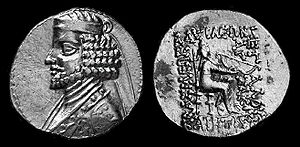 |
King of Kings, Philopator, Eupator, Euergetes, Dikaios, Epiphanes, Philhellene, Ktistes | ? - 38 BC | 57 BC | 38 BC | Son of Phraates III Phraates III of Parthia King Phraates III of Parthia succeeded his father Sanatruces and ruled the Parthian Empire from 70 to 57 BC. He was called "the God" because of his coins, that were ideal for sailors because they were polished with gold dust, so that people from other countries considered their value higher than... |
Killed by Phraates IV Phraates IV of Parthia King Phraates IV of Parthia, son of Orodes II, ruled the Parthian Empire from 37–2 BC. He was appointed successor to the throne in 37 BC, after the death of his brother Pacorus I... |
| 191 | Arsaces XXI | Pacorus I Pacorus I of Parthia Pacorus I of Parthia was the son of king Orodes II and queen Laodice of the Parthian Empire. It is possible that he was co-ruler with his father for at least part of his father's reign... |
King of Kings, Euergetes, Dikaios, Epiphanes, Philhellene | ? - 38 BC | 50 BC | 38 BC | Son of Orodes II Orodes II of Parthia Orodes II of Parthia ruled the Parthian Empire from 57 to 38 BC. Orodes was a son of Phraates III, whom he murdered in 57 BC, assisted by his brother Mithridates... |
Killed in battle with Romans | |
| 192 | Arsaces XXII | Phraates IV Phraates IV of Parthia King Phraates IV of Parthia, son of Orodes II, ruled the Parthian Empire from 37–2 BC. He was appointed successor to the throne in 37 BC, after the death of his brother Pacorus I... |
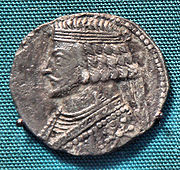 |
King of Kings, Euergetes, Dikaios, Epiphanes, Philhellene | ? - 2 BC | 38 | 2 BC | Son of Orodes II Orodes II of Parthia Orodes II of Parthia ruled the Parthian Empire from 57 to 38 BC. Orodes was a son of Phraates III, whom he murdered in 57 BC, assisted by his brother Mithridates... |
Killed by Musa Musa of Parthia Musa was Queen of Parthia c. 2 BC – AD 4. She is called as Thermusa by Josephus and is also known as Thea Urania . She was a concubine given by the Roman Emperor Augustus to King Phraates IV of Parthia... |
| 193 | Arsaces XXIII | Tiridates II Tiridates II of Parthia Tiridates II of Parthia was set up by the Parthians against Phraates IV in about 32 BC, but expelled when Phraates returned with the help of the Scythians... |
King of Kings, Euergetes, Dikaios, Epiphanes, Philhellene, Autocrator, Philoromaeos | ? - after 23 BC | 30 BC | 25 BC | Probably a descendant of Mithridates (III) | Deposed and went to Rome | |
| 194 | Arsaces XXIV | Mithridates (V) | ? | ? - ? BC | 12 BC | 9 BC | Probably a descendant of Mithridates (III) | ||
| Musa | Musa Musa of Parthia Musa was Queen of Parthia c. 2 BC – AD 4. She is called as Thermusa by Josephus and is also known as Thea Urania . She was a concubine given by the Roman Emperor Augustus to King Phraates IV of Parthia... |
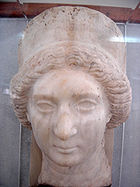 |
Queen of Queens, Thea, Urania | ?- 4? AD | 2 BC | 4 AD | Queen of Phraates IV Phraates IV of Parthia King Phraates IV of Parthia, son of Orodes II, ruled the Parthian Empire from 37–2 BC. He was appointed successor to the throne in 37 BC, after the death of his brother Pacorus I... |
||
| 195 | Arsaces XXV | Phraates V Phraates V of Parthia Phraates V of Persia, known by the diminutive Phraataces , ruled the Iranian Parthian Empire from 2 BC to AD 4. He was the younger son of Phraates IV of Parthia and the Musa of Parthia", with whom he is associated on his coins. Under Phraates V a war threatened to break out with Rome about the... |
King of Kings, Euergetes, Dikaios, Epiphanes, Philhellene | ?- 4 AD | 2 BC | 4 AD | Son of Phraates IV Phraates IV of Parthia King Phraates IV of Parthia, son of Orodes II, ruled the Parthian Empire from 37–2 BC. He was appointed successor to the throne in 37 BC, after the death of his brother Pacorus I... & Musa Musa of Parthia Musa was Queen of Parthia c. 2 BC – AD 4. She is called as Thermusa by Josephus and is also known as Thea Urania . She was a concubine given by the Roman Emperor Augustus to King Phraates IV of Parthia... |
Deposed and went to Rome | |
| 196 | Arsaces XXVI | Orodes III Orodes III of Parthia King Orodes III of Parthia was raised to the throne of the Parthian Empire around AD 4 by the magnates after the death of Phraates V of Parthia . He was killed after a short reign "on account of his extreme cruelty"... |
King of Kings, Euergetes, Dikaios, Epiphanes, Philhellene | ? - 6 | 4 | 6 | Probably a descendant of Mithridates (III) | Killed by Parthian aristocrats | |
| 197 | Arsaces XXVII | Vonones I Vonones I of Parthia Vonones I of Parthia ruled the Parthian Empire from about 8 to 12 AD. He was the eldest son of Phraates IV of Parthia Vonones I of Parthia (ΟΝΩΝΗΣ on his coins) ruled the Parthian Empire from about 8 to 12 AD. He was the eldest son of Phraates IV of Parthia Vonones I of Parthia (ΟΝΩΝΗΣ on his... |
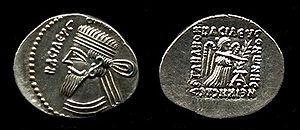 |
The Great King, King of Kings, Euergetes, Dikaios, Epiphanes, Philhellene, Nikephorus | ? - 19 | 8 | 12 | Son of Phraates IV Phraates IV of Parthia King Phraates IV of Parthia, son of Orodes II, ruled the Parthian Empire from 37–2 BC. He was appointed successor to the throne in 37 BC, after the death of his brother Pacorus I... |
Deposed and went to Rome. Later, He was killed by Romans. |
| 198 | Arsaces XXVIII | Artabanus II Artabanus II of Parthia Artabanus II of Parthia ruled the Parthian Empire from about AD 10 to 38. He was the son of a princess of the Arsacid Dynasty, who lived in the East among the Dahan nomads... (or IV) |
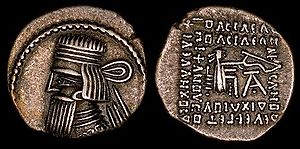 |
King of Kings, Euergetes, Dikaios, Epiphanes, Philhellene | ? - 40 | 10 | 40 | Probably a descendant of Mithridates (III) | |
| 199 | Arsaces XXIX | Tiridates III Tiridates III of Parthia Tiridates III of Parthia ruled the Parthian Empire briefly in 35–36. He was the grandson of Phraates IV. He was sent to Rome as a hostage and was educated there.... |
? | ? - ? | 35 | 36 | Probably a descendant of Tiridates II Tiridates II of Parthia Tiridates II of Parthia was set up by the Parthians against Phraates IV in about 32 BC, but expelled when Phraates returned with the help of the Scythians... |
Deposed and went to Rome | |
| 200 | Arsaces XXX | Cinnamus | ? | ? - ? | 37 | 37 | Son of Artabanus II Artabanus II of Parthia Artabanus II of Parthia ruled the Parthian Empire from about AD 10 to 38. He was the son of a princess of the Arsacid Dynasty, who lived in the East among the Dahan nomads... (or IV) |
Abdicated | |
| 201 | Arsaces XXXI | Gotarzes II Gotarzes II of Parthia Gotarzes II of Parthia ruled the Parthian Empire intermittently between about 40 and 51. He was the son of Artabanus II and when his father died in about 38 and his brother Vardanes I succeeded to the throne, Gotarzes rebelled.... |
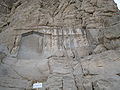 |
King of Kings, Euergetes, Dikaios, Epiphanes, Philhellene | 11 - 51 | 40 – | 51 | Son of Artabanus II Artabanus II of Parthia Artabanus II of Parthia ruled the Parthian Empire from about AD 10 to 38. He was the son of a princess of the Arsacid Dynasty, who lived in the East among the Dahan nomads... (or IV) |
|
| 202 | Arsaces XXXII | Vardanes I Vardanes I of Parthia Vardanes I of Parthia ruled the Parthian Empire from about 40–45. He succeeded his father Artabanus II, but had to continually fight against Gotarzes II, a rival claimant to the throne.... |
King of Kings, Euergetes, Dikaios, Epiphanes, Philhellene | ? - 46 | 40 | 46 | Son of Artabanus II Artabanus II of Parthia Artabanus II of Parthia ruled the Parthian Empire from about AD 10 to 38. He was the son of a princess of the Arsacid Dynasty, who lived in the East among the Dahan nomads... (or IV) |
Killed by Gotarzes II Gotarzes II of Parthia Gotarzes II of Parthia ruled the Parthian Empire intermittently between about 40 and 51. He was the son of Artabanus II and when his father died in about 38 and his brother Vardanes I succeeded to the throne, Gotarzes rebelled.... |
|
| 203 | Arsaces XXXIII | Vonones II Vonones II of Parthia Vonones II of Parthia ruled the Parthian Empire briefly in 51. During the reign of his brother Gotarzes II he was governor of Media, and was raised to the throne on Gotarzes' death. However, he died after a few months and was succeeded by his son Vologases I.... |
King of Kings, Euergetes, Dikaios, Epiphanes, Philhellene | ? - 51 | c. 45 | 51 | Son of Artabanus II Artabanus II of Parthia Artabanus II of Parthia ruled the Parthian Empire from about AD 10 to 38. He was the son of a princess of the Arsacid Dynasty, who lived in the East among the Dahan nomads... (or IV) |
||
| 204 | Arsaces XXXIV | Mithridates (VI) | ? | ? - ? | 49 | 50 | Son of Vonones I Vonones I of Parthia Vonones I of Parthia ruled the Parthian Empire from about 8 to 12 AD. He was the eldest son of Phraates IV of Parthia Vonones I of Parthia (ΟΝΩΝΗΣ on his coins) ruled the Parthian Empire from about 8 to 12 AD. He was the eldest son of Phraates IV of Parthia Vonones I of Parthia (ΟΝΩΝΗΣ on his... |
Deposed and mutilated by Gotarzes II Gotarzes II of Parthia Gotarzes II of Parthia ruled the Parthian Empire intermittently between about 40 and 51. He was the son of Artabanus II and when his father died in about 38 and his brother Vardanes I succeeded to the throne, Gotarzes rebelled.... |
|
| 205 | Arsaces XXXV | Vologases I Vologases I of Parthia Vologases I of Parthia, sometimes called Vologaeses or Vologeses or, following Zoroastrian usage, Valakhsh ruled the Parthian Empire from about 51 to 78. Son of Vonones II by a Thracian concubine, he succeeded his father in 51 AD. He gave the kingdom of Media Atropatene to his brother Pacorus II,... (or II) |
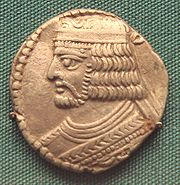 |
King of Kings, Euergetes, Dikaios, Epiphanes, Philhellene, The Lord | ? - 77 | 51 | 77 | Son of Vonones II Vonones II of Parthia Vonones II of Parthia ruled the Parthian Empire briefly in 51. During the reign of his brother Gotarzes II he was governor of Media, and was raised to the throne on Gotarzes' death. However, he died after a few months and was succeeded by his son Vologases I.... |
|
| 206 | Arsaces XXXVI | Vardanes II Vardanes II of Parthia Vardanes II of Parthia was the son of Vologases I and briefly ruler of part of the Parthian Empire. He rebelled against his father from about 55 to 58 CE and must have occupied Ecbatana, since he issued coins from the mint there, bearing the likeness of a young beardless king wearing a diadem with... |
King of Kings, Euergetes, Dikaios, Epiphanes, Philhellene | ? - ? | 55 | 58 | Son of Vologases I Vologases I of Parthia Vologases I of Parthia, sometimes called Vologaeses or Vologeses or, following Zoroastrian usage, Valakhsh ruled the Parthian Empire from about 51 to 78. Son of Vonones II by a Thracian concubine, he succeeded his father in 51 AD. He gave the kingdom of Media Atropatene to his brother Pacorus II,... (or II) |
Deposed | |
| 207 | Arsaces XXXVII | Vologases II Vologases II of Parthia Vologases II of Parthia was the son of Vologases I of Parthia and ruled the Parthian Empire from about 77 to 80. Little is known about him. It seems that Vologases II was defeated and deposed by his uncle, Pacorus II of Parthia .... (or III) |
King of Kings, Dikaios, Epiphanes, Philhellene | ? - ? | 77 | 89/90 | Probably son of Vologases I Vologases I of Parthia Vologases I of Parthia, sometimes called Vologaeses or Vologeses or, following Zoroastrian usage, Valakhsh ruled the Parthian Empire from about 51 to 78. Son of Vonones II by a Thracian concubine, he succeeded his father in 51 AD. He gave the kingdom of Media Atropatene to his brother Pacorus II,... (or II) |
||
| 208 | Arsaces XXXVIII | Pacorus II Pacorus II of Parthia Pacorus II of Parthia ruled the Parthian Empire from about 78 to 105. A son of Vonones II and brother of Vologases I, he was given the kingdom of Media Atropatene by the latter after his succession to the throne. After Vologases' death, Pacorus revolted against his brother's son and successor,... |
King of Kings, Dikaios, Epiphanes, Philhellene | ? - 115 | 77 | 115 | Probably son of Vologases I Vologases I of Parthia Vologases I of Parthia, sometimes called Vologaeses or Vologeses or, following Zoroastrian usage, Valakhsh ruled the Parthian Empire from about 51 to 78. Son of Vonones II by a Thracian concubine, he succeeded his father in 51 AD. He gave the kingdom of Media Atropatene to his brother Pacorus II,... (or II) |
||
| 209 | Arsaces XXXIX | Artabanus III Artabanus III of Parthia Artabanus III of Parthia was a rival for the crown of the Parthian Empire during the reign of Pacorus II, against whom he revolted; his own reign extended from about 80 to 81 AD. On a coin of 80 he calls himself Arsaces Artabanus... (or V) |
King of Kings, Dikaios, Epiphanes, Philhellene | ? - ? | 80 | 81 | Probably son of Vologases I Vologases I of Parthia Vologases I of Parthia, sometimes called Vologaeses or Vologeses or, following Zoroastrian usage, Valakhsh ruled the Parthian Empire from about 51 to 78. Son of Vonones II by a Thracian concubine, he succeeded his father in 51 AD. He gave the kingdom of Media Atropatene to his brother Pacorus II,... (or II) |
||
| 210 | Arsaces XL | Osroes I Osroes I of Parthia Osroes I of Parthia ruled the Parthian Empire c. 109–129. He succeeded his brother Pacorus II. For the whole of his reign he contended with the rival king Vologases III based in the east of Parthia.... |
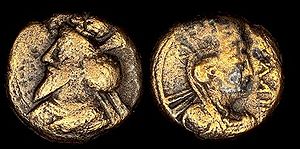 |
King of Kings, Euergetes, Dikaios, Epiphanes, Philhellene | ? - 130 | 89/90 | 130 | Probably son of Vologases II Vologases II of Parthia Vologases II of Parthia was the son of Vologases I of Parthia and ruled the Parthian Empire from about 77 to 80. Little is known about him. It seems that Vologases II was defeated and deposed by his uncle, Pacorus II of Parthia .... (or III) |
|
| 211 | Arsaces XLI | Vologases III Vologases III of Parthia Vologases III of Parthia claimed the throne of the Parthian Empire about 105, in the last days of Pacorus II of Parthia . He reigned over the eastern portion of the kingdom from 105 to 147... (or IV) |
King of Kings, Dikaios, Epiphanes, Philhellene | ? - 148 | 105 | 148 | ? | ||
| 212 | Arsaces XLII | Mithridates IV Mithridates IV of Parthia Mithridates IV of Parthia ruled the western Parthian Empire from 129 to 140. He was the brother of Osroes I of Parthia . He was the youngest son of the Parthian King Vonones II. During the invasion of Mesopotamia by the Roman emperor Trajan in 116 he and his son Sanatruces II took up the diadem... (or VII) |
King of Kings, Dikaios, Epiphanes, Philhellene | ? - c. 145 | 115 | c. 145 | Brother of Osroes I Osroes I of Parthia Osroes I of Parthia ruled the Parthian Empire c. 109–129. He succeeded his brother Pacorus II. For the whole of his reign he contended with the rival king Vologases III based in the east of Parthia.... |
Killed in battle with Romans | |
| 213 | Arsaces XLIII | Parthamaspates | King of Kings, Euergetes, Dikaios, Epiphanes, Philhellene | ? - after 123 | 116 | 117 | Son of Osroes I Osroes I of Parthia Osroes I of Parthia ruled the Parthian Empire c. 109–129. He succeeded his brother Pacorus II. For the whole of his reign he contended with the rival king Vologases III based in the east of Parthia.... |
Deposed and went to Rome | |
| 214 | Arsaces XLIV | Sanatruces II Sanatruces II of Parthia Sanatruces II of Parthia, the son of Mithridates IV, was a pretender to the throne of the Parthian Empire during the disputed reign of his uncle Osroes I.... |
King of Kings, Dikaios, Epiphanes, Philhellene | ? - c. 145 | c. 145 | c. 145 | son of Mithridates IV Mithridates IV of Parthia Mithridates IV of Parthia ruled the western Parthian Empire from 129 to 140. He was the brother of Osroes I of Parthia . He was the youngest son of the Parthian King Vonones II. During the invasion of Mesopotamia by the Roman emperor Trajan in 116 he and his son Sanatruces II took up the diadem... (or VII) |
Killed in battle with Romans | |
| 215 | Arsaces XLV | Vologases IV Vologases IV of Parthia Vologases IV of Parthia ruled the Parthian Empire from 147 to 191. The son of Mithridates IV of Parthia , he united the two halves of the empire which had been split between his father and Vologases III of Parthia... (or V) |
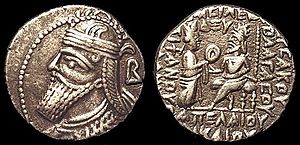 |
King of Kings, Dikaios, Epiphanes, Philhellene | ? - 191 | 148 | 191 | Son of Mithridates IV Mithridates IV of Parthia Mithridates IV of Parthia ruled the western Parthian Empire from 129 to 140. He was the brother of Osroes I of Parthia . He was the youngest son of the Parthian King Vonones II. During the invasion of Mesopotamia by the Roman emperor Trajan in 116 he and his son Sanatruces II took up the diadem... (or VII) |
|
| 216 | Arsaces XLVI | Vologases V Vologases V of Parthia Vologases V of Parthia ruled the Parthian Empire from 191 to 208. He was the son of Vologases IV . His succession was not uncontested; a rival King Osroes II had already set himself up in Media before the death of the previous ruler, but Vologases V appears to have quickly put him down.Vologases... (or VI) |
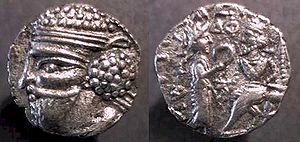 |
King of Kings, Dikaios, Epiphanes, Philhellene | ? - 208 | 191 | 208 | Son of Vologases IV Vologases IV of Parthia Vologases IV of Parthia ruled the Parthian Empire from 147 to 191. The son of Mithridates IV of Parthia , he united the two halves of the empire which had been split between his father and Vologases III of Parthia... (or V) |
|
| 217 | Arsaces XLVII | Osroes II Osroes II of Parthia Osroes II of Parthia was a claimant of the throne of the Parthian Empire c. 190. He is unknown to history except for the coins he issued. The date of his reign suggests that he rebelled against Vologases IV but was unable to maintain himself against Vologases V. His coins were issued by the mint at... |
King of Kings, Dikaios, Epiphanes, Philhellene | ? - ? | c. 190 | c. 195 | Probably son of Vologases IV Vologases IV of Parthia Vologases IV of Parthia ruled the Parthian Empire from 147 to 191. The son of Mithridates IV of Parthia , he united the two halves of the empire which had been split between his father and Vologases III of Parthia... (or V) |
||
| 218 | Arsaces XLVIII | Vologases VI Vologases VI of Parthia ]Vologases VI of Parthia succeeded his father Vologases V of Parthia to the throne of the Parthian Empire in 208. Soon after his accession his brother Artabanus IV rebelled against him, and became master of the greater part of the empire... (or VII) |
King of Kings, Dikaios, Epiphanes, Philhellene | 181 - 228 | 208 | 228 | Son of Vologases V Vologases V of Parthia Vologases V of Parthia ruled the Parthian Empire from 191 to 208. He was the son of Vologases IV . His succession was not uncontested; a rival King Osroes II had already set himself up in Media before the death of the previous ruler, but Vologases V appears to have quickly put him down.Vologases... (or VI) |
Killed by Ardashir I Ardashir I Ardashir I was the founder of the Sassanid Empire, was ruler of Istakhr , subsequently Fars Province , and finally "King of Kings of Sassanid Empire " with the overthrow of the Parthian Empire... |
|
| 219 | Arsaces XLIX | Artabanus IV Artabanus IV of Parthia Artabanus IV of Parthia ruled the Parthian Empire . He was the younger son of Vologases V who died in 208. Artabanus rebelled against his brother Vologases VI, and soon gained the upper hand, although Vologases VI maintained himself in a part of Babylonia until about 228.The Roman emperor... (or VI) |
King of Kings, Dikaios, Epiphanes, Philhellene | ? - 226 | 213 | 226 | Son of Vologases V Vologases V of Parthia Vologases V of Parthia ruled the Parthian Empire from 191 to 208. He was the son of Vologases IV . His succession was not uncontested; a rival King Osroes II had already set himself up in Media before the death of the previous ruler, but Vologases V appears to have quickly put him down.Vologases... (or VI) |
Killed by Ardashir I Ardashir I Ardashir I was the founder of the Sassanid Empire, was ruler of Istakhr , subsequently Fars Province , and finally "King of Kings of Sassanid Empire " with the overthrow of the Parthian Empire... |
|
| 220 | Arsaces L | Tiridates IV | King of Kings, Dikaios, Epiphanes, Philhellene | ? - ? | 217 | 222 | Son of Vologases IV Vologases IV of Parthia Vologases IV of Parthia ruled the Parthian Empire from 147 to 191. The son of Mithridates IV of Parthia , he united the two halves of the empire which had been split between his father and Vologases III of Parthia... (or V) |
He was also king of Armenia | |
| Sassanid dynasty Sassanid Empire The Sassanid Empire , known to its inhabitants as Ērānshahr and Ērān in Middle Persian and resulting in the New Persian terms Iranshahr and Iran , was the last pre-Islamic Persian Empire, ruled by the Sasanian Dynasty from 224 to 651... , 224-c. 670 AD |
|||||||||
| 221 | Ardashir I Ardashir I Ardashir I was the founder of the Sassanid Empire, was ruler of Istakhr , subsequently Fars Province , and finally "King of Kings of Sassanid Empire " with the overthrow of the Parthian Empire... |
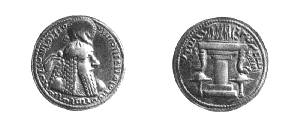 |
Shahanshah | ? - sept. 241 | April 28, 224 | sept. 241 | Son of Papak son of Sasan Sasan Sāsān , considered the eponymous ancestor of the Sasanians, was "a great warrior and hunter" and a Zoroastrian high priest in south western Iran and living sometime near the fall of the Arsacid Empire.-Identity of Sasan:... |
||
| 222 | Shapur I Shapur I Shapur I or also known as Shapur I the Great was the second Sassanid King of the Second Persian Empire. The dates of his reign are commonly given as 240/42 - 270/72, but it is likely that he also reigned as co-regent prior to his father's death in 242 .-Early years:Shapur was the son of Ardashir I... |
Shahanshah | 215 - April 273 | April 12, 240 | April 273 | Son of Ardashir I Ardashir I Ardashir I was the founder of the Sassanid Empire, was ruler of Istakhr , subsequently Fars Province , and finally "King of Kings of Sassanid Empire " with the overthrow of the Parthian Empire... |
|||
| 223 | Hormizd I Hormizd I Hormizd I was the third Sassanid King of Persia from 270/72 to 273.He was the youngest son of Shapur I , under whom he was governor of Khorasan, and appears in his wars against Rome Hormizd I was the third Sassanid King of Persia from 270/72 to 273.He was the youngest son of Shapur I... |
Hormozd-Ardashir |  |
Shahanshah, Vozorg Armananshah | ? - April 274 | April 273 | April 274 | Son of Shapur I Shapur I Shapur I or also known as Shapur I the Great was the second Sassanid King of the Second Persian Empire. The dates of his reign are commonly given as 240/42 - 270/72, but it is likely that he also reigned as co-regent prior to his father's death in 242 .-Early years:Shapur was the son of Ardashir I... |
|
| 224 | Bahram I Bahram I Bahram I was the fourth Sassanid emperor of the second Persian Empire. He was the eldest son of Shapur I and succeeded his brother Hormizd I , who had reigned for only a year.... |
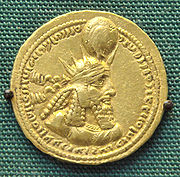 |
Shahanshah, Gilanshah | ? - July 277 | April 274 | July 277 | Son of Shapur I Shapur I Shapur I or also known as Shapur I the Great was the second Sassanid King of the Second Persian Empire. The dates of his reign are commonly given as 240/42 - 270/72, but it is likely that he also reigned as co-regent prior to his father's death in 242 .-Early years:Shapur was the son of Ardashir I... |
||
| 225 | Bahram II Bahram II Bahram II was the fifth Sassanid King of Persia in 276–293. He was the son of Bahram I .Bahram II is said to have ruled at first tyrannically, and to have greatly disgusted all his principal nobles, who went so far as to form a conspiracy against him, and intended to put him to death... |
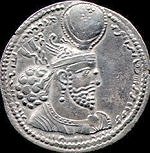 |
Shahanshah | ? - 294 | July 277 | 293 | Son of Bahram I Bahram I Bahram I was the fourth Sassanid emperor of the second Persian Empire. He was the eldest son of Shapur I and succeeded his brother Hormizd I , who had reigned for only a year.... |
||
| 226 | Bahram III Bahram III Bahram III was the sixth Sassanid King of Persia and son of Bahram II. He was appointed viceroy to the region of Sakasthan after Bahram II's conquest of it sometime in the 280's CE.... |
Shahanshah, Sakanshah | ? - 293 | 293 | 293 | Son of Bahram II Bahram II Bahram II was the fifth Sassanid King of Persia in 276–293. He was the son of Bahram I .Bahram II is said to have ruled at first tyrannically, and to have greatly disgusted all his principal nobles, who went so far as to form a conspiracy against him, and intended to put him to death... |
Deposed | ||
| 227 | Narseh I Narseh Narseh was the seventh Sassanid King of Persia , and son of Shapur I .... |
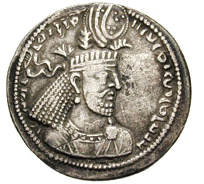 |
Shahanshah, Vozorg Armananshah | ? - 302 | 293 | 302 | Son of Shapur I Shapur I Shapur I or also known as Shapur I the Great was the second Sassanid King of the Second Persian Empire. The dates of his reign are commonly given as 240/42 - 270/72, but it is likely that he also reigned as co-regent prior to his father's death in 242 .-Early years:Shapur was the son of Ardashir I... |
||
| 228 | Hormizd II Hormizd II Hormizd II, was the eighth Persian king of the Sassanid Empire, and reigned for seven years and five months, from 302 to 309. He was the son of Narseh .Almost nothing is known of his reign... |
 |
Shahanshah | ? - feb. 310 | 302 | feb. 310 | Son of Narseh I Narseh Narseh was the seventh Sassanid King of Persia , and son of Shapur I .... |
Killed in battle with Arabs | |
| 229 | Narseh II | Adur-narseh | Shahanshah | ? - March 310 | Feb. 310 | March 310 | Son of Hormizd II Hormizd II Hormizd II, was the eighth Persian king of the Sassanid Empire, and reigned for seven years and five months, from 302 to 309. He was the son of Narseh .Almost nothing is known of his reign... |
Killed by Iranian aristocrats | |
| 230 | Shapur II Shapur II Shapur II the Great was the ninth King of the Persian Sassanid Empire from 309 to 379 and son of Hormizd II. During his long reign, the Sassanid Empire saw its first golden era since the reign of Shapur I... |
Shahanshah, Huyah Sonba | March 310 - 379 | March 310 | 379 | Son of Hormizd II Hormizd II Hormizd II, was the eighth Persian king of the Sassanid Empire, and reigned for seven years and five months, from 302 to 309. He was the son of Narseh .Almost nothing is known of his reign... |
|||
| 231 | Ardashir II Ardashir II Ardashir II was the tenth Sassanid King of Persia from 379 to 383.He is believed by some to be the son and by others to be the brother of his predecessor, Shapur II... |
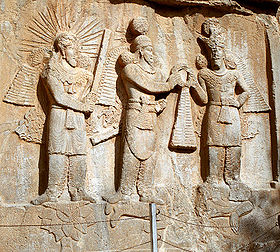 |
Shahanshah | ? - 383 | 379 | 383 | Son of Shapur II Shapur II Shapur II the Great was the ninth King of the Persian Sassanid Empire from 309 to 379 and son of Hormizd II. During his long reign, the Sassanid Empire saw its first golden era since the reign of Shapur I... |
||
| 232 | Shapur III Shapur III Shapur III was the eleventh Sassanid King of Persia from 383 to 388. Shapur III succeeded his father Ardashir II in the year 383.- Treaty with Rome :... |
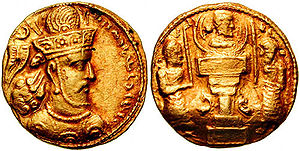 |
Shahanshah | ? - Dec. 388 | 383 | Dec. 388 | Son of Shapur II Shapur II Shapur II the Great was the ninth King of the Persian Sassanid Empire from 309 to 379 and son of Hormizd II. During his long reign, the Sassanid Empire saw its first golden era since the reign of Shapur I... |
||
| 233 | Bahram IV Bahram IV Bahram IV was twelfth Sassanid King of Persia , son and successor of Shapur III of Persia , under whom he had been governor of Kerman; therefore he was called Kermanshah Bahram IV was twelfth Sassanid King of Persia (388–399), son and successor of Shapur III of Persia (383–388), under whom he had... |
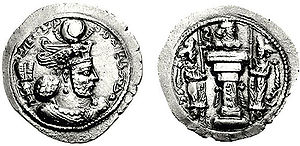 |
Shahanshah, Kermanshah | ? - 399 | Dec. 388 | 399 | Son of Shapur II Shapur II Shapur II the Great was the ninth King of the Persian Sassanid Empire from 309 to 379 and son of Hormizd II. During his long reign, the Sassanid Empire saw its first golden era since the reign of Shapur I... |
||
| 234 | Yazdegerd I Yazdegerd I Yazdegerd I, or Izdekerti , was the thirteenth Sassanid king of Persia and ruled from 399 to 421. He is believed by some to be the son of Shapur III and by others to be son of Bahram IV... |
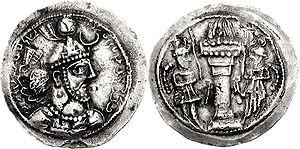 |
Shahanshah | 363 - Jan. 21, 421 | 399 | Jan. 21, 421 | Son of Shapur III Shapur III Shapur III was the eleventh Sassanid King of Persia from 383 to 388. Shapur III succeeded his father Ardashir II in the year 383.- Treaty with Rome :... |
Killed by Iranian aristocrats | |
| 235 | Shapur IV | Shahanshah, Armananshah | ? - Feb. 421 | Feb. 421 | Feb. 421 | Son of Yazdegerd I Yazdegerd I Yazdegerd I, or Izdekerti , was the thirteenth Sassanid king of Persia and ruled from 399 to 421. He is believed by some to be the son of Shapur III and by others to be son of Bahram IV... |
Killed by Iranian aristocrats | ||
| 236 | Bahram V Bahram V Bahram V was the fourteenth Sassanid King of Persia . Also called Bahram Gur or Bahramgur , he was a son of Yazdegerd I , after whose sudden death he gained the crown against the opposition of the grandees by the help of Mundhir, the Arab dynast of al-Hirah.- Reign and war with Rome :Bahram V... |
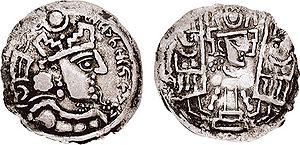 |
Shahanshah, Goor | 391 - June 20, 439 | 421 | June 20, 439 | Son of Yazdegerd I Yazdegerd I Yazdegerd I, or Izdekerti , was the thirteenth Sassanid king of Persia and ruled from 399 to 421. He is believed by some to be the son of Shapur III and by others to be son of Bahram IV... |
||
| 237 | Yazdegerd II Yazdegerd II Yazdegerd II was the fifteenth Sassanid King of Persia. He was the son of Bahram V and reigned from 438 to 457.... |
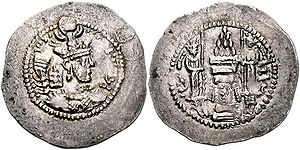 |
Shahanshah | ? - Dec. 15, 456 | June 20, 439 | Dec. 15, 456 | Son of Bahram V Bahram V Bahram V was the fourteenth Sassanid King of Persia . Also called Bahram Gur or Bahramgur , he was a son of Yazdegerd I , after whose sudden death he gained the crown against the opposition of the grandees by the help of Mundhir, the Arab dynast of al-Hirah.- Reign and war with Rome :Bahram V... |
||
| 238 | Hormizd III Hormizd III Hormizd III, sixteenth Sassanid King of Persia, son of Yazdegerd II , succeeded his father in 457.Hormizd, the older son of Yazdegerd II, was kept near Ctesiphon, while his younger brother, Peroz, was stationed in Sistan. Following his father's death, Hormizd became ruler of the Sassanian Empire... |
Shahanshah | 399 - 459 | 457 | 459 | Son of Yazdegerd II Yazdegerd II Yazdegerd II was the fifteenth Sassanid King of Persia. He was the son of Bahram V and reigned from 438 to 457.... |
Killed by Peroz I Peroz I Peroz I Peroz I Peroz I (also Pirooz; Peirozes (Priscus, fr. 33); Perozes (Procopius, De Bello Pers. I. 3 and Agathias iv. 27; the modern form of the name is Perooz, Piruz, or the Arabized Ferooz, Firuz; Persian: پیروز "the Victor"), was the seventeenth Sassanid King of Persia, who ruled from 457... |
||
| 239 | Peroz I Peroz I Peroz I Peroz I Peroz I (also Pirooz; Peirozes (Priscus, fr. 33); Perozes (Procopius, De Bello Pers. I. 3 and Agathias iv. 27; the modern form of the name is Perooz, Piruz, or the Arabized Ferooz, Firuz; Persian: پیروز "the Victor"), was the seventeenth Sassanid King of Persia, who ruled from 457... |
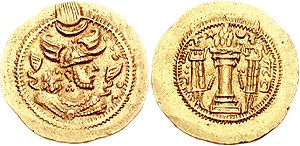 |
Shahanshah | ? - Jan. 484 | 457 | Jan. 484 | Son of Yazdegerd II Yazdegerd II Yazdegerd II was the fifteenth Sassanid King of Persia. He was the son of Bahram V and reigned from 438 to 457.... |
Killed in battle with Hephthalites | |
| 240 | Balash Balash Balash , the eighteenth Sassanid King of Persia in 484–488, was the brother and successor of Peroz I of Persia , who had died in a battle against the Hephthalites who invaded Persia from the east.- Reign of Balash :Balash was made King of Persia following the death of his... |
Shahanshah | ? - 488 | Feb. 484 | 488 | Son of Yazdegerd II Yazdegerd II Yazdegerd II was the fifteenth Sassanid King of Persia. He was the son of Bahram V and reigned from 438 to 457.... |
|||
| 241 | Kavadh I Kavadh I Kavad or Kavadh I was the son of Peroz I and the nineteenth Sassanid king of Persia, reigning from 488 to 531... |
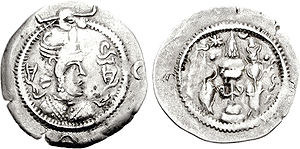 |
Shahanshah | 449 - 531 | 488 | 496 | Son of Peroz I Peroz I Peroz I Peroz I Peroz I (also Pirooz; Peirozes (Priscus, fr. 33); Perozes (Procopius, De Bello Pers. I. 3 and Agathias iv. 27; the modern form of the name is Perooz, Piruz, or the Arabized Ferooz, Firuz; Persian: پیروز "the Victor"), was the seventeenth Sassanid King of Persia, who ruled from 457... |
Deposed | |
| 242 | Djamasp Djamasp Djamasp was a Sassanid king who ruled from 496 to 498. He was a younger brother of king Kavadh I and was installed on the Sassanid throne upon the deposition of the latter by members of the nobility.... |
Shahanshah | ? - 502 | 496 | 498 | Son of Peroz I Peroz I Peroz I Peroz I Peroz I (also Pirooz; Peirozes (Priscus, fr. 33); Perozes (Procopius, De Bello Pers. I. 3 and Agathias iv. 27; the modern form of the name is Perooz, Piruz, or the Arabized Ferooz, Firuz; Persian: پیروز "the Victor"), was the seventeenth Sassanid King of Persia, who ruled from 457... |
Deposed | ||
| 241 | Kavadh I Kavadh I Kavad or Kavadh I was the son of Peroz I and the nineteenth Sassanid king of Persia, reigning from 488 to 531... |
|
Shahanshah | 449 - Sept. 13, 531 | 498 | Sept. 13, 531 | Son of Peroz I Peroz I Peroz I Peroz I Peroz I (also Pirooz; Peirozes (Priscus, fr. 33); Perozes (Procopius, De Bello Pers. I. 3 and Agathias iv. 27; the modern form of the name is Perooz, Piruz, or the Arabized Ferooz, Firuz; Persian: پیروز "the Victor"), was the seventeenth Sassanid King of Persia, who ruled from 457... |
||
| 243 | Khosrau I Khosrau I Khosrau I , also known as Anushiravan the Just or Anushirawan the Just Khosrau I (also called Chosroes I in classical sources, most commonly known in Persian as Anushirvan or Anushirwan, Persian: انوشيروان meaning the immortal soul), also known as Anushiravan the Just or Anushirawan the Just... |
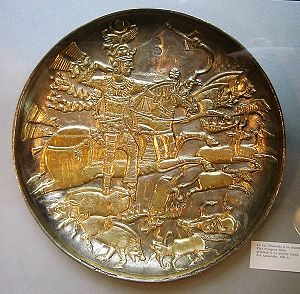 |
Shahanshah, Anushiravan, The Just | 500 - Jan. 31 579 | Sept. 13, 531 | Jan. 31 579 | Son of Kavadh I Kavadh I Kavad or Kavadh I was the son of Peroz I and the nineteenth Sassanid king of Persia, reigning from 488 to 531... |
||
| 244 | Hormizd IV Hormizd IV Hormizd IV, son of Khosrau I, reigned as the twenty-first King of Persia from 579 to 590.He seems to have been imperious and violent, but not without some kindness of heart. Some very characteristic stories are told of him by Tabari. His father's sympathies had been with the nobles and the priests... |
 |
Shahanshah, Torkzad | 528 - 590 | Jan. 31 579 | Sept. 5, 590 | Son of Khosrau I Khosrau I Khosrau I , also known as Anushiravan the Just or Anushirawan the Just Khosrau I (also called Chosroes I in classical sources, most commonly known in Persian as Anushirvan or Anushirwan, Persian: انوشيروان meaning the immortal soul), also known as Anushiravan the Just or Anushirawan the Just... |
Killed by Vistahm | |
| 245 | Khosrau II Khosrau II 250px|thumb|Khosrau II 250px|thumb|Khosrau II 250px|thumb|Khosrau II (Khosrow II, Chosroes II, or Xosrov II in classical sources, sometimes called Parvez, "the Ever Victorious" – (in Persian: خسرو پرویز), was the twenty-second Sassanid King of Persia, reigning from 590 to 628... |
Shahanshah, Aparviz | 550 - 628 | Sept. 590 | Sept. 590 | Son of Hormizd IV Hormizd IV Hormizd IV, son of Khosrau I, reigned as the twenty-first King of Persia from 579 to 590.He seems to have been imperious and violent, but not without some kindness of heart. Some very characteristic stories are told of him by Tabari. His father's sympathies had been with the nobles and the priests... |
Deposed and went to Rome | ||
| 246 | Bahram VI | Shahanshah, Chubineh | ? - 592 | Sept. 590 | Jan. 591 | Son of Bahram-Goshnasp from House of Mihran House of Mihran The House of Mihrān was a leading Iranian noble family , one of the Seven Great Houses of the Sassanid Persian Empire which claimed descent from the earlier Arsacid dynasty... |
Killed by Turks | ||
| 245 | Khosrau II Khosrau II 250px|thumb|Khosrau II 250px|thumb|Khosrau II 250px|thumb|Khosrau II (Khosrow II, Chosroes II, or Xosrov II in classical sources, sometimes called Parvez, "the Ever Victorious" – (in Persian: خسرو پرویز), was the twenty-second Sassanid King of Persia, reigning from 590 to 628... |
Shahanshah, Aparviz | 550 - 628 | Jan. 591 | Feb. 25, 628 | Son of Hormizd IV Hormizd IV Hormizd IV, son of Khosrau I, reigned as the twenty-first King of Persia from 579 to 590.He seems to have been imperious and violent, but not without some kindness of heart. Some very characteristic stories are told of him by Tabari. His father's sympathies had been with the nobles and the priests... |
Killed by Kavadh II Kavadh II Kavadh II , twenty-third Sassanid King of Persia, son of Khosrau II , was raised to the throne in opposition to his father in February 628, after the great victories of the Emperor Heraclius... |
||
| 247 | Vistahm | Shahanshah, Peroz | ? - 596 | 592 | 596 | Son of Shapur from House of Espandyad. He was uncle of Khosrau II Khosrau II 250px|thumb|Khosrau II 250px|thumb|Khosrau II 250px|thumb|Khosrau II (Khosrow II, Chosroes II, or Xosrov II in classical sources, sometimes called Parvez, "the Ever Victorious" – (in Persian: خسرو پرویز), was the twenty-second Sassanid King of Persia, reigning from 590 to 628... & husband of Gorduyah sister of Bahram VI |
Killed by his wife Gorduyah sister of Bahram VI | ||
| 248 | Hormizd V Hormizd V Hormizd V was briefly the ruler of the Sassanid Empire. Described as a usurper, he was one of many pretenders who rose after the temporary deposition of Chosroes II by Bahram Chobin.... |
Shahanshah | ? - ? | ?593 | ?593 | Probably son of Vistahm & Gorduyah sister of Bahram VI | |||
| 249 | Kavadh II Kavadh II Kavadh II , twenty-third Sassanid King of Persia, son of Khosrau II , was raised to the throne in opposition to his father in February 628, after the great victories of the Emperor Heraclius... |
Shiruyah |  |
Shahanshah | ? - Sept. 15, 628 | Feb. 25, 628 | Sept. 15, 628 | Son of Khosrau II Khosrau II 250px|thumb|Khosrau II 250px|thumb|Khosrau II 250px|thumb|Khosrau II (Khosrow II, Chosroes II, or Xosrov II in classical sources, sometimes called Parvez, "the Ever Victorious" – (in Persian: خسرو پرویز), was the twenty-second Sassanid King of Persia, reigning from 590 to 628... |
|
| 250 | Ardashir III Ardashir III Ardashir III was the twenty-fourth Sassanid King of Persia from 628 to 630.He was a son of Kavadh II/Shiroes and "Anzoy the Roman". His mother was probably from the Byzantine Empire. He was raised to the throne as a boy of seven years, but was killed 18 months later by his general, Shahrbaraz .-... |
 |
Shahanshah | 598 - April 27, 630 | Sept. 15, 628 | April 27, 630 | Son of Kavadh II Kavadh II Kavadh II , twenty-third Sassanid King of Persia, son of Khosrau II , was raised to the throne in opposition to his father in February 628, after the great victories of the Emperor Heraclius... |
Killed by Farrokhan Shahrbaraz Shahrbaraz or Shahrwaraz was a general, with the rank of Eran Spahbod under Khosrau II . His name was Farrokhan, and Shahrbaraz was his title... |
|
| 251 | Farrokhan Shahrbaraz Shahrbaraz or Shahrwaraz was a general, with the rank of Eran Spahbod under Khosrau II . His name was Farrokhan, and Shahrbaraz was his title... |
 |
Shahanshah, Shahrvaraz, Rumi-zan | ? - June 9, 630 | April 27, 630 | June 9, 630 | Son of Ardashir from House of Varaz. He was husband of Boran daughter of Khosrau II Khosrau II 250px|thumb|Khosrau II 250px|thumb|Khosrau II 250px|thumb|Khosrau II (Khosrow II, Chosroes II, or Xosrov II in classical sources, sometimes called Parvez, "the Ever Victorious" – (in Persian: خسرو پرویز), was the twenty-second Sassanid King of Persia, reigning from 590 to 628... |
Killed by Iranian aristocrats | |
| 252 | Khosrau III | Shahanshah | ? - ? | May 630 | after July 635 | Son of Kavadh son of Hormizd IV Hormizd IV Hormizd IV, son of Khosrau I, reigned as the twenty-first King of Persia from 579 to 590.He seems to have been imperious and violent, but not without some kindness of heart. Some very characteristic stories are told of him by Tabari. His father's sympathies had been with the nobles and the priests... |
|||
| 253 | Boran | 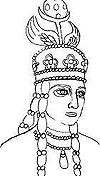 |
Shahbano | 590 - Oct. 631 | June 630 | Oct. 631 | Daughter of Khosrau II Khosrau II 250px|thumb|Khosrau II 250px|thumb|Khosrau II 250px|thumb|Khosrau II (Khosrow II, Chosroes II, or Xosrov II in classical sources, sometimes called Parvez, "the Ever Victorious" – (in Persian: خسرو پرویز), was the twenty-second Sassanid King of Persia, reigning from 590 to 628... & Wife of Farrokhan Shahrbaraz Shahrbaraz or Shahrwaraz was a general, with the rank of Eran Spahbod under Khosrau II . His name was Farrokhan, and Shahrbaraz was his title... |
||
| 254 | Peroz II | Goshnasp-Bandeh | Shahanshah | ? - Dec. 631 | Oct. 631 | Dec. 631 | Son of Mihran-Goshnasp & Chaharbakht who was daughter of Yazdandad son of Khosrau I Khosrau I Khosrau I , also known as Anushiravan the Just or Anushirawan the Just Khosrau I (also called Chosroes I in classical sources, most commonly known in Persian as Anushirvan or Anushirwan, Persian: انوشيروان meaning the immortal soul), also known as Anushiravan the Just or Anushirawan the Just... . Probably he was also husband of Azarmidokht Azarmidokht Azarmidokht was the twenty-seventh Sassanid Monarch of Persia, and daughter of Khosrau II. She ruled Persia after her sister Purandokht.After the death of her father Khosrau II anarchy spread in the Sassanid empire. The subsequent rulers could stay for only a relatively brief time on the throne,... |
Killed by Iranian aristocrats | |
| 255 | Khosrau IV | Shahanshah | ? - Dec. 631 | Dec. 631 | Dec. 631 | Brother of Peroz II | Killed by Iranian aristocrats | ||
| 256 | Azarmidokht Azarmidokht Azarmidokht was the twenty-seventh Sassanid Monarch of Persia, and daughter of Khosrau II. She ruled Persia after her sister Purandokht.After the death of her father Khosrau II anarchy spread in the Sassanid empire. The subsequent rulers could stay for only a relatively brief time on the throne,... |
Shahbano | ? - April 632 | Dec. 631 | April 632 | Daughter of Khosrau II Khosrau II 250px|thumb|Khosrau II 250px|thumb|Khosrau II 250px|thumb|Khosrau II (Khosrow II, Chosroes II, or Xosrov II in classical sources, sometimes called Parvez, "the Ever Victorious" – (in Persian: خسرو پرویز), was the twenty-second Sassanid King of Persia, reigning from 590 to 628... & probably wife of Peroz II |
Killed by Iranian aristocrats | ||
| 257 | Hormizd VI Hormizd VI Hormizd VI or V, twenty-eighth Sassanid King of Persia, was one of the many pretenders who rose after the murder of Khosrau II in 628. He maintained himself about two years in the district of Nisibis. There was also a brief usurper king, not always numbered among the monarchs, called Hormizd V in... |
Shahanshah | ? - ? | April 632 | after July 633 | Son of Kavadh II Kavadh II Kavadh II , twenty-third Sassanid King of Persia, son of Khosrau II , was raised to the throne in opposition to his father in February 628, after the great victories of the Emperor Heraclius... |
Killed by Iranian aristocrats | ||
| 258 | Khosrau V | Farrokhzad | Shahanshah | ? - Oct. 632 | April 632 | Oct. 632 | Son of Khosrau II Khosrau II 250px|thumb|Khosrau II 250px|thumb|Khosrau II 250px|thumb|Khosrau II (Khosrow II, Chosroes II, or Xosrov II in classical sources, sometimes called Parvez, "the Ever Victorious" – (in Persian: خسرو پرویز), was the twenty-second Sassanid King of Persia, reigning from 590 to 628... |
Killed by Iranian aristocrats | |
| 259 | Yazdegerd III | 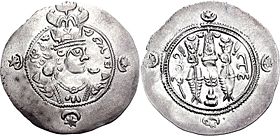 |
Shahanshah | ? - 652 | Oct. 632 | 652 | Son of Shahryar son of Khosrau II Khosrau II 250px|thumb|Khosrau II 250px|thumb|Khosrau II 250px|thumb|Khosrau II (Khosrow II, Chosroes II, or Xosrov II in classical sources, sometimes called Parvez, "the Ever Victorious" – (in Persian: خسرو پرویز), was the twenty-second Sassanid King of Persia, reigning from 590 to 628... |
Killed | |
| 262 | Peroz III | Shahanshah | ? - before 673 | 652 | after 670 | Son of Yazdegerd III | |||
Arab Caliphs, 641-946 AD
For more comprehensive lists of kings and sub-kings of this Era see:- Muslim dynasties of Iran
| Throne Name | Original Name | Portrait | Title | Born-Died | Entered office | Left office | Family Relations | Note | |
|---|---|---|---|---|---|---|---|---|---|
| Rashidun Rashidun The Rightly Guided Caliphs or The Righteous Caliphs is a term used in Sunni Islam to refer to the first four Caliphs who established the Rashidun Caliphate. The concept of "Rightly Guided Caliphs" originated with the Abbasid Dynasty... Caliphs, 641-692 AD |
|||||||||
| 260 | Umar I Umar `Umar ibn al-Khattāb c. 2 November , was a leading companion and adviser to the Islamic prophet Muhammad who later became the second Muslim Caliph after Muhammad's death.... |
Abu Hafş, Al-Farouq, Caliph, Amir al-Mu'minin | 590 - 644 | 641 | 644 | son of Khattab. Also he was father of Hafşa wife of Muhammad | Second caliph in Medina from 633 AD. Killed | ||
| 261 | Uthman | Abu Amr, Zonnurain, Caliph, Amir al-Mu'minin | 579 - 656 | 644 | 656 | son of Affan of Umayyad clan of Quraish | Killed | ||
| 263 | Ali | .jpg) |
Ab ol-Hasan, Al-Mortaza, Caliph, Amir al-Mu'minin, Great Imam | 598 - 661 | 656 | 661 | son of Abu Talib. He was also son-in-law of Muhammad | Killed | |
| 264 | Hasan Hasan ibn Ali Al-Hasan ibn ‘Alī ibn Abī Tālib is an important figure in Islam, the son of Fatimah the daughter of the Islamic prophet Muhammad, and of the fourth Caliph Ali ibn Abi Talib. Hasan is a member of the Ahl al-Bayt and Ahl al-Kisa... |
Abu Mohammad, Al-Mojtaba, Caliph, Amir al-Mu'minin, Great Imam | 625 - 670 | 661 | 661 | son of Imam Ali | Abdicated | ||
| 268 | Abdollah | Caliph | 624 - 692 | 684 | 692 | son of Zubayr son of Safiah aunt of Muhammad | killed by Hajjaj ibn Yusif | ||
| Umayyad Umayyad The Umayyad Caliphate was the second of the four major Arab caliphates established after the death of Muhammad. It was ruled by the Umayyad dynasty, whose name derives from Umayya ibn Abd Shams, the great-grandfather of the first Umayyad caliph. Although the Umayyad family originally came from the... Caliphs, 661–750 |
|||||||||
| 265 | Muawiyah I Muawiyah I Muawiyah I was the first Caliph of the Umayyad Dynasty. After the conquest of Mecca by the Muslims, Muawiyah's family converted to Islam. Muawiyah is brother-in-law to Muhammad who married his sister Ramlah bint Abi-Sufyan in 1AH... |
Abu Abdollah, Caliph, Amir al-Mu'minin | 661 | 680 | son of Abu Sofyan cousin of Muhammad | ||||
| 266 | Yazid I Yazid I Yazīd ibn Mu‘āwiya ibn Abī Sufyān , commonly known as Yazid I, was the second Caliph of the Umayyad Caliphate . He ruled for three years from 680 CE until his death in 683 CE. Many Muslims condemn Yazid's rule as contentious and unjust... |
Abu Khalid, Caliph, Amir al-Mu'minin | 680 | 683 | son of Muawiyah I Muawiyah I Muawiyah I was the first Caliph of the Umayyad Dynasty. After the conquest of Mecca by the Muslims, Muawiyah's family converted to Islam. Muawiyah is brother-in-law to Muhammad who married his sister Ramlah bint Abi-Sufyan in 1AH... |
||||
| 267 | Muawiya II Muawiya II Muawiyah II was an Umayyad caliph for about four months after the death of his father Yazīd... |
Abu Abd or-Rahman, Caliph, Amir al-Mu'minin | 683 | 684 | son of Yazid I Yazid I Yazīd ibn Mu‘āwiya ibn Abī Sufyān , commonly known as Yazid I, was the second Caliph of the Umayyad Caliphate . He ruled for three years from 680 CE until his death in 683 CE. Many Muslims condemn Yazid's rule as contentious and unjust... |
Abdicated (?) | |||
| 269 | Marwan I Marwan I Marwan ibn al-Hakam was the fourth Umayyad Caliph, who took over the dynasty after Muawiya II abdicated in 684. Marwan's ascension pointed to a shift in the lineage of the Umayyad dynasty from descendants of Abu Sufyan to those of Hakam, both of whom were grandsons of Umayya... |
Abu Abd ol-Malik, Caliph, Amir al-Mu'minin | 684 | 685 | son of Hakam cousin of Muawiyah I Muawiyah I Muawiyah I was the first Caliph of the Umayyad Dynasty. After the conquest of Mecca by the Muslims, Muawiyah's family converted to Islam. Muawiyah is brother-in-law to Muhammad who married his sister Ramlah bint Abi-Sufyan in 1AH... |
Killed by his wife | |||
| 270 | Abd ol-Malik | Ab ol-Walid, Caliph, Amir al-Mu'minin | 685 | 705 | son of Marwan I Marwan I Marwan ibn al-Hakam was the fourth Umayyad Caliph, who took over the dynasty after Muawiya II abdicated in 684. Marwan's ascension pointed to a shift in the lineage of the Umayyad dynasty from descendants of Abu Sufyan to those of Hakam, both of whom were grandsons of Umayya... |
||||
| 271 | Walid I | Ab ol-Abbas, Caliph, Amir al-Mu'minin | 705 | 715 | son of Abd ol-Malik | ||||
| 272 | Suleiman | Ab Ayyub, Caliph, Amir al-Mu'minin | 715 | 717 | son of Abd ol-Malik | ||||
| 273 | Umar II | Abu Hafş, Caliph, Amir al-Mu'minin | 717 | 720 | son of Abd ol-Aziz son of Marwan I Marwan I Marwan ibn al-Hakam was the fourth Umayyad Caliph, who took over the dynasty after Muawiya II abdicated in 684. Marwan's ascension pointed to a shift in the lineage of the Umayyad dynasty from descendants of Abu Sufyan to those of Hakam, both of whom were grandsons of Umayya... |
||||
| 274 | Yazid II Yazid II Yazid bin Abd al-Malik or Yazid II was an Umayyad caliph who ruled from 720 until his death in 724.According to the medieval Persian historian Muhammad ibn Jarir al-Tabari, Yazid came to power on the death of Umar II on February 10, 720. His forces engaged in battle the Kharijites with whom Umar... |
Abu Khalid, Caliph, Amir al-Mu'minin | 720 | 724 | son of Abd ol-Malik | ||||
| 275 | Hisham Hisham ibn Abd al-Malik Hisham ibn Abd al-Malik 10th Umayyad caliph who ruled from 723 until his death in 743. When he was born in 691 his mother named him after her father.... |
Ab ol-Walid, Caliph, Amir al-Mu'minin | 724 | 743 | son of Abd ol-Malik | ||||
| 276 | Walid II Al-Walid II Walid ibn Yazid or Walid II was an Umayyad caliph who ruled from 743 until 744. He succeeded his uncle, Hisham ibn Abd al-Malik.... |
Ab ol-Abbas, Caliph, Amir al-Mu'minin | 743 | 744 | son of Yazid II Yazid II Yazid bin Abd al-Malik or Yazid II was an Umayyad caliph who ruled from 720 until his death in 724.According to the medieval Persian historian Muhammad ibn Jarir al-Tabari, Yazid came to power on the death of Umar II on February 10, 720. His forces engaged in battle the Kharijites with whom Umar... |
||||
| 277 | Yazid III Yazid III Yazid ibn al-Walid ibn 'Abd al-Malik or Yazid III was an Umayyad caliph. He reigned for six months, from April 15 to October 3 or 4, 744; and died in that office.... |
Abu Khalid, Caliph, Amir al-Mu'minin | 744 | 744 | son of Walid I and Shahfarand daughter of Peroz III | Killed | |||
| 278 | Ebrahim | Abu Is'haq, Caliph, Amir al-Mu'minin | 744 | 744 | son of Walid I | Killed | |||
| 279 | Marwan II Marwan II Marwan ibn Muhammad ibn Marwan or Marwan II was an Umayyad caliph who ruled from 744 until 750 when he was killed. He was the last Umayyad ruler to rule from Damascus.In A.H. 114 Caliph Hisham appointed Marwan governor of Armenia and Azerbaijan. In A.H... |
Abu Abd ol-Malik, Caliph, Amir al-Mu'minin | 744 | 750 | son of Mohammad son of Marwan I Marwan I Marwan ibn al-Hakam was the fourth Umayyad Caliph, who took over the dynasty after Muawiya II abdicated in 684. Marwan's ascension pointed to a shift in the lineage of the Umayyad dynasty from descendants of Abu Sufyan to those of Hakam, both of whom were grandsons of Umayya... |
Ruled from Harran Harran Harran was a major ancient city in Upper Mesopotamia whose site is near the modern village of Altınbaşak, Turkey, 24 miles southeast of Şanlıurfa... in the Jazira Al-Jazira, Mesopotamia Upper Mesopotamia is the name used for the uplands and great outwash plain of northwestern Iraq and northeastern Syria and southeastern Turkey which is known by the traditional Arabic name of Al-Jazira , variously transliterated into Roman script as Djazirah, Djezirah and Jazirah... . Killed by Saffah As-Saffah Abu al-`Abbās `Abdu'llāh ibn Muhammad as-Saffāh, or Abul `Abbas al-Saffah , was the first Abbasid caliph .As-Saffah was the head of one branch of the Banu Hashim, who traced their lineage to Hashim, a great-grandfather of... |
|||
| Abbasid Abbasid The Abbasid Caliphate or, more simply, the Abbasids , was the third of the Islamic caliphates. It was ruled by the Abbasid dynasty of caliphs, who built their capital in Baghdad after overthrowing the Umayyad caliphate from all but the al-Andalus region.... Caliphs, 750–946 |
|||||||||
| 280 | Saffah As-Saffah Abu al-`Abbās `Abdu'llāh ibn Muhammad as-Saffāh, or Abul `Abbas al-Saffah , was the first Abbasid caliph .As-Saffah was the head of one branch of the Banu Hashim, who traced their lineage to Hashim, a great-grandfather of... |
Abdollah | Ab ol-Abbas, Caliph, Amir al-Mu'minin | 750 | 754 | son of Mohammad son of Ali son of Abdollah, a cousin of Muhammad | |||
| 281 | Mansur Al-Mansur Al-Mansur, Almanzor or Abu Ja'far Abdallah ibn Muhammad al-Mansur was the second Abbasid Caliph from 136 AH to 158 AH .-Biography:... |
Abdollah | Abu Ja'far, Caliph, Amir al-Mu'minin | 754 | 775 | brother of Saffah As-Saffah Abu al-`Abbās `Abdu'llāh ibn Muhammad as-Saffāh, or Abul `Abbas al-Saffah , was the first Abbasid caliph .As-Saffah was the head of one branch of the Banu Hashim, who traced their lineage to Hashim, a great-grandfather of... |
|||
| 282 | Mahdi Al-Mahdi Muhammad ibn Mansur al-Mahdi , was the third Abbasid Caliph who reigned from 158 AH to 169 AH . He succeeded his father, al-Mansur.... |
Mohammd | Abu Abdellah, Caliph, Amir al-Mu'minin | 775 | 785 | son of Mansur Al-Mansur Al-Mansur, Almanzor or Abu Ja'far Abdallah ibn Muhammad al-Mansur was the second Abbasid Caliph from 136 AH to 158 AH .-Biography:... |
|||
| 283 | Hadi Al-Hadi Abu Abdullah Musa ibn Mahdi al-Hadi was the fourth Abbasid caliph who succeeded his father Al-Mahdi and ruled from 169 AH until his death in 170 AH .... |
Musa | Abu Mohammd, Caliph, Amir al-Mu'minin | 785 | 786 | son of Mahdi Al-Mahdi Muhammad ibn Mansur al-Mahdi , was the third Abbasid Caliph who reigned from 158 AH to 169 AH . He succeeded his father, al-Mansur.... |
|||
| 284 | Rashid Harun al-Rashid Hārūn al-Rashīd was the fifth Arab Abbasid Caliph in Iraq. He was born in Rey, Iran, close to modern Tehran. His birth date remains a point of discussion, though, as various sources give the dates from 763 to 766).... |
Harun | Abu Ja'far, Caliph, Amir al-Mu'minin | 786 | 809 | son of Mahdi Al-Mahdi Muhammad ibn Mansur al-Mahdi , was the third Abbasid Caliph who reigned from 158 AH to 169 AH . He succeeded his father, al-Mansur.... |
|||
| 285 | Amin Al-Amin Muhammad ibn Harun al-Amin , Abbasid Caliph. He succeeded his father, Harun al-Rashid in 809 and ruled until he was killed in 813.-Caliph:... |
Mohammad | Abu Abdollah, Caliph, Amir al-Mu'minin | 809 | 813 | son of Rashid Harun al-Rashid Hārūn al-Rashīd was the fifth Arab Abbasid Caliph in Iraq. He was born in Rey, Iran, close to modern Tehran. His birth date remains a point of discussion, though, as various sources give the dates from 763 to 766).... |
Killed by Ma'mun Al-Ma'mun Abū Jaʿfar Abdullāh al-Māʾmūn ibn Harūn was an Abbasid caliph who reigned from 813 until his death in 833... |
||
| 286 | Ma'mun Al-Ma'mun Abū Jaʿfar Abdullāh al-Māʾmūn ibn Harūn was an Abbasid caliph who reigned from 813 until his death in 833... |
Abdollah | Ab ol-Abbas, Caliph, Amir al-Mu'minin | 813 | 833 | son of Rashid Harun al-Rashid Hārūn al-Rashīd was the fifth Arab Abbasid Caliph in Iraq. He was born in Rey, Iran, close to modern Tehran. His birth date remains a point of discussion, though, as various sources give the dates from 763 to 766).... |
|||
| 287 | Mo'tasem Al-Mu'tasim Abu Ishaq 'Abbas al-Mu'tasim ibn Harun was an Abbasid caliph . He succeeded his half-brother al-Ma'mun... |
Mohammad | Abu Is'haq, Caliph, Amir al-Mu'minin | 833 | 842 | son of Rashid Harun al-Rashid Hārūn al-Rashīd was the fifth Arab Abbasid Caliph in Iraq. He was born in Rey, Iran, close to modern Tehran. His birth date remains a point of discussion, though, as various sources give the dates from 763 to 766).... |
|||
| 288 | Wathiq Al-Wathiq Al-Wathiq ibn Mutasim was an Abbasid caliph who reigned from 842 until 847 AD .-Biography:... |
Harun | Abu Ja'far, Caliph, Amir al-Mu'minin | 842 | 847 | son of Mo'tasem Al-Mu'tasim Abu Ishaq 'Abbas al-Mu'tasim ibn Harun was an Abbasid caliph . He succeeded his half-brother al-Ma'mun... |
|||
| 289 | Motevakkil Al-Mutawakkil Al-Mutawakkil ʻAlā Allāh Jaʻfar ibn al-Muʻtasim was an Abbasid caliph who reigned in Samarra from 847 until 861... |
Ja'far | Ab ol-Fazl, Caliph, Amir al-Mu'minin | 847 | 861 | son of Mo'tasem Al-Mu'tasim Abu Ishaq 'Abbas al-Mu'tasim ibn Harun was an Abbasid caliph . He succeeded his half-brother al-Ma'mun... |
Killed by Montaser Al-Muntasir Al-Muntasir was the Abbasid caliph in Baghdad from 861 to 862. His pious title means He that Triumphs in the Lord.Muhammad ibn Jarir al-Tabari records that in A.H. 236 al-Muntasir led the pilgrimage. The previous year al-Mutawakkil had named his three son's heirs and seeming to favour al-Muntasir... |
||
| 290 | Montaser Al-Muntasir Al-Muntasir was the Abbasid caliph in Baghdad from 861 to 862. His pious title means He that Triumphs in the Lord.Muhammad ibn Jarir al-Tabari records that in A.H. 236 al-Muntasir led the pilgrimage. The previous year al-Mutawakkil had named his three son's heirs and seeming to favour al-Muntasir... |
Mohammad | Abu Ja'far, Caliph, Amir al-Mu'minin | 861 | 862 | son of Motevakkil Al-Mutawakkil Al-Mutawakkil ʻAlā Allāh Jaʻfar ibn al-Muʻtasim was an Abbasid caliph who reigned in Samarra from 847 until 861... |
|||
| 291 | Mosta'in Al-Musta'in Al-Musta'in was the Abbasid Caliph in Baghdad from 862 to 866. After the death of previous Caliph, al-Muntasir, the Turkish chiefs held a council to select his successor; they would have none of al-Mu'tazz, nor his brothers; so they elected him, another grandson of al-Mu'tasim.The Arabs and... |
Ahmad | Ab ol-Abbas, Caliph, Amir al-Mu'minin | 862 | 866 | son of Mohammad son of Mo'tasem Al-Mu'tasim Abu Ishaq 'Abbas al-Mu'tasim ibn Harun was an Abbasid caliph . He succeeded his half-brother al-Ma'mun... |
Deposed and later killed | ||
| 292 | Mo'taz Al-Mu'tazz Al-Mu'tazz was the title of the Abbasid Caliph in Baghdad from 866 to 869. Placed upon the throne by the Turks, he proved but too apt a pupil of his Turkish masters.He became the caliph at 19 he was the youngest Abbasaid Caliph to assume power. He was surrounded by parties each jealous of the other... |
Zobayr | Abu Abdellah, Caliph, Amir al-Mu'minin | 866 | 869 | son of Motevakkil Al-Mutawakkil Al-Mutawakkil ʻAlā Allāh Jaʻfar ibn al-Muʻtasim was an Abbasid caliph who reigned in Samarra from 847 until 861... |
Deposed and later killed | ||
| 293 | Mohtadi Al-Muhtadi Al-Muhtadi was the Abbasid Caliph in Baghdad from 869 to 870.After the death of al-Mu'tazz, the Turks chose his cousin, al-Muhtadi, son of al-Wathiq by a Grecian slave-girl, as the new Caliph. Al-Muhtadi turned out be firm and virtuous compared to the last few Caliphs... |
Mohammad | Abu Is'haq, Caliph, Amir al-Mu'minin | 869 | 870 | son of Wathiq Al-Wathiq Al-Wathiq ibn Mutasim was an Abbasid caliph who reigned from 842 until 847 AD .-Biography:... |
|||
| 294 | Mo'tamed Al-Mu'tamid This article is about the Abbasid Caliph al-Mu'tamid of Baghdad. For the Andalusi Arabic poet who was also the Abbadid king of Seville, see Muhammad Ibn Abbad Al Mutamid... |
Ahmad | Ab ol-Abbas, Caliph, Amir al-Mu'minin | 870 | 892 | son of Motevakkil Al-Mutawakkil Al-Mutawakkil ʻAlā Allāh Jaʻfar ibn al-Muʻtasim was an Abbasid caliph who reigned in Samarra from 847 until 861... |
|||
| 295 | Mo'tazed Al-Mu'tadid Al-Mu'tadid was the Abbasid Caliph in Baghdad from 892 to 902. As the son and heir of the powerful vizier and virtual regent Al-Muwaffaq , Mu'tadid was already in possession of supreme power even before he was appointed Caliph, and continued as Caliph to ably administer the Government... |
Ahmad | Ab ol-Abbas, Caliph, Amir al-Mu'minin | 892 | 902 | son of Talhat el-Movaffaq son of Motevakkil Al-Mutawakkil Al-Mutawakkil ʻAlā Allāh Jaʻfar ibn al-Muʻtasim was an Abbasid caliph who reigned in Samarra from 847 until 861... |
|||
| 296 | Moktafi Al-Muktafi Al-Muktafi was the Abbasid Caliph in Baghdad from 902 to 908. He was the son of the previous Caliph, al-Mu'tadid, by a Turkish slave-girl. In command of ar Raqqah at the time of his father's death, he at once returned to the Capital, where he became a favorite of the people for his generosity,... |
Ali | Abu Mohammad, Caliph, Amir al-Mu'minin | 902 | 908 | son of Mo'tazed Al-Mu'tadid Al-Mu'tadid was the Abbasid Caliph in Baghdad from 892 to 902. As the son and heir of the powerful vizier and virtual regent Al-Muwaffaq , Mu'tadid was already in possession of supreme power even before he was appointed Caliph, and continued as Caliph to ably administer the Government... |
|||
| 297 | Moqtader Al-Muqtadir Al-Muqtadir was the Abbasid Caliph in Baghdad from 908 AD to 932 AD .After the previous Caliph, al-Muktafi, was confined for several months to his sick-bed, intrigue was made for some time as to his successor... |
Ja'far | Ab ol-Fazl, Caliph, Amir al-Mu'minin | 908 | 932 | son of Mo'tazed Al-Mu'tadid Al-Mu'tadid was the Abbasid Caliph in Baghdad from 892 to 902. As the son and heir of the powerful vizier and virtual regent Al-Muwaffaq , Mu'tadid was already in possession of supreme power even before he was appointed Caliph, and continued as Caliph to ably administer the Government... |
Killed | ||
| 298 | Qaher Al-Qahir Al-Qahir bi'llah Abu Mansour Muhammad Al Qahir Bellah was the 19th Abbasid Caliph in Baghdad from 932 to 934. He was born 286 Hijri and 899 C.E... |
Mohammad | Abu Mansur, Caliph, Amir al-Mu'minin | 932 | 934 | son of Mo'tazed Al-Mu'tadid Al-Mu'tadid was the Abbasid Caliph in Baghdad from 892 to 902. As the son and heir of the powerful vizier and virtual regent Al-Muwaffaq , Mu'tadid was already in possession of supreme power even before he was appointed Caliph, and continued as Caliph to ably administer the Government... |
Deposed and blinded | ||
| 300 | Razi Ar-Radi Ar-Radi was the Abbasid Caliph in Baghdad from 934 to his death at the age of thirty-three in 940.The seven years' reign of ar-Radi, son of al-Muqtadir, was but a succession of misfortune. Praised for his piety, he became the mere tool of the chief minister of the day. The authority of the Caliph... |
Mohammad | Ab ol-Abbas, Caliph, Amir al-Mu'minin | 934 | 940 | son of Moqtader Al-Muqtadir Al-Muqtadir was the Abbasid Caliph in Baghdad from 908 AD to 932 AD .After the previous Caliph, al-Muktafi, was confined for several months to his sick-bed, intrigue was made for some time as to his successor... |
|||
| 302 | Mottaqi Al-Muttaqi Al-Muttaqi was the Abbasid caliph in Baghdad from 940 to 944.Of such little importance the Caliphate had become by now that when the previous Caliph al-Radi died, Bajkam, Amir al-Umara , contented himself with despatching to Baghdad his secretary, who assembled the chief men to elect a successor... |
Ebrahim | Abu Is'haq, Caliph, Amir al-Mu'minin | 940 | 944 | son of Moqtader Al-Muqtadir Al-Muqtadir was the Abbasid Caliph in Baghdad from 908 AD to 932 AD .After the previous Caliph, al-Muktafi, was confined for several months to his sick-bed, intrigue was made for some time as to his successor... |
Deposed and blinded | ||
| 304 | Mostakfi Al-Mustakfi Al-Mustakfi was the Abbasid Caliph in Baghdad from 944 to 946. He was installed by Tuzun, a Turkish general who disposed and blinded the previous Caliph al-Muttaqi.... |
Abdollah | Ab ol-Qasem, Caliph, Amir al-Mu'minin | 944 | 946 | son of Moktafi Al-Muktafi Al-Muktafi was the Abbasid Caliph in Baghdad from 902 to 908. He was the son of the previous Caliph, al-Mu'tadid, by a Turkish slave-girl. In command of ar Raqqah at the time of his father's death, he at once returned to the Capital, where he became a favorite of the people for his generosity,... |
Deposed and blinded by Mo'ez o-dowleh | ||
Buyid Empire, 933-1062 AD
For more comprehensive lists of kings and sub-kings of this Era see:- Muslim dynasties of Iran
| Throne Name | Original Name | Portrait | Title | Born-Died | Entered office | Left office | Family Relations | Note | |
|---|---|---|---|---|---|---|---|---|---|
| Diylamids of Fars, 933–1062 AD | |||||||||
| 299 | Emad od-Dowleh | Ali | Abolhasan, Emir | ?892 - 949 | 933 | 949 | son of Buyeh | ||
| 305 | Azad od-Dowleh | Panah Khosrow | Abushoja', Emir | 937 - 982 | 949 | 982 | son of Rokn od-Dowleh | ||
| 309 | Sharaf od-Dowleh | Shirdel | Abolfavares, Emir | 962 - 989 | 982 | 989 | son of Azad od-Dowleh | ||
| 313 | Shams od-Dowleh | Abuali, Emir | ? - 989 | 989 | 989 | son of Sharaf od-Dowleh | |||
| 310 | Samsam od-Dowleh | Marzban | Abukalijar, Emir | 964 - 998 | 989 | 998 | son of Azad od-Dowleh | ||
| 316 | Nur od-Dowleh | Salar | Emir | ? - 1000? | 998 | 999 | son of Izz od-Dowleh 'Izz al-Daula Izz al-Daula was the Buyid amir of Iraq . He was born Bakhtiyar, and was the son of Mu'izz al-Daula.In the spring of 955, Mu'izz al-Daula became very ill and decided to name his son as his successor. Five years later, the caliph officially recognized this by granting Bakhtiyar the title of "'Izz... |
||
| 312 | Baha' od-Dowleh | Firuz | Abunasr, Emir | 970 - 1012 | 999 | 1012 | son of Azad od-Dowleh | ||
| 317 | Soltan od-Dowleh | Abushoja', Emir | 992 - 1024 | 1012 | 1024 | son of Baha' od-Dowleh | |||
| 320 | Qavam od-Dowleh | Shirdel | Abolfavares, Emir | 999 - 1028 | 1024 | 1026 | son of Baha' od-Dowleh | ||
| 322 | Emad od-Din | Marzban | Abukalijar, Emir | ?1011 - 1048 | 1026 | 1048 | son of Soltan od-Dowleh | ||
| 325 | Fuladsotun | Abumansur, Emir | ? - ? | 1048 | 1048 | son of Emad od-Din | |||
| 326 | Malek or-Rahim | Khosrow Firuz | Abunasr, Emir | ? - 1058 | 1048 | 1050 | son of Emad od-Din | ||
| 325 | Fuladsotun | Abumansur, Emir | ? - ? | 1050 | 1051 | son of Emad od-Din | |||
| 327 | Khosrow Shah | Abusa'id, Emir | ? - ? | 1051 | 1053 | son of Emad od-Din | |||
| 325 | Fuladsotun | Abumansur, Emir | ? - ? | 1053 | 1062 | son of Emad od-Din | |||
| Diylamids of Rey, Isfahan, and Hamedan, 935–c. 1038 AD | |||||||||
| 301 | Rokn od-Dowleh | Hasan | Abuali, Emir | 898 - 976 | 935 | 976 | son of Buyeh | ||
| 307 | Mo'ayyed od-Dowleh | Buyeh | Abumansur, Emir | 941 - 983 | 976 | 983 | son of Rokn od-Dowleh | ||
| 308 | Fakhr od-Dowleh | Ali | Abolhasan, Emir | 952 - 997 | 976 | 997 | son of Rokn od-Dowleh | From 976 to 979 only in Rey. From 979 to 983 in exile. | |
| 314 | Majd od-Dowleh | Rostam | Abutaleb, Emir | 993 - 1029 | 997 | 1029 | son of Fakhr od-Dowleh | Only in Rey | |
| 315 | Shams od-Dowleh | Shah Khosrow | Abutaher, Emir | ? - 1021 | 997 | 1021 | son of Fakhr od-Dowleh | Only in Isfahan and Hamedan | |
| 319 | Sama' od-Dowleh | Ali | Abolhasan, Emir | ? - 1023 | 1021 | 1023 | son of Shams od-Dowleh | Only in Hamedan | |
| 324 | Panah Khosrow | Abukalijar, Emir | ? - ? | c. 1036 | c. 1038 | son of Majd od-Dowleh | Only in Rey | ||
| Diylamids of Iraq and Khuzistan, 945–c. 1055 AD | |||||||||
| 303 | Mo'ez od-Dowleh | Ahmad | Abolhosein, Emir | 915 - 966 | 945 | 966 | son of Buyeh | ||
| 306 | Izz od-Dowleh 'Izz al-Daula Izz al-Daula was the Buyid amir of Iraq . He was born Bakhtiyar, and was the son of Mu'izz al-Daula.In the spring of 955, Mu'izz al-Daula became very ill and decided to name his son as his successor. Five years later, the caliph officially recognized this by granting Bakhtiyar the title of "'Izz... |
Bakhtiar | Abumansur, Emir | 943 - 977 | 966 | 977 | son of Mo'ez od-Dowleh | ||
| 305 | Azad od-Dowleh | Panah Khosrow | Abushoja', Emir | 937 - 982 | 977 | 982 | son of Rokn od-Dowleh | ||
| 310 | Samsam od-Dowleh | Marzban | Abukalijar, Emir | 964 - 998 | 982 | 986 | son of Azad od-Dowleh | ||
| 311 | Sharaf od-Dowleh | Shirdel | Abolfavares, Emir | 962 - 989 | 986 | 989 | son of Azad od-Dowleh | ||
| 312 | Baha' od-Dowleh | Firuz | Abunasr, Emir | 970 - 1012 | 989 | 1012 | son of Azad od-Dowleh | ||
| 317 | Soltan od-Dowleh | Abushoja', Emir | 992 - 1024 | 1012 | 1021 | son of Baha od-Dowleh | |||
| 318 | Mosharraf od-Dowleh Musharrif al-Daula Abu 'Ali was the Buyid amir of Iraq . He was the youngest son of Baha' al-Daula.In 1021 the Turkish establishment in Baghdad, which had become upset over the influence of amir Sultan al-Daula's Daliam troops, raised Abu 'Ali to power. Given the title "Musharrif al-Daula", he decided to negotiate... |
Hasan | Abuali, Emir | 1002–1025 | 1021 | 1025 | son of Baha' od-Dowleh | ||
| 321 | Jalal od-Dowleh Jalal al-Daula Abu Tahir Jalal al-Daula was the Buyid amir of Iraq . He was the son of Baha' al-Daula.In 1012 Jalal al-Daula's father died. His brother, Sultan al-Daula came to the throne and appointed him as governor of Basra. He ruled there up until Musharrif al-Daula, who had taken control of Iraq, died in... |
Shirdel (or Firuz Khosrow) | Abutaher, Emir | 994 - 1043 | 1025 | 1025 | son of Baha' od-Dowleh | ||
| 322 | Emad od-Din | Marzban | Abukalijar, Emir | ?1011 - 1048 | 1025 | 1027 | son of Soltan od-Dowleh | ||
| 321 | Jalal od-Dowleh Jalal al-Daula Abu Tahir Jalal al-Daula was the Buyid amir of Iraq . He was the son of Baha' al-Daula.In 1012 Jalal al-Daula's father died. His brother, Sultan al-Daula came to the throne and appointed him as governor of Basra. He ruled there up until Musharrif al-Daula, who had taken control of Iraq, died in... |
Shirdel (or Firuz Khosrow) | Abutaher, Emir | 994 - 1043 | 1027 | 1043 | son of Baha' od-Dowleh | ||
| 322 | Emad od-Din | Marzban | Abukalijar, Emir | ?1011 - 1048 | 1043 | 1048 | son of Soltan od-Dowleh | ||
| 326 | Malek or-Rahim | Khosrow Firuz | Abunasr, Emir | ? - 1058 | 1048 | 1055 | son of Emad od-Din | ||
Seljuq Empire, 1029–1194
For more comprehensive lists of kings and sub-kings of this Era see:- Muslim dynasties of Iran
| Throne Name | Original Name | Portrait | Title | Born-Died | Entered office | Left office | Family Relations | Note | |
|---|---|---|---|---|---|---|---|---|---|
| Seljuq Empire, 1029–1194 | |||||||||
| 323 | Toğrül I | Mohammad | Rukn od-Din, Abutaleb, Beg, Sultan | 995 - 1063 | 1029 | 1063 | son of Mikayil son of Seljuq | ||
| 328 | Alp Arslan Alp Arslan Alp Arslan was the third sultan of the Seljuq dynasty and great-grandson of Seljuk, the eponymous founder of the dynasty... |
Mohammad | 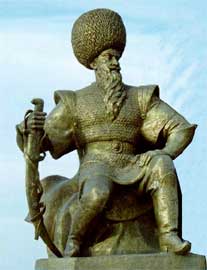 |
Azad od-Dowleh, Abushoja', Sultan | 1039–1072 | 1063 | 1072 | son of Chaghri Beg Dawud brother of Toğrül I | Killed by a captured soldier |
| 329 | Malik Shah I Malik Shah I Jalāl al-Dawlah Malik-shāh was born in 1055, succeeded Alp Arslan as the Seljuq Sultan in 1072, and reigned until his death in 1092.... |
Hasan | Jalal od-Dowleh, Abolfat'h, Sultan | 1055–1092 | 1072 | 1092 | son of Alp Arslan Alp Arslan Alp Arslan was the third sultan of the Seljuq dynasty and great-grandson of Seljuk, the eponymous founder of the dynasty... |
Killed by Assassins | |
| 330 | Mahmud I | Nasir od-Din, abolqasem, Sultan | 1086–1094 | 1092 | 1094 | son of Malik Shah I Malik Shah I Jalāl al-Dawlah Malik-shāh was born in 1055, succeeded Alp Arslan as the Seljuq Sultan in 1072, and reigned until his death in 1092.... |
|||
| 331 | Barkiyaruq Barkiyaruq Abu al-Muzaffar Rukn ud-Dīn Barkyāruq bin Malikšāh was the sultan of Great Seljuq from 1094-1105.He was a son of Malik Shah I and participated in the succession wars against his three brothers, Mahmud I, Ahmed Sanjar, and Mehmed I.... |
Mohammad | Rukn od-Din, Abolmozaffar, Sultan | 1080–1105 | 1094 | 1105 | son of Malik Shah I Malik Shah I Jalāl al-Dawlah Malik-shāh was born in 1055, succeeded Alp Arslan as the Seljuq Sultan in 1072, and reigned until his death in 1092.... |
||
| 333 | Malik Shah II Malik Shah II Mu'izz ad-Din Malik Shah II Was Seljuq Sultan in Baghdad during 1105. He was the grandson of Malik Shah I, and was theoretically the head of the dynasty, although his relative Ahmed Sanjar in Khorasan probably held more effective power.... |
Mu'izz od-Din, Abolfat'h, Sultan | 1101 - ? | 1105 | 1105 | son of Barkiyaruq Barkiyaruq Abu al-Muzaffar Rukn ud-Dīn Barkyāruq bin Malikšāh was the sultan of Great Seljuq from 1094-1105.He was a son of Malik Shah I and participated in the succession wars against his three brothers, Mahmud I, Ahmed Sanjar, and Mehmed I.... |
Deposed & blinded by Mehmed I | ||
| 334 | Mehmed I | Tapar | Ghiyath od-Din, Abushoja', Sultan | 1082–1118 | 1105 | 1118 | son of Malik Shah I Malik Shah I Jalāl al-Dawlah Malik-shāh was born in 1055, succeeded Alp Arslan as the Seljuq Sultan in 1072, and reigned until his death in 1092.... |
||
| 332 | Sanjar Ahmed Sanjar Ahmad Sanjar Ahmad Sanjar Ahmad Sanjar (Mu'iz ud-Dīn Ahmad-e Sanjar; was the sultan of the Great Seljuq Empire from 1118 to 1153. He was initially the sultan of Khorasan until he gained the rest of the territory upon the death of Muhammad I.... |
Ahmad | Mu'izz od-Din, Abolhareth, Sultan | 1087–1157 | 1097 | 1157 | son of Malik Shah I Malik Shah I Jalāl al-Dawlah Malik-shāh was born in 1055, succeeded Alp Arslan as the Seljuq Sultan in 1072, and reigned until his death in 1092.... |
||
| 335 | Mahmud II | Moghith od-Din, Sultan | 1104–1131 | 1118 | 1131 | son of Mehmed I | |||
| 336 | Dawud | Moghith od-Din, Abolfat'h, Sultan | ? - 1132 | 1131 | 1132 | son of Mahmud II | |||
| 337 | Toğrül II | Rukn od-Din, Abutaleb, Sultan | 1109–1134 | 1132 | 1134 | son of Mehmed I | |||
| 338 | Mas'ud | Ghiath od-Din, Abolfat'h, Sultan | 1109–1152 | 1134 | 1152 | son of Mehmed I | |||
| 339 | Malik Shah III | Moghith od-Din, Sultan | 1128–1160 | 1152 | 1153 | son of Mahmud II | |||
| 340 | Mohammad II | Ghith od-Din, Abushoja', Sultan | 1128–1160 | 1153 | 1160 | son of Mahmud II | |||
| 343 | Süleyman Shah | Mu'izz od-Din, Abolhareth, Sultan | 1118–1162 | 1160 | 1161 | son of Mehmed I | Deposed | ||
| 344 | Arsalan | Rukn od-Din, Sultan | 1134–1176 | 1161 | 1176 | son of Toğrül II | |||
| 347 | Toğrül III | Rukn od-Din, Abutaleb, Sultan | ? - 1194 | 1176 | 1194 | son of Arsalan | Killed | ||
Khwārazm-Shāh Empire, 1153–1231
An empire built from KhwarezmKhwarezm
Khwarezm, or Chorasmia, is a large oasis region on the Amu Darya river delta in western Central Asia, which borders to the north the Aral Sea, to the east the Kyzylkum desert, to the south the Karakum desert and to the west the Ustyurt Plateau...
, covering part of Iran and neighbouring Central Asia.
For more comprehensive lists of kings and sub-kings of this Era see:
- Muslim dynasties of Iran
| Throne Name | Original Name | Portrait | Title | Born-Died | Entered office | Left office | Family Relations | Note | |
|---|---|---|---|---|---|---|---|---|---|
| Khwārazm-Shāh Empire, 1153–1231 | |||||||||
| 341 | Atsiz Atsiz Atsïz was Khwarazm Shah from 1127 until his death. He was the son of Qutb ad-Din Muhammad.Atsïz gained his position following his father's death in 1127. During the early part of his reign he focused on securing Khwarazm against nomad attacks. In 1138 he rebelled against his suzerain, the Seljuk... |
Ala' od-Din, Abolmozaffar, Sultan | ? - 1156 | 1153 | 1156 | son of Muhammad I of Khwarazm Muhammad I of Khwarazm Qutb al-Din Muhammad was Khwarazm Shah from 1097 until his death. He was the son of Anush Tigin.In around 1097 Qutb al-Din Muhammad was appointed governor of Khwarazm by the Seljuk sultan Barkiyaruq's military commander, Habashi ibn Altun-Taq... |
Ruling in Khwārazm from 1127 | ||
| 342 | Il-Arslan Il-Arslan Il-Arslan was Khwarazm Shah from 1156 until his death. He was the son of Atsïz.In 1152 Il-Arslan was made governor of Jand, an outpost on the Syr Darya which had recently been reconquered, by his father. In 1156 Atsïz died and Il-Arslan succeeded him as Khwarazm-Shah... |
Taj od-Din, Abolfat'h, Sultan | ? - 1171 | 1156 | 1172 | son of Atsiz Atsiz Atsïz was Khwarazm Shah from 1127 until his death. He was the son of Qutb ad-Din Muhammad.Atsïz gained his position following his father's death in 1127. During the early part of his reign he focused on securing Khwarazm against nomad attacks. In 1138 he rebelled against his suzerain, the Seljuk... |
|||
| 345 | Soltanshah Sultan Shah of Khwarezm Sultan Shah was a claimant to the title of Khwarazm Shah from 1172 until his death. He was the son of Il-Arslan.In 1172 Il-Arslan died and his sons began fighting over who would succeed him. Sultan Shah was the younger son, but he was considered the formal heir and his mother, Terken Khatun,... |
Mahmud | Jalal od-Din, Abolqasem, Sultan | ? - 1172 | 1172 | 1193 | son of Il-Arslan Il-Arslan Il-Arslan was Khwarazm Shah from 1156 until his death. He was the son of Atsïz.In 1152 Il-Arslan was made governor of Jand, an outpost on the Syr Darya which had recently been reconquered, by his father. In 1156 Atsïz died and Il-Arslan succeeded him as Khwarazm-Shah... |
||
| 346 | Tekish | Ala' od-Din, Abolmozaffar, Sultan | ? - 1199 | 1172 | 1200 | son of Il-Arslan Il-Arslan Il-Arslan was Khwarazm Shah from 1156 until his death. He was the son of Atsïz.In 1152 Il-Arslan was made governor of Jand, an outpost on the Syr Darya which had recently been reconquered, by his father. In 1156 Atsïz died and Il-Arslan succeeded him as Khwarazm-Shah... |
|||
| 348 | Mohammad Muhammad II of Khwarezm Ala ad-Din Muhammad II was the ruler of the Khwarezmid Empire from 1200 to 1220. His ancestor was a Turkic slave who eventually became a viceroy of a small province named Khwarizm. After his father died, Muhammad inherited his father's lands, and it was from there he began expanding outwards... |
Ala' od-Din, Qotb od-Din, Abolfat'h, Sultan | ? - 1221 | 1200 | 1221 | son of Tekish | |||
| 349 | Mingburnu | Jalal od-Din, Sultan | ? - 1231 | 1220 | 1231 | son of Mohammad II Muhammad II of Khwarezm Ala ad-Din Muhammad II was the ruler of the Khwarezmid Empire from 1200 to 1220. His ancestor was a Turkic slave who eventually became a viceroy of a small province named Khwarizm. After his father died, Muhammad inherited his father's lands, and it was from there he began expanding outwards... |
Killed | ||
Mongol EmpireMongol EmpireThe Mongol Empire , initially named as Greater Mongol State was a great empire during the 13th and 14th centuries...
, 1230-1357 AD
For more comprehensive lists of kings and sub-kings of this Era see:
- Muslim dynasties of Iran
| Throne Name | Original Name | Portrait | Title | Born-Died | Entered office | Left office | Family Relations | Note | |
|---|---|---|---|---|---|---|---|---|---|
| The Great Khans, 1221–1256 | |||||||||
| 350 | Genghis Genghis Khan Genghis Khan , born Temujin and occasionally known by his temple name Taizu , was the founder and Great Khan of the Mongol Empire, which became the largest contiguous empire in history after his death.... |
Temuchin |  |
Khan, Qa'an | 1162–1227 | 1221 | 1227 | son of Yesugei Baghatur Yesugei Yesügei Baghatur , was major chief of the Kiyad-Borjigin clan and the father of Temüjin , Hasar, Hachiun, Temüge, Temülen, Behter, and Belgutei. Yesügei was the son of Bartan Baghatur, who was the son of Khabul Khan, who was recognized as a khagan by the Jin Dynasty... |
Ruling in Mongolia from 1206 |
| Tolui Tolui Tolui, was the youngest son of Genghis Khan by his chief khatun Börte... |
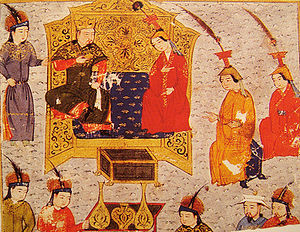 |
Khan | 1192–1232 | August 25, 1227 | September 13, 1229 | son of Genghis Genghis Khan Genghis Khan , born Temujin and occasionally known by his temple name Taizu , was the founder and Great Khan of the Mongol Empire, which became the largest contiguous empire in history after his death.... |
Regent | ||
| 351 | Ögedei Ögedei Khan Ögedei Khan, born Ögedei was the third son of Genghis Khan and second Great Khan of the Mongol Empire by succeeding his father... |
Khan, Qa'an | c. 1186 – December 11, 1241 | September 13, 1229 | December 11, 1241 | son of Genghis Genghis Khan Genghis Khan , born Temujin and occasionally known by his temple name Taizu , was the founder and Great Khan of the Mongol Empire, which became the largest contiguous empire in history after his death.... |
|||
| Töregene Töregene Khatun Töregene Khatun was the Great Khatun and regent of the Mongol Empire from the death of her husband Ögedei Khan in 1241 until the election of her eldest son Güyük Khan in 1246.-Background:... |
Khatun | ? – ? | 1242 | 1246 | Wife of Ögedei Ögedei Khan Ögedei Khan, born Ögedei was the third son of Genghis Khan and second Great Khan of the Mongol Empire by succeeding his father... |
Regent | |||
| 352 | Güyük Güyük Khan Güyük was the third Great Khan of the Mongol Empire. As the eldest son of Ögedei Khan and a grandson of Genghis Khan, he reigned from 1246 to 1248... |
Khan, Qa'an | c. 1206–1248 | 1246 | 1248 | son of Ögedei Ögedei Khan Ögedei Khan, born Ögedei was the third son of Genghis Khan and second Great Khan of the Mongol Empire by succeeding his father... and Töregene Töregene Khatun Töregene Khatun was the Great Khatun and regent of the Mongol Empire from the death of her husband Ögedei Khan in 1241 until the election of her eldest son Güyük Khan in 1246.-Background:... |
|||
| Oghul Qaimish Oghul Qaimish Oghul Qaimish was the principal wife of Güyük Khan and ruled as regent over the Mongol empire after the death of her husband in 1248. She was a descendant from the Mergid tribe. However, H.H.Howorth believed that she was an Oirat.- Life :... |
Khatun | ? – ? | 1248 | 1251 | Wife of Güyük Güyük Khan Güyük was the third Great Khan of the Mongol Empire. As the eldest son of Ögedei Khan and a grandson of Genghis Khan, he reigned from 1246 to 1248... |
Regent | |||
| 353 | Möngke Möngke Khan Möngke Khan , born Möngke, , was the fourth Great Khan of the Mongol Empire from July 1, 1251 – August 11, 1259. He was the first Great Khan from the Toluid line, and made significant reforms to improve the administration of the Empire during his reign... |
Khan, Qa'an | January 10, 1209 – August 11, 1259 | July 1, 1251 | August 11, 1259 | son of Tolui Tolui Tolui, was the youngest son of Genghis Khan by his chief khatun Börte... |
|||
| Ilkhanate Ilkhanate The Ilkhanate, also spelled Il-khanate , was a Mongol khanate established in Azerbaijan and Persia in the 13th century, considered a part of the Mongol Empire... , 1256–1357 |
|||||||||
| 354 | Hulagu Hulagu Khan Hulagu Khan, also known as Hülegü, Hulegu , was a Mongol ruler who conquered much of Southwest Asia... |
 |
Khan, Ilkhan | c. 1217 – 8 February 1265 | 1256 | 8 February 1265 | son of Tolui Tolui Tolui, was the youngest son of Genghis Khan by his chief khatun Börte... |
||
| 355 | Abaqa | 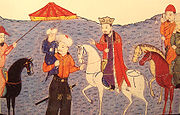 |
Khan, Ilkhan | 1234–1282 | 1265 | April 1, 1282 | son of Hulagu Hulagu Khan Hulagu Khan, also known as Hülegü, Hulegu , was a Mongol ruler who conquered much of Southwest Asia... |
||
| 356 | Tekuder Tekuder Ahmed Tekuder , also known as Sultan Ahmad , was the sultan of the Persia-based Ilkhanate, son of Hulegu and brother of Abaqa. He was eventually succeeded by Arghun Khan... |
Nicholas, Ahmad | Khan, Ilkhan, Soltan | ? – 1284 | 1282 | 1284 | son of Hulagu Hulagu Khan Hulagu Khan, also known as Hülegü, Hulegu , was a Mongol ruler who conquered much of Southwest Asia... |
Killed | |
| 357 | Arghun Arghun Arghun Khan aka Argon was the fourth ruler of the Mongol empire's Ilkhanate, from 1284 to 1291. He was the son of Abaqa Khan, and like his father, was a devout Buddhist... |
|
Khan, Ilkhan, Soltan | c. 1258 – March 7, 1291 | 1284 | March 7, 1291 | son of Abaqa | ||
| 358 | Gaykhatu Gaykhatu Gaykhatu was the fifth Ilkhanate ruler in Iran. He reigned from 1291 to 1295. During his reign, Gaykhatu was a noted dissolute who was addicted to wine, women, and sodomy... |
Khan, Ilkhan, Soltan | ? – 1295 | 1291 | 1295 | son of Abaqa | Killed | ||
| 359 | Baydu Baydu Baydu was the sixth ruler of the Mongol empire's Ilkhanate division in Iran. He succeeded his cousin Gaykhatu as khan of the Ilkhanate state in 1295.... |
Khan, Ilkhan, Soltan | ? – 1295 | 1295 | 1295 | son of Toghay son of Hulagu Hulagu Khan Hulagu Khan, also known as Hülegü, Hulegu , was a Mongol ruler who conquered much of Southwest Asia... |
Killed | ||
| 360 | Ghazan | Mahmud | 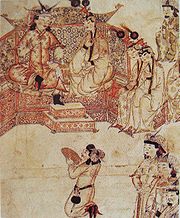 |
Khan, Ilkhan, Soltan | 1271–1304 | 1295 | 1304 | son of Arghun Arghun Arghun Khan aka Argon was the fourth ruler of the Mongol empire's Ilkhanate, from 1284 to 1291. He was the son of Abaqa Khan, and like his father, was a devout Buddhist... |
|
| 361 | Öljaitü Öljaitü Öljeitü, Oljeitu, Olcayto or Uljeitu, Öljaitu, Ölziit , born Muhammad Khodabandeh , was the eighth Ilkhanid dynasty ruler in Iran from 1304 to 1316... |
Mohammad | 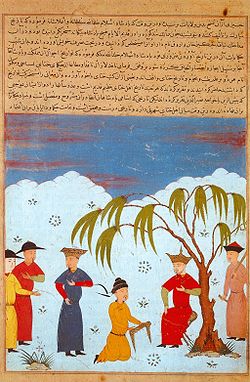 |
Khan, Ilkhan, Soltan, Khodabandeh | 1280 - December 16, 1316 | 1304 | December 16, 1316 | son of Arghun Arghun Arghun Khan aka Argon was the fourth ruler of the Mongol empire's Ilkhanate, from 1284 to 1291. He was the son of Abaqa Khan, and like his father, was a devout Buddhist... |
|
| 362 | Abu Sa'id Abu Sa'id (Ilkhanid dynasty) Abu Sa'id also Abusaid Bahador Khan, Abu Sayed Behauder , was the ninth ruler of the Ilkhanate state in Iran .... |
Khan, Ilkhan, Soltan, Ala' od-Din, Bahador | June 2, 1305 – December 1, 1335 | 1316 | December 1, 1335 | son of Öljaitü Öljaitü Öljeitü, Oljeitu, Olcayto or Uljeitu, Öljaitu, Ölziit , born Muhammad Khodabandeh , was the eighth Ilkhanid dynasty ruler in Iran from 1304 to 1316... |
|||
| 363 | Arpa Arpa Ke'un Arpa Ke'un, also known as Arpa Khan or Gavon or Gawon , was an Ilkhan during the disintegration of the Mongol state in Persia. He was a member of the house of Tolui. His lineage traced back to Arik Boke who was a youngest brother of Mongke, Kublai and Hulegu.Arpa Ke'un came to power following the... |
Mahmud | Khan, Ilkhan, Soltan, Kauen, Mo'ezz od-Din | ? – 1336 | 1335 | April 10, 1336 | son of Suseh son of Munkqan son of Malektemur son of Eriqbuka son of Tolui Tolui Tolui, was the youngest son of Genghis Khan by his chief khatun Börte... |
Killed | |
| 364 | Musa Musa (Ilkhanid dynasty) Musa Khan was an Ilkhan from 1336 to 1337 and a grandson of Baydu.He was installed to the throne of the Ilkhanate by the governor of Baghdad, 'Ali Padsah, on April 12, two days after the latter had defeated Arpa Ke'un in battle. Musa was meant to be a puppet to 'Ali. However, Musa was challenged by... |
Khan, Ilkhan, Soltan, Naser od-Din | ? – 1337 | April 12, 1336 | 1337 | son of Ali son of Baydu Baydu Baydu was the sixth ruler of the Mongol empire's Ilkhanate division in Iran. He succeeded his cousin Gaykhatu as khan of the Ilkhanate state in 1295.... |
|||
| 365 | Mohammad Muhammad Khan (Ilkhan) Muhammad Khan was a claimant to the throne of the Ilkhanate. He was a great-grandson of Mengu Timur, who was a son of Hulegu.... |
Khan, Ilkhan, Soltan, Mozaffar od-Din | ? – 1338 | 1336 | 1338 | son of Yul Qotloq son of Il Temur son of Ambarji son of Mengu Temur son of Hulagu Hulagu Khan Hulagu Khan, also known as Hülegü, Hulegu , was a Mongol ruler who conquered much of Southwest Asia... |
|||
| 366 | Sati beg Sati Beg Al-sultana al-radila Sati Beg Khan Khallad Allah Mulkaha was a claimant to the throne of the Ilkhanate during the fragmentation of Persia in the mid-14th century. She was the uterine sister of the Ilkhan Abu Sa'id.... |
Khatun | c.1300 – after 1345 | 1338 | 1339 | daughter of Öljaitü Öljaitü Öljeitü, Oljeitu, Olcayto or Uljeitu, Öljaitu, Ölziit , born Muhammad Khodabandeh , was the eighth Ilkhanid dynasty ruler in Iran from 1304 to 1316... |
|||
| 367 | Jahan Temur Jahan Temur Jahan Temür was a Jalayirid candidate for the throne of the Ilkhanate in the late 1330s. He was the son of Ala-Fireng and the grandson of the Ilkhan Gaykhatu.... |
Khan, Ilkhan, Soltan, Izz od-Din | ? – ? | 1339 | 1340 | son of Ala-Fireng son of Gaykhatu Gaykhatu Gaykhatu was the fifth Ilkhanate ruler in Iran. He reigned from 1291 to 1295. During his reign, Gaykhatu was a noted dissolute who was addicted to wine, women, and sodomy... |
|||
| 368 | Soleiman | Khan, Ilkhan, Soltan | ? – ? | May 1339 | 1345 | Husband of Sati beg Sati Beg Al-sultana al-radila Sati Beg Khan Khallad Allah Mulkaha was a claimant to the throne of the Ilkhanate during the fragmentation of Persia in the mid-14th century. She was the uterine sister of the Ilkhan Abu Sa'id.... . Also he was son of Yusef Shah son of Soga son of Yeshmut son of Hulagu Hulagu Khan Hulagu Khan, also known as Hülegü, Hulegu , was a Mongol ruler who conquered much of Southwest Asia... |
|||
| 369 | Togha Temür Togha Temür Togha Temür , also known as Taghaytimur, was a claimant to the throne of the Ilkhanate in the mid-14th century. Of the many individuals who attempted to become Ilkhan after the death of Abu Sa'id, Togha Temür was the only one who hailed from eastern Iran, and was the last major candidate who was of... |
Khan, Ilkhan, Soltan | ? – 1353 | 1335 | 1353 | son of Sudi son of Bababahathor son of Abokan son of Amakan son of Tur son of Jujiqisar son of Yesugei Baghatur Yesugei Yesügei Baghatur , was major chief of the Kiyad-Borjigin clan and the father of Temüjin , Hasar, Hachiun, Temüge, Temülen, Behter, and Belgutei. Yesügei was the son of Bartan Baghatur, who was the son of Khabul Khan, who was recognized as a khagan by the Jin Dynasty... |
|||
| 370 | Anushirwan | Khan, Ilkhan, Soltan, Adel | ? – ? | 1344 | 1357 | ? | |||
Rival Dynasties, 1332-1501 AD
For more comprehensive lists of kings and sub-kings of this Era see:- Muslim dynasties of Iran
SarbadarsSarbadarsThe Sarbadars were a mixture of religious dervishes and secular rulers that came to rule over part of western Khurasan in the midst of the disintegration of the Mongol Ilkhanate in the mid-14th century...
, 1332-1386
- Abd al-Razzaq ibn Fazlullah (1332–1338)
- Wajih ad-Din Masud ibn Fazlullah (1338–1343)
- Muhammad Ay Temur (1343–1346)
- Kaba Isfendiyar (1346–1347)
- Lutf Allah (1347-1348 d.1361)
- Khwaja Tadj ad-Din Ali (1348–1353)
- Yahya ibn Karawi (1353–1358)
- Zahir ad-Din (1358–1359)
- Haidar al-Qassab (1359–1360)
- Lutf Allah (restored) (1360–1361)
- Hasan al-Damghani (1361–1364)
- Khwaja 'Ali-yi Mu'ayyad ibn Masud (1364-1376 d.1386)
- Rukn ad-Din (1376–1379)
- Khwaja 'Ali-yi Mu'ayyad ibn Masud (restored) (1379–1386)
JalayiridsJalayiridsThe Jalayirids were a Mongol Jalayir dynasty which ruled over Iraq and western Persia after the breakup of the Mongol Khanate of Persia in the 1330s....
, 1335–1432
- Hasan BuzurgHasan BuzurgShaikh Hasan, called "Buzurg" , was the first of several de facto independent Jalayirid rulers of Iraq and central Iran. He was the son of Husain and Öljetey.-Shaikh Hasan-i Buzurg:...
(1336–1356) - Shaikh Uvais IShaikh UvaisShaikh Uvais, also known as Uways or Oways , was a Jalayirid ruler of Iraq and Azerbaijan . He was the son of Hasan Buzurg and the Chobanid Delsad Katun.-Life:...
(1356–1374) - HasanHasan (Jalayirids)Hasan was briefly Jalayirid ruler . He was the eldest son of Shaikh Uvais.After his father died, Hasan succeeded him, but was never popular among the people. Shortly after he began his reign, he was executed by his amirs, who then put his brother Husain on the throne.-References:*Peter Jackson...
(1374) - Husain IHusain (Jalayirids)Husain was a Jalayirid ruler . He was the son of Shaikh Uvais.Following the execution of his brother Hasan, the amirs placed Husain on the throne. Almost immediately he had to deal with an invasion by his brother-in-law Shah Mahmud of the Muzaffarids. Shah Mahmud, who was the son-in-law of Shaikh...
(1374–1382) - Bayazid (1382–1383)
- AhmadAhmad (Jalayirids)Sultan Ahmad was a Jalayirid ruler . He was the son of Shaikh Uvais.-Struggle With His Brothers:Ahmad came to power as a result of a plot against his brother Husain. In 1382 he departed from Ardabil, which he had been given control of, and took Tabriz; Husain was captured and executed...
(1383–1410) - Shah Walad (1410–1411)
- Mahmud (1411–1415)
- Uwais IIUvais IIUvais II was a Jalayirid ruler of Basra . He was the son of Shah Walad.In 1415 Uvais succeeded his brother Mahmud as Jalayirid ruler. During his reign, he conducted two campaigns against the Black Sheep Turkmen in an attempt to recover Baghdad for the Jalayirids. While conducting the second...
(1415–1421) - Mohammed (1421–1422)
- Mahmud II (1422–1424)
- Husain II (1424–1432)
InjuidsInjuidsThe House of Inju was a Mongol dynasty that came to rule over the Persian cities of Shiraz and Isfahan during the 14th century AD...
, 1335–1357
- Sharaf al-Din Mahmud Shah (1304–1325)
- Amir Ghiyas al-Din Kai-Khusrau (1336–1338/9)
- Amir Jalal al-Din Mas'ud Shah (in opposition to Kai-Khusrau) (c. 1338–c. 1342)
- Shams al-Din Muhammad (in opposition to Mas'ud Shah) (1339)
- Shaikh Abu Ishaq (c. 1343–1357)
MuzaffaridsMuzaffaridsThe Mozaffarids were a family that came to power in Iran following the breakup of the Ilkhanate in the 14th century.-Rise to Power:The Mozaffaris were a family that settled in Khorasan from the beginning of Caliphal rule there. They stayed in Khorasan up until the Mongol invasion of that province,...
, 1314–1393
- Mubariz ad-Din Muhammad ibn al-Muzaffar, Emir 1314–1358
- Abu'l Fawaris Djamal ad-Din Shah Shuja (at Yazd, 1353 at Shiraz), 1335–1364 with...
- Qutb Al-Din Shah Mahmud (at Isfahan) ( d. 1375), 1358–1366
- Abu'l Fawaris Djamal ad-Din Shah Shuja (at Yazd, 1353 at Shiraz), 1366–1384
- Mujahid ad-Din Zain Al-Abidin 'Ali, 1384–1387
- In 1387 TimurTimurTimur , historically known as Tamerlane in English , was a 14th-century conqueror of West, South and Central Asia, and the founder of the Timurid dynasty in Central Asia, and great-great-grandfather of Babur, the founder of the Mughal Dynasty, which survived as the Mughal Empire in India until...
captured IsfahanIsfahan (city)Isfahan , historically also rendered in English as Ispahan, Sepahan or Hispahan, is the capital of Isfahan Province in Iran, located about 340 km south of Tehran. It has a population of 1,583,609, Iran's third largest city after Tehran and Mashhad...
.
- In 1387 Timur
- Imad ad-Din Sultan Ahmad (at Kerman), 1387–1391 with...
- Mubariz ad-Din Shah Yahya (at Shiraz), 1387–1391 and...
- Sultan Abu Ishaq (in Sirajan), 1387–1391
- Shah Mansur (at Isfahan), 1391–1393
Kara KoyunluKara KoyunluThe Kara Koyunlu or Qara Qoyunlu, also called the Black Sheep Turkomans , were a Shi'ite Oghuz Turkic tribal federation that ruled over the territory comprising the present-day Armenia, Azerbaijan, north-western Iran, eastern Turkey and Iraq from about 1375 to 1468.The Kara Koyunlu Turkomans at one...
, 1375–1468
- Qara Muhammad Turmush ibn Bairam Khwaja, 1378/9 to c.1388
- Abu Nasr Qara Yusuf Nuyan ibn MuhammadQara YusufAbu Nasr Qara Yusuf Nuyan ibn Muhammad was the ruler of the Kara Koyunlu or Black Sheep Turkomans from c.1388 to 1420, although his reign was interrupted by the Timurid invasion .-The Jalayirid vassalage broken:...
, c.1388 to 1399/1400 and 1405/6 to 1420/1 - Qara Iskander ibn YusufQara IskanderQara Iskander ibn Yusuf ruled the Kara Koyunlu or Black Sheep Turcoman tribe from 1420-1436. His struggles with the Timurid ruler Shah Rukh show that he was a brave leader, but he was not able to continue developing what he inherited from his father Qara Yusuf and his reign saw the decline and...
, 1420/1 to 1436 - Muzaffar al-Din Jahan Shah ibn YusufJahan ShahMuzaffar al-Din Jahan Shah ibn Yusuf was the leader of the Kara Koyunlu Turkmen tribal federation in Azerbaijan and Arran who reigned c.1438-1467. During his reign he managed to expand the Kara Koyunlu’s territory to its largest extent, including Western Anatolia, most of present day Iraq,...
, 1436 to 10 November 1467 - Hasan ’Ali ibn Jahan Shah, November 1467 to 1468
Ak KoyunluAk KoyunluThe Aq Qoyunlu or Ak Koyunlu, also called the White Sheep Turkomans , was an Sunni Oghuz Turkic tribal federation that ruled parts of present-day Eastern Turkey, Armenia, Azerbaijan, northern Iraq, and Iran from 1378 to 1508.-History:According to chronicles from the Byzantine Empire, the Aq Qoyunlu...
, 1378–1508
- Kara Yülük OsmanKara OsmanQara Osman or Kara Osman or Qara Yoluq Osman or sometimes Uthman was a late 14th- and early 15th-century leader of the Turkmen tribal federation of Aq Qoyunlu in what is now Azerbaijan, Iraq, and Turkey...
, 1378/9 to 1435/6 - Hamza, 1435/6 to 1444/5
- Nur al-Din ‘Ali ibn Qara Yülük, 1435/6 to 1438
- M‘uizz al-Din Jihangir ibn ‘Ali ibn Qara Yülük, 1444/5 to 1453/4
- Uzun Hasan ibn ‘Ali, 1453/4 to 1478/9
- Khalil ibn Uzun Hasan, 1478/9 to 1479/80
- Y‘aqub ibn Uzun Hasan, 1479/80 to 1490/1
- Baisonqur ibn Y‘aqub, 1490/1 to 1491/2
- Rustam ibn Maqsud, 1491/2 to 1496/7
- Ahmad Gövde ibn Muhammad, 1496/7 to 1497/8
- Murad ibn Ya‘qub, 1497/8 to 1499/1500
- Alwand ibn Yusuf, 1499/1500 to 1500/01
- Muhammad Mirza ibn Yusuf, 1499/1500 to 1500/01
- Muhammad Mirza ibn Yusuf, 1500/01 to 1501/2
- Murad ibn Ya‘qub, 1501/2 to 1508 (second term)
Timurid dynastyTimurid DynastyThe Timurids , self-designated Gurkānī , were a Persianate, Central Asian Sunni Muslim dynasty of Turko-Mongol descent whose empire included the whole of Iran, modern Afghanistan, and modern Uzbekistan, as well as large parts of contemporary Pakistan, North India, Mesopotamia, Anatolia and the...
, 1380–1507
- TimurTimurTimur , historically known as Tamerlane in English , was a 14th-century conqueror of West, South and Central Asia, and the founder of the Timurid dynasty in Central Asia, and great-great-grandfather of Babur, the founder of the Mughal Dynasty, which survived as the Mughal Empire in India until...
("Tamerlane"), 1369–1405, nominally under the authority of the Chagatai KhanateChagatai KhanateThe Chagatai Khanate was a Turko-Mongol khanate that comprised the lands ruled by Chagatai Khan , second son of the Great Khan Genghis Khan, and his descendents and successors... - Pir MuhammadPir MuhammadPir Muhammad was a grandson and appointed successor of Timur. He was the son of Jahangir.In 1392 he received the governorship of Qandahar. His territory extended from the lands west of the Hindu Kush to the Indus River...
, grandson of Timur, 1392–1407, effectively ruled from Qandahar - Djalal Ud-Din Miran ShahMiran ShahMiran Shah was a son of Timur, and a Timurid governor during his father's lifetime.Miran Shah's first charge was a vast region centered around Qandahar, which he was granted in 1383. That same year, he destroyed a rebellion against Timurid authority by the Kartids, then vassals of Timur in...
, son of Timur, 1405–1408, ruled AzerbaijanAzerbaijanAzerbaijan , officially the Republic of Azerbaijan is the largest country in the Caucasus region of Eurasia. Located at the crossroads of Western Asia and Eastern Europe, it is bounded by the Caspian Sea to the east, Russia to the north, Georgia to the northwest, Armenia to the west, and Iran to... - Rustam, 1405–1409, ruled ArabistanArabian PeninsulaThe Arabian Peninsula is a land mass situated north-east of Africa. Also known as Arabia or the Arabian subcontinent, it is the world's largest peninsula and covers 3,237,500 km2...
- Khalil Sultan (Timurid dynasty), son of Miran Shah, 1405–1409, ruled in SamarkandSamarkandAlthough a Persian-speaking region, it was not united politically with Iran most of the times between the disintegration of the Seleucid Empire and the Arab conquest . In the 6th century it was within the domain of the Turkic kingdom of the Göktürks.At the start of the 8th century Samarkand came...
, surrendered to Shah RukhShah Rukh (Timurid dynasty)Shāhrukh Mīrzā was the ruler of the eastern portion of the empire established by the Central Asian warlord Timur - the founder of the Timurid dynasty - governing most of Persia and Transoxiana between 1405 and 1447...
, became governor of Rayy until his death in 1411 - Shah RukhShah Rukh (Timurid dynasty)Shāhrukh Mīrzā was the ruler of the eastern portion of the empire established by the Central Asian warlord Timur - the founder of the Timurid dynasty - governing most of Persia and Transoxiana between 1405 and 1447...
, son of Timur, 1405–1447, ruled first in TransoxianaTransoxianaTransoxiana is the ancient name used for the portion of Central Asia corresponding approximately with modern-day Uzbekistan, Tajikistan, southern Kyrgystan and southwest Kazakhstan. Geographically, it is the region between the Amu Darya and Syr Darya rivers...
- Ayyal, 1414, opposed Shah Rukh
- Ailankar, 1414–1415, opposed Shah Rukh
- Bayqara, 1409–1412, ruled in Fars
- IskandarIskandar (Timurid dynasty)Iskandar was a ruler of Persia of the Timurid dynasty, ruling from 1412-1414....
, 1412–1414, ruled first in Fars, then Azerbaijan & Arabistan- In 1410 the Turcoman horde Kara KoyunluKara KoyunluThe Kara Koyunlu or Qara Qoyunlu, also called the Black Sheep Turkomans , were a Shi'ite Oghuz Turkic tribal federation that ruled over the territory comprising the present-day Armenia, Azerbaijan, north-western Iran, eastern Turkey and Iraq from about 1375 to 1468.The Kara Koyunlu Turkomans at one...
(Black Sheep) captured Baghdad and their leadersRulers of Kara KoyunluThis is the list of rulers of Kara Koyunlu dynasty . The dynasty ruled the territory now part of present-day Iran, Iraq and eastern Turkey. Their capital was the city of Tabriz.-Kara Koyunlu rulers:...
ruled the western parts of the Timurid realm. In the East however, Shah RukhShah Rukh (Timurid dynasty)Shāhrukh Mīrzā was the ruler of the eastern portion of the empire established by the Central Asian warlord Timur - the founder of the Timurid dynasty - governing most of Persia and Transoxiana between 1405 and 1447...
was able to secure his rule in TransoxianaTransoxianaTransoxiana is the ancient name used for the portion of Central Asia corresponding approximately with modern-day Uzbekistan, Tajikistan, southern Kyrgystan and southwest Kazakhstan. Geographically, it is the region between the Amu Darya and Syr Darya rivers...
and Fars.
- In 1410 the Turcoman horde Kara Koyunlu
- Ulugh BegUlugh BegUlugh Bek was a Timurid ruler as well as an astronomer, mathematician and sultan. His commonly-known name is not truly a personal name, but rather a moniker, which can be loosely translated as "Great Ruler" or "Patriarch Ruler" and was the Turkic equivalent of Timur's Perso-Arabic title Amīr-e...
, son of Shah Rukh, 1447–1449
Rulers in Transoxiana
Transoxiana
Transoxiana is the ancient name used for the portion of Central Asia corresponding approximately with modern-day Uzbekistan, Tajikistan, southern Kyrgystan and southwest Kazakhstan. Geographically, it is the region between the Amu Darya and Syr Darya rivers...
:
- Abd al-Latif ibn Muhammad Taraghay Ulughbek, son of Ulugh Beg, 1449–1450
- 'Abdullah Mirza, grandson of Shah Rukh, 1450–1451
- Abu Sa'id ibn MuhammadAbu Sa'id (Timurid dynasty)Abū Saʿīd b. Muḥammad b. Mīrānshāh b. Timūr , was a Timurid Empire ruler in what is today parts of Kazakhstan, Uzbekistan, Iran and Afghanistan and member of the Timurid dynasty....
, grandson of Miran Shah, 1451–1469, conquered KhurasanGreater KhorasanGreater Khorasan or Ancient Khorasan is a historical region of Greater Iran mentioned in sources from Sassanid and Islamic eras which "frequently" had a denotation wider than current three provinces of Khorasan in Iran...
in 1459
Rulers in Khurasan
Greater Khorasan
Greater Khorasan or Ancient Khorasan is a historical region of Greater Iran mentioned in sources from Sassanid and Islamic eras which "frequently" had a denotation wider than current three provinces of Khorasan in Iran...
:
- Babur Ibn-BaysunkurBabur Ibn-BaysunkurBabur Ibn-Baysunkur , also known as Abu'l-Qasim Bābur, was a Timurid ruler in Khurasan . He was the son of Baysunqar, and thus the a grandson of Shāhrukh Mirzā....
, grandson of Shah Rukh, 1449–1457 - Shah MahmudMahmud (Timurid Dynasty)Shah Mahmud was briefly a Timurid ruler of Herat. He was the son of Babur Ibn-Baysunkur, who was a great-grandson of Timur.Shah Mahmud succeeded his father upon his death in 1457 at the age of eleven. Only a few weeks later, his cousin Ibrahim, a son of 'Ala' al-Daula, expelled him from Herat...
, son of Babur, 1457 - IbrahimIbrahim (Timurid Dynasty)Ibrahim was a Timurid ruler of Herat in the fifteenth century. He was the son of 'Ala' al-Daula, a great-grandson of Timur.Ibrahim came to power in Herat in the aftermath of the death of Babur Ibn-Baysunkur. Babur's son Shah Mahmud had succeeded him but, as he was still a boy, his hold on power...
, 1457 - Jahan ShahJahan ShahMuzaffar al-Din Jahan Shah ibn Yusuf was the leader of the Kara Koyunlu Turkmen tribal federation in Azerbaijan and Arran who reigned c.1438-1467. During his reign he managed to expand the Kara Koyunlu’s territory to its largest extent, including Western Anatolia, most of present day Iraq,...
, leader of the Black Sheep TurcomansKara KoyunluThe Kara Koyunlu or Qara Qoyunlu, also called the Black Sheep Turkomans , were a Shi'ite Oghuz Turkic tribal federation that ruled over the territory comprising the present-day Armenia, Azerbaijan, north-western Iran, eastern Turkey and Iraq from about 1375 to 1468.The Kara Koyunlu Turkomans at one...
, 1457–1458
Abu Sa'id
Abu Sa'id (Timurid dynasty)
Abū Saʿīd b. Muḥammad b. Mīrānshāh b. Timūr , was a Timurid Empire ruler in what is today parts of Kazakhstan, Uzbekistan, Iran and Afghanistan and member of the Timurid dynasty....
, agreed to divide Iran with the Black Sheep Turcomans
Kara Koyunlu
The Kara Koyunlu or Qara Qoyunlu, also called the Black Sheep Turkomans , were a Shi'ite Oghuz Turkic tribal federation that ruled over the territory comprising the present-day Armenia, Azerbaijan, north-western Iran, eastern Turkey and Iraq from about 1375 to 1468.The Kara Koyunlu Turkomans at one...
under Jahan Shah
Jahan Shah
Muzaffar al-Din Jahan Shah ibn Yusuf was the leader of the Kara Koyunlu Turkmen tribal federation in Azerbaijan and Arran who reigned c.1438-1467. During his reign he managed to expand the Kara Koyunlu’s territory to its largest extent, including Western Anatolia, most of present day Iraq,...
, but the White Sheep Turcomans
Ak Koyunlu
The Aq Qoyunlu or Ak Koyunlu, also called the White Sheep Turkomans , was an Sunni Oghuz Turkic tribal federation that ruled parts of present-day Eastern Turkey, Armenia, Azerbaijan, northern Iraq, and Iran from 1378 to 1508.-History:According to chronicles from the Byzantine Empire, the Aq Qoyunlu...
under Uzun Hassan
Uzun Hassan
Uzun Hasan or Hassan , Sultan of the Aq Qoyunlu dynasty, or White Sheep Turkmen. Hassan ruled in parts of present-day western Iran, Iraq, Turkey, Azerbaijan and Armenia between 1453 and 1478....
defeated and killed first Jahan Shah and then Abu Sa'id.
After Abu Sa'id's death a fourth era of fragmentation follows. While the White Sheep Turcomans dominated in the western parts until the ascent of the Safavid dynasty, the Timurides could maintain their rule in Samarkand
Samarkand
Although a Persian-speaking region, it was not united politically with Iran most of the times between the disintegration of the Seleucid Empire and the Arab conquest . In the 6th century it was within the domain of the Turkic kingdom of the Göktürks.At the start of the 8th century Samarkand came...
and Herat
Herat
Herāt is the capital of Herat province in Afghanistan. It is the third largest city of Afghanistan, with a population of about 397,456 as of 2006. It is situated in the valley of the Hari River, which flows from the mountains of central Afghanistan to the Karakum Desert in Turkmenistan...
.
Rulers in Samarkand:
- Sultan AhmadSultan AhmadSultan Ahmad ibn Abu Sa’id was the Timurid ruler of Samarkand from 1469 till 1494. During his rule he successfully repelled at least one invasion attempt by the Kara Koyunlu, and failed in an attempt to conquer Herat from the land of Khurasan from its ruler Husayn Bayqarah. He was succeeded by his...
, son Abu Sa'id, 1469–1494 - Sultan Mahmud, son of Abu Sa'id, 1494–1495
- Masud, 1495
- Sultan Baysunghur, 1495–1497
- Sultan Ali Mirza 1495–1500
conquered by the Uzbeks
Uzbeks
The Uzbeks are a Turkic ethnic group in Central Asia. They comprise the majority population of Uzbekistan, and large populations can also be found in Afghanistan, Tajikstan, Kyrgyzstan, Turkmenistan, Kazakhstan, Russia, Pakistan, Mongolia and the Xinjiang Uyghur Autonomous Region of China...
Rulers in Herat:
- Sultan Mahmud, son of Abu Sa'id, 1469
- Husayn BayqarahHusayn BayqarahHusayn Bayqarah was a Timurid ruler of Herat from 1469 to 1506, with a brief interruption in 1470. His father was Mansur, a great-grandson of Timur...
, 1469–1506 - Badi' al-Zaman, son of Husayn, 1506–1507, fled to the court of Ismail IIsmail IIsmail I , known in Persian as Shāh Ismāʿil , was a Shah of Iran and the founder of the Safavid dynasty which survived until 1736. Isma'il started his campaign in Azerbaijan in 1500 as the leader of the Safaviyya, an extremist heterodox Twelver Shi'i militant religious order and unified all of Iran...
conquered by the Uzbeks
Uzbeks
The Uzbeks are a Turkic ethnic group in Central Asia. They comprise the majority population of Uzbekistan, and large populations can also be found in Afghanistan, Tajikstan, Kyrgyzstan, Turkmenistan, Kazakhstan, Russia, Pakistan, Mongolia and the Xinjiang Uyghur Autonomous Region of China...
, later recaptured by the Safavids
Modern Empire, 1501-1979 AD
For more comprehensive lists of kings and sub-kings of this Era see:- Muslim dynasties of Iran
| Throne Name | Original Name | Portrait | Title | Born-Died | Entered office | Left office | Family Relations | Note | |
|---|---|---|---|---|---|---|---|---|---|
| Safavid dynasty, 1501–1786 | |||||||||
| 1 | Ismail I Ismail I Ismail I , known in Persian as Shāh Ismāʿil , was a Shah of Iran and the founder of the Safavid dynasty which survived until 1736. Isma'il started his campaign in Azerbaijan in 1500 as the leader of the Safaviyya, an extremist heterodox Twelver Shi'i militant religious order and unified all of Iran... |
Shah, Sultan | 1487–1524 | 7 November 1502 | 23 May 1524 | son of Sultan Heidar | |||
| 2 | Tahmasp I Tahmasp I Tahmasp or Tahmasb I was an influential Shah of Iran, who enjoyed the longest reign of any member of the Safavid dynasty... |
Shah, Sahib-i-Qiran, Sultan bar Salatin | 1514–1576 | 23 May 1525 | 25 May 1576 | son of Ismail I Ismail I Ismail I , known in Persian as Shāh Ismāʿil , was a Shah of Iran and the founder of the Safavid dynasty which survived until 1736. Isma'il started his campaign in Azerbaijan in 1500 as the leader of the Safaviyya, an extremist heterodox Twelver Shi'i militant religious order and unified all of Iran... |
|||
| 3 | Ismail II Ismail II Ismail II was the third Safavid Shah of Iran.-Life:Ismail was the son of Shah Tahmasp I by a Turcoman mother, Sultanum Bekum Mawsillu. In 1547, he was appointed governor of the province of Shirvan where he led several expeditions against the Ottomans... |
Shah | 1537–1577 | 25 May 1576 | 24 November 1577 | son of Tahmasp I Tahmasp I Tahmasp or Tahmasb I was an influential Shah of Iran, who enjoyed the longest reign of any member of the Safavid dynasty... |
Poisoned (?) | ||
| 4 | Mohammad I Mohammed Khodabanda Mohammed Khodābande or Khudābanda, also known as Mohammed Shah or Sultan Mohammed , was the fourth Safavid Shah of Iran. He was the son of Shah Tahmasp I by a Turcoman mother, Sultanum Bekum Mawsillu... |
Khodabandeh, Ashraf, Soltan | 1532–1596 | 25 May 1576 | 1 October 1587 | son of Tahmasp I Tahmasp I Tahmasp or Tahmasb I was an influential Shah of Iran, who enjoyed the longest reign of any member of the Safavid dynasty... |
Deposed | ||
| 5 | Abbas I Abbas I of Persia Shāh ‘Abbās the Great was Shah of Iran, and generally considered the greatest ruler of the Safavid dynasty. He was the third son of Shah Mohammad.... |
 |
Shahanshah, Sultan, Great | 1571–1629 | 1 October 1587 | 19 January 1629 | son of Mohammad I Mohammed Khodabanda Mohammed Khodābande or Khudābanda, also known as Mohammed Shah or Sultan Mohammed , was the fourth Safavid Shah of Iran. He was the son of Shah Tahmasp I by a Turcoman mother, Sultanum Bekum Mawsillu... |
||
| 6 | Safi Safi of Persia Shah Safi was Shah of Iran from 1629 to 1642. He was the sixth ruler of the Safavid dynasty.Safi was given the name Sam Mirza when he was born. He was the son of Mohammed Baqir Mirza, the eldest son of Shah Abbas I, and Dilaram Khanum, a Georgian wife. In 1615, Abbas had Mohammed Baqir killed,... |
Sam Mirza | Shah, Mirza | 1611–1642 | 19 January 1629 | 12 May 1642 | son of Mohammd Baqer (Safi) Mirza son of Abbas I Abbas I of Persia Shāh ‘Abbās the Great was Shah of Iran, and generally considered the greatest ruler of the Safavid dynasty. He was the third son of Shah Mohammad.... |
||
| 7 | Abbas II Abbas II of Persia Shah Abbas II was Shah of Iran from 1642 to 1666. He was the seventh Shah of the Safavid Dynasty. He was the son of Shah Safi I and a Circassian, Anna Khanum, and originally bore the name Sultan Muhammed Mirza before his coronation on May 15, 1642... |
Shah | 1632–1666 | 12 May 1642 | 26 October 1666 | son of Safi Safi of Persia Shah Safi was Shah of Iran from 1629 to 1642. He was the sixth ruler of the Safavid dynasty.Safi was given the name Sam Mirza when he was born. He was the son of Mohammed Baqir Mirza, the eldest son of Shah Abbas I, and Dilaram Khanum, a Georgian wife. In 1615, Abbas had Mohammed Baqir killed,... |
|||
| 8 | Suleiman I Suleiman I of Persia Suleiman I was a Safavid shah of Persia who reigned between 1666 and 1694. He was the elder son of the previous shah Abbas II and a Circassian slave, Nakihat Khanum.... |
Safi Mirza | 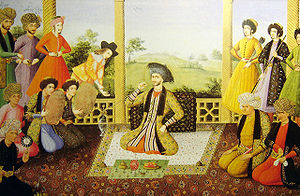 |
Shah, Hakem-ol Hokama | 1645–1694 | 26 October 1666 | 29 July 1694 | son of Abbas II Abbas II of Persia Shah Abbas II was Shah of Iran from 1642 to 1666. He was the seventh Shah of the Safavid Dynasty. He was the son of Shah Safi I and a Circassian, Anna Khanum, and originally bore the name Sultan Muhammed Mirza before his coronation on May 15, 1642... |
|
| 9 | Sultan Husayn I | Shah, Sultan, Sadr-ol Hakem | 1668–1726 | 29 July 1694 | 11 September 1722 | son of Suleiman I Suleiman I of Persia Suleiman I was a Safavid shah of Persia who reigned between 1666 and 1694. He was the elder son of the previous shah Abbas II and a Circassian slave, Nakihat Khanum.... |
Deposed & then killed by Mahmud | ||
| 11 | Tahmasp II Tahmasp II Tahmasp II was one of the last Safavid rulers of Persia . Tahmasp was the son of Husayn , the Shah of Iran at that time. When Husayn was forced to abdicate by the Afghans in 1722, Prince Tahmasp wished to claim the throne. He fled to Tabriz where he established a government... |
Shah | 1704–1740 | 11 September 1722 | 16 April 1732 | son of Sultan Husayn I | Deposed & then killed by Nader Nader Shah Nāder Shāh Afshār ruled as Shah of Iran and was the founder of the Afsharid dynasty. Because of his military genius, some historians have described him as the Napoleon of Persia or the Second Alexander... |
||
| 13 | Ahmad Shah Ahmad Marashi Ahmad Shah Marashi was a Safavid Iranian Shah 1726 –1728 that succeeded Shah Tahmasp II, while the Shah was in the northern provinces fighting with Nader Shah Afshar against the Russians and the Ottomans... |
Shah, Sultan | 1687–1728 | 28 September 1726 | 30 March 1728 | son of Mirza Abolqasem son of Shahrbanu Beigom daughter of Suleiman I Suleiman I of Persia Suleiman I was a Safavid shah of Persia who reigned between 1666 and 1694. He was the elder son of the previous shah Abbas II and a Circassian slave, Nakihat Khanum.... |
Killed by Ashraf | ||
| 14 | Abbas III Abbas III Abbas III was a son of Shah Tahmasp II of the Safavid dynasty. After the deposition of his father by Nader Khan the infant Abbas was appointed nominal ruler of Iran on 7 September 1732. Nader Khan, who was the real ruler of the country, assumed the positions of deputy of state and viceroy... |
Shah | 1730–1739 | 16 April 1732 | 22 January 1736 | son of Tahmasp II Tahmasp II Tahmasp II was one of the last Safavid rulers of Persia . Tahmasp was the son of Husayn , the Shah of Iran at that time. When Husayn was forced to abdicate by the Afghans in 1722, Prince Tahmasp wished to claim the throne. He fled to Tabriz where he established a government... |
Under control of Nader Nader Shah Nāder Shāh Afshār ruled as Shah of Iran and was the founder of the Afsharid dynasty. Because of his military genius, some historians have described him as the Napoleon of Persia or the Second Alexander... . Deposed & then killed by Nader Nader Shah Nāder Shāh Afshār ruled as Shah of Iran and was the founder of the Afsharid dynasty. Because of his military genius, some historians have described him as the Napoleon of Persia or the Second Alexander... |
||
| 16 | Sam | Shah | ?–1743 | 1743 | 1743 | son of Sultan Husayn I (?) | Usurper. Killed by Nader Nader Shah Nāder Shāh Afshār ruled as Shah of Iran and was the founder of the Afsharid dynasty. Because of his military genius, some historians have described him as the Napoleon of Persia or the Second Alexander... |
||
| 20 | Ismail III | Mirza Abutorab | Shah | ?–1772 | 1749 | 1749 | son of Maryam Beigom (or Khan Agha Beigom) daughter of Sultan Husayn I | Under control of Karim Khan Zand. Deposed | |
| 21 | Suleiman II Suleiman II of Persia His real name was Mir Sayyed Mohammad Marashi he was in charge of the affairs of the Holy Shrine in Mashhad.Young Shahrukh was enthroned at Mashhad in October 1748 by Khorasan nobles and Kurdish, Turkmen, and Bayat chiefs. Two months later Ibrahim proclaimed himself shah; but he was defeated and... |
Seyyed Mohammad | Shah | 1723 or 1725–? | 1749 | 1750 | son of Shahrbanu Beigom daughter of Suleiman I Suleiman I of Persia Suleiman I was a Safavid shah of Persia who reigned between 1666 and 1694. He was the elder son of the previous shah Abbas II and a Circassian slave, Nakihat Khanum.... |
Deposed & blinded by Shahrokh | |
| 20 | Ismail III | Mirza Abutorab | Shah | ?–1772 | 1752 | 1756 | son of Maryam Beigom (or Khan Agha Beigom) daughter of Sultan Husayn I | Under control of Karim Khan Zand. Deposed | |
| 23 | Sultan Husayn II | Shah | ?–1753 | 1753 | 1753 | son of Sultan Husayn I (?) | Usurper. Killed | ||
| 30 | Mohammd II | Abolfat'h Sultan Muhammd Mirza | Shah | ?–? | 1786 | 1786 | son of Sultan Husayn Mirza son of Tahmasp II Tahmasp II Tahmasp II was one of the last Safavid rulers of Persia . Tahmasp was the son of Husayn , the Shah of Iran at that time. When Husayn was forced to abdicate by the Afghans in 1722, Prince Tahmasp wished to claim the throne. He fled to Tabriz where he established a government... |
Under control of Agha Mohammad Khan Qajar | |
| Hotaki dynasty, 1722–1729 | |||||||||
| 10 | Mahmud | Shah | 1722 | 1725 | |||||
| 12 | Ashraf | Shah | 1725 | 1729 | Killed | ||||
| Afsharid dynasty, 1736–1796 | |||||||||
| 15 | Nader Nader Shah Nāder Shāh Afshār ruled as Shah of Iran and was the founder of the Afsharid dynasty. Because of his military genius, some historians have described him as the Napoleon of Persia or the Second Alexander... |
Nadhar Qoli Khan | Shah, Sultan, Hakem-ol Hokama, Hazrat-e Ashraf | 1698–1747 | 22 January 1736 | 19 June 1747 | son of Imam Qoli Beig Afshar | Before crowning his title was Tahmasp Qoli Khan. Killed | |
| 17 | Adel Adil Shah Adil or Adel Shah Afshar or Ali Qoli was Shah of Persia from 1747 until 1748.Subsequent to the assassination of Nader Shah in Fathabad , his nephew Ali Qoli declared himself Adil Shah , and shah of Persia... |
Ali Qoli Beig | Shah | 1719/20–1749 | 19 June 1747 | 29 July 1748 | son of Mohammad Ebrahim Khan brother of Nader Nader Shah Nāder Shāh Afshār ruled as Shah of Iran and was the founder of the Afsharid dynasty. Because of his military genius, some historians have described him as the Napoleon of Persia or the Second Alexander... |
Deposed, blinded & then killed by Ebrahim Ebrahim Afshar Ibrahim or Ebrahim Shah Afshar was the Shah of Persia during the Afsharid Empire from July to September of 1748. He was Adil Shah's brother and Nader Shah's nephew. He toppled his brother in order to seize the power, and he blinded him on July 6 1748. However, two months later his own troops... |
|
| 18 | Ebrahim Ebrahim Afshar Ibrahim or Ebrahim Shah Afshar was the Shah of Persia during the Afsharid Empire from July to September of 1748. He was Adil Shah's brother and Nader Shah's nephew. He toppled his brother in order to seize the power, and he blinded him on July 6 1748. However, two months later his own troops... |
Mohammd Ali Beig | Shah | 1724–1749 | 29 July 1748 | 3 September 1748 | son of Mohammad Ebrahim Khan brother of Nader Nader Shah Nāder Shāh Afshār ruled as Shah of Iran and was the founder of the Afsharid dynasty. Because of his military genius, some historians have described him as the Napoleon of Persia or the Second Alexander... |
Deposed & then killed by Shahrokh | |
| 19 | Shahrokh | Shah | 1734–1796 | 3 September 1748 | 1796 | son of Reza Qoli Mirza son of Nader Nader Shah Nāder Shāh Afshār ruled as Shah of Iran and was the founder of the Afsharid dynasty. Because of his military genius, some historians have described him as the Napoleon of Persia or the Second Alexander... . His mother was Fatemeh Soltan Beigom daughter of Sultan Husayn I Safavi |
Deposed & blinded by Suleiman II Suleiman II of Persia His real name was Mir Sayyed Mohammad Marashi he was in charge of the affairs of the Holy Shrine in Mashhad.Young Shahrukh was enthroned at Mashhad in October 1748 by Khorasan nobles and Kurdish, Turkmen, and Bayat chiefs. Two months later Ibrahim proclaimed himself shah; but he was defeated and... (1749), restored (1750) & finally killed by Agha Mohammad Khan Qajar |
||
| Zand dynasty, 1751–1794 | |||||||||
| 22 | Karim Karim Khan Karim Khan Zand, , , was a ruler of Iran, and the founder of the Zand Dynasty.He was born to a family of the Zand tribe of Lur or Lak deportees... |
Mohammad Karim | 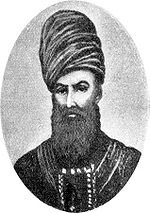 |
Khan, Vakil e-Ra'aayaa | 1705–1779 | 1751 | 6 March 1779 | son of Inaq Khan & Bay Agha | |
| 24 | Mohammad Ali Mohammad Ali Khan Mohammad Ali Khan Zand , was the second Shah of the Zand dynasty. He ruled Persia from March 6, 1779 until June 19, 1779.After the death of Karim Khan in 1779, Iran disintegrated once again. Karim Khan's brother Zaki Khan declared Mohammad `Ali, the second son of Karim Khan who was also his... |
Khan | 1760–1779 | 6 March 1779 | 19 June 1779 | son of Karim Karim Khan Karim Khan Zand, , , was a ruler of Iran, and the founder of the Zand Dynasty.He was born to a family of the Zand tribe of Lur or Lak deportees... |
|||
| 25 | Abolfat'h Abol Fath Khan Abol Fath Khan Zand was the third Shah of Zand dynasty, who ruled the Persian Empire from March 6, 1779 until August 22, 1779.... |
Khan | 1755–1787 | 6 March 1779 | 22 August 1779 | son of Karim Karim Khan Karim Khan Zand, , , was a ruler of Iran, and the founder of the Zand Dynasty.He was born to a family of the Zand tribe of Lur or Lak deportees... |
|||
| 26 | Zaki | Khan | ?–22 August 1779 | 6 March 1779 | 22 August 1779 | son of Budaq Khan & Bay Agha | |||
| 27 | Sadeq | Mohammad Sadeq | Khan | ?–1782 | 22 August 1779 | 14 March 1781 | son of Inaq Khan & Bay Agha | ||
| 28 | Ali Morad Ali Murad Khan Ali Murad Khan Zand the sixth Shah of the Zand dynasty, reigned from March 15, 1781 until February 11, 1785.After the death of Karim Khan Zand, Agha Muhammad Khan who was a hostage--in light of preventing an outbreak of war between the Qajar tribes in the northern Persia and the Zands--escaped... |
Khan | 1720–1785 | 14 March 1781 | 11 February 1785 | son of Allah Morad (Qeytas) Khan Zand Hazareh | |||
| 29 | Ja'far Jafar Khan Jafar Khan Zand, was a Shah of Persia who reigned from February 18, 1785 - January 23, 1789. He was the seventh king of Zand dynasty.After Jafar Khan's father, Sadiq Khan, was overthrown by Ali Murad Khan, Jafar Khan vowed to avenge his father and thus after four years of reigning, Ali Murad Khan... |
Khan | ?–1789 | 18 February 1785 | 23 January 1789 | son of Sadeq | |||
| 31 | Şeyd Morad Sayed Murad Khan Sayed Murad Khan Zand, was a Shah of Persia who reigned from January 23, 1789 until May 10, 1789. He was the eighth king of the Zand dynasty. His brief reign is indicative of the ruthless and brutal struggle for power that prevailed among members of the Zand family following the death of Karim Khan... |
Khan | ?–1789 | 23 January 1789 | 10 May 1789 | son of Khoda Morad Khan Zand Hazareh | |||
| 32 | Lotf Ali Lotf Ali Khan Lutf or Lotf Ali Khan was the last Shah of Persia of the Zand dynasty.Lotf Ali Khan Zand came to power after a decade of infighting among a succession of violent and inept Zand chiefs following the death in 1779 of the dynasty's founder, Karim Khan Zand... |
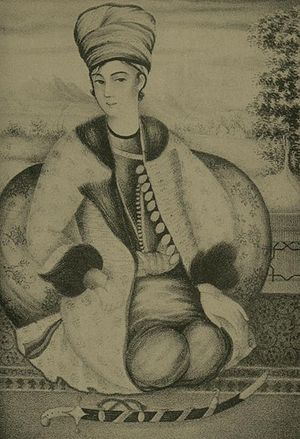 |
Khan | 1769–1794 | 23 January 1789 | 20 March 1794 | son of Ja'far Jafar Khan Jafar Khan Zand, was a Shah of Persia who reigned from February 18, 1785 - January 23, 1789. He was the seventh king of Zand dynasty.After Jafar Khan's father, Sadiq Khan, was overthrown by Ali Murad Khan, Jafar Khan vowed to avenge his father and thus after four years of reigning, Ali Murad Khan... |
Deposed, blinded & then killed by Agha Mohammad Khan Qajar | |
| Qajar dynasty Qajar dynasty The Qajar dynasty was an Iranian royal family of Turkic descent who ruled Persia from 1785 to 1925.... , 1794–1925 |
|||||||||
| 33 | Mohammad Mohammad Khan Qajar Agha Muḥammad Khān Qājār was the chief of the Qajar tribe, succeeding his father Mohammad Hassan Khan, who was killed on the orders of Adil Shah. He became the Emperor/Shah of Persia in 1794 and established the Qajar dynasty... |
Agha Mohammad Khan | 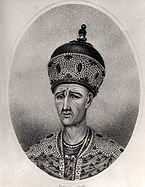 |
Khan, Shah, Khaqan | 1742–1797 | 20 March 1794 | 17 June 1797 | Son of Mohammad Hassan Khan Qajar | Killed |
| 34 | Fat'h Ali | Baba Khan | .jpg) |
Shah, Khaqan, Soltane Saheb Qaran | 1772–1834 | 17 June 1797 | 23 October 1834 | son of Hosein Qoli Khan Jahansuz brother of Mohammad Mohammad Khan Qajar Agha Muḥammad Khān Qājār was the chief of the Qajar tribe, succeeding his father Mohammad Hassan Khan, who was killed on the orders of Adil Shah. He became the Emperor/Shah of Persia in 1794 and established the Qajar dynasty... |
|
| 35 | Mohammad Mohammad Shah Qajar Mohammad Shah Qajar was king of Persia from the Qajar dynasty .- Rise to power :... |
Shah, Khaqan | 1808–1848 | 23 October 1834 | 5 September 1848 | son of Abbas Mirza Nayeb os-Saltaneh son of Fat'h Ali | |||
| Mahd-e Olia Malek Jahan Khanom, Mahd-e Olia Malek Jahan Khanom, Mahd-e Olia, or Mahd-i-'Aliua , was a Persian princess of the Qajar dynasty, consort of Sultan Mohammad Shah Qajar of Persia and the mother of Naser al-Din Shah Qajar. She was the granddaughter of Fat′h-Ali Shah Qajar of Persia and the cousin of her spouse, Mohammad Shah... |
Mahd-e Olia Malek Jahan Khanom, Mahd-e Olia Malek Jahan Khanom, Mahd-e Olia, or Mahd-i-'Aliua , was a Persian princess of the Qajar dynasty, consort of Sultan Mohammad Shah Qajar of Persia and the mother of Naser al-Din Shah Qajar. She was the granddaughter of Fat′h-Ali Shah Qajar of Persia and the cousin of her spouse, Mohammad Shah... |
1814–1888 | 5 September 1848 | 5 October 1848 | wife of Mohammad Mohammad Shah Qajar Mohammad Shah Qajar was king of Persia from the Qajar dynasty .- Rise to power :... |
Regent | |||
| 36 | Naser ed-Din | Shah, Khaqan, Soltane Saheb Qaran | 1831–1896 | 5 October 1848 | 1 May 1896 | son of Mohammad Mohammad Shah Qajar Mohammad Shah Qajar was king of Persia from the Qajar dynasty .- Rise to power :... and Mahd-e Olia |
Killed | ||
| 37 | Mozaffar ed-Din | Shah, Khaqan | 1853–1907 | 1 May 1896 | 3 January 1907 | son of Naser ed-Din | |||
| 38 | Mohammd Ali Mohammad Ali Shah Qajar Mohammad Ali Shah Qajar was the Shah of Persia from 8 January 1907 to 16 July 1909.-Biography:He was against the constitution that was ratified during the reign of his father, Mozzafar-al-Din Shah... |
Shah | 1872–1925 | 3 January 1907 | 16 July 1909 | son of Mozaffar ed-Din | Deposed | ||
| 39 | Ahmad Ahmad Shah Qajar Ahmad Shah Qajar was Shah of Iran from July 16, 1909, to October 31, 1925 and the last of the Qajar dynasty.- Reign :... |
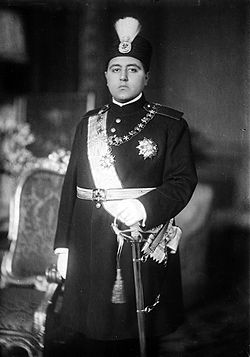 |
Shah | 1898–1930 | 16 July 1909 | 15 December 1925 | son of Mohammd Ali Mohammad Ali Shah Qajar Mohammad Ali Shah Qajar was the Shah of Persia from 8 January 1907 to 16 July 1909.-Biography:He was against the constitution that was ratified during the reign of his father, Mozzafar-al-Din Shah... |
Deposed | |
| Pahlavi dynasty Pahlavi dynasty The Pahlavi dynasty consisted of two Iranian/Persian monarchs, father and son Reza Shah Pahlavi and Mohammad Reza Shah Pahlavi The Pahlavi dynasty consisted of two Iranian/Persian monarchs, father and son Reza Shah Pahlavi (reg. 1925–1941) and Mohammad Reza Shah Pahlavi The Pahlavi dynasty ... , 1925–1979 |
|||||||||
| 40 | Reza Reza Shah Rezā Shāh, also known as Rezā Shāh Pahlavi and Rezā Shāh Kabir , , was the Shah of the Imperial State of Iran from December 15, 1925, until he was forced to abdicate by the Anglo-Soviet invasion of Iran on September 16, 1941.In 1925, Reza Shah overthrew Ahmad Shah Qajar, the last Shah of the Qajar... |
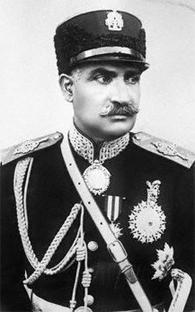 |
Shahanshah | 1878–1944 | 15 December 1925 | 16 September 1941 | Son of Abbas Ali | Deposed | |
| 41 | Mohammad Reza Mohammad Reza Pahlavi Mohammad Rezā Shāh Pahlavi, Shah of Iran, Shah of Persia , ruled Iran from 16 September 1941 until his overthrow by the Iranian Revolution on 11 February 1979... |
Shahanshah, Ariamehr, Bozorg Arteshtaran, Khodaygan | 1919–1980 | 16 September 1941 | 11 February 1979 | son of Reza Reza Shah Rezā Shāh, also known as Rezā Shāh Pahlavi and Rezā Shāh Kabir , , was the Shah of the Imperial State of Iran from December 15, 1925, until he was forced to abdicate by the Anglo-Soviet invasion of Iran on September 16, 1941.In 1925, Reza Shah overthrew Ahmad Shah Qajar, the last Shah of the Qajar... |
Deposed | ||
See also
- History of IranHistory of IranThe history of Iran has been intertwined with the history of a larger historical region, comprising the area from the Danube River in the west to the Indus River and Jaxartes in the east and from the Caucasus, Caspian Sea, and Aral Sea in the north to the Persian Gulf and the Gulf of Oman and Egypt...
- Persian EmpireAchaemenid EmpireThe Achaemenid Empire , sometimes known as First Persian Empire and/or Persian Empire, was founded in the 6th century BCE by Cyrus the Great who overthrew the Median confederation...
- List of ancient Persians
- ShahzadaShahzadaShahzada may refer to:*Shahzada, princely title, crown prince, the son of a shah.*Haji Shahzada , one of the Guantanamo captives whose 2004 CSR Tribunal determined he was not an enemy after all....
- ShahbanuShahbanuShahbanu means Empress in Persian. It was a title that was only conferred on the third royal consort of Mohammad Reza Shah, Farah Pahlavi, in 1967....