

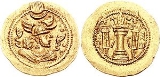
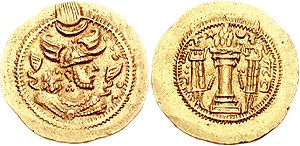
Peroz I

Encyclopedia
Procopius
Procopius of Caesarea was a prominent Byzantine scholar from Palestine. Accompanying the general Belisarius in the wars of the Emperor Justinian I, he became the principal historian of the 6th century, writing the Wars of Justinian, the Buildings of Justinian and the celebrated Secret History...
, De Bello Pers. I. 3 and Agathias iv. 27; the modern form of the name is Perooz, Piruz, or the Arabized Ferooz, Firuz; Persian
Persian language
Persian is an Iranian language within the Indo-Iranian branch of the Indo-European languages. It is primarily spoken in Iran, Afghanistan, Tajikistan and countries which historically came under Persian influence...
: پیروز "the Victor"), was the seventeenth Sassanid King of Persia, who ruled from 457 to 484. Peroz I was the eldest son of Yazdegerd II of Persia (438–457).
Disputed succession
On the death of Peroz I's father, Yazdegerd IIYazdegerd II
Yazdegerd II was the fifteenth Sassanid King of Persia. He was the son of Bahram V and reigned from 438 to 457....
, the younger son of the deceased Emperor, Hormizd
Hormizd III
Hormizd III, sixteenth Sassanid King of Persia, son of Yazdegerd II , succeeded his father in 457.Hormizd, the older son of Yazdegerd II, was kept near Ctesiphon, while his younger brother, Peroz, was stationed in Sistan. Following his father's death, Hormizd became ruler of the Sassanian Empire...
, seized the throne in the absence of his elder brother Peroz who had been posted as the Governor of distant Sistan
Sistan
Sīstān is a border region in eastern Iran , southwestern Afghanistan and northern tip of Southwestern Pakistan .-Etymology:...
forcing Peroz to seek the protection of the Hephthalites. The Hephthalite
Hephthalite
The Hephthalites or Hephthalite is a pre-Islamic Greek term for local Abdali Afghans, who's famous ruler was Nazak Abdali . Hephthalites were a Central Asian nomadic confederation of the AD 5th-6th centuries whose precise origins and composition remain obscure...
monarch, Khush-Nevaz was only too glad to welcome him and aid him in his war against Hormizd. So, with Hephthalite assistance, Peroz led an army against Hormizd, defeated him and held him captive. Sources differ as to what happened to Hormizd after his capture. Some say that he was put to death. However, the Persian historian, Mirkhond says that Peroz pardoned his younger brother and amicably spared his life.
Reign
Peroz ruled from 457 to 484. He is said to have favored NestorianismNestorianism
Nestorianism is a Christological doctrine advanced by Nestorius, Patriarch of Constantinople from 428–431. The doctrine, which was informed by Nestorius's studies under Theodore of Mopsuestia at the School of Antioch, emphasizes the disunion between the human and divine natures of Jesus...
and persecuted Chalcedonians
Council of Chalcedon
The Council of Chalcedon was a church council held from 8 October to 1 November, 451 AD, at Chalcedon , on the Asian side of the Bosporus. The council marked a significant turning point in the Christological debates that led to the separation of the church of the Eastern Roman Empire in the 5th...
. Historians regard him as a fearless monarch and give him the epithet, Peroz the Victorious.
Events
The civil warCivil war
A civil war is a war between organized groups within the same nation state or republic, or, less commonly, between two countries created from a formerly-united nation state....
in Persia had affected the nation so much as to cost a province. Vatche, the king of Aghouank (Albania), rebelled against Persian rule and declared himself independent while the brothers were busy fighting amongst each other. So once Peroz I ascended the throne in the year 457, he led an army into Albania and completely subjugated the nation. He then dismissed his allies the Hephthalites with costly presents and proceeded to rule the nation in moderation and justice.
Seven-year famine 464-471
Historians of the period record the occurrence of a seven-year famine which devastated the crops and ruined the country. Sources say that the wells became dry and that there was not a trickleTrickle
Trickle is the second and most recent album from English trip-hop band Olive.- History :Following the band's debut album Extra Virgin and a subsequent promotional tour, keyboard programmer Robin Taylor-Firth left the band...
of water either in the Tigris
Tigris
The Tigris River is the eastern member of the two great rivers that define Mesopotamia, the other being the Euphrates. The river flows south from the mountains of southeastern Turkey through Iraq.-Geography:...
or the Euphrates
Euphrates
The Euphrates is the longest and one of the most historically important rivers of Western Asia. Together with the Tigris, it is one of the two defining rivers of Mesopotamia...
. Eventually the crops failed and thousands perished.
Historians record that Peroz I showed an extreme rigidness of character in the face of such an adversity and great wisdom in dealing with the catastrophe. As a result of his wisdom and benevolence, Persia gradually recovered from the famine.
First campaign against the Huns
No sooner had Persia recovered from the famine, than war broke out with the Huns of the north. Provoked by an insult heaped upon him by Khush-Newaz, Peroz led an invasion of the Hephthalite country forcing them to retreat. But when Peroz pursued the Hephthalites to the hills, he suffered a crushing defeat, was captured and forced to surrender his son Kavadh IKavadh I
Kavad or Kavadh I was the son of Peroz I and the nineteenth Sassanid king of Persia, reigning from 488 to 531...
to Khush-Newaz as a hostage
Hostage
A hostage is a person or entity which is held by a captor. The original definition meant that this was handed over by one of two belligerent parties to the other or seized as security for the carrying out of an agreement, or as a preventive measure against certain acts of war...
, until the ransom was paid.
Trouble in Armenia
In 481, Peroz was defeated by the Kushans. Soon afterwards, Iberia broke into revolt and declared its independence. Peroz sent the Persian Governor of Armenia to Iberia to quell the rebellion. But no sooner had he left the province, that ArmeniaArmenia
Armenia , officially the Republic of Armenia , is a landlocked mountainous country in the Caucasus region of Eurasia...
rose in rebellion and chose an Armenian Christian called Bargatide as its Emperor.
The Persian Governor, Adar-Vishnasp after restoring Persian rule in Iberia
Caucasian Iberia
Iberia , also known as Iveria , was a name given by the ancient Greeks and Romans to the ancient Georgian kingdom of Kartli , corresponding roughly to the eastern and southern parts of the present day Georgia...
rushed to Armenia to quell the rebellion but was squarely defeated. Peroz responded by sending two large armies to the region, one under Adar-Narseh into Armenia and the other against Iberia.
Sahag, the Armenian king, was killed and Mihran was wreaking havoc in Persia, but just when success was within grasp, Peroz blundered by recalling Mihran and entrusting the command to one Hazaravough. Hazaravough too did not remain long in Armenia and was recalled in a few months. This policy of rotating military commanders frequently ensured that Armenia was lost to the Persians for the time being.
Second campaign against the Huns and death
Towards the end of his reign, Peroz gathered an army of 50,000-100,000 men and, placing his brother BalashBalash
Balash , the eighteenth Sassanid King of Persia in 484–488, was the brother and successor of Peroz I of Persia , who had died in a battle against the Hephthalites who invaded Persia from the east.- Reign of Balash :Balash was made King of Persia following the death of his...
at the head of the government in Ctesiphon
Ctesiphon
Ctesiphon, the imperial capital of the Parthian Arsacids and of the Persian Sassanids, was one of the great cities of ancient Mesopotamia.The ruins of the city are located on the east bank of the Tigris, across the river from the Hellenistic city of Seleucia...
, he invaded the Hephthalites in order to avenge the insult heaped upon him during the first campaign. He set up his position at Balkh
Balkh
Balkh , was an ancient city and centre of Zoroastrianism in what is now northern Afghanistan. Today it is a small town in the province of Balkh, about 20 kilometers northwest of the provincial capital, Mazar-e Sharif, and some south of the Amu Darya. It was one of the major cities of Khorasan...
and rejected the terms of peace offered by Khush-Newaz. However, when a showdown with the Persians seemed imminent, Khush-Newaz sent a small body of troops in advance in order to trick Peroz into an ambuscade. The plan was successful, and the Persians were defeated with great slaughter, Peroz being one of the victims. Khush-Newaz, however, treated the body of his erstwhile friend with dignity and dispatched it to Persia to be buried with full honors. Balash was crowned the next Emperor of Persia.
Soon afterwards, the Hephthalites invaded and plundered Persia. Persia, however, was saved when a noble Persian from the Parthia
Parthia
Parthia is a region of north-eastern Iran, best known for having been the political and cultural base of the Arsacid dynasty, rulers of the Parthian Empire....
n family of Karen
Seven Parthian clans
The Seven Parthian clans or Seven Houses were seven purportedly "Parthian" feudal aristocracies allied with the Sassanid court.Only two of the seven - the House of Suren and the House of Karen - are actually attested in sources dateable to the Arsacid period...
, Zarmihr (or Sokhra/Sufra), raised Balash
Balash
Balash , the eighteenth Sassanid King of Persia in 484–488, was the brother and successor of Peroz I of Persia , who had died in a battle against the Hephthalites who invaded Persia from the east.- Reign of Balash :Balash was made King of Persia following the death of his...
(484–488), one of Peroz I's brothers, to the throne.