

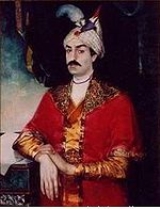
Ismail I

Encyclopedia
Ismail I known in Persian as Shāh Ismāʿil , was a Shah of Iran and the founder of the Safavid dynasty
which survived until 1736. Isma'il started his campaign in Azerbaijan
in 1500 as the leader of the Safaviyya, an extremist heterodox
Twelver Shi'i militant religious order and unified all of Iran by 1509. Born in Ardabil
in Northwestern Iran
, he reigned as Shah Ismail I of Iran
from 1502 to 1524.
Ismail played a key role in the rise of Twelver Islam; he converted Iran from Sunni
and Ismaili Shi'i Islam, importing religious authorities from the Levant. In Alevi
sm, Shah Ismail remains revered as a spiritual guide.
Ismail was also a prolific poet who, under the pen name Khatā'ī ("Sinner") contributed greatly to the literary development of the Azerbaijani language
.
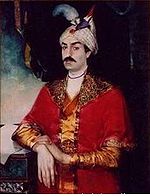 Ismail was born to Martha and Shaykh Haydar on July 17, 1487 in Ardabil
. His father, Haydar, was the sheikh
of the Safaviyya Sufi order and a direct descendant of its founder, the Kurdish
Sufi
saint Safi-ad-din Ardabili (1252–1334). Ismail was the last in line of hereditary Grand Masters of the Safaviyah Sufi order, prior to his ascent to a ruling dynasty. As a boy only a year old, he lost his father - the leader of a growing Qizilbash Shi'i community in the Azerbaijan, who died in battle. His mother, Martha, was the daughter of Uzun Hasan by his Pontic Greek
wife Theodora, better known as Despina Khatun
. Theodora was the daughter of Emperor John IV of Trebizond
. (She had married Uzun Hassan in a deal to protect Trebizond from the Ottomans.) Ismail grew up bilingual, speaking Persian
and Azeri
.
As legend has it, the infant Ismail went into hiding for several years. With his followers, he finally returned to Tabriz
, vowing to make Shi'i Islam the official religion of Iran. Ismail found significant support among the people of Azerbaijan, as well as some parts of the Ottoman Empire
, mainly in eastern Anatolia
. Ismail's advent to power was due to Turkoman tribes of Anatolia and Azerbaijan, who formed the most important part of the Qizilbash movement.
Centuries of Sunni
rule followed by non-Muslim Mongol hegemony lent fertile ground for new teachings. In the summer of 1500, about 7000 Qizilbash forces, consisted of Ustaclu, Shamlu, Rumlu, Tekelu, Zhulkadir, Afshar
, Qajar
ve Varsak tribes, responded to the invitation of Ismail in Erzincan
. Qizilbash forces passed over the Kura River
in Novermber 1500, and marched towards the Shirvanshah
's state. They defeated the forces under the Shirvanshah Farrukh Yassar
near Cabanı
(present-day Shamakhi Rayon, Azerbaijan
), and conquered Baku
. In July 1501, Ismail was enthroned as Shah of Azerbaijan, choosing Tabriz
, in Iran's northernmost province of Azerbaijan, as his capital. When the Safavids came to power in 1501, Shah Ismail was 14 or 15 years old; by 1510 he had conquered the whole of Iran.
After defeating the Aq Qoyunlu in 1502, he took the title of Shah of Iran.
In 1510, Ismail I moved against the Sunni Uzbeg tribe. In battle near the city of Merv
, some 17,000 Qizilbash warriors ambushed and defeated a superior Uzbek force numbering 28,000. The Uzbek ruler, Muhammad Shaybani
, was caught and killed trying to escape the battle and the shah had his skull made into a jeweled drinking goblet.
In 1514, Selim I
, the Sunni Sultan of the Ottoman Empire
, attacked Ismail's kingdom to stop the spread of Shiism into Ottoman dominions. Selim and Ismail had been exchanging a series of belligerent letters prior to the attack.
Selim I defeated Ismail at the battle of Chaldiran
in 1514. Ismail's army was more mobile and their soldiers were better prepared but the Ottomans prevailed due in large part to their efficient modern army, and possession of artillery, black powder and muskets. Ismail was wounded and almost captured in battle. Selim I entered the Iranian capital of Tabriz
in triumph on September 5, but did not linger. A mutiny among his troops fearing a counter attack and entrapment by the fresh Safavid forces called in from the interior, forced the triumphant Ottomans to withdraw prematurely. This allowed Ismail to recover quickly. Among the booties from Tabriz was Ismail's favorite wife, for whose release the Sultan demanded huge concessions, which were refused. Despite his defeat at Chaldiran, Ismail quickly recovered most of his kingdom, from east of the Lake Van
to the shores of the Indian Ocean
.
After Chaldiran, however, Ismail lost his supernatural air and the aura of invincibility, gradually falling into heavy drinking of alcohol
. Ismail retired to his palace and withdrew from active participation in the affairs of the state, leaving these to his minister, Mirza Shah-Hussayn. He died on 23 May 1524 at the relatively early age of thirty-six.
Ismail's reign featured extensive conquests, shaping the map of Iran up to the present day. Iraq, including Baghdad
and the holy Shi'a shrines of Najaf
and Karbala
, had been already seized from the Jalayirids
and remained a part of Ismail's kingdom until its end. Despite the defeat at Chaldiran, where he lost western Armenia
and northwestern Kurdistan, he managed to pass on to his son, Tahmasp I
, his entire vast empire. Ismail destroyed Sunni sites in Baghdad including tombs of Abbasid Caliphs, tombs of Sunni Imam Abū Ḥanīfah and Abdul Qadir Gilani.
His son Tahmasp I succeeded him as Shah.
, "Ismail was a skillful poet who used prevalent themes and images in lyric and didactic-religious poetry with ease and some degree of originality". He was also deeply influenced by the Persian literary tradition
of Iran, particularly by the Shahnameh
of Ferdowsi
, which probably explains the fact that he named all of his sons after Shahnameh
-characters. Dickson and Welch suggest that Ismail's "Shāhnāmaye Shāhī" was intended as a present to the young Tahmasp. After defeating Muhammad Shaybani
's Uzbeks, Ismail asked Hatefi, a famous poet from Jam (Khorasan), to write a Shahnameh-like epic about his victories and his newly established dynasty. Although the epic was left unfinished, it was an example of mathnawis in the heroic style of the Shahnameh written later on for the Safavid kings.
He wrote in the Azerbaijani language, the language of the majority of his followers, and in the Persian language
. He is considered an important figure in the literary history of Azerbaijani language and has left approximately 1400 verses in this language, which he chose to use for political reasons. Approximately 50 verses of his Persian poetry have also survived.
Most of the poems are concerned with love — particularly of the mystical
Sufi kind — though there are also poems propagating Shi'i doctrine and Safavi politics. His other serious works include the Nasihatnāme, a book of advice, and the unfinished Dahnāme, a book which extols the virtues of love.
As Ismail believed in his own divinity and in his descent from Ali
, in his poems he tended to strongly emphasize these claims.
Along with the poet Imadaddin Nasimi, Khatā'ī is considered to be among the first proponents of using a simpler Azeri language in verse that would thereby appeal to a broader audience. His work is most popular in Azerbaijan
, as well as among the Bektashi
s of Turkey
. There is a large body of Alevi and Bektashi poetry that has been attributed to him. The major impact of his religious propaganda, in the long run, was the conversion of Persia from Sunniism to Shiism.
The following anecdote demonstrates the status of vernacular Turkish and Persian in the Ottoman Empire and in the incipient Safavid state. Khatā'ī sent a poem in Turkish to the Ottoman Sultan Selim I
before going to war in 1514. In a reply the Ottoman Sultan answered in Persian to indicate his contempt.
, Zand
, Qajar, and Pahlavi
dynasties into the modern Islamic Republic of Iran, where Shi’a Islam is still the official religion as it was during the Safavids.
.
Safavid dynasty
The Safavid dynasty was one of the most significant ruling dynasties of Iran. They ruled one of the greatest Persian empires since the Muslim conquest of Persia and established the Twelver school of Shi'a Islam as the official religion of their empire, marking one of the most important turning...
which survived until 1736. Isma'il started his campaign in Azerbaijan
Azerbaijan (Iran)
Azerbaijan or Azarbaijan , also Iranian Azerbaijan, Persian Azarbaijan is a region in northwestern Iran. It is also historically known as Atropatene and Aturpatakan....
in 1500 as the leader of the Safaviyya, an extremist heterodox
Ghulat
Ghulāt , is a term used in the theology of Shia Islam to describe some minority Muslim groups who either ascribe divine characteristics to a member of Muhammad's family , or hold beliefs deemed deviant by mainstream Shi'i theology...
Twelver Shi'i militant religious order and unified all of Iran by 1509. Born in Ardabil
Ardabil
Ardabil is a historical city in north-western Iran. The name Ardabil probably comes from the Zoroastrian name of "Artavil" which means a holy place. Ardabil is the center of Ardabil Province. At the 2006 census, its population was 412,669, in 102,818 families...
in Northwestern Iran
Azerbaijan (Iran)
Azerbaijan or Azarbaijan , also Iranian Azerbaijan, Persian Azarbaijan is a region in northwestern Iran. It is also historically known as Atropatene and Aturpatakan....
, he reigned as Shah Ismail I of Iran
Greater Iran
Greater Iran refers to the regions that have significant Iranian cultural influence. It roughly corresponds to the territory on the Iranian plateau and its bordering plains, stretching from Iraq, the Caucasus, and Turkey in the west to the Indus River in the east...
from 1502 to 1524.
Ismail played a key role in the rise of Twelver Islam; he converted Iran from Sunni
Sunni Islam
Sunni Islam is the largest branch of Islam. Sunni Muslims are referred to in Arabic as ʾAhl ūs-Sunnah wa āl-Ǧamāʿah or ʾAhl ūs-Sunnah for short; in English, they are known as Sunni Muslims, Sunnis or Sunnites....
and Ismaili Shi'i Islam, importing religious authorities from the Levant. In Alevi
Alevi
The Alevi are a religious and cultural community, primarily in Turkey, constituting probably more than 15 million people....
sm, Shah Ismail remains revered as a spiritual guide.
Ismail was also a prolific poet who, under the pen name Khatā'ī ("Sinner") contributed greatly to the literary development of the Azerbaijani language
Azerbaijani language
Azerbaijani or Azeri or Torki is a language belonging to the Turkic language family, spoken in southwestern Asia by the Azerbaijani people, primarily in Azerbaijan and northwestern Iran...
.
Life and political history
Ardabil
Ardabil is a historical city in north-western Iran. The name Ardabil probably comes from the Zoroastrian name of "Artavil" which means a holy place. Ardabil is the center of Ardabil Province. At the 2006 census, its population was 412,669, in 102,818 families...
. His father, Haydar, was the sheikh
Sheikh
Not to be confused with sikhSheikh — also spelled Sheik or Shaikh, or transliterated as Shaykh — is an honorific in the Arabic language that literally means "elder" and carries the meaning "leader and/or governor"...
of the Safaviyya Sufi order and a direct descendant of its founder, the Kurdish
Kurdish people
The Kurdish people, or Kurds , are an Iranian people native to the Middle East, mostly inhabiting a region known as Kurdistan, which includes adjacent parts of Iran, Iraq, Syria, and Turkey...
Sufi
Sufism
Sufism or ' is defined by its adherents as the inner, mystical dimension of Islam. A practitioner of this tradition is generally known as a '...
saint Safi-ad-din Ardabili (1252–1334). Ismail was the last in line of hereditary Grand Masters of the Safaviyah Sufi order, prior to his ascent to a ruling dynasty. As a boy only a year old, he lost his father - the leader of a growing Qizilbash Shi'i community in the Azerbaijan, who died in battle. His mother, Martha, was the daughter of Uzun Hasan by his Pontic Greek
Pontic Greeks
The Pontians are an ethnic group traditionally living in the Pontus region, the shores of Turkey's Black Sea...
wife Theodora, better known as Despina Khatun
Khatun
Khatun is a female title of nobility and alternative to male "khan" prominently used in the First Turkic Empire and in the subsequent Mongol Empire...
. Theodora was the daughter of Emperor John IV of Trebizond
John IV of Trebizond
John IV Megas Komnenos , was Emperor of Trebizond from 1429 to 1459. He was a son of Emperor Alexios IV of Trebizond and Theodora Kantakouzene....
. (She had married Uzun Hassan in a deal to protect Trebizond from the Ottomans.) Ismail grew up bilingual, speaking Persian
Persian language
Persian is an Iranian language within the Indo-Iranian branch of the Indo-European languages. It is primarily spoken in Iran, Afghanistan, Tajikistan and countries which historically came under Persian influence...
and Azeri
Azerbaijani language
Azerbaijani or Azeri or Torki is a language belonging to the Turkic language family, spoken in southwestern Asia by the Azerbaijani people, primarily in Azerbaijan and northwestern Iran...
.
As legend has it, the infant Ismail went into hiding for several years. With his followers, he finally returned to Tabriz
Tabriz
Tabriz is the fourth largest city and one of the historical capitals of Iran and the capital of East Azerbaijan Province. Situated at an altitude of 1,350 meters at the junction of the Quri River and Aji River, it was the second largest city in Iran until the late 1960s, one of its former...
, vowing to make Shi'i Islam the official religion of Iran. Ismail found significant support among the people of Azerbaijan, as well as some parts of the Ottoman Empire
Ottoman Empire
The Ottoman EmpireIt was usually referred to as the "Ottoman Empire", the "Turkish Empire", the "Ottoman Caliphate" or more commonly "Turkey" by its contemporaries...
, mainly in eastern Anatolia
Anatolia
Anatolia is a geographic and historical term denoting the westernmost protrusion of Asia, comprising the majority of the Republic of Turkey...
. Ismail's advent to power was due to Turkoman tribes of Anatolia and Azerbaijan, who formed the most important part of the Qizilbash movement.
Centuries of Sunni
Sunni Islam
Sunni Islam is the largest branch of Islam. Sunni Muslims are referred to in Arabic as ʾAhl ūs-Sunnah wa āl-Ǧamāʿah or ʾAhl ūs-Sunnah for short; in English, they are known as Sunni Muslims, Sunnis or Sunnites....
rule followed by non-Muslim Mongol hegemony lent fertile ground for new teachings. In the summer of 1500, about 7000 Qizilbash forces, consisted of Ustaclu, Shamlu, Rumlu, Tekelu, Zhulkadir, Afshar
Afshar tribe
Afshars, also called Avshar are a branch of the Turkic Oghuz groups. These originally nomadic Oghuz tribes moved from Central Asia through Iran, Afghanistan, Syria, and finally most of them settled in Anatolia.Most of Afshars are followers of Shia Islam....
, Qajar
Kajars
The Kajars are a Turkic people of the Oghuz Turks who lived variously, with other tribes, in the area that is now northeastern Turkey, Armenia, Azerbaijan and northwestern Iran. They are often considered a branch of the Azeri...
ve Varsak tribes, responded to the invitation of Ismail in Erzincan
Erzincan
-Trivia:Erzincan has the largest man made of Portrait of Atatürk, located north of the city, 176m×43m. It covers 7,500 square meter. Turkish Army made it 1982, in 29 days by 3,000 soldier, 100 tons of black and white paint was used...
. Qizilbash forces passed over the Kura River
Kura River
Kura is a river, also known from the Greek as the Cyrus in the Caucasus Mountains. Starting in north-eastern Turkey, it flows through Turkey to Georgia, then to Azerbaijan, where it receives the Aras River as a right tributary, and enters the Caspian Sea...
in Novermber 1500, and marched towards the Shirvanshah
Shirvanshah
Shirvanshah also spelled as Shīrwān Shāh or Sharwān Shāh, was the title in mediaeval Islamic times of an Arab in Ethnos but speedily Persianized dynasty within their culturally Persian environment. The Shirvanshah established a native state in Shirvan...
's state. They defeated the forces under the Shirvanshah Farrukh Yassar
Farrukh Yassar
Farrukh Yassar Shirvanshah of Shirvan .In 1488 Shaykh Haydar of Safaviyya moved through Shirvan towards Derbend, supposedly to wage jihad against Circassians, but instead laid siege to Derbent. Farrukh Yassar was not able to mount defense and asked Sultan Yagub of Kara Koyunlu to the rescue...
near Cabanı
Cabani
Cabanı is a village in the Shamakhi Rayon of Azerbaijan. The village forms part of the municipality of İkinci Cabanı....
(present-day Shamakhi Rayon, Azerbaijan
Azerbaijan
Azerbaijan , officially the Republic of Azerbaijan is the largest country in the Caucasus region of Eurasia. Located at the crossroads of Western Asia and Eastern Europe, it is bounded by the Caspian Sea to the east, Russia to the north, Georgia to the northwest, Armenia to the west, and Iran to...
), and conquered Baku
Baku
Baku , sometimes spelled as Baki or Bakou, is the capital and largest city of Azerbaijan, as well as the largest city on the Caspian Sea and of the Caucasus region. It is located on the southern shore of the Absheron Peninsula, which projects into the Caspian Sea. The city consists of two principal...
. In July 1501, Ismail was enthroned as Shah of Azerbaijan, choosing Tabriz
Tabriz
Tabriz is the fourth largest city and one of the historical capitals of Iran and the capital of East Azerbaijan Province. Situated at an altitude of 1,350 meters at the junction of the Quri River and Aji River, it was the second largest city in Iran until the late 1960s, one of its former...
, in Iran's northernmost province of Azerbaijan, as his capital. When the Safavids came to power in 1501, Shah Ismail was 14 or 15 years old; by 1510 he had conquered the whole of Iran.
After defeating the Aq Qoyunlu in 1502, he took the title of Shah of Iran.
In 1510, Ismail I moved against the Sunni Uzbeg tribe. In battle near the city of Merv
Merv
Merv , formerly Achaemenid Satrapy of Margiana, and later Alexandria and Antiochia in Margiana , was a major oasis-city in Central Asia, on the historical Silk Road, located near today's Mary in Turkmenistan. Several cities have existed on this site, which is significant for the interchange of...
, some 17,000 Qizilbash warriors ambushed and defeated a superior Uzbek force numbering 28,000. The Uzbek ruler, Muhammad Shaybani
Muhammad Shaybani
Abu 'I-Fath Muhammad , known in later centuries as Shaybani Khan , was a khan of the Uzbeks who continued consolidating various Uzbek tribes and laid foundations for their ascendance in Transoxiana. of Genghis Khan through his grandson Shayban and considered the Timurids as usurpers of the...
, was caught and killed trying to escape the battle and the shah had his skull made into a jeweled drinking goblet.
In 1514, Selim I
Selim I
Selim I, Yavuz Sultân Selim Khan, Hâdim-ül Haramain-ish Sharifain , nicknamed Yavuz "the Stern" or "the Steadfast", but often rendered in English as "the Grim" , was the Sultan of the Ottoman Empire from 1512 to...
, the Sunni Sultan of the Ottoman Empire
Ottoman Empire
The Ottoman EmpireIt was usually referred to as the "Ottoman Empire", the "Turkish Empire", the "Ottoman Caliphate" or more commonly "Turkey" by its contemporaries...
, attacked Ismail's kingdom to stop the spread of Shiism into Ottoman dominions. Selim and Ismail had been exchanging a series of belligerent letters prior to the attack.
Selim I defeated Ismail at the battle of Chaldiran
Battle of Chaldiran
The Battle of Chaldiran or Chaldoran occurred on 23 August 1514 and ended with a victory for the Ottoman Empire over the Safavid Empire of Persia . As a result, the Ottomans gained immediate control over eastern Anatolia and northern Iraq...
in 1514. Ismail's army was more mobile and their soldiers were better prepared but the Ottomans prevailed due in large part to their efficient modern army, and possession of artillery, black powder and muskets. Ismail was wounded and almost captured in battle. Selim I entered the Iranian capital of Tabriz
Tabriz
Tabriz is the fourth largest city and one of the historical capitals of Iran and the capital of East Azerbaijan Province. Situated at an altitude of 1,350 meters at the junction of the Quri River and Aji River, it was the second largest city in Iran until the late 1960s, one of its former...
in triumph on September 5, but did not linger. A mutiny among his troops fearing a counter attack and entrapment by the fresh Safavid forces called in from the interior, forced the triumphant Ottomans to withdraw prematurely. This allowed Ismail to recover quickly. Among the booties from Tabriz was Ismail's favorite wife, for whose release the Sultan demanded huge concessions, which were refused. Despite his defeat at Chaldiran, Ismail quickly recovered most of his kingdom, from east of the Lake Van
Lake Van
Lake Van is the largest lake in Turkey, located in the far east of the country in Van district. It is a saline and soda lake, receiving water from numerous small streams that descend from the surrounding mountains. Lake Van is one of the world's largest endorheic lakes . The original outlet from...
to the shores of the Indian Ocean
Indian Ocean
The Indian Ocean is the third largest of the world's oceanic divisions, covering approximately 20% of the water on the Earth's surface. It is bounded on the north by the Indian Subcontinent and Arabian Peninsula ; on the west by eastern Africa; on the east by Indochina, the Sunda Islands, and...
.
After Chaldiran, however, Ismail lost his supernatural air and the aura of invincibility, gradually falling into heavy drinking of alcohol
Alcohol
In chemistry, an alcohol is an organic compound in which the hydroxy functional group is bound to a carbon atom. In particular, this carbon center should be saturated, having single bonds to three other atoms....
. Ismail retired to his palace and withdrew from active participation in the affairs of the state, leaving these to his minister, Mirza Shah-Hussayn. He died on 23 May 1524 at the relatively early age of thirty-six.
Ismail's reign featured extensive conquests, shaping the map of Iran up to the present day. Iraq, including Baghdad
Baghdad
Baghdad is the capital of Iraq, as well as the coterminous Baghdad Governorate. The population of Baghdad in 2011 is approximately 7,216,040...
and the holy Shi'a shrines of Najaf
Najaf
Najaf is a city in Iraq about 160 km south of Baghdad. Its estimated population in 2008 is 560,000 people. It is the capital of Najaf Governorate...
and Karbala
Karbala
Karbala is a city in Iraq, located about southwest of Baghdad. Karbala is the capital of Karbala Governorate, and has an estimated population of 572,300 people ....
, had been already seized from the Jalayirids
Jalayirids
The Jalayirids were a Mongol Jalayir dynasty which ruled over Iraq and western Persia after the breakup of the Mongol Khanate of Persia in the 1330s....
and remained a part of Ismail's kingdom until its end. Despite the defeat at Chaldiran, where he lost western Armenia
Armenia
Armenia , officially the Republic of Armenia , is a landlocked mountainous country in the Caucasus region of Eurasia...
and northwestern Kurdistan, he managed to pass on to his son, Tahmasp I
Tahmasp I
Tahmasp or Tahmasb I was an influential Shah of Iran, who enjoyed the longest reign of any member of the Safavid dynasty...
, his entire vast empire. Ismail destroyed Sunni sites in Baghdad including tombs of Abbasid Caliphs, tombs of Sunni Imam Abū Ḥanīfah and Abdul Qadir Gilani.
His son Tahmasp I succeeded him as Shah.
Ismail's poetry
Ismail is also known for his poetry using the pen-name Khatā'ī ( "Sinner"). According to Encyclopædia IranicaEncyclopædia Iranica
Encyclopædia Iranica is a project whose goal is to create a comprehensive and authoritative English language encyclopedia about the history, culture, and civilization of Iranian peoples from prehistory to modern times...
, "Ismail was a skillful poet who used prevalent themes and images in lyric and didactic-religious poetry with ease and some degree of originality". He was also deeply influenced by the Persian literary tradition
Persian literature
Persian literature spans two-and-a-half millennia, though much of the pre-Islamic material has been lost. Its sources have been within historical Persia including present-day Iran as well as regions of Central Asia where the Persian language has historically been the national language...
of Iran, particularly by the Shahnameh
Shahnameh
The Shahnameh or Shah-nama is a long epic poem written by the Persian poet Ferdowsi between c.977 and 1010 AD and is the national epic of Iran and related societies...
of Ferdowsi
Ferdowsi
Ferdowsi was a highly revered Persian poet. He was the author of the Shahnameh, the national epic of Iran and related societies.The Shahnameh was originally composed by Ferdowsi for the princes of the Samanid dynasty, who were responsible for a revival of Persian cultural traditions after the...
, which probably explains the fact that he named all of his sons after Shahnameh
Shahnameh
The Shahnameh or Shah-nama is a long epic poem written by the Persian poet Ferdowsi between c.977 and 1010 AD and is the national epic of Iran and related societies...
-characters. Dickson and Welch suggest that Ismail's "Shāhnāmaye Shāhī" was intended as a present to the young Tahmasp. After defeating Muhammad Shaybani
Muhammad Shaybani
Abu 'I-Fath Muhammad , known in later centuries as Shaybani Khan , was a khan of the Uzbeks who continued consolidating various Uzbek tribes and laid foundations for their ascendance in Transoxiana. of Genghis Khan through his grandson Shayban and considered the Timurids as usurpers of the...
's Uzbeks, Ismail asked Hatefi, a famous poet from Jam (Khorasan), to write a Shahnameh-like epic about his victories and his newly established dynasty. Although the epic was left unfinished, it was an example of mathnawis in the heroic style of the Shahnameh written later on for the Safavid kings.
He wrote in the Azerbaijani language, the language of the majority of his followers, and in the Persian language
Persian language
Persian is an Iranian language within the Indo-Iranian branch of the Indo-European languages. It is primarily spoken in Iran, Afghanistan, Tajikistan and countries which historically came under Persian influence...
. He is considered an important figure in the literary history of Azerbaijani language and has left approximately 1400 verses in this language, which he chose to use for political reasons. Approximately 50 verses of his Persian poetry have also survived.
Most of the poems are concerned with love — particularly of the mystical
Mysticism
Mysticism is the knowledge of, and especially the personal experience of, states of consciousness, i.e. levels of being, beyond normal human perception, including experience and even communion with a supreme being.-Classical origins:...
Sufi kind — though there are also poems propagating Shi'i doctrine and Safavi politics. His other serious works include the Nasihatnāme, a book of advice, and the unfinished Dahnāme, a book which extols the virtues of love.
As Ismail believed in his own divinity and in his descent from Ali
Ali
' |Ramaḍān]], 40 AH; approximately October 23, 598 or 600 or March 17, 599 – January 27, 661).His father's name was Abu Talib. Ali was also the cousin and son-in-law of the Islamic prophet Muhammad, and ruled over the Islamic Caliphate from 656 to 661, and was the first male convert to Islam...
, in his poems he tended to strongly emphasize these claims.
Along with the poet Imadaddin Nasimi, Khatā'ī is considered to be among the first proponents of using a simpler Azeri language in verse that would thereby appeal to a broader audience. His work is most popular in Azerbaijan
Azerbaijan
Azerbaijan , officially the Republic of Azerbaijan is the largest country in the Caucasus region of Eurasia. Located at the crossroads of Western Asia and Eastern Europe, it is bounded by the Caspian Sea to the east, Russia to the north, Georgia to the northwest, Armenia to the west, and Iran to...
, as well as among the Bektashi
Bektashi
Bektashi Order or Bektashism is an Islamic Sufi order founded in the 13th century by the Persian saint Haji Bektash Veli. In addition to the spiritual teachings of Haji Bektash Veli the order was significantly influenced during its formative period by both the Hurufis as well as the...
s of Turkey
Turkey
Turkey , known officially as the Republic of Turkey , is a Eurasian country located in Western Asia and in East Thrace in Southeastern Europe...
. There is a large body of Alevi and Bektashi poetry that has been attributed to him. The major impact of his religious propaganda, in the long run, was the conversion of Persia from Sunniism to Shiism.
The following anecdote demonstrates the status of vernacular Turkish and Persian in the Ottoman Empire and in the incipient Safavid state. Khatā'ī sent a poem in Turkish to the Ottoman Sultan Selim I
Selim I
Selim I, Yavuz Sultân Selim Khan, Hâdim-ül Haramain-ish Sharifain , nicknamed Yavuz "the Stern" or "the Steadfast", but often rendered in English as "the Grim" , was the Sultan of the Ottoman Empire from 1512 to...
before going to war in 1514. In a reply the Ottoman Sultan answered in Persian to indicate his contempt.
Issue
- Sons
- Tahmasp ITahmasp ITahmasp or Tahmasb I was an influential Shah of Iran, who enjoyed the longest reign of any member of the Safavid dynasty...
- Prince Shahzadeh ‘Abul Ghazi Sultan Alqas Mirza (15 March 1515 - 9 April 1550) Governor of Shirvan 1538-1547. He rebelled against his brother Tahmasp, captured and imprisoned at the Fortress of Qahqahan. m. Khadija Sultan Khanum, having had issue, two sons, Sultan Ahmad Mirza (died 1568) and Sultan Farrukh Mirza (died 1568)
- Prince Sultan Rustam Mirza (born 13 September 1517)
- Prince ‘Abul Naser Sultan Sam Mirza (28 August 1518 - December 1567) Governor-General of Khorasan 1521-1529 and 1532–1534, and of Ardabil 1549-1571. He rebelled against his brother Tahmasp, captured and imprisoned at the Fortress of Qahqahan. He had issue, two sons and one daughter. His daughter, married Prince Jésé (d. 1583) Governor of Sakki the third son of LevanLevan of KakhetiLevan also known as Leon , of the Bagrationi Dynasty, was a king of Kakheti in eastern Georgia from 1518/1520 to 1574. He presided over the most prosperous and peaceful period in the history of the Kingdom of Kakheti.- Biography :...
King of KakhetiKakhetiKakheti is a historical province in Eastern Georgia inhabited by Kakhetians who speak a local dialect of Georgian. It is bordered by the small mountainous province of Tusheti and the Greater Caucasus mountain range to the north, Russian Federation to the Northeast, Azerbaijan to the Southeast, and...
in GeorgiaGeorgia (country)Georgia is a sovereign state in the Caucasus region of Eurasia. Located at the crossroads of Western Asia and Eastern Europe, it is bounded to the west by the Black Sea, to the north by Russia, to the southwest by Turkey, to the south by Armenia, and to the southeast by Azerbaijan. The capital of...
. - Prince ‘Abu'l Fat'h Sultan Moez od-din Bahram Mirza (7 September 1518 - 16 September 1550) Governor of Khorasan 1529-1532, Gilan 1536-1537 and Hamadan 1546-1549. m. Zainab Sultan Khanum. He had issue, four sons and one daughter: Sultan Hassan Mirza died in his youth, Sultan Husain Mirza (died 1567) ‘Abu'l Fat'h Sultan Ibrahim MirzaIbrahim MirzaPrince Ibrahim Mirza, Solṭān Ebrāhīm Mīrzā, in full Abu'l Fat'h Sultan Ibrahim Mirza was a Persian prince of the Safavid dynasty, who was a favourite of his uncle and father-in-law Shah Tahmasp I. He is now mainly remembered as a patron of the arts, especially the Persian miniature...
(1541-1577), Sultan Badi uz-Zaman Mirza (k.1577) - Prince Shahzadeh Soltan Hossein Mirza (born 11 December 1520)
- Tahmasp I
- Daughters
- Princess ‘Alamiyan Fulaneh Begum, m. as his second wife, before 14 May 1513, Prince Murad Effendi, elder son of Şehzade AhmetŞehzade AhmetŞehzade Ahmet was an Ottoman prince who fought for throne in 1512-3.-Background:Ahmet was the oldest living son of Beyazit II. His mother was Bülbül Hatun. In Ottoman tradition all princes were required to work as provencial governors in Anatolia as a part of their training...
, Crown Prince of Ottoman Empire, son of Bayezid IIBayezid IIBayezid II or Sultân Bayezid-î Velî was the oldest son and successor of Mehmed II, ruling as Sultan of the Ottoman Empire from 1481 to 1512...
. - Princess ‘Alamiyan Janish Khanum (26 February 1507 – 2 March 1533) m. (first) at Hamadan, 24 August 1518, Sultan Mozaffar Amir-i-Dibaj (k. at TabrizTabrizTabriz is the fourth largest city and one of the historical capitals of Iran and the capital of East Azerbaijan Province. Situated at an altitude of 1,350 meters at the junction of the Quri River and Aji River, it was the second largest city in Iran until the late 1960s, one of its former...
, 23 September 1536), Governor of Rasht and Fooman 1516-1535, son of Amir Hisam od-din Amir-i-Dibaj. - Princess ‘Alamiyan Pari-Khan Khanum m. in 4 October 1521, Sultan Khalil Governor of Shirvan 1523-1536, son of Sheikh Shah Sultan Ibrahim bin Farrokh Yasar.
- Princess ‘Alamiyan Khair un-nisa Khanish Khanum (died 12 March 1564) m. 1537, Seyyed Nur od-din Nimatu’llah Baqi Yazdi (d. 21 July 1564), son of Mir Nezam od-din ‘Abdu'l Baqi Yazdi.
- Princess ‘Alamiyan Shah Zainab Khanum (born 1519)
- Princess ‘Alamiyan Farangis Khanum (born 1519)
- Princess ‘Alamiyan Mahin Banu Khanum (1519- 20 January 1562)
- Princess ‘Alamiyan Fulaneh Begum, m. as his second wife, before 14 May 1513, Prince Murad Effendi, elder son of Şehzade Ahmet
Legacy
Ismail's greatest legacy was establishing an enduring empire which lasted over 200 years. Even after the fall of Safavids in 1736, their cultural and political influence endured through the era of AfsharidAfsharid dynasty
The Afsharids were members of an Iranian dynasty of Turkmen origin from Khorasan who ruled Persia in the 18th century. The dynasty was founded in 1736 by the military commander Nader Shah who deposed the last member of the Safavid dynasty and proclaimed himself King of Iran. During Nader's reign,...
, Zand
Zand dynasty
The Zand dynasty ruled southern and central Iran in the 18th century.- Karim Khan Zand :The dynasty was founded by Karim Khan, chief of the Zand tribe which was Lur or Lak deportees. Modern scholarships such as Wadie Jwaideh suggested his Kurdishness. He became one of Nader Shah's generals...
, Qajar, and Pahlavi
Pahlavi dynasty
The Pahlavi dynasty consisted of two Iranian/Persian monarchs, father and son Reza Shah Pahlavi and Mohammad Reza Shah Pahlavi The Pahlavi dynasty consisted of two Iranian/Persian monarchs, father and son Reza Shah Pahlavi (reg. 1925–1941) and Mohammad Reza Shah Pahlavi The Pahlavi dynasty ...
dynasties into the modern Islamic Republic of Iran, where Shi’a Islam is still the official religion as it was during the Safavids.
Memory
In the name of Ismail I mentioned:- Metro, District and Facility in Azerbaijan.
- The street in GanjaGanja, AzerbaijanGanja is Azerbaijan's second-largest city with a population of around 313,300. It was named Yelizavetpol in the Russian Empire period. The city regained its original name—Ganja—from 1920–1935 during the first part of its incorporation into the Soviet Union. However, its name was changed again and...
and Prospect in BakuBakuBaku , sometimes spelled as Baki or Bakou, is the capital and largest city of Azerbaijan, as well as the largest city on the Caspian Sea and of the Caucasus region. It is located on the southern shore of the Absheron Peninsula, which projects into the Caspian Sea. The city consists of two principal...
. - In 1993, in Baku was erected a monument to Ismail I.
- The sculpture was erected in Khachmaz (city)Khachmaz (city)Khachmaz is a city in the Khachmaz Rayon of Azerbaijan.-Origin of the name:...
to Ismail I.
Alevism
In Alevism, Shah Ismail is seen as a religious figure, and a moral spiritual leader. His teachings are in the BuyrukBuyruks
The Buyruks are a collection of spiritual books providing the basis of the Alevi value system. The word buyruk in archaic Turkish means adept. Topics addressed in the Buyruks include Musahiplik , a wide range of Alevi stories and poems...
.
See also
- Safavid dynasty family treeSafavid dynasty family treeThe oldest extant book on the genealogy of the Safavid family is Safvat as-safa and was written in 1350 by Ibn Bazzaz, a disciple of Sheikh Sadr-al-Din Safavi, the son of the Sheikh Safi ad-din Ardabili. According Ibn Bazzaz, the Sheikh was a descendant of a noble Kurdish man named Firooz Shah...
- List of Turkic Languages poets
- Safavid conversion of Iran from Sunnism to Shiism