


Darius II of Persia

Encyclopedia
Darius II was king of the Persian Empire
from 423 BC to 405 BC.
Artaxerxes I, who died on December 25, 424 BC, was followed by his son Xerxes II. After a month and a half Xerxes II was murdered by his brother Secydianus or Sogdianus (the form of the name is uncertain). His illegitimate brother, Ochus, satrap
of Hyrcania
, rebelled against Sogdianus, and after a short fight killed him, and suppressed by treachery the attempt of his own brother Arsites to imitate his example. Ochus adopted the name Darius (Greek sources often call him Darius Nothos, "Bastard"). Neither the names Xerxes II nor Sogdianus occur in the dates of the numerous Babylon
ian tablets from Nippur
; here effectively the reign of Darius II follows immediately after that of Artaxerxes I.
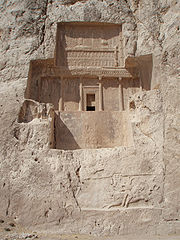 Historians know very little about Darius II's reign. A rebellion by the Medes
in 409 BC is mentioned by Xenophon
. It does seem that Darius II was quite dependent on his wife Parysatis
. In excerpts from Ctesias
some harem
intrigues are recorded, in which he played a disreputable part.
It is likely that Ezra
and Nehemiah
were alive during this monarch's reign, as it was approximately at this time that the new walls of Jerusalem
, demolished during the Babylonian period, were rebuilt .
As long as the power of Athens
remained intact he did not meddle in Greek
affairs. When in 413 BC, Athens supported the rebel Amorges in Caria
, Darius would not have responded had not the Athenian power been broken in the same year at Syracuse. As a result of that event, Darius II gave orders to his satraps in Asia Minor
, Tissaphernes
and Pharnabazus, to send in the overdue tribute of the Greek towns and to begin a war with Athens. To support the war with Athens, the Persian satraps entered into an alliance with Sparta. In 408 BC he sent his son Cyrus
to Asia Minor, to carry on the war with greater energy.
Darius II died in 405 BC, in the nineteenth year of his reign, and was followed as Persian king by Artaxerxes II.
By other wives
Achaemenid Empire
The Achaemenid Empire , sometimes known as First Persian Empire and/or Persian Empire, was founded in the 6th century BCE by Cyrus the Great who overthrew the Median confederation...
from 423 BC to 405 BC.
Artaxerxes I, who died on December 25, 424 BC, was followed by his son Xerxes II. After a month and a half Xerxes II was murdered by his brother Secydianus or Sogdianus (the form of the name is uncertain). His illegitimate brother, Ochus, satrap
Satrap
Satrap was the name given to the governors of the provinces of the ancient Median and Achaemenid Empires and in several of their successors, such as the Sassanid Empire and the Hellenistic empires....
of Hyrcania
Hyrcania
Hyrcania was the name of a satrapy located in the territories of present day Gilan, Golestan, Mazandaran and part of Turkmenistan, lands south of the Caspian Sea. To the Greeks, the Caspian Sea was the "Hyrcanian Sea".-Etymology:...
, rebelled against Sogdianus, and after a short fight killed him, and suppressed by treachery the attempt of his own brother Arsites to imitate his example. Ochus adopted the name Darius (Greek sources often call him Darius Nothos, "Bastard"). Neither the names Xerxes II nor Sogdianus occur in the dates of the numerous Babylon
Babylon
Babylon was an Akkadian city-state of ancient Mesopotamia, the remains of which are found in present-day Al Hillah, Babil Province, Iraq, about 85 kilometers south of Baghdad...
ian tablets from Nippur
Nippur
Nippur was one of the most ancient of all the Sumerian cities. It was the special seat of the worship of the Sumerian god Enlil, the "Lord Wind," ruler of the cosmos subject to An alone...
; here effectively the reign of Darius II follows immediately after that of Artaxerxes I.
Medes
The MedesThe Medes...
in 409 BC is mentioned by Xenophon
Xenophon
Xenophon , son of Gryllus, of the deme Erchia of Athens, also known as Xenophon of Athens, was a Greek historian, soldier, mercenary, philosopher and a contemporary and admirer of Socrates...
. It does seem that Darius II was quite dependent on his wife Parysatis
Parysatis
Parysatis was the 5th-century BCE illegitimate daughter of Artaxerxes I, Emperor of Persia and Andia of Babylon.She was the half-sister of Xerxes II, Sogdianus and Darius II...
. In excerpts from Ctesias
Ctesias
Ctesias of Cnidus was a Greek physician and historian from Cnidus in Caria. Ctesias, who lived in the 5th century BC, was physician to Artaxerxes Mnemon, whom he accompanied in 401 BC on his expedition against his brother Cyrus the Younger....
some harem
Harem
Harem refers to the sphere of women in what is usually a polygynous household and their enclosed quarters which are forbidden to men...
intrigues are recorded, in which he played a disreputable part.
It is likely that Ezra
Ezra
Ezra , also called Ezra the Scribe and Ezra the Priest in the Book of Ezra. According to the Hebrew Bible he returned from the Babylonian exile and reintroduced the Torah in Jerusalem...
and Nehemiah
Nehemiah
Nehemiah ]]," Standard Hebrew Nəḥemya, Tiberian Hebrew Nəḥemyāh) is the central figure of the Book of Nehemiah, which describes his work rebuilding Jerusalem and purifying the Jewish community. He was the son of Hachaliah, Nehemiah ]]," Standard Hebrew Nəḥemya, Tiberian Hebrew Nəḥemyāh) is the...
were alive during this monarch's reign, as it was approximately at this time that the new walls of Jerusalem
Walls of Jerusalem
The Walls of Jerusalem surround the old city of Jerusalem . The walls were built between 1535 and 1538, when Jerusalem was in the Ottoman empire region of Palestine, by order of the Ottoman Sultan Suleiman the Magnificent....
, demolished during the Babylonian period, were rebuilt .
As long as the power of Athens
Athens
Athens , is the capital and largest city of Greece. Athens dominates the Attica region and is one of the world's oldest cities, as its recorded history spans around 3,400 years. Classical Athens was a powerful city-state...
remained intact he did not meddle in Greek
Ancient Greece
Ancient Greece is a civilization belonging to a period of Greek history that lasted from the Archaic period of the 8th to 6th centuries BC to the end of antiquity. Immediately following this period was the beginning of the Early Middle Ages and the Byzantine era. Included in Ancient Greece is the...
affairs. When in 413 BC, Athens supported the rebel Amorges in Caria
Caria
Caria was a region of western Anatolia extending along the coast from mid-Ionia south to Lycia and east to Phrygia. The Ionian and Dorian Greeks colonized the west of it and joined the Carian population in forming Greek-dominated states there...
, Darius would not have responded had not the Athenian power been broken in the same year at Syracuse. As a result of that event, Darius II gave orders to his satraps in Asia Minor
Asia Minor
Asia Minor is a geographical location at the westernmost protrusion of Asia, also called Anatolia, and corresponds to the western two thirds of the Asian part of Turkey...
, Tissaphernes
Tissaphernes
Tissaphernes was a Persian soldier and statesman, grandson of Hydarnes.In 413 BC he was satrap of Lydia and Caria, and commander in chief of the Persian army in Asia Minor...
and Pharnabazus, to send in the overdue tribute of the Greek towns and to begin a war with Athens. To support the war with Athens, the Persian satraps entered into an alliance with Sparta. In 408 BC he sent his son Cyrus
Cyrus the Younger
Cyrus the Younger, son of Darius II of Persia and Parysatis, was a Persian prince and general. The time of his birth is unknown, but he died in 401 B.C. The history of Cyrus and of the retreat of the Greeks is told by Xenophon in his Anabasis. Another account, probably from Sophaenetus of...
to Asia Minor, to carry on the war with greater energy.
Darius II died in 405 BC, in the nineteenth year of his reign, and was followed as Persian king by Artaxerxes II.
Offspring
By ParysatisParysatis
Parysatis was the 5th-century BCE illegitimate daughter of Artaxerxes I, Emperor of Persia and Andia of Babylon.She was the half-sister of Xerxes II, Sogdianus and Darius II...
- Artaxerxes II
- Cyrus the YoungerCyrus the YoungerCyrus the Younger, son of Darius II of Persia and Parysatis, was a Persian prince and general. The time of his birth is unknown, but he died in 401 B.C. The history of Cyrus and of the retreat of the Greeks is told by Xenophon in his Anabasis. Another account, probably from Sophaenetus of...
- Oxathres or Oxendares or Oxendras
- Artoxexes
- OstanesOstanes (son of Darius II)Ostanes , was son of Darius II of Persia and Parysatis. He was also the father of Arsames II and grandfather of Darius III of Persia, the last Emperor of Achaemenid Empire....
- Amestris wife of Teritouchmes & then Artaxerxes II
- & seven other unnamed children
By other wives
- Artostes
- The unnamed satrap of MediaMedesThe MedesThe Medes...
at 401 B.C.