


Artabanus II of Parthia

Encyclopedia
Parthia
Parthia is a region of north-eastern Iran, best known for having been the political and cultural base of the Arsacid dynasty, rulers of the Parthian Empire....
from about AD 10
10
Year 10 was a common year starting on Wednesday of the Julian calendar. At the time, throughout Roman Empire, it was known as the year of the consulship of Dolabella and Silanus...
to 38. He was the son of a princess of the Arsacid Dynasty, who lived in the East among the Dahan nomads. He was raised to the throne by those Parthian grandee
Grandee
Grandee is the word used to render in English the Iberic high aristocratic title Grande , used by the Spanish nobility; Portuguese nobility, and Brazilian nobility....
s, who would not acknowledge Vonones I
Vonones I of Parthia
Vonones I of Parthia ruled the Parthian Empire from about 8 to 12 AD. He was the eldest son of Phraates IV of Parthia Vonones I of Parthia (ΟΝΩΝΗΣ on his coins) ruled the Parthian Empire from about 8 to 12 AD. He was the eldest son of Phraates IV of Parthia Vonones I of Parthia (ΟΝΩΝΗΣ on his...
, whom the Roman Emperor
Roman Emperor
The Roman emperor was the ruler of the Roman State during the imperial period . The Romans had no single term for the office although at any given time, a given title was associated with the emperor...
Augustus had sent from Rome
Rome
Rome is the capital of Italy and the country's largest and most populated city and comune, with over 2.7 million residents in . The city is located in the central-western portion of the Italian Peninsula, on the Tiber River within the Lazio region of Italy.Rome's history spans two and a half...
(where he lived as hostage) as successor of his father Phraates IV
Phraates IV of Parthia
King Phraates IV of Parthia, son of Orodes II, ruled the Parthian Empire from 37–2 BC. He was appointed successor to the throne in 37 BC, after the death of his brother Pacorus I...
.
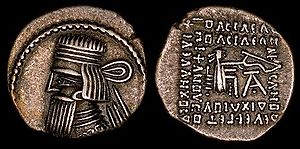
The war between the two pretenders was long and doubtful; on a coin Vonones mentions a victory over Artabanus. At last Artabanus defeated his rival completely and occupied the Parthian capital Ctesiphon
Ctesiphon
Ctesiphon, the imperial capital of the Parthian Arsacids and of the Persian Sassanids, was one of the great cities of ancient Mesopotamia.The ruins of the city are located on the east bank of the Tigris, across the river from the Hellenistic city of Seleucia...
. Vonones fled to Armenia
Armenia
Armenia , officially the Republic of Armenia , is a landlocked mountainous country in the Caucasus region of Eurasia...
, where he was acknowledged as king, under the protection of the Romans. But when Artabanus invaded Armenia, Vonones fled to Syria
Syria
Syria , officially the Syrian Arab Republic , is a country in Western Asia, bordering Lebanon and the Mediterranean Sea to the West, Turkey to the north, Iraq to the east, Jordan to the south, and Israel to the southwest....
, and the emperor Tiberius
Tiberius
Tiberius , was Roman Emperor from 14 AD to 37 AD. Tiberius was by birth a Claudian, son of Tiberius Claudius Nero and Livia Drusilla. His mother divorced Nero and married Augustus in 39 BC, making him a step-son of Octavian...
thought it prudent to support him no longer. Tiberius' nephew and heir Germanicus
Germanicus
Germanicus Julius Caesar , commonly known as Germanicus, was a member of the Julio-Claudian dynasty and a prominent general of the early Roman Empire. He was born in Rome, Italia, and was named either Nero Claudius Drusus after his father or Tiberius Claudius Nero after his uncle...
, whom he sent to the East, concluded a treaty with Artabanus, in which he was recognized as king and friend of the Romans. Armenia was given in AD 18
18
Year 18 was a common year starting on Saturday of the Julian calendar. At the time, it was known as the Year of the Consulship of Augustus and Caesar...
to Zeno
Artaxias III
Artaxias III, also known as Zeno-Artaxias, Artaxes or Artashes was a prince of the Bosporan, Pontus, Cilicia, Cappadocia and Roman Client King of Armenia....
, the son of the king of Pontus
Pontus
Pontus or Pontos is a historical Greek designation for a region on the southern coast of the Black Sea, located in modern-day northeastern Turkey. The name was applied to the coastal region in antiquity by the Greeks who colonized the area, and derived from the Greek name of the Black Sea: Πόντος...
.
Artabanus, like all Parthian princes, was much troubled by the opposition of the grandees. He is said to have been very cruel in consequence of his education among the Dahan barbarians. To strengthen his power he killed all the Arsacid princes whom he could reach. Rebellions of the subject nations may have occurred also. We learn that he intervened in the Greek city Seleucia on the Tigris
Seleucia on the Tigris
Seleucia , also known as Seleucia on the Tigris, was one of the great cities of the world during Hellenistic and Roman times. It stood in Mesopotamia, on the west bank of the Tigris River, opposite the smaller town of Ctesiphon, in present day Babil Governorate, Iraq.-Seleucid empire:Seleucia,...
in favour of the oligarch
Oligarchy
Oligarchy is a form of power structure in which power effectively rests with an elite class distinguished by royalty, wealth, family ties, commercial, and/or military legitimacy...
s, and that two Jewish brigands, Anilai and Asinai
Anilai and Asinai
Anilai and Asinai were two Babylonian-Jewish robber chieftains of the Parthian Empire whose exploits were reported by Josephus.They were apprenticed by their widowed mother to a weaver. Having been punished for laziness by their master, they ran away and became freebooters in the marshlands of the...
, maintained themselves for years in Neerda in the swamps of Babylonia
Babylonia
Babylonia was an ancient cultural region in central-southern Mesopotamia , with Babylon as its capital. Babylonia emerged as a major power when Hammurabi Babylonia was an ancient cultural region in central-southern Mesopotamia (present-day Iraq), with Babylon as its capital. Babylonia emerged as...
, and were acknowledged as dynasts by Artabanus.
In 35, he tried anew to conquer Armenia, and to establish his son Arsaces as king there. A war with Rome seemed inevitable. But that party among the Parthian magnates which was hostile to Artabanus applied to Tiberius for a king of the race of Phraates. Tiberius sent Phraates's grandson, Tiridates III
Tiridates III of Parthia
Tiridates III of Parthia ruled the Parthian Empire briefly in 35–36. He was the grandson of Phraates IV. He was sent to Rome as a hostage and was educated there....
, and ordered Lucius Vitellius
Lucius Vitellius
Lucius Vitellius the Elder was the youngest of four sons of quaestor Publius Vitellius and the only one that did not die through politics. Under Emperor Tiberius, he was Consul in 34 and Governor of Syria in 35. He deposed Pontius Pilate in 36 after complaints from the people in Samaria...
(the father of the emperor Vitellius
Vitellius
Vitellius , was Roman Emperor for eight months, from 16 April to 22 December 69. Vitellius was acclaimed Emperor following the quick succession of the previous emperors Galba and Otho, in a year of civil war known as the Year of the Four Emperors...
) to restore the Roman authority in the East. By very dexterous military and diplomatic operations Vitellius succeeded completely. Artabanus was deserted by his followers and fled to the East. Tiridates, who was proclaimed king, could no longer maintain himself, because he appeared to be a vassal of the Romans; Artabanus returned from Hyrcania
Hyrcania
Hyrcania was the name of a satrapy located in the territories of present day Gilan, Golestan, Mazandaran and part of Turkmenistan, lands south of the Caspian Sea. To the Greeks, the Caspian Sea was the "Hyrcanian Sea".-Etymology:...
with a strong army of Scythian (Dahan) auxiliaries, and was again acknowledged by the Parthians. Tiridates left Seleucia and fled to Syria
Syria
Syria , officially the Syrian Arab Republic , is a country in Western Asia, bordering Lebanon and the Mediterranean Sea to the West, Turkey to the north, Iraq to the east, Jordan to the south, and Israel to the southwest....
. But Artabanus was not strong enough for a war with Rome; he therefore concluded a treaty with Vitellius in 37, in which he gave up all further pretensions. A short time after-wards Artabanus was deposed again, and a certain Cinnamus was proclaimed king. Artabanus took refuge with his vassal, the king Izates of Adiabene; and Izates by negotiations and the promise of a complete pardon induced the Parthians to restore Artabanus once more to the throne. Shortly afterwards Artabanus died, and was succeeded by his son, Vardanes
Vardanes I of Parthia
Vardanes I of Parthia ruled the Parthian Empire from about 40–45. He succeeded his father Artabanus II, but had to continually fight against Gotarzes II, a rival claimant to the throne....
, whose reign was still more turbulent than that of his father.