


Bahram II

Encyclopedia
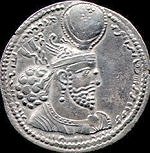
Sassanid Empire
The Sassanid Empire , known to its inhabitants as Ērānshahr and Ērān in Middle Persian and resulting in the New Persian terms Iranshahr and Iran , was the last pre-Islamic Persian Empire, ruled by the Sasanian Dynasty from 224 to 651...
in 276–293. He was the son of Bahram I
Bahram I
Bahram I was the fourth Sassanid emperor of the second Persian Empire. He was the eldest son of Shapur I and succeeded his brother Hormizd I , who had reigned for only a year....
(273–276).
Bahram II is said to have ruled at first tyrannically, and to have greatly disgusted all his principal nobles, who went so far as to form a conspiracy against him, and intended to put him to death. The chief of the Magi
Magi
Magi is a term, used since at least the 4th century BC, to denote a follower of Zoroaster, or rather, a follower of what the Hellenistic world associated Zoroaster with, which...
, however, interposed, and, having effectually alarmed the king, brought him to acknowledge his wrong and to promise an entire change of conduct. The nobles upon this returned to their allegiance; and Bahram, during the remainder of his reign, is said to have been distinguished for wisdom and moderation, and to have rendered himself popular with every class of his subjects.
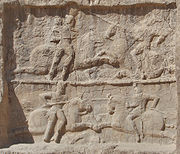
Bahram is believed to have been involved in a campaign in Sakasthan (the modern-day Sistan) and Afghanistan against his brother Hormizd. The hostilities ended in 283 with his victory in Sakasthan. He later had rock reliefs cut at Bishapur
Bishapur
thumb|Irano-Roman floor mosaic detail from the palace of [[Shapur I]] at BishapurBishapur is an ancient city situated south of modern Faliyan, Iran on the ancient road between Persis and Elam. The road linked the Sassanid capitals Istakhr and Ctesiphon...
and Naqsh-e Rustam
Naqsh-e Rustam
Naqsh-e Rustam also referred to as Necropolis is an archaeological site located about 12 km northwest of Persepolis, in Fars province, Iran. Naqsh-e Rustam lies a few hundred meters from Naqsh-e Rajab....
to commemorate his victory.
Hostilities with Rome
Roman Emperor
The Roman emperor was the ruler of the Roman State during the imperial period . The Romans had no single term for the office although at any given time, a given title was associated with the emperor...
Carus
Carus
Carus , was Roman Emperor from 282 to 283. During his short reign, Carus fought the Germanic tribes and Sarmatians along the Danube frontier with success. During his campaign against the Sassanid Empire he sacked their capital Ctesiphon, but died shortly thereafter...
crossed the Euphrates along with his troops and invaded Mesopotamia
Mesopotamia
Mesopotamia is a toponym for the area of the Tigris–Euphrates river system, largely corresponding to modern-day Iraq, northeastern Syria, southeastern Turkey and southwestern Iran.Widely considered to be the cradle of civilization, Bronze Age Mesopotamia included Sumer and the...
wreaking havoc. Bahram II was not able to offer any resistance as his troops were occupied with the campaign in Afghanistan. Mesopotamia
Mesopotamia
Mesopotamia is a toponym for the area of the Tigris–Euphrates river system, largely corresponding to modern-day Iraq, northeastern Syria, southeastern Turkey and southwestern Iran.Widely considered to be the cradle of civilization, Bronze Age Mesopotamia included Sumer and the...
was ravaged and the cities of Selucia and Ctesiphon were occupied by the Roman troops. However, as an oracle had predicted earlier, the death of Carus cut short his career as well as the Roman advance.
Following Carus's death, the Romans retreated and Carus's son, Numerian
Numerian
Numerian , was a Roman Emperor from 282 to 284 with his older brother Carinus. They were sons of Carus, a general raised to the office of praetorian prefect under Emperor Probus in 282.-Reign:...
, concluded peace with the Persians.
In A.D. 286, however, the celebrated Diocletian
Diocletian
Diocletian |latinized]] upon his accession to Diocletian . c. 22 December 244 – 3 December 311), was a Roman Emperor from 284 to 305....
resumed hostilities with Persia, and marched into Persian territory in aid of the Armenian prince Tiridates
Tiridates III of Armenia
Tiridates III or Diritades III was the king of Arsacid Armenia , and is also known as Tiridates the Great ; some scholars incorrectly refer to him as Tiridates IV as a result of the fact that Tiridates I of Armenia reigned twice)...
who was in rebellion against Persia. Armenia was separated after a couple of battles and Tiridates declared himself independent.
Tiridates achieved extraordinary success during this period. He defeated two Persian armies in the open field, drove out the garrisons which held the more important of the fortified towns, and became undisputed master of Armenia. He even crossed the border which separated Armenia from Persia, and gained signal victories on admitted Persian ground.
Bahram II died soon afterwards in an extremely dejected state.
Of Bahram II's reign some theological inscriptions exist (F. Stolze and J.C. Andreas, Persepolis (1882), and E.W. West, "Pahlavi Literature" in Grundriss d. iranischen Philologie, ii. pp. 75–129).