

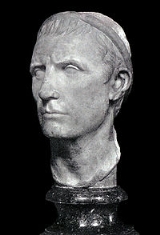
Antiochus III the Great

Encyclopedia
Antiochus III the Great Seleucid Greek
king who became the 6th ruler of the Seleucid Empire
as a youth of about eighteen in 223 BC. Antiochus was an ambitious ruler who ruled over Greater Syria
and western Asia towards the end of the 3rd century BC. Although his early attempts in war against the Ptolemaic Kingdom
were unsuccessful, in the following years of conquest Antiochus proved himself the most successful Seleucid King after Seleucus I. His traditional designation, the Great, reflects an epithet he briefly assumed. Antiochus also assumed the title "Basileus Megas" (which is Greek
for "Great King"), the traditional title of the Persian kings
.
Self-declaring himself the "champion of Greek freedom against Roman domination", Antiochus III waged a war against the Roman Republic
in mainland Greece in autumn of 192 BC.
Seleucid dynasty
, he was the son of king Seleucus II and Laodice II and was born in 242 BC near Susa
in Iran
. Antiochus succeeded his brother Seleucus III as the king of the Seleucid Empire.
Antiochus III inherited a disorganized state. Not only had Asia Minor
become detached, but the easternmost provinces had broken away, Bactria
under the Greek Diodotus of Bactria, and Parthia
under the nomad chieftain Arsaces
. Soon after Antiochus's accession, Media
and Persis revolted under their governors, the brothers Molon
and Alexander
.
The young king, under the baneful influence of the minister Hermeias
, authorised an attack on Ptolemaic Syria instead of going in person to face the rebels. The attack against Egypt of the Ptolemies proved a fiasco, and the generals sent against Molon and Alexander met with disaster. Only in Asia Minor, where the king's cousin, the able Achaeus
represented the Seleucid cause, did its prestige recover, driving the Pergamene power back to its earlier limits.
In 221 BC Antiochus at last went east, and the rebellion of Molon and Alexander collapsed which Polybios attributes in part to his following the advice of Zeuxis
rather than Hermeias. The submission of Lesser Media, which had asserted its independence under Artabazanes, followed. Antiochus rid himself of Hermeias by assassination and returned to Syria
(220 BC). Meanwhile Achaeus himself had revolted and assumed the title of king in Asia Minor. Since, however, his power was not well enough grounded to allow an attack on Syria, Antiochus considered that he might leave Achaeus for the present and renew his attempt on Ptolemaic Syria.
, but in 217 BC Ptolemy IV
defeated Antiochus at the Battle of Raphia
. This defeat nullified all Antiochus's successes and compelled him to withdraw north of the Lebanon
.
In 216 BC Antiochus' army marched into western Anatolia to suppress the local rebellion led by Antiochus' own cousin Achaeus
, and had by 214 BC driven him from the field into Sardis
. Capturing Achaeus, Antiochus had him executed. The citadel managed to hold out until 213 BC under Achaeus' widow Laodice
who surrendered later.
Having thus recovered the central part of Asia Minor (for the Seleucid government had perforce to tolerate the dynasties in Pergamon
, Bithynia
and Cappadocia
) Antiochus turned to recover the outlying provinces of the north and east. He obliged Xerxes of Armenia
to acknowledge his supremacy in 212 BC. In 209 BC Antiochus invaded Parthia
, occupied the capital Hecatompylus and pushed forward into Hyrcania
. The Parthian king Arsaces II
apparently successfully sued for peace.
, where the Greco-Bactrian king Euthydemus I
had supplanted the original rebel. Antiochus again met with success. After sustaining a famous siege in his capital Bactra (Balkh), Euthydemus obtained an honourable peace by which Antiochus promised Euthydemus' son Demetrius
the hand of one of his daughters.
Antiochus next, following in the steps of Alexander, crossed into the Kabul
valley, reaching the realm of India
n king Sophagasenus
and returned west by way of Seistan and Kerman (206/5). According to Polybius
:
he led a short expedition down the Persian Gulf
against the Gerrha
eans of the Arabian coast (205 BC/204 BC). Antiochus seemed to have restored the Seleucid empire in the east, which him the title of "the Great" (Antiochos Megas). In 205/204 BC the infant Ptolemy V Epiphanes succeeded to the Egyptian throne, and Antiochus is said (notably by Polybios) to have concluded a secret pact with Philip V of Macedon
for the partition of the Ptolemaic possessions. Under the terms of this pact, Macedon
were to receive Egypt's possessions around the Aegean Sea and Cyrene
, while Antiochus would annex Cyprus
and Egypt.
Once more Antiochus attacked the Ptolemaic province of Coele Syria and Phoenicia, and by 199 BC he seems to have had possession of it before the Aetolian, Scopas
, recovered it for Ptolemy. But that recovery proved brief, for in 198 BC Antiochus defeated Scopas at the Battle of Panium
, near the sources of the Jordan, a battle which marks the end of Ptolemaic rule in Judea
.
, since Smyrna
and Lampsacus
appealed to the republic of the west, and the tension grew after Antiochus had in 196 BC established a footing in Thrace
. The evacuation of Greece by the Romans gave Antiochus his opportunity, and he now had the fugitive Hannibal at his court to urge him on.
In 192 BC Antiochus invaded Greece with a 10,000 man army, and was elected the commander in chief of the Aetolian League
. In 191 BC, however, the Romans under Manius Acilius Glabrio
routed him at Thermopylae
, forcing him to withdraw to Asia Minor. The Romans followed up their success by invading Anatolia
, and the decisive victory of Scipio Asiaticus
at Magnesia ad Sipylum
(190 BC), following the defeat of Hannibal at sea off Side
, delivered Asia Minor into their hands.
By the Treaty of Apamea
(188 BC) the Seleucid king abandoned all the country north of the Taurus
, which the Roman Republic distributed amongst its local allies. As a consequence of this blow to the Seleucid power, the outlying provinces of the empire, recovered by Antiochus, reasserted their independence. Antiochus mounted a fresh eastern expedition in Luristan, where he died on while pillaging a temple of Bel
at Elymaïs
, Persia, in 187 BC.
, a daughter of King Mithridates II of Pontus
and Princess Laodice of the Seleucid Empire
. The couple were first cousins through their mutual grandfather, Antiochus II Theos
. Antiochus and Laodice had eight children (three sons and five daughters):
Laodice III died in about 191 BC. Later that year, Antiochus III remarried to Euboea of Chalcis. They had no children.
into the Hellenistic Anatolian regions of Lydia
and Phrygia
. He is not the king who oppressed Judea and was resisted by the Maccabees in the Jewish story of Hanukkah
; rather, that was his son, Antiochus IV. On the contrary, Josephus portrays him as friendly towards the Jews and cognizant of their loyalty to him (see Antiquities, chapter 3, sections 3-4), in stark contrast to the attitude of his son. In fact, Antiochus III lowered taxes and let the Jews live, as Josephus puts it, "according to the law of their forefathers."
play Believe as You List
is centered around Antiochus resistance to the Romans after the Battle of Thermopylae
. The play was originally about Sebastian of Portugal
surviving the Battle of Alcazar and returning, trying to gather support to return to the throne. This first version was censored for being considered "subversive" because it portrayed Sebastian being deposed, its comments in favor of an Anglo-Spanish alliance and possible pro-Catholicism
, which led to the final version changing to the story of Antiochus (which led to historical innacuracy in exaggerating his defeat at that phase in history to fit the earlier text), turning Spaniards into Romans and the Catholic eremite into a stoic
philosopher.
Greeks
The Greeks, also known as the Hellenes , are a nation and ethnic group native to Greece, Cyprus and neighboring regions. They also form a significant diaspora, with Greek communities established around the world....
king who became the 6th ruler of the Seleucid Empire
Seleucid Empire
The Seleucid Empire was a Greek-Macedonian state that was created out of the eastern conquests of Alexander the Great. At the height of its power, it included central Anatolia, the Levant, Mesopotamia, Persia, today's Turkmenistan, Pamir and parts of Pakistan.The Seleucid Empire was a major centre...
as a youth of about eighteen in 223 BC. Antiochus was an ambitious ruler who ruled over Greater Syria
Greater Syria
Greater Syria , also known simply as Syria, is a term that denotes a region in the Near East bordering the Eastern Mediterranean Sea or the Levant....
and western Asia towards the end of the 3rd century BC. Although his early attempts in war against the Ptolemaic Kingdom
Ptolemaic Kingdom
The Ptolemaic Kingdom in and around Egypt began following Alexander the Great's conquest in 332 BC and ended with the death of Cleopatra VII and the Roman conquest in 30 BC. It was founded when Ptolemy I Soter declared himself Pharaoh of Egypt, creating a powerful Hellenistic state stretching from...
were unsuccessful, in the following years of conquest Antiochus proved himself the most successful Seleucid King after Seleucus I. His traditional designation, the Great, reflects an epithet he briefly assumed. Antiochus also assumed the title "Basileus Megas" (which is Greek
Greek language
Greek is an independent branch of the Indo-European family of languages. Native to the southern Balkans, it has the longest documented history of any Indo-European language, spanning 34 centuries of written records. Its writing system has been the Greek alphabet for the majority of its history;...
for "Great King"), the traditional title of the Persian kings
Shah
Shāh is the title of the ruler of certain Southwest Asian and Central Asian countries, especially Persia , and derives from the Persian word shah, meaning "king".-History:...
.
Self-declaring himself the "champion of Greek freedom against Roman domination", Antiochus III waged a war against the Roman Republic
Roman Republic
The Roman Republic was the period of the ancient Roman civilization where the government operated as a republic. It began with the overthrow of the Roman monarchy, traditionally dated around 508 BC, and its replacement by a government headed by two consuls, elected annually by the citizens and...
in mainland Greece in autumn of 192 BC.
Background and early career
Antiochus III was a member of the Greek-MacedonianAncient Macedonians
The Macedonians originated from inhabitants of the northeastern part of the Greek peninsula, in the alluvial plain around the rivers Haliacmon and lower Axios...
Seleucid dynasty
Seleucid dynasty
The Seleucid dynasty or the Seleucidae was a Greek Macedonian royal family, founded by Seleucus I Nicator , which ruled the Seleucid Kingdom centered in the Near East and regions of the Asian part of the earlier Achaemenid Persian Empire during the Hellenistic period.-History:Seleucus was an...
, he was the son of king Seleucus II and Laodice II and was born in 242 BC near Susa
Susa
Susa was an ancient city of the Elamite, Persian and Parthian empires of Iran. It is located in the lower Zagros Mountains about east of the Tigris River, between the Karkheh and Dez Rivers....
in Iran
Iran
Iran , officially the Islamic Republic of Iran , is a country in Southern and Western Asia. The name "Iran" has been in use natively since the Sassanian era and came into use internationally in 1935, before which the country was known to the Western world as Persia...
. Antiochus succeeded his brother Seleucus III as the king of the Seleucid Empire.
Antiochus III inherited a disorganized state. Not only had Asia Minor
Anatolia
Anatolia is a geographic and historical term denoting the westernmost protrusion of Asia, comprising the majority of the Republic of Turkey...
become detached, but the easternmost provinces had broken away, Bactria
Bactria
Bactria and also appears in the Zend Avesta as Bukhdi. It is the ancient name of a historical region located between south of the Amu Darya and west of the Indus River...
under the Greek Diodotus of Bactria, and Parthia
Parthia
Parthia is a region of north-eastern Iran, best known for having been the political and cultural base of the Arsacid dynasty, rulers of the Parthian Empire....
under the nomad chieftain Arsaces
Arsaces I of Parthia
Arsaces I was the founder of the Arsacid dynasty, and after whom all 30+ monarchs of the Arsacid empire officially named themselves. A celebrated descent from antiquity begins with Arsaces.A 1st century AD tradition casts Arsaces as descending from the 5th-century BC Achaemenid monarch...
. Soon after Antiochus's accession, Media
Medes
The MedesThe Medes...
and Persis revolted under their governors, the brothers Molon
Molon
Molon or Molo was a general and satrap of the Seleucid king Antiochus the Great . He held the satrapy of Media at the accession of that monarch ; in addition to which, Antiochus conferred upon him and his brother Alexander the government of all the upper provinces of his empire...
and Alexander
Alexander (satrap)
Alexander was brother of Molon. On the accession of the Seleucid king Antiochus III, afterwards called the Great, in 223 BC, he entrusted Alexander with the government of the satrapy of Persis and Molon received Media...
.
The young king, under the baneful influence of the minister Hermeias
Hermeias
Hermeias was a Carian by birth, who had raised himself to be the favourite and chief minister of Seleucus III Ceraunus , and was left at the head of affairs in Syria by that monarch when he set out on the expedition across the Taurus Mountains, in the course of which Seleucus met with his death,...
, authorised an attack on Ptolemaic Syria instead of going in person to face the rebels. The attack against Egypt of the Ptolemies proved a fiasco, and the generals sent against Molon and Alexander met with disaster. Only in Asia Minor, where the king's cousin, the able Achaeus
Achaeus (general)
Achaeus was a general and later a separatist ruler of part of the Greek Seleucid kingdom. He was the son of Andromachus, whose sister Laodice II, married Seleucus Callinicus, the father of Antiochus III the Great. Achaeus himself married Laodice of Pontus, one of the daughters to Laodice and...
represented the Seleucid cause, did its prestige recover, driving the Pergamene power back to its earlier limits.
In 221 BC Antiochus at last went east, and the rebellion of Molon and Alexander collapsed which Polybios attributes in part to his following the advice of Zeuxis
Zeuxis (general)
Zeuxis was a general in the service of the Seleucid king Antiochus III the Great at the end of the 3rd century BC. He served in Mesopotamia against the rebel Molon, was a general at the Battle of Magnesia and after that defeat went to Rome to negotiate a peace.- Career :He was engaged in 221 BC in...
rather than Hermeias. The submission of Lesser Media, which had asserted its independence under Artabazanes, followed. Antiochus rid himself of Hermeias by assassination and returned to Syria
Syria
Syria , officially the Syrian Arab Republic , is a country in Western Asia, bordering Lebanon and the Mediterranean Sea to the West, Turkey to the north, Iraq to the east, Jordan to the south, and Israel to the southwest....
(220 BC). Meanwhile Achaeus himself had revolted and assumed the title of king in Asia Minor. Since, however, his power was not well enough grounded to allow an attack on Syria, Antiochus considered that he might leave Achaeus for the present and renew his attempt on Ptolemaic Syria.
Early wars against other Hellenistic rulers
The campaigns of 219 BC and 218 BC carried the Seleucid armies almost to the confines of Ptolemaic KingdomPtolemaic Kingdom
The Ptolemaic Kingdom in and around Egypt began following Alexander the Great's conquest in 332 BC and ended with the death of Cleopatra VII and the Roman conquest in 30 BC. It was founded when Ptolemy I Soter declared himself Pharaoh of Egypt, creating a powerful Hellenistic state stretching from...
, but in 217 BC Ptolemy IV
Ptolemy IV Philopator
Ptolemy IV Philopator , son of Ptolemy III and Berenice II of Egypt was the fourth Pharaoh of Ptolemaic Egypt...
defeated Antiochus at the Battle of Raphia
Battle of Raphia
The Battle of Raphia, also known as the Battle of Gaza, was a battle fought on 22 June 217 BC near modern Rafah between the forces of Ptolemy IV Philopator, king of Egypt and Antiochus III the Great of the Seleucid kingdom during the Syrian Wars...
. This defeat nullified all Antiochus's successes and compelled him to withdraw north of the Lebanon
Lebanon
Lebanon , officially the Republic of LebanonRepublic of Lebanon is the most common term used by Lebanese government agencies. The term Lebanese Republic, a literal translation of the official Arabic and French names that is not used in today's world. Arabic is the most common language spoken among...
.
In 216 BC Antiochus' army marched into western Anatolia to suppress the local rebellion led by Antiochus' own cousin Achaeus
Achaeus (general)
Achaeus was a general and later a separatist ruler of part of the Greek Seleucid kingdom. He was the son of Andromachus, whose sister Laodice II, married Seleucus Callinicus, the father of Antiochus III the Great. Achaeus himself married Laodice of Pontus, one of the daughters to Laodice and...
, and had by 214 BC driven him from the field into Sardis
Sardis
Sardis or Sardes was an ancient city at the location of modern Sart in Turkey's Manisa Province...
. Capturing Achaeus, Antiochus had him executed. The citadel managed to hold out until 213 BC under Achaeus' widow Laodice
Laodice of Pontus
Laodice , was a Princess of Pontus and was one of the daughters of Mithridates II of Pontus and Laodice. She sister was Laodice III the first wife of Antiochus III the Great and her brother was Mithridates III of Pontus. She married her distant maternal cousin the Seleucid general Achaeus...
who surrendered later.
Having thus recovered the central part of Asia Minor (for the Seleucid government had perforce to tolerate the dynasties in Pergamon
Pergamon
Pergamon , or Pergamum, was an ancient Greek city in modern-day Turkey, in Mysia, today located from the Aegean Sea on a promontory on the north side of the river Caicus , that became the capital of the Kingdom of Pergamon during the Hellenistic period, under the Attalid dynasty, 281–133 BC...
, Bithynia
Bithynia
Bithynia was an ancient region, kingdom and Roman province in the northwest of Asia Minor, adjoining the Propontis, the Thracian Bosporus and the Euxine .-Description:...
and Cappadocia
Cappadocia
Cappadocia is a historical region in Central Anatolia, largely in Nevşehir Province.In the time of Herodotus, the Cappadocians were reported as occupying the whole region from Mount Taurus to the vicinity of the Euxine...
) Antiochus turned to recover the outlying provinces of the north and east. He obliged Xerxes of Armenia
Xerxes of Armenia
Xerxes .He succeeded his father Arsames I to rule both Sophene and Commagene in 228 BC, his brother Orontes IV ruled Armenia....
to acknowledge his supremacy in 212 BC. In 209 BC Antiochus invaded Parthia
Parthia
Parthia is a region of north-eastern Iran, best known for having been the political and cultural base of the Arsacid dynasty, rulers of the Parthian Empire....
, occupied the capital Hecatompylus and pushed forward into Hyrcania
Hyrcania
Hyrcania was the name of a satrapy located in the territories of present day Gilan, Golestan, Mazandaran and part of Turkmenistan, lands south of the Caspian Sea. To the Greeks, the Caspian Sea was the "Hyrcanian Sea".-Etymology:...
. The Parthian king Arsaces II
Arsaces II of Parthia
Arsaces II, also Artabanus I, of the Arsacid dynasty was King of Parthia between 211 BC and 191 BC. Greek 'Arsaces' appears as 'Artabanus' in Latin sources, and both forms appear in history books....
apparently successfully sued for peace.
Bactrian campaign and Indian expedition
Year 209 BC saw Antiochus in BactriaBactria
Bactria and also appears in the Zend Avesta as Bukhdi. It is the ancient name of a historical region located between south of the Amu Darya and west of the Indus River...
, where the Greco-Bactrian king Euthydemus I
Euthydemus I
Euthydemus I , Greco-Bactrian king in about 230 or 223 BCE according to Polybius., he is thought to have originally been a Satrap of Sogdiana, who overturned the dynasty of Diodotus of Bactria and became a Greco-Bactrian king. Strabo, on the other hand, correlates his accession with internal...
had supplanted the original rebel. Antiochus again met with success. After sustaining a famous siege in his capital Bactra (Balkh), Euthydemus obtained an honourable peace by which Antiochus promised Euthydemus' son Demetrius
Demetrius I of Bactria
Demetrius I was a Buddhist Greco-Bactrian king . He was the son of Euthydemus and succeeded him around 200 BC, after which he conquered extensive areas in what now is eastern Iran, Afghanistan and Pakistan thus creating an Indo-Greek kingdom far from Hellenistic Greece...
the hand of one of his daughters.
Antiochus next, following in the steps of Alexander, crossed into the Kabul
Kabul
Kabul , spelt Caubul in some classic literatures, is the capital and largest city of Afghanistan. It is also the capital of the Kabul Province, located in the eastern section of Afghanistan...
valley, reaching the realm of India
India
India , officially the Republic of India , is a country in South Asia. It is the seventh-largest country by geographical area, the second-most populous country with over 1.2 billion people, and the most populous democracy in the world...
n king Sophagasenus
Sophagasenus
Sophagasenos also spelt Sophagasenus or Sophagasenas was a local Indian king ruling in Kabul and Kapisa valley during the last decade of 3rd century BC. Sophagasnus finds reference only in "The Histories" of Polybius. The identity of Sophagasenus is not clear...
and returned west by way of Seistan and Kerman (206/5). According to Polybius
Polybius
Polybius , Greek ) was a Greek historian of the Hellenistic Period noted for his work, The Histories, which covered the period of 220–146 BC in detail. The work describes in part the rise of the Roman Republic and its gradual domination over Greece...
:
- "He crossed the Caucasus (Hindu KushHindu KushThe Hindu Kush is an mountain range that stretches between central Afghanistan and northern Pakistan. The highest point in the Hindu Kush is Tirich Mir in the Chitral region of Khyber-Pakhtunkhwa, Pakistan.It is the westernmost extension of the Pamir Mountains, the Karakoram Range, and is a...
) and descended into India; renewed his friendship with SophagasenusSophagasenusSophagasenos also spelt Sophagasenus or Sophagasenas was a local Indian king ruling in Kabul and Kapisa valley during the last decade of 3rd century BC. Sophagasnus finds reference only in "The Histories" of Polybius. The identity of Sophagasenus is not clear...
(Subhashsena in Prakrit) the king of the Indians; received more elephants, until he had a hundred and fifty altogether; and having once more provisioned his troops, set out again personally with his army: leaving Androsthenes of CyzicusAndrosthenes of CyzicusAndrosthenes of Cyzicus was a Greek from the city of Cyzicus in Asia Minor, who lived around 200 BCE. He accompanied Antiochus III the Great to India in 206 BCE...
the duty of taking home the treasure which this king had agreed to hand over to him."
Persia and Coele Syria campaigns
From Seleucia on the TigrisSeleucia on the Tigris
Seleucia , also known as Seleucia on the Tigris, was one of the great cities of the world during Hellenistic and Roman times. It stood in Mesopotamia, on the west bank of the Tigris River, opposite the smaller town of Ctesiphon, in present day Babil Governorate, Iraq.-Seleucid empire:Seleucia,...
he led a short expedition down the Persian Gulf
Persian Gulf
The Persian Gulf, in Southwest Asia, is an extension of the Indian Ocean located between Iran and the Arabian Peninsula.The Persian Gulf was the focus of the 1980–1988 Iran-Iraq War, in which each side attacked the other's oil tankers...
against the Gerrha
Gerrha
Gerrha , was an ancient city of Arabia, on the west side of the Persian Gulf. More accurately, the ancient city of Gerrha has been determined to have existed near or under the present fort of Uqair. This fort is 50 miles northeast of Al-Hasa in the Eastern Province of Saudi Arabia...
eans of the Arabian coast (205 BC/204 BC). Antiochus seemed to have restored the Seleucid empire in the east, which him the title of "the Great" (Antiochos Megas). In 205/204 BC the infant Ptolemy V Epiphanes succeeded to the Egyptian throne, and Antiochus is said (notably by Polybios) to have concluded a secret pact with Philip V of Macedon
Philip V of Macedon
Philip V was King of Macedon from 221 BC to 179 BC. Philip's reign was principally marked by an unsuccessful struggle with the emerging power of Rome. Philip was attractive and charismatic as a young man...
for the partition of the Ptolemaic possessions. Under the terms of this pact, Macedon
Macedon
Macedonia or Macedon was an ancient kingdom, centered in the northeastern part of the Greek peninsula, bordered by Epirus to the west, Paeonia to the north, the region of Thrace to the east and Thessaly to the south....
were to receive Egypt's possessions around the Aegean Sea and Cyrene
Cyrene, Libya
Cyrene was an ancient Greek colony and then a Roman city in present-day Shahhat, Libya, the oldest and most important of the five Greek cities in the region. It gave eastern Libya the classical name Cyrenaica that it has retained to modern times.Cyrene lies in a lush valley in the Jebel Akhdar...
, while Antiochus would annex Cyprus
Cyprus
Cyprus , officially the Republic of Cyprus , is a Eurasian island country, member of the European Union, in the Eastern Mediterranean, east of Greece, south of Turkey, west of Syria and north of Egypt. It is the third largest island in the Mediterranean Sea.The earliest known human activity on the...
and Egypt.
Once more Antiochus attacked the Ptolemaic province of Coele Syria and Phoenicia, and by 199 BC he seems to have had possession of it before the Aetolian, Scopas
Scopas of Aetolia
Scopas was an Aetolian general, who served both his native Aetolian League in the Social War and Ptolemaic Egypt against the Seleucids, with mixed success...
, recovered it for Ptolemy. But that recovery proved brief, for in 198 BC Antiochus defeated Scopas at the Battle of Panium
Battle of Panium
The Battle of Panium was fought in 200 BC between Seleucid and Ptolemaic forces as part of the Syrian Wars. The Seleucids were led by Antiochus III the Great, while the Ptolemaic army was led by Scopas of Aetolia. The Seleucids won the battle...
, near the sources of the Jordan, a battle which marks the end of Ptolemaic rule in Judea
Judea
Judea or Judæa was the name of the mountainous southern part of the historic Land of Israel from the 8th century BCE to the 2nd century CE, when Roman Judea was renamed Syria Palaestina following the Jewish Bar Kokhba revolt.-Etymology:The...
.
War against Rome and death
Antiochus then moved to Asia Minor, by land and by sea, to secure the coast towns which belonged to the remnants of Ptolemaic overseas dominions and the independent Greek cities. This enterprise earned him the antagonism of the Roman RepublicRoman Republic
The Roman Republic was the period of the ancient Roman civilization where the government operated as a republic. It began with the overthrow of the Roman monarchy, traditionally dated around 508 BC, and its replacement by a government headed by two consuls, elected annually by the citizens and...
, since Smyrna
Smyrna
Smyrna was an ancient city located at a central and strategic point on the Aegean coast of Anatolia. Thanks to its advantageous port conditions, its ease of defence and its good inland connections, Smyrna rose to prominence. The ancient city is located at two sites within modern İzmir, Turkey...
and Lampsacus
Lampsacus
Lampsacus was an ancient Greek city strategically located on the eastern side of the Hellespont in the northern Troad. An inhabitant of Lampsacus was called a Lampsacene. The name has been transmitted in the nearby modern town of Lapseki.-Ancient history:...
appealed to the republic of the west, and the tension grew after Antiochus had in 196 BC established a footing in Thrace
Thrace
Thrace is a historical and geographic area in southeast Europe. As a geographical concept, Thrace designates a region bounded by the Balkan Mountains on the north, Rhodope Mountains and the Aegean Sea on the south, and by the Black Sea and the Sea of Marmara on the east...
. The evacuation of Greece by the Romans gave Antiochus his opportunity, and he now had the fugitive Hannibal at his court to urge him on.
In 192 BC Antiochus invaded Greece with a 10,000 man army, and was elected the commander in chief of the Aetolian League
Aetolian League
The Aetolian League was a confederation of tribal communities and cities in ancient Greece centered on Aetolia in central Greece. It was established, probably during the early Hellenistic era, in opposition to Macedon and the Achaean League. Two annual meetings were held in Thermika and Panaetolika...
. In 191 BC, however, the Romans under Manius Acilius Glabrio
Manius Acilius Glabrio (consul 191 BC)
Manius Acilius Glabrio was a consul of the Roman Republic in 191 BC. He came from an illustrious plebeian family whose members held magistracies throughout the Republic and into the Imperial era....
routed him at Thermopylae
Battle of Thermopylae (191 BC)
The Battle of Thermopylae was fought in 191 BC between a Roman army led by consul Manius Acilius Glabrio and a Seleucid force led by King Antiochus III the Great. The Romans were victorious, and as a result, Antiochus was forced to flee Greece. It was described by Appian and by Livy at...
, forcing him to withdraw to Asia Minor. The Romans followed up their success by invading Anatolia
Anatolia
Anatolia is a geographic and historical term denoting the westernmost protrusion of Asia, comprising the majority of the Republic of Turkey...
, and the decisive victory of Scipio Asiaticus
Scipio Asiaticus
Lucius Cornelius Scipio Asiaticus was a Roman general and statesman. He was the son of Publius Cornelius Scipio and the older brother of Publius Cornelius Scipio Africanus...
at Magnesia ad Sipylum
Battle of Magnesia
The Battle of Magnesia was fought in 190 BC near Magnesia ad Sipylum, on the plains of Lydia , between the Romans, led by the consul Lucius Cornelius Scipio and his brother, the famed general Scipio Africanus, with their ally Eumenes II of Pergamum against the army of Antiochus III the Great of the...
(190 BC), following the defeat of Hannibal at sea off Side
Side
Side was an ancient Greek city in Anatolia, in the region of Pamphylia, in what is now Antalya province, on the southern Mediterranean coast of Turkey...
, delivered Asia Minor into their hands.
By the Treaty of Apamea
Treaty of Apamea
The Treaty of Apamea of 188 BC, was peace treaty between the Roman Republic and Antiochus III , ruler of the Seleucid Empire. It took place after the Romans' victories in the battle of Thermopylae , in the Battle of Magnesia , and after Roman and Rhodian naval victories over the Seleucid navy.In...
(188 BC) the Seleucid king abandoned all the country north of the Taurus
Taurus Mountains
Taurus Mountains are a mountain complex in southern Turkey, dividing the Mediterranean coastal region of southern Turkey from the central Anatolian Plateau. The system extends along a curve from Lake Eğirdir in the west to the upper reaches of the Euphrates and Tigris rivers in the east...
, which the Roman Republic distributed amongst its local allies. As a consequence of this blow to the Seleucid power, the outlying provinces of the empire, recovered by Antiochus, reasserted their independence. Antiochus mounted a fresh eastern expedition in Luristan, where he died on while pillaging a temple of Bel
Bel
Bel can mean:* bel , a unit of ratio used in acoustics, electronics, etc. A derived unit of 1 decibel = 0.1 B is often used.* Bel , a Semitic deity * Belenus aka Bel; a Celtic deity...
at Elymaïs
Elymais
Elymais or Elamais was a semi-independent state of the 2nd century BC to the early 3rd century AD, frequently a vassalary under Parthian control, and located at the head of the Persian Gulf in the present-day region of Khuzestan, Iran...
, Persia, in 187 BC.
Family
In 222 BC, Antiochus III married Princess Laodice of PontusLaodice III
Laodice III , was a Princess of Pontus and a daughter born to King Mithridates II of Pontus and his wife Laodice. Her sister was Laodice of Pontus and her brother was Mithridates III of Pontus....
, a daughter of King Mithridates II of Pontus
Mithridates II of Pontus
Mithridates II , third king of Pontus and son of Ariobarzanes, whom he succeeded on the throne. He was a minor when his father died, but the period of his accession cannot be determined...
and Princess Laodice of the Seleucid Empire
Laodice (wife of Mithridates II of Pontus)
Laodice was a Greek Princess of the Seleucid Empire. Laodice was of Greek Macedonian and Persian descent. She was one of the daughters and youngest child born to the Seleucid Monarchs Antiochus II Theos and Laodice I. Among her siblings were her brothers Seleucus II Callinicus and Antiochus Hierax...
. The couple were first cousins through their mutual grandfather, Antiochus II Theos
Antiochus II Theos
Antiochus II Theos was a king of the Hellenistic Seleucid Kingdom who reigned 261 BC – 246 BC). He succeeded his father Antiochus I Soter in the winter of 262–61 BC...
. Antiochus and Laodice had eight children (three sons and five daughters):
- AntiochusAntiochus (son of Antiochus III the Great)Antiochus was a Greek Seleucid Prince, first born child to the Seleucid Monarchs Antiochus III the Great and Laodice III and his father’s first heir....
(221 - 193 BC), Antiochus III's first heir apparentHeir apparentAn heir apparent or heiress apparent is a person who is first in line of succession and cannot be displaced from inheriting, except by a change in the rules of succession....
and joint-king with his father from 210 - 193 BC - Seleucus IV PhilopatorSeleucus IV PhilopatorSeleucus IV Philopator , ruler of the Hellenistic Seleucid Empire, reigned from 187 BC to 175 BC over a realm consisting of Syria , Mesopotamia, Babylonia and Nearer Iran . He was the second son and successor of Antiochus III the Great and Laodice III...
(c. 220 - 175 BC), Antiochus III's successor - Ardys
- unnamed daughter, betrothed in about 206 BC to Demetrius I of BactriaDemetrius I of BactriaDemetrius I was a Buddhist Greco-Bactrian king . He was the son of Euthydemus and succeeded him around 200 BC, after which he conquered extensive areas in what now is eastern Iran, Afghanistan and Pakistan thus creating an Indo-Greek kingdom far from Hellenistic Greece...
- Laodice IVLaodice IVLaodice IV was a Greek Princess, Head Priestess and Queen of the Seleucid Empire.-Ancestry, Family & Early Life:...
, married all three of her brothers in succession and became Queen of the Seleucid EmpireSeleucid EmpireThe Seleucid Empire was a Greek-Macedonian state that was created out of the eastern conquests of Alexander the Great. At the height of its power, it included central Anatolia, the Levant, Mesopotamia, Persia, today's Turkmenistan, Pamir and parts of Pakistan.The Seleucid Empire was a major centre...
through her second and third marriages - Cleopatra I Syra (c. 204 - 176 BC), married in 193 BC Ptolemy V Epiphanes of EgyptPtolemy V EpiphanesPtolemy V Epiphanes , son of Ptolemy IV Philopator and Arsinoe III of Egypt, was the fifth ruler of the Ptolemaic dynasty. He became ruler at the age of five, and under a series of regents the kingdom was paralyzed.-Regency infighting:Ptolemy Epiphanes was only a small boy when his father, Ptolemy...
- Antiochis, married in 194 BC King Ariarathes IV of CappadociaAriarathes IV of CappadociaAriarathes IV Eusebes , son of the king of Cappadocia Ariarathes III and Stratonice. He was a child at his accession, and reigned 220—163 BC, about 57 years. He married Antiochis, the daughter of Antiochus III the Great, king of Syria, and wife Laodice III, and, in consequence of this alliance,...
- MithridatesAntiochus IV EpiphanesAntiochus IV Epiphanes ruled the Seleucid Empire from 175 BC until his death in 164 BC. He was a son of King Antiochus III the Great. His original name was Mithridates; he assumed the name Antiochus after he ascended the throne....
(215 - 164 BC), succeeded his brother Seleucus IV PhilopatorSeleucus IV PhilopatorSeleucus IV Philopator , ruler of the Hellenistic Seleucid Empire, reigned from 187 BC to 175 BC over a realm consisting of Syria , Mesopotamia, Babylonia and Nearer Iran . He was the second son and successor of Antiochus III the Great and Laodice III...
in 175 BC under the regnal nameRegnal nameA regnal name, or reign name, is a formal name used by some monarchs and popes during their reigns. Since medieval times, monarchs have frequently chosen to use a name different from their own personal name when they inherit a throne....
Antiochus IV EpiphanesAntiochus IV EpiphanesAntiochus IV Epiphanes ruled the Seleucid Empire from 175 BC until his death in 164 BC. He was a son of King Antiochus III the Great. His original name was Mithridates; he assumed the name Antiochus after he ascended the throne....
Laodice III died in about 191 BC. Later that year, Antiochus III remarried to Euboea of Chalcis. They had no children.
Antiochus and the Jews
Antiochus III resettled 2000 Jewish families from BabyloniaBabylonia
Babylonia was an ancient cultural region in central-southern Mesopotamia , with Babylon as its capital. Babylonia emerged as a major power when Hammurabi Babylonia was an ancient cultural region in central-southern Mesopotamia (present-day Iraq), with Babylon as its capital. Babylonia emerged as...
into the Hellenistic Anatolian regions of Lydia
Lydia
Lydia was an Iron Age kingdom of western Asia Minor located generally east of ancient Ionia in the modern Turkish provinces of Manisa and inland İzmir. Its population spoke an Anatolian language known as Lydian....
and Phrygia
Phrygia
In antiquity, Phrygia was a kingdom in the west central part of Anatolia, in what is now modern-day Turkey. The Phrygians initially lived in the southern Balkans; according to Herodotus, under the name of Bryges , changing it to Phruges after their final migration to Anatolia, via the...
. He is not the king who oppressed Judea and was resisted by the Maccabees in the Jewish story of Hanukkah
Hanukkah
Hanukkah , also known as the Festival of Lights, is an eight-day Jewish holiday commemorating the rededication of the Holy Temple in Jerusalem at the time of the Maccabean Revolt of the 2nd century BCE...
; rather, that was his son, Antiochus IV. On the contrary, Josephus portrays him as friendly towards the Jews and cognizant of their loyalty to him (see Antiquities, chapter 3, sections 3-4), in stark contrast to the attitude of his son. In fact, Antiochus III lowered taxes and let the Jews live, as Josephus puts it, "according to the law of their forefathers."
Cultural portrayals
The caroline eraCaroline era
The Caroline era refers to the era in English and Scottish history during the Stuart period that coincided with the reign of Charles I , Carolus being Latin for Charles...
play Believe as You List
Believe as You List
Believe as You List is a Caroline era tragedy by Philip Massinger, famous as a case of theatrical censorship.-Censorship:The play originally dealt with the legend that Sebastian of Portugal had survived the battle of Alcácer Quibir, and the efforts of Philip II of Spain to suppress the "false...
is centered around Antiochus resistance to the Romans after the Battle of Thermopylae
Battle of Thermopylae (191 BC)
The Battle of Thermopylae was fought in 191 BC between a Roman army led by consul Manius Acilius Glabrio and a Seleucid force led by King Antiochus III the Great. The Romans were victorious, and as a result, Antiochus was forced to flee Greece. It was described by Appian and by Livy at...
. The play was originally about Sebastian of Portugal
Sebastian of Portugal
Sebastian "the Desired" was the 16th king of Portugal and the Algarves. He was the son of Prince John of Portugal and his wife, Joan of Spain...
surviving the Battle of Alcazar and returning, trying to gather support to return to the throne. This first version was censored for being considered "subversive" because it portrayed Sebastian being deposed, its comments in favor of an Anglo-Spanish alliance and possible pro-Catholicism
Catholicism
Catholicism is a broad term for the body of the Catholic faith, its theologies and doctrines, its liturgical, ethical, spiritual, and behavioral characteristics, as well as a religious people as a whole....
, which led to the final version changing to the story of Antiochus (which led to historical innacuracy in exaggerating his defeat at that phase in history to fit the earlier text), turning Spaniards into Romans and the Catholic eremite into a stoic
Stoicism
Stoicism is a school of Hellenistic philosophy founded in Athens by Zeno of Citium in the early . The Stoics taught that destructive emotions resulted from errors in judgment, and that a sage, or person of "moral and intellectual perfection," would not suffer such emotions.Stoics were concerned...
philosopher.
External links
- Antiochus III "the Great" entry in historical sourcebook by Mahlon H. Smith