
All Topics  
Reza Shah

 
Reza Shah

   Email Print
   Bookmark   Link


Reza Shah


Reza Shah, also Reza Shah Pahlavi (pronounced []), (March 16, 1878 – July 26, 1944), was the Shah
Shah

Shah is a Persian language term for a monarch that has been adopted in many other languages.Shah used as a last name by Jains and Hindus is unrelated....
 of Iran
Iran

Iran , officially the Islamic Republic of Iran and formerly known internationally as Persian Empire until 1935, is a country in Central Eurasia, located on the northeastern shore of the Persian Gulf and the southern shore of the Caspian Sea....
 from December 15, 1925 until he was forced to abdicate
Abdication

Abdication is the act of renouncing and resigning from a formal office, especially from the supreme office of state. In Roman law the term was also applied to the disowning of a family member, as the disinheriting of a son....
 by the Anglo-Soviet invasion of Iran
Anglo-Soviet invasion of Iran

The Anglo-Soviet invasion of Iran was the invasion of Iran by United Kingdom and the Soviet Union, codenamed Operation Countenance, from August 25, 1941 to September 17, 1941....
 in September 16, 1941. Reza Shah overthrew Ahmad Shah Qajar
Ahmad Shah Qajar

Ahmad Shah Qajar ? was Shah of Persia from July 16, 1909, to October 31, 1925 and the last of the Qajar dynasty....
, the last Shah
Shah

Shah is a Persian language term for a monarch that has been adopted in many other languages.Shah used as a last name by Jains and Hindus is unrelated....
 of the Qajar dynasty
Qajar dynasty

The Qajar dynasty is a common term to describe Iran under the ruling Qajar royal family that ruled Iran from 1794 to 1925. In 1794 the Qajar family took full control of Iran as they had eliminated all their rivals, including Lotf 'Ali Khan, the last of the Zand dynasty, and had reasserted Persian sovereignty over the former Iranian terr...
, and founded the Pahlavi Dynasty
Pahlavi dynasty

The Pahlavi dynasty ruled Iran from the crowning of Reza Shah in 1925 to the overthrow of Reza Shah Pahlavi's son Mohammad Reza Pahlavi in the Iranian Revolution of 1979....
. He established an authoritarian government
Authoritarianism

Authoritarianism describes a form of government characterized by an emphasis on the authority of the state in a republic or union. It is a political system controlled by nonelected rulers who usually permit some degree of individual freedom....
 that valued nationalism
Iranian nationalism

Iranian Nationalism is the term given to describe a political movement that has been in existence in the Iran for thousands of years to maintain Iranian identity by keeping Iranian culture and Iranian languages and oppose cultural assimilation in the long history of Iran which dates back thousands of years....
, militarism
Militarism

File:CaptainJ.R.Jellicoe.jpgMilitarism is the belief or desire of a government or people that a country should maintain a strong military capability and be prepared to use it aggressively to defend or promote national interests....
, secularism
Secularism in Iran

Secularism in Iran first started in 1924 when Reza Shah was crowned the new monarch. Afterwards he established for the first time a state policy of secularism that made it illegal for any public display or expression of religious faith, including the wearing of the headscarf and chador by women and wearing of facial hair by men ....
 and anti-communism
Anti-communism

Anti-communism is opposition to communism. Historically, the word communism has been used to refer to several types of communal social organization and their supporters, but, since the mid-19th century, the dominant school of communism in the world has been Marxism....
 combined with strict censorship
Censorship

Censorship is the suppression of freedom of speech or deletion of communicative material which may be considered objectionable, harmful or sensitive, as determined by a censor....
 and state propaganda.

Known as quite intelligent despite his lack of formal education, Reza Shah introduced many socio-economic reforms, reorganizing the army, government administration, and finances.


Discussion
Ask a question about 'Reza Shah'
Start a new discussion about 'Reza Shah'
Answer questions from other users
Full Discussion Forum


Recent Posts


Encyclopedia


Reza Shah, also Reza Shah Pahlavi (pronounced []), (March 16, 1878 – July 26, 1944), was the Shah
Shah

Shah is a Persian language term for a monarch that has been adopted in many other languages.Shah used as a last name by Jains and Hindus is unrelated....
 of Iran
Iran

Iran , officially the Islamic Republic of Iran and formerly known internationally as Persian Empire until 1935, is a country in Central Eurasia, located on the northeastern shore of the Persian Gulf and the southern shore of the Caspian Sea....
 from December 15, 1925 until he was forced to abdicate
Abdication

Abdication is the act of renouncing and resigning from a formal office, especially from the supreme office of state. In Roman law the term was also applied to the disowning of a family member, as the disinheriting of a son....
 by the Anglo-Soviet invasion of Iran
Anglo-Soviet invasion of Iran

The Anglo-Soviet invasion of Iran was the invasion of Iran by United Kingdom and the Soviet Union, codenamed Operation Countenance, from August 25, 1941 to September 17, 1941....
 in September 16, 1941. Reza Shah overthrew Ahmad Shah Qajar
Ahmad Shah Qajar

Ahmad Shah Qajar ? was Shah of Persia from July 16, 1909, to October 31, 1925 and the last of the Qajar dynasty....
, the last Shah
Shah

Shah is a Persian language term for a monarch that has been adopted in many other languages.Shah used as a last name by Jains and Hindus is unrelated....
 of the Qajar dynasty
Qajar dynasty

The Qajar dynasty is a common term to describe Iran under the ruling Qajar royal family that ruled Iran from 1794 to 1925. In 1794 the Qajar family took full control of Iran as they had eliminated all their rivals, including Lotf 'Ali Khan, the last of the Zand dynasty, and had reasserted Persian sovereignty over the former Iranian terr...
, and founded the Pahlavi Dynasty
Pahlavi dynasty

The Pahlavi dynasty ruled Iran from the crowning of Reza Shah in 1925 to the overthrow of Reza Shah Pahlavi's son Mohammad Reza Pahlavi in the Iranian Revolution of 1979....
. He established an authoritarian government
Authoritarianism

Authoritarianism describes a form of government characterized by an emphasis on the authority of the state in a republic or union. It is a political system controlled by nonelected rulers who usually permit some degree of individual freedom....
 that valued nationalism
Iranian nationalism

Iranian Nationalism is the term given to describe a political movement that has been in existence in the Iran for thousands of years to maintain Iranian identity by keeping Iranian culture and Iranian languages and oppose cultural assimilation in the long history of Iran which dates back thousands of years....
, militarism
Militarism

File:CaptainJ.R.Jellicoe.jpgMilitarism is the belief or desire of a government or people that a country should maintain a strong military capability and be prepared to use it aggressively to defend or promote national interests....
, secularism
Secularism in Iran

Secularism in Iran first started in 1924 when Reza Shah was crowned the new monarch. Afterwards he established for the first time a state policy of secularism that made it illegal for any public display or expression of religious faith, including the wearing of the headscarf and chador by women and wearing of facial hair by men ....
 and anti-communism
Anti-communism

Anti-communism is opposition to communism. Historically, the word communism has been used to refer to several types of communal social organization and their supporters, but, since the mid-19th century, the dominant school of communism in the world has been Marxism....
 combined with strict censorship
Censorship

Censorship is the suppression of freedom of speech or deletion of communicative material which may be considered objectionable, harmful or sensitive, as determined by a censor....
 and state propaganda.

Known as quite intelligent despite his lack of formal education, Reza Shah introduced many socio-economic reforms, reorganizing the army, government administration, and finances. To his supporters his reign brought "law and order, discipline, central authority, and modern amenities - schools, trains, buses, radios, cinemas, and telephones". However, his attempts of modernisation have been criticised for being "too fast" and "superficial", and his reign a time of "oppression, corruption, taxation, lack of authenticity" with "security typical of police state
Police state

The term police state describes a state in which the government exercises rigid and repressive controls over the social, economic and political life of the population....
s."

Name

In the early stages of his life, Reza Shah was known as Reza Savad-Koohi, or Reza Khan because of his birth place (see below). Later on, when he gained territory with his own army, he entitled himself Reza Khan, and later as Reza Khan Mirpanj (Persian: ??? ??? ??????), his full military title at the time. Upon becoming minister of war, he was known as Reza Khan Sardar
Sardar

Sardar is a title of Persian language origin, used for military or political leaders.The word's cognate in Persian, Sard?r, means commander....
 Sepah
, which in Persian roughly means Reza Khan, head of the armed forces. Upon securing his position as the Shah of Persia, he chose the surname Pahlavi (surnames did not exist in Persia before this date, and were introduced as one of the modernization measures during his reign).

Early life

Reza Pahlavi was born in the village of Alasht
Alasht

Alasht or Alasht , is a small rural village in Savadkuh County, Mazandaran Province in Iran. It is isolated by surrounding mountains, which gives it a cooler climate than most regions of the province....
 in Savad Kooh county, Mazandaran
Mazandaran Province

History...
 in 1878. It is believed that Reza Shah
Reza Shah

'Reza Shah, also Reza Shah Pahlavi , , was the Shah of Iran from December 15, 1925 until he was forced to Abdication by the Anglo-Soviet invasion of Iran in September 16, 1941....
 Pahlavi
Pahlavi dynasty

The Pahlavi dynasty ruled Iran from the crowning of Reza Shah in 1925 to the overthrow of Reza Shah Pahlavi's son Mohammad Reza Pahlavi in the Iranian Revolution of 1979....
's grandmother was a Georgian (from Mazandaran). When Reza was sixteen years old, he joined the Persian Cossack Brigade
Persian Cossack Brigade

The Persian Cossack Brigade was an elite military unit in the armed forces of Persia during the late nineteenth and early twentieth centuries....
, in which, years later, he would rise to the rank of Brigadier
Brigadier

Brigadier is a military Military rank, the meaning of which has a considerable variation....
. He also served in the Iranian Army, where he gained the rank of gunnery sergeant under Qajar
Qajar dynasty

The Qajar dynasty is a common term to describe Iran under the ruling Qajar royal family that ruled Iran from 1794 to 1925. In 1794 the Qajar family took full control of Iran as they had eliminated all their rivals, including Lotf 'Ali Khan, the last of the Zand dynasty, and had reasserted Persian sovereignty over the former Iranian terr...
 Prince Abdol Hossein Mirza Farmanfarma
Abdol Hossein Mirza Farmanfarma

Abdol Hossein Mirza was the patriarch of one of the most prominent Qajar families, the Farmanfarmaians, and one of the most influential politicians of his time in Persia....
's command. He rose through the ranks, eventually holding a commission as a Brigadier General
Brigadier General

Brigadier General is the lowest ranking General Officer in some countries, usually sitting between the ranks of Colonel and Major General.The rank can be traced back to the militaries of Europe where a brigadier general, or simply a brigadier, would command a brigade in the field....
 in the Persian Cossack Brigade
Persian Cossack Brigade

The Persian Cossack Brigade was an elite military unit in the armed forces of Persia during the late nineteenth and early twentieth centuries....
. He was the last and only Iran
Iran

Iran , officially the Islamic Republic of Iran and formerly known internationally as Persian Empire until 1935, is a country in Central Eurasia, located on the northeastern shore of the Persian Gulf and the southern shore of the Caspian Sea....
ian commander of the Persian Cossack Brigade
Persian Cossack Brigade

The Persian Cossack Brigade was an elite military unit in the armed forces of Persia during the late nineteenth and early twentieth centuries....
. He was also one of the last individuals to become an officer of the Neshan-e Aqdas prior to the collapse of the Qajar dynasty
Qajar dynasty

The Qajar dynasty is a common term to describe Iran under the ruling Qajar royal family that ruled Iran from 1794 to 1925. In 1794 the Qajar family took full control of Iran as they had eliminated all their rivals, including Lotf 'Ali Khan, the last of the Zand dynasty, and had reasserted Persian sovereignty over the former Iranian terr...
 in 1925.

Rise to power


The 1921 Coup

Reza Shah Mow
In late 1920 the Soviet Socialist Republic in Rasht was preparing to march on Tehran with "a guerrilla force of 1500 Jangalis, Kurds, Armenians, and Azerbaijanis", reinforced by the Soviet Red Army. This fact, along with various other disorders, mutinies and unrest in the country created "an acute political crisis in the capital." On February 21, 1921, Reza Khan staged a coup d'état
Coup d'état

A coup d??tat , often simply called a coup, is the sudden unconstitutional overthrow of a government by a part of the state establishment – usually the military – to replace the branch of the stricken government, either with another civil government or with a military government....
 together with Seyyed Zia'eddin Tabatabaee
Seyyed Zia'eddin Tabatabaee

Seyyed Zia'eddin Tabatabaee was an Persian Empire politician and the Prime Minister of Iran from February to May 1921 under Ahmad Shah Qajar, the last Iranian monarchy of the Qajar dynasty....
, to get control over a country which had practically no functioning central government at the time.

Commanding a Russian-trained Cossack Brigade, Reza Khan marched his troops from Qazvin, 150 kilometres to the west of Tehran
Tehran

Tehran is the capital and largest city of Iran, and the administrative center of Tehran Province. Tehran is a sprawling city at the foot of the Alborz mountain range with an immense network of highways unparalleled in Western Asia....
, and seized key parts of the capital city almost without opposition and forced the government to resign.

With the success of the coup, Tabatabaee became the Prime Minister of Iran
Prime Minister of Iran

Prime Minister of Iran was a political post in Iran had existed during several different periods of time starting with the Qajar era until its most recent revival from 1979 to 1989 following the Iranian Revolution....
. Reza Khan's first role in the new government was as commander of the army, which, in April 1921, he combined with the post of Minister of War
Defence minister

A defence minister is a Cabinet position which regulates the armed forces in some sovereign nations. The minister usually has a very important role in a cabinet....
. At the same time, he took the title Reza Khan Sardar Sepah (??? ??? ????? ???).

While Reza Khan and his Cossack brigade were securing Tehran, the Persian envoy was in Moscow negotiating a treaty with the Bolsheviks for the removal of Soviet troops from Persia. Known as the 1921 Treaty of Friendship, its Article IV allowed the Soviets to invade and occupy Persia should they believe foreign troops are using Persia as a staging area for an invasion of Soviet territory. As Soviets interpreted the Treaty, they could invade should events in Persia prove threatening to Soviet national security. The Soviets would hold this Treaty over the heads of Persia leaders for years to come.

The coup d'état of 1921 and the emergence of Reza Khan were assisted by the British government which wished to halt the Bolshevik's penetration of Iran particularly because of the threat it posed to the British colonial possession of India. It is thought that British provided "ammunition, supplies and pay" for Reza's troops. Before the coup, the commander of the British Forces in Iran, General Edmond Ironside, gave a situation report to the British War Office opining that a capable Persian officer must command the Cossacks and this "would solve many difficulties and enable us to depart in peace and honour."

In 1921 there were a number of revolts against the coup In June 1920, a soviet socialist republic had established in Gilan by Mirza Kuchak Khan
Mirza Kuchak Khan

Mirza Kuchik Khan was an early twentieth century revolutionary and is considered a national hero in modern Iranian people history. He was the founder of a revolutionary movement based in the forests of Gilan in northern Iran that became known as the Constitutionalist movement of Gilan....
, as the prime minister. Kurds of Khorasan
Khorasan

Khorasan Khorasan is famous world wide for its saffron and Berberis#Zereshk which are produced in the southern cities of the province. Production is more than 170 tons per year....
 also revolted in the same year.

Overthrow of the Qajar dynasty


On October 26, 1923, Reza had seized control of Iran and forced the young Ahmad Shah Qajar
Ahmad Shah Qajar

Ahmad Shah Qajar ? was Shah of Persia from July 16, 1909, to October 31, 1925 and the last of the Qajar dynasty....
 to exile in Europe. As the Prime Minister, Reza Khan wanted to secure his power in opposition to any potential restoration of Qajar house. He now machinated for a republic and his military junta started a massive propaganda campaign for establishment of a republic. However, the idea of a republic was fiercely opposed by the powerful clergymen, and the feudal landlords.. Some leaders of the National Assembly
National Assembly

The National Assembly is either a legislature, or the lower house of a bicameral legislature in some countries. The best known National Assembly, and the first legislature to be known by this title, was that established during the French Revolution in 1789, known as the National Assembly ....
 of Iran, known as the Majlis
Majlis of Iran

The Majlis of Iran , also called The Iranian Parliament, is the national legislative body of Iran. The Majlis currently has 290 representatives, changed from the previous 270 seats since the February 18, 2000 election....
, particularly Hassan Modarres
Hassan Modarres

Seyyed Hassan Modarres , was an Iranian Twelver Shi'a cleric and a notable supporter of the Iranian Constitutional Revolution. He was among the founding members, along with Abdolhossein Teymourtash, of the reformist party Hezb-e Eslaah-talab of the time, which was formed during the fourth national Majlis of Iran....
 and the young Dr. Mohammed Mossadegh
Mohammed Mossadegh

Mohammad Mosaddeq was a major figure in modern Iranian history who served as the Prime Minister of Iranfrom 1951 to 1953 when he was removed from power by a coup d'?tat....
 forcefully opposed Reza Khan’s plan to consolidate his autocracy. His supremacy was imposed by 1925 with the subjugation of all tribal insurrections and nationalists’ unrest. He maneuvered against Qajar dynasty and in October forced the parliament to depose the young King. He assured the landlords and the conservative clergy that he would defend Islamic law and would not undertake any radical reform. The Majlis, convening as a constituent assembly
Constituent assembly

A constituent assembly is a body composed for the purpose of drafting or adopting a constitution. As described by Columbia University Social Sciences Professor John Elster:...
 on December 12, 1925, declared him the Shah.

Three days later, on December 15, 1925, he took his imperial oath and thus became the first Shah of the Pahlavi dynasty. It was not until April 25, 1926 that Reza Shah would receive his coronation
Coronation

A coronation is a ceremony marking the investiture of a monarch with regal power, specifically involving the placement of a coronation crown upon his or her head, and the presentation of other items of regalia....
 and first place the Imperial Crown
Pahlavi Crown

The Pahlavi Crown is part of the Coronation used by the Pahlavi dynasty Shahanshahs of Iran and is part of the Iranian Crown Jewels....
 on his head. At the same ceremony his son, Mohammad Reza Pahlavi
Mohammad Reza Pahlavi

Mohammad Reza Shah Pahlavi, List of kings of Persia, , styled His Imperial Majesty, and holding the imperial titles of Shahanshah , and Aryamehr , was the monarchy of Iran from September 16, 1941, until his overthrow by the Iranian Revolution on February 11, 1979....
, was proclaimed the Crown Prince
Crown Prince

A Crown Prince or Crown Princess is the heir apparent to the throne in a royal or imperial monarchy. The wife of a crown prince is also titled crown princess....
 of Persia to rule after his father.

Reign


Modernization

Openingceremony Tehranumedicine
During Reza Shah's sixteen years of rule, major developments, such as large road construction projects and the Trans-Iranian Railway
Trans-Iranian Railway

The Trans-Iranian Railway was a major railway building project started in 1927 and finished in 1939, under the direction of the Persian monarch, Reza Shah, to construct a basic network of railways joining the capital Tehran to the Persian Gulf and the Caspian Sea....
 were built, modern education was introduced and the University of Tehran
University of Tehran

The University of Tehran , also known as Tehran University and UT, is the oldest and largest university of Iran. Its library is the largest in country....
 was established. The government sponsored European educations for many Iranian students. The number of modern industrial plants, increased 17 fold under Reza Shah, (excluding oil installations), the number of miles of highway increased from 2000 to 14,000.

Some of his development has been criticized as wasteful and/or serving special or foreign (British) interests. For example, an economically justifiable east-west railway system was not built, while an uneconomical north-south system was, this being attributed by some to provide benefit to the British who had a military presence in the south of Iran and wanted to transfer their troops to Russia and the Indian subcontinent as part of their strategic defence plan.

One area of modernization his regime failed in was public health. According to historian Ervand Abrahamian
Ervand Abrahamian

Ervand Abrahamian is a historian of Middle Eastern and especially Iranian history. An Armenians born in Iran and raised in England, he received his M.A....
, with the exception of Abadan
Abadan

Abadan is a city in the Khuzestan province in southwestern Iran . It lies on Abadan Island , from the Persian Gulf, near the Iraqi-Iran border....
, an oil company town, Iranian cities "saw little of modern medicine and sanitation in terms of sewage, piped water, or medical facilities" under Reza Shah's reign. "Infant mortality remained high... Even the capital had fewer than 40 registered doctors."

Along with the modernization of the nation, Reza Shah was the ruler during the time of the Women's Awakening (1936-1941). This movement sought the elimination of the Islamic veil from Iranian society. Supporters held that the veil impeded physical exercise and the ability of women to enter society and contribute to the progress of the nation. This move met opposition from the religious establishment. The unveiling issue and the Women's Awakening are linked to the Marriage Law of 1931 and the Second Congress of Eastern Women in Tehran in 1932.

Reza Shah was the first Iranian Monarch after 1400 years who paid respect to the Jews by praying to the Torah and bowing in front of it when visiting the Jewish community of Isfahan; an act that boosted the self-esteem of the Iranian Jews and made Reza Shah their second most respected Iranian leader after Cyrus the Great
Cyrus the Great

Cyrus the Great , , also known as Cyrus II of Persia and Cyrus the Elder, was a Persian people Shah . He was the founder of the Persian Empire under the Achaemenid dynasty, an empire, perhaps the most wealthy and magnificent in history....
. Reza Shah's reforms in opening new occupations to Jews and allowing them to leave the ghetto
Ghetto

A ghetto is described as a "portion of a city in which members of a minority group live especially because of social, legal, or economic pressure."...
.

He forbade photographing aspects of Iran he considered backwards such as camel
Camel

Camels are even-toed ungulates within the genus Camelus. The dromedary, one-humped or Arabian camel has a single hump and is well known for its healthy low fat milk, and the Bactrian camel has two humps....
s, and he banned Islamic dress and chadors in favour of Western
Western culture

File:Clash of Civilizations map.pngWestern culture are terms which are used to refer to cultures of European origin. This terminology originated as a way of describing what was different about the Graeco-Roman culture and its descendants, in contrast to the older neighboring civilizations of the Middle East, which in many ways continued...
 dress. Women who resisted this compulsory unveiling had their veils forcibly removed. He dealt harshly with opposition: troops were sent to massacre protesters at mosques and nomad
Nomad

Nomadic people, , also known as nomads, are communities of people who move from one place to another, rather than Settler in one location....
s who refused to settle; newspapers were closed and liberals imprisoned. He also used his power to vastly increase his fortune, becoming the biggest landowner in Iran, proprietor of nearly three thousand villages, as well as many factories and enterprises.

Treatment of ministers

Reza Shah would discredit and eliminate his ministers whom he considered as his rivals. His minister of Imperial Court, Teimurtash, was accused and convicted of corruption, bribery, misuse of foreign currency regulations, and plans to overthrow the Shah. He was removed as the minister of court in 1932 and was murdered while in prison in September 1933. His minister of finance, Firuz who played an important role in the first three years of his reign was convicted on similar charges in May 1930 and was murdered in prison in January 1938. Davar, his minister of justice, was suspected of similar charges and committed suicide in February 1937. As Ghani writes with the elimination of these ministers “Iran was deprived of her most dynamic figures… and the burden of government fell heavily on Reza Shah.

Clash with the clergy

As his reign became more secure, Reza Shah clashed with Iran's clergy and devout Muslims on many issues. In March 1928 he violated the sanctuary of Qom's Fatima al-Masumeh Shrine
Fatima al-Masumeh Shrine

The shrine of Fatema M?'sume, sister of Ali al-Rida, is located in Qom, the second most sacred city in Iran after Mashhad.Shah Abbas I built the shrine complex in the early 17th century....
 and beat a cleric who had angrily admonished Reza Shah's wife for temporarily exposing her face a day earlier while on pilgrimage to Qom. In December of that year he instituted a law requiring everyone (except Shia jurisconsults who had passed a special qualifying examination) to wear Western clothes. This angered devout Muslims because it included a hat with a brim which prevented the devout from touching their foreheads on the ground during salah as required by Islamic law. The Shah also encouraged women to discard hijab
Hijab

Hijab or ?ijab is the Arabic word for "curtain / cover" , based on the root ??? meaning "to cover, to veil, to shelter". In popular use, hijab means "head cover and modest dress for women" among Muslims, which most Islamic legal systems define as covering everything except the face, feet and hands in public....
. He announced that female teachers could not longer come to school with head coverings. One of his daughters reviewed a girls' athletic event with an uncovered head.

The devout were also angered by policies which allowed mixing of the sexes. Women were allowed to study in the colleges of law and medicine, and in 1934 a law set heavy fines for cinemas, restaurants, and hotels that did not open doors to both sexes. Doctors were permitted to dissect human bodies. He restricted public mourning observances
Mourning of Muharram

The Mourning of Muharram is an important period of mourning in the Shi'a branch of Islam, taking place in Muharram which is the first month of the Islamic calendar....
 to one day and required mosques to use chairs during these observances instead of the traditional sitting on the floors of mosques.

By the mid-1930s, Reza Shah's rule had caused intense dissatisfaction within the Shi'a clergy
Shi'a clergy

Twelver Usooli and Akhbari Shia Twelver Muslims believe that the study of Islamic literature is a continual process, and is necessary for identifying all of God's laws....
 throughout Iran. In 1935 a backlash erupted in the Mashed shrine. Responding to a cleric who denounced the Shah's heretical innovations, corruption and heavy consumer taxes, many bazaaris and villagers took refuge in the shrine, chanting slogans such as `The Shah is a new Yezid.` For four full days local police and army refused to violate the shrine. The standoff was ended when troops from Azerbaijan
Azerbaijan

Azerbaijan , officially the Republic of Azerbaijan , is the largest and most populous country in the South Caucasus, located partially in Eastern Europe and partially in Western Asia....
 arrived and broke into the shrine, killing dozens and injuring hundreds, and marking a final rupture between Shi'ite clergy and the Shah.

The shah intensified his controversial changes following the incident, banning the chador
Chador

A chador or chadar is an outer garment or open cloak worn by many Women in Iran in public spaces; it is one possible way in which a Women and Islam may follow the Islamic dress code known as hijab....
 and ordering all citizens - rich and poor - to bring their wives to public functions without head coverings.

Foreign affairs

Reza Shah initiated changes in foreign affairs as well. Despite the support initially given to him by the British, the Shah worked to balance British influence with other foreigners and generally to diminish foreign influence in Iran. In 1931, he refused to allow Imperial Airways to fly in Persian airspace, instead giving the concession to German-owned Lufthansa Airlines. The next year he surprised the British by unilaterally canceling the oil concession awarded William Knox D’Arcy (then called Anglo-Persian Oil Company
Anglo-Persian Oil Company

The Anglo-Persian Oil Company was founded in 1908 following the discovery of a large Petroleum field in Masjed Soleiman, Iran. It was the first company using the oil reserves of the Middle East....
), which was slated to expire in 1961. The concession granted Persia 16% of the net profits from APOC oil operations. The Shah wanted 21%. Following a brief challenge by the British before the League of Nations, the British acquiesced. He previously hired American consultants to develop and implement Western-styled financial and administrative systems. Included among them was U.S. Economist, Dr. Arthur Millspaugh
Arthur Millspaugh

Arthur Chester Millspaugh, PhD, was a former adviser at the United States Department of State?s Office of the Foreign Trade, who was hired to re-organize the Finance Ministry of Iran from 1922-1927 and 1942-1945....
 who acted as the nation's Finance Minister. Reza Shah also purchased ships from Italy
Italy

Italy , officially the Italian Republic , is a country located on the Italian Peninsula in Southern Europe and on the two largest islands in the Mediterranean Sea, Sicily and Sardinia....
 and hired Italians to teach his troops the intricacies of naval warfare. He also began bringing in hundreds of German technicians and advisors for various projects. Mindful of the Persian’s long period of subservience to British and Russian authority, Reza Shah was careful to avoid giving any one foreign nation too much control. He also insisted that foreign advisors be employed by the Persian government so that they would not be answerable to foreign powers. This was based upon his experience with Anglo-Persian which was owned and operated by the British government.

In his campaign against foreign influence he annulled the 19th century capitulations to Europeans in 1928. Under these, Europeans in Iran had enjoyed the privilege of being subject to their own consular courts rather than to the Iranian judiciary. The right to print money was moved from the British Imperial Bank to his National Bank of Iran (Bank-i Melli Iran), as was the administration of the telegraph system from the Indo-European Telegraph Company to the Iranian government, in addition to the collection of customs by Belgian officials. He eventually fired Millspaugh, and prohibited foreigners from administering schools, owning land or traveling in the provinces without police permission.

On 21 March 1935, he issued a decree asking foreign delegates to use the term Iran in formal correspondence in accordance with the fact that Persia was a term used for a country identified as Iran in the Persian language
Persian language

name=Persian|nativename=|pronunciation=[f??r'si]|image=|caption=Farsi in Perso-Arabic script |states= Iran, Afghanistan, Tajikistan, Uzbekistan, and Bahrain....
. It has however contributed more to the Iranian people than others, particularly its language. Opponents claimed that this act brought cultural damage to the country and separated Iran from its past in the West (see Iran naming dispute
Iran naming dispute

Iran has been the subject of a naming dispute in common Western world usage. The two possible names for this country are Iran and Persian Empire; their adjectives being Iranian peoples and Persian people, respectively....
). The name Iran means “Land of the Aryans”.

Suspicious of both Britain
United Kingdom

The United Kingdom of Great Britain and Northern Ireland, commonly known as the United Kingdom , the UK or Britain,is a sovereign state located off the northwestern coast of continental Europe....
 and the Soviet Union
Soviet Union

The Union of Soviet Socialist Republics was a Constitution of the Soviet Union socialist state that existed in Eurasia from 1922 to 1991.The name is a translation of the , romanization of Russian Soyuz Sovetskikh Sotsialisticheskikh Respublik, abbreviated ????, SSSR....
, the shah circumscribed contacts with foreign embassies. Relations with the Soviet Union had already deteriorated because of that country's commercial policies, which in the 1920s and 1930s adversely affected Iran. In 1932 the shah offended Britain by canceling the agreement under which the Anglo-Persian Oil Company produced and exported Iran's oil. Although a new and improved agreement was eventually signed, it did not satisfy Iran's demands and left bad feeling on both sides. To counterbalance British and Soviet influence, Reza Shah encouraged German commercial enterprise in Iran. On the eve of World War II
World War II

World War II, or the Second World War , was a global military conflict which involved a Participants in World War II, including all of the great powers, organised into two opposing military alliances: the Allies of World War II and the Axis powers....
, Germany was Iran's largest trading partner.

The Germans agreed to sell him the steel factory he coveted and considered a sine qua non
Sine qua non

Sine qua non or conditio sine qua non was originally a Latin law term for " without which it could not be" or "but for..." or "without which nothing." It refers to an indispensable and essential action, condition, or ingredient....
 of progress and modernity. Nevertheless, according to the British embassy reports from Tehran in 1940, the total number of German citizens in Iran - from technicians to spies - was no more than a thousand.

His foreign policy, which had consisted essentially of playing the Soviet Union off against Great Britain, failed when those two powers joined in 1941 to fight the Germans. To supply the Soviet forces with war material through Iran, the two allies jointly occupied the country in August 1941.

Later years of reign

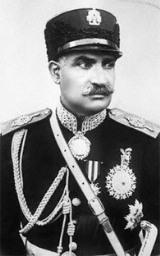
thumb|200px|Reza Shah with full regalia for a portrait. By the late 1930s, Reza Shah had become increasingly despotic and disliked. The parliament assented to his decrees, the free press was suppressed, and the swift incarceration of political leaders like Mossadegh and the murder of others like Teymourtash and Davar
Davar

Davar was a Hebrew language daily newspaper published in the British Mandate of Palestine and Israel from 1925 until May 1996. It was established by Berl Katznelson, who was its editor until his death in 1944....
 halted the formation of any democratic process. He treated the urban middle class, the managers, and technocrats
Technocracy (bureaucratic)

Technocracy is a form of government in which engineers, scientists, and other technical experts are in control. Technocracy is a governmental or organizational system where decision makers are selected based upon how highly knowledgeable they are, rather than how much political capital they hold....
 with an Iron Fist
Iron Fist

Iron Fist is a fictional character, a comic book superhero in the Marvel Comics Marvel Universe, and a practitioner of martial arts. Created by Roy Thomas and Gil Kane, he first appeared in Marvel Premiere #15 ....
; as a result his state-owned industries remained unproductive and inefficient. The bureaucracy fell apart before him since anyone could be whisked away to prison at any moment for disobeying his whims. He confiscated land from the Qajars and from his rivals to usurp it into his own estates. The corruption continued under his rule and even became institutionalized. Progress toward modernization was spotty and isolated. He became totally dependent on his military force and the army, which in return regularly received up to 50 percent of the public revenue to guarantee its loyalty.

Although the landed upper class lost its influence during his reign, his new regime aroused opposition not from the gentry
Gentry

Gentry generally refers to people of high social class, especially in the past. The word derives from the Latin gentis, meaning a clan or extended family....
 but mainly from Iranian "tribes, the clergy, and the young generation of the new intelligentsia. The tribes bore the brunt of the new order."

World War II deposition and death

In August 1941, the Allied
Allies of World War II

The Allies of World War II were the countries officially opposed to the Axis powers of World War II during the World War II. Within the ranks of the Allies powers, the British Empire, the Soviet Union, and the United States of America were known as "The Big Three"....
 powers Britain
United Kingdom

The United Kingdom of Great Britain and Northern Ireland, commonly known as the United Kingdom , the UK or Britain,is a sovereign state located off the northwestern coast of continental Europe....
 and the Soviet Union
Soviet Union

The Union of Soviet Socialist Republics was a Constitution of the Soviet Union socialist state that existed in Eurasia from 1922 to 1991.The name is a translation of the , romanization of Russian Soyuz Sovetskikh Sotsialisticheskikh Respublik, abbreviated ????, SSSR....
 occupied Iran
Anglo-Soviet invasion of Iran

The Anglo-Soviet invasion of Iran was the invasion of Iran by United Kingdom and the Soviet Union, codenamed Operation Countenance, from August 25, 1941 to September 17, 1941....
 by a massive air, land, and naval assault subsequently forcing Reza Shah to abdicate
Abdication

Abdication is the act of renouncing and resigning from a formal office, especially from the supreme office of state. In Roman law the term was also applied to the disowning of a family member, as the disinheriting of a son....
 in favour of his son (see also Persian Corridor
Persian Corridor

The Persian Corridor is the name for a supply route through Iran into Soviet Azerbaijan by which British aid and American Lend-Lease supplies were transferred to the Soviet Union during World War II....
).

The Shah received with disbelief, as a personal humiliation and defeat, news that fifteen Iranian divisions had surrendered without much resistance. Some of his troops dispersed and went home, while others were locked up in their barracks by the Allies.

The British left the Shah a face-saving way out:

The invasion was allegedly in fear that Reza Shah was about to align his petroleum
Petroleum

Petroleum or crude oil is a naturally occurring, flammable liquid found in rock formations in the Earth consisting of a complex mixture of hydrocarbons of various molecular weights, plus other organic compounds....
-rich country with Nazi Germany
Nazi Germany

Nazi Germany and the Third Reich are the colloquial English names for Germany under the regime of Adolf Hitler and the Nazi Party , which established a Totalitarianism dictatorship that existed from 1933 to 1945....
 during the war: However, Reza Shah's earlier Declaration of Neutrality and refusal to allow Iranian territory to be used to train, supply, and act as a transport corridor to ship arms to Russia for its war effort against Germany, was the strongest motive for the allied invasion of Iran. Because of its importance in the allied victory, Iran was subsequently called "The Bridge of Victory" by Winston Churchill.

The Shah's son, Mohammad Reza Pahlavi
Mohammad Reza Pahlavi

Mohammad Reza Shah Pahlavi, List of kings of Persia, , styled His Imperial Majesty, and holding the imperial titles of Shahanshah , and Aryamehr , was the monarchy of Iran from September 16, 1941, until his overthrow by the Iranian Revolution on February 11, 1979....
, officially replaced his father on the throne on September 16, 1941. Reza Shah was soon forced into exile
Exile

Exile means to be away from one's home while either being explicitly refused permission to return and/or being threatened by prison or death upon return....
 in British territories, first to Mauritius
Mauritius

Mauritius , officially the Republic of Mauritius, , is an island nation off the coast of the African continent in the southwest Indian Ocean, about 900 kilometres east of Madagascar....
, then to Durban
Durban

Durban is the third most populous city in South Africa, forming part of the eThekwini metropolitan municipality . It is the largest city in KwaZulu-Natal and is famous as the busiest port in Africa....
 thence Johannesburg
Johannesburg

Johannesburg also known as Joburg, is the largest city in South Africa. Johannesburg is the province Capital of Gauteng the wealthiest province in South Africa, having the largest economy of any metropolitan region in Sub-Saharan Africa....
, South Africa
South Africa

The Republic of South Africa, also known by Official names of South Africa, is a country located at the southern tip of the continent of Africa....
, where he died on July 26, 1944, of heart ailment from which he had been complaining for many years. (His personal doctor had boosted the King's morale in exile by telling him that he was suffering from chronic indigestion and not heart ailment. He lived on a diet of plain rice and boiled chicken in the last years of his life) He was sixty-six years old at the time of his death.

After his passing, his body was carried to Egypt
Egypt

Egypt is a country mainly in North Africa, with the Sinai Peninsula forming a land bridge in Western Asia. Covering an area of about , Egypt borders the Mediterranean Sea to the north, the Gaza Strip and Israel to the northeast, the Red Sea to the east, Sudan to the south and Libya to the west....
, where his body was embalmed and kept at the royal Al Rifa'i Mosque
Al Rifa'i Mosque

The Al-Rifa'i Mosque , is located in Cairo, Egypt, in Midan al-Qal'a, adjacent to the Cairo Citadel. The building is located opposite the Madrassa of Sultan Hassan, which dates from around 1361, and was architecturally conceived as a complement to the older structure....
 in Cairo
Cairo

Cairo , which means "the triumphant", is the Cairo and largest city of Egypt.It is the most populous metropolitan area in Egypt and is also one of the most populous in the world....
 (poignantly, the future burial place of his son, the exiled Mohammad Reza Pahlavi). Many years later, the remains were flown back to Iran, where the embalming was removed (Islamic laws do not allow for embalmment of the dead), and buried in a beautifully designed and decorated mausoleum
Mausoleum

A mausoleum is an external free-standing building constructed as a monument enclosing the interment space or burial chamber of a deceased person or persons....
 built in his honor at the Shia shrine town of Ray
Ray

Ray may refer to:*Batoidea , a superorder of cartilaginous fishes**Rajiformes, "True rays" and skates*Radiation*Ray , idealized narrow beam of light...
/Shah-Abdol-Azim, in the southern suburbs of the capital, Tehran. The Iranian parliament (Majlis) later designated the title "the Great" to be added to his name.

Following the Iranian Revolution
Iranian Revolution

The Iranian Revolution was the revolution that transformed Iran from a Iranian monarchy under Shah Mohammad Reza Pahlavi to an Islamic republic under Ayatollah Ruhollah Khomeini, the leader of the revolution and founder of the Islamic Republic....
 in 1979, Reza Shah's mausoleum
Reza Shah's mausoleum

Reza Shah's Mausoleum, located in Ray south of Tehran, was the burial ground of Reza Shah, the penultimate king of Iran.In the early days of the Iranian Revolution in 1979, Reza Shah's mausoleum was destroyed by bulldozers and dynamite under the direction of Ayatollah Sadeq Khalkhali; the act was approved by Ruhollah Khomeini....
 was destroyed under the direction of Ayatollah
Ayatollah

Ayatollah is a high ranking title given to Usuli Twelver Shia Islam clergy. Those who carry the title are experts in Islamic studies such as jurisprudence, ethics, and philosophy and usually teach in Hawza....
 Sadeq Khalkhali, which was sanctioned by Ayatollah Ruhollah Khomeini
Ruhollah Khomeini

Sayyid Ruhollah Musavi Khomeini was an Iranian religious leader and scholar, politician, and leader of the 1979 Iranian Revolution which saw the overthrow of Mohammad Reza Pahlavi, the late Iranian monarchy of Iran....
.

Legacy


Reza Shah's main critics were the so-called "new intelligencia", often educated in Europe, for whom the Shah "was not a state-builder but an `oriental despot` ... not a reformer but a plutocrat strengthening the landed upper class; not a real nationalist but a jack-booted Cossack
Cossack

The term Cossacks is applied to specific militaristic communities of various ethnicities living in the southern steppe regions of Ukraine and Russia....
 trained by the Tsarists and brought to power by British imperialists. His defenders included Ahmad Kasravi
Ahmad Kasravi

Ahmad Kasravi , was a notable Iranian linguistics, historian, and reformer.Born in Hokmabad , Tabriz, Iran, Kasravi was an Iranian Azari. Initially, Kasravi enrolled in a seminary....
, an older intellectual who defended the Shah saying
Our younger intellectuals cannot possibly understand, and thus cannot possibly judge Reza Shah. They cannot because they were too young to remember the chaotic and desperate conditions out of which he arose.


Family


Reza Shah's first wife, whom he married in 1894, was Maryam Khanum (died 1904). They had one daughter:

  • Hamdamsaltaneh Pahlavi
    Hamdamsaltaneh Pahlavi

    HIH Princess Hamdamsaltaneh Pahlavi , first child and dughter of Reza Shah Pahlavi of Iran and Maryam Khanum , born 22nd February 1903 in Tehran, married Hadi Atabay, and had issue....
     (1903-1992) (see, Aga Khan III
    Aga Khan III

    Sultan Mahommed Shah, Aga Khan III, Order of the Star of India, Order of St Michael and St George, Order of the Indian Empire, Royal Victorian Order, Imperial Privy Council was the 48th Shia Imam of the Shia Islam Ismaili Muslims....
    )


His second wife was Tadj ol-Molouk
Tadj ol-Molouk

Tadj ol-Molouk , n?e Nimtaj Khanum, was the daughter of General Teymur Tadfel Molouk Ayrumlu, and was the queen consort of Reza Shah, founder of the Pahlavi dynasty and Iranian monarchy of Iran between 1925 and 1941....
 (1896-1982), by whom he had four children:

  • Princess Shams Pahlavi
    Shams Pahlavi

    File:Mohammad Pahlavi Coronation.jpgHIH Princess Shams Pahlavi or Shahdokht Shams ul-Mulk Pahlavi was the elder sister of Mohammad Reza Pahlavi, the last Shah of Iran....
     (1917-1996)
  • Mohammad Reza Pahlavi
    Mohammad Reza Pahlavi

    Mohammad Reza Shah Pahlavi, List of kings of Persia, , styled His Imperial Majesty, and holding the imperial titles of Shahanshah , and Aryamehr , was the monarchy of Iran from September 16, 1941, until his overthrow by the Iranian Revolution on February 11, 1979....
     (1919-1980)
  • Princess Ashraf Pahlavi
    Ashraf Pahlavi

    File:Ashraf et shah.jpgPrincess Ashraf ul-Mulk , is the twin sister of Mohammad Reza Pahlavi, the late Shah of Iran and the Pahlavi Dynasty....
     (b. 1919)
  • Prince Ali Reza Pahlavi
    Ali Reza Pahlavi I

    Ali Reza Pahlavi was Reza Shah second son, and the brother of Shah Mohammad Reza Pahlavi. Following Reza Shah's deposition and exile Ali Reza accompanied his father into exile in Mauritius and then into Johannesburg, South Africa....
     (1922-1954)


In 1922 (divorced 1923), Reza Shah married Turan (Qamar al Molk) Amir Soleimani (1904 1995), by whom he had one son:

  • Gholam Reza Pahlavi (b. 1923)


Reza Shah's fourth wife was Esmat Dowlatshahi (1904-1995), by whom he had five children:

  • Abdul Reza Pahlavi (1924-2004)
  • Ahmad Reza Pahlavi (1925-1981)
  • Mahmud Reza Pahlavi (1926-2001)
  • Fatimeh Pahlavi (1928-1987)
  • Hamid Reza Pahlavi (1932-1992)


Honours

  • Decoration of the Imperial Portrait, 1st Class of the Persian Empire
    Qajar dynasty

    The Qajar dynasty is a common term to describe Iran under the ruling Qajar royal family that ruled Iran from 1794 to 1925. In 1794 the Qajar family took full control of Iran as they had eliminated all their rivals, including Lotf 'Ali Khan, the last of the Zand dynasty, and had reasserted Persian sovereignty over the former Iranian terr...
    -1923
  • Nishan-i-Aqdas, 1st Class of the Persian Empire
    Qajar dynasty

    The Qajar dynasty is a common term to describe Iran under the ruling Qajar royal family that ruled Iran from 1794 to 1925. In 1794 the Qajar family took full control of Iran as they had eliminated all their rivals, including Lotf 'Ali Khan, the last of the Zand dynasty, and had reasserted Persian sovereignty over the former Iranian terr...
    -1923
  • Order of the Lion and Sun, 1st Class of the Persian Empire
    Qajar dynasty

    The Qajar dynasty is a common term to describe Iran under the ruling Qajar royal family that ruled Iran from 1794 to 1925. In 1794 the Qajar family took full control of Iran as they had eliminated all their rivals, including Lotf 'Ali Khan, the last of the Zand dynasty, and had reasserted Persian sovereignty over the former Iranian terr...
    -1923
  • Grand Collar of the Order of the Supreme Sun of the Kingdom of Afghanistan-1928
  • Knight of the Order of the White Eagle
    Order of the White Eagle

    The Order of the White Eagle is Poland's highest Order awarded to both civilians and the military for their merits. It was officially instituted on November 1, 1705 by Augustus II the Strong and bestowed on eight of his supporters, four Polish magnates, three Russian field marshals, amongs them Peter von Lacy and one Cossack hetman....
     of Poland
    Poland

    Poland , officially the Republic of Poland , is a country in Central Europe. Poland is bordered by Germany to the west; the Czech Republic and Slovakia to the south; Ukraine, Belarus and Lithuania to the east; and the Baltic Sea and Kaliningrad Oblast, a Russian Enclave and exclave, to the north....
    -1929
  • Collar of the Order of Muhammad 'Ali of the Kingdom of Egypt
    Kingdom of Egypt

    The Kingdom of Egypt was the first modern Egypt, lasting from 1922 to 1953. The Kingdom was created in 1922 when the British granted independence to Egypt, a de facto colony, in order to suppress growing nationalism....
    -1932
  • Collar of the Grand Order of the Hashimites of the Kingdom of Iraq
    Kingdom of Iraq

    The Kingdom of Iraq was the sovereign state of Iraq after the end of British Mandate of Mesopotamia. It began with the coronation of Faisal I of Iraq in August 1921 and ended in 1958 when the monarchy was over thrown in a bloody coup led by Abd al-Karim Qasim...
    -1932
  • Knight of the Order of the Seraphim
    Order of the Seraphim

    The Royal Order of the Seraphim is a Swedish Royal order of chivalry created by King Frederick I of Sweden on 23 February 1748, together with the Order of the Sword and the Order of the Polar Star....
     of Sweden
    Sweden

    Sweden , officially the Kingdom of Sweden , is a Nordic countries on the Scandinavian Peninsula in Northern Europe. Sweden has land borders with Norway to the west and Finland to the northeast, and it is connected to Denmark by the ?resund Bridge in the south....
    -1934
  • Knight of the Order of the Elephant
    Order of the Elephant

    The Order of the Elephant is the highest Order of Denmark. The order is of ancient origin, but was instituted in its current form on 1 December 1693 by King Christian V....
     of Denmark
    Denmark

    Denmark is a Scandinavian country in northern Europe and the senior member of the Kingdom of Denmark. It is the southernmost of the Nordic countries....
    -1937
  • Grand Cordon of the Order of Leopold of Belgium
    Belgium

    * A small German-speaking Community of Belgium exists in eastern Wallonia. Belgium's linguistic diversity and related political and cultural conflicts are reflected in the history of Belgium and a complex Communities and regions of Belgium....
    -1937
  • Grand Cross of the Legion d'honneur
    Légion d'honneur

    The L?gion d'honneur or Ordre national de la L?gion d'honneur is a France order established by Napoleon I of France, First Consul of the French First Republic, on May 19, 1802....
     of France
    France

    France , officially the French Republic , is a country whose Metropolitan France is located in Western Europe and that also comprises various Overseas departments and territories of France....
    -1937
  • Knight of the Order of the Most Holy Annunciation
    Order of the Most Holy Annunciation

    The Supreme Order of the Most Holy Annunciation was the primary dynastic order of the Kingdom of Italy, which ceased to be a national order when the kingdom became a republic in 1946....
     of the Kingdom of Italy
    Kingdom of Italy

    There have been several distinct entities known as the Kingdom of Italy. Italy under the rule of Odoacer from 476 to 493 is often called the kingdom of Italy, since it encompassed the Italia and Odoacer is periodically styled rex ....
    -1939
  • Grand Cross of the Order of Saints Maurice and Lazarus
    Order of Saints Maurice and Lazarus

    The Order of Saints Maurice and Lazarus is an order of chivalry awarded by the House of Savoy, the heads of which were formerly King of Italy. The order was formed by a union of the original Hospitaller Order of Saint Lazarus of Jerusalem and the Order of Saint Maurice in 1572....
     of the Kingdom of Italy
    Kingdom of Italy

    There have been several distinct entities known as the Kingdom of Italy. Italy under the rule of Odoacer from 476 to 493 is often called the kingdom of Italy, since it encompassed the Italia and Odoacer is periodically styled rex ....
    -1939
  • Chain of Fuad I of the Kingdom of Egypt
    Kingdom of Egypt

    The Kingdom of Egypt was the first modern Egypt, lasting from 1922 to 1953. The Kingdom was created in 1922 when the British granted independence to Egypt, a de facto colony, in order to suppress growing nationalism....
    -1939


See also

  • Anglo-Soviet invasion of Iran
    Anglo-Soviet invasion of Iran

    The Anglo-Soviet invasion of Iran was the invasion of Iran by United Kingdom and the Soviet Union, codenamed Operation Countenance, from August 25, 1941 to September 17, 1941....
  • Amir Abdollah Tahmasebi
    Amir Abdollah Tahmasebi

    Amir Abdollah Khan Tahmasebi was a senior military commander, instrumental in the fall of the Qajar dynasty and rise to power of Reza Shah Pahlavi....
  • Mohammad Hosein Airom
    Mohammad Hosein Airom

    Sar-lashgar Mohammad Hosein Ayrom was a senior military leader of the Pahlavi dynasty of Iran.Born in 1882 in Baku, Ayrom began studies in Russia and soon began military training....
  • Abdolhossein Teymourtash
  • Sar Lashgar Buzarjomehri
  • Mahmud Khan Puladeen
    Mahmud Khan Puladeen

    Major General Mahmud Khan Puladeen was a senior military leader of the Reza Shah Pahlavi era.In 1921, he served as personal guard to Seyyed Zia'eddin Tabatabaee....
  • Amanullah Jahanbani
    Amanullah Jahanbani

    Sepahbod Amanullah Jahanbani was a senior general of Reza Shah.At the age of 10, Jahanbani was sent to St. Petersburg for schooling, and returned to Iran as a ranked military officer in World War I....
  • Colonel Pesian
    Colonel Pesian

    Colonel Mohammad Taqi-Khan Pessian , born in Tabriz, was a popular military leader of Iran.He was born into a prominent Persian family, from Azerbaijan who had immigrated to Iran after Persia's defeat to the Russian Empire in the war which ended with the shameful Treaty of Turkomanchai in 1828....
  • Khaz'al Khan
    Khaz'al Khan

    Sheikh Khaz'al Khan ibn Haji Jabir Khan, Order of the Indian Empire, Order of the Star of India , Muaz us-Sultana, and Sardar-e-Nishan-e-Aqdas , was the ruler of a virtually autonomous emirate of Khorramshahr in the Khuzestan Province....
  • Sepahbod Ahmad Amir-Ahmadi
  • General Fazlollah Zahedi
    Fazlollah Zahedi

    Mohammad Fazlollah Zahedi was an Iranian general, Prime Minister, and politician....
  • A.P. World History Leader
  • Human rights in the Pahlavi Dynasty
    Human rights in the Pahlavi Dynasty

    During the 1970s, the human rights of Iranian subjects during the Pahlavi Dynasty began to be criticized by some in the Western world, particularly by President Jimmy Carter of the United States....
  • Reza Shah's mausoleum
    Reza Shah's mausoleum

    Reza Shah's Mausoleum, located in Ray south of Tehran, was the burial ground of Reza Shah, the penultimate king of Iran.In the early days of the Iranian Revolution in 1979, Reza Shah's mausoleum was destroyed by bulldozers and dynamite under the direction of Ayatollah Sadeq Khalkhali; the act was approved by Ruhollah Khomeini....


External links