


Kavadh I

Encyclopedia
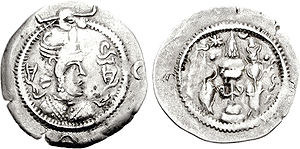
Peroz I
Peroz I Peroz I Peroz I (also Pirooz; Peirozes (Priscus, fr. 33); Perozes (Procopius, De Bello Pers. I. 3 and Agathias iv. 27; the modern form of the name is Perooz, Piruz, or the Arabized Ferooz, Firuz; Persian: پیروز "the Victor"), was the seventeenth Sassanid King of Persia, who ruled from 457...
(457–484) and the nineteenth Sassanid
Sassanid Empire
The Sassanid Empire , known to its inhabitants as Ērānshahr and Ērān in Middle Persian and resulting in the New Persian terms Iranshahr and Iran , was the last pre-Islamic Persian Empire, ruled by the Sasanian Dynasty from 224 to 651...
king of Persia, reigning from 488 to 531. He was crowned by the nobles in place of his deposed and blinded uncle Balash
Balash
Balash , the eighteenth Sassanid King of Persia in 484–488, was the brother and successor of Peroz I of Persia , who had died in a battle against the Hephthalites who invaded Persia from the east.- Reign of Balash :Balash was made King of Persia following the death of his...
(484–488).
Early life and accession
The date of his birth is unclear; John MalalasJohn Malalas
John Malalas or Ioannes Malalas was a Greek chronicler from Antioch. Malalas is probably a Syriac word for "rhetor", "orator"; it is first applied to him by John of Damascus .-Life:Malalas was educated in Antioch, and probably was a jurist there, but moved to...
claims that at his death he was 82 years old, hence born in 449, but Procopius
Procopius
Procopius of Caesarea was a prominent Byzantine scholar from Palestine. Accompanying the general Belisarius in the wars of the Emperor Justinian I, he became the principal historian of the 6th century, writing the Wars of Justinian, the Buildings of Justinian and the celebrated Secret History...
mentions that he had barely entered puberty when his father Peroz was killed with his entire army during a campaign against the Hephthalites in 484. After this disaster, only few members of the royal line remained; according to Procopius, of the ca. 30 sons of Peroz, Kavadh was the only one to remain alive. Kavadh found refuge with the Hephthalites, whose king gave him his daughter in marriage. During this, his uncle Balash
Balash
Balash , the eighteenth Sassanid King of Persia in 484–488, was the brother and successor of Peroz I of Persia , who had died in a battle against the Hephthalites who invaded Persia from the east.- Reign of Balash :Balash was made King of Persia following the death of his...
had usurped the throne and reigned until 488, when Kavadh returned with aid from the Hephthalite king and became king of Persia.
MazdakMazdakMazdak was a proto-socialist Persian reformer and religious activist who gained influence under the reign of the Sassanian Shahanshah Kavadh I...
i sect
Kavadh I gave his support to the communistic sect founded by MazdakMazdak
Mazdak was a proto-socialist Persian reformer and religious activist who gained influence under the reign of the Sassanian Shahanshah Kavadh I...
, son of Bamdad, who demanded that the rich should divide their wives and their wealth with the poor. His intention evidently was, by adopting the doctrine of the Mazdak
Mazdak
Mazdak was a proto-socialist Persian reformer and religious activist who gained influence under the reign of the Sassanian Shahanshah Kavadh I...
ites, to break the influence of the magnates. But in 496 he was deposed and incarcerated in the "Castle of Oblivion (Lethe
Lethe
In Greek mythology, Lethe was one of the five rivers of Hades. Also known as the Ameles potamos , the Lethe flowed around the cave of Hypnos and through the Underworld, where all those who drank from it experienced complete forgetfulness...
)" in Susiana, and his brother Djamasp
Djamasp
Djamasp was a Sassanid king who ruled from 496 to 498. He was a younger brother of king Kavadh I and was installed on the Sassanid throne upon the deposition of the latter by members of the nobility....
(496–498) was raised to the throne.
Return from exile
Kavadh, however, escaped and found refuge with the Hephthalites. In 498, with 30,000 troops from the Hephthalite king, Kavadh became king again and punished his opponents. He had to pay a tribute to the Hephthalites and applied for subsidies to RomeRome
Rome is the capital of Italy and the country's largest and most populated city and comune, with over 2.7 million residents in . The city is located in the central-western portion of the Italian Peninsula, on the Tiber River within the Lazio region of Italy.Rome's history spans two and a half...
, which had before supported the Persians. But now the Emperor Anastasius I
Anastasius I (emperor)
Anastasius I was Byzantine Emperor from 491 to 518. During his reign the Roman eastern frontier underwent extensive re-fortification, including the construction of Dara, a stronghold intended to counter the Persian fortress of Nisibis....
(491–518) refused subsidies, expecting that the two rival powers of the East would exhaust one another in war. At the same time he intervened in the affairs of the Persian part of Armenia
Armenia
Armenia , officially the Republic of Armenia , is a landlocked mountainous country in the Caucasus region of Eurasia...
and restored Iberia
Caucasian Iberia
Iberia , also known as Iveria , was a name given by the ancient Greeks and Romans to the ancient Georgian kingdom of Kartli , corresponding roughly to the eastern and southern parts of the present day Georgia...
to Iran's effective control.
War and succession
Kavadh I joined the Hephthalites and began war against the Byzantine EmpireByzantine Empire
The Byzantine Empire was the Eastern Roman Empire during the periods of Late Antiquity and the Middle Ages, centred on the capital of Constantinople. Known simply as the Roman Empire or Romania to its inhabitants and neighbours, the Empire was the direct continuation of the Ancient Roman State...
. In 502 he took Theodosiopolis (Erzurum
Erzurum
Erzurum is a city in Turkey. It is the largest city, the capital of Erzurum Province. The city is situated 1757 meters above sea level. Erzurum had a population of 361,235 in the 2000 census. .Erzurum, known as "The Rock" in NATO code, served as NATO's southeastern-most air force post during the...
) in Armenia; in 503 Amida (Diarbekr) on the Tigris
Tigris
The Tigris River is the eastern member of the two great rivers that define Mesopotamia, the other being the Euphrates. The river flows south from the mountains of southeastern Turkey through Iraq.-Geography:...
. In 505 an invasion of Armenia by the western Huns from the Caucasus
Caucasus
The Caucasus, also Caucas or Caucasia , is a geopolitical region at the border of Europe and Asia, and situated between the Black and the Caspian sea...
led to an armistice, during which the Romans paid subsidies to the Persians for the maintenance of the fortifications on the Caucasus.
When Justin I
Justin I
Justin I was Byzantine Emperor from 518 to 527. He rose through the ranks of the army and ultimately became its Emperor, in spite of the fact he was illiterate and almost 70 years old at the time of accession...
(518–527) came to the throne in Constantinople, the conflict began anew. His Arab vassal, al-Mundhir IV ibn al-Mundhir
Al-Mundhir IV ibn al-Mundhir
Al-Mundhir IV ibn al-Mundhir was the king of the Lakhmid Arabs in 574–580.The son of the great al-Mundhir III ibn al-Nu'man , he succeeded to the throne after his brothers 'Amr III ibn al-Mundhir and Qabus ibn al-Mundhir . His succession was unpopular with the inhabitants of the capital, al-Hirah,...
, laid waste Mesopotamia
Mesopotamia (Roman province)
Mesopotamia was the name of two distinct Roman provinces, the one a short-lived creation of the Roman Emperor Trajan in 116–117 and the other established by Emperor Septimius Severus in ca. 198, which lasted until the Muslim conquests of the 7th century....
and slaughtered the monks and nuns. In 531 Belisarius
Belisarius
Flavius Belisarius was a general of the Byzantine Empire. He was instrumental to Emperor Justinian's ambitious project of reconquering much of the Mediterranean territory of the former Western Roman Empire, which had been lost less than a century previously....
was defeated at the Battle of Callinicum
Battle of Callinicum
The Battle of Callinicum took place Easter day, 19 April 531, between the armies of the Eastern Roman Empire under Belisarius and the Sassanid Persians under Azarethes. After a defeat at the Battle of Dara, the Sassanids moved to invade Syria in an attempt to turn the tide of the war...
. Shortly afterwards Kavadh died, at the age of eighty-two, in September 531. During his last years his favourite son Khosrau I
Khosrau I
Khosrau I , also known as Anushiravan the Just or Anushirawan the Just Khosrau I (also called Chosroes I in classical sources, most commonly known in Persian as Anushirvan or Anushirwan, Persian: انوشيروان meaning the immortal soul), also known as Anushiravan the Just or Anushirawan the Just...
had had great influence over him and had been proclaimed successor over his older brothers, Kawus (Caoses) and Zames. He also induced Kavadh to break with the Mazdak
Mazdak
Mazdak was a proto-socialist Persian reformer and religious activist who gained influence under the reign of the Sassanian Shahanshah Kavadh I...
ites, whose doctrine had spread widely and caused great turmoil throughout Persia.
Effect on Sassanid Empire
In 529 MazdakMazdak
Mazdak was a proto-socialist Persian reformer and religious activist who gained influence under the reign of the Sassanian Shahanshah Kavadh I...
i doctrine was formally refuted in a theological discussion held before the throne of the king by the orthodox Magians, and its adherents were slaughtered and persecuted everywhere; Mazdak
Mazdak
Mazdak was a proto-socialist Persian reformer and religious activist who gained influence under the reign of the Sassanian Shahanshah Kavadh I...
himself was hanged. Kavadh I evidently was, as Procopius
Procopius
Procopius of Caesarea was a prominent Byzantine scholar from Palestine. Accompanying the general Belisarius in the wars of the Emperor Justinian I, he became the principal historian of the 6th century, writing the Wars of Justinian, the Buildings of Justinian and the celebrated Secret History...
(Pers. i.6) calls him, an unusually clear-sighted and energetic ruler. Although he could not free himself from the yoke of the Hephthalites, he succeeded in restoring order in the interior and fought with success against the Romans. He built some towns which were named after him, and began to regulate taxation.