


Mithridates I of Parthia

Encyclopedia
Parthia
Parthia is a region of north-eastern Iran, best known for having been the political and cultural base of the Arsacid dynasty, rulers of the Parthian Empire....
from ca. 171 BC - 138 BC, succeeding his brother Phraates I
Phraates I of Parthia
Phraates I of Parthia, ruler of the Parthian Empire from 176-171 BCE, succeed his father Phriapatius on the throne. Died relatively young, and appointed as his successor not one of his sons, but his brother Mithridates I ....
. His father was King Phriapatius of Parthia
Phriapatius of Parthia
Phriapatius , sometimes called Phriapites, ruled the Parthian Empire from 191 BC to 176 BC. He was the grandson of Tiridates I of Parthia , the brother of Arsaces I of Parthia , the founder of the Parthian Empire.He ruled in the period following the invasion of Parthia by the Seleucid king...
, who died ca. 176 BC). Mithridates I made Parthia into a major political power by expanding the empire to the east, south, and west. During his reign the Parthians took Herat
Herat
Herāt is the capital of Herat province in Afghanistan. It is the third largest city of Afghanistan, with a population of about 397,456 as of 2006. It is situated in the valley of the Hari River, which flows from the mountains of central Afghanistan to the Karakum Desert in Turkmenistan...
(in 167 BC), Babylonia
Babylonia
Babylonia was an ancient cultural region in central-southern Mesopotamia , with Babylon as its capital. Babylonia emerged as a major power when Hammurabi Babylonia was an ancient cultural region in central-southern Mesopotamia (present-day Iraq), with Babylon as its capital. Babylonia emerged as...
(in 144 BC), Media
Medes
The MedesThe Medes...
(in 141 BC) and Persia (in 139 BC).
Mithridates first expanded Parthia's control eastward by defeating King Eucratides of the Greco-Bactrian Kingdom
Greco-Bactrian Kingdom
The Greco-Bactrian Kingdom was the easternmost part of the Hellenistic world, covering Bactria and Sogdiana in Central Asia from 250 to 125 BC...
. This gave Parthia control over Bactria's territory west of the Arius
Hari Rud
The Hari River or Harirud is a river flowing 1100 kilometers from the mountains of central Afghanistan to Turkmenistan, where it disappears in the Kara-Kum desert. Rud means "river" in Persian....
river, the regions of Margiana and Aria (including the city of Herat
Herat
Herāt is the capital of Herat province in Afghanistan. It is the third largest city of Afghanistan, with a population of about 397,456 as of 2006. It is situated in the valley of the Hari River, which flows from the mountains of central Afghanistan to the Karakum Desert in Turkmenistan...
in 167 BC).
- "The satrapy Turiva and that of Aspionus were taken away from Eucratides by the Parthians." (Strabo XI.11.2)
These victories gave Parthia control of the overland trade routes between east and west (the Silk Road
Silk Road
The Silk Road or Silk Route refers to a historical network of interlinking trade routes across the Afro-Eurasian landmass that connected East, South, and Western Asia with the Mediterranean and European world, as well as parts of North and East Africa...
and the Persian Royal Road
Royal Road
The Persian Royal Road was an ancient highway reorganized and rebuilt by the Persian king Darius the Great of the Achaemenid Empire in the 5th century BC. Darius built the road to facilitate rapid communication throughout his very large empire from Susa to Sardis...
). This control of trade became the foundation of Parthia's wealth and power and was jealously guarded by the Arsacids, who attempted to maintain direct control over the lands through which the major trade routes passed.
In Persia in 139 BC, Mithridates I captured the Seleucid King Demetrius II, and held him captive for 10 years while consolidating his conquests. Demetrius II later married Mithridates I's daughter Rhodogune and had several children with her.
Parthian victories broke the tenuous link with Greeks in the West that had sustained the Hellenistic kingdom of Greco-Bactria, yet Mithridates I actively promoted Hellenism
Hellenistic civilization
Hellenistic civilization represents the zenith of Greek influence in the ancient world from 323 BCE to about 146 BCE...
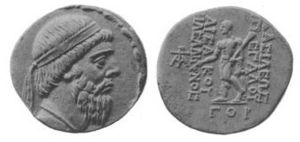
in the areas he controlled and titled himself Philhellene ("friend of the Greeks") on his coins. The coins minted during his reign show the first appearance on Parthian coinage of a Greek-style portrait showing the royal diadem
Diadem (personal wear)
A diadem is a type of crown, specifically an ornamental headband worn by Eastern monarchs and others as a badge of royalty. The word derives from the Greek "διάδημα" , "band" or "fillet", from "διαδέω" , "I bind round", or "I fasten"....
, the standard Greek symbol for kingship. Mithradates I resumed the striking of coins, which had been suspended ever since Arsaces II of Parthia
Arsaces II of Parthia
Arsaces II, also Artabanus I, of the Arsacid dynasty was King of Parthia between 211 BC and 191 BC. Greek 'Arsaces' appears as 'Artabanus' in Latin sources, and both forms appear in history books....
(211–191 BC) had been forced to submit to the Seleucid
Seleucid dynasty
The Seleucid dynasty or the Seleucidae was a Greek Macedonian royal family, founded by Seleucus I Nicator , which ruled the Seleucid Kingdom centered in the Near East and regions of the Asian part of the earlier Achaemenid Persian Empire during the Hellenistic period.-History:Seleucus was an...
Antiochus III
Antiochus III the Great
Antiochus III the Great Seleucid Greek king who became the 6th ruler of the Seleucid Empire as a youth of about eighteen in 223 BC. Antiochus was an ambitious ruler who ruled over Greater Syria and western Asia towards the end of the 3rd century BC...
(223–187 BC) in 206 BC.
His name assigned him to the protection of Mithra
Mithra
Mithra is the Zoroastrian divinity of covenant and oath. In addition to being the divinity of contracts, Mithra is also a judicial figure, an all-seeing protector of Truth, and the guardian of cattle, the harvest and of The Waters....
and carried the god's authority in some measure.
Mithridates I's son, Phraates
Phraates II of Parthia
Phraates II of Parthia, son of Mithridates I of Parthia , the conqueror of Babylon, ruled the Parthian Empire from 138 BC to 128 BC. He was attacked in 130 BC by Antiochus VII Sidetes , ruler of the Seleucid Empire...
(138–128 BC), succeeded him on his death as Great King.