


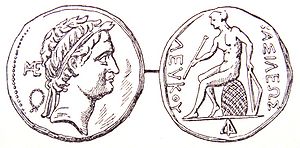
Seleucus IV Philopator

Encyclopedia
Seleucid Empire
The Seleucid Empire was a Greek-Macedonian state that was created out of the eastern conquests of Alexander the Great. At the height of its power, it included central Anatolia, the Levant, Mesopotamia, Persia, today's Turkmenistan, Pamir and parts of Pakistan.The Seleucid Empire was a major centre...
, reigned from 187 BC to 175 BC over a realm consisting of Syria
Syria
Syria , officially the Syrian Arab Republic , is a country in Western Asia, bordering Lebanon and the Mediterranean Sea to the West, Turkey to the north, Iraq to the east, Jordan to the south, and Israel to the southwest....
(now including Cilicia
Cilicia
In antiquity, Cilicia was the south coastal region of Asia Minor, south of the central Anatolian plateau. It existed as a political entity from Hittite times into the Byzantine empire...
and Judea
Judea
Judea or Judæa was the name of the mountainous southern part of the historic Land of Israel from the 8th century BCE to the 2nd century CE, when Roman Judea was renamed Syria Palaestina following the Jewish Bar Kokhba revolt.-Etymology:The...
), Mesopotamia
Mesopotamia
Mesopotamia is a toponym for the area of the Tigris–Euphrates river system, largely corresponding to modern-day Iraq, northeastern Syria, southeastern Turkey and southwestern Iran.Widely considered to be the cradle of civilization, Bronze Age Mesopotamia included Sumer and the...
, Babylonia
Babylonia
Babylonia was an ancient cultural region in central-southern Mesopotamia , with Babylon as its capital. Babylonia emerged as a major power when Hammurabi Babylonia was an ancient cultural region in central-southern Mesopotamia (present-day Iraq), with Babylon as its capital. Babylonia emerged as...
and Nearer Iran (Media and Persia). He was the second son and successor of Antiochus III the Great
Antiochus III the Great
Antiochus III the Great Seleucid Greek king who became the 6th ruler of the Seleucid Empire as a youth of about eighteen in 223 BC. Antiochus was an ambitious ruler who ruled over Greater Syria and western Asia towards the end of the 3rd century BC...
and Laodice III
Laodice III
Laodice III , was a Princess of Pontus and a daughter born to King Mithridates II of Pontus and his wife Laodice. Her sister was Laodice of Pontus and her brother was Mithridates III of Pontus....
. The wife of Seleucus IV was his sister Laodice IV
Laodice IV
Laodice IV was a Greek Princess, Head Priestess and Queen of the Seleucid Empire.-Ancestry, Family & Early Life:...
, by whom he had three children: two sons Antiochus, Demetrius I Soter
Demetrius I Soter
Demetrius I , surnamed Soter , was a ruler of the Hellenistic Seleucid Empire....
and a daughter Laodice V
Laodice V
Laodice V was a Greek Princess of the Seleucid Empire. Through marriage she was a Queen of the ruling Antigonid dynasty in Macedonia and possibly later of the Seleucid dynasty.-Family and Early Life:...
.
He was compelled by financial necessities, created in part by the heavy war-indemnity exacted by Rome, to pursue an ambitious policy. In an effort to collect money to pay the Romans, he sent his minister Heliodorus
Heliodorus (minister)
Heliodorus was a minister of Seleucus IV Philopator ca. [187 BC - 175 BC]. According to some sources he is said to have assassinated Seleucus.-Biblical background:...
to Jerusalem to seize the Jewish temple
Second Temple
The Jewish Second Temple was an important shrine which stood on the Temple Mount in Jerusalem between 516 BCE and 70 CE. It replaced the First Temple which was destroyed in 586 BCE, when the Jewish nation was exiled to Babylon...
treasury. On his return, Heliodorus assassinated Seleucus, and seized the throne for himself.
The true heir Demetrius
Demetrius I Soter
Demetrius I , surnamed Soter , was a ruler of the Hellenistic Seleucid Empire....
, son of Seleucus, was now being retained in Rome as a hostage, and the kingdom was seized by the younger brother of Seleucus, Antiochus IV Epiphanes
Antiochus IV Epiphanes
Antiochus IV Epiphanes ruled the Seleucid Empire from 175 BC until his death in 164 BC. He was a son of King Antiochus III the Great. His original name was Mithridates; he assumed the name Antiochus after he ascended the throne....
. Antiochus managed to oust Heliodorus and an infant son of Seleucus, also named Antiochus, was formal head of state for a few years until Epiphanes had him murdered.
Ancestry
External links
- Seleucus IV Philopator entry in historical sourcebook by Mahlon H. Smith