


Antiochus II Theos

Encyclopedia
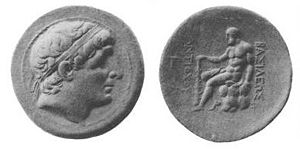
Antiochus I Soter
Antiochus I Soter , was a king of the Hellenistic Seleucid Empire. He reigned from 281 BC - 261 BC....
in the winter of 262–61 BC. He was the younger son of Antiochus I and princess Stratonice
Stratonice of Syria
For other persons with the same name, see StratoniceStratonice of Syria was the daughter of king Demetrius Poliorcetes and Phila, the daughter of Antipater...
, the daughter of Demetrius Poliorcetes
Demetrius I of Macedon
Demetrius I , called Poliorcetes , son of Antigonus I Monophthalmus and Stratonice, was a king of Macedon...
.
He inherited a state of war with Egypt
Egypt
Egypt , officially the Arab Republic of Egypt, Arabic: , is a country mainly in North Africa, with the Sinai Peninsula forming a land bridge in Southwest Asia. Egypt is thus a transcontinental country, and a major power in Africa, the Mediterranean Basin, the Middle East and the Muslim world...
, the "Second Syrian War
Syrian Wars
The Syrian Wars were a series of six wars between the Successor states of the Seleucid Empire and the Ptolemaic Kingdom of Egypt during the 3rd and 2nd centuries BC over the region then called Coele-Syria, one of the few avenues into Egypt...
", which was fought along the coasts of Asia Minor
Asia Minor
Asia Minor is a geographical location at the westernmost protrusion of Asia, also called Anatolia, and corresponds to the western two thirds of the Asian part of Turkey...
, and the constant intrigues of petty despots and restless city-states in Asia Minor. Antiochus also made some attempt to get a footing in Thrace
Thrace
Thrace is a historical and geographic area in southeast Europe. As a geographical concept, Thrace designates a region bounded by the Balkan Mountains on the north, Rhodope Mountains and the Aegean Sea on the south, and by the Black Sea and the Sea of Marmara on the east...
. During the war he was given the title Theos (Greek
Greek language
Greek is an independent branch of the Indo-European family of languages. Native to the southern Balkans, it has the longest documented history of any Indo-European language, spanning 34 centuries of written records. Its writing system has been the Greek alphabet for the majority of its history;...
: Θεός, "God"), being such to the Milesians in slaying the tyrant Timarchus
Timarchus of Miletus
Timarchus or Timarch was a tyrant of the ancient Greek city of Miletus in the 3rd century BC. He with Ptolemy I Epigone led a revolt against Ptolemy II Philadelphus of Egypt in 259 BC. He was slain the next year by the Seleucid king Antiochus II during the course of the second Syrian war between...
.
During the time Antiochus was occupied with the war against Egypt, Andragoras, his satrap in Parthia
Parthia
Parthia is a region of north-eastern Iran, best known for having been the political and cultural base of the Arsacid dynasty, rulers of the Parthian Empire....
, proclaimed independence. According to Justin
Justin
Justin is a given name. It may refer to:People* Justin , a common given name* Justin , 3rd century Roman historian* Justin I , or Flavius Iustinius Augustus, an Eastern Roman Emperor who ruled from 518 to 527...
's epitome of Pompeius Trogus, in Bactria
Bactria
Bactria and also appears in the Zend Avesta as Bukhdi. It is the ancient name of a historical region located between south of the Amu Darya and west of the Indus River...
, his satrap Diodotus also revolted in 255 BC, and founded the Greco-Bactrian kingdom, which further expanded in India in 180 BC to form the Greco-Indian kingdom (180 BC – 1 BC). Then about 238 BC, Arsaces
Arsaces I of Parthia
Arsaces I was the founder of the Arsacid dynasty, and after whom all 30+ monarchs of the Arsacid empire officially named themselves. A celebrated descent from antiquity begins with Arsaces.A 1st century AD tradition casts Arsaces as descending from the 5th-century BC Achaemenid monarch...
led a revolt of the Parthia
Parthia
Parthia is a region of north-eastern Iran, best known for having been the political and cultural base of the Arsacid dynasty, rulers of the Parthian Empire....
ns against Andragoras, leading to the foundation of the Parthian Empire
Parthian Empire
The Parthian Empire , also known as the Arsacid Empire , was a major Iranian political and cultural power in ancient Persia...
. These events would have cut off communications with India. Phylarchus
Phylarchus
Phylarchus was a Greek historical writer whose works have been lost, but not before having been considerably used by other historians whose works have survived.-Life:Phylarchus was a contemporary of Aratus, in the 3rd century BC. His birthplace is doubtful...
relays current scandals regarding his drunken banquets and liaisons with unsuitable young men.
About this time, Antiochus made peace with Ptolemy II of Egypt, ending the Second Syrian War. Antiochus repudiated his wife Laodice I
Laodice I
Laodice I was an Anatolian noblewoman who was a close relative of the early Seleucid Dynasty and was the first wife of the Seleucid Greek King Antiochus II Theos. -Family Background:...
and exiled her to Ephesus
Ephesus
Ephesus was an ancient Greek city, and later a major Roman city, on the west coast of Asia Minor, near present-day Selçuk, Izmir Province, Turkey. It was one of the twelve cities of the Ionian League during the Classical Greek era...
. To seal the treaty, he married Ptolemy's daughter Berenice
Berenice (Seleucid queen)
Berenice, also called Berenice Syra, was the daughter of Ptolemy II Philadelphus and his first wife Arsinoe I of Egypt.In 261 BC she married the Seleucid monarch Antiochus II Theos, who, following an agreement with Ptolemy , had divorced his wife Laodice I and transferred the succession to...
and received an enormous dowry.
During her stay in Ephesus, Laodice I continued numerous intrigues to become queen again. By 246 BC Antiochus had left Berenice and their infant son Antiochus, in Antioch
Antioch
Antioch on the Orontes was an ancient city on the eastern side of the Orontes River. It is near the modern city of Antakya, Turkey.Founded near the end of the 4th century BC by Seleucus I Nicator, one of Alexander the Great's generals, Antioch eventually rivaled Alexandria as the chief city of the...
to live again with Laodice I in Asia Minor. Laodice I took the occasion to poison Antiochus while her partisans at Antioch murdered Berenice and their infant son. Antiochus was buried in the Belevi Mausoleum
Belevi Mausoleum
The Belevi Mausoleum, also known as the Mausoleum at Belevi is a Hellenistic monument tomb located in Turkey. The monument was the burial place of the Seleucid Greek King Antiochus II Theos who reigned 261 BC-246 BC.-Location of Mausoleum:...
.
Laodice I then proclaimed Seleucus II as King. With his cousin-wife Laodice I, Antiochus had two sons: Seleucus II Callinicus
Seleucus II Callinicus
Seleucus II Callinicus or Pogon , was a ruler of the Hellenistic Seleucid Empire, who reigned from 246 to 225 BC...
, Antiochus Hierax
Antiochus Hierax
Antiochus Hierax , or Antiochus III, , so called from his grasping and ambitious character, was the younger son of Antiochus II and Laodice I and separatist leader in the Hellenistic Seleucid kingdom, who ruled as king of Syria during his brother's reign.On the death of his father, in 246 BCE,...
and three daughters: Apama, Stratonice of Cappadocia
Stratonice of Cappadocia
For other persons with the same name, see StratoniceStratonice was a Syrian Greek Princess of the Seleucid Empire. Stratonice was of Greek Macedonian and Persian descent. She was one of the daughters born to the Seleucid Monarchs Antiochus II Theos and Laodice I...
and Laodice
Laodice (wife of Mithridates II of Pontus)
Laodice was a Greek Princess of the Seleucid Empire. Laodice was of Greek Macedonian and Persian descent. She was one of the daughters and youngest child born to the Seleucid Monarchs Antiochus II Theos and Laodice I. Among her siblings were her brothers Seleucus II Callinicus and Antiochus Hierax...
.
Relations with India
Antiochus is mentioned in the Edicts of AshokaEdicts of Ashoka
The Edicts of Ashoka are a collection of 33 inscriptions on the Pillars of Ashoka, as well as boulders and cave walls, made by the Emperor Ashoka of the Mauryan dynasty during his reign from 269 BCE to 231 BCE. These inscriptions are dispersed throughout the areas of modern-day Bangladesh, India,...
, as one of the recipients of the Indian Emperor Ashoka
Ashoka
Ashok Maurya or Ashoka , popularly known as Ashoka the Great, was an Indian emperor of the Maurya Dynasty who ruled almost all of the Indian subcontinent from ca. 269 BC to 232 BC. One of India's greatest emperors, Ashoka reigned over most of present-day India after a number of military conquests...
's Buddhist
Buddhism
Buddhism is a religion and philosophy encompassing a variety of traditions, beliefs and practices, largely based on teachings attributed to Siddhartha Gautama, commonly known as the Buddha . The Buddha lived and taught in the northeastern Indian subcontinent some time between the 6th and 4th...
proselytizing, although no Western historical record of this event remains:
- "And even this conquest [preaching Buddhism] has been won by the Beloved of the Gods here and in all the borderlands, as far as six hundred yojanaYojanaA Yojana is a Vedic measure of distance used in ancient India. The exact measurement is disputed amongst scholars with distances being given between 6 to 15 kilometers ....
s (5,400-9,600 km) away, where Antiochos, king of the Yavanas [Greeks/Macedonians] rules, and beyond this Antiochus four kings named PtolemyPtolemy II PhiladelphusPtolemy II Philadelphus was the king of Ptolemaic Egypt from 283 BCE to 246 BCE. He was the son of the founder of the Ptolemaic kingdom Ptolemy I Soter and Berenice, and was educated by Philitas of Cos...
, Antigonos, MagasMagas of CyreneMagas of Cyrene was a Greek Macedonian nobleman. Through his mother’s second marriage he was a member of the Ptolemaic dynasty. He became King of Cyrenaica and he managed to wrestle independence for Cyrenaica from the Greek Ptolemaic dynasty of Ancient Egypt.-Family Background & Early Life:Magas...
and AlexanderAlexander II of EpirusAlexander II was a king of Epirus, and the son of Pyrrhus and Lanassa, the daughter of the Sicilian tyrant Agathocles.-Reign:He succeeded his father as king in 272 BC, and continued the war which his father had begun with Antigonus II Gonatas, whom he succeeded in driving from the kingdom of Macedon...
rule,".
Ashoka also claims that he encouraged the development of herbal medicine, for men and animals, in the territories of the Hellenistic kings:
- "Everywhere within Beloved-of-the-Gods, King Piyadasi's [Ashoka's] domain, and among the people beyond the borders, the Cholas, the Pandyas, the Satiyaputras, the Keralaputras, as far as TamraparniTamraparniTamraparni or Tambapanni is an old name of Sri Lanka. Tamraparniya is a name given to the Theravada school lineage in Sri Lanka...
and where the Greek king Antiochos rules, and among the kings who are neighbors of Antiochos, everywhere has Beloved-of-the-Gods, King Piyadasi, made provision for two types of medical treatment: medical treatment for humans and medical treatment for animals. Wherever medical herbs suitable for humans or animals are not available, I have had them imported and grown. Wherever medical roots or fruits are not available I have had them imported and grown. Along roads I have had wells dug and trees planted for the benefit of humans and animals."