


Alexander Balas

Encyclopedia
Greece
Greece , officially the Hellenic Republic , and historically Hellas or the Republic of Greece in English, is a country in southeastern Europe....
Seleucid kingdom
Seleucid Empire
The Seleucid Empire was a Greek-Macedonian state that was created out of the eastern conquests of Alexander the Great. At the height of its power, it included central Anatolia, the Levant, Mesopotamia, Persia, today's Turkmenistan, Pamir and parts of Pakistan.The Seleucid Empire was a major centre...
150-146 BC, was a native of Smyrna
Izmir
Izmir is a large metropolis in the western extremity of Anatolia. The metropolitan area in the entire Izmir Province had a population of 3.35 million as of 2010, making the city third most populous in Turkey...
of humble origin, but gave himself out to be the son of Antiochus IV Epiphanes
Antiochus IV Epiphanes
Antiochus IV Epiphanes ruled the Seleucid Empire from 175 BC until his death in 164 BC. He was a son of King Antiochus III the Great. His original name was Mithridates; he assumed the name Antiochus after he ascended the throne....
and Laodice IV
Laodice IV
Laodice IV was a Greek Princess, Head Priestess and Queen of the Seleucid Empire.-Ancestry, Family & Early Life:...
and heir to the Seleucid throne. Along with his sister Laodice VI
Laodice VI
Laodice VI was a Greek Seleucid Princess and through marriage was a Queen of the Kingdom of Pontus....
, the youngster Alexander was "discovered" by Heracleides, a former minister of Antiochus IV and brother of Timarchus
Timarchus
Timarchus or Timarch was a usurper in the Seleucid empire between 163-160 BCE.A Greek nobleman, possibly from Miletus in Asia Minor, Timarchus was a friend of the Seleucid prince Antiochus IV Epiphanes during his time as hostage to Rome...
, an usurper in Media
Medes
The MedesThe Medes...
who had been executed by the reigning king Demetrius I Soter.
Alexander's claims were recognized by the Roman Senate
Roman Senate
The Senate of the Roman Republic was a political institution in the ancient Roman Republic, however, it was not an elected body, but one whose members were appointed by the consuls, and later by the censors. After a magistrate served his term in office, it usually was followed with automatic...
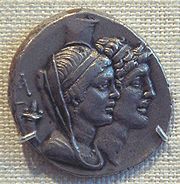
, Ptolemy Philometor of Egypt and others. He married Cleopatra Thea
Cleopatra Thea
Cleopatra Thea surnamed Eueteria was the ruler of the Hellenistic Seleucid Empire. She ruled Syria from 125 BC after the death of Demetrius II Nicator...
, a daughter of the Ptolemaic dynasty
Ptolemaic dynasty
The Ptolemaic dynasty, was a Macedonian Greek royal family which ruled the Ptolemaic Empire in Egypt during the Hellenistic period. Their rule lasted for 275 years, from 305 BC to 30 BC...
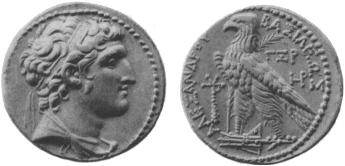
. At first unsuccessful, Alexander finally defeated Demetrius Soter in 150 BC. Being now master of the empire, he is said to have abandoned himself to a life of debauchery. Whatever the truth behind this, the young king was forced to depend heavily on his Ptolemaic support and even struck portraits with the characteristic features of king Ptolemy I.
Demetrius Soter's son Demetrius II profited by the opportunity to regain the throne. Ptolemy Philometor, who was Alexander's father-in-law, went over to his side, and Alexander was defeated in the battle of Antioch (145 BC)
Battle of Antioch (145 BC)
The Battle of Antioch in 145 BC saw the defeat and overthrow of Seleucid king Alexander Balas by Ptolemy VI Philometor of Egypt, but the Egyptian pharaoh died in the battle. This battle is also known as the Battle of the Oenoparus.- History :...
in Syria, sometimes known as the battle of the Oenoparus.
He fled for refuge to a Nabataean prince, who murdered him and sent his head to Ptolemy Philometor, who had been mortally wounded in the engagement.
External links
- Alexander Balas, article in historical sourcebook by Mahlon H. Smith