

.gif)
Isfahan (city)

Encyclopedia
Isfahan historically also rendered in English
as Ispahan, Sepahan or Hispahan, is the capital of Isfahan Province in Iran, located about 340 km south of Tehran
. It has a population of 1,583,609, Iran's third largest city after Tehran and Mashhad
. The Isfahan metropolitan area had a population of 3,430,353 in the 2006 Census, the second most populous metropolitan area in Iran after Tehran.
The cities of Najafabad
, Se-deh (Homayounshahr, renamed Khomeinishahr since 1981), Khan Isfahan, Shahin-shahr, Zarrinshahr
, Mobarakeh
, Falavarjan
and Fouladshahr all constitute the metropolitan city of Isfahan.
Isfahan is located on the main north-south and east-west routes crossing Iran, and was once one of the largest cities in the world. It flourished from 1050 to 1722, particularly in the 16th century under the Safavid dynasty, when it became the capital of Persia for the second time in its history. Even today, the city retains much of its past glory. It is famous for its Islamic architecture, with many beautiful boulevards, covered bridges, palaces, mosques, and minarets. This led to the Persian proverb "'Esfahān nesf-e jahān ast" (Isfahan is half of the world).
The Naghsh-e Jahan Square in Isfahan is one of the biggest city squares
in the world and an outstanding example of Iranian and Islamic architecture. It has been designated by UNESCO
as a World Heritage Site
. The city also has a wide variety of historic monuments.
period. In recent discoveries, archaeologists
have found artefact
s dating back to the Palaeolithic, Mesolithic
, Neolithic
, Bronze
and Iron age
s.
. Subsequently the province became part of the Achaemenid Empire
. After the liberation of Iran from Macedonian occupation by the Arsacids, it became part of Parthian Empire
. Esfahan was the centre and capital city of a large province, which was administered by Arsacid governors. In the Sassanid era, Esfahan was governed by "Espoohrans" or the members of seven noble Iranian families who had important royal positions, and served as the residence of these noble families as well. Moreover, in this period Esfahan was a military centre with strong fortifications.
 Esfahan fell temporarily under the rule of Arabs until the Abbasid
era, only being attended to by Al-Mansur
. In the 10th century, under the Buwayhid Dynasty
, Esfahan regained its importance. In the reign of Malik Shah I
of the Seljuk dynasty, Esfahan was again selected as capital and commenced another golden age. In this period, Esfahan was one of the most thriving and important cities of the world. The famous Persian philosopher Avicenna
lived and taught there in the 11th century.
In 1387, Esfahan surrendered to the Turko-Mongol warlord Timur
. Initially treated with relative mercy, the city revolted against Timur's punitive taxes by killing the tax collectors and some of Timur's soldiers. In retribution, Timur ordered the massacre of the city residents and his soldiers killed a reported 70,000 citizens. An eye-witness counted more than 28 towers, each constructed of about 1,500 heads.
As the result of its suitable geographic situation, Esfahan flourished again especially during the Safavid dynasty
.
The Golden Age of Esfahan arrived in the 16th century under Shah Abbas the Great (1587–1629), who conquered it and made it the new capital of the Safavid dynasty. During the reign of Shah Abbas I, who unified Persia, Esfahan reached its pinnacle. Esfahan had parks, libraries and mosques that amazed Europeans.
The Persians called Esfahan, Nesf-e-Jahan (half the world), meaning that to see it was to see half the world, and also referring to it as a point where many cultures and nationalities meet and mingled. In its heyday, Esfahan was one of the largest cities, with a population of over half a million; 163 mosques, 48 religious schools, 1801 shops and 263 public baths.
In 1722, following the defeat of the Safavids in the Battle of Gulnabad, Afghans
raided Esfahan after a long siege, which left much of the city in ruins. Although the Afghans were a primary cause of Esfahan's decline, it can also be attributed to competition from maritime commerce developed by European merchants from such countries as the Netherlands
. Esfahan's wealth originated in its role as a chief waystation along the trans-Asia trade route (such as the Silk Road
). Such land trade dwindled as the cheaper sea routes increased in popularity for transporting commodities between Asia and Europe.
experimental reactors as well as facilities for producing nuclear fuel (UCF). Esfahan has one of the largest steel-producing facilities in the entire region, as well as facilities for producing special alloys.
At Esfahan uranium
is converted into uranium hexafluoride
(UF6). In its gaseous form it is spun at high speed in the centrifuges to extract the fissile isotope. Esfahan is Iran's only domestic source of UF6. According to IAEA
in 2006, Iran was building hardened bunkers under Esfahan to protect UF6 production.
The cities of Najafabad
, Khomeini-shahr
, Shahin-shahr, Zarrinshahr
, Mobarakeh
, Qomshe, Kashan
, Fouladshahr and Falavarjan constitute the metropolitan city of Esfahan. The city has an international airport
and is in the final stages of constructing its first Metro
line.
Over 2000 companies are working in the area using Esfahan's economic, cultural, and social potentials. Esfahan contains a major oil refinery and a large airforce base. HESA
, Iran's most advanced aircraft manufacturing plant (where the IR.AN-140
aircraft is made), is located nearby.
Esfahan hosted the International Physics Olympiad
in 2007.
on the eastern side of the Zagros Mountains, Isfahan has an arid climate (Köppen
BWk). Despite its altitude, Isfahan remains very hot during the summer with maxima typically around 36 °C (97 °F). However, with low humidity and moderate temperatures at night, the climate can be very pleasant. During the winter, days are mild but nights can be very cold and snow has occurred at least once every winter except 1986/1987 and 1989/1990. However, on the whole Isfahan’s climate is extremely dry. Its annual precipitation
of 122 millimetres (4.8 in) is only about half that of Tehran
or Mashhad
and only a quarter that of more exposed Kermanshah
.


Najvan Forest Park
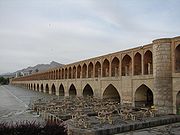
The bridges over the river include some of the nicest architecture in Isfahan. The oldest bridge is the "Pol-e Shahrestan," which was probably built in the 12th century during the Seljuk period. Further upstream is the "Pol-e Khaju," which was built by Shah Abbas II in 1650. It is 123 metres long with 24 arches, and it also serves as a sluice gate.
The next bridge is the "Pol-e Jubi." It was originally built as an aqueduct to supply the palace gardens on the north bank of the river. Further upstream again is the Si-o-Seh Pol
or bridge of 33 arches. Built during the rule of Shah Abbas the Great, it linked Isfahan with the Armenian
suburb of Jolfa. It is by far the longest bridge in Isfahan at 295 m (967.85 ft).
Other bridges include:
which handles domestic flights to Iranian cities and international flights, mostly to regional destinations across Middle East and central Asia including Dubai and Damascus.
.
.jpg)
. Weaving in Esfahan flourished in the Safavid era. But when the Afghans invaded Iran, ending the Safavid dynasty, the craft also became stagnant.
Not until 1920s, between two world wars, was weaving again taken seriously by the people of Esfahan. They started to weave Safavid designs and once again became one of the most important nexus of the Iranian rug weaving industry. Esfahani carpets today are among the most wanted in world markets, having many customers in western countries.
Esfahani rugs and carpets usually have ivory backgrounds with blue, rose, and indigo motifs. Rugs and carpets often have very symmetrical and balanced designs. They usually have a single medallion that is surrounded with vines and palmettos and are of excellent quality.
Actors and movie directors
Painters
Political figures
Religious figures
Sportspeople
Writers and poets
Others
 Aside from the seminaries and religious schools, the major universities of the Isfahan metropolitan area are:
There are also more than 50 Technical and Vocational Training Centers under the administration of Isfahan TVTO which provide non-formal training programs freely throughout the province.
Isfahan has an important derby called as Naqsh e jahan derby
. This competition is one of the most popular annual football events in Iran between Sepahan F.C. and Zob Ahan
.
Isfahan has two association football clubs that have been title contenders in Iran's Premier Football League
. These are:
with:
Baalbek
, Lebanon
Barcelona
, Spain
Cairo
, Egypt
Florence
, Italy
Freiburg
, Germany
Havana
, Cuba
Hyderabad, Andhra Pradesh
, India
Iaşi
, Romania
Istanbul
, Turkey
Kuala Lumpur
, Malaysia Kuwait City
, Kuwait
Lahore
, Pakistan
Saint Petersburg
, Russia
Venice
, Italy
Xi'an
, Shaanxi
, China
Yerevan
, Armenia
English language
English is a West Germanic language that arose in the Anglo-Saxon kingdoms of England and spread into what was to become south-east Scotland under the influence of the Anglian medieval kingdom of Northumbria...
as Ispahan, Sepahan or Hispahan, is the capital of Isfahan Province in Iran, located about 340 km south of Tehran
Tehran
Tehran , sometimes spelled Teheran, is the capital of Iran and Tehran Province. With an estimated population of 8,429,807; it is also Iran's largest urban area and city, one of the largest cities in Western Asia, and is the world's 19th largest city.In the 20th century, Tehran was subject to...
. It has a population of 1,583,609, Iran's third largest city after Tehran and Mashhad
Mashhad
Mashhad , is the second largest city in Iran and one of the holiest cities in the Shia Muslim world. It is also the only major Iranian city with an Arabic name. It is located east of Tehran, at the center of the Razavi Khorasan Province close to the borders of Afghanistan and Turkmenistan. Its...
. The Isfahan metropolitan area had a population of 3,430,353 in the 2006 Census, the second most populous metropolitan area in Iran after Tehran.
The cities of Najafabad
Najafabad
Najafabad is a city in and the capital of Najafabad County, Isfahan Province, Iran. At the 2006 census, its population was 206,114, in 54,529 families. It is located west of Isfahan and is increasingly becoming a part of Isfahan Metropolitan area....
, Se-deh (Homayounshahr, renamed Khomeinishahr since 1981), Khan Isfahan, Shahin-shahr, Zarrinshahr
Zarrinshahr
Zarrin Shahr is a city in and the capital of Lenjan County, Isfahan Province, Iran. At the 2006 census, its population was 55,984, in 15,154 families. It is located in southwest of Isfahan.-Name:...
, Mobarakeh
Mobarakeh
Mobarakeh is a city in and the capital of Mobarakeh County, Isfahan Province, Iran. At the 2006 census, its population was 62,454, in 16,583 families....
, Falavarjan
Falavarjan
Falavarjan is a city in and the capital of Falavarjan County, Isfahan Province, Iran. At the 2006 census, its population was 37,740, in 9,097 families....
and Fouladshahr all constitute the metropolitan city of Isfahan.
Isfahan is located on the main north-south and east-west routes crossing Iran, and was once one of the largest cities in the world. It flourished from 1050 to 1722, particularly in the 16th century under the Safavid dynasty, when it became the capital of Persia for the second time in its history. Even today, the city retains much of its past glory. It is famous for its Islamic architecture, with many beautiful boulevards, covered bridges, palaces, mosques, and minarets. This led to the Persian proverb "'Esfahān nesf-e jahān ast" (Isfahan is half of the world).
The Naghsh-e Jahan Square in Isfahan is one of the biggest city squares
Town square
A town square is an open public space commonly found in the heart of a traditional town used for community gatherings. Other names for town square are civic center, city square, urban square, market square, public square, and town green.Most town squares are hardscapes suitable for open markets,...
in the world and an outstanding example of Iranian and Islamic architecture. It has been designated by UNESCO
UNESCO
The United Nations Educational, Scientific and Cultural Organization is a specialized agency of the United Nations...
as a World Heritage Site
World Heritage Site
A UNESCO World Heritage Site is a place that is listed by the UNESCO as of special cultural or physical significance...
. The city also has a wide variety of historic monuments.
History
Prehistory
The history of Esfahan can be traced back to the PalaeolithicPaleolithic
The Paleolithic Age, Era or Period, is a prehistoric period of human history distinguished by the development of the most primitive stone tools discovered , and covers roughly 99% of human technological prehistory...
period. In recent discoveries, archaeologists
Archaeology
Archaeology, or archeology , is the study of human society, primarily through the recovery and analysis of the material culture and environmental data that they have left behind, which includes artifacts, architecture, biofacts and cultural landscapes...
have found artefact
Artifact (archaeology)
An artifact or artefact is "something made or given shape by man, such as a tool or a work of art, esp an object of archaeological interest"...
s dating back to the Palaeolithic, Mesolithic
Mesolithic
The Mesolithic is an archaeological concept used to refer to certain groups of archaeological cultures defined as falling between the Paleolithic and the Neolithic....
, Neolithic
Neolithic
The Neolithic Age, Era, or Period, or New Stone Age, was a period in the development of human technology, beginning about 9500 BC in some parts of the Middle East, and later in other parts of the world. It is traditionally considered as the last part of the Stone Age...
, Bronze
Bronze Age
The Bronze Age is a period characterized by the use of copper and its alloy bronze as the chief hard materials in the manufacture of some implements and weapons. Chronologically, it stands between the Stone Age and Iron Age...
and Iron age
Iron Age
The Iron Age is the archaeological period generally occurring after the Bronze Age, marked by the prevalent use of iron. The early period of the age is characterized by the widespread use of iron or steel. The adoption of such material coincided with other changes in society, including differing...
s.
Elamite Empire
Ancient Esfahan was part of the Elamite Empire under the name of Aspandana also spelt Ispadana. It later became one of the principal towns of the Median dynastyMedes
The MedesThe Medes...
. Subsequently the province became part of the Achaemenid Empire
Achaemenid Empire
The Achaemenid Empire , sometimes known as First Persian Empire and/or Persian Empire, was founded in the 6th century BCE by Cyrus the Great who overthrew the Median confederation...
. After the liberation of Iran from Macedonian occupation by the Arsacids, it became part of Parthian Empire
Parthian Empire
The Parthian Empire , also known as the Arsacid Empire , was a major Iranian political and cultural power in ancient Persia...
. Esfahan was the centre and capital city of a large province, which was administered by Arsacid governors. In the Sassanid era, Esfahan was governed by "Espoohrans" or the members of seven noble Iranian families who had important royal positions, and served as the residence of these noble families as well. Moreover, in this period Esfahan was a military centre with strong fortifications.
Islamic Era
Abbasid
The Abbasid Caliphate or, more simply, the Abbasids , was the third of the Islamic caliphates. It was ruled by the Abbasid dynasty of caliphs, who built their capital in Baghdad after overthrowing the Umayyad caliphate from all but the al-Andalus region....
era, only being attended to by Al-Mansur
Al-Mansur
Al-Mansur, Almanzor or Abu Ja'far Abdallah ibn Muhammad al-Mansur was the second Abbasid Caliph from 136 AH to 158 AH .-Biography:...
. In the 10th century, under the Buwayhid Dynasty
Buwayhid
The Buyid dynasty, also known as the Buyid Empire or the Buyids , also known as Buwaihids, Buyahids, or Buyyids, were a Shī‘ah Persian dynasty that originated from Daylaman in Gilan...
, Esfahan regained its importance. In the reign of Malik Shah I
Malik Shah I
Jalāl al-Dawlah Malik-shāh was born in 1055, succeeded Alp Arslan as the Seljuq Sultan in 1072, and reigned until his death in 1092....
of the Seljuk dynasty, Esfahan was again selected as capital and commenced another golden age. In this period, Esfahan was one of the most thriving and important cities of the world. The famous Persian philosopher Avicenna
Avicenna
Abū ʿAlī al-Ḥusayn ibn ʿAbd Allāh ibn Sīnā , commonly known as Ibn Sīnā or by his Latinized name Avicenna, was a Persian polymath, who wrote almost 450 treatises on a wide range of subjects, of which around 240 have survived...
lived and taught there in the 11th century.
In 1387, Esfahan surrendered to the Turko-Mongol warlord Timur
Timur
Timur , historically known as Tamerlane in English , was a 14th-century conqueror of West, South and Central Asia, and the founder of the Timurid dynasty in Central Asia, and great-great-grandfather of Babur, the founder of the Mughal Dynasty, which survived as the Mughal Empire in India until...
. Initially treated with relative mercy, the city revolted against Timur's punitive taxes by killing the tax collectors and some of Timur's soldiers. In retribution, Timur ordered the massacre of the city residents and his soldiers killed a reported 70,000 citizens. An eye-witness counted more than 28 towers, each constructed of about 1,500 heads.
As the result of its suitable geographic situation, Esfahan flourished again especially during the Safavid dynasty
Safavid dynasty
The Safavid dynasty was one of the most significant ruling dynasties of Iran. They ruled one of the greatest Persian empires since the Muslim conquest of Persia and established the Twelver school of Shi'a Islam as the official religion of their empire, marking one of the most important turning...
.
The Golden Age of Esfahan arrived in the 16th century under Shah Abbas the Great (1587–1629), who conquered it and made it the new capital of the Safavid dynasty. During the reign of Shah Abbas I, who unified Persia, Esfahan reached its pinnacle. Esfahan had parks, libraries and mosques that amazed Europeans.
The Persians called Esfahan, Nesf-e-Jahan (half the world), meaning that to see it was to see half the world, and also referring to it as a point where many cultures and nationalities meet and mingled. In its heyday, Esfahan was one of the largest cities, with a population of over half a million; 163 mosques, 48 religious schools, 1801 shops and 263 public baths.
In 1722, following the defeat of the Safavids in the Battle of Gulnabad, Afghans
Afghanistan
Afghanistan , officially the Islamic Republic of Afghanistan, is a landlocked country located in the centre of Asia, forming South Asia, Central Asia and the Middle East. With a population of about 29 million, it has an area of , making it the 42nd most populous and 41st largest nation in the world...
raided Esfahan after a long siege, which left much of the city in ruins. Although the Afghans were a primary cause of Esfahan's decline, it can also be attributed to competition from maritime commerce developed by European merchants from such countries as the Netherlands
Netherlands
The Netherlands is a constituent country of the Kingdom of the Netherlands, located mainly in North-West Europe and with several islands in the Caribbean. Mainland Netherlands borders the North Sea to the north and west, Belgium to the south, and Germany to the east, and shares maritime borders...
. Esfahan's wealth originated in its role as a chief waystation along the trans-Asia trade route (such as the Silk Road
Silk Road
The Silk Road or Silk Route refers to a historical network of interlinking trade routes across the Afro-Eurasian landmass that connected East, South, and Western Asia with the Mediterranean and European world, as well as parts of North and East Africa...
). Such land trade dwindled as the cheaper sea routes increased in popularity for transporting commodities between Asia and Europe.
Modern age
Today Esfahan, the third largest city in Iran, produces fine carpets, textiles, steel, and handicrafts. Esfahan also has nuclearNuclear reactor
A nuclear reactor is a device to initiate and control a sustained nuclear chain reaction. Most commonly they are used for generating electricity and for the propulsion of ships. Usually heat from nuclear fission is passed to a working fluid , which runs through turbines that power either ship's...
experimental reactors as well as facilities for producing nuclear fuel (UCF). Esfahan has one of the largest steel-producing facilities in the entire region, as well as facilities for producing special alloys.
At Esfahan uranium
Uranium
Uranium is a silvery-white metallic chemical element in the actinide series of the periodic table, with atomic number 92. It is assigned the chemical symbol U. A uranium atom has 92 protons and 92 electrons, of which 6 are valence electrons...
is converted into uranium hexafluoride
Uranium hexafluoride
Uranium hexafluoride , referred to as "hex" in the nuclear industry, is a compound used in the uranium enrichment process that produces fuel for nuclear reactors and nuclear weapons. It forms solid grey crystals at standard temperature and pressure , is highly toxic, reacts violently with water...
(UF6). In its gaseous form it is spun at high speed in the centrifuges to extract the fissile isotope. Esfahan is Iran's only domestic source of UF6. According to IAEA
International Atomic Energy Agency
The International Atomic Energy Agency is an international organization that seeks to promote the peaceful use of nuclear energy, and to inhibit its use for any military purpose, including nuclear weapons. The IAEA was established as an autonomous organization on 29 July 1957...
in 2006, Iran was building hardened bunkers under Esfahan to protect UF6 production.
The cities of Najafabad
Najafabad
Najafabad is a city in and the capital of Najafabad County, Isfahan Province, Iran. At the 2006 census, its population was 206,114, in 54,529 families. It is located west of Isfahan and is increasingly becoming a part of Isfahan Metropolitan area....
, Khomeini-shahr
Khomeini-shahr
Khomeyni Shahr and Homayoon Shahr; known as Sedeh - prior to the 1930s) is a city in and the capital of Khomeyni Shahr County, Isfahan Province, Iran. At the 2006 census, its population was 218,737, in 57,551 families....
, Shahin-shahr, Zarrinshahr
Zarrinshahr
Zarrin Shahr is a city in and the capital of Lenjan County, Isfahan Province, Iran. At the 2006 census, its population was 55,984, in 15,154 families. It is located in southwest of Isfahan.-Name:...
, Mobarakeh
Mobarakeh
Mobarakeh is a city in and the capital of Mobarakeh County, Isfahan Province, Iran. At the 2006 census, its population was 62,454, in 16,583 families....
, Qomshe, Kashan
Kashan
Kashan is a city in and the capital of Kashan County, in the province of Isfahan, Iran. At the 2006 census, its population was 248,789, in 67,464 families....
, Fouladshahr and Falavarjan constitute the metropolitan city of Esfahan. The city has an international airport
Isfahan International Airport
Isfahan International Airport is an international airport located at the city of Isfahan in the Isfahan Province of Iran.Named in honor of Shahid Beheshti. The international airport is a one level building with limited services...
and is in the final stages of constructing its first Metro
Rapid transit
A rapid transit, underground, subway, elevated railway, metro or metropolitan railway system is an electric passenger railway in an urban area with a high capacity and frequency, and grade separation from other traffic. Rapid transit systems are typically located either in underground tunnels or on...
line.
Over 2000 companies are working in the area using Esfahan's economic, cultural, and social potentials. Esfahan contains a major oil refinery and a large airforce base. HESA
Iran Aircraft Manufacturing Industrial Company
Iran Aircraft Manufacturing Industrial Company was established in 1976 and belongs to the Iran Aviation Industries Organization . The company is located at Shahinshahr, Isfahan...
, Iran's most advanced aircraft manufacturing plant (where the IR.AN-140
HESA IrAn-140
|-See also:* Iran Aviation Industries Organization* Military of Iran* List of Iranian Air Force aircraft* Iranian military industry* Current Equipment of the Iranian Army-External links:* - Globalsecurity.org...
aircraft is made), is located nearby.
Esfahan hosted the International Physics Olympiad
International Physics Olympiad
The International Physics Olympiad is an annual physics competition for high school students. It is one of the International Science Olympiads. The first IPhO was held in Warsaw, Poland in 1967....
in 2007.
Geography and climate
The city is located in the lush plain of the Zayandeh River, at the foothills of the Zagros mountain range. No geological obstacles exist within 90 km north of Isfahan, allowing cool northern winds to blow from this direction. Situated at 1590 metres (5,217 ft) above sea levelAbove mean sea level
The term above mean sea level refers to the elevation or altitude of any object, relative to the average sea level datum. AMSL is used extensively in radio by engineers to determine the coverage area a station will be able to reach...
on the eastern side of the Zagros Mountains, Isfahan has an arid climate (Köppen
Köppen climate classification
The Köppen climate classification is one of the most widely used climate classification systems. It was first published by Crimea German climatologist Wladimir Köppen in 1884, with several later modifications by Köppen himself, notably in 1918 and 1936...
BWk). Despite its altitude, Isfahan remains very hot during the summer with maxima typically around 36 °C (97 °F). However, with low humidity and moderate temperatures at night, the climate can be very pleasant. During the winter, days are mild but nights can be very cold and snow has occurred at least once every winter except 1986/1987 and 1989/1990. However, on the whole Isfahan’s climate is extremely dry. Its annual precipitation
Precipitation (meteorology)
In meteorology, precipitation In meteorology, precipitation In meteorology, precipitation (also known as one of the classes of hydrometeors, which are atmospheric water phenomena is any product of the condensation of atmospheric water vapor that falls under gravity. The main forms of precipitation...
of 122 millimetres (4.8 in) is only about half that of Tehran
Tehran
Tehran , sometimes spelled Teheran, is the capital of Iran and Tehran Province. With an estimated population of 8,429,807; it is also Iran's largest urban area and city, one of the largest cities in Western Asia, and is the world's 19th largest city.In the 20th century, Tehran was subject to...
or Mashhad
Mashhad
Mashhad , is the second largest city in Iran and one of the holiest cities in the Shia Muslim world. It is also the only major Iranian city with an Arabic name. It is located east of Tehran, at the center of the Razavi Khorasan Province close to the borders of Afghanistan and Turkmenistan. Its...
and only a quarter that of more exposed Kermanshah
Kermanshah
Kermanshah is a city in and the capital of Kermanshah Province, Iran. At the 2006 census, its population was 784,602, in 198,117 families.The overwhelming majority of Kermanshahi people are Shi'a Muslims...
.
Main sights
Mosques
- Hakim MosqueHakim Mosque, IsfahanHakim Mosque is one of the oldest mosques in Isfahan, Iran. It is one of the officially recognized monuments of Iran....
- Jameh Mosque
- Menar Jonban (Shaking Minarets)
- Shah Mosque
- Sheikh Lotf Allah MosqueSheikh Lotf Allah MosqueSheikh Lotf Allah Mosque is one of the architectural masterpieces of Safavid Iranian architecture, standing on the eastern side of Naghsh-i Jahan Square, Isfahan, Iran.Construction of the mosque started in 1603 and was finished in 1618...
Palaces and caravanserais
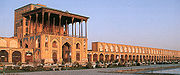
- Ali QapuAli QapuĀlī Qāpū is a grand palace in Isfahan, Iran. It is located on the western side of the Naghsh-i Jahan Square opposite to Sheikh lotf allah mosque, and had been originally designed as a vast portal. It is forty-eight meters high and there are seven floors, each accessible by a difficult spiral...
(The Royal Palace) – early 17th century - Talar Ashraf (The Palace of Ashraf) – 1650
- Hasht-Behesht (The Palace of Eight Paradises)Hasht BeheshtHasht Behesht is a Safavid era palace in Isfahan.It was built in 1669 and is today protected by Iran's Cultural Heritage Organization.-Links:*...
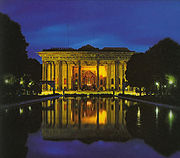
– 1669 - Chehel SotounChehel SotounChehel Sotoun is a pavilion in the middle of a park at the far end of a long pool, in Isfahan, Iran, built by Shah Abbas II to be used for his entertainment and receptions...
(The Palace of Forty Columns) – 1647 - Shah Caravanserai
Najvan Forest Park
Old schools (madresse)
- Madreseye Sadr.
- Madreseye Shah (Chahar Bagh School).
- Madreseye Khajoo.
- Harati
Squares and streets
- Naqsh-e Jahan SquareNaghsh-i Jahan SquareNaqsh-e Jahan Square , known as Imam Square , formerly known as Shah Square , is a square situated at the center of Isfahan city, Iran. Constructed between 1598 and 1629, it is now an important historical site, and one of UNESCO's World Heritage Sites...
also known as "Shah Square" or "Imam Square" – 1602. - Meydan Kohne (Old Square)
- Shahshahan Square
- Chaharbagh Boulevard – 1596.
- Chaharbagh-e-khajou Boulevard
Bridges
The Zayande River starts in the Zagros Mountains, flows from west to east through the heart of Isfahan, and dries up in the Kavir desert.The bridges over the river include some of the nicest architecture in Isfahan. The oldest bridge is the "Pol-e Shahrestan," which was probably built in the 12th century during the Seljuk period. Further upstream is the "Pol-e Khaju," which was built by Shah Abbas II in 1650. It is 123 metres long with 24 arches, and it also serves as a sluice gate.
The next bridge is the "Pol-e Jubi." It was originally built as an aqueduct to supply the palace gardens on the north bank of the river. Further upstream again is the Si-o-Seh Pol
33 pol
Si-o-se Pol , also called the Allah-Verdi Khan Bridge, is one of the eleven bridges of Isfahan, Iran. It is highly ranked as being one of the most famous examples of Safavid bridge design....
or bridge of 33 arches. Built during the rule of Shah Abbas the Great, it linked Isfahan with the Armenian
Armenians
Armenian people or Armenians are a nation and ethnic group native to the Armenian Highland.The largest concentration is in Armenia having a nearly-homogeneous population with 97.9% or 3,145,354 being ethnic Armenian....
suburb of Jolfa. It is by far the longest bridge in Isfahan at 295 m (967.85 ft).
Other bridges include:
- Pol-e Shahrestan (The Shahrestan bridgeShahrestan bridgeShahrestan bridge near Isfahan is one of the oldest surviving bridges in Iran, built in the 14th Century . It crosses the Zayanderood River at the village of Sharestan.-External links:* - with photo* -See also:* Bridges over the Zayandeh River...
) – 11th century. - Marnan bridge
- Pol-e Khaju(Khaju Bridge) – 1650.
- Si-o-Seh Pol33 polSi-o-se Pol , also called the Allah-Verdi Khan Bridge, is one of the eleven bridges of Isfahan, Iran. It is highly ranked as being one of the most famous examples of Safavid bridge design....
(The Bridge of 33 Arches) – 1602. - Pol-e-JouiJoui BridgeJoui Bridge , also called the Choobi Bridge, is a bridge in Isfahan, Iran. It is one of Isfahan's oldest bridges and was built in 1665, during the Safavid era....
or Choobi (Joui bridge).
Tourist Attractions
Isfahan is unique city. It is an important historical center for main different group of tourists in the domestic and international in the world. The central historical region and the area called Seeosepol (the name of a famous bridge)- – Naghsheh jahan square – Sheykh Lotfolah Mosque – Imam Mosque – Ali Qapou palace – See-o-se pol bridge – Ghaisarieh bazaar – Ghaisarieh bazaar entrance – Chehel setoon building – Chahar Bagh complex – Jameh Mosque – Hasht Behesht Building – Charhar Bagh school – Ashraf saloon – Khajoo bridge – Flower Garden – Bird park – Waterfall Park – Bozorg bazaar (grand bazaar) – Zargarha bazaar – Honar bazaar – Honar Museum – Rangrazha bazaar – Ferdosi Bridge – Darol shafa bazaar – Shishehgarha bazaar – Mokhels saray – Golshan saray – Haj Karim saray – Kodak Boston – Tofang and shamshir bazaar – Najvan park – Shahrestan Bridge – Safeh park – Folad Takht – Leleh park – Baba Roknoldin cemetery – Shahsheham Boghah – Ghasr Darb – Baghoshkaneh park – Isargarn park – Zalyandeh rood Bostan – Melat Bostan – Aeneh Khaneh Bostan – Abozar bridge – Sadi Booston – Osan commercial complex – Carpet shopping center – Vanak church – Maryam church – Chehel Dokhtaran Monareh – Dardasht Monareh – Sareban Monareh – Shaigh Bahaee public bath – Ghazvineha house – Bait-oll-ham church – Darolziafeh Monareh – Petros house – Darid house – Jewish synagogue – Mesri Mosque – Koshk Darb – Malek Gorestan – Ghazviniha Museum – Lebanon Mosque – Khat Museum – Shohada Museum – Halal Ahmar Museum – Shaikholeslam house – Safa Mosque – Ali Agha public bath/hamam – Jolfa church – Bazi shahr – Atashgah – Monar Jonban – Ghadir cultural complex – Japanese garden – Daeme exhibition – Ibrahim Emam zadeh – Khan Mosque – Ghodsi house – Laleh park – Haghighi house – Baba Ghasam cemetery – Massod Boghaeh – Haronieh Imam Zadeh – Ismeel Imam zadeh – Ahmad Imam Zadeh – Ali Mosque – Malek shahr complex – Hassan Abad bazaar – Jacob church – Marta house – Narsis church – Bidabad bazaar – Soltani complex – Shahzadeghan Bogheh – Mirza Kochek khan park – Ghadir recreational cultural complex
Other sites
- AtashgahAtashgah of IsfahanThe Atashgah of Isfahan is a Sassanid-era archaeological complex located on a hill of the same name about eight kilometers west of city center of Isfahan, Iran....
– a Zoroastrian fire temple. - Buqe'h-ye Ibn-Sina (Avicenna's Dome) – 12th century.
- The Tombs of Nizam al-Mulk & Malek Shah – 12th & 18th century.
- New JulfaNew JulfaNew Julfa is the Armenian quarter of Isfahan, Iran, located along the south bank of the river Zayandeh River....
(The Armenian Quarter). - The Bathhouse of Sheikh Bahai.
- Pigeon Towers – 17th century.
- Manar JonbanManar JonbanManar Jonban is a mausoleum in Isfahan, Iran, entitled to Amu Abdoullah Ebne Mohammad Ebne Mahmmoud, a mystic who died in 1316 AD....
, a famous minaret
Airport
Isfahan is served by the Isfahan International AirportIsfahan International Airport
Isfahan International Airport is an international airport located at the city of Isfahan in the Isfahan Province of Iran.Named in honor of Shahid Beheshti. The international airport is a one level building with limited services...
which handles domestic flights to Iranian cities and international flights, mostly to regional destinations across Middle East and central Asia including Dubai and Damascus.
Metro and Inter City Public Transportation
Esfahan Metro is under construction and will include 2 lines with 43 km length. The first line of that is planned to be finished by end of 2010 with 21 km length and 20 stations. Until the metro is completed an expanded bus system accompanied by taxis will handle Isfahan intra-urban public transportation.Rail
Isfahan is connected to three major rail lines: Isfahan-Tehran, Isfahan-Shiraz (Recently opened), Isfahan-Yazd and via this recent one to Bandar Abbas and ZahedanZahedan
Zahedan is a city in and the capital of Sistan and Baluchestan Province, Iran. At the 2006 census, its population was 552,706, in 109,488 families.-Geography:...
.
Road transport
Isfahan's internal highway network is currently under heavy expansion which began during the last decade. Its lengthy construction is due to concerns of possible destruction of valuable historical buildings. Outside the city, Isfahan is connected by modern highways to Tehran which spans a distance of nearly 400 km (248.55 mi) to North and to Shiraz at about 200 km (124.27 mi) to the south. The highways also service satellite cities surrounding the metropolitan area.Culture
Rug manufacture
Esfahan has long been one of the centers for production of the famous Persian RugPersian rug
The Persian carpet is an essential part of Persian art and culture. Carpet-weaving is undoubtedly one of the most distinguished manifestations of Persian culture and art, and dates back to ancient Persia. In 2008, Iran’s exports of hand-woven carpets was $420 million or 30% of the world's market...
. Weaving in Esfahan flourished in the Safavid era. But when the Afghans invaded Iran, ending the Safavid dynasty, the craft also became stagnant.
Not until 1920s, between two world wars, was weaving again taken seriously by the people of Esfahan. They started to weave Safavid designs and once again became one of the most important nexus of the Iranian rug weaving industry. Esfahani carpets today are among the most wanted in world markets, having many customers in western countries.
Esfahani rugs and carpets usually have ivory backgrounds with blue, rose, and indigo motifs. Rugs and carpets often have very symmetrical and balanced designs. They usually have a single medallion that is surrounded with vines and palmettos and are of excellent quality.
Food
- FesenjanFesenjanKhoresht-e fesenjān , or simply fesenjān , is a dish in Persian cuisine and Mesopotamian cuisine. It is a thick, tart stew made from pomegranate juice and ground walnuts . It is traditionally made with poultry ; but variants using balls of ground meat, ghormeh cut lamb, fish, or no meat at all are...
– a casserole type dish with a sweet and tart sauce containing the two base ingredients, pomegranate molasses and ground walnuts cooked with chicken, duck, lamb or beef and served with rice.
- GazGaz (candy)Gaz is the traditional name of Persian nougat originating from the city of Esfahan, located in the central plateau of Iran.The name gaz is associated with gaz-angebin which translates to "sap of angebin"; a desert plant member of the Tamarisk family and native to the Zagros mountain range located...
– the name given to Persian Nougat using the sap collected from angebin, a plant from the tamarisk family found only on the outskirts of Esfahan. It is mixed with various ingredients including rose water, pistachio and almond kernels and saffron.
- "Khoresht-e mast" (yoghurt stew) is a traditional dish in Esfahan. Unlike other stews despite its name, it is not served as a main dish and with rice; Since it is more of a sweet pudding it is usually served as a side dish or dessert. The dish is made with yogurt, lamb/mutton or chicken, saffron, sugar and orange zest. Iranians either put the orange zest in water for one week or longer or boil them for few minutes so the orange peels become sweet and ready for use. People in Iran make a lot of delicate dishes and jam with fruit rinds. This dish often accompanies celebrations and weddings.
- Esfahan is famous for its Beryooni. This dish is made of baked mutton & lungs that are minced and then cooked in a special small pan over open fire with a pinch of cinnamon. Beryooni is generally eaten with a certain type of bread, "nan-e taftton." Although it can also be served with other breads.
See also BiryaniBiryaniBiryani, biriani, or beriani is a set of rice-based foods made with spices, rice and meat, fish, eggs or vegetables. The name is derived from the Persian word beryā which means "fried" or "roasted"....
.
Famous people
Artists- Jalal al din Taj Esfahani,1903–, famous vocalist of classical music of Iran
- Hasan Kasaie,1928, distinguished ney player (ney is a musical instrument used in Iran's classical music)
- Jalil ShahnazJalil ShahnazJalil Shahnaz is an Iranian tar player born in 1921 in Isfahan.- Biography :Shahnaz studied under the supervision of Abdolhossein Shahnazi and Hossein Shahnaz and befriended ney player Hassan Kassai....
, 1921, notable TarTar (drum)A tar is a single-headed frame drum. The tar comes from North Africa and the Middle East. Depictions of these frame drums date back thousands of years....
player of Iran - Freydoon RassouliFreydoon RassouliRassouli is an Iranian-Born, American abstract surrealist painter. He was raised in a home decorated with murals and intricate floral designs. Inspired and encouraged by an uncle, he began painting and learning poetry from early age...
, famous artist and Founder of Fusionart movement - Master Ahmad Archang famous artist and designer of Isfahan rug patterns
- Alireza EftekhariAlireza EftekhariAlireza Eftekhari is an Iranian vocalist of Iranian classical and popular music.-Biography:He learnt music from several well known Iranian musicians, such as Taj Esfahani and Ali Tajvidi. Eftekhari is one of the most prolific Iranian vocalists....
, 1956–, is a famous singer in Iran - Mohammad EsfahaniMohammad EsfahaniMohammad Esfahani is an Iranian pop music singer.He graduated from The Medical University of Iran in 1997, while learning Iranian music from the famous Iranian singer Mohammad-Reza Shajarian and one of his best students,...
, popular music - MoeinMoeinNasrollah Moein known as Moein is an Iranian singer known for his love songs. Born in 1951 in Najaf Abad in Esfahan, he has played lots of concerts across the world...
, 1951, popular and classical music - Hoshmand Aghili, 1945–, popular and classical music
- Hassan ShamaizadehHassan ShamaizadehHassan Shamaizadeh is a famous pioneering and respected Persian singer, songwriter, composer, arranger, saxophonist, pianist. He is maestro in playing Saxophone and also play the Flute, Oboe and Clarinet with complete virtuosity. He is mostly known for his composition...
, music composer and Singer - Leila ForouharLeila ForouharLeila Forouhar is a singer and actress from Iran. She relocated to Los Angeles after the Iranian Revolution.-Career:Leila is the daughter of the late Iranian actor Jahangir Forouhar, who had already established a solid background in the Iranian entertainment industry by the early 1970s. She speaks...
(لیلا فروهر), born in 1957, The Iranian Woman Singer
Actors and movie directors
- Reza Arhamsadr, 1923–2008, a famous father of Persian comic cinema and theater, popular actor
- Nosratolah Vahdat,1925, a famous & popular actor
- Mohamad Ali Keshvarz, محمدعلی کشاورز 1930,-, a famous & popular actor
- Jahangir ForouharJahangir ForouharJahangir Forouhar was an Iranian actor, and the father of Iranian entertainer Leila Forouhar. He was born in Esfahan, Iran in 1916. He started playing in theater at the age of eighteen and in cinema at the age of 50.-External links:...
, 1916–1997, جهانگیر فروهر, a famous & popular actor and Father of Leila Forouhar (the Iranian woman singer) - Kiumars Poorahmad, 1949–, a famous & popular director
- Soraya Esfandiary-Bakhtiari, 1956–2001, former princess of Iran also an actress
- Homayoun ErshadiHomayoun ErshadiHomayoun Ershadi is an Iranian actor.Ershadi was born in Isfahan, Iran in 1947. He studied architecture in Italy and worked in that field. Acclaimed Iranian New Wave director Abbas Kiarostami chose him to play the leading role in Taste of Cherry...
, 1947–, a Hollywood actor and an architect
Painters
- Sumbat Der Kiureghian, 1913–1999, سمبات دِر كيوُرغيان, the best Isfahanian Armenian painter
- Hossein Mosaverolmolki,1889–1969, حسين مصورالملكي, notable painter and miniaturist
- Yervand Nahapetian, 1917–, يرواند نهاپطيان, Isfahanian Armenian painter
- Freydoon RassouliFreydoon RassouliRassouli is an Iranian-Born, American abstract surrealist painter. He was raised in a home decorated with murals and intricate floral designs. Inspired and encouraged by an uncle, he began painting and learning poetry from early age...
, An American painter born and raised in Isfahan - Ostad Javad Rostamshirazi, 1919–, Isfahanian painter
- Mahmoud FarshchianMahmoud FarshchianMahmoud Farshchian is a master of Persian painting and miniatures. He was born in the city of Isfahan in Iran, a place famed for its art and artists, and it was here where he started to learn art, painting and sculpting....
, 1930–, distinguished miniaturist
Political figures
- Mohammad-Ali Foroughi, a politician and Prime Minister of Iran in World war II era
- Shapour BakhtiarShapour BakhtiarShapour Bakhtiar was an Iranian political scientist, writer and the last Prime Minister of Iran under Shah Mohammad Reza Pahlavi...
, Ex Prime Minister of Iran - Hossein FatemiHossein FatemiHossein Fatemi was a scholar, journalist, and famous politician of Iran. A close associate of Prime Minister Mohammad Mosaddegh, he proposed nationalization of Iranian oil and gas assets. Initially a journalist, he served as Foreign Affairs Minister of Iran from 1951 to 1953...
, 1919–1954, PhD, politician (Foreign Minister of Dr M.Mosadegh Cabinet) - Ahmad Amir-AhmadiAhmad Amir-AhmadiSepahbod Ahmad Amir-Ahmadi was a military leader and cabinet Minister of Iran.Born in 1906 in Isfahan, he is one of the planners of the coup d'état of Reza Pahlavi and Seyyed Zia'eddin Tabatabaee against the Qajar dynasty...
, 1906–1965, military leader and cabinet minister of Iran - Hossein KharraziHossein KharraziMajor General Hosein Kharrazi was an Iranian commander of "Imam Hosein 14th Division" during Iran-Iraq War. He supported Islamic revolution and after its victory, served and helped safeguarding it...
, chief of army in the Iran & Iraq war - Mohsen NourbakhshMohsen NourbakhshSeyed Mohsen Nourbakhsh was an Iranian economist, most famous as Governor of the Central Bank of Iran and the former Minister of Economic and Finance of Iran.-Personal Life and Education:...
, 1948–2003, economist, Governor of the Central Bank of Iran - Nusrat BhuttoNusrat BhuttoBegum Nusrat Bhutto was an Iranian-Pakistani who was the wife of the 9th Prime Minister of Pakistan Zulfikar Ali Bhutto, serving as the First Lady of Pakistan during his premiership from 1971 until Bhutto's removal in 1977. She became her husband's successor as the chairman of the Pakistan Peoples...
, Chairman of Pakistan Peoples PartyPakistan Peoples PartyThe Pakistan Peoples Party , is a democratic socialist political party in Pakistan affiliated with Socialist International. Pakistan People's Party is the largest political party of Pakistan...
from 1979–1983, wife of Zulfikar Ali BhuttoZulfikar Ali BhuttoZulfikar Ali Bhutto was 9th Prime Minister of Pakistan from 1973 to 1977, and prior to that, 4th President of Pakistan from 1971 to 1973. Bhutto was the founder of the Pakistan Peoples Party — the largest and most influential political party in Pakistan— and served as its chairman until his...
, and mother of Benazir BhuttoBenazir BhuttoBenazir Bhutto was a democratic socialist who served as the 11th Prime Minister of Pakistan in two non-consecutive terms from 1988 until 1990 and 1993 until 1996....
.
Religious figures
- Ayatollah Hossein-Ali Montazeri Najafabadi,آیت الله حسینعلی منتظری نجف آبادی, Born in 1922 and died in December 19, 2009, a prominent Iranian scholar, Islamic theologian, democracy advocate, writer and human rights activist, a Grand Marja (religious authority) of Shi'ite Islam
- Ayatollah Yousef SaneiAyatollah Yousef SaneiGrand Ayatollah Yousef Sanei is an Iranian scholar, renowned theologian and Islamic philosopher. He is admired by many and condemned by others for his radical calls for reforms and also serves as a Grand Marja of Shia Islam.-Biography:...
,یوسف صانعی, Born in Isfahan in 1937, He is an Iranian scholar, renowned theologian and Islamic philosopher. He is known as a senior reformist cleric and a Grand Marja of Shia Islam. - Salman the PersianSalman the PersianSalman the Persian or Salman al Farisi was one of Muhammad's companions.During some of his later meetings with the other Sahaba, he was referred to as Abu Abdullah .-Birth place:...
- Allamah al-MajlisiAllamah al-MajlisiMuhammad Baqir Majlesi, known as Allamah Majlesi or Majlesi-ye Thani , was a renowned and very powerful Iranian Twelver Shi'a cleric, during the Safavid era...
, 1616–1698, Safavid cleric, Sheikh ul-IslamSheikh ul-IslamShaykh al-Islām is a title of superior authority in the issues of Islam....
in Isfahan - Ayatollah Rahim ArbabRahim ArbabAyatollah-al-ozma Haj Agha Rahim Arbab was born in Chermaheen in Iran, near Shahre Kord, to a family of scholars.Ayatollah-al-ozma is the highest rank in traditional Twelver Shi'a studies. Ayatollah Arbab is among three Ayatollahs who never wore the traditional turban...
, 1847–?, cleric, Ayatollah-al-ozma rank - Ayatollah Mohammad BeheshtiAyatollah Mohammad BeheshtiAyatollah Dr. Seyyed Mohammad Hosseini Beheshti , was an Iranian scholar, writer, jurist and one of the main architects of the constitution of the Islamic Republic in Iran. He was the secretary-general of the Islamic Republic Party, and the head of Iran's judicial system...
, 1928–1981, cleric, Chairman of the Council of Revolution of Iran
Sportspeople
- Mahmoud Yavari, محمود یاوری, Born in 1939, Former Player of Shahine Esfahan and Iran National Team from 1958 until 1970, The Former Coach of Iran National Team and is known as an oldest and the most Active Coach in 2010 Persian Gulf League and Football Federation, He was also retired of Iran Police Department as a Colonel degree, amir ghalenouie calls him as Father of Football of Iran
- Abdolali ChangizAbdolali ChangizAbdolali Changiz is a Iranian football Forward who played for Iran in the 1984 Asian Cup. He also played for Esteghlal.- International Records :-External links:**...
, football star and Famous Player of Perspolis Fc in 1970s - Mansour EbrahimzadehMansour EbrahimzadehMansour Ebrahimzadeh is an Iranian retired football player and current coach. He is currently managing Zob Ahan in Iran Pro League. He was caretaker manager of Iran national football team from January to March 2008.-Early lfe:...
, Former Player of Sepahan in 1970s and 1980s, He have been Coach of Zobahan FC since 2007 - Rasoul KorbekandiRasoul KorbekandiMohammad Reza Rasoul Korbekandi is a retired Iranian football player and now manager.He was a member of the Iran squad which participated at the 1978 FIFA World Cup.-Coaching career:-References:...
, Famous Goalkeeper in Iran National Team, current coach of Rah Ahan FCRah Ahan FCRah Ahan Football Club is an Iranian football club based in Shahr-e-Rey. They currently play in the IPL.-Establishment:Rah Ahan was formed in 1937 in Tehran by Iran Railways and to this day the club still remains in their control... - Moharram NavidkiaMoharram NavidkiaMoharram Navidkia is an Iranian football player who currently plays as the captain of Sepahan in Iran's Premier League. He plays as a midfielder.During his career, he has dealt with consecutive injuries making him unable to regain his top form....
, Captain of the SepahanSepahanSepahan Esfahan is an Iranian football club based in Isfahan, Iran. They compete in Iran's top flight known as Persian Gulf League and hold most of the records in the PGL under their belt. Sepahan are the latest champions of the PGL in 2010–11 season for the record third time in the ten-year PGL...
Football Club - Ehsan Hajsafi, youth phenomenon of the SepahanSepahanSepahan Esfahan is an Iranian football club based in Isfahan, Iran. They compete in Iran's top flight known as Persian Gulf League and hold most of the records in the PGL under their belt. Sepahan are the latest champions of the PGL in 2010–11 season for the record third time in the ten-year PGL...
Football Club
Writers and poets
- Mohammad-Ali Jamālzādeh Esfahani,1892–1997, author
- Mohammad ALi Mokrame Esfahani, 1886–1966, Liberalist and anti-religion's Superstitions Poet and journalist in Sedaye Esfahan Newspaper
- Khakshir Esfahani, 1883–1956, Poet of Joke and satire
- Houshang GolshiriHoushang GolshiriHoushang Golshiri was an Iranian fiction writer, critic and editor. He was one of the first Iranian writers to use modern literary techniques, and is recognized as one of the most influential writers of Persian prose of the twentieth century.-Early life:...
, 1938–2000, writer and editor - Mirza Abbas Khan SheidaMirza Abbas Khan SheidaMirza Abbas Khan Sheida, or Sheida-ye-Esfahani , was an Iranian sufi, poet and Journalist.Sheida was born in 1873 in Shahre-Kord near Isfahan. His father Mirza Es-hagh Dehkordi, was the governor-general of Shahre Kord and the province of Chahar Mahaal o Bakhtiari...
, 1880–1949, poet and publisher - Hamid MosadeghHamid MosadeghHamid Mosadegh , was a contemporary Iranian poet, author and lawyer.Mohammad Mosaddegh or Mosaddeq , also Mossadegh, Mossadeq, Mosadeck, or Musaddiq , was the democratically elected[1][2][3] Prime Minister of Iran from 1951 to 1953 when he was overthrown in a coup d'état...
, 1939–1998, poet and lawyer - Hatef EsfehaniHatef EsfehaniSeyyed Ahmad Hatef Esfehani is a famous Iranian poet of the 18th century.-Life:...
, 1198(died), Persian Moral poet in Afsharye Era - Saib Tabrizi
Others
- Nasser David KhaliliNasser David KhaliliNasser David Khalili, KCSS, KCFO is a British-Iranian property developer, art collector and philanthropist based in London. He holds [United Kingdom] citizenship....
, 1945–, property developer, art collector, and philanthropist - Arthur PopeArthur PopeArthur Upham Pope , was an American archaeologist and historian of Persian art.Born in Phenix, Rhode Island, graduated from Worcester Academy in 1899, and taught at Amherst College and the University of California. He married fellow Persian art historian, Phyllis Ackerman, in 1920. In 1923, Pope...
, 1881–1969, American archaeologist, buried near Khaju BridgeKhaju BridgeKhaju Bridge is arguably the finest bridge in the province of Isfahan, Iran. It was built by the Persian Safavid king, Shah Abbas II around 1650 C.E., on the foundations of an older bridge. Serving as both a bridge, and a dam , it links the Khaju quarter on the north bank with the Zoroastrian...
Education
- Universities
- Islamic Azad University, Majlesi Branch (Esfahan)
- Islamic azad university of khorasgan
- Islamic Azad University of Khomeini Shahr
- Isfahan University of TechnologyIsfahan University of TechnologyIsfahan University of Technology is one of the most prestigious engineering universities in Iran. It is located 15 Kilometers north west of Isfahan and is one of the major universities and research poles in Iran in the fields of science, engineering and agriculture...
- Sheikh Bahaei University
- Isfahan University of Medical SciencesIsfahan University of Medical SciencesIsfahan University of Medical Sciences is a university of higher education in basic medical sciences, clinical medical sciences and health services in Iran....
- University of IsfahanUniversity of IsfahanUniversity of Isfahan is a state-operated university in Iran. It is one of the most prominent science and engineering schools in Iran and is the largest university in Isfahan Province in Iran. The university is located in the southern section of the city of Isfahan...
- Isfahan University of ArtIsfahan University of ArtIsfahan University of Art is in Isfahan, Iran. It operated under the name of Farabi University before 1978, then it became a campus of the University of Art . It was separated and became independent in 1999. The university owns some of the greatest houses in Isfahan, mostly of the Safavid period...
- High schools
- Shahid Ejei High SchoolShahid Ejei High SchoolThe Shahid Ejei High School , Ejei high school or Ezhei high school is located in University of Isfahan, Isfahan, Iran....
- Harati High SchoolHarati High SchoolHarati High School is located in Esfahan, Iran. The school is regarded as a well known landmark. It is located on Kamal Esmaeel Avenue between the Khadjoo and the 33 pol bridges....
- Adab High SchoolAdab High SchoolAdab High School in Isfahan, Iran, was established in the early 20th century by British Anglican missionaries as an all boys school. It was later converted to a secular school under the direction of Isa Sadiq and under the administration of Sayyid Yahya DowlatAbadi...
- Mahboobeh Danesh(Navaie)
- iyliya education institue Eng.Saghaei
- Imam Mohammad Bagher Education Complex
- Shahid Ejei High School
There are also more than 50 Technical and Vocational Training Centers under the administration of Isfahan TVTO which provide non-formal training programs freely throughout the province.
Sports
Isfahan is host of many national and international sport events therefore enjoying good sport facilities such as Naghsh-e-Jahan Stadium with 50,000 capacity which second phase is under development to increase capacity to 75,000 spectators.Isfahan has an important derby called as Naqsh e jahan derby
Naqsh e jahan derby
The Naqsh-e Jahan derby is a football match played annually in of Isfahan, Iran, between the two rival professional teams of the city: Zob Ahan F.C...
. This competition is one of the most popular annual football events in Iran between Sepahan F.C. and Zob Ahan
Zob Ahan
Zob Ahan may refer to:*Esfahan Steel Company, in Esfahan Province, Iran, which also goes by name Zob Ahan*Zob Ahan F.C., an Iranian football club owned by Esfahan Steel Company...
.
Isfahan has two association football clubs that have been title contenders in Iran's Premier Football League
Iran's Premier Football League
The Iran Pro League , is a professional football league competition for clubs located at the highest level of the Iranian football league system.The league system resembles the system being used in England currently...
. These are:
- Sepahan IsfahanSepahanSepahan Esfahan is an Iranian football club based in Isfahan, Iran. They compete in Iran's top flight known as Persian Gulf League and hold most of the records in the PGL under their belt. Sepahan are the latest champions of the PGL in 2010–11 season for the record third time in the ten-year PGL...
. Honours:- Attend in FIFA Club World CupFIFA Club World CupThe FIFA Club World Cup is a football competition between the champion clubs from all six continental confederations.The first FIFA Club World Championship took place in Brazil in January 2000...
, 2007 - Vice-Champion of AFC Champions League 2007
- Attend in AFC Champions LeagueAFC Champions LeagueThe AFC Champions League is the premier Asian club football competition hosted annually by Asian Football Confederation . The tournament is contested among the top thirty-two clubs from the top 10 Asian leagues, two of which must qualify through the playoffs...
, 2004, 2005, 2006, 2007, 2008, 2009, 2010, 2011 - Champion of Iran's Premier Football LeagueIran's Premier Football LeagueThe Iran Pro League , is a professional football league competition for clubs located at the highest level of the Iranian football league system.The league system resembles the system being used in England currently...
, 2003, 2010 and 2011 - Vice-Champion of Iran's Premier Football LeagueIran's Premier Football LeagueThe Iran Pro League , is a professional football league competition for clubs located at the highest level of the Iranian football league system.The league system resembles the system being used in England currently...
2008 - Champion of Hazfi CupHazfi CupThe Hazfi Cup is a knockout cup competition in Iranian football, run by the Iranian Football Federation. The competition wasn't regarded important by clubs until the IRIFF decided to award one of Iran's four AFC Champions League spots to the champion....
, 2004, 2006, 2007
- Attend in FIFA Club World Cup
- Sepahan NovinSepahan Novin F.C.Sepahan Novin Football Club is an Iranian professional football team based in Esfahan, Iran. They are the reserve team of Sepahan F.C. and currently compete in the 2011–12 Iran Football's 3rd Division.-History:...
. Honour(s):- Iran's Premier Football LeagueIran's Premier Football LeagueThe Iran Pro League , is a professional football league competition for clubs located at the highest level of the Iranian football league system.The league system resembles the system being used in England currently...
Runners Up 2008
- Iran's Premier Football League
- Zob Ahan Isfahan. Honours:
- Vice-Champion of Iran's Premier Football LeagueIran's Premier Football LeagueThe Iran Pro League , is a professional football league competition for clubs located at the highest level of the Iranian football league system.The league system resembles the system being used in England currently...
2005, 2009, 2010 - Champion of Hazfi CupHazfi CupThe Hazfi Cup is a knockout cup competition in Iranian football, run by the Iranian Football Federation. The competition wasn't regarded important by clubs until the IRIFF decided to award one of Iran's four AFC Champions League spots to the champion....
, 2003, 2009 - Attend in AFC Champions LeagueAFC Champions LeagueThe AFC Champions League is the premier Asian club football competition hosted annually by Asian Football Confederation . The tournament is contested among the top thirty-two clubs from the top 10 Asian leagues, two of which must qualify through the playoffs...
, 2004, 2010 and 2011
- Vice-Champion of Iran's Premier Football League
Twin towns – Sister cities
Isfahan is twinnedTown twinning
Twin towns and sister cities are two of many terms used to describe the cooperative agreements between towns, cities, and even counties in geographically and politically distinct areas to promote cultural and commercial ties.- Terminology :...
with:
Baalbek
Baalbek
Baalbek is a town in the Beqaa Valley of Lebanon, altitude , situated east of the Litani River. It is famous for its exquisitely detailed yet monumentally scaled temple ruins of the Roman period, when Baalbek, then known as Heliopolis, was one of the largest sanctuaries in the Empire...
, Lebanon
Lebanon
Lebanon , officially the Republic of LebanonRepublic of Lebanon is the most common term used by Lebanese government agencies. The term Lebanese Republic, a literal translation of the official Arabic and French names that is not used in today's world. Arabic is the most common language spoken among...
Barcelona
Barcelona
Barcelona is the second largest city in Spain after Madrid, and the capital of Catalonia, with a population of 1,621,537 within its administrative limits on a land area of...
, Spain
Spain
Spain , officially the Kingdom of Spain languages]] under the European Charter for Regional or Minority Languages. In each of these, Spain's official name is as follows:;;;;;;), is a country and member state of the European Union located in southwestern Europe on the Iberian Peninsula...
Cairo
Cairo
Cairo , is the capital of Egypt and the largest city in the Arab world and Africa, and the 16th largest metropolitan area in the world. Nicknamed "The City of a Thousand Minarets" for its preponderance of Islamic architecture, Cairo has long been a centre of the region's political and cultural life...
, Egypt
Egypt
Egypt , officially the Arab Republic of Egypt, Arabic: , is a country mainly in North Africa, with the Sinai Peninsula forming a land bridge in Southwest Asia. Egypt is thus a transcontinental country, and a major power in Africa, the Mediterranean Basin, the Middle East and the Muslim world...
Florence
Florence
Florence is the capital city of the Italian region of Tuscany and of the province of Florence. It is the most populous city in Tuscany, with approximately 370,000 inhabitants, expanding to over 1.5 million in the metropolitan area....
, Italy
Italy
Italy , officially the Italian Republic languages]] under the European Charter for Regional or Minority Languages. In each of these, Italy's official name is as follows:;;;;;;;;), is a unitary parliamentary republic in South-Central Europe. To the north it borders France, Switzerland, Austria and...
Freiburg
Freiburg
Freiburg im Breisgau is a city in Baden-Württemberg, Germany. In the extreme south-west of the country, it straddles the Dreisam river, at the foot of the Schlossberg. Historically, the city has acted as the hub of the Breisgau region on the western edge of the Black Forest in the Upper Rhine Plain...
, Germany
Germany
Germany , officially the Federal Republic of Germany , is a federal parliamentary republic in Europe. The country consists of 16 states while the capital and largest city is Berlin. Germany covers an area of 357,021 km2 and has a largely temperate seasonal climate...
Havana
Havana
Havana is the capital city, province, major port, and leading commercial centre of Cuba. The city proper has a population of 2.1 million inhabitants, and it spans a total of — making it the largest city in the Caribbean region, and the most populous...
, Cuba
Cuba
The Republic of Cuba is an island nation in the Caribbean. The nation of Cuba consists of the main island of Cuba, the Isla de la Juventud, and several archipelagos. Havana is the largest city in Cuba and the country's capital. Santiago de Cuba is the second largest city...
Hyderabad, Andhra Pradesh
Andhra Pradesh
Andhra Pradesh , is one of the 28 states of India, situated on the southeastern coast of India. It is India's fourth largest state by area and fifth largest by population. Its capital and largest city by population is Hyderabad.The total GDP of Andhra Pradesh is $100 billion and is ranked third...
, India
India
India , officially the Republic of India , is a country in South Asia. It is the seventh-largest country by geographical area, the second-most populous country with over 1.2 billion people, and the most populous democracy in the world...
Iaşi
Iasi
Iași is the second most populous city and a municipality in Romania. Located in the historical Moldavia region, Iași has traditionally been one of the leading centres of Romanian social, cultural, academic and artistic life...
, Romania
Romania
Romania is a country located at the crossroads of Central and Southeastern Europe, on the Lower Danube, within and outside the Carpathian arch, bordering on the Black Sea...
Istanbul
Istanbul
Istanbul , historically known as Byzantium and Constantinople , is the largest city of Turkey. Istanbul metropolitan province had 13.26 million people living in it as of December, 2010, which is 18% of Turkey's population and the 3rd largest metropolitan area in Europe after London and...
, Turkey
Turkey
Turkey , known officially as the Republic of Turkey , is a Eurasian country located in Western Asia and in East Thrace in Southeastern Europe...
Kuala Lumpur
Kuala Lumpur
Kuala Lumpur is the capital and the second largest city in Malaysia by population. The city proper, making up an area of , has a population of 1.4 million as of 2010. Greater Kuala Lumpur, also known as the Klang Valley, is an urban agglomeration of 7.2 million...
, Malaysia Kuwait City
Kuwait City
-Suburbs:Although the districts below are not usually recognized as suburbs, the following is a list of a few areas surrounding Kuwait city:Al-Salam ""السلام"" -Economy:...
, Kuwait
Kuwait
The State of Kuwait is a sovereign Arab state situated in the north-east of the Arabian Peninsula in Western Asia. It is bordered by Saudi Arabia to the south at Khafji, and Iraq to the north at Basra. It lies on the north-western shore of the Persian Gulf. The name Kuwait is derived from the...
Lahore
Lahore
Lahore is the capital of the Pakistani province of Punjab and the second largest city in the country. With a rich and fabulous history dating back to over a thousand years ago, Lahore is no doubt Pakistan's cultural capital. One of the most densely populated cities in the world, Lahore remains a...
, Pakistan
Pakistan
Pakistan , officially the Islamic Republic of Pakistan is a sovereign state in South Asia. It has a coastline along the Arabian Sea and the Gulf of Oman in the south and is bordered by Afghanistan and Iran in the west, India in the east and China in the far northeast. In the north, Tajikistan...
Saint Petersburg
Saint Petersburg
Saint Petersburg is a city and a federal subject of Russia located on the Neva River at the head of the Gulf of Finland on the Baltic Sea...
, Russia
Russia
Russia or , officially known as both Russia and the Russian Federation , is a country in northern Eurasia. It is a federal semi-presidential republic, comprising 83 federal subjects...
Venice
Venice
Venice is a city in northern Italy which is renowned for the beauty of its setting, its architecture and its artworks. It is the capital of the Veneto region...
, Italy
Italy
Italy , officially the Italian Republic languages]] under the European Charter for Regional or Minority Languages. In each of these, Italy's official name is as follows:;;;;;;;;), is a unitary parliamentary republic in South-Central Europe. To the north it borders France, Switzerland, Austria and...
Xi'an
Xi'an
Xi'an is the capital of the Shaanxi province, and a sub-provincial city in the People's Republic of China. One of the oldest cities in China, with more than 3,100 years of history, the city was known as Chang'an before the Ming Dynasty...
, Shaanxi
Shaanxi
' is a province in the central part of Mainland China, and it includes portions of the Loess Plateau on the middle reaches of the Yellow River in addition to the Qinling Mountains across the southern part of this province...
, China
China
Chinese civilization may refer to:* China for more general discussion of the country.* Chinese culture* Greater China, the transnational community of ethnic Chinese.* History of China* Sinosphere, the area historically affected by Chinese culture...
Yerevan
Yerevan
Yerevan is the capital and largest city of Armenia and one of the world's oldest continuously-inhabited cities. Situated along the Hrazdan River, Yerevan is the administrative, cultural, and industrial center of the country...
, Armenia
Armenia
Armenia , officially the Republic of Armenia , is a landlocked mountainous country in the Caucasus region of Eurasia...
External links
- Municipality of Isfahan
- Isfahan official website
- Isfahan Metro
- Isfahan Geometry on a Human Scale A Documentary film directed by Manouchehr Tayyab (30 min)