

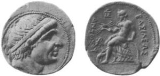
Antiochus I Soter

Encyclopedia
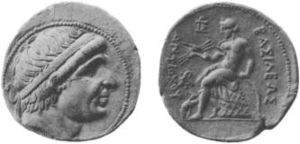
Seleucid Empire
The Seleucid Empire was a Greek-Macedonian state that was created out of the eastern conquests of Alexander the Great. At the height of its power, it included central Anatolia, the Levant, Mesopotamia, Persia, today's Turkmenistan, Pamir and parts of Pakistan.The Seleucid Empire was a major centre...
. He reigned from 281 BC - 261 BC.
Antiochus I was half Persian
Persian people
The Persian people are part of the Iranian peoples who speak the modern Persian language and closely akin Iranian dialects and languages. The origin of the ethnic Iranian/Persian peoples are traced to the Ancient Iranian peoples, who were part of the ancient Indo-Iranians and themselves part of...
, his mother Apama
Apama
Apama , sometimes known as Apama I or Apame I was the wife of the first ruler of the Seleucid Empire, Seleucus I Nicator. They married at Susa in 324 BC...
being one of the eastern princesses whom Alexander the Great had given as wives to his generals in 324 BC. In 294 BC, prior to the death of his father Seleucus I
Seleucus I Nicator
Seleucus I was a Macedonian officer of Alexander the Great and one of the Diadochi. In the Wars of the Diadochi that took place after Alexander's death, Seleucus established the Seleucid dynasty and the Seleucid Empire...
, Antiochus married his stepmother, Stratonice
Stratonice of Syria
For other persons with the same name, see StratoniceStratonice of Syria was the daughter of king Demetrius Poliorcetes and Phila, the daughter of Antipater...
, daughter of Demetrius Poliorcetes. His elderly father reportedly instigated the marriage after discovering that his son was in danger of dying of lovesickness. Stratonice bore five children to Antiochus: Seleucus (he was executed for rebellion), Laodice, Apama II
Apama II
For other uses of this name see, Apama Apama II , sometimes known as Apame II was a Syrian Greek Princess of the Seleucid Empire and through marriage was a Queen of Cyrenaica.Apama II was of Greek Macedonian and Persian descent...
, Stratonice of Macedon and Antiochus II Theos
Antiochus II Theos
Antiochus II Theos was a king of the Hellenistic Seleucid Kingdom who reigned 261 BC – 246 BC). He succeeded his father Antiochus I Soter in the winter of 262–61 BC...
, who succeeded his father as king.
On the assassination of his father in 281 BC, the task of holding together the empire was a formidable one. A revolt in Syria
Syria
Syria , officially the Syrian Arab Republic , is a country in Western Asia, bordering Lebanon and the Mediterranean Sea to the West, Turkey to the north, Iraq to the east, Jordan to the south, and Israel to the southwest....
broke out almost immediately. Antiochus was soon compelled to make peace with his father's murderer, Ptolemy Keraunos
Ptolemy Keraunos
Ptolemy Keraunos was the King of Macedon from 281 BC to 279 BC. His epithet Keraunos is Greek for "Thunder" or "Thunderbolt".He was the eldest son of Ptolemy I Soter, ruler of Egypt, and his third wife Eurydice, daughter of the regent Antipater. His younger half-brother, also called Ptolemy,...
, apparently abandoning Macedon
Macedon
Macedonia or Macedon was an ancient kingdom, centered in the northeastern part of the Greek peninsula, bordered by Epirus to the west, Paeonia to the north, the region of Thrace to the east and Thessaly to the south....
ia and Thrace
Thrace
Thrace is a historical and geographic area in southeast Europe. As a geographical concept, Thrace designates a region bounded by the Balkan Mountains on the north, Rhodope Mountains and the Aegean Sea on the south, and by the Black Sea and the Sea of Marmara on the east...
. In Anatolia
Anatolia
Anatolia is a geographic and historical term denoting the westernmost protrusion of Asia, comprising the majority of the Republic of Turkey...
he was unable to reduce Bithynia
Bithynia
Bithynia was an ancient region, kingdom and Roman province in the northwest of Asia Minor, adjoining the Propontis, the Thracian Bosporus and the Euxine .-Description:...
or the Persian dynasties that ruled in Cappadocia
Cappadocia
Cappadocia is a historical region in Central Anatolia, largely in Nevşehir Province.In the time of Herodotus, the Cappadocians were reported as occupying the whole region from Mount Taurus to the vicinity of the Euxine...
.
In 278 BC the Gaul
Gaul
Gaul was a region of Western Europe during the Iron Age and Roman era, encompassing present day France, Luxembourg and Belgium, most of Switzerland, the western part of Northern Italy, as well as the parts of the Netherlands and Germany on the left bank of the Rhine. The Gauls were the speakers of...
s broke into Anatolia, and a victory that Antiochus won over these hordes is said to have been the origin of his title of Soter (Gr.
Greek language
Greek is an independent branch of the Indo-European family of languages. Native to the southern Balkans, it has the longest documented history of any Indo-European language, spanning 34 centuries of written records. Its writing system has been the Greek alphabet for the majority of its history;...
for "saviour").
At the end of 275 BC the question of Coele-Syria
Coele-Syria
Coele-Syria , or Cœle-Syria or Celesyria, traditionally given the meaning 'hollow' Syria, was the region of southern Syria disputed between the Seleucid dynasty and the Ptolemaic dynasty. Rather than limiting the Greek term to the Beqaa Valley of Lebanon, it is often used to cover the entire area...
, which had been open between the houses of Seleucus and Ptolemy since the partition of 301 BC, led to hostilities (the First Syrian War). It had been continuously in Ptolemaic
Ptolemaic dynasty
The Ptolemaic dynasty, was a Macedonian Greek royal family which ruled the Ptolemaic Empire in Egypt during the Hellenistic period. Their rule lasted for 275 years, from 305 BC to 30 BC...
occupation, but the house of Seleucus
Seleucid Empire
The Seleucid Empire was a Greek-Macedonian state that was created out of the eastern conquests of Alexander the Great. At the height of its power, it included central Anatolia, the Levant, Mesopotamia, Persia, today's Turkmenistan, Pamir and parts of Pakistan.The Seleucid Empire was a major centre...
maintained its claim. War did not materially change the outlines of the two kingdoms, though frontier cities like Damascus
Damascus
Damascus , commonly known in Syria as Al Sham , and as the City of Jasmine , is the capital and the second largest city of Syria after Aleppo, both are part of the country's 14 governorates. In addition to being one of the oldest continuously inhabited cities in the world, Damascus is a major...
and the coast districts of Asia Minor might change hands.
On March 27th 268 BC Antiochus I laid the foundation for the Ezida Temple in Borsippa
Borsippa
Borsippa was an important ancient city of Sumer, built on both sides of a lake about southwest of Babylon on the east bank of the Euphrates. The site of Borsippa is in Babil Governorate, Iraq and now called Birs Nimrud, identifying the site with Nimrod...
.http://www.aakkl.helsinki.fi/melammu/pdf/oelsner2002.pdf His eldest son Seleucus had ruled in the east as viceroy from 275 BC(?) till 268/267 BC; Antiochus put his son to death in the latter year on the charge of rebellion. Circa 262 BC Antiochus tried to break the growing power of Pergamum by force of arms, but suffered defeat near Sardis
Sardis
Sardis or Sardes was an ancient city at the location of modern Sart in Turkey's Manisa Province...
and died soon afterwards. He was succeeded in 261 BC by his second son Antiochus II Theos
Antiochus II Theos
Antiochus II Theos was a king of the Hellenistic Seleucid Kingdom who reigned 261 BC – 246 BC). He succeeded his father Antiochus I Soter in the winter of 262–61 BC...
.http://www.attalus.org/translate/malalas.html
External links
- Appianus' Syriaka
- Antiochus I Soter: fact sheet at Livius.org
- Babylonian Chronicles of the Hellenistic Period
- Antiochus I Soter entry in historical sourcebook by Mahlon H. Smith
- Hellenization of the Babylonian Culture?
- Coins of Antiochus I