


Bahram V

Encyclopedia
Yazdegerd I
Yazdegerd I, or Izdekerti , was the thirteenth Sassanid king of Persia and ruled from 399 to 421. He is believed by some to be the son of Shapur III and by others to be son of Bahram IV...
(399–421), after whose sudden death (or assassination) he gained the crown against the opposition of the grandees by the help of Mundhir, the Arab
Arab
Arab people, also known as Arabs , are a panethnicity primarily living in the Arab world, which is located in Western Asia and North Africa. They are identified as such on one or more of genealogical, linguistic, or cultural grounds, with tribal affiliations, and intra-tribal relationships playing...
dynast of al-Hirah
Al-Hirah
Al Hīra was an ancient city located south of al-Kufah in south-central Iraq.- Middle Ages:Al Hīra was a significant city in pre-Islamic Arab history. Originally a military encampment, in the 5th and 6th centuries CE it became the capital of the Lakhmids.The Arabs were migrating into the Near East...
.
Reign and war with Rome
Bahram V began his reign with a systematic persecution of the ChristiansChristianity in Iran
Christianity in Iran has a long history, dating back to the early years of the faith. It has always been a minority religion, with the majority state religions — Zoroastrianism before the Islamic conquest, Sunni Islam in the Middle Ages and Shia Islam in modern times — though it had a much larger...
, among whom was James Intercisus
James Intercisus
Saint James Intercisus is a Persian saint. His surname, Intercisus, is derived from the Latin word for "cut into pieces," which refers to the manner of his martyrdom: he was slowly cut into twenty-eight pieces...
, which led to a war with the Eastern Romans
Roman–Sassanid War (421–422)
The Roman–Sassanid war of 421–422 was a conflict between the Eastern Roman Empire and the Sassanids. The casus belli was the persecution of Christians by the Sassanid king Bahram V; the Christian Eastern Roman Emperor Theodosius II declared war and obtained some victories, but in the end the two...
.
In the year 421, the Romans sent their general Ardaburius with an extensive contingent into Armenia. Ardaburius defeated the Persian commander Narseh and proceeded to plunder the province of Arzanene and lay siege to Nisibis
Nisibis
Nusaybin Nisêbîn) is a city in Mardin Province, Turkey, populated mainly by Kurds. Earlier Arameans, Arabs, and Armenians lived in the city. The population of the city is 83,832 as of 2009.-Ancient Period:...
. Ardaburius abandoned the siege in the face of an advancing army under Bahram, who in turn besieged Theodosiopolis (probably Theodosiopolis in Osroene
Osroene
Osroene, also spelled Osrohene and Osrhoene and sometimes known by the name of its capital city, Edessa , was a historic Syriac kingdom located in Mesopotamia, which enjoyed semi-autonomy to complete independence from the years of 132 BC to AD 244.It was a Syriac-speaking kingdom.Osroene, or...
).
Peace was then concluded between the Persians and Romans (422) with a return to status quo ante bellum
Status quo ante bellum
The term status quo ante bellum is Latin, meaning literally "the state in which things were before the war".The term was originally used in treaties to refer to the withdrawal of enemy troops and the restoration of prewar leadership. When used as such, it means that no side gains or loses...
.
Relations with Armenia
The situation in Armenia occupied Bahram immediately after the conclusion of peace with Rome. Armenia had been without a king since Bahram's brother Shapur had vacated the country in 418. Bahram now desired that a descendant of the royal line of kings, a scion of the Arshakunis, should be on the throne of Armenia. With this intention in mind, he selected an Arshakuni named Artaxias IVArtaxias IV
Artashes IV, son of Vramshapuh, was appointed king of Armenia by the Sassanian king Bahram V. However, after losing the confidence of the nakharar lords, he was removed by Bahram V in 428. This ended the Armenian Arsacid dynasty, which was followed by the marzpanate period in Armenia....
(Artashes), a son of Vramshapuh
Vramshapuh
Vramshapuh was the Arshakuni king of Armenia from 389 to 414/417. Vramshapuh is most notable for presiding over the creation of the Armenian alphabet in 405. He also managed to unite the two parts of Greater Armenia.-References:...
, and made him King of Armenia.
But the newly appointed king did not have a good character. The frustrated nobles petitioned Bahramgur to remove Artaxias and admit Armenia into the Persian Empire so that the province would be under the direct control of the Sassanian Empire. However, the annexation of Armenia by Persia was strongly opposed by the Armenian patriarch Isaac of Armenia
Isaac of Armenia
Isaac or Sahak of Armenia was Catholicos of Armenia. He is sometimes known as "Isaac the Great," and as "Սահակ Պարթև / Sahak Parthev" in Armenian, owing to his Parthian origin....
, who felt the rule of a Christian better than that of a non-Christian regardless of his character or ability. Despite his strong protests, however, Armenia was annexed by Bahram, who placed it under the charge of a Persian governor in 428.
Invasion of the Huns
During the later part of Bahram V's reign, Persia was invaded from the northeast by HephthaliteHephthalite
The Hephthalites or Hephthalite is a pre-Islamic Greek term for local Abdali Afghans, who's famous ruler was Nazak Abdali . Hephthalites were a Central Asian nomadic confederation of the AD 5th-6th centuries whose precise origins and composition remain obscure...
hordes
Hordes
Hordes may refer to:*Social and military structures of nomadic Turkic peoples in the Middle Ages; see:**Golden Horde**Mongol and Tatar states in Europe*The miniature war game Hordes -See also:* Horde...
who ravaged northern Iran under the command of their Great Khan. They crossed the Elburz into Khorasan
Greater Khorasan
Greater Khorasan or Ancient Khorasan is a historical region of Greater Iran mentioned in sources from Sassanid and Islamic eras which "frequently" had a denotation wider than current three provinces of Khorasan in Iran...
and proceeded as far as the ancient town of Rei
Rei
-People:*Rei, the Biblical term for those who retained their allegiance to King David when Adonijah rebelled, as mentioned in 1 Kings 1:8*Rei Hiroe*Rei Igarashi*Rei Kawakubo*Rei Kikukawa*Rei Mikamoto*Rei Munakata*Rei Okamoto*Rei Omishi...
. Unprepared, Bahram initially made an offer of peace and submission which was well-received by the Khan of the Hephthalites. But crossing Tabaristan, Hyrcania
Hyrcania
Hyrcania was the name of a satrapy located in the territories of present day Gilan, Golestan, Mazandaran and part of Turkmenistan, lands south of the Caspian Sea. To the Greeks, the Caspian Sea was the "Hyrcanian Sea".-Etymology:...
and Nishapur
Nishapur
Nishapur or Nishabur , is a city in the Razavi Khorasan province in northeastern Iran, situated in a fertile plain at the foot of the Binalud Mountains, near the regional capital of Mashhad...
by night, he took the Huns
Huns
The Huns were a group of nomadic people who, appearing from east of the Volga River, migrated into Europe c. AD 370 and established the vast Hunnic Empire there. Since de Guignes linked them with the Xiongnu, who had been northern neighbours of China 300 years prior to the emergence of the Huns,...
unawares and massacred them along with their Khan, taking the Khan's wife hostage. The retreating Huns were pursued and slaughtered up to the Oxus. One of Bahram's generals followed the Huns deep into Hun territory and destroyed their power. His portrait which survived for centuries on the coinage of Bukhara
Bukhara
Bukhara , from the Soghdian βuxārak , is the capital of the Bukhara Province of Uzbekistan. The nation's fifth-largest city, it has a population of 263,400 . The region around Bukhara has been inhabited for at least five millennia, and the city has existed for half that time...
(in contemporary Uzbekistan
Uzbekistan
Uzbekistan , officially the Republic of Uzbekistan is a doubly landlocked country in Central Asia and one of the six independent Turkic states. It shares borders with Kazakhstan to the west and to the north, Kyrgyzstan and Tajikistan to the east, and Afghanistan and Turkmenistan to the south....
) is considered to be an evidence of his victory over the Huns.

Legacy
Bahram V has left behind a rich and colorful legacy, with numerous legends and fantastical tales. His fame has survived the downplay of Zoroastrianism and the anti-Iranian measures of the Umayyads and the Mongols, and many of the stories have been incorporated in contemporary Islamic lore.His legacy even survives outside Iran. He is the king who receives the Three Princes of Serendip
The Three Princes of Serendip
The Three Princes of Serendip is the English version of the Peregrinaggio di tre giovani figliuoli del re di Serendippo published by Michele Tramezzino in Venice in 1557. Tramezzino claimed to have heard the story from one Christophero Armeno who had translated the Persian fairy tale into Italian...
in the tale that gave rise to the word Serendipity
Serendipity
Serendipity means a "happy accident" or "pleasant surprise"; specifically, the accident of finding something good or useful without looking for it. The word has been voted as one of the ten English words hardest to translate in June 2004 by a British translation company. However, due to its...
. He is believed to be the inspiration for the legend of Bahramgur prevalent in the Punjab.
He is a great favourite in Persian tradition, which relates many stories of his valour and beauty; of his victories over the Romans, Turks
Turkic peoples
The Turkic peoples are peoples residing in northern, central and western Asia, southern Siberia and northwestern China and parts of eastern Europe. They speak languages belonging to the Turkic language family. They share, to varying degrees, certain cultural traits and historical backgrounds...
, Indians
Gupta Empire
The Gupta Empire was an ancient Indian empire which existed approximately from 320 to 550 CE and covered much of the Indian Subcontinent. Founded by Maharaja Sri-Gupta, the dynasty was the model of a classical civilization. The peace and prosperity created under leadership of Guptas enabled the...
, and Africans; and of his adventures in hunting and in love. He is called Bahram Gur, "Onager," on account of his love for hunting, and in particular, hunting onager
Onager
The Onager is a large member of the genus Equus of the family Equidae native to the deserts of Syria, Iran, Pakistan, India, Israel and Tibet...
s.
For example, the Rubaiyat of Omar Khayyam, by Edward Fitzgerald, quatrain 17:
"They say the Lion and the Lizard keep
The Courts where Jamshyd gloried and drank deep:
And Bahram, that great Hunter - the Wild Ass
Stamps o'er his Head, and he lies fast asleep."
To which Fitzgerald adds the following footnote (1st edition, 1859): "Bahram Gur - Bahram of the Wild Ass from his fame in hunting it - a Sassanian sovereign, had also his seven palaces, each of a different colour; each with a Royal mistress within; each of whom recounts to Bahram a romance. The ruins of three of these towers are yet shown by the peasantry; as also the swamp in which Bahram sunk while pursuing his Gur.
Some have judged Bahram V to have been rather a weak monarch
Monarch
A monarch is the person who heads a monarchy. This is a form of government in which a state or polity is ruled or controlled by an individual who typically inherits the throne by birth and occasionally rules for life or until abdication...
, after the heart of the grandees and the priests. He is said to have built many great fire-temple
Fire temple
A fire temple in Zoroastrianism is the place of worship for Zoroastrians. Zoroastrians revere fire in any form. In the Zoroastrian religion, fire , together with clean water , are agents of ritual purity...
s, with large gardens and villages (Tabari).
Coins
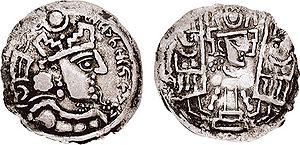
The coins of Bahram V are chiefly remarkable for their crude and coarse workmanship and for the number of the mints from which they were issued. The mint-marks include Ctesiphon, Ecbatana, Ispahan, Arbela, Ledan, Nehavend, Assyria, Chuzistan, Media, and Kerman or Carmania. The headdress has the mural crown in front and behind, but interposes between these two detached fragments a crescent and a circle, emblems, no doubt, of the sun and moon gods. The reverse shows the usual fire-altar, with guards, or attendants, watching it. The king's head appears in the flame upon the altar.Legends
Numerous legends have been associated with Bahram. One account says that he aided an Indian king in his war against China and that, in return for his help, the Indian king made over the provinces of MakranMakran
The present day Makran is a semi-desert coastal strip in the south of Sindh, Balochistan, in Iran and Pakistan, along the coast of the Arabian Sea and the Gulf of Oman. The present day Makran derived its name from Maka, a satrap of Achaemenid Empire....
and Sindh
Sindh
Sindh historically referred to as Ba'ab-ul-Islam , is one of the four provinces of Pakistan and historically is home to the Sindhi people. It is also locally known as the "Mehran". Though Muslims form the largest religious group in Sindh, a good number of Christians, Zoroastrians and Hindus can...
to Persia. The Lurs of Persia, it is argued, are the descendants of musicians sent to Persia by the grateful Indian monarch. However there does not exist any historical proof in support of this story. Other accounts suggest that he married an Indian princess. However, the conclusion of such a marriage alliance is regarded as highly dubious once again due to lack of evidence.
Another legend, found in the Shahnameh
Shahnameh
The Shahnameh or Shah-nama is a long epic poem written by the Persian poet Ferdowsi between c.977 and 1010 AD and is the national epic of Iran and related societies...
, is about Bahram slaying two lions and gaining the crown between them.