


List of French phrases used by English speakers

Encyclopedia
Here are some examples of French words and phrases used by English speakers.
English contains many words of French origin, such as art, collage, competition, force, machine, police, publicity, role, routine, table, and many other Anglicized French words. These are pronounced according to English
rules of phonology
, rather than French
. Around 28% of English vocabulary is of French or Oïl language
origin, most derived from, or transmitted by, the Anglo-Norman
spoken by the upper class
es in England
for several hundred years after the Norman Conquest
, before the language settled into what became Modern English
.
This article, however, covers words and phrases that generally entered the lexicon later, as through literature, the arts, diplomacy, and other cultural exchanges not involving conquests. As such, they have not lost their character as Gallicisms, or words that seem unmistakably foreign and "French" to an English speaker.
The phrases are given as used in English, and may seem correct modern French to English speakers, but may not be recognized as such by French speakers as many of them are now defunct or have a different meaning due to semantic evolution. A general rule is that if the word or phrase retains French diacritic
s or is usually printed in italics, it has retained its French identity.
Few of these phrases are common knowledge to all English speakers, and for some English speakers most are rarely if ever used in daily conversation, but for other English speakers many of them are a routine part of both their conversational and their written vocabulary. They may however possibly be used more often in written than in spoken English.
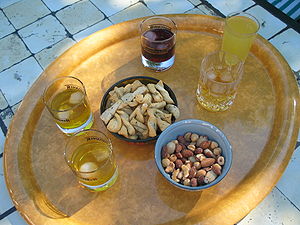

 à gogo: in abundance. In French this is colloquial.
à la […]: in the manner of/in the style of […]
à la carte
: literally: on the menu; In restaurants it refers to ordering individual dishes rather than a fixed-price meal.
à la mode: idiomatic: in the style; In the United States, the phrase is used to describe a dessert with an accompanying scoop of ice cream (example: apple pie à la mode). However, in French, it is a culinary term usually meaning cooked with ale and some carrots and onions (example: boeuf à la mode).
à propos: regarding/concerning (note that the correct French syntax is à propos de)
abattoir: slaughterhouse
accouchement: confinement during childbirth; the process of having a baby; only this latter meaning remains in French
acquis communautaire: used in European Union law
to refer to the total body of EU law accumulated thus far.
adieu: farewell; literally means "to God," it carries more weight than "au revoir" ("goodbye," literally "Until re-seeing"). It is definitive, implying you will never see the other person again. Depending on the context, misuse of this term can be considered as an insult, as one may wish for the other person's death or say that you do not wish to see the other person ever again while alive. It is used for "au revoir" in south of France and to denote a deprivation from someone or something.
adroit: dexterous, skillful, clever, in French: habile, as a "right-handed" person would be using his "right" hand, as opposed to his left one with which he would be "gauche" meaning "clumsy."
aide-mémoire: "memory aid"; an object or memorandum to assist in remembrance, or a diplomatic paper proposing the major points of discussion
allez!: "go!" or "come on!" as a command or as encouragment
allons-y!: "Here we go!" often used when trying something new. Especially popular in television shows such as Doctor Who
amuse-bouche or amuse-gueule: a single, bite-sized hors d'œuvre. Literally "mouth amuser". In France, the exact expression used is "amuse-gueule", gueule being slang for mouth (gueule is the mouth of a carnivorous animal; when used to describe the mouth of a human, it is vulgar), although the expression in itself is not vulgar (see also: cul-de-sac).
ancien régime: a sociopolitical or other system that no longer exists, an allusion to pre-revolutionary France (used with capital letters in French with this meaning: Ancien Régime)
aperçu: preview; a first impression; initial insight.
apéritif
: a before-meal drink (in colloquial French, it is shortened as "apéro"). In French, it means either the drink or food (amuse-gueules) taken before a meal.
appellation contrôlée: supervised use of a name. For the conventional use of the term, see Appellation d'origine contrôlée
après moi, le déluge: literally: After me, the deluge, a remark attributed to Louis XV of France in reference to the impending end of a functioning French monarchy and predicting the French Revolution. The chorus of Regina Spektor
's song Après Moi references this phrase. It is derived from Madame de Pompadour's après nous, le déluge, after us the deluge. The Royal Air Force
No. 617 Squadron
, famously known as the "Dambusters," uses this as its motto.
arête
: a narrow ridge. In French, also fishbone; edge of a polyhedron or graph; bridge of the nose.
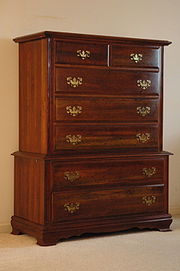
armoire: a type of cabinet; wardrobe.
art nouveau
: a style of decoration and architecture of the late 19th and early 20th centuries. It takes a capital in French (Art nouveau).
attaché
: a person attached to an embassy; in French it is also the past participle of the verb attacher (= to fasten, to tighten, to be linked)
Attaque au Fer: An attack on the opponent's blade in fencing
, e.g. beat, expulsion, pressure.
au contraire: on the contrary.
au courant: up-to-date; abreast of current affairs.
au fait: being conversant in or with, or instructed in or with.
au jus: literally, with juice, referring to a food course served with sauce. Often redundantly formulated, as in 'Open-faced steak sandwich, served with au jus.'. No longer used in French, except for the slang "être au jus" (to be informed).
au pair
: a young foreigner who does domestic chores in exchange for room and board. In France, those chores are mainly child care/education.
au revoir!: "See you later!" In French a contraction of Au plaisir de vous revoir (to the pleasure of seeing you again).
avant-garde
(pl. avant-gardes): applied to cutting-edge or radically innovative movements in art, music and literature; figuratively "on the edge," literally, a military term, meaning "vanguard" (which is a corruption of avant-garde) or "advance guard," in other words, "first to attack" (antonym of arrière-garde).
avant la lettre: used to describe something or someone seen as a forerunner of something (such as an artistic or political movement) before that something was recognized and named, e.g., "a post-modernist avant la lettre," "a feminist avant la lettre." The expression literally means before the letter, i.e., "before it had a name."
avec plaisir: my pleasure (lit. "with pleasure")
avoirdupois
: used in Middle English, avoir de pois = commodities sold by weight, alteration of Old French aveir de peis = goods of weight
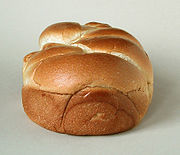
 baguette
: a long, narrow loaf of bread with a crispy crust, often called 'French bread' in the United Kingdom and United States. In French, a "baguette" also refers to many long and narrow objects, including the kind of bread above (which has also some subvarieties), a magical wand
or chopsticks
. Some breads that would be called baguettes in English are known in France as "épi" or "ficelle"
ballet
: a classical type of dance
beau geste: literally "beautiful gesture", a gracious gesture, noble in form but often futile or meaningless in substance
Beaux-Arts: monumental architectural style of the early 20th century made famous by the Académie des Beaux-Arts
beaucoup: plenty, lots of, much; merci beaucoup: thanks a lot; misused in slang, for example "beaucoup money" (French would add the preposition de: "beaucoup d'argent"), especially in New Orleans, LA. Occasionally corrupted to Bookoo, typically in the context of French influenced by Vietnamese culture.
bel esprit (pl. beaux esprits): literally "fine mind"; a cultivated, highly intelligent person
belle: a beautiful woman or girl. Common uses of this word are in the phrases the belle of the ball (the most beautiful woman or girl present at a function) and southern belle
(a beautiful woman from the southern states of the US)
Belle Époque
: a period in European social history that began during the late 19th century and lasted until World War I.
belles-lettres
: literally "fine letters"; literature regarded for its aesthetic value rather than its didactic or informative content; also, light, stylish writings, usually on literary or intellectual subjects
bien fait!: literally "well done"; used to express schadenfreude
when someone is well-deservedly punished
bien pensant: literally "well thinking"; right thinking, orthodox. Commonly implies willful blindness to dangers or suffering faced by others. The noun form bien-pensance is rarely seen in English.
blasé: unimpressed with something because of overfamiliarity, jaded.
Bleu celeste
: literally "sky blue," is a rarely-occurring tincture in heraldry (not being one of the seven main colours or metals or the three "staynard colours").
bon appétit: literally "good appetite"; enjoy your meal
bon mot: well-chosen word(s), particularly a witty remark
bon vivant: one who enjoys the good life, an epicurean
bon voyage: literally "good journey"; have a good trip!
bonjour: "good day," a standard greeting in the morning or afternoon
bonne chance: "good luck" (as in, 'I wish you good luck')
les boules
: (vulgar) literally "the balls"; meaning that whatever you are talking about is dreadful
bourgeois: member of the bourgeoisie
. The word used to refer to shopkeepers living in towns in the Middle Ages
. Now the term is derogatory, and it applies to a person whose beliefs, attitudes, and practices are conventionally middle-class.
bouquet
: a handful of flowers.
bric-à-brac
: small ornamental objects, less valuable than antiques; a collection of old furniture, china, plates and curiosities. Cf. de bric et de broc, corresponding to our "by hook or by crook," and brack, refuse.
brioche
: a sweet yeast bun, kind of a crossover between a popover and a light muffin; French also use the term as slang for 'potbelly', because of the overhang effect.
brunette: a brown-haired girl. For brown-haired man, French uses brun and for a woman brune. "Brunette" is rarely used in French, unless in old literature, and its masculine form, "brunet" (for a boy), is almost unheard of.
bureau (pl. bureaux): office. Also means "desk" in French.
 ça ne fait rien: "that doesn't matter"; rendered as san fairy Ann in British World War I slang.
cache
: a collection of items of the same type stored in a hidden or inaccessible place (such as in an oubliette)
cachet
: lit. "stamp"; a distinctive quality; quality, prestige.
café
: a coffee shop (also used in French for "coffee").
café au lait
: coffee with milk; or a light-brown color. In medicine, it is also used to describe a birthmark that is of a light-brown color (café au lait spot).
calque
: a copied term/thing.
canard: (1) unfounded rumor or anecdote. (2) a leading airfoil attached to an aircraft forward of the main wing. ('canard' means 'duck' in French)
carte blanche: unlimited authority; literally "white card" (i.e. blank check
).
carte de visite
: a calling card, literally "visiting card."
carte d'identité: identity card. Its proper, but less commonly used administrative appellation, is "carte nationale d'identité" (national identity card), abbreviated as CNI.
c'est bon: "That's good."
c'est la guerre!: "That's War!"; or "Such is war!" Often used with the meaning that "this means war," but it can be sometimes used as an expression to say that war (or life in general) is harsh but that one must accept it.
c'est la mode. : "That's the fashion."
c'est la vie!: "That's life!"; or "Such is life!" or "It is what it is!" It is sometimes used as an expression to say that life is harsh but that one must accept it.
c'est magnifique!: "That's great!"; literally it's magnificent.
c’est tout: that is everything, "That's all." See also un point c’est tout.
chacun ses goûts / à chacun ses goûts / à chacun son goût [all are used]: "to each his (their) own taste(s)" or "each to his own taste." Note that the expression chacun à son goût is incorrect.
chaise longue: a long chair for reclining; (also rendered chaise lounge or chase lounge by folk etymology).
Champs-Élysées: literally "Elysian Fields
"; Avenue des Champs-Élysées
, one of the broadest boulevards in Paris
. Often referred as simply "les Champs."
chanteuse: a female singer
chapeau
: a hat. In French, chapeau is also an expression of congratulations similar to the English "hats off to…."
chargé d'affaires
: a diplomat left in charge of day to day business at a diplomatic mission. Within the United States Department of State a chargé is any officer left in charge of the mission in the absence of the titular chief of mission.
charlatan
: a person who is a fraud, a fake, a hoaxer, a deceiver, a con artist.
châteaux en Espagne: literally "castles in Spain"; imaginary projects, with little hope of realisation (means the same as "castles in the air
" or "pie in the sky"). No known etymology, though it was already used in the 13th century in the Roman de la rose
.
chauffeur
: driver
chef d'œuvre
: a masterpiece
cherchez la femme
: "look for the woman," in the sense that, when a man behaves out of character or in an otherwise apparently inexplicable manner, the reason may be found in his trying to cover up an illicit affair with a woman, or to impress or gain favour with a woman. First used by Alexandre Dumas (père)
in the third chapter of his novel Les Mohicans de Paris (1854).
chevalier d'industrie: "knight of industry": one who lives by his wits, specially by swindling.
chez: at the house of: often used in the names of restaurants and the like; Chez Marie = "Marie's"
chic
: stylish
chignon
: a hairstyle worn in a roll at the nape of the neck
cinéma pur
: an avant-garde
film movement which was born in Paris in the 1920s and 30s.
cinéma vérité
: realism in documentary filmmaking
cinq, cinque: five; normally referring to the 5 on dice or cards. In French, always spelt cinq.
cliché
: lit. negative
; trite through overuse; a stereotype
clique
: a small exclusive group of friends; always used in a pejorative way in French.
commandant
: a commanding officer. In France, used for an airline pilot (le commandant de bord), in the Army as appellative for a chef de bataillon or a chef d'escadron (roughly equivalent to a major) or in the Navy for any officer from capitaine de corvette to capitaine de vaisseau (equivalent to the Army's majors, lieutenant-colonels and colonels) or for any officer heading a ship.
comme ci, comme ça: "like this, like that"; so-so, neither good nor bad. In French, usu. couci-couça.
comme il faut: "as it must be": in accord with conventions or accepted standards; proper.
communiqué
: lit. communicated; an official communication.
concierge
: a receptionist at a hotel or residence.
concordat
: an agreement; a treaty; when used with a capital C in French, it refers to the treaty between the French State and Judaeo-Christian religions during the French Empire (Napoleon): priests, ministers and rabbis became civil servants. This treaty was abolished in 1905 (law Church-State separation) but is still in use in Alsace-Lorraine (those territories were under German administration during 1871–1918)
confrère: a colleague, esp. in the medical and law professions.
congé: a departure; in French refers to time off work
conte: a short story, a tale; in French a conte has usually a fantasy context (such as in fairytales) and always begins with the words "Il était une fois" ("Once upon a time").
contre-coup: against the blow
contre-jour
: against daylight
contretemps: an awkward clash; a delay
coquette: a flirtatious girl; a tease
cordon sanitaire
: a policy of containment
directed against a hostile entity or ideology; a chain of buffer states; lit. "quarantine line"
cortège: a funeral procession; in French has a broader meaning and refers to all kinds of processions.
corvée
: forced labor for minimal or no pay. In French, overall an unpleasant/tedious task.
cotte d'armes
: coat of arms.
coup de foudre: lit. thunderbolt ("strike of thunder"); a sudden unforeseen event, usually used to describe love at first sight.
coup de grâce
: the final blow that results in victory (literally "blow of mercy"), historically used in the context of the battlefield to refer to the killing of badly wounded enemy soldiers, now more often used in a figurative context (e.g., business). Frequently pronounced without the final "s" sound by English speakers who believe that any such sound at the end of a French word is supposed to be silent. In French this would sound like coup de gras, or "blow of fat."
coup de maître: stroke of the master, master stroke
coup d'œil: a glance, literally "a blow (or touch) of the eye."
coup de théâtre: unexpected dramatic turn of events, a plot twist
couture
: fashion (usually refers to high fashion)
couturier: a fashion designer (usually refers to high fashion, rather than everyday clothes design)
crèche: a nativity
display; more commonly (in the United Kingdom), a place where children are left by their parents for short periods in the supervision of childminders; both meanings still exist in French
crème brûlée
: a dessert consisting primarily of custard and toasted sugar, that is, caramel
; literally "burnt cream"
crème de la crème: best of the best, "cream of the cream," used to describe highly skilled people or objects. A synonymous expression in French is « fin du fin ».
crème fraîche
: literally "fresh cream," a heavy cream slightly soured with bacterial culture, but not as sour or as thick as sour cream and does not curdle.
crêpe
: a thin sweet or savoury pancake eaten as a light meal or dessert
crêperie: a takeaway restaurant or stall, serving crêpes as a form of fast food or street food, or may be a more formal sit-down restaurant or café
cri d'amour: a "cry of love"
critique
: a critical analysis or evaluation of a work, or the art of criticizing.
croissant
: a crescent-shaped bread made of flaky pastry
cuisine minceur: gourmet cooking for staying thin
cul-de-sac
: a dead-end street; literally "arse [buttocks] of the bag". Even though "cul" is vulgar in French, this expression in itself is not (see also amuse-gueule). Equivalent terms "impasse" or "voie sans issue" are also used in French.
 d'accord: in accord; agreed; sure; OK; of course
débâcle: an event or enterprise that ends suddenly and disastrously, often with humiliating consequences.
de nouveau: again; anew. Cf. de novo
de règle: according to custom;
de rigueur: required or expected, especially in fashion or etiquette
de trop: excessive, "too much"
déclassé: of inferior social status
décolleté: a woman's garment with a low-cut neckline that exposes cleavage, or a situation in which a woman's chest or cleavage is exposed; décolletage
is dealt with below.
décor: the layout and furnishing of a room
découpage
: decoration with cut paper
dépôt
: a deposit (as in geology or banking), a storehouse, or a transportation hub (bus depot)
demi-glace
: a reduced wine-based sauce for meats and poultry
demi-sec: semi-dry, usually said of wine
déjà vu
: "already seen": an impression or illusion of having seen or experienced something before.
dénouement: the end result
dérailleur
: a bicycle gear-shift mechanism
dernier cri: the latest fashion; literally "latest scream"
derrière: rear; buttocks; literally "behind"
déshabillé: partially clad or scantily dressed; also a special type of garment.
désolé: sorry
détente
: easing of diplomatic tension
diablerie: witchcraft, devilry, or, more figuratively, "wickedness"
Dieu et mon droit
: motto of the British Monarchy. It appears on a scroll beneath the shield of the coat of arms of the United Kingdom
.
directeur sportif
: lit. sports director. A person responsible for the operation of a cycling team during a road bicycle race. In French, it means any kind of sports director.
divertissement: an amusing diversion; entertainment
dossier: a file containing detailed information about a person; it has a much wider meaning in modern French, as any type of file, or even a computer directory
douceur de vivre: "sweetness of life"
doyen: the senior member of a group; the feminine is doyenne
dressage
: a form of competitive horse training, in French has the broader meaning of taming any kind of animal
droit du seigneur: "right of the lord": the purported right of a lord in feudal times to take the virginity of one of his vassal
s' brides on her wedding night (in precedence to her new husband). The actual French term for this hypothetical custom is droit de cuissage (from cuisse 'thigh').
du jour: said of something fashionable or hip for a day and quickly forgotten; today's choice on the menu, as soup du jour, literally "of the day"
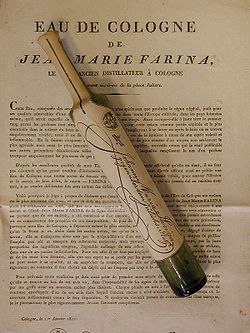


 eau de Cologne
: a type of perfume, originating in Cologne
, Germany. Its Italian creator used a French name to commercialize it, Cologne at that time being under the control of France.
eau de toilette
: literally "grooming water." It usually refers to a aromatic product that is less expensive than a perfume because it has less of the aromatic compounds and is more for an everyday use. Can not be shortened as eau, which means something else altogether in French (water).
eau de vie
: literally "water of life" (cf Aquavit
and whisky
), a type of fruit brandy.
écarté
: a card game; also a ballet position
échappé: dance movement foot position
éclair: a cream and chocolate icing pastry
éclat: Great brilliance, as of performance or achievement. Conspicuous success. Great acclamation or applause
écorché: flayed; biological graphic or model with skin removed
élan
: a distinctive flair or style
élan vital
: literally "vital ardor"; the vital force hypothesized by Henri Bergson as a source of efficient causation and evolution in nature; also called "life-force"
éminence grise: "grey eminence": a publicity-shy person with little formal power but great influence over those in authority
en banc
: court hearing of the entire group of judges instead of a subset panel
en bloc: as a group
en escalier: going up like stairs; the English tends to be used of text.
en famille: expression used in French to express an action done with one's family: "Tonight we are dining en famille."
en garde: "[be] on [your] guard," used in fencing
, and sometimes mistranscribed as "on guard."
en grande tenue: is used in invertebrate paleontology (of Agnostida, an order of Trilobites), to designate an exoskeleton with well marked features. By opposition, some Agnostida have quite an smooth exoskeleton, with no well marked features.
en passant
: in passing; term used in chess.
en plein air: literally "in the open air," and is particularly used to describe the act of painting outdoors.
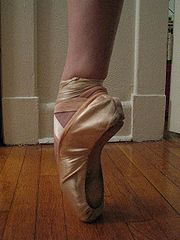
en pointe
: (in ballet) on tiptoe. Though used in French in this same context, it is not an expression as such. A "pointe" is the ballet figure where one stands on tiptoes. The expression "en pointe," though, means "in an acute angle," and, figuratively, it qualifies the most progressive or modern things (ideas, industry…).
en principe, oui: "in principle, yes": a diplomatic way of saying 'no'
en route: on the way
(je suis) enchanté(e): "(I am) enchanted (to meet you)": a formal greeting on receiving an introduction. Often shortened to simply "enchanté."
enfant terrible: a disruptively unconventional person, a "terrible child."
ennui: boredom.
entente: diplomatic agreement or cooperation. L'Entente cordiale
(the Cordial Entente) refers to the good diplomatic relationship between France and United Kingdom before the first World War.
entre nous: confidentially; literally "between us"
entrée
: literally "entrance"; the first course of a meal (UK English); used to denote the main dish or course of a meal (US English).
entremets: desserts/sweet dishes. More literally, a side dish that can be served between the courses of a meal.
entrepreneur
: a person who undertakes and operates a new enterprise or venture and assumes some accountability for the inherent risks
Embonpoint: a plump, hourglass figure.
escargot: snail
escritoire
: writing desk; spelled "écritoire" in current French
esprit de corps: "spirit of the body [group]": a feeling of solidarity among members of a group; morale. Often used in connection with a military force.
esprit de l'escalier: "wit of the stairs": a concise, clever statement you don't think of until too late, e.g. on the stairs leaving the scene. The expression was created by French philosopher Denis Diderot
. Very rarely used in French.
l'État, c'est moi!: "I am the state!" — attributed to the archetypal absolute monarch, Louis XIV of France
étude
: a musical composition designed to provide practice in a particular technical skill in the performance of an instrument. French for "study."
étui: small ornamental case for needles or cosmetics
excusez-moi: excuse me; can be used sarcastically (depends on the tone)
excusez le mot!: excuse the word!; if a certain word has negative connotations (for example, a word-joke at a time of grief)
extraordinaire: extraordinary, usually as a following adjective, as "musician extraordinaire"
et toi?: and you? (Je m'appelle (your name), Et toi?)(my name is (your name) and yours?)
: the front view of an edifice (from the Italian facciata, or face); a fake persona, as in "putting on a façade" (the ç is pronounced like an s)
fait accompli: lit. accomplished fact; something that has already happened and is thus unlikely to be reversed, a done deal. In French used only in the expression "placer/mettre quelqu'un devant le fait accompli" meaning to present somebody with a fait accompli.
faute de mieux: for want of better
faux
: false, ersatz
, fake.
faux amis: "false friends": words in two different languages that have the same or similar spelling, and often the same etymology
but different meanings, such as the French verb rester, which means "to stay" rather than "to rest"
faux pas
: "false step": violation of accepted, although unwritten, social rules
femme fatale
: "deadly woman": an attractive woman who seduces and takes advantage of men for her personal goals, after which she discards or abandons them. It extends to describe an attractive woman with whom a relationship is likely to result, or has already resulted, in pain and sorrow.
feuilleton
: "little leaf of paper": a periodical, or part of a periodical, consisting chiefly of non-political news and gossip, literature and art criticism, a chronicle of the latest fashions, and epigrams, charades and other literary trifles.
fiancé/e: betrothed; lit. a man/woman engaged to be married.
fier de l'être: proud of being; "French, and proud to be so"
film noir
: a genre of dark-themed movies from the 1940s and 1950s that focus on stories of crime and immorality
fils: used after a man's surname to distinguish a son from a father, as George Bush fils (in French, "fils" = son)
fin de saison: "end of season": marks the end of an extended (annual) period during which business increases significantly, most commonly used for the end of summer tourism
flambé
: a cooking procedure in which alcohol (ethanol) is added to a hot pan to create a burst of flames, meaning "flamed" in French. Also used colloquially in reference to something on fire or burned.
flambeau: a lit torch
flâneur
: a gentleman stroller of city streets; an aimless idler
fleur-de-lis
: a stylized-flower heraldic device; the golden fleur-de-lis on an azure background were the arms of the French Kingdom (often spelled with the old French style as "fleur-de-lys")
 fleur de sel
: literally "flower of salt," hand-harvested sea salt collected by workers who scrape only the top layer of salt before it sinks to the bottom of large salt pans. Is one of the more expensive salts; the most prized is harvested during the Mistral winds that blow over the lavender fields and infuse the salt beds with a mild lavender scent.
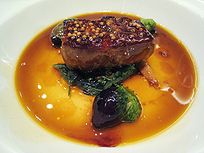 foie gras
: fatty liver; usually the liver of overfed goose, hence: pâté de foie gras, pâté made from goose liver. However, "foie gras" generally stands for "pâté de foie gras" as it is the most common way to use it.
folie à deux
: a simultaneous occurrence of delusions in two closely related people, often said of an unsuitable romance. In clinical psychology, the term is used to describe people who share schizophrenic delusions. The derivated forms folie à trois, folie à quatre, folie en famille or even folie à plusieurs do not exist in French where "collective hysterics" is used.
force majeure
: an overpowering and unforeseeable event, especially when talking about weather (often appears in insurance contracts)
forme fruste
: an atypical or attenuated manifestation of a disease or syndrome. Its opposite is "forme pleine."
froideur: coldness (for behavior and manners only)

 gaffe: blunder
garçon: literally "boy" or "male servant"; sometimes used by English speakers to summon the attention of a male waiter
(has a playful connotation in English but is condescending and possibly offensive in French)
garde manger
: literally "keeper of the food" or pantry supervisor, refers to the task of preparing and presenting cold foods.
gauche: tactless, does not mean "left-handed" (which translates in French as "gaucher"), but does mean "left"
gaucherie: boorishness
Gautier et Garguille: all the world and his wife (possibly derived from a 17th century French comic Hugues Guérin, who performed under the stage name Gautier-Garguille, though it is likely that he in turn may have taken this pseudonym from earlier 16th century recorded sayings: prendre Gautier pour Garguille: "to take Gautier for Garguille," that is to mistake one person for another. Il n'y a ni Gautier, ni Garguille: "he is neither Gaultier nor Garguille," that is, 'he is no-one')
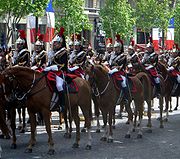
gendarme: member of a gendarmerie
which is an arm of the military; the word is often incorrectly used in English to refer to any French policeman [which is civilian]. Note - the picture titled Gendarmes in fact shows Republican Guards
(who are gendarmes).
genre
: a type or class, such as "the thriller genre"
glissade
: slide down a slope
les goûts et les couleurs ne se discutent pas: "tastes and colours are not argued over"; one does not argue over differences in taste, to each his own. French People usually shorten the sentence, to "les goûts et les couleurs…"
grâce à: "thanks to," "by the grace of," naming credit or fortune
Grand Prix
: a type of motor racing, literally "Great Prize"
grand projet: literally "large project"; usually a government funded large scale civil engineering or technology project executed for prestige or general social benefit, and not immediately (if ever) profitable
Grand Guignol
: a horror
show, named after a French theater famous for its frightening plays and bloody special effects. (Guignol
can be used in French to describe a ridiculous person, in the same way that clown might be used in English.)
Grenadier: a specialized soldier, first established for the throwing of grenades and later as elite troops
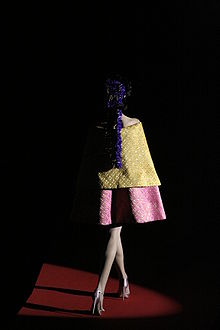 habitué: one who regularly frequents a place
haute couture
: "high sewing": Paris-based custom-fitted clothing; trend-setting fashion
haute cuisine
: upscale gastronomy; literally "high cooking."
haute école
: advanced horsemanship; literally "high school"
hauteur: arrogance; lit. height
haut monde: fashionable society, the "high world"
homme du monde: cultured, sophisticated man, "man of the world"
Honi soit qui mal y pense
.: "Shamed be he who thinks ill of it"; or sometimes translated as Evil be to him who evil thinks; the motto of the English Order of the Garter
(modern French writes honni instead of Old French honi)
hors concours: "out of the running"; a non-competitor, e.g. in love
hors de combat
: out of the fight: prevented from fighting, usually by injury
hors d'œuvre: "outside the [main] work": appetizer
huis-clos: "closed door": an enclosed space such as a room or cell, where action or speech can not be seen or heard from outside; title of a play
by Jean-Paul Sartre
 idée fixe: "fixed idea": obsession; in music, a leitmotiv.
impasse
: a deadlock.
insouciant/e: a nonchalant man/woman
ingénu/e
: an innocent young man/woman, used particularly in reference to a theatrical stock character
who is entirely virginal and wholesome. L'Ingénu is a famous novella written by Voltaire
.
’s exposé of the Dreyfus affair
, a political scandal that divided France from the 1890s to the early 1900s and involved the false conviction for treason in 1894 of a young French artillery officer of Jewish background).
j'adore & je t'adore: literally, I adore [you]. I love [you] to the full extent.
j'adoube: In chess
, an expression, said discreetly, that signals the intention to straighten the pieces without committing to move or capturing the first one touched as per the game's rules; literally, "I adjust," from adouber, to dub (the action of knighting someone).
j'arrive: I arrive.
Jacques Bonhomme: a name given to a French peasant as tamely submissive to taxation. Also the pseudonym of the 14th century peasant leader Guillaume Caillet
je m'appelle: my name is…
je m'en fous: "I don't give a damn/a fuck."
je ne regrette rien: "I regret nothing" (from the title of a popular song sung by Édith Piaf
: "Non, je ne regrette rien
"). Also the phrase the UK's then Chancellor of the Exchequer
Norman Lamont chose to use to describe his feelings over the events of September 16, 1992 ('Black Wednesday
')
je ne sais pas: "I don't know"; collapses to chais pas ʃɛpa in modern colloquial speech
je ne sais quoi: "I-don't-know-what": an indescribable or indefinable 'something' that distinguishes the object in question from others that are superficially similar.
je t'aime: I love you. Implies "I like you" too. The French word "aimer" implies all the different kinds of love (love = like). To differentiate the two, one would say simply "je t'aime" to one's love whereas one would say "je t'aime bien" (lit. I love you well) to a friend.
jeu d'esprit: "play of spirit"; a witty, often light-hearted, comment or composition
jeunesse dorée: "gilded youth"; name given to a body of young dandies
who, after the fall of Robespierre
, strove to bring about a counterrevolution. Today used for any offspring living an affluent lifestyle.
joie de vivre: "joy of life/living"
: separation of the State and the different Churches (at first, it concerned especially Catholicism). In France, where the concept originated, it means an absence of religious interference in government affairs and government interference in religious affairs. But the concept is often assimilated and changed by other countries. For example, in Belgium, it usually means the secular-humanist movement and school of thought.
laissez-faire
: "let do"; often used within the context of economic policy
or political philosophy
, meaning leaving alone, or non-interference. The phrase is the shortcut of Laissez faire, laissez passer, a doctrine first supported by the Physiocrats
in the 18th century. The motto was invented by Vincent de Gournay, and it became popular among supporters of free-trade and economic liberalism
. It is also used to describe a parental style in developmental psychology, where the parent(s) does not apply rules or guiding.
laissez-passer: a travel document, a passport
laissez les bons temps rouler: Cajun
expression for "let the good times roll": not used in proper French, and not generally understood by Francophones outside of Louisiana
, who would say "profitez des bons moments" (enjoy the good moments)
lamé
: a type of fabric woven or knit with metallic yarns
lanterne rouge
: the last-place finisher in a cycling stage race; most commonly used in connection with the Tour de France
layette
: a set of clothing and accessories for a new baby
lèse majesté: an offense against a sovereign power; or, an attack against someone's dignity or against a custom or institution held sacred (from the Latin "crimen laesae maiestatis": the crime of injured majesty)
liaison: a close relationship or connection; an affair. The French meaning is broader; "liaison" also means bond such as in "une liaison chimique" (a chemical bond)
Liberté, Égalité, Fraternité
: "Liberty, Equality/Egality, Brotherhood" (motto of the French Republic)
littérateur: an intellectual (can be pejorative in French, meaning someone who writes a lot but does not have a particular skill)
louche: of questionable taste;
Louis Quatorze: "Louis XIV" (of France)
, the Sun King, usually a reference to décor or furniture design. Also the namesake of the winner of the 1996 Preakness
.
Louis Quinze: "Louis XV" (of France)
, associated with the rococo
style of furniture, architecture and interior decoration

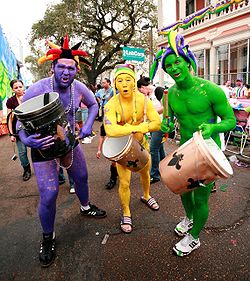 macramé
: coarse lace work made with knotted cords
mademoiselle: young unmarried lady, miss; literally "my noble young lady"
mais oui: "but of course!." This is often used as a sarcastic reply in French, in order to close a debate by feigning agreement.
maison: house
mal de mer
: motion sickness, literally "seasickness"
malaise
: a general sense of depression or unease
mange tout
: another phrase describing 'peas' (litt: "Eat-all," because some peas can be cooked and eaten with their pod.)
manqué
: unfulfilled; failed
Mardi gras
: Fat Tuesday, the last day of eating meat before Lent
. Note that gras is not capitalised.
marque: a model or brand
matériel
: supplies and equipment, particularly in a military context (French meaning is broader and corresponds more to "hardware")
mauvais quart d'heure: "bad quarter hour": a short unpleasant or uncomfortable moment
mélange
: a mixture
mêlée
: a confused fight; a struggling crowd
ménage à trois
: "household for three": a sexual arrangement between three people
merci beaucoup: "Thank you very much!"
merde: "shit"
merde alors: "Damn it!" (literally "shit then," "well shit"). Vulgar; non-vulgar equivalent is "zut alors."
métier: a field of work or other activity; usually one in which one has special ability or training
milieu
: social environment; setting (has also the meaning of "middle" in French.)
milieu intérieur
: the extra-cellular fluid environment, and its physiological capacity to ensure protective stability for the tissues and organs of multicellular living organisms.
mirepoix
: a cooking mixture of two parts onions and one part each of celery and carrots
mise en place
: an assembly of ingredients, usually set up in small bowls, used to facilitate cooking. This means all the raw ingredients are prepared and ready to go before cooking. Translated, “put in place.”
mise en scène
: the process of setting a stage with regard to placement of actors, scenery, properties, etc.; the stage setting or scenery of a play; surroundings, environment
mise en table: table setting
moi: "me"; often used in English as an ironic reply to an accusation; for example, "Pretentious? Moi?"
moi aussi: "me too," used to show agreeing with someone
le moment suprême: "the supreme moment"; the climax in a series of events (for example at the unveiling of an art exhibition)
Mon ami: my friend (male) or 'mon amie': my friend (female)
Mon Dieu!: my God!
monsieur
(pl. messieurs): a man, a gentleman. Also used as a title, equivalent to Mr. or Sir.
montage: editing
le mot juste: "the just word"; the right word at the right time. French uses it often in the expression chercher le mot juste (to search for the right word)
motif: a recurrent thematic element
moue: a pursing together of the lips to indicate dissatisfaction, a pout
mousse
: a whipped dessert or a hairstyling foam; in French, means any type of foam
né
, née
: "born": a man’s/woman’s birth name (maiden name
for a woman), e.g., "Martha Washington, née Dandridge."
n'est-ce pas?: "isn't it [true]?"; asked rhetorically after a statement, as in "Right?"
noblesse oblige
: "nobility obliges"; those granted a higher station in life have a duty to extend (possibly token) favours/courtesies to those in lower stations
nom de guerre
: pseudonym to disguise the identity of a leader of a militant group, literally "war name," used in France for "pseudonym"
nom de plume
: author's pseudonym, literally "pen name." Originally an English phrase, now also used in France
nouveau
(pl. nouveaux; fem. nouvelle; fem. pl. nouvelles): new
nouveau riche
: newly rich, used in English to refer particularly to those living a garish lifestyle with their newfound wealth; see also arriviste and parvenu
.
nouvelle cuisine
: new cuisine
nouvelle vague: Literally meaning "new wave." Used for stating a new way or a new trend of something. Originally marked a new style of French filmmaking in the late 1950s and early 1960s, reacting against films seen as too literary (whereas the phrase "new wave" is used in French to qualify some 1980's music, such as Depeche Mode.)
œuvre: "work," in the sense of an artist's work; by extension, an artist's entire body of work
omelette
: omelette
ouais: yeah
oui: yes
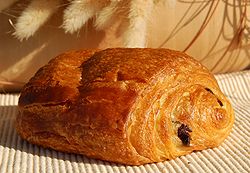

 pain au chocolat
: lit. chocolate bread. Unlike what its name may suggest, it's not made of bread but puff pastry with chocolate inside. The term "chocolatine" is used in some Francophone areas, but not in English.
pain aux raisins
: raisin bread.
panache
: verve; flamboyance
papier-mâché
: lit. chewed paper; a craft medium using paper and paste
par avion
: by air mail. The meaning is broader in French, it means by plane in general.
par excellence: "by excellence": quintessential
parc fermé
: lit. closed park. A secure area at a Grand Prix
circuit where the cars may be stored overnight.
parkour
: urban street sport involving climbing and leaping, using buildings, walls, curbs to ricochet off much as if one were on a skateboard, often in follow-the-leader style. It's actually the phonetic form of the French word "parcours," which means "route." Also known as, or the predecessor to, "free running", developed by Sébastien Foucan
.
Parole: speech, more specifically the individual, personal phenomenon of language.
parvenu
: a social upstart.
pas de deux
: a close relationship between two people; in ballet, a duet.
pas de problème: no problem
pas de trois
: a dance for three, usually in ballet.
passe-partout: a document or key that allows the holder to travel without hindrance from the authorities or enter any location.
pastiche
: a derivative work; an imitation
patois
: a dialect; jargon
père: lit. father, used after a man's surname to distinguish a father from a son, as in "George Bush père."
petite bourgeoisie
: often anglicised as "petty bourgeoisie," the lower middle class.
la petite mort
: an expression for orgasm
; literally "the little death"
peut-être: perhaps, possibly, maybe
Pied-Noir
: literally "black foot," a European Algeria
n in the pre-independence state.
pied-à-terre
: "foot-on-the-ground" or "foothold"; a place to stay, generally applied to the city house as opposed to the country estate of the wealthy
pince-nez
: literally "pinch nose," a type of spectacles without temple arms.
pis-aller: "worse"; an undesirable option selected because the other choices were even worse
piste
: referring to skiing at a ski area (on piste) versus skiing in the back country (off piste).
plat du jour: a dish served in a restaurant on a particular day but separate from the regular menu; literally "dish of the day."
plongeur (fem. plongeuse): a male (or female) dishwasher
plus ça change, plus c'est la même chose (or plus ça change, plus c’est pareil) (often abbreviated to just "plus ça change"): the more things change, the more they stay the same
plus royaliste que le roi: "more royalist than the king," i.e., more enthusiastic than the cause deserves
point d'appui
: a location where troops assemble prior to a battle. While this figurative meaning also exists in French, the first and literal meaning of "point d'appui" is a fixed point from which a person or thing executes a movement (such as a footing in climbing or a pivot).
pomme: apple
pomme de terre: potato, literally, "apple of the earth"
porte cochère: an architectural term referring to a kind of porch or porticolike structure.
poseur: "poser": a person who pretends to be something he is not; an affected or insincere person: a wannabe
pot-au-feu
: stew, soup
pour encourager les autres: "to encourage others"; said of an excessive punishment meted out as an example. The original is from Voltaire
's Candide
and referred to the execution of Admiral John Byng.
pourboire: "for drink"; gratuity, tip; donner un pourboire: to tip.
prêt-à-porter: "ready to wear" (clothing off the shelf), in contrast to haute couture
première dame: "first lady"
prie-dieu
: "pray [to] God"; a type of prayer desk
prix fixe: "fixed price"; a menu on which multi-course meals with only a few choices are charged at a fixed price
protégé/e
: a man/woman who receives support from an influential mentor.
provocateur
: agitator, a polemicist
, used to refer to the ministry itself.
Quatorze juillet: "14th July" Bastille Day
. The beginning of the French Revolution
in 1789; used to refer to the Revolution itself and its ideals. It is the French National Day.
quel dommage!: "What a pity!"
quelle horreur!: What a horrible thing! (can be used sarcastically).
quelle surprise!: "What a surprise!"
Qu'est-ce que c'est?: "What is this/that?"
qui vive?: "who is living?" (modern language : who is here ?) : a sentry's challenge. Obsolete, but for the expressions "sur le qui-vive" (literally "on the point of saying qui vive") — on the alert, vigilant — and "il n'y a pas âme qui vive" (literally "no soul is/lives here," soul meaning person).
quoi de neuf?: "What's new?" What's up?
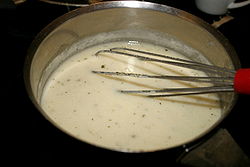 raconteur: a storyteller
raison d'État
: reason of state (always with a capital "É" in French).
raison d'être: "reason for being": justification or purpose of existence
rapport
: to be in someone's "good graces"; to be in synch with someone; "I've developed a rapport with my co-workers"; French for: relationship
rapprochement
: the establishment of cordial relations, often used in diplomacy
reconnaissance
: scouting; like connoisseur
. Modern French uses an "a," never a "o" (as in ).
renaissance
: meaning rebirth, a cultural movement in the 14-17th centuries
reportage: reporting; journalism
répondez s'il vous plaît. (RSVP
): Please reply. Though francophones may use more usually "prière de répondre," it is common enough. (Note: RSLP ["Répondre s'il lui plaît"] is used on old-fashioned invitations written in the 3rd person, usually in "Script" typography — at least in Belgium.)
reservoir: An artificial lake
ressentiment
: a deep-seated sense of aggrievement and powerlessness
restaurateur: a restaurant owner
retard: Translates as late, but is used as a derogative term for someone who is a slow thinker
riposte
: A quick retort in speech or action, or in fencing, a quick thrust after parrying a lunge
Rive Gauche
: the left (southern) bank (of the River Seine in Paris). A particular mindset attributed to inhabitants of that area, which includes the Sorbonne
roi fainéant: "do-nothing king": an expression first used about the kings of France from 670 to 752 (Thierry III to Childeric III), who were puppets of their ministers. The term was later used about other royalty who had been made powerless, also in other countries, but lost its meaning when parliamentarism made all royals powerless.
rôle
: a part or function of a person in a situation or an actor in a play
roman à clef
: "novel with a key": an account of actual persons, places or events in fictional guise
roué: an openly debauched, lecherous older man
roux
: a cooked mixture of flour and fat used as a base in soups and gravies
: subversive destruction, from the practice of workers fearful of industrialization destroying machines by tossing their sabots ("wooden shoes") into machinery
saboteur
: one who commits sabotage
Sacrebleu
!: "holy Blue!" general exclamation of horror and shock; a stereotypical minced oath
. Very dated in France and rarely heard.
sang-froid: "cold blood": coolness and composure under strain; stiff upper lip
. Also pejorative in the phrase meurtre de sang-froid ("cold-blooded murder").
sans: without
sans-culottes
: "without knee-breeches," a name the insurgent crowd in the streets of Paris gave to itself during the French Revolution
, because they usually wore pantaloons (full-length pants or trousers) instead of the chic knee-length culotte of the nobles. In modern use: holding strong republican views.
saperlipopette: goodness me
sauté: lit. jumped; quickly fry in a small amount of oil.
sauve qui peut!: those who can should save themselves. Used as a pragmatic response to an accident. Equivalent to the English "every man for himself."
savant: "knowing": a wise or learned person; in English, one exceptionally gifted in a narrow skill.
savoir-faire: literally "know how to do"; to respond appropriately to any situation.
savoir-vivre:fact of following conventional norms within a society; etiquette (etiquette also comes from a French word, "étiquette")
s'il vous plaît (SVP): "if it pleases you," "if you please"
silhouette
: the image of a person, an object or scene consisting of the outline and a featureless interior, with the silhouetted object usually being black
si vous préférez: "if you prefer"
sobriquet
: an assumed name, a nickname (often used in a pejorative way in French)
soi-disant: so-called; self-described; literally "oneself saying"
soigné: fashionable; polished
soirée: an evening party
sommelier
: a wine steward
soupçon: a very small amount (In French, can also mean suspicion)
soupe du jour: "soup of the day," meaning the particular kind of soup offered that day.
succès d’estime: a "success of esteem" [critical success], sometimes used pejoratively
il faut souffrir pour être belle: "beauty does not come without suffering"; lit. "you have to suffer to be pretty"
sur le tas: as one goes along; on the fly
Système D: resourcefulness, or ability to work around the system; from débrouillard, one with the knack of making do. A typical phrase using this concept would translate directly to "Thanks to System D, I managed to fix this cupboard without the missing part."
tableau vivant
: literally 'living picture', the term describes a striking group of suitably costumed actors or artist's models, carefully posed and often theatrically lit.
tant mieux: so much the better.
tant pis: "too bad," "oh well, that's tough."
tenné
: orange-browm, 'rust' colour, not commonly used outside of heraldic emblazoning.
tête-à-tête:"head to head"; an intimate get-together or private conversation between two people.
toilette: the process of dressing or grooming. Also refers in French, when plural ("les toilettes"), to the toilet room.
torsade de pointes: meaning "twisting around a point," used to describe a particular type of heart rhythm.
touché
: acknowledgment of an effective counterpoint; literally "touched" or "hit!" Comes from the fencing vocabulary.
tour de force: "feat of strength": a masterly or brilliant stroke, creation, effect, or accomplishment.
tout de suite: lit. everything (else) following; "at once," "immediately" (according to the Oxford English Dictionary).
très: very (often ironic in English)
très beau:very beautiful
très bonne: very good (feminine form).
 tricoteuse
: a woman who knits and gossips; from the women who knitted and sewed during the executions of the French Revolution.
trompe-l'œil: photographlike realism in painting; literally "trick the eye"
trou de loup
: literally "wolf hole," a kind of booby trap
.
va-t'en!: imperative form, like above, literally meaning "Go from here" but translating more closely as "Go away." Roughly equivalent to idiomatic English get lost or get out.
vendu (pl. vendus):sellout
. Lit. sold (past tense of "vendre" = to sell); used as a noun, it means someone who betrays for money.
venu/e: invited man/woman for a show, once ("come"); unused in modern French, though it can still be used in a few expressions like bienvenu/e (literally well come: welcome) or le premier venu (anyone; literally, the first who came).
vin de pays
: literally "country wine"; wine of a lower designated quality than appellation contrôlée
vinaigrette
: salad dressing of oil and vinegar
; diminutive of vinaigre (vinegar)
vis-à-vis: "face to face [with]": in comparison with or in relation to; opposed to. From "vis" (conjugated form of "voir," to see). In French, it's also a real estate vocabulary word meaning that your windows and your neighbours' are within sighting distance (more precisely, that you can see inside of their home).
vive
[…]!: "Long live…!"; lit. "Live"; as in "Vive la France
!", "Vive la République!", “Vive la Résistance!
”, "Vive le Canada
!", or "Vive le Québec libre!" (long live free Quebec, a sovereigntist
slogan famously used by French President Charles de Gaulle
in 1967 in Montreal
). Unlike "viva" (Spanish) or "vivat" (Latin), it cannot be used alone; it needs a complement.
vive la différence!:"[long] live the difference"; originally referring to the difference between the sexes, the phrase may be used to celebrate the difference between any two groups of people (or simply the general diversity of individuals)
voilà!: literally "see there"; in French it can mean simply "there it is"; in English it is generally restricted to a triumphant revelation.
volte-face
: a complete reversal of opinion or position, about face
Voulez-vous coucher avec moi (ce soir)?
: "Do you want to sleep with me (tonight)?" In French, coucher is vulgar in this sense. In English it appears in Tennessee Williams
's play A Streetcar Named Desire
, as well as in the lyrics of a popular song by Labelle
, "Lady Marmalade
."
voyeur
: lit. someone who sees; a peeping tom.
zut alors!: "Darn it!" or the British expression "Blimey!" This is a general exclamation (vulgar equivalent is "merde alors!" "Damn it!"). Just plain zut is also in use, often repeated for effect: zut, zut et zut! There is an album by Frank Zappa
titled Zoot Allures
. The phrase is also used on the Saturday Night Live
Weekend Update
sketch by recurring character Jean K. Jean, played by Kenan Thompson
.
accoutrement: personal military or fighting armaments worn about one's self; has come to mean the accompanying items available to pursue a mission, or just accessories in general. In French, means a funny or ridiculous clothing; often a weird disguise or a getup, though it can be said also for people with bad taste in clothing.
agent provocateur
: a police spy who infiltrates a group to disrupt or discredit it. In French it has both a broader and more specific meaning. The Académie française, in its dictionary, says that an agent provocateur is a person working for another State or a political party (for example), whose mission is to provoke troubles in order to justify repression.
appliqué
: an inlaid or attached decorative feature. Lit. "applied," though this meaning doesn't exist as such in French, the dictionary of the Académie française indicates that in the context of the arts, "arts appliqués" is synonym of decorative arts.
après-ski
: after skiing socializing after a ski session; in French, this word refers to boots used to walk in snow (e.g. MoonBoots).
artiste: a skilled performer, a person with artistic pretentions. In French: an artist. Can be used ironically for a person demonstrating little professional skills or passion.
arrêt à bon temps: A counterattack that attempts to take advantage of an uncertain attack in fencing
. Though grammatically correct, this expression is not used in French. The term "arrêt" exists in fencing, with the meaning of a "simple counteroffensive action"; the general meaning is "a stop." A French expression is close, though: "s'arrêter à temps" (to stop in time).
auteur: A film director, specifically one who controls most aspects of a film, or other controller of an artistic situation. The English connotation derives from French film theory. It was popularized in the journal Cahiers du cinéma
: auteur theory maintains that directors like Hitchcock exert a level of creative control equivalent to the author of a literary work. In French, the word means author, but some expressions like "cinéma d'auteur" are also in use.
au naturel: nude; in French, literally, in a natural manner or way ("au" is the contraction of "à le," masculine form of "à la"). It means "in an unaltered way" and can be used either for people or things. For people, it rather refers to a person who does not use make-up or artificial manners (un entretien au naturel = a backstage interview). For things, it means that they have not been altered. Often used in cooking, like "thon au naturel": canned tuna without any spices or oil. Also in heraldry, meaning "in natural colours," especially flesh colour, which is not one of the "standard" colours of heraldry.
à la mode: fashionable; also, with ice cream (in the U.S.) or with cheese in some U.S. regions. In French, it means "fashionable" but is also a culinary term usually meaning something cooked with carrots and onions, as in "boeuf à la mode".
bête noire: a scary or unpopular person, idea, or thing, or the archetypical scary monster in a story; literally "black beast." In French, "être la bête noire de quelqu'un" ("to be somebody's bête noire") means that you're particularly hated by this person or this person has a strong aversion against you, regardless of whether you're scary or not. The dictionary of the Académie française admits its use only for people, though other dictionaries admits it for things or ideas too. Colloquial in French.
boutique
: a clothing store, usually selling designer/one off pieces rather than mass-produced clothes. Can also describe a quirky and/or upmarket hotel. In French, it can describe any shop, clothing or otherwise.
boutonnière
: In English, a boutonnière is a flower placed in the buttonhole of a suit jacket. In French, a boutonnière is the buttonhole itself.
bureau de change
(pl. bureaux de change): a currency exchange. In French, it means the office where you can change your currency.
c'est magnifique, mais ce n'est pas la guerre: "it is magnificent, but it is not war" — quotation from Marshal Pierre Bosquet
commenting on the charge of the Light Brigade
. Unknown quotation in French.
cap-à-pied: from head to foot; modern French uses de pied en cap.
cause célèbre
: An issue arousing widespread controversy or heated public debate, lit. famous cause. It is correct grammatically, but the expression is not used in French.
chacun à son goût: the correct expressions in French are chacun ses goûts / à chacun ses goûts / à chacun son goût: "to each his (their) own taste(s)".
cinq à sept: extraconjugal affair between five and seven pm. In French, though it can also mean this, it primarily means any relaxing time with friends between the end of work and the beginning of the marital obligations.
chanson: 1) a classical "art song," equiv. to the German lied or the Italian aria; or 2) in Russian, a cabaret-style sung narrative, usually rendered by a guttural male voice with guitar accompaniment. In French, it simply means a song.
claque
: a group of admirers; in old French, the claque was a group of people paid to applaud or disturb a piece at the theater; in modern French, it means "a slap"; "clique" is used in this sense (but in a pejorative way).
connoisseur
: an expert in wines, fine arts, or other matters of culture; a person of refined taste. It is spelled connaisseur in modern French.
corsage
: A bouquet of flowers worn on a woman's dress or worn around her wrist. In French, it refers to a woman's chest (from shoulder to waist) and, by extension, the part of a woman's garment that covers this area.
coup de main
(pl. coups de main): a surprise attack. In French, "[donner] un coup de main" means "[to give] a hand" (to give assistance). Even if the English meaning exists as well (as in "faire le coup de main"), it is old-fashioned.
coup d'état
(pl. coups d'État): a sudden change in government by force; literally "hit (blow) of state." French uses the capital É, because the use of a capital letter alters the meaning of the word (État: a State, as in a country; état: a state of being). It also can not be shortened as "coup," which means something else altogether in French.
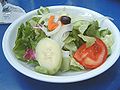
crudité: an appetizer of grated raw vegetables soaked in a vinaigrette. In French, it means uncooked vegetable, traditionally served as an entrée (first part of the meal, contrary to an appetizer outside the meal), with or without a vinaigrette or other sauce. It's almost always used in the plural form in French (as in, crudités).
début: first public performance of an entertainment personality or group. In French, it means "beginning." The English sense of the word exist only when in plural form: "[faire] ses débuts [sur scène]" (to make one's débuts on the scene).
décolletage
: a low-cut neckline, cleavage (This is actually a case of "false friends": Engl. décolletage = Fr. décolleté; Fr. décolletage means: 1. action of lowering a female garment's neckline; 2. Agric.: cutting leaves from some cultivated roots such as beets, carrots, etc.; 3. Tech. Operation consisting of making screws, bolts, etc. one after another out of a single bar of metal on a parallel lathe.)
déjà entendu/lu: already heard/read. They do not exist as expressions in French: the Académie française
says that un déjà vu (a feeling of something already seen) can be used but not un déjà entendu or un déjà lu.
démarche
: a decisive step. In French, it means a preparing step often used in the plural form, or a distinctive way of walking.
dépanneur
: a neighbourhood general/convenience store, term used in eastern Canada (often shortened to "dép" or "dep"). This term is commonly used in Canadian French; however, in France, it means a repairman. In France, a convenience store would be a "supérette" or "épicerie [de quartier]."
émigré
: one who has emigrated for political reasons. In French, it means someone who emigrated. To imply the political reason, French would use of the word "exilé" (exiled).
encore
: A request to repeat a performance, as in “Encore!”, lit. again; also used to describe additional songs played at the end of a gig
. Francophones would say «Une autre!» (Another one!) to request « un rappel » (an encore).
en masse: in a mass or group, all together. In French, 'mass' refers only to a physical mass, whether for people or objects. It cannot be used for something immaterial, like, for example, the voice: "they all together said 'get out'" would be translated as "ils ont dit 'dehors' en choeur" ([like a chorus]). Also, 'en masse' refers to numerous people or objects (a crowd or a mountain of things).
en suite: as a set (not to be confused with "ensuite," meaning "then"). In French, "suite," when in the context of a hotel, already means several rooms following each other. "J'ai loué une suite au Ritz" would be translated as "I rented a suite at the Ritz." "En suite" is not grammatically incorrect in French, but it is not an expression in itself and it is not used.
épée: a fencing weapon descended from the duelling sword. In French, apart from fencing (the sport) the term is more generic: it means sword.
escritoire
: a writing table. It is spelt écritoire in modern French.
exposé: a published exposure of a fraud or scandal (past participle of "to expose"); in French refers to a talk or a report on any kind of subject.
extraordinaire: extraordinary, out of the ordinary capacity for a person. In French, it simply means extraordinary (adjective) and can be used for either people, things or concepts. The rule that systematically puts 'extraordinary' after the noun in English differs from French, because in French, an adjective can be put before the noun for emphasis—which is particularly the case for the adjective extraordinaire. In fact, French people would just as well use 'un musicien extraordinaire' as 'un extraordinaire musicien' (an extraordinary male musician, but the latter emphasizes his being extraordinary).
femme: a stereotypically effeminate gay man or lesbian (slang, pronounced as written). In French, femme means "woman."
fin de siècle
: comparable to (but not exactly the same as) turn-of-the-century but with a connotation of decadence, usually applied to the period from 1890 through 1910. In French, it means "end of the century," but it isn't a recognized expression as such.
foible: a minor weakness or quirkiness. The word is spelt faible in French and means "weak" (adjective). Weakness is translated as faiblesse (noun).
forte: a strength, a strong point, typically of a person, from the French fort (strong) and/or Italian forte (strong, esp. "loud" in music) and/or Latin forte (neuter form of fortis, strong). French use "fort" both for people and objects.
fromage: cheese. Used in place of Say cheese. when taking pictures of people to get them to smile, one would utter Say fromage. French people would use the English word "cheese" or "ouistiti."
la sauce est tout: "The sauce is everything!" or "The secret's in the sauce!" Tagline used in a 1950s American television commercial campaign for an American line of canned food products. Grammatically correct but not used in French, where one might say "Tout est dans la sauce" or "C'est la sauce qui fait (passer) le poisson" (also fig.).
marquee
: the sign above a theater that tells you what's playing. From "marquise," which means not only a marchioness but also an awning. Theater buildings are generally old and nowadays there is never such a sign above them; there is only the advertisement for the play (l'affiche).
naïve: a man or woman lacking experience, understanding or sophistication. In French, it only refers to the last two and often has a pejorative connotation, as in gullible. Also, naïve can be used only for women; naïf is used for men.
: "yearning for the mud"; attraction to what is unworthy, crude or degrading. Though grammatically correct, it's not an expression used in French.
ooh la la!: "wowie!" Expression of exaggerated feminine delight; variation of an expression more commonly used by the French, "oh là là!" which means "yikes!" or "uh-oh!" The "wowie" intent does exist in French, but is not as pretentious as the English usage.
outré: out of the ordinary, unusual. In French, it means outraged (for a person) or exaggerated, extravagant, overdone (for a thing, esp. a praise, an actor's style of acting, etc.) (In that second meaning, belongs to "literary" style.)
passé: out of fashion. The correct expression in French is "passé de mode." Passé means past, passed, or (for a colour) faded.
peignoir
: a woman’s dressing gown. In French it is a bathrobe
. A dressing gown is a "robe de chambre" (lit. a bedroom dress).
petite: small; waiflike; skinny; In French, it means only small and does not have those other connotations it has in English. Also, this is the feminine form of the adjective (used for girls); the masculine form (used for boys) is "petit."
philosophe
: a French intellectual and writer of the Enlightenment
. In French, it applies to any philosopher.
pièce d'occasion
: "occasional piece"; item written or composed for a special occasion. In French, it means "second-hand hardware." Can be shortened as "pièce d'occas'" or even "occas'" .
portemanteau (pl. portemanteaux): a blend; a word that fuses two or more words or parts of words to give a combined meaning. In French, lit. a carry coat, referred to a person who carried the royal coat or dress train, now meaning a large suitcase; more often, a clothes hanger. The equivalent of the English "portemanteau" is un mot-valise (lit. a suitcase word).
potpourri
: medley, mixture; French write it "pot-pourri," literally rotten pot (it is primarily a pot in which different kinds of flowers or spices are put to dry for years for the scent).
précis: a concise summary. In French, when talking about a school course, it means an abridged book about the matter. Literally, 'Précis' means precise, accurate.
premier
: prime minister or head of government. In French, it is only an adjective meaning "first."
première
: refers to the first performance of a play, a film, etc. In French, it means "the first" and only for a live performance; it cannot be used as a verb ("the film premiered on November" is the equivalent of "the film firsted in November").
raisonneur: a type of author intrusion in which a writer inserts a character to argue the author's viewpoint; alter ego, sometimes called 'author avatar'. In French, a "raisonneur" is a character in a play who stands for morality and reason, i.e., not necessarily the author's point of view. The first meaning of this word though is a man (fem. raisonneuse) who overdoes reasonings, who tires by objecting with numerous arguments to every order.
recherché: lit. searched; obscure; pretentious. In French, means sophisticated or delicate, or simply studied, without the negative connotations of the English.
rendezvous: lit. "go to"; a meeting, appointment, or date in French, but in English has taken on other overtones. Always hyphenated in French, as in "rendez-vous." Its only accepted abbreviation in French is RDV.
reprise
: repetition of previous music in a suite, programme, etc. In French it may mean an alternate version of a piece of music, or a cover version
. To express the repetition of a previous musical theme, French would exclusively use the Italian term coda
.
résumé
: in North American English
, a document listing one's qualifications for employment. In French, it means summary; French speakers would use instead curriculum vitæ, or its abbreviation, C.V. (like most other English speakers)
risqué: sexually suggestive; in French, the meaning of risqué is "risky," with no sexual connotation. Francophones use instead "osé" (lit. "daring") or sometimes "dévergondé" (very formal language). "Osé," unlike "dévergondé," cannot be used for people themselves, only for things (such as pictures) or attitudes.
table d'hôte
(pl. tables d'hôte): a full-course meal offered at a fixed price. In French, it is a type of lodging where, unlike a hotel, you eat with other patrons and the host. Lit. "the host's table": one eats at the host's table whatever he has prepared for himself or herself, at the family's table, with a single menu. Generally, the menu is composed of traditional courses of the region and the number of patrons is very limited.
tableau vivant
(pl. tableaux vivants, often shortened as tableau): in drama, a scene where actors remain motionless as if in a picture. Tableau means painting, tableau vivant, living painting. In French, it is an expression used in body painting.
vignette
: a brief description; a short scene. In French, it is a small picture, and now in some European countries also means 'permit for driving on motorways.'
 aide-de-camp
: "camp assistant"; in the army, a military assistant to a senior military officer (heads of State are considered military officers because of their status as head of the army). In Canada, it may also refer to the honorary position a person holds as a personal assistant to a high civil servant. It is written "aide de camp" (without any hyphens) in French.
après-garde: Avant-garde's antonym. French (and most English) speakers use arrière-garde (either in a military or artistic context).
art deco
: a style of decoration and architecture of the early 20th century made famous by the Exposition internationale des arts décoratifs et industriels modernes. Spelled "art déco" (note the accent) in French.
brassiere
: French use brassière (note the accent). Also, the French equivalent of "bra" would be "un soutien-gorge" (which can be colloquially abbreviated as soutif). A "brassière" in French is a newborn baby's knitted garment but is also a special kind of woman's undergarment for sports. Larger than a simple "soutien-gorge," it offers better breast support.
cinquefoil: five-petal, five-leaf flower of the genus Potentilla, family Rosaceae; also a circular 5-lobed ornamental design. Spelt quintefeuille in French.
corduroy
: Suggested as "corde du roi" ("the king's cord") but this does not exist in French. More likely from 1780 American English "cord" and 17th "duroy," a coarse fabric made in England.
cri de cœur: "cry from the heart": an impassioned outcry, as of entreaty or protest. In French, the exact expression is "cri du cœur".
demimonde
: a class of women of ill repute; a fringe group or subculture. Fell out of use in the French language in the 19th century. Frenchmen still use "une demi-mondaine" to qualify a woman that lives (exclusively or partially) of the commerce of her charms but in a high-life style.
demitasse
: small cup, usually for coffee. Comes from "une demi-tasse," literally a half cup. It's not an expression as such in French.
différance
: a term of post-modernist criticism, meaning both the fact that words and signs can never fully summon forth what they mean, but can only be defined through appeal to additional words, from which they differ and the force which differentiates elements from one another and, in so doing, engenders binary oppositions and hierarchies which underpin meaning itself. This notion is a neologism created by French Jacques Derrida in 1963, but isn't a French word per se, as it never made it to any dictionary and is unknown in French.
double entendre
: double meaning. French would use either "un mot / une phrase à double sens" (a word / a sentence with two meanings) or "un sous-entendu" (a hidden meaning). The verb entendre, to hear (modern), originally meant to understand. "Double entendre" has, however, been found previously in French documents dating back to the 15th century. The dictionary of the Académie française lists the expression "à double entente" as obsolete.
homage: term used for films that are influenced by other films, in particular by the works of a notable director. French word is written "hommage," and is used for all shows of admiration, respect, or in a close sense for dedication of an artwork to another.
léger de main: "light of hand": sleight of hand
, usually in the context of deception or the art of stage magic tricks. Means nothing in French and has no equivalent.
maître d’: translates as master o. Francophones would say maître d’hôtel (head waiter) instead (French never uses "d'" alone).
negligee
: A robe or a dressing gown, usually of sheer or soft fabric for women. French uses négligé (masculine form, with accents) or nuisette. Négligée qualifies a woman who neglects her appearance.
pièce de résistance
: the best; the main meal, literally "a piece that resists." Francophones use plat de résistance (main dish).
Pur autre vie
: for another's life. Used in the context of estates and meaning that the life-duration of the estate is based on a third party, not the life tenant. French would use "droit pour autre vie" (note how "pour" is spelled. "Pur" means "pure" in French).
repertoire: the range of skills of a particular person or group. It is spelt répertoire, in French; also, the meaning is slightly different: it means the range of songs / musics a person or group can play.
reservoir: a holding tank for liquids; an artificial pond for water. It is spelt réservoir, in French.
Rouge
: literally "red" in Canadian football
, awarded when the ball is kicked into the end zone by any legal means, other than a successful field goal, and the receiving team does not return, or kick, the ball out of its end zone.
succès de scandale
: Success through scandal; Francophones might use «succès par médisance».
tas-de-charge
: term in architecture, for which there is no equivalent in English, given to the lower courses of ribs of a Gothic vault, which are laid in horizontal courses and bonded into the wall. It is written "tas de charge" (without any hyphens) in French.
voir dire
: jury selection (Law French
). Literally "to speak the truth." (Anglo-Norman
voir [truth] is etymologically unrelated to the modern French voir [to see].) In modern American court procedure, the examination of prospective jurors for their qualification to serve, including inherent biases, views and predelictions; during this examination, each prospective juror must "speak the truth" so that counsel and the court may decide whether they should remain on the jury or be excused.
vol-au-vent
: from the French "flight in the wind", or "windblown". A vol-au-vent is a culinary term meaning a small canapé - circular pieces of puff pastry with a small hole that accommodates various fillings, such as mushrooms, prawns, fruit, cheese, etc. It is thus named because of the lightness of its pastry. French Canadians however still use the term.
----
s. Note that the "phonetic" versions are presented as shown and not the IPA.
SECURITAY: (securité, “safety”) the following is a safety message or warning, the lowest level of danger.
PAN PAN
: (panne, “breakdown”) the following is a message concerning a danger to a person or ship, the next level of danger.
MAYDAY
: ([venez] m'aider, come to help me"; note that aidez-moi means "help me") the following is a message of extreme urgency, the highest level of danger. (MAYDAY is used on voice channels for the same uses as SOS on Morse
channels.)
SEELONCE: (silence, “silence”) keep this channel clear for air-sea rescue communications.
SEELONCE FEE NEE: (silence fini, “silence is over”) this channel is now available again.
PRU DONCE: (prudence, “prudence”) silence partially lifted, channel may be used again for urgent non-distress communication.
MAY DEE CAL: (médical, “medical”) medical assistance needed.
It is a serious breach in most countries, and in international zones, to use any of these phrases without justification.
See Mayday (distress signal)
for a more detailed explanation.
English contains many words of French origin, such as art, collage, competition, force, machine, police, publicity, role, routine, table, and many other Anglicized French words. These are pronounced according to English
English language
English is a West Germanic language that arose in the Anglo-Saxon kingdoms of England and spread into what was to become south-east Scotland under the influence of the Anglian medieval kingdom of Northumbria...
rules of phonology
Phonology
Phonology is, broadly speaking, the subdiscipline of linguistics concerned with the sounds of language. That is, it is the systematic use of sound to encode meaning in any spoken human language, or the field of linguistics studying this use...
, rather than French
French language
French is a Romance language spoken as a first language in France, the Romandy region in Switzerland, Wallonia and Brussels in Belgium, Monaco, the regions of Quebec and Acadia in Canada, and by various communities elsewhere. Second-language speakers of French are distributed throughout many parts...
. Around 28% of English vocabulary is of French or Oïl language
Langues d'oïl
The langues d'oïl or langues d'oui , in English the Oïl or Oui languages, are a dialect continuum that includes standard French and its closest autochthonous relatives spoken today in the northern half of France, southern Belgium, and the Channel Islands...
origin, most derived from, or transmitted by, the Anglo-Norman
Anglo-Norman language
Anglo-Norman is the name traditionally given to the kind of Old Norman used in England and to some extent elsewhere in the British Isles during the Anglo-Norman period....
spoken by the upper class
Upper class
In social science, the "upper class" is the group of people at the top of a social hierarchy. Members of an upper class may have great power over the allocation of resources and governmental policy in their area.- Historical meaning :...
es in England
England
England is a country that is part of the United Kingdom. It shares land borders with Scotland to the north and Wales to the west; the Irish Sea is to the north west, the Celtic Sea to the south west, with the North Sea to the east and the English Channel to the south separating it from continental...
for several hundred years after the Norman Conquest
Norman conquest of England
The Norman conquest of England began on 28 September 1066 with the invasion of England by William, Duke of Normandy. William became known as William the Conqueror after his victory at the Battle of Hastings on 14 October 1066, defeating King Harold II of England...
, before the language settled into what became Modern English
Modern English
Modern English is the form of the English language spoken since the Great Vowel Shift in England, completed in roughly 1550.Despite some differences in vocabulary, texts from the early 17th century, such as the works of William Shakespeare and the King James Bible, are considered to be in Modern...
.
This article, however, covers words and phrases that generally entered the lexicon later, as through literature, the arts, diplomacy, and other cultural exchanges not involving conquests. As such, they have not lost their character as Gallicisms, or words that seem unmistakably foreign and "French" to an English speaker.
The phrases are given as used in English, and may seem correct modern French to English speakers, but may not be recognized as such by French speakers as many of them are now defunct or have a different meaning due to semantic evolution. A general rule is that if the word or phrase retains French diacritic
Diacritic
A diacritic is a glyph added to a letter, or basic glyph. The term derives from the Greek διακριτικός . Diacritic is both an adjective and a noun, whereas diacritical is only an adjective. Some diacritical marks, such as the acute and grave are often called accents...
s or is usually printed in italics, it has retained its French identity.
Few of these phrases are common knowledge to all English speakers, and for some English speakers most are rarely if ever used in daily conversation, but for other English speakers many of them are a routine part of both their conversational and their written vocabulary. They may however possibly be used more often in written than in spoken English.
A B C D E F G H I J K L M N O P Q R S T U V W X Y Z Not used as such in French — Found only in English — French phrases in international air-sea rescue — See also — References |
A
à la […]: in the manner of/in the style of […]
à la carte
À la carte
À la carte is a French language loan phrase meaning "according to the menu", and used in* A reference to a menu of items priced and ordered separately, i.e. the usual operation of restaurants * To order an item from the menu on its own, e.g...
: literally: on the menu; In restaurants it refers to ordering individual dishes rather than a fixed-price meal.
à la mode: idiomatic: in the style; In the United States, the phrase is used to describe a dessert with an accompanying scoop of ice cream (example: apple pie à la mode). However, in French, it is a culinary term usually meaning cooked with ale and some carrots and onions (example: boeuf à la mode).
à propos: regarding/concerning (note that the correct French syntax is à propos de)
abattoir: slaughterhouse
accouchement: confinement during childbirth; the process of having a baby; only this latter meaning remains in French
acquis communautaire: used in European Union law
European Union law
European Union law is a body of treaties and legislation, such as Regulations and Directives, which have direct effect or indirect effect on the laws of European Union member states. The three sources of European Union law are primary law, secondary law and supplementary law...
to refer to the total body of EU law accumulated thus far.
adieu: farewell; literally means "to God," it carries more weight than "au revoir" ("goodbye," literally "Until re-seeing"). It is definitive, implying you will never see the other person again. Depending on the context, misuse of this term can be considered as an insult, as one may wish for the other person's death or say that you do not wish to see the other person ever again while alive. It is used for "au revoir" in south of France and to denote a deprivation from someone or something.
adroit: dexterous, skillful, clever, in French: habile, as a "right-handed" person would be using his "right" hand, as opposed to his left one with which he would be "gauche" meaning "clumsy."
aide-mémoire: "memory aid"; an object or memorandum to assist in remembrance, or a diplomatic paper proposing the major points of discussion
allez!: "go!" or "come on!" as a command or as encouragment
allons-y!: "Here we go!" often used when trying something new. Especially popular in television shows such as Doctor Who
amuse-bouche or amuse-gueule: a single, bite-sized hors d'œuvre. Literally "mouth amuser". In France, the exact expression used is "amuse-gueule", gueule being slang for mouth (gueule is the mouth of a carnivorous animal; when used to describe the mouth of a human, it is vulgar), although the expression in itself is not vulgar (see also: cul-de-sac).
ancien régime: a sociopolitical or other system that no longer exists, an allusion to pre-revolutionary France (used with capital letters in French with this meaning: Ancien Régime)
aperçu: preview; a first impression; initial insight.
apéritif
Aperitif
Apéritifs and digestifs are alcoholic drinks that are normally served with meals.-Apéritifs:An apéritif is usually served before a meal to stimulate the appetite. This contrasts with digestifs, which are served after a meal for the purpose of aiding digestion...
: a before-meal drink (in colloquial French, it is shortened as "apéro"). In French, it means either the drink or food (amuse-gueules) taken before a meal.
appellation contrôlée: supervised use of a name. For the conventional use of the term, see Appellation d'origine contrôlée
Appellation d'Origine Contrôlée
Appellation d’origine contrôlée , which translates as "controlled designation of origin", is the French certification granted to certain French geographical indications for wines, cheeses, butters, and other agricultural products, all under the auspices of the government bureau Institut National...
après moi, le déluge: literally: After me, the deluge, a remark attributed to Louis XV of France in reference to the impending end of a functioning French monarchy and predicting the French Revolution. The chorus of Regina Spektor
Regina Spektor
Regina Ilyinichna Spektor is a Russian American singer-songwriter and pianist. Her music is associated with the anti-folk scene centered in New York City's East Village.-Early life:...
's song Après Moi references this phrase. It is derived from Madame de Pompadour's après nous, le déluge, after us the deluge. The Royal Air Force
Royal Air Force
The Royal Air Force is the aerial warfare service branch of the British Armed Forces. Formed on 1 April 1918, it is the oldest independent air force in the world...
No. 617 Squadron
No. 617 Squadron RAF
No. 617 Squadron is a Royal Air Force aircraft squadron based at RAF Lossiemouth in Scotland. It currently operates the Tornado GR4 in the ground attack and reconnaissance role...
, famously known as the "Dambusters," uses this as its motto.
arête
Arete
Areté is the term meaning "virtue" or "excellence", from Greek ἈρετήArete may also be used:*as a given name of persons or things:**Queen Arete , a character in Homer's Odyssey.***197 Arete, an asteroid....
: a narrow ridge. In French, also fishbone; edge of a polyhedron or graph; bridge of the nose.
armoire: a type of cabinet; wardrobe.
art nouveau
Art Nouveau
Art Nouveau is an international philosophy and style of art, architecture and applied art—especially the decorative arts—that were most popular during 1890–1910. The name "Art Nouveau" is French for "new art"...
: a style of decoration and architecture of the late 19th and early 20th centuries. It takes a capital in French (Art nouveau).
attaché
Attaché
Attaché is a French term in diplomacy referring to a person who is assigned to the diplomatic or administrative staff of a higher placed person or another service or agency...
: a person attached to an embassy; in French it is also the past participle of the verb attacher (= to fasten, to tighten, to be linked)
Attaque au Fer: An attack on the opponent's blade in fencing
Fencing
Fencing, which is also known as modern fencing to distinguish it from historical fencing, is a family of combat sports using bladed weapons.Fencing is one of four sports which have been featured at every one of the modern Olympic Games...
, e.g. beat, expulsion, pressure.
au contraire: on the contrary.
au courant: up-to-date; abreast of current affairs.
au fait: being conversant in or with, or instructed in or with.
au jus: literally, with juice, referring to a food course served with sauce. Often redundantly formulated, as in 'Open-faced steak sandwich, served with au jus.'. No longer used in French, except for the slang "être au jus" (to be informed).
au pair
Au pair
An au pair is a domestic assistant from a foreign country working for, and living as part of, a host family. Typically, au pairs take on a share of the family's responsibility for childcare as well as some housework, and receive a small monetary allowance for personal use...
: a young foreigner who does domestic chores in exchange for room and board. In France, those chores are mainly child care/education.
au revoir!: "See you later!" In French a contraction of Au plaisir de vous revoir (to the pleasure of seeing you again).
avant-garde
Avant-garde
Avant-garde means "advance guard" or "vanguard". The adjective form is used in English to refer to people or works that are experimental or innovative, particularly with respect to art, culture, and politics....
(pl. avant-gardes): applied to cutting-edge or radically innovative movements in art, music and literature; figuratively "on the edge," literally, a military term, meaning "vanguard" (which is a corruption of avant-garde) or "advance guard," in other words, "first to attack" (antonym of arrière-garde).
avant la lettre: used to describe something or someone seen as a forerunner of something (such as an artistic or political movement) before that something was recognized and named, e.g., "a post-modernist avant la lettre," "a feminist avant la lettre." The expression literally means before the letter, i.e., "before it had a name."
avec plaisir: my pleasure (lit. "with pleasure")
avoirdupois
Avoirdupois
The avoirdupois system is a system of weights based on a pound of 16 ounces. It is the everyday system of weight used in the United States and is still widely used to varying degrees by many people in Canada, the United Kingdom, and some other former British colonies despite the official adoption...
: used in Middle English, avoir de pois = commodities sold by weight, alteration of Old French aveir de peis = goods of weight
B
Baguette
A baguette is "a long thin loaf of French bread" that is commonly made from basic lean dough...
: a long, narrow loaf of bread with a crispy crust, often called 'French bread' in the United Kingdom and United States. In French, a "baguette" also refers to many long and narrow objects, including the kind of bread above (which has also some subvarieties), a magical wand
Wand
A wand is a thin, straight, hand-held stick of wood, stone, ivory, or metal. Generally, in modern language, wands are ceremonial and/or have associations with magic but there have been other uses, all stemming from the original meaning as a synonym of rod and virge, both of which had a similar...
or chopsticks
Chopsticks
Chopsticks are small, often tapered, sticks used in pairs of equal length as the traditional eating utensils of China and its diaspora, Japan, Korea, Vietnam and Northern provinces of Laos, Thailand and Burma. Generally believed to have originated in ancient China, they can also be found in some...
. Some breads that would be called baguettes in English are known in France as "épi" or "ficelle"
ballet
Ballet
Ballet is a type of performance dance, that originated in the Italian Renaissance courts of the 15th century, and which was further developed in France and Russia as a concert dance form. The early portions preceded the invention of the proscenium stage and were presented in large chambers with...
: a classical type of dance
beau geste: literally "beautiful gesture", a gracious gesture, noble in form but often futile or meaningless in substance
Beaux-Arts: monumental architectural style of the early 20th century made famous by the Académie des Beaux-Arts
beaucoup: plenty, lots of, much; merci beaucoup: thanks a lot; misused in slang, for example "beaucoup money" (French would add the preposition de: "beaucoup d'argent"), especially in New Orleans, LA. Occasionally corrupted to Bookoo, typically in the context of French influenced by Vietnamese culture.
bel esprit (pl. beaux esprits): literally "fine mind"; a cultivated, highly intelligent person
belle: a beautiful woman or girl. Common uses of this word are in the phrases the belle of the ball (the most beautiful woman or girl present at a function) and southern belle
Southern belle
A southern belle is an archetype for a young woman of the American Old South's upper class....
(a beautiful woman from the southern states of the US)
Belle Époque
Belle Époque
The Belle Époque or La Belle Époque was a period in European social history that began during the late 19th century and lasted until World War I. Occurring during the era of the French Third Republic and the German Empire, it was a period characterised by optimism and new technological and medical...
: a period in European social history that began during the late 19th century and lasted until World War I.
belles-lettres
Belles-lettres
Belles-lettres or belles lettres is a term that is used to describe a category of writing. A writer of belles-lettres is a belletrist. However, the boundaries of that category vary in different usages....
: literally "fine letters"; literature regarded for its aesthetic value rather than its didactic or informative content; also, light, stylish writings, usually on literary or intellectual subjects
bien fait!: literally "well done"; used to express schadenfreude
Schadenfreude
Schadenfreude is pleasure derived from the misfortunes of others. This German word is used as a loanword in English and some other languages, and has been calqued in Danish and Norwegian as skadefryd and Swedish as skadeglädje....
when someone is well-deservedly punished
bien pensant: literally "well thinking"; right thinking, orthodox. Commonly implies willful blindness to dangers or suffering faced by others. The noun form bien-pensance is rarely seen in English.
blasé: unimpressed with something because of overfamiliarity, jaded.
Bleu celeste
Bleu celeste
Bleu celeste is a rarely occurring tincture in heraldry . This tincture is sometimes also called ciel or simply celeste...
: literally "sky blue," is a rarely-occurring tincture in heraldry (not being one of the seven main colours or metals or the three "staynard colours").
bon appétit: literally "good appetite"; enjoy your meal
bon mot: well-chosen word(s), particularly a witty remark
bon vivant: one who enjoys the good life, an epicurean
Epicureanism
Epicureanism is a system of philosophy based upon the teachings of Epicurus, founded around 307 BC. Epicurus was an atomic materialist, following in the steps of Democritus. His materialism led him to a general attack on superstition and divine intervention. Following Aristippus—about whom...
bon voyage: literally "good journey"; have a good trip!
bonjour: "good day," a standard greeting in the morning or afternoon
bonne chance: "good luck" (as in, 'I wish you good luck')
les boules
Boules
Boules is a collective name for games played with metal balls.Two of the most played boule games are pétanque and boule lyonnaise. The aim of the game is to get large, heavy balls as close to the 'jack' as you can. It is very popular especially in France, but also Italy, where it may often be seen...
: (vulgar) literally "the balls"; meaning that whatever you are talking about is dreadful
bourgeois: member of the bourgeoisie
Bourgeoisie
In sociology and political science, bourgeoisie describes a range of groups across history. In the Western world, between the late 18th century and the present day, the bourgeoisie is a social class "characterized by their ownership of capital and their related culture." A member of the...
. The word used to refer to shopkeepers living in towns in the Middle Ages
Middle Ages
The Middle Ages is a periodization of European history from the 5th century to the 15th century. The Middle Ages follows the fall of the Western Roman Empire in 476 and precedes the Early Modern Era. It is the middle period of a three-period division of Western history: Classic, Medieval and Modern...
. Now the term is derogatory, and it applies to a person whose beliefs, attitudes, and practices are conventionally middle-class.
bouquet
Bouquet
Bouquet, a word of French origin, pronounced , may refer to:* Bouquet , a fragrance or odor, especially when used as a description of wine* Flower bouquet, an arrangement of cut flowers* Fruit bouquet, a fruits arrangement in the form of bouquet...
: a handful of flowers.
bric-à-brac
Bric-a-brac
Bric-à-brac , first used in the Victorian era, refers to collections of curios such as elaborately decorated teacups and small vases, feathers, wax flowers under glass domes, eggshells, statuettes, painted miniatures or photographs, and so on...
: small ornamental objects, less valuable than antiques; a collection of old furniture, china, plates and curiosities. Cf. de bric et de broc, corresponding to our "by hook or by crook," and brack, refuse.
brioche
Brioche
Brioche is a highly enriched French pastry, whose high egg and butter content give it a rich and tender crumb. It is "light and slightly puffy, more or less fine, according to the proportion of butter and eggs" It has a dark, golden, and flaky crust, frequently accentuated by an egg wash applied...
: a sweet yeast bun, kind of a crossover between a popover and a light muffin; French also use the term as slang for 'potbelly', because of the overhang effect.
brunette: a brown-haired girl. For brown-haired man, French uses brun and for a woman brune. "Brunette" is rarely used in French, unless in old literature, and its masculine form, "brunet" (for a boy), is almost unheard of.
bureau (pl. bureaux): office. Also means "desk" in French.
C
cache
Cache
In computer engineering, a cache is a component that transparently stores data so that future requests for that data can be served faster. The data that is stored within a cache might be values that have been computed earlier or duplicates of original values that are stored elsewhere...
: a collection of items of the same type stored in a hidden or inaccessible place (such as in an oubliette)
cachet
Cachet
In philately, a cachet is a printed or stamped design or inscription, other than a cancellation or pre-printed postage, on an envelope, postcard, or postal card to commemorate a postal or philatelic event. There are official and private cachets. They commemorate everything from the first flight...
: lit. "stamp"; a distinctive quality; quality, prestige.
café
Café
A café , also spelled cafe, in most countries refers to an establishment which focuses on serving coffee, like an American coffeehouse. In the United States, it may refer to an informal restaurant, offering a range of hot meals and made-to-order sandwiches...
: a coffee shop (also used in French for "coffee").
café au lait
Café au lait
Café au lait is a French coffee drink. The meaning of the term differs between Europe and the United States; in both cases it means some kind of coffee with hot milk added, in contrast to white coffee, which is coffee with room temperature milk or other whitener added.- Europe :In Europe, "café au...
: coffee with milk; or a light-brown color. In medicine, it is also used to describe a birthmark that is of a light-brown color (café au lait spot).
calque
Calque
In linguistics, a calque or loan translation is a word or phrase borrowed from another language by literal, word-for-word or root-for-root translation.-Calque:...
: a copied term/thing.
canard: (1) unfounded rumor or anecdote. (2) a leading airfoil attached to an aircraft forward of the main wing. ('canard' means 'duck' in French)
carte blanche: unlimited authority; literally "white card" (i.e. blank check
Blank check
A blank cheque , in the literal sense, is a cheque that has no numerical value written in, but is already signed...
).
carte de visite
Carte de visite
The carte de visite was a type of small photograph which was patented in Paris, France by photographer André Adolphe Eugène Disdéri in 1854, although first used by Louis Dodero...
: a calling card, literally "visiting card."
carte d'identité: identity card. Its proper, but less commonly used administrative appellation, is "carte nationale d'identité" (national identity card), abbreviated as CNI.
c'est bon: "That's good."
c'est la guerre!: "That's War!"; or "Such is war!" Often used with the meaning that "this means war," but it can be sometimes used as an expression to say that war (or life in general) is harsh but that one must accept it.
c'est la mode. : "That's the fashion."
c'est la vie!: "That's life!"; or "Such is life!" or "It is what it is!" It is sometimes used as an expression to say that life is harsh but that one must accept it.
c'est magnifique!: "That's great!"; literally it's magnificent.
c’est tout: that is everything, "That's all." See also un point c’est tout.
chacun ses goûts / à chacun ses goûts / à chacun son goût [all are used]: "to each his (their) own taste(s)" or "each to his own taste." Note that the expression chacun à son goût is incorrect.
chaise longue: a long chair for reclining; (also rendered chaise lounge or chase lounge by folk etymology).
Champs-Élysées: literally "Elysian Fields
Elysium
Elysium is a conception of the afterlife that evolved over time and was maintained by certain Greek religious and philosophical sects, and cults. Initially separate from Hades, admission was initially reserved for mortals related to the gods and other heroes...
"; Avenue des Champs-Élysées
Champs-Élysées
The Avenue des Champs-Élysées is a prestigious avenue in Paris, France. With its cinemas, cafés, luxury specialty shops and clipped horse-chestnut trees, the Avenue des Champs-Élysées is one of the most famous streets and one of the most expensive strip of real estate in the world. The name is...
, one of the broadest boulevards in Paris
Paris
Paris is the capital and largest city in France, situated on the river Seine, in northern France, at the heart of the Île-de-France region...
. Often referred as simply "les Champs."
chanteuse: a female singer
chapeau
Chapeau
-Mainland Europe:"Chapeau" is a French term signifying a hat or other covering for the head. In mainland European heraldry, it is used as a mark of ecclesiastical dignity, especially that of cardinals, which is called the red chapeau...
: a hat. In French, chapeau is also an expression of congratulations similar to the English "hats off to…."
chargé d'affaires
Chargé d'affaires
In diplomacy, chargé d’affaires , often shortened to simply chargé, is the title of two classes of diplomatic agents who head a diplomatic mission, either on a temporary basis or when no more senior diplomat has been accredited.-Chargés d’affaires:Chargés d’affaires , who were...
: a diplomat left in charge of day to day business at a diplomatic mission. Within the United States Department of State a chargé is any officer left in charge of the mission in the absence of the titular chief of mission.
charlatan
Charlatan
A charlatan is a person practicing quackery or some similar confidence trick in order to obtain money, fame or other advantages via some form of pretense or deception....
: a person who is a fraud, a fake, a hoaxer, a deceiver, a con artist.
châteaux en Espagne: literally "castles in Spain"; imaginary projects, with little hope of realisation (means the same as "castles in the air
Castles in the Air
Castles in the Air is a musical comedy, with a book and lyrics by Raymond W. Peck and music by Percy Wenrich . The story concerns two young men, Monty Blair and John Brown, who mistake an exclusive Westchester resort for an inn. They decide to pretend to be nobility, and Monty introduces John as...
" or "pie in the sky"). No known etymology, though it was already used in the 13th century in the Roman de la rose
Roman de la Rose
The Roman de la rose, , is a medieval French poem styled as an allegorical dream vision. It is a notable instance of courtly literature. The work's stated purpose is to both entertain and to teach others about the Art of Love. At various times in the poem, the "Rose" of the title is seen as the...
.
chauffeur
Chauffeur
A chauffeur is a person employed to drive a passenger motor vehicle, especially a luxury vehicle such as a large sedan or limousine.Originally such drivers were always personal servants of the vehicle owner, but now in many cases specialist chauffeur service companies, or individual drivers provide...
: driver
chef d'œuvre
Masterpiece
Masterpiece in modern usage refers to a creation that has been given much critical praise, especially one that is considered the greatest work of a person's career or to a work of outstanding creativity, skill or workmanship....
: a masterpiece
cherchez la femme
Cherchez la femme
Cherchez la femme is a French phrase which literally means "look for the woman." The implication is that a man behaves out of character or in an otherwise inexplicable manner because he is trying to cover up an affair with a woman, or trying to impress or gain favor with a woman.The expression...
: "look for the woman," in the sense that, when a man behaves out of character or in an otherwise apparently inexplicable manner, the reason may be found in his trying to cover up an illicit affair with a woman, or to impress or gain favour with a woman. First used by Alexandre Dumas (père)
Alexandre Dumas, père
Alexandre Dumas, , born Dumas Davy de la Pailleterie was a French writer, best known for his historical novels of high adventure which have made him one of the most widely read French authors in the world...
in the third chapter of his novel Les Mohicans de Paris (1854).
chevalier d'industrie: "knight of industry": one who lives by his wits, specially by swindling.
chez: at the house of: often used in the names of restaurants and the like; Chez Marie = "Marie's"
chic
Chic (style)
Chic , meaning 'stylish' or 'smart', is an element of fashion.-Etymology:Chic is a French word, established in English since at least the 1870s...
: stylish
chignon
Chignon (hairstyle)
A chignon is a popular type of hairstyle. The word “chignon” comes from the French phrase “chignon du cou,” which means nape of the neck. Chignons are generally achieved by pinning the hair into a knot at the nape of the neck or at the back of the head, but there are many different variations of...
: a hairstyle worn in a roll at the nape of the neck
cinéma pur
Cinema pur
Cinéma Pur was an avant-garde film movement birthed in Paris in the 1920s and 30s. The term was first coined by Henri Chomette to define a cinema that focused on the pure elements of film like form, light, motion, visual composition, and rhythm, something he accomplished in his shorts Reflets de...
: an avant-garde
Avant-garde
Avant-garde means "advance guard" or "vanguard". The adjective form is used in English to refer to people or works that are experimental or innovative, particularly with respect to art, culture, and politics....
film movement which was born in Paris in the 1920s and 30s.
cinéma vérité
Cinéma vérité
Cinéma vérité is a style of documentary filmmaking, combining naturalistic techniques with stylized cinematic devices of editing and camerawork, staged set-ups, and the use of the camera to provoke subjects. It is also known for taking a provocative stance toward its topics.There are subtle yet...
: realism in documentary filmmaking
cinq, cinque: five; normally referring to the 5 on dice or cards. In French, always spelt cinq.
cliché
Cliché
A cliché or cliche is an expression, idea, or element of an artistic work which has been overused to the point of losing its original meaning or effect, especially when at some earlier time it was considered meaningful or novel. In phraseology, the term has taken on a more technical meaning,...
: lit. negative
Negative (photography)
In photography, a negative may refer to three different things, although they are all related.-A negative:Film for 35 mm cameras comes in long narrow strips of chemical-coated plastic or cellulose acetate. As each image is captured by the camera onto the film strip, the film strip advances so that...
; trite through overuse; a stereotype
clique
Clique
A clique is an exclusive group of people who share common interests, views, purposes, patterns of behavior, or ethnicity. A clique as a reference group can be either normative or comparative. Membership in a clique is typically exclusive, and qualifications for membership may be social or...
: a small exclusive group of friends; always used in a pejorative way in French.
commandant
Commandant
Commandant is a senior title often given to the officer in charge of a large training establishment or academy. This usage is common in anglophone nations...
: a commanding officer. In France, used for an airline pilot (le commandant de bord), in the Army as appellative for a chef de bataillon or a chef d'escadron (roughly equivalent to a major) or in the Navy for any officer from capitaine de corvette to capitaine de vaisseau (equivalent to the Army's majors, lieutenant-colonels and colonels) or for any officer heading a ship.
comme ci, comme ça: "like this, like that"; so-so, neither good nor bad. In French, usu. couci-couça.
comme il faut: "as it must be": in accord with conventions or accepted standards; proper.
communiqué
Communique
A communiqué is a brief report or statement released by a public agency.Communiqué may also refer to:* Communiqué , a rock band* Communiqué , 1979* Communiqué , 1987...
: lit. communicated; an official communication.
concierge
Concierge
A concierge is an employee who either works in shifts within, or lives on the premises of an apartment building or a hotel and serves guests with duties similar to those of a butler. The position can also be maintained by a security officer over the 'graveyard' shift. A similar position, known as...
: a receptionist at a hotel or residence.
concordat
Concordat
A concordat is an agreement between the Holy See of the Catholic Church and a sovereign state on religious matters. Legally, they are international treaties. They often includes both recognition and privileges for the Catholic Church in a particular country...
: an agreement; a treaty; when used with a capital C in French, it refers to the treaty between the French State and Judaeo-Christian religions during the French Empire (Napoleon): priests, ministers and rabbis became civil servants. This treaty was abolished in 1905 (law Church-State separation) but is still in use in Alsace-Lorraine (those territories were under German administration during 1871–1918)
confrère: a colleague, esp. in the medical and law professions.
congé: a departure; in French refers to time off work
conte: a short story, a tale; in French a conte has usually a fantasy context (such as in fairytales) and always begins with the words "Il était une fois" ("Once upon a time").
contre-coup: against the blow
contre-jour
Contre-jour
Contre-jour, French for 'against daylight', refers to photographs taken when the camera is pointing directly toward a source of light. An alternative term is backlighting....
: against daylight
contretemps: an awkward clash; a delay
coquette: a flirtatious girl; a tease
cordon sanitaire
Cordon sanitaire
Cordon sanitaire — or quarantine line — is a French phrase that, literally translated, means "sanitary cordon". Though in French it originally denoted a barrier implemented to stop the spread of disease, it has often been used in English in a metaphorical sense to refer to attempts to prevent the...
: a policy of containment
Containment
Containment was a United States policy using military, economic, and diplomatic strategies to stall the spread of communism, enhance America’s security and influence abroad, and prevent a "domino effect". A component of the Cold War, this policy was a response to a series of moves by the Soviet...
directed against a hostile entity or ideology; a chain of buffer states; lit. "quarantine line"
cortège: a funeral procession; in French has a broader meaning and refers to all kinds of processions.
corvée
Corvée
Corvée is unfree labour, often unpaid, that is required of people of lower social standing and imposed on them by the state or a superior . The corvée was the earliest and most widespread form of taxation, which can be traced back to the beginning of civilization...
: forced labor for minimal or no pay. In French, overall an unpleasant/tedious task.
cotte d'armes
Coat of arms
A coat of arms is a unique heraldic design on a shield or escutcheon or on a surcoat or tabard used to cover and protect armour and to identify the wearer. Thus the term is often stated as "coat-armour", because it was anciently displayed on the front of a coat of cloth...
: coat of arms.
coup de foudre: lit. thunderbolt ("strike of thunder"); a sudden unforeseen event, usually used to describe love at first sight.
coup de grâce
Coup de grâce
The expression coup de grâce means a death blow intended to end the suffering of a wounded creature. The phrase can refer to the killing of civilians or soldiers, friends or enemies, with or without the consent of the sufferer...
: the final blow that results in victory (literally "blow of mercy"), historically used in the context of the battlefield to refer to the killing of badly wounded enemy soldiers, now more often used in a figurative context (e.g., business). Frequently pronounced without the final "s" sound by English speakers who believe that any such sound at the end of a French word is supposed to be silent. In French this would sound like coup de gras, or "blow of fat."
coup de maître: stroke of the master, master stroke
coup d'œil: a glance, literally "a blow (or touch) of the eye."
coup de théâtre: unexpected dramatic turn of events, a plot twist
couture
Haute couture
Haute couture refers to the creation of exclusive custom-fitted clothing. Haute couture is made to order for a specific customer, and it is usually made from high-quality, expensive fabric and sewn with extreme attention to detail and finished by the most experienced and capable seamstresses,...
: fashion (usually refers to high fashion)
couturier: a fashion designer (usually refers to high fashion, rather than everyday clothes design)
crèche: a nativity
Nativity scene
A nativity scene, manger scene, krippe, crèche, or crib, is a depiction of the birth of Jesus as described in the gospels of Matthew and Luke...
display; more commonly (in the United Kingdom), a place where children are left by their parents for short periods in the supervision of childminders; both meanings still exist in French
crème brûlée
Crème brûlée
Crème brûlée , also known as burnt cream, crema catalana, or Trinity cream is a dessert consisting of a rich custard base topped with a contrasting layer of hard caramel...
: a dessert consisting primarily of custard and toasted sugar, that is, caramel
Caramel
Caramel is a beige to dark-brown confection made by heating any of a variety of sugars. It is used as a flavoring in puddings and desserts, as a filling in bonbons, and as a topping for ice cream, custard and coffee....
; literally "burnt cream"
crème de la crème: best of the best, "cream of the cream," used to describe highly skilled people or objects. A synonymous expression in French is « fin du fin ».
crème fraîche
Crème fraîche
Crème fraîche is a soured cream containing about 28% butterfat and with a pH of around 4.5. It is soured with bacterial culture, but is less sour than sour cream. It has a comparatively high viscosity and a higher fat content....
: literally "fresh cream," a heavy cream slightly soured with bacterial culture, but not as sour or as thick as sour cream and does not curdle.
crêpe
Crêpe
A crêpe or crepe , is a type of very thin pancake, usually made from wheat flour or buckwheat flour . The word is of French origin, deriving from the Latin crispa, meaning "curled". While crêpes originate from Brittany, a region in the northwest of France, their consumption is widespread in France...
: a thin sweet or savoury pancake eaten as a light meal or dessert
crêperie: a takeaway restaurant or stall, serving crêpes as a form of fast food or street food, or may be a more formal sit-down restaurant or café
cri d'amour: a "cry of love"
critique
Critique
Critique is a method of disciplined, systematic analysis of a written or oral discourse. Critique is commonly understood as fault finding and negative judgement, but it can also involve merit recognition, and in the philosophical tradition it also means a methodical practice of doubt...
: a critical analysis or evaluation of a work, or the art of criticizing.
croissant
Croissant
A croissant is a buttery flaky pastry named for its distinctive crescent shape. It is also sometimes called a crescent, from the French word for "crescent". Croissants are made of a leavened variant of puff pastry...
: a crescent-shaped bread made of flaky pastry
cuisine minceur: gourmet cooking for staying thin
cul-de-sac
Cul-de-sac
A cul-de-sac is a word of French origin referring to a dead end, close, no through road or court meaning dead-end street with only one inlet/outlet...
: a dead-end street; literally "arse [buttocks] of the bag". Even though "cul" is vulgar in French, this expression in itself is not (see also amuse-gueule). Equivalent terms "impasse" or "voie sans issue" are also used in French.
D
débâcle: an event or enterprise that ends suddenly and disastrously, often with humiliating consequences.
de nouveau: again; anew. Cf. de novo
De novo
In general usage, de novo is a Latin expression meaning "from the beginning," "afresh," "anew," "beginning again." It is used in:* De novo transcriptome assembly, the method of creating a transcriptome without a reference genome...
de règle: according to custom;
de rigueur: required or expected, especially in fashion or etiquette
de trop: excessive, "too much"
déclassé: of inferior social status
décolleté: a woman's garment with a low-cut neckline that exposes cleavage, or a situation in which a woman's chest or cleavage is exposed; décolletage
Décolletage
Décolletage is the upper part of a woman's torso, between her waist and neck, comprising her neck, shoulders, back and chest, that is exposed by the style of her clothing. However, the term is most commonly applied to a neckline which reveals or emphasizes cleavage...
is dealt with below.
décor: the layout and furnishing of a room
découpage
Decoupage
Decoupage is the art of decorating an object by gluing colored paper cutouts onto it in combination with special paint effects, gold leaf and so on. Commonly an object like a small box or an item of furniture is covered by cutouts from magazines or from purpose-manufactured papers...
: decoration with cut paper
dépôt
Depot
Depot is from the French dépôt which means a deposit or a storehouse. In English, depot can mean any one of a number of things, with minor variances between the different English speaking countries:Transport* Train station...
: a deposit (as in geology or banking), a storehouse, or a transportation hub (bus depot)
demi-glace
Demi-glace
Demi-glace is a rich brown sauce in French cuisine used by itself or as a base for other sauces. The term comes from the French word glace, which used in reference to a sauce means icing or glaze...
: a reduced wine-based sauce for meats and poultry
demi-sec: semi-dry, usually said of wine
déjà vu
Déjà vu
Déjà vu is the experience of feeling sure that one has already witnessed or experienced a current situation, even though the exact circumstances of the prior encounter are uncertain and were perhaps imagined...
: "already seen": an impression or illusion of having seen or experienced something before.
dénouement: the end result
dérailleur
Derailleur gears
Derailleur gears are a variable-ratio transmission system commonly used on bicycles, consisting of a chain, multiple sprockets of different sizes, and a mechanism to move the chain from one sprocket to another...
: a bicycle gear-shift mechanism
dernier cri: the latest fashion; literally "latest scream"
derrière: rear; buttocks; literally "behind"
déshabillé: partially clad or scantily dressed; also a special type of garment.
désolé: sorry
détente
Détente
Détente is the easing of strained relations, especially in a political situation. The term is often used in reference to the general easing of relations between the Soviet Union and the United States in the 1970s, a thawing at a period roughly in the middle of the Cold War...
: easing of diplomatic tension
diablerie: witchcraft, devilry, or, more figuratively, "wickedness"
Dieu et mon droit
Dieu et mon droit
Dieu et mon droit is the motto of the British Monarch in England. It appears on a scroll beneath the shield of the coat of arms of the United Kingdom...
: motto of the British Monarchy. It appears on a scroll beneath the shield of the coat of arms of the United Kingdom
United Kingdom
The United Kingdom of Great Britain and Northern IrelandIn the United Kingdom and Dependencies, other languages have been officially recognised as legitimate autochthonous languages under the European Charter for Regional or Minority Languages...
.
directeur sportif
Directeur sportif
A directeur sportif is a person directing a cycling team during a road bicycle racing event...
: lit. sports director. A person responsible for the operation of a cycling team during a road bicycle race. In French, it means any kind of sports director.
divertissement: an amusing diversion; entertainment
dossier: a file containing detailed information about a person; it has a much wider meaning in modern French, as any type of file, or even a computer directory
douceur de vivre: "sweetness of life"
doyen: the senior member of a group; the feminine is doyenne
dressage
Dressage
Dressage is a competitive equestrian sport, defined by the International Equestrian Federation as "the highest expression of horse training." Competitions are held at all levels from amateur to the World Equestrian Games...
: a form of competitive horse training, in French has the broader meaning of taming any kind of animal
droit du seigneur: "right of the lord": the purported right of a lord in feudal times to take the virginity of one of his vassal
Vassal
A vassal or feudatory is a person who has entered into a mutual obligation to a lord or monarch in the context of the feudal system in medieval Europe. The obligations often included military support and mutual protection, in exchange for certain privileges, usually including the grant of land held...
s' brides on her wedding night (in precedence to her new husband). The actual French term for this hypothetical custom is droit de cuissage (from cuisse 'thigh').
du jour: said of something fashionable or hip for a day and quickly forgotten; today's choice on the menu, as soup du jour, literally "of the day"
E
Eau de Cologne
Eau de Cologne or simply Cologne is a toiletry, a perfume in a style that originated from Cologne, Germany. It is nowadays a generic term for scented formulations in typical concentration of 2-5% essential oils. However as of today cologne is a blend of extracts, alcohol, and water...
: a type of perfume, originating in Cologne
Cologne
Cologne is Germany's fourth-largest city , and is the largest city both in the Germany Federal State of North Rhine-Westphalia and within the Rhine-Ruhr Metropolitan Area, one of the major European metropolitan areas with more than ten million inhabitants.Cologne is located on both sides of the...
, Germany. Its Italian creator used a French name to commercialize it, Cologne at that time being under the control of France.
eau de toilette
Perfume
Perfume is a mixture of fragrant essential oils and/or aroma compounds, fixatives, and solvents used to give the human body, animals, objects, and living spaces "a pleasant scent"...
: literally "grooming water." It usually refers to a aromatic product that is less expensive than a perfume because it has less of the aromatic compounds and is more for an everyday use. Can not be shortened as eau, which means something else altogether in French (water).
eau de vie
Eau de vie
An eau de vie is a clear, colorless fruit brandy that is produced by means of fermentation and double distillation...
: literally "water of life" (cf Aquavit
Aqua vitae
Aqua vitae, or aqua vita, is an archaic name for a concentrated aqueous solution of ethanol. The term was in wide use during the Middle Ages, although its origin is undoubtedly much earlier having been used by Saint Patrick and his fellow monks to refer to both the alcohol and the waters of baptism...
and whisky
Whisky
Whisky or whiskey is a type of distilled alcoholic beverage made from fermented grain mash. Different grains are used for different varieties, including barley, malted barley, rye, malted rye, wheat, and corn...
), a type of fruit brandy.
écarté
Écarté
Écarté is a two-player card game originating from France, the word literally meaning "discarded". It is a trick-taking game, similar to whist, but with a special and eponymous discarding phase. It is closely related to Euchre, a card game played mainly in the United States...
: a card game; also a ballet position
échappé: dance movement foot position
éclair: a cream and chocolate icing pastry
éclat: Great brilliance, as of performance or achievement. Conspicuous success. Great acclamation or applause
écorché: flayed; biological graphic or model with skin removed
élan
Élan
Élan Corporation plc is a major drugs firm based in Athlone, County Roscommon, Ireland which has major interests in the United States. In the late 1990s its value on the Irish Stock Exchange reached over €20bn. It has secondary listings on the London Stock Exchange and the New York Stock Exchange....
: a distinctive flair or style
élan vital
Élan vital
Élan vital was coined by French philosopher Henri Bergson in his 1907 book Creative Evolution, in which he addresses the question of self-organisation and spontaneous morphogenesis of things in an increasingly complex manner. Elan vital was translated in the English edition as "vital impetus", but...
: literally "vital ardor"; the vital force hypothesized by Henri Bergson as a source of efficient causation and evolution in nature; also called "life-force"
éminence grise: "grey eminence": a publicity-shy person with little formal power but great influence over those in authority
en banc
En banc
En banc, in banc, in banco or in bank is a French term used to refer to the hearing of a legal case where all judges of a court will hear the case , rather than a panel of them. It is often used for unusually complex cases or cases considered to be of greater importance...
: court hearing of the entire group of judges instead of a subset panel
en bloc: as a group
en escalier: going up like stairs; the English tends to be used of text.
en famille: expression used in French to express an action done with one's family: "Tonight we are dining en famille."
en garde: "[be] on [your] guard," used in fencing
Fencing
Fencing, which is also known as modern fencing to distinguish it from historical fencing, is a family of combat sports using bladed weapons.Fencing is one of four sports which have been featured at every one of the modern Olympic Games...
, and sometimes mistranscribed as "on guard."
en grande tenue: is used in invertebrate paleontology (of Agnostida, an order of Trilobites), to designate an exoskeleton with well marked features. By opposition, some Agnostida have quite an smooth exoskeleton, with no well marked features.
en passant
En passant
En passant is a move in the board game of chess . It is a special pawn capture which can occur immediately after a player moves a pawn two squares forward from its starting position, and an enemy pawn could have captured it had it moved only one square forward...
: in passing; term used in chess.
en plein air: literally "in the open air," and is particularly used to describe the act of painting outdoors.
en pointe
En pointe
En pointe means "on the tip" and is a part of classical ballet technique, usually practised using specially reinforced shoes called pointe shoes or toe shoes. The technique developed from the desire for dancers to appear weightless and sylph-like and has evolved to enable dancers to dance on the...
: (in ballet) on tiptoe. Though used in French in this same context, it is not an expression as such. A "pointe" is the ballet figure where one stands on tiptoes. The expression "en pointe," though, means "in an acute angle," and, figuratively, it qualifies the most progressive or modern things (ideas, industry…).
en principe, oui: "in principle, yes": a diplomatic way of saying 'no'
en route: on the way
(je suis) enchanté(e): "(I am) enchanted (to meet you)": a formal greeting on receiving an introduction. Often shortened to simply "enchanté."
enfant terrible: a disruptively unconventional person, a "terrible child."
ennui: boredom.
entente: diplomatic agreement or cooperation. L'Entente cordiale
Entente Cordiale
The Entente Cordiale was a series of agreements signed on 8 April 1904 between the United Kingdom and the French Republic. Beyond the immediate concerns of colonial expansion addressed by the agreement, the signing of the Entente Cordiale marked the end of almost a millennium of intermittent...
(the Cordial Entente) refers to the good diplomatic relationship between France and United Kingdom before the first World War.
entre nous: confidentially; literally "between us"
entrée
Entrée
An entrée is a dish served before the main course, or between two principal courses of a meal.The disappearance in the early 20th century of a large communal main course such as a roast as a standard part of the meal in the English-speaking world has led to the term being used to describe the main...
: literally "entrance"; the first course of a meal (UK English); used to denote the main dish or course of a meal (US English).
entremets: desserts/sweet dishes. More literally, a side dish that can be served between the courses of a meal.
entrepreneur
Entrepreneur
An entrepreneur is an owner or manager of a business enterprise who makes money through risk and initiative.The term was originally a loanword from French and was first defined by the Irish-French economist Richard Cantillon. Entrepreneur in English is a term applied to a person who is willing to...
: a person who undertakes and operates a new enterprise or venture and assumes some accountability for the inherent risks
Embonpoint: a plump, hourglass figure.
escargot: snail
escritoire
Escritoire
An escritoire or secretary desk comes in various styles. One version is a small, portable writing desk with a sloping front door, hinged at the bottom edge, that can be opened downwards to provide a writing surface. It is usually larger than a lap desk...
: writing desk; spelled "écritoire" in current French
esprit de corps: "spirit of the body [group]": a feeling of solidarity among members of a group; morale. Often used in connection with a military force.
esprit de l'escalier: "wit of the stairs": a concise, clever statement you don't think of until too late, e.g. on the stairs leaving the scene. The expression was created by French philosopher Denis Diderot
Denis Diderot
Denis Diderot was a French philosopher, art critic, and writer. He was a prominent person during the Enlightenment and is best known for serving as co-founder and chief editor of and contributor to the Encyclopédie....
. Very rarely used in French.
l'État, c'est moi!: "I am the state!" — attributed to the archetypal absolute monarch, Louis XIV of France
Louis XIV of France
Louis XIV , known as Louis the Great or the Sun King , was a Bourbon monarch who ruled as King of France and Navarre. His reign, from 1643 to his death in 1715, began at the age of four and lasted seventy-two years, three months, and eighteen days...
étude
Étude
An étude , is an instrumental musical composition, most commonly of considerable difficulty, usually designed to provide practice material for perfecting a particular technical skill. The tradition of writing études emerged in the early 19th century with the rapidly growing popularity of the piano...
: a musical composition designed to provide practice in a particular technical skill in the performance of an instrument. French for "study."
étui: small ornamental case for needles or cosmetics
excusez-moi: excuse me; can be used sarcastically (depends on the tone)
excusez le mot!: excuse the word!; if a certain word has negative connotations (for example, a word-joke at a time of grief)
extraordinaire: extraordinary, usually as a following adjective, as "musician extraordinaire"
et toi?: and you? (Je m'appelle (your name), Et toi?)(my name is (your name) and yours?)
F
façadeFacade
A facade or façade is generally one exterior side of a building, usually, but not always, the front. The word comes from the French language, literally meaning "frontage" or "face"....
: the front view of an edifice (from the Italian facciata, or face); a fake persona, as in "putting on a façade" (the ç is pronounced like an s)
fait accompli: lit. accomplished fact; something that has already happened and is thus unlikely to be reversed, a done deal. In French used only in the expression "placer/mettre quelqu'un devant le fait accompli" meaning to present somebody with a fait accompli.
faute de mieux: for want of better
faux
Faux
'Faux is a French word for "false".When manufacturing faux objects or materials, an attempt is often made to create products which will resemble the imitated items as closely as possible...
: false, ersatz
Ersatz
Ersatz means 'substituting for, and typically inferior in quality to', e.g. 'chicory is ersatz coffee'. It is a German word literally meaning substitute or replacement...
, fake.
faux amis: "false friends": words in two different languages that have the same or similar spelling, and often the same etymology
Etymology
Etymology is the study of the history of words, their origins, and how their form and meaning have changed over time.For languages with a long written history, etymologists make use of texts in these languages and texts about the languages to gather knowledge about how words were used during...
but different meanings, such as the French verb rester, which means "to stay" rather than "to rest"
faux pas
Faux pas
A faux pas is a violation of accepted social norms . Faux pas vary widely from culture to culture, and what is considered good manners in one culture can be considered a faux pas in another...
: "false step": violation of accepted, although unwritten, social rules
femme fatale
Femme fatale
A femme fatale is a mysterious and seductive woman whose charms ensnare her lovers in bonds of irresistible desire, often leading them into compromising, dangerous, and deadly situations. She is an archetype of literature and art...
: "deadly woman": an attractive woman who seduces and takes advantage of men for her personal goals, after which she discards or abandons them. It extends to describe an attractive woman with whom a relationship is likely to result, or has already resulted, in pain and sorrow.
feuilleton
Feuilleton
Feuilleton was originally a kind of supplement attached to the political portion of French newspapers, consisting chiefly of non-political news and gossip, literature and art criticism, a chronicle of the latest fashions, and epigrams, charades and other literary trifles...
: "little leaf of paper": a periodical, or part of a periodical, consisting chiefly of non-political news and gossip, literature and art criticism, a chronicle of the latest fashions, and epigrams, charades and other literary trifles.
fiancé/e: betrothed; lit. a man/woman engaged to be married.
fier de l'être: proud of being; "French, and proud to be so"
film noir
Film noir
Film noir is a cinematic term used primarily to describe stylish Hollywood crime dramas, particularly those that emphasize cynical attitudes and sexual motivations. Hollywood's classic film noir period is generally regarded as extending from the early 1940s to the late 1950s...
: a genre of dark-themed movies from the 1940s and 1950s that focus on stories of crime and immorality
fils: used after a man's surname to distinguish a son from a father, as George Bush fils (in French, "fils" = son)
fin de saison: "end of season": marks the end of an extended (annual) period during which business increases significantly, most commonly used for the end of summer tourism
flambé
Flambé
Flambé is a cooking procedure in which alcohol is added to a hot pan to create a burst of flames. The word means flamed in French ....
: a cooking procedure in which alcohol (ethanol) is added to a hot pan to create a burst of flames, meaning "flamed" in French. Also used colloquially in reference to something on fire or burned.
flambeau: a lit torch
flâneur
Flâneur
The term flâneur comes from the French masculine noun flâneur—which has the basic meanings of "stroller", "lounger", "saunterer", "loafer"—which itself comes from the French verb flâner, which means "to stroll". Charles Baudelaire developed a derived meaning of flâneur—that of "a person who walks...
: a gentleman stroller of city streets; an aimless idler
fleur-de-lis
Fleur-de-lis
The fleur-de-lis or fleur-de-lys is a stylized lily or iris that is used as a decorative design or symbol. It may be "at one and the same time, political, dynastic, artistic, emblematic, and symbolic", especially in heraldry...
: a stylized-flower heraldic device; the golden fleur-de-lis on an azure background were the arms of the French Kingdom (often spelled with the old French style as "fleur-de-lys")
Fleur de sel
Fleur de sel is a hand-harvested sea salt collected by workers who scrape only the top layer of salt before it sinks to the bottom of large salt pans...
: literally "flower of salt," hand-harvested sea salt collected by workers who scrape only the top layer of salt before it sinks to the bottom of large salt pans. Is one of the more expensive salts; the most prized is harvested during the Mistral winds that blow over the lavender fields and infuse the salt beds with a mild lavender scent.
Foie gras
Foie gras ; French for "fat liver") is a food product made of the liver of a duck or goose that has been specially fattened. This fattening is typically achieved through gavage corn, according to French law, though outside of France it is occasionally produced using natural feeding...
: fatty liver; usually the liver of overfed goose, hence: pâté de foie gras, pâté made from goose liver. However, "foie gras" generally stands for "pâté de foie gras" as it is the most common way to use it.
folie à deux
Folie à deux
-Further reading:*Halgin, R. & Whitbourne, S. Abnormal Psychology: Clinical Perspectives on Psychological Disorders. McGraw-Hill. ISBN 0072817216...
: a simultaneous occurrence of delusions in two closely related people, often said of an unsuitable romance. In clinical psychology, the term is used to describe people who share schizophrenic delusions. The derivated forms folie à trois, folie à quatre, folie en famille or even folie à plusieurs do not exist in French where "collective hysterics" is used.
force majeure
Force majeure
Force majeure or vis major "superior force", also known as cas fortuit or casus fortuitus "chance occurrence, unavoidable accident", is a common clause in contracts that essentially frees both parties from liability or obligation when an extraordinary event or circumstance beyond the control of...
: an overpowering and unforeseeable event, especially when talking about weather (often appears in insurance contracts)
forme fruste
Forme fruste
In medicine, a forme fruste is an atypical or attenuated manifestation of a disease or syndrome, with the implication of incompleteness, partial presence or aborted state...
: an atypical or attenuated manifestation of a disease or syndrome. Its opposite is "forme pleine."
froideur: coldness (for behavior and manners only)
G
garçon: literally "boy" or "male servant"; sometimes used by English speakers to summon the attention of a male waiter
Waiter
Waiting staff, wait staff, or waitstaff are those who work at a restaurant or a bar attending customers — supplying them with food and drink as requested. Traditionally, a male waiting tables is called a "waiter" and a female a "waitress" with the gender-neutral version being a "server"...
(has a playful connotation in English but is condescending and possibly offensive in French)
garde manger
Garde manger
Garde manger , meaning "keep to eat" refers to a cool, well-ventilated area where cold dishes are prepared and other foods are stored under refrigeration...
: literally "keeper of the food" or pantry supervisor, refers to the task of preparing and presenting cold foods.
gauche: tactless, does not mean "left-handed" (which translates in French as "gaucher"), but does mean "left"
gaucherie: boorishness
Gautier et Garguille: all the world and his wife (possibly derived from a 17th century French comic Hugues Guérin, who performed under the stage name Gautier-Garguille, though it is likely that he in turn may have taken this pseudonym from earlier 16th century recorded sayings: prendre Gautier pour Garguille: "to take Gautier for Garguille," that is to mistake one person for another. Il n'y a ni Gautier, ni Garguille: "he is neither Gaultier nor Garguille," that is, 'he is no-one')
gendarme: member of a gendarmerie
Gendarmerie
A gendarmerie or gendarmery is a military force charged with police duties among civilian populations. Members of such a force are typically called "gendarmes". The Shorter Oxford English Dictionary describes a gendarme as "a soldier who is employed on police duties" and a "gendarmery, -erie" as...
which is an arm of the military; the word is often incorrectly used in English to refer to any French policeman [which is civilian]. Note - the picture titled Gendarmes in fact shows Republican Guards
French Republican Guard
The Republican Guard is part of the French Gendarmerie. It is responsible for providing security in the Paris area and for providing guards of honor.Its missions include:...
(who are gendarmes).
genre
Genre
Genre , Greek: genos, γένος) is the term for any category of literature or other forms of art or culture, e.g. music, and in general, any type of discourse, whether written or spoken, audial or visual, based on some set of stylistic criteria. Genres are formed by conventions that change over time...
: a type or class, such as "the thriller genre"
glissade
Glissade (climbing)
Glissading is the act of descending a steep snow- or scree-covered slope via a controlled slide on one's feet or buttocks. It is an alternative to other descent methods such as plunge stepping, and may be used to expedite a descent, or simply for the thrill....
: slide down a slope
les goûts et les couleurs ne se discutent pas: "tastes and colours are not argued over"; one does not argue over differences in taste, to each his own. French People usually shorten the sentence, to "les goûts et les couleurs…"
grâce à: "thanks to," "by the grace of," naming credit or fortune
Grand Prix
Grand Prix motor racing
Grand Prix motor racing has its roots in organised automobile racing that began in France as far back as 1894. It quickly evolved from a simple road race from one town to the next, to endurance tests for car and driver...
: a type of motor racing, literally "Great Prize"
grand projet: literally "large project"; usually a government funded large scale civil engineering or technology project executed for prestige or general social benefit, and not immediately (if ever) profitable
Grand Guignol
Grand Guignol
Le Théâtre du Grand-Guignol — known as the Grand Guignol — was a theatre in the Pigalle area of Paris . From its opening in 1897 until its closing in 1962 it specialized in naturalistic horror shows...
: a horror
Horror film
Horror films seek to elicit a negative emotional reaction from viewers by playing on the audience's most primal fears. They often feature scenes that startle the viewer through the means of macabre and the supernatural, thus frequently overlapping with the fantasy and science fiction genres...
show, named after a French theater famous for its frightening plays and bloody special effects. (Guignol
Guignol
Guignol is the main character in a French puppet show which has come to bear his name.Although often thought of as children's entertainment, Guignol's sharp wit and linguistic verve have always been appreciated by adults as well, as shown by the motto of a prominent Lyon troupe: "Guignol amuses...
can be used in French to describe a ridiculous person, in the same way that clown might be used in English.)
Grenadier: a specialized soldier, first established for the throwing of grenades and later as elite troops
H
haute couture
Haute couture
Haute couture refers to the creation of exclusive custom-fitted clothing. Haute couture is made to order for a specific customer, and it is usually made from high-quality, expensive fabric and sewn with extreme attention to detail and finished by the most experienced and capable seamstresses,...
: "high sewing": Paris-based custom-fitted clothing; trend-setting fashion
haute cuisine
Haute cuisine
Haute cuisine or grande cuisine was characterised by French cuisine in elaborate preparations and presentations served in small and numerous courses that were produced by large and hierarchical staffs at the grand restaurants and hotels of Europe.The 17th century chef and writer La Varenne...
: upscale gastronomy; literally "high cooking."
haute école
Classical dressage
Classical dressage evolved from cavalry movements and training for the battlefield, and has since developed into the competitive dressage seen today...
: advanced horsemanship; literally "high school"
hauteur: arrogance; lit. height
haut monde: fashionable society, the "high world"
homme du monde: cultured, sophisticated man, "man of the world"
Honi soit qui mal y pense
Honi soit qui mal y pense
"Honi soit qui mal y pense" is a French phrase meaning: "Shamed be he who thinks evil of it". The phrase is sometimes rendered as "Honi soit quy mal y pense", "Hony soyt qe mal y pense", "Hony soyt ke mal y pense", "Hony soyt qui mal pence" and various other phoneticizations. It is the motto of...
.: "Shamed be he who thinks ill of it"; or sometimes translated as Evil be to him who evil thinks; the motto of the English Order of the Garter
Order of the Garter
The Most Noble Order of the Garter, founded in 1348, is the highest order of chivalry, or knighthood, existing in England. The order is dedicated to the image and arms of St...
(modern French writes honni instead of Old French honi)
hors concours: "out of the running"; a non-competitor, e.g. in love
hors de combat
Hors de combat
Hors de Combat, literally meaning "outside the fight," is a French term used in diplomacy and international law to refer to soldiers who are incapable of performing their military function. Examples include a downed fighter pilot, as well as the sick, wounded, detained, or otherwise disabled...
: out of the fight: prevented from fighting, usually by injury
hors d'œuvre: "outside the [main] work": appetizer
huis-clos: "closed door": an enclosed space such as a room or cell, where action or speech can not be seen or heard from outside; title of a play
No Exit
No Exit is a 1944 existentialist French play by Jean-Paul Sartre. The original French title is Huis Clos, the French equivalent of the legal term in camera, referring to a private discussion behind closed doors; English translations have also been performed under the titles In Camera, No Way Out...
by Jean-Paul Sartre
Jean-Paul Sartre
Jean-Paul Charles Aymard Sartre was a French existentialist philosopher, playwright, novelist, screenwriter, political activist, biographer, and literary critic. He was one of the leading figures in 20th century French philosophy, particularly Marxism, and was one of the key figures in literary...
I
impasse
Impasse
A bargaining impasse occurs when the two sides negotiating an agreement are unable to reach an agreement and become deadlocked. An impasse is almost invariably mutually harmful, either as a result of direct action which may be taken such as a strike in employment negotiation or sanctions/military...
: a deadlock.
insouciant/e: a nonchalant man/woman
ingénu/e
Ingenue (stock character)
See also Disingenuous, which is not quite the antonym that it may seem!The ingénue is a stock character in literature, film, and a role type in the theatre; generally a girl or a young woman who is endearingly innocent and wholesome. Ingenue may also refer to a new young actress or one typecast in...
: an innocent young man/woman, used particularly in reference to a theatrical stock character
Stock character
A Stock character is a fictional character based on a common literary or social stereotype. Stock characters rely heavily on cultural types or names for their personality, manner of speech, and other characteristics. In their most general form, stock characters are related to literary archetypes,...
who is entirely virginal and wholesome. L'Ingénu is a famous novella written by Voltaire
Voltaire
François-Marie Arouet , better known by the pen name Voltaire , was a French Enlightenment writer, historian and philosopher famous for his wit and for his advocacy of civil liberties, including freedom of religion, free trade and separation of church and state...
.
J
j’accuse: "I accuse"; used generally in reference to a political or social indictment (alluding to the title of Émile ZolaÉmile Zola
Émile François Zola was a French writer, the most important exemplar of the literary school of naturalism and an important contributor to the development of theatrical naturalism...
’s exposé of the Dreyfus affair
Dreyfus Affair
The Dreyfus affair was a political scandal that divided France in the 1890s and the early 1900s. It involved the conviction for treason in November 1894 of Captain Alfred Dreyfus, a young French artillery officer of Alsatian Jewish descent...
, a political scandal that divided France from the 1890s to the early 1900s and involved the false conviction for treason in 1894 of a young French artillery officer of Jewish background).
j'adore & je t'adore: literally, I adore [you]. I love [you] to the full extent.
j'adoube: In chess
Chess
Chess is a two-player board game played on a chessboard, a square-checkered board with 64 squares arranged in an eight-by-eight grid. It is one of the world's most popular games, played by millions of people worldwide at home, in clubs, online, by correspondence, and in tournaments.Each player...
, an expression, said discreetly, that signals the intention to straighten the pieces without committing to move or capturing the first one touched as per the game's rules; literally, "I adjust," from adouber, to dub (the action of knighting someone).
j'arrive: I arrive.
Jacques Bonhomme: a name given to a French peasant as tamely submissive to taxation. Also the pseudonym of the 14th century peasant leader Guillaume Caillet
je m'appelle: my name is…
je m'en fous: "I don't give a damn/a fuck."
je ne regrette rien: "I regret nothing" (from the title of a popular song sung by Édith Piaf
Édith Piaf
Édith Piaf , born Édith Giovanna Gassion, was a French singer and cultural icon who became widely regarded as France's greatest popular singer. Her singing reflected her life, with her specialty being ballads...
: "Non, je ne regrette rien
Non, je ne regrette rien
"Non, je ne regrette rien" , meaning "No, I'm not sorry for anything", is a French song composed by Charles Dumont, with lyrics by Michel Vaucaire. It was written in 1956, and is best known through its 1960 recording by Édith Piaf....
"). Also the phrase the UK's then Chancellor of the Exchequer
Chancellor of the Exchequer
The Chancellor of the Exchequer is the title held by the British Cabinet minister who is responsible for all economic and financial matters. Often simply called the Chancellor, the office-holder controls HM Treasury and plays a role akin to the posts of Minister of Finance or Secretary of the...
Norman Lamont chose to use to describe his feelings over the events of September 16, 1992 ('Black Wednesday
Black Wednesday
In politics and economics, Black Wednesday refers to the events of 16 September 1992 when the British Conservative government was forced to withdraw the pound sterling from the European Exchange Rate Mechanism after they were unable to keep it above its agreed lower limit...
')
je ne sais pas: "I don't know"; collapses to chais pas ʃɛpa in modern colloquial speech
je ne sais quoi: "I-don't-know-what": an indescribable or indefinable 'something' that distinguishes the object in question from others that are superficially similar.
je t'aime: I love you. Implies "I like you" too. The French word "aimer" implies all the different kinds of love (love = like). To differentiate the two, one would say simply "je t'aime" to one's love whereas one would say "je t'aime bien" (lit. I love you well) to a friend.
jeu d'esprit: "play of spirit"; a witty, often light-hearted, comment or composition
jeunesse dorée: "gilded youth"; name given to a body of young dandies
Dandy
A dandy is a man who places particular importance upon physical appearance, refined language, and leisurely hobbies, pursued with the appearance of nonchalance in a cult of Self...
who, after the fall of Robespierre
Maximilien Robespierre
Maximilien François Marie Isidore de Robespierre is one of the best-known and most influential figures of the French Revolution. He largely dominated the Committee of Public Safety and was instrumental in the period of the Revolution commonly known as the Reign of Terror, which ended with his...
, strove to bring about a counterrevolution. Today used for any offspring living an affluent lifestyle.
joie de vivre: "joy of life/living"
L
laïcitéLaïcité
French secularism, in French, laïcité is a concept denoting the absence of religious involvement in government affairs as well as absence of government involvement in religious affairs. French secularism has a long history but the current regime is based on the 1905 French law on the Separation of...
: separation of the State and the different Churches (at first, it concerned especially Catholicism). In France, where the concept originated, it means an absence of religious interference in government affairs and government interference in religious affairs. But the concept is often assimilated and changed by other countries. For example, in Belgium, it usually means the secular-humanist movement and school of thought.
laissez-faire
Laissez-faire
In economics, laissez-faire describes an environment in which transactions between private parties are free from state intervention, including restrictive regulations, taxes, tariffs and enforced monopolies....
: "let do"; often used within the context of economic policy
Economic policy
Economic policy refers to the actions that governments take in the economic field. It covers the systems for setting interest rates and government budget as well as the labor market, national ownership, and many other areas of government interventions into the economy.Such policies are often...
or political philosophy
Political philosophy
Political philosophy is the study of such topics as liberty, justice, property, rights, law, and the enforcement of a legal code by authority: what they are, why they are needed, what, if anything, makes a government legitimate, what rights and freedoms it should protect and why, what form it...
, meaning leaving alone, or non-interference. The phrase is the shortcut of Laissez faire, laissez passer, a doctrine first supported by the Physiocrats
Physiocrats
Physiocracy is an economic theory developed by the Physiocrats, a group of economists who believed that the wealth of nations was derived solely from the value of "land agriculture" or "land development." Their theories originated in France and were most popular during the second half of the 18th...
in the 18th century. The motto was invented by Vincent de Gournay, and it became popular among supporters of free-trade and economic liberalism
Economic liberalism
Economic liberalism is the ideological belief in giving all people economic freedom, and as such granting people with more basis to control their own lives and make their own mistakes. It is an economic philosophy that supports and promotes individual liberty and choice in economic matters and...
. It is also used to describe a parental style in developmental psychology, where the parent(s) does not apply rules or guiding.
laissez-passer: a travel document, a passport
laissez les bons temps rouler: Cajun
Cajun
Cajuns are an ethnic group mainly living in the U.S. state of Louisiana, consisting of the descendants of Acadian exiles...
expression for "let the good times roll": not used in proper French, and not generally understood by Francophones outside of Louisiana
Louisiana
Louisiana is a state located in the southern region of the United States of America. Its capital is Baton Rouge and largest city is New Orleans. Louisiana is the only state in the U.S. with political subdivisions termed parishes, which are local governments equivalent to counties...
, who would say "profitez des bons moments" (enjoy the good moments)
lamé
Lamé (fabric)
Lamé is a type of fabric woven or knit with thin ribbons of metallic yarns, as opposed to guimpé, where the ribbons are wrapped around a fibre yarn. It is usually gold or silver in color; sometimes copper lamé is seen. Lamé comes in different varieties, depending on the composition of the other...
: a type of fabric woven or knit with metallic yarns
lanterne rouge
Lanterne rouge
The Lanterne Rouge is the competitor in last place in a cycling race such as the Tour de France. The phrase comes from the French "Red Lantern" and refers to the red lantern hung on the caboose of a railway train, which conductors would look for in order to make sure none of the couplings had...
: the last-place finisher in a cycling stage race; most commonly used in connection with the Tour de France
layette
Layette
A layette is a collection of clothing for a newborn child. The term "layette set" is commonly used in the United States to refer to gift sets of baby clothes....
: a set of clothing and accessories for a new baby
lèse majesté: an offense against a sovereign power; or, an attack against someone's dignity or against a custom or institution held sacred (from the Latin "crimen laesae maiestatis": the crime of injured majesty)
liaison: a close relationship or connection; an affair. The French meaning is broader; "liaison" also means bond such as in "une liaison chimique" (a chemical bond)
Liberté, Égalité, Fraternité
Liberté, égalité, fraternité
Liberté, égalité, fraternité, French for "Liberty, equality, fraternity ", is the national motto of France, and is a typical example of a tripartite motto. Although it finds its origins in the French Revolution, it was then only one motto among others and was not institutionalized until the Third...
: "Liberty, Equality/Egality, Brotherhood" (motto of the French Republic)
littérateur: an intellectual (can be pejorative in French, meaning someone who writes a lot but does not have a particular skill)
louche: of questionable taste;
Louis Quatorze: "Louis XIV" (of France)
Louis XIV of France
Louis XIV , known as Louis the Great or the Sun King , was a Bourbon monarch who ruled as King of France and Navarre. His reign, from 1643 to his death in 1715, began at the age of four and lasted seventy-two years, three months, and eighteen days...
, the Sun King, usually a reference to décor or furniture design. Also the namesake of the winner of the 1996 Preakness
Louis Quatorze (horse)
Louis Quatorze is an American thoroughbred stallion racehorse. He was sired by Sovereign Dancer, who in turn was a son of the great 1964 Kentucky Derby and Preakness Stakes winner, Northern Dancer out of the mare, On To Royalty....
.
Louis Quinze: "Louis XV" (of France)
Louis XV of France
Louis XV was a Bourbon monarch who ruled as King of France and of Navarre from 1 September 1715 until his death. He succeeded his great-grandfather at the age of five, his first cousin Philippe II, Duke of Orléans, served as Regent of the kingdom until Louis's majority in 1723...
, associated with the rococo
Rococo
Rococo , also referred to as "Late Baroque", is an 18th-century style which developed as Baroque artists gave up their symmetry and became increasingly ornate, florid, and playful...
style of furniture, architecture and interior decoration
M
Macramé
Macramé or macrame is a form of textile-making using knotting rather than weaving or knitting. Its primary knots are the square knot and forms of "hitching": full hitch and double half hitches...
: coarse lace work made with knotted cords
mademoiselle: young unmarried lady, miss; literally "my noble young lady"
mais oui: "but of course!." This is often used as a sarcastic reply in French, in order to close a debate by feigning agreement.
maison: house
mal de mer
Motion sickness
Motion sickness or kinetosis, also known as travel sickness, is a condition in which a disagreement exists between visually perceived movement and the vestibular system's sense of movement...
: motion sickness, literally "seasickness"
malaise
Malaise
Malaise is a feeling of general discomfort or uneasiness, of being "out of sorts", often the first indication of an infection or other disease. Malaise is often defined in medicinal research as a "general feeling of being unwell"...
: a general sense of depression or unease
mange tout
Mange Tout
Mange Tout is the second album by Blancmange. The full album title is - Mange Tout .-Side 1:# "Don't Tell Me" – 3:31# "Game Above My Head" – 3:58# "Blind Vision" – 3:56# "Time Became The Tide" – 4:49...
: another phrase describing 'peas' (litt: "Eat-all," because some peas can be cooked and eaten with their pod.)
manqué
Manqué
Manqué is a term used in reference to a person who has failed to live up to a specific expectation or ambition. It is usually used in combination with a profession: for example, a career civil servant with political prowess who nonetheless never attained political office might be described as a...
: unfulfilled; failed
Mardi gras
Mardi Gras
The terms "Mardi Gras" , "Mardi Gras season", and "Carnival season", in English, refer to events of the Carnival celebrations, beginning on or after Epiphany and culminating on the day before Ash Wednesday...
: Fat Tuesday, the last day of eating meat before Lent
Lent
In the Christian tradition, Lent is the period of the liturgical year from Ash Wednesday to Easter. The traditional purpose of Lent is the preparation of the believer – through prayer, repentance, almsgiving and self-denial – for the annual commemoration during Holy Week of the Death and...
. Note that gras is not capitalised.
marque: a model or brand
matériel
Materiel
Materiel is a term used in English to refer to the equipment and supplies in military and commercial supply chain management....
: supplies and equipment, particularly in a military context (French meaning is broader and corresponds more to "hardware")
mauvais quart d'heure: "bad quarter hour": a short unpleasant or uncomfortable moment
mélange
Mélange
In geology, a mélange is a large-scale breccia, a mappable body of rock characterized by a lack of continuous bedding and the inclusion of fragments of rock of all sizes, contained in a fine-grained deformed matrix. The mélange typically consists of a jumble of large blocks of varied lithologies...
: a mixture
mêlée
Mêlée
Melee , generally refers to disorganized close combat involving a group of fighters. A melee ensues when groups become locked together in combat with no regard to group tactics or fighting as an organized unit; each participant fights as an individual....
: a confused fight; a struggling crowd
ménage à trois
Ménage à trois
Ménage à trois is a French term which originally described a domestic arrangement in which three people having sexual relations occupy the same household – the phrase literally translates as "household of three"...
: "household for three": a sexual arrangement between three people
merci beaucoup: "Thank you very much!"
merde: "shit"
merde alors: "Damn it!" (literally "shit then," "well shit"). Vulgar; non-vulgar equivalent is "zut alors."
métier: a field of work or other activity; usually one in which one has special ability or training
milieu
Social environment
The social environment of an individual, also called social context or milieu, is the culture that s/he was educated or lives in, and the people and institutions with whom the person interacts....
: social environment; setting (has also the meaning of "middle" in French.)
milieu intérieur
Milieu interieur
Milieu intérieur or interior milieu, from the French, milieu intérieur, is a term coined by Claude Bernard to refer to the extra-cellular fluid environment, and its physiological capacity to ensure protective stability for the tissues and organs of multicellular living organisms.-Origin:Claude...
: the extra-cellular fluid environment, and its physiological capacity to ensure protective stability for the tissues and organs of multicellular living organisms.
mirepoix
Mirepoix (cuisine)
A mirepoix is a combination of celery , onions, and carrots. Mirepoix, either raw, roasted or sautéed with butter, is the flavor base for a wide number of dishes, such as stocks, soups, stews and sauces...
: a cooking mixture of two parts onions and one part each of celery and carrots
mise en place
Mise en place
Mise en place is a French phrase defined by the Culinary Institute of America as "everything in place", as in set up. It is used in professional kitchens to refer to organizing and arranging the ingredients that a cook will require for the menu items that he or she expects...
: an assembly of ingredients, usually set up in small bowls, used to facilitate cooking. This means all the raw ingredients are prepared and ready to go before cooking. Translated, “put in place.”
mise en scène
Mise en scène
Mise-en-scène is an expression used to describe the design aspects of a theatre or film production, which essentially means "visual theme" or "telling a story"—both in visually artful ways through storyboarding, cinematography and stage design, and in poetically artful ways through direction...
: the process of setting a stage with regard to placement of actors, scenery, properties, etc.; the stage setting or scenery of a play; surroundings, environment
mise en table: table setting
moi: "me"; often used in English as an ironic reply to an accusation; for example, "Pretentious? Moi?"
moi aussi: "me too," used to show agreeing with someone
le moment suprême: "the supreme moment"; the climax in a series of events (for example at the unveiling of an art exhibition)
Mon ami: my friend (male) or 'mon amie': my friend (female)
Mon Dieu!: my God!
monsieur
Monsieur
' is an honorific title that used to refer to or address the eldest living brother of the king in the French royal court. It is also a customary French title of respect and term of address for a French-speaking man, corresponding to such English titles as Mr...
(pl. messieurs): a man, a gentleman. Also used as a title, equivalent to Mr. or Sir.
montage: editing
le mot juste: "the just word"; the right word at the right time. French uses it often in the expression chercher le mot juste (to search for the right word)
motif: a recurrent thematic element
moue: a pursing together of the lips to indicate dissatisfaction, a pout
mousse
Mousse
Mousse is derived from the French word mousse which means "lather" or "foam". A mousse is a prepared food that incorporates air bubbles to give it a light and airy texture...
: a whipped dessert or a hairstyling foam; in French, means any type of foam
N
naturellement: naturallyné
NE
-Places:England* NE postcode area, a postcode for the City of Newcastle upon Tyne, Tyne and WearItaly* Ne, Liguria, a comune in the Province of GenoaNiger* Niger, ISO 3166-1 country code** .ne, the country code top level domain for Niger...
, née
NEE
NEE is a political protest group whose goal was to provide an alternative for voters who are unhappy with all political parties at hand in Belgium, where voting is compulsory.The NEE party was founded in 2005 in Antwerp...
: "born": a man’s/woman’s birth name (maiden name
Married and maiden names
A married name is the family name adopted by a person upon marriage. When a person assumes the family name of her spouse, the new name replaces the maiden name....
for a woman), e.g., "Martha Washington, née Dandridge."
n'est-ce pas?: "isn't it [true]?"; asked rhetorically after a statement, as in "Right?"
noblesse oblige
Noblesse oblige
Noblesse oblige is a French phrase literally meaning "nobility obliges".The Dictionnaire de l’Académie française defines it thus:# Whoever claims to be noble must conduct himself nobly....
: "nobility obliges"; those granted a higher station in life have a duty to extend (possibly token) favours/courtesies to those in lower stations
nom de guerre
Pseudonym
A pseudonym is a name that a person assumes for a particular purpose and that differs from his or her original orthonym...
: pseudonym to disguise the identity of a leader of a militant group, literally "war name," used in France for "pseudonym"
nom de plume
Pen name
A pen name, nom de plume, or literary double, is a pseudonym adopted by an author. A pen name may be used to make the author's name more distinctive, to disguise his or her gender, to distance an author from some or all of his or her works, to protect the author from retribution for his or her...
: author's pseudonym, literally "pen name." Originally an English phrase, now also used in France
nouveau
Nouveau
A nouveau, or vin primeur, is a French wine which may, under the Appellation d'origine contrôlée regulations, be sold in the same year in which it was harvested. The most widely exported nouveau wine is Beaujolais nouveau which is released on the third Thursday of November, often only a few weeks...
(pl. nouveaux; fem. nouvelle; fem. pl. nouvelles): new
nouveau riche
Nouveau riche
The nouveau riche , or new money, comprise those who have acquired considerable wealth within their own generation...
: newly rich, used in English to refer particularly to those living a garish lifestyle with their newfound wealth; see also arriviste and parvenu
Parvenu
A Parvenu is a person who is a relative newcomer to a socioeconomic class. The word is borrowed from the French language; it is the past participle of the verb parvenir...
.
nouvelle cuisine
Nouvelle Cuisine
Nouvelle cuisine is an approach to cooking and food presentation used in French cuisine. By contrast with cuisine classique, an older form of French haute cuisine, nouvelle cuisine is characterized by lighter, more delicate dishes and an increased emphasis on presentation.-History:The term...
: new cuisine
nouvelle vague: Literally meaning "new wave." Used for stating a new way or a new trend of something. Originally marked a new style of French filmmaking in the late 1950s and early 1960s, reacting against films seen as too literary (whereas the phrase "new wave" is used in French to qualify some 1980's music, such as Depeche Mode.)
O
objet d'art: a work of art, commonly a painting or sculpture; also a utilitarian object displayed for its aesthetic qualitiesœuvre: "work," in the sense of an artist's work; by extension, an artist's entire body of work
omelette
Omelette
In cuisine, an omelette or omelet is a dish made from beaten eggs quickly cooked with butter or oil in a frying pan, sometimes folded around a filling such as cheese, vegetables, meat , or some combination of the above...
: omelette
ouais: yeah
oui: yes
P
Pain au chocolat
A pain au chocolat , also called a chocolatine in southern France and in French Canada, is a French pastry consisting of a cuboid-shaped piece of yeast-leavened laminated dough, similar to puff pastry, with one or two pieces of chocolate in the centre.Pain au chocolat is made of the same puff...
: lit. chocolate bread. Unlike what its name may suggest, it's not made of bread but puff pastry with chocolate inside. The term "chocolatine" is used in some Francophone areas, but not in English.
pain aux raisins
Pain aux raisins
Pain aux raisins, known in Australia as an escargot, is a member of the pâtisserie viennoise family of baked foods.In France, it is typically a variant on the croissant or pain au chocolat, made with a leavened butter pastry, with raisins added, shaped in a spiral with a crème pâtissière filling...
: raisin bread.
panache
Panache
Panache is a word of French origin that carries the connotation of a flamboyant manner and reckless courage.The literal translation is a plume, such as is worn on a hat or a helmet, but the reference is to King Henry IV of France...
: verve; flamboyance
papier-mâché
Papier-mâché
Papier-mâché , alternatively, paper-mache, is a composite material consisting of paper pieces or pulp, sometimes reinforced with textiles, bound with an adhesive, such as glue, starch, or wallpaper paste....
: lit. chewed paper; a craft medium using paper and paste
par avion
Par Avion
"Par Avion" is the 12th episode of the 3rd season of Lost and the 61st episode overall, making it the exact midpoint of the series. It was aired on March 14, 2007 on ABC. The episode was written by Christina M. Kim and Jordan Rosenberg and directed by Paul Edwards...
: by air mail. The meaning is broader in French, it means by plane in general.
par excellence: "by excellence": quintessential
parc fermé
Parc fermé
Parc fermé, literally meaning "closed park" in French, is a term used to describe a secure area at a Grand Prix circuit wherein the cars are driven back to the pits post-race. According to the FIA Formula One regulations, the area must be sufficiently large and secure so as to prevent unauthorised...
: lit. closed park. A secure area at a Grand Prix
Grand Prix motor racing
Grand Prix motor racing has its roots in organised automobile racing that began in France as far back as 1894. It quickly evolved from a simple road race from one town to the next, to endurance tests for car and driver...
circuit where the cars may be stored overnight.
parkour
Parkour
Parkour is a method of movement focused on moving around obstacles with speed and efficiency. Originally developed in France, the main purpose of the discipline is to teach participants how to move through their environment by vaulting, rolling, running, climbing and jumping...
: urban street sport involving climbing and leaping, using buildings, walls, curbs to ricochet off much as if one were on a skateboard, often in follow-the-leader style. It's actually the phonetic form of the French word "parcours," which means "route." Also known as, or the predecessor to, "free running", developed by Sébastien Foucan
Sebastien Foucan
Sébastien Foucan is a French actor of Guadeloupean descent. Along with David Belle he is considered one of the founders of parkour and is the creator of free running. He is known as a representative of, and ambassador for parkour and free running to many countries...
.
Parole: speech, more specifically the individual, personal phenomenon of language.
parvenu
Parvenu
A Parvenu is a person who is a relative newcomer to a socioeconomic class. The word is borrowed from the French language; it is the past participle of the verb parvenir...
: a social upstart.
pas de deux
Pas de deux
In ballet, a pas de deux is a duet in which ballet dancers perform the dance together. It usually consists of an entrée, adagio, two variations , and a coda.-Notable Pas de deux:...
: a close relationship between two people; in ballet, a duet.
pas de problème: no problem
pas de trois
Pas de trois
Pas de trois. French term usually referring to a dance in ballet between three people. Typically a Pas de trois in ballet consists of 6 parts -#The Entrée...
: a dance for three, usually in ballet.
passe-partout: a document or key that allows the holder to travel without hindrance from the authorities or enter any location.
pastiche
Pastiche
A pastiche is a literary or other artistic genre or technique that is a "hodge-podge" or imitation. The word is also a linguistic term used to describe an early stage in the development of a pidgin language.-Hodge-podge:...
: a derivative work; an imitation
patois
Patois
Patois is any language that is considered nonstandard, although the term is not formally defined in linguistics. It can refer to pidgins, creoles, dialects, and other forms of native or local speech, but not commonly to jargon or slang, which are vocabulary-based forms of cant...
: a dialect; jargon
père: lit. father, used after a man's surname to distinguish a father from a son, as in "George Bush père."
petite bourgeoisie
Petite bourgeoisie
Petit-bourgeois or petty bourgeois is a term that originally referred to the members of the lower middle social classes in the 18th and early 19th centuries...
: often anglicised as "petty bourgeoisie," the lower middle class.
la petite mort
The little death
La petite mort, French for "the little death", is an idiom and metaphor for orgasm.More widely, it can refer to the spiritual release that comes with orgasm or to a short period of melancholy or transcendence as a result of the expenditure of the "life force", the feeling whereof is caused by the...
: an expression for orgasm
Orgasm
Orgasm is the peak of the plateau phase of the sexual response cycle, characterized by an intense sensation of pleasure...
; literally "the little death"
peut-être: perhaps, possibly, maybe
Pied-Noir
Pied-noir
Pied-Noir , plural Pieds-Noirs, pronounced , is a term referring to French citizens of various origins who lived in French Algeria before independence....
: literally "black foot," a European Algeria
Algeria
Algeria , officially the People's Democratic Republic of Algeria , also formally referred to as the Democratic and Popular Republic of Algeria, is a country in the Maghreb region of Northwest Africa with Algiers as its capital.In terms of land area, it is the largest country in Africa and the Arab...
n in the pre-independence state.
pied-à-terre
Pied a terre
A pied-à-terre is a small living unit usually located in a large city some distance away from an individual's primary residence. It may be an apartment or condominium....
: "foot-on-the-ground" or "foothold"; a place to stay, generally applied to the city house as opposed to the country estate of the wealthy
pince-nez
Pince-nez
Pince-nez are a style of spectacles, popular in the 19th century, which are supported without earpieces, by pinching the bridge of the nose. The name comes from French pincer, to pinch, and nez, nose....
: literally "pinch nose," a type of spectacles without temple arms.
pis-aller: "worse"; an undesirable option selected because the other choices were even worse
piste
Piste
A piste is a marked ski run or path down a mountain for snow skiing, snowboarding, or other mountain sports. The term is European, from the French for trail or track, synonymous with trail, slope, or groomed run in North America....
: referring to skiing at a ski area (on piste) versus skiing in the back country (off piste).
plat du jour: a dish served in a restaurant on a particular day but separate from the regular menu; literally "dish of the day."
plongeur (fem. plongeuse): a male (or female) dishwasher
plus ça change, plus c'est la même chose (or plus ça change, plus c’est pareil) (often abbreviated to just "plus ça change"): the more things change, the more they stay the same
plus royaliste que le roi: "more royalist than the king," i.e., more enthusiastic than the cause deserves
point d'appui
Point d'appui
A point d'appui, in military theory, is a location where troops are assembled prior to a battle. Often a monument is erected to commemorate the point d'appui for notable battles...
: a location where troops assemble prior to a battle. While this figurative meaning also exists in French, the first and literal meaning of "point d'appui" is a fixed point from which a person or thing executes a movement (such as a footing in climbing or a pivot).
pomme: apple
pomme de terre: potato, literally, "apple of the earth"
porte cochère: an architectural term referring to a kind of porch or porticolike structure.
poseur: "poser": a person who pretends to be something he is not; an affected or insincere person: a wannabe
pot-au-feu
Pot-au-feu
The pot-au-feu is a French beef stew. According to chef Raymond Blanc, the pot-au feu is "the quintessence of French family cuisine, it is the most celebrated dish in France...
: stew, soup
pour encourager les autres: "to encourage others"; said of an excessive punishment meted out as an example. The original is from Voltaire
Voltaire
François-Marie Arouet , better known by the pen name Voltaire , was a French Enlightenment writer, historian and philosopher famous for his wit and for his advocacy of civil liberties, including freedom of religion, free trade and separation of church and state...
's Candide
Candide
Candide, ou l'Optimisme is a French satire first published in 1759 by Voltaire, a philosopher of the Age of Enlightenment. The novella has been widely translated, with English versions titled Candide: or, All for the Best ; Candide: or, The Optimist ; and Candide: or, Optimism...
and referred to the execution of Admiral John Byng.
pourboire: "for drink"; gratuity, tip; donner un pourboire: to tip.
prêt-à-porter: "ready to wear" (clothing off the shelf), in contrast to haute couture
Haute couture
Haute couture refers to the creation of exclusive custom-fitted clothing. Haute couture is made to order for a specific customer, and it is usually made from high-quality, expensive fabric and sewn with extreme attention to detail and finished by the most experienced and capable seamstresses,...
première dame: "first lady"
prie-dieu
Prie-dieu
A prie-dieu is a type of prayer desk primarily intended for private devotional use, but also often found in churches of the European continent. It is a small ornamental wooden desk furnished with a sloping shelf for books, and a cushioned pad on which to kneel. Sometimes, instead of the sloping...
: "pray [to] God"; a type of prayer desk
prix fixe: "fixed price"; a menu on which multi-course meals with only a few choices are charged at a fixed price
protégé/e
Mentoring
Mentorship refers to a personal developmental relationship in which a more experienced or more knowledgeable person helps a less experienced or less knowledgeable person....
: a man/woman who receives support from an influential mentor.
provocateur
Polemic
A polemic is a variety of arguments or controversies made against one opinion, doctrine, or person. Other variations of argument are debate and discussion...
: agitator, a polemicist
Q
Quai d'Orsay: address of the French foreign ministry in ParisParis
Paris is the capital and largest city in France, situated on the river Seine, in northern France, at the heart of the Île-de-France region...
, used to refer to the ministry itself.
Quatorze juillet: "14th July" Bastille Day
Bastille Day
Bastille Day is the name given in English-speaking countries to the French National Day, which is celebrated on 14 July of each year. In France, it is formally called La Fête Nationale and commonly le quatorze juillet...
. The beginning of the French Revolution
French Revolution
The French Revolution , sometimes distinguished as the 'Great French Revolution' , was a period of radical social and political upheaval in France and Europe. The absolute monarchy that had ruled France for centuries collapsed in three years...
in 1789; used to refer to the Revolution itself and its ideals. It is the French National Day.
quel dommage!: "What a pity!"
quelle horreur!: What a horrible thing! (can be used sarcastically).
quelle surprise!: "What a surprise!"
Qu'est-ce que c'est?: "What is this/that?"
qui vive?: "who is living?" (modern language : who is here ?) : a sentry's challenge. Obsolete, but for the expressions "sur le qui-vive" (literally "on the point of saying qui vive") — on the alert, vigilant — and "il n'y a pas âme qui vive" (literally "no soul is/lives here," soul meaning person).
quoi de neuf?: "What's new?" What's up?
R
raison d'État
National interest
The national interest, often referred to by the French expression raison d'État , is a country's goals and ambitions whether economic, military, or cultural. The concept is an important one in international relations where pursuit of the national interest is the foundation of the realist...
: reason of state (always with a capital "É" in French).
raison d'être: "reason for being": justification or purpose of existence
rapport
Rapport
Rapport is a term used to describe, in common terms, the relationship of two or more people who are in sync or on the same wavelength because they feel similar and/or relate well to each other....
: to be in someone's "good graces"; to be in synch with someone; "I've developed a rapport with my co-workers"; French for: relationship
rapprochement
Rapprochement
In international relations, a rapprochement, which comes from the French word rapprocher , is a re-establishment of cordial relations, as between two countries...
: the establishment of cordial relations, often used in diplomacy
Diplomacy
Diplomacy is the art and practice of conducting negotiations between representatives of groups or states...
reconnaissance
Reconnaissance
Reconnaissance is the military term for exploring beyond the area occupied by friendly forces to gain information about enemy forces or features of the environment....
: scouting; like connoisseur
Connoisseur
A connoisseur is a person who has a great deal of knowledge about the fine arts, cuisines, or an expert judge in matters of taste.Modern connoisseurship must be seen along with museums, art galleries and "the cult of originality"...
. Modern French uses an "a," never a "o" (as in ).
renaissance
Renaissance
The Renaissance was a cultural movement that spanned roughly the 14th to the 17th century, beginning in Italy in the Late Middle Ages and later spreading to the rest of Europe. The term is also used more loosely to refer to the historical era, but since the changes of the Renaissance were not...
: meaning rebirth, a cultural movement in the 14-17th centuries
reportage: reporting; journalism
répondez s'il vous plaît. (RSVP
RSVP (invitations)
In the context of social invitations RSVP or Rsvp is a request for a response from the invited person...
): Please reply. Though francophones may use more usually "prière de répondre," it is common enough. (Note: RSLP ["Répondre s'il lui plaît"] is used on old-fashioned invitations written in the 3rd person, usually in "Script" typography — at least in Belgium.)
reservoir: An artificial lake
ressentiment
Ressentiment
Ressentiment , in philosophy and psychology, is a particular form of resentment or hostility. It is the French word for "resentment" . Ressentiment is a sense of hostility directed at that which one identifies as the cause of one's frustration, that is, an assignment of blame for one's frustration...
: a deep-seated sense of aggrievement and powerlessness
restaurateur: a restaurant owner
retard: Translates as late, but is used as a derogative term for someone who is a slow thinker
riposte
Riposte
In fencing, the riposte is an offensive action with the intent of hitting one's opponent, made by the fencer who has just parried an attack....
: A quick retort in speech or action, or in fencing, a quick thrust after parrying a lunge
Rive Gauche
Rive Gauche
La Rive Gauche is the southern bank of the river Seine in Paris. Here the river flows roughly westward, cutting the city in two: looking downstream, the southern bank is to the left, and the northern bank is to the right....
: the left (southern) bank (of the River Seine in Paris). A particular mindset attributed to inhabitants of that area, which includes the Sorbonne
Sorbonne
The Sorbonne is an edifice of the Latin Quarter, in Paris, France, which has been the historical house of the former University of Paris...
roi fainéant: "do-nothing king": an expression first used about the kings of France from 670 to 752 (Thierry III to Childeric III), who were puppets of their ministers. The term was later used about other royalty who had been made powerless, also in other countries, but lost its meaning when parliamentarism made all royals powerless.
rôle
Role
A role or a social role is a set of connected behaviours, rights and obligations as conceptualised by actors in a social situation. It is an expected or free or continuously changing behaviour and may have a given individual social status or social position...
: a part or function of a person in a situation or an actor in a play
roman à clef
Roman à clef
Roman à clef or roman à clé , French for "novel with a key", is a phrase used to describe a novel about real life, overlaid with a façade of fiction. The fictitious names in the novel represent real people, and the "key" is the relationship between the nonfiction and the fiction...
: "novel with a key": an account of actual persons, places or events in fictional guise
roué: an openly debauched, lecherous older man
roux
Roux
Roux is a cooked mixture of wheat flour and fat, traditionally butter. It is the thickening agent of three of the mother sauces of classical French cooking: sauce béchamel, sauce velouté and sauce espagnole. Clarified butter, vegetable oils, or lard are commonly used fats. It is used as a...
: a cooked mixture of flour and fat used as a base in soups and gravies
S
sabotageSabotage
Sabotage is a deliberate action aimed at weakening another entity through subversion, obstruction, disruption, or destruction. In a workplace setting, sabotage is the conscious withdrawal of efficiency generally directed at causing some change in workplace conditions. One who engages in sabotage is...
: subversive destruction, from the practice of workers fearful of industrialization destroying machines by tossing their sabots ("wooden shoes") into machinery
saboteur
Sabotage
Sabotage is a deliberate action aimed at weakening another entity through subversion, obstruction, disruption, or destruction. In a workplace setting, sabotage is the conscious withdrawal of efficiency generally directed at causing some change in workplace conditions. One who engages in sabotage is...
: one who commits sabotage
Sacrebleu
Sacrebleu
Sacrebleu is an old French profanity, meant as a cry of surprise or anger.- Usage :The expression today is infrequently used in the major French-speaking countries France, Belgium or Switzerland, but in the English-speaking world, it is well known from Agatha Christie's books about the fictional...
!: "holy Blue!" general exclamation of horror and shock; a stereotypical minced oath
Minced oath
A minced oath is an expression based on a profanity or a taboo term that has been altered to reduce the objectionable characteristics.Many languages have such expressions...
. Very dated in France and rarely heard.
sang-froid: "cold blood": coolness and composure under strain; stiff upper lip
Stiff upper lip
One who has a stiff upper lip displays fortitude in the face of adversity, or exercises great self-restraint in the expression of emotion. The phrase is most commonly heard as part of the idiom "keep a stiff upper lip", and has traditionally been used to describe an attribute of British people ,...
. Also pejorative in the phrase meurtre de sang-froid ("cold-blooded murder").
sans: without
sans-culottes
Sans-culottes
In the French Revolution, the sans-culottes were the radical militants of the lower classes, typically urban laborers. Though ill-clad and ill-equipped, they made up the bulk of the Revolutionary army during the early years of the French Revolutionary Wars...
: "without knee-breeches," a name the insurgent crowd in the streets of Paris gave to itself during the French Revolution
French Revolution
The French Revolution , sometimes distinguished as the 'Great French Revolution' , was a period of radical social and political upheaval in France and Europe. The absolute monarchy that had ruled France for centuries collapsed in three years...
, because they usually wore pantaloons (full-length pants or trousers) instead of the chic knee-length culotte of the nobles. In modern use: holding strong republican views.
saperlipopette: goodness me
sauté: lit. jumped; quickly fry in a small amount of oil.
sauve qui peut!: those who can should save themselves. Used as a pragmatic response to an accident. Equivalent to the English "every man for himself."
savant: "knowing": a wise or learned person; in English, one exceptionally gifted in a narrow skill.
savoir-faire: literally "know how to do"; to respond appropriately to any situation.
savoir-vivre:fact of following conventional norms within a society; etiquette (etiquette also comes from a French word, "étiquette")
s'il vous plaît (SVP): "if it pleases you," "if you please"
silhouette
Silhouette
A silhouette is the image of a person, an object or scene consisting of the outline and a basically featureless interior, with the silhouetted object usually being black. Although the art form has been popular since the mid-18th century, the term “silhouette” was seldom used until the early decades...
: the image of a person, an object or scene consisting of the outline and a featureless interior, with the silhouetted object usually being black
si vous préférez: "if you prefer"
sobriquet
Sobriquet
A sobriquet is a nickname, sometimes assumed, but often given by another. It is usually a familiar name, distinct from a pseudonym assumed as a disguise, but a nickname which is familiar enough such that it can be used in place of a real name without the need of explanation...
: an assumed name, a nickname (often used in a pejorative way in French)
soi-disant: so-called; self-described; literally "oneself saying"
soigné: fashionable; polished
soirée: an evening party
sommelier
Sommelier
A sommelier , or wine steward, is a trained and knowledgeable wine professional, commonly working in fine restaurants, who specializes in all aspects of wine service as well as wine and food matching...
: a wine steward
soupçon: a very small amount (In French, can also mean suspicion)
soupe du jour: "soup of the day," meaning the particular kind of soup offered that day.
succès d’estime: a "success of esteem" [critical success], sometimes used pejoratively
il faut souffrir pour être belle: "beauty does not come without suffering"; lit. "you have to suffer to be pretty"
sur le tas: as one goes along; on the fly
Système D: resourcefulness, or ability to work around the system; from débrouillard, one with the knack of making do. A typical phrase using this concept would translate directly to "Thanks to System D, I managed to fix this cupboard without the missing part."
T
tableau: chalkboard. The meaning is broader in French: all types of board (chalkboard, whiteboard, notice board…). Refers also to a painting (see tableau vivant, below) or a table (chart).tableau vivant
Tableau vivant
Tableau vivant is French for "living picture." The term describes a striking group of suitably costumed actors or artist's models, carefully posed and often theatrically lit. Throughout the duration of the display, the people shown do not speak or move...
: literally 'living picture', the term describes a striking group of suitably costumed actors or artist's models, carefully posed and often theatrically lit.
tant mieux: so much the better.
tant pis: "too bad," "oh well, that's tough."
tenné
Tenné
In heraldry, tenné or tawny or tenny is a "stain", a rarely used tincture, an orangish brown colour, at least in Continental European use....
: orange-browm, 'rust' colour, not commonly used outside of heraldic emblazoning.
tête-à-tête:"head to head"; an intimate get-together or private conversation between two people.
toilette: the process of dressing or grooming. Also refers in French, when plural ("les toilettes"), to the toilet room.
torsade de pointes: meaning "twisting around a point," used to describe a particular type of heart rhythm.
touché
Touché
Touché is a fencing term used to acknowledge a hit.Touché may also refer to:* Touché , a German boy band* "Touché" , a song by Godsmack* Touché: The Adventures of the Fifth Musketeer, a video game* Touché Turtle, a cartoon character...
: acknowledgment of an effective counterpoint; literally "touched" or "hit!" Comes from the fencing vocabulary.
tour de force: "feat of strength": a masterly or brilliant stroke, creation, effect, or accomplishment.
tout de suite: lit. everything (else) following; "at once," "immediately" (according to the Oxford English Dictionary).
très: very (often ironic in English)
très beau:very beautiful
très bonne: very good (feminine form).
Tricoteuse
Tricoteuse literally translates from the French as a knitter or knitting device. The term is most often used in its historical sense as a name for the women who frequented the public executions in Paris during the French Revolution.-Origins:...
: a woman who knits and gossips; from the women who knitted and sewed during the executions of the French Revolution.
trompe-l'œil: photographlike realism in painting; literally "trick the eye"
trou de loup
Trou de loup
In medieval fortification, a trou de loup was a type of booby trap or defensive obstacle. Each trou de loup consisted of a conical pit about 2 m deep and 1.2 to 2 m wide at the top...
: literally "wolf hole," a kind of booby trap
Booby trap
A booby trap is a device designed to harm or surprise a person, unknowingly triggered by the presence or actions of the victim. As the word trap implies, they often have some form of bait designed to lure the victim towards it. However, in other cases the device is placed on busy roads or is...
.
V
vas-y!: Go Ahead! Used to encourage someoneva-t'en!: imperative form, like above, literally meaning "Go from here" but translating more closely as "Go away." Roughly equivalent to idiomatic English get lost or get out.
vendu (pl. vendus):sellout
Selling out
"Selling out" is the compromising of integrity, morality, or principles in exchange for money or "success" . It is commonly associated with attempts to tailor material to a mainstream audience...
. Lit. sold (past tense of "vendre" = to sell); used as a noun, it means someone who betrays for money.
venu/e: invited man/woman for a show, once ("come"); unused in modern French, though it can still be used in a few expressions like bienvenu/e (literally well come: welcome) or le premier venu (anyone; literally, the first who came).
vin de pays
Vin de pays
Vin de pays is a French term meaning "country wine". Vins de pays are a step in the French wine classification which is above the table wine classification, but below the VDQS and Appellation d'origine contrôlée classifications...
: literally "country wine"; wine of a lower designated quality than appellation contrôlée
vinaigrette
Vinaigrette
The word vinaigrette or vinegarette can refer to:*Vinaigrette, the salad dressing or sauce...
: salad dressing of oil and vinegar
Vinegar
Vinegar is a liquid substance consisting mainly of acetic acid and water, the acetic acid being produced through the fermentation of ethanol by acetic acid bacteria. Commercial vinegar is produced either by fast or slow fermentation processes. Slow methods generally are used with traditional...
; diminutive of vinaigre (vinegar)
vis-à-vis: "face to face [with]": in comparison with or in relation to; opposed to. From "vis" (conjugated form of "voir," to see). In French, it's also a real estate vocabulary word meaning that your windows and your neighbours' are within sighting distance (more precisely, that you can see inside of their home).
vive
Vive, Viva
Vive, Viva and Vivat are interjections used in the Romance languages. Vive in French, Viva in Italian, Portuguese and Spanish, and Vivat in Latin and Romanian are subjunctive forms of the verb "to live". They literally mean, "live!" , and are usually translated to English as "long live"...
[…]!: "Long live…!"; lit. "Live"; as in "Vive la France
France
The French Republic , The French Republic , The French Republic , (commonly known as France , is a unitary semi-presidential republic in Western Europe with several overseas territories and islands located on other continents and in the Indian, Pacific, and Atlantic oceans. Metropolitan France...
!", "Vive la République!", “Vive la Résistance!
French Resistance
The French Resistance is the name used to denote the collection of French resistance movements that fought against the Nazi German occupation of France and against the collaborationist Vichy régime during World War II...
”, "Vive le Canada
Vive le Canada
Vive le Canada is a website stressing Canadian nationalism....
!", or "Vive le Québec libre!" (long live free Quebec, a sovereigntist
Quebec sovereignty movement
The Quebec sovereignty movement refers to both the political movement and the ideology of values, concepts and ideas that promote the secession of the province of Quebec from the rest of Canada...
slogan famously used by French President Charles de Gaulle
Charles de Gaulle
Charles André Joseph Marie de Gaulle was a French general and statesman who led the Free French Forces during World War II. He later founded the French Fifth Republic in 1958 and served as its first President from 1959 to 1969....
in 1967 in Montreal
Montreal
Montreal is a city in Canada. It is the largest city in the province of Quebec, the second-largest city in Canada and the seventh largest in North America...
). Unlike "viva" (Spanish) or "vivat" (Latin), it cannot be used alone; it needs a complement.
vive la différence!:"[long] live the difference"; originally referring to the difference between the sexes, the phrase may be used to celebrate the difference between any two groups of people (or simply the general diversity of individuals)
voilà!: literally "see there"; in French it can mean simply "there it is"; in English it is generally restricted to a triumphant revelation.
volte-face
Volte-face
Volte-face is a total change of position, as in policy or opinion; an about-face.The expression comes through French, from Italian voltafaccia and Portuguese volte face, composed of volta and faccia ....
: a complete reversal of opinion or position, about face
Voulez-vous coucher avec moi (ce soir)?
Voulez-vous coucher avec moi?
' is a French phrase that has become well-known in the English-speaking world through popular songs. It is perhaps best known from the song "Lady Marmalade," first popularized in 1975 by the group Labelle...
: "Do you want to sleep with me (tonight)?" In French, coucher is vulgar in this sense. In English it appears in Tennessee Williams
Tennessee Williams
Thomas Lanier "Tennessee" Williams III was an American writer who worked principally as a playwright in the American theater. He also wrote short stories, novels, poetry, essays, screenplays and a volume of memoirs...
's play A Streetcar Named Desire
A Streetcar Named Desire (play)
A Streetcar Named Desire is a 1947 play written by American playwright Tennessee Williams for which he received the Pulitzer Prize for Drama in 1948. The play opened on Broadway on December 3, 1947, and closed on December 17, 1949, in the Ethel Barrymore Theatre. The Broadway production was...
, as well as in the lyrics of a popular song by Labelle
Labelle
Labelle is an American all female singing group who were a popular vocal group of the 1960s and 1970s. The group was formed after the disbanding of two rival girl groups in the Philadelphia/Trenton areas, the Ordettes and the Del-Capris, forming as a new version of the former group, later changing...
, "Lady Marmalade
Lady Marmalade
"Lady Marmalade" was also covered by Italian pop star Sabrina. It was released in 1987 as the album's second single by Baby Records. In some countries, including France and the Netherlands, the song was known as "Voulez-vous coucher avec moi? " and was released in 1988.-Track listings:7" maxi#...
."
voyeur
Voyeurism
In clinical psychology, voyeurism is the sexual interest in or practice of spying on people engaged in intimate behaviors, such as undressing, sexual activity, or other activity usually considered to be of a private nature....
: lit. someone who sees; a peeping tom.
Z
le zinc: bar/café counter.zut alors!: "Darn it!" or the British expression "Blimey!" This is a general exclamation (vulgar equivalent is "merde alors!" "Damn it!"). Just plain zut is also in use, often repeated for effect: zut, zut et zut! There is an album by Frank Zappa
Frank Zappa
Frank Vincent Zappa was an American composer, singer-songwriter, electric guitarist, record producer and film director. In a career spanning more than 30 years, Zappa wrote rock, jazz, orchestral and musique concrète works. He also directed feature-length films and music videos, and designed...
titled Zoot Allures
Zoot Allures
Zoot Allures is a 1976 rock album by Frank Zappa. This was Zappa's only release on the Warner Bros. Records label. Due to a lawsuit with his former manager Herb Cohen Frank Zappa's recording contract was temporarily re-assigned from DiscReet Records to Warner Bros.The title is a pun on the French...
. The phrase is also used on the Saturday Night Live
Saturday Night Live
Saturday Night Live is a live American late-night television sketch comedy and variety show developed by Lorne Michaels and Dick Ebersol. The show premiered on NBC on October 11, 1975, under the original title of NBC's Saturday Night.The show's sketches often parody contemporary American culture...
Weekend Update
Weekend Update
Weekend Update is a Saturday Night Live sketch that comments on and parodies current events. It is the show's longest running recurring sketch, having been on since the show's first broadcast, and is typically presented in the middle of the show immediately after the first musical performance...
sketch by recurring character Jean K. Jean, played by Kenan Thompson
Kenan Thompson
Kenan Thompson is an American actor and comedian. He is best known for his work as a cast member of NBC's long-running sketch comedy series Saturday Night Live...
.
Not used as such in French
Through the evolution of the language, many words and phrases are no longer used in French. Also, there are those that, even though grammatically correct, do not have the same meaning in French as the English words that derive from them.accoutrement: personal military or fighting armaments worn about one's self; has come to mean the accompanying items available to pursue a mission, or just accessories in general. In French, means a funny or ridiculous clothing; often a weird disguise or a getup, though it can be said also for people with bad taste in clothing.
agent provocateur
Agent provocateur
Traditionally, an agent provocateur is a person employed by the police or other entity to act undercover to entice or provoke another person to commit an illegal act...
: a police spy who infiltrates a group to disrupt or discredit it. In French it has both a broader and more specific meaning. The Académie française, in its dictionary, says that an agent provocateur is a person working for another State or a political party (for example), whose mission is to provoke troubles in order to justify repression.
appliqué
Applique
In its broadest sense, an appliqué is a smaller ornament or device applied to another surface. In the context of ceramics, for example, an appliqué is a separate piece of clay added to the primary work, generally for the purpose of decoration...
: an inlaid or attached decorative feature. Lit. "applied," though this meaning doesn't exist as such in French, the dictionary of the Académie française indicates that in the context of the arts, "arts appliqués" is synonym of decorative arts.
après-ski
Après-ski
Après-ski refers to going out, having drinks, dancing, and generally socializing after skiing. It is popular in the Alps, where skiers often stop at bars on their last run of the day while still wearing all their ski gear. The concept is similar to the nineteenth hole in golf. This can also...
: after skiing socializing after a ski session; in French, this word refers to boots used to walk in snow (e.g. MoonBoots).
artiste: a skilled performer, a person with artistic pretentions. In French: an artist. Can be used ironically for a person demonstrating little professional skills or passion.
arrêt à bon temps: A counterattack that attempts to take advantage of an uncertain attack in fencing
Fencing
Fencing, which is also known as modern fencing to distinguish it from historical fencing, is a family of combat sports using bladed weapons.Fencing is one of four sports which have been featured at every one of the modern Olympic Games...
. Though grammatically correct, this expression is not used in French. The term "arrêt" exists in fencing, with the meaning of a "simple counteroffensive action"; the general meaning is "a stop." A French expression is close, though: "s'arrêter à temps" (to stop in time).
auteur: A film director, specifically one who controls most aspects of a film, or other controller of an artistic situation. The English connotation derives from French film theory. It was popularized in the journal Cahiers du cinéma
Cahiers du cinéma
Cahiers du Cinéma is an influential French film magazine founded in 1951 by André Bazin, Jacques Doniol-Valcroze and Joseph-Marie Lo Duca. It developed from the earlier magazine Revue du Cinéma involving members of two Paris film clubs — Objectif 49 and...
: auteur theory maintains that directors like Hitchcock exert a level of creative control equivalent to the author of a literary work. In French, the word means author, but some expressions like "cinéma d'auteur" are also in use.
au naturel: nude; in French, literally, in a natural manner or way ("au" is the contraction of "à le," masculine form of "à la"). It means "in an unaltered way" and can be used either for people or things. For people, it rather refers to a person who does not use make-up or artificial manners (un entretien au naturel = a backstage interview). For things, it means that they have not been altered. Often used in cooking, like "thon au naturel": canned tuna without any spices or oil. Also in heraldry, meaning "in natural colours," especially flesh colour, which is not one of the "standard" colours of heraldry.
à la mode: fashionable; also, with ice cream (in the U.S.) or with cheese in some U.S. regions. In French, it means "fashionable" but is also a culinary term usually meaning something cooked with carrots and onions, as in "boeuf à la mode".
bête noire: a scary or unpopular person, idea, or thing, or the archetypical scary monster in a story; literally "black beast." In French, "être la bête noire de quelqu'un" ("to be somebody's bête noire") means that you're particularly hated by this person or this person has a strong aversion against you, regardless of whether you're scary or not. The dictionary of the Académie française admits its use only for people, though other dictionaries admits it for things or ideas too. Colloquial in French.
boutique
Boutique
A boutique is a small shopping outlet, especially one that specializes in elite and fashionable items such as clothing and jewelry. The word is French for "shop", via Latin from Greek ἀποθήκη , "storehouse"....
: a clothing store, usually selling designer/one off pieces rather than mass-produced clothes. Can also describe a quirky and/or upmarket hotel. In French, it can describe any shop, clothing or otherwise.
boutonnière
Boutonniere
A boutonnière is a floral decoration worn by men, typically a single flower or bud. The word comes from the French word for buttonhole, which is the British term....
: In English, a boutonnière is a flower placed in the buttonhole of a suit jacket. In French, a boutonnière is the buttonhole itself.
bureau de change
Bureau de Change
A bureau de change or currency exchange is a business whose customers exchange one currency for another. Although originally French, the term bureau de change is widely used throughout Europe, and European travellers can usually easily identify these facilities when in other European countries...
(pl. bureaux de change): a currency exchange. In French, it means the office where you can change your currency.
c'est magnifique, mais ce n'est pas la guerre: "it is magnificent, but it is not war" — quotation from Marshal Pierre Bosquet
Pierre Bosquet
Pierre François Joseph Bosquet was a French Army general. He served during the conquest of Algeria and the Crimean War; returning from Crimea he was made Marshal of France and senator.-Biography:...
commenting on the charge of the Light Brigade
Charge of the Light Brigade
The Charge of the Light Brigade was a charge of British cavalry led by Lord Cardigan against Russian forces during the Battle of Balaclava on 25 October 1854 in the Crimean War. The charge was the result of a miscommunication in such a way that the brigade attempted a much more difficult objective...
. Unknown quotation in French.
cap-à-pied: from head to foot; modern French uses de pied en cap.
cause célèbre
Cause célèbre
A is an issue or incident arousing widespread controversy, outside campaigning and heated public debate. The term is particularly used in connection with celebrated legal cases. It is a French phrase in common English use...
: An issue arousing widespread controversy or heated public debate, lit. famous cause. It is correct grammatically, but the expression is not used in French.
chacun à son goût: the correct expressions in French are chacun ses goûts / à chacun ses goûts / à chacun son goût: "to each his (their) own taste(s)".
cinq à sept: extraconjugal affair between five and seven pm. In French, though it can also mean this, it primarily means any relaxing time with friends between the end of work and the beginning of the marital obligations.
chanson: 1) a classical "art song," equiv. to the German lied or the Italian aria; or 2) in Russian, a cabaret-style sung narrative, usually rendered by a guttural male voice with guitar accompaniment. In French, it simply means a song.
claque
Claque
Claque is an organized body of professional applauders in French theatres and opera houses. Members of a claque are called claqueurs....
: a group of admirers; in old French, the claque was a group of people paid to applaud or disturb a piece at the theater; in modern French, it means "a slap"; "clique" is used in this sense (but in a pejorative way).
connoisseur
Connoisseur
A connoisseur is a person who has a great deal of knowledge about the fine arts, cuisines, or an expert judge in matters of taste.Modern connoisseurship must be seen along with museums, art galleries and "the cult of originality"...
: an expert in wines, fine arts, or other matters of culture; a person of refined taste. It is spelled connaisseur in modern French.
corsage
Corsage
Corsage refers to a bouquet of flowers worn on a woman's dress or worn around her wrist.* Corsages are often worn by the mothers and grandmothers of the bride and groom at a wedding ceremony in some countries....
: A bouquet of flowers worn on a woman's dress or worn around her wrist. In French, it refers to a woman's chest (from shoulder to waist) and, by extension, the part of a woman's garment that covers this area.
coup de main
Coup de main
A coup de main is a swift attack that relies on speed and surprise to accomplish its objectives in a single blow. The United States Department of Defense defines it as:The literal translation from French means a stroke or blow of the hand...
(pl. coups de main): a surprise attack. In French, "[donner] un coup de main" means "[to give] a hand" (to give assistance). Even if the English meaning exists as well (as in "faire le coup de main"), it is old-fashioned.
coup d'état
Coup d'état
A coup d'état state, literally: strike/blow of state)—also known as a coup, putsch, and overthrow—is the sudden, extrajudicial deposition of a government, usually by a small group of the existing state establishment—typically the military—to replace the deposed government with another body; either...
(pl. coups d'État): a sudden change in government by force; literally "hit (blow) of state." French uses the capital É, because the use of a capital letter alters the meaning of the word (État: a State, as in a country; état: a state of being). It also can not be shortened as "coup," which means something else altogether in French.
crudité: an appetizer of grated raw vegetables soaked in a vinaigrette. In French, it means uncooked vegetable, traditionally served as an entrée (first part of the meal, contrary to an appetizer outside the meal), with or without a vinaigrette or other sauce. It's almost always used in the plural form in French (as in, crudités).
début: first public performance of an entertainment personality or group. In French, it means "beginning." The English sense of the word exist only when in plural form: "[faire] ses débuts [sur scène]" (to make one's débuts on the scene).
décolletage
Décolletage
Décolletage is the upper part of a woman's torso, between her waist and neck, comprising her neck, shoulders, back and chest, that is exposed by the style of her clothing. However, the term is most commonly applied to a neckline which reveals or emphasizes cleavage...
: a low-cut neckline, cleavage (This is actually a case of "false friends": Engl. décolletage = Fr. décolleté; Fr. décolletage means: 1. action of lowering a female garment's neckline; 2. Agric.: cutting leaves from some cultivated roots such as beets, carrots, etc.; 3. Tech. Operation consisting of making screws, bolts, etc. one after another out of a single bar of metal on a parallel lathe.)
déjà entendu/lu: already heard/read. They do not exist as expressions in French: the Académie française
Académie française
L'Académie française , also called the French Academy, is the pre-eminent French learned body on matters pertaining to the French language. The Académie was officially established in 1635 by Cardinal Richelieu, the chief minister to King Louis XIII. Suppressed in 1793 during the French Revolution,...
says that un déjà vu (a feeling of something already seen) can be used but not un déjà entendu or un déjà lu.
démarche
Demarche
A démarche has come to refer either to# a line of action; move; countermove; maneuver, esp. in diplomatic relations, or# formal diplomatic representation of the official position, views, or wishes on a given subject from one government to another government or intergovernmental...
: a decisive step. In French, it means a preparing step often used in the plural form, or a distinctive way of walking.
dépanneur
Dépanneur
A dépanneur is a convenience store, usually part of a chain, or an independently-run corner shop, general store or deli, in the province of Quebec in Canada...
: a neighbourhood general/convenience store, term used in eastern Canada (often shortened to "dép" or "dep"). This term is commonly used in Canadian French; however, in France, it means a repairman. In France, a convenience store would be a "supérette" or "épicerie [de quartier]."
émigré
Émigré
Émigré is a French term that literally refers to a person who has "migrated out", but often carries a connotation of politico-social self-exile....
: one who has emigrated for political reasons. In French, it means someone who emigrated. To imply the political reason, French would use of the word "exilé" (exiled).
encore
Encore (concert)
An encore is an additional performance added to the end of a concert, from the French "encore", which means "again", "some more"; multiple encores are not uncommon. Encores originated spontaneously, when audiences would continue to applaud and demand additional performance from the artist after the...
: A request to repeat a performance, as in “Encore!”, lit. again; also used to describe additional songs played at the end of a gig
Concert
A concert is a live performance before an audience. The performance may be by a single musician, sometimes then called a recital, or by a musical ensemble, such as an orchestra, a choir, or a musical band...
. Francophones would say «Une autre!» (Another one!) to request « un rappel » (an encore).
en masse: in a mass or group, all together. In French, 'mass' refers only to a physical mass, whether for people or objects. It cannot be used for something immaterial, like, for example, the voice: "they all together said 'get out'" would be translated as "ils ont dit 'dehors' en choeur" ([like a chorus]). Also, 'en masse' refers to numerous people or objects (a crowd or a mountain of things).
en suite: as a set (not to be confused with "ensuite," meaning "then"). In French, "suite," when in the context of a hotel, already means several rooms following each other. "J'ai loué une suite au Ritz" would be translated as "I rented a suite at the Ritz." "En suite" is not grammatically incorrect in French, but it is not an expression in itself and it is not used.
épée: a fencing weapon descended from the duelling sword. In French, apart from fencing (the sport) the term is more generic: it means sword.
escritoire
Escritoire
An escritoire or secretary desk comes in various styles. One version is a small, portable writing desk with a sloping front door, hinged at the bottom edge, that can be opened downwards to provide a writing surface. It is usually larger than a lap desk...
: a writing table. It is spelt écritoire in modern French.
exposé: a published exposure of a fraud or scandal (past participle of "to expose"); in French refers to a talk or a report on any kind of subject.
extraordinaire: extraordinary, out of the ordinary capacity for a person. In French, it simply means extraordinary (adjective) and can be used for either people, things or concepts. The rule that systematically puts 'extraordinary' after the noun in English differs from French, because in French, an adjective can be put before the noun for emphasis—which is particularly the case for the adjective extraordinaire. In fact, French people would just as well use 'un musicien extraordinaire' as 'un extraordinaire musicien' (an extraordinary male musician, but the latter emphasizes his being extraordinary).
femme: a stereotypically effeminate gay man or lesbian (slang, pronounced as written). In French, femme means "woman."
fin de siècle
Fin de siècle
Fin de siècle is French for "end of the century". The term sometimes encompasses both the closing and onset of an era, as it was felt to be a period of degeneration, but at the same time a period of hope for a new beginning...
: comparable to (but not exactly the same as) turn-of-the-century but with a connotation of decadence, usually applied to the period from 1890 through 1910. In French, it means "end of the century," but it isn't a recognized expression as such.
foible: a minor weakness or quirkiness. The word is spelt faible in French and means "weak" (adjective). Weakness is translated as faiblesse (noun).
forte: a strength, a strong point, typically of a person, from the French fort (strong) and/or Italian forte (strong, esp. "loud" in music) and/or Latin forte (neuter form of fortis, strong). French use "fort" both for people and objects.
- According to Merriam Webster Dictionary, "In forte we have a word derived from French that in its "strong point" sense has no entirely satisfactory pronunciation. Usage writers have denigrated \'for-"tA\ and \'for-tE\ because they reflect the influence of the Italian-derived forte. Their recommended pronunciation \'fort\, however, does not exactly reflect French either: the French would write the word le fort and would rhyme it with English for [French doesn't pronounce the final "t"]. All are standard, however. In British English \'fo-"tA\ and \'fot\ predominate; \'for-"tA\ and \for-'tA\ are probably the most frequent pronunciations in American English."
- The New Oxford Dictionary of English derives it from fencing. In French, "le fort d'une épée" is the third of a blade nearer the hilt, the strongest part of the sword used for parrying.
fromage: cheese. Used in place of Say cheese. when taking pictures of people to get them to smile, one would utter Say fromage. French people would use the English word "cheese" or "ouistiti."
la sauce est tout: "The sauce is everything!" or "The secret's in the sauce!" Tagline used in a 1950s American television commercial campaign for an American line of canned food products. Grammatically correct but not used in French, where one might say "Tout est dans la sauce" or "C'est la sauce qui fait (passer) le poisson" (also fig.).
marquee
Marquee (sign)
A marquee is most commonly a structure placed over the entrance to a hotel or theatre. It has signage stating either the name of the establishment or, in the case of theatres, the play or movie and the artist appearing at that venue...
: the sign above a theater that tells you what's playing. From "marquise," which means not only a marchioness but also an awning. Theater buildings are generally old and nowadays there is never such a sign above them; there is only the advertisement for the play (l'affiche).
naïve: a man or woman lacking experience, understanding or sophistication. In French, it only refers to the last two and often has a pejorative connotation, as in gullible. Also, naïve can be used only for women; naïf is used for men.
: "yearning for the mud"; attraction to what is unworthy, crude or degrading. Though grammatically correct, it's not an expression used in French.
ooh la la!: "wowie!" Expression of exaggerated feminine delight; variation of an expression more commonly used by the French, "oh là là!" which means "yikes!" or "uh-oh!" The "wowie" intent does exist in French, but is not as pretentious as the English usage.
outré: out of the ordinary, unusual. In French, it means outraged (for a person) or exaggerated, extravagant, overdone (for a thing, esp. a praise, an actor's style of acting, etc.) (In that second meaning, belongs to "literary" style.)
passé: out of fashion. The correct expression in French is "passé de mode." Passé means past, passed, or (for a colour) faded.
peignoir
Peignoir
A peignoir is a long outer garment for women frequently sheer and made of chiffon or other translucent fabrics. The word come from French peigner, to comb the hair describing a garment worn while brushing ones hair, originally referring to a dressing gown or bathrobe...
: a woman’s dressing gown. In French it is a bathrobe
Bathrobe
A bathrobe, dressing gown or housecoat is a robe. A bathrobe is usually made from towelling or other absorbent textile, and may be donned while the wearer's body is wet, serving both as a towel and an informal garment...
. A dressing gown is a "robe de chambre" (lit. a bedroom dress).
petite: small; waiflike; skinny; In French, it means only small and does not have those other connotations it has in English. Also, this is the feminine form of the adjective (used for girls); the masculine form (used for boys) is "petit."
philosophe
Philosophe
The philosophes were the intellectuals of the 18th century Enlightenment. Few were primarily philosophers; rather they were public intellectuals who applied reason to the study of many areas of learning, including philosophy, history, science, politics, economics and social issues...
: a French intellectual and writer of the Enlightenment
Age of Enlightenment
The Age of Enlightenment was an elite cultural movement of intellectuals in 18th century Europe that sought to mobilize the power of reason in order to reform society and advance knowledge. It promoted intellectual interchange and opposed intolerance and abuses in church and state...
. In French, it applies to any philosopher.
pièce d'occasion
Pièce d'occasion
A pièce d'occasion is a composition, dance or theatrical piece composed, often commissioned, for a festive occasion.- Examples :* The Dying Swan, ballet by Mikhail Fokine for the ballerina Anna Pavlova * Fanfare for a Prince, ballet by John Taras * Dance Preludes, ballet by Miriam Mahdaviani * FOR...
: "occasional piece"; item written or composed for a special occasion. In French, it means "second-hand hardware." Can be shortened as "pièce d'occas'" or even "occas'" .
portemanteau (pl. portemanteaux): a blend; a word that fuses two or more words or parts of words to give a combined meaning. In French, lit. a carry coat, referred to a person who carried the royal coat or dress train, now meaning a large suitcase; more often, a clothes hanger. The equivalent of the English "portemanteau" is un mot-valise (lit. a suitcase word).
potpourri
Potpourri
Potpourri is a mixture of dried, naturally fragrant plant material, used to provide a gentle natural scent in houses. It is usually placed in a decorative wooden bowl, or tied in small sachet made from sheer fabric....
: medley, mixture; French write it "pot-pourri," literally rotten pot (it is primarily a pot in which different kinds of flowers or spices are put to dry for years for the scent).
précis: a concise summary. In French, when talking about a school course, it means an abridged book about the matter. Literally, 'Précis' means precise, accurate.
premier
Premier
Premier is a title for the head of government in some countries and states.-Examples by country:In many nations, "premier" is used interchangeably with "prime minister"...
: prime minister or head of government. In French, it is only an adjective meaning "first."
première
Premiere
A premiere is generally "a first performance". This can refer to plays, films, television programs, operas, symphonies, ballets and so on. Premieres for theatrical, musical and other cultural presentations can become extravagant affairs, attracting large numbers of socialites and much media...
: refers to the first performance of a play, a film, etc. In French, it means "the first" and only for a live performance; it cannot be used as a verb ("the film premiered on November" is the equivalent of "the film firsted in November").
raisonneur: a type of author intrusion in which a writer inserts a character to argue the author's viewpoint; alter ego, sometimes called 'author avatar'. In French, a "raisonneur" is a character in a play who stands for morality and reason, i.e., not necessarily the author's point of view. The first meaning of this word though is a man (fem. raisonneuse) who overdoes reasonings, who tires by objecting with numerous arguments to every order.
recherché: lit. searched; obscure; pretentious. In French, means sophisticated or delicate, or simply studied, without the negative connotations of the English.
rendezvous: lit. "go to"; a meeting, appointment, or date in French, but in English has taken on other overtones. Always hyphenated in French, as in "rendez-vous." Its only accepted abbreviation in French is RDV.
reprise
Reprise
Reprise is a fundamental device in the history of art. In literature, a reprise consists of the rewriting of another work; in music, a reprise is the repetition or reiteration of the opening material later in a composition as occurs in the recapitulation of sonata form, though—originally in the...
: repetition of previous music in a suite, programme, etc. In French it may mean an alternate version of a piece of music, or a cover version
Cover version
In popular music, a cover version or cover song, or simply cover, is a new performance or recording of a contemporary or previously recorded, commercially released song or popular song...
. To express the repetition of a previous musical theme, French would exclusively use the Italian term coda
Coda (music)
Coda is a term used in music in a number of different senses, primarily to designate a passage that brings a piece to an end. Technically, it is an expanded cadence...
.
résumé
Résumé
A résumé is a document used by individuals to present their background and skillsets. Résumés can be used for a variety of reasons but most often to secure new employment. A typical résumé contains a summary of relevant job experience and education...
: in North American English
North American English
North American English is the variety of the English language of North America, including that of the United States and Canada. Because of their shared histories and the similarities between the pronunciation, vocabulary and accent of American English and Canadian English, the two spoken languages...
, a document listing one's qualifications for employment. In French, it means summary; French speakers would use instead curriculum vitæ, or its abbreviation, C.V. (like most other English speakers)
risqué: sexually suggestive; in French, the meaning of risqué is "risky," with no sexual connotation. Francophones use instead "osé" (lit. "daring") or sometimes "dévergondé" (very formal language). "Osé," unlike "dévergondé," cannot be used for people themselves, only for things (such as pictures) or attitudes.
table d'hôte
Table d'hôte
Table d'hôte is a French loan phrase which literally means "host's table". It is used as restaurant terminology to indicate a menu where multi-course meals with only a few choices are charged, at a fixed total price. Such a menu may also be called prix fixe . The terms "set meal" and "set menu"...
(pl. tables d'hôte): a full-course meal offered at a fixed price. In French, it is a type of lodging where, unlike a hotel, you eat with other patrons and the host. Lit. "the host's table": one eats at the host's table whatever he has prepared for himself or herself, at the family's table, with a single menu. Generally, the menu is composed of traditional courses of the region and the number of patrons is very limited.
tableau vivant
Tableau vivant
Tableau vivant is French for "living picture." The term describes a striking group of suitably costumed actors or artist's models, carefully posed and often theatrically lit. Throughout the duration of the display, the people shown do not speak or move...
(pl. tableaux vivants, often shortened as tableau): in drama, a scene where actors remain motionless as if in a picture. Tableau means painting, tableau vivant, living painting. In French, it is an expression used in body painting.
vignette
Vignette (literature)
In theatrical script writing, sketch stories, and poetry, a vignette is a short impressionistic scene that focuses on one moment or gives a trenchant impression about a character, an idea, or a setting and sometimes an object...
: a brief description; a short scene. In French, it is a small picture, and now in some European countries also means 'permit for driving on motorways.'
Found only in English
Aide-de-camp
An aide-de-camp is a personal assistant, secretary, or adjutant to a person of high rank, usually a senior military officer or a head of state...
: "camp assistant"; in the army, a military assistant to a senior military officer (heads of State are considered military officers because of their status as head of the army). In Canada, it may also refer to the honorary position a person holds as a personal assistant to a high civil servant. It is written "aide de camp" (without any hyphens) in French.
après-garde: Avant-garde's antonym. French (and most English) speakers use arrière-garde (either in a military or artistic context).
art deco
Art Deco
Art deco , or deco, is an eclectic artistic and design style that began in Paris in the 1920s and flourished internationally throughout the 1930s, into the World War II era. The style influenced all areas of design, including architecture and interior design, industrial design, fashion and...
: a style of decoration and architecture of the early 20th century made famous by the Exposition internationale des arts décoratifs et industriels modernes. Spelled "art déco" (note the accent) in French.
brassiere
Brassiere
A brassiere is an undergarment that covers, supports, and elevates the breasts. Since the late 19th century, it has replaced the corset as the most widely accepted method for supporting breasts....
: French use brassière (note the accent). Also, the French equivalent of "bra" would be "un soutien-gorge" (which can be colloquially abbreviated as soutif). A "brassière" in French is a newborn baby's knitted garment but is also a special kind of woman's undergarment for sports. Larger than a simple "soutien-gorge," it offers better breast support.
cinquefoil: five-petal, five-leaf flower of the genus Potentilla, family Rosaceae; also a circular 5-lobed ornamental design. Spelt quintefeuille in French.
corduroy
Corduroy
Corduroy is a textile composed of twisted fibers that, when woven, lie parallel to one another to form the cloth's distinct pattern, a "cord." Modern corduroy is most commonly composed of tufted cords, sometimes exhibiting a channel between the tufts...
: Suggested as "corde du roi" ("the king's cord") but this does not exist in French. More likely from 1780 American English "cord" and 17th "duroy," a coarse fabric made in England.
cri de cœur: "cry from the heart": an impassioned outcry, as of entreaty or protest. In French, the exact expression is "cri du cœur".
demimonde
Demimonde
Demi-monde refers to a group of people who live hedonistic lifestyles, usually in a flagrant and conspicuous manner. The term was commonly used in Europe from the late 18th to the early 20th century, and modern use often refers to that period...
: a class of women of ill repute; a fringe group or subculture. Fell out of use in the French language in the 19th century. Frenchmen still use "une demi-mondaine" to qualify a woman that lives (exclusively or partially) of the commerce of her charms but in a high-life style.
demitasse
Demitasse
A demitasse is a small cup used to serve Arabic coffee or espresso. In some languages it is called fincan, fildžan, filxhan or φλιτζάνι . In Spanish, it is called a pocillo....
: small cup, usually for coffee. Comes from "une demi-tasse," literally a half cup. It's not an expression as such in French.
différance
Différance
Différance - French term coined by Jacques Derrida and homophonous with the word "différence". Différance plays on the fact that the French word différer means both "to defer" and "to differ." Derrida first uses the term différance in his 1963 paper "Cogito et histoire de la folie"...
: a term of post-modernist criticism, meaning both the fact that words and signs can never fully summon forth what they mean, but can only be defined through appeal to additional words, from which they differ and the force which differentiates elements from one another and, in so doing, engenders binary oppositions and hierarchies which underpin meaning itself. This notion is a neologism created by French Jacques Derrida in 1963, but isn't a French word per se, as it never made it to any dictionary and is unknown in French.
double entendre
Double entendre
A double entendre or adianoeta is a figure of speech in which a spoken phrase is devised to be understood in either of two ways. Often the first meaning is straightforward, while the second meaning is less so: often risqué or ironic....
: double meaning. French would use either "un mot / une phrase à double sens" (a word / a sentence with two meanings) or "un sous-entendu" (a hidden meaning). The verb entendre, to hear (modern), originally meant to understand. "Double entendre" has, however, been found previously in French documents dating back to the 15th century. The dictionary of the Académie française lists the expression "à double entente" as obsolete.
homage: term used for films that are influenced by other films, in particular by the works of a notable director. French word is written "hommage," and is used for all shows of admiration, respect, or in a close sense for dedication of an artwork to another.
léger de main: "light of hand": sleight of hand
Sleight of hand
Sleight of hand, also known as prestidigitation or legerdemain, is the set of techniques used by a magician to manipulate objects such as cards and coins secretly....
, usually in the context of deception or the art of stage magic tricks. Means nothing in French and has no equivalent.
maître d’: translates as master o. Francophones would say maître d’hôtel (head waiter) instead (French never uses "d'" alone).
negligee
Negligee
The negligee is a form of women's clothing consisting of a sheer usually long dressing gown. It is a form of nightgown intended for wear at night and in the bedroom...
: A robe or a dressing gown, usually of sheer or soft fabric for women. French uses négligé (masculine form, with accents) or nuisette. Négligée qualifies a woman who neglects her appearance.
pièce de résistance
Pièce de résistance
Pièce de résistance is a French term , translated into English literally as "piece of resistance," referring to the best part or feature of something , a showpiece, or highlight. It can be thought of as the portion of a creation which defies Pièce de résistance is a French term (circa 1839),...
: the best; the main meal, literally "a piece that resists." Francophones use plat de résistance (main dish).
Pur autre vie
Pur autre vie
The French translation of pur autre vie is "for another's life." It is also spelled "pour autre vie" in modern French.- Property Law :Pur autre vie is a phrase used to describe the duration of a property interest in property law in the United States and some Canadian provinces...
: for another's life. Used in the context of estates and meaning that the life-duration of the estate is based on a third party, not the life tenant. French would use "droit pour autre vie" (note how "pour" is spelled. "Pur" means "pure" in French).
repertoire: the range of skills of a particular person or group. It is spelt répertoire, in French; also, the meaning is slightly different: it means the range of songs / musics a person or group can play.
reservoir: a holding tank for liquids; an artificial pond for water. It is spelt réservoir, in French.
Rouge
Single (football)
In Canadian football, a single is awarded when the ball is kicked into the end zone by any legal means, other than a successful field goal, and the receiving team does not return, or kick, the ball out of its end zone...
: literally "red" in Canadian football
Canadian football
Canadian football is a form of gridiron football played exclusively in Canada in which two teams of 12 players each compete for territorial control of a field of play long and wide attempting to advance a pointed prolate spheroid ball into the opposing team's scoring area...
, awarded when the ball is kicked into the end zone by any legal means, other than a successful field goal, and the receiving team does not return, or kick, the ball out of its end zone.
succès de scandale
Succès de scandale
Succès de scandale is French for "success from scandal", i.e. when a success derives from a scandal.It might seem contradictory that any kind of success might follow from scandal: but scandal attracts attention, and this attention is sometimes the beginning of notoriety and/or other successes...
: Success through scandal; Francophones might use «succès par médisance».
tas-de-charge
Tas-de-charge
Tas-de-charge is a French language term in architecture, for which there is no equivalent in English, given to the lower courses of ribs of a Gothic vault, which are laid in horizontal courses and bonded into the wall, forming a solid mass; this helps bond the ribs, vault and walls together...
: term in architecture, for which there is no equivalent in English, given to the lower courses of ribs of a Gothic vault, which are laid in horizontal courses and bonded into the wall. It is written "tas de charge" (without any hyphens) in French.
voir dire
Voir dire
Voir dire is a phrase in law which comes from the Anglo-Norman language. In origin it refers to an oath to tell the truth , i.e., to say what is true, what is objectively accurate or subjectively honest, or both....
: jury selection (Law French
Law French
Law French is an archaic language originally based on Old Norman and Anglo-Norman, but increasingly influenced by Parisian French and, later, English. It was used in the law courts of England, beginning with the Norman Conquest by William the Conqueror...
). Literally "to speak the truth." (Anglo-Norman
Anglo-Norman language
Anglo-Norman is the name traditionally given to the kind of Old Norman used in England and to some extent elsewhere in the British Isles during the Anglo-Norman period....
voir [truth] is etymologically unrelated to the modern French voir [to see].) In modern American court procedure, the examination of prospective jurors for their qualification to serve, including inherent biases, views and predelictions; during this examination, each prospective juror must "speak the truth" so that counsel and the court may decide whether they should remain on the jury or be excused.
vol-au-vent
Vol-au-vent
A vol-au-vent is a small hollow case of puff pastry. A round opening is cut in the top and the pastry cut out for the opening should be replaced as a lid after the case is filled...
: from the French "flight in the wind", or "windblown". A vol-au-vent is a culinary term meaning a small canapé - circular pieces of puff pastry with a small hole that accommodates various fillings, such as mushrooms, prawns, fruit, cheese, etc. It is thus named because of the lightness of its pastry. French Canadians however still use the term.
----
French phrases in international air-sea rescue
International authorities have adopted a number of words and phrases from French for use by speakers of all languages in voice communications during air-sea rescueAir-sea rescue
Air-sea rescue is the coordinated search and rescue of the survivors of emergency water landings as well as people who have survived the loss of their sea-going vessel. ASR can involve a wide variety of resources including seaplanes, helicopters, submarines, rescue boats and ships...
s. Note that the "phonetic" versions are presented as shown and not the IPA.
SECURITAY: (securité, “safety”) the following is a safety message or warning, the lowest level of danger.
PAN PAN
Pan-pan
In radiotelephone communications, a call of three repetitions of pan-pan is used to signify that there is an urgency on board a boat, ship, aircraft or other vehicle but that, for the time being at least, there is no immediate danger to anyone's life or to the vessel itself. This is referred to as...
: (panne, “breakdown”) the following is a message concerning a danger to a person or ship, the next level of danger.
MAYDAY
Mayday (distress signal)
Mayday is an emergency procedure word used internationally as a distress signal in voice procedure radio communications. It derives from the French venez m'aider, meaning "come help me"....
: ([venez] m'aider, come to help me"; note that aidez-moi means "help me") the following is a message of extreme urgency, the highest level of danger. (MAYDAY is used on voice channels for the same uses as SOS on Morse
Morse code
Morse code is a method of transmitting textual information as a series of on-off tones, lights, or clicks that can be directly understood by a skilled listener or observer without special equipment...
channels.)
SEELONCE: (silence, “silence”) keep this channel clear for air-sea rescue communications.
SEELONCE FEE NEE: (silence fini, “silence is over”) this channel is now available again.
PRU DONCE: (prudence, “prudence”) silence partially lifted, channel may be used again for urgent non-distress communication.
MAY DEE CAL: (médical, “medical”) medical assistance needed.
It is a serious breach in most countries, and in international zones, to use any of these phrases without justification.
See Mayday (distress signal)
Mayday (distress signal)
Mayday is an emergency procedure word used internationally as a distress signal in voice procedure radio communications. It derives from the French venez m'aider, meaning "come help me"....
for a more detailed explanation.
See also
- Glossary of balletGlossary of balletBallet is a formalized type of dance; ballet dance is usually performed on stage as part of a ballet dance work which includes mime, acting, and is set to music...
, which is predominantly French - Fencing terms, which are often in French.
- FranglaisFranglaisFranglais , a portmanteau combining the French words "français" and "anglais" , is a slang term for an interlanguage, although the word has different overtones in French and English....
- French languageFrench languageFrench is a Romance language spoken as a first language in France, the Romandy region in Switzerland, Wallonia and Brussels in Belgium, Monaco, the regions of Quebec and Acadia in Canada, and by various communities elsewhere. Second-language speakers of French are distributed throughout many parts...
- Law FrenchLaw FrenchLaw French is an archaic language originally based on Old Norman and Anglo-Norman, but increasingly influenced by Parisian French and, later, English. It was used in the law courts of England, beginning with the Norman Conquest by William the Conqueror...
- English words of French origin
- Pseudo-Gallicisms
- German expressions in English
- Greek phrases
- Latin phrases
- Latin words with English derivatives
- French loanwords in Persian
External links
- Communications Instructions, Distress and Rescue Procedures (pdf), Combined Communications-Electronics BoardCombined Communications Electronics BoardThe Combined Communications Electronics Board is a military communications-electronics organisation established between five nations: Australia, Canada, New Zealand, United Kingdom & United States...
- Hutchinson Dictionary of Difficult Words, Helicon Publishing, Ltd.
- Online Etymology Dictionary, Harper, D.
- Je Ne Sais What?: A Guide to de rigueur Frenglish for Readers, Writers, and Speakers, Winokur, J.
- French Words and Phrases
- French words within complete sentences, text + audio files
- Mathematical Words: Origins and Sources (John Aldrich, University of Southampton) See Section on Contribution of French.