

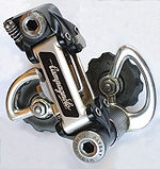
Derailleur gears

Encyclopedia
Derailleur gears are a variable-ratio transmission
system commonly used on bicycle
s, consisting of a chain
, multiple sprocket
s of different sizes, and a mechanism to move the chain from one sprocket to another. Although referred to as gear
s in the bike world, these bicycle gears are technically sprockets since they drive or are driven by a chain, and are not driven by one another.
Modern front and rear derailleurs typically consist of a moveable chain-guide that is operated remotely by a Bowden cable
attached to a shifter
mounted on the down tube
, handlebar stem, or handlebar
. When a rider operates the lever while pedalling, the change in cable tension moves the chain-guide from side to side, "derailing" the chain onto different sprockets.
For more information about the choice of particular gear ratios and sprocket sizes, see Bicycle gearing
.
The French
bicycle tourist, writer and cycling promoter Paul de Vivie
(1853–1930), who wrote under the name Velocio, invented a two speed rear derailleur in 1905 which he used on forays into the Alps.
Some early designs used rods to move the chain onto various gears. 1928 saw the introduction of the "Super Champion Gear" (or "Osgear") from the company founded by champion cyclist Oscar Egg
, as well as the Vittoria Margherita; both employed chainstay mounted 'paddles' and single lever chain tensioners mounted near or on the downtube. However, these systems, along with the rod-operated Campagnolo Cambio Corsa were eventually superseded by parallelogram derailleurs.
In 1937, the derailleur system was introduced to the Tour de France
, allowing riders to change gears without having to remove wheels. Previously, riders would have to dismount in order to change their wheel from downhill to uphill mode. Derailleurs did not become common road racing equipment until 1938 when Simplex
introduced a cable-shifted derailleur.
In 1949 Campagnolo
introduced the Gran Sport, a more refined version of the then already existing, yet less commercially successful, cable-operated parallelogram rear derailleurs.
In 1964, Suntour
invented the slant-parallelogram rear derailleur, which let the jockey pulley maintain a more constant distance from the different sized sprockets, resulting in easier shifting. Once the patents expired, other manufacturers adopted this design, at least for their better models, and the "slant parallelogram" remains the current rear derailleur pattern.
Before the 1990s many manufacturers made derailleurs, including Simplex, Huret, Galli, Mavic, Gipiemme, Zeus, Suntour, and Shimano. However, the successful introduction and promotion of indexed shifting by Shimano in 1985 required a compatible system of shift levers, derailleur, cogset, chainrings, chain, shift cable, and shift housing. This need for compatibility increased the use of groupsets made by one company, and was one of the factors that drove the other manufacturers out of the market. Today Campagnolo
and Shimano
are the two main manufacturers of derailleurs, with Campagnolo only making road cycling derailleurs and Shimano making both road and offroad
. American manufacturer SRAM
has been an important third, specializing in derailleurs for mountain bikes, and in 2006 they introduced a drivetrain system for road bicycles.
or ratchet
mechanism which stops the gear lever, and hence the cable and the derailleur, after moving a specific distances with each press or pull. Indexed shifters require re-calibration when cables stretch and parts get damaged or swapped out. On racing bicycle
s, 10-gear rear cassettes appeared in 2000, and 11-gear
cassettes appeared in 2009. Most current mountain bicycles have three front chainrings; while road bicycles may have two or three.
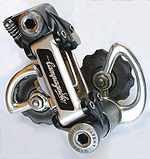
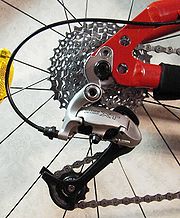 The rear derailleur serves double duty: moving the chain between rear sprockets and taking up chain slack caused by moving to a smaller sprocket at the rear or a smaller chainring by the front derailleur. In order to accomplish this second task, it is positioned in the path of the bottom, slack portion of chain.
s that guide the chain in an S
-shaped pattern. The pulleys are known as the jockey pulley or guide pulley (top) and the tension pulley (bottom). The cage rotates in its plane and is spring-loaded to take up chain slack. The cage is positioned under the desired sprocket by an arm that can swing back and forth under the sprockets. The arm is usually implemented with a parallelogram
mechanism to keep the cage properly aligned with the chain as it swings back and forth. The other end of the arm mounts to a pivot point attached to the bicycle frame. The arm pivots about this point to maintain the cage at a nearly constant distance from the different sized sprockets. There may be one or more adjustment screws that control the amount of lateral travel allowed and the spring tension.
The components may be constructed of aluminum alloy
, steel
, plastic
, or carbon fiber
composite. The pivot points may be bushings or ball bearings
. These will require moderate lubrication.
Low normal or rapid rise rear derailleurs return the chain to the largest sprocket on the cassette when no cable tension is applied. While this was once a common design for rear derailleurs, it is relatively uncommon today. In mountain biking and off-road cycling, the most critical gear changes occur on uphill sections, where riders must cope with obstacles and difficult turns while pedaling under heavy load. This derailleur type provides an advantage over high normal derailleurs because gear changes to lower gears occur in the direction of the loaded spring, making these shifts easier during high load pedaling.
Manufacturer stated derailleur capacities are as follows:
Shimano long = 45T; medium = 33T
SRAM long = 43T; medium = 37T; short = 30T
Benefits of a shorter cage length:

 The front derailleur only has to move the chain side to side between the front chainrings, but it has to do this with the top, taut portion of the chain. It also needs to accommodate large differences in chainring size: from as many as 53 teeth to as few as 20 teeth.
There are usually two adjustment screws controlling the limits of lateral travel allowed.
The components may be constructed of aluminum alloy
, steel
, plastic
, or carbon fiber
composite. The pivot points are usually bushings, and these will require lubrication.
shell on a cable guide
, which redirects the cable up the lower edge of the frame's down tube. Full-suspension mountain bikes often have bottom pull routing as the rear suspension prevents routing via the top tube.
top pull : This type is more commonly seen on mountain bikes without rear-suspension. The derailleur is actuated by a cable pulling upwards, which is usually routed along the frame's top tube, using cable stops and a short length of housing to change the cable's direction. This arrangement keeps the cable away from the underside of the bottom bracket/down tube which get pelted with dirt when off-road.
combination of both (dual pull): There are some derailleurs available that have provisions for either top pull or bottom pull, and can be used in either application.
triple (Alpine) : Derailleurs designed to be used with cranksets having three chainrings, or with two chainrings that differ greatly in size. When viewed from the side of the bicycle, the inner cage plate extends further towards the bottom bracket's center of rotation than the outer cage plate does. This is to help shift the chain from the smallest ring onto the middle ring more easily.
top swing : The derailleur cage is mounted to the top of the four-bar linkage that carries it. This alternate arrangement was created as a way to get the frame clamp of the derailleur closer to the bottom bracket to be able to clear larger suspension components and allow different frame shapes. The compact construction of a top swing derailleur can cause it to be less robust than its bottom swing counterpart. Top swing derailleurs are typically only used in applications where a bottom swing derailleur will not fit. An alternate solution would be to use an E-type front derailleur, which does not clamp around the seat tube at all.
braze-on : An alternative to the clamp is the braze-on
derailleur hanger, where the derailleur is mounted by bolting a tab on the derailleur to a corresponding tab on the frame's seat tube. This avoids any clamp size issues, but requires either a frame with the appropriate braze-on, or an adapter clamp that simulates a braze-on derailleur tab.
E-type : This type front derailleurs do not clamp around the frame's seat tube, but instead are attached to the frame by a plate mounted under the drive side bottom bracket cup and a screw threaded into a boss on the seat tube. These derailleurs are usually found on mountain bikes with rear suspension components that do not allow space for a normal derailleur's clamp to go around the seat tube.
DMD : Direct-Mount-Derailleur - Initiated by Specialized Bicycles, this type of derailleur is bolted directly to bosses on the chainstay of the bike. They are mostly used on dual suspension mountain bikes, where suspension movement causes changes to the chain angle as it enters the front derailleur cage. By utilizing a DMD system, the chain and derailleur move together, allowing for better shifting when the suspension is active. A DMD derailleur should not be confused with Shimano's Direct Mount, which uses a different mounting system. However, SRAM's direct mount front derailleurs are compatible with DMD, and certain Shimano E-type derailleurs can be used with DMD if the e-type plate is removed.
Chain-drive systems such as the derailleur systems work best if the chain is in line with the sprockets, especially avoiding the biggest drive sprocket running with the biggest driven sprocket (or the smallest with the smallest). The diagonal chain run produced by these practices is less efficient and shortens the life of all components, with no advantage from the middle of the range ratio obtained.
Transmission (mechanics)
A machine consists of a power source and a power transmission system, which provides controlled application of the power. Merriam-Webster defines transmission as: an assembly of parts including the speed-changing gears and the propeller shaft by which the power is transmitted from an engine to a...
system commonly used on bicycle
Bicycle
A bicycle, also known as a bike, pushbike or cycle, is a human-powered, pedal-driven, single-track vehicle, having two wheels attached to a frame, one behind the other. A person who rides a bicycle is called a cyclist, or bicyclist....
s, consisting of a chain
Bicycle chain
A bicycle chain is a roller chain that transfers power from the pedals to the drive-wheel of a bicycle, thus propelling it. Most bicycle chains are made from plain carbon or alloy steel, but some are nickel-plated to prevent rust, or simply for aesthetics. Nickel also confers a measure of...
, multiple sprocket
Sprocket
A sprocket or sprocket-wheel is a profiled wheel with teeth, cogs, or even sprockets that mesh with a chain, track or other perforated or indented material. The name 'sprocket' applies generally to any wheel upon which are radial projections that engage a chain passing over it...
s of different sizes, and a mechanism to move the chain from one sprocket to another. Although referred to as gear
Gear
A gear is a rotating machine part having cut teeth, or cogs, which mesh with another toothed part in order to transmit torque. Two or more gears working in tandem are called a transmission and can produce a mechanical advantage through a gear ratio and thus may be considered a simple machine....
s in the bike world, these bicycle gears are technically sprockets since they drive or are driven by a chain, and are not driven by one another.
Modern front and rear derailleurs typically consist of a moveable chain-guide that is operated remotely by a Bowden cable
Bowden cable
A Bowden cable is a type of flexible cable used to transmit mechanical force or energy by the movement of an inner cable relative to a hollow outer cable housing...
attached to a shifter
Shifter (bicycle part)
A bicycle shifter or gear control or gear levers is a component used to control the gearing mechanisms and select the desired gear ratio. Typically, they operate either a derailleur mechanism or an internal hub gear mechanism. In either case, the control is operated by moving a cable that connects...
mounted on the down tube
Bicycle frame
A bicycle frame is the main component of a bicycle, on to which wheels and other components are fitted. The modern and most common frame design for an upright bicycle is based on the safety bicycle, and consists of two triangles, a main triangle and a paired rear triangle...
, handlebar stem, or handlebar
Bicycle handlebar
Bicycle handlebar or often bicycle handlebars refers to the steering mechanism for bicycles; the equivalent of a steering wheel. Besides steering, handlebars also often support a portion of the rider's weight, depending on their riding position, and provide a convenient mounting place for brake...
. When a rider operates the lever while pedalling, the change in cable tension moves the chain-guide from side to side, "derailing" the chain onto different sprockets.
For more information about the choice of particular gear ratios and sprocket sizes, see Bicycle gearing
Bicycle gearing
A bicycle gear or gear ratio refers to the rate at which the rider's legs turn compared to the rate at which the wheels turn. Bicycle gearing refers to how the gear ratio is set or changed. On some bicycles, there is only one gear so the ratio is fixed. Most modern bicycles have multiple gears,...
.
History
Various derailleur systems were designed and built in the late 1800s.The French
France
The French Republic , The French Republic , The French Republic , (commonly known as France , is a unitary semi-presidential republic in Western Europe with several overseas territories and islands located on other continents and in the Indian, Pacific, and Atlantic oceans. Metropolitan France...
bicycle tourist, writer and cycling promoter Paul de Vivie
Paul de Vivie
Paul de Vivie, who wrote as Velocio , was publisher of Le Cycliste, an early champion of derailleur gears, and father of French bicycle touring and randonneuring.-Background:...
(1853–1930), who wrote under the name Velocio, invented a two speed rear derailleur in 1905 which he used on forays into the Alps.
Some early designs used rods to move the chain onto various gears. 1928 saw the introduction of the "Super Champion Gear" (or "Osgear") from the company founded by champion cyclist Oscar Egg
Oscar Egg
Oscar Egg was a Swiss track and road bicycle racer. He captured the world hour record three times before the First World War...
, as well as the Vittoria Margherita; both employed chainstay mounted 'paddles' and single lever chain tensioners mounted near or on the downtube. However, these systems, along with the rod-operated Campagnolo Cambio Corsa were eventually superseded by parallelogram derailleurs.
In 1937, the derailleur system was introduced to the Tour de France
Tour de France
The Tour de France is an annual bicycle race held in France and nearby countries. First staged in 1903, the race covers more than and lasts three weeks. As the best known and most prestigious of cycling's three "Grand Tours", the Tour de France attracts riders and teams from around the world. The...
, allowing riders to change gears without having to remove wheels. Previously, riders would have to dismount in order to change their wheel from downhill to uphill mode. Derailleurs did not become common road racing equipment until 1938 when Simplex
Lucien Juy
Lucien Charles Hippolyte Juy was a French industrialist who made derailleur gears. He is credited with making the first derailleur with a collapsible parallelogram . A hinged frame swung in and out from the frame and fed the chain to one of a number of sprockets attached to the hub...
introduced a cable-shifted derailleur.
In 1949 Campagnolo
Campagnolo
Campagnolo is an Italian manufacturer of high-end bicycle components with headquarters in Vicenza, Italy. The components are organised as groupsets and are a near-complete collection of a bicycle's mechanical parts. Campagnolo's flagship components are the Super Record, Record, and Chorus...
introduced the Gran Sport, a more refined version of the then already existing, yet less commercially successful, cable-operated parallelogram rear derailleurs.
In 1964, Suntour
SunTour
SunTour or SR Suntour is a manufacturer of bicycle components. It was Japanese owned and managed, based in Osaka, until the mid 1990s when its name was sold to a Taiwan conglomerate. Its products ranged from suspension forks to derailleurs...
invented the slant-parallelogram rear derailleur, which let the jockey pulley maintain a more constant distance from the different sized sprockets, resulting in easier shifting. Once the patents expired, other manufacturers adopted this design, at least for their better models, and the "slant parallelogram" remains the current rear derailleur pattern.
Before the 1990s many manufacturers made derailleurs, including Simplex, Huret, Galli, Mavic, Gipiemme, Zeus, Suntour, and Shimano. However, the successful introduction and promotion of indexed shifting by Shimano in 1985 required a compatible system of shift levers, derailleur, cogset, chainrings, chain, shift cable, and shift housing. This need for compatibility increased the use of groupsets made by one company, and was one of the factors that drove the other manufacturers out of the market. Today Campagnolo
Campagnolo
Campagnolo is an Italian manufacturer of high-end bicycle components with headquarters in Vicenza, Italy. The components are organised as groupsets and are a near-complete collection of a bicycle's mechanical parts. Campagnolo's flagship components are the Super Record, Record, and Chorus...
and Shimano
Shimano
Shimano, Inc. is a Japanese multinational manufacturer of cycling components, fishing tackle, and rowing equipment.In 2005, the company had net sales of US $1.4 billion. Bicycle components provided 75% of its sales income...
are the two main manufacturers of derailleurs, with Campagnolo only making road cycling derailleurs and Shimano making both road and offroad
Mountain bike
A mountain bike or mountain bicycle is a bicycle created for off-road cycling. This activity includes traversing of rocks and washouts, and steep declines,...
. American manufacturer SRAM
SRAM (bicycles)
SRAM Corporation is a privately held bicycle component manufacturer based in Chicago, Illinois, founded in 1987. SRAM is an acronym comprising the names of its founders, Scott, Ray, and Sam, .In 2008, the company received a strategic investment from Trilantic Capital Partners, formerly known as...
has been an important third, specializing in derailleurs for mountain bikes, and in 2006 they introduced a drivetrain system for road bicycles.
Modern derailleur types
The major innovations since then have been the switch from friction to indexed shifting and the gradual increase in the number of gears. With friction shifting, the rider first moves the lever enough for the chain to jump to the next sprocket, and then adjusts the lever a slight amount to center the chain on that sprocket. An indexed shifter has a detentDetent
Detent is the term for a method, as well as the actual device, used to mechanically resist or arrest the rotation of a wheel, axle or spindle....
or ratchet
Ratchet (device)
A ratchet is a device that allows continuous linear or rotary motion in only one direction while preventing motion in the opposite direction. Because most socket wrenches today use ratcheting handles, the term "ratchet" alone is often used to refer to a ratcheting wrench, and the terms "ratchet"...
mechanism which stops the gear lever, and hence the cable and the derailleur, after moving a specific distances with each press or pull. Indexed shifters require re-calibration when cables stretch and parts get damaged or swapped out. On racing bicycle
Racing bicycle
A racing bicycle, also known as a road bike, is a bicycle designed for competitive road cycling, a sport governed by according to the rules of the Union Cycliste Internationale...
s, 10-gear rear cassettes appeared in 2000, and 11-gear
Campagnolo
Campagnolo is an Italian manufacturer of high-end bicycle components with headquarters in Vicenza, Italy. The components are organised as groupsets and are a near-complete collection of a bicycle's mechanical parts. Campagnolo's flagship components are the Super Record, Record, and Chorus...
cassettes appeared in 2009. Most current mountain bicycles have three front chainrings; while road bicycles may have two or three.
Rear derailleurs
Construction
Although variations exist, as noted below, most rear derailleurs have several components in common. They have a cage that holds two pulleyPulley
A pulley, also called a sheave or a drum, is a mechanism composed of a wheel on an axle or shaft that may have a groove between two flanges around its circumference. A rope, cable, belt, or chain usually runs over the wheel and inside the groove, if present...
s that guide the chain in an S
S
S is the nineteenth letter in the ISO basic Latin alphabet.-History: Semitic Šîn represented a voiceless postalveolar fricative . Greek did not have this sound, so the Greek sigma came to represent...
-shaped pattern. The pulleys are known as the jockey pulley or guide pulley (top) and the tension pulley (bottom). The cage rotates in its plane and is spring-loaded to take up chain slack. The cage is positioned under the desired sprocket by an arm that can swing back and forth under the sprockets. The arm is usually implemented with a parallelogram
Parallelogram
In Euclidean geometry, a parallelogram is a convex quadrilateral with two pairs of parallel sides. The opposite or facing sides of a parallelogram are of equal length and the opposite angles of a parallelogram are of equal measure...
mechanism to keep the cage properly aligned with the chain as it swings back and forth. The other end of the arm mounts to a pivot point attached to the bicycle frame. The arm pivots about this point to maintain the cage at a nearly constant distance from the different sized sprockets. There may be one or more adjustment screws that control the amount of lateral travel allowed and the spring tension.
The components may be constructed of aluminum alloy
Aluminium alloy
Aluminium alloys are alloys in which aluminium is the predominant metal. The typical alloying elements are copper, magnesium, manganese, silicon and zinc. There are two principal classifications, namely casting alloys and wrought alloys, both of which are further subdivided into the categories...
, steel
Steel
Steel is an alloy that consists mostly of iron and has a carbon content between 0.2% and 2.1% by weight, depending on the grade. Carbon is the most common alloying material for iron, but various other alloying elements are used, such as manganese, chromium, vanadium, and tungsten...
, plastic
Plastic
A plastic material is any of a wide range of synthetic or semi-synthetic organic solids used in the manufacture of industrial products. Plastics are typically polymers of high molecular mass, and may contain other substances to improve performance and/or reduce production costs...
, or carbon fiber
Carbon fiber
Carbon fiber, alternatively graphite fiber, carbon graphite or CF, is a material consisting of fibers about 5–10 μm in diameter and composed mostly of carbon atoms. The carbon atoms are bonded together in crystals that are more or less aligned parallel to the long axis of the fiber...
composite. The pivot points may be bushings or ball bearings
Rolling-element bearing
A rolling-element bearing, also known as a rolling bearing, is a bearing which carries a load by placing round elements between the two pieces...
. These will require moderate lubrication.
Relaxed position
High normal or top normal rear derailleurs return the chain to the smallest sprocket on the cassette when no cable tension is applied. This is the regular pattern used on most Shimano mountain, all Shimano road, and all SRAM and Campagnolo derailleurs. In this condition, spring pressure takes care of the easier change to smaller sprockets. In road racing the swiftest gear changes are required on the sprints to the finish line, hence high-normal types, which allow a quick change to a higher gear, remain the preference.Low normal or rapid rise rear derailleurs return the chain to the largest sprocket on the cassette when no cable tension is applied. While this was once a common design for rear derailleurs, it is relatively uncommon today. In mountain biking and off-road cycling, the most critical gear changes occur on uphill sections, where riders must cope with obstacles and difficult turns while pedaling under heavy load. This derailleur type provides an advantage over high normal derailleurs because gear changes to lower gears occur in the direction of the loaded spring, making these shifts easier during high load pedaling.
Cage length
The distance between the upper and lower pulleys of a rear derailleur is known as the cage length. Cage length, when combined with the pulley size, determines the capacity of a derailleur to take up chain slack. Cage length determines the total capacity of the derailleur, that is the size difference between the largest and smallest chainrings, and the size difference between the largest and smallest sprockets on the cogset added together. A larger sum requires a longer cage length. Typical cross country mountain bikes with three front chainrings will use a long cage rear derailleur. A road bike with only two front chainrings and close ratio sprockets can operate with either a short or long cage derailleur, but will work better with a short cage.Manufacturer stated derailleur capacities are as follows:
Shimano long = 45T; medium = 33T
SRAM long = 43T; medium = 37T; short = 30T
Benefits of a shorter cage length:
- more positive gear-changing due to less flex in the parallelogram
- better gear-changing with good cable leverage
- better obstruction clearance
- less danger of catching spokes.
- slight weight savings.
Cage positioning
There are at least two methods employed by rear derailleurs to maintain the appropriate gap between the upper jockey wheel and the rear sprockets as the derailleur moves between the large sprockets and the small sprockets.- One method, used by Shimano, is to use chain tension to pivot the cage. This has the advantage of working with most sets of sprockets, if the chain has the proper length. A disadvantage is that rapid shifts from small sprockets to large over multiple sprockets at once can cause the cage to strike the sprockets before the chain moves onto the larger sprockets and pivots the cage as necessary.
- Another method, used by SRAM, is to design the spacing into the parallelogramParallelogramIn Euclidean geometry, a parallelogram is a convex quadrilateral with two pairs of parallel sides. The opposite or facing sides of a parallelogram are of equal length and the opposite angles of a parallelogram are of equal measure...
mechanism of the derailleur itself. The advantage is that no amount of rapid, multi-sprocket shifting can cause the cage to strike the sprockets. The disadvantage is that there are limited options for sprocket sizes that can be used with a particular derailleur.
Actuation ratio
The actuation ratio or shift ratio is the ratio between the amount of shifter travel and the amount of derailleur travel it generates. There are currently multiple conventions in production, but this is not necessarily an issue for friction shifting. For correct indexed shifting however, the product of the derailleur's actuation ratio and the length of cable pulled must equal the pitch of the rear sprockets.- The Shimano convention has been labeled as two-to-one (2:1), and since SRAM makes both families of components, the term has been widely adopted to distinguish it from SRAM's own one to one (1:1) family of derailleurs. Thus, in Shimano systems a unit of cable shifted causes about twice as much movement of the derailleur.
- The native SRAM convention is called one-to-one (1:1). A unit of cable retracted at the shifter causes about an equal amount of movement in the derailleur. SRAM claims that standard makes their systems more robust: more resistant to the effects of contamination. Some SRAM shifters are made to be 2:1 Shimano-compatible, but these clearly will not work with SRAM's 1:1 derailleurs.
- The CampagnoloCampagnoloCampagnolo is an Italian manufacturer of high-end bicycle components with headquarters in Vicenza, Italy. The components are organised as groupsets and are a near-complete collection of a bicycle's mechanical parts. Campagnolo's flagship components are the Super Record, Record, and Chorus...
convention. - The SuntourSunTourSunTour or SR Suntour is a manufacturer of bicycle components. It was Japanese owned and managed, based in Osaka, until the mid 1990s when its name was sold to a Taiwan conglomerate. Its products ranged from suspension forks to derailleurs...
's convention.
- Shifters employing one convention are generally not compatible with derailleurs employing another, although exceptions exist, and adaptors are available.
Front derailleurs
Construction
As with the rear derailleur, the front derailleur has a cage through which the chain passes. On a properly adjusted derailleur, the chain will only touch the cage while shifting. The cage is held in place by a movable arm which is usually implemented with a parallelogram mechanism to keep the cage properly aligned with the chain as it swings back and forth.There are usually two adjustment screws controlling the limits of lateral travel allowed.
The components may be constructed of aluminum alloy
Aluminium alloy
Aluminium alloys are alloys in which aluminium is the predominant metal. The typical alloying elements are copper, magnesium, manganese, silicon and zinc. There are two principal classifications, namely casting alloys and wrought alloys, both of which are further subdivided into the categories...
, steel
Steel
Steel is an alloy that consists mostly of iron and has a carbon content between 0.2% and 2.1% by weight, depending on the grade. Carbon is the most common alloying material for iron, but various other alloying elements are used, such as manganese, chromium, vanadium, and tungsten...
, plastic
Plastic
A plastic material is any of a wide range of synthetic or semi-synthetic organic solids used in the manufacture of industrial products. Plastics are typically polymers of high molecular mass, and may contain other substances to improve performance and/or reduce production costs...
, or carbon fiber
Carbon fiber
Carbon fiber, alternatively graphite fiber, carbon graphite or CF, is a material consisting of fibers about 5–10 μm in diameter and composed mostly of carbon atoms. The carbon atoms are bonded together in crystals that are more or less aligned parallel to the long axis of the fiber...
composite. The pivot points are usually bushings, and these will require lubrication.
Cable pull types
bottom pull : Commonly used on road and touring bikes, this type of derailleur is actuated by a cable pulling downwards. The cable is often routed across the top or along the bottom of the bottom bracketBottom bracket
The bottom bracket on a bicycle connects the crankset to the bicycle and allows the crankset to rotate freely. It contains a spindle that the crankset attaches to, and the bearings that allow the spindle and cranks to rotate. The chainrings and pedals attach to the cranks...
shell on a cable guide
Cable guide
A cable guide is a fitting or part of a bicycle frame which guides a piece of bare inner bowden cable around a corner. Most multi-speed bicycles have cable guides to get the derailleur cables past the bottom bracket....
, which redirects the cable up the lower edge of the frame's down tube. Full-suspension mountain bikes often have bottom pull routing as the rear suspension prevents routing via the top tube.
top pull : This type is more commonly seen on mountain bikes without rear-suspension. The derailleur is actuated by a cable pulling upwards, which is usually routed along the frame's top tube, using cable stops and a short length of housing to change the cable's direction. This arrangement keeps the cable away from the underside of the bottom bracket/down tube which get pelted with dirt when off-road.
combination of both (dual pull): There are some derailleurs available that have provisions for either top pull or bottom pull, and can be used in either application.
Cage types
double (Standard) : These are intended to be used with cranksets having two chainrings. When viewed from the side of the bicycle, the inner and outer plates of the cage have roughly the same profile.triple (Alpine) : Derailleurs designed to be used with cranksets having three chainrings, or with two chainrings that differ greatly in size. When viewed from the side of the bicycle, the inner cage plate extends further towards the bottom bracket's center of rotation than the outer cage plate does. This is to help shift the chain from the smallest ring onto the middle ring more easily.
Swing types
bottom swing : The derailleur cage is mounted to the bottom of the four-bar linkage that carries it. This is the most common type of derailleur.top swing : The derailleur cage is mounted to the top of the four-bar linkage that carries it. This alternate arrangement was created as a way to get the frame clamp of the derailleur closer to the bottom bracket to be able to clear larger suspension components and allow different frame shapes. The compact construction of a top swing derailleur can cause it to be less robust than its bottom swing counterpart. Top swing derailleurs are typically only used in applications where a bottom swing derailleur will not fit. An alternate solution would be to use an E-type front derailleur, which does not clamp around the seat tube at all.
Mount types
clamp : The vast majority of front derailleurs are mounted to the frame by a clamp around the frame's seat tube. Derailleurs are available with several different clamp diameters designed to fit different types of frame tubing. Recently, there has been a trend to make derailleurs with only one diameter clamp, and several sets of shims are included to space the clamp down to the appropriate size.braze-on : An alternative to the clamp is the braze-on
Braze-on
A braze-on is the name for any number of parts of a bicycle which have been permanently attached to the frame. The term "braze-on" comes from when these parts would have been brazed on to steel frame bicycles...
derailleur hanger, where the derailleur is mounted by bolting a tab on the derailleur to a corresponding tab on the frame's seat tube. This avoids any clamp size issues, but requires either a frame with the appropriate braze-on, or an adapter clamp that simulates a braze-on derailleur tab.
E-type : This type front derailleurs do not clamp around the frame's seat tube, but instead are attached to the frame by a plate mounted under the drive side bottom bracket cup and a screw threaded into a boss on the seat tube. These derailleurs are usually found on mountain bikes with rear suspension components that do not allow space for a normal derailleur's clamp to go around the seat tube.
DMD : Direct-Mount-Derailleur - Initiated by Specialized Bicycles, this type of derailleur is bolted directly to bosses on the chainstay of the bike. They are mostly used on dual suspension mountain bikes, where suspension movement causes changes to the chain angle as it enters the front derailleur cage. By utilizing a DMD system, the chain and derailleur move together, allowing for better shifting when the suspension is active. A DMD derailleur should not be confused with Shimano's Direct Mount, which uses a different mounting system. However, SRAM's direct mount front derailleurs are compatible with DMD, and certain Shimano E-type derailleurs can be used with DMD if the e-type plate is removed.
Add-ons
Because of the possibility of the chain shifting past the smallest inner chainring, especially when the inner chainring is very small, even on bikes adjusted by professional race mechanics, and the problems such misshifts can cause, a small after-market of add-on products, called chain deflectors, exists to help prevent them from occurring. Some clamp around the seat tube, below the front derailleur, and at least one attaches to the front derailleur mount.Use of derailleurs
Derailleurs require the chain to be in movement in order to change ratio. Thus usually requires the rider to be pedalling, but some systems have been developed with the freewheel in the crankset so that the chain moves even when the rider is not pedalling.Chain-drive systems such as the derailleur systems work best if the chain is in line with the sprockets, especially avoiding the biggest drive sprocket running with the biggest driven sprocket (or the smallest with the smallest). The diagonal chain run produced by these practices is less efficient and shortens the life of all components, with no advantage from the middle of the range ratio obtained.
Electronic gear-shifting system
An electronic gear-shifting system is a derailleur system that uses electric motors controlled by switches in place of traditional lever-and-cable actuation.See also
- List of bicycle parts
- Bicycle drivetrain systemsBicycle drivetrain systemsBicycle drivetrain systems are used to transmit power on bicycles, tricycles, quadracycles, unicycles, or other human-powered vehicles from the riders to the drive wheels. Most also include some type of a mechanism to convert speed and torque via gear ratios....
- Bicycle gearingBicycle gearingA bicycle gear or gear ratio refers to the rate at which the rider's legs turn compared to the rate at which the wheels turn. Bicycle gearing refers to how the gear ratio is set or changed. On some bicycles, there is only one gear so the ratio is fixed. Most modern bicycles have multiple gears,...
- Gear inchesGear inchesGear inches is a system that assigns numerical measurements to bicycle gear ratios, to indicate how low or high a gear is.Gear inches has no current physical significance; it corresponds to the diameter in inches of the main wheel of an old-fashioned penny-farthing bicycle with equivalent gearing...
- ShifterShifter (bicycle part)A bicycle shifter or gear control or gear levers is a component used to control the gearing mechanisms and select the desired gear ratio. Typically, they operate either a derailleur mechanism or an internal hub gear mechanism. In either case, the control is operated by moving a cable that connects...
- Shimano Total IntegrationShimano Total IntegrationShimano Total Integration is a gearshift system designed by Shimano for racing bicycles. It combines the braking and gear shifting controls into the same component. This allows shifting gears without having to remove a hand from the bars, unlike previous down tube shifting systems...
- Ergo Shifting
- SRAM Double TapSRAM Double TapSRAM Double Tap is an integrated gearshift and brake lever system designed by SRAM Corporation for racing bicycles. It allows shifting gears without having to remove a hand from the bars, unlike previous down tube shifting systems. It was launched in late 2005 to compete with Shimano Total...
- Shimano Total Integration
- Hub gears
- Single speed bicycle
- Fixed gear bicycle
History
Covers a number of non-British designs as well. RDs by period, manufacturer, etc. Many pics and scanned documents. Pictures of several old derailleur mechanisms.How-To
- Bicycle Repair in WikibooksWikibooksWikibooks is a Wiki hosted by the Wikimedia Foundation for the creation of free content textbooks and annotated texts that anyone can edit....
- Tables of shifting data: A Wikibooks page on pitch, pull, and shift ratio, including the compatibility of SRAM shifters.
- Rear Derailleur Adjustment : Part of the Wikibooks repair series Also available in German and Russian languages.
- A video describing Derailleur adjustment