
All Topics  
Candide


   Email Print
   Bookmark   Link


Candide


Candide, ou l'Optimisme (1759) is a ian the Enlightenment
Age of Enlightenment

The Age of Enlightenment or The Enlightenment is a term used to describe a time in Western philosophy and cultural life centered upon the eighteenth century, in which rationalism was advocated as the primary source and legitimacy for authority....
 philosopher Voltaire
Voltaire

Fran?ois-Marie Arouet , better known by the pen name Voltaire, was a French Age of Enlightenment writer, essayist, and philosophy known for his wit, philosophical sport, and defense of civil liberty, including freedom of religion and free trade....
, English translations of which have been titled Candide: Or, All for the Best (1759); Candide: Or, The Optimist (1762); and Candide: Or, Optimism (1947). The novella
Novella

A novella is a writing, fictional, prose narrative longer than a novelette but shorter than a novel. While there is disagreement as to what length defines a novella, the Science Fiction and Fantasy Writers of America Nebula Awards for science fiction define the novella as having a word count between 17,500 and 40,000....
 begins with a young man, Candide, who is living a sheltered life in an Edenic
Garden of Eden

The Garden of Eden is a location described in the Book of Genesis as being the place where the first man, Adam , and his wife, Eve , lived after they were created by God....
 paradise
Paradise

Paradise is an idealized place in which existence is positive, harmonious and timeless. It is conceptually a counter-image of the miseries of human civilization, and in paradise there is only peace, prosperity, and happiness....
 and being indoctrinated with Leibnizian optimism
Gottfried Leibniz

Gottfried Wilhelm Leibniz was a Germany polymath who wrote primarily in Latin and French language.He occupies an equally grand place in both the history of philosophy and the history of mathematics....
 (or simply optimism) by his tutor, Pangloss.


Discussion
Ask a question about 'Candide'
Start a new discussion about 'Candide'
Answer questions from other users
Full Discussion Forum


Quotations


All that is very well,.

answered Candide, "but let us cultivate our garden."

If this is the best of all possible worlds, what are the others like.

Candide questioning the optimism of his tutor, Dr.Pangloss

Let us work,.

said Martin, "without disputing; it is the only way to render life tolerable."

Idiots admire everything written by a famous author.

Pococurante (wealthy and esteemed Venetian senator) to Candide, when speaking of Horace's poetry.

You must have a vast and magnificent estate,.

said Candide to the Turk. "I have only twenty acres 81,000 m²," replied the old man; "I and my children cultivate them; our labor preserves us from three great evils - weariness, vice, and want."

Individual misfortunes result in the general good, with the consequence that the more individual misfortune there is, the more everything is for the best.

- Pangloss


Encyclopedia


Candide, ou l'Optimisme (1759) is a ian the Enlightenment
Age of Enlightenment

The Age of Enlightenment or The Enlightenment is a term used to describe a time in Western philosophy and cultural life centered upon the eighteenth century, in which rationalism was advocated as the primary source and legitimacy for authority....
 philosopher Voltaire
Voltaire

Fran?ois-Marie Arouet , better known by the pen name Voltaire, was a French Age of Enlightenment writer, essayist, and philosophy known for his wit, philosophical sport, and defense of civil liberty, including freedom of religion and free trade....
, English translations of which have been titled Candide: Or, All for the Best (1759); Candide: Or, The Optimist (1762); and Candide: Or, Optimism (1947). The novella
Novella

A novella is a writing, fictional, prose narrative longer than a novelette but shorter than a novel. While there is disagreement as to what length defines a novella, the Science Fiction and Fantasy Writers of America Nebula Awards for science fiction define the novella as having a word count between 17,500 and 40,000....
 begins with a young man, Candide, who is living a sheltered life in an Edenic
Garden of Eden

The Garden of Eden is a location described in the Book of Genesis as being the place where the first man, Adam , and his wife, Eve , lived after they were created by God....
 paradise
Paradise

Paradise is an idealized place in which existence is positive, harmonious and timeless. It is conceptually a counter-image of the miseries of human civilization, and in paradise there is only peace, prosperity, and happiness....
 and being indoctrinated with Leibnizian optimism
Gottfried Leibniz

Gottfried Wilhelm Leibniz was a Germany polymath who wrote primarily in Latin and French language.He occupies an equally grand place in both the history of philosophy and the history of mathematics....
 (or simply optimism) by his tutor, Pangloss. The work describes the abrupt cessation of this existence, followed by Candide's slow, painful disillusionment as he witnesses and experiences great hardships in the world. Voltaire concludes with Candide, if not outright rejecting optimism, advocating an enigmatic precept, "we must cultivate our garden", in lieu of the Leibnizian mantra of Pangloss, "all is for the best in the best of all possible worlds
Best of all possible worlds

The phrase "the best of all possible worlds" was coined by the German people philosopher Gottfried Leibniz in his 1710 work Essais de Th?odic?e sur la bont? de Dieu, la libert? de l'homme et l'origine du mal ....
".

Candide is known for its sarcastic tone and its erratic, fantastical, and fast-moving plot. With a story similar to that of a more serious bildungsroman
Bildungsroman

A bildungsroman is a novelistic genre that arose during the German Enlightenment, in which the author presents the psychological, moral and social shaping of the personality of a protagonist....
 or picaresque novel
Picaresque novel

The picaresque novel is a popular sub-genre of prose fiction which is usually satire and depicts in realism and often humorous detail the adventures of a roguish hero of low social class who lives by his or her wits in a corrupt society....
, it parodies many adventure and romance clichés, the struggles of which are caricatured in a tone that is mordantly matter-of-fact. Still, the events discussed are often based on historical happenings, such as the Seven Years' War
Seven Years' War

The Seven Years' War lasted between 1756?1763 and involved all of the major European powers of the period. The war pitted Kingdom of Prussia and Kingdom of Great Britain and a coalition of smaller German states against an alliance consisting of Archduchy of Austria, Early Modern France, Russian Empire, Kingdom of Sweden, and Electorate of Sa...
 and the 1755 Lisbon earthquake
1755 Lisbon earthquake

The 1755 Lisbon earthquake, also known as the Great Lisbon Earthquake, took place on November 1, 1755, at around 9:40 in the morning. The earthquake was followed by a tsunami and fires, which caused near-total destruction of Lisbon in Portugal, and adjoining areas....
. As philosophers of Voltaire's day contended with the problem of evil
Problem of evil

In the philosophy of religion and theology, the problem of evil is the problem of reconciling the existence of evil or suffering in the world with the existence of God....
, so too does Candide in this short novel, albeit more directly and humourously. Voltaire ridicules religion, theologians, governments, armies, philosophies, and philosophers through allegory
Allegory

Allegory is generally treated as a figure of rhetoric, but an allegory does not have to be expressed in language: it may be addressed to the eye, and is often found in realistic painting, sculpture or some other form of Mimesis, or representative art....
; most conspicuously, he assaults Leibniz and his optimism.

As expected by Voltaire, Candide has enjoyed both great success and great scandal. Immediately after its secretive publication, the book was widely banned because it contained religious blasphemy, political sedition and intellectual hostility hidden under a thin veil of naïveté. However, with its sharp wit and insightful portrayal of the human condition, the novel has since inspired many later authors and artists to mimic and adapt it; most notably, Leonard Bernstein
Leonard Bernstein

Leonard Bernstein was a multi-Emmy-winning and Academy Award for Original Music Score nominated American Conductor , composer, author, music lecturer and Piano....
 produced a 1956 comic operetta
Candide (operetta)

Candide is an operetta with music composed by Leonard Bernstein, based on the novella Candide by Voltaire. The original libretto was written by Lillian Hellman, but since 1974, has been generally performed with a book by Hugh Wheeler, which is more faithful to Voltaire's novel....
 whose libretto is closely based on the novella. Today, Candide is recognised as Voltaire's magnum opus
Magnum opus

Magnum opus , from the Latin meaning great work, refers to the largest, and perhaps the best, greatest, most popular, or most renowned achievement of an author, artist, or composer....
 and is often listed as part of the Western canon
Western canon

The Western canon is a term used to denote a wiktionary:canon of Western literatures, and, more widely, European classical music and Western art history, that has been the most Power in shaping Western culture....
; it is likely taught more than any other work of French literature
French literature

French literature is, generally speaking, literature written in the French language, particularly by citizens of France; it may also refer to literature written by people living in France who speak other traditional languages of France....
.

Historical and literary background

1755 Lisbon Earthquake
A number of deadly historical events inspired Voltaire to write Candide, most notably the Seven Years' War and the 1755 Lisbon earthquake: both are frequently referred to in the book and are cited by scholars as reasons for its composition. The 1755 Lisbon earthquake, tsunami
Tsunami

A is a series of ocean surface wave that is created when a large volume of a body of water, such as an ocean, is rapidly displaced. The Japanese term is literally translated into " harbor wave."...
 and resulting fires of All Saints' Day had a strong influence on theologians of the day and on Voltaire, who was himself disillusioned by them. The earthquake had an especially large effect on the contemporary doctrine of optimism, a philosophical system which implies that such events should not occur. Optimism is founded on the theodicy of Gottfried Wilhelm Leibniz that says all is for the best because God is a benevolent deity. This concept is often put into the form, "all is for the best in the best of all possible worlds" (Fr. "Tout est pour le mieux dans le meilleur des mondes possibles"). Philosophers had trouble fitting the horrors of this earthquake into the optimist world view
World view

A comprehensive world view is a term calqued from the German language word Weltanschauung Welt is the German word for "world", and Anschauung is the German word for "view" or "outlook." It is a concept fundamental to German philosophy and epistemology and refers to a wide world perception....
.

Voltaire actively rejected Leibnizian optimism after the natural disaster, convinced that if this were the best possible world, it should surely be better than it is. In both Candide and Poème sur le désastre de Lisbonne
Poème sur le désastre de Lisbonne

The Po?me sur le d?sastre de Lisbonne was a poem in French language composed by Voltaire, regarding the 1755 Lisbon earthquake. It is widely regarded as an introduction to Voltaire's later acclaimed work Candide....
 ("Poem on the Lisbon Disaster"), Voltaire attacks this optimist belief. He makes use of the Lisbon earthquake in both Candide and his Poème to argue this point, sarcastically describing the catastrophe as one of the most horrible disasters "in the best of all possible worlds". Immediately after the earthquake, unreliable rumours circulated around Europe
Europe

Europe is, conventionally, one of the world's seven continents. Comprising the westernmost peninsula of Eurasia, Europe is generally divided from Asia to its east by the water divide of the Ural Mountains, the Ural , the Caspian Sea, and by the Caucasus Mountains to the southeast....
, sometimes overestimating the severity of the event. Ira Wade, a noted expert on Voltaire and Candide, has analysed which sources Voltaire might have referenced in learning of the event. Wade speculates that Voltaire's primary source for information on the Lisbon earthquake was the 1755 work Relation historique du Tremblement de Terre survenu à Lisbonne by Ange Goudar.

Apart from such events, contemporaneous stereotypes of the German personality may have been a source of inspiration for the text, as they were for Simplicius Simplicissimus, a 1669 satirical picaresque novel written by Hans Jakob Christoffel von Grimmelshausen
Hans Jakob Christoffel von Grimmelshausen

Hans Jakob Christoffel von Grimmelshausen was a Germany author.Grimmelshausen was born at Gelnhausen. At the age of ten he was kidnapped by Hesse soldiery, and in their midst tasted the adventures of military life in the Thirty Years' War....
 and inspired by the Thirty Years' War
Thirty Years' War

The Thirty Years' War was one of the most destructive conflicts in European history. The war was fought primarily in Germany and at various points involved most of the countries of Europe....
. The protagonist of this novel, who was supposed to embody stereotypically German characteristics, is quite similar to the protagonist of Candide. These stereotypes, according to Voltaire biographer Alfred Owen Aldridge, include "extreme credulousness or sentimental simplicity", two of Candide's, and Simplicius's, defining qualities. Aldridge writes, "Since Voltaire admitted familiarity with fifteenth-century German authors who used a bold and buffoonish style, it is quite possible that he knew Simplicissimus as well."

A satirical and parodic precursor of Candide, Jonathan Swift
Jonathan Swift

Jonathan Swift was an Anglo-Irish satire, essayist, political pamphleteer , poet and cleric who became Dean of St. Patrick's Cathedral, Dublin, Dublin....
's Gulliver's Travels
Gulliver's Travels

Gulliver's Travels , officially Travels into Several Remote Nations of the World, in Four Parts. By Lemuel Gulliver, First a Surgeon, and then a Captain of several Ships, is a novel by Jonathan Swift that is both a satire on human nature and a parody of the "travellers' tales" literary sub-genre....
 (1726) is one of Candide's closest literary relatives. This satire tells the story of "a gullible ingenue", Gulliver, who (like Candide) travels to several "remote nations" and is hardened by the many misfortunes which befall him. As evidenced by similarities between the two books, Voltaire likely drew upon Gulliver's Travels for inspiration while writing Candide. Other probable sources of inspiration for Candide are Télémaque (1699) by François Fénelon
François Fénelon

Fran?ois de Salignac de la Mothe-F?nelon, more commonly known as Fran?ois F?nelon , was a France Roman Catholic theology, poet and writer....
 and Cosmopolite (1753) by Louis-Charles Fougeret de Monbron. Candide's parody of the bildungsroman is likely based on Télémaque, which includes the prototypical parody of the sagacious tutor on whom Pangloss may have been partly based. Likewise, Monbron's protagonist undergoes a disillusioning series of travels similar to those of Candide.

Creation

Voltaire Dictionary
Born François Marie Arouet, Voltaire (1694–1778), by the time of the Lisbon earthquake, was already a well-established author, known for his satirical wit. He had been made a member of the Académie Française
Académie française

L'Acad?mie fran?aise, or the French Academy, is the pre-eminent France learned body on matters pertaining to the French language. The Acad?mie was officially established in 1635 by Cardinal Richelieu, the chief minister to Louis XIII of France....
 in 1746. He was a deist, a strong proponent of religious freedom, and a critic of what he saw to be tyrannical governments. Candide became part of his large, diverse body of philosophical, political and artistic works expressing these views. More specifically, it was a model for the eighteenth- and early nineteenth-century novels called the "contes philosophiques
Philosophical novel

Philosophical novels are works of fiction in which a significant proportion of the novel is devoted to a discussion of the sort of questions normally addressed in discursive philosophy....
" (En. literally "philosophical tales"). This genre, of which Voltaire was one of the founders, included previous works of his such as Zadig
Zadig

Zadig, ou La Destin?e, is a famous novel written by Enlightenment philosopher Voltaire. It tells the story of Zadig, a philosopher in ancient Babylonia....
 and Micromegas
Micromégas

Microm?gas is a short story written in the 18th century by the France philosopher and satirist Voltaire. It is a significant development in the history of literature because it originates ideas which helped create the genre of science fiction....
; a conte philosophique is an intellectual critique of society told through an allegory of light fiction, as Candide certainly is.

It is unknown exactly when Voltaire wrote Candide, but scholars estimate that it was primarily composed in late 1758 and begun as early as 1757: Voltaire is believed to have written a portion of it while at his house in Ferney and also while visiting Charles Théodore
Charles Theodore, Elector of Bavaria

Karl Theodor, Prince-Elector, Count Palatine and Duke of Bavaria reigned as Prince-Elector and Count Electoral Palatinate from 1742, as Duchy of J?lich and Berg from 1742 and also as Prince-Elector and Duke of Bavaria from 1777, until his death....
, the Elector-Palatinate at Schwetzingen
Schwetzingen

Schwetzingen is a German town situated in the northwest of Baden-W?rttemberg, around 10 km southwest of Heidelberg and 15 km southeast of Mannheim....
, for three weeks in the summer of 1758. Despite solid evidence for these claims, a popular legend persists that Voltaire wrote Candide in three days. This idea is probably based on a misreading of the 1885 work La Vie intime de Voltaire aux Délices et à Ferney by Lucien Perey (real name: Clara Adèle Luce Herpin) and Gaston Maugras. The evidence indicates strongly that Voltaire did not rush nor improvise Candide, but worked on it for a significant period of time, even a whole year. Candide is mature and carefully developed, not impromptu, as the intentionally choppy plot and the aforementioned myth suggest.

There is only one extant manuscript of Candide that was written before the work's 1759 publication; it was discovered in 1956 by Wade and since named the La Vallière Manuscript. It is believed to have been sent, chapter by chapter, by Voltaire to the Duke and Duchess La Vallière in the autumn of 1758. The manuscript was sold to the Bibliothèque de l'Arsenal in the late eighteenth century, where it remained undiscovered for almost two hundred years. The La Vallière Manuscript, the most original and authentic of all surviving copies of Candide, was likely dictated by Voltaire to his secretary, Wagnière, then edited directly. In addition to this manuscript, there is believed to have been another, one copied by Wagnière for the Elector Charles-Théodore, who hosted Voltaire during the summer of 1758. The existence of this copy was first postulated by Norman L. Torrey in 1929. If it exists, it remains undiscovered.

Voltaire published Candide simultaneously in five countries no later than 15 January 1759, although the exact date is uncertain. Seventeen versions of Candide from 1759, in the original French, are known today, and there has been great controversy over which is the earliest. More versions were published in other languages: Candide was translated once into Italian and thrice into English that same year. The complicated science of calculating the relative publication dates of all of the versions of Candide is described at length in Wade's article "The First Edition of Candide: A Problem of Identification". The publication process was extremely secretive, likely the "most clandestine work of the century", because of the book's obviously illicit and irreverent content. The greatest number of copies of Candide were published concurrently in Geneva
Geneva

Geneva is the second-most-populous city in Switzerland and is the most populous city of Romandie . Situated where the Rh?ne River exits Lake Geneva , it is the capital of the Canton of Geneva....
 by Cramer
Cramer brothers

The Cramer brothers, Gabriel and Philibert Cramer, were 18th century publishers from Geneva and the official publishers of Voltaire....
, in Amsterdam
Amsterdam

Amsterdam is the Capital of the Netherlands and List of cities in the Netherlands with over 100,000 people of the Netherlands, located in the Provinces of the Netherlands of North Holland in the west of the country....
 by Marc-Michel Rey, in London
London

London is the capital of both England and the United Kingdom, and the most populous municipality in the European Union. An important settlement for two millennia, History of London goes back to its founding by the Roman Empire....
 by Jean Nourse, and in Paris
Paris

Paris is the Capital of France and the country's largest city. It is situated on the river Seine, in northern France, at the heart of the ?le-de-France Regions of France ....
 by Lambert.

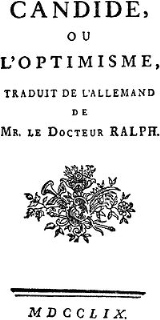
Candide underwent one major revision after its initial publication, in addition to some minor ones. In 1761, a version of Candide was published that included, along with several minor changes, a major addition by Voltaire to the twenty-second chapter, a section that had been thought weak by the Duke of Vallière. The English title of this edition was Candide, or Optimism. Translated from the German of Dr. Ralph. With the additions found in the Doctor's pocket when he died at Minden, in the Year of Grace 1759. The last edition of Candide authorised by Voltaire was the one included in Cramer's 1775 compilation, l'éditions encadrées, meaning "supervised editions".

Voltaire strongly opposed the inclusion of illustrations in his works, as he stated in a 1778 letter to writer and publisher Charles Joseph Panckoucke:

Despite this protest, two sets of illustrations for Candide were produced by French artist Jean-Michel Moreau le Jeune
Jean-Michel Moreau le Jeune

Jean-Michel Moreau, also called Moreau the Younger was a French draughtsman, illustrator and engraver.Moreau the Younger, as he is usually called, was the pupil of the painter Louis-Joseph Le Lorrain who accompanied his master to St Petersburg in 1758 when Le Lorrain went to be the first director of the Imperial Academy of Arts estab...
. The first version was done, at Moreau's own expense, in 1787 and included in Kehl's publication of that year, Oeuvres Complètes de Voltaire. Four images were drawn by Moreau for this edition and were engraved by Pierre-Charles Baquoy. The second version, in 1803, consisted of seven drawings by Moreau which were transposed by multiple engravers. Twentieth-century modern artist Paul Klee
Paul Klee

Paul Klee was a Switzerland Painting of Germany nationality. His highly individual style was influenced by many different art trends, including expressionism, cubism, and surrealism....
 relates it was while reading Candide that he discovered his own artistic style. Klee illustrated the work, and his drawings were published in a 1920 version edited by Kurt Wolff
Kurt Wolff

Kurt Wolff was a Germany publisher, editor, writer and journalist.Wolff was born in Bonn, Rhine Province. Together with Ernst Rowohlt he began to work in publishing in Leipzig in 1908....
.

Synopsis


Candide contains thirty episodic
Episode

An episode is a part of a dramatic work such as a Serial television program or Radio programming program. An episode is a part of a sequence of a body of work, akin to a chapter of a book....
 chapters, which may be grouped into two main schemes: one consists of two divisions, separated by the protagonist's hiatus in El Dorado
El Dorado

El Dorado is a legend that began with the story of a South American tribal chief who covered himself with gold dust and would dive into a lake of pure mountain water....
, the other consists of three parts, each defined by its geographical setting. By the former scheme, the first half of Candide constitutes the rising action
Rising action

The Rising action, in the narratology of a work of fiction, follows the exposition and leads up to the Climax . The rising action's purpose is usually to build suspense all the way up the climactic finish....
 and the last part the resolution
Falling action

The Falling action is the part of a story, usually found in tragedy and short story, following the Climax and showing the effects of the climax....
. This view is supported by the strong theme of travel and quest, reminiscent of adventure and picaresque novels, which tend to employ such a dramatic structure
Dramatic structure

Dramatic structure is the plot structure of a dramatic work such as a Play or screenplay. Many scholars have analyzed dramatic structure, beginning with Aristotle in his Poetics ....
. By the latter scheme, the thirty chapters may be grouped into three parts each comprising ten chapters and defined by locale: I–X are set in Europe, XI–XX are set in the Americas
Americas

The Americas are the region of the Western hemisphere that consists of the continents of North America and South America with their associated islands and regions....
, and XXI–XXX are set in Europe and the Ottoman Empire
Ottoman Empire

The Ottoman Empire , also known by its contemporaries as the Turkish Empire or Turkey , was an empire that lasted from 1299?1923. It was Treaty of Lausanne by the Republic of Turkey, which was officially proclaimed on October 29, 1923....
. The plot summary that follows uses this second format and includes Voltaire's additions of 1761.

The tale of Candide begins in the castle of the Baron Thunder-ten-tronckh in Westphalia
Westphalia

Westphalia is a region in Germany, centred on the cities of Bielefeld, Bochum, Dortmund, Gelsenkirchen, M?nster, and Osnabr?ck and included in the states of North Rhine-Westphalia and Lower Saxony....
, home to the Baron's daughter, Lady Cunégonde; his bastard nephew, Candide; a tutor, Pangloss; a chambermaid, Paquette; and the rest of the Baron's family. The protagonist
Protagonist

A protagonist is the main Character of a drama or Narrative. The word "protagonist" derives from the Greek language p??ta????st?? , "one who plays the first part, chief actor." In the theatre of Ancient Greece, three actors played all of the main dramatic roles in a tragedy; the leading role was played by the protagonist, while the othe...
, Candide (from the Latin
Latin

Latin is an Italic language, historically spoken in Latium and Ancient Rome. Through the Military history of the Roman Empire, Latin spread throughout the Mediterranean and a large part of Europe....
 candidus), is romantically attracted to Cunégonde. He is a child of "the most unaffected simplicity", whose face is "the index of his mind". Dr. Pangloss, professor of "métaphysico-théologo-cosmolonigologie" and self-proclaimed optimist, may have been based on Luise Dorothea of Saxe-Meiningen
Luise Dorothea of Saxe-Meiningen

Luise Dorothea of Saxe-Meiningen was the daughter of Ernst Ludwig I, Duke of Saxe-Meiningen and Dorothea Marie of Saxe-Gotha. She was the wife off Frederick III, Duke of Saxe-Gotha-Altenburg....
, a Leibnizian with whom Voltaire corresponded regularly. The name Pangloss is derived from the Greek
Greek language

Greek is an Indo-European languages native to the southern Balkan peninsula, the language of the Greek people. It forms an independent branch within Indo-European....
 words p?? (all) and ???ssa (tongue), implying the emptiness of this character's statements. Pangloss teaches his pupils that they live in the "best of all possible worlds" and that "all is for the best". These locutions express the fundamental tenets of Leibnizian optimism to which Candide adheres for most of the story: Candide, before his disillusion, thinks himself lucky and the world a good place.

Chapters I–X

All is well in the Baron's castle, until Cunégonde accidentally sees Pangloss sexually engaged with Paquette in some bushes. Encouraged by this show of affection, Cunégonde drops her handkerchief next to Candide which entices him to kiss her. For this infraction, Candide is evicted from the castle, at which point he is captured by Bulgar (Prussia
Prussia

Prussia was, most recently, a historic state originating out of the Duchy of Prussia and the Margraviate of Brandenburg. This state had for centuries substantial influence on Germany and European history....
n) recruiters and coerced into military service. For attempted desertion, Candide is flogged
Flagellation

Flagellation is the act of whipping the human body. Specialised implements for it include rods, Switch and the cat-o-nine-tails. Typically, whipping is performed on unwilling subjects as a punishment; however, flagellation can also be submitted to willingly, or performed on oneself, in religious or Sadism and masochism contexts....
 and nearly executed, before being forced to engage in a large battle between the Bulgars and the Abares (French). Candide successfully escapes the army and makes his way to Holland where he is given aid by Jacques, an Anabaptist
Anabaptist

Anabaptists are Christianity of the Radical Reformation. Various groups at various times have been called Anabaptist, but the term is most commonly used to refer to the Anabaptists of 16th century Europe....
, who strengthens Candide's faith in optimism. Soon after, Candide finds his master Pangloss, now a beggar with syphilis
Syphilis

Syphilis is a sexually transmitted disease caused by the spirochete bacterium Treponema pallidum subspecies pallidum. The route of transmission of syphilis is almost always through sexual contact, although there are examples of congenital syphilis via transmission from mother to child in utero....
. Pangloss reveals he was infected with this disease by Paquette and shocks Candide by relating how Castle Thunder-ten-Tronckh was destroyed by Bulgars, and that Cunégonde and her whole family were killed. Pangloss is cured of his illness by Jacques, losing one eye and one ear in the process, and the three set sail to Lisbon
Lisbon

Lisbon is the Capital and largest city of Portugal. It is also the seat of the Lisbon and capital of the Lisbon region. Its municipalities of Portugal, which matches the city proper excluding the larger continuous conurbation, has a municipal population of 564,477 in , while the Lisbon Metropolitan Area in total has around 2.8 million inha...
. However, at the end of their journey, they are overtaken by a vicious storm which destroys the boat. The only survivors are Pangloss, Candide, and a "brutish sailor" (Fr. "matelot furieux"). Shortly after these three set foot in Lisbon, the city is hit by an earthquake, tsunami and fire which kill tens of thousands.

In the wake of the destruction, Candide and Pangloss are arrested by the Portuguese Inquisition
Portuguese Inquisition

The Portuguese Inquisition was formally established in Portugal in 1536 at the request of the King of Portugal, Jo?o III. Manuel I of Portugal had asked for the installation of the Inquisition in 1515, but was only after his death that the pope acquiesced....
 for their uncommon philosophy, and set to be punished in an "auto-da-fé
Auto de fe

The phrase auto de fe refers to the ritual of public penance of condemned heresy and apostates that took place when the Spanish Inquisition or the Portuguese Inquisition had decided their punishment ....
", a ceremony designed to eliminate heretics, appease God and prevent another disaster. Candide is flogged again and sees Pangloss hanged, but another earthquake follows. Candide is then approached by an old woman (Fr. "la vieille") whose name is never revealed. The old woman leads Candide to a house where Lady Cunégonde waits, alive, to relate her story: after Bulgars raided the baron's castle, killed her family, and attacked her, Cunégonde was rescued by a captain
Captain (nautical)

The captain or master of a merchant vessel is a licensed mariner in ultimate command of the vessel. A ship's captain is responsible for its safe and efficient operation, including cargo operations and navigation, and ensuring that the vessel complies with local and international laws, as well as company policies....
 who, in turn, sold her to a Jewish merchant and banker, Don Issachar. When Candide finds Cunégonde, her ownership is shared by this Don Issachar and a Grand Inquisitor
Grand Inquisitor

Grand Inquisitor is the lead official of an Inquisition. The most famous Inquisitor General is probably the Spanish Dominican Order Tom?s de Torquemada, who spearheaded the Spanish Inquisition....
, each possessing the girl on alternate days of the week. Having heard this story, Candide kills both the Jew and the Inquisitor, then escapes with Cunégonde and the old woman to Cadiz
Cádiz

C?diz is a city and port in southwestern Spain. It is the capital of the province of C?diz, one of eight which make up the Autonomous communities of Spain of Andalusia....
.

Cunégonde falls into self-pity, complaining of all the misfortunes that have befallen her. The old woman reciprocates by revealing her own tragic life, which has included having a buttock cut off in order to feed some starving men.

Chapters X–XX

The trio embarks for the port at Buenos Aires
Buenos Aires

Buenos Aires is the Capital and largest city of Argentina. It is located on the southern shore of the R?o de la Plata, on the southeastern coast of the South American continent....
. In Cadiz, Governor Don Fernando de Ibaraa, y Figueora, y Mascarenes, y Lampurdos, y Suza, asks to marry Cunégonde. Just then, an alcaide (a Portugese fortress commander) arrives in Buenos Aires pursuing Candide for killing the Grand Inquisitor. Candide escapes to Paraguay
Paraguay

Paraguay, officially the Republic of Paraguay , is one of the only two landlocked countries in South America . It lies on both banks of the Paraguay River and is bordered by Argentina to the south and southwest, Brazil to the east and northeast, and Bolivia to the northwest....
 by following the advice of his practical and heretofore unmentioned manservant Cacambo (from the Spanish word caca). At a border post on the way to Paraguay, Cacambo and Candide speak to the commandant
Commandant

Commandant is a military or police title or rank....
, who turns out to be Cunégonde's brother (who is not named). This brother explains how he was saved by Jesuits and came to be there. The character of this brother is likely based on Frederick the Great, the King of Prussia
King of Prussia

King of Prussia may refer to:* A ruler of the former German state of Prussia**List of rulers of Prussia* King of Prussia, Pennsylvania* King of Prussia Mall...
, with whom Voltaire corresponded. When Candide proclaims he intends to marry Cunégonde, the brother is enraged and strikes Candide with the flat of his sword. Candide then apparently kills him, steals his robe and flees with Cacambo.

Candide and Cacambo wander into El Dorado
El Dorado

El Dorado is a legend that began with the story of a South American tribal chief who covered himself with gold dust and would dive into a lake of pure mountain water....
, a geographically isolated utopia
Utopia

Utopia is a name for an ideal community or society, taken from the Utopia written in 1516 by Sir Thomas More describing a fictional island in the Atlantic Ocean, possessing a seemingly perfect social system-politics-legal system....
 where the streets are covered with precious stones, there exist no priests, and all of the king's jokes are funny. Candide and Cacambo stay a month in El Dorado, but Candide is still in pain without Cunégonde, and expresses to the king his wish to leave. The king points out that this is a foolish idea, but generously helps them do so. The pair continue their journey, now accompanied by one hundred red pack sheep carrying provisions and incredible sums of money, which are slowly lost and stolen. Candide and Cacambo find a slave on the road to Surinam who is missing an arm and leg. He's been left behind, apparently, and complains bitterly about it. The Church teaches that everyone descends from Adam, he says, so that means we're all second cousins, "and you must admit that relatives could not be treated more horribly." Candide and Cacambo, taking pity on the slave, help him to reach Surinam. This reflects Voltaire's hatred of slavery, a revolutionary concept in his time. Candide and Cacambo reach Surinam, where they split up: Cacambo travels to Buenos Aires to retrieve Lady Cunégonde, and Candide travels to Venice
Venice

Venice is a city in northern Italy, the capital city of the Italian regions Veneto, a population of 271,251 . Together with Padua, Italy, the city is included in the Padua-Venice Metropolitan Area ....
 to await his arrival, finding a ship to take him to Bordeaux
Bordeaux

is a Port city on the Garonne in southwest France, with one million inhabitants in its aire urbaine at a 2008 estimate. It is the Capital of the Aquitaine regions of France, as well as the Prefectures in France of the Gironde Departments of France....
. Feeling in need of companionship he interviews a number of local men who have been through various ill-fortunes and settles on a man named Martin.

Chapters XX–XXX


This companion, Martin, discusses Pangloss's philosophy with Candide and reveals that he himself is a Manichean scholar from Amsterdam. The character of Martin is based on the real-life pessimist Pierre Bayle
Pierre Bayle

Pierre Bayle was a French philosopher and writer.Pierre Bayle was a Christian scholar who argued that faith could not be justified by reason, on the grounds that God is incomprehensible to man....
, who is a chief opponent of Leibniz. For the remainder of the voyage, Martin and Candide argue about philosophy, Candide still being an optimist at heart since it is all he knows. Upon arrival in France, Candide and Martin stay in Paris for a period before travelling to England. Just before docking they witness the execution of a British naval officer on the charge of not killing enough of the enemy (Admiral John Byng
John Byng

Sir John Byng was a United Kingdom admiral who was court-martialled and executed for failing to "do his utmost" during the Battle of Minorca, at the beginning of the Seven Years' War....
 was shot on such a charge). Horrified, Candide refuses to even set foot on British soil.

In Venice, Candide and Martin meet Paquette, the chambermaid who infected Pangloss with his syphilis. She is now a prostitute, and is spending her time with a monk, Brother Giroflée. Although both appear happy on the surface, they reveal their despair: Paquette has led a miserable existence as a sexual object, and the monk detests the religious order in which he was indoctrinated.

Candide and Martin even visit the wealthy nobleman Signor Pococurante (meaning "taking little care" in Italian) in his palace. This man is surrounded by beautiful girls, wonderful paintings, books and music which greatly impress Candide. Pococurante, however, is unimpressed with it all: he finds no pleasure in anything, for he sees only faults. Candide even meets a number of exiled statesmen, including Bonnie Prince Charlie.

Later, while Candide and Martin are eating supper, Cacambo returns to Candide and informs him that Cunégonde is in Constantinople
Constantinople

Constantinople was the empire capital of the Roman Empire , the Byzantine Empire , the Latin Empire , and the Ottoman Empire . Strategically located between the Golden Horn and the Sea of Marmara at the point where Europe meets Asia, Byzantine Constantinople had been the capital of a Christendom empire, successor to ancient ancient Greece...
, and that she has been enslaved. In the twenty-seventh chapter, Candide, Martin, and Cacambo are on board a ship to Constantinople, on which Cacambo relates Cunégonde's status: she is washing dishes for a prince of Transylvania
Transylvania

Transylvania is a historical region in the central part of Romania. Bounded on the east and south by the Carpathian mountains, historical Transylvania extended in the west to the Apuseni Mountains; however, the term frequently encompasses not only Transylvania proper, but also the historical regions of Crisana, Maramures, and Banat....
, and has become ugly. On the way to rescue her, Candide finds Pangloss and Lady Cunégonde's brother rowing in the galley. Candide buys their freedom and further passage at steep prices. The baron and Pangloss relate their survival stories which, despite their horrors, have not shaken Pangloss's optimism. According to the philosopher, "I still hold to my original opinions, because, after all, I'm a philosopher, and it wouldn't be proper for me to recant, since Leibniz cannot be wrong, and since preestablished harmony is the most beautiful thing in the world, along with the plenum and subtle matter."

The travellers arrive in Transylvania where they rejoin Cunégonde and the old woman. Cunégonde has indeed become hideously ugly but Candide nevertheless buys their freedom and marries Cunégonde to spite her brother. Paquette and Brother Giroflée, too, are reconciled with Candide on a farm which he just bought, his only property remaining.

One day, the protagonists seek out a dervish
Dervish

Darvesh or Dervish , as it is known in European languages, refers to members of Sufi Muslim ascetic religious Tariqah, known for their extreme poverty and austerity, similar to mendicant order friars in Christianity or Hindu/Buddhist/Jain sadhus, also called fakirs amongst Muslims ....
 known as a great philosopher of the land. Pangloss asks him why Man is made to suffer so, and what they all ought to do. The dervish responds by asking rhetorically why Pangloss is concerned about the existence of evil and good. The dervish describes human beings as mice on a ship sent by a king to Egypt; their comfort does not matter to the king. The dervish then slams his door on the group. Returning to their farm, Candide, Pangloss, and Martin meet a Turk
Turkish people

The Turkish people , also known as "Turks" are defined mainly as citizens of the Republic of Turkey. An early history text provided the definition of being a Turk as "any individual within the Republic of Turkey, whatever his faith who speaks Turkish, grows up with Turkish culture and adopts the Turkish ideal is a Turk." This ideal...
 whose philosophy is to devote his life only to simple work and not concern himself with external affairs. He and his four children work a small farm to keep "free of three great evils: boredom, vice and necessity". Candide, Pangloss, Martin, Cunégonde, Paquette, the old woman, and Brother Giroflée all set to work (on this "louable dessein", or "commendable plan", as the narrator calls it), each to one specific task. Candide ignores Pangloss's insistence that all turned out for the best by necessity, and he is resolved only that "we must cultivate our garden".

Style


As Voltaire himself described it, the purpose of Candide was to "bring amusement to a small number of men of wit". The author achieves this goal, according to literary critics, by combining his sharp wit with a fun parody of the classic adventure-romance plot. Candide is confronted with horrible events described in painstaking detail so often that it becomes humorous. Literary theorist Frances K. Barasch described Voltaire's matter-of-fact narrative as treating topics such as mass death "as coolly as a weather report". The fast-paced and improbable plot—in which characters repeatedly narrowly escape death, for instance—allows for compounding tragedies to befall the same characters over and over again. In the end, Candide is primarily, as described by Voltaire's biographer Ian Davidson, "short, light, rapid and humorous".

Behind the playful façade of Candide which has amused so many, there lies very harsh criticism of contemporary European civilisation which angered many others. European governments such as France, Prussia, Portugal and England are each attacked ruthlessly by the author: the French and Prussians for the Seven Years' War, the Portuguese for their Inquisition
Portuguese Inquisition

The Portuguese Inquisition was formally established in Portugal in 1536 at the request of the King of Portugal, Jo?o III. Manuel I of Portugal had asked for the installation of the Inquisition in 1515, but was only after his death that the pope acquiesced....
, and the British for the execution of John Byng
John Byng

Sir John Byng was a United Kingdom admiral who was court-martialled and executed for failing to "do his utmost" during the Battle of Minorca, at the beginning of the Seven Years' War....
. Organised religion, too, is harshly treated in Candide. For example, Voltaire mocks the Jesuit order
Society of Jesus

The Society of Jesus is a Roman Catholic religious order of clerks regular whose members are called Jesuits, Soldiers of Jesus Christ, and Foot soldiers of the Pope, because the founder, Saint Ignatius of Loyola, was a knight before becoming a Holy Orders....
 of the Roman Catholic Church
Roman Catholic Church

The Roman Catholic Church, officially known as the Catholic Church is the world's largest Christianity Ecclesia , representing over half of all Christians and one-sixth of the world population....
. Aldridge provides a characteristic example of such anti-clerical passages for which the work was banned: while in Paraguay
Paraguay

Paraguay, officially the Republic of Paraguay , is one of the only two landlocked countries in South America . It lies on both banks of the Paraguay River and is bordered by Argentina to the south and southwest, Brazil to the east and northeast, and Bolivia to the northwest....
, Cacambo remarks, "[The Jesuits] are masters of everything, and the people have no money at all ...". Here, Voltaire suggests the Christian mission
Mission (Christian)

A Christianity mission has been widely defined, since the Lausanne Congress of 1974, as that which is designed "to form a viable indigenous Christian Church-planting and world changing movement." This definition is motivated by a Christian theology imperative theme of the Bible to make God known, as outlined in the Great Commission....
 in Paraguay is taking advantage of the local population. Voltaire depicts the Jesuits holding the indigenous peoples as slaves while they claim to be helping them. The old woman relates that she is the illegitimate daughter of non-existent Pope Urban X by an Italian noble-woman, among other scathing attacks on the Church. Several names, like Pangloss (literally "all tongue" in Latin, or all talk) and Pennecunde ("caring little") as the name of an Italian character, reflect the subtler mockery. Also of note is the fact that Jacques, the Anabaptist who helps Candide and Pangloss, is described as the best character of the book, dying senselessly in the storm at sea. The Protestant-Catholic schism, along with the Holy Inquisition, are frequently derided. Some view the portrayal of the Jewish merchant in Lisbon as anti-semitic; however, in Constantinople at the end, Jewish bankers alone will deal honestly with the foreign characters.

Satire


The main method of Candide's satire is to contrast ironically great tragedy and comedy. The story does not invent or exaggerate evils of the world—it displays real ones starkly, allowing Voltaire to simplify subtle philosophies and cultural traditions, highlighting their flaws. Thus Candide derides optimism, for instance, with a deluge of horrible, historical (or at least plausible) events with no apparent redeeming qualities.

A simple example of the satire of Candide is seen in the treatment of the historical event witnessed by Candide and Martin in Portsmouth
Portsmouth

Portsmouth city status in the United Kingdom located in the Counties of England of Hampshire on the south coast of England. Portsmouth is the UK's only island city and is located on Portsea Island....
 harbour. There, the duo spy an admiral, John Byng
John Byng

Sir John Byng was a United Kingdom admiral who was court-martialled and executed for failing to "do his utmost" during the Battle of Minorca, at the beginning of the Seven Years' War....
, being executed for failing to properly engage a French fleet. The admiral is blindfolded and shot in the head on the deck of his own boat, merely "to encourage the others". This depiction of military punishment trivializes Byng's death. The dry, pithy explanation "to encourage the others" thus satirises a serious historical event in characteristically Voltairian fashion. For its classic wit, this phrase has become one of the more often quoted from Candide.

Voltaire depicts the worst of the world and his pathetic hero's desperate effort to fit it into an optimistic outlook. Almost all of Candide is a discussion of various forms of evil: its characters rarely find even temporary respite. There is at least one notable exception: the episode of El Dorado
El Dorado

El Dorado is a legend that began with the story of a South American tribal chief who covered himself with gold dust and would dive into a lake of pure mountain water....
, a fantastic village in which the inhabitants are simply rational, and their society is just and reasonable. The positivity of El Dorado may be contrasted with the pessimistic attitude of most of the book. Even in this case, the bliss of El Dorado is fleeting: Candide soon leaves the village to seek Cunégonde, whom he eventually marries only out of spite.

Another element of the satire focuses on what William F. Bottiglia, author of many published works on Candide, calls the "sentimental foibles of the age" and Voltaire's attack on them. Flaws in European culture are highlighted as Candide parodies adventure and romance clichés, mimicking the style of a picaresque novel
Picaresque novel

The picaresque novel is a popular sub-genre of prose fiction which is usually satire and depicts in realism and often humorous detail the adventures of a roguish hero of low social class who lives by his or her wits in a corrupt society....
. A number of archetypal characters thus have recognisable manifestations in Voltaire's work: Candide is supposed to be the drifting rogue
Rogue (vagrant)

The word "rogue" was first recorded in print in John Awdeley?s Fraternity of Vagabonds , and then in Thomas Harman?s Caveat for Common Cursitors ....
 of low social class, Cunégonde the sex interest, Pangloss the knowledgeable mentor and Cacambo the skilful valet. As the plot unfolds, readers find that Candide is no rogue, Cunégonde becomes ugly and Pangloss is a stubborn fool. The characters of Candide are unrealistic, two-dimensional, mechanical, and even marionette
Marionette

A marionette is a puppet controlled from above using strings; a marionette's puppeteer is called a manipulator. Marionettes are operated with the puppeteer hidden or revealed to an audience by using a vertical or horizontal control bar in different forms of theatres or entertainment venues....
-like; they are simplistic and stereotypical. As the initially naïve protagonist eventually comes to a mature conclusion—however noncommittal—the novella is a bildungsroman
Bildungsroman

A bildungsroman is a novelistic genre that arose during the German Enlightenment, in which the author presents the psychological, moral and social shaping of the personality of a protagonist....
, if not a very serious one.

Garden motif


Gardens are thought by many critics to play a critical symbolic role in Candide. The first location commonly identified as a garden is the castle of the Baron, from which Candide and Cunégonde are evicted much in the same fashion as Adam and Eve
Adam and Eve

Adam and Eve are the First man or woman created by God in the Hebrew creation story told in Genesis 1-2....
 are evicted from the Garden of Eden
Garden of Eden

The Garden of Eden is a location described in the Book of Genesis as being the place where the first man, Adam , and his wife, Eve , lived after they were created by God....
 in Genesis. Cyclically, the main characters of Candide conclude the novel in a garden of their own making, one which might represent celestial paradise. The third most prominent "garden" is El Dorado
El Dorado

El Dorado is a legend that began with the story of a South American tribal chief who covered himself with gold dust and would dive into a lake of pure mountain water....
, which may be a false Eden. Other possibly symbolic gardens include the Jesuit pavilion, the garden of Pococurante, Cacambo's garden, and the Turk's garden.

These gardens are likely references to the Garden of Eden, but it has also been proposed, by Bottiglia, for example, that the gardens refer also to the Encyclopédie, and that Candide's conclusion to cultivate "his garden" symbolises Voltaire's great support for this endeavour. Candide and his companions, as they find themselves at the end of the novella, are in a very similar position to Voltaire's tightly knit philosophical circle which supported the Encyclopédie: the main characters of Candide live in seclusion to "cultivate [their] garden", just as Voltaire suggested his colleagues leave society to write. In addition, there is evidence in the epistolary correspondence of Voltaire that he had elsewhere used the metaphor of gardening to describe writing the Encyclopédie. Another interpretative possibility is that Candide cultivating "his garden" suggests his engaging only in necessary occupations, such as feeding oneself and fighting boredom. This is analogous to Voltaire's own view on gardening: he was himself a gardener at his estates in Les Délices
Les Délices

Les Délices, or "The Delights", was a Geneva home of Voltaire, a France Age of Enlightenment writer and philosopher. Voltaire moved to Les Délices in January 1755, having purchased a life interest in the Estate ....
 and Ferney, and he often wrote in his correspondence that gardening was an important pastime of his own, it being an extraordinarily effective way to keep busy.

Philosophy


Optimism


Candide satirises various philosophical and religious theories that Voltaire had previously criticised. Primary among these is Leibnizian optimism
Optimism

Optimism is an outlook on life such that one maintains a view of the world as a positive place, or one's personal situation as a positive one. It is the philosophical opposite of pessimism....
 (sometimes called Panglossianism after its fictional proponent), which Voltaire ridicules with descriptions of seemingly endless calamity. Voltaire demonstrates a variety of irredeemable evils in the world, leading many critics to contend that Voltaire's treatment of evil—specifically the theological problem of its existence—is the focus of the work. Heavily referenced in the text are the Lisbon earthquake, disease, and the sinking of ships in storms. Also, war, thievery, and murder—evils of human design—are explored as extensively in Candide as are environmental ills. Bottiglia notes Voltaire is "comprehensive" in his enumeration of the world's evils. He is unrelenting in attacking Leibnizian optimism.

Fundamental to Voltaire's attack is Candide's tutor Pangloss, a self-proclaimed follower of Leibniz and a teacher of his doctrine. Ridicule of Pangloss's theories thus ridicules Leibniz himself, and Pangloss's reasoning is silly at best. For example, Pangloss's first teachings of the narrative absurdly mix up cause and effect:

Following such flawed reasoning even more doggedly than Candide, Pangloss defends optimism. Whatever their horrendous fortune, Pangloss reiterates "all is for the best" (Fr. "Tout est pour le mieux") and proceeds to "justify" the evil event's occurrence. A characteristic example of such theodicy is found in Pangloss's explanation of why it is good that syphilis
Syphilis

Syphilis is a sexually transmitted disease caused by the spirochete bacterium Treponema pallidum subspecies pallidum. The route of transmission of syphilis is almost always through sexual contact, although there are examples of congenital syphilis via transmission from mother to child in utero....
 exists:

Candide, the impressionable and incompetent student of Pangloss, often tries to justify evil, fails, invokes his mentor and eventually despairs. It is by these failures that Candide is painfully cured (as Voltaire would see it) of his optimism.

Interestingly, this critique of Voltaire's seems to be directed almost exclusively at Leibnizian optimism. Candide does not ridicule Voltaire's contemporary Alexander Pope
Alexander Pope

Alexander Pope is generally regarded as the greatest England poet of the eighteenth century, best known for his satirical verse and for his translation of Homer....
, a later optimist of slightly different convictions. Candide does not discuss Pope's optimistic principle that "all is right", but Leibniz's that states, "this is the best of all possible worlds". However subtle the difference between the two, Candide is unambiguous as to which is its subject. Some critics conjecture that Voltaire meant to spare Pope this ridicule out of respect, although Voltaire's Poème may have been written as a more direct response to Pope's theories. This work is similar to Candide in subject matter, but very different to it in style: the Poème embodies a more serious philosophical argument than Candide.

Conclusion


The conclusion of the novella, in which Candide finally dismisses his tutor's optimism, leaves unresolved what philosophy the protagonist is to accept in its stead. This element of Candide has been written about voluminously, perhaps above all others. The conclusion is enigmatic and its analysis is contentious.

Voltaire develops no formal, systematic philosophy for the characters to adopt. The conclusion of the novel may be thought of not as a philosophical alternative to optimism, but as a prescribed practical outlook (though what it prescribes is in dispute). Many critics have concluded that one minor character or another is portrayed as having the right philosophy. For instance, a number believe that Martin is treated sympathetically, and that his character holds Voltaire's ideal philosophy—pessimism. Others disagree, citing Voltaire's negative descriptions of Martin's principles and the conclusion of the work in which Martin plays little part.

Within debates attempting to decipher the conclusion of Candide lies another primary Candide debate. This one concerns the degree to which Voltaire was advocating a pessimistic philosophy, by which Candide and his companions give up hope for a better world. Critics argue that the group's reclusion on the farm signifies Candide and his companions' loss of hope for the rest of the human race. This view is to be compared to a reading that presents Voltaire as advocating a melioristic
Meliorism

Meliorism is an idea in metaphysics thinking holding that progress is a real concept leading to an improvement of the world. It holds that humans can, through their interference with processes that would otherwise be natural, produce an outcome which is an improvement over the aforementioned natural one....
 philosophy and a precept committing the travellers to improving the world through metaphorical gardening. This debate, and others, focuses on the question of whether or not Voltaire was prescribing passive retreat from society, or active industrious contribution to it.

Inside/outside controversy


Separate from the debate about the text's conclusion is the "inside/outside" controversy. This argument centres on the matter of whether or not Voltaire was actually prescribing anything. Roy Wolper, professor emeritus of English, argues in a revolutionary 1969 paper that Candide does not necessarily speak for its author; that the work should be viewed as a narrative independent of Voltaire's history; and that its message is entirely (or mostly) inside it. This point of view, the "inside", specifically rejects attempts to find Voltaire's "voice" in the many characters of Candide and his other works. Indeed, writers have seen Voltaire as speaking through at least Candide, Martin, and the Turk. Wolper argues that Candide should be read with a minimum of speculation as to its meaning in Voltaire's personal life. His article ushered in a new era of Voltaire studies, causing many scholars to look at the novel differently.

Critics such as Lester Crocker, Henry Stavan, and Vivienne Mylne find too many similarities between Candide's point of view and that of Voltaire to accept the "inside" view; they support the "outside" interpretation. They believe that Candide's final decision is the same as Voltaire's, and see a strong connection between the development of the protagonist and his author. Some scholars who support the "outside" view also believe that the isolationist philosophy of the Old Turk closely mirrors that of Voltaire. Others see a strong parallel between Candide's gardening at the conclusion and the gardening of the author. Martine Darmon Meyer argues that the "inside" view fails to see the satirical work in context, and that denying that Candide is primarily a mockery of optimism (a matter of historical context) is a "very basic betrayal of the text".

Reception


Though Voltaire did not openly admit to having written the controversial Candide until 1768 (until then he signed with a pseudonym: "Monsieur le docteur Ralph", or "Doctor Ralph"), his authorship of the work was hardly disputed. Immediately after publication, the work and its author were denounced by both secular and religious authorities, because the book openly derides government and church alike. It was because of such polemics that Omer-Louis-François Joly de Fleury, who was Advocate General
Advocate General

An Advocate General is a senior law officer of a country or other jurisdiction. Usually charged with advising the courts or Government on legal matters....
 to the Parisian parlement
Parlement

The political institutions of the Parlement in ancien r?gime France developed out of the previous council of the king, the Conseil du roi or curia regis, and consequently had ancient and customary rights of consultation and deliberation....
 when Candide was published, found parts of Candide to be "contrary to religion and morals".

Despite much official indictment, soon after its publication, Candide's irreverent prose was being quoted. "Let us eat a Jesuit", for instance, became a popular phrase for its reference to a humorous passage in Candide. By the end of February 1759, The Great Council of Geneva
Tagsatzung

The Swiss Tagsatzung was the legislative and executive council of the Old Swiss Confederacy from medieval times until the formation of the Swiss federal state in 1848....
 and the administrators of Paris had banned Candide. Candide nevertheless succeeded in selling twenty thousand to thirty thousand copies by the end of the year in over twenty editions, making it a best seller. The Duke de La Vallière speculated near the end of January 1759 that Candide might have been the fastest-selling book ever. In 1762, Candide was listed in the Index Librorum Prohibitorum
Index Librorum Prohibitorum

The Index Librorum Prohibitorum was a list of publications censorship by the Roman Catholic Church.It was abolished on June 14, 1966 by Pope Paul VI....
, the Roman Catholic Church's list of prohibited books.

Bannings of Candide lasted into the twentieth-century in the United States, where the work has long been considered a seminal work of Western literature. At least once, Candide was temporarily barred from entering America: in February 1929, a US customs
Customs

Customs is an authority or Government agency in a country responsible for collecting and safeguarding Duty and for controlling the flow of goods including animals, personal effects and hazardous items in and out of a country....
 official in Boston prevented a number of copies of the book, deemed "obscene", from reaching a Harvard University
Harvard University

Harvard University is a private university in Cambridge, Massachusetts, Massachusetts, United States, and a member of the Ivy League. Founded in 1636 by the colonial Massachusetts legislature, Harvard is the Colonial Colleges institution of higher learning in the United States....
 French class. Candide was admitted in August of the same year; however by that time the class was over. In an interview soon after Candide's detention, the official who confiscated the book explained the office's decision to ban it, "... But about 'Candide,' I'll tell you. For years we've been letting that book get by. There were so many different editions, all sizes and kinds, some illustrated and some plain, that we figured the book must be all right. Then one of us happened to read it. It's a filthy book ...".

Legacy


Candide is the most widely read of Voltaire's many works, and it is considered one of the great achievements of Western literature
Western literature

Western literature refers to the literature written in the languages of Europe, including the ones belonging to the Indo-European languages as well as several geographically or historically related languages such as Basque language, Hungarian language, and so forth....
. However, Candide is not necessarily considered a true "classic". According to Bottiglia, "The physical size of Candide, as well as Voltaire's attitude toward his fiction, precludes the achievement of artistic dimension through plenitude, autonomous '3D' vitality, emotional resonance, or poetic exaltation. Candide, then, cannot in quantity of quality, measure up to the supreme classics." Bottiglia instead calls it a miniature classic, though others are more forgiving of its size. As the only work of Voltaire which has remained popular up to the present day, Candide is listed in The Western Canon: The Books and School of the Ages. It has been named one of the 1001 Books You Must Read Before You Die
1001 Books You Must Read Before You Die

1001 Books You Must Read Before You Die is a literary reference book compiled by over one hundred literary critics worldwide and edited by Peter Boxall, an instructor of English at Sussex University, with an introduction by Peter Ackroyd....
 and one of the 100 Most Influential Books Ever Written
100 Most Influential Books Ever Written

The 100 Most Influential Books Ever Written: The History of Thought from Ancient Times to Today is a book of intellectual history written by Martin Seymour-Smith , a United Kingdom poet, critic, and biographer....
. It is included in the Encyclopædia Britannica
Encyclopædia Britannica

The Encyclop?dia Britannica is a general English language encyclopedia published by Encyclop?dia Britannica, Inc., a privately held company....
 collection Great Books of the Western World
Great Books of the Western World

Great Books of the Western World is a series of books originally published in the United States in 1952 by Encyclop?dia Britannica Inc. to present the western canon in a single package of 54 volumes....
. Candide has had a significant influence on modern writers of black humour
Black comedy

file:Hopscotch to oblivion.jpgBlack comedy is a sub-genre of comedy and satire in which topics and events that are usually regarded as taboo are treated in a satirical or humorous manner while retaining its seriousness....
 such as Céline
Louis-Ferdinand Céline

Louis-Ferdinand C?line was the pen name of French writer and Physician Louis-Ferdinand Destouches . The name C?line was chosen after his grandmother's forename....
, Joseph Heller
Joseph Heller

Joseph Heller was an American satirical novelist, short story writer and playwright. He wrote the influential novel Catch-22 about American servicemen during World War II....
, John Barth
John Barth

John Simmons Barth is an American novelist and short-story writer, known for the postmodern literature and metafiction quality of his work.John Barth was born in Cambridge, Maryland, and briefly studied "Elementary Theory and Advanced Orchestration" at Juilliard before attending Johns Hopkins University, receiving a B.A....
, Thomas Pynchon
Thomas Pynchon

Thomas Ruggles Pynchon, Jr. is an American literature based in New York City, noted for his dense and complex works of fiction. Hailing from Long Island, Pynchon spent two years in the United States Navy and earned an English studies degree from Cornell University....
, Kurt Vonnegut
Kurt Vonnegut

Kurt Vonnegut, Jr. was a prolific and genre-bending American novelist known for works blending satire, black comedy and science fiction, such as Slaughterhouse-Five , Cat's Cradle , and Breakfast of Champions .He was also known for his Humanism beliefs and being honorary president of the American Humanist Association....
, and Terry Southern
Terry Southern

Terry Southern was a highly influential American author, essayist, screenwriter and university lecturer, noted for a distinctive satirical style....
. Its parody and picaresque methods have become favourites of black humorists.

Charles Brockden Brown

Charles Brockden Brown , an United States Author, historian, and magazine editor of the Early National period, is generally regarded by Academia as the most ambitious and accomplished US novelist before James Fenimore Cooper....
, an early American novelist, may have been directly affected by Voltaire, whose work he knew well. Mark Kamrath, professor of English, describes the strength of the connection between Candide and Edgar Huntly; or, Memoirs of a Sleep-Walker (1799): "An unusually large number of parallels ... crop up in the two novels, particularly in terms of characters and plot." For instance, the protagonists of both novels are romantically involved with a recently orphaned young woman. Furthermore, in both works the brothers of the female lovers are Jesuits, and each is murdered (although under different circumstances). Some twentieth-century novels that may have been influenced by Candide are dystopia
Dystopia

A dystopia is the vision of a society that is the opposite of utopia. A dystopian society is one in which the conditions of life are suffering, characterized by human misery, poverty, oppression, violence, disease, and/or pollution....
n science-fiction works. Armand Mattelart
Armand Mattelart

Armand Mattelart is a Belgian sociologist and well known as a Leftist French scholar. His work deals with media, culture and communication, specially in their historical and international dimensions....
, a French critic, sees Candide in Aldous Huxley
Aldous Huxley

Aldous Leonard Huxley was an English writer and one of the most prominent members of the famous Huxley family. He spent the later part of his life in the United States, living in Los Angeles from 1937 until his death in 1963....
's Brave New World
Brave New World

Brave New World is a novel by Aldous Huxley, written in 1931 in literature and published in 1932 in literature. Set in the London of AD 2540 , the novel anticipates developments in reproductive technology and sleep-learning that combine to change society....
, George Orwell
George Orwell

Eric Arthur Blair , better known by his pen name George Orwell, was an England author. His work is marked by a profound consciousness of social injustice, an intense dislike of totalitarianism, and a passion for clarity in language....
's Nineteen Eighty-Four
Nineteen Eighty-Four

Nineteen Eighty-Four is a classic utopian and dystopian fiction by English author George Orwell. Published in 1949 in literature, it is set in the eponymous year and focuses on a repressive, totalitarian regime....
 and Yevgeny Zamyatin
Yevgeny Zamyatin

Yevgeny Ivanovich Zamyatin was a Russian author, most famous for his 1921 in literature novel We , a story of dystopian future which influenced George Orwell's Nineteen Eighty-Four, Ayn Rand's Anthem , Ursula Le Guin?s The Dispossessed and, indirectly, Kurt Vonnegut's Player Piano ....
's We
We (novel)

We is a dystopian novel by Yevgeny Zamyatin completed in 1921 in literature.It was written in response to the author's personal experiences with the Russian revolutions of Russian revolution of 1905 and Russian Revolution of 1917, his life in the Newcastle upon Tyne suburb of Jesmond and work in the River Tyne, England shipyards at nea...
, three canonical works of the genre. Specifically, Mattelart writes that in each of these works, there exist references to Candide's popularisation of the phrase "the best of all possible worlds". He cites as evidence, for example, that the French version of Brave New World was entitled Le Meilleur des mondes (En. literally "The best of worlds").

Readers of Candide often compare it with certain works of the modern genre the Theatre of the Absurd
Theatre of the Absurd

The Theatre of the Absurd is a designation for particular Play written by a number of primarily European playwrights in the late 1940s, 1950s, and 1960s, as well as to the style of theatre which has evolved from their work....
. Haydn Mason, a Voltaire scholar, sees in Candide a few similarities to this brand of literature. For instance, he notes commonalities of Candide and Waiting for Godot
Waiting for Godot

Waiting for Godot is a play by Samuel Beckett, in which two characters wait for someone named Godot. Godot's absence, as well as numerous other aspects of the play, have led to many different interpretations since the play's premiere....
 (1952). In both of these works, and in a similar manner, friendship provides emotional support for characters when they are confronted with harshness of their existences. However, Mason qualifies, "... the conte must not be seen as a forerunner of the 'absurd' in modern fiction. Candide's world is full of ridiculous and meaningless elements, but human beings are not totally deprived of the ability tomake [sic] sense out of it." John Pilling, biographer of Beckett, does state that Candide was an early and powerful influence on Beckett's thinking.

Derivative works


In 1760, one year after Voltaire published Candide, a sequel was published with the name Candide, ou l'optimisme, seconde partie
Candide, Part II

Candide, or Optimism ? Part II is an apocryphal picaresque novel, possibly written by Thorel de Campigneulles or Henri Joseph Du Laurens , published in 1760....
. This work is attributed both to Thorel de Campigneulles, a writer unknown today, and Henri Joseph Du Laurens
Henri Joseph Du Laurens

Henri Joseph Du Laurens was a French novelist, author of such works as Le comp?re Matthieu, Imirce, ou la fille de la nature and L'Arr?tin moderne. He may also have written Candide, Part II....
, who is suspected of having habitually plagiarised Voltaire. The story continues in this sequel with Candide having new adventures in the Ottoman Empire
Ottoman Empire

The Ottoman Empire , also known by its contemporaries as the Turkish Empire or Turkey , was an empire that lasted from 1299?1923. It was Treaty of Lausanne by the Republic of Turkey, which was officially proclaimed on October 29, 1923....
, Persia, and Denmark
Denmark

Denmark is a Scandinavian country in northern Europe and the senior member of the Kingdom of Denmark. It is the southernmost of the Nordic countries....
. Part II has potential use in studies of the popular and literary receptions of Candide, but is almost certainly apocrypha
Apocrypha

Apocrypha are texts of uncertain authenticity, or writings where the authorship is questioned.When used in the specific context of Judeo-Christian theology, the term apocrypha refers to any collection of scriptural texts that falls outside the Biblical canon....
l. In total, by the year 1803, at least ten imitations of Candide or continuations of its story were published by authors other than Voltaire.

Candide the operetta
Candide (operetta)

Candide is an operetta with music composed by Leonard Bernstein, based on the novella Candide by Voltaire. The original libretto was written by Lillian Hellman, but since 1974, has been generally performed with a book by Hugh Wheeler, which is more faithful to Voltaire's novel....
 was originally conceived by playwright Lillian Hellman
Lillian Hellman

Lillian Florence Hellman was an United States playwright, linked throughout her life with many Left-wing politics causes. She was romantically involved for 30 years with mystery novel and crime novel writer Dashiell Hammett , and was also a long-time friend and literary executor of author Dorothy Parker....
, as a play with incidental music. Leonard Bernstein
Leonard Bernstein

Leonard Bernstein was a multi-Emmy-winning and Academy Award for Original Music Score nominated American Conductor , composer, author, music lecturer and Piano....
, the American composer
Composer

A composer is a person who creates music, usually in the medium of musical notation, for interpretation and performance. The level of distinction between composers and other musicians varies, which affects issues such as copyright and the deference given to individual interpretations of a particular piece of music....
 and conductor who wrote the music was so excited about the project that he convinced Hellman to do it as a "comic operetta". Many lyricists worked on the show, including James Agee
James Agee

James Rufus Agee was an United States author, journalist, poet, screenwriter and film critic. In the 1940s, he was one of the most influential film critics in the U.S....
, Dorothy Parker
Dorothy Parker

Dorothy Parker was an American writer and poet, best known for her caustic wit, wisecracks, and sharp eye for 20th century urban foibles.From a conflicted and unhappy childhood, Parker rose to acclaim, both for her literary output in such venues as The New Yorker and as a founding member of the Algonquin Round Table, a group she later...
, John Latouche, Richard Wilbur
Richard Wilbur

Richard Purdy Wilbur is an American poet. He was appointed the sixth Poet Laureate Consultant in Poetry to the Library of Congress in 1987, and twice received the Pulitzer Prize for Poetry in 1957 and in 1989....
, Leonard and Felicia Bernstein, and Hellman. Hershy Kay
Hershy Kay

Hershy Kay was an American composer, arranger, and orchestrator.The son of a Philadelphia printer, Kay started arranging music to escape playing the cello....
 orchestrated all the pieces except for the overture
Overture

Overture in music is the instrumental introduction to a dramatic, choir or, occasionally, Musical composition. During the early Romantic era, composers such as Ludwig van Beethoven and Felix Mendelssohn began to use the term to refer to instrumental, programmatic works that presaged genres such as the symphonic poem....
, which Bernstein did himself.

Candide first opened on Broadway
Broadway theatre

Broadway theatre, commonly called simply Broadway, refers to theatrical performances presented in one of the 39 large professional theaters with 500 seats or more located in the Theatre District, New York in Manhattan, New York City....
 as a musical
Musical theatre

Musical theatre is a form of theatre combining music, songs, spoken dialogue and dance. The emotional content of the piece ? humor, pathos, love, anger ? as well as the story itself, is communicated through the words, music, movement and technical aspects of the entertainment as an integrated whole....
 on 1 December 1956. The premier production was directed by Tyrone Guthrie
Tyrone Guthrie

Sir William Tyrone Guthrie was an Anglo-Irish Tony Award-winning theatrical director instrumental in the founding of the Stratford Festival of Canada, the Guthrie Theater in Minneapolis, Minnesota and the Tyrone Guthrie Centre, at his family's home, Annaghmakerrig, in County Monaghan, Ireland....
 and conducted by Samuel Krachmalnick. While this production was a box office flop, the music was highly praised, and an original cast album was made. The album gradually became a cult hit, but Hellman's libretto was criticised as being too serious an adaptation of Voltaire's novel. Candide would be more popular seventeen years later with a new libretto by Hugh Wheeler
Hugh Wheeler

Hugh Callingham Wheeler was a Tony Award-winning England-born playwright, screenwriter, librettist, poet, and translator who resided in the United States from 1946 until his death....
.

Candido ovvero un sogno fatto in Sicilia (1977) or simply Candido is a book by Leonardo Sciascia
Leonardo Sciascia

Leonardo Sciascia was an Italy writer and politician....
. It was at least partly based on Voltaire's Candide, although the actual influence of Candide on Candido is a hotly debated topic. A number of theories on the matter have been proposed. Proponents of one say that Candido is very similar to Candide, only with a happy ending; supporters of another claim that Voltaire provided Sciascia with only a starting point from which to work, that the two books are quite distinct.

Nedim Gürsel
Nedim Gürsel

Nedim G?rsel is a Turkish novelist currently living in Paris. Publishing novellas and esays in Turkish magazines in the 1960s, he was once required to testify in court about one of his articles, which prompted him to move temporary in France, where he studied Comparative Literature at Sorbonne in Paris....
 wrote his 2001 novel Le voyage de Candide à Istanbul about a minor passage in Candide during which its protagonist meets Ahmed III
Ahmed III

Ahmed III was Sultan of the Ottoman Empire and a son of Sultan Mehmed IV . His mother was Valide Sultan Mah-Para Ummatullah Rabia G?l-Nush, :tr:Emetullah Rabia G?lnus Sultan, originally named Evemia, a Greeks....
, the deposed Turkish
Ottoman Empire

The Ottoman Empire , also known by its contemporaries as the Turkish Empire or Turkey , was an empire that lasted from 1299?1923. It was Treaty of Lausanne by the Republic of Turkey, which was officially proclaimed on October 29, 1923....
 sultan
Sultan

Sultan is an Islamic honorifics, with several historical meanings. Originally it was an Arabic language abstract noun meaning "strength", "authority", or "rulership", derived from the verbal noun ???? sulah, meaning "authority" or "power"....
. This chance meeting on a ship from Venice
Venice

Venice is a city in northern Italy, the capital city of the Italian regions Veneto, a population of 271,251 . Together with Padua, Italy, the city is included in the Padua-Venice Metropolitan Area ....
 to Istanbul
Istanbul

Istanbul is the largest city in Turkey, List of metropolitan areas in Europe by population, and List of cities proper by population in the world with a population of 12.6 million....
 is the setting of Gürsel's book. Terry Southern
Terry Southern

Terry Southern was a highly influential American author, essayist, screenwriter and university lecturer, noted for a distinctive satirical style....
, in writing his popular novel Candy
Candy (novel)

Candy is a 1958 novel written by Maxwell Kenton in collaboration with Mason Hoffenberg published by Olympia Press. It was later published in North America by Putnam under the authors' own names....
, adapted Candide for a modern audience and changed the protagonist from male to female. Candy deals with the rejection of a sort of optimism which the author sees in women's magazines of the modern era; Candy also parodies pornography
Pornography

Pornography or porn is the explicit depiction of sexual subject matter with the sole intention of sexually exciting the viewer. It is to a certain extent similar to erotica, which is the use of sexually arousing imagery....
 and popular psychology
Popular psychology

The term popular psychology refers to concepts and theories about human mental life and behaviour that are purportedly based on psychology and that attain popularity among the general population....
. This adaptation of Candide was itself adapted for the cinema by director Christian Marquand
Christian Marquand

Christian Marquand was a French director, actor and screenwriter working in French cinema. A native of Marseille, he was the brother of film director Nadine Trintignant....
 in 1968.

In addition to the above, Candide was made into a number of minor films and theatrical adaptations throughout the twentieth century. For a list of these, see Voltaire: Candide ou L'Optimisme et autres contes (1989) with preface and commentaries by Pierre Malandain.

Footnotes


Bibliography


Further reading


External links


  •  – Bibliography of illustrated editions, list of available electronic editions and more useful information from Trier University Library
  •  – free audio download from LibriVox
    LibriVox

    LibriVox is an online digital library of free public domain audiobooks, read by volunteers. In January 2009, it had a catalog of 2,014 unabridged books and shorter works available to download....
     (English translation)
  • (iTunes link)
  •  – issued by the Voltaire Society of America