

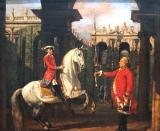
Classical dressage

Encyclopedia
Classical dressage evolved from cavalry
movements and training for the battlefield, and has since developed into the competitive dressage
seen today. Classical riding is the art of riding in harmony with, rather than against, the horse.
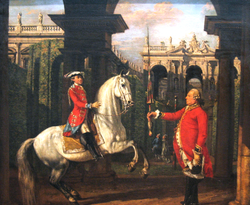 Correct classical riding only occurs when the rider has a good seat and a correct and well-balanced body position, moves with the horse's motion, and gives and times the aids correctly.
lie in the natural ability of the horse and its movements in the wild. In fact, most modern definitions of dressage state that the goal is to have the horse perform under saddle with the degree of athleticism and grace that it naturally shows when free.
Horses naturally use the concept of collection when playing, fighting, competing and courting with each other. When trying to impress other horses they make themselves look bigger, just as other animals do. They achieve this by lifting the forehand, raising the neck and making it bigger by flexing the poll, while at the same time transforming their gaits
to emphasize more upwards movement. When fighting, the horse will collect because in collection he can produce lightning speed reactions for kicking, rearing
, spinning, striking with the front feet, bucking
and jumping.
This natural ability to collect is visible in every horse of any breed, and probably inspired early trainers to reproduce that kind of behavior in more controlled circumstances. This origin also points out why, according to most Classical dressage trainers, every healthy horse, regardless of its breed, can perform classical dressage movements, including the Haute Ecole jumps, or Airs above the ground, even though it may perform them a little differently from the ideal performance due to the build of its body.
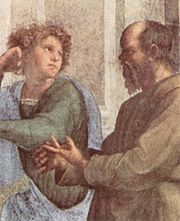 The earliest surviving work on many of the principles of classical dressage was Xenophon's On Horsemanship
. Xenophon
emphasized training the horse through kindness and reward.
In the 15th century, brute force training largely came to an end while artistry in riding was once again coming into its own. Along with these developments came indoor riding. The Renaissance
gives rise to a new and enlightened approach to riding as a part of the general cultivation of the arts. By the Victorian age indoor riding had become a sophisticated art, with both rider and horse
spending many years perfecting their form. Gueriniere, Eisenberg, Andrade and Marialva write treatises on technique and theory.
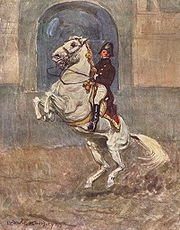
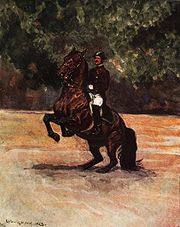
The horses were trained for a number of airs or schools, above the ground movements that enabled their riders to escape if surrounded, or to fight more easily. These included movements such as levade, capriole, courbette
, and ballotade. Movements still seen today in dressage include the piaffe
, passage
, and half-pass
.
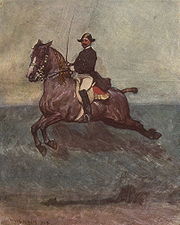
 Modern dressage
evolved from the classical school, although it is seen in a slightly different form than its ancestor. Competitive dressage is an international sport ranging from beginner levels to the Olympics. Unlike classical dressage, competitive dressage does not require the aires above ground, which most horses cannot perform well even with correct training, due to physical limitations. Instead, competitive dressage focuses on movements such as the piaffe
, passage
, half-pass
, extended trot
, pirouette
, and tempi changes.
In theory, competitive dressage should follow the same principles as classical dressage. However, there has been criticism by some riders for the trend at all levels for "quick fixes" and incorrect training that makes the horse appear correct, but that is in fact neglecting the basics. Classical riders criticize such training methods on the grounds that they are biomechanically incompatible with correct movement, are painful to the horse, and cause long-term physical damage. These short-cuts usually catch up to the rider as they move up the levels and need to be correct to perform certain movements. While these modern methods, such as the highly controversial rollkur
technique, produce winning animals, classical dressage riders argue that such training is theoretically incorrect and even abusive.
It is also believed by some that competitive dressage does not always reward the most correctly trained horse and rider, especially at the lower levels. For example, some riders who consider themselves to be training classically would not ask their horse to hold his head near-vertical when he first began training, and this would be penalized at the lower levels of competitive dressage, marked down because the horse is not considered to be correctly on the bit. Other riders, who also would consider themselves classically trained, would disagree, saying that if a horse is not ready to travel in a correct outline (on the bit) he is not ready for competition, and this is the reason such horses would be marked down.
The purest form of classical riding, as well as dressage
, High School dressage, of Haute Ecole, takes years for both the horse and rider to master. When a horse is advanced in its training, it can perform not only Grand Prix dressage movements such as collected and extended gaits, passage
and piaffe
, but some can also perform certain "Airs Above the Ground," although usually a horse will only be trained in one air, and only if they are particularly able.
, capriole, levade, and ballotade. Though these movements are said to come from when the horse was used in war, in their modern form, it is unlikely the airs were used in actual battle, as all but the Capriole expose the horse's sensitive underbelly to the weapons of foot soldiers
, and it is more likely that they were training exercises used off the battlefield.
The courbette is a movement where the horse balances on its hindlegs and jumps, keeping its forelegs off the ground, thus it "hops" on its hindlegs.
The capriole is a movement where the horse leaps into the air and pulls his forelegs in towards his chest at the height of elevation, while kicking out with his hindlegs.
The levade is a movement where the horse is balanced on its haunches at a 45 degree angle from the ground. It requires great control and balance, and is very strenuous.
There are two main breeds that are most well known for their abilities for airs above ground: the Lipizzaner and the Andalusian
. Other breeds that are known for their abilities in High School dressage include the Friesian
and Lusitano
.
The Spanish Riding School
in Vienna
, as well as the Cadre Noir
in Saumur
, still practice and teach the Haute Ecole. The Spanish Riding School exclusively uses Lipizzan
stallions for their work.
Today the only remaining large schools of classical dressage are the Cadre Noir
, the Spanish Riding School
, the Royal Andalusian School of Equestrian Art
in Jerez de la Frontera
, the Portuguese School of Equestrian Art in Lisbon
and the South African Lipizzaners
in South Africa
. There are independent classical dressage trainers who also endeavor to keep this branch of the art alive, including the Portuguese
riding master Nuno Oliveira
and his students, Bent Branderup and the American clinicians, Paul Belasik
and Dr. Thomas Ritter.
Cavalry
Cavalry or horsemen were soldiers or warriors who fought mounted on horseback. Cavalry were historically the third oldest and the most mobile of the combat arms...
movements and training for the battlefield, and has since developed into the competitive dressage
Dressage
Dressage is a competitive equestrian sport, defined by the International Equestrian Federation as "the highest expression of horse training." Competitions are held at all levels from amateur to the World Equestrian Games...
seen today. Classical riding is the art of riding in harmony with, rather than against, the horse.
Natural abilities of the horse
The origins of classical dressage and collectionCollection (horse)
Collection is when a horse carries more weight on his hindlegs than his front legs. The horse draws the body in upon itself so that it becomes like a giant spring whose stored energy can be reclaimed for fighting or running from a predator...
lie in the natural ability of the horse and its movements in the wild. In fact, most modern definitions of dressage state that the goal is to have the horse perform under saddle with the degree of athleticism and grace that it naturally shows when free.
Horses naturally use the concept of collection when playing, fighting, competing and courting with each other. When trying to impress other horses they make themselves look bigger, just as other animals do. They achieve this by lifting the forehand, raising the neck and making it bigger by flexing the poll, while at the same time transforming their gaits
Horse gait
Horse gaits are the various ways in which a horse can move, either naturally or as a result of specialized training by humans.-Classification:...
to emphasize more upwards movement. When fighting, the horse will collect because in collection he can produce lightning speed reactions for kicking, rearing
Rear (horse)
Rearing occurs when a horse or other equid "stands up" on its hind legs with the forelegs off the ground. Rearing may be linked to fright, aggression, excitement, disobedience, or pain. It is not uncommon to see stallions rearing in the wild when they fight, while striking at their opponent with...
, spinning, striking with the front feet, bucking
Bucking
Bucking is a movement performed by a horse or bull in which the animal lowers his head and raises his hindquarters into the air, usually while kicking out with his hind legs. If powerful, it may unseat the rider enough so that he falls off....
and jumping.
This natural ability to collect is visible in every horse of any breed, and probably inspired early trainers to reproduce that kind of behavior in more controlled circumstances. This origin also points out why, according to most Classical dressage trainers, every healthy horse, regardless of its breed, can perform classical dressage movements, including the Haute Ecole jumps, or Airs above the ground, even though it may perform them a little differently from the ideal performance due to the build of its body.
A history of classical dressage
On Horsemanship (Xenophon)
On Horsemanship is the English title usually given to , peri hippikēs, one of the two treatises on horsemanship by the Athenian historian and soldier Xenophon . Other common titles for this work are De equis alendis and The Art of Horsemanship...
. Xenophon
Xenophon
Xenophon , son of Gryllus, of the deme Erchia of Athens, also known as Xenophon of Athens, was a Greek historian, soldier, mercenary, philosopher and a contemporary and admirer of Socrates...
emphasized training the horse through kindness and reward.
In the 15th century, brute force training largely came to an end while artistry in riding was once again coming into its own. Along with these developments came indoor riding. The Renaissance
Renaissance
The Renaissance was a cultural movement that spanned roughly the 14th to the 17th century, beginning in Italy in the Late Middle Ages and later spreading to the rest of Europe. The term is also used more loosely to refer to the historical era, but since the changes of the Renaissance were not...
gives rise to a new and enlightened approach to riding as a part of the general cultivation of the arts. By the Victorian age indoor riding had become a sophisticated art, with both rider and horse
Horse
The horse is one of two extant subspecies of Equus ferus, or the wild horse. It is a single-hooved mammal belonging to the taxonomic family Equidae. The horse has evolved over the past 45 to 55 million years from a small multi-toed creature into the large, single-toed animal of today...
spending many years perfecting their form. Gueriniere, Eisenberg, Andrade and Marialva write treatises on technique and theory.
The horses were trained for a number of airs or schools, above the ground movements that enabled their riders to escape if surrounded, or to fight more easily. These included movements such as levade, capriole, courbette
Courbette
Courbette may refer to:* One of the Airs above the ground or school jumps performed by horses in classical dressage* Courbette, a commune of the Jura département of France...
, and ballotade. Movements still seen today in dressage include the piaffe
Piaffe
The piaffe[p] is a dressage movement where the horse is in a highly collected and cadenced trot, in place or nearly in place. The center of gravity of the horse should be more towards the hind end, with the hindquarters slightly lowered and great bending of the joints in the hind legs...
, passage
Passage (dressage)
The passage is a movement seen in upper-level dressage, in which the horse performs a highly elevated and extremely powerful trot. The horse is very collected and moves with great impulsion....
, and half-pass
Half-pass
The half-pass is a lateral movement seen in dressage, in which the horse moves forward and sideways at the same time. Unlike the easier leg-yield, the horse is bent in the direction of travel, slightly around the rider's inside leg. The outside hind and forelegs should cross over the inside legs,...
.
Classical dressage vs. competitive dressage
Dressage
Dressage is a competitive equestrian sport, defined by the International Equestrian Federation as "the highest expression of horse training." Competitions are held at all levels from amateur to the World Equestrian Games...
evolved from the classical school, although it is seen in a slightly different form than its ancestor. Competitive dressage is an international sport ranging from beginner levels to the Olympics. Unlike classical dressage, competitive dressage does not require the aires above ground, which most horses cannot perform well even with correct training, due to physical limitations. Instead, competitive dressage focuses on movements such as the piaffe
Piaffe
The piaffe[p] is a dressage movement where the horse is in a highly collected and cadenced trot, in place or nearly in place. The center of gravity of the horse should be more towards the hind end, with the hindquarters slightly lowered and great bending of the joints in the hind legs...
, passage
Passage (dressage)
The passage is a movement seen in upper-level dressage, in which the horse performs a highly elevated and extremely powerful trot. The horse is very collected and moves with great impulsion....
, half-pass
Half-pass
The half-pass is a lateral movement seen in dressage, in which the horse moves forward and sideways at the same time. Unlike the easier leg-yield, the horse is bent in the direction of travel, slightly around the rider's inside leg. The outside hind and forelegs should cross over the inside legs,...
, extended trot
Trot
A trot is a type of symmetrical gait in animals.Trot may also refer to:*Trot , the specifics of trotting in horses*Trot , a genre of Korean pop music*Trot , a character from the Oz books of L...
, pirouette
Pirouette (dressage)
A Pirouette is a French word for the Ballet reference, "to whirl about."A pirouette is a two-track lateral movement asked of a horse in dressage, in which the animal makes a circle with its front end around a smaller circle made by the hind end...
, and tempi changes.
In theory, competitive dressage should follow the same principles as classical dressage. However, there has been criticism by some riders for the trend at all levels for "quick fixes" and incorrect training that makes the horse appear correct, but that is in fact neglecting the basics. Classical riders criticize such training methods on the grounds that they are biomechanically incompatible with correct movement, are painful to the horse, and cause long-term physical damage. These short-cuts usually catch up to the rider as they move up the levels and need to be correct to perform certain movements. While these modern methods, such as the highly controversial rollkur
Rollkur
Rollkur or hyperflexion of the horse's neck is a practice in equestrianism defined as "flexion of the horse's neck achieved through aggressive force" and is banned by the world governing body, the International Federation for Equestrian Sports...
technique, produce winning animals, classical dressage riders argue that such training is theoretically incorrect and even abusive.
It is also believed by some that competitive dressage does not always reward the most correctly trained horse and rider, especially at the lower levels. For example, some riders who consider themselves to be training classically would not ask their horse to hold his head near-vertical when he first began training, and this would be penalized at the lower levels of competitive dressage, marked down because the horse is not considered to be correctly on the bit. Other riders, who also would consider themselves classically trained, would disagree, saying that if a horse is not ready to travel in a correct outline (on the bit) he is not ready for competition, and this is the reason such horses would be marked down.
The purest form of classical riding, as well as dressage
Dressage
Dressage is a competitive equestrian sport, defined by the International Equestrian Federation as "the highest expression of horse training." Competitions are held at all levels from amateur to the World Equestrian Games...
, High School dressage, of Haute Ecole, takes years for both the horse and rider to master. When a horse is advanced in its training, it can perform not only Grand Prix dressage movements such as collected and extended gaits, passage
Passage (dressage)
The passage is a movement seen in upper-level dressage, in which the horse performs a highly elevated and extremely powerful trot. The horse is very collected and moves with great impulsion....
and piaffe
Piaffe
The piaffe[p] is a dressage movement where the horse is in a highly collected and cadenced trot, in place or nearly in place. The center of gravity of the horse should be more towards the hind end, with the hindquarters slightly lowered and great bending of the joints in the hind legs...
, but some can also perform certain "Airs Above the Ground," although usually a horse will only be trained in one air, and only if they are particularly able.
The School Jumps
The "high school" or haute ecole school jumps, popularly known as the "airs above the ground," include the courbetteCourbette
Courbette may refer to:* One of the Airs above the ground or school jumps performed by horses in classical dressage* Courbette, a commune of the Jura département of France...
, capriole, levade, and ballotade. Though these movements are said to come from when the horse was used in war, in their modern form, it is unlikely the airs were used in actual battle, as all but the Capriole expose the horse's sensitive underbelly to the weapons of foot soldiers
Infantry
Infantrymen are soldiers who are specifically trained for the role of fighting on foot to engage the enemy face to face and have historically borne the brunt of the casualties of combat in wars. As the oldest branch of combat arms, they are the backbone of armies...
, and it is more likely that they were training exercises used off the battlefield.
The courbette is a movement where the horse balances on its hindlegs and jumps, keeping its forelegs off the ground, thus it "hops" on its hindlegs.
The capriole is a movement where the horse leaps into the air and pulls his forelegs in towards his chest at the height of elevation, while kicking out with his hindlegs.
The levade is a movement where the horse is balanced on its haunches at a 45 degree angle from the ground. It requires great control and balance, and is very strenuous.
There are two main breeds that are most well known for their abilities for airs above ground: the Lipizzaner and the Andalusian
Andalusian horse
The Andalusian, also known as the Pure Spanish Horse or PRE , is a horse breed developed in the Iberian Peninsula. Its ancestors have been present on the Iberian Peninsula for thousands of years. The Andalusian has been recognized as an individual breed since the 15th century, and its conformation...
. Other breeds that are known for their abilities in High School dressage include the Friesian
Friesian horse
The Friesian is a horse breed originating in Friesland, Netherlands. Although the breed's conformation resembles that of a light draft horse, Friesians are graceful and nimble for their size. During the Middle Ages, it is believed that the ancestors of Friesian horses were in great demand as war...
and Lusitano
Lusitano
The Lusitano is a Portuguese horse breed, closely related to the Spanish Andalusian horse. Both are sometimes called Iberian horses, as the breeds both developed on the Iberian peninsula, and until the 1960s they were considered one breed, under the Andalusian name...
.
The Spanish Riding School
Spanish Riding School
The Spanish Riding School of Vienna, Austria, is a traditional riding school for Lipizzan horses, which perform in the Winter Riding School in the Hofburg...
in Vienna
Vienna
Vienna is the capital and largest city of the Republic of Austria and one of the nine states of Austria. Vienna is Austria's primary city, with a population of about 1.723 million , and is by far the largest city in Austria, as well as its cultural, economic, and political centre...
, as well as the Cadre Noir
Cadre Noir
The Cadre Noir is an equestrian display team based in the city of Saumur in western France. The troop was founded in 1828, and gets its name from the black uniforms that are still used today...
in Saumur
Saumur
Saumur is a commune in the Maine-et-Loire department in western France.The historic town is located between the Loire and Thouet rivers, and is surrounded by the vineyards of Saumur itself, Chinon, Bourgueil, Coteaux du Layon, etc...
, still practice and teach the Haute Ecole. The Spanish Riding School exclusively uses Lipizzan
Lipizzan
The Lipizzan or Lipizzaner , is a breed of horse closely associated with the Spanish Riding School of Vienna, Austria, where the finest representatives demonstrate the haute école or "high school" movements of classical dressage, including the highly controlled, stylized jumps and other movements...
stallions for their work.
Today the only remaining large schools of classical dressage are the Cadre Noir
Cadre Noir
The Cadre Noir is an equestrian display team based in the city of Saumur in western France. The troop was founded in 1828, and gets its name from the black uniforms that are still used today...
, the Spanish Riding School
Spanish Riding School
The Spanish Riding School of Vienna, Austria, is a traditional riding school for Lipizzan horses, which perform in the Winter Riding School in the Hofburg...
, the Royal Andalusian School of Equestrian Art
Royal Andalusian School of Equestrian Art
The Royal Andalusian School of Equestrian Art is an institution in Jerez de la Frontera, Spain, devoted to conserving the ancestral abilities of the Andalusian horse, maintaining the classical traditions of Spanish baroque horsemanship, preparing horses and riders for international dressage...
in Jerez de la Frontera
Jerez de la Frontera
Jerez de la Frontera is a municipality in the province of Cádiz in the autonomous community of Andalusia, in southwestern Spain, situated midway between the sea and the mountains. , the city, the largest in the province, had 208,896 inhabitants; it is the fifth largest in Andalusia...
, the Portuguese School of Equestrian Art in Lisbon
Lisbon
Lisbon is the capital city and largest city of Portugal with a population of 545,245 within its administrative limits on a land area of . The urban area of Lisbon extends beyond the administrative city limits with a population of 3 million on an area of , making it the 9th most populous urban...
and the South African Lipizzaners
South African Lipizzaners
The South African Lipizzaners is the name of a riding academy that operates according to the classical model in Kyalami, Midrand , South Africa. In contrast to other classical riding schools, only women ride and train the 40 Lipizzaner stallions. Public performances take place every week on Sundays...
in South Africa
South Africa
The Republic of South Africa is a country in southern Africa. Located at the southern tip of Africa, it is divided into nine provinces, with of coastline on the Atlantic and Indian oceans...
. There are independent classical dressage trainers who also endeavor to keep this branch of the art alive, including the Portuguese
Portugal
Portugal , officially the Portuguese Republic is a country situated in southwestern Europe on the Iberian Peninsula. Portugal is the westernmost country of Europe, and is bordered by the Atlantic Ocean to the West and South and by Spain to the North and East. The Atlantic archipelagos of the...
riding master Nuno Oliveira
Nuno Oliveira
Nuno Oliveira is widely acknowledged as a master of the art of dressage.Nuno was born in Lisbon on June 23, 1925. He studied riding under Joaquim Goncalves de Miranda, in the style of the riding academy of Versailles. A great teacher, he possessed a near-encyclopedic knowledge of equestrian theory...
and his students, Bent Branderup and the American clinicians, Paul Belasik
Paul Belasik
Paul Belasik is a horse trainer and clinician in the classical dressage tradition. A student of Nuno Oliveira and H.L.M van Schaik, he is also a graduate of Cornell University and has competed in dressage at the international level. He has written several books on dressage, and his work is...
and Dr. Thomas Ritter.
Dressage masters and authors
- XenophonXenophonXenophon , son of Gryllus, of the deme Erchia of Athens, also known as Xenophon of Athens, was a Greek historian, soldier, mercenary, philosopher and a contemporary and admirer of Socrates...
(427-355 BC): Greek general, the earliest European master with surviving treatises, wrote On Horsemanship which advocated the use of sympathetic training of the horse. Despite living over 2000 years ago, his ideas are still widely praised - Federico GrisoneFederico GrisoneFederico Grisone was a Neapolitan nobleman and one of the first masters of dressage and courtly riding. Referred to in his time as the "father of the art of equitation", he wrote the first book on this subject to be published in early modern Europe....
(mid-16th century): one of the few to write on horsemanship to that point since Xenophon. Was considered a master of his time; his methods are viewed as harsh and cruel by modern standards - Giovanni Battista PignatelliGiovanni Battista PignatelliGiovanni Battista Pignatelli was an early sixteenth-century Italian riding master who had influence on horse training and dressage during his time. Taught by Federico Grisone in Naples, Pignatelli inherited his mentor's cruel methods...
(mid- to late-16th century) - Salomon de La Broue (1530–1610)
- Antoine de PluvinelAntoine de PluvinelAntoine de Pluvinel was the first of the French riding masters, and has had great influence on modern dressage. He wrote L’Instruction du Roy en l’exercice de monter à cheval , was tutor to King Louis XIII, and is credited with the invention of using two pillars, as well as using shoulder-in to...
(1555–1620): the first of the French riding masters, author of L’Instruction du Roy en l’Exercise de Monter a Cheval, tutor to King Louis XIII, and is the first notable writer to advocate for gentle training since Xenophon - William Cavendish, 1st Duke of NewcastleWilliam Cavendish, 1st Duke of NewcastleWilliam Cavendish, 1st Duke of Newcastle-upon-Tyne KG KB PC was an English polymath and aristocrat, having been a poet, equestrian, playwright, swordsman, politician, architect, diplomat and soldier...
(1592–1676): Master of Horse to Charles II of England - François Robichon de La GuérinièreFrancois Robichon de la GueriniereFrançois Robichon de La Guérinière was a French riding master who had a profound effect on accepted method for correct training of the horse, and is one of the most influential riders on the art of dressage.-History:...
(1688–1751): taught the classical position still used today, introduced the flying change, and had great impact on the Spanish Riding SchoolSpanish Riding SchoolThe Spanish Riding School of Vienna, Austria, is a traditional riding school for Lipizzan horses, which perform in the Winter Riding School in the Hofburg... - François BaucherFrancois BaucherA "baucher" is also a type of bit, named after the man.François Baucher was a French riding master whose methods are still hotly debated by dressage enthusiasts today. His methods diverge from those of many earlier masters, but he still has a strong following of riders and trainers today...
(1796–1873): introduced the one-tempi flying change, his method, which is still hotly contested, was based on the fact that the horse's jaw is the source of all resistance; there are two 'manners' by which Baucher is known, the first a more dominant form of riding comparable to the modern rollkurRollkurRollkur or hyperflexion of the horse's neck is a practice in equestrianism defined as "flexion of the horse's neck achieved through aggressive force" and is banned by the world governing body, the International Federation for Equestrian Sports...
, the second more associated with 'lightness' and a lessening of the hands and legs as the horse progresses - Count Antoine Cartier D'AureCount Antoine Cartier D'AureCount Antoine Cartier d'Aure was a riding master in France.Antoine Henri Philippe Léon Cartier d'Aure was born in Toulouse, southwest France. He graduated from the Military Academy, St Cyr. In 1817, he joined the "Grand Stable" of the Palace of Versailles, which was under the direction of...
(1799-1863) - James FillisJames FillisJames Fillis was a well-known English-born French riding master. He attended the school of Francois Baucher in France, and introduced his methods to his home country. He taught for 12 years as Ecuyer en chef of the St. Petersburg Cavalry Riding School...
- Gustav SteinbrechtGustav SteinbrechtGustav Steinbrecht is considered one of the masters of dressage. His advice to ride the horse "forward and straight" is one of the foundation principles of German dressage training.- Biography :...
(1808–1885) - Maximilian WeyrotherMaximilian WeyrotherMax Ritter von Weyrother was Chief Rider of the Spanish Riding School in Vienna from 1813, and Director from 1814 to 1833.His grandfather, Adam Weyrother, a previous Chief Rider at the school, may have known de la Guérinière in Paris. Adam Weyrother traveled to Paris frequently...
director of the Spanish Riding School - Alois PodhajskyAlois PodhajskyColonel Alois Podhajsky was the director of the Spanish Riding School in Vienna, Austria as well as an Olympic medal-winner in dressage, riding instructor, and writer.-Career:...
(1898–1973): became director of the Spanish Riding School in 1939; his books in English translation form the basis of Classical Dressage today - Nuno OliveiraNuno OliveiraNuno Oliveira is widely acknowledged as a master of the art of dressage.Nuno was born in Lisbon on June 23, 1925. He studied riding under Joaquim Goncalves de Miranda, in the style of the riding academy of Versailles. A great teacher, he possessed a near-encyclopedic knowledge of equestrian theory...
- Egon von Neindorff (dressage)Egon von Neindorff (dressage)Egon von Neindorff had a Riding Institution at Karlsruhe, Germany, where he trained horses and taught dressage. He was a world famous teacher and his methods are the standard for the German School. One of his famous students is Erik Herbermann, author of the Dressage Formula...
(1923–2004): author of The Art of Classical Horsemanship