
All Topics  
Femme fatale

 
Femme Fatale

   Email Print
   Bookmark   Link


Femme fatale


A femme fatale (plural: femmes fatales) (pronunciation , FAHM faTAHL, not the faux French FEHM) is an alluring and seductive
Seduction

In sociology, seduction is the process of deliberately enticing a person to engage in some sort of behavior, frequently sexual in nature. The word seduction stems from Indo-European roots and means literally "to lead astray." As a result, the term may have a positive or negative connotation....
 woman whose charms ensnare her lovers in bonds of irresistible desire, often leading them into compromising, dangerous, and deadly situations. She is an archetypal character of literature and art. Her ability to entrance and hypnotize her male victim was in the earliest stories seen as being literally supernatural, hence the most prosaic femme fatale today is still described as having a power akin to an enchantress, vampire, female monster or demon.

The phrase is French
French language

French is a Romance language spoken around the world by around 80 million people as first language, by 190 million as second language, and by about another 200 million people as an acquired tongue, with significant speakers in 54 countries....
 for "deadly woman".


Discussion
Ask a question about 'Femme fatale'
Start a new discussion about 'Femme fatale'
Answer questions from other users
Full Discussion Forum


Recent Posts


Encyclopedia


A femme fatale (plural: femmes fatales) (pronunciation , FAHM faTAHL, not the faux French FEHM) is an alluring and seductive
Seduction

In sociology, seduction is the process of deliberately enticing a person to engage in some sort of behavior, frequently sexual in nature. The word seduction stems from Indo-European roots and means literally "to lead astray." As a result, the term may have a positive or negative connotation....
 woman whose charms ensnare her lovers in bonds of irresistible desire, often leading them into compromising, dangerous, and deadly situations. She is an archetypal character of literature and art. Her ability to entrance and hypnotize her male victim was in the earliest stories seen as being literally supernatural, hence the most prosaic femme fatale today is still described as having a power akin to an enchantress, vampire, female monster or demon.

The phrase is French
French language

French is a Romance language spoken around the world by around 80 million people as first language, by 190 million as second language, and by about another 200 million people as an acquired tongue, with significant speakers in 54 countries....
 for "deadly woman". A femme fatale tries to achieve her hidden purpose by using feminine wiles such as beauty, charm, and sexual allure. Typically, she is exceptionally well-endowed with these qualities. In some situations, she uses lying or coercion rather than charm. She may also be (or imply to be) a victim, caught in a situation from which she cannot escape; The Lady from Shanghai
The Lady from Shanghai

The Lady from Shanghai is a black-and-white film noir directed by Orson Welles and starring Welles, his then-estranged wife Rita Hayworth, and Everett Sloane....
 (a 1948 film noir
Film noir

Film noir is a film term used primarily to describe stylish cinema of the United States Crime film, particularly those that emphasize moral ambiguity and sexual motivation....
) giving one such example. Her characteristic weapon, if needed, is frequently poison
Poison

In the context of biology, poisons are Chemical substance that can cause disturbances to organisms, usually by chemical reaction or other activity on the molecular scale, when a sufficient quantity is absorbed by an organism....
, which also serves as a metaphor for her charms.

Although typically villainous, femmes fatales have also appeared as antiheroines in some stories, and some even repent and become heroines by the end of the tale. In social life, the femme fatale tortures her lover in an asymmetrical relationship, denying confirmation of her affection. She usually drives him to the point of obsession and exhaustion so that he is incapable of making rational decisions.

History


Mythology

The femme fatale archetype exists, in the folklore and myth of nearly every culture in every century. The early examples are Ishtar
Ishtar

Ishtar is the Assyrian and Babylonian counterpart to the Mesopotamian mythology Inanna and to the cognate northwest Semitic goddess Astarte....
, the Sumer
Sumer

Sumer was a civilization and a historical region located in Southern Iraq , known as the Cradle of civilization. It lasted from the first settlement of Eridu in the Ubaid period through the Uruk period and the Dynastic periods until the rise of Babylon in the early 2nd millennium BC....
ian goddess, and Eve
Eve

Eve is the first woman created by God in the Book of Genesis.Eve may also refer to:...
, Lilith
Lilith

Lilith is a mythology female Mesopotamian storm demon associated with wind and was thought to be a bearer of disease, illness, and death. The figure of Lilith first appeared in a class of wind and storm demons or spirits as Lilitu, in Sumer, circa 4000 BC....
, Delilah
Delilah

Delilah appears only in the Hebrew Bible Book of Judges 16, where she is the "woman in the valley of Sorek" whom Samson loved, and who was his downfall....
, and Salome
Salome

Salome or Salom? the Daughter of Herodias , is known from the New Testament in connection with the death of John the Baptist. Another source from Antiquity, Flavius Josephus' Jewish Antiquities, gives her name and some detail about her family relations....
 from the Judaeo-Christian Bible. In ancient Greek literature, the femme fatale is incarnated by Aphrodite
Aphrodite

Aphrodite is the classical Greek mythology goddess of love, sex, and beauty. According to Greek oral poet Hesiod, she was born when Uranus was castrated by his son Cronus....
, the Siren
Siren

In Greek mythology, the Sirens were three dangerous bird-women, portrayed as seductresses, who lived on an island called Sirenum scopuli. In some later, rationalized traditions the literal geography of the "flowery" island of Anthemoessa, or Anthemusa, is fixed: sometimes on Cape Pelorum and at others in the Sirenusian islands near Paestum...
, the Sphinx
Sphinx

A sphinx is a zoomorphic mythological figure which is depicted as a recumbent lion with a human head. It has its origins in sculpted figures of Old Kingdom Ancient Egypt, to which the ancient Greeks applied their own name for a female monster, the "strangler", an archaic figure of Greek mythology....
, Scylla
Scylla

Scylla , also known as Scylle , was one of the two monsters in Greek mythology that lived on either side of a narrow channel of water. The two sides of the strait were within an arrow's range of each other?so close that sailors attempting to avoid Charybdis would pass too close to Scylla and vice versa....
, Circe
Circe

In Greek mythology, Circe , is a Queen goddess living on the island of Aeaea.Circe's father was Helios , the god of the sun and the owner of the land where Odysseus' men ate cattle, and her mother was Hecate the goddess of magic and the moon ; she was sister of two kings of Colchis, Aeetes and Perses, and of Pasipha?, mother of the Mino...
, Lamia (mythology)
Lamia (mythology)

In Greek mythology, Lamia was a Queen of Libya who became a child-murdering daemon . In later writings she is pluralized into many lamiae ....
, Helen of Troy, and Clytemnestra
Clytemnestra

Clytemnestra was the wife of Agamemnon, king of the Ancient Greece kingdom of Mycenae or Argos. In the Oresteia by Aeschylus, she was a femme fatale who murdered her husband, Agamemnon—said by Euripides to be her second husband—and his concubine Cassandra....
. Beside them is the historical figure Cleopatra, Queen of Egypt, with her ability to seduce the powerful men of Rome
Rome

Rome is the capital city of Italy and Lazio, and is Italy's largest and most populous city, with 2,724,347 residents in an urban area of some ....
. Roman propaganda
Propaganda

Propaganda is the dissemination of information aimed at influencing the opinions or behaviors of large numbers of people. As opposed to Objectivity providing information, propaganda in its most basic sense presents information in order to influence its audience....
 attacked Cleopatra as a femme fatale; as a result, she became the legendary archetype of the attractions and the dangers inherent to the powerful, exotic woman.

The femme fatale as an archetypal character also existed in Asia. In Chinese myths, stories and history, certain concubines (such as the historical Yang Guifei
Yang Guifei

Consort Yang Yuhuan , often known as Y?ng Gu?fei , known briefly by the Taoist nun name Taizhen , was one of the Four Beauties of ancient China....
) have been accused of being responsible in part for the weakening and downfall of dynasties, by seducing her lover into neglecting his duties or twisting him to her will.

Early Western culture to the 19th century

.]] In the Middle Ages, the idea of the dangers of female sexuality, typified by Eve
Eve (Bible)

Eve was, according to the Book of Genesis, the First man or woman created by God, and an important figure in Judaism, Christianity, and Islam. Her husband was Adam, from whose rib God created her to be his helpmate....
, was commonly expressed in medieval romances as a wicked, seductive enchantress, the prime example being Morgan le Fay
Morgan le Fay

Morgan le Fay, alternatively known as Morgane, Morgain, Morgana and other variants, is a powerful Magician and antagonist of King Arthur and Guinevere in the Arthurian legend....
.

The femme fatale flourished in the Romantic
Romanticism

Romanticism is a complex artistic, literary, and intellectual movement that originated in the second half of the 18th century in Western Europe, and gained strength during the Industrial Revolution....
 period in the works of John Keats
John Keats

John Keats was an England poetry who became one of the principal poets of the English Romanticism movement during the early nineteenth century....
, notably La Belle Dame sans Merci and Lamia. Along with them, there rose the gothic novel, The Monk
The Monk

Ambrosio, or the Monk is a Gothic fiction by Matthew Gregory Lewis, published in 1796. It was written before the author turned 20, in the space of 10 weeks....
 featuring Matilda, a very potent femme fatale. This led to her appearing in the work of Edgar Allan Poe
Edgar Allan Poe

Edgar Allan Poe was an American poet, Short story writer, Editing and Literary criticism, and is considered part of the American Romanticism. Best known for his tales of Mystery and the macabre, Poe was one of the earliest American practitioners of the short story and is considered the inventor of the Detective fiction genre....
, and as the vampiress, notably in Carmilla
Carmilla

"Carmilla" is a Gothic novel novella by Sheridan Le Fanu. First published in 1872, it tells the story of a young woman's susceptibility to the attentions of a female vampire named Carmilla....
 and Brides of Dracula
Brides of Dracula

For the 1960 Hammer film, see The Brides of DraculaThe Brides of Dracula are fictional characters in Bram Stoker's 1897 novel Dracula....
. The Monk was greatly admired by the Marquis de Sade
Marquis de Sade

Donatien Alphonse Fran?ois de Sade, Marquis de Sade was a France aristocrat, revolutionary and novelist. His novels were philosophical novel and sadomasochistic, exploring such controversial subjects as rape, bestiality and necrophilia....
, for whom the femme fatale symbolised not evil, but all the best qualities of Women, with his novel Juliette
L'Histoire de Juliette

Juliette is a novel written by the Marquis de Sade and published 1797 in literature?1801 in literature, accompanying Sade's Justine . Whilst Justine, Juliette's sister, was a virtue woman who consequently encountered nothing but despair and abuse, Juliette is an amoralism nymphomaniac who ends up successful and happy....
 being perhaps the earliest wherein the femme fatale triumphs. Pre-Raphaelite painters frequently used the classic personifications of the femme fatale as a subject.

In the Western culture of the late nineteenth and early twentieth centuries, the femme fatale became a more fashionable trope
Trope (literature)

A literary trope is a common pattern, theme , motif in literature, or a figure of speech in which words are used in a sense different from their literal meaning....
, and she is found in the paintings of the artists Edvard Munch
Edvard Munch

Edvard Munch was a Norway Symbolism Painting, printmaker, and an important forerunner of Expressionism. His best-known composition, The Scream is one of the pieces in a series titled The Frieze of Life, in which Munch explored the themes of life, love, fear, death, and melancholy....
, Gustav Klimt
Gustav Klimt

Gustav Klimt was an Austrian Symbolism and one of the most prominent members of the Vienna Art Nouveau movement. His major works include paintings, murals, Sketch , and other art objects, many of which are on display in the Vienna Secession gallery....
, Franz von Stuck and Gustave Moreau
Gustave Moreau

Gustave Moreau was a France Symbolist painters whose main focus was the illustration of Bible and mythological figures. As a painter of literary ideas rather than visual images, Moreau appealed to the imaginations of some Symbolism writers and artists, who saw him as a precursor to their movement....
. The novel À rebours
À rebours

? rebours is a novel by the French language novelist Joris-Karl Huysmans. It is a novel in which very little happens; its narrative concentrates almost entirely on its principal character, and is mostly a catalogue of the taste and inner life of Jean Des Esseintes, an eccentric, reclusive aesthete and antihero, who loathes 19th century...
 by Joris-Karl Huysmans
Joris-Karl Huysmans

Charles-Marie-Georges Huysmans was a French people novelist who published his works as Joris-Karl Huysmans; he is most famous for the novel ? rebours ....
 includes these fevered imaginings about an image of Salome in a Moreau painting:

No longer was she merely the dancing-girl who extorts a cry of lust and concupiscence from an old man by the lascivious contortions of her body; who breaks the will, masters the mind of a King by the spectacle of her quivering bosoms, heaving belly and tossing thighs; she was now revealed in a sense as the symbolic incarnation of world-old Vice, the goddess of immortal Hysteria, the Curse of Beauty supreme above all other beauties by the cataleptic spasm that stirs her flesh and steels her muscles, - a monstrous Beast of the Apocalypse, indifferent, irresponsible, insensible, poisoning.


In fin-de-siecle decadence, Oscar Wilde
Oscar Wilde

Oscar Fingal O'Flahertie Wills Wilde was an Irish people playwright, Irish poetry and author of numerous short stories and one novel. Known for his biting wit, he became one of the most successful playwrights of the late Victorian era in London, and one of the greatest Celebrity of his day....
 re-invented the femme fatale in the play Salome
Salome (play)

Salome is a tragedy by Oscar Wilde.The original 1891 version of the play was in French language. Three years later an English translation was published....
: she manipulates her lust-crazed uncle, King Herod, with her enticing Dance of the Seven Veils
Dance of the seven veils

In several notable works of Western culture, the Dance of the Seven Veils is one of the elaborations on the Bible tale of the execution of John the Baptist....
 (Wilde's invention) to agree to her imperious demand: bring me the head of John the Baptist
John the Baptist

John the Baptist was a mission preacher and a major religious figure who led a movement of baptism at the Jordan River in expectation of a divine apocalypse that would restore occupied Israel....
. Later, Salome was the subject of an opera by Strauss, was popularized on stage, screen, and peep-show booth in countless reincarnations.

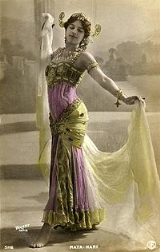
Another enduring icon of womanly glamour, seduction, and moral turpitude was Mata Hari
Mata Hari

Mata Hari was the stage name of Margaretha Geertruida "Grietje" Zelle , a the Netherlands-Frisians exotic dancer and courtesan who was Execution by firing squad for espionage during World War I....
, 1876 - 1917, an alluring oriental dancer who was accused of German espionage and was put to death by a French firing squad. As such, she embodied the femme fatale archetype, and, after her death she became the subject of much fantastical imagining. She was the subject of many sensational films and books.

20th century film, opera, etc

The femme fatale has been portrayed as a sexual vampiress; her charms leach the virility and independence of lovers, leaving them shells of themselves. Rudyard Kipling
Rudyard Kipling

Joseph Rudyard Kipling was an English author and poet. Born in Mumbai, British India , he is best known for his works of fiction The Jungle Book , Kim , many short stories, including The Man Who Would Be King ; and his poems, including Mandalay , Gunga Din , and If? ....
 was inspired by a vampiress painted by Philip Burne-Jones
Philip Burne-Jones

Sir Philip Burne-Jones, 2nd Baronet was the first child of the United Kingdom Pre-Raphaelite artist Sir Edward Burne-Jones. He became a well-known Painting in his own right, producing more than 60 paintings, including portraits, landscapes, and poetic fantasies....
, an image typical of the era in 1897, to write his poem "The Vampire". Like much of Kipling's verse it was incredibly popular, and its refrain: "A fool there was...", describing a seduced man, became the title of the popular 1915 film A Fool There Was that made Theda Bara
Theda Bara

Theda Bara , was an United States silent film actor. Bara was one of the most popular screen actresses of her era, and was one of cinema's earliest sex symbols....
 a star. The poem was used in the publicity for the film. On this account, in early American
American English

PhonologyIn many ways, compared to English language in England, North American English is conservative in its phonology. Some distinctive accents can be found on the East Coast of the United States , partly because these areas were in contact with England, and imitated prestigious varieties of English English at a time when those varieties we...
 slang
Slang

Slang is the use of highly informal words and expressions that are not considered standard in the speaker's dialect or language....
 the femme fatale was called a vamp, short for vampiress.

From the American film audience perspective, the femme fatale often was foreign, usually either of an indeterminate Eastern European or Asian ancestry. She was the sexual counterpart to wholesome actresses such as Lillian Gish
Lillian Gish

Lillian Diana Gish , was an United States stage, screen and television actor whose film acting career spanned 75 years, from 1912 to 1987. She was a prominent film star of the 1910s and 1920s, particularly associated with the films of director D.W....
 and Mary Pickford
Mary Pickford

Mary Pickford was an Academy Award-winning Canada film actor, as well as a co-founder of the film studio United Artists and one of the original 36 founders of the Academy of Motion Picture Arts and Sciences....
. Notable silent cinema vamps were Theda Bara, Helen Gardner
Helen Gardner (actress)

Helen Gardner was an American film actress, writer, editor, producer and costume designer.She was the first actor to form her own production company, the Helen Gardner Picture Players in 1912....
, Louise Glaum
Louise Glaum

Louise Glaum was an American actor. Best-known for her role as a femme fatale in silent film drama film, she was credited with giving one of the best characterizations of a wiktionary:vamp....
, Musidora
Musidora

Musidora was the stage name of Jeanne Roques, a popular French people silent film actress. She became famous for her vamp roles in such film serials as Les Vampires and Judex , in which she developed a persona comparable to that of Theda Bara....
, Nita Naldi
Nita Naldi

Nita Naldi was an United States silent film actress. One of the most successful actresses in Hollywood during the "Roaring Twenties", she was often cast in the role of the "femme fatale"/"Vamp_", a Stock character first popularized by actress Theda Bara....
, Pola Negri
Pola Negri

Pola Negri was a Poland film actress who achieved notoriety as a femme fatale in silent films between 1910s and 1930s.Personal life...
, and in her early appearances, Myrna Loy
Myrna Loy

Myrna Loy was an American actress. Trained as a dancer, but after a few minor roles in silent films, she devoted herself fully to an acting career, and from 1925 gradually established herself as a film actress....
.

During the film noir
Film noir

Film noir is a film term used primarily to describe stylish cinema of the United States Crime film, particularly those that emphasize moral ambiguity and sexual motivation....
 era of the 1940s and 1950s, the femme fatale flourished in American cinema. Examples include the overly-possessive and narcissistic wife Ellen Brent Harland, portrayed by Gene Tierney
Gene Tierney

Gene Tierney was an United States film and Theatre actor. Acclaimed as one of the great beauties of her day, she is best-remembered for her performance in the title role of Laura and her Academy Award-nominated performance for Academy Award for Best Actress in Leave Her to Heaven ....
, in Leave Her to Heaven
Leave Her to Heaven

Leave Her to Heaven is a 1945 in film 20th Century Fox color film noir film starring Gene Tierney, Cornel Wilde, Jeanne Crain, with Vincent Price, Darryl Hickman, and Chill Wills....
 (1945
1945 in film

The year 1945 in film involved some significant events....
), who will stop at nothing to keep her husband's affections. Another is Brigid O'Shaughnessy, portrayed by Mary Astor
Mary Astor

Mary Astor was an Academy Awards-winning United States actress. Most famous for her role as Brigid O'Shaughnessy in The Maltese Falcon opposite Humphrey Bogart, Astor began her long film career as a teenager in the silent films of the early 1920 in film....
, who uses her acting skills to murder Sam Spade's partner in The Maltese Falcon
The Maltese Falcon

The Maltese Falcon is a 1930 detective novel by Dashiell Hammett, originally serialized in the magazine "Black Mask ". The story has been adapted several times for the cinema....
. Yet another is the cabaret singer portrayed by Rita Hayworth
Rita Hayworth

Rita Hayworth , was an American actress who attained fame during the 1940s not only as one of the era's top musical stars, but also as the era's defining sex symbol, most notably in the 1946 film Gilda....
 in Gilda
Gilda

Gilda is a black-and-white film noir directed by Charles Vidor. It stars Glenn Ford and Rita Hayworth in her signature role as the ultimate femme fatale. The film was noted for cinematographer Rudolph Mate's lush photography, costume designer Jean Louis' sexy wardrobe for Hayworth , and choreographer Jack Cole's staging of "Put the...
 (1946
1946 in film

The year 1946 in film involved some significant events....
), who sexually manipulates her husband and his best friend. Another noir femme fatale is Phyllis Dietrichson
Phyllis Dietrichson

Phyllis Dietrichson is a fictional character James M. Cain's novella Double Indemnity . In the Double Indemnity , she was played by Barbara Stanwyck....
, played by Barbara Stanwyck
Barbara Stanwyck

Barbara Stanwyck was an United States actor, a star of film and television, known during her 60-year career as a consummate and versatile professional with a strong screen presence, and a favorite of directors such as Cecil B....
, who seduces a hapless insurance salesman and persuades him to kill her husband in Double Indemnity (1944
1944 in film

The year 1944 in film involved some significant events....
). In The Paradine Case
The Paradine Case

The Paradine Case is a Legal drama film, set in England, directed by Alfred Hitchcock and produced by David O. Selznick. The screenplay was written by Selznick and an uncredited Ben Hecht, from an adaptation by Alma Reville and James Bridie of the novel by Robert S....
, a Hitchcock
Hitchcock

Hitchcock may refer to people with the surname Hitchcock:* Alfred Hitchcock, film director* Billy Hitchcock* Carol Hitchcock* David Howard Hitchcock , American/Hawaiian artist...
 movie from 1947, the character played by Alida Valli
Alida Valli

Alida Valli , sometimes simply credited as Valli, was an Italian actress who appeared in over 100 films, including Carol Reed The Third Man and Luchino Visconti Senso ....
 is a poisonous femme fatale who is responsible for the deaths of two men and the near destruction of another. One often referred to example is the character of Jane in 1949's Too Late for Tears
Too Late for Tears

Too Late for Tears is a 1949 black-and-white film starring Lizabeth Scott and Dan Duryea. Scott and Duryea appeared in many films noir during this era; however, they only appeared in one other film together; the western Silver Lode ....
, played by Lizabeth Scott
Lizabeth Scott

Lizabeth Scott is an United States actor who achieved much success within the film noir genre, as well as other mainstream films and music....
. During her quest to keep some dirty money from its rightful recipient and her husband, she uses poison, lies, sexual teasing and a gun to keep men wrapped around her finger.

Other American cultural examples of deadly women occur in espionage
Espionage

Espionage or spying involves an individual obtaining information that is considered secrecy or confidential without the permission of the holder of the information....
 thrillers, and juvenile adventure
Adventure

An adventure is an activity that comprises risky, dangerous or uncertain experiences. The term is more popularly used in reference to physical activities that have some potential for danger, such as skydiving, mountain climbing, and extreme sports....
 comic strips, such as The Spirit
The Spirit

The Spirit is a Character appearing in the comic books published by DC Comics. Created by writer-artist Will Eisner, he first appeared in Spirit Section #1 ....
, by Will Eisner
Will Eisner

William Erwin Eisner was an acclaimed Jewish-American comics writer, artist and entrepreneur. He is considered one of the most important contributors to the development of the medium and is known for the cartooning studio he founded; for his highly influential series The Spirit; for his use of comics as an instructional medium; for his l...
, and Terry and the Pirates
Terry and the Pirates

Terry and the Pirates is the title of:* Terry and the Pirates , the comic strip created by Milton Caniff* Terry and the Pirates , a radio serial based on the comic strip...
, by Milton Caniff
Milton Caniff

Milton Arthur Paul Caniff was an United States cartoonist famous for the Terry and the Pirates and Steve Canyon comic strips....
. Today, she remains a key character in films such as Body Heat
Body Heat

Body Heat is a 1981 neo-noir film written and directed by Lawrence Kasdan. It stars William Hurt, Kathleen Turner, Richard Crenna, Ted Danson, J.A....
, with Kathleen Turner
Kathleen Turner

Mary Kathleen Turner , better known as Kathleen Turner, is a Tony Award- and Academy Award-nominated United States actress. She came to fame during the 1980s, after roles in the Hollywood films Body Heat, Romancing the Stone and Prizzi's Honor....
, The Last Seduction
The Last Seduction

The Last Seduction is a neo-noir 1994 in film film directed by John Dahl.The movie features Linda Fiorentino as the femme fatale, Peter Berg as a small town man whose one night affair turns into more than he wanted, and Bill Pullman as Fiorentino's husband who is chasing her and running from loan sharks at the same time....
, with Linda Fiorentino
Linda Fiorentino

Linda Fiorentino is an Italian-American actress. She is known for her roles in films such as Dogma , Vision Quest, Men in Black , Jade , After Hours and The Last Seduction....
, Fatal Attraction
Fatal Attraction

Fatal Attraction is a 1987 Thriller film about a married man who has a weekend affair with a woman who refuses to allow it to end and who becomes Obsession with him....
, with Glenn Close
Glenn Close

Glenn Close is an United States actress and singer of theatre and film, perhaps best known for her role as deranged stalker Alex Forrest in Fatal Attraction ....
, and Basic Instinct
Basic Instinct

Basic Instinct is a 1992 in film United States Thriller /neo-noir film, Film director by Paul Verhoeven and screenwriter by Joe Eszterhas, starring Sharon Stone, Michael Douglas, Jeanne Tripplehorn and George Dzundza....
, with Sharon Stone
Sharon Stone

Sharon Yvonne Stone is an United Statesn actress, film producer and former Model . She first acheived international recognition for her performance in the erotic thriller Basic Instinct....
.

In popular culture

In contemporary culture, the femme fatale survives as heroine and anti-heroine, in Nikita
Nikita

Nikita is a French films of 1990 France action film written and directed by Luc Besson....
 and Moulin Rouge!
Moulin Rouge!

Moulin Rouge! is a 2001 in film Cinema of Australia film by Baz Luhrmann, director of William Shakespeare's Romeo + Juliet, based largely on the Giuseppe Verdi opera La Traviata....
, as well as in video games and comic books. Elektra, a character from Marvel Comics
Marvel Comics

Marvel Comics is an American comic book and related media company owned by Marvel Publishing, Inc., a subsidiary of Marvel Entertainment, Inc. Marvel counts among as its List of Marvel Comics characters such well-known properties as Captain America, the Fantastic Four, the Hulk , Iron Man, Spider-Man, the X-Men, and many others....
, Fujiko Mine
Fujiko Mine

is a fictional character created by Monkey Punch, for his Lupin III series. Fujiko is Lupin's love interest. Lupin and Fujiko were never really lovers although occasionally Lupin scored with Fujiko, especially when the latter is dying to find out about a particular detail that Lupin knows....
 from Lupin the 3rd, Catwoman
Catwoman

Catwoman is a fictional character associated with DC Comics' Batman media franchise. The supervillainess was created by Bill Finger and Bob Kane, partially inspired by Kane's second cousin by marriage, Ruth Steel....
 and Poison Ivy from the Batman
Batman

Batman is a Character , a comic book superhero co-created by artist Bob Kane and writer Bill Finger , appearing in publications by DC Comics. The character first appeared in Detective Comics #27 in May 1939....
 stories, Rayne from Bloodrayne
BloodRayne

BloodRayne is a third-person Action-adventure game video game. In addition to a sequel, BloodRayne 2, Bloodrayne inspired two BloodRayne and a series of self-contained comic books....
 and EVA from Metal Gear Solid 3 are examples. The protagonists of the American television program Desperate Housewives
Desperate Housewives

Desperate Housewives is an American television comedy-drama series, created by Marc Cherry, who also serves as show runner, and produced by ABC Studios and Marc Cherry....
 use sexual allure to get what and whom they want. A modern example of the archetypal femme fatale is Xenia Onatopp, the character from Goldeneye
GoldenEye

GoldenEye is the seventeenth spy film in the James Bond James Bond , and the first to star Pierce Brosnan as the fictional character Secret Intelligence Service agent James Bond ....
 who seduced men and then murdered them by crushing them between her thighs.

The Velvet Underground

The Velvet Underground was an American Rock music band first active, in various incarnations, from 1965 to 1973. Their best-known members were Lou Reed and John Cale, who both went on to find success as solo artists....
 song "Femme Fatale", on the The Velvet Underground and Nico
The Velvet Underground and Nico

The Velvet Underground & Nico is the debut album by experimental rock band The Velvet Underground and vocal collaborator Nico. It was originally released in March 1967 by Verve Records....
 album, tells of a woman who will "play" a man "for a fool". Two songs, both titled "Poison", by Alice Cooper
Poison (Alice Cooper song)

Poison is a song by artist Alice Cooper co-written and produced by Desmond Child, released worldwide as a single in 1989 and is featured on his 18th studio album Trash ....
 and Bell Biv DeVoe
Poison (Bell Biv DeVoe song)

"Poison" is a 1990 single by the New Edition spinoff group, Bell Biv DeVoe. This song?in the style of New Jack Swing, a late-80s hybrid of R&B and hip hop music?was the group's most successful, and sings of the dangers of falling in love....
 respectively, tell of femme fatales.

L'homme fatal

Men who are fatal include Don Juan
Don Juan

Don Juan or Don Giovanni is a legendary, fictional libertine whose story has been told many times by many authors. El burlador de Sevilla y convidado de piedra, by Tirso de Molina, is a play set in the fourteenth century that was published in Spain around 1630....
, Heathcliff
Heathcliff (Wuthering Heights)

Heathcliff is a fictional character in the novel Wuthering Heights by Emily Bront?. Owing to the novel's enduring fame and popularity, Heathcliff is often regarded as an archetype of the tortured Romanticism Byronic hero whose all-consuming passion are powerful enough to destroy both himself and those around him....
 from Wuthering Heights
Wuthering Heights

Wuthering Heights is Emily Bront?'s only novel. It was first published in 1847 under the pseudonym Ellis Bell, and a posthumous second edition was edited by her sister Charlotte Bront?....
, most of the heroes in Lord Byron's books (termed the "Byronic hero
Byronic hero

The Byronic hero is an idealised but flawed fictional character exemplified in the life and writings of George Gordon Byron, 6th Baron Byron, characterised by his ex-lover Lady Caroline Lamb as being "mad, bad and dangerous to know"....
"), as well as such diverse characters as Billy Budd
Billy Budd (novella)

Billy Budd is a novella begun around 1886 by United States author Herman Melville, left unfinished at his death in 1891 and not published until 1924....
, Count Dracula
Count Dracula

Count Dracula is a fictional character, the titular Antagonist of Bram Stoker's 1897 Gothic horror novel Dracula. Some aspects of his character may have been inspired by the 15th century Romanians Prince, Vlad III the Impaler....
, Tadzio in Death in Venice
Death in Venice

The novella Death in Venice was written by the German author Thomas Mann, and was first published in 1912 as Der Tod in Venedig.. It was first published in English in 1925 as Death in Venice and Other Stories, translated by Kenneth Burke....
, Harthouse in Charles Dickens
Charles Dickens

Charles John Huffam Dickens, Royal Society of Arts , pen-name "Boz", was the most popular English people novelist of the Victorian era, as well as a vigorous Reform movement....
' Hard Times
Hard Times

Hard Times- For These Times. is a novel by Charles Dickens, first published in 1854. The book is a state-of-the-nation novel, which aimed to highlight the social and economic pressures that some people were experiencing....
, Georges Querelle
Georges Querelle

Georges "Jo" Querelle is the protagonist and antihero of Jean Genet's 1947 novel Querelle de Brest....
 in Jean Genet
Jean Genet

Jean Genet was a prominent and controversial France novelist, playwright, poet, essayist, and political activism. Early in his life he was a vagabond and petty criminal, but later took to writing....
's Querelle of Brest, Ian Fleming
Ian Fleming

Ian Lancaster Fleming was an English literature author and journalist. Fleming is best remembered for creating the character of James Bond and chronicling his adventures in twelve novels and nine short stories....
's James Bond
James Bond

James Bond 007 is a fictional character created in 1953 by writer Ian Fleming, who featured him in twelve novels and two short story collections....
, and Tom Ripley in Patricia Highsmith
Patricia Highsmith

Patricia Highsmith was an United States author known for her psychological thrillers, which have led to more than two dozen film adaptations. Strangers on a Train has been adapted for the screen three times, notably by Alfred Hitchcock in 1951....
's "Ripley" novels.

See also

  • Anatomy of a Murder
    Anatomy of a Murder

    Anatomy of a Murder is an Cinema of the United States trial court drama film directed by Otto Preminger and written by Wendell Mayes based on the best-selling novel of the same name written by Michigan Supreme Court Justice John D....
  • Dragon Lady (stereotype)
    Dragon Lady (stereotype)

    A Dragon Lady is a misogynistic stereotype of East Asian women as wicked, calculating and troublesome....
  • Girls with guns
    Girls with guns

    Girls with guns is a sub-genre of films and animation, especially Hong Kong action films and anime, with a female protagonist in a strong lead role, set in a Modern era context....
  • Gun moll
    Gun moll

    A gun moll is a female companion of male professional criminal, and in some contexts the term more specifically suggests that the gun moll handles a firearm....
  • Histrionic personality disorder
    Histrionic personality disorder

    Histrionic personality disorder is defined by the American Psychiatric Association as a personality disorder characterized by a pattern of excessive emotionality and attention-seeking, including an excessive need for approval and inappropriate seductiveness, usually beginning in early adulthood....
  • List of female supervillains
  • Male gaze
  • Succubus
    Succubus

    A Succubus is a demon who takes the form of a highly attractive woman to seduce men, in dreams to have sexual intercourse, according to the medieval European legend....
  • Warrior princess


Bibliography

  • Toni Bentley (2002) Sisters of Salome. Salome considered as an archetype of female desire and transgression and as the ultimate femme fatale.
  • Bram Dijkstra
    Bram Dijkstra

    Bram Dijkstra is a professor of English literature. He joined the faculty of the University of California, San Diego in 1966, and taught there until he retired and became an emeritus in 2000....
     (1986) Idols of Perversity: Fantasies of Feminine Evil in Fin-De-Siecle Culture, (1986) ISBN 0-19-505652-3. Discusses the Femme fatale-stereotype.
  • Bram Dijkstra (1996) Evil Sisters: The Threat of Female Sexuality in Twentieth-Century Culture, (1996) ISBN 0-8050-5549-5
  • Elizabeth K. Mix Evil By Design: The Creation and Marketing of the Femme Fatale, ISBN 978-0252073236. Discusses the origin of the Femme fatale in 19th century French popular culture.
  • Mario Praz
    Mario Praz

    Mario Praz was an Italy-born critic of art and literature, and a scholar of English literature. His best-known book, The Romantic Agony, was a comprehensive survey of the erotic and morbid themes that characterized European authors of the late 18th and 19th Centuries....
     (1951) The Romantic Agony. See chapters four, 'La Belle Dame Sans Merci', and five, 'Byzantium'.


External links