
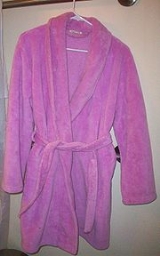
A
bathrobe,
dressing gown or
housecoat is a
robeA robe is a loose-fitting outer garment. A robe is distinguished from a cape or cloak by the fact that it usually has sleeves. The English word robe derives from Middle English robe , borrowed from Old French robe , itself taken from the Frankish word *rouba , and is related to the word rob...
. A bathrobe is usually made from towelling or other absorbent textile, and may be donned while the wearer's body is wet, serving both as a
towelA towel is a piece of absorbent fabric or paper used for drying or wiping. It draws moisture through direct contact, often using a blotting or a rubbing motion. Common household textile towels are made from cotton, rayon, bamboo, nonwoven fibers or a few other materials.-Types of towels:* A bath...
and an informal garment. A dressing gown (for men) or a housecoat (for women) is a loose, open-fronted
gownA gown is a loose outer garment from knee- to full-length worn by men and women in Europe from the early Middle Ages to the 17th century ; later, gown was applied to any woman's garment consisting of a bodice and attached skirt.A long, loosely-fitted gown called a Banyan was worn by men in the 18th...
closed with a fabric belt that is put on over
nightwearNightwear, also called "sleepwear", "sleeping suit", "nightclothes", or "nightdress", is clothing designed to be worn while sleeping. The style of nightwear worn may vary with the seasons, with eg. warmer styles being worn in colder conditions...
on rising from bed, or, less commonly today, worn over some day clothes when partially dressed or undressed in the morning or evening (for example, over a man's shirt and trousers without jacket and tie). The regular wearing of a dressing gown by men about the house is derived from the 18th-century wearing of the
banyanA banyan is a garment worn by men in the 18th century influenced by Persian and Asian clothing....
in
orientalistOrientalism is a term used for the imitation or depiction of aspects of Eastern cultures in the West by writers, designers and artists, as well as having other meanings...
imitation. The
JapaneseThe various traditional ethnic garments worn in Japan are still in use, they are mainly worn for ceremonies and special occasions- like weddings or festivals. Both men and women favor "western-style" clothing in their daily lives- due to the comparative convenience and the influx of global...
yukataA is a Japanese garment, a casual summer kimono usually made of cotton. People wearing yukata are a common sight in Japan at fireworks displays, bon-odori festivals, and other summer events. The yukata is also frequently worn after bathing at traditional Japanese inns...
is an unlined, cotton
kimonoThe is a Japanese traditional garment worn by men, women and children. The word "kimono", which literally means a "thing to wear" , has come to denote these full-length robes...
worn as a bathrobe or as summer outdoor clothing. Several styles of bathrobes are marketed to consumers, categorised by textile material and type of weave.
Styles of fabrics
Bathrobes are generally made of four different fabrics.
- Cotton: Cotton
Cotton is a soft, fluffy staple fiber that grows in a boll, or protective capsule, around the seeds of cotton plants of the genus Gossypium. The fiber is almost pure cellulose. The botanical purpose of cotton fiber is to aid in seed dispersal....
is a natural fibre consisting primarily of cellulose and is one of the most commonly used fibres in textile manufacturing. Due to the hydrophilicA hydrophile, from the Greek "water" and φιλια "love," is a molecule or other molecular entity that is attracted to, and tends to be dissolved by water. A hydrophilic molecule or portion of a molecule is one that has a tendency to interact with or be dissolved by, water and other polar substances...
nature of cellulose, cotton absorb water easily and are frequently used by the beach, pool, or following a shower. Cotton robes are especially suited to use in hot climates because cotton tends to absorb perspiration.
- Silk: Another common fabric used in robes is silk
Silk is a natural protein fiber, some forms of which can be woven into textiles. The best-known type of silk is obtained from the cocoons of the larvae of the mulberry silkworm Bombyx mori reared in captivity...
. Silk is a fine lustrous fibre composed mainly of fibroin and produced by the secretions of certain insect larvae (normally silkworms) forming strong, elastic, fibrous thread. These kinds of bathrobes can be relatively expensive due to the cost of producing silk. Such robes are very thin and lightweight. These bathrobes are not particularly suited to wet environments because they lack the surface area and polarity necessary to absorb water. However, silk dressing gowns are the traditional choice, since they are not worn after bathing.
- Microfibre: Microfibre
Microfiber or microfibre refers to synthetic fibers that measure less than one denier. The most common types of microfibers are made from polyesters, polyamides , and or a conjugation of polyester and polyamide.Microfiber is used to make non-woven, woven and knitted textiles...
is an extremely fine synthetic fibre, typically made of cellulose or polyester, that can be woven into textiles to mimic natural-fibre cloth. Modern microfibres are developed to maximise breathability and water absorption and can be thinner than the width of human hair. Much like silk, robes made out of microfibre are light in weight and are very soft to the touch. Microfibre is flammable.
- Wool: Wool
Wool is the textile fiber obtained from sheep and certain other animals, including cashmere from goats, mohair from goats, qiviut from muskoxen, vicuña, alpaca, camel from animals in the camel family, and angora from rabbits....
is common in colder climates.
- Nylon: Nylon
Nylon is a generic designation for a family of synthetic polymers known generically as polyamides, first produced on February 28, 1935, by Wallace Carothers at DuPont's research facility at the DuPont Experimental Station...
is a synthetic fiber occasionally used in inexpensive bathrobes. It is valued for its ability to be cleaned easily.
Styles of weave
Bathrobes are also categorised by their shape of weave.
- Flannel: Flannel
Flannel is a soft woven fabric, of various fineness. Flannel was originally made from carded wool or worsted yarn, but is now often made from either wool, cotton, or synthetic fibre. Flannel may be brushed to create extra softness or remain unbrushed. The brushing process is a mechanical process...
is a soft woven fabric, made from loosely spun yarn, usually cotton or wool.
- Terry: Terry
There are two types of terry fabrics# Towell Terry is a [woven] fabric with long loops that can absorb large amounts of water. Its content is usually 100% cotton, but may sometimes contain polyester....
is a pile fabric, usually woven of cotton, with uncut loops on both sides, used for bath towels and robes. The longer and denser the loops are, more absorbent the bathrobes are.
- Velour: Velour
Velour or velours is a plush, knitted fabric or textile. It is usually made from cotton but can also be made from synthetic materials such as polyester. Velour is used in a wide variety of applications, including clothing and upholstery....
is a fabric with cut loops. Velour bathrobes are typically made with terry inside, as terrycloth absorbs water better than velour. Velour gives the bathrobe luxury, coziness, and makes the garment softer to the touch.
- Waffle: Waffle fabric
Waffle, or sometimes honeycomb fabric is fabric, usually cotton or microfibre, woven in a way which makes it very absorbent. The waffle weave also allows air to flow through the towel so that it dries quickly....
is loose and has a distinctive "gridlike" appearance. For most part, these bathrobes are designed for their light weight. "Pique" is a type of waffle weave that can be applied to cotton, velour, silk, and other fabrics.
Styles of collars
There are varieties of collars for bathrobes as well.
- Shawl collar: So called because the collar closes about the neck just like a shawl. The shawl collar is borrowed from its use on men's evening wear, the dinner jacket and smoking jacket
A smoking jacket is an overgarment designed to be worn while smoking tobacco, usually in the form of pipes and cigars, or for domestic leisure.-Design:The classic smoking jacket is a mid thigh-length jacket made from velvet or silk, or both...
, and is common on traditional dressing gowns. The shawl collar gives a feeling of warmth and cosiness.
- Kimono: The kimono
The is a Japanese traditional garment worn by men, women and children. The word "kimono", which literally means a "thing to wear" , has come to denote these full-length robes...
style robe actually has no collar per se. It generally provides more comfort to the wearer in warm weather.
- Hooded: A hood is sewn into the neckline, which can be worn over the head to keep it warm and help dry wet hair.
Styles of sculpture
The sculpture refers to the texture or styling of the bathrobe's fabric. The sculpture of a robe not only provides aesthetic appeal, but also affects the absorbency and the hang of the item. The sculpture is a pattern sewn into the terry cloth, velour, or other fabric that reduces bulk, increases suppleness, and yields a more graceful hang on thicker styles. There are several varieties of fabric sculptures for robes:
- Window Pane: A box or checkerboard pattern in various sizes
- Zig Zag: A plush, repeating "Z" pattern
- Ribbed: A sculpture design that yields alternating vertical lines of plush material and sewn material
- Waves: Similar to the Zig Zag sculpture, but with gentler angles
Further reading