


Baldwin I of Constantinople

Encyclopedia
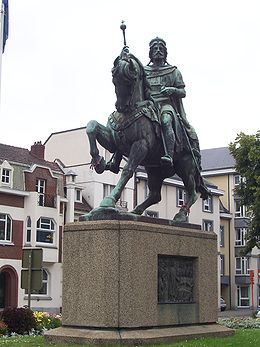
Latin Empire
The Latin Empire or Latin Empire of Constantinople is the name given by historians to the feudal Crusader state founded by the leaders of the Fourth Crusade on lands captured from the Byzantine Empire. It was established after the capture of Constantinople in 1204 and lasted until 1261...
of Constantinople
Constantinople
Constantinople was the capital of the Roman, Eastern Roman, Byzantine, Latin, and Ottoman Empires. Throughout most of the Middle Ages, Constantinople was Europe's largest and wealthiest city.-Names:...
, as Baldwin IX Count of Flanders
Count of Flanders
The Count of Flanders was the ruler or sub-ruler of the county of Flanders from the 9th century until the abolition of the position by the French revolutionaries in 1790....
and as Baldwin VI Count of Hainaut
County of Hainaut
The County of Hainaut was a historical region in the Low Countries with its capital at Mons . In English sources it is often given the archaic spelling Hainault....
, was one of the most prominent leaders of the Fourth Crusade
Fourth Crusade
The Fourth Crusade was originally intended to conquer Muslim-controlled Jerusalem by means of an invasion through Egypt. Instead, in April 1204, the Crusaders of Western Europe invaded and conquered the Christian city of Constantinople, capital of the Eastern Roman Empire...
, which resulted in the capture of Constantinople
Constantinople
Constantinople was the capital of the Roman, Eastern Roman, Byzantine, Latin, and Ottoman Empires. Throughout most of the Middle Ages, Constantinople was Europe's largest and wealthiest city.-Names:...
, the conquest of the greater part of the Byzantine Empire
Byzantine Empire
The Byzantine Empire was the Eastern Roman Empire during the periods of Late Antiquity and the Middle Ages, centred on the capital of Constantinople. Known simply as the Roman Empire or Romania to its inhabitants and neighbours, the Empire was the direct continuation of the Ancient Roman State...
(then called the "Empire of Romania" by westerners), and the foundation of the Latin Empire
Latin Empire
The Latin Empire or Latin Empire of Constantinople is the name given by historians to the feudal Crusader state founded by the leaders of the Fourth Crusade on lands captured from the Byzantine Empire. It was established after the capture of Constantinople in 1204 and lasted until 1261...
, also known as Romania (not to be confused with the modern state Romania
Romania
Romania is a country located at the crossroads of Central and Southeastern Europe, on the Lower Danube, within and outside the Carpathian arch, bordering on the Black Sea...
). He lost his final battle to Kaloyan
Kaloyan of Bulgaria
Kaloyan the Romanslayer , Ivan II , ruled as emperor of Bulgaria 1197-1207. He is the third and youngest brother of Peter IV and Ivan Asen I who managed to restore the Bulgarian Empire...
, the emperor of Bulgaria
Second Bulgarian Empire
The Second Bulgarian Empire was a medieval Bulgarian state which existed between 1185 and 1396 . A successor of the First Bulgarian Empire, it reached the peak of its power under Kaloyan and Ivan Asen II before gradually being conquered by the Ottomans in the late 14th-early 15th century...
, and spent his last days as his prisoner.
Early life and family history
Baldwin was the son of Baldwin V of HainautBaldwin V, Count of Hainaut
Baldwin V of Hainaut was count of Hainaut , count of Flanders as Baldwin VIII and margrave of Namur as Baldwin I .-History:...
and Margaret I, Countess of Flanders
Count of Flanders
The Count of Flanders was the ruler or sub-ruler of the county of Flanders from the 9th century until the abolition of the position by the French revolutionaries in 1790....
and sister of Count Philip of Alsace. When the childless Philip of Alsace left on his first crusade in 1177, he designated his brother-in-law Baldwin V his heir. When Philip returned in 1179 after an unsuccessful siege of Harim during his campaign for the Principality of Antioch
Principality of Antioch
The Principality of Antioch, including parts of modern-day Turkey and Syria, was one of the crusader states created during the First Crusade.-Foundation:...
, he was designated as the chief adviser of prince Philip II Augustus
Philip II of France
Philip II Augustus was the King of France from 1180 until his death. A member of the House of Capet, Philip Augustus was born at Gonesse in the Val-d'Oise, the son of Louis VII and his third wife, Adela of Champagne...
by his sickly father Louis VII of France
Louis VII of France
Louis VII was King of France, the son and successor of Louis VI . He ruled from 1137 until his death. He was a member of the House of Capet. His reign was dominated by feudal struggles , and saw the beginning of the long rivalry between France and England...
. One year later, Philip of Alsace had his protégé married to his niece, Isabelle of Hainaut
Isabelle of Hainaut
Isabella of Hainault was queen consort of France as the first wife of King Philip II of France.- Early life :...
, offering the County of Artois
County of Artois
The County of Artois was an historic province of the Kingdom of France, held by the Dukes of Burgundy from 1384 until 1477/82, and a state of the Holy Roman Empire from 1493 until 1659....
and other Flemish territories as dowry
Dowry
A dowry is the money, goods, or estate that a woman brings forth to the marriage. It contrasts with bride price, which is paid to the bride's parents, and dower, which is property settled on the bride herself by the groom at the time of marriage. The same culture may simultaneously practice both...
, much to the dismay of Baldwin V. In 1180, war broke out between Philip II and his mentor, resulting in the devastation of Picardy
Picardy
This article is about the historical French province. For other uses, see Picardy .Picardy is a historical province of France, in the north of France...
and Île-de-France
Île-de-France (province)
The province of Île-de-France or Isle de France is an historical province of France, and the one at the centre of power during most of French history...
; King Philip refused to give open battle and gained the upper hand, and Baldwin V, at first allied with his brother-in-law (Philip of Alsace), intervened on behalf of his son-in-law in 1184, in support of his daughter's interests.
Count Philip's wife Elisabeth died in 1183, and Philip Augustus seized the province of Vermandois
Vermandois
Vermandois was a French county, that appears in the Merovingian period. In the tenth century, it was organised around two castellan domains: St Quentin and Péronne . Pepin I of Vermandois, the earliest of its hereditary counts, was descended in direct male line from the emperor Charlemagne...
on behalf of Elisabeth's sister, Eleonore. Philip then remarried, to Princess Matilda of Portugal
Infanta Teresa, Countess of Flanders
Infanta Theresa of Portugal was a Portuguese infanta , being the third daughter of Portuguese 1st King Afonso Henriques and Maud of Savoy. She was born c. 1157 and died in 1218 in Veurne, Flanders.Around 1183 she married Philip of Alsace, Count of Flanders, becoming Countess consort of Flanders...
, daughter of Afonso I
Afonso I of Portugal
Afonso I or Dom Afonso Henriques , more commonly known as Afonso Henriques , nicknamed "the Conqueror" , "the Founder" or "the Great" by the Portuguese, and El-Bortukali and Ibn-Arrik by the Moors whom he fought, was the first King of Portugal...
, the first King of Portugal, and Maud of Savoy
Maud of Savoy
Maud of Savoy was the first Queen of Portugal. She was Queen consort through her marriage, in 1146, to King Afonso I, the first ruler of Portugal as an independent kingdom....
. Philip gave Matilda of Portugal a dowry of a number of major Flemish towns, in an apparent slight to Baldwin V. Fearing that he would be surrounded by the royal domain of France and the County of Hainaut
County of Hainaut
The County of Hainaut was a historical region in the Low Countries with its capital at Mons . In English sources it is often given the archaic spelling Hainault....
, Count Philip signed a peace treaty
Peace treaty
A peace treaty is an agreement between two or more hostile parties, usually countries or governments, that formally ends a state of war between the parties...
with Philip Augustus and Count Baldwin V on 10 March 1186, recognizing the cession of Vermandois to the king, although he was allowed to retain the title Count of Vermandois for the remainder of his life. When Philip died of disease in 1191, unsuccessful in producing an heir with Countess Matilda, he was succeeded in Flanders by Baldwin V, although the two had been on seemingly uncordial terms since the 1186 treaty. Baldwin V thereupon ruled as Baldwin VIII of Flanders by right of marriage. When Countess Margaret I died in 1194, Flanders descended to her eldest son Baldwin, who ruled as Baldwin IX, Count of Flanders.
In 1186, the younger Baldwin had married Marie of Champagne
Marie of Champagne
Marie of Champagne was the Empress consort of Baldwin I of Constantinople.-Family:She was a daughter of Henry I, Count of Champagne and Marie of France, Countess of Champagne. Her maternal grandparents were Louis VII of France and Eleanor of Aquitaine.Her brothers were Henry II of Champagne and...
, daughter of Count Henry I of Champagne
Henry I of Champagne
Henry I of Champagne , known as "the Liberal", was count of Champagne from 1152 to 1181. He was the eldest son of Count Thibaut II of Champagne and his wife, Matilda of Carinthia....
and Countess Marie of France. The chronicler Gislebert
Gislebert of Mons
Gislebert of Mons was the Flemish chronicler whose Chronicon Hanoniense is an essential eyewitness source for events affecting his patron Baldwin V, Count of Hainaut....
describes Baldwin as being infatuated with his young bride, who nevertheless preferred prayer to the marital bed.
Immediately after this arrangement, the count of Hainaut's son Baldwin, thirteen years old, received as wife Marie, the count of Champagne's sister, twelve years old, at Château-ThierryChâteau-ThierryChâteau-Thierry is a commune in northern France about east-northeast of Paris. It is a sub-prefecture of the Aisne department in Picardy.-History:...
. This Marie began sufficiently young to devote herself to divine obedience in prayers, vigils, fasts and alms. Her husband Baldwin, a young knight, by chaste living, scorning all other women, began to love her alone with a fervent love, which is rarely found in any man, so that he devoted himself to his sole wife only and was content with her alone. The solemn rejoicing of the wedding was celebrated at ValenciennesValenciennesValenciennes is a commune in the Nord department in northern France.It lies on the Scheldt river. Although the city and region had seen a steady decline between 1975 and 1990, it has since rebounded...
with an abundance of knights and ladies and men of whatever status.
Through Marie, Baldwin had additional connections and obligations to the defenders of the Holy Land: her brother Henry II of Champagne
Henry II of Champagne
Henry II of Champagne was count of Champagne from 1181 to 1197, and King of Jerusalem from 1192 to 1197, although he never used the title of king.- Early Life and Family :...
had been King of Jerusalem
Kingdom of Jerusalem
The Kingdom of Jerusalem was a Catholic kingdom established in the Levant in 1099 after the First Crusade. The kingdom lasted nearly two hundred years, from 1099 until 1291 when the last remaining possession, Acre, was destroyed by the Mamluks, but its history is divided into two distinct periods....
in the 1190s (leaving a widow and two daughters who needed help to keep and regain their territories in Palestine). Marie's uncles Richard I of England
Richard I of England
Richard I was King of England from 6 July 1189 until his death. He also ruled as Duke of Normandy, Duke of Aquitaine, Duke of Gascony, Lord of Cyprus, Count of Anjou, Count of Maine, Count of Nantes, and Overlord of Brittany at various times during the same period...
and Philip II of France
Philip II of France
Philip II Augustus was the King of France from 1180 until his death. A member of the House of Capet, Philip Augustus was born at Gonesse in the Val-d'Oise, the son of Louis VII and his third wife, Adela of Champagne...
had just been on the Third Crusade
Third Crusade
The Third Crusade , also known as the Kings' Crusade, was an attempt by European leaders to reconquer the Holy Land from Saladin...
.
Baldwin's own family had also been involved in the defence of Jerusalem: his uncle Philip had died on Crusade. Baldwin's mother's mother was great-aunt of Isabella, Queen of Jerusalem and the Counts of Flanders had tried to help Jerusalem relatives in their struggle. Baldwin wanted to continue the tradition. Margaret died in 1194, and the younger Baldwin became Count of Flanders. His father died the next year, and he succeeded to Hainaut
County of Hainaut
The County of Hainaut was a historical region in the Low Countries with its capital at Mons . In English sources it is often given the archaic spelling Hainault....
.
Count of Flanders and Hainaut
Baldwin took possession of a much-reduced Flanders, lessened by the large chunk, including ArtoisArtois
Artois is a former province of northern France. Its territory has an area of around 4000 km² and a population of about one million. Its principal cities are Arras , Saint-Omer, Lens and Béthune.-Location:...
, given by Philip of Alsace as dowry to Baldwin's sister Isabelle of Hainaut
Isabelle of Hainaut
Isabella of Hainault was queen consort of France as the first wife of King Philip II of France.- Early life :...
, and another significant piece to his own wife. Isabelle had died in 1190, but King Philip still retained her dowry, on behalf of Isabelle's son, the future Louis VIII of France
Louis VIII of France
Louis VIII the Lion reigned as King of France from 1223 to 1226. He was a member of the House of Capet. Louis VIII was born in Paris, France, the son of Philip II Augustus and Isabelle of Hainaut. He was also Count of Artois, inheriting the county from his mother, from 1190–1226...
. The eight years of Baldwin's rule in Flanders were dominated by his attempts to recover some of this land, culminating in January 1200 in the Treaty of Péronne
Treaty of Péronne
There exist multiple Treaties of Péronne signed in Péronne, France:*Treaty of Péronne *Treaty of Péronne...
, in which Philip returned most of Artois.
In this fight against the French king, Baldwin allied with others who had quarrels with Philip, including kings Richard I
Richard I of England
Richard I was King of England from 6 July 1189 until his death. He also ruled as Duke of Normandy, Duke of Aquitaine, Duke of Gascony, Lord of Cyprus, Count of Anjou, Count of Maine, Count of Nantes, and Overlord of Brittany at various times during the same period...
and John of England
John of England
John , also known as John Lackland , was King of England from 6 April 1199 until his death...
, and the German King Otto IV. A month after the treaty, on 23 February 1200, Baldwin took the cross—that is, he committed to embark on a crusade. He spent the next two years preparing, finally leaving on 14 April 1202.
As part of his effort to leave his domains in good order, Baldwin issued two notable charters for Hainaut
County of Hainaut
The County of Hainaut was a historical region in the Low Countries with its capital at Mons . In English sources it is often given the archaic spelling Hainault....
. One detailed an extensive criminal code, and appears to be based on a now-lost charter of his father. The other laid down specific rules for inheritance. These are an important part of the legal tradition in Belgium.
Baldwin left behind his two-year-old daughter and his pregnant wife, Countess Marie. Marie was regent for Baldwin for the two years she remained in Flanders and Hainaut, but by early 1204, she had left both her children behind to join him in the East. They expected to return in a couple of years, but in the end neither would see their children or their homeland again. In their absence Baldwin's younger brother Philip of Namur
Philip I of Namur
Philip I , called the Noble, was the margrave of Namur from 1195 to his death. He was the second son of Baldwin V, Count of Hainault, and Margaret I, Countess of Flanders...
was regent in Flanders, with custody of the daughters. Baldwin's uncle William of Thy (an illegitimate son of Baldwin IV of Hainaut
Baldwin IV, Count of Hainaut
Baldwin IV was count of Hainaut from 1120 to his death. He was the son of Baldwin III, Count of Hainaut, and Yolande de Wassenberg.-History:...
) was regent for Hainaut.
Meanwhile, the crusade had been diverted to Constantinople, where the crusaders restored the imprisoned Isaac II Angelos
Isaac II Angelos
Isaac II Angelos was Byzantine emperor from 1185 to 1195, and again from 1203 to 1204....
(now enfeebled after his captivity) to the throne along with his son Alexios IV. In January 1204 these two were overthrown and died when a usurper was briefly emperor before the crusaders captured and sacked the city, and decided to set up a Latin empire in place of the fallen Greek one.
Latin Emperor
Enrico Dandolo
Enrico Dandolo — anglicised as Henry Dandolo and Latinized as Henricus Dandulus — was the 41st Doge of Venice from 1195 until his death...
, Doge of Venice
Doge of Venice
The Doge of Venice , often mistranslated Duke was the chief magistrate and leader of the Most Serene Republic of Venice for over a thousand years. Doges of Venice were elected for life by the city-state's aristocracy. Commonly the person selected as Doge was the shrewdest elder in the city...
, who refused it. The choice then lay between Baldwin and the nominal leader of the crusade, Boniface of Montferrat
Boniface of Montferrat
Boniface of Montferrat was Marquess of Montferrat and the leader of the Fourth Crusade. He was the third son of William V of Montferrat and Judith of Babenberg, born after his father's return from the Second Crusade...
. While Boniface was considered the most probable choice, due to his connections with the Byzantine court, Baldwin was young, gallant, pious, and virtuous, one of the few who interpreted and observed his crusading vows strictly, and the most popular leader in the host. With Venetian support he was elected on 9 May 1204, and crowned on 16 May in the Hagia Sophia
Hagia Sophia
Hagia Sophia is a former Orthodox patriarchal basilica, later a mosque, and now a museum in Istanbul, Turkey...
at a ceremony which closely followed Byzantine practices. During his coronation, Baldwin wore a very rich jewel that had been bought by Byzantine Emperor Manuel I Komnenos
Manuel I Komnenos
Manuel I Komnenos was a Byzantine Emperor of the 12th century who reigned over a crucial turning point in the history of Byzantium and the Mediterranean....
for 62,000 silver marks. Baldwin's wife Marie, unaware of these events, had sailed to Acre. There she learned of her husband's election as emperor, but died in August 1204 before she could join him.
The Latin Empire was organized on feudal
Feudalism
Feudalism was a set of legal and military customs in medieval Europe that flourished between the 9th and 15th centuries, which, broadly defined, was a system for ordering society around relationships derived from the holding of land in exchange for service or labour.Although derived from the...
principles; the emperor was feudal superior of the princes who received portions of the conquered territory. His own special portion consisted of the city of Constantinople, the adjacent regions both on the Europe
Europe
Europe is, by convention, one of the world's seven continents. Comprising the westernmost peninsula of Eurasia, Europe is generally 'divided' from Asia to its east by the watershed divides of the Ural and Caucasus Mountains, the Ural River, the Caspian and Black Seas, and the waterways connecting...
an and the Asia
Asia
Asia is the world's largest and most populous continent, located primarily in the eastern and northern hemispheres. It covers 8.7% of the Earth's total surface area and with approximately 3.879 billion people, it hosts 60% of the world's current human population...
tic side, along with some outlying districts, and several islands including Lemnos
Lemnos
Lemnos is an island of Greece in the northern part of the Aegean Sea. Administratively the island forms a separate municipality within the Lemnos peripheral unit, which is part of the North Aegean Periphery. The principal town of the island and seat of the municipality is Myrina...
, Lesbos
Lesbos Island
Lesbos is a Greek island located in the northeastern Aegean Sea. It has an area of with 320 kilometres of coastline, making it the third largest Greek island. It is separated from Turkey by the narrow Mytilini Strait....
, Chios
Chios
Chios is the fifth largest of the Greek islands, situated in the Aegean Sea, seven kilometres off the Asia Minor coast. The island is separated from Turkey by the Chios Strait. The island is noted for its strong merchant shipping community, its unique mastic gum and its medieval villages...
and Tenos. The territories still had to be conquered; first of all it was necessary to break the resistance of the Greeks in Thrace
Thrace
Thrace is a historical and geographic area in southeast Europe. As a geographical concept, Thrace designates a region bounded by the Balkan Mountains on the north, Rhodope Mountains and the Aegean Sea on the south, and by the Black Sea and the Sea of Marmara on the east...
and secure Thessalonica. In this enterprise in the summer of 1204, Baldwin came into collision with Boniface of Montferrat, the rival candidate for the empire, who was to receive a large territory in Macedonia
Macedonia (region)
Macedonia is a geographical and historical region of the Balkan peninsula in southeastern Europe. Its boundaries have changed considerably over time, but nowadays the region is considered to include parts of five Balkan countries: Greece, the Republic of Macedonia, Bulgaria, Albania, Serbia, as...
with the title of King of Thessalonica
Kingdom of Thessalonica
The Kingdom of Thessalonica was a short-lived Crusader State founded after the Fourth Crusade over the conquered Byzantine lands.- Background :...
.
Boniface hoped to make himself quite independent of the empire, to do no homage for his kingdom, and he opposed Baldwin's proposal to march to Thessalonica. The antagonism between Flemings and Lombards
Lombards
The Lombards , also referred to as Longobards, were a Germanic tribe of Scandinavian origin, who from 568 to 774 ruled a Kingdom in Italy...
aggravated the quarrel. Baldwin insisted on going to Thessalonica; Boniface laid siege to Adrianople, where Baldwin had established a governor; civil war seemed inevitable. An agreement was effected by the efforts of Dandolo and the count of Blois. Boniface received Thessalonica as a fief from the emperor, and was appointed commander of the forces which were to march to the conquest of Greece
Greece
Greece , officially the Hellenic Republic , and historically Hellas or the Republic of Greece in English, is a country in southeastern Europe....
.

Bithynia
Bithynia was an ancient region, kingdom and Roman province in the northwest of Asia Minor, adjoining the Propontis, the Thracian Bosporus and the Euxine .-Description:...
, in which Henry
Henry of Flanders
Henry was the second emperor of the Latin Empire of Constantinople. He was a younger son of Baldwin V, Count of Hainaut , and Margaret I of Flanders, sister of Philip of Alsace, count of Flanders....
, Baldwin's brother, took part. But in February the Greeks revolted in Thrace
Thrace
Thrace is a historical and geographic area in southeast Europe. As a geographical concept, Thrace designates a region bounded by the Balkan Mountains on the north, Rhodope Mountains and the Aegean Sea on the south, and by the Black Sea and the Sea of Marmara on the east...
, relying on the assistance of Kaloyan
Kaloyan of Bulgaria
Kaloyan the Romanslayer , Ivan II , ruled as emperor of Bulgaria 1197-1207. He is the third and youngest brother of Peter IV and Ivan Asen I who managed to restore the Bulgarian Empire...
, tsar of Bulgaria
Bulgaria
Bulgaria , officially the Republic of Bulgaria , is a parliamentary democracy within a unitary constitutional republic in Southeast Europe. The country borders Romania to the north, Serbia and Macedonia to the west, Greece and Turkey to the south, as well as the Black Sea to the east...
, whose overtures of alliance had been rejected by the emperor. The garrison of Adrianople was expelled. Baldwin along with Dandolo, the count of Blois, and Marshal Villehardouin
Geoffrey of Villehardouin
Geoffrey of Villehardouin was a knight and historian who participated in and chronicled the Fourth Crusade...
, the historian
Historian
A historian is a person who studies and writes about the past and is regarded as an authority on it. Historians are concerned with the continuous, methodical narrative and research of past events as relating to the human race; as well as the study of all history in time. If the individual is...
, marched to besiege that city. The Frankish knights were defeated (14 April 1205); the count of Blois was slain, and the emperor captured by the Bulgarians (see Battle of Adrianople
Battle of Adrianople (1205)
The Battle of Adrianople occurred on April 14, 1205 between Bulgarians under Tsar Kaloyan of Bulgaria, and Crusaders under Baldwin I. It was won by the Bulgarians after a skillful ambush using the help of their Cuman and Greek allies. Around 300 knights were killed, including Louis of Blois, Duke...
).
For some time his fate was uncertain, and in the meanwhile Henry, his brother, assumed the regency. Not until the middle of July the following year was it ascertained that he was dead. The circumstances of Baldwin's death are not exactly known. It seems that he was at first treated well as a valuable hostage, but was sacrificed by the Bulgarian monarch in a sudden outburst of rage, perhaps in consequence of the revolt of Philippopolis
Plovdiv
Plovdiv is the second-largest city in Bulgaria after Sofia with a population of 338,153 inhabitants according to Census 2011. Plovdiv's history spans some 6,000 years, with traces of a Neolithic settlement dating to roughly 4000 BC; it is one of the oldest cities in Europe...
, which passed into the hands of the Franks. According to a Bulgarian legend, Baldwin had caused his own downfall by trying to seduce Kaloyan's wife. The historian George Acropolites reports that the Tsar had Baldwin's skull made into a drinking cup
Skull cup
A skull cup is a drinking vessel or eating bowl made from an inverted human calvaria that has been cut away from the rest of the skull. The use of a human skull as a drinking cup in ritual use or as a trophy is reported in numerous sources throughout history and among various peoples, and among...
, just as had happened to Nicephorus I almost four hundred years before.
At any rate, Tsar Kaloyan wrote to Pope Innocent III
Pope Innocent III
Pope Innocent III was Pope from 8 January 1198 until his death. His birth name was Lotario dei Conti di Segni, sometimes anglicised to Lothar of Segni....
, reporting that Baldwin had died in prison. A tower of the Tsarevets
Tsarevets
Tsarevets is a medieval stronghold located on a hill with the same name in Veliko Tarnovo in northern Bulgaria. It served as the Second Bulgarian Empire's primary fortress and strongest bulwark from 1185 to 1393, housing the royal and the patriarchal palaces, and is a popular tourist...
fortress of the medieval Bulgarian capital, Veliko Tarnovo
Veliko Tarnovo
Veliko Tarnovo is a city in north central Bulgaria and the administrative centre of Veliko Tarnovo Province. Often referred to as the "City of the Tsars", Veliko Tarnovo is located on the Yantra River and is famous as the historical capital of the Second Bulgarian Empire, attracting many tourists...
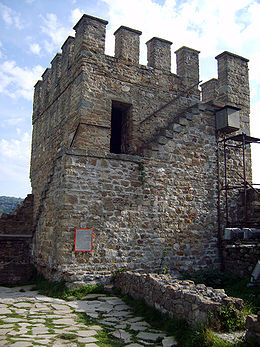
, is still called "Baldwin's Tower"; supposedly, it was the tower where he was interned.
Family
It was not until July 1206 that the Latins in Constantinople had reliable information that Baldwin was dead. His brother HenryHenry of Flanders
Henry was the second emperor of the Latin Empire of Constantinople. He was a younger son of Baldwin V, Count of Hainaut , and Margaret I of Flanders, sister of Philip of Alsace, count of Flanders....
was crowned emperor in August.
Back in Flanders, however, there seemed to be doubt whether Baldwin was truly dead. In any case, Baldwin's other brother Philip of Namur remained as regent, and eventually both of Baldwin's daughters Jeanne and Margaret were to rule as countesses of Flanders.