All Topics  
Pas-de-Calais


   Email Print
   Bookmark   Link


Pas-de-Calais


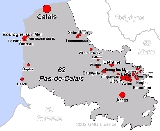
Pas-de-Calais is a department in northern France
France

France , officially the French Republic , is a country whose Metropolitan France is located in Western Europe and that also comprises various Overseas departments and territories of France....
. Its name is the French
French language

French is a Romance language spoken around the world by around 80 million people as first language, by 190 million as second language, and by about another 200 million people as an acquired tongue, with significant speakers in 54 countries....
 equivalent of the Strait of Dover
Strait of Dover

The Strait of Dover or Dover Strait is the strait at the narrowest part of the English Channel. The shortest distance across the strait is from the South Foreland, some 6 kilometres north-east of Dover in the county of Kent, England, to Cap Gris Nez, a Headlands and bays near to Calais in the French of Pas-de-Calais, Franc...
, which it borders.

bited since prehistoric times, the Pas-de-Calais region was populated in turn by the Celtic Belgae
Belgae

The Belgae were a group of tribes living in northern Gaul in the 1st century BC, and later also in Roman Britain. They gave their name to the Roman province of Gallia Belgica, and later, to the modern country of Belgium, where they are colloquially known as the "Old Belgians"....
, the Romans
Ancient Rome

Ancient Rome was a civilization that grew out of a small agricultural community founded on the Italian Peninsula as early as the 10th century BC....
, the Germanic
Germanic peoples

File:Germanische-ratsversammlung 1-1250x715.jpgThe Germanic peoples are a historical Ethnolinguistics group, originating in Northern Europe and identified by their use of the Indo-European languages Germanic languages which diversified out of Common Germanic in the course of the Pre-Roman Iron Age....
 Franks
Franks

The Franks or Frankish people were a West Germanic ethnic group first identified in the 3rd century as living north and east of the Lower Rhine River....
 and the Alemanni. During the fourth and fifth centuries, the Roman practice of coopting Germanic tribes to provide military and defense services along the route from Boulogne
Boulogne-sur-Mer

Boulogne-sur-Mer is a city in northern France. It is a Subprefectures in France of the Departments of France of Pas-de-Calais.The population of the city was 44,859 in the 1999 census, whereas that of the whole metropolitan area was 135,116....
 to Cologne
Cologne

Cologne is Germany's fourth-largest city , and is the largest city both in the German Federal State of North Rhine-Westphalia and within the Rhine-Ruhr, one of the major European metropolitan areas with more than ten million inhabitants....
 created a Germanic-Romance linguistic border in the region that persisted until the eighth century.

Saxon
Saxons

The Saxons were a confederation of Germanic peoples. Their modern-day descendants in Saxony are considered ethnic Germans; those in the eastern Netherlands are considered to be ethnic Dutch people; those in north eastern Belgium are considered to be ethnic Flemish people; and those in southern England ethnic English people ....
 colonization into the region from the fifth to the eighth centuries likely extended the linguistic border somewhat south and west so that by the ninth century most inhabitants north of the line between Béthune
Béthune

B?thune is a city in northern France, Subprefectures in France of the Pas-de-Calais Departments of France....
 and Berck
Berck

Berck, sometimes referred to as Berck-sur-Mer, is a Communes of France in the Pas-de-Calais Departments of France in northern France....
 spoke a dialect of Middle Dutch
Middle Dutch

Middle Dutch is a collective name for a number of closely related West Germanic dialects which were spoken and written between 1150 and 1500. There was at that time as yet no overarching standard language, but they were all mutually intelligible....
, while the inhabitants to the south spoke Picard
Picard language

Picard is a language closely related to French language, and as such is one of the larger group of Romance languages. It is spoken in two List of regions in France in the far north of France – Nord-Pas-de-Calais and Picardy – and in parts of the Belgium region Wallonia ....
, a variety of Romance dialects
Romance languages

The Romance languages are a branch of the Indo-European languages comprising all the languages that descend from Latin language, the language of ancient Rome....
.

This linguistic border is still evident today in the toponyms and patronyms of the region.


Discussion
Ask a question about 'Pas-de-Calais'
Start a new discussion about 'Pas-de-Calais'
Answer questions from other users
Full Discussion Forum


Encyclopedia


Pas-de-Calais is a department in northern France
France

France , officially the French Republic , is a country whose Metropolitan France is located in Western Europe and that also comprises various Overseas departments and territories of France....
. Its name is the French
French language

French is a Romance language spoken around the world by around 80 million people as first language, by 190 million as second language, and by about another 200 million people as an acquired tongue, with significant speakers in 54 countries....
 equivalent of the Strait of Dover
Strait of Dover

The Strait of Dover or Dover Strait is the strait at the narrowest part of the English Channel. The shortest distance across the strait is from the South Foreland, some 6 kilometres north-east of Dover in the county of Kent, England, to Cap Gris Nez, a Headlands and bays near to Calais in the French of Pas-de-Calais, Franc...
, which it borders.

History

Inhabited since prehistoric times, the Pas-de-Calais region was populated in turn by the Celtic Belgae
Belgae

The Belgae were a group of tribes living in northern Gaul in the 1st century BC, and later also in Roman Britain. They gave their name to the Roman province of Gallia Belgica, and later, to the modern country of Belgium, where they are colloquially known as the "Old Belgians"....
, the Romans
Ancient Rome

Ancient Rome was a civilization that grew out of a small agricultural community founded on the Italian Peninsula as early as the 10th century BC....
, the Germanic
Germanic peoples

File:Germanische-ratsversammlung 1-1250x715.jpgThe Germanic peoples are a historical Ethnolinguistics group, originating in Northern Europe and identified by their use of the Indo-European languages Germanic languages which diversified out of Common Germanic in the course of the Pre-Roman Iron Age....
 Franks
Franks

The Franks or Frankish people were a West Germanic ethnic group first identified in the 3rd century as living north and east of the Lower Rhine River....
 and the Alemanni. During the fourth and fifth centuries, the Roman practice of coopting Germanic tribes to provide military and defense services along the route from Boulogne
Boulogne-sur-Mer

Boulogne-sur-Mer is a city in northern France. It is a Subprefectures in France of the Departments of France of Pas-de-Calais.The population of the city was 44,859 in the 1999 census, whereas that of the whole metropolitan area was 135,116....
 to Cologne
Cologne

Cologne is Germany's fourth-largest city , and is the largest city both in the German Federal State of North Rhine-Westphalia and within the Rhine-Ruhr, one of the major European metropolitan areas with more than ten million inhabitants....
 created a Germanic-Romance linguistic border in the region that persisted until the eighth century.

Saxon
Saxons

The Saxons were a confederation of Germanic peoples. Their modern-day descendants in Saxony are considered ethnic Germans; those in the eastern Netherlands are considered to be ethnic Dutch people; those in north eastern Belgium are considered to be ethnic Flemish people; and those in southern England ethnic English people ....
 colonization into the region from the fifth to the eighth centuries likely extended the linguistic border somewhat south and west so that by the ninth century most inhabitants north of the line between Béthune
Béthune

B?thune is a city in northern France, Subprefectures in France of the Pas-de-Calais Departments of France....
 and Berck
Berck

Berck, sometimes referred to as Berck-sur-Mer, is a Communes of France in the Pas-de-Calais Departments of France in northern France....
 spoke a dialect of Middle Dutch
Middle Dutch

Middle Dutch is a collective name for a number of closely related West Germanic dialects which were spoken and written between 1150 and 1500. There was at that time as yet no overarching standard language, but they were all mutually intelligible....
, while the inhabitants to the south spoke Picard
Picard language

Picard is a language closely related to French language, and as such is one of the larger group of Romance languages. It is spoken in two List of regions in France in the far north of France – Nord-Pas-de-Calais and Picardy – and in parts of the Belgium region Wallonia ....
, a variety of Romance dialects
Romance languages

The Romance languages are a branch of the Indo-European languages comprising all the languages that descend from Latin language, the language of ancient Rome....
.

This linguistic border is still evident today in the toponyms and patronyms of the region. Beginning in the ninth century, the linguistic border began a steady move to north and the east, and by the end of the 15th century Romance dialects had completely displaced those of Dutch
Dutch language

Dutch is a West Germanic languages spoken by over 22 million people as a first language, and about 5 million people as a second language."1% of the EU population claims to speak Dutch well enough in order to have a conversation." Outside the European Union the number of second language speakers of Dutch is very small. Most native...
.

Pas-de-Calais is one of the original 83 departments created during the French Revolution
French Revolution

The French Revolution was a period of political and social upheaval and radical change in the history of France, during which the French governmental structure, previously an absolute monarchy with feudalism for the aristocracy and Roman Catholic Church clergy, underwent radical change to forms based on Age of Enlightenment principles of cit...
 on March 4, 1790. It was created from parts of the former provinces
Provinces of France

The Kingdom of France was organised into provinces until March 4, 1790, when the establishment of the d?partement in France system superseded provinces....
 of Calaisis, formerly English, Boulonnais
Boulonnais

The Boulonnais, also known as the "White Marble Horse", is a heavy draft horse breed now bred mainly by the France government due to their decreased numbers....
, Ponthieu
Ponthieu

Ponthieu is a Provinces of France of northern France. Its chief town is Abbeville....
 and Artois
Artois

Artois is a former provinces of France of northern France. Its territory has an area of around 4000 km? and a population of about one million....
, this last formerly part of the Spanish Netherlands.

Some of the costliest battles of World War I
World War I

World War I, or the First World War , was a global military conflict which involved the Great powers, organized into two opposing military alliances: the Allies of World War I and the Central Powers....
 were fought in the region. The Vimy Memorial
Vimy Memorial

The Canadian National Vimy Memorial is a Canadian National Historic Site and one of Canada's most important overseas war memorials. Dedicated to those Canadians who gave their lives in the World War I, the Vimy Memorial is one of eight Canadian First World War memorials in Europe....
 commemorates the Battle of Vimy Ridge
Battle of Vimy Ridge

The Battle of Vimy Ridge was a military engagement fought as part of the Battle of Arras , in the Nord-Pas-de-Calais region of France, during the First World War....
 and is Canada
Canada

Canada is a country occupying most of northern North America, extending from the Atlantic Ocean in the east to the Pacific Ocean in the west and northward into the Arctic Ocean....
's most important memorial to its fallen soldiers.

Pas-de-Calais was also the target of Operation Fortitude
Operation Fortitude

Operation Fortitude was the codename for the deception operations used by the Allies of World War II during World War II in connection with the Battle of Normandy ....
 during World War II
World War II

World War II, or the Second World War , was a global military conflict which involved a Participants in World War II, including all of the great powers, organised into two opposing military alliances: the Allies of World War II and the Axis powers....
, which was an Allied plan to deceive the Germans
Oberkommando der Wehrmacht

The Oberkommando der Wehrmacht was part of the command structure of the armed forces of Nazi Germany during World War II....
 that the invasion of Europe
Operation Overlord

Operation Overlord was the code name for the invasion of Western Front during World War II by Western Allies forces. The operation began with the Normandy Landings on 6 June 1944 , among the largest amphibious warfares ever conducted....
 at D-Day was to occur here, rather than in Normandy
Normandy

Normandy is a geographical region corresponding to the former Duchy of Normandy. It is situated along the coast of France south of the English Channel between Brittany and Picardy and comprises territory in northern France and the Channel Islands....
.

Geography

Pas-de-Calais is in the current region
Régions of France

France is divided into 26 regions or r?gions , of which 21 are in continental metropolitan France, one is the island of Corsica, and four lie overseas....
 of Nord-Pas de Calais
Nord-Pas de Calais

Nord-Pas de Calais is one of the 26 regions of France of France. It consists of the departments of France of Nord and Pas-de-Calais, in the north and has a border with Belgium....
 and is surrounded by the departments of Nord and Somme
Somme

The Somme is a departments of France of France, located in the north of the country and named after the Somme River. It is part of the Picardie regions of France....
, the English Channel
English Channel

The English Channel is an Arm of the Atlantic Ocean that separates England from northern France, and joins the North Sea to the Atlantic. It is about long and varies in width from at its widest, to only in the Strait of Dover....
, and the North Sea
North Sea

The North Sea is a marginal sea, epeiric sea on the European continental shelf. The Dover Strait and the English Channel in the south and the Norwegian Sea in the north connect it to the Atlantic Ocean....
.

Its principal towns are, on the coast, Calais
Calais

Calais is a town in northern France in the Departments of France of Pas-de-Calais, of which it is a sub-prefecture. Although Calais is by far the largest city in Pas-de-Calais, the department's capital is its third-largest city of Arras....
 and Boulogne-sur-Mer
Boulogne-sur-Mer

Boulogne-sur-Mer is a city in northern France. It is a Subprefectures in France of the Departments of France of Pas-de-Calais.The population of the city was 44,859 in the 1999 census, whereas that of the whole metropolitan area was 135,116....
, and in Artois, Lens
Lens, Pas-de-Calais

Lens is a Communes of France in the Pas-de-Calais Departments of France in northern France. It is one of France's large Picard languagee cities along with Lille, Valenciennes, Amiens, Roubaix, Tourcoing, Arras, and Douai....
, Liévin
Liévin

Li?vin is a commune in France in the Pas-de-Calais Departments of France in northern France....
, Arras
Arras

Arras is the capital of the Pas-de-Calais Departments of France in northern France. The historic centre of the Artois region, its local speech is characterized as a Picard language dialect....
, and Saint-Omer
Saint-Omer

Saint-Omer , a Communes of France and sub-prefecture of the Pas-de-Calais Departments of France west-northwest of Lille on the railway to Calais....
.

The principal rivers are the following:
  • Authie
    Authie River

    The Authie is a river in northern France whose 103 km course crosses the departement of the Pas-de-Calais and Somme. Its source is near the village of Coigneux....
  • Canche
    Canche

    The river Canche is one of the rivers that flow from the plateau of the southern Boulonnais and Picardy, into the English Channel. The Somme river is the largest example....
  • Ternoise
    Ternoise

    The river Ternoise is one of the small chalk streams that flow from the plateau of the southern Boulonnais and Picardy, via the Canche, into the English Channel....
  • Liane
    Liane

    As well as being the plural form of liana, Liane is a female given name, and may refer to one of the following;* Liane Bahler, German professional racing cyclist;...
  • Sensée
    Sensée

    The Sens?e is a river in northern France that crosses the departement of Pas-de-Calais. The source is found at Croisilles, Pas-de-Calais and passes through L?cluse....
  • Scarpe
    Scarpe

    The Scarpe is a river in the Nord-Pas-de-Calais region of France, left tributary of the Scheldt.The Scarpe is about a hundred kilometers long, of which two thirds has been turned into canals....
  • Deûle
    Deûle

    The De?le is a river of northern France which is currently channeled for the main part of its course . The upstream part is still partly free-flowing and is known as the Souchez....
  • Lys
    Lys River

    The Leie or Lys is a river in France and Belgium, and a left tributary of the Scheldt. Its source is in Pas-de-Calais, France, and it flows into the river Scheldt in Ghent, Belgium....
  • Aa


Pas De Calais

Economy

The economy of the department was long dependent on mining
Mining

Mining is the extraction of value minerals or other geology materials from the earth, usually from an ore body, vein or seam. Materials recovered by mining include base metals, precious metals, iron, uranium, coal, diamonds, limestone, oil shale, Sodium chloride and potash....
, primarily the coal mine
Coal mining

Coal mining is the extraction or removal of coal from the earth by mining. When coal is used for fuel in power generation it is referred to as steaming or thermal coal....
s. However, since World War II
World War II

World War II, or the Second World War , was a global military conflict which involved a Participants in World War II, including all of the great powers, organised into two opposing military alliances: the Allies of World War II and the Axis powers....
, the economy has become more diversified.

Demographics

The inhabitants of the department are called Pas-de-Calaisiens.

Pas-de-Calais is one of the most heavily populated departments of France, and yet it has no large cities. Calais
Calais

Calais is a town in northern France in the Departments of France of Pas-de-Calais, of which it is a sub-prefecture. Although Calais is by far the largest city in Pas-de-Calais, the department's capital is its third-largest city of Arras....
 has only about 80,000 inhabitants, followed closely by Arras
Arras

Arras is the capital of the Pas-de-Calais Departments of France in northern France. The historic centre of the Artois region, its local speech is characterized as a Picard language dialect....
, Boulogne-sur-Mer
Boulogne-sur-Mer

Boulogne-sur-Mer is a city in northern France. It is a Subprefectures in France of the Departments of France of Pas-de-Calais.The population of the city was 44,859 in the 1999 census, whereas that of the whole metropolitan area was 135,116....
,Lens
Lens

Lens can refer to:...
 and Liévin
Liévin

Li?vin is a commune in France in the Pas-de-Calais Departments of France in northern France....
. The remaining population is primarily concentrated along the border with the department of Nord in the mining district, where a string of small towns constitutes an urban area with a population of about 1.2 million. The center and south of the department are more rural, but still quite heavily populated, with many villages and small towns.

Although the department saw some of the heaviest fighting of World War I
World War I

World War I, or the First World War , was a global military conflict which involved the Great powers, organized into two opposing military alliances: the Allies of World War I and the Central Powers....
, its population rebounded quickly after both world wars. However, many of the mining towns have seen dramatic decreases in population, some up to half of their population.

Culture

Although Pas-de-Calais is one of the most populous departments of France, it did not contain a university until 1992.

See also

  • Cantons of the Pas-de-Calais department
  • Communes of the Pas-de-Calais department
  • Arrondissements of the Pas-de-Calais department


External links