

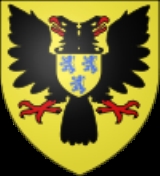
Cambrai

Encyclopedia
Cambrai is a commune
in the Nord department in northern France
. It is a sub-prefecture of the department.
Cambrai is the seat of an archdiocese
whose jurisdiction was immense during the Middle Ages
. The territory of the Bishopric of Cambrai, roughly coinciding with the shire of Brabant
, included the central part of the Low Countries
. The bishopric had some limited secular power.
Cambrai was the Duke of Wellington's headquarters, for the British Army of Occupation, from 1815 to 1818.
The Battle of Cambrai (20 November 1917 – 3 December 1917), a campaign of World War I
took place there. It was noted for the first successful use of tank
s. A second Battle of Cambrai
took place between 8 October 1918 – 10 October 1918 as part of the Hundred Days Offensive
.
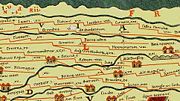 Little is known with certainty of the beginnings of Cambrai. Camaracum or Camaraco, as it was known to the Romans, is mentioned for the first time on the Peutinger table
in the middle of the 4th century. It was a town of the Nervii
, whose "capital" was at Bagacum, present-day Bavay
.
In the middle of the 4th century Frankish
raids from the north led the Romans to build forts along the Cologne to Bavay to Cambrai road, and thence to Boulogne. Cambrai thus occupied an important strategic position. In the early 5th century the town had become the administrative centre of the Nervii in replacement of Bavay which was probably too exposed to the Franks' raids and perhaps too damaged.
Christianity
arrived in the region at about the same time. A bishop of the Nervii by the name of Superior is mentioned in the middle of the 4th century, but nothing else is known about him.
In 430 the Salian Franks
under the command of Clodio
the Long-Haired took the town. In the early 6th century Clovis
undertook to unify the Frankish kingdoms by getting rid of his relatives. One of them was Ragnachar, who ruled over a small kingdom from Cambrai.
In 870 the town was destroyed by the Normans.
(in French Géry), founded abbeys and churches to host relics, which contributed powerfully to giving Cambrai both the appearance and functions of a city.
When the treaty of Verdun
(843) split Charlemagne
's empire into three parts the county of Cambrai fell into Lothaire's kingdom. However on the death of Lothair II
, who had no heir, king Charles the Bald
tried to gain control of his kingdom by having himself sacred at Metz
. Cambrai thus reverted, but only briefly, to the Western Frankish Realm. By 925 Henry the Fowler
had regained control of Lothair's former domains. Cambrai henceforth belonged to the Holy Roman Empire
, in an uncomfortable position on the border with France, until it was annexed by France
eight centuries later after being captured by Louis XIV in 1677.
In the Middle-Ages the region around Cambrai, called Cambrésis, was a county. Rivalries between the count, who ruled the city and county, and the bishop, ceased when in 948 Otto I
granted the bishop
with temporal powers over the city. In 1007 emperor Henry II, Holy Roman Emperor
, extended the bishop's temporal power to the territory surrounding Cambrai. The bishops then had both spiritual and temporal powers. This made Cambrai and Cambrésis a church principality, much like Liège
, an independent state which was part of the Holy Roman Empire.
In 958 one of the first communes
in Europe was established in Cambrai. The inhabitants rebelled against the bishop's power and abuses. They were severely repressed, but the discontent flared up again in the 10th and 11th centuries. In 1226, following another period of unrest, the burghers
of Cambrai finally had to give up their charters and accept the bishop's authority, while retaining some freedom in the running of the town.
. Cambrai then belonged to a commercial hansa of seventeen low country cities whose aim was to develop trade with the fairs in Champagne
and Paris
. By the 11th century the city walls had reached the circumference they would keep until the 19th century.
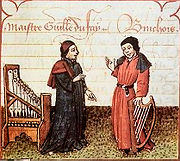 Cambrai has a distinguished musical history, particularly in the 15th century. The cathedral
there, a musical center until the 17th century, had one of the most active musical establishments in the Low Countries; many composers of the Burgundian School
either grew up and learned their craft there, or returned to teach. In 1428 Philippe de Luxembourg claimed that the cathedral was the finest in all of Christianity, for the fineness of its singing, its light, and the sweetness of its bells. Guillaume Dufay
, the most famous European musician of the 15th century, studied at the cathedral from 1409 to 1412, and returned in 1439 after spending many years in Italy. Cambrai cathedral had other famous composers in the later 15th century: Johannes Tinctoris
and Ockeghem
went to Cambrai to study with Dufay. Other composers included Nicolas Grenon
, Alexander Agricola
, and Jacob Obrecht
. In the 16th century, Philippe de Monte
, Johannes Lupi
, and Jacobus de Kerle
all worked there.
, of Hainaut
and the kings of France
, especially during the Hundred Years' War
.
In 1339, in the early stages of the war, the English king Edward III
laid siege to the city but eventually had to withdraw. By the 14th century the county was surrounded on all parts by Burgundy
's possessions and John of Burgundy, an illegitimate son of John the Fearless, was made bishop. However what looked like an impending annexation of Cambrésis to the states of Burgundy was made impossible by the sudden death of Charles the Bold in 1477. Louis XI
immediately seized the opportunity to take control of Cambrai, but left the city a year later.
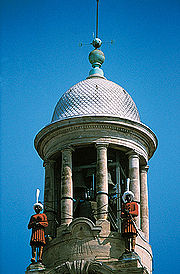 Martin and Martine are two legendary characters who have come to represent the city which they are said to have saved. There are different versions of the story. The most commonly accepted version runs as follows: around the year 1370, at the time of Bishop Robert, Count of Geneva, Martin, a blacksmith of Moorish descent established in Cambrai, was among the burghers who left the city to fight the lord of Thun-Lévêque, who was then reputed to ransom the population around the city and generally to afflict the region. Martin, armed only with his heavy iron hammer, soon came face to face with the enemy. He dealt such a heavy blow on his opponent's head that, although the helmet of the lord did not break, because it was made of good steel, it was driven down to his eyes. Dazed and blinded, the lord of Thun quickly surrendered. Today the automatons of Martin and Martine, standing at the top of the town hall, strike the hours with a hammer as a reminder of that mighty blow.
, the area became poorer, with an associated period of cultural decline. However the city's neutrality and its position between the possessions of the Habsburg Empire and France
made it the venue of several international negotiations, including the League of Cambrai, an alliance engineered in 1508 by Pope Julius II
against the Republic of Venice
. The alliance collapsed in 1510 when the Pope allied with Venice against his former ally France
. The conflict is also referred to as the War of the League of Cambrai
and lasted from 1508 to 1516. Cambrai was also the site of negotiations in 1529 that led to France's withdrawal from the War of the League of Cognac
.
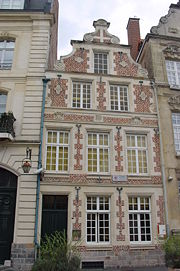 In 1543 Cambrai was conquered by Charles V, Holy Roman Emperor
, and annexed to his already vast possessions. He had the medieval monastery of Saint-Sépulchre demolished and a citadel built in its place.
In 1623, the community of nuns of the English Benedictine Congregation
was founded at Cambrai, which was expelled during the French Revolution and its successor community has since 1838 been established at Stanbrook Abbey
, near Malvern
.
In 1677, Louis XIV
, in an effort to "safeguard the tranquility of his borders for ever" ("assurer à jamais le repos de ses frontières"), decided to take Cambrai and supervised the siege in person. The city was taken on April 19, 1677. By the Treaty of Nijmegen of 1678 Spain relinquished Cambrai, which has remained to this day a part of France.
The first archbishop appointed by the king of France was François Fénelon
. He came to be known as the "swan of Cambrai" ("le cygne de Cambrai"), in opposition to his rival Bossuet
, the "eagle of Meaux" ("l'aigle de Meaux"), and he wrote his Maxims of the Saints while residing in the city.
: Joseph Le Bon
, sent by the Comité de salut public, arrived in Cambrai in 1794. He was to set up an era of "terror", sending many to the guillotine
, until he was tried and executed in 1795. Most of the religious buildings of the city were demolished in that period: in 1797, the old cathedral
, which had been dubbed the "wonder of the low countries", was sold to a merchant who exploited it as a stone quarry. Only the main tower was left standing by 1809, when it collapsed in a storm. However the cathedral's archives have been preserved (they are now at the Archives Départementales du Nord in Lille
) and a new cathedral was later provided.
- Louisiana
, United States
Châteauguay - Quebec
, Canada
Kamp-Lintfort
- Germany
Esztergom
- Hungary
Gravesend
- Kent
- United Kingdom
Communes of France
The commune is the lowest level of administrative division in the French Republic. French communes are roughly equivalent to incorporated municipalities or villages in the United States or Gemeinden in Germany...
in the Nord department in northern France
France
The French Republic , The French Republic , The French Republic , (commonly known as France , is a unitary semi-presidential republic in Western Europe with several overseas territories and islands located on other continents and in the Indian, Pacific, and Atlantic oceans. Metropolitan France...
. It is a sub-prefecture of the department.
Cambrai is the seat of an archdiocese
Archdiocese of Cambrai
The Roman Catholic Archdiocese of Cambrai is an archdiocese of the Latin Rite of the Roman Catholic church in France, comprising the arrondissements of Avesnes-sur-Helpe, Cambrai, Douai, and Valenciennes within the département of Nord, in the region of Nord-Pas-de-Calais. The current archbishop is...
whose jurisdiction was immense during the Middle Ages
Middle Ages
The Middle Ages is a periodization of European history from the 5th century to the 15th century. The Middle Ages follows the fall of the Western Roman Empire in 476 and precedes the Early Modern Era. It is the middle period of a three-period division of Western history: Classic, Medieval and Modern...
. The territory of the Bishopric of Cambrai, roughly coinciding with the shire of Brabant
Duchy of Brabant
The Duchy of Brabant was a historical region in the Low Countries. Its territory consisted essentially of the three modern-day Belgian provinces of Flemish Brabant, Walloon Brabant and Antwerp, the Brussels-Capital Region and most of the present-day Dutch province of North Brabant.The Flag of...
, included the central part of the Low Countries
Low Countries
The Low Countries are the historical lands around the low-lying delta of the Rhine, Scheldt, and Meuse rivers, including the modern countries of Belgium, the Netherlands, Luxembourg and parts of northern France and western Germany....
. The bishopric had some limited secular power.
Cambrai was the Duke of Wellington's headquarters, for the British Army of Occupation, from 1815 to 1818.
The Battle of Cambrai (20 November 1917 – 3 December 1917), a campaign of World War I
World War I
World War I , which was predominantly called the World War or the Great War from its occurrence until 1939, and the First World War or World War I thereafter, was a major war centred in Europe that began on 28 July 1914 and lasted until 11 November 1918...
took place there. It was noted for the first successful use of tank
Tank
A tank is a tracked, armoured fighting vehicle designed for front-line combat which combines operational mobility, tactical offensive, and defensive capabilities...
s. A second Battle of Cambrai
Battle of Cambrai (1918)
The Battle of Cambrai was a battle between troops of the British First, Third and Fourth Armies and German Empire forces during the Hundred Days Offensive of the First World War. The battle took place in and around the French city of Cambrai, between 8 and 10 October 1918...
took place between 8 October 1918 – 10 October 1918 as part of the Hundred Days Offensive
Hundred Days Offensive
The Hundred Days Offensive was the final period of the First World War, during which the Allies launched a series of offensives against the Central Powers on the Western Front from 8 August to 11 November 1918, beginning with the Battle of Amiens. The offensive forced the German armies to retreat...
.
Roman times
Tabula Peutingeriana
The Tabula Peutingeriana is an itinerarium showing the cursus publicus, the road network in the Roman Empire. The original map of which this is a unique copy was last revised in the fourth or early fifth century. It covers Europe, parts of Asia and North Africa...
in the middle of the 4th century. It was a town of the Nervii
Nervii
The Nervii were an ancient Germanic tribe, and one of the most powerful Belgic tribes; living in the northeastern hinterlands of Gaul, they were known to trek long distances to engage in various wars and functions...
, whose "capital" was at Bagacum, present-day Bavay
Bavay
Bavay is a commune in the Nord department in northern France.It lies 15 m. ESE of Valenciennes by railway.-History:Under the name of Bagacum or Bavacum, the town was the capital of the Nervii and, under the Roman Empire, an important center of roads, the meeting-place of which was marked by a...
.
In the middle of the 4th century Frankish
Franks
The Franks were a confederation of Germanic tribes first attested in the third century AD as living north and east of the Lower Rhine River. From the third to fifth centuries some Franks raided Roman territory while other Franks joined the Roman troops in Gaul. Only the Salian Franks formed a...
raids from the north led the Romans to build forts along the Cologne to Bavay to Cambrai road, and thence to Boulogne. Cambrai thus occupied an important strategic position. In the early 5th century the town had become the administrative centre of the Nervii in replacement of Bavay which was probably too exposed to the Franks' raids and perhaps too damaged.
Christianity
Christianity
Christianity is a monotheistic religion based on the life and teachings of Jesus as presented in canonical gospels and other New Testament writings...
arrived in the region at about the same time. A bishop of the Nervii by the name of Superior is mentioned in the middle of the 4th century, but nothing else is known about him.
In 430 the Salian Franks
Salian Franks
The Salian Franks or Salii were a subgroup of the early Franks who originally had been living north of the limes in the area above the Rhine. The Merovingian kings responsible for the conquest of Gaul were Salians. From the 3rd century on, the Salian Franks appear in the historical records as...
under the command of Clodio
Clodio
Chlodio was a king of the Salian Franks from the Merovingian dynasty. He was known as the Long-Haired King and lived in Thuringian territory at the castle of Duisburg. He became chief of the Thérouanne area in 414 AD...
the Long-Haired took the town. In the early 6th century Clovis
Clovis I
Clovis Leuthwig was the first King of the Franks to unite all the Frankish tribes under one ruler, changing the leadership from a group of royal chieftains, to rule by kings, ensuring that the kingship was held by his heirs. He was also the first Catholic King to rule over Gaul . He was the son...
undertook to unify the Frankish kingdoms by getting rid of his relatives. One of them was Ragnachar, who ruled over a small kingdom from Cambrai.
In 870 the town was destroyed by the Normans.
Early Middle Ages
Cambrai began to grow from a rural market into a real city during the Merovingian times, a long period of peace when the bishoprics of Arras and Cambrai were first unified (probably owing to the small number of clerics left at the time) and were later transferred to Cambrai, an administrative centre for the region. Successive bishops, including GaugericusGaugericus
Saint Gaugericus, in French Saint Géry was a bishop of Cambrai. He was born to Roman parents, Gaudentius and Austadiola, at Eposium...
(in French Géry), founded abbeys and churches to host relics, which contributed powerfully to giving Cambrai both the appearance and functions of a city.
When the treaty of Verdun
Treaty of Verdun
The Treaty of Verdun was a treaty between the three surviving sons of Louis the Pious, the son and successor of Charlemagne, which divided the Carolingian Empire into three kingdoms...
(843) split Charlemagne
Charlemagne
Charlemagne was King of the Franks from 768 and Emperor of the Romans from 800 to his death in 814. He expanded the Frankish kingdom into an empire that incorporated much of Western and Central Europe. During his reign, he conquered Italy and was crowned by Pope Leo III on 25 December 800...
's empire into three parts the county of Cambrai fell into Lothaire's kingdom. However on the death of Lothair II
Lothair II of Lotharingia
Lothair II was the second son of Emperor Lothair I and Ermengarde of Tours. He was married to Teutberga, daughter of Boso the Elder. He is the namesake of the Lothair Crystal, which he probably commissioned, and of the Cross of Lothair, which was made over a century after his death but...
, who had no heir, king Charles the Bald
Charles the Bald
Charles the Bald , Holy Roman Emperor and King of West Francia , was the youngest son of the Emperor Louis the Pious by his second wife Judith.-Struggle against his brothers:He was born on 13 June 823 in Frankfurt, when his elder...
tried to gain control of his kingdom by having himself sacred at Metz
Metz
Metz is a city in the northeast of France located at the confluence of the Moselle and the Seille rivers.Metz is the capital of the Lorraine region and prefecture of the Moselle department. Located near the tripoint along the junction of France, Germany, and Luxembourg, Metz forms a central place...
. Cambrai thus reverted, but only briefly, to the Western Frankish Realm. By 925 Henry the Fowler
Henry I of Germany
Henry I the Fowler was the Duke of Saxony from 912 and German king from 919 until his death. First of the Ottonian Dynasty of German kings and emperors, he is generally considered to be the founder and first king of the medieval German state, known until then as East Francia...
had regained control of Lothair's former domains. Cambrai henceforth belonged to the Holy Roman Empire
Holy Roman Empire
The Holy Roman Empire was a realm that existed from 962 to 1806 in Central Europe.It was ruled by the Holy Roman Emperor. Its character changed during the Middle Ages and the Early Modern period, when the power of the emperor gradually weakened in favour of the princes...
, in an uncomfortable position on the border with France, until it was annexed by France
France
The French Republic , The French Republic , The French Republic , (commonly known as France , is a unitary semi-presidential republic in Western Europe with several overseas territories and islands located on other continents and in the Indian, Pacific, and Atlantic oceans. Metropolitan France...
eight centuries later after being captured by Louis XIV in 1677.
In the Middle-Ages the region around Cambrai, called Cambrésis, was a county. Rivalries between the count, who ruled the city and county, and the bishop, ceased when in 948 Otto I
Otto I, Holy Roman Emperor
Otto I the Great , son of Henry I the Fowler and Matilda of Ringelheim, was Duke of Saxony, King of Germany, King of Italy, and "the first of the Germans to be called the emperor of Italy" according to Arnulf of Milan...
granted the bishop
Archdiocese of Cambrai
The Roman Catholic Archdiocese of Cambrai is an archdiocese of the Latin Rite of the Roman Catholic church in France, comprising the arrondissements of Avesnes-sur-Helpe, Cambrai, Douai, and Valenciennes within the département of Nord, in the region of Nord-Pas-de-Calais. The current archbishop is...
with temporal powers over the city. In 1007 emperor Henry II, Holy Roman Emperor
Henry II, Holy Roman Emperor
Henry II , also referred to as Saint Henry, Obl.S.B., was the fifth and last Holy Roman Emperor of the Ottonian dynasty, from his coronation in Rome in 1014 until his death a decade later. He was crowned King of the Germans in 1002 and King of Italy in 1004...
, extended the bishop's temporal power to the territory surrounding Cambrai. The bishops then had both spiritual and temporal powers. This made Cambrai and Cambrésis a church principality, much like Liège
Liège
Liège is a major city and municipality of Belgium located in the province of Liège, of which it is the economic capital, in Wallonia, the French-speaking region of Belgium....
, an independent state which was part of the Holy Roman Empire.
In 958 one of the first communes
Communes of France
The commune is the lowest level of administrative division in the French Republic. French communes are roughly equivalent to incorporated municipalities or villages in the United States or Gemeinden in Germany...
in Europe was established in Cambrai. The inhabitants rebelled against the bishop's power and abuses. They were severely repressed, but the discontent flared up again in the 10th and 11th centuries. In 1226, following another period of unrest, the burghers
Bourgeoisie
In sociology and political science, bourgeoisie describes a range of groups across history. In the Western world, between the late 18th century and the present day, the bourgeoisie is a social class "characterized by their ownership of capital and their related culture." A member of the...
of Cambrai finally had to give up their charters and accept the bishop's authority, while retaining some freedom in the running of the town.
Economic activity
In the Middle-Ages the city grew richer and larger thanks to its weaving industry which produced woollen cloth, linen and cambricCambric
Cambric, pronounced , "one of the finest and most dense species of the cloth manufacture", is a lightweight plain weave cloth, originally from Cambrai, woven in greige, then bleached and piece-dyed, often glazed or calendered. Initially made from flax, then cotton in the 19th century, it is also...
. Cambrai then belonged to a commercial hansa of seventeen low country cities whose aim was to develop trade with the fairs in Champagne
Champagne, France
Champagne is a historic province in the northeast of France, now best known for the sparkling white wine that bears its name.Formerly ruled by the counts of Champagne, its western edge is about 100 miles east of Paris. The cities of Troyes, Reims, and Épernay are the commercial centers of the area...
and Paris
Paris
Paris is the capital and largest city in France, situated on the river Seine, in northern France, at the heart of the Île-de-France region...
. By the 11th century the city walls had reached the circumference they would keep until the 19th century.
Music history
Old Cambrai Cathedral
Old Cambrai Cathedral was the Gothic cathedral of the diocese of Cambrai in France, sited on what is now Place Fénelon in Cambrai but now entirely lost...
there, a musical center until the 17th century, had one of the most active musical establishments in the Low Countries; many composers of the Burgundian School
Burgundian School
The Burgundian School is a term used to denote a group of composers active in the 15th century in what is now northern and eastern France, Belgium, and the Netherlands, centered on the court of the Dukes of Burgundy. The main names associated with this school are Guillaume Dufay, Gilles Binchois,...
either grew up and learned their craft there, or returned to teach. In 1428 Philippe de Luxembourg claimed that the cathedral was the finest in all of Christianity, for the fineness of its singing, its light, and the sweetness of its bells. Guillaume Dufay
Guillaume Dufay
Guillaume Dufay was a Franco-Flemish composer of the early Renaissance. As the central figure in the Burgundian School, he was the most famous and influential composer in Europe in the mid-15th century.-Early life:From the evidence of his will, he was probably born in Beersel, in the vicinity of...
, the most famous European musician of the 15th century, studied at the cathedral from 1409 to 1412, and returned in 1439 after spending many years in Italy. Cambrai cathedral had other famous composers in the later 15th century: Johannes Tinctoris
Johannes Tinctoris
Johannes Tinctoris was a Flemish composer and music theorist of the Renaissance. He is known to have studied in Orléans, and to have been master of the choir there; he also may have been director of choirboys at Chartres...
and Ockeghem
Johannes Ockeghem
Johannes Ockeghem was the most famous composer of the Franco-Flemish School in the last half of the 15th century, and is often considered the most...
went to Cambrai to study with Dufay. Other composers included Nicolas Grenon
Nicolas Grenon
Nicolas Grenon was a French composer of the early Renaissance. He wrote in all the prevailing musical forms of the time, and was a rare case of a long-lived composer who learned his craft in the late 14th century but primarily practiced during the era during which the Renaissance styles were...
, Alexander Agricola
Alexander Agricola
Alexander Agricola was a Franco-Flemish composer of the Renaissance. A prominent member of the Grande chapelle, the Habsburg musical establishment, he was a renowned composer in the years around 1500, and his music was widely distributed throughout Europe...
, and Jacob Obrecht
Jacob Obrecht
Jacob Obrecht was a Flemish composer of the Renaissance. He was the most famous composer of masses in Europe in the late 15th century, being eclipsed by only Josquin des Prez after his death.-Life:...
. In the 16th century, Philippe de Monte
Philippe de Monte
Philippe de Monte , sometimes known as Philippus de Monte, was a Flemish composer of the late Renaissance. He was a member of the 3rd generation madrigalists and wrote more madrigals than any other composer of the time...
, Johannes Lupi
Johannes Lupi
Johannes Lupi was a Franco-Flemish composer of the Renaissance. A representative of the generation after Josquin, he was a minor but skilled composer of polyphony who was mainly active in Cambrai.- Life :...
, and Jacobus de Kerle
Jacobus de Kerle
Jacobus de Kerle was a Flemish composer and organist of the late Renaissance.-Life:Kerle was trained at the monastery of St. Martin in Ypres, and held positions as a singer in Cambrai and choirmaster in Orvieto, where he also became organist and carillonneur...
all worked there.
Hundred Years' War
Even though the bishop tried to preserve the independence of his small state of Cambrésis, the task was not easy, wedged as the county was between its more powerful neighbours the counts of FlandersCounty of Flanders
The County of Flanders was one of the territories constituting the Low Countries. The county existed from 862 to 1795. It was one of the original secular fiefs of France and for centuries was one of the most affluent regions in Europe....
, of Hainaut
County of Hainaut
The County of Hainaut was a historical region in the Low Countries with its capital at Mons . In English sources it is often given the archaic spelling Hainault....
and the kings of France
France
The French Republic , The French Republic , The French Republic , (commonly known as France , is a unitary semi-presidential republic in Western Europe with several overseas territories and islands located on other continents and in the Indian, Pacific, and Atlantic oceans. Metropolitan France...
, especially during the Hundred Years' War
Hundred Years' War
The Hundred Years' War was a series of separate wars waged from 1337 to 1453 by the House of Valois and the House of Plantagenet, also known as the House of Anjou, for the French throne, which had become vacant upon the extinction of the senior Capetian line of French kings...
.
In 1339, in the early stages of the war, the English king Edward III
Edward III of England
Edward III was King of England from 1327 until his death and is noted for his military success. Restoring royal authority after the disastrous reign of his father, Edward II, Edward III went on to transform the Kingdom of England into one of the most formidable military powers in Europe...
laid siege to the city but eventually had to withdraw. By the 14th century the county was surrounded on all parts by Burgundy
Duchy of Burgundy
The Duchy of Burgundy , was heir to an ancient and prestigious reputation and a large division of the lands of the Second Kingdom of Burgundy and in its own right was one of the geographically larger ducal territories in the emergence of Early Modern Europe from Medieval Europe.Even in that...
's possessions and John of Burgundy, an illegitimate son of John the Fearless, was made bishop. However what looked like an impending annexation of Cambrésis to the states of Burgundy was made impossible by the sudden death of Charles the Bold in 1477. Louis XI
Louis XI of France
Louis XI , called the Prudent , was the King of France from 1461 to 1483. He was the son of Charles VII of France and Mary of Anjou, a member of the House of Valois....
immediately seized the opportunity to take control of Cambrai, but left the city a year later.
The legend of Martin and Martine
The Renaissance and classical age
As the economic centre of northern Europe moved away from BrugesBruges
Bruges is the capital and largest city of the province of West Flanders in the Flemish Region of Belgium. It is located in the northwest of the country....
, the area became poorer, with an associated period of cultural decline. However the city's neutrality and its position between the possessions of the Habsburg Empire and France
France
The French Republic , The French Republic , The French Republic , (commonly known as France , is a unitary semi-presidential republic in Western Europe with several overseas territories and islands located on other continents and in the Indian, Pacific, and Atlantic oceans. Metropolitan France...
made it the venue of several international negotiations, including the League of Cambrai, an alliance engineered in 1508 by Pope Julius II
Pope Julius II
Pope Julius II , nicknamed "The Fearsome Pope" and "The Warrior Pope" , born Giuliano della Rovere, was Pope from 1503 to 1513...
against the Republic of Venice
Republic of Venice
The Republic of Venice or Venetian Republic was a state originating from the city of Venice in Northeastern Italy. It existed for over a millennium, from the late 7th century until 1797. It was formally known as the Most Serene Republic of Venice and is often referred to as La Serenissima, in...
. The alliance collapsed in 1510 when the Pope allied with Venice against his former ally France
France
The French Republic , The French Republic , The French Republic , (commonly known as France , is a unitary semi-presidential republic in Western Europe with several overseas territories and islands located on other continents and in the Indian, Pacific, and Atlantic oceans. Metropolitan France...
. The conflict is also referred to as the War of the League of Cambrai
War of the League of Cambrai
The War of the League of Cambrai, sometimes known as the War of the Holy League and by several other names, was a major conflict in the Italian Wars...
and lasted from 1508 to 1516. Cambrai was also the site of negotiations in 1529 that led to France's withdrawal from the War of the League of Cognac
War of the League of Cognac
The War of the League of Cognac was fought between the Habsburg dominions of Charles V—primarily Spain and the Holy Roman Empire—and the League of Cognac, an alliance including France, Pope Clement VII, the Republic of Venice, England, the Duchy of Milan and Republic of Florence.- Prelude :Shocked...
.
Charles V, Holy Roman Emperor
Charles V was ruler of the Holy Roman Empire from 1519 and, as Charles I, of the Spanish Empire from 1516 until his voluntary retirement and abdication in favor of his younger brother Ferdinand I and his son Philip II in 1556.As...
, and annexed to his already vast possessions. He had the medieval monastery of Saint-Sépulchre demolished and a citadel built in its place.
In 1623, the community of nuns of the English Benedictine Congregation
English Benedictine Congregation
The English Benedictine Congregation comprises autonomous Roman Catholic Benedictine communities of monks and nuns and is technically the oldest of the 21 congregations that are affiliated in the Benedictine Confederation....
was founded at Cambrai, which was expelled during the French Revolution and its successor community has since 1838 been established at Stanbrook Abbey
Stanbrook Abbey
Stanbrook Abbey is an abbey built as a contemplative house for Benedictine nuns. It was founded in 1625 in Cambrai, Flanders, then part of the Spanish Netherlands, under the auspices of the English Benedictine Congregation.-History:...
, near Malvern
Malvern, Worcestershire
Malvern is a town and civil parish in Worcestershire, England, governed by Malvern Town Council. As of the 2001 census it has a population of 28,749, and includes the historical settlement and commercial centre of Great Malvern on the steep eastern flank of the Malvern Hills, and the former...
.
In 1677, Louis XIV
Louis XIV of France
Louis XIV , known as Louis the Great or the Sun King , was a Bourbon monarch who ruled as King of France and Navarre. His reign, from 1643 to his death in 1715, began at the age of four and lasted seventy-two years, three months, and eighteen days...
, in an effort to "safeguard the tranquility of his borders for ever" ("assurer à jamais le repos de ses frontières"), decided to take Cambrai and supervised the siege in person. The city was taken on April 19, 1677. By the Treaty of Nijmegen of 1678 Spain relinquished Cambrai, which has remained to this day a part of France.
The first archbishop appointed by the king of France was François Fénelon
François Fénelon
François de Salignac de la Mothe-Fénelon, more commonly known as François Fénelon , was a French Roman Catholic archbishop, theologian, poet and writer...
. He came to be known as the "swan of Cambrai" ("le cygne de Cambrai"), in opposition to his rival Bossuet
Jacques-Bénigne Bossuet
Jacques-Bénigne Bossuet was a French bishop and theologian, renowned for his sermons and other addresses. He has been considered by many to be one of the most brilliant orators of all time and a masterly French stylist....
, the "eagle of Meaux" ("l'aigle de Meaux"), and he wrote his Maxims of the Saints while residing in the city.
The French Revolution
The city suffered from the RevolutionFrench Revolution
The French Revolution , sometimes distinguished as the 'Great French Revolution' , was a period of radical social and political upheaval in France and Europe. The absolute monarchy that had ruled France for centuries collapsed in three years...
: Joseph Le Bon
Joseph le Bon
Joseph Le Bon was a French politician.He was born at Arras. He became a priest in the order of the Oratory, and professor of rhetoric at Beaune. He adopted revolutionary ideas, and became a curé of the Constitutional Church in the department of Pas-de-Calais, where he was later elected as a député...
, sent by the Comité de salut public, arrived in Cambrai in 1794. He was to set up an era of "terror", sending many to the guillotine
Guillotine
The guillotine is a device used for carrying out :executions by decapitation. It consists of a tall upright frame from which an angled blade is suspended. This blade is raised with a rope and then allowed to drop, severing the head from the body...
, until he was tried and executed in 1795. Most of the religious buildings of the city were demolished in that period: in 1797, the old cathedral
Old Cambrai Cathedral
Old Cambrai Cathedral was the Gothic cathedral of the diocese of Cambrai in France, sited on what is now Place Fénelon in Cambrai but now entirely lost...
, which had been dubbed the "wonder of the low countries", was sold to a merchant who exploited it as a stone quarry. Only the main tower was left standing by 1809, when it collapsed in a storm. However the cathedral's archives have been preserved (they are now at the Archives Départementales du Nord in Lille
Lille
Lille is a city in northern France . It is the principal city of the Lille Métropole, the fourth-largest metropolitan area in the country behind those of Paris, Lyon and Marseille. Lille is situated on the Deûle River, near France's border with Belgium...
) and a new cathedral was later provided.
Heraldry
Demographics
Births
Cambrai was the birthplace of:- Amé BourdonAmé BourdonAmé Bourdon was a French physician and anatomist.Bourdon was born in Cambrai, France, in 1636 or 1638, the son of an engineer in the service of the Spanish Crown. Having studied science extensively, he decided to attend the university in Douai at the age of 37. He practiced as a physician in...
(1636 or 1638–1706), physicianPhysicianA physician is a health care provider who practices the profession of medicine, which is concerned with promoting, maintaining or restoring human health through the study, diagnosis, and treatment of disease, injury and other physical and mental impairments...
and anatomist - Charles François DumouriezCharles François DumouriezCharles-François du Périer Dumouriez was a French general during the French Revolutionary Wars. He shared the victory at Valmy with General François Christophe Kellermann, but later deserted the Revolutionary Army and became a royalist intriguer during the reign of Napoleon.-Early life:Dumouriez...
(1739–1823), French general - Francisco de CarondeletFrancisco Luis Hector de CarondeletFrancisco Luis Hector, barón de Carondelet was an administrator of Burgundian descent in the employ of the Spanish Empire. He was a Knight of Malta....
(1747–1807), in Noyelles, Spanish governor of LouisianaLouisiana TerritoryThe Territory of Louisiana or Louisiana Territory was an organized incorporated territory of the United States that existed from July 4, 1805 until June 4, 1812, when it was renamed to Missouri Territory...
, president of the Audiencia of QuitoQuitoSan Francisco de Quito, most often called Quito , is the capital city of Ecuador in northwestern South America. It is located in north-central Ecuador in the Guayllabamba river basin, on the eastern slopes of Pichincha, an active stratovolcano in the Andes mountains... - Marcel LermoyezMarcel LermoyezMarcel Lermoyez was a French otolaryngologist and surgeon who was a native of Cambrai. In 1886 he received his doctorate in Paris, and in 1891 became Médecin des Hôpitaux. In 1892 he traveled to Vienna to study with famed otologist Adam Politzer . During this period of time, Lermoyez decided to...
(1858–1929), otologist - Louis BlériotLouis BlériotLouis Charles Joseph Blériot was a French aviator, inventor and engineer. In 1909 he completed the first flight across a large body of water in a heavier-than-air craft, when he crossed the English Channel. For this achievement, he received a prize of £1,000...
(1872–1936), aviatorAviatorAn aviator is a person who flies an aircraft. The first recorded use of the term was in 1887, as a variation of 'aviation', from the Latin avis , coined in 1863 by G. de la Landelle in Aviation Ou Navigation Aérienne... - Henri de LubacHenri de LubacHenri-Marie de Lubac, SJ was a French Jesuit priest who became a Cardinal of the Catholic Church, and is considered to be one of the most influential theologians of the 20th century...
(1896–1991), Jesuit and theologian - Julien TormaJulien TormaJulien Torma was a French writer, playwright and poet who was part of the Dadaist movement. He was born in Cambrai, France, and died in Tyrol....
(1902–1933), writer, playwright and poet - René DumontRené DumontRené Dumont was a French engineer in agronomy, a sociologist, and an environmental politician.He was born in Cambrai, Nord, in the north of France. His father was a professor in agriculture and his grandfather was a farmer. He graduated from the INA P-G, as an engineer in agronomy...
(1904–2001), engineer in agronomyAgricultural scienceAgricultural science is a broad multidisciplinary field that encompasses the parts of exact, natural, economic and social sciences that are used in the practice and understanding of agriculture. -Agriculture and agricultural science:The two terms are often confused...
, sociologistSociologySociology is the study of society. It is a social science—a term with which it is sometimes synonymous—which uses various methods of empirical investigation and critical analysis to develop a body of knowledge about human social activity...
, and environmental politicianPoliticsPolitics is a process by which groups of people make collective decisions. The term is generally applied to the art or science of running governmental or state affairs, including behavior within civil governments, but also applies to institutions, fields, and special interest groups such as the... - Maurice GodelierMaurice GodelierBorn in Cambrai, France in 28 February 1934, Maurice Godelier is one of the most influential names in French anthropology. Directeur d'études at the École des Hautes Études en Sciences Sociales...
(born 1934), social anthropologistAnthropologyAnthropology is the study of humanity. It has origins in the humanities, the natural sciences, and the social sciences. The term "anthropology" is from the Greek anthrōpos , "man", understood to mean mankind or humanity, and -logia , "discourse" or "study", and was first used in 1501 by German...
, neo-MarxistNeo-MarxismNeo-Marxism is a loose term for various twentieth-century approaches that amend or extend Marxism and Marxist theory, usually by incorporating elements from other intellectual traditions, such as: critical theory, psychoanalysis or Existentialism .Erik Olin Wright's theory of contradictory class...
, and FrenchFranceThe French Republic , The French Republic , The French Republic , (commonly known as France , is a unitary semi-presidential republic in Western Europe with several overseas territories and islands located on other continents and in the Indian, Pacific, and Atlantic oceans. Metropolitan France...
intellectual - Charles Henri Joseph CordierCharles Henri Joseph CordierCharles Henri Joseph Cordier , was a French sculptor of Ethnographic subjects.- Career :In 1847, Charles Cordier's meeting with Seïd Enkess, a former black slave who had become a model, determined the course of his career.His first success was a bust in plaster of a Sudanese man "Saïd Abdullah of...
(1829–1905), sculptor of Ethnographic subjects.
Twin towns
Cambrai is twinned with: HoumaHouma, Louisiana
Houma is a city in and the parish seat of Terrebonne Parish, Louisiana, and the largest principal city of the Houma–Bayou Cane–Thibodaux Metropolitan Statistical Area. The city's powers of government have been absorbed by the parish, which is now run by the Terrebonne Parish...
- Louisiana
Louisiana
Louisiana is a state located in the southern region of the United States of America. Its capital is Baton Rouge and largest city is New Orleans. Louisiana is the only state in the U.S. with political subdivisions termed parishes, which are local governments equivalent to counties...
, United States
United States
The United States of America is a federal constitutional republic comprising fifty states and a federal district...
Châteauguay - Quebec
Quebec
Quebec or is a province in east-central Canada. It is the only Canadian province with a predominantly French-speaking population and the only one whose sole official language is French at the provincial level....
, Canada
Canada
Canada is a North American country consisting of ten provinces and three territories. Located in the northern part of the continent, it extends from the Atlantic Ocean in the east to the Pacific Ocean in the west, and northward into the Arctic Ocean...
Kamp-Lintfort
Kamp-Lintfort
Kamp-Lintfort is a town in Wesel District, in North Rhine-Westphalia, Germany. It is located 8 km north-west of Moers.- Twin towns :Kamp-Linfort is twinned with the town of Chester-le-Street in the North East of England....
- Germany
Germany
Germany , officially the Federal Republic of Germany , is a federal parliamentary republic in Europe. The country consists of 16 states while the capital and largest city is Berlin. Germany covers an area of 357,021 km2 and has a largely temperate seasonal climate...
Esztergom
Esztergom
Esztergom , is a city in northern Hungary, 46 km north-west of the capital Budapest. It lies in Komárom-Esztergom county, on the right bank of the river Danube, which forms the border with Slovakia there....
- Hungary
Hungary
Hungary , officially the Republic of Hungary , is a landlocked country in Central Europe. It is situated in the Carpathian Basin and is bordered by Slovakia to the north, Ukraine and Romania to the east, Serbia and Croatia to the south, Slovenia to the southwest and Austria to the west. The...
Gravesend
Gravesend, Kent
Gravesend is a town in northwest Kent, England, on the south bank of the Thames, opposite Tilbury in Essex. It is the administrative town of the Borough of Gravesham and, because of its geographical position, has always had an important role to play in the history and communications of this part of...
- Kent
Kent
Kent is a county in southeast England, and is one of the home counties. It borders East Sussex, Surrey and Greater London and has a defined boundary with Essex in the middle of the Thames Estuary. The ceremonial county boundaries of Kent include the shire county of Kent and the unitary borough of...
- United Kingdom
United Kingdom
The United Kingdom of Great Britain and Northern IrelandIn the United Kingdom and Dependencies, other languages have been officially recognised as legitimate autochthonous languages under the European Charter for Regional or Minority Languages...
Sources
- David Fallows, Barbara H. Haggh: "Cambrai", Grove Music Online ed. L. Macy (Accessed December 18, 2005), (subscription access) (source for the music history section)
- "Cambrai." Encyclopædia Britannica, 11th ed. New York, Encyclopædia Britannica Co., 1910.
- "Histoire de Cambrai", sous la direction de Louis Trénard, Presses Universitaires de Lille, 1982.