


Kortrijk

Encyclopedia
Kortrijk; , kuʁtʁɛ; ) is a Belgian city
and municipality located in the Flemish
province
West Flanders. It is the capital and biggest city of the arrondissement of Kortrijk
, which is both a judicial and an administrative arrondissement
.
The wider municipality comprises the city of Kortrijk proper and the towns of Aalbeke
, Bellegem
, Bissegem
, Heule
, Kooigem
, Marke
, and Rollegem
.
The city is situated on the Leie, 42 km (26.1 mi) southwest of Ghent
and 25 km (15.5 mi) northeast of Lille
in France. Both Kortrijk and Lille are part of the same transnational Eurodistrict
urban area
with around 1,900,000 inhabitants. As the biggest city of southern West Flanders, Kortrijk has many schools, hospitals and shopping streets.
Kortrijk originated from a Gallo-Roman town at an important crossroads near the Leie river and two Roman roads. During the Middle Ages
, Kortrijk grew significantly thanks to the flax
and wool
industry with France and England and became one of the biggest and richest cities in Flanders
. The city is often referred to as City of Groeninge or City of the Gulden Spurs, referring to the Battle of Courtrai or the Battle of the Golden Spurs
which took place on 11 juli 1302 on the Fields of Groeninge
in Kortrijk. In 1820, the Treaty of Kortrijk
was signed, which laid out the current borders between France and Belgium. Throughout the 19th and 20th century, Kortrijk became an important centre of the flaxindustry and is today still an important region within the Belgian textile industry.
Today, Kortrijk is the most important city in southern West-Flanders with several hospitals, colleges and a University
. Where Kortrijk was the very first city in Belgium with a pedestrian shopping street (the Korte Steenstraat), nowadays, a big part of the historical city centre is a complete pedestrian area with lots of shops and shopping malls (like the new covered K Shopping Centre and the Ring Shopping Kortrijk Noord centre).
at an important crossroads near the Leie river. It was situated on the crossroads of the Roman roads linking Tongeren and Cassel and Tournai
and Oudenburg
. In the 9th century, Baldwin II, Count of Flanders
established fortifications against the Vikings. The town gained its city charter
in 1190 from Philip, Count of Flanders
. The population growth required new defensive walls, part of which can still be seen today (the Broeltorens
).
In the 13th century, the battles between Fernando of Portugal, Count of Flanders
and his first cousin, King Louis VIII of France
, led to the destruction of the city. The Counts of Flanders had it rebuilt soon after. To promote industry and weaving in the town, Joan, Countess of Flanders exempted settlers in Kortrijk from property tax
. From that time, Kortrijk gained great importance as a centre of linen
production.
started a successful uprising against the French, who had annexed Flanders a couple of years earlier. On May 18, the French population in that city was massacred, an event that could not go unpunished. The famous ensuing Battle of Courtrai or the Battle of the Golden Spurs
(Dutch: Guldensporenslag) between the Flemish people, mostly commoners and farmers, and Philip the Fair
’s knights took place near Kortrijk on July 11, resulting in a victory for Flanders. This date is now remembered as a national holiday by the whole Flemish community
.
Following a new uprising by the Flemish in 1323, but this time against their own Count Louis I, the French invaded again. These Flemish acquisitions were consolidated by the French at the Battle of Cassel (1328)
. Louis I’s son, Louis II
, then Philip van Artevelde
briefly regained the city in 1381 but lost it again the following year at the Battle of Roosebeke
, resulting in a new wave of plundering and destruction.
, in 1482, which ushered in renewed fighting with France. The 16th century was marked by the confrontations engendered by the Reformation
and the uprising of the Netherlands against Spain. Louis XIV’s reign saw Kortrijk occupied by the French five times in sixty years and its former fortifications razed to the ground. The Treaty of Utrecht
finally assigned the whole area to Austria.
After the French Revolution
and the Napoleonic era, the textile industry, based on flax
, and the general economy of the city could finally prosper again. Kortrijk was heavily bombed in the summer of 1917, but even more damaged by the allied bombing in 1944. The city was an important railway hub for the German army, and for this reason was the target of several allied air-strikes. On July 21, 1944 (the Belgian National Day) around 300 Avro Lancasters dropped over 5,000 bombs on the city center. Many historical buildings on the central square, as well as the old train station, were destroyed.
 The metropolitan area, including the outer commuter zone, also consists of Kuurne, Wevelgem, Zwevegem and Harelbeke. Although these municipalities have strong morphologic ties with Kortrijk, they aren't officially part of the city.
as World Heritage Sites in 1998 and 1999.
Interesting highlights are:
, providing access to the city centre and the suburbs (city lines) and to many towns and villages in the region around the city (regional lines).
. The Bossuit-Kortrijk Canal
enables in the city centre a direct connection with the river Scheldt
.
From the 1970s on, the planning and later the execution of the so called Leiewerken (Leieworks) started. These construction works comprise the deepening and widening of the river. This should enable ships with 4400 tons to navigate from France to the Scheldt. At the same time, this project includes a thorough urban renewal of the riversides in the city. Seven new bridges have to give a new architectural impulse to the river quarters as well as the construction of several new parks along the river. Four bridges already opened (Dambrug, Groeningebrug, Ronde van Vlaanderenbrug and Collegebrug). The Noordbrug will open in 2010. The Budabrug and Reepbrug are planned after the opening of the Noordbrug. The construction works started in 1997 and should be ready in 2012.
and the textile industry, and still today the textile industry remains important in the region.
Major companies headquartered in Kortrijk include Cisco
, Barco
and Bekaert
.
There are 55 schools in Kortrijk, on 72 different locations throughout the city, with an estimated 21,000 students.
The city also provides higher education. The Kortrijk University
, the KULAK, a campus of the Catholic University of Leuven
, is located in on the south edge of the city, in the Hoog Kortrijk quarter. Other institutes of higher education include the Katholieke Hogeschool Zuid-West-Vlaanderen
(KATHO) and Hogeschool West-Vlaanderen
(HOWEST) university college
s.
met in Kortrijk on January 28, 2008 to sign a document creating the first European Grouping of Territorial Cooperation within the EU. The purpose of this new organisation is to facilitate the movement of people within this area of nearly 2 million people.
Also, trade shows and events such as the international Design Fair Interieur, Busworld and the Eurodogshow take place in the Kortrijk Xpo
event center. These fairs attract numerous visitors to the city.
In July and August there are various boat tours on the river Lys
.
), Peperbollen, Biscuits, and chocolate little beguines. The town of Heule
is home to the small brewery Picobrouwerij Alvinne
, while Bellegem
is the hometown of brewery Bockor.
to encourage good international relations.
Bad Godesberg
, Germany, since 1964 Cebu City
, Philippines, since 2005 Frascati
, Italy, since 1967 Greenville
, United States, since 1991 Saint-Cloud
, France, since 1993 Lahore
, Pakistan, since 1993 Tashkent
, Uzbekistan, since the late 1980s Windsor and Maidenhead, United Kingdom, since 1981 Wuxi
, China, since 2007
City
A city is a relatively large and permanent settlement. Although there is no agreement on how a city is distinguished from a town within general English language meanings, many cities have a particular administrative, legal, or historical status based on local law.For example, in the U.S...
and municipality located in the Flemish
Flemish Region
The Flemish Region is one of the three official regions of the Kingdom of Belgium—alongside the Walloon Region and the Brussels-Capital Region. Colloquially, it is usually simply referred to as Flanders, of which it is the institutional iteration within the context of the Belgian political system...
province
Provinces of Belgium
Belgium is divided into three regions, two of them are subdivided into five provinces each.The division into provinces is fixed by Article 5 of the Belgian Constitution...
West Flanders. It is the capital and biggest city of the arrondissement of Kortrijk
Arrondissement of Kortrijk
The Arrondissement of Kortrijk is one of the eight administrative arrondissements in the Province of West Flanders, Belgium.It is both an administrative and a judicial arrondissement...
, which is both a judicial and an administrative arrondissement
Arrondissements of Belgium
The federalized country Belgium geographically consists of 3 regions, of which only Flemish Region and Walloon Region are subdivided into 5 provinces each; the Brussels-Capital Region is neither a province nor is it part of one....
.
The wider municipality comprises the city of Kortrijk proper and the towns of Aalbeke
Aalbeke
"Aalbeke" is a village in the Belgian province of West Flanders and since 1977 a district of Kortrijk. Aalbeke has postal code 8511 and covers an area of 717 ha. The district had 2,953 inhabitants on December 31, 2007. Aalbeke is located 6 km southwest of Kortrijk and is surrounded by...
, Bellegem
Bellegem
Bellegem is a submunicipality of the city of Kortrijk. It is a village in West Flanders, Belgium. As of 2007 it had a population of 3,691....
, Bissegem
Bissegem
Bissegem is a submunicipality of the city of Kortrijk, Belgium. It is part of the urban area of this city. As of 2007 it had a population of 5533....
, Heule
Heule
Heule is a submunicipality of the city of Kortrijk in the Belgian province of West-Flandres. The first notion of this settlement date of the year 1111. Heule has a surface of 1169h and has a population of 10,503 . Surrounding villages of Heule are Bissegem, Gullegem, Lendelede and Kuurne...
, Kooigem
Kooigem
Kooigem is a submunicipality of the city of Kortrijk, Belgium. As of 2007 it had a population of 791....
, Marke
Marke (Belgium)
Marke is a submunicipality of the city of Kortrijk, Belgium. It is part of the urban area of this city. As of 2007 it had a population of 7,882....
, and Rollegem
Rollegem
Rollegem is a submunicipality of the city of Kortrijk, Belgium. As of 2007 it had a population of 2,720....
.
The city is situated on the Leie, 42 km (26.1 mi) southwest of Ghent
Ghent
Ghent is a city and a municipality located in the Flemish region of Belgium. It is the capital and biggest city of the East Flanders province. The city started as a settlement at the confluence of the Rivers Scheldt and Lys and in the Middle Ages became one of the largest and richest cities of...
and 25 km (15.5 mi) northeast of Lille
Lille
Lille is a city in northern France . It is the principal city of the Lille Métropole, the fourth-largest metropolitan area in the country behind those of Paris, Lyon and Marseille. Lille is situated on the Deûle River, near France's border with Belgium...
in France. Both Kortrijk and Lille are part of the same transnational Eurodistrict
Eurodistrict
A eurodistrict is a European administrative entity that contains urban agglomerations which lie across the border between two or more states. A eurodistrict offers a program for cooperation and integration of the towns or communes which it comprises: for example, improving transport links for...
urban area
Largest urban areas of the European Union
This is a list of all the urban areas of the European Union which have greater than 750,000 inhabitants each in 2011.This list is an attempt to present a consistent list of population figures for urban areas in the European Union. All the figures here have been compiled by Demographia.-Important...
with around 1,900,000 inhabitants. As the biggest city of southern West Flanders, Kortrijk has many schools, hospitals and shopping streets.
Kortrijk originated from a Gallo-Roman town at an important crossroads near the Leie river and two Roman roads. During the Middle Ages
Middle Ages
The Middle Ages is a periodization of European history from the 5th century to the 15th century. The Middle Ages follows the fall of the Western Roman Empire in 476 and precedes the Early Modern Era. It is the middle period of a three-period division of Western history: Classic, Medieval and Modern...
, Kortrijk grew significantly thanks to the flax
Flax
Flax is a member of the genus Linum in the family Linaceae. It is native to the region extending from the eastern Mediterranean to India and was probably first domesticated in the Fertile Crescent...
and wool
Wool
Wool is the textile fiber obtained from sheep and certain other animals, including cashmere from goats, mohair from goats, qiviut from muskoxen, vicuña, alpaca, camel from animals in the camel family, and angora from rabbits....
industry with France and England and became one of the biggest and richest cities in Flanders
Flanders
Flanders is the community of the Flemings but also one of the institutions in Belgium, and a geographical region located in parts of present-day Belgium, France and the Netherlands. "Flanders" can also refer to the northern part of Belgium that contains Brussels, Bruges, Ghent and Antwerp...
. The city is often referred to as City of Groeninge or City of the Gulden Spurs, referring to the Battle of Courtrai or the Battle of the Golden Spurs
Battle of the Golden Spurs
The Battle of the Golden Spurs, known also as the Battle of Courtrai was fought on July 11, 1302, near Kortrijk in Flanders...
which took place on 11 juli 1302 on the Fields of Groeninge
Groeninge Monument
The Groeninge Monument is a Monument in the Belgian city of Kortrijk. The gilded statue was inaugurated to commemorate the 600th anniversary of the Battle of the Golden Spurs. The statue is situated in the Groeningepark where during the Middle Ages the Groeninge battle field was situated...
in Kortrijk. In 1820, the Treaty of Kortrijk
Treaty of Kortrijk
The Treaty of Kortrijk was signed the 28 March 1820 in the current Museum of Arts Broelmuseum in the Belgian city of Kortrijk. This Treaty laid out the boundaries between France and the United Kingdom of the Netherlands...
was signed, which laid out the current borders between France and Belgium. Throughout the 19th and 20th century, Kortrijk became an important centre of the flaxindustry and is today still an important region within the Belgian textile industry.
Today, Kortrijk is the most important city in southern West-Flanders with several hospitals, colleges and a University
KULCK
The Katholieke Universiteit Leuven Campus Kortrijk , or KULCK is the only university in the Belgian province of West-Flanders. Until recently, the KULCK was known as the KULAK, “Katholieke Universiteit Leuven Afdeling Kortrijk"...
. Where Kortrijk was the very first city in Belgium with a pedestrian shopping street (the Korte Steenstraat), nowadays, a big part of the historical city centre is a complete pedestrian area with lots of shops and shopping malls (like the new covered K Shopping Centre and the Ring Shopping Kortrijk Noord centre).
Origins to the 13th century
Cortoriacum was a typical Gallo-Roman vicusVicus (Rome)
In ancient Rome, the vicus was a neighborhood. During the Republican era, the four regiones of the city of Rome were subdivided into vici. In the 1st century BC, Augustus reorganized the city for administrative purposes into 14 regions, comprising 265 vici. Each vicus had its own board of...
at an important crossroads near the Leie river. It was situated on the crossroads of the Roman roads linking Tongeren and Cassel and Tournai
Tournai
Tournai is a Walloon city and municipality of Belgium located 85 kilometres southwest of Brussels, on the river Scheldt, in the province of Hainaut....
and Oudenburg
Oudenburg
Oudenburg Latin: Aldenburgensis is a municipality located in the Belgian province of West Flanders. The municipality comprises the city of Oudenburg itself and the towns of Ettelgem, Roksem and Westkerke. On January 1, 2006 Oudenburg had a total population of 8,929...
. In the 9th century, Baldwin II, Count of Flanders
Baldwin II, Count of Flanders
Baldwin II , nicknamed Calvus was the second count of Flanders. He was also hereditary abbot of St. Bertin from 892 till his death. He was the son of Baldwin I of Flanders and Judith, a daughter of Charles the Bald...
established fortifications against the Vikings. The town gained its city charter
Municipal charter
A city charter or town charter is a legal document establishing a municipality such as a city or town. The concept developed in Europe during the middle ages....
in 1190 from Philip, Count of Flanders
Philip, Count of Flanders
Philip of Alsace was count of Flanders from 1168 to 1191. He succeeded his father Thierry of Alsace.-Count of Flanders:...
. The population growth required new defensive walls, part of which can still be seen today (the Broeltorens
Broeltorens
The Broel Towers are a classified monument and a landmark in the Belgian city of Kortrijk. The towers are known as one of the most important symbols of the city.- History :...
).
In the 13th century, the battles between Fernando of Portugal, Count of Flanders
Infante Fernando, Count of Flanders
Infante Ferdinand of Portugal, Count of Flanders was a Portuguese infante, fourth son of Portuguese King Sancho I and Dulce of Aragon...
and his first cousin, King Louis VIII of France
Louis VIII of France
Louis VIII the Lion reigned as King of France from 1223 to 1226. He was a member of the House of Capet. Louis VIII was born in Paris, France, the son of Philip II Augustus and Isabelle of Hainaut. He was also Count of Artois, inheriting the county from his mother, from 1190–1226...
, led to the destruction of the city. The Counts of Flanders had it rebuilt soon after. To promote industry and weaving in the town, Joan, Countess of Flanders exempted settlers in Kortrijk from property tax
Property tax
A property tax is an ad valorem levy on the value of property that the owner is required to pay. The tax is levied by the governing authority of the jurisdiction in which the property is located; it may be paid to a national government, a federated state or a municipality...
. From that time, Kortrijk gained great importance as a centre of linen
Linen
Linen is a textile made from the fibers of the flax plant, Linum usitatissimum. Linen is labor-intensive to manufacture, but when it is made into garments, it is valued for its exceptional coolness and freshness in hot weather....
production.
Battle of the Golden Spurs
In 1302, the population of BrugesBruges
Bruges is the capital and largest city of the province of West Flanders in the Flemish Region of Belgium. It is located in the northwest of the country....
started a successful uprising against the French, who had annexed Flanders a couple of years earlier. On May 18, the French population in that city was massacred, an event that could not go unpunished. The famous ensuing Battle of Courtrai or the Battle of the Golden Spurs
Battle of the Golden Spurs
The Battle of the Golden Spurs, known also as the Battle of Courtrai was fought on July 11, 1302, near Kortrijk in Flanders...
(Dutch: Guldensporenslag) between the Flemish people, mostly commoners and farmers, and Philip the Fair
Philip IV of France
Philip the Fair was, as Philip IV, King of France from 1285 until his death. He was the husband of Joan I of Navarre, by virtue of which he was, as Philip I, King of Navarre and Count of Champagne from 1284 to 1305.-Youth:A member of the House of Capet, Philip was born at the Palace of...
’s knights took place near Kortrijk on July 11, resulting in a victory for Flanders. This date is now remembered as a national holiday by the whole Flemish community
Flemish Community
The term Flemish Community has two distinct, though related, meanings:...
.
Following a new uprising by the Flemish in 1323, but this time against their own Count Louis I, the French invaded again. These Flemish acquisitions were consolidated by the French at the Battle of Cassel (1328)
Battle of Cassel (1328)
The Battle of Cassel was fought on 23 August 1328 by Philip VI, the King of France, and first ruler of House of Valois , against the peasant revolt in Flanders, led by Nicolaas Zannekin. The battle took place near the city of Cassel, 30 km south of Dunkirk in present-day France...
. Louis I’s son, Louis II
Louis II of Flanders
Louis II of Flanders , also Louis III of Artois and Louis I of Palatine Burgundy, known as Louis of Male, was the son of Louis I of Flanders and Margaret I of Burgundy, and Count of Flanders.On his father's death at the Battle of Crécy in 1346, he inherited the counties of Flanders, Nevers, and...
, then Philip van Artevelde
Philip van Artevelde
Philip van Artevelde was a Flemish patriot, the son of Jacob van Artevelde. Because of his father's prominence he was godson of English queen Philippa of Hainault, who held him in her arms during his baptism....
briefly regained the city in 1381 but lost it again the following year at the Battle of Roosebeke
Battle of Roosebeke
The Battle of Roosebeke took place on November 27, 1382 on the Goudberg between a Flemish army under Philip van Artevelde and a French army under Louis II of Flanders who had called upon the help of the French king Charles VI after he had suffered a defeat during the Battle of Beverhoutsveld...
, resulting in a new wave of plundering and destruction.
15th century to modern times
Most of the 15th century was prosperous under the Dukes of Burgundy, until the death of the Burgundian heiress, Mary of BurgundyMary of Burgundy
Mary of Burgundy ruled the Burgundian territories in Low Countries and was suo jure Duchess of Burgundy from 1477 until her death...
, in 1482, which ushered in renewed fighting with France. The 16th century was marked by the confrontations engendered by the Reformation
Protestant Reformation
The Protestant Reformation was a 16th-century split within Western Christianity initiated by Martin Luther, John Calvin and other early Protestants. The efforts of the self-described "reformers", who objected to the doctrines, rituals and ecclesiastical structure of the Roman Catholic Church, led...
and the uprising of the Netherlands against Spain. Louis XIV’s reign saw Kortrijk occupied by the French five times in sixty years and its former fortifications razed to the ground. The Treaty of Utrecht
Treaty of Utrecht
The Treaty of Utrecht, which established the Peace of Utrecht, comprises a series of individual peace treaties, rather than a single document, signed by the belligerents in the War of Spanish Succession, in the Dutch city of Utrecht in March and April 1713...
finally assigned the whole area to Austria.
After the French Revolution
French Revolution
The French Revolution , sometimes distinguished as the 'Great French Revolution' , was a period of radical social and political upheaval in France and Europe. The absolute monarchy that had ruled France for centuries collapsed in three years...
and the Napoleonic era, the textile industry, based on flax
Flax
Flax is a member of the genus Linum in the family Linaceae. It is native to the region extending from the eastern Mediterranean to India and was probably first domesticated in the Fertile Crescent...
, and the general economy of the city could finally prosper again. Kortrijk was heavily bombed in the summer of 1917, but even more damaged by the allied bombing in 1944. The city was an important railway hub for the German army, and for this reason was the target of several allied air-strikes. On July 21, 1944 (the Belgian National Day) around 300 Avro Lancasters dropped over 5,000 bombs on the city center. Many historical buildings on the central square, as well as the old train station, were destroyed.
Municipality
After the 1977 fusion the city is made up of:- I Kortrijk
- II HeuleHeuleHeule is a submunicipality of the city of Kortrijk in the Belgian province of West-Flandres. The first notion of this settlement date of the year 1111. Heule has a surface of 1169h and has a population of 10,503 . Surrounding villages of Heule are Bissegem, Gullegem, Lendelede and Kuurne...
- III BissegemBissegemBissegem is a submunicipality of the city of Kortrijk, Belgium. It is part of the urban area of this city. As of 2007 it had a population of 5533....
- IV MarkeMarkeMarke is a village and a former municipality in the district of Anhalt-Bitterfeld, in Saxony-Anhalt, Germany. Since 1 January 2010, it is part of the town Raguhn-Jeßnitz....
- V AalbekeAalbeke"Aalbeke" is a village in the Belgian province of West Flanders and since 1977 a district of Kortrijk. Aalbeke has postal code 8511 and covers an area of 717 ha. The district had 2,953 inhabitants on December 31, 2007. Aalbeke is located 6 km southwest of Kortrijk and is surrounded by...
- VI RollegemRollegemRollegem is a submunicipality of the city of Kortrijk, Belgium. As of 2007 it had a population of 2,720....
- VII BellegemBellegemBellegem is a submunicipality of the city of Kortrijk. It is a village in West Flanders, Belgium. As of 2007 it had a population of 3,691....
- VIII KooigemKooigemKooigem is a submunicipality of the city of Kortrijk, Belgium. As of 2007 it had a population of 791....
Neighbouring municipalities
|
|
Wevelgem Wevelgem is a municipality located in the Belgian province of West Flanders. The municipality comprises the towns of Gullegem, Moorsele and Wevelgem proper. On January 1, 2006 Wevelgem had a total population of 31,020... (municipality Wevelgem) Sint-Eloois-Winkel Sint-Eloois-Winkel is a village in the Belgian province of West-Flanders. It is a deelgemeente of the municipality of Ledegem, separated from the center of the town by highway A17... (municipality Ledegem) Lendelede Lendelede is a municipality located in the Belgian province of West Flanders. The municipality comprises only the town of Lendelede proper. On January 1, 2006 Lendelede had a total population of 5,399. The total area is 13.15 km² which gives a population density of 411 inhabitants per km².-... , with Sint-Katharina (municipality Lendelede) |
Main sights
Architecture
Much of the city's medieval architecture remains intact and is remarkably well preserved and restored. The city center is one of the largest carfree areas in Belgium. The béguinage, as well as the belfry, were recognized by UNESCOUNESCO
The United Nations Educational, Scientific and Cultural Organization is a specialized agency of the United Nations...
as World Heritage Sites in 1998 and 1999.
Interesting highlights are:
Civil
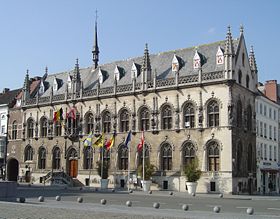
- Medieval City HallKortrijk City HallThe City Hall of Kortrijk is situated on the main square of the Belgian city of Kortrijk . The facade of the late-Gothic, early Renaissance city hall is adorned with the statues of the Counts of Flanders.- History :...
(on the main square, the Grote MarktGrote Markt (Kortrijk)The Grote Markt of Kortrijk is the central square in the Belgian city of Kortrijk.Its location on the crossing of some of Kortrijk's most famous and most touristic spots makes the Grote Markt one of the city's busiest squares...
). The façadeFacadeA facade or façade is generally one exterior side of a building, usually, but not always, the front. The word comes from the French language, literally meaning "frontage" or "face"....
of the late-GothicGothic architectureGothic architecture is a style of architecture that flourished during the high and late medieval period. It evolved from Romanesque architecture and was succeeded by Renaissance architecture....
, early RenaissanceRenaissanceThe Renaissance was a cultural movement that spanned roughly the 14th to the 17th century, beginning in Italy in the Late Middle Ages and later spreading to the rest of Europe. The term is also used more loosely to refer to the historical era, but since the changes of the Renaissance were not...
city hall is adorned with the statues of the Counts of FlandersCount of FlandersThe Count of Flanders was the ruler or sub-ruler of the county of Flanders from the 9th century until the abolition of the position by the French revolutionaries in 1790....
. - The belfryBelfries of Belgium and FranceThe Belfries of Belgium and France is a group of 56 historical buildings designated by UNESCO as World Heritage Site, in recognition of an architectural manifestation of emerging civic independence in historic Flanders and neighbouring regions from feudal and religious influences, leading to a...
is surmounted by a statue of MercuryMercury (mythology)Mercury was a messenger who wore winged sandals, and a god of trade, the son of Maia Maiestas and Jupiter in Roman mythology. His name is related to the Latin word merx , mercari , and merces...
, god of the merchants. The belfry is classified by UNESCO as a World Heritage SiteWorld Heritage SiteA UNESCO World Heritage Site is a place that is listed by the UNESCO as of special cultural or physical significance...
. - Near-identical medieval Broel TowersBroeltorensThe Broel Towers are a classified monument and a landmark in the Belgian city of Kortrijk. The towers are known as one of the most important symbols of the city.- History :...
with the bridge in between that spans the river LysLys RiverThe Leie or Lys is a river in France and Belgium, and a left tributary of the Scheldt. Its source is in Pas-de-Calais, France, and it flows into the river Scheldt in Ghent, Belgium. Its total length is ....
. (the Speyetower and the Ingelburgtower) - Artillerytower (Artillerietoren)
- Mont de PiétéMont de PiétéA mount of piety was an institutional pawnbroker run as a charity in Europe from the later Middle Ages times to the 20th century, more often referred to in English by the relevant local term , such as monte di pietà , mont de piété , or monte de piedad...
(Berg van Barmhartigheid or house of Mercy) - Weigh house (Stadswaag) on the St.Michael-square
- Our Lady Hospital (Onze-Lieve-Vrouwehospitaal), founded in 1200–1204.
- Baggaertshof, often called Kortrijk's second Beguinage, contains a Botanical gardenBotanical gardenA botanical garden The terms botanic and botanical, and garden or gardens are used more-or-less interchangeably, although the word botanic is generally reserved for the earlier, more traditional gardens. is a well-tended area displaying a wide range of plants labelled with their botanical names...
- Groeningekouter contains the GroeningegateGroeningegateThe Groeningegate is a Monument in the Belgian city of Kortrijk. The Triumphal arch was built to commemorate the 600th anniversary of the Battle of the Golden Spurs and gives access to the Groeningepark where during the Middle Ages the Groeninge battle field was situated. In this park you can also...
and the Groeninge MonumentGroeninge MonumentThe Groeninge Monument is a Monument in the Belgian city of Kortrijk. The gilded statue was inaugurated to commemorate the 600th anniversary of the Battle of the Golden Spurs. The statue is situated in the Groeningepark where during the Middle Ages the Groeninge battle field was situated...
, to commemorate the 600th anniversaryAnniversaryAn anniversary is a day that commemorates or celebrates a past event that occurred on the same day of the year as the initial event. For example, the first event is the initial occurrence or, if planned, the inaugural of the event. One year later would be the first anniversary of that event...
of the famous Battle of the Golden SpursBattle of the Golden SpursThe Battle of the Golden Spurs, known also as the Battle of Courtrai was fought on July 11, 1302, near Kortrijk in Flanders...
Religious
- The Saint-Martin churchSaint Martin's Church (Kortrijk)The Saint-Martin's Church is the main church and one of the principal Gothic monuments of Kortrijk, Flanders, Belgium. The church is dedicated to the saint Martin of Tours and was built between 1390 and 1466...
dates from the 13th century but was mostly rebuilt after a fire in the 15th century. It now houses a 48-bell carillonCarillonA carillon is a musical instrument that is typically housed in a free-standing bell tower, or the belfry of a church or other municipal building. The instrument consists of at least 23 cast bronze, cup-shaped bells, which are played serially to play a melody, or sounded together to play a chord...
. Its 83 meter (272 feet) tower remains the highest building in the city. - The beguinageBéguinageA béguinage or begijnhof is a collection of small buildings used by Beguines. These were various lay sisterhoods of the Roman Catholic Church, founded in the 13th century in the Low Countries, comprising religious women who sought to serve God without retiring from the world.-Description:A...
is one of the quaintest sites in the city. It too, was listed by UNESCOUNESCOThe United Nations Educational, Scientific and Cultural Organization is a specialized agency of the United Nations...
as a World Heritage SiteWorld Heritage SiteA UNESCO World Heritage Site is a place that is listed by the UNESCO as of special cultural or physical significance...
. - The church of Our LadyChurch of Our Lady (Kortrijk)The Church of Our Lady in Kortrijk was built in 1199 established by count Baldwin I of Constantinople. The church is situated in the historic city centre of Kortrijk.- History :...
(Onze-Lieve-Vrouwekerk) was where the golden spurs taken from the battlefield in 1302 were hung. It houses a famous van DyckAnthony van DyckSir Anthony van Dyck was a Flemish Baroque artist who became the leading court painter in England. He is most famous for his portraits of Charles I of England and his family and court, painted with a relaxed elegance that was to be the dominant influence on English portrait-painting for the next...
painting. - the Count’s chapel (Gravenkapel), built after the example of la Sainte Chapelle in Paris as shrineShrineA shrine is a holy or sacred place, which is dedicated to a specific deity, ancestor, hero, martyr, saint, daemon or similar figure of awe and respect, at which they are venerated or worshipped. Shrines often contain idols, relics, or other such objects associated with the figure being venerated....
for Louis II of FlandersLouis II of FlandersLouis II of Flanders , also Louis III of Artois and Louis I of Palatine Burgundy, known as Louis of Male, was the son of Louis I of Flanders and Margaret I of Burgundy, and Count of Flanders.On his father's death at the Battle of Crécy in 1346, he inherited the counties of Flanders, Nevers, and...
. - Saint-Michaelschurch; a church of the Society of JesusSociety of JesusThe Society of Jesus is a Catholic male religious order that follows the teachings of the Catholic Church. The members are called Jesuits, and are also known colloquially as "God's Army" and as "The Company," these being references to founder Ignatius of Loyola's military background and a...
- Saint-Johnschurch in the St.-Johnsquarter; a neogoticGothic Revival architectureThe Gothic Revival is an architectural movement that began in the 1740s in England...
basilicaBasilicaThe Latin word basilica , was originally used to describe a Roman public building, usually located in the forum of a Roman town. Public basilicas began to appear in Hellenistic cities in the 2nd century BC.The term was also applied to buildings used for religious purposes... - Groeninge Abbey
- Saint Eligiuschurch
- Saint-Pius X-church
- Saint-Rochchurch
- Saint-Elisabethchurch
- Saint-Anthonychurch or Toontjes kerk with the pelgrimage of Isidore of Saint JosephIsidore of Saint JosephBlessed Isidore of Saint Joseph, also known as ‘the Brother of the Will of God’ born Isidore de Loor, a lay brother of the Passionist Congregation, born on April 13, 1881 in Vrasene, Belgium; died October 6, 1916 at Kortrijk, Belgium...
- Saint-Annechurch
- Saint-Theresiachurch
- Father Damienchurch
Museums
Museums in Kortrijk include:- Kortrijk 1302: seven centuries in one day, a historic museum about the famous Battle of the Golden SpursBattle of the Golden SpursThe Battle of the Golden Spurs, known also as the Battle of Courtrai was fought on July 11, 1302, near Kortrijk in Flanders...
, which gave Flanders its official holiday (July 11) - BroelmuseumBroel MuseumThe Broel Museum is an art museum located in Kortrijk, Belgium. The building is a converted 18th-century neoclassical mansion, located at 6 Broelkaai.-Exhibits:...
(Museum of Fine Arts and archaeological museum), with paintings by Roelant SaveryRoelant SaveryRoelant Savery , was a Flanders-born Dutch Golden Age painter.-Life:Savery was born in Kortrijk...
and international CeramicCeramicA ceramic is an inorganic, nonmetallic solid prepared by the action of heat and subsequent cooling. Ceramic materials may have a crystalline or partly crystalline structure, or may be amorphous...
. - National FlaxFlaxFlax is a member of the genus Linum in the family Linaceae. It is native to the region extending from the eastern Mediterranean to India and was probably first domesticated in the Fertile Crescent...
Museum in honour of the plant that once was the main driver of Kortrijk’s economy. This museum will be relocated. - Groeninge Abbey with the Groeningemuseum. This museum gives you an overview of Kortrijk's history.
- Beguinage museum located in the old town, in the béguinage.
- Flemish Film museum and archive
- Bakery- and Millmuseum, located in an old windmill.
- Museum of Agriculture
- International Rose gardens, located in the park of the Castle t Hooghe, in the Hoog-Kortrijk quarter just in front of Kortrijk Xpo.
Road
Kortrijk lies at the intersection of three highways:- The E17European route E17European route E 17 passes through the following cities:** Antwerp → Sint-Niklaas → Ghent → Kortrijk** Tourcoing → Lille** Lille → Arras** Arras → Cambrai → Saint-Quentin → Laon → Reims...
: connects Kortrijk with GhentGhentGhent is a city and a municipality located in the Flemish region of Belgium. It is the capital and biggest city of the East Flanders province. The city started as a settlement at the confluence of the Rivers Scheldt and Lys and in the Middle Ages became one of the largest and richest cities of...
, Sint-NiklaasSint-NiklaasSint-Niklaas is a Belgian city and municipality located in the Flemish province of East Flanders. The municipality comprises the city of Sint-Niklaas proper and the towns of Belsele, Nieuwkerken-Waas, and Sinaai....
and Antwerp to the northeast, and with LilleLilleLille is a city in northern France . It is the principal city of the Lille Métropole, the fourth-largest metropolitan area in the country behind those of Paris, Lyon and Marseille. Lille is situated on the Deûle River, near France's border with Belgium...
and ParisParisParis is the capital and largest city in France, situated on the river Seine, in northern France, at the heart of the Île-de-France region...
to the south-west. - The E403European route E403The European route E 403 is a European route connecting the Belgian towns of Zeebrugge and Tournai. This north-south route runs entirely on Belgian territory and falls together with the Belgian roads N31 and A17....
: connects Kortrijk with BrugesBrugesBruges is the capital and largest city of the province of West Flanders in the Flemish Region of Belgium. It is located in the northwest of the country....
and OstendOstendOstend is a Belgian city and municipality located in the Flemish province of West Flanders. It comprises the boroughs of Mariakerke , Stene and Zandvoorde, and the city of Ostend proper – the largest on the Belgian coast....
to the north, and with TournaiTournaiTournai is a Walloon city and municipality of Belgium located 85 kilometres southwest of Brussels, on the river Scheldt, in the province of Hainaut....
, MonsMonsMons is a Walloon city and municipality located in the Belgian province of Hainaut, of which it is the capital. The Mons municipality includes the old communes of Cuesmes, Flénu, Ghlin, Hyon, Nimy, Obourg, Baudour , Jemappes, Ciply, Harmignies, Harveng, Havré, Maisières, Mesvin, Nouvelles,...
and CharleroiCharleroiCharleroi is a city and a municipality of Wallonia, located in the province of Hainaut, Belgium. , the total population of Charleroi was 201,593. The metropolitan area, including the outer commuter zone, covers an area of and had a total population of 522,522 as of 1 January 2008, ranking it as...
to the south-east. - The Belgian highway A19
- In addition Kortrijk also has two ringways:
- The R8: connects the outskirts of Kortrijk with each other and the surrounding villages, and also leads to the A19, E403European route E403The European route E 403 is a European route connecting the Belgian towns of Zeebrugge and Tournai. This north-south route runs entirely on Belgian territory and falls together with the Belgian roads N31 and A17....
and E17European route E17European route E 17 passes through the following cities:** Antwerp → Sint-Niklaas → Ghent → Kortrijk** Tourcoing → Lille** Lille → Arras** Arras → Cambrai → Saint-Quentin → Laon → Reims...
roads. - The R36: connects the different downtown quarters with each other, and provides access to the main avenues.
- The R8: connects the outskirts of Kortrijk with each other and the surrounding villages, and also leads to the A19, E403
Railway
- To municipality of Kortrijk comprises two train stations:
- Kortrijk main railway stationKortrijk main railway stationKortrijk railway station is the main railway station in the Belgian city of Kortrijk and one of the busiest railway stations in Belgium. Its NMBS/SNCB internal code is LK. The station was first inaugurated on 22 September 1839....
: an international train station with direct connections to BrugesBrugesBruges is the capital and largest city of the province of West Flanders in the Flemish Region of Belgium. It is located in the northwest of the country....
, BrusselsBrusselsBrussels , officially the Brussels Region or Brussels-Capital Region , is the capital of Belgium and the de facto capital of the European Union...
, Antwerp, GhentGhentGhent is a city and a municipality located in the Flemish region of Belgium. It is the capital and biggest city of the East Flanders province. The city started as a settlement at the confluence of the Rivers Scheldt and Lys and in the Middle Ages became one of the largest and richest cities of...
, YpresYpresYpres is a Belgian municipality located in the Flemish province of West Flanders. The municipality comprises the city of Ypres and the villages of Boezinge, Brielen, Dikkebus, Elverdinge, Hollebeke, Sint-Jan, Vlamertinge, Voormezele, Zillebeke, and Zuidschote...
, OudenaardeOudenaardeOudenaarde is a Belgian municipality in the Flemish province of East Flanders. The municipality comprises the city of Oudenaarde proper and the towns of Bevere, Edelare, Eine, Ename, Heurne, Leupegem, Mater, Melden, Mullem, Nederename, Welden, Volkegem and a part of Ooike.From the 15th to the 18th...
, other Belgian towns and LilleGare de Lille-FlandresLille-Flandres is the main station of the city of Lille, France. It is a terminus for SNCF Intercity and regional trains and was named Flandres in 1993 when Lille-Europe station opened....
in France. The station also offers a direct connection to Brussels AirportBrussels AirportBrussels Airport is an international airport northeast of Brussels, Belgium. The airport is partially in Zaventem and partially in the Diegem area of Machelen, both located in the Flemish Region of Belgium.Brussels Airport currently consists of 54 contact gates, and a total of 109 gates...
. - Bissegem Station: a regional train station in the village of Bissegem with connections to Ypres.
- Kortrijk main railway station
Public city transport
Kortrijk has an extensive web of public transport lines, operated by De LijnDe Lijn
Vlaamse Vervoersmaatschappij De Lijn , usually known as simply De Lijn , is a company run by the Flemish government in Belgium to provide public transportation, similar to the way in which Belgian railroads or the postal system is run. It runs about 3650 buses and 359 trams...
, providing access to the city centre and the suburbs (city lines) and to many towns and villages in the region around the city (regional lines).
- City buses:
- Line 1: Station – Kortrijk XpoKortrijk XpoKortrijk Xpo is one of the biggest multi-purpose indoor arenas and convention centres in the BENELUX, covering some 55,000m³ . The complex is situated in the city of Kortrijk, Belgium and is home to some internationally renowned fairs, like the Kortrijk design fair Interieur and Busworld.- History...
– KinepolisKinepolisThe Kinepolis Group is a Belgian chain of movie theatres conceived in 1997 which consist of 23 Cinema complexes in Europe, representing a total of 317 theatres. They received about 22 million visitors in 2008...
– Leiedal - Line 2: Station – Lange Munte
- Line 3: Station – Heule Bozestraat
- Line 4: Station – Bissegem Station – Heule Kransvijver
- Line 5-0: Station – Kuurne Seizoenswijk
- Line 5-1: Station – Kuurne Sint-Pieter
- Line 6: Station – Shopping Center (- Industriezone) – Heule Markt
- Line 8: Station – Pottelberg – Walle
- Line 9: Station – Cederlaan
- Line 12: Station – Kinepolis – Bellegem – Rollegem (- Aalbeke)
- Line 13: Station – Hoog Kortrijk
- Line 80/81: Station – Marke
- Line 91/92/93: Station – Zwevegem
- Line 1: Station – Kortrijk Xpo
- Regional buses
- At Kortrijk main railway stationKortrijk main railway stationKortrijk railway station is the main railway station in the Belgian city of Kortrijk and one of the busiest railway stations in Belgium. Its NMBS/SNCB internal code is LK. The station was first inaugurated on 22 September 1839....
, there is a bus station where regional buses stop as well.
Airport
- The city has an airport known as Kortrijk-Wevelgem International AirportKortrijk-Wevelgem International AirportKortrijk-Wevelgem International Airport is located in Belgium, partly in the town of Wevelgem and also in Bissegem, a part of the city of Kortrijk. It is mainly used as a business airport. One of the main users of this airport is Abelag Aviation, though it is also used by flying clubs and schools...
, which is mainly used for business travel and medical flights. Kortrijk Airport is located northwest of the citycentre, next to the R8 ringroad. - The national Brussels AirportBrussels AirportBrussels Airport is an international airport northeast of Brussels, Belgium. The airport is partially in Zaventem and partially in the Diegem area of Machelen, both located in the Flemish Region of Belgium.Brussels Airport currently consists of 54 contact gates, and a total of 109 gates...
, one hour away by train or car, offers the best international connectivity. - The Lille Lesquin International AirportLille Lesquin International AirportLille Airport is an airport located in Lesquin, south-southeast of Lille, a city in northern France. It is also known as Lille-Lesquin Airport or Lesquin Airport. Lille is the principal city of the Lille Métropole, the capital of the Nord-Pas de Calais region and the prefecture of the Nord...
is located 35 kilometres from Kortrijk.
Waterways
The river Leie is an important way of transporting goods through inland navigationInland navigation
Inland navigation is transport with ships via inland water between inland ports or quays and wharfs.-See also:* Code Européen des Voies de la Navigation Intérieure -External links:...
. The Bossuit-Kortrijk Canal
Bossuit-Kortrijk Canal
The Canal Bossuit-Kortrijk is a canal in westhern Belgium, which connects the city of Kortrijk to village of Bossuit. It forms a direct link between the river Leie and the river Scheldt....
enables in the city centre a direct connection with the river Scheldt
Scheldt
The Scheldt is a 350 km long river in northern France, western Belgium and the southwestern part of the Netherlands...
.
From the 1970s on, the planning and later the execution of the so called Leiewerken (Leieworks) started. These construction works comprise the deepening and widening of the river. This should enable ships with 4400 tons to navigate from France to the Scheldt. At the same time, this project includes a thorough urban renewal of the riversides in the city. Seven new bridges have to give a new architectural impulse to the river quarters as well as the construction of several new parks along the river. Four bridges already opened (Dambrug, Groeningebrug, Ronde van Vlaanderenbrug and Collegebrug). The Noordbrug will open in 2010. The Budabrug and Reepbrug are planned after the opening of the Noordbrug. The construction works started in 1997 and should be ready in 2012.
Cycling and pedestrian areas
Cars are required to yield to pedestrians and cyclists. In general, cars are led to large underground parkings in the historic center of Kortrijk or Park&Ride parkings at outside the city center. Large parts of the historic center are car free.Economy
The city is historically connected with the flaxFlax
Flax is a member of the genus Linum in the family Linaceae. It is native to the region extending from the eastern Mediterranean to India and was probably first domesticated in the Fertile Crescent...
and the textile industry, and still today the textile industry remains important in the region.
Major companies headquartered in Kortrijk include Cisco
Cisco
Cisco may refer to:Companies:*Cisco Systems, a computer networking company* Certis CISCO, corporatised entity of the former Commercial and Industrial Security Corporation in Singapore...
, Barco
Barco
Barco N.V. is a display hardware manufacturer specialising in video projectors, LCD projectors, DLP projectors, LCoS projectors, LED displays, video walls, flat panel displays, automated luminaires, digital lighting and lighting controls....
and Bekaert
Bekaert
N.V. Bekaert S.A. is an industrial company, which is one of the BEL20 companies in the index for the Euronext Brussels stock exchange. The company specializes in advanced metal transformation and advanced materials and coatings...
.
Education
Kortrijk serves as an educational centre in south West Flanders, attracting students from the entire region.There are 55 schools in Kortrijk, on 72 different locations throughout the city, with an estimated 21,000 students.
The city also provides higher education. The Kortrijk University
KULCK
The Katholieke Universiteit Leuven Campus Kortrijk , or KULCK is the only university in the Belgian province of West-Flanders. Until recently, the KULCK was known as the KULAK, “Katholieke Universiteit Leuven Afdeling Kortrijk"...
, the KULAK, a campus of the Catholic University of Leuven
Katholieke Universiteit Leuven
The Katholieke Universiteit Leuven is a Dutch-speaking university in Flanders, Belgium.It is located at the centre of the historic town of Leuven, and is a prominent part of the city, home to the university since 1425...
, is located in on the south edge of the city, in the Hoog Kortrijk quarter. Other institutes of higher education include the Katholieke Hogeschool Zuid-West-Vlaanderen
Katholieke Hogeschool Zuid-West-Vlaanderen
The Katholieke Hogeschool Zuid-West-Vlaanderen or KATHO is a university college in West-Flanders. It has four campusses: Kortrijk, Roeselare, Tielt and Torhout. Since September 1st 2002 KATHO is a member of the Association K.U.Leuven....
(KATHO) and Hogeschool West-Vlaanderen
Hogeschool West-Vlaanderen
The Hogeschool West-Vlaanderen , abbreviated as HOWEST, is a university in West-Flanders, a province of Belgium....
(HOWEST) university college
University college
The term "university college" is used in a number of countries to denote college institutions that provide tertiary education but do not have full or independent university status. A university college is often part of a larger university...
s.
European cooperation
Even though Kortrijk is a Dutch speaking town, it borders with Wallonia, and is only 9 km (5.6 mi) away from the French border. This has created an urban area that extends across linguistic and national borders. The mayors of Lille, Kortrijk and TournaiTournai
Tournai is a Walloon city and municipality of Belgium located 85 kilometres southwest of Brussels, on the river Scheldt, in the province of Hainaut....
met in Kortrijk on January 28, 2008 to sign a document creating the first European Grouping of Territorial Cooperation within the EU. The purpose of this new organisation is to facilitate the movement of people within this area of nearly 2 million people.
Theatres and concert venues
- Kortrijk has several cultural centres, each comprising different locations:
- Cultural Centre Kortrijk
- City Theatre (see picture), a neo-Renaissance architecture theatre known for its glass ceilingStained-glass ceilingThe stained-glass ceiling is a sociological phenomenon in religious communities similar to the concept of the "glass ceiling." This concept revolves around the apparent difficulty for women who seek to gain a role within church leadership...
, an artwork of the French-Algerian artist Alberola - Arenatheatre
- Antigone Theatre
- Buda Kunstencentrum (Buda Arts Centre), comprising the cinema Budascoop, the artists residence Tacktower and the artists creation space Budafactory
- The Concertstudio
- Music Centre Track*
- Concert venue De Kreun
- Cinemas
- Kinepolis, a modern cinema multiplex with 10 screens.
- Budascoop, a 5 screen cinema, specialised in European movies.
Festivals and events
The city is host to some sizable cultural events such as:- Day of the Flemish CommunityDay of the Flemish CommunityThe Day of the Flemish Community of Belgium, also known as the Flemish Community Day, is celebrated every year on 11 July in remembrance for the Battle of Golden Spurs or Guldensporenslag and is observed only by the Flemish Community of Belgium.- History :...
(11 July) - Golden River City Jazz FestivalGolden River City Jazz FestivalAnnual Music festival in Kortrijk, Belgium, on the first weekend in september coinsiding with the local 'september' Braderie, focussing on Jazz. The Festival was an opportunity for The Golden River City Jazz Band to showcase their repertoire and to mingle with international musicians...
(first weekend of September) - Humorologie: cabaret festival
- Next: arts festival in the Eurodistrict Kortrijk-Lille-Tournai
- Happy New Ears: festival of experimental modern music
- Budafest: theatre festival
- The Internationaal Festival van Vlaanderen (April–May): several concerts of classical and modern music.
- Novarock: rock festival in Kortrijk Xpo
- Easter Carnival (Paasfoor): during the weeks after Easter
- Sinxenfestival: one of the most vivid festivals downtown with street artists, concerts and flee markets all over town
- Kortrijk Congé (July)
- Summer Carnival (weekend in August)
- Student Welcome Concert: rock festival to celebrate the start of the new academic year at the Kortrijk University and the Kortrijk Colleges.
Also, trade shows and events such as the international Design Fair Interieur, Busworld and the Eurodogshow take place in the Kortrijk Xpo
Kortrijk Xpo
Kortrijk Xpo is one of the biggest multi-purpose indoor arenas and convention centres in the BENELUX, covering some 55,000m³ . The complex is situated in the city of Kortrijk, Belgium and is home to some internationally renowned fairs, like the Kortrijk design fair Interieur and Busworld.- History...
event center. These fairs attract numerous visitors to the city.
In July and August there are various boat tours on the river Lys
Lys River
The Leie or Lys is a river in France and Belgium, and a left tributary of the Scheldt. Its source is in Pas-de-Calais, France, and it flows into the river Scheldt in Ghent, Belgium. Its total length is ....
.
Food
Local specialities include Kalletaart (applecake with CalvadosCalvados (spirit)
Calvados is an apple brandy from the French région of Basse-Normandie or Lower Normandy.-History:Apple orchards and brewers are mentioned as far back as the 8th century by Charlemagne. The first known Norman distillation was carried out by "Lord" de Gouberville in 1554, and the guild for cider...
), Peperbollen, Biscuits, and chocolate little beguines. The town of Heule
Heule
Heule is a submunicipality of the city of Kortrijk in the Belgian province of West-Flandres. The first notion of this settlement date of the year 1111. Heule has a surface of 1169h and has a population of 10,503 . Surrounding villages of Heule are Bissegem, Gullegem, Lendelede and Kuurne...
is home to the small brewery Picobrouwerij Alvinne
Picobrouwerij Alvinne
Picobrouwerij Alvinne is a tiny craft brewery located in the small hamlet of Heule near the Belgian city of Kortrijk. The name of the brewery derives from a female spirit of local folk tales, who can be seen depicted on the brewery's logo and labels....
, while Bellegem
Bellegem
Bellegem is a submunicipality of the city of Kortrijk. It is a village in West Flanders, Belgium. As of 2007 it had a population of 3,691....
is the hometown of brewery Bockor.
Shopping
- Kortrijk was the very first city in Belgium who created a fully pedestrian shopping street (in 1962, the Korte Steenstraat). Later on, a lot of neighbouring streets were also transformed into pedestrian streets. As a result, Kortrijk has nowadays one the biggest carfree areas in Belgium (comprising the main shopping streets Lange Steenstraat, Steenpoort, Sint-Jansttraat, Wijngaardstraat and several squares).
- Shopping centres:
- Kortrijk has several indoor shopping centres such as the Ring Shopping Kortrijk Noord, Bouwcentrum Pottelberg and the new shopping centre K in KortrijkK in KortrijkK in Kortrijk is a shopping centre in the Belgian city of Kortrijk. The centre, located downtown, was developed by Foruminvest at a cost of €200,000,000. The shopping mall comprises 35,000 sqm of shopping space, 90 shops and a tower with apartments. It is one of the biggest downtown shopping...
(opened March 2010). The later is a downtown shopping centre, which links the main shopping street Lange Steenstraat with the Veemarket square and includes as many as 90 shops as electronics store SaturnSaturn (store)Saturn is a German chain of electronics stores, now found in several European countries. Saturn sells household appliances, home entertainment, and media such as CDs and DVDs. With Media Markt it constitutes MediaSaturn Holding, owned by the German retail trade company METRO...
, H&MH&MH & M Hennes & Mauritz AB is a Swedish retail-clothing company, known for its fast-fashion clothing offerings for women, men, teenagers and children....
, ZaraZara-Places:*Zara, Turkey, district in the Turkish province of Sivas Province *Zara, Italian, Venetian, German and Hungarian name of the Adriatic port city of Zadar , former capital of Dalmatia, today in Croatia*Zara, Tibet, village in the Tibet Autonomous Region of China*Zara ,...
and many other clothes, food and houseware stores.
Parks
- Beguinagepark
- Groeningepark: on the historical site of the Groeningekouter where the Battle of Courtrai or the Battle of the Golden SpursBattle of the Golden SpursThe Battle of the Golden Spurs, known also as the Battle of Courtrai was fought on July 11, 1302, near Kortrijk in Flanders...
took place. Here one can find the GroeningegateGroeningegateThe Groeningegate is a Monument in the Belgian city of Kortrijk. The Triumphal arch was built to commemorate the 600th anniversary of the Battle of the Golden Spurs and gives access to the Groeningepark where during the Middle Ages the Groeninge battle field was situated. In this park you can also...
and the Groeninge MonumentGroeninge MonumentThe Groeninge Monument is a Monument in the Belgian city of Kortrijk. The gilded statue was inaugurated to commemorate the 600th anniversary of the Battle of the Golden Spurs. The statue is situated in the Groeningepark where during the Middle Ages the Groeninge battle field was situated... - King Albertpark with the Leiemonument (which commemorates the Battle of the LysBattle of the Lys (1940)The Battle of the Lys was part of the 1940 Nazi-German offensive in Flanders during World War II. The battle was named after the river Leie, where the battlefield was situated .- Trivia :...
) - Gebroeders van Raemdonckpark
- Queen AstridAstrid of SwedenAstrid of Sweden was Queen of the Belgians as the wife of King Leopold III.-Early life:Princess Astrid of Sweden was born in Stockholm on 17 November 1905...
park in the Overleie quarter - 't Plein (the esplanade): a 19th century park, laid out on a former military zone (the citadel)
- Park de Blauwe Poort
- Magdalenapark
- International Rosegarden
- Stadsgroen Messeyne
- Kasteelpark Blommeghem
- Kasteelpark 't Hooghe
- Nolfpark
- Stadsgroen Venning with a butterfly garden
Sports
- Football
- In the Belgian first football division Kortrijk is represented by K.V. KortrijkK.V. KortrijkKoninklijke Voetbalclub Kortrijk is a Belgian professional football club based in Kortrijk, West Flanders. They have been playing in the Belgian Pro League since the 2008-09 season, and they achieved they best ranking ever during the 2009-10 season, finishing 4th after the play-offs...
. However, Kortrijk has three official football clubs. The most famous of them is K.V. KortrijkK.V. KortrijkKoninklijke Voetbalclub Kortrijk is a Belgian professional football club based in Kortrijk, West Flanders. They have been playing in the Belgian Pro League since the 2008-09 season, and they achieved they best ranking ever during the 2009-10 season, finishing 4th after the play-offs...
, which plays in the Belgian First Division after having won the championship in the Belgian second divisionBelgian Second DivisionThe Belgian Second Division is the second-highest division in the Belgian football league system after the Belgian Pro League. It was created by the Belgian Football Association in 1905. Between 2008 and 2010 it was named EXQI League after a television channel owned by the league main sponsor,...
during the 2007–2008 season. - The second club SV Kortrijk plays in the fourth provincial divisionBelgian Provincial leaguesThe Belgian Provincial leagues are the lower leagues for Belgian football. It is divided into 9 regional league systems . Each league system is itself divided into 4 levels...
. - The third club, Wikings Kortrijk, only has youth teams.
- Basketball
- Kortrijk Sport CB
- Basketbalteam Kortrijk
- CyclingRoad bicycle racingRoad bicycle racing is a bicycle racing sport held on roads, using racing bicycles. The term "road racing" is usually applied to events where competing riders start simultaneously with the winner being the first to the line at the end of the course .Historically, the most...
- As anywhere in Flanders, professional cycling is very popular. Many cycling races start, finish or pass through the Kortrijk region. Amongst them are the Driedaagse van West-VlaanderenDriedaagse van West-VlaanderenThe Driedaagse van West-Vlaanderen is a stage race cycling race held annually in the West Flanders, Belgium. Since 2006 the race has been organized as a 2.1 event on the UCI Europe Tour.Between 1945 and 1998 it was known a Omloop der Vlaamse Ardennen...
, Kuurne–Brussels–Kuurne, Gent–Wevelgem, the Ronde van Vlaanderen and Dwars door VlaanderenDwars door VlaanderenDwars door Vlaanderen is a Flanders Classics road bicycle race. Traditionally, it is the start of the Flemish cycling week, with Gent–Wevelgem , the Three Days of De Panne and the Ronde van Vlaanderen. Dwars door Vlaanderen has always been contested on a Wednesday, a week and a half before the...
. Kortrijk also hosts an after-tour criteriumCriteriumA criterium, or crit, is a bike race held on a short course , often run on closed-off city center streets....
at the start of August called Kortrijk Koerse. Many of the riders who participated in the Tour de France usually appear at the start.
- RugbyRugby unionRugby union, often simply referred to as rugby, is a full contact team sport which originated in England in the early 19th century. One of the two codes of rugby football, it is based on running with the ball in hand...
- Tennis
- Tennis Club De Egelantier
- SwimmingSwimming (sport)Swimming is a sport governed by the Fédération Internationale de Natation .-History: Competitive swimming in Europe began around 1800 BCE, mostly in the form of the freestyle. In 1873 Steve Bowyer introduced the trudgen to Western swimming competitions, after copying the front crawl used by Native...
- KZK, Kortrijkse Zwemkring
- KZK Kortrijk is arguably the best waterpolo team in Belgium, having won the Belgian championship nine times. In the 2007–2008 season they won both the championship and the Belgian cup.
Notable citizens
- Sabin Millecam, father to notable Matthew Wedlake-Millecam
- Emmanuel de BethuneEmmanuel de BethuneBaron Emmanuel Pierre Marie Ghislain de Bethune was a Belgian politician. He was the Mayor of Kortrijk from 1987 to 1989 and again from 1995 to 2000. He went onto found the Bethune Foundation, a foundation used to preserve the library collections of the Bethune family.Bethune died on 4 November...
, former mayor (1987-1989) and (1995-2000) - Hendrik BeyaertHendrik BeyaertHendrik Beyaert or Henri Beyaert was a Belgian architect.He was born in Kortrijk, Belgium on 29 July 1823 and died in Brussels 22 January 1894. He is considered one of the most important Belgian architects of the 19th-century....
, architectArchitectAn architect is a person trained in the planning, design and oversight of the construction of buildings. To practice architecture means to offer or render services in connection with the design and construction of a building, or group of buildings and the space within the site surrounding the... - Francis BonaertFrancis BonaertBaron Francis Bonaert is a Belgian architect.-Biography:Bonaert was born in Kortrijk. Initially he pursued classical studies in Latin and Greek at Maredsous Abbey, until 1933. While at Maredsous he started taking photographs under the guidance of Father Attout OSB using a Leica...
, architect - John II of Brienne, Count of EuJohn II of Brienne, Count of EuJohn II of Brienne was the son of John I of Brienne, Count of Eu and Beatrice of Saint-Pol. He succeeded his father as Count of Eu in 1294....
- Hendrik ConscienceHendrik ConscienceHenri "Hendrik" Conscience was a Belgian writer. He was a pioneer in writing in Dutch after the secession from the Netherlands in 1830 left Belgium a mostly French speaking country....
, writer - Nico F. DeclercqNico F. DeclercqNico F. Declercq is a Physicist and Mechanical Engineer. He is a Professor with the Georgia Institute of Technology in Atlanta, Ga and Georgia Tech Lorraine in France...
, physicist and professor - Carl ColpaertCarl ColpaertCarl Colpaert is an American film director and the founder of Cineville, a production and distribution company based in Los Angeles.-Background:...
, director movie industries - Laurence CourtoisLaurence CourtoisLaurence Courtois is a former professional female tennis player from Belgium.Courtois won four doubles titles on the WTA Tour during her career.-Singles 2:-Doubles 9 :-References:*...
, tennis player - Edmée Daenen, pop artist
- Stefaan De ClerckStefaan De ClerckStefaan Maria Joris Yolanda De Clerck is a Belgian politician and former Minister of Justice of Belgium. He was Minister of Justice from 1995 until 1998 as well, when he resigned following the escape from prison of Marc Dutroux. He has served as chairman of Christian Democratic and Flemish party...
, politician and mayorMayorIn many countries, a Mayor is the highest ranking officer in the municipal government of a town or a large urban city....
of Kortrijk, current Minister of JusticeVan Rompuy I GovernmentThe Van Rompuy I Government was the federal government of Belgium from 30 December 2008 until 15 November 2009. Herman Van Rompuy was nominated as the first President of the European Council and resigned shortly after as Premier... - Carl de KeyzerCarl de KeyzerCarl de Keyzer is a Belgian contemporary photographer. He was nominated to the Magnum Photos agency in 1990, became an associated member in 1992 and a full member in 1994.-Career:...
, photographer - Pierre de La RuePierre de La RuePierre de la Rue , called Piersson, was a Franco-Flemish composer and singer of the Renaissance. A member of the same generation as Josquin des Prez, and a long associate of the Habsburg-Burgundian musical chapel, he ranks with Agricola, Brumel, Compère, Isaac, Obrecht, and Weerbeke as one of the...
, RenaissanceRenaissanceThe Renaissance was a cultural movement that spanned roughly the 14th to the 17th century, beginning in Italy in the Late Middle Ages and later spreading to the rest of Europe. The term is also used more loosely to refer to the historical era, but since the changes of the Renaissance were not...
composer - Ann DemeulemeesterAnn DemeulemeesterAnn Demeulemeester is a fashion designer whose eponymous label 'Ann Demeulemeester' is mainly showcased at the annual Paris Fashion Week.-Early life:...
, fashion designer - Sophie de SchaepdrijverSophie de SchaepdrijverSophie de Schaepdrijver is a Belgian historian.-Education:She graduated in history at the Vrije Universiteit Brussel and obtained a PhD with a dissertation on Elites for the Capital? Foreign Migration to mid-nineteenth-century Brussels at the Universiteit van Amsterdam .-Career:From 1986 until...
, historian - Stijn DevolderStijn DevolderStijn Devolder is a Belgian professional road bicycle racer. He rides for UCI ProTeam , having ridden for Discovery Channel between 2004 and 2007 and from 2008 to 2010. Devolder won his first professional race at the 2004 Four Days of Dunkirk, winning stage 4...
, road bicycle racer - Ernest GambartErnest GambartJean Joseph Ernest Theodore Gambart was a Belgian-born English art publisher and dealer who dominated the London art world in the middle of the nineteenth century.-Life and career:...
, art publisher and dealer - Guido GezelleGuido GezelleGuido Pieter Theodorus Josephus Gezelle was an influential Flemish language writer and poet and a Roman Catholic priest from Belgium.- Life :...
, poet - Robert GillonRobert GillonRobert Paul Raymond Gillon was a Belgian lawyer and liberal politician.He was a member of the municipal council of Kortrijk, member of the provincial council of West Flanders, three times President of the Belgian Senate and later became...
(1884–1972), lawyer, politician - Piet Goddaer, singer-composer, mostly under the name:Ozark HenryOzark HenryPiet Goddaer is a Belgian musician, better known by his stage name Ozark Henry.-Biography:In his early life, Piet Goddaer was involved in several local bands...
- Paul GoethalsPaul GoethalsPaul Goethals was a Belgian Jesuit priest, missionary in India and First Archbishop of Calcutta.-Early years and Formation:...
(1832–1901), first ArchbishopArchbishopAn archbishop is a bishop of higher rank, but not of higher sacramental order above that of the three orders of deacon, priest , and bishop...
of Calcutta - The members of electro rock band GooseGoose (band)Goose are a Belgian electro rock band consisting of members Mickael Karkousse, Dave Martijn, Tom Coghe, and Bert Libeert. They are currently signed to !K7 Records.- History :Goose was formed in the summer of 2000 in Kortrijk, Belgium...
- Leif HosteLeif HosteLeif Hoste is a Belgian professional road racing cyclist since 1998. He rides on the UCI ProTour for . His career highlights include winning two stages and the overall title at the 2006 Three Days of De Panne, the 2001 and 2006 Belgian national time trial championships, and a second place finish...
, road bicycle racer - Gilles JoyeGilles JoyeGilles Joye was a Franco-Flemish composer of the Renaissance. A member of the Burgundian school, he was known mainly for his secular songs which were in a lyrical and graceful style.- Life :...
, Franco-FlemishFranco-Flemish SchoolIn music, the Franco-Flemish School or more precisely the Netherlandish School refers, somewhat imprecisely, to the style of polyphonic vocal music composition in Europe in the 15th and 16th centuries, and to the composers who wrote it...
composer of the RenaissanceRenaissanceThe Renaissance was a cultural movement that spanned roughly the 14th to the 17th century, beginning in Italy in the Late Middle Ages and later spreading to the rest of Europe. The term is also used more loosely to refer to the historical era, but since the changes of the Renaissance were not... - Xavier MalisseXavier MalisseXavier Malisse is a Belgian tennis player. Born in Kortrijk, Belgium, he is the only men's player from his country to have been ranked in the top 20 of the ATP tour. He is sponsored by Prince and Lotto. His nickname is "The X-Man"....
, tennis player - Isidore of Saint JosephIsidore of Saint JosephBlessed Isidore of Saint Joseph, also known as ‘the Brother of the Will of God’ born Isidore de Loor, a lay brother of the Passionist Congregation, born on April 13, 1881 in Vrasene, Belgium; died October 6, 1916 at Kortrijk, Belgium...
(1881–1916), PassionistPassionistThe Passionists are a Roman Catholic religious order founded by Saint Paul of the Cross . Professed members use the initials C.P. after their names.-History:St...
brother, beatified by Pope John Paul II in 1984 - MorrisMorris (comics)Maurice De Bevere , better known as Morris, was a Belgian cartoonist and the creator of Lucky Luke. His pen name is an alternate spelling of his first name.-Biography:...
, creator of Lucky LukeLucky LukeLucky Luke is a Belgian comics series created by Belgian cartoonist, Maurice De Bevere better known as Morris, the original artist, and was for one period written by René Goscinny... - Hanne Gaby OdieleHanne Gaby OdieleHanne Gaby Odiele is a Belgian model.- Early Life and Discovery :Hanne Gaby Odiele was born on 8 October 1988 in Kortrijk, Belgium. She was discovered while attending Novarock rock festival in Belgium.- Career :...
, model - Jan PalfynJan PalfijnJan Palfijn was a Flemish surgeon and obstetrician who was a native of Kortrijk, Flanders...
(1650–1730), doctorPhysicianA physician is a health care provider who practices the profession of medicine, which is concerned with promoting, maintaining or restoring human health through the study, diagnosis, and treatment of disease, injury and other physical and mental impairments...
, surgeonSurgeonIn medicine, a surgeon is a specialist in surgery. Surgery is a broad category of invasive medical treatment that involves the cutting of a body, whether human or animal, for a specific reason such as the removal of diseased tissue or to repair a tear or breakage...
and inventor of the forcepsForcepsForceps or forcipes are a handheld, hinged instrument used for grasping and holding objects. Forceps are used when fingers are too large to grasp small objects or when many objects need to be held at one time while the hands are used to perform a task. The term 'forceps' is used almost exclusively... - Arne QuinzeArne QuinzeArne Quinze is a conceptual artist best known for his unconventional and controversial public art installations. Quinze also creates large and small sculptures, drawings, paintings. In his late teens he started out as a graffiti artist in Brussels.-Installation art:The artist is known for his...
(1971–), designer and conceptual artist - Jan RobbeJan RobbeJan Robbe , otherwise known by his music project aliases Atomhead, Erratic, and UndaCova, is an electronic music artist. He founded the experimental netlabel Entity in 2003 with friend Nico de Gols . Jan Robbe is known for expressing various musical styles under different pseudonyms...
(1980–), electronic artistElectronic musicElectronic music is music that employs electronic musical instruments and electronic music technology in its production. In general a distinction can be made between sound produced using electromechanical means and that produced using electronic technology. Examples of electromechanical sound...
and founder of EntityEntity (netlabel)Entity is a netlabel specialising in experimental electronic music. The label was established in 2003 by Belgian musicians Jan Robbe and Nico de Gols, working under the monikers UndaCova and Kaebin Yield, respectively... - Louis Robbe (1806–1887), painterPaintingPainting is the practice of applying paint, pigment, color or other medium to a surface . The application of the medium is commonly applied to the base with a brush but other objects can be used. In art, the term painting describes both the act and the result of the action. However, painting is...
- Roelant SaveryRoelant SaveryRoelant Savery , was a Flanders-born Dutch Golden Age painter.-Life:Savery was born in Kortrijk...
(1576–1639), painter - Stijn StreuvelsStijn StreuvelsStijn Streuvels, born Franciscus Petrus Maria Lateur, is a Flemish writer. He was born on 3 October 1871 in Heule, Kortrijk, and died in Ingooigem, Anzegem on 15 August 1969 at the age of 98. In 1905 he married Alida Staelens. They had 4 children: Paula , Paul , Dina and Isa...
(1871–1969), writer - Jacobus VaetJacobus VaetJacobus Vaet was a Franco-Flemish composer of the Renaissance. He was a representative of the generation between Josquin and Palestrina, writing smooth polyphony with pervasive imitation, and he was a friend both of Clemens non Papa and Lassus.-Life:...
, Franco-FlemishFranco-Flemish SchoolIn music, the Franco-Flemish School or more precisely the Netherlandish School refers, somewhat imprecisely, to the style of polyphonic vocal music composition in Europe in the 15th and 16th centuries, and to the composers who wrote it...
composer of the RenaissanceRenaissanceThe Renaissance was a cultural movement that spanned roughly the 14th to the 17th century, beginning in Italy in the Late Middle Ages and later spreading to the rest of Europe. The term is also used more loosely to refer to the historical era, but since the changes of the Renaissance were not... - Gella VandecaveyeGella VandecaveyeGella Vandecaveye is a judoka from Belgium.At the 1996 Summer Olympics she won the silver medal in the women's half-middleweight category. Four years later, at the 2000 Summer Olympics in Sydney, she captured a second medal: a bronze one in the same category...
, judoka, former world champion and Olympic silver medalist - Guido van GheluweGuido van GheluweGuido Richard van Gheluwe is a Belgian lawyer and founder of the Orde van den Prince. He founded the Orde van den Prince on 2 November 1955, and was its president from 1955 until 1964. Since July 1965 he bears the honorary title of President Founder of the Orde van den Prince.-Education:Guido Van...
(b. 1926), founder of the Orde van den PrinceOrde van den PrinceThe Orde van den Prince or Order of the Prince is a Flemish-Dutch society of men and women who do their best for the promotion of language and culture of the Netherlands . Each month members meet on fixed locations, except during summer.-History:The organization was founded in November 1955, by the... - Vincent Van QuickenborneVincent Van QuickenborneVincent Paul Marie Van Quickenborne is a Belgian politician, as a member of the Open Flemish Liberals and Democrats party....
(b. 1973), current minister of enterpriseVan Rompuy I GovernmentThe Van Rompuy I Government was the federal government of Belgium from 30 December 2008 until 15 November 2009. Herman Van Rompuy was nominated as the first President of the European Council and resigned shortly after as Premier...
and member of the Kortrijk city council. - Emmanuel Viérin (1869–1954), painterPaintingPainting is the practice of applying paint, pigment, color or other medium to a surface . The application of the medium is commonly applied to the base with a brush but other objects can be used. In art, the term painting describes both the act and the result of the action. However, painting is...
- George WashingtonGeorge Washington (inventor)George Constant Louis Washington was an American inventor and businessman of Anglo-Belgian origin. He is best remembered for his invention of an early instant coffee process and for the company he founded to mass-produce it, the G...
, inventor - Bruno de Witte (1955–), European law Professor, European thinkerIntellectualAn intellectual is a person who uses intelligence and critical or analytical reasoning in either a professional or a personal capacity.- Terminology and endeavours :"Intellectual" can denote four types of persons:...
- Vincent de Vos (1829–1875), painter
- Jean-Jacques Pieters, jazz musician
Town twinning
Kortrijk participates in town twinningTown twinning
Twin towns and sister cities are two of many terms used to describe the cooperative agreements between towns, cities, and even counties in geographically and politically distinct areas to promote cultural and commercial ties.- Terminology :...
to encourage good international relations.
Bad Godesberg
Bad Godesberg
Bad Godesberg is a municipal district of Bonn, southern North Rhine-Westphalia, Germany. From 1949 till 1990 , the majority of foreign embassies to Germany were located in Bad Godesberg...
, Germany, since 1964 Cebu City
Cebu City
The City of Cebu is the capital city of Cebu and is the second largest city in the Philippines, the second most significant metropolitan centre in the Philippines and known as the oldest settlement established by the Spaniards in the country.The city is located on the eastern shore of Cebu and was...
, Philippines, since 2005 Frascati
Frascati
Frascati is a town and comune in the province of Rome in the Lazio region of central Italy. It is located south-east of Rome, on the Alban Hills close to the ancient city of Tusculum. Frascati is closely associated with science, being the location of several international scientific...
, Italy, since 1967 Greenville
Greenville, South Carolina
-Law and government:The city of Greenville adopted the Council-Manager form of municipal government in 1976.-History:The area was part of the Cherokee Nation's protected grounds after the Treaty of 1763, which ended the French and Indian War. No White man was allowed to enter, though some families...
, United States, since 1991 Saint-Cloud
Saint-Cloud
Saint-Cloud is a commune in the western suburbs of Paris, France. It is located from the centre of Paris.Like other communes of the Hauts-de-Seine such as Marnes-la-Coquette, Neuilly-sur-Seine or Vaucresson, Saint-Cloud is one of the wealthiest cities in France, ranked 22nd out of the 36500 in...
, France, since 1993 Lahore
Lahore
Lahore is the capital of the Pakistani province of Punjab and the second largest city in the country. With a rich and fabulous history dating back to over a thousand years ago, Lahore is no doubt Pakistan's cultural capital. One of the most densely populated cities in the world, Lahore remains a...
, Pakistan, since 1993 Tashkent
Tashkent
Tashkent is the capital of Uzbekistan and of the Tashkent Province. The officially registered population of the city in 2008 was about 2.2 million. Unofficial sources estimate the actual population may be as much as 4.45 million.-Early Islamic History:...
, Uzbekistan, since the late 1980s Windsor and Maidenhead, United Kingdom, since 1981 Wuxi
Wuxi
Wuxi is an old city in Jiangsu province, People's Republic of China. Split in half by Lake Tai, Wuxi borders Changzhou to the west and Suzhou to the east. The northern half looks across to Taizhou across the Yangtze River, while the southern half also borders the province of Zhejiang to the south...
, China, since 2007
External links
- Official website – Information available in Dutch, French, English and German
- Kortrijk airport
- Kortrijk photo gallery