
All Topics  
High-speed rail

 
High Speed Rail

   Email Print
   Bookmark   Link


High-speed rail


High-speed rail is a type of passenger rail transport that operates significantly faster than the normal speed of rail traffic.


Discussion
Ask a question about 'High-speed rail'
Start a new discussion about 'High-speed rail'
Answer questions from other users
Full Discussion Forum


Recent Posts


Encyclopedia


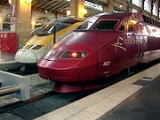
Eurostar, Thalys At Gare Du Nord
Jr Maglev Mlx01 2
High-speed rail is a type of passenger rail transport that operates significantly faster than the normal speed of rail traffic. Specific definitions include 200 km/h (125 mph) and faster — depending on whether the track is upgraded or new — by the European Union
European Union

The European Union is an economic and political union of 27 European Union member state, located primarily in Europe. It was established by the Treaty of Maastricht on 1 November 1993 upon the foundations of the pre-existing European Economic Community....
, and above 90 mph (145 km/h) by the United States
United States

The United States of America is a Federal government constitutional republic comprising U.S. state and a federal district. The country is situated mostly in central North America, where its Contiguous United States and Washington, D.C., the Capital districts and territories, lie between the Pacific Ocean and Atlantic Oceans, Borders of the U...
 Federal Railroad Administration
Federal Railroad Administration

The Federal Railroad Administration is an administration in the U.S. Department of Transportation. The agency was created by the Department of Transportation Act of 1966 ....
, but there is no single standard, and lower speeds can be required by local constraints.

While high-speed rail is usually designed for passenger travel, some high-speed systems also carry some kind of freight service. For instance, the French mail service La Poste
La Poste (France)

La Poste is the mail service of France, which also operates postal services in the French d?partement d'outre-mer of R?union, Guadeloupe, Martinique and French Guiana, and the territorial collectivities of Saint Pierre and Miquelon and Mayotte....
 owns a few special TGV trains
SNCF TGV La Poste

The SNCF TGV La Poste trains were built by Alstom between 1978?1986. These TGV units are essentially SNCF TGV Sud-Est trainsets that are modified for transporting mail for the French postal carrier La Poste ....
 for carrying postal freight.

History


Railways were the first form of mass transportation, and until the development of the motorcar in the early 20th century had an effective monopoly on land transport. Railway companies in Europe
Europe

Europe is, conventionally, one of the world's seven continents. Comprising the westernmost peninsula of Eurasia, Europe is generally divided from Asia to its east by the water divide of the Ural Mountains, the Ural , the Caspian Sea, and by the Caucasus Mountains to the southeast....
 and the United States
United States

The United States of America is a Federal government constitutional republic comprising U.S. state and a federal district. The country is situated mostly in central North America, where its Contiguous United States and Washington, D.C., the Capital districts and territories, lie between the Pacific Ocean and Atlantic Oceans, Borders of the U...
 used streamlined trains
Streamliner

A streamliner is any vehicle that incorporates streamline to produce a shape that provides less air resistance. The term is most often applied to certain high-speed railway trainsets of the 1930s to 1950s, and to their successor "high-speed trains"....
 since 1933 for high speed services with an average speed of up to 130 km/h (80 mph) and top speed of more than 160 km/h (100 mph).

The first high speed train was the Italian ETR 200
ETR 200

The ETR 200 is an Italian electric multiple unit introduced in 1936. It achieved the Land_speed_record_for_railed_vehicles#Long_distance in 1939....
 that in July 1939 went from Milan
Milan

Milan is the second largest city of Italy, located in the plains of Lombardy. It is the capital in the Province of Milan, as well as the Regions of Italy capital of Lombardy....
 to Florence
Florence

Florence is the Capital city of the Italy Regions of Italy of Tuscany and of the provinces of Italy Province of Florence. It is the most populous city in Tuscany and has a population of 364,779 ....
 at 165 km/h, with top speed of 203 km/h . With this service they were able to compete with the upcoming airplanes. World War II
World War II

World War II, or the Second World War , was a global military conflict which involved a Participants in World War II, including all of the great powers, organised into two opposing military alliances: the Allies of World War II and the Axis powers....
 stopped these services.

In 1957, the Odakyu Electric Railway
Odakyu Electric Railway

The , or OER, is a major private railway company in Tokyo, Japan, best known for its Romance car series of limited express trains from Tokyo to Odawara, Kanagawa, Enoshima, Tama New Town, and Hakone, Kanagawa....
 in Greater Tokyo launched its Romancecar
Romancecar

The is Odakyu Electric Railway's name for its limited express luxury tourist services south-west of Tokyo, to mountain resorts such as Gotenba and Hakone, and beaches such as Numazu and Enoshima....
 3000 SSE. This set a world record for narrow gauge
Narrow gauge

A narrow gauge railway is a railway that has a track gauge narrower than the of standard gauge railways. Most existing narrow gauge railways have gauges of or less....
 trains at 145 km/h (90 mph) , giving Japanese designers confidence they could safely and reliably build even faster trains at standard gauge
Standard gauge

The standard gauge is a widely-used rail gauge. Approximately 60% of the world's existing railway lines are built to this gauge . The distance between the inside edges of the rails of standard gauge track is ....
. Desperate for transport solutions due to overloaded trains between Tokyo
Tokyo

, officially , is one of the 47 prefectures of Japan of Japan and located on the eastern side of the main island Honshu. The twenty-three special wards of Tokyo, each governed as a city, cover the area that was once the Tokyo City in the eastern part of the prefecture, and total over 8 million people....
 and Osaka
Osaka

is a Cities of Japan in Japan, located at the mouth of the Yodo River on Osaka Bay, in the Kansai region of the main island of Honshu.Osaka is a City designated by government ordinance under the Local Autonomy Law and the capital city of Osaka Prefecture....
, Japan, the idea of high speed rail was born.

The world's first contemporary high volume capable (initially 12 car maximum) "high-speed train" was Japan's Tokaido Shinkansen
Tokaido Shinkansen

is a Japanese high-speed Shinkansen line, opened in 1964 between Tokyo Station and Shin-Osaka Station. It is operated by the Central Japan Railway Company , and formerly by JNR, Japan National Railways....
, that officially opened in October 1964, with construction commencing 50 years ago in April 1959. The 0 Series Shinkansen
0 Series Shinkansen

The 0 series Shinkansen were the first Shinkansen trainsets built to run on Japan's new Tokaido Shinkansen high-speed line which opened in 1964....
, built by Kawasaki Heavy Industries
Kawasaki Heavy Industries

is an international corporation based in Japan. It has headquarters in both Chuo-ku, Kobe, Kobe and Minato, Tokyo.The company is named after its founder Shozo Kawasaki and has no connection with the city of Kawasaki, Kanagawa, Kanagawa....
, achieved maximum passenger service speeds of 200 km/h (125 mph) on the Tokyo
Tokyo

, officially , is one of the 47 prefectures of Japan of Japan and located on the eastern side of the main island Honshu. The twenty-three special wards of Tokyo, each governed as a city, cover the area that was once the Tokyo City in the eastern part of the prefecture, and total over 8 million people....
–Nagoya–Kyoto
Kyoto

Sorry, no overview for this topic
Osaka
Osaka

is a Cities of Japan in Japan, located at the mouth of the Yodo River on Osaka Bay, in the Kansai region of the main island of Honshu.Osaka is a City designated by government ordinance under the Local Autonomy Law and the capital city of Osaka Prefecture....
 route, with earlier test runs top speeds in 1963 at 256 km/h.

In Europe, high-speed rail started during the international Munich traffic exposition, when DB Class 103
DB Class 103

The Baureihe 103 is a class of electric locomotives in Germany, originally operated by Deutsche Bundesbahn. For a long period, they were perceived as flagships of the DB rolling stock....
 hauled a total of 347 demonstration trains at 200 km/h between Munich and Augsburg. The first regular service at this speed was the TEE "Le Capitole" between Paris and Toulouse with specially adapted SNCF Class BB 9200
SNCF Class BB 9200

The SNCF Class BB 9200 1500 V DC electric locomotives were built by Schneider Electric/Compagnie Electro-M?chanique between 1958-1964. 92 of them were built and 20 remain....
 locomotives.

Definition of high-speed rail

There is no globally accepted standard separating high-speed rail from conventional railroads; however a number of widely accepted variables have been acknowledged by the industry in recent years. Generally, high-speed rail is defined as having a top speed in regular use of over 200 km/h (125 mph). Although almost every form of high-speed rail is electrically driven via overhead lines, this is not necessarily a defining aspect and other forms of propulsion, such as diesel locomotives, may be used. A definitive aspect is the use of continuous welded rail which reduces track vibrations and discrepancies between rail segments enough to allow trains to pass at speeds in excess 200 km/h. Curve radius will often be the ultimate limiting factor in a train's speed, with passenger discomfort often more imminent than the danger of derailment. Depending on design speed, banking and the forces deemed acceptable to the passengers, curves often exceed a 5 kilometre radius. Although a few exceptions exist, zero grade crossings is a policy adopted almost worldwide, with advanced switches using very low entry and frog angles. Magnetic levitation
Magnetic levitation

Magnetic levitation, maglev, or magnetic suspension is a method by which an object is levitation with no support other than magnetic fields....
 trains fall under the category of high-speed rail due to their association with track oriented vehicles; however their inability to operate on conventional railroads often leads to their classification in a separate category.

Rationale

Mountfujijapan
In both Japan and France the initial impetus for the introduction of high speed rail was the need for additional capacity to meet increasing demand for passenger rail travel. By the mid-1950s, the Tokaido Main Line
Tokaido Main Line

The is the busiest trunk line of Japan Railways Group , connecting Tokyo Station and Kobe Station . It is 589.5 km long, not counting its many freight feeder lines around the major cities....
 in Japan was operating at full capacity, and construction of the first segment of the Tokaido Shinkansen
Tokaido Shinkansen

is a Japanese high-speed Shinkansen line, opened in 1964 between Tokyo Station and Shin-Osaka Station. It is operated by the Central Japan Railway Company , and formerly by JNR, Japan National Railways....
 between Tokyo
Tokyo

, officially , is one of the 47 prefectures of Japan of Japan and located on the eastern side of the main island Honshu. The twenty-three special wards of Tokyo, each governed as a city, cover the area that was once the Tokyo City in the eastern part of the prefecture, and total over 8 million people....
 and Osaka
Osaka

is a Cities of Japan in Japan, located at the mouth of the Yodo River on Osaka Bay, in the Kansai region of the main island of Honshu.Osaka is a City designated by government ordinance under the Local Autonomy Law and the capital city of Osaka Prefecture....
 started in 1959. The Tokaido Shinkansen
Shinkansen

File:JR East Shinkansen lineup 200 E2 E4 E1 Niigata Depot 20071100.JPGThe is a network of high-speed railway lines in Japan operated by four Japan Railways Group companies....
 opened on October 11964, in time for the Tokyo Olympics
1964 Summer Olympics

The 1964 Summer Olympics, officially known as the Games of the XVIII Olympiad, were an international multi-sport event held in Tokyo, Japan in 1964....
. The situation for the first line in Japan was different than the subsequent lines. The route was already so densely populated and rail oriented that highway development would be extremely costly, and that one single line between Tokyo and Osaka could bring service to over half the nation's population. In 1959 that was nearly 45 million people; today it is well over 65 million. The Tokaido Shinkansen line is the most heavily traveled high speed line in the world, and still transports more passengers than all other high speed rail lines in the world combined, including in Japan. The subsequent lines in Japan had a rationale more similar to situations in Europe.

In France the main line between Paris
Paris

Paris is the Capital of France and the country's largest city. It is situated on the river Seine, in northern France, at the heart of the ?le-de-France Regions of France ....
 and Lyon
Lyon

||-||}Lyon, also known as Lyons in English, is a city in east-central France. Its name is pronounced in French language and Franco-Proven?al language, and or in English language....
 was projected to run out of capacity by 1970, so it was decided to build a new line. In both cases the choice to build a completely separate passenger-only line allowed for the much straighter higher speed lines. The dramatically reduced travel times on both lines, bringing cities within three hours of one another, caused explosions in ridership. It was the commercial success of both lines that inspired those countries and their economies to expand or start high speed rail networks.

In the United States
United States

The United States of America is a Federal government constitutional republic comprising U.S. state and a federal district. The country is situated mostly in central North America, where its Contiguous United States and Washington, D.C., the Capital districts and territories, lie between the Pacific Ocean and Atlantic Oceans, Borders of the U...
 the decades after World War II, improvements in automobile
Automobile

An automobile or motor car is a wheeled motor vehicle for transportation passengers, which also carries its own car engine or motor. Most definitions of the term specify that automobiles are designed to run primarily on roads, to have seating for one to eight people, to typically have four wheels, and to be constructed principally f...
s and aircraft
Aircraft

An aircraft is a vehicle which is able to flight by being supported by the air, or in general, the atmosphere, of a planet. Examples include balloons, airplanes and helicopters....
, severe antitrust restrictions on railroads, and government subsidization of highway
Highway

A highway is a main road intended for travel by the public between important destinations, such as city and towns. Highway designs vary widely and can range from a two-lane road without margins to a multi-lane, grade separated freeway....
s and airport
Airport

An airport is a location where aircraft such as Fixed-wing aircraft, helicopters, and Non-rigid airship take off and land. Aircraft may also be stored or maintained at an airport....
s made those means practical for a greater portion of the population than previously. In Europe
Europe

Europe is, conventionally, one of the world's seven continents. Comprising the westernmost peninsula of Eurasia, Europe is generally divided from Asia to its east by the water divide of the Ural Mountains, the Ural , the Caspian Sea, and by the Caucasus Mountains to the southeast....
 and Japan
Japan

Japan is an island country in East Asia. Located in the Pacific Ocean, it lies to the east of the Sea of Japan, People's Republic of China, North Korea, South Korea and Russia, stretching from the Sea of Okhotsk in the north to the East China Sea and Taiwan in the south....
, emphasis was given to rebuilding the railways after the war. In the United States
United States

The United States of America is a Federal government constitutional republic comprising U.S. state and a federal district. The country is situated mostly in central North America, where its Contiguous United States and Washington, D.C., the Capital districts and territories, lie between the Pacific Ocean and Atlantic Oceans, Borders of the U...
, emphasis was given to building a huge national interstate highway system
Interstate Highway System

The Dwight D. Eisenhower National System of Interstate and Defense Highways, commonly called the Interstate Highway System , is a list of highway systems with full control of access and no cross traffic in the United States that is named for United States President Dwight D....
 and airport
Airport

An airport is a location where aircraft such as Fixed-wing aircraft, helicopters, and Non-rigid airship take off and land. Aircraft may also be stored or maintained at an airport....
s. Urban mass transport systems in the United States were largely eschewed in favor of road expansion. The U.S. railways have been less competitive partly because the government has tended to favour road and air transportation more than in Japan
Japan

Japan is an island country in East Asia. Located in the Pacific Ocean, it lies to the east of the Sea of Japan, People's Republic of China, North Korea, South Korea and Russia, stretching from the Sea of Okhotsk in the north to the East China Sea and Taiwan in the south....
 and Europe
Europe

Europe is, conventionally, one of the world's seven continents. Comprising the westernmost peninsula of Eurasia, Europe is generally divided from Asia to its east by the water divide of the Ural Mountains, the Ural , the Caspian Sea, and by the Caucasus Mountains to the southeast....
an countries, and partly because of lower population density in the United States
United States

The United States of America is a Federal government constitutional republic comprising U.S. state and a federal district. The country is situated mostly in central North America, where its Contiguous United States and Washington, D.C., the Capital districts and territories, lie between the Pacific Ocean and Atlantic Oceans, Borders of the U...
, but as energy costs increase, rail ridership is increasing across the country.

Travel by rail becomes more competitive in areas of higher population density
Population density

Population density is a measurement of population per unit area or unit volume. It is frequently applied to living organisms, and particularly to humans....
 or where gasoline
Gasoline

File:GasCan.jpgGasoline or petrol is a petroleum-derived liquid mixture, primarily used as fuel in internal combustion engines.It consists mostly of aliphatic hydrocarbons, enhanced with iso-octane or the aromatic hydrocarbons toluene and benzene to increase its octane rating....
 is expensive, because conventional trains are more fuel efficient than cars . Very few high-speed trains consume diesel
Diesel

Diesel or diesel fuel in general is any fuel used in diesel engines. The most common is a specific fractional distillation of petroleum fuel oil, but alternatives that are not derived from petroleum, such as biodiesel, biomass to liquid or gas to liquid diesel, are increasingly being developed and adopted....
 or other fossil fuel
Fossil fuel

Fossil fuels or mineral fuels are fossil source fuels, that is, carbon or hydrocarbons found in the earth?s Crust .Fossil fuel range from volatile materials with low carbon:hydrogen ratios like methane, to liquid petroleum to nonvolatile materials composed of almost pure carbon, like anthracite coal....
s but the power stations that provide electric trains with power can consume fossil fuels. In Japan
Japan

Japan is an island country in East Asia. Located in the Pacific Ocean, it lies to the east of the Sea of Japan, People's Republic of China, North Korea, South Korea and Russia, stretching from the Sea of Okhotsk in the north to the East China Sea and Taiwan in the south....
 and France
France

France , officially the French Republic , is a country whose Metropolitan France is located in Western Europe and that also comprises various Overseas departments and territories of France....
, where the most extensive high speed rail networks exist, a large proportion of electricity comes from nuclear power
Nuclear power

Nuclear power is any nuclear technology designed to extract usable energy from atomic nucleus via controlled nuclear reactions. The only method in use today is through nuclear fission, though other methods might one day include nuclear fusion and radioactive decay ....
. Even using electricity generated from coal or oil, trains are more fuel efficient per passenger per kilometer travelled than the typical automobile because of efficiencies of scale
Economies of scale

Economies of scale, in microeconomics, are the cost advantages that a business obtains due to expansion. They are factors that cause a producer?s average cost per unit to fall as output rises....
 in generator technology. Rail networks, like highways, require large fixed capital investments and thus require a blend of high density and government investment to be competitive against existing capital infrastructure for aircraft
Fixed-wing aircraft

A fixed-wing aircraft is an aircraft capable of heavier-than-air flight whose Lift is generated not by wing motion relative to the aircraft, but by forward motion through the air....
 and automobiles. Urban density and mass transit have been key factors in the success of European and Japanese railway transport, especially in countries such as the Netherlands
Netherlands

The Netherlands is a country that is part of the Kingdom of the Netherlands. It is a parliamentary democratic constitutional monarchy. The Netherlands is located in North-West Europe, and bordered by the North Sea to the north and west, Belgium to the south, and Germany to the east....
, Belgium
Belgium

* A small German-speaking Community of Belgium exists in eastern Wallonia. Belgium's linguistic diversity and related political and cultural conflicts are reflected in the history of Belgium and a complex Communities and regions of Belgium....
, Germany
Germany

Germany , officially the Federal Republic of Germany , is a country in Central Europe. It is bordered to the north by the North Sea, Denmark, and the Baltic Sea; to the east by Poland and the Czech Republic; to the south by Austria and Switzerland; and to the west by France, Luxembourg, Belgium, and the Netherlands....
, Switzerland
Switzerland

Switzerland is a landlocked Swiss Alps country of roughly 7.7 million people in Western Europe with an area of 41,285 km?. Switzerland is a federal republic consisting of 26 states called Cantons of Switzerland....
, Spain
Spain

Spain or the Kingdom of Spain , is a country located in Southern Europe on the Iberian Peninsula.The Spanish constitution does not establish any official denomination of the country, even though Espa?a , Estado espa?ol and Naci?n espa?ola are used interchangeably....
 and France
France

France , officially the French Republic , is a country whose Metropolitan France is located in Western Europe and that also comprises various Overseas departments and territories of France....
.

High-speed rail by region


For the purposes of this table, high speed rail is defined as passenger rail running at a top speed of 125 mph (200 km/h) or higher. Countries with scheduled services at 300 km/h or faster are highlighted in blue. Using the 200 km/h definition, existing high speed rail service is limited to Europe
Europe

Europe is, conventionally, one of the world's seven continents. Comprising the westernmost peninsula of Eurasia, Europe is generally divided from Asia to its east by the water divide of the Ural Mountains, the Ural , the Caspian Sea, and by the Caucasus Mountains to the southeast....
 (including Turkey) and East Asia
East Asia

East Asia is a subregion of Asia that can be defined in either Geography or cultural terms. Geography and geopolitically, it covers about 12,000,000 km?, or about 28 percent of the Asian continent, about 15 percent bigger than the area of Europe, though some categorize Tibet, Xinjiang, and Mongolia as Central Asia....
 entirely
.

Country Scheduled trains Test run speed record
Austria
Austrian Western Railway

The Austrian Western Railway was the name of a former railway company during the time of the Austria-Hungary. Today, the term is still used to refer to the railway lines which was formerly operated by that company....
 
230 km/h 275 km/h
Belgium
High-speed rail in Belgium

Belgium's rail network is served by four types of high-speed trains: Thalys, Eurostar, InterCityExpress and TGV trains. All of them stop in Brussels Bruxelles-Midi / Brussel-Zuid railway station, Belgium's largest train station.Since 2007 Eurostar connects Brussels to London St Pancras railway station....
 
300, 250 km/h 347 km/h
China
High-speed rail in China

The People's Republic of China introduced 430 km/h Maglev train service in March 2004 and regular high-speed train services in April 2007. The maximum speed limit for regular train in China is 350km/h in Beijing?Tianjin Intercity Rail by 2008....
 
431 km/h maglev
350, 300, 250, 200 km/h conventional
502 km/h maglev
394 km/h conventional
Finland 220 km/h 255 km/h
France
TGV

The TGV is France's high-speed rail service. It was developed during the 1970s by GEC-Alsthom and SNCF, the French national rail transport operations, and is now operated primarily by SNCF....
 
320, 300, 280, 210 km/h 574 km/h
Germany
High-speed rail in Germany

Construction on first Germany high-speed lines began shortly after that of the French LGVs . Legal battles caused significant delays, so that the InterCityExpress trains were deployed ten years after the TGV network was established....
 
300, 280, 250, 230 km/h (conventional) 550 km/h maglev
406 km/h conventional
Italy
High-speed rail in Italy

Italy opened what is often regarded as Europe's first high-speed rail route, the Direttissima, which from 1978 connected Rome with Florence ; however, the major works were only finally completed in the early 1990s, long after France's faster TGV network was established....
 
300, 260, 200 km/h 368 km/h
Japan
Shinkansen

File:JR East Shinkansen lineup 200 E2 E4 E1 Niigata Depot 20071100.JPGThe is a network of high-speed railway lines in Japan operated by four Japan Railways Group companies....
 
300, 275, 260 km/h (conventional) 581 km/h maglev
443 km/h conventional
Norway
High-speed rail in Norway

Currently, the only high-speed rail in Norway, on the Rail transport in Norway is on Gardermobanen, a 60 kilometer line between Oslo Sentralstasjon and Eidsvoll Station via Oslo Airport Station....
 
210 km/h 260 km/h
Portugal
High-speed rail in Portugal

File:Alfa Pendular CP Lisboa Santa Apolonia.jpgThe government of Portugal plans to build a high-speed rail line from Lisbon to Madrid. The 7.8 billion Euro plan, announced in February 2009, is part of an effort to stimulate the country's Economy of Portugal....
 
220 km/h 275 km/h
Russia
High-speed rail in Europe

High-speed rail is emerging in Europe as an increasingly popular and efficient means of transportation. The first high-speed rail lines in Europe, built in the 1980s and 1990s, improved travel times on intra-national corridors....
 
210 km/h 260 km/h
South Korea
Korea Train Express

The Korea Train eXpress is South Korea's high-speed rail system, which connects the capital Seoul to Busan and Mokpo. Operated by Korail, the train's technology is largely based on the French TGV system, and has a top speed of 350 km/h, limited to 300 km/h during regular service for safety....
 
300, 240 km/h 355 km/h
Spain 350, 300, 250 km/h 404 km/h
Sweden
High-speed rail in Sweden

In Sweden many trains run at 200 km/h. Train types which currently attain this speed include the X2 train tilting trains for long distances, the Regina widebody trains, the SJ X40 double-decker regional trains, and the Arlanda Airport Express X3 ....
 
200 km/h 303 km/h
Taiwan
Taiwan High Speed Rail

The Taiwan High Speed Rail is a high-speed rail network that runs along the west coast of Taiwan. It is approximately , and runs from Taipei City to Kaohsiung City....
 
300, 240 km/h 315 km/h
Turkey
High-speed rail in Turkey

The Turkish State Railways started building high-speed rail lines in 2003. The first line, which has a length of 533 km from Istanbul via Eskisehir to Ankara is under construction and will reduce the travelling time from 6–7 hours to 3 hours and 10 minutes....
 
250 km/h 303 km/h
United Kingdom
High-speed rail in the United Kingdom

The United Kingdom has four "classic" main railway lines operating at , plus of purpose built high-speed rail known as High Speed 1. Costs and benefits of route options for a second dedicated high speed line in the UK, between London and the West Midlands, are to be considered by the Government at the end of 2009 ....
 
300, 200 km/h 335 km/h


Comparison with other modes of transport

High speed rail is often viewed as an isolated system and simply as advantageous or disadvantageous as compared to other transport systems, but all transport systems must work together to maximize benefits. A good HSR system has capacity for non-stop and local services, and has good connectivity with other transport systems. HSR, like any transport system, is not inherently convenient, fast, clean, nor comfortable. All of this depends on design, implementation, maintenance, operation and funding. Operational smoothness is often more indicative of organizational discipline than technological prowess.

Due to current infrastructure designs in many nations, there are constraints on the growth of the highway and air travel systems. Some key factors promoting HSR is that airports and highways have no room to expand, and are often overloaded. High-speed rail has the potential for high capacity on its fixed corridors (double decked E4 Series Shinkansen
E4 Series Shinkansen

The E4 Series Shinkansen were the second series of completely bi-level Shinkansen high-speed trainsets to be built in Japan . They operate on the Tohoku Shinkansen, Joetsu Shinkansen and Nagano Shinkansen....
 can carry 1634 seated passengers, double that of an Airbus A380
Airbus A380

The Airbus A380 is a Double-deck aircraft, wide-body, four-engine jet airliner manufactured by the European corporation Airbus, a subsidiary of EADS....
 in all economy class, and even more if standing passengers are allowed), and has the potential to relieve congestion on the other systems. Well established high speed rail systems in use today are more environmentally friendly than air or road travel. This is due to:

  • displaced usage from more environmentally damaging modes of transport.
  • lower energy consumption per passenger kilometer
  • reduced land usage for a given capacity compared to motorways


Automobiles

Shinkansen 100 Fukuyama
High-speed rail has the advantage over automobiles in that it can move passengers at speeds far faster than those possible by car. The lower limit for HSR (200 km/h, 125 mph) is substantially faster than the highest road speed limit in any country. Ignoring the few countries without a general speed limit, the speed limit is rarely higher than 130 km/h (80 mph). For journeys that connect city centre to city centre, HSR's advantage is increased due to the lower speed limits within most urban areas. Generally, the longer the journey, the better the time advantage of rail over road if going to the same destination.

Moreover, train tracks permit a far higher throughput of passengers per hour than a road the same width. A high speed rail needs just a double track railway, one track for each direction. A typical capacity is 15 trains per hour and 800 passengers per train (as for the Eurostar
Eurostar

Eurostar is a high-speed train service in Western Europe connecting London and Kent in the United Kingdom, with Paris and Lille in France, and Brussels in Belgium....
 sets), which implies a capacity of 12,000 passengers per hour in each direction. By way of contrast, the Highway Capacity Manual
Highway Capacity Manual

File:Cover HCM2000 low res.jpgThe Highway Capacity Manual is a publication of the Transportation Research Board in the United States. It contains concepts, guidelines, and computational procedures for computing the capacity and quality of service of various highway facilities, including freeways, highways, arterial roads, roundabouts, traf...
 gives a maximum capacity for a single lane of highway of 2,250 passenger cars per hour (excluding trucks or RVs). Assuming an average vehicle occupancy of 1.57 people, a standard twin track railway has a typical capacity 13% greater than a 6-lane highway (3 lanes each way), while requiring only 40% of the land (1.0/3.0 versus 2.5/7.5 hectares per kilometer of direct/indirect land consumption). This means that typical passenger rail carries 2.83 times as many passengers per hour per meter (width) as a road. Some passenger rail systems, such as the Tokaido Shinkansen line in Japan
Japan

Japan is an island country in East Asia. Located in the Pacific Ocean, it lies to the east of the Sea of Japan, People's Republic of China, North Korea, South Korea and Russia, stretching from the Sea of Okhotsk in the north to the East China Sea and Taiwan in the south....
, have much higher ratios (with as many as 20,000 passengers per hour per direction). Congested roadways tend to be commuter – these carry fewer than 1.57 persons per vehicle (Washington State Department of Transportation, for instance, uses 1.2 persons per vehicle) during commute times. Congestion also causes the maximum throughput of a lane to decrease.

Aircraft


Optimal distance
While commercial high-speed trains have maximum operating speeds much slower than jet aircraft, they have advantages over air travel mostly for relatively short distances, and can be an integral part of any good transportation system. They also connect city center rail stations to multiple other city center rail stations (with an intermediate stop passenger loading/unloading time of 3-8 minutes), while air transport necessarily connects airports outside city centers to other airports outside city centers (with a stop time for intermediate destinations of 30 minutes to 1 hour.) Both systems complement each other if they are well designed and maintained.

HSR is best suited for journeys of 2 - 3 hours (150-600 km or about 100-400 miles), for which the train can beat both air and car in this range. When traveling less than about 650 km (400 mi), the process of checking in and going through security screening at airports, as well as the journey to the airport itself makes the total air journey time no faster than HSR. However, anecdotally, competition authorities in Europe treat HSR for city pairs as competitive with passenger air at 4-4.5 hours, allowing on a 1-hour flight at least 40 minutes at each point for travel to and from the airport, check-in–security–boarding, disembarcation–baggage retrieval and other waits.

However, unless air travel is severely congested, merely providing a comparable service is often not a compelling financial basis for build an HSR system from scratch. As a rule of thumb, rail journeys need to be four hours or thereabouts to be competitive with air travel on journey time. One factor which may have a further bearing on HSR's competitiveness is the general lack of inconvenience when using HSR, for example the lack of a requirement to check baggage, or repeated queuing for checkin, security and boarding as well as the typically high on-time reliability as compared to air. Separately, from a business traveler's perspective, HSR can offer amenities such as cellular phone network availability and on for example Franco-German TGV-Est wireless internet broadband.

There are routes where high-speed trains have totally beaten air transport, so that there is no air connection anymore. Examples are Paris-Brussels and Cologne-Frankfurt. If the train stops at a big airport, like Paris and Frankfurt, these short distance airplanes lose an extra advantage for the many travellers who want to go to the airport for a long-distance journey. Air plane tickets can include a train segment for the journey, with guaranteed rebooking if the connection is missed, like normal air travel.

Other considerations
Although jet travel has a speed advantage, with multiple boarding points trains can typically be boarded more quickly, and stations can be located closer to, if not within, urban centers. This can mostly – or completely – offset the speed advantage of air travel for mid-distance trips.

Weather
Rail lines also permit far greater capacity and frequency of service than what is possible with aircraft, and rail schedules find fewer weather-related interruptions than do airline schedules. Although comfort over air travel is often believed to be a trait of high speed rail, it is not inherent, it depends on the specific implementation. From the operator's point of view, a single train can call in at multiple stops, often far more stops than aircraft, and each stop takes much less down time. One train stopping pattern can allow a multitude of possible journeys, increasing the potential market.

Energy Efficiency
High speed trains are more energy efficient than aircraft on a same load factor basis, as trains consume less energy per passenger kilometer. This may result in less carbon dioxide emissions, however this depends on each implementation's actual usage patterns and their indirect effects. Short-haul energy requirements for transporting people are generally more competitive on trains than long haul. (where rail competes best on time), because takeoff and landing have proportionately high energy requirements per km versus cruising.

Safety
From the point of view of required traffic control systems and infrastructure, high-speed rail has the added advantage of being much simpler to control due to its predictable course, even at very high passenger loads; this issue is becoming more relevant as air traffic reaches its safe limit in busy airspaces over London, New York, and other large centers. However, it must be noted that high speed rail systems eliminate the possibility of traffic collisions with automobiles (adding cost, simplicity, and safety), while other systems do not.

Maximum speed records


Maximum speed in service


The term "maximum speed" has many meanings here. It can reflect:

  • maximum scheduled speed between two scheduled stops
  • maximum speed at which a train is allowed to run safely as set by law or policy on a straight section with minimal contraints (MOR)
  • the maximum speed at which an unmodified train is capable of running
  • the maximum speed a specially modified train is capable of running.


A one time specially modified system and trainset record (see land speed record for railed vehicles
Land speed record for railed vehicles

Determination of the fastest rail vehicle in the world varies depending on the definition of "Rail tracks".The French TGV is the fastest conventional train in the world, using powered metal wheels riding on metal rails....
) was set by the manned TGV
TGV

The TGV is France's high-speed rail service. It was developed during the 1970s by GEC-Alsthom and SNCF, the French national rail transport operations, and is now operated primarily by SNCF....
's 574.8 km/h run, however it is far from a typical situation. The sheer amount of smoke emitted from the train is evidence that it was meant for proof of concept and not for passenger runs. Safety, cost, reliability, mass production are major concerns for high speed rail engineers and designers, which would not allow such conditions in a scheduled passenger run. The record for railed vehicles however is 10,325 km/h (6,416 mph) by an unmanned rocket sled
Rocket sled

A rocket sled is a test platform that slides along a set of rails, propelled by rockets. They were used extensively by the United States early in the Cold War to accelerate equipment considered too experimental for testing directly in piloted aircraft....
 by the United States Air Force
United States Air Force

The United States Air Force is the aerial warfare branch of the Military of the United States and one of the uniformed services of the United States....
.
Ktx Engine
The maximum speed an unmodified train is capable of running was set by the non-wheeled 581 km/h JR-Maglev MLX01
JR-Maglev

JR-Maglev is a magnetic levitation train system developed by the Central Japan Railway Company and Railway Technical Research Institute . JR-Maglev MLX01 is one of the latest designs of a series of Maglev trains in development in Japan since the 1970s....
 run in 2003. However, even this is not necessarily suitable for passenger operation as there can be concerns such as noise, cost, deceleration time in an emergency, etc.

The fastest maximum operating speed (MOR) of ANY segment of any high speed rail line, currently 350 km/h (217 mph), a record held by China. It is Beijing–Tianjin Intercity Rail which links Beijing to neighbouring Tianjin (117 km in 30 minutes). The trains have shown an unmodified capability of running 394 km/h in tests, and thus have been set to run 350 km/h in normal operation. That rail line went into operation on August 1, 2008.

The highest scheduled average speed between two scheduled stops is held by TGV and ICE service on part of the TGV Est Line in France. at 279.4 km/h (173.6 mph) from Lorraine-TGV to Champagne-Ardennes-TGV (167.66 km in 36 min) and Nozomi
Nozomi (Shinkansen)

is the fastest train service running on the Tokaido Shinkansen/Sanyo Shinkansen Shinkansen. Along the stretch between Shin-Kobe Station and Hakata station, Nozomi services using 500 series and N700 series equipment reach speeds of 300 km/h ....
 Shinkansen
Shinkansen

File:JR East Shinkansen lineup 200 E2 E4 E1 Niigata Depot 20071100.JPGThe is a network of high-speed railway lines in Japan operated by four Japan Railways Group companies....
 at 261.8 km/h (162.7 mph) from Hiroshima
Hiroshima

The Japanese city of is the capital of Hiroshima Prefecture, and the largest city in the Chugoku region of western Honshu, the largest of Japan's islands....
 to Kokura
Kokura

is an ancient castle town and the center of Kitakyushu, Japan, guarding, via its suburb Moji-ku, Kitakyushu, the Kanmon Straits between Honshu and Kyushu....
 according to the last official Railway Gazette International
Railway Gazette International

Railway Gazette International is a monthly business journal covering the railway, rapid transit, light rail and tram industries worldwide. Available by annual subscription, the magazine is read in over 140 countries by transport professionals and decision makers, railway managers, consultants and suppliers to the rail industry....
  study in 2005. With the introduction of the new N700 Shinkansen on July 1, 2007, the Kokura
Kokura

is an ancient castle town and the center of Kitakyushu, Japan, guarding, via its suburb Moji-ku, Kitakyushu, the Kanmon Straits between Honshu and Kyushu....
 to Hiroshima
Hiroshima

The Japanese city of is the capital of Hiroshima Prefecture, and the largest city in the Chugoku region of western Honshu, the largest of Japan's islands....
 time may have decreased further.

The highest speed in gallery was obtained in the new TAV line Bologna
Bologna

Bologna is the capital city of Emilia-Romagna in northern Italy, in the Po Valley , between the Po River and the Apennine Mountains, exactly between the Reno River and the S?vena River....
-Florence
Florence

Florence is the Capital city of the Italy Regions of Italy of Tuscany and of the provinces of Italy Province of Florence. It is the most populous city in Tuscany and has a population of 364,779 ....
 on january 3, 2009: a ETR 500 "Frecciarossa" reached 362 km/h inside the Mount Babele gallery.

Records in trial runs


  • 1963 - Japan
    Japan

    Japan is an island country in East Asia. Located in the Pacific Ocean, it lies to the east of the Sea of Japan, People's Republic of China, North Korea, South Korea and Russia, stretching from the Sea of Okhotsk in the north to the East China Sea and Taiwan in the south....
     - Shinkansen
    Shinkansen

    File:JR East Shinkansen lineup 200 E2 E4 E1 Niigata Depot 20071100.JPGThe is a network of high-speed railway lines in Japan operated by four Japan Railways Group companies....
     - 256 km/h (First country to develop HSR technology)
  • 1965 - West Germany
    Germany

    Germany , officially the Federal Republic of Germany , is a country in Central Europe. It is bordered to the north by the North Sea, Denmark, and the Baltic Sea; to the east by Poland and the Czech Republic; to the south by Austria and Switzerland; and to the west by France, Luxembourg, Belgium, and the Netherlands....
     - Class 103 locomotives
    DB Class 103

    The Baureihe 103 is a class of electric locomotives in Germany, originally operated by Deutsche Bundesbahn. For a long period, they were perceived as flagships of the DB rolling stock....
     - 200 km/h (Second country to develop HSR technology)
  • 1967 - France
    France

    France , officially the French Republic , is a country whose Metropolitan France is located in Western Europe and that also comprises various Overseas departments and territories of France....
     - TGV 001
    TGV 001

    TGV 001 , the first TGV prototype, was commissioned in 1969 and began testing in 1972. The TGV 001 was an experimental gas turbine-electric locomotive-powered trainset built by Alsthom to break speed records between 250 and 300 Kilometre per hour....
     - 318 km/h (Third country to develop HSR technology)
  • 1972 - Japan - Shinkansen - 286 km/h
  • 1974 - West Germany - EET-01 - 230 km/h
  • 1974 - France - Aérotrain
    Aérotrain

    The A?rotrain was a hovercraft train developed in France from 1965 to 1977. The lead engineer was Jean Bertin.The goal of the A?rotrain was similar to that of the magnetic levitation train: to suspend the train above the tracks so the only resistance is that of air resistance....
     - 430.2 km/h (high speed monorail train)
  • 1975 - West Germany - Comet - 401.3 km/h (steam rocket propulsion)
  • 1978 - Japan - HSST-01 - 307.8 km/h (Auxiliary rocket propulsion)
  • 1978 - Japan - HSST-02 - 110 km/h
  • 1979 - Japan - Shinkansen - 319 km/h
  • 1979 - Japan - ML-500R
    JR-Maglev

    JR-Maglev is a magnetic levitation train system developed by the Central Japan Railway Company and Railway Technical Research Institute . JR-Maglev MLX01 is one of the latest designs of a series of Maglev trains in development in Japan since the 1970s....
     (unmanned) - 504 km/h
  • 1979 - Japan - ML-500R
    JR-Maglev

    JR-Maglev is a magnetic levitation train system developed by the Central Japan Railway Company and Railway Technical Research Institute . JR-Maglev MLX01 is one of the latest designs of a series of Maglev trains in development in Japan since the 1970s....
     (unmanned) - 517 km/h
  • 1981 - France - TGV
    TGV

    The TGV is France's high-speed rail service. It was developed during the 1970s by GEC-Alsthom and SNCF, the French national rail transport operations, and is now operated primarily by SNCF....
     - 380 km/h
  • 1985 - West Germany - InterCityExperimental
    InterCityExperimental

    The Intercity Experimental, later renamed ICE V, was an experimental train for research into high-speed rail. It is the predecessor of all Intercity-Express trains....
     - 324 km/h
  • 1987 - Japan - MLU001
    JR-Maglev

    JR-Maglev is a magnetic levitation train system developed by the Central Japan Railway Company and Railway Technical Research Institute . JR-Maglev MLX01 is one of the latest designs of a series of Maglev trains in development in Japan since the 1970s....
     (manned) - 400.8 km/h
  • 1988 - West Germany - InterCityExperimental - 406 km/h
  • 1988 - Italy
    Italy

    Italy , officially the Italian Republic , is a country located on the Italian Peninsula in Southern Europe and on the two largest islands in the Mediterranean Sea, Sicily and Sardinia....
     - ETR 500-X
    ETR 500

    ETR 500 is a family of Italian high-speed trains introduced in 1993.Designed under the aegis of the Ferrovie dello Stato , it is now operated by Trenitalia on Rete Ferroviaria Italiana tracks....
     - 319 km/h (Fourth country to develop HSR technology)
  • 1988 - West Germany - TR-06
    Transrapid

    Transrapid is a Germany high-speed rail monorail using maglev train. Based on a patent from 1934, planning of the Transrapid system started in 1969....
     - 412.6 km/h
  • 1989 - West Germany - TR-07
    Transrapid

    Transrapid is a Germany high-speed rail monorail using maglev train. Based on a patent from 1934, planning of the Transrapid system started in 1969....
     - 436 km/h
  • 1990 - France - TGV - 515.3 km/h
  • 1992 - Japan - Shinkansen - 350 km/h
  • 1993 - Japan - Shinkansen - 425 km/h
  • 1993 - Germany - TR-07
    Transrapid

    Transrapid is a Germany high-speed rail monorail using maglev train. Based on a patent from 1934, planning of the Transrapid system started in 1969....
     - 450 km/h
  • 1994 - Japan - MLU002N
    JR-Maglev

    JR-Maglev is a magnetic levitation train system developed by the Central Japan Railway Company and Railway Technical Research Institute . JR-Maglev MLX01 is one of the latest designs of a series of Maglev trains in development in Japan since the 1970s....
     - 431 km/h
  • 1996 - Japan - Shinkansen - 446 km/h
  • 1997 - Japan - MLX01
    JR-Maglev

    JR-Maglev is a magnetic levitation train system developed by the Central Japan Railway Company and Railway Technical Research Institute . JR-Maglev MLX01 is one of the latest designs of a series of Maglev trains in development in Japan since the 1970s....
     - 550 km/h
  • 1999 - Japan - MLX01
    JR-Maglev

    JR-Maglev is a magnetic levitation train system developed by the Central Japan Railway Company and Railway Technical Research Institute . JR-Maglev MLX01 is one of the latest designs of a series of Maglev trains in development in Japan since the 1970s....
     - 552 km/h
  • 2002 - Spain
    Spain

    Spain or the Kingdom of Spain , is a country located in Southern Europe on the Iberian Peninsula.The Spanish constitution does not establish any official denomination of the country, even though Espa?a , Estado espa?ol and Naci?n espa?ola are used interchangeably....
     - AVE Class 330
    AVE Class 102

    The AVE Class 102 is a series of AVE high speed trains for the Spain state-run railway company RENFE.The AVE Class 102 was constructed by Talgo in association with Bombardier....
     - 362 km/h (Fifth country to develop HSR technology)
  • 2002 - China
    People's Republic of China

    The People's Republic of China , commonly known as China, is the largest country in East Asia and the List of countries by population in the world with over 1.3 billion people, approximately a fifth of the world's population....
     - China Star
    China Star

    China Star is an indigenously designed experimental high-speed train manufactured in China. It is a push-pull train developed from the DJJ1 "Blue Arrow" high speed train by Zhuzhou Electric Locomotive Works....
     - 321 km/h
  • 2003 - China - Transrapid 08
    Transrapid

    Transrapid is a Germany high-speed rail monorail using maglev train. Based on a patent from 1934, planning of the Transrapid system started in 1969....
     - 501 km/h
  • 2003 - Japan - MLX01
    JR-Maglev

    JR-Maglev is a magnetic levitation train system developed by the Central Japan Railway Company and Railway Technical Research Institute . JR-Maglev MLX01 is one of the latest designs of a series of Maglev trains in development in Japan since the 1970s....
     - 581 km/h (current world record holder)
  • 2004 - South Korea
    South Korea

    South Korea, officially the Republic of Korea , ), often referred to as Korea and the "names of Korea#Revival of the names", is a Semi-presidential system republic in East Asia, located in the southern half of the Korean Peninsula....
     - HSR-350x
    HSR-350x

    HSR-350x , also known as Korean G-7, is a high speed train which was developed independently by South Korea. The main motivation was to reduce traffic problems and to raise the nation's science and technology to the level of the world's top leaders, at the time known as the G-7....
     - 352.4 km/h (Sixth country to develop HSR technology)
  • 2006 - Germany - Siemens Velaro
    Siemens Velaro

    Siemens Velaro is a family of Germany high-speed rail multiple units. They are based on Deutsche Bahn's ICE 3 high-speed trains. Unlike the ICE 3, the Velaro is a full Siemens product....
     - 404 km/h (unmodified commercial trainset)
  • 2007 - France - V150
    V150

    The V150 is a specially configured TGV train which broke the world record for conventional rail trains on April 3, 2007. The train is French-made and reached a speed of 574.8 kilometers per hour ....
     - 574.8 km/h
  • 2008 - China - CRH3 - 394.3 km/h


Target areas for high-speed trains

Tgv Original Livery 1987
Shinkansen 700t
Main articles: High-speed rail by country
High-speed rail by country

This article provides of a list of operating High-speed rail networks, listed by country. High-speed rail is public transport by rail transport at speeds in excess of 200 km/h ....
 and Planned high-speed rail by country
Planned high-speed rail by country

This article provides of planned or proposed High-speed rail projects, listed by country. High-speed rail is public transport by rail transport at speeds in excess of 200 km/h ....


The early target areas, identified by France, Japan, and the U.S., were connections between pairs of large cities. In France
France

France , officially the French Republic , is a country whose Metropolitan France is located in Western Europe and that also comprises various Overseas departments and territories of France....
 this was Paris
Paris

Paris is the Capital of France and the country's largest city. It is situated on the river Seine, in northern France, at the heart of the ?le-de-France Regions of France ....
Lyon
Lyon

||-||}Lyon, also known as Lyons in English, is a city in east-central France. Its name is pronounced in French language and Franco-Proven?al language, and or in English language....
, in Japan
Japan

Japan is an island country in East Asia. Located in the Pacific Ocean, it lies to the east of the Sea of Japan, People's Republic of China, North Korea, South Korea and Russia, stretching from the Sea of Okhotsk in the north to the East China Sea and Taiwan in the south....
 Tokyo
Tokyo

, officially , is one of the 47 prefectures of Japan of Japan and located on the eastern side of the main island Honshu. The twenty-three special wards of Tokyo, each governed as a city, cover the area that was once the Tokyo City in the eastern part of the prefecture, and total over 8 million people....
Osaka
Osaka

is a Cities of Japan in Japan, located at the mouth of the Yodo River on Osaka Bay, in the Kansai region of the main island of Honshu.Osaka is a City designated by government ordinance under the Local Autonomy Law and the capital city of Osaka Prefecture....
, and in the U.S. the proposals are in high-density areas. The only high-speed rail service at present in the U.S. is the Acela Express
Acela Express

Acela Express is the name used by Amtrak for the high-speed rail tilting train service operating between Washington, D.C. and Boston, Massachusetts via Baltimore, Maryland, Philadelphia, and New York City along the Northeast Corridor in the Northeast U.S.....
, in the Northeast Corridor
Northeast Corridor

The Northeast Corridor is the busiest passenger railroad line in the United States by ridership and service frequency. The route is fully electrified and serves a BosWash from Washington, D.C., in the south through Baltimore, Maryland, Wilmington, Delaware, Philadelphia, Trenton, New Jersey, Newark, New Jersey, New York City, New Haven, Con...
 between Boston
Boston, Massachusetts

Boston is the State capital and largest city of the Commonwealth of Massachusetts, and is one of the oldest cities in the United States. The largest city in New England, Boston is considered the economic and cultural center of the region, and is sometimes regarded as the unofficial "Capital of New England." Boston city proper had a 2007 est...
, New York
New York

The State of New York is a U.S. state in the Mid-Atlantic States and Northeastern United States regions of the United States and is the nation's List of U.S....
 and Washington, D.C.
Washington, D.C.

Washington, D.C. , formally the District of Columbia and commonly referred to as Washington, the District, or simply D.C., is the Capital of the United States, founded on July 16, 1790....
; it uses tilting train
Tilting train

A wikt:tilting train has a mechanism that enables increased speed on regular railway tracks. As a vehicle rounds a curve at speed, objects inside the train experience Centrifugal force ....
s to achieve speeds of up to 240 km/h (150 mph) on existing tracks.

In Europe
Europe

Europe is, conventionally, one of the world's seven continents. Comprising the westernmost peninsula of Eurasia, Europe is generally divided from Asia to its east by the water divide of the Ural Mountains, the Ural , the Caspian Sea, and by the Caucasus Mountains to the southeast....
, South Korea
South Korea

South Korea, officially the Republic of Korea , ), often referred to as Korea and the "names of Korea#Revival of the names", is a Semi-presidential system republic in East Asia, located in the southern half of the Korean Peninsula....
, and Japan
Japan

Japan is an island country in East Asia. Located in the Pacific Ocean, it lies to the east of the Sea of Japan, People's Republic of China, North Korea, South Korea and Russia, stretching from the Sea of Okhotsk in the north to the East China Sea and Taiwan in the south....
, dense networks of city subways and railways connect seamlessly with high speed rail lines. Some argue that cities that lack dense intra-city rail infrastructure, like some cities in the USA, will find low ridership for high speed rail. The argument is that it is incompatible with existing automobile infrastructure. (People will want to drive when traveling in city, so they might as well drive the entire trip). However, others contend that this does not square with the high use of rail transport in the Northeast Corridor, where many people living in the towns outside the large eastern cities drive to the commuter train and then commute by train the rest of the way in, similar to the way many people drive to an airport, park their cars and then fly to their final destination.

Since in Japan intra-city rail daily usage per capita is the highest, it follows naturally that ridership of 6 billion passengers exceeds the French TGV of 1 billion (until 2003), the only other system to reach a billion cumulative passengers. For comparison, the world's fleet of 22,685 aircraft carried 2.1 billion passengers in 2006, according to International Civil Aviation Organization.

The California High Speed Rail Authority is currently studying a San Francisco Bay Area and Sacramento to Los Angeles and San Diego line. The strives to bring Texas
Texas

Texas is a U.S. state located in the South Central United States, nicknamed the Lone Star State. Texas is the second largest U.S. state in both area and population, spanning , and with a growing population of 24.3 million residents....
 an innovative high-speed rail and multimodal transportation corridor. The Corporation developed the Brazos Express Corridor to link Central Texas
Texas

Texas is a U.S. state located in the South Central United States, nicknamed the Lone Star State. Texas is the second largest U.S. state in both area and population, spanning , and with a growing population of 24.3 million residents....
. New York State Senator Caesar Trunzo
Caesar Trunzo

Caesar Trunzo is a United States Republican Party politician who served in the New York State Senate from 1973 to 2009. He was born May 11, 1926, in Brooklyn....
 announced a long-term plan to bring high-speed rail service between Buffalo and New York City, via Albany, to under three hours.

Later high speed rail lines, such as the LGV Atlantique
LGV Atlantique

The LGV Atlantique is a high-speed railway line running from Paris to Western France. It opened in 1989-1990. It divides into two parts at Courtalain, one going westward to Le Mans , the second one going southwestward to Tours ....
, the LGV Est
LGV Est

The LGV Est europ?enne is an extension to the French High-speed rail TGV network, connecting Paris and Strasbourg. It provides fast service between Paris and the principal cities of eastern France and Luxembourg, and several cities in Germany and Switzerland....
, and most high speed lines in Germany, were designed as feeder routes branching into conventional rail lines, serving a larger number of medium-sized cities.

A side effect of the first high-speed rail lines in France
France

France , officially the French Republic , is a country whose Metropolitan France is located in Western Europe and that also comprises various Overseas departments and territories of France....
 was the opening up of previously isolated regions to fast economic development. Some newer high-speed lines have been planned primarily for this purpose, such as the Madrid
Madrid

Madrid is the Capital and largest city of Spain. It is the Largest cities of the European Union by population within city limits in the European Union after Greater London and Berlin, and its Madrid metropolitan area is the Largest urban areas of the European Union in the European Union after Paris aire urbaine, Greater London Urban Area, a...
–Sevilla line and the proposed Amsterdam
Amsterdam

Amsterdam is the Capital of the Netherlands and List of cities in the Netherlands with over 100,000 people of the Netherlands, located in the Provinces of the Netherlands of North Holland in the west of the country....
Groningen
Groningen (city)

||-| |-| |-| |-| |-| |-| |-| |-| |}Groningen is the capital city of the province of Groningen in the Netherlands. With a population of 185,000, it is by far the largest city in the north of the Netherlands....
 line. Cities relatively close to a major city may see an increase in population, but those farther away may actually lose population (except for tourist spots), having a ripple effect on local economies.

Five years after construction began on the line, the first Japan
Japan

Japan is an island country in East Asia. Located in the Pacific Ocean, it lies to the east of the Sea of Japan, People's Republic of China, North Korea, South Korea and Russia, stretching from the Sea of Okhotsk in the north to the East China Sea and Taiwan in the south....
ese high-speed rail line opened on the eve of the 1964 Olympics
1964 Summer Olympics

The 1964 Summer Olympics, officially known as the Games of the XVIII Olympiad, were an international multi-sport event held in Tokyo, Japan in 1964....
 in Tokyo
Tokyo

, officially , is one of the 47 prefectures of Japan of Japan and located on the eastern side of the main island Honshu. The twenty-three special wards of Tokyo, each governed as a city, cover the area that was once the Tokyo City in the eastern part of the prefecture, and total over 8 million people....
, connecting the capital with Osaka
Osaka

is a Cities of Japan in Japan, located at the mouth of the Yodo River on Osaka Bay, in the Kansai region of the main island of Honshu.Osaka is a City designated by government ordinance under the Local Autonomy Law and the capital city of Osaka Prefecture....
. The first French high-speed rail line, or Ligne à grande vitesse (LGV
TGV

The TGV is France's high-speed rail service. It was developed during the 1970s by GEC-Alsthom and SNCF, the French national rail transport operations, and is now operated primarily by SNCF....
), was opened in 1981 by SNCF
SNCF

SNCF is a France public enterprise. Its functions include operation of rail services for passengers and freight, and maintenance as well as signalling of rail infrastructure owned by R?seau Ferr? de France ....
, the French rail agency, planning starting in 1966 and construction in 1976.

Market segmentation has principally focused on the business travel market. The French original focus on business travelers is reflected by the early design of the TGV
TGV

The TGV is France's high-speed rail service. It was developed during the 1970s by GEC-Alsthom and SNCF, the French national rail transport operations, and is now operated primarily by SNCF....
 trains, including the bar car. Pleasure travel was to be a secondary market; now many of the French extensions connect with vacation beaches on the Atlantic
Atlantic Ocean

The Atlantic Ocean is the second-largest of the world's oceanic divisions; with a total area of about 106.4 million square kilometres . It covers approximately one-fifth of the Earth's surface....
 and Mediterranean
Mediterranean Sea

The Mediterranean Sea is a sea or Ocean off the Atlantic Ocean surrounded by the Mediterranean region and almost completely enclosed by land: on the north by Europe, on the south by Africa, and on the east by Asia....
, as well as major amusement park
Amusement park

Amusement park is the generic term for a collection of Amusement ride and other entertainment attractions assembled for the purpose of entertaining a large group of people....
s and also the very popular Alpine ski resorts in France
France

France , officially the French Republic , is a country whose Metropolitan France is located in Western Europe and that also comprises various Overseas departments and territories of France....
 or Switzerland
Switzerland

Switzerland is a landlocked Swiss Alps country of roughly 7.7 million people in Western Europe with an area of 41,285 km?. Switzerland is a federal republic consisting of 26 states called Cantons of Switzerland....
. Friday evenings are the peak time for TGV
TGV

The TGV is France's high-speed rail service. It was developed during the 1970s by GEC-Alsthom and SNCF, the French national rail transport operations, and is now operated primarily by SNCF....
s (train à grande vitesse) (Metzler, 1992). The system has lowered prices on long distance travel to compete more effectively with air services, and as a result some cities within an hour of Paris by TGV
TGV

The TGV is France's high-speed rail service. It was developed during the 1970s by GEC-Alsthom and SNCF, the French national rail transport operations, and is now operated primarily by SNCF....
 have become commuter communities, thus increasing the market while restructuring land use
Land use

Land use is the human modification of natural environment or wilderness into built environment such as fields, pastures, and settlements. The major effect of land use on land cover since 1750 has been deforestation of temperate regions....
.

On the Paris
Paris

Paris is the Capital of France and the country's largest city. It is situated on the river Seine, in northern France, at the heart of the ?le-de-France Regions of France ....
 - Lyon
Lyon

||-||}Lyon, also known as Lyons in English, is a city in east-central France. Its name is pronounced in French language and Franco-Proven?al language, and or in English language....
 service, the number of passengers grew to impressive numbers justifying the introduction of double-decks coaches on the TGV
TGV

The TGV is France's high-speed rail service. It was developed during the 1970s by GEC-Alsthom and SNCF, the French national rail transport operations, and is now operated primarily by SNCF....
 trainsets.

Other target areas include freight lines, such as the Trans-Siberian Railway
Trans-Siberian Railway

The Trans-Siberian Railway or Trans-Siberian Railroad is a network of railways connecting Moscow and European Russia with the Russian Far East provinces, Mongolia, China and the Sea of Japan....
 in Russia
Russia

Russia , or the Russian Federation , is a list of countries spanning more than one continent country extending over much of northern Eurasia....
, which would allow 3 day Far East to Europe
Europe

Europe is, conventionally, one of the world's seven continents. Comprising the westernmost peninsula of Eurasia, Europe is generally divided from Asia to its east by the water divide of the Ural Mountains, the Ural , the Caspian Sea, and by the Caucasus Mountains to the southeast....
 service for freight as opposed to months by ship (but still slower than air), and allow just in time deliveries. High speed north-south freight lines in Switzerland
Switzerland

Switzerland is a landlocked Swiss Alps country of roughly 7.7 million people in Western Europe with an area of 41,285 km?. Switzerland is a federal republic consisting of 26 states called Cantons of Switzerland....
 are under construction, avoiding slow mountainous truck traffic, and lowering labour costs.

In South America, Brazilian government is currently studying a high speed rail line connecting the cities Campinas and Sao Paulo to Rio de Janeiro. This high speed rail line will also connect these airports: Viracopos (Campinas), Guarulhos (Sao Paulo) and Galeao (Rio de Janeiro).

Technology

Tgv Double Decker Dsc00132
Much of the technology behind high-speed rail is an improved application of mature standard gauge rail technology using overhead electrification. By building a new rail infrastructure with 20th century engineering, including elimination of constrictions such as roadway at-grade (level) crossings, frequent stops, a succession of curves and reverse curves, and not sharing the right-of-way with freight or slower passenger trains, higher speeds (250–320 km/h) are maintained. Total cost of ownership of HSR systems is generally lower than the total costs of competing alternatives (new highway or air capacity). Japanese systems are often more expensive than their counterparts but more comprehensive because they have their own dedicated elevated guideway, no traffic crossings, and disaster monitoring systems. Despite this, the lion's share of the Japanese system's cost is related to boring tunnels through mountains, as was in Taiwan
Taiwan

Taiwan is an island in East Asia. "Taiwan" is also commonly used to refer to the country governed by the Republic of China and to the ROC itself, which governs the island of Taiwan, Orchid Island and Green Island, Taiwan in the Pacific Ocean off the Taiwan coast, the Penghu islands in the Taiwan Strait, and Kinmen and the Matsu Islands...
. Recent advances in wheeled trains in the last few decades have pushed the speed limits past 400 km/h, among the advances being tilting trainsets, aerodynamic designs (to reduce drag, lift, and noise), air brakes, regenerative braking, stronger engines, dynamic weight shifting, etc. Some of the advances were to fix problems, like the Eschede
Eschede train disaster

The Eschede train disaster was the world's deadliest high-speed rail accident. It occurred on 3 June 1998, near the village of Eschede in the Celle district of Lower Saxony, Germany....
 disaster. The record speed for a wheeled electric train
Land speed record for railed vehicles

Determination of the fastest rail vehicle in the world varies depending on the definition of "Rail tracks".The French TGV is the fastest conventional train in the world, using powered metal wheels riding on metal rails....
 is 574.8 km/h is held by a shortened TGV
TGV

The TGV is France's high-speed rail service. It was developed during the 1970s by GEC-Alsthom and SNCF, the French national rail transport operations, and is now operated primarily by SNCF....
 train and long straight track. The record speed for an unmodified commercial trainset is 403.7 km/h, held by the German Velaro E
Siemens Velaro

Siemens Velaro is a family of Germany high-speed rail multiple units. They are based on Deutsche Bahn's ICE 3 high-speed trains. Unlike the ICE 3, the Velaro is a full Siemens product....
. European high-speed routes typically combine segments on new track, where the train runs at full commercial speed, with some sections of older track on the extremities of the route, near cities.

In France
France

France , officially the French Republic , is a country whose Metropolitan France is located in Western Europe and that also comprises various Overseas departments and territories of France....
, the cost of construction (which was €10 million/km (US$15.1 million/km) for LGV Est
LGV Est

The LGV Est europ?enne is an extension to the French High-speed rail TGV network, connecting Paris and Strasbourg. It provides fast service between Paris and the principal cities of eastern France and Luxembourg, and several cities in Germany and Switzerland....
) is minimised by adopting steeper grades rather than building tunnels and viaducts. However, in mountainous Switzerland, tunnels are inevitable. Because the lines are dedicated to passengers, gradients of 3.5%, rather than the previous maximum of 1–1.5% for mixed traffic, are used. Possibly more expensive land is acquired in order to build straighter lines which minimize line construction as well as operating and maintenance costs. In other countries high-speed rail was built without those economies so that the railway can also support other traffic, such as freight. Experience has shown however, that trains of significantly different speeds cause massive decreases of line capacity. As a result, mixed-traffic lines are usually reserved for high-speed passenger trains during the daytime, while freight trains go at night. In some cases, nighttime high-speed trains are even diverted to lower speed lines in favor of freight traffic.

See also

Acela 2000
*Aérotrain
Aérotrain

The A?rotrain was a hovercraft train developed in France from 1965 to 1977. The lead engineer was Jean Bertin.The goal of the A?rotrain was similar to that of the magnetic levitation train: to suspend the train above the tracks so the only resistance is that of air resistance....
  • Ground effect train
    Ground effect train

    A ground effect train is an alternative to a Magnetic levitation train. In both cases the object is to prevent the vehicle from making contact with the ground....
  • High-speed rail by country
    High-speed rail by country

    This article provides of a list of operating High-speed rail networks, listed by country. High-speed rail is public transport by rail transport at speeds in excess of 200 km/h ....
  • High speed tilting train
    High speed tilting train

    File:800px-Pendolino Helsinki.jpgA high speed tilting train is a train combining:* high speed* tilting technology...
  • Land speed record for railed vehicles
    Land speed record for railed vehicles

    Determination of the fastest rail vehicle in the world varies depending on the definition of "Rail tracks".The French TGV is the fastest conventional train in the world, using powered metal wheels riding on metal rails....
  • Magnetic levitation train
  • Transrapid
    Transrapid

    Transrapid is a Germany high-speed rail monorail using maglev train. Based on a patent from 1934, planning of the Transrapid system started in 1969....
  • Megaproject
    Megaproject

    A megaproject is an extremely large-scale investment project. Megaprojects are typically defined as costing more than United States dollar1 billion and attracting a lot of public attention because of substantial impacts on communities, Natural environment, and budgets....
  • Planned high-speed rail by country
    Planned high-speed rail by country

    This article provides of planned or proposed High-speed rail projects, listed by country. High-speed rail is public transport by rail transport at speeds in excess of 200 km/h ....
  • Passenger rail terminology
    Passenger rail terminology

    Various terms are used for passenger rail lines and equipment. Unfortunately the usage of these terms differs substantially between areas....
  • Speed limits in the United States (rail)
    Speed limits in the United States (rail)

    Rail speed limits in the United States are regulated by the Federal Railroad Administration. Railroads also implement their own limits and enforce speed limits....


Further reading


External links

  • Business Times (The New Straits Times Press, Malaysia)