

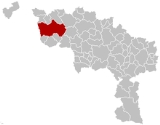
Tournai

Encyclopedia
Tournai is a Walloon city
and municipality of Belgium
located 85 kilometres southwest of Brussels
, on the river Scheldt
, in the province of Hainaut.
Along with Tongeren, Tournai is the oldest city in Belgium and it has played an important role in the country's cultural history.
of Belgium, at the southern limit of the Flemish plain, in the basin of the river Escaut ("Schelde" in Dutch). Administratively, the town is part of the Province of Hainaut, itself part of Wallonia. It is also a municipality that is part of the French-speaking Community
of Belgium. Tournai has its own arrondissements
, both administrative and judicial.
Its area of 213.75 km² makes it the largest commune in size in Belgium; it is also the largest in population in Western Hainaut. The municipality of Tournai consists of the former municipalities of
Ere, Saint-Maur, Orcq, Esplechin, Froyennes, Froidmont, Willemeau, Ramegnies-Chin, Templeuve, Chercq, Blandain, Hertain, Lamain, Marquain, Gaurain-Ramecroix, Havinnes, Beclers, Thimougies, Barry, Maulde, Vaulx, Vezon, Kain, Melles, Quartes, Rumillies, Mont-Saint-Aubert, Mourcourt and Warchin.
from Cologne
on the Rhine to Boulogne
on the coast crossed the river Scheldt. It was fortified under Maximian
in the third century, when the Roman limes
was withdrawn to the string of outposts along the road. It came into the possession of the Salian Franks
in 432. Under king Childeric I
, who was buried or reburied there, Tournai was the capital of the Frankish empire. In 486, Clovis
moved the center of power to Paris
. In turn, a native son of Tournai, Eleutherius
, became bishop of the newly created bishopric of Tournai, extending over most of the area west of the Scheldt
. In 862 Charles the Bald
, first king of Western Francia
and still to become Holy Roman Emperor
, would make Tournai the seat of the County of Flanders
.
After the partition of the Frankish empire by the Treaties of Verdun (843)
and of Meerssen (870)
, Tournai remained in the western part of the empire, which in 987 became France
. The city participated in eleventh-century rise of towns in the Low Countries
, with a woollen cloth industry based on English wool, which soon made it attractive to wealthy merchants. An ambitious rebuilding of the cathedral was initiated in 1030. The commune's drive for independence from the local counts succeeded in 1187, and the city was henceforth directly subordinated to the French Crown, as the seigneurie de Tournaisis, as the city's environs are called. The stone Pont des Trous over the Scheldt, with defensive towers at either end, was built in 1290, replacing an earlier wooden structure.
During the 15th century, the city's textile trade boomed and it became an important supplier of tapestry
. The art of painting flourished too: Jacques Daret
, Robert Campin
and Rogier van der Weyden all came from Tournai. It was conquered in 1513 by Henry VIII of England
, making it the only Belgian city ever to have been ruled by England. It was also represented
in the 1515 Parliament of England
. The city was handed back to French rule in 1519.
In 1521, Emperor Charles V
added the city to his possessions in the Low Countries
, leading to a period of religious strife and economic decline. During the 16th century, Tournai was a bulwark of Calvinism
, but eventually it was conquered by the Spanish governor of the Low Countries, the Duke of Parma, following a prolonged siege in 1581. After the fall of the city, its Protestant inhabitants were given one year to sell their possessions and emigrate, a policy that was at the time considered relatively humane, since very often religious opponents were simply massacred.
One century later, in 1668, the city briefly returned to France under Louis XIV
in the Treaty of Aachen
. After the end of the War of Spanish Succession in 1713, under terms of the Treaty of Utrecht
the former Spanish Netherlands, including Tournai, came into possession of the Austrian Habsburgs. From 1815 on, following the Napoleonic Wars
, Tournai formed part of the United Netherlands
and after 1830 of newly independent Belgium. Badly damaged in 1940, Tournai has since been carefully restored.

- and Gothic
-style cathedral
of Notre Dame de Tournai
and the belfry
, the oldest in Belgium, have been jointly designated by UNESCO
as a World Heritage Site
. Inside the cathedral, the Châsse de Notre-Dame flamande, a beautifully ornate 12th-century reliquary
, gives witness to Tournai's wealth in the Middle Ages
. Other places of interest are the 13th-century Scheldt
bridge (Pont-des-Trous) and the main square (Grand'Place), as well as several old city gates, historic warehouses, and a variety of museums.
On rue Barre-St-Brice are two of the oldest private houses in Europe, dating from between 1175 and 1200 and built in the Romanesque style, while the rue des Jésuites includes a Gothic house from the 13th century.
As is the case with many cities in Belgium there are a number of beautiful and friendly cafés and pubs in the Grand'Place. In the middle of the Grand'Place there are a series of water fountains that are fun to observe and even play in for people of all ages. Another great interactive experience available is climbing the circular staircase to the top of the belfry.
There are several buildings in the art nouveau
style.
dialect similar to that of other communes of Hainaut and Northern France.
Tournai belongs to Romance Flanders
, like Lille
, Douai
, Tourcoing
, and Mouscron
. The city of Tournai was one of the greatest cultural and economic centers of the County of Flanders
. Some traces can still be seen today:
Although Tournai is in the Flemish cultural area (of the Scheldt), it also possesses some treasures of the Mosan style
. Indeed, the two most beautiful shrines of the Cathedral, commissioned by the Bishop of Tournai, were made in the region of Liège
by the artist Nicholas of Verdun
: the shrines of Saint-Eleutherius and of Our Lady of Flanders (13th century). Those shrines testify to the opulence of the towns of Tournai and Liège during the Middle-Ages. The shrine of Our Lady of Flanders has been called one of the seven wonders of Belgium.
City
A city is a relatively large and permanent settlement. Although there is no agreement on how a city is distinguished from a town within general English language meanings, many cities have a particular administrative, legal, or historical status based on local law.For example, in the U.S...
and municipality of Belgium
Belgium
Belgium , officially the Kingdom of Belgium, is a federal state in Western Europe. It is a founding member of the European Union and hosts the EU's headquarters, and those of several other major international organisations such as NATO.Belgium is also a member of, or affiliated to, many...
located 85 kilometres southwest of Brussels
Brussels
Brussels , officially the Brussels Region or Brussels-Capital Region , is the capital of Belgium and the de facto capital of the European Union...
, on the river Scheldt
Scheldt
The Scheldt is a 350 km long river in northern France, western Belgium and the southwestern part of the Netherlands...
, in the province of Hainaut.
Along with Tongeren, Tournai is the oldest city in Belgium and it has played an important role in the country's cultural history.
Geography
Tournai is located in the lowlandsNorthern European Lowlands
The North European Plain is a geomorphological region in Europe. It consists of the low plains between the Central European Highlands to the south and the North Sea and the Baltic Sea to the north. These two seas are separated by the Jutland peninsula...
of Belgium, at the southern limit of the Flemish plain, in the basin of the river Escaut ("Schelde" in Dutch). Administratively, the town is part of the Province of Hainaut, itself part of Wallonia. It is also a municipality that is part of the French-speaking Community
French Community of Belgium
The French Community of Belgium is one of the three official communities in Belgium along with the Flemish Community and the German speaking Community. Although its name could suggest that it is a community of French citizens in Belgium, it is not...
of Belgium. Tournai has its own arrondissements
Arrondissements of Belgium
The federalized country Belgium geographically consists of 3 regions, of which only Flemish Region and Walloon Region are subdivided into 5 provinces each; the Brussels-Capital Region is neither a province nor is it part of one....
, both administrative and judicial.
Its area of 213.75 km² makes it the largest commune in size in Belgium; it is also the largest in population in Western Hainaut. The municipality of Tournai consists of the former municipalities of
Ere, Saint-Maur, Orcq, Esplechin, Froyennes, Froidmont, Willemeau, Ramegnies-Chin, Templeuve, Chercq, Blandain, Hertain, Lamain, Marquain, Gaurain-Ramecroix, Havinnes, Beclers, Thimougies, Barry, Maulde, Vaulx, Vezon, Kain, Melles, Quartes, Rumillies, Mont-Saint-Aubert, Mourcourt and Warchin.
Geology
Rocks from the Tournai area date from the Carboniferous Period and have been used to define the Tournaisian Age, a subdivision of the Carboniferous lasting from 359 to 345 million years ago. Tournai stone is a dark limestone which takes a polish and was used particularly in the Romanesque period for sculpted items such as baptismal fonts. It is also hard enough to have been used locally for pavements and kerb-stones. It is sometimes called Tournai marble, though this is geologically inaccurate.History
Tournai, known as Tornacum, was a place of minor importance in Roman times, a stopping place where the Roman roadRoman road
The Roman roads were a vital part of the development of the Roman state, from about 500 BC through the expansion during the Roman Republic and the Roman Empire. Roman roads enabled the Romans to move armies and trade goods and to communicate. The Roman road system spanned more than 400,000 km...
from Cologne
Cologne
Cologne is Germany's fourth-largest city , and is the largest city both in the Germany Federal State of North Rhine-Westphalia and within the Rhine-Ruhr Metropolitan Area, one of the major European metropolitan areas with more than ten million inhabitants.Cologne is located on both sides of the...
on the Rhine to Boulogne
Boulogne-sur-Mer
-Road:* Metropolitan bus services are operated by the TCRB* Coach services to Calais and Dunkerque* A16 motorway-Rail:* The main railway station is Gare de Boulogne-Ville and located in the south of the city....
on the coast crossed the river Scheldt. It was fortified under Maximian
Maximian
Maximian was Roman Emperor from 286 to 305. He was Caesar from 285 to 286, then Augustus from 286 to 305. He shared the latter title with his co-emperor and superior, Diocletian, whose political brain complemented Maximian's military brawn. Maximian established his residence at Trier but spent...
in the third century, when the Roman limes
Limes
A limes was a border defense or delimiting system of Ancient Rome. It marked the boundaries of the Roman Empire.The Latin noun limes had a number of different meanings: a path or balk delimiting fields, a boundary line or marker, any road or path, any channel, such as a stream channel, or any...
was withdrawn to the string of outposts along the road. It came into the possession of the Salian Franks
Salian Franks
The Salian Franks or Salii were a subgroup of the early Franks who originally had been living north of the limes in the area above the Rhine. The Merovingian kings responsible for the conquest of Gaul were Salians. From the 3rd century on, the Salian Franks appear in the historical records as...
in 432. Under king Childeric I
Childeric I
Childeric I was a Merovingian king of the Salian Franks and the father of Clovis.He succeeded his father Merovech as king, traditionally in 457 or 458...
, who was buried or reburied there, Tournai was the capital of the Frankish empire. In 486, Clovis
Clovis I
Clovis Leuthwig was the first King of the Franks to unite all the Frankish tribes under one ruler, changing the leadership from a group of royal chieftains, to rule by kings, ensuring that the kingship was held by his heirs. He was also the first Catholic King to rule over Gaul . He was the son...
moved the center of power to Paris
Paris
Paris is the capital and largest city in France, situated on the river Seine, in northern France, at the heart of the Île-de-France region...
. In turn, a native son of Tournai, Eleutherius
Eleutherius of Tournai
Saint Eleutherius of Tournai is venerated as a saint and considered the first bishop of Tournai. The Catholic Encyclopedia writes that "historically there is very little known about St. Eleutherius, but he was without doubt the first Bishop of Tournai." Tradition makes him a lifelong friend of St...
, became bishop of the newly created bishopric of Tournai, extending over most of the area west of the Scheldt
Scheldt
The Scheldt is a 350 km long river in northern France, western Belgium and the southwestern part of the Netherlands...
. In 862 Charles the Bald
Charles the Bald
Charles the Bald , Holy Roman Emperor and King of West Francia , was the youngest son of the Emperor Louis the Pious by his second wife Judith.-Struggle against his brothers:He was born on 13 June 823 in Frankfurt, when his elder...
, first king of Western Francia
Western Francia
West Francia, also known as the West Frankish Kingdom or Francia Occidentalis, was a short-lived kingdom encompassing the lands of the western part of the Carolingian Empire that came under the undisputed control of Charlemagne's grandson, Charles the Bald, as a result of the Treaty of Verdun of...
and still to become Holy Roman Emperor
Holy Roman Emperor
The Holy Roman Emperor is a term used by historians to denote a medieval ruler who, as German King, had also received the title of "Emperor of the Romans" from the Pope...
, would make Tournai the seat of the County of Flanders
County of Flanders
The County of Flanders was one of the territories constituting the Low Countries. The county existed from 862 to 1795. It was one of the original secular fiefs of France and for centuries was one of the most affluent regions in Europe....
.
After the partition of the Frankish empire by the Treaties of Verdun (843)
Treaty of Verdun
The Treaty of Verdun was a treaty between the three surviving sons of Louis the Pious, the son and successor of Charlemagne, which divided the Carolingian Empire into three kingdoms...
and of Meerssen (870)
Treaty of Meerssen
The Treaty of Meerssen or Mersen was a partition treaty of the Carolingian Empire concluded on 8 August 870 by the two surviving sons of Emperor Louis the Pious, King Charles the Bald of West Francia and Louis the German of East Francia, at Meerssen north of Maastricht, in the present-day...
, Tournai remained in the western part of the empire, which in 987 became France
France
The French Republic , The French Republic , The French Republic , (commonly known as France , is a unitary semi-presidential republic in Western Europe with several overseas territories and islands located on other continents and in the Indian, Pacific, and Atlantic oceans. Metropolitan France...
. The city participated in eleventh-century rise of towns in the Low Countries
Low Countries
The Low Countries are the historical lands around the low-lying delta of the Rhine, Scheldt, and Meuse rivers, including the modern countries of Belgium, the Netherlands, Luxembourg and parts of northern France and western Germany....
, with a woollen cloth industry based on English wool, which soon made it attractive to wealthy merchants. An ambitious rebuilding of the cathedral was initiated in 1030. The commune's drive for independence from the local counts succeeded in 1187, and the city was henceforth directly subordinated to the French Crown, as the seigneurie de Tournaisis, as the city's environs are called. The stone Pont des Trous over the Scheldt, with defensive towers at either end, was built in 1290, replacing an earlier wooden structure.
During the 15th century, the city's textile trade boomed and it became an important supplier of tapestry
Tapestry
Tapestry is a form of textile art, traditionally woven on a vertical loom, however it can also be woven on a floor loom as well. It is composed of two sets of interlaced threads, those running parallel to the length and those parallel to the width ; the warp threads are set up under tension on a...
. The art of painting flourished too: Jacques Daret
Jacques Daret
Jacques Daret was an Early Netherlandish painter born in Tournai , where he would spend much of his life. Daret spent 15 years as a pupil in the studio of Robert Campin, alongside Rogier or Rogelet de le Pasture , and afterwards...
, Robert Campin
Robert Campin
Robert Campin , now usually identified as the artist known as the Master of Flémalle, is usually considered the first great master of Early Netherlandish painting...
and Rogier van der Weyden all came from Tournai. It was conquered in 1513 by Henry VIII of England
Henry VIII of England
Henry VIII was King of England from 21 April 1509 until his death. He was Lord, and later King, of Ireland, as well as continuing the nominal claim by the English monarchs to the Kingdom of France...
, making it the only Belgian city ever to have been ruled by England. It was also represented
Tournai (constituency)
Tournai was a former constituency of the Parliament of England.The city of Tournai, Flemish city dependent of the French Crown, was under English rule from 23 September 1513 until it was returned to France in 1519. During part of that time it was represented in the Parliament of England by two...
in the 1515 Parliament of England
Parliament of England
The Parliament of England was the legislature of the Kingdom of England. In 1066, William of Normandy introduced a feudal system, by which he sought the advice of a council of tenants-in-chief and ecclesiastics before making laws...
. The city was handed back to French rule in 1519.
In 1521, Emperor Charles V
Charles V, Holy Roman Emperor
Charles V was ruler of the Holy Roman Empire from 1519 and, as Charles I, of the Spanish Empire from 1516 until his voluntary retirement and abdication in favor of his younger brother Ferdinand I and his son Philip II in 1556.As...
added the city to his possessions in the Low Countries
Low Countries
The Low Countries are the historical lands around the low-lying delta of the Rhine, Scheldt, and Meuse rivers, including the modern countries of Belgium, the Netherlands, Luxembourg and parts of northern France and western Germany....
, leading to a period of religious strife and economic decline. During the 16th century, Tournai was a bulwark of Calvinism
Calvinism
Calvinism is a Protestant theological system and an approach to the Christian life...
, but eventually it was conquered by the Spanish governor of the Low Countries, the Duke of Parma, following a prolonged siege in 1581. After the fall of the city, its Protestant inhabitants were given one year to sell their possessions and emigrate, a policy that was at the time considered relatively humane, since very often religious opponents were simply massacred.
One century later, in 1668, the city briefly returned to France under Louis XIV
Louis XIV of France
Louis XIV , known as Louis the Great or the Sun King , was a Bourbon monarch who ruled as King of France and Navarre. His reign, from 1643 to his death in 1715, began at the age of four and lasted seventy-two years, three months, and eighteen days...
in the Treaty of Aachen
Treaty of Aix-la-Chapelle (1668)
The Treaty of Aix-la-Chapelle or Treaty of Aachen was signed on May 2, 1668 in Aachen. It ended the war of Devolution between France and Spain. It was mediated by the Triple Alliance of England, the Dutch Republic and Sweden at the first Congress of Aix-la-Chapelle...
. After the end of the War of Spanish Succession in 1713, under terms of the Treaty of Utrecht
Treaty of Utrecht
The Treaty of Utrecht, which established the Peace of Utrecht, comprises a series of individual peace treaties, rather than a single document, signed by the belligerents in the War of Spanish Succession, in the Dutch city of Utrecht in March and April 1713...
the former Spanish Netherlands, including Tournai, came into possession of the Austrian Habsburgs. From 1815 on, following the Napoleonic Wars
Napoleonic Wars
The Napoleonic Wars were a series of wars declared against Napoleon's French Empire by opposing coalitions that ran from 1803 to 1815. As a continuation of the wars sparked by the French Revolution of 1789, they revolutionised European armies and played out on an unprecedented scale, mainly due to...
, Tournai formed part of the United Netherlands
United Kingdom of the Netherlands
United Kingdom of the Netherlands is the unofficial name used to refer to Kingdom of the Netherlands during the period after it was first created from part of the First French Empire and before the new kingdom of Belgium split out in 1830...
and after 1830 of newly independent Belgium. Badly damaged in 1940, Tournai has since been carefully restored.
Main sights
Tournai is considered to be one of the most important cultural sites in Belgium. The mixed RomanesqueRomanesque architecture
Romanesque architecture is an architectural style of Medieval Europe characterised by semi-circular arches. There is no consensus for the beginning date of the Romanesque architecture, with proposals ranging from the 6th to the 10th century. It developed in the 12th century into the Gothic style,...
- and Gothic
Gothic architecture
Gothic architecture is a style of architecture that flourished during the high and late medieval period. It evolved from Romanesque architecture and was succeeded by Renaissance architecture....
-style cathedral
Cathedral
A cathedral is a Christian church that contains the seat of a bishop...
of Notre Dame de Tournai
Tournai Cathedral
The Cathedral of Our Lady is Roman Catholic church, see of the Diocese of Tournai in Tournai, Belgium. It has been classified both as a Wallonia's major heritage since 1936 and as a World Heritage Site since 2000.-History:...
and the belfry
Belfry of Tournai
The belfry of Tournai, Belgium, is a freestanding bell tower of medieval origin, 72 metres in height with a 256-step stairway. This landmark building is one of a set of belfries of Belgium and France registered on the UNESCO World Heritage List....
, the oldest in Belgium, have been jointly designated by UNESCO
UNESCO
The United Nations Educational, Scientific and Cultural Organization is a specialized agency of the United Nations...
as a World Heritage Site
World Heritage Site
A UNESCO World Heritage Site is a place that is listed by the UNESCO as of special cultural or physical significance...
. Inside the cathedral, the Châsse de Notre-Dame flamande, a beautifully ornate 12th-century reliquary
Reliquary
A reliquary is a container for relics. These may be the physical remains of saints, such as bones, pieces of clothing, or some object associated with saints or other religious figures...
, gives witness to Tournai's wealth in the Middle Ages
Middle Ages
The Middle Ages is a periodization of European history from the 5th century to the 15th century. The Middle Ages follows the fall of the Western Roman Empire in 476 and precedes the Early Modern Era. It is the middle period of a three-period division of Western history: Classic, Medieval and Modern...
. Other places of interest are the 13th-century Scheldt
Scheldt
The Scheldt is a 350 km long river in northern France, western Belgium and the southwestern part of the Netherlands...
bridge (Pont-des-Trous) and the main square (Grand'Place), as well as several old city gates, historic warehouses, and a variety of museums.
On rue Barre-St-Brice are two of the oldest private houses in Europe, dating from between 1175 and 1200 and built in the Romanesque style, while the rue des Jésuites includes a Gothic house from the 13th century.
As is the case with many cities in Belgium there are a number of beautiful and friendly cafés and pubs in the Grand'Place. In the middle of the Grand'Place there are a series of water fountains that are fun to observe and even play in for people of all ages. Another great interactive experience available is climbing the circular staircase to the top of the belfry.
There are several buildings in the art nouveau
Art Nouveau
Art Nouveau is an international philosophy and style of art, architecture and applied art—especially the decorative arts—that were most popular during 1890–1910. The name "Art Nouveau" is French for "new art"...
style.
A French-speaking Flemish town
Tournai is a French-speaking town of Belgium. The local language is tournaisien, a PicardPicard language
Picard is a language closely related to French, and as such is one of the larger group of Romance languages. It is spoken in two regions in the far north of France – Nord-Pas-de-Calais and Picardy – and in parts of the Belgian region of Wallonia, the district of Tournai and a part of...
dialect similar to that of other communes of Hainaut and Northern France.
Tournai belongs to Romance Flanders
Romance Flanders
Romance Flanders or Gallicant Flanders is the part of the county of Flanders where people speak Romance languages, like varieties of Picard. It currently straddles the border of France and Belgium.-Name:...
, like Lille
Lille
Lille is a city in northern France . It is the principal city of the Lille Métropole, the fourth-largest metropolitan area in the country behind those of Paris, Lyon and Marseille. Lille is situated on the Deûle River, near France's border with Belgium...
, Douai
Douai
-Main sights:Douai's ornate Gothic style belfry was begun in 1380, on the site of an earlier tower. The 80 m high structure includes an impressive carillon, consisting of 62 bells spanning 5 octaves. The originals, some dating from 1391 were removed in 1917 during World War I by the occupying...
, Tourcoing
Tourcoing
Tourcoing is a city in northern France. It is designated municipally as a commune within the département of Nord.Tourcoing is situated near the cities of Lille and Roubaix and the Belgian border.-Main sights:...
, and Mouscron
Mouscron
Mouscron is a Walloon city and municipality located in the Belgian province of Hainaut. The Mouscron municipality includes the old communes of Dottignies , Luingne, and Herseaux .-Middle Ages:...
. The city of Tournai was one of the greatest cultural and economic centers of the County of Flanders
County of Flanders
The County of Flanders was one of the territories constituting the Low Countries. The county existed from 862 to 1795. It was one of the original secular fiefs of France and for centuries was one of the most affluent regions in Europe....
. Some traces can still be seen today:
- The gothic choir of Our Lady's CathedralTournai CathedralThe Cathedral of Our Lady is Roman Catholic church, see of the Diocese of Tournai in Tournai, Belgium. It has been classified both as a Wallonia's major heritage since 1936 and as a World Heritage Site since 2000.-History:...
is a precursory element of the Scaldian (meaning from the ScheldtScheldtThe Scheldt is a 350 km long river in northern France, western Belgium and the southwestern part of the Netherlands...
area), typically Flemish, GothicGothic architectureGothic architecture is a style of architecture that flourished during the high and late medieval period. It evolved from Romanesque architecture and was succeeded by Renaissance architecture....
art. - The bishopric of Tournai was the religious capital of Flanders during more than a millennium (from 496 to 1559).
- The tapestries and draperies of Tournai belong to the great Flemish school of tapestryTapestryTapestry is a form of textile art, traditionally woven on a vertical loom, however it can also be woven on a floor loom as well. It is composed of two sets of interlaced threads, those running parallel to the length and those parallel to the width ; the warp threads are set up under tension on a...
and Tournai was part of the Flemish HansaHanseatic LeagueThe Hanseatic League was an economic alliance of trading cities and their merchant guilds that dominated trade along the coast of Northern Europe...
of London, which also included the draper towns of Flanders. - The Saint-Brice church of Tournai, dedicated to Saint Britius, is one of the first examples of the hallekerk style, so typical of the Flemish countryside.
- Some of the great Flemish PrimitivesEarly Netherlandish paintingEarly Netherlandish painting refers to the work of artists active in the Low Countries during the 15th- and early 16th-century Northern renaissance, especially in the flourishing Burgundian cities of Bruges and Ghent...
are from Tournai: Robert CampinRobert CampinRobert Campin , now usually identified as the artist known as the Master of Flémalle, is usually considered the first great master of Early Netherlandish painting...
, Roger van der WeydenRoger van der WeydenRogier van der Weyden or Rogier de le Pasture was an Early Flemish painter. His surviving works consist mainly of religious triptychs, altarpieces and commissioned single and diptych portraits. Although his life was generally uneventful, he was highly successful and internationally famous in his...
, Jacques DaretJacques DaretJacques Daret was an Early Netherlandish painter born in Tournai , where he would spend much of his life. Daret spent 15 years as a pupil in the studio of Robert Campin, alongside Rogier or Rogelet de le Pasture , and afterwards...
.
Although Tournai is in the Flemish cultural area (of the Scheldt), it also possesses some treasures of the Mosan style
Mosan art
Mosan art is a regional style of art from the valley of the Meuse in present-day Belgium, the Netherlands, and Germany. Although the term applies to art from this region from all periods, it generally refers to Romanesque art, with Mosan Romanesque architecture, stone carving, metalwork, enamelling...
. Indeed, the two most beautiful shrines of the Cathedral, commissioned by the Bishop of Tournai, were made in the region of Liège
Bishopric of Liège
The Bishopric of Liège or Prince-Bishopric of Liège was a state of the Holy Roman Empire in the Low Countries in present Belgium. It acquired its status as a prince-bishopric between 980 and 985 when Bishop Notger, who had been the bishop of Liege since 972, acquired the status of Prince-Bishop...
by the artist Nicholas of Verdun
Nicholas of Verdun
Nicholas of Verdun was a French artist, one of the most famous goldsmiths and enamellists of the Middle Ages, a major figure in Romanesque art, and the leading figure of Mosan art in his day...
: the shrines of Saint-Eleutherius and of Our Lady of Flanders (13th century). Those shrines testify to the opulence of the towns of Tournai and Liège during the Middle-Ages. The shrine of Our Lady of Flanders has been called one of the seven wonders of Belgium.
Festivities
- The "Great Procession" (in FrenchFrench languageFrench is a Romance language spoken as a first language in France, the Romandy region in Switzerland, Wallonia and Brussels in Belgium, Monaco, the regions of Quebec and Acadia in Canada, and by various communities elsewhere. Second-language speakers of French are distributed throughout many parts...
: Grande Procession) has taken place every year since 1092, with the single exception of the year 1566, when the iconoclastsIconoclasmIconoclasm is the deliberate destruction of religious icons and other symbols or monuments, usually with religious or political motives. It is a frequent component of major political or religious changes...
considerably damaged the religious symbols of the city. This historic processionProcessionA procession is an organized body of people advancing in a formal or ceremonial manner.-Procession elements:...
unfolds in the streets every second Sunday of September. - The first Monday after January 6 is known as "Lost Monday" (in FrenchFrench languageFrench is a Romance language spoken as a first language in France, the Romandy region in Switzerland, Wallonia and Brussels in Belgium, Monaco, the regions of Quebec and Acadia in Canada, and by various communities elsewhere. Second-language speakers of French are distributed throughout many parts...
: Lundi perdu) or "Perjury Monday" (Lundi parjuré). This tradition dates from more than 700 years ago. The wealthier city inhabitants used to prepare fastuous family dinners and elect a king. Today, the family dinners have expanded to wider groups and a rabbit dish is often served.
People born in Tournai
- Clovis IClovis IClovis Leuthwig was the first King of the Franks to unite all the Frankish tribes under one ruler, changing the leadership from a group of royal chieftains, to rule by kings, ensuring that the kingship was held by his heirs. He was also the first Catholic King to rule over Gaul . He was the son...
, first king of all Salian FranksSalian FranksThe Salian Franks or Salii were a subgroup of the early Franks who originally had been living north of the limes in the area above the Rhine. The Merovingian kings responsible for the conquest of Gaul were Salians. From the 3rd century on, the Salian Franks appear in the historical records as... - Gilles Li MuisisGilles Li MuisisGilles Li Muisis was a French chronicler and poet. Li Muisis was probably born at Tournai, and in 1289 entered the Benedictine abbey of St Martin in his native city, becoming prior of this house in 1327, and abbot four years later...
, FrenchFranceThe French Republic , The French Republic , The French Republic , (commonly known as France , is a unitary semi-presidential republic in Western Europe with several overseas territories and islands located on other continents and in the Indian, Pacific, and Atlantic oceans. Metropolitan France...
chronicler and poet (13th century) - Roger van der WeydenRoger van der WeydenRogier van der Weyden or Rogier de le Pasture was an Early Flemish painter. His surviving works consist mainly of religious triptychs, altarpieces and commissioned single and diptych portraits. Although his life was generally uneventful, he was highly successful and internationally famous in his...
, FlemishFlemish paintingFlemish painting flourished from the early 15th century until the 17th century. Flanders delivered the leading painters in Northern Europe and attracted many promising young painters from neighbouring countries. These painters were invited to work at foreign courts and had a Europe-wide influence...
painter (15th century) - Jacques DaretJacques DaretJacques Daret was an Early Netherlandish painter born in Tournai , where he would spend much of his life. Daret spent 15 years as a pupil in the studio of Robert Campin, alongside Rogier or Rogelet de le Pasture , and afterwards...
, FlemishFlemish paintingFlemish painting flourished from the early 15th century until the 17th century. Flanders delivered the leading painters in Northern Europe and attracted many promising young painters from neighbouring countries. These painters were invited to work at foreign courts and had a Europe-wide influence...
painter (15th century) - Pierre de La RuePierre de La RuePierre de la Rue , called Piersson, was a Franco-Flemish composer and singer of the Renaissance. A member of the same generation as Josquin des Prez, and a long associate of the Habsburg-Burgundian musical chapel, he ranks with Agricola, Brumel, Compère, Isaac, Obrecht, and Weerbeke as one of the...
, Franco-FlemishFranco-Flemish SchoolIn music, the Franco-Flemish School or more precisely the Netherlandish School refers, somewhat imprecisely, to the style of polyphonic vocal music composition in Europe in the 15th and 16th centuries, and to the composers who wrote it...
composer (15th century) - Perkin WarbeckPerkin WarbeckPerkin Warbeck was a pretender to the English throne during the reign of King Henry VII of England. By claiming to be Richard of Shrewsbury, Duke of York, the younger son of King Edward IV, one of the Princes in the Tower, Warbeck was a significant threat to the newly established Tudor Dynasty,...
, impostor and pretender to the throne of EnglandEnglandEngland is a country that is part of the United Kingdom. It shares land borders with Scotland to the north and Wales to the west; the Irish Sea is to the north west, the Celtic Sea to the south west, with the North Sea to the east and the English Channel to the south separating it from continental...
(15th century) - Marbrianus de OrtoMarbrianus de OrtoMarbrianus de Orto was a Franco-Flemish composer of the Renaissance. He was a contemporary, close associate, and possible friend of Josquin des Prez, and was one of the first composers to write a completely canonic setting of the Ordinary of the Mass.-Life:The illegitimate child of a priest,...
, Franco-FlemishFranco-Flemish SchoolIn music, the Franco-Flemish School or more precisely the Netherlandish School refers, somewhat imprecisely, to the style of polyphonic vocal music composition in Europe in the 15th and 16th centuries, and to the composers who wrote it...
composer (15th-16th century) - Charles Blount, 5th Baron MountjoyCharles Blount, 5th Baron MountjoyCharles Blount, fifth Baron Mountjoy was an English courtier and patron of learning.-Life:Charles Blount was born on 28 June 1516 in Tournai, where his father, William Blount, 4th Baron Mountjoy, was governor. Charles Blount's mother was William 's second wife, Alice, daughter of Henry Keble, Lord...
, courtier and patron of learning (16th century) - Isaac Le MaireIsaac Le MaireIsaac le Maire was a merchant for the Vereenigde Oostindische Compagnie and later for the Austraalse Compagnie. He is best known for his constant strife with the VOC, which ultimately led to the discovery of Cape Horn.Isaac le Maire was born in 1558 or 1559 in Tournai...
, pioneering merchant of the VOC, the Dutch East India CompanyDutch East India CompanyThe Dutch East India Company was a chartered company established in 1602, when the States-General of the Netherlands granted it a 21-year monopoly to carry out colonial activities in Asia...
(16th century) - Louise-Françoise de BourbonLouise-Françoise de BourbonLouise Françoise de Bourbon, Légitimée de France was the eldest surviving legitimised daughter of Louis XIV of France and his maîtresse-en-titre, Madame de Montespan. She was said to have been named after her godmother, Louise de La Vallière, the woman that her mother had replaced as the king's...
(1673–1743) illegitimate daughter of Louis XIV of FranceLouis XIV of FranceLouis XIV , known as Louis the Great or the Sun King , was a Bourbon monarch who ruled as King of France and Navarre. His reign, from 1643 to his death in 1715, began at the age of four and lasted seventy-two years, three months, and eighteen days...
and his most famous mistress Madame de MontespanFrançoise-Athénaïs, marquise de MontespanFrançoise Athénaïs de Rochechouart de Mortemart, marquise of Montespan , better known as Madame de Montespan, was the most celebrated maîtresse en titre of King Louis XIV of France, by whom she had seven children....
. - Donat CastermanCastermanCasterman is a publisher of Franco-Belgian comics, specializing in comic books and children's literature. The company is based in Tournai, Belgium.Founded in 1780, Casterman was originally a printing company and publishing house...
, publisher (18th century) - Piat SauvagePiat SauvagePiat Joseph Sauvage was a Belgian painter. Piat's father, Antoine, was a glass cutter. Piat worked in his father's factory until the age of 17, when he completed his technical schooling in drawing...
, painter (19th century) - Louis GallaitLouis GallaitLouis Gallait was a Belgian painter.Gallait was born in Tournai, Hainaut, Belgium in 1810. He first studied in his native town under Philippe Auguste Hennequin. In 1832 his first picture, Tribute to Caesar, won a prize at the exhibition at Ghent...
, painter (19th century) - Jean-Baptiste MoënsJean-Baptiste MoënsJean-Baptiste Philippe Constant Moens was a Belgian philatelist recognized as the first dealer in stamps for collectors. He was one of the original philatelic journalists.- Youth :...
, philatelist (19th century) - Jules BaraJules BaraJules Bara was a Belgian statesman and liberal politician.-Early years:He was born at Tournai and pursued the study of law in his native town, showing remarkable intellectual gifts and a fine power of oratory.-Career:...
, statesman (19th century) - Georges RodenbachGeorges RodenbachGeorges Raymond Constantin Rodenbach was a Belgian Symbolist poet and novelist.- Biography :Georges Rodenbach was born in Tournai to a French mother and a German father from the Rhineland . He went to school in Ghent at the prestigious Sint-Barbaracollege, where he became friends with the poet...
, SymbolistSymbolism (arts)Symbolism was a late nineteenth-century art movement of French, Russian and Belgian origin in poetry and other arts. In literature, the style had its beginnings with the publication Les Fleurs du mal by Charles Baudelaire...
poet and novelist (19th century) - Hélène DutrieuHélène DutrieuHélène Dutrieu , was a cycling world champion, stunt cyclist, stunt motorcyclist, automobile racer, stunt driver, pioneer aviator, wartime ambulance driver, and director of a military hospital.-Biography:...
, cycle racerTrack cyclingTrack cycling is a bicycle racing sport usually held on specially built banked tracks or velodromes using track bicycles....
, stuntStuntA stunt is an unusual and difficult physical feat, or any act requiring a special skill, performed for artistic purposes in TV, theatre, or cinema...
driver and aviatorAviatorAn aviator is a person who flies an aircraft. The first recorded use of the term was in 1887, as a variation of 'aviation', from the Latin avis , coined in 1863 by G. de la Landelle in Aviation Ou Navigation Aérienne...
(19th and 20th centuries) - Marc QuaghebeurMarc QuaghebeurMarc Quaghebeur is a Belgian poet and essayist. He is currently director of the Archives and Museum of Literature in Brussels.-Poetry:*Forclaz, Paris, P-J...
, writer (20th century) - Xaveer De GeyterXaveer De GeyterXaveer De Geyter is a Belgian architect.De Geyter was born in Doornik, Belgium.He spent ten years at office for metropolitan architecture with Rem Koolhaas, where he worked on projects such as the Villa dall'ava in Paris, "urban design, melun sénart paris", the sea terminal in Zeebrugge, the zkm...
, architect (20th century)
External links
- Internationale petitie tegen het bouwproject van een toren in de Unesco zone van de kathedraal van Doornik (België).
- UNESCO World Heritage Site Citation
- Official site — The city's site, available in FrenchFrench languageFrench is a Romance language spoken as a first language in France, the Romandy region in Switzerland, Wallonia and Brussels in Belgium, Monaco, the regions of Quebec and Acadia in Canada, and by various communities elsewhere. Second-language speakers of French are distributed throughout many parts...
, EnglishEnglish languageEnglish is a West Germanic language that arose in the Anglo-Saxon kingdoms of England and spread into what was to become south-east Scotland under the influence of the Anglian medieval kingdom of Northumbria...
and DutchDutch languageDutch is a West Germanic language and the native language of the majority of the population of the Netherlands, Belgium, and Suriname, the three member states of the Dutch Language Union. Most speakers live in the European Union, where it is a first language for about 23 million and a second...
. - Tournai City.net — Online directory for this city.
- Joan of Arc's letter to Tournai — English translation (by Allen Williamson) of this letter dictated by Joan of ArcJoan of ArcSaint Joan of Arc, nicknamed "The Maid of Orléans" , is a national heroine of France and a Roman Catholic saint. A peasant girl born in eastern France who claimed divine guidance, she led the French army to several important victories during the Hundred Years' War, which paved the way for the...
on June 25, 1429. - Apis Tornacensis — database and bibliography about history.
- Medieval Tournai An Academic Resource Center
- Société Royale d'Histoire et d'Archéologie de Tournai, an exhaustive list of references on the history of the Tournai region, in FrenchFrench languageFrench is a Romance language spoken as a first language in France, the Romandy region in Switzerland, Wallonia and Brussels in Belgium, Monaco, the regions of Quebec and Acadia in Canada, and by various communities elsewhere. Second-language speakers of French are distributed throughout many parts...
.