

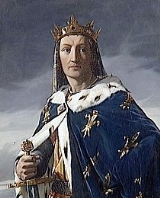
Louis VIII of France

Encyclopedia
Louis VIII the Lion reigned as King of France from 1223 to 1226. He was a member of the House of Capet
. Louis VIII was born in Paris, France, the son of Philip II Augustus
and Isabelle of Hainaut
. He was also Count of Artois, inheriting the county from his mother, from 1190–1226. It remained attached to the crown until 1237, when his son Louis IX gave the title in accordance with the will of his father to Louis IX's younger brother Robert on attaining his majority.
, following prolonged negotiations between Philip Augustus
and Blanche's uncle John of England
(as represented in William Shakespeare
's historical play King John).
, Count Renaud of Boulogne and Count Ferdinand of Flanders. John's plan was to split Philip's forces by pushing north-east from Poitou
towards Paris, whilst Otto, Renaud and Ferdinand, supported by William Longespée, marched south-west from Flanders. Whereas Philip II August took personal command of the northern front against the Emperor and his allies, he gave his son Louis the command of the front against the Plantagenet possessions in middle France. The first part of the campaign went well for the English, with John out-manoeuvring the forces under the command of Prince Louis and retaking the county of Anjou
by the end of June. John besieged the castle of Roche-au-Moine
, a key stronghold, forcing Louis to give battle against John's larger army. The local Angevin nobles refused to advance with the king; left at something of a disadvantage, John retreated back to La Rochelle
. Shortly afterwards, Philip II August won the hard-fought battle of Bouvines
in the north against Otto and John's other allies, bringing an end to John's hopes of retaking Normandy.
against the unpopular King John of England
(1199–1216). The barons offered the throne to Prince Louis, who landed unopposed on the Isle of Thanet
in England at the head of an army on 21 May 1216. There was little resistance when the prince entered London and at St Paul's Cathedral
, Louis was proclaimed King with great pomp and celebration in the presence of all of London. Even though he was not crowned, many nobles, as well as King Alexander II of Scotland
(1214–49) for his English possessions, gathered to give homage.
On 14 June 1216, Louis captured Winchester
and soon controlled over half of the English kingdom. But just when it seemed that England was his, King John's death in October 1216 caused many of the rebellious barons to desert Louis in favour of John's nine-year-old son, Henry III
.
With William Marshall
acting as regent
, a call for the English "to defend our land" against the French led to a reversal of fortunes on the battlefield. After his army was beaten
at Lincoln
on 20 May 1217, and his naval forces (led by Eustace the Monk
) were defeated
off the coast of Sandwich
on 24 August 1217, he was forced to make peace on English terms.
The principal provisions of the Treaty of Lambeth
were an amnesty for English rebels, Louis to undertake not to attack England again, and 10,000 marks to be given to Louis. The effect of the treaty was that Louis agreed he had never been the legitimate King of England.
. As King, he continued to seek revenge on the Angevins
and seized Poitou
and Saintonge
from them. There followed the seizure of Avignon
and Languedoc
.
 On 1 November 1223, he issued an ordinance that prohibited his officials from recording debts owed to Jews
, thus reversing the policies set by his father Philip II Augustus. Usury
(lending money with interest) was illegal for Christians to practice. According to Church law it was seen as a vice in which people profited from others' misfortune (like gambling), and was punishable by excommunication
, a severe punishment. However since Jews were not Christian, they could not be excommunicated, and thus fell in to a legal grey area which secular rulers would sometimes exploit by allowing (or requesting) Jews to provide usury services, often for personal gain to the secular ruler, and to the discontent of the Church. Louis VIII's prohibition was one attempt at resolving this legal problem which was a constant source of friction in Church and State
courts.
Twenty-six barons accepted, but Theobald IV
(1201–53), the powerful Count
of Champagne
, did not, since he had an agreement with the Jews that guaranteed him extra income through taxation. Theobald IV would become a major opposition force to Capetian dominance, and his hostility was manifest during the reign of Louis VIII. For example, during the siege of Avignon, he performed only the minimum service of 40 days, and left home amid charges of treachery.
In 1225, the council of Bourges
excommunicated the Count of Toulouse, Raymond VII
, and declared a crusade against the southern barons. Louis happily renewed the conflict in order to enforce his royal rights. Roger Bernard the Great
, Count of Foix, tried to keep the peace, but the king rejected his embassy and the counts of Foix and Toulouse took up arms against him. The king was largely successful, but he did not complete the work before his death.
While returning to Paris, King Louis VIII became ill with dysentery
, and died on 8 November 1226 in the chateau at Montpensier
, Auvergne
.
The Saint Denis Basilica
houses the tomb of Louis VIII. His son, Louis IX
(1226–70), succeeded him on the throne.
(4 March 1188 – 26 November 1252).
House of Capet
The House of Capet, or The Direct Capetian Dynasty, , also called The House of France , or simply the Capets, which ruled the Kingdom of France from 987 to 1328, was the most senior line of the Capetian dynasty – itself a derivative dynasty from the Robertians. As rulers of France, the dynasty...
. Louis VIII was born in Paris, France, the son of Philip II Augustus
Philip II of France
Philip II Augustus was the King of France from 1180 until his death. A member of the House of Capet, Philip Augustus was born at Gonesse in the Val-d'Oise, the son of Louis VII and his third wife, Adela of Champagne...
and Isabelle of Hainaut
Isabelle of Hainaut
Isabella of Hainault was queen consort of France as the first wife of King Philip II of France.- Early life :...
. He was also Count of Artois, inheriting the county from his mother, from 1190–1226. It remained attached to the crown until 1237, when his son Louis IX gave the title in accordance with the will of his father to Louis IX's younger brother Robert on attaining his majority.
Marriage
On 23 May 1200, at the age of 12, Louis was married to Blanche of CastileBlanche of Castile
Blanche of Castile , was a Queen consort of France as the wife of Louis VIII. She acted as regent twice during the reign of her son, Louis IX....
, following prolonged negotiations between Philip Augustus
Philip II of France
Philip II Augustus was the King of France from 1180 until his death. A member of the House of Capet, Philip Augustus was born at Gonesse in the Val-d'Oise, the son of Louis VII and his third wife, Adela of Champagne...
and Blanche's uncle John of England
John of England
John , also known as John Lackland , was King of England from 6 April 1199 until his death...
(as represented in William Shakespeare
William Shakespeare
William Shakespeare was an English poet and playwright, widely regarded as the greatest writer in the English language and the world's pre-eminent dramatist. He is often called England's national poet and the "Bard of Avon"...
's historical play King John).
Campaign of 1214
In 1214 King John of England began his final campaign to reclaim Normandy from Philip II August. John was optimistic, as he had successfully built up alliances with the Emperor Otto IVOtto IV, Holy Roman Emperor
Otto IV of Brunswick was one of two rival kings of the Holy Roman Empire from 1198 on, sole king from 1208 on, and emperor from 1209 on. The only king of the Welf dynasty, he incurred the wrath of Pope Innocent III and was excommunicated in 1215.-Early life:Otto was the third son of Henry the...
, Count Renaud of Boulogne and Count Ferdinand of Flanders. John's plan was to split Philip's forces by pushing north-east from Poitou
Poitou
Poitou was a province of west-central France whose capital city was Poitiers.The region of Poitou was called Thifalia in the sixth century....
towards Paris, whilst Otto, Renaud and Ferdinand, supported by William Longespée, marched south-west from Flanders. Whereas Philip II August took personal command of the northern front against the Emperor and his allies, he gave his son Louis the command of the front against the Plantagenet possessions in middle France. The first part of the campaign went well for the English, with John out-manoeuvring the forces under the command of Prince Louis and retaking the county of Anjou
Anjou
Anjou is a former county , duchy and province centred on the city of Angers in the lower Loire Valley of western France. It corresponds largely to the present-day département of Maine-et-Loire...
by the end of June. John besieged the castle of Roche-au-Moine
Roche-au-Moine
The Battle of Roche-au-Moine was a battle between the Kingdom of France and the Kingdom of England in 1214. When John besieged the castle, he retreated after he was refused support from Angevin nobles.- Battle :...
, a key stronghold, forcing Louis to give battle against John's larger army. The local Angevin nobles refused to advance with the king; left at something of a disadvantage, John retreated back to La Rochelle
La Rochelle
La Rochelle is a city in western France and a seaport on the Bay of Biscay, a part of the Atlantic Ocean. It is the capital of the Charente-Maritime department.The city is connected to the Île de Ré by a bridge completed on 19 May 1988...
. Shortly afterwards, Philip II August won the hard-fought battle of Bouvines
Battle of Bouvines
The Battle of Bouvines, 27 July 1214, was a conclusive medieval battle ending the twelve year old Angevin-Flanders War that was important to the early development of both the French state by confirming the French crown's sovereignty over the Angevin lands of Brittany and Normandy.Philip Augustus of...
in the north against Otto and John's other allies, bringing an end to John's hopes of retaking Normandy.
Pretender to the English Throne
In 1215, the English barons rebelled in the First Barons' WarFirst Barons' War
The First Barons' War was a civil war in the Kingdom of England, between a group of rebellious barons—led by Robert Fitzwalter and supported by a French army under the future Louis VIII of France—and King John of England...
against the unpopular King John of England
John of England
John , also known as John Lackland , was King of England from 6 April 1199 until his death...
(1199–1216). The barons offered the throne to Prince Louis, who landed unopposed on the Isle of Thanet
Isle of Thanet
The Isle of Thanet lies at the most easterly point of Kent, England. While in the past it was separated from the mainland by the nearly -wide River Wantsum, it is no longer an island ....
in England at the head of an army on 21 May 1216. There was little resistance when the prince entered London and at St Paul's Cathedral
St Paul's Cathedral
St Paul's Cathedral, London, is a Church of England cathedral and seat of the Bishop of London. Its dedication to Paul the Apostle dates back to the original church on this site, founded in AD 604. St Paul's sits at the top of Ludgate Hill, the highest point in the City of London, and is the mother...
, Louis was proclaimed King with great pomp and celebration in the presence of all of London. Even though he was not crowned, many nobles, as well as King Alexander II of Scotland
Alexander II of Scotland
Alexander II was King of Scots from1214 to his death.-Early life:...
(1214–49) for his English possessions, gathered to give homage.
On 14 June 1216, Louis captured Winchester
Winchester
Winchester is a historic cathedral city and former capital city of England. It is the county town of Hampshire, in South East England. The city lies at the heart of the wider City of Winchester, a local government district, and is located at the western end of the South Downs, along the course of...
and soon controlled over half of the English kingdom. But just when it seemed that England was his, King John's death in October 1216 caused many of the rebellious barons to desert Louis in favour of John's nine-year-old son, Henry III
Henry III of England
Henry III was the son and successor of John as King of England, reigning for 56 years from 1216 until his death. His contemporaries knew him as Henry of Winchester. He was the first child king in England since the reign of Æthelred the Unready...
.
With William Marshall
William Marshal, 1st Earl of Pembroke
Sir William Marshal, 1st Earl of Pembroke , also called William the Marshal , was an Anglo-Norman soldier and statesman. He was described as the "greatest knight that ever lived" by Stephen Langton...
acting as regent
Regent
A regent, from the Latin regens "one who reigns", is a person selected to act as head of state because the ruler is a minor, not present, or debilitated. Currently there are only two ruling Regencies in the world, sovereign Liechtenstein and the Malaysian constitutive state of Terengganu...
, a call for the English "to defend our land" against the French led to a reversal of fortunes on the battlefield. After his army was beaten
Battle of Lincoln (1217)
The Second Battle of Lincoln occurred at Lincoln Castle on 20 May 1217, during the First Barons' War, between the forces of the future Louis VIII of France and those of King Henry III of England. Louis' forces were attacked by a relief force under the command of William Marshal, 1st Earl of Pembroke...
at Lincoln
Lincoln, Lincolnshire
Lincoln is a cathedral city and county town of Lincolnshire, England.The non-metropolitan district of Lincoln has a population of 85,595; the 2001 census gave the entire area of Lincoln a population of 120,779....
on 20 May 1217, and his naval forces (led by Eustace the Monk
Eustace the Monk
Eustace the Monk was a mercenary and pirate, in the tradition of medieval outlaws.-Early life:Eustace was born a younger son of Baudoin Busket, a lord of the county of Boulogne...
) were defeated
Battle of Sandwich (1217)
In the Battle of Sandwich on 24 August 1217 a Plantagenet English fleet commanded by Hubert de Burgh attacked a Capetian French armada led by Eustace the Monk and Robert of Courtenay. The English captured the French flagship and most of the supply vessels, forcing the rest of the French fleet to...
off the coast of Sandwich
Sandwich, Kent
Sandwich is a historic town and civil parish on the River Stour in the Non-metropolitan district of Dover, within the ceremonial county of Kent, south-east England. It has a population of 6,800....
on 24 August 1217, he was forced to make peace on English terms.
The principal provisions of the Treaty of Lambeth
Treaty of Lambeth
The Treaty of Lambeth may refer to either of two agreements signed following conflict with King John and Philip Augustus of France which broke out in 1202.-Treaty of Lambeth :...
were an amnesty for English rebels, Louis to undertake not to attack England again, and 10,000 marks to be given to Louis. The effect of the treaty was that Louis agreed he had never been the legitimate King of England.
As King Louis VIII
Louis VIII succeeded his father on 14 July 1223; his coronation took place on 6 August of the same year in the cathedral at ReimsReims
Reims , a city in the Champagne-Ardenne region of France, lies east-northeast of Paris. Founded by the Gauls, it became a major city during the period of the Roman Empire....
. As King, he continued to seek revenge on the Angevins
House of Plantagenet
The House of Plantagenet , a branch of the Angevins, was a royal house founded by Geoffrey V of Anjou, father of Henry II of England. Plantagenet kings first ruled the Kingdom of England in the 12th century. Their paternal ancestors originated in the French province of Gâtinais and gained the...
and seized Poitou
Poitou
Poitou was a province of west-central France whose capital city was Poitiers.The region of Poitou was called Thifalia in the sixth century....
and Saintonge
Saintonge
Saintonge is a small region on the Atlantic coast of France within the département Charente-Maritime, west and south of Charente in the administrative region of Poitou-Charentes....
from them. There followed the seizure of Avignon
Avignon
Avignon is a French commune in southeastern France in the départment of the Vaucluse bordered by the left bank of the Rhône river. Of the 94,787 inhabitants of the city on 1 January 2010, 12 000 live in the ancient town centre surrounded by its medieval ramparts.Often referred to as the...
and Languedoc
Languedoc
Languedoc is a former province of France, now continued in the modern-day régions of Languedoc-Roussillon and Midi-Pyrénées in the south of France, and whose capital city was Toulouse, now in Midi-Pyrénées. It had an area of approximately 42,700 km² .-Geographical Extent:The traditional...
.
History of the Jews in France
The history of the Jews of France dates back over 2,000 years. In the early Middle Ages, France was a center of Jewish learning, but persecution increased as the Middle Ages wore on...
, thus reversing the policies set by his father Philip II Augustus. Usury
Usury
Usury Originally, when the charging of interest was still banned by Christian churches, usury simply meant the charging of interest at any rate . In countries where the charging of interest became acceptable, the term came to be used for interest above the rate allowed by law...
(lending money with interest) was illegal for Christians to practice. According to Church law it was seen as a vice in which people profited from others' misfortune (like gambling), and was punishable by excommunication
Excommunication
Excommunication is a religious censure used to deprive, suspend or limit membership in a religious community. The word means putting [someone] out of communion. In some religions, excommunication includes spiritual condemnation of the member or group...
, a severe punishment. However since Jews were not Christian, they could not be excommunicated, and thus fell in to a legal grey area which secular rulers would sometimes exploit by allowing (or requesting) Jews to provide usury services, often for personal gain to the secular ruler, and to the discontent of the Church. Louis VIII's prohibition was one attempt at resolving this legal problem which was a constant source of friction in Church and State
Separation of church and state (medieval)
The relationship between the Church and the feudal states during the medieval period went through a number of developments, roughly from the end of the Roman Empire through to the beginning of the Reformation...
courts.
Twenty-six barons accepted, but Theobald IV
Theobald I of Navarre
Theobald I , called the Troubadour, the Chansonnier, and the Posthumous, was Count of Champagne from birth and King of Navarre from 1234...
(1201–53), the powerful Count
Count of Champagne
The Counts of Champagne ruled the region of Champagne from 950 to 1316. Champagne evolved from the county of Troyes in the late eleventh century and Hugh I was the first to officially use the title "Count of Champagne". When Louis became King of France in 1314, upon the death of his father Philip...
of Champagne
Champagne (province)
The Champagne wine region is a historic province within the Champagne administrative province in the northeast of France. The area is best known for the production of the sparkling white wine that bears the region's name...
, did not, since he had an agreement with the Jews that guaranteed him extra income through taxation. Theobald IV would become a major opposition force to Capetian dominance, and his hostility was manifest during the reign of Louis VIII. For example, during the siege of Avignon, he performed only the minimum service of 40 days, and left home amid charges of treachery.
In 1225, the council of Bourges
Bourges
Bourges is a city in central France on the Yèvre river. It is the capital of the department of Cher and also was the capital of the former province of Berry.-History:...
excommunicated the Count of Toulouse, Raymond VII
Raymond VII of Toulouse
Raymond VII of Saint-Gilles was Count of Toulouse, Duke of Narbonne and Marquis of Provence from 1222 until his death. He was the son of Raymond VI of Toulouse and Joan of England...
, and declared a crusade against the southern barons. Louis happily renewed the conflict in order to enforce his royal rights. Roger Bernard the Great
Roger-Bernard II of Foix
Roger Bernard II , called the Great, was the sixth count of Foix from 1223 until his death. He was the son and successor of the illustrious count Raymond-Roger and his wife Philippa of Montcada....
, Count of Foix, tried to keep the peace, but the king rejected his embassy and the counts of Foix and Toulouse took up arms against him. The king was largely successful, but he did not complete the work before his death.
While returning to Paris, King Louis VIII became ill with dysentery
Dysentery
Dysentery is an inflammatory disorder of the intestine, especially of the colon, that results in severe diarrhea containing mucus and/or blood in the faeces with fever and abdominal pain. If left untreated, dysentery can be fatal.There are differences between dysentery and normal bloody diarrhoea...
, and died on 8 November 1226 in the chateau at Montpensier
Montpensier
The French lordship of Montpensier , located in historical Auvergne, became a countship in the 14th century....
, Auvergne
Auvergne (province)
Auvergne was a historic province in south central France. It was originally the feudal domain of the Counts of Auvergne. It is now the geographical and cultural area that corresponds to the former province....
.
The Saint Denis Basilica
Saint Denis Basilica
The Cathedral Basilica of Saint Denis is a large medieval abbey church in the commune of Saint-Denis, now a northern suburb of Paris. The abbey church was created a cathedral in 1966 and is the seat of the Bishop of Saint-Denis, Pascal Michel Ghislain Delannoy...
houses the tomb of Louis VIII. His son, Louis IX
Louis IX of France
Louis IX , commonly Saint Louis, was King of France from 1226 until his death. He was also styled Louis II, Count of Artois from 1226 to 1237. Born at Poissy, near Paris, he was an eighth-generation descendant of Hugh Capet, and thus a member of the House of Capet, and the son of Louis VIII and...
(1226–70), succeeded him on the throne.
Ancestry
Marriage and issue
On 23 May 1200, at the age of twelve, Louis married Blanche of CastileBlanche of Castile
Blanche of Castile , was a Queen consort of France as the wife of Louis VIII. She acted as regent twice during the reign of her son, Louis IX....
(4 March 1188 – 26 November 1252).
- Blanche (1205–1206).
- Agnes (b. and d. 1207).
- Philip (9 September 1209 – July 1218), married (or only betrothed) in 1217 to Agnes of Donzy.
- Alphonse (b. and d. Lorrez-le-Bocage, 23 January 1213).
- John (b. and d. Lorrez-le-Bocage, 23 January 1213), twin of Alphonse.
- Louis IXLouis IX of FranceLouis IX , commonly Saint Louis, was King of France from 1226 until his death. He was also styled Louis II, Count of Artois from 1226 to 1237. Born at Poissy, near Paris, he was an eighth-generation descendant of Hugh Capet, and thus a member of the House of Capet, and the son of Louis VIII and...
(Poissy, 25 April 1214 – 25 August 1270, Tunis), King of France as successor to his father. - RobertRobert I of ArtoisRobert I , called the Good, was the first Count of Artois, the fifth son of Louis VIII of France and Blanche of Castile.-Life:...
(25 September 1216 – 9 February 1250, killed in Battle of Al MansurahBattle of Al MansurahThe Battle of Al Mansurah was fought from February 8 to February 11, 1250 between crusaders led by Louis IX, King of France, and Ayyubid forces led by Emir Fakhr-ad-Din Yussuf, Faris ad-Din Aktai and Baibars al-Bunduqdari.-Background:...
, Egypt) - Philip (2 January 1218–1220).
- John Tristan (21 July 1219–1232), Count of Anjou and Maine.
- AlphonseAlphonse of ToulouseAlfonso or Alphonse was the Count of Poitou from 1225 and Count of Toulouse from 1247.-Life:...
(Poissy, 11 November 1220 – 21 August 1271, Corneto), Count of Poitou and Auvergne, and by marriage, of Toulouse. - Philip Dagobert (20 February 1222–1232).
- Isabelle (14 April 1225 – 23 February 1269).
- CharlesCharles I of SicilyCharles I , known also as Charles of Anjou, was the King of Sicily by conquest from 1266, though he had received it as a papal grant in 1262 and was expelled from the island in the aftermath of the Sicilian Vespers of 1282...
Etienne (21 March 1226 – 7 January 1285), Count of Anjou and Maine, by marriage Count of Provence and Forcalquier, and King of Sicily.