

Ramallah

Encyclopedia
Ramallah (literally "Height of God") is a Palestinian
city in the central West Bank
located 10 kilometers (6 miles) north of Jerusalem, adjacent to al-Bireh
. It currently serves as the de facto administrative capital of the Palestinian National Authority
. With a population of nearly 25,500, Ramallah was historically a Christian
town, but today Muslims form the majority of the population, with a strong Christian minority.
ian tribe of brothers descended from Ghassanid Christian Arabs. The Haddadins, led by Rashid Haddadin, arrived from east of the Jordan River near the Jordan
ian town of Shoubak
. The Haddadin migration is attributed to fighting and unrest among clans in that area. According to modern living descendents of original Haddadin family members, Rashid's brother Sabra Haddadin was hosting Emir Ibn Kaysoom, head of a powerful Muslim clan in the region, when Sabra's wife gave birth to a baby girl. According to custom, the Emir proposed a betrothal to his own young son when they came of age. Sabra believed the proposal was in jest, as Muslim-Christian marriages were not customary, and gave his word. When the Emir later came to the Haddadins and demanded that they fulfill their promise, they refused. This set off bloody conflict between the two families. The Haddadins fled west and settled on the hilltops of Ramallah, where only a few Muslim families lived at the time. Today, a large community of people descended directly from the Haddadins live in the United States. The town is now predominately Muslim.
In 1596, Ramallah appeared in Ottoman tax registers as being in the Nahiya of Quds of the Liwa
of Quds. It had a population of 71 Christian households and 9 Muslim households. It paid taxes on wheat, barley, olives, vines or fruit trees, and goats or beehives.
Church, the Christian denomination prevailed in the Holy Land at the time. In the early 19th century, the first Arab Orthodox
Christian church was built. Later in the 1850s, "The Church of Transfiguration", was built to replace it and is the sole Orthodox Church in Ramallah today. During that same decade, the Latin (Roman Catholic) Church established its presence in Ramallah, constituting the second largest Christian denomination in the city. The Roman Catholic Church established the St. Joseph's Girl's School runs by St. Joseph sisters, as well as the co-educational Al-Ahliyyah College high school runs by Rosary sisters. With the influx of Muslim and Christian refugees and internal migration, new mosques and churches were built. The Jamal Abdel Nasser Mosque
is one of the city's largest. The Melkite Catholic Church, Evangelical Lutheran Church, Arab Episcopal
(Anglican) Church, Ramallah Local Church (Evangelical\Born Again) and Ramallah Baptist
Church all operate schools in the city. A large new church has been built on top of one of the highest hills of Ramallah, belonging to the Coptic Orthodox Church. A small group of Jehovah Witnesses are present in the area as well and others.
In the 19th century, the Religious Society of Friends
(Quakers) established a presence in Ramallah and built the Ramallah Friends Schools
, one for girls and later a boys school, to alleviate the dearth of education for women and girls. Eli and Sybil Jones opened “The Girls Training Home of Ramallah” in 1869. A medical clinic was established in 1883, with Dr. George Hassenauer serving as the first doctor in Ramallah. In 1889, the girls academy became the Friends Girls School (FGS). As the FGS was also a boarding school, it attracted a number of girls from surrounding communities, including Jerusalem, Lydda
, Jaffa
, and Beirut
. The Friends Boys School (FBS) was founded in 1901 and opened in 1918. The Quakers opened a Friends Meeting House for worship in the city center in 1910. According to the schools' official website, most high school students choose to take the International Baccalaureate exams instead of the traditional "Tawjihi" university exams.
The activity of foreign churches in southern Ottoman Syria
in the late 19th century increased awareness of prosperity in the West. In Ramallah and Bethlehem
, a few miles south, local residents began to seek their fortunes overseas. In 1901, merchants from Ramallah emigrated to the United States and established import-export businesses, selling handmade rugs and other exotic wares across the Atlantic. Increased trade dramatically improved living standards for Ramallah's inhabitants. American cars, mechanized farming equipment,radios, and later televisions became attainable luxuries for upper class families. As residents of Jaffa
and Lydda
moved to Ramallah, the balance of Muslims and Christians began to change.
Before the 20th century, it was a vibrant agricultural town where the majority of the population was Christian. Hence several churches in the old town of Ramallah. Eastern Orthodox, Roman Catholic and Melkite Eastern Catholic presence is quite strong here, with Christian monasteries, institution, schools and charities. With the influx of refugees in the 20th century, Muslims came to constitute the majority of Ramallah’s population.
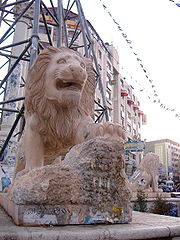 By the beginning of the 20th century Ramallah was an active agricultural town. It was declared a city in 1908 and had an elected municipality as well as partnership projects with the adjacent town of al-Bireh
. In World War I, a few locals joined the Turkish army
, a number of whom were killed in battle. The Friends Boys School
became a temporary hospital during the War. The British Army
occupied Ramallah in December 1917. The city remained under British rule until 1948.
The economy improved in the 1920s. The landed aristocracy and merchants who formed the Palestinian upper class built stately multi-storied villas during this period; many of these estates are still standing today. The Jerusalem Electric Company brought electricity to Ramallah in 1936, and most homes were wired shortly thereafter. That same year, the British authorities inaugurated the "Palestine Broadcasting Service" in Ramallah, the staff of which was trained by the British Broadcasting Corporation to deliver daily broadcasts in Arabic
, Hebrew
, and English. This station was later renamed "Kol Yerushalayim
" (The Voice of Jerusalem).
By 1953, Ramallah's population had doubled, but the economy and infrastructure were not equipped to handle the influx of poor villagers. Natives of Ramallah left, primarily to the United States. By 1946, 1,500 of Ramallah's 6,000 natives (or about a quarter) had emigrated, and Arabs from the surrounding towns and villages particularly Hebron
, bought up the property and homes the émigrés left behind.
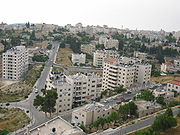
Ramallah was relatively tranquil during the years of Jordanian rule
between 1948 and 1967, with residents enjoying freedom of movement between the West Bank
, Jordan, Lebanon
, Syria, and elsewhere. Jordan had annexed the West Bank, applying its law to the territory. However, many Palestinians were jailed for being members of what the Jordanian government regarded as illegal political parties, including the Palestine Communist Party
and other socialist and pro-independence groups. Jordanian law also restricted the creativity and freedom desired by many Palestinians at the time.
During the Six-Day War
in 1967, Israel
captured Ramallah, imposing a military closure and conducting a census a few weeks later. Every person registered in the census was given an Israeli identity card which allowed the bearer to continue to reside there. Those who were abroad during the census lost their residency rights. For residents of Ramallah, the situation had now reversed itself; for the first time in 19 years residents could freely visit Israel and the Gaza Strip
and engage in commerce there.
Unlike the Jordanians, Israel did not attempt to annex all of the West Bank or offer citizenship to the residents. Ramallah residents were issued permits to work in Israel. The city remained under Israeli military rule for over four decades. The Israeli Civil Administration established in 1981, was in charge of civilian and day-to-day services such as issuing permission to travel, build, export or import, and host relatives from abroad. The CA reprinted Jordanian textbooks for distribution in schools but did not update them. The CA was in charge of tax collection and land expropriation, which sometimes included olive groves that Arab villagers claimed to have tended for generations. According to the Israeli Human Rights activists, Jewish settlements in the Ramallah area, such as Beit El
and Psagot
, prevented the expansion of the city and cut it off from the surrounding villages. As resistance increased, Ramallah residents were jailed or deported to neighboring countries for membership in the Palestine Liberation Organization
. In December 1987, the popular uprising known as the Intifada
erupted.
s. The IDF
responded with tear gas and rubber bullets. Schools in Ramallah were forcibly shut down, and opened gradually for a few hours a day. House arrests were carried out and curfews were imposed that restricted travel and exports in what Palestinians regarded as collective punishment. In response to the closure of schools, residents organized home schooling sessions to help students make up missed material; this became one of the few symbols of civil disobedience. The Intifada leadership organized "tree plantings" and resorted to the tactics used in pre-1948 Palestine, such as ordering general strikes in which no commercial businesses were allowed to open and no cars were allowed on the streets.
In 1991, the Palestinian delegation to the Madrid International Peace Conference
included many notables from Ramallah. As the Intifada wound down and the peace process moved forward, normal life in Ramallah resumed. On September 13, 1993 the famous White House
handshake between Israeli Prime Minister Yitzhak Rabin
and Palestinian Leader Yasser Arafat
took place, and schoolchildren in Ramallah handed out olive branches to Israeli soldiers patrolling the streets. In December 1995, in keeping with the Oslo Accords
, the Israeli army abandoned the Mukata'a
and withdrew to the city outskirts. The newly established Palestinian Authority assumed civilian and security responsibility for the city, which was designated "Area A" under the accords.
 The years between 1993 and 2000 (known locally as the "Oslo Years") brought relative prosperity to Ramallah. Many expatriates returned to establish businesses there and the atmosphere was one of optimism. In 2000, unemployment began to rise and the economy of Ramallah declined. The Israel Defense Force remained in control of the territories, the freedom of movement enjoyed by Ramallah residents prior to the first Intifada was not restored. Travel to Jerusalem required special permits, and expansion of Israeli settlement
s around Ramallah increased dramatically. A network of bypass roads for use of Israeli citizens only was built around Ramallah, and land was confiscated for settlements. Many official documents previously handled by the Israeli Civil Administration were now handled by the Palestinian Authority but still required Israeli approval. A Palestinian passport issued to Ramallah residents was not valid unless the serial number was registered with the Israeli authorities, who controlled border crossings. The failure of the Camp David summit
in July 2000 led to the outbreak of the al-Aqsa Intifada (Second Intifada) in September 2000.
Young Ramallah residents demonstrated daily against the Israeli army, with marches to the Israeli checkpoints at the outskirts of the city. Over time, the marches were replaced by sporadic use of live ammunition against Israeli soldiers; and various attacks targeting Jewish settlers, particularly on the Israeli-only bypass roads. Army checkpoints were established to restrict movement in and out of Ramallah.
On October 12, 2000, two Israeli army reservists, Vadim Norzhich and Yosef Avrahami were lynched in Ramallah. They had taken a wrong turn, and were set upon by a mob, enraged in particular by the Muhammad al-Durrah incident in Gaza. A frenzied crowd killed the two IDF reservists, mutilated their bodies, and dragged them through the streets. Later that afternoon, Israeli army carried out an air strike on Ramallah, demolishing the police station, Israel later succeeded in capturing and prosecuting some of those involved in the deaths.
In 2002, Ramallah was reoccupied by Israel in an IDF operation codenamed Operation Defensive Shield
, which resulted in curfews, electricity cuts, school closures and disruptions of commercial life. Many Ramallah institutions, including government ministries, were vandalized, and equipment was destroyed or stolen. The IDF took over local Ramallah television stations, and social and economic conditions deteriorated. Many expatriates left, as did many other Palestinians who complained that the living conditions had become intolerable. The Israeli West Bank barrier
has furthered Ramallah's isolation.
neighborhood. In 2010, "more than one hundred" Palestinian businesses were reported to have moved to Ramallah from East Jerusalem
, because “Here they pay less taxes and have more customers." One local boasted to a journalist that “Ramallah is becoming the de facto capital of Palestine.” This boast was seconded by the New York Times which, in 2010, called Ramallah the "de facto capital of the West Bank. According to Sani Meo, the publisher of This Week in Palestine
, "Capital or no capital, Ramallah has done well and Palestine is proud of its achievements.” Many foreign nations have located their diplomatic missions to the Palestinian Authority in Ramallah, including, as of 2010, Argentina, Australia, Austria, Korea, South Africa, Norway, Sri Lanka, Switzerland, China, Poland, Portugal, The Netherlands, Russia, Jordan, Brazil, Finland, Denmark, Ireland, Germany, India, Japan, the Czech Republic, Canada and Mexico.
Other Palestinians, however, allege that Ramallah's prosperity is part of an Israeli "conspiracy" to make Ramallah the capital of a Palestinian state, instead of Jerusalem. Munir Hamdan, a member of Fatah
and a Ramallah businessman, told a journalist that the fact that “The president and prime minister have their offices here. So do the parliament and all the government ministries,” represents a "collusion" between the Palestinian Authority and Israel to turn Ramallah into the political as well as the financial capital of the Palestinians. He is particularly worried by the construction of a large new governmental complex by the PA. Hatem Abdel Kader, a Jerusalem resident, Fatah legislator and former Minister for Jerusalem Affairs, complained that “If they are building a new government compound here, that means they have no plans to be based in Jerusalem... Unfortunately, the Palestinian government of Salam Fayyad has abandoned Jerusalem in favor of Ramallah.” According to Kader, who resigned the post of Minister for Jerusalem Affairs upon learning that the Ministry had no budget, not even funds to purchase a desk and chair, “I have to be honest with you and tell you that we have lost the battle for Jerusalem,... One of the reasons is because the Palestinian government doesn’t really care about Jerusalem.”
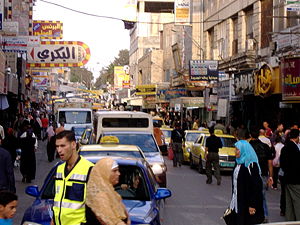 According to the 1922 British Mandate census, Ramallah had a population of 3,067 which included 10 Jews. In Sami Hadawi
's 1945 survey, the population stood at 5,080, with Christians forming the majority of the population. However, the demographic makeup of the town changed drastically between 1948 and 1967 with only slightly more than half of the city's 12,134 inhabitants being Christian, the other half Muslim.
Ramallah's population drastically decreased in the late 20th century from 24,722 inhabitants in 1987 to 17,851 in 1997. In the Palestinian Central Bureau of Statistics
(PCBS) census in 1997, Palestinian refugee
s accounted for 60.3% of the population which was 17,851. There were 8,622 males and 9,229 females. People younger than 20 years of age made up 45.9% of the population, while those aged between 20 and 64 were 45.4%, and residents aged over 64 constituted 4.7%.
Only in 2005 did the population reach over 24,000. In a PCBS projection in 2006, Ramallah had a population of 25,467 inhabitants. In the 2007 PCBS census, there were 27,460 people living in the city. Sources vary about the current Christian population in the city, ranging around 25%.
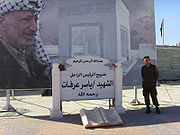
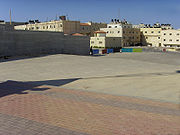 Yasser Arafat
established his West Bank headquarters, the Mukata'a, in Ramallah. Although considered an interim solution, Ramallah has become the de facto capital of the Palestinian Authority, hosting almost all governmental headquarters. In December 2001, Arafat held meetings at the Mukata'a, but lived with his wife and daughter in Gaza City
. After suicide bombings in Haifa
, Arafat was confined to the Ramallah compound. In 2002, the compound was partly demolished by the IDF and Arafat's building was cut off from the rest of the compound.
On November 11, 2004 Arafat died at the Percy training hospital of the Armies near Paris. He was buried in the courtyard of the Mukata'a on November 12, 2004. The site still serves as the Ramallah headquarters of the Palestinian Authority, as well the official West Bank office of Mahmoud Abbas
.
In December 2005, local elections were held in Ramallah in which candidates from three different factions competed for the 15-seat municipal council for a four-year term. The council elected Janet Mikhail
as mayor, the first woman to hold the post.
, a branch of the Tche Tche
Cafe and the Orjuwan Lounge
, described in 2010 as two among the "dozens of fancy restaurants, bars and discotheques that have cropped up in Ramallah in the last three years."
One hallmark of Ramallah is Rukab's Ice Cream, which is based on the resin of chewing gum and thus has a distinctive taste. Another is the First Ramallah Group, a boy- and girl-scout club that also holds a number of traditional dance (Dabka) performances and is also home to men's and women's basketball teams that compete regionally. During the annual "Saturday of Light" religious festival (which occurs on the Saturday between Good Friday and Easter Sunday to commemorate the light that tradition holds shone from the tomb of Jesus), the scouts hold a parade through the city streets to receive the flame from Jerusalem. (The flame is ignited in Jerusalem's Church of the Holy Sepulchre
and is passed on through candles and lanterns to regional churches.) A variety of mosques and churches of different denominations dot the landscape. International music and dance troupes occasionally make a stop in Ramallah, and renowned Israeli pianist Daniel Barenboim
performs there often. The Khalil Sakakini Cultural Center
, founded in 1996, is a popular venue for such events. The Al-Kasaba Theatre
is a venue for plays and movies. In 2004, the state-of-the art Ramallah Cultural Palace opened in the city. The only cultural center of its kind in the Palestinian territories, it houses a 736-seat auditorium, as well as conference rooms, exhibit halls, and movie-screening rooms. It was a joint venture of the Palestinian Authority, the United Nations Development Programme
(UNDP), and the Japanese government. Ramallah hosted its first annual international film festival in 2004.
remained isolated. As a result, clothing and accessories became a statement of region. In Ramallah, the back panels of dresses often incorporated a palm tree motif embroidered in cross-stitch. Ramallah women were famous for their distinctive dress of white linen
fabric embroidered with red silk thread. The headdress or smadeh worn in Ramallah was common throughout northern Palestine: a small roundish cap, padded and stiffened, with gold and silver coins set in a fringe with a long veil pinned to the back, sometimes of silk and sometimes embroidered.
In November 2009 the New York Times published 'Blair Hails Economic Steps in West Bank': as in Ramallah 'Mr. Tony Blair
made the point that there is more hope for Palestinians than many realize...Mr. Blair acted as a kind of missionary for the idea that economic growth is a vital component of a sovereign state, but many here are skeptical of its value without political progress.'
Reuters
' article 'Ramallah building boom symbolizes West Bank growth':
'The Ramallah construction boom is one of the most obvious signs of West Bank economic growth estimated at an annual rate of 8 percent—which Palestinian policymakers attribute to relative stability and Western donor support to the Palestinian Authority..... Many Palestinians who worked here but lived elsewhere moved in to avoid the hassle created by Israeli checkpoints........Today, Ramallah's buoyant economy continues to draw Palestinians from other West Bank towns where jobs are fewer. ...Ramallah's built-up area has grown fivefold since the peak of Israeli-Palestinian violence in 2002, said Ahmad Odaly, head of the Palestinian Engineers Union.'
, Brazil Trondheim
, Norway (since 2004) Muscatine, Iowa
, United States of America (since 2011)
Palestinian territories
The Palestinian territories comprise the West Bank and the Gaza Strip. Since the Palestinian Declaration of Independence in 1988, the region is today recognized by three-quarters of the world's countries as the State of Palestine or simply Palestine, although this status is not recognized by the...
city in the central West Bank
West Bank
The West Bank ) of the Jordan River is the landlocked geographical eastern part of the Palestinian territories located in Western Asia. To the west, north, and south, the West Bank shares borders with the state of Israel. To the east, across the Jordan River, lies the Hashemite Kingdom of Jordan...
located 10 kilometers (6 miles) north of Jerusalem, adjacent to al-Bireh
Al-Bireh
al-Bireh or el-Bira is a Palestinian city adjacent to Ramallah in the central West Bank, north of Jerusalem. It is situated on the central ridge running through the West Bank and is above sea level, covering an area of...
. It currently serves as the de facto administrative capital of the Palestinian National Authority
Palestinian National Authority
The Palestinian Authority is the administrative organization established to govern parts of the West Bank and Gaza Strip...
. With a population of nearly 25,500, Ramallah was historically a Christian
Palestinian Christians
Palestinian Christians are Arabic-speaking Christians descended from the people of the geographical area of Palestine. Within Palestine, there are churches and believers from many Christian denominations, including Oriental Orthodoxy, Eastern Orthodoxy, Catholic , Protestant, and others...
town, but today Muslims form the majority of the population, with a strong Christian minority.
Early history
Modern Ramallah was founded in the mid-16th century by the Haddadins, a JordanJordan
Jordan , officially the Hashemite Kingdom of Jordan , Al-Mamlaka al-Urduniyya al-Hashemiyya) is a kingdom on the East Bank of the River Jordan. The country borders Saudi Arabia to the east and south-east, Iraq to the north-east, Syria to the north and the West Bank and Israel to the west, sharing...
ian tribe of brothers descended from Ghassanid Christian Arabs. The Haddadins, led by Rashid Haddadin, arrived from east of the Jordan River near the Jordan
Jordan
Jordan , officially the Hashemite Kingdom of Jordan , Al-Mamlaka al-Urduniyya al-Hashemiyya) is a kingdom on the East Bank of the River Jordan. The country borders Saudi Arabia to the east and south-east, Iraq to the north-east, Syria to the north and the West Bank and Israel to the west, sharing...
ian town of Shoubak
Shoubak
Shoubak is a municipality that lies at the north western edge of the Ma'an Governorate, bordered with Tafilah Governorate and Aqaba Governorate. It has a population of 12500...
. The Haddadin migration is attributed to fighting and unrest among clans in that area. According to modern living descendents of original Haddadin family members, Rashid's brother Sabra Haddadin was hosting Emir Ibn Kaysoom, head of a powerful Muslim clan in the region, when Sabra's wife gave birth to a baby girl. According to custom, the Emir proposed a betrothal to his own young son when they came of age. Sabra believed the proposal was in jest, as Muslim-Christian marriages were not customary, and gave his word. When the Emir later came to the Haddadins and demanded that they fulfill their promise, they refused. This set off bloody conflict between the two families. The Haddadins fled west and settled on the hilltops of Ramallah, where only a few Muslim families lived at the time. Today, a large community of people descended directly from the Haddadins live in the United States. The town is now predominately Muslim.
In 1596, Ramallah appeared in Ottoman tax registers as being in the Nahiya of Quds of the Liwa
Liwa (arabic)
Liwa or Liwa is an Arabic term meaning district, banner, or flag, a type of administrative division. It was interchangeable with the Turkish term "Sanjak" in the time of the Ottoman Empire. After the fall of the empire, the term was used in the Arab countries formerly under Ottoman rule...
of Quds. It had a population of 71 Christian households and 9 Muslim households. It paid taxes on wheat, barley, olives, vines or fruit trees, and goats or beehives.
Christian town
Ramallah grew dramatically throughout the 17th and 18th centuries as an agricultural village; thus, attracting more (predominantly Christian) inhabitants from all around the region. In 1700, Yacoub Elias was the first Ramallah native to be ordained by the Eastern Arab OrthodoxArab Orthodox
The Arab Orthodox are Arab Greek Orthodox Christian communities which have existed in Greater Syria since the early years of Christianity. During the Palestine Mandate they were prominent in many of the major cities including Jaffa, Nazareth, Haifa and Jerusalem and also formed the majority of...
Church, the Christian denomination prevailed in the Holy Land at the time. In the early 19th century, the first Arab Orthodox
Arab Orthodox
The Arab Orthodox are Arab Greek Orthodox Christian communities which have existed in Greater Syria since the early years of Christianity. During the Palestine Mandate they were prominent in many of the major cities including Jaffa, Nazareth, Haifa and Jerusalem and also formed the majority of...
Christian church was built. Later in the 1850s, "The Church of Transfiguration", was built to replace it and is the sole Orthodox Church in Ramallah today. During that same decade, the Latin (Roman Catholic) Church established its presence in Ramallah, constituting the second largest Christian denomination in the city. The Roman Catholic Church established the St. Joseph's Girl's School runs by St. Joseph sisters, as well as the co-educational Al-Ahliyyah College high school runs by Rosary sisters. With the influx of Muslim and Christian refugees and internal migration, new mosques and churches were built. The Jamal Abdel Nasser Mosque
Jamal Abdel Nasser Mosque
Jamal Abdel Nasser Mosque is the largest mosque in Ramallah, in the central West Bank. The mosque is named after the late Egyptian president and Arab leader Gamal Abdel Nasser....
is one of the city's largest. The Melkite Catholic Church, Evangelical Lutheran Church, Arab Episcopal
Episcopal Church in Jerusalem and the Middle East
The Episcopal Church in Jerusalem and the Middle East is a province of the Anglican Communion stretching from Iran in the east to Algeria in the west, and Cyprus in the north to Somalia in the south. It is the largest and the most diverse Anglican province. The church is headed by a President...
(Anglican) Church, Ramallah Local Church (Evangelical\Born Again) and Ramallah Baptist
Baptist
Baptists comprise a group of Christian denominations and churches that subscribe to a doctrine that baptism should be performed only for professing believers , and that it must be done by immersion...
Church all operate schools in the city. A large new church has been built on top of one of the highest hills of Ramallah, belonging to the Coptic Orthodox Church. A small group of Jehovah Witnesses are present in the area as well and others.
In the 19th century, the Religious Society of Friends
Religious Society of Friends
The Religious Society of Friends, or Friends Church, is a Christian movement which stresses the doctrine of the priesthood of all believers. Members are known as Friends, or popularly as Quakers. It is made of independent organisations, which have split from one another due to doctrinal differences...
(Quakers) established a presence in Ramallah and built the Ramallah Friends Schools
Ramallah Friends Schools
The Ramallah Friends Schools are two elite Private Schools founded by Quakers in the city of Ramallah, in the West Bank. The Friends Girls' School was inaugurated in 1869; the construction of the Friends Boy's School began in 1901 and opened in 1918. The Schools were run by American Quakers...
, one for girls and later a boys school, to alleviate the dearth of education for women and girls. Eli and Sybil Jones opened “The Girls Training Home of Ramallah” in 1869. A medical clinic was established in 1883, with Dr. George Hassenauer serving as the first doctor in Ramallah. In 1889, the girls academy became the Friends Girls School (FGS). As the FGS was also a boarding school, it attracted a number of girls from surrounding communities, including Jerusalem, Lydda
Lod
Lod is a city located on the Sharon Plain southeast of Tel Aviv in the Center District of Israel. At the end of 2010, it had a population of 70,000, roughly 75 percent Jewish and 25 percent Arab.The name is derived from the Biblical city of Lod...
, Jaffa
Jaffa
Jaffa is an ancient port city believed to be one of the oldest in the world. Jaffa was incorporated with Tel Aviv creating the city of Tel Aviv-Yafo, Israel. Jaffa is famous for its association with the biblical story of the prophet Jonah.-Etymology:...
, and Beirut
Beirut
Beirut is the capital and largest city of Lebanon, with a population ranging from 1 million to more than 2 million . Located on a peninsula at the midpoint of Lebanon's Mediterranean coastline, it serves as the country's largest and main seaport, and also forms the Beirut Metropolitan...
. The Friends Boys School (FBS) was founded in 1901 and opened in 1918. The Quakers opened a Friends Meeting House for worship in the city center in 1910. According to the schools' official website, most high school students choose to take the International Baccalaureate exams instead of the traditional "Tawjihi" university exams.
The activity of foreign churches in southern Ottoman Syria
Ottoman Syria
Ottoman Syria is a European reference to the area that during European Renaissance from the late 15th to early 18th century was called the Levant within the early period of the Ottoman Empire, the Orient until the early 19th century, and Greater Syria until 1918...
in the late 19th century increased awareness of prosperity in the West. In Ramallah and Bethlehem
Bethlehem
Bethlehem is a Palestinian city in the central West Bank of the Jordan River, near Israel and approximately south of Jerusalem, with a population of about 30,000 people. It is the capital of the Bethlehem Governorate of the Palestinian National Authority and a hub of Palestinian culture and tourism...
, a few miles south, local residents began to seek their fortunes overseas. In 1901, merchants from Ramallah emigrated to the United States and established import-export businesses, selling handmade rugs and other exotic wares across the Atlantic. Increased trade dramatically improved living standards for Ramallah's inhabitants. American cars, mechanized farming equipment,radios, and later televisions became attainable luxuries for upper class families. As residents of Jaffa
Jaffa
Jaffa is an ancient port city believed to be one of the oldest in the world. Jaffa was incorporated with Tel Aviv creating the city of Tel Aviv-Yafo, Israel. Jaffa is famous for its association with the biblical story of the prophet Jonah.-Etymology:...
and Lydda
Lod
Lod is a city located on the Sharon Plain southeast of Tel Aviv in the Center District of Israel. At the end of 2010, it had a population of 70,000, roughly 75 percent Jewish and 25 percent Arab.The name is derived from the Biblical city of Lod...
moved to Ramallah, the balance of Muslims and Christians began to change.
Before the 20th century, it was a vibrant agricultural town where the majority of the population was Christian. Hence several churches in the old town of Ramallah. Eastern Orthodox, Roman Catholic and Melkite Eastern Catholic presence is quite strong here, with Christian monasteries, institution, schools and charities. With the influx of refugees in the 20th century, Muslims came to constitute the majority of Ramallah’s population.
Modern era
Al-Bireh
al-Bireh or el-Bira is a Palestinian city adjacent to Ramallah in the central West Bank, north of Jerusalem. It is situated on the central ridge running through the West Bank and is above sea level, covering an area of...
. In World War I, a few locals joined the Turkish army
Turkish Army
The Turkish Army or Turkish Land Forces is the main branch of the Turkish Armed Forces responsible for land-based military operations. The modern history of the army began with its formation after the collapse of the Ottoman Empire...
, a number of whom were killed in battle. The Friends Boys School
Ramallah Friends Schools
The Ramallah Friends Schools are two elite Private Schools founded by Quakers in the city of Ramallah, in the West Bank. The Friends Girls' School was inaugurated in 1869; the construction of the Friends Boy's School began in 1901 and opened in 1918. The Schools were run by American Quakers...
became a temporary hospital during the War. The British Army
British Army
The British Army is the land warfare branch of Her Majesty's Armed Forces in the United Kingdom. It came into being with the unification of the Kingdom of England and Scotland into the Kingdom of Great Britain in 1707. The new British Army incorporated Regiments that had already existed in England...
occupied Ramallah in December 1917. The city remained under British rule until 1948.
The economy improved in the 1920s. The landed aristocracy and merchants who formed the Palestinian upper class built stately multi-storied villas during this period; many of these estates are still standing today. The Jerusalem Electric Company brought electricity to Ramallah in 1936, and most homes were wired shortly thereafter. That same year, the British authorities inaugurated the "Palestine Broadcasting Service" in Ramallah, the staff of which was trained by the British Broadcasting Corporation to deliver daily broadcasts in Arabic
Arabic language
Arabic is a name applied to the descendants of the Classical Arabic language of the 6th century AD, used most prominently in the Quran, the Islamic Holy Book...
, Hebrew
Hebrew language
Hebrew is a Semitic language of the Afroasiatic language family. Culturally, is it considered by Jews and other religious groups as the language of the Jewish people, though other Jewish languages had originated among diaspora Jews, and the Hebrew language is also used by non-Jewish groups, such...
, and English. This station was later renamed "Kol Yerushalayim
Kol Yerushalayim
Kol Yerushalayim was the name given to the Hebrew transmissions of the Palestine Broadcasting Service established by the British Mandatory Authority.-Establishment:...
" (The Voice of Jerusalem).
By 1953, Ramallah's population had doubled, but the economy and infrastructure were not equipped to handle the influx of poor villagers. Natives of Ramallah left, primarily to the United States. By 1946, 1,500 of Ramallah's 6,000 natives (or about a quarter) had emigrated, and Arabs from the surrounding towns and villages particularly Hebron
Hebron
Hebron , is located in the southern West Bank, south of Jerusalem. Nestled in the Judean Mountains, it lies 930 meters above sea level. It is the largest city in the West Bank and home to around 165,000 Palestinians, and over 500 Jewish settlers concentrated in and around the old quarter...
, bought up the property and homes the émigrés left behind.
Jordanian and Israeli Management
Ramallah was relatively tranquil during the years of Jordanian rule
Rule of the West Bank and East Jerusalem by Jordan
The West Bank and East Jerusalem were occupied by Jordan for a period of nearly two decades starting from the 1948 Arab-Israeli War. In 1950, the British extended formal recognition to the union between the Hashemite Kingdom and of that part of Palestine under Jordanian occupation and control -...
between 1948 and 1967, with residents enjoying freedom of movement between the West Bank
West Bank
The West Bank ) of the Jordan River is the landlocked geographical eastern part of the Palestinian territories located in Western Asia. To the west, north, and south, the West Bank shares borders with the state of Israel. To the east, across the Jordan River, lies the Hashemite Kingdom of Jordan...
, Jordan, Lebanon
Lebanon
Lebanon , officially the Republic of LebanonRepublic of Lebanon is the most common term used by Lebanese government agencies. The term Lebanese Republic, a literal translation of the official Arabic and French names that is not used in today's world. Arabic is the most common language spoken among...
, Syria, and elsewhere. Jordan had annexed the West Bank, applying its law to the territory. However, many Palestinians were jailed for being members of what the Jordanian government regarded as illegal political parties, including the Palestine Communist Party
Palestine Communist Party
The Palestine Communist Party was a political party in British Mandate of Palestine formed in 1923 through the merger of the Palestinian Communist Party and the Communist Party of Palestine...
and other socialist and pro-independence groups. Jordanian law also restricted the creativity and freedom desired by many Palestinians at the time.
During the Six-Day War
Six-Day War
The Six-Day War , also known as the June War, 1967 Arab-Israeli War, or Third Arab-Israeli War, was fought between June 5 and 10, 1967, by Israel and the neighboring states of Egypt , Jordan, and Syria...
in 1967, Israel
Israel
The State of Israel is a parliamentary republic located in the Middle East, along the eastern shore of the Mediterranean Sea...
captured Ramallah, imposing a military closure and conducting a census a few weeks later. Every person registered in the census was given an Israeli identity card which allowed the bearer to continue to reside there. Those who were abroad during the census lost their residency rights. For residents of Ramallah, the situation had now reversed itself; for the first time in 19 years residents could freely visit Israel and the Gaza Strip
Gaza Strip
thumb|Gaza city skylineThe Gaza Strip lies on the Eastern coast of the Mediterranean Sea. The Strip borders Egypt on the southwest and Israel on the south, east and north. It is about long, and between 6 and 12 kilometres wide, with a total area of...
and engage in commerce there.
Unlike the Jordanians, Israel did not attempt to annex all of the West Bank or offer citizenship to the residents. Ramallah residents were issued permits to work in Israel. The city remained under Israeli military rule for over four decades. The Israeli Civil Administration established in 1981, was in charge of civilian and day-to-day services such as issuing permission to travel, build, export or import, and host relatives from abroad. The CA reprinted Jordanian textbooks for distribution in schools but did not update them. The CA was in charge of tax collection and land expropriation, which sometimes included olive groves that Arab villagers claimed to have tended for generations. According to the Israeli Human Rights activists, Jewish settlements in the Ramallah area, such as Beit El
Beit El
Beit El is an Israeli settlement and a local council in the Benjamin region of the central West Bank, within the borders of the Matte Binyamin Regional Council. The religiously observant town is located in the hills north of Jerusalem east of the Palestinian city of al-Bireh. In 2009, it had a...
and Psagot
Psagot
Psagot is a communal Israeli settlement in the West Bank located north of Jerusalem on Tawil hill adjacent to Ramallah, al-Bireh, and Kokhav Ya'akov. Psagot, established in 1981, falls under the jurisdiction of Binyamin Regional Council, with the council's headquarters located there...
, prevented the expansion of the city and cut it off from the surrounding villages. As resistance increased, Ramallah residents were jailed or deported to neighboring countries for membership in the Palestine Liberation Organization
Palestine Liberation Organization
The Palestine Liberation Organization is a political and paramilitary organization which was created in 1964. It is recognized as the "sole legitimate representative of the Palestinian people" by the United Nations and over 100 states with which it holds diplomatic relations, and has enjoyed...
. In December 1987, the popular uprising known as the Intifada
First Intifada
The First Intifada was a Palestinian uprising against the Israeli occupation of the Palestinian Territories. The uprising began in the Jabalia refugee camp and quickly spread throughout Gaza, the West Bank and East Jerusalem....
erupted.
First Intifada
Ramallah residents were among the early joiners of the First Intifada. The Intifada Unified Leadership, an umbrella organization of various Palestinian factions, distributed weekly bulletins on the streets of Ramallah with a schedule of the daily protests, strikes and action against Israeli patrols in the city. At the demonstrations, tyres were burned in the street and the crowds threw stones and Molotov cocktailMolotov cocktail
The Molotov cocktail, also known as the petrol bomb, gasoline bomb, Molotov bomb, fire bottle, fire bomb, or simply Molotov, is a generic name used for a variety of improvised incendiary weapons...
s. The IDF
Israel Defense Forces
The Israel Defense Forces , commonly known in Israel by the Hebrew acronym Tzahal , are the military forces of the State of Israel. They consist of the ground forces, air force and navy. It is the sole military wing of the Israeli security forces, and has no civilian jurisdiction within Israel...
responded with tear gas and rubber bullets. Schools in Ramallah were forcibly shut down, and opened gradually for a few hours a day. House arrests were carried out and curfews were imposed that restricted travel and exports in what Palestinians regarded as collective punishment. In response to the closure of schools, residents organized home schooling sessions to help students make up missed material; this became one of the few symbols of civil disobedience. The Intifada leadership organized "tree plantings" and resorted to the tactics used in pre-1948 Palestine, such as ordering general strikes in which no commercial businesses were allowed to open and no cars were allowed on the streets.
In 1991, the Palestinian delegation to the Madrid International Peace Conference
Madrid Conference of 1991
The Madrid Conference was hosted by the government of Spain and co-sponsored by the USA and the USSR. It convened on October 30, 1991 and lasted for three days. It was an early attempt by the international community to start a peace process through negotiations involving Israel and the Palestinians...
included many notables from Ramallah. As the Intifada wound down and the peace process moved forward, normal life in Ramallah resumed. On September 13, 1993 the famous White House
White House
The White House is the official residence and principal workplace of the president of the United States. Located at 1600 Pennsylvania Avenue NW in Washington, D.C., the house was designed by Irish-born James Hoban, and built between 1792 and 1800 of white-painted Aquia sandstone in the Neoclassical...
handshake between Israeli Prime Minister Yitzhak Rabin
Yitzhak Rabin
' was an Israeli politician, statesman and general. He was the fifth Prime Minister of Israel, serving two terms in office, 1974–77 and 1992 until his assassination in 1995....
and Palestinian Leader Yasser Arafat
Yasser Arafat
Mohammed Yasser Abdel Rahman Abdel Raouf Arafat al-Qudwa al-Husseini , popularly known as Yasser Arafat or by his kunya Abu Ammar , was a Palestinian leader and a Laureate of the Nobel Prize. He was Chairman of the Palestine Liberation Organization , President of the Palestinian National Authority...
took place, and schoolchildren in Ramallah handed out olive branches to Israeli soldiers patrolling the streets. In December 1995, in keeping with the Oslo Accords
Oslo Accords
The Oslo Accords, officially called the Declaration of Principles on Interim Self-Government Arrangements or Declaration of Principles , was an attempt to resolve the ongoing Palestinian-Israeli conflict...
, the Israeli army abandoned the Mukata'a
Mukataa
Mukataa is the name used to refer to the offices and administrative centers of the Palestinian National Authority.Mukataas were mostly built during the British Mandate as Tegart forts and were used both as British government centers and as dwellings for the British administrative staff. Some...
and withdrew to the city outskirts. The newly established Palestinian Authority assumed civilian and security responsibility for the city, which was designated "Area A" under the accords.
Second Intifada
Israeli settlement
An Israeli settlement is a Jewish civilian community built on land that was captured by Israel from Jordan, Egypt, and Syria during the 1967 Six-Day War and is considered occupied territory by the international community. Such settlements currently exist in the West Bank...
s around Ramallah increased dramatically. A network of bypass roads for use of Israeli citizens only was built around Ramallah, and land was confiscated for settlements. Many official documents previously handled by the Israeli Civil Administration were now handled by the Palestinian Authority but still required Israeli approval. A Palestinian passport issued to Ramallah residents was not valid unless the serial number was registered with the Israeli authorities, who controlled border crossings. The failure of the Camp David summit
Camp David 2000 Summit
The Middle East Peace Summit at Camp David of July 2000 took place between United States President Bill Clinton, Israeli Prime Minister Ehud Barak, and Palestinian Authority Chairman Yasser Arafat...
in July 2000 led to the outbreak of the al-Aqsa Intifada (Second Intifada) in September 2000.
Young Ramallah residents demonstrated daily against the Israeli army, with marches to the Israeli checkpoints at the outskirts of the city. Over time, the marches were replaced by sporadic use of live ammunition against Israeli soldiers; and various attacks targeting Jewish settlers, particularly on the Israeli-only bypass roads. Army checkpoints were established to restrict movement in and out of Ramallah.
On October 12, 2000, two Israeli army reservists, Vadim Norzhich and Yosef Avrahami were lynched in Ramallah. They had taken a wrong turn, and were set upon by a mob, enraged in particular by the Muhammad al-Durrah incident in Gaza. A frenzied crowd killed the two IDF reservists, mutilated their bodies, and dragged them through the streets. Later that afternoon, Israeli army carried out an air strike on Ramallah, demolishing the police station, Israel later succeeded in capturing and prosecuting some of those involved in the deaths.
In 2002, Ramallah was reoccupied by Israel in an IDF operation codenamed Operation Defensive Shield
Operation Defensive Shield
Operation Defensive Shield was a large-scale military operation conducted by the Israel Defense Forces in 2002, during the course of the Second Intifada. It was the largest military operation in the West Bank since the 1967 Six-Day War. The operation was an attempt by the Israeli army to stop the...
, which resulted in curfews, electricity cuts, school closures and disruptions of commercial life. Many Ramallah institutions, including government ministries, were vandalized, and equipment was destroyed or stolen. The IDF took over local Ramallah television stations, and social and economic conditions deteriorated. Many expatriates left, as did many other Palestinians who complained that the living conditions had become intolerable. The Israeli West Bank barrier
Israeli West Bank barrier
The Israeli West Bank barrier is a separation barrier being constructed by the State of Israel along and within the West Bank. Upon completion, the barrier’s total length will be approximately...
has furthered Ramallah's isolation.
Economic development
By 2010 Ramallah had become the leading center of economic and political activity in the territories under the control of the Palestinian Authority. A building boom in the early years of the 21st century saw apartment buildings and "five-star" hotels erected, particularly in the Al-MasyounAl-Masyoun
Al-Masyoun is an upscale neighborhood in Ramallah.In the first decade of the 21st century this "fashionable" neighborhood experienced a major building boom that included new condominiums, upscale stores and upscale restaurants such as Orjuwan....
neighborhood. In 2010, "more than one hundred" Palestinian businesses were reported to have moved to Ramallah from East Jerusalem
East Jerusalem
East Jerusalem or Eastern Jerusalem refer to the parts of Jerusalem captured and annexed by Jordan in the 1948 Arab-Israeli War and then captured and annexed by Israel in the 1967 Six-Day War...
, because “Here they pay less taxes and have more customers." One local boasted to a journalist that “Ramallah is becoming the de facto capital of Palestine.” This boast was seconded by the New York Times which, in 2010, called Ramallah the "de facto capital of the West Bank. According to Sani Meo, the publisher of This Week in Palestine
This Week in Palestine
This Week in Palestine is a monthly magazine that covers cultural and political material in the Palestinian territories.-External links:*...
, "Capital or no capital, Ramallah has done well and Palestine is proud of its achievements.” Many foreign nations have located their diplomatic missions to the Palestinian Authority in Ramallah, including, as of 2010, Argentina, Australia, Austria, Korea, South Africa, Norway, Sri Lanka, Switzerland, China, Poland, Portugal, The Netherlands, Russia, Jordan, Brazil, Finland, Denmark, Ireland, Germany, India, Japan, the Czech Republic, Canada and Mexico.
Other Palestinians, however, allege that Ramallah's prosperity is part of an Israeli "conspiracy" to make Ramallah the capital of a Palestinian state, instead of Jerusalem. Munir Hamdan, a member of Fatah
Fatah
Fataḥ is a major Palestinian political party and the largest faction of the Palestine Liberation Organization , a multi-party confederation. In Palestinian politics it is on the left-wing of the spectrum; it is mainly nationalist, although not predominantly socialist. Its official goals are found...
and a Ramallah businessman, told a journalist that the fact that “The president and prime minister have their offices here. So do the parliament and all the government ministries,” represents a "collusion" between the Palestinian Authority and Israel to turn Ramallah into the political as well as the financial capital of the Palestinians. He is particularly worried by the construction of a large new governmental complex by the PA. Hatem Abdel Kader, a Jerusalem resident, Fatah legislator and former Minister for Jerusalem Affairs, complained that “If they are building a new government compound here, that means they have no plans to be based in Jerusalem... Unfortunately, the Palestinian government of Salam Fayyad has abandoned Jerusalem in favor of Ramallah.” According to Kader, who resigned the post of Minister for Jerusalem Affairs upon learning that the Ministry had no budget, not even funds to purchase a desk and chair, “I have to be honest with you and tell you that we have lost the battle for Jerusalem,... One of the reasons is because the Palestinian government doesn’t really care about Jerusalem.”
Demographics
Sami Hadawi
Sami Hadawi was a Palestinian scholar and author. He is known for documenting the effects of the 1948 Arab-Israeli War on the Arab population in Palestine and published statistics for individual villages prior to Israel's establishment. Hadawi worked as a land specialist until he was exiled from...
's 1945 survey, the population stood at 5,080, with Christians forming the majority of the population. However, the demographic makeup of the town changed drastically between 1948 and 1967 with only slightly more than half of the city's 12,134 inhabitants being Christian, the other half Muslim.
Ramallah's population drastically decreased in the late 20th century from 24,722 inhabitants in 1987 to 17,851 in 1997. In the Palestinian Central Bureau of Statistics
Palestinian Central Bureau of Statistics
The Palestinian Central Bureau of Statistics is the statistical organization under the umbrella of the Palestinian Cabinet of the Palestinian National Authority....
(PCBS) census in 1997, Palestinian refugee
Palestinian refugee
Palestinian refugees or Palestine refugees are the people and their descendants, predominantly Palestinian Arabic-speakers, who fled or were expelled from their homes during and after the 1948 Palestine War, within that part of the British Mandate of Palestine, that after that war became the...
s accounted for 60.3% of the population which was 17,851. There were 8,622 males and 9,229 females. People younger than 20 years of age made up 45.9% of the population, while those aged between 20 and 64 were 45.4%, and residents aged over 64 constituted 4.7%.
Only in 2005 did the population reach over 24,000. In a PCBS projection in 2006, Ramallah had a population of 25,467 inhabitants. In the 2007 PCBS census, there were 27,460 people living in the city. Sources vary about the current Christian population in the city, ranging around 25%.
Government
Yasser Arafat
Mohammed Yasser Abdel Rahman Abdel Raouf Arafat al-Qudwa al-Husseini , popularly known as Yasser Arafat or by his kunya Abu Ammar , was a Palestinian leader and a Laureate of the Nobel Prize. He was Chairman of the Palestine Liberation Organization , President of the Palestinian National Authority...
established his West Bank headquarters, the Mukata'a, in Ramallah. Although considered an interim solution, Ramallah has become the de facto capital of the Palestinian Authority, hosting almost all governmental headquarters. In December 2001, Arafat held meetings at the Mukata'a, but lived with his wife and daughter in Gaza City
Gaza
Gaza , also referred to as Gaza City, is a Palestinian city in the Gaza Strip, with a population of about 450,000, making it the largest city in the Palestinian territories.Inhabited since at least the 15th century BC,...
. After suicide bombings in Haifa
Haifa
Haifa is the largest city in northern Israel, and the third-largest city in the country, with a population of over 268,000. Another 300,000 people live in towns directly adjacent to the city including the cities of the Krayot, as well as, Tirat Carmel, Daliyat al-Karmel and Nesher...
, Arafat was confined to the Ramallah compound. In 2002, the compound was partly demolished by the IDF and Arafat's building was cut off from the rest of the compound.
On November 11, 2004 Arafat died at the Percy training hospital of the Armies near Paris. He was buried in the courtyard of the Mukata'a on November 12, 2004. The site still serves as the Ramallah headquarters of the Palestinian Authority, as well the official West Bank office of Mahmoud Abbas
Mahmoud Abbas
Mahmoud Abbas , also known by the kunya Abu Mazen , has been the Chairman of the Palestine Liberation Organisation since 11 November 2004 and became President of the Palestinian National Authority on 15 January 2005 on the Fatah ticket.Elected to serve until 9 January 2009, he unilaterally...
.
In December 2005, local elections were held in Ramallah in which candidates from three different factions competed for the 15-seat municipal council for a four-year term. The council elected Janet Mikhail
Janet Mikhail
Janet Mikhail or Janet Michael, sometimes known as Janet Khouri is the mayor of Ramallah in the West Bank.She is the first woman to hold this post. She was head teacher of the girls' school in Ramallah for 20 years, now retired...
as mayor, the first woman to hold the post.
Culture
Ramallah is generally considered the most affluent and cultural, as well as the most liberal, of all Palestinian cities, and is home to a number of popular Palestinian activists, poets, artists, and musicians. It boasts a lively nightlife, with many restaurants including the Stars and Bucks CafeStars and Bucks Cafe
Stars and Bucks Cafe is an upscale coffee shop in Ramallah and Jenin that emulates the Starbucks brand.Like Starbucks, the Stars and Bucks serves cappuccinos in ceramic cups, offers free Wifi, has a circular, green logo and, According to the Seattle Post Intelligencer, even the green, block...
, a branch of the Tche Tche
Tche Tche
Tche Tche Cafe and Restaurant is a popular chain in the Middle East.Tche Tche and is one of the "leading" restaurant chains in the region.There are more than 20 branches of Tche Tche located throughout the Middle East, including the Mecca Mall and a cafe in Ramallah, "a favorite spot" among...
Cafe and the Orjuwan Lounge
Orjuwan
Orjuwan is an upscale restaurant and nightclub in Ramallah.Orjuwan is located in the "fashionable" Ramallah neighborhood of Al-Masyoun. The restaurant was opened in 2009 by two brothers and a sister from the well-known Sakakini family, Sari,, Salim; their sister, Katia...
, described in 2010 as two among the "dozens of fancy restaurants, bars and discotheques that have cropped up in Ramallah in the last three years."
One hallmark of Ramallah is Rukab's Ice Cream, which is based on the resin of chewing gum and thus has a distinctive taste. Another is the First Ramallah Group, a boy- and girl-scout club that also holds a number of traditional dance (Dabka) performances and is also home to men's and women's basketball teams that compete regionally. During the annual "Saturday of Light" religious festival (which occurs on the Saturday between Good Friday and Easter Sunday to commemorate the light that tradition holds shone from the tomb of Jesus), the scouts hold a parade through the city streets to receive the flame from Jerusalem. (The flame is ignited in Jerusalem's Church of the Holy Sepulchre
Church of the Holy Sepulchre
The Church of the Holy Sepulchre, also called the Church of the Resurrection by Eastern Christians, is a church within the walled Old City of Jerusalem. It is a few steps away from the Muristan....
and is passed on through candles and lanterns to regional churches.) A variety of mosques and churches of different denominations dot the landscape. International music and dance troupes occasionally make a stop in Ramallah, and renowned Israeli pianist Daniel Barenboim
Daniel Barenboim
Daniel Barenboim, KBE is an Argentinian-Israeli pianist and conductor. He has served as music director of several major symphonic and operatic orchestras and made numerous recordings....
performs there often. The Khalil Sakakini Cultural Center
Khalil Sakakini Cultural Center
Khalil Sakakini Cultural Center is an organization established in 1996. It is located at 4 Raja Street, Ramallah in the West Bank. The traditional manor that houses the centre was the former family home of Khalil Salem Salah, the mayor of Ramallah between 1947/1951, is now owned by the Palestinian...
, founded in 1996, is a popular venue for such events. The Al-Kasaba Theatre
Al-Kasaba Theatre
Al-Kasaba Theatre is a cinema in the city of Ramallah in the West Bank. It was established in 1970 for playwrights and eventually began presenting films. Al-Kasaba is the only official multipurpose cinema in the Palestinian territories.-History:...
is a venue for plays and movies. In 2004, the state-of-the art Ramallah Cultural Palace opened in the city. The only cultural center of its kind in the Palestinian territories, it houses a 736-seat auditorium, as well as conference rooms, exhibit halls, and movie-screening rooms. It was a joint venture of the Palestinian Authority, the United Nations Development Programme
United Nations Development Programme
The United Nations Development Programme is the United Nations' global development network. It advocates for change and connects countries to knowledge, experience and resources to help people build a better life. UNDP operates in 177 countries, working with nations on their own solutions to...
(UNDP), and the Japanese government. Ramallah hosted its first annual international film festival in 2004.
Palestinian costume
Due to the difficulty of travel in the 19th century, villages in southern Ottoman SyriaOttoman Syria
Ottoman Syria is a European reference to the area that during European Renaissance from the late 15th to early 18th century was called the Levant within the early period of the Ottoman Empire, the Orient until the early 19th century, and Greater Syria until 1918...
remained isolated. As a result, clothing and accessories became a statement of region. In Ramallah, the back panels of dresses often incorporated a palm tree motif embroidered in cross-stitch. Ramallah women were famous for their distinctive dress of white linen
Linen
Linen is a textile made from the fibers of the flax plant, Linum usitatissimum. Linen is labor-intensive to manufacture, but when it is made into garments, it is valued for its exceptional coolness and freshness in hot weather....
fabric embroidered with red silk thread. The headdress or smadeh worn in Ramallah was common throughout northern Palestine: a small roundish cap, padded and stiffened, with gold and silver coins set in a fringe with a long veil pinned to the back, sometimes of silk and sometimes embroidered.
Economy
Edward Sayre, Assistant Professor of International Development, University of Southern Mississippi, said in a 14 January 2009 interview, that "Ramallah is the seat of power for the Fatah-led Palestinian Authority of the West Bank and it serves as the headquarters for most international NGOs and embassies. It is through Ramallah that nearly all of the hundreds of millions of dollars in aid has been flowing. As a result Ramallah’s economy has recovered strongly since the end of the second Intifada."In November 2009 the New York Times published 'Blair Hails Economic Steps in West Bank': as in Ramallah 'Mr. Tony Blair
Tony Blair
Anthony Charles Lynton Blair is a former British Labour Party politician who served as the Prime Minister of the United Kingdom from 2 May 1997 to 27 June 2007. He was the Member of Parliament for Sedgefield from 1983 to 2007 and Leader of the Labour Party from 1994 to 2007...
made the point that there is more hope for Palestinians than many realize...Mr. Blair acted as a kind of missionary for the idea that economic growth is a vital component of a sovereign state, but many here are skeptical of its value without political progress.'
Reuters
Reuters
Reuters is a news agency headquartered in New York City. Until 2008 the Reuters news agency formed part of a British independent company, Reuters Group plc, which was also a provider of financial market data...
' article 'Ramallah building boom symbolizes West Bank growth':
'The Ramallah construction boom is one of the most obvious signs of West Bank economic growth estimated at an annual rate of 8 percent—which Palestinian policymakers attribute to relative stability and Western donor support to the Palestinian Authority..... Many Palestinians who worked here but lived elsewhere moved in to avoid the hassle created by Israeli checkpoints........Today, Ramallah's buoyant economy continues to draw Palestinians from other West Bank towns where jobs are fewer. ...Ramallah's built-up area has grown fivefold since the peak of Israeli-Palestinian violence in 2002, said Ahmad Odaly, head of the Palestinian Engineers Union.'
International relations
Twin towns – Sister cities
Ramallah is twinned with: Rio de JaneiroRio de Janeiro
Rio de Janeiro , commonly referred to simply as Rio, is the capital city of the State of Rio de Janeiro, the second largest city of Brazil, and the third largest metropolitan area and agglomeration in South America, boasting approximately 6.3 million people within the city proper, making it the 6th...
, Brazil Trondheim
Trondheim
Trondheim , historically, Nidaros and Trondhjem, is a city and municipality in Sør-Trøndelag county, Norway. With a population of 173,486, it is the third most populous municipality and city in the country, although the fourth largest metropolitan area. It is the administrative centre of...
, Norway (since 2004) Muscatine, Iowa
Muscatine, Iowa
Muscatine is a city in Muscatine County, Iowa, United States. The population was 22,886 in the 2010 census, an increase from 22,697 in the 2000 census. It is the county seat of Muscatine County...
, United States of America (since 2011)
External links
- Ramallah City
- Ramallah History
- Music and Art from Ramallah
- Quaker Meeting in Ramallah
- West Bank/Palestine
- Ramallah
- Al Kasaba Theatre
- Khalil Sakakini Cultural Centre
- First Ramallah Group
- Ramallah International Film Festival
- RamallahOnline.com
- Ramallah Club of Metro Detroit
- Jnewswire.com, Ramallah ancient synagogue
- Anne Brunswic's book Welcome to Palestine, english translation