Gaza Strip

Encyclopedia
Mediterranean Sea
The Mediterranean Sea is a sea connected to the Atlantic Ocean surrounded by the Mediterranean region and almost completely enclosed by land: on the north by Anatolia and Europe, on the south by North Africa, and on the east by the Levant...
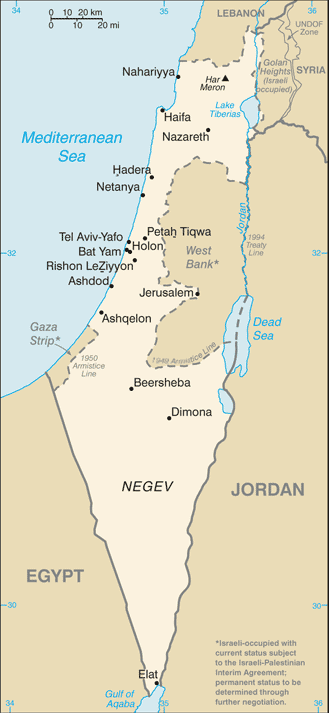
. The Strip borders Egypt
Egypt
Egypt , officially the Arab Republic of Egypt, Arabic: , is a country mainly in North Africa, with the Sinai Peninsula forming a land bridge in Southwest Asia. Egypt is thus a transcontinental country, and a major power in Africa, the Mediterranean Basin, the Middle East and the Muslim world...
on the southwest and Israel
Israel
The State of Israel is a parliamentary republic located in the Middle East, along the eastern shore of the Mediterranean Sea...
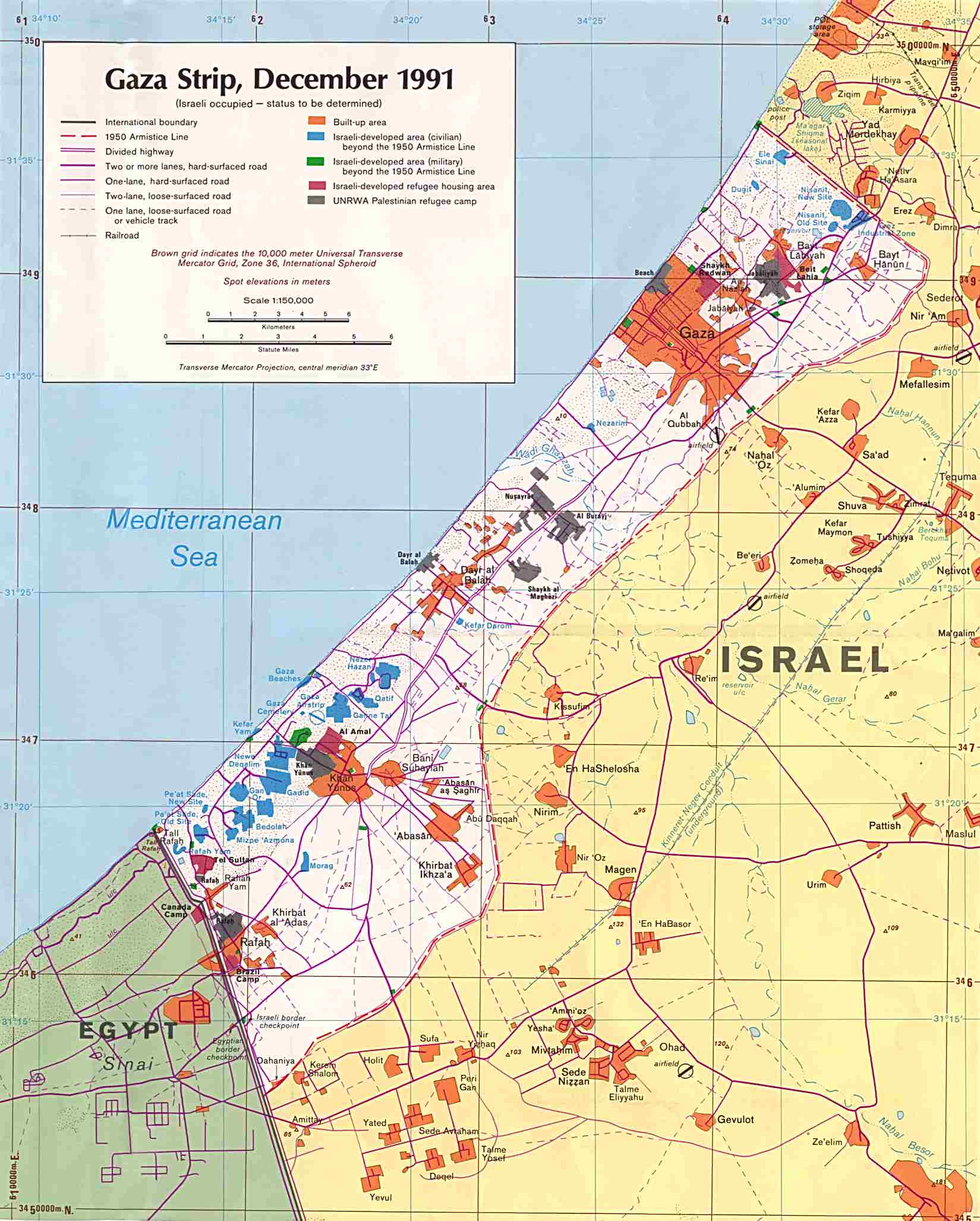
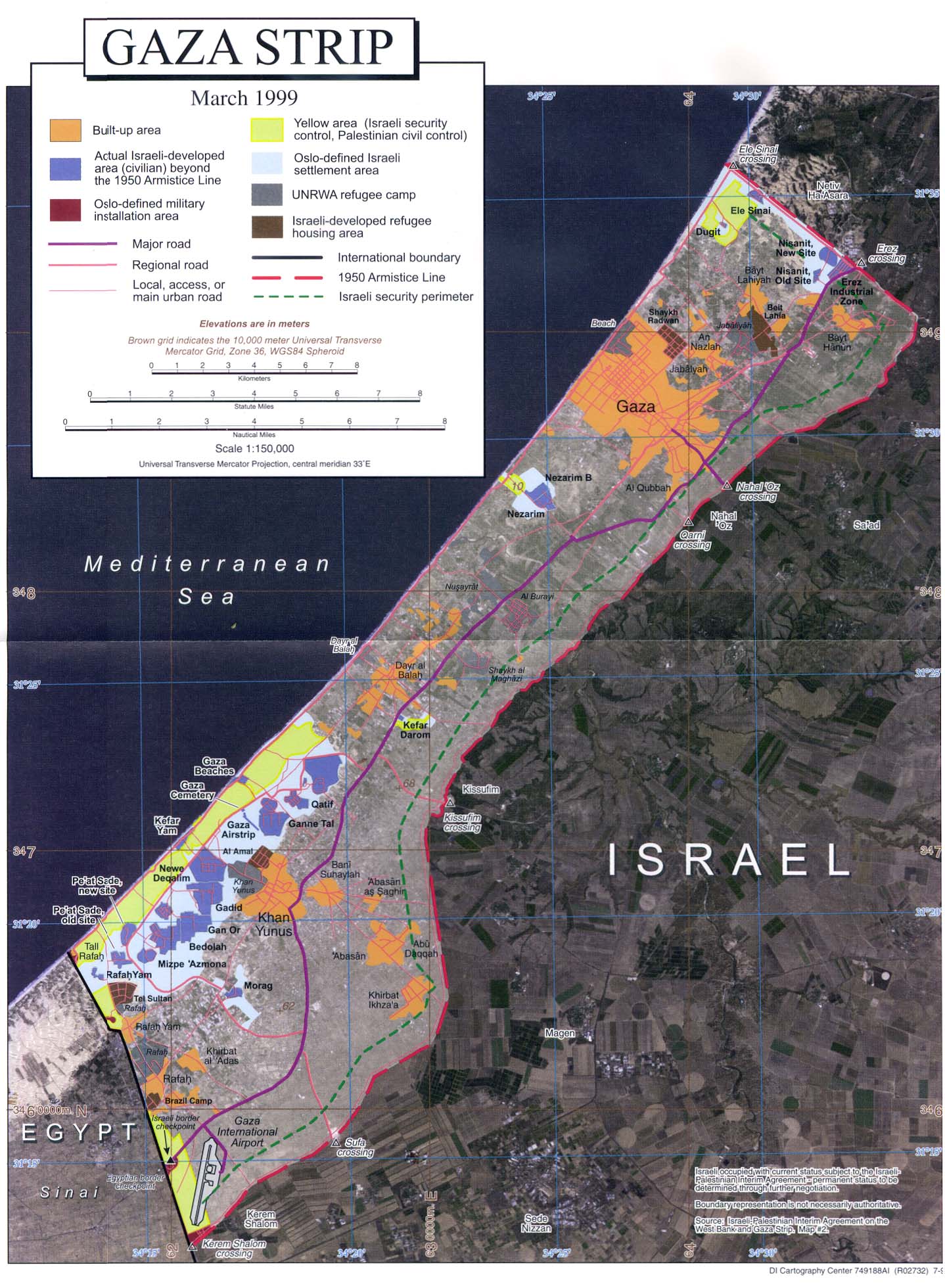
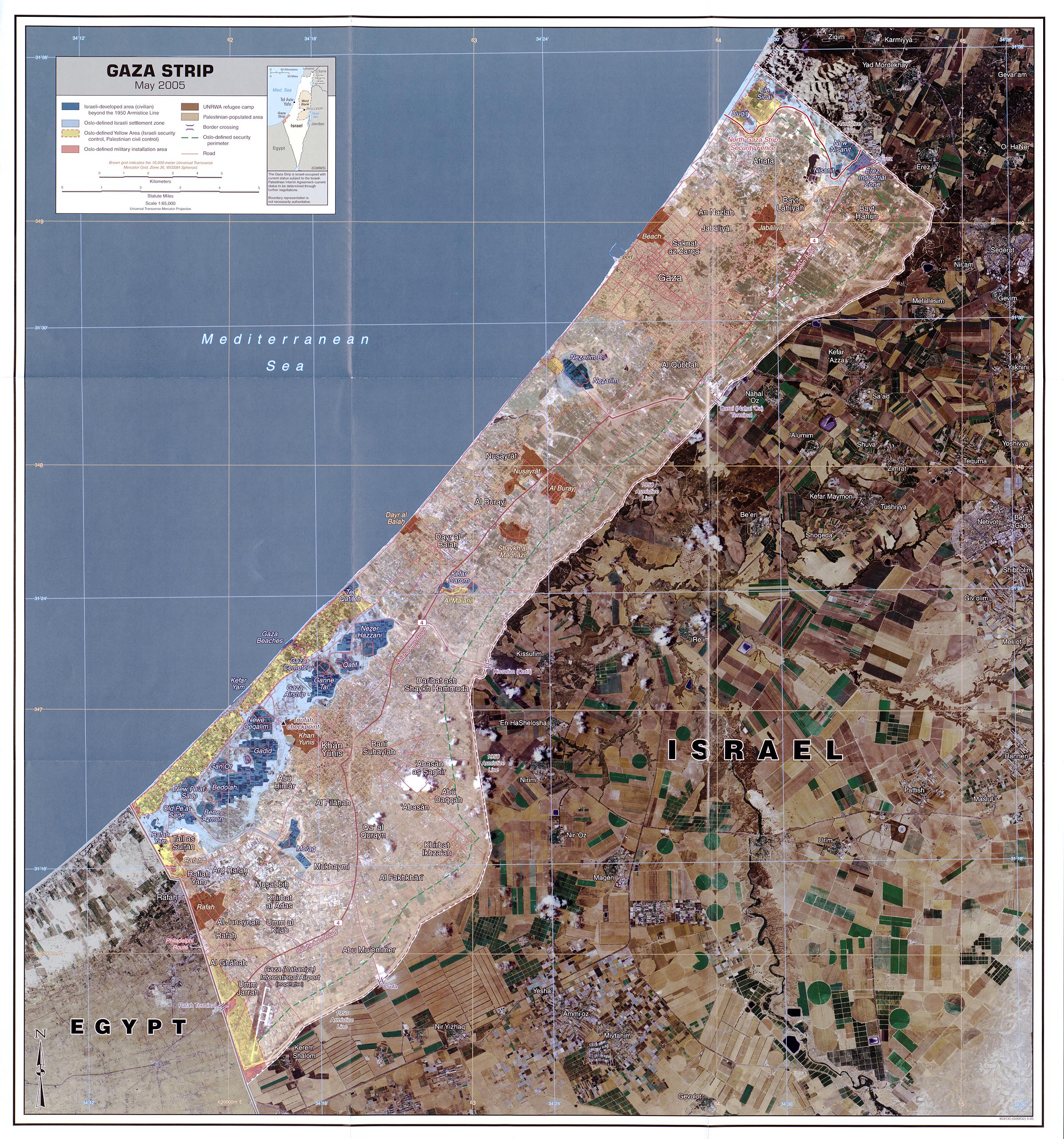
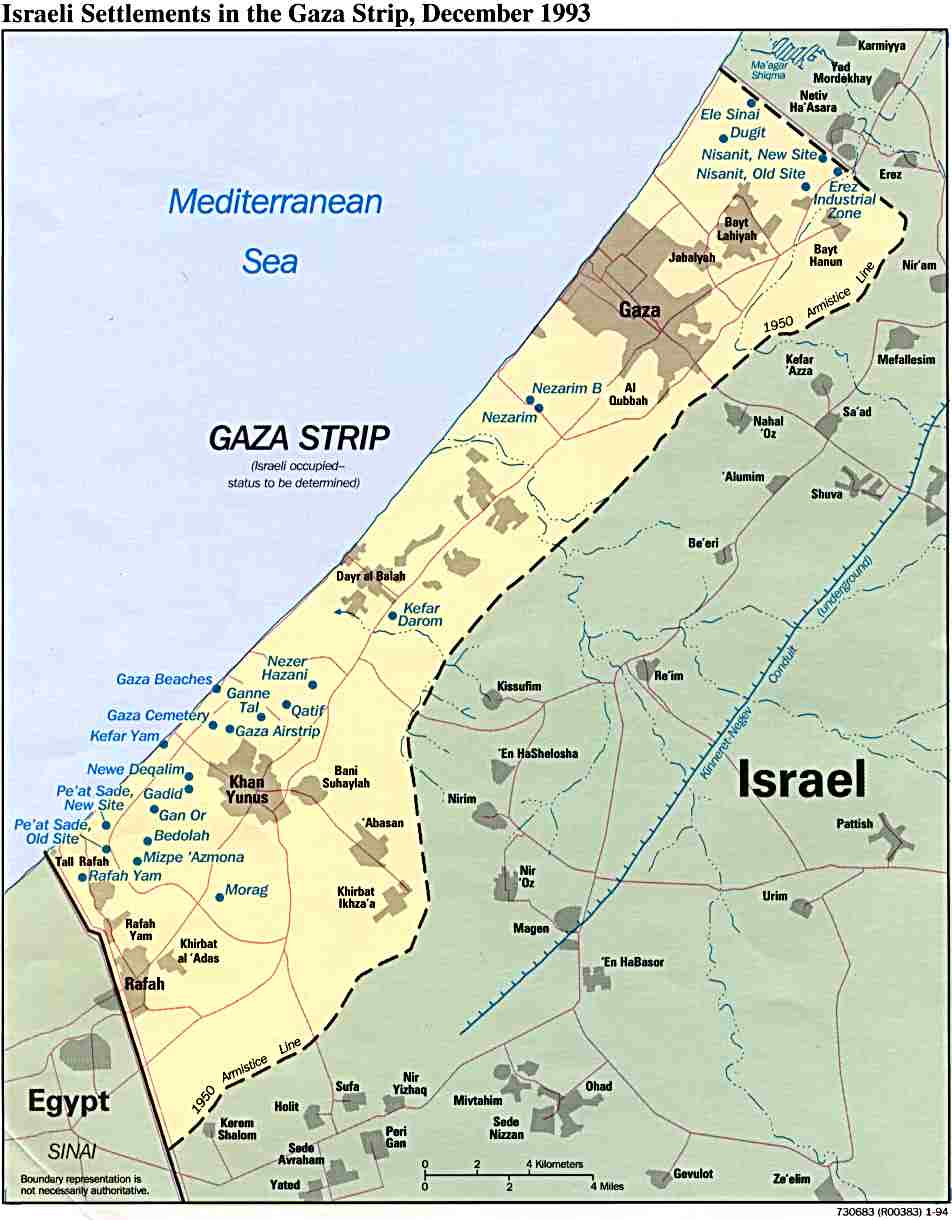
on the south, east and north. It is about 41 kilometres (25.5 mi) long, and between 6 and 12 kilometres (4–7.5 mi) wide, with a total area of 360 square kilometres (139 sq mi). The territory takes its name from Gaza
Gaza
Gaza , also referred to as Gaza City, is a Palestinian city in the Gaza Strip, with a population of about 450,000, making it the largest city in the Palestinian territories.Inhabited since at least the 15th century BC,...
, its main city.
The population is about 1.6 million people, most of them descendants of refugees. One million of the population, as of March 2005, were considered refugees
Palestinian refugee
Palestinian refugees or Palestine refugees are the people and their descendants, predominantly Palestinian Arabic-speakers, who fled or were expelled from their homes during and after the 1948 Palestine War, within that part of the British Mandate of Palestine, that after that war became the...
, although the vast majority of them were actually born in the Gaza Strip; the older generation fled to Gaza in 1948 as part of the 1948 Palestinian exodus
1948 Palestinian exodus
The 1948 Palestinian exodus , also known as the Nakba , occurred when approximately 711,000 to 725,000 Palestinian Arabs left, fled or were expelled from their homes, during the 1948 Arab-Israeli War and the Civil War that preceded it. The exact number of refugees is a matter of dispute...
following the 1948 Arab-Israeli War
1948 Arab-Israeli War
The 1948 Arab–Israeli War, known to Israelis as the War of Independence or War of Liberation The war commenced after the termination of the British Mandate for Palestine and the creation of an independent Israel at midnight on 14 May 1948 when, following a period of civil war, Arab armies invaded...
, from some parts of Mandate Palestine
Mandate Palestine
Mandate Palestine existed while the British Mandate for Palestine, which formally began in September 1923 and terminated in May 1948, was in effect...
that became Israel. The population is predominantly Sunni Muslim. With a yearly growth rate of about 3.2%, the Gaza strip has the 7th highest population growth rate in the world.
The Gaza Strip acquired its current boundaries at the cessation of fighting in the 1948 Arab–Israeli War, which was confirmed in the Israel-Egypt Armistice Agreement
1949 Armistice Agreements
The 1949 Armistice Agreements are a set of agreements signed during 1949 between Israel and neighboring Egypt, Lebanon, Jordan, and Syria. The agreements ended the official hostilities of the 1948 Arab-Israeli War, and established armistice lines between Israeli forces and the forces in...
on 24 February 1949. Article V of the Agreement declared that the demarcation line was not to be an international border. The Gaza Strip continued to be occupied by Egypt. At first it administered the territory through the All-Palestine Government
All-Palestine Government
The All-Palestine Government was established by the Arab League on 22 September 1948, during the 1948 Arab-Israeli War. Shortly thereafter, an Arab-Palestinian Congress named King Abdullah I of Transjordan, "King of Arab Palestine"...
and then directly from 1959 until 1967, when Israel occupied it following the Six-Day War
Six-Day War
The Six-Day War , also known as the June War, 1967 Arab-Israeli War, or Third Arab-Israeli War, was fought between June 5 and 10, 1967, by Israel and the neighboring states of Egypt , Jordan, and Syria...
. Pursuant to the Oslo Accords
Oslo Accords
The Oslo Accords, officially called the Declaration of Principles on Interim Self-Government Arrangements or Declaration of Principles , was an attempt to resolve the ongoing Palestinian-Israeli conflict...
signed between Israel and the Palestinian Liberation Organization in 1993, the Palestinian Authority was set up as an interim administrative body to govern Palestinian population centres, with Israel maintaining control of Gaza Strip's airspace
Airspace
Airspace means the portion of the atmosphere controlled by a country above its territory, including its territorial waters or, more generally, any specific three-dimensional portion of the atmosphere....
, all but one of its land borders and territorial waters
Territorial waters
Territorial waters, or a territorial sea, as defined by the 1982 United Nations Convention on the Law of the Sea, is a belt of coastal waters extending at most from the baseline of a coastal state...
, until a final agreement could be reached. As agreement remained elusive, Israel unilaterally disengaged from Gaza in 2005.
The Gaza Strip is one of the territorial units forming the Palestinian territories
Palestinian territories
The Palestinian territories comprise the West Bank and the Gaza Strip. Since the Palestinian Declaration of Independence in 1988, the region is today recognized by three-quarters of the world's countries as the State of Palestine or simply Palestine, although this status is not recognized by the...
. Since July 2007, following the 2006 Palestinian legislative election
Palestinian legislative election, 2006
On January 25, 2006, elections were held for the Palestinian Legislative Council , the legislature of the Palestinian National Authority . Notwithstanding the 2005 municipal elections and the January 9, 2005 presidential election, this was the first election to the PLC since 1996; subsequent...
and the Battle of Gaza
Battle of Gaza (2007)
The Battle of Gaza was a military conflict between Hamas and Fatah that took place between June 7 and 15, 2007 in the Gaza Strip. After winning Palestinian legislative elections in 2006, Hamas and Fatah formed the Palestinan authority national unity government in 2007, headed by Ismail Haniya. In...
, Hamas
Hamas
Hamas is the Palestinian Sunni Islamic or Islamist political party that governs the Gaza Strip. Hamas also has a military wing, the Izz ad-Din al-Qassam Brigades...
has functioned as the effective government in the Gaza Strip.
Egyptian occupation (1948–1967)
On 22 September 1948, towards the end of the 1948 Arab-Israeli War, the All-Palestine GovernmentAll-Palestine Government
The All-Palestine Government was established by the Arab League on 22 September 1948, during the 1948 Arab-Israeli War. Shortly thereafter, an Arab-Palestinian Congress named King Abdullah I of Transjordan, "King of Arab Palestine"...
was proclaimed in Gaza City by the Arab League
Arab League
The Arab League , officially called the League of Arab States , is a regional organisation of Arab states in North and Northeast Africa, and Southwest Asia . It was formed in Cairo on 22 March 1945 with six members: Egypt, Iraq, Transjordan , Lebanon, Saudi Arabia, and Syria. Yemen joined as a...
. It was conceived partly as an Arab League attempt to limit the influence of Transjordan
Transjordan
The Emirate of Transjordan was a former Ottoman territory in the Southern Levant that was part of the British Mandate of Palestine...
in Palestine. It was not recognized by Transjordan or any non-Arab country.
After the cessation of hostilities, the Israel-Egypt Armistice Agreement of 24 February 1949 established the separation line between Egyptian and Israeli forces, and established what became the present boundary between the Gaza Strip and Israel. Both sides declared that the boundary was not to be an international border. The southern border with Egypt continued to be the international border which had been drawn in 1906 between the Ottoman Empire
Ottoman Empire
The Ottoman EmpireIt was usually referred to as the "Ottoman Empire", the "Turkish Empire", the "Ottoman Caliphate" or more commonly "Turkey" by its contemporaries...
and the British Empire
British Empire
The British Empire comprised the dominions, colonies, protectorates, mandates and other territories ruled or administered by the United Kingdom. It originated with the overseas colonies and trading posts established by England in the late 16th and early 17th centuries. At its height, it was the...
.
The population of the Gaza Strip had been greatly augmented by an influx of Palestinian refugees who fled from Israel before and during the fighting. Palestinians living in the Gaza Strip or Egypt were issued All-Palestine passports. Egypt did not offer the Palestinians citizenship. From the end of 1949, they received aid from UNRWA
United Nations Relief and Works Agency for Palestine Refugees in the Near East
United Nations Relief and Works Agency for Palestine Refugees in the Near East is a relief and human development agency, providing education, health care, social services and emergency aid to 5 million Palestine refugees living in Jordan, Lebanon and Syria, as well as in the West Bank and the Gaza...
. The government was accused of being little more than a façade for Egyptian control, with negligible independent funding or influence. It subsequently moved to Cairo
Cairo
Cairo , is the capital of Egypt and the largest city in the Arab world and Africa, and the 16th largest metropolitan area in the world. Nicknamed "The City of a Thousand Minarets" for its preponderance of Islamic architecture, Cairo has long been a centre of the region's political and cultural life...
and was dissolved in 1959, by decree of Gamal Abdul Nasser, President of Egypt.
Egypt continued to occupy the Gaza Strip until 1967, except for four months of Israeli occupation during the 1956 Suez Crisis
Suez Crisis
The Suez Crisis, also referred to as the Tripartite Aggression, Suez War was an offensive war fought by France, the United Kingdom, and Israel against Egypt beginning on 29 October 1956. Less than a day after Israel invaded Egypt, Britain and France issued a joint ultimatum to Egypt and Israel,...
. Egypt never annexed the Gaza Strip, but instead treated it as a controlled territory and administered it through a military governor.
During the Sinai campaign of November 1956
Suez Crisis
The Suez Crisis, also referred to as the Tripartite Aggression, Suez War was an offensive war fought by France, the United Kingdom, and Israel against Egypt beginning on 29 October 1956. Less than a day after Israel invaded Egypt, Britain and France issued a joint ultimatum to Egypt and Israel,...
, the Gaza Strip and the Sinai Peninsula
Sinai Peninsula
The Sinai Peninsula or Sinai is a triangular peninsula in Egypt about in area. It is situated between the Mediterranean Sea to the north, and the Red Sea to the south, and is the only part of Egyptian territory located in Asia as opposed to Africa, effectively serving as a land bridge between two...
were occupied by Israeli troops. International pressure led Israel to withdraw.
Israeli occupation (1967–2005)
Israel controlled the Gaza Strip again beginning in June 1967, after the Six-Day WarSix-Day War
The Six-Day War , also known as the June War, 1967 Arab-Israeli War, or Third Arab-Israeli War, was fought between June 5 and 10, 1967, by Israel and the neighboring states of Egypt , Jordan, and Syria...
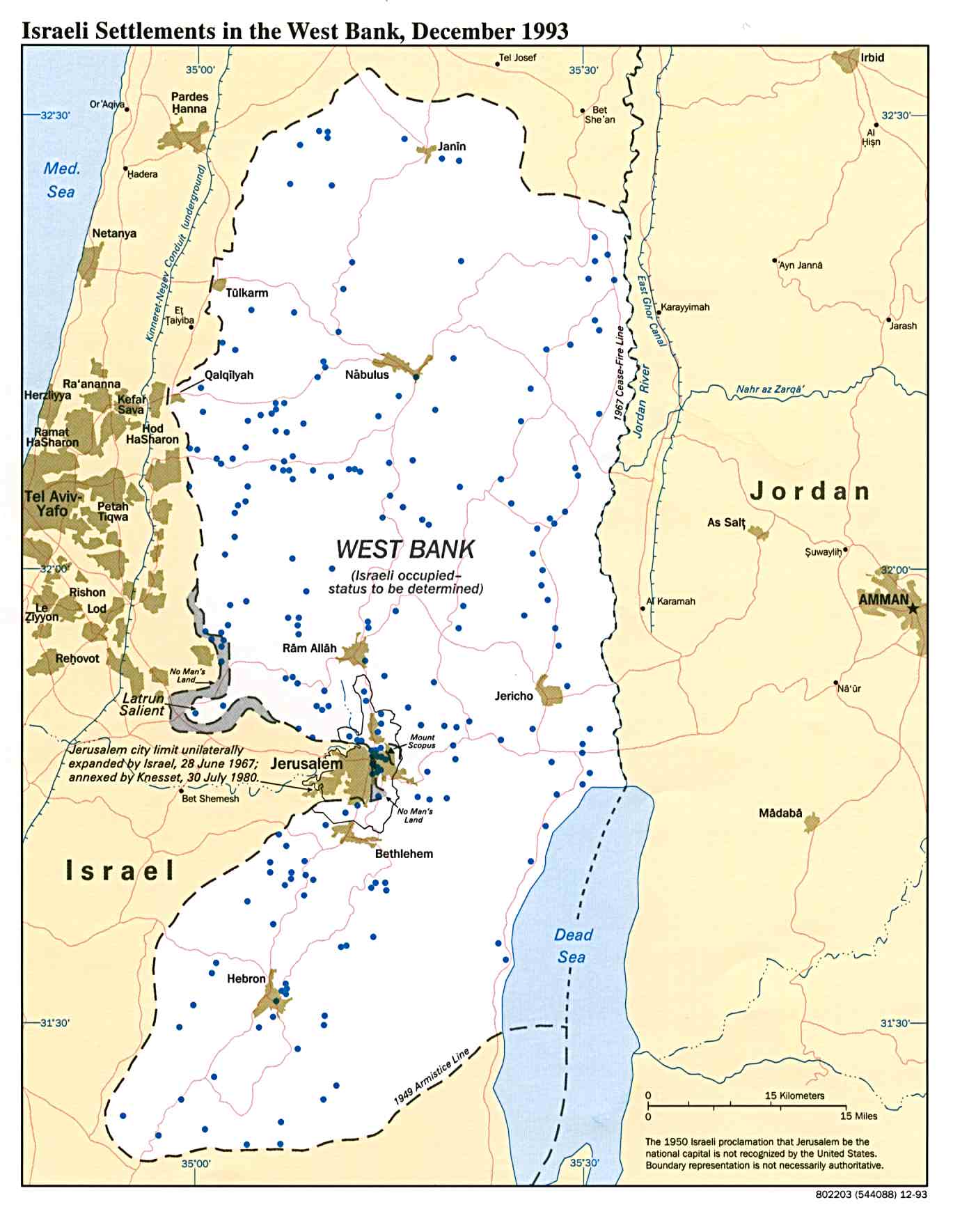
. During the period of Israeli control, Israel created a settlement bloc, Gush Katif
Gush Katif
Gush Katif was a bloc of 17 Israeli settlements in the southern Gaza strip. Gush Katif was specifically mentioned by Yitzhak Rabin, the Israeli prime minister who fell victim to an assassin in 1995, as essential to Israel's security border. In August 2005, the Israeli army moved the 8,600...
, in the southwest corner of the Strip near Rafah
Rafah
Rafah , also known as Rafiah, is a Palestinian city in the southern Gaza Strip. Located south of Gaza, Rafah's population of 71,003 is overwhelmingly made up of Palestinian refugees. Rafah camp and Tall as-Sultan form separate localities. Rafah is the district capital of the Rafah Governorate...
and the Egyptian border. In total Israel created 21 settlements in the Gaza Strip, comprising 20% of the total territory. Besides ideological reasons for being there, these settlements also served Israel's security concerns.
In March 1979 Israel and Egypt signed the Israel-Egypt Peace Treaty
Israel-Egypt Peace Treaty
The 1979 Egypt–Israel Peace Treaty was signed in Washington, D.C. on the 26th of March 1979, following the 1978 Camp David Accords, which were signed by Egyptian President Anwar El Sadat and Israeli Prime Minister Menachem Begin, and were witnessed by United States President Jimmy Carter.The peace...
. Among other things, the treaty provided for the withdrawal by Israel of its armed forces and civilians from the Sinai Peninsula, which Israel had captured during the Six-Day War, to the 1906 international border. The Egyptians agreed to keep the Sinai Peninsula demilitarized. The final status of the Gaza Strip, and other relations between Israel and Palestinians, was not dealt with in the treaty. Egypt renounced all territorial claims to territory north of the international border.
The Gaza Strip remained under Israeli military administration until 1994. During that period the military was responsible for the maintenance of civil facilities and services. In May 1994, following the Palestinian-Israeli agreements known as the Oslo Accords
Oslo Accords
The Oslo Accords, officially called the Declaration of Principles on Interim Self-Government Arrangements or Declaration of Principles , was an attempt to resolve the ongoing Palestinian-Israeli conflict...
, a phased transfer of governmental authority to the Palestinians took place. Much of the Strip (except for the settlement blocs and military areas) came under Palestinian control. The Israeli forces left Gaza City and other urban areas, leaving the new Palestinian Authority to administer and police those areas. The Palestinian Authority, led by Yasser Arafat
Yasser Arafat
Mohammed Yasser Abdel Rahman Abdel Raouf Arafat al-Qudwa al-Husseini , popularly known as Yasser Arafat or by his kunya Abu Ammar , was a Palestinian leader and a Laureate of the Nobel Prize. He was Chairman of the Palestine Liberation Organization , President of the Palestinian National Authority...
, chose Gaza City as its first provincial headquarters. In September 1995, Israel and the PLO
Palestine Liberation Organization
The Palestine Liberation Organization is a political and paramilitary organization which was created in 1964. It is recognized as the "sole legitimate representative of the Palestinian people" by the United Nations and over 100 states with which it holds diplomatic relations, and has enjoyed...
signed a second peace agreement
Interim Agreement on the West Bank and the Gaza Strip
The Interim Agreement on the West Bank and the Gaza Strip, also known as the Israeli-Palestinian Interim Agreement, the Interim Agreement, Oslo 2, Oslo II, and Taba, was a key and complex agreement governing several aspects of the Palestinian territories of Gaza Strip and the West Bank.-History:It...
, extending the Palestinian Authority to most West Bank
West Bank
The West Bank ) of the Jordan River is the landlocked geographical eastern part of the Palestinian territories located in Western Asia. To the west, north, and south, the West Bank shares borders with the state of Israel. To the east, across the Jordan River, lies the Hashemite Kingdom of Jordan...
towns. The agreement also established an elected 88-member Palestinian National Council
Palestinian National Council
The Palestinian National Council is the legislative body of the Palestine Liberation Organization and elects its Executive Committee, which assumes leadership of the organization between its sessions. The Council normally meets every two years. Resolutions are passed by a simple majority with a...
, which held its inaugural session in Gaza in March 1996.
The Palestinian Authority rule of the Gaza Strip and West Bank under the leadership of Arafat suffered from serious mismanagement and corruption scandals. For example, exorbitant bribes were demanded for allowing goods to pass in and out of the Gaza Strip, while heads of the Preventive Security Service apparatus profited from their involvement in the gravel import and cement and construction industries, such as the Great Arab Company for Investment and Development, the al-Motawaset Company, and the al-Sheik Zayid construction project.
The Second Intifada broke out in September 2000 with its waves of protest, civil unrest and bombings against Israeli military and civilians, many of them perpetrated by suicide bombers, and the beginning of rockets and bombings of Israeli border localities by Palestinian guerrillas from Gaza Strip, especially from Hamas and Jihad Islami movements. In February 2005, the Israeli government voted to implement a unilateral disengagement plan
Israel's unilateral disengagement plan
Israel's unilateral disengagement plan , also known as the "Disengagement plan", "Gaza expulsion plan", and "Hitnatkut", was a proposal by Israeli Prime Minister Ariel Sharon, adopted by the government on June 6, 2004 and enacted in August 2005, to evict all Israelis from the Gaza Strip and from...
from the Gaza Strip. The plan began to be implemented on 15 August 2005, and was completed on 12 September 2005. Under the plan, all Israeli settlement
Israeli settlement
An Israeli settlement is a Jewish civilian community built on land that was captured by Israel from Jordan, Egypt, and Syria during the 1967 Six-Day War and is considered occupied territory by the international community. Such settlements currently exist in the West Bank...
s in the Gaza Strip (and four in the West Bank) and the joint Israeli-Palestinian Erez Industrial Zone were dismantled with the removal of all 9,000 Israeli settlers (most of them in the Gush Katif
Gush Katif
Gush Katif was a bloc of 17 Israeli settlements in the southern Gaza strip. Gush Katif was specifically mentioned by Yitzhak Rabin, the Israeli prime minister who fell victim to an assassin in 1995, as essential to Israel's security border. In August 2005, the Israeli army moved the 8,600...
settlement area in the Strip's southwest) and military bases. On 12 September 2005 the Israeli cabinet formally declared an end to Israeli military occupation of the Gaza Strip. To avoid allegations that it was still in occupation of any part of the Gaza Strip, Israel also withdrew from the Philadelphi Route
Philadelphi Route
The Philadelphi Route refers to a narrow strip of land, 14 km in length, situated along the border between Gaza Strip and Egypt. Under the provisions of the Israeli-Egyptian peace treaty of 1979, the buffer zone was controlled and patrolled by Israeli forces. After the 1995 Oslo Accords,...
, which is a narrow strip adjacent to the Strip's border with Egypt, after Egypt's agreement to secure its side of the border. Under the Oslo Accords the Philadelphi Route was to remain under Israeli control to prevent the smuggling of materials (such as ammunition) and people across the border with Egypt. With Egypt agreeing to patrol its side of the border, it was hoped that the objective would be achieved. However, Israel maintained its control over the crossings in and out of Gaza. The Rafah crossing between Egypt and Gaza was monitored by the Israeli army through special surveillance cameras. Official documents such as passports, I.D. cards, export and import papers, and many others had to be approved by the Israeli army.
Israel-Gaza Strip barrier
Between 1994 and 1996, Israel built the Israeli Gaza Strip barrier. The separation barrierSeparation barrier
A separation barrier is a wall or fence constructed to limit the movement of people across a certain line or border, or to separate two populations. These structures vary in placement with regard to international borders and topography...
was first constructed to improve security in Israel. The barrier was largely torn down by Palestinians at the beginning of the Al-Aqsa Intifada
Al-Aqsa Intifada
The Second Intifada, also known as the Al-Aqsa Intifada and the Oslo War, was the second Palestinian uprising, a period of intensified Palestinian-Israeli violence, which began in late September 2000...
in September 2000. Between December 2000 and June 2001, the barrier fence between the Gaza Strip and Israel was reconstructed. A barrier on the Gaza Strip-Egypt border was constructed from 2004. There are three main crossing points in the barrier: the northern Erez Crossing
Erez Crossing
The Erez Crossing is a pedestrian/cargo terminal on the Israeli Gaza Strip barrier. It is located in the northern end of the Gaza Strip, on the border with Israel.It is part of a complex formerly including the Erez Industrial Park....
into Israel, the southern Rafah Crossing into Egypt, and the eastern Karni Crossing
Karni crossing
The Karni Crossing is a cargo terminal on the Israel-Gaza Strip barrier. It is located in the north-eastern end of the Gaza Strip and was opened in 1994 after the signing of the Oslo Accords, in order to allow Palestinian merchants to export and import goods...
used only for cargo. Israel controls the Gaza Strip's northern borders, as well as its territorial waters and airspace. Egypt controls Gaza Strip's southern border, under an agreement between it and Israel.
2005 – Israel's unilateral disengagement
The Israel Defence Forces left the Gaza Strip on 1 September 2005 as part of Israel's unilateral disengagement planIsrael's unilateral disengagement plan
Israel's unilateral disengagement plan , also known as the "Disengagement plan", "Gaza expulsion plan", and "Hitnatkut", was a proposal by Israeli Prime Minister Ariel Sharon, adopted by the government on June 6, 2004 and enacted in August 2005, to evict all Israelis from the Gaza Strip and from...
, and all Israeli citizens were evicted from the area. An 'Agreement on Movement and Access' between Israel and the Palestinian Authority was brokered by Condoleezza Rice
Condoleezza Rice
Condoleezza Rice is an American political scientist and diplomat. She served as the 66th United States Secretary of State, and was the second person to hold that office in the administration of President George W. Bush...
in November 2005 to improve Palestinian freedom of movement and economic activity in the Gaza Strip. Under its terms, the Rafah
Rafah
Rafah , also known as Rafiah, is a Palestinian city in the southern Gaza Strip. Located south of Gaza, Rafah's population of 71,003 is overwhelmingly made up of Palestinian refugees. Rafah camp and Tall as-Sultan form separate localities. Rafah is the district capital of the Rafah Governorate...
crossing with Egypt
Egypt
Egypt , officially the Arab Republic of Egypt, Arabic: , is a country mainly in North Africa, with the Sinai Peninsula forming a land bridge in Southwest Asia. Egypt is thus a transcontinental country, and a major power in Africa, the Mediterranean Basin, the Middle East and the Muslim world...
was to be reopened, with transits monitored by the Palestinian National Authority and the European Union
European Union
The European Union is an economic and political union of 27 independent member states which are located primarily in Europe. The EU traces its origins from the European Coal and Steel Community and the European Economic Community , formed by six countries in 1958...
. Only people with Palestinian ID, or foreign nationals, by exception, in certain categories, subject to Israeli oversight, were permitted to cross in and out. All goods, vehicles and trucks to and from Egypt had to pass through the Israeli crossing at Kerem Shalom
Kerem Shalom
Kerem Shalom is a kibbutz in the Eshkol Regional Council and a border crossing near the meeting of the Gaza Strip-Israel-Egypt borders.- Kibbutz :The kibbutz was founded in 1966 adjacent to the triborder area by members of Hashomer Hatzair...
, under full Israeli supervision. Goods were also permitted transit at the Karni crossing
Karni crossing
The Karni Crossing is a cargo terminal on the Israel-Gaza Strip barrier. It is located in the north-eastern end of the Gaza Strip and was opened in 1994 after the signing of the Oslo Accords, in order to allow Palestinian merchants to export and import goods...
in the north.
Legal status
The UN, Human Rights WatchHuman Rights Watch
Human Rights Watch is an international non-governmental organization that conducts research and advocacy on human rights. Its headquarters are in New York City and it has offices in Berlin, Beirut, Brussels, Chicago, Geneva, Johannesburg, London, Los Angeles, Moscow, Paris, San Francisco, Tokyo,...
and many other international bodies and NGOs
Non-governmental organization
A non-governmental organization is a legally constituted organization created by natural or legal persons that operates independently from any government. The term originated from the United Nations , and is normally used to refer to organizations that do not form part of the government and are...
consider Israel to be the occupying power of the Gaza Strip as Israel controls Gaza's airspace and territorial waters, and does not allow the movement of goods in or out of Gaza by air or sea (only by land). However, the border crossing into Egypt is not controlled by Israel; similar to Israel, Egypt has alternately restricted or allowed goods and people to cross that terrestrial border. Israel states that Gaza is no longer occupied, inasmuch as Israel does not exercise effective control or authority over any land or institutions in the Gaza Strip. Foreign Affairs Minister of Israel
Foreign Affairs Minister of Israel
The Foreign Affairs Minister of Israel is the political head of the Israeli Ministry of Foreign Affairs. The position is one of the most important in the Israeli cabinet after Prime Minister and Defense Minister...
Tzipi Livni
Tzipi Livni
Tzipporah Malkah "Tzipi" Livni is an Israeli lawyer and politician. She is the current Israeli Opposition Leader and leader of Kadima, the largest party in the Knesset. Raised an ardent nationalist, Livni has become one of her nation's leading voices for the two-state solution. In Israel she has...
stated in January, 2008: "Israel got out of Gaza. It dismantled its settlements there. No Israeli soldiers were left there after the disengagement." After Israel withdrew in 2005, Palestinian Authority Chairman Mahmoud Abbas
Mahmoud Abbas
Mahmoud Abbas , also known by the kunya Abu Mazen , has been the Chairman of the Palestine Liberation Organisation since 11 November 2004 and became President of the Palestinian National Authority on 15 January 2005 on the Fatah ticket.Elected to serve until 9 January 2009, he unilaterally...
stated, "the legal status of the areas slated for evacuation has not changed." Palestinian American
Palestinian American
Palestinian Americans are Americans of Palestinian ancestry. It is difficult to say when the first Palestinian immigrants arrived at the United States; however, many of the first immigrants to arrive were Christians escaping persecution from the Ottoman Empire in the late 19th century...
attorney Gregory Khalil said "Israel still controls every person, every good, literally every drop of water to enter or leave the Gaza Strip. Its troops may not be there... but it still restricts the ability for the Palestinian authority to exercise control.". The issue of the legal status of Gaza strip appears to be particularly complex according to international law and legally intriguing, even after the Operation "Cast Lead" and the Israeli invasion of Gaza in January 2009.
In his statement on the 2008–2009 Israel–Gaza conflict
2008–2009 Israel–Gaza conflict
The Gaza War, known as Operation Cast Lead in Israel and as the Gaza Massacre in the Arab world, was a three-week bombing and invasion of the Gaza Strip by Israel, and hundreds of rocket attacks on south of Israel which...
Richard Falk
Richard A. Falk
Richard Anderson Falk is an American professor emeritus of international law at Princeton University, the author or co-author of 20 books and the editor or co-editor of another 20 books, speaker, activist on world affairs, and an appointee to two United Nations positions on the Palestinian...
, United Nations Special Rapporteur wrote that international humanitarian law
International humanitarian law
International humanitarian law , often referred to as the laws of war, the laws and customs of war or the law of armed conflict, is the legal corpus that comprises "the Geneva Conventions and the Hague Conventions, as well as subsequent treaties, case law, and customary international law." It...
applied to Israel "in regard to the obligations of an Occupying Power and in the requirements of the laws of war." In a 2009 interview on Democracy Now Christopher Gunness, spokesperson for the United Nations Relief and Works Agency for Palestine Refugees in the Near East
United Nations Relief and Works Agency for Palestine Refugees in the Near East
United Nations Relief and Works Agency for Palestine Refugees in the Near East is a relief and human development agency, providing education, health care, social services and emergency aid to 5 million Palestine refugees living in Jordan, Lebanon and Syria, as well as in the West Bank and the Gaza...
(UNRWA) called Israel an occupying power. However, Meagan Buren, Senior Adviser to the pro-Israeli media group Israel Project
Israel Project
The Israel Project is a US-based 501 non-profit, educational organization that gets facts about Israel and the Middle East to press, public officials and the public.” The Israel Project is not affiliated with any government. TIP has offices in the USA and Israel, and "works tirelessly to help...
, contested that characterization.
Palestinian Authority control (1994–2007)
In accordance with the Oslo AccordsOslo Accords
The Oslo Accords, officially called the Declaration of Principles on Interim Self-Government Arrangements or Declaration of Principles , was an attempt to resolve the ongoing Palestinian-Israeli conflict...
, the Palestinian Authority
Palestinian National Authority
The Palestinian Authority is the administrative organization established to govern parts of the West Bank and Gaza Strip...
took over the administrative authority of the Gaza Strip (other than the settlement blocs and military areas) in 1994. After the complete Israeli withdrawal
Israel's unilateral disengagement plan
Israel's unilateral disengagement plan , also known as the "Disengagement plan", "Gaza expulsion plan", and "Hitnatkut", was a proposal by Israeli Prime Minister Ariel Sharon, adopted by the government on June 6, 2004 and enacted in August 2005, to evict all Israelis from the Gaza Strip and from...
of Israeli settlers and military from the Gaza Strip on 12 September 2005, the Palestinian Authority had complete administrative authority in the Gaza Strip. Since the Israeli withdrawal the Rafah Border Crossing had been supervised by EU Border Assistance Mission Rafah
European Union Border Assistance Mission Rafah
The European Union Border Assistance Mission Rafah is, after the European Union Police Mission for the Gaza Strip , the EU's second Civilian Crisis Management Mission in the Gaza Strip. It is situated at the Rafah Border Crossing on the Palestinian-Egyptian border...
under an Agreement finalised in November 2005.
Post-election violence
In the Palestinian parliamentary electionsPalestinian legislative election, 2006
On January 25, 2006, elections were held for the Palestinian Legislative Council , the legislature of the Palestinian National Authority . Notwithstanding the 2005 municipal elections and the January 9, 2005 presidential election, this was the first election to the PLC since 1996; subsequent...
held on January 25, 2006, Hamas
Hamas
Hamas is the Palestinian Sunni Islamic or Islamist political party that governs the Gaza Strip. Hamas also has a military wing, the Izz ad-Din al-Qassam Brigades...
won a plurality of 42.9% of the total vote and 74 out of 132 total seats (56%). When Hamas assumed power the next month, the Israeli government and the key players of the international community, the United States and the EU refused to recognize its right to govern the Palestinian Authority. Direct aid to the Palestinian government there was cut off, although some of that money was redirected to humanitarian organizations not affiliated with the government. The resulting political disorder and economic stagnation led to many Palestinians emigrating from the Gaza Strip.
In January 2007, fighting erupted between Hamas and Fatah
Fatah
Fataḥ is a major Palestinian political party and the largest faction of the Palestine Liberation Organization , a multi-party confederation. In Palestinian politics it is on the left-wing of the spectrum; it is mainly nationalist, although not predominantly socialist. Its official goals are found...
. The deadliest clashes occurred in the northern Gaza Strip, where General Muhammed Gharib, a senior commander of the Fatah-dominated Preventative Security Force, died when a rocket hit his home. Gharib's two daughters and two bodyguards were also killed in the attack, which was carried out by Hamas gunmen.
At the end of January 2007, a truce was negotiated between Fatah and Hamas. However, after a few days, new fighting broke out. Fatah fighters stormed a Hamas-affiliated university in the Gaza Strip. Officers from Abbas' presidential guard battled Hamas gunmen guarding the Hamas-led Interior Ministry.
In May 2007, new fighting broke out between the factions. Interior Minister Hani Qawasmi
Talab al-Qawasmi
Talab al-Qawasmi is a Palestinian politician. He was born in Gaza, although his family originated from Hebron in the modern-day West Bank and emigrated to Gaza in 1949. Al-Qawasmi received his BA degree in Accounting from Cairo University and pursued his studies and got a high diploma in Human...
, who had been considered a moderate civil servant acceptable to both factions, resigned due to what he termed harmful behavior by both sides.
Fighting spread in the Gaza Strip with both factions attacking vehicles and facilities of the other side. In response to constant attacks by rocket fire from the Gaza Strip, Israel launched an air strike which destroyed a building used by Hamas. Ongoing violence prompted fear that it could bring the end of the Fatah-Hamas coalition government
Palestinian government of March 2007
The Palestinian national unity government formed on March 17, 2007 was a Palestinian cabinet headed by Palestinian Prime Minister Ismail Haniya, founded following Saudi-sponsored negotiations in Mecca. On June 14 2007, Following the Hamas military takeover of the Gaza Strip, Palestinian President...
, and possibly the end of the Palestinian authority.
Hamas spokesman Moussa Abu Marzouk blamed the worsening situation on Israel, stating that the constant pressure of economic sanctions resulted in the "real explosion."
Expressions of concerns were received from many Arab leaders, with many offering to try to help by doing some diplomatic work between the two factions. Associated Press reporter Ibrahim Barzak wrote an eyewitness account stating:
Casualties
From 2006-2007 more than 600 Palestinians were killed in factional fighting between Hamas and Fatah. In the aftermath of the Gaza War, a series of violent acts killed 54 Palestinians, while hundreds have claimed they were tortured. 349 Palestinians were killed in fighting between factions in 2007. 160 Palestinians killed each other in June alone.Hamas control (2007–present)
Following the victory of Hamas in the 2006 Palestinian legislative electionPalestinian legislative election, 2006
On January 25, 2006, elections were held for the Palestinian Legislative Council , the legislature of the Palestinian National Authority . Notwithstanding the 2005 municipal elections and the January 9, 2005 presidential election, this was the first election to the PLC since 1996; subsequent...
, Hamas and Fatah
Fatah
Fataḥ is a major Palestinian political party and the largest faction of the Palestine Liberation Organization , a multi-party confederation. In Palestinian politics it is on the left-wing of the spectrum; it is mainly nationalist, although not predominantly socialist. Its official goals are found...
formed a Palestinan authority national unity government headed by Ismail Haniya
Ismail Haniya
Ismail Haniyeh ; is a senior political leader of Hamas and one of two disputed Prime Ministers of the Palestinian National Authority, the matter being under political and legal dispute. He became Prime Minister after the legislative elections of 2006 which Hamas won...
. Shortly after, Hamas took control of the Gaza Strip in the course of the Battle of Gaza
Battle of Gaza (2007)
The Battle of Gaza was a military conflict between Hamas and Fatah that took place between June 7 and 15, 2007 in the Gaza Strip. After winning Palestinian legislative elections in 2006, Hamas and Fatah formed the Palestinan authority national unity government in 2007, headed by Ismail Haniya. In...
, seizing government institutions and replacing Fatah and other government officials with its own. By 14 June, Hamas fully controlled the Gaza Strip. Palestinian President
President of the Palestinian National Authority
The President of the Palestinian National Authority is the highest-ranking political position in the Palestinian National Authority ....
Mahmoud Abbas
Mahmoud Abbas
Mahmoud Abbas , also known by the kunya Abu Mazen , has been the Chairman of the Palestine Liberation Organisation since 11 November 2004 and became President of the Palestinian National Authority on 15 January 2005 on the Fatah ticket.Elected to serve until 9 January 2009, he unilaterally...
responded by declaring a state of emergency
State of emergency
A state of emergency is a governmental declaration that may suspend some normal functions of the executive, legislative and judicial powers, alert citizens to change their normal behaviours, or order government agencies to implement emergency preparedness plans. It can also be used as a rationale...
, dissolving the unity government and forming a new government without Hamas participation. PNA security forces
Preventive Security Service
The Preventive Security Force is the official security apparatus of the Palestinian National Authority. It was established in 1994 by President Yasser Arafat in accordance with the Oslo Accords....
in the West Bank
West Bank
The West Bank ) of the Jordan River is the landlocked geographical eastern part of the Palestinian territories located in Western Asia. To the west, north, and south, the West Bank shares borders with the state of Israel. To the east, across the Jordan River, lies the Hashemite Kingdom of Jordan...
arrested a number of Hamas members.
Abbas's government received widespread international support. In late June 2008 Egypt, Jordan, and Saudi Arabia said that the West Bank-based Cabinet formed by Abbas was the sole legitimate Palestinian government, and Egypt moved its embassy from Gaza to the West Bank. The Hamas government in the Gaza Strip faces international, diplomatic, and economic isolation.
Both Saudi Arabia
Saudi Arabia
The Kingdom of Saudi Arabia , commonly known in British English as Saudi Arabia and in Arabic as as-Sa‘ūdiyyah , is the largest state in Western Asia by land area, constituting the bulk of the Arabian Peninsula, and the second-largest in the Arab World...
and Egypt supported reconciliation and the forming of a new unity government, and pressed Abbas to start serious talks with Hamas. Abbas had always conditioned this on Hamas' returning control of the Gaza Strip to the Palestinian Authority. Hamas has been invited to and has visited a number of countries, including Russia, and in the EU countries, opposition parties and politicians called for a dialogue with Hamas and an end to the economic sanctions.
After the takeover, Israel and Egypt closed their border crossings with Gaza. Palestinian sources reported that European Union monitors fled the Rafah Border Crossing, on the Gaza–Egypt border for fear of being kidnapped or harmed. Arab foreign ministers and Palestinian officials presented a united front against control of the border by Hamas.
Meanwhile, Israeli and Egyptian security reports said that Hamas continued smuggling in large quantities of explosives and arms from Egypt through tunnels. Egyptian security forces uncovered 60 tunnels in 2007.
After Hamas takeover
After Hamas' June win, it ousted Fatah-linked officials from positions of power and authority (such as government positions, security services, universities, newspapers, etc.) and strove to enforce law by progressively removing guns from the hands of peripheral militias, clans, and criminal groups, and gaining control of supply tunnels. According to Amnesty InternationalAmnesty International
Amnesty International is an international non-governmental organisation whose stated mission is "to conduct research and generate action to prevent and end grave abuses of human rights, and to demand justice for those whose rights have been violated."Following a publication of Peter Benenson's...
, under Hamas rule, newspapers have been closed down and journalists have been harassed. Fatah demonstrations have been forbidden or suppressed, as in the case of a large demonstration on the anniversary of Yasser Arafat
Yasser Arafat
Mohammed Yasser Abdel Rahman Abdel Raouf Arafat al-Qudwa al-Husseini , popularly known as Yasser Arafat or by his kunya Abu Ammar , was a Palestinian leader and a Laureate of the Nobel Prize. He was Chairman of the Palestine Liberation Organization , President of the Palestinian National Authority...
's death, which resulted in the deaths of seven people, after protesters hurled stones at Hamas security forces.
Violence against Christians has been recorded. The owner of a Christian bookshop was abducted and murdered, and on 15 February 2008, the Christian Youth Organization's library in Gaza City was bombed.
Hamas and other militant groups continued to fire Qassam rockets across the border into Israel. According to Israel, between the Hamas takeover and the end of January 2008, 697 rockets and 822 mortar bombs were fired at Israeli towns. In response, Israel targeted home made Qassam launchers and military targets and on 19 September 2007, declared the Gaza Strip a hostile entity. In January 2008, Israel curtailed travel from Gaza, the entry of goods, and cut fuel supplies, resulting in power shortages. This brought charges that Israel was inflicting collective punishment
Collective punishment
Collective punishment is the punishment of a group of people as a result of the behavior of one or more other individuals or groups. The punished group may often have no direct association with the other individuals or groups, or direct control over their actions...
on the Gaza population, leading to international condemnation. Despite multiple reports from within the Strip that food and other essentials were in extremely short supply,
Israel countered that Gaza had enough food and energy supplies for weeks. In early March 2008, air strikes and ground incursions by the IDF led to the deaths of over 110 Palestinians and extensive damage to Jabalia
Jabalia
Jabalia also Jabalya is a Palestinian city located north of Gaza City. It is under the jurisdiction of the North Gaza Governorate, in the Gaza Strip. According to the Palestinian Central Bureau of Statistics, Jabalia had a population of 82,877 in mid-year 2006...
. After Egypt's President Hosni Mubarak resigned, on May 28, 2011, Egypt permanently opened its border with the Gaza Strip.
Barrier breach
On 23 January 2008, after months of preparation during which the steel reinforcement of the border barrier was weakened, Hamas destroyed several parts of the wallBreach of the Gaza-Egypt border (2008)
The breach of the Gaza-Egypt border began on January 23, 2008, after Hamas militants in the Gaza Strip set off an explosion near the Rafah Border Crossing, destroying part of the Israel and Egypt – Gaza Strip barrier. The United Nations estimates that as many as half the 1.5 million population of...
dividing Gaza and Egypt in the town of Rafah
Rafah
Rafah , also known as Rafiah, is a Palestinian city in the southern Gaza Strip. Located south of Gaza, Rafah's population of 71,003 is overwhelmingly made up of Palestinian refugees. Rafah camp and Tall as-Sultan form separate localities. Rafah is the district capital of the Rafah Governorate...
. Hundreds of thousands of Gazans crossed the border into Egypt seeking food and supplies. Due to the crisis, Egyptian President Hosni Mubarak
Hosni Mubarak
Muhammad Hosni Sayyid Mubarak is a former Egyptian politician and military commander. He served as the fourth President of Egypt from 1981 to 2011....
ordered his troops to allow the Palestinians in but to verify that they did not bring weapons back across the border. Egypt arrested and later released several armed Hamas militants in the Sinai who presumably wanted to infiltrate into Israel. At the same time, Israel increased its state of alert along the length of the Israel-Egypt Sinai border, and warned its citizens to leave Sinai "without delay."
The EU Border Monitors indicated their readiness to return to monitor the border, should Hamas guarantee their safety; while the Palestinian Authority demanded that Egypt deal only with the Authority in negotiations relating to borders. Israel eased up some influx of goods and medical supplies to the strip, but it curtailed electricity by 5% in one of its ten lines, while Hamas and Egypt shored up some of the gaping holes between the two areas. The first attempts by Egypt to reclose the border were met by violent clashes with Gaza gunmen, but after 12 days the borders were sealed again.
By mid-February the Rafah crossing remained closed. In February 2008 a Haaretz
Haaretz
Haaretz is Israel's oldest daily newspaper. It was founded in 1918 and is now published in both Hebrew and English in Berliner format. The English edition is published and sold together with the International Herald Tribune. Both Hebrew and English editions can be read on the Internet...
poll indicated that 64% of Israelis favour their government holding direct talks with Hamas in Gaza about a cease-fire and to secure the release of Gilad Shalit
Gilad Shalit
Gilad Shalit is an Israeli – French citizen and Israel Defense Forces soldier. On 25 June 2006, he was captured inside Israel by Hamas militants in a cross-border raid via underground tunnels near the border with Gaza. The Hamas militants held him for over five years, until he was released on...
, an Israeli soldier who was captured in a cross border raid by Hamas militants on 25 June 2006 and has been held hostage since.
In February 2008, Israeli-Palestinian fighting intensified with rockets launched at Israeli cities and Israel attacking Palestinian gunmen. Military aggression by Hamas led to a heavy Israeli military action on 1 March 2008, resulting in over 110 Palestinians being killed according to BBC News, as well as 2 Israeli soldiers. Israeli human rights group B'Tselem
B'Tselem
B'Tselem is an Israeli non-governmental organization . It calls itself "The Israeli Information Center for Human Rights in the Occupied Territories"...
estimated that 45 of those killed were not involved in hostilities, and 15 were minors.
After a round of tit-for-tat
Tit for tat
Tit for tat is an English saying meaning "equivalent retaliation". It is also a highly effective strategy in game theory for the iterated prisoner's dilemma. It was first introduced by Anatol Rapoport in Robert Axelrod's two tournaments, held around 1980. An agent using this strategy will initially...
arrests between Fatah and Hamas in the Gaza Strip and West Bank, the Hilles clan
Hilles clan
The Hilles clan is a Palestinian extended family that became known in 2008 for its violent conflict with the de facto Hamas military government in the Gaza Strip...
from Gaza were relocated to Jericho
Jericho
Jericho ; is a city located near the Jordan River in the West Bank of the Palestinian territories. It is the capital of the Jericho Governorate and has a population of more than 20,000. Situated well below sea level on an east-west route north of the Dead Sea, Jericho is the lowest permanently...
on 4 August 2008. Retiring Prime Minister Ehud Olmert said on 11 November 2008, "The question is not whether there will be a confrontation, but when it will take place, under what circumstances, and who will control these circumstances, who will dictate them, and who will know to exploit the time from the beginning of the ceasefire until the moment of confrontation in the best possible way.” On 14 November 2008, Gaza was blockaded by Israel in response to the rocket and mortar attacks by Hamas and other militant groups operating inside Gaza, however food, power and water can still enter from Egypt if the Egyptian authorities allow it.
On November 28, 2008, after a 24-hour period in which no Qassam rocket
Qassam rocket
The Qassam rocket is a simple steel artillery rocket developed and deployed by the Izz ad-Din al-Qassam Brigades, the military arm of Hamas. Three models have been produced and used between 2001 and 2011....
s were fired into Israel, the IDF
Israel Defense Forces
The Israel Defense Forces , commonly known in Israel by the Hebrew acronym Tzahal , are the military forces of the State of Israel. They consist of the ground forces, air force and navy. It is the sole military wing of the Israeli security forces, and has no civilian jurisdiction within Israel...
facilitated the transfer of over 30 truckloads of food, basic supplies and medicine into the Gaza Strip, and it also transferred fuel to the main power plant of the area. On 25 November 2008 Israel closed its cargo crossing with Gaza due to two rockets being shot at Israel.
Gaza War
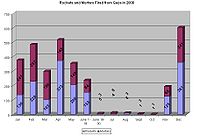

Israel Defense Forces
The Israel Defense Forces , commonly known in Israel by the Hebrew acronym Tzahal , are the military forces of the State of Israel. They consist of the ground forces, air force and navy. It is the sole military wing of the Israeli security forces, and has no civilian jurisdiction within Israel...
rejected claims the majority of those killed were civilians, providing evidence that Hamas deliberately hides weapons and fighters in "mosques, school yards and civilian houses" to deter an attack and exploit Israel's rules of engagement. Israel began a ground invasion of the Gaza Strip on 3 January 2009. Israel rebuffed many cease-fire calls and both sides declared unilateral cease-fires.
A total of 1,100-1,400 Palestinians and 13 Israelis were killed in the 22-day war. After 22 days of fighting, Israel declared a ceasefire. Hamas vowed to continue the battle if Israeli forces did not leave the Strip. The conflict damaged or destroyed tens of thousands of homes, 15 of Gaza’s 27 hospitals and 43 of its 110 primary health care facilities, 800 water wells, 186 greenhouses, and nearly all of its 10,000 family farms; leaving 50,000 homeless, 400,000-500,000 without running water, one million without electricity, and resulting in acute food shortages.
By February 2009, food availability returned to pre-war levels but the supplies of local fresh foods were anticipated to decrease seriously by April-June 2009 due to the severe damages sustained by the agricultural sector during the war.
Gaza blockade continues
The blockade of the Gaza strip continued after the end of the war, although Israel allowed in limited quantities of medical humanitarian aid. The Red Cross said that the blockade was harming the Gazan economy and causing a shortage of basic medicines and equipment such as painkillers and x-ray film.Director of the Shin Bet (Israel Security Agency) Yuval Diskin
Yuval Diskin
Yuval Diskin was the 12th Director of Shabak .In the Israel Defense Forces, Diskin served as deputy company commander of Sayeret Shaked . In 1978, he was recruited to the Shabak and served as area coordinator for the Nablus district...
has said he would not oppose the loosening of trade restrictions, but believed that smuggling tunnel
Smuggling tunnel
Gaza Strip smuggling tunnels are smuggling tunnels that have been dug under the Egypt-Gaza Strip separation barrier which separates Egypt from the Gaza Strip. The barrier runs along the international border along the Philadelphi corridor, which is a buffer zone along the border created by the...
s in the Sinai and an open seaport in the Gaza Strip endangered the security of Israel. According to Diskin, Hamas and Islamic Jihad
Islamic Jihad Movement in Palestine
The Islamic Jihad Movement in Palestine known in the West as simply Palestinian Islamic Jihad , is a small Palestinian militant organization. The group has been labelled as a terrorist group by the United States, the European Union, the United Kingdom, Japan, Canada, Australia and Israel...
have smuggled over "5,000 rockets with ranges up to 40 kilometers." Some of the rockets can reach as far as the Tel Aviv Metropolitan Area.
Mark Regev, spokesman for the Israeli prime minister’s office, described Israel's actions as "sanctions," not a blockade, but a Gazan legal consultant for UNRWA called the blockade "an action outside of international law.”
In July 2010, British prime minister David Cameron
David Cameron
David William Donald Cameron is the current Prime Minister of the United Kingdom, First Lord of the Treasury, Minister for the Civil Service and Leader of the Conservative Party. Cameron represents Witney as its Member of Parliament ....
criticized the blockade, saying "Humanitarian goods and people must flow in both directions. Gaza cannot and must not be allowed to remain a prison camp." In response, the spokesman for the Israeli embassy in London said "The people of Gaza are the prisoners of the terrorist organisation Hamas. The situation in Gaza is the direct result of Hamas' rule and priorities."
The Arab League
Arab League
The Arab League , officially called the League of Arab States , is a regional organisation of Arab states in North and Northeast Africa, and Southwest Asia . It was formed in Cairo on 22 March 1945 with six members: Egypt, Iraq, Transjordan , Lebanon, Saudi Arabia, and Syria. Yemen joined as a...
has accused Israel of waging a financial war.
The IDF strictly controls travel within the area of the crossing points between Israel and the Gaza Strip, and has sealed its border with Gaza. The security environment within Gaza and along its borders, including its border with Egypt and its seacoast, is dangerous and can change at any time.
Facing mounting international calls to ease or lift their blockade, Egypt and Israel lessened the restrictions starting in June 2010, when the Rafah border crossing from Egypt to Gaza has been partially opened by Egypt, and Egypt’s foreign ministry has made it clear that the crossing will remain open mainly for people, but not for supplies, to go through. Israel announced that it will allow all strictly civilian goods into Gaza while preventing certain weapons and dual-use items from entering the Hamas-run Gaza.
Islamization Trend
From 1987 to 1991, during the first intifadaFirst Intifada
The First Intifada was a Palestinian uprising against the Israeli occupation of the Palestinian Territories. The uprising began in the Jabalia refugee camp and quickly spread throughout Gaza, the West Bank and East Jerusalem....
, Hamas campaigned for the wearing of the hijab alongside other measures, including insisting women stay at home be segregated from men, and the promotion of polygamy. In the course of this campaign women who chose not to wear the hijab were verbally and physically harassed, with the result that the hijab was being worn 'just to avoid problems on the streets'.
Since Hamas took control of the Gaza Strip in 2007, some of its members have attempted to impose Islamic dress or the Hijab
Hijab
The word "hijab" or "'" refers to both the head covering traditionally worn by Muslim women and modest Muslim styles of dress in general....
head covering on women. Also, the government’s "Islamic Endowment Ministry" has deployed Virtue Committee members to warn citizens of the dangers of immodest dress, card playing and dating. However, there are no government laws imposing dress and other moral standards, and the Hamas education ministry reversed one effort to impose Islamic dress on students. There has also been successful resistance to attempts by local Hamas officials to impose Islamic dress on women.
According to Human Rights Watch
Human Rights Watch
Human Rights Watch is an international non-governmental organization that conducts research and advocacy on human rights. Its headquarters are in New York City and it has offices in Berlin, Beirut, Brussels, Chicago, Geneva, Johannesburg, London, Los Angeles, Moscow, Paris, San Francisco, Tokyo,...
, the Hamas-controlled government of Gaza stepped up its efforts to "Islamize" Gaza in 2010, efforts that included, according to the organization, the "repression of civil society" and "severe violations of personal freedom."
Palestinian
Palestinian people
The Palestinian people, also referred to as Palestinians or Palestinian Arabs , are an Arabic-speaking people with origins in Palestine. Despite various wars and exoduses, roughly one third of the world's Palestinian population continues to reside in the area encompassing the West Bank, the Gaza...
researcher Dr. Khaled Al-Hroub has criticized what he called the "Taliban-like steps" Hamas has taken. He wrote, "The Islamization that has been forced upon the Gaza Strip – the suppression of social, cultural, and press freedoms that do not suit Hamas's view[s] – is an egregious deed that must be opposed. It is the reenactment, under a religious guise, of the experience of [other] totalitarian regimes and dictatorships.
Hamas officials denied having any plans to impose Islamic law, one legislator stating that “What you are seeing are incidents, not policy,” and that Islamic law is the desired standard "but we believe in persuasion.”
Israel's cooperation with international aid programs
Between January 2009-June 2010, approximately 2 billion pounds of aid, 137 million liters of fuel, and 50,000 tons of cooking gas were delivered through Israel to the Gaza Strip.There are also cases where aid to Gazans is blocked by Israel such as the Gaza flotilla raid
Gaza flotilla raid
The Gaza flotilla raid was a military operation by Israel against six ships of the "Gaza Freedom Flotilla" on 31 May 2010 in international waters of the Mediterranean Sea...
,
though the aid was subsequently transferred through Israel once it had been searched for weapons and other contraband material.
In January and February 2011, the United Nations Office for the Coordination of Humanitarian Affairs (UNOCHA) conducted an assessment of the effects of the measures to ease the access restrictions. They concluded that they did not result in a significant improvement in people’s livelihoods. They found that the "pivotal nature of the remaining restrictions" and the effects of three years of strict blockade prevented a significant improvement in livelihoods and called on Israel to fully abolish the blockade including removing restrictions on the import of construction materials and the exports of goods, and to lift the general ban on the movement of people between Gaza and the West Bank via Israel in order to comply with what they described as international humanitarian and human rights law obligations.
Government and politics
In 2005, Israel carried out its unilateral disengagement planIsrael's unilateral disengagement plan
Israel's unilateral disengagement plan , also known as the "Disengagement plan", "Gaza expulsion plan", and "Hitnatkut", was a proposal by Israeli Prime Minister Ariel Sharon, adopted by the government on June 6, 2004 and enacted in August 2005, to evict all Israelis from the Gaza Strip and from...
and evacuated all Jewish settlements from the Gaza Strip. In 2006, Hamas won the 2006 Palestinian legislative elections
Palestinian legislative election, 2006
On January 25, 2006, elections were held for the Palestinian Legislative Council , the legislature of the Palestinian National Authority . Notwithstanding the 2005 municipal elections and the January 9, 2005 presidential election, this was the first election to the PLC since 1996; subsequent...
and assumed administrative control of Gaza. In 2007, it declared a military victory
Battle of Gaza (2007)
The Battle of Gaza was a military conflict between Hamas and Fatah that took place between June 7 and 15, 2007 in the Gaza Strip. After winning Palestinian legislative elections in 2006, Hamas and Fatah formed the Palestinan authority national unity government in 2007, headed by Ismail Haniya. In...
over Fatah, the secular Palestinian nationalist party. In March 2010, Ahmed Jabari described the security situation in Gaza as deteriorating and said Hamas was starting to lose control.
In June 2011, the Independent Commission for Human Rights published a report whose findings included that the Palestinians in the West Bank
West Bank
The West Bank ) of the Jordan River is the landlocked geographical eastern part of the Palestinian territories located in Western Asia. To the west, north, and south, the West Bank shares borders with the state of Israel. To the east, across the Jordan River, lies the Hashemite Kingdom of Jordan...
and the Gaza Strip were subjected in 2010 to an “almost systematic campaign” of human rights abuses by the Palestinian Authority and Hamas
Hamas
Hamas is the Palestinian Sunni Islamic or Islamist political party that governs the Gaza Strip. Hamas also has a military wing, the Izz ad-Din al-Qassam Brigades...
, as well as by Israel
Israel
The State of Israel is a parliamentary republic located in the Middle East, along the eastern shore of the Mediterranean Sea...
i authorities, with the security forces belonging to the PA and Hamas being responsible for torture, arrests and arbitrary detentions.
Geography and climate
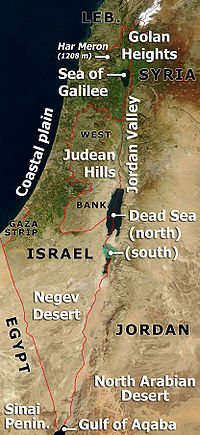
Israel
The State of Israel is a parliamentary republic located in the Middle East, along the eastern shore of the Mediterranean Sea...
, and an 11 km border with Egypt
Egypt
Egypt , officially the Arab Republic of Egypt, Arabic: , is a country mainly in North Africa, with the Sinai Peninsula forming a land bridge in Southwest Asia. Egypt is thus a transcontinental country, and a major power in Africa, the Mediterranean Basin, the Middle East and the Muslim world...
, near the city of Rafah
Rafah
Rafah , also known as Rafiah, is a Palestinian city in the southern Gaza Strip. Located south of Gaza, Rafah's population of 71,003 is overwhelmingly made up of Palestinian refugees. Rafah camp and Tall as-Sultan form separate localities. Rafah is the district capital of the Rafah Governorate...
. Khan Yunis
Khan Yunis
Khan Yunis - often spelt Khan Younis or Khan Yunnis - is a city and adjacent refugee camp in the southern part of the Gaza Strip. According to the Palestinian Central Bureau of Statistics the city, its refugee camp, and its immediate surroundings had a total population of 180,000 in 2006...
is located 7 kilometres (4.3 mi) northeast of Rafah, and several towns around Deir el-Balah
Deir el-Balah
Deir el-Balah or Dayr al-Balah is located in the central Gaza Strip and is the capital or muhfaza of the Deir el-Balah Governorate...
are located along the coast between it and Gaza City
Gaza
Gaza , also referred to as Gaza City, is a Palestinian city in the Gaza Strip, with a population of about 450,000, making it the largest city in the Palestinian territories.Inhabited since at least the 15th century BC,...
. Beit Lahia
Beit Lahia
Beit Lahia is a city located north of Jabalia, near Beit Hanoun and the 1949 Armistice Line with Israel. According to the Palestinian Central Bureau of Statistics, the city had a population of 59,540 in mid-year 2006. Hamas, an Islamist party, took control of it during the 2005 municipal...
and Beit Hanoun
Beit Hanoun
Beit Hanoun is a city on the north-east edge of the Gaza Strip. According to the Palestinian Central Bureau of Statistics, the town had a population of 32,187 in mid-year 2006. It is administered by the Palestinian Authority...
are located to the north and northeast of Gaza City, respectively. The Gush Katif
Gush Katif
Gush Katif was a bloc of 17 Israeli settlements in the southern Gaza strip. Gush Katif was specifically mentioned by Yitzhak Rabin, the Israeli prime minister who fell victim to an assassin in 1995, as essential to Israel's security border. In August 2005, the Israeli army moved the 8,600...
bloc of Israeli localities used to exist on the sand dune
Dune
In physical geography, a dune is a hill of sand built by wind. Dunes occur in different forms and sizes, formed by interaction with the wind. Most kinds of dunes are longer on the windward side where the sand is pushed up the dune and have a shorter "slip face" in the lee of the wind...
s adjacent to Rafah and Khan Yunis, along the southwestern edge of the 40 kilometres (24.9 mi) Mediterranean
Mediterranean Sea
The Mediterranean Sea is a sea connected to the Atlantic Ocean surrounded by the Mediterranean region and almost completely enclosed by land: on the north by Anatolia and Europe, on the south by North Africa, and on the east by the Levant...
coastline.
Gaza strip has an arid climate, with mild winters, and dry, hot summers subject to drought
Drought
A drought is an extended period of months or years when a region notes a deficiency in its water supply. Generally, this occurs when a region receives consistently below average precipitation. It can have a substantial impact on the ecosystem and agriculture of the affected region...
. The terrain is flat or rolling, with dunes near the coast. The highest point is Abu 'Awdah (Joz Abu 'Auda), at 105 metres (344.5 ft) above sea level
Sea level
Mean sea level is a measure of the average height of the ocean's surface ; used as a standard in reckoning land elevation...
. Natural resources include arable land
Arable land
In geography and agriculture, arable land is land that can be used for growing crops. It includes all land under temporary crops , temporary meadows for mowing or pasture, land under market and kitchen gardens and land temporarily fallow...
(about a third of the strip is irrigated), and recently discovered natural gas
Natural gas
Natural gas is a naturally occurring gas mixture consisting primarily of methane, typically with 0–20% higher hydrocarbons . It is found associated with other hydrocarbon fuel, in coal beds, as methane clathrates, and is an important fuel source and a major feedstock for fertilizers.Most natural...
. Environmental issues include desertification
Desertification
Desertification is the degradation of land in drylands. Caused by a variety of factors, such as climate change and human activities, desertification is one of the most significant global environmental problems.-Definitions:...
; salination
Biosalinity
Biosalinity is the study and practice of using saline water for irrigating agricultural crops.Many arid and semi-arid areas actually do have sources of water, but the available water is usually brackish or saline . The water may be present in underground aquifers or as seawater along coastal...
of fresh water; sewage treatment
Sewage treatment
Sewage treatment, or domestic wastewater treatment, is the process of removing contaminants from wastewater and household sewage, both runoff and domestic. It includes physical, chemical, and biological processes to remove physical, chemical and biological contaminants...
; water-borne disease; soil degradation; and depletion and contamination of underground water resources.
Demographics
In 2010 approximately 1.6 million Palestinians live in the Gaza Strip, of whom almost 1.0 million are UN-registered refugees. The majority of the Palestinians are descendants of refugees who were driven from or left their homes during the 1948 Arab-Israeli War1948 Arab-Israeli War
The 1948 Arab–Israeli War, known to Israelis as the War of Independence or War of Liberation The war commenced after the termination of the British Mandate for Palestine and the creation of an independent Israel at midnight on 14 May 1948 when, following a period of civil war, Arab armies invaded...
. The Strip's population has continued to increase since that time, one of the main reasons being a total fertility rate
Total Fertility Rate
The total fertility rate of a population is the average number of children that would be born to a woman over her lifetime if she were to experience the exact current age-specific fertility rates through her lifetime, and she...
of almost 5 children per woman. In a ranking by total fertility rate, this places Gaza 26th of 223 regions.
Most of the inhabitants are Sunni Muslims, with an estimated 2,000 to 3,000 Christians, making the region 99.3 percent Sunni Muslim and 0.7 percent Christian.
Before the Hamas takeover, approximately 500 women from the former Soviet Union
Soviet Union
The Soviet Union , officially the Union of Soviet Socialist Republics , was a constitutionally socialist state that existed in Eurasia between 1922 and 1991....
lived in Gaza. During the Soviet era, the Communist Party subsidized university studies for thousands of students from Yemen, Egypt, Syria and the territories. Some of them married during their studies and brought their Russian and Ukrainian spouses back home. When Hamas came to power, over half of them left the Strip via the Erez crossing to Amman and flew back to Eastern Europe.
Economy
The economy of the Gaza Strip is severely hampered by high population density, limited land access, strict internal and external security controls, the effects of Israeli military operations, and restrictions on labour and trade access across the border. Per capita incomePer capita income
Per capita income or income per person is a measure of mean income within an economic aggregate, such as a country or city. It is calculated by taking a measure of all sources of income in the aggregate and dividing it by the total population...
(PPP) was estimated at US$ 3,100 in 2009, a position of 164th in the world. Seventy percent of the population is below the poverty line according to a 2009 estimate. Gaza Strip industries are generally small family businesses that produce textile
Textile
A textile or cloth is a flexible woven material consisting of a network of natural or artificial fibres often referred to as thread or yarn. Yarn is produced by spinning raw fibres of wool, flax, cotton, or other material to produce long strands...
s, soap
Soap
In chemistry, soap is a salt of a fatty acid.IUPAC. "" Compendium of Chemical Terminology, 2nd ed. . Compiled by A. D. McNaught and A. Wilkinson. Blackwell Scientific Publications, Oxford . XML on-line corrected version: created by M. Nic, J. Jirat, B. Kosata; updates compiled by A. Jenkins. ISBN...
, olive-wood carvings, and mother-of-pearl souvenirs; the Israelis have established some small-scale modern industries in an industrial centre. Israel supplies the Gaza Strip with electricity. The main agricultural products are olive
Olive
The olive , Olea europaea), is a species of a small tree in the family Oleaceae, native to the coastal areas of the eastern Mediterranean Basin as well as northern Iran at the south end of the Caspian Sea.Its fruit, also called the olive, is of major agricultural importance in the...
s, citrus
Citrus
Citrus is a common term and genus of flowering plants in the rue family, Rutaceae. Citrus is believed to have originated in the part of Southeast Asia bordered by Northeastern India, Myanmar and the Yunnan province of China...
, vegetable
Vegetable
The noun vegetable usually means an edible plant or part of a plant other than a sweet fruit or seed. This typically means the leaf, stem, or root of a plant....
s, Halal
Halal
Halal is a term designating any object or an action which is permissible to use or engage in, according to Islamic law. The term is used to designate food seen as permissible according to Islamic law...
beef
Beef
Beef is the culinary name for meat from bovines, especially domestic cattle. Beef can be harvested from cows, bulls, heifers or steers. It is one of the principal meats used in the cuisine of the Middle East , Australia, Argentina, Brazil, Europe and the United States, and is also important in...
, and dairy products. Primary exports are citrus and cut flowers, while primary imports are food, consumer goods, and construction materials. The main trade partners of the Gaza Strip are Israel, Egypt, and the West Bank.
Economic output in the Gaza Strip declined by about one-third between 1992 and 1996. This downturn was attributed to corruption and mismanagement by Yasser Arafat
Yasser Arafat
Mohammed Yasser Abdel Rahman Abdel Raouf Arafat al-Qudwa al-Husseini , popularly known as Yasser Arafat or by his kunya Abu Ammar , was a Palestinian leader and a Laureate of the Nobel Prize. He was Chairman of the Palestine Liberation Organization , President of the Palestinian National Authority...
, and to Israeli closure policies. Economic development has been hindered by the lack of a sea harbour. A harbour was planned to be built in Gaza city with help from France and the Netherlands, but the project was bombed by Israel in 2001. Israel said that the Israeli settlement was being shot from the construction site at the harbour. As a result, international transports (both trade and aid) had to go through Israel, which was hindered by the imposition of generalized border closures. These also disrupted previously established labor and commodity market relationships between Israel and the Strip. A serious negative social effect of this downturn was the emergence of high unemployment.
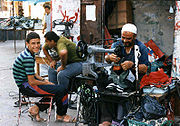
Al-Aqsa Intifada
The Second Intifada, also known as the Al-Aqsa Intifada and the Oslo War, was the second Palestinian uprising, a period of intensified Palestinian-Israeli violence, which began in late September 2000...
in the last quarter of 2000 that lasted until 2004. The al-Aqsa Intifada triggered tight IDF
Israel Defense Forces
The Israel Defense Forces , commonly known in Israel by the Hebrew acronym Tzahal , are the military forces of the State of Israel. They consist of the ground forces, air force and navy. It is the sole military wing of the Israeli security forces, and has no civilian jurisdiction within Israel...
closures of the border with Israel, as well as frequent curbs on traffic in Palestinian self-rule areas, severely disrupting trade and labor movements. In 2001, and even more so in early 2002, internal turmoil and Israeli military measures led to widespread business closures and a sharp drop in GDP
Gross domestic product
Gross domestic product refers to the market value of all final goods and services produced within a country in a given period. GDP per capita is often considered an indicator of a country's standard of living....
. Infrastructure, such as the Palestine airport, was destroyed. Another major factor was a drop in income due to reduction in the number of Gazans permitted entry to work in Israel. After the Israeli withdrawal from Gaza, the flow of a limited number of workers into Israel resumed, although Israel said it would reduce or end such permits due to the victory of Hamas
Hamas
Hamas is the Palestinian Sunni Islamic or Islamist political party that governs the Gaza Strip. Hamas also has a military wing, the Izz ad-Din al-Qassam Brigades...
in the 2006 parliamentary elections
Palestinian legislative election, 2006
On January 25, 2006, elections were held for the Palestinian Legislative Council , the legislature of the Palestinian National Authority . Notwithstanding the 2005 municipal elections and the January 9, 2005 presidential election, this was the first election to the PLC since 1996; subsequent...
.
The Israeli settlers of Gush Katif
Gush Katif
Gush Katif was a bloc of 17 Israeli settlements in the southern Gaza strip. Gush Katif was specifically mentioned by Yitzhak Rabin, the Israeli prime minister who fell victim to an assassin in 1995, as essential to Israel's security border. In August 2005, the Israeli army moved the 8,600...
built greenhouse
Greenhouse
A greenhouse is a building in which plants are grown. These structures range in size from small sheds to very large buildings...
s and experimented with new forms of agriculture. These greenhouses provided employment for hundreds of Gazans. When Israel withdrew from the Gaza Strip in the summer of 2005, some of the greenhouses were purchased with money raised by former World Bank
World Bank
The World Bank is an international financial institution that provides loans to developing countries for capital programmes.The World Bank's official goal is the reduction of poverty...
president James Wolfensohn
James Wolfensohn
Sir James David Wolfensohn AO KBE FKC was the ninth president of the World Bank Group.-Early life:James Wolfensohn was born in Sydney, Australia, on 1 December 1933...
, and given to Palestinians to jump-start their economy, while others were demolished by the departing settlers. The effort faltered due to limited water supply, Palestinian looting, restrictions on exports and corruption in the Palestinian Authority. Many Palestinian companies repaired the greenhouses damaged and looted in the process of Israeli withdrawal.
Before the second Palestinian uprising in September 2000, around 25,000 workers from the Gaza Strip (about 2% of the population) used to work in Israel every day.
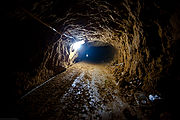
Palestinian legislative election, 2006
On January 25, 2006, elections were held for the Palestinian Legislative Council , the legislature of the Palestinian National Authority . Notwithstanding the 2005 municipal elections and the January 9, 2005 presidential election, this was the first election to the PLC since 1996; subsequent...
. They view the group as a terrorist organization, and have pressured Hamas to recognize Israel, renounce violence, and make good on past agreements. Prior to disengagement, 120,000 Palestinians from Gaza were employed in Israel or in joint projects. After the Israeli withdrawal, the gross domestic product of the Gaza Strip declined. Jewish enterprises shut down, work relationships were severed and job opportunities in Israel dried up. After the 2006 elections, fighting broke out between Fatah and Hamas, which Hamas won in the Gaza Strip on 14 June 2007. Israel imposed a blockade, and the only goods permitted into the Strip through the land crossings were goods of a humanitarian nature.
Health
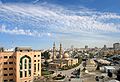
Johns Hopkins University
The Johns Hopkins University, commonly referred to as Johns Hopkins, JHU, or simply Hopkins, is a private research university based in Baltimore, Maryland, United States...
(U.S.) and Al-Quds University
Al-Quds University
Al-Quds University is a Palestinian university with campuses in Jerusalem, Abu Dis, and al-Bireh. It was founded in 1984, but its official constitution was written in 1993 when Mohammed Nusseibeh, its first Chancellor and Chancellor of the College of Science and Technology, announced its...
(in Abu Dis
Abu Dis
Abu Dis is a Palestinian town in the Jerusalem Governorate, bordering Jerusalem. Abu Dis is due east of the Jerusalem municipal border. According to the Palestinian Central Bureau of Statistics , the town had a population of approximately 12,100 in mid-year 2006.-Ottoman era:Abu Dis was one of the...
) for CARE International in late 2002 revealed very high levels of dietary deficiency among the Palestinian population. The study found that 17.5% of children aged 6–59 months suffered from chronic malnutrition
Malnutrition
Malnutrition is the condition that results from taking an unbalanced diet in which certain nutrients are lacking, in excess , or in the wrong proportions....
. 53% of women of reproductive age and 44% of children were found to be anemic
Anemia
Anemia is a decrease in number of red blood cells or less than the normal quantity of hemoglobin in the blood. However, it can include decreased oxygen-binding ability of each hemoglobin molecule due to deformity or lack in numerical development as in some other types of hemoglobin...
. After the Hamas takeover of the Gaza Strip health conditions in Gaza Strip faced new challenges. World Health Organization
World Health Organization
The World Health Organization is a specialized agency of the United Nations that acts as a coordinating authority on international public health. Established on 7 April 1948, with headquarters in Geneva, Switzerland, the agency inherited the mandate and resources of its predecessor, the Health...
(WHO) expressed its concerns about the consequences of the Palestinian internal political fragmentation; the socioeconomic decline; military actions; and the physical, psychological and economic isolation on the health of the population in Gaza. Gazans who desire medical care in Israeli hospitals must apply for a medical visa permit. In 2007, State of Israel granted 7,176 permits and denied 1,627. Dr. Mohammed Abu Shaban, director of the Blood Tumors Department in Al-Rantisy Hospital in Gaza witnessed an increase in blood cancer. In March 2010 the department had seen 55 cases that year, compared to 20 to 25 cases normally seen in an entire year.According to the United Nations Development Programme
United Nations Development Programme
The United Nations Development Programme is the United Nations' global development network. It advocates for change and connects countries to knowledge, experience and resources to help people build a better life. UNDP operates in 177 countries, working with nations on their own solutions to...
, the average life expectancy in the Gaza Strip is 72. As part of the Palestinian territories, the Gaza Strip places 24th out of 135 countries according to Human Poverty Index
Human Poverty Index
The Human Poverty Index is an indication of the standard of living in a country, developed by the United Nations . For highly developed countries, the UN considers that it can better reflect the extent of deprivation compared to the Human Development Index....
. According to Palestinian leaders in the Gaza Strip, the majority of medical aid delivered are "past their expiration date." Mounir el-Barash, the director of donations in Gaza's health department, claims 30% of aid sent to Gaza is used.
Education
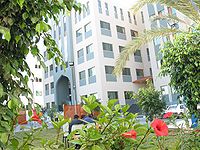
In 2010, Al Zahara, a private school in central Gaza introduced a special program for mental development based on math computations. The program was created in Malaysia in 1993, according to the school principal, Majed al-Bari.
The Community College of Applied Science and Technology (CCAST) was established in 1998 in Gaza City. In 2003, the college moved into its new campus and established the Gaza Polytechnic Institute (GPI) in 2006 in southern Gaza. In 2007, the college received accreditation to award BA degrees as the University College of Applied Sciences
University College of Applied Sciences
University College of Applied Sciences is a technical college in Gaza founded in 1998. It offers 40 majors in engineering, health, technology, administration, education and the humanities. The school has a student population of 6,000. The main campus is in Gaza City. Females make up 50% of the...
(UCAS). In 2010, the college had a student population of 6,000 in eight departments offering over 40 majors.
Culture and sports
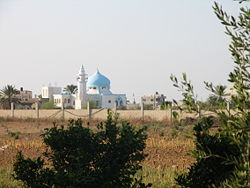
Laila Shawa
Laila Shawa is a Palestinian artist. Her work has been described as reflecting a view of the politics of her country highlighting perceived injustices and persecution. Often her work uses photographs that are used as the base for silkscreen printing. Her work has been internationally exhibited and...
(who lives in London). An emerging generation of artists is also active in nonprofit art organizations such as Windows From Gaza and Eltiqa Group, which regularly host exhibitions and events open to the public.
In 2010, Gaza inaugurated its first Olympic-size swimming pool at the As-Sadaka
As-Sadaka
The As-Sadaka is a 50m swimming pool in the Gaza strip. It was inaugurated in May 2010. The pool belongs to the as-Sadaka Athletic Club, and its construction was sponsored by the Islamic Society...
club. The opening ceremony was held by the Islamic Society. The swimming team of as-Sadaka holds several gold and silver medals from Palestinian swimming competitions.
Transport and communication
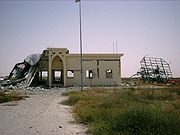
Standard gauge
The standard gauge is a widely-used track gauge . Approximately 60% of the world's existing railway lines are built to this gauge...
railway line that ran the length of the Strip from north to south is not operative. Prior to 1948 the line connected to the Egyptian railway system
Egyptian National Railways
Egyptian National Railways is the national railway of Egypt and managed by the parastatal Egyptian Railway Authority .-1833–77:...
to the south, as well as what then became the Israeli system
Israel Railways
Israel Railways is the principal passenger railway operating company in Israel, and is responsible for all inter-city and suburban rail way passenger and freight traffic in the country. All its lines are standard gauge. The network is centered in Israel's densely populated coastal plain, from...
to the north. Plans to build a port were halted after the outbreak of the al-Aqsa Intifada
Al-Aqsa Intifada
The Second Intifada, also known as the Al-Aqsa Intifada and the Oslo War, was the second Palestinian uprising, a period of intensified Palestinian-Israeli violence, which began in late September 2000...
. The Yasser Arafat International Airport
Yasser Arafat International Airport
Yasser Arafat International Airport , formerly Gaza International Airport and Dahaniya International Airport, is located in the Gaza Strip, in Rafah close to the Egyptian border....
opened on 24 November 1998 after the signing of the Oslo II Accord and the Wye River Memorandum
Wye River Memorandum
The Wye River Memorandum was an agreement negotiated between Israel and the Palestine Authority to implement the earlier Interim Agreement of 28 September, 1995...
. It was closed by Israel in October 2000. Its radar station and control tower were destroyed by Israel Defense Forces aircraft in 2001 during the al-Aqsa Intifada, and bulldozers razed the runway in January 2002. The only remaining runway is at the Gaza Airstrip
Gaza Airstrip
Gaza Airstrip, also known as Gush Katif Airport, is a small airfield in the Gaza Strip approximately two miles north of the town of Khan Yunis, and adjacent to the UNRWA Khan Younis refugee camp. It is immediately west of the former Israeli settlement of Ganei Tal, and named after the former...
. However, the airspace over Gaza is blockaded by the Israeli Air Force
Israeli Air Force
The Israeli Air Force is the air force of the State of Israel and the aerial arm of the Israel Defense Forces. It was founded on May 28, 1948, shortly after the Israeli Declaration of Independence...
.
The Gaza Strip has rudimentary land line telephone service provided by an open-wire system, as well as extensive mobile telephone services provided by PalTel
Paltel
Paltel Group or Palestinian Telecommunication Group is the largest private-sector company in the Palestinian territories, employing almost 2,000 people...
(Jawwal) and Israeli providers such as Cellcom
Cellcom (Israel)
Cellcom is a major Israeli telecommunications company. Founded in 1994, most of the company's business is centered around wireless service...
. Gaza is serviced by four internet service provider
Internet service provider
An Internet service provider is a company that provides access to the Internet. Access ISPs directly connect customers to the Internet using copper wires, wireless or fiber-optic connections. Hosting ISPs lease server space for smaller businesses and host other people servers...
s that now compete for ADSL and dial-up customers. Most Gaza households have a radio and a TV (70%+), and approximately 20% have a personal computer
Personal computer
A personal computer is any general-purpose computer whose size, capabilities, and original sales price make it useful for individuals, and which is intended to be operated directly by an end-user with no intervening computer operator...
. People living in Gaza have access to FTA
Free-to-air
Free-to-air describes television and radio services broadcast in clear form, allowing any person with the appropriate receiving equipment to receive the signal and view or listen to the content without requiring a subscription or one-off fee...
satellite programs, broadcast TV from the Palestinian Broadcasting Corporation
Palestinian Broadcasting Corporation
The Palestinian Broadcasting Corporation was established on 1 July 1994 and is within the jurisdiction of the Palestinian Authority. It has a subsidiary radio station known as the Voice Of Palestine and a satellite channel known as Palestinian Satellite Channel. Palestine TV first began...
, the Israel Broadcasting Authority
Israel Broadcasting Authority
Israel Broadcasting Authority is Israel's state broadcasting network.It grew out of the radio station Kol Yisrael, which made its first broadcast as an independent station on . The name of the organisation operating Kol Yisrael was changed to Israel Broadcasting Service in 1951...
, and the Second Israeli Broadcasting Authority
Second Israeli Broadcasting Authority
The Second Authority for Television and Radio law was passed by the Knesset in 1990. Its purpose was to establish a new governing-body whose purpose is to facilitate and regulate commercially-operated television and radio broadcasts in Israel...
.
See also
- 2006 Israel–Gaza conflict
- Enclave and exclaveEnclave and exclaveIn political geography, an enclave is a territory whose geographical boundaries lie entirely within the boundaries of another territory.An exclave, on the other hand, is a territory legally or politically attached to another territory with which it is not physically contiguous.These are two...
- Gaza flotilla raidGaza flotilla raidThe Gaza flotilla raid was a military operation by Israel against six ships of the "Gaza Freedom Flotilla" on 31 May 2010 in international waters of the Mediterranean Sea...
- Gaza Ghetto (film)
- Gaza–Israel conflict
- HamastanHamastanHamastan is a pejorative neologism, merging 'Hamas', a Palestinian militant organization and political party, and '-stan', a suffix of Persian origin meaning "home of/place of".-Linguistic history:...
- Human rights in the Palestinian National AuthorityHuman rights in the Palestinian National AuthorityHuman rights in the Palestinian National Authority refers to the human rights record of the Palestinian Authority in the West Bank and Gaza. Since Israel's implementation of its unilateral disengagement plan in 2005 and the evacuation of all Jewish settlements from Gaza Strip, the Palestinian...
- Israeli-Palestinian conflictIsraeli-Palestinian conflictThe Israeli–Palestinian conflict is the ongoing conflict between Israelis and Palestinians. The conflict is wide-ranging, and the term is also used in reference to the earlier phases of the same conflict, between Jewish and Zionist yishuv and the Arab population living in Palestine under Ottoman or...
- Political status of the West Bank and Gaza StripPolitical status of the West Bank and Gaza StripThe political status of the West Bank and the Gaza Strip is one of the most violently disputed issues in the Arab-Israeli conflict. Various conferences and negotiations have been conducted to determine the status of the West Bank and the Gaza Strip .The Israel-PLO Declaration of Principles on...
External links
- Statistical Atlas of Palestine - Palestinian Central Bureau of StatisticsPalestinian Central Bureau of StatisticsThe Palestinian Central Bureau of Statistics is the statistical organization under the umbrella of the Palestinian Cabinet of the Palestinian National Authority....
- Palestinian Territories at the United States Department of StateUnited States Department of StateThe United States Department of State , is the United States federal executive department responsible for international relations of the United States, equivalent to the foreign ministries of other countries...
- Gaza Strip at UCB Libraries GovPubs
- Gaza.net directory of Palestinian related websites
- Map of Palestinian Refugee Camps 1993 (UNRWA/C.I.A./Univ. of Texas, Austin)
- Live Webcam Ramattan Live Stream of Gaza City via UStream
- GazaSiege.org - Background, News and Analysis on the siege of Gaza
- Hamas In Control of Gaza Strip
- New Palestinian Cabinet Sworn In
- Bregman, Ahron (2002). Israel's Wars: A History Since 1947. London: Routledge. ISBN 978-0415287166 - on Google Books
- Ward, Richard J. (1977). The Palestine State: A Rational Approach. London: National University Publications. ISBN 978-0804691598
- Rashdan, Abdelrahman (2008-04-29), Myths and Facts about Gaza (FAQs)IslamOnline.net
- Israel and Palestine: A Brief History – MidEast Web for Coexistence
- Special: Gaza kidnapping Israeli News – Ynetnews English version of Yedioth AhronothYedioth AhronothYedioth Ahronoth is a daily newspaper published in Tel Aviv, Israel. Since the 1970s, it has been the most widely circulated paper in Israel. In a TGI survey comparing the last half of 2009 with the same period in 2008, Yedioth Ahronoth retained the title of most widely read newspaper in Israel...
- War Enters the Classrooms the consequences of the Mideast conflict for children of the Gaza Strip, by Inter Press ServiceInter Press ServiceInter Press Service is a global news agency. Its main focus is the production of independent news and analysis about events and processes affecting economic, social and political development....
, February 2007 - B'Tselem The Israeli Information Centre for Human Rights in the Occupied Territories on the status of Gaza since the disengagement.

Maps
- Gaza Strip at Google Maps
- 1991 Map of the Gaza Strip showing roads and Israeli towns
- 1999 Map of the Gaza Strip (annotated photo)
- 2005 Map of the Gaza Strip (C.I.A./Univ. of Texas, Austin)
- Map of Palestinian Refugee Camps 1993 (UNRWA/C.I.A./Univ. of Texas, Austin)
- Map of Israel 2008 (C.I.A./Univ. of Texas, Austin)
- Map of Israeli Settlements in the West Bank Dec. 1993 (C.I.A./Univ. of Texas, Austin)
- Map of Israeli Settlements in the Gaza Strip Dec. 1993 (C.I.A./Univ. of Texas, Austin)