


Alexander Jannaeus

Encyclopedia
Judea
Judea or Judæa was the name of the mountainous southern part of the historic Land of Israel from the 8th century BCE to the 2nd century CE, when Roman Judea was renamed Syria Palaestina following the Jewish Bar Kokhba revolt.-Etymology:The...
from 103 BC to 76 BC. The son of John Hyrcanus
John Hyrcanus
John Hyrcanus was a Hasmonean leader of the 2nd century BC.-Name:...
, he inherited the throne from his brother Aristobulus I, and appears to have married his brother's widow, Shlomtzion or "Shelomit", also known as Salome Alexandra
Salome Alexandra
Salome Alexandra or Alexandra of Jerusalem , was the only Jewish regnant queen, with the exception of her own husband's mother whom he had prevented from ruling as his dying father had wished, and of the much earlier usurper Athaliah...
, according to the Biblical law of Yibbum
Yibbum
Yibbum , or levirate marriage, in Judaism, is one of the most complex types of marriages mandated by Torah law by which, according to the law, the brother of a man who died without children has an obligation to marry the widow...
("levirate marriage"), although Josephus
Josephus
Titus Flavius Josephus , also called Joseph ben Matityahu , was a 1st-century Romano-Jewish historian and hagiographer of priestly and royal ancestry who recorded Jewish history, with special emphasis on the 1st century AD and the First Jewish–Roman War, which resulted in the Destruction of...
is inexplicit on that point.
His likely full Hebrew name was "Jonathan"; he may have been the High Priest Jonathan, rather than his great-uncle of the same name, who established the Masada
Masada
Masada is the name for a site of ancient palaces and fortifications in the South District of Israel, on top of an isolated rock plateau, or horst, on the eastern edge of the Judean Desert, overlooking the Dead Sea. Masada is best known for the violence that occurred there in the first century CE...
fortress. Under the name "King Yannai" he appears as a wicked tyrant in the Talmud
Talmud
The Talmud is a central text of mainstream Judaism. It takes the form of a record of rabbinic discussions pertaining to Jewish law, ethics, philosophy, customs and history....
, reflecting his conflict with the Pharisee party. He is among the more colorful historical figures, despite being little known outside specialized history. He and his widow (who became queen regnant
Queen regnant
A queen regnant is a female monarch who reigns in her own right, in contrast to a queen consort, who is the wife of a reigning king. An empress regnant is a female monarch who reigns in her own right over an empire....
after his death) had a substantial impact on the subsequent development of Judaism.
Jannaeus expanded the Hasmonean Kingdom and established the city of Gamla
Gamla
Gamla was an ancient Jewish city in the Golan Heights. Inhabited since the Early Bronze Age, it is believed to have been founded as a Seleucid fort during the Syrian Wars. The site of a Roman siege during the Great Revolt of the 1st century CE, Gamla is a symbol of heroism for the modern state of...
in 81 BC, as the capital for what is now the Golan Heights.
Family
Alexander Jannaeus married the wife of his brother, Aristobulus I (Salome AlexandraSalome Alexandra
Salome Alexandra or Alexandra of Jerusalem , was the only Jewish regnant queen, with the exception of her own husband's mother whom he had prevented from ruling as his dying father had wished, and of the much earlier usurper Athaliah...
). By her, he had two sons, the eldest, Hyrcanus II
Hyrcanus II
Hyrcanus II, a member of the Hasmonean dynasty, was the Jewish High Priest and King of Judea in the 1st century BC.-Accession:Hyrcanus was the eldest son of Alexander Jannaeus, King and High Priest, and Alexandra Salome...
became high-priest in 62 BC and Aristobulus II
Aristobulus II
Aristobulus II was the Jewish High Priest and King of Judea, 66 BC to 63 BC, from the Hasmonean Dynasty.-Family:Aristobulus was the younger son of Alexander Jannaeus, King and High Priest, and Alexandra Salome. After the death of Alexander in 76 BC, his widow succeeded to the rule of Judea and...
who was high-priest from 66 - 62 BC and started a bloody civil war with his brother, ending in his capture by Pompey the Great.
Conquests of Alexander Jannaeus
During the twenty-seven year reign of Alexander Jannaeus, he was almost constantly involved in military conflict. Primarily, international factors at the time created an environment suitable for Jannaeus' conquests. First of all, Jannaeus received support from Cleopatra III of Egypt
Cleopatra III of Egypt
Cleopatra III was a queen of Egypt 142–101 BC.Cleopatra III was also known as Cleopatra Euergetis while associated with her husband Ptolemy VIII or her son Ptolemy X. She is attested as Cleopatra Philometor Soteira while associated with her eldest son Ptolemy IX...
. She was probably swayed to support Jannaeus through two Jewish commanders in her military. This support was particularly crucial during the war with Ptolemy Lathyrus (discussed later). Ultimately, conflict in the Roman Empire was the greatest outside influence on Judean military campaigns. Political instability in Rome led to a Civil War beginning in 88 BC. With Rome chiefly concerned with a tumultuous domestic predicament, Jannaeus was free to expand the Judean state. Finally, a weak Seleucid Empire was unable to help Hellenistic cities near Judea.
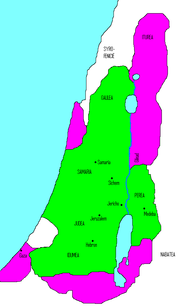
With a mercenary army similar to that of his father, Jannaeus led a Judean army that conquered the entire coastal plain except for Ashkelon. Jannaeus toppled Western Samaria, the Galilee and the Northern Transjordan. The coastal ports of Dor and Caesarea were also taken after Jannaeus was defeated at Acre. Elsewhere on the Mediterranean coast, the Judeans triumphed over the cities of Raffah and Antedon. Finally, in 96 BC Jannaeus outlasted the inhabitants of Gaza in a year long siege. This impressive victory gained Judean control over the Mediterranean outlet for the Nabatean trade routes.
War with Ptolemy Lathyrus
After a failed siege against Gaza, Jannaeus struck a phony league of friendship with the Egyptian co-ruler Ptolemy Lathyrus. In reality Jannaeus sought the assistance of Lathyrus’ mother, Cleopatra III, against her son. When Lathyrus learned of this treachery, he took out his fury on Judea. After defeating Jannaeus near the Jordan River, Lathyrus’ soldiers slaughtered fleeing Jewish troops. Afterwards, Lathyrus attacked a small village in Judea with utter malice. The Egyptian troops strangled women and children. Then the deceased were cut into pieces, boiled in cauldrons, and eaten as a sacrifice. This act of cannibalism was used to terrify the Judean people and their military. After this massacre, Jannaeus was in no position to stop the onslaught of Lathyrus. However, Cleopatra III stepped in to prevent Lathyrus from sacking Jerusalem.News of this slaughter certainly spread rapidly throughout Judea, exemplified by the Pesher on Isaiah 4Q161 found at Qumran:
“(25) He will shake his fist at the mount of the daughters of Zion, the hill of Jerusalem…(27) when he goes up from the Valley of Acco to fight against Philistia…(29) and even up to the boundaries of Jerusalem.”
High Priesthood
It is clear that a strong rift existed between the Pharisees and Alexander Jannaeus. The rival Sadducees were avid supporters of Jannaeus (see 4Q448). The Pharisaic opposition to Jannaeus continued with his marriage to his brother’s widow, which was forbidden by Torah law. Furthermore, Jannaeus established himself as a ruler concerned mainly with conquests rather than his religious obligations.One year during the Jewish holiday of Sukkot, Alexander Jannaeus, while officiating as the High Priest (Kohen Gadol) at the Temple in Jerusalem, demonstrated his support of the Sadducees by denying the law of the water libation. The crowd responded with shock at his mockery and showed their displeasure by pelting Alexander with the etrog
Etrog
Etrog refers to the yellow citron or Citrus medica used by Jews on the week-long holiday of Sukkot.While in modern Hebrew this is the name for any variety of citron, its English usage applies to those varieties and specimens used as one of the Four Species...
im (citron
Citron
Not to be confused with Cintron.The citron is a fragrant citrus fruit, botanically classified as Citrus medica by both the Swingle and Tanaka systems...
s) that they were holding in their hands. Unwittingly, the crowd had played right into Alexander's hands. He had intended to incite the people to riot and his soldiers fell upon the crowd at his command. The soldiers slew more than 6,000 people in the Temple courtyard.
This incident during Tabernacles was a major factor leading up to the Judean Civil War by igniting popular opponents of Jannaeus. A Qumran document sheds further light on another opponent of Jannaeus. The scroll 4Q390 was written by an adversary of Jannaeus seeking popular support to overthrow the Hasmonean King. The author called for an end to the dispute between Jannaeus and the Pharisees. According to the author, the only acceptable solution was an end to the Hasmonean Priesthood and secular control. This opposition culminated in the Judean Civil War.
Judean Civil War and the Crucifixion of the 800
The Judean Civil War initially began after the conquest of Gaza by Jannaeus. Due to Jannaeus’ victory at Gaza, the Nabatean kingdom no longer controlled their trade routes to Rome and Damascus. Therefore Nabatean king Obodas IObodas I
Obodas I was King of the Nabateans from 96 BC to 85 BC. He was the successor of Aretas II, from whom he inherited the war with the Hasmonean kingdom. He defeated them around 93 BC on the Golan Heights....
launched an attack on Judea in the Golan. Potentially, the war with the Nabateans was the last straw against a war-mongering king and an incompetent High Priest. After Jannaeus was defeated in battle against Obadas, he returned to fierce Jewish opposition in Jerusalem. A civil war broke out between Pharisaic supported Jewish rebels and Jannaeus.
Overall, the war lasted six years and left 50,000 Judeans dead. After Jannaeus succeeded early in the war, the rebels unbelievably asked for Seleucid assistance. Judean insurgents joined forces with Demetrius III to fight against Jannaeus. The Seleucid forces defeated Jannaeus at Schechem and forced him into exile in the mountains. However, these Judean rebels ultimately decided that it was better to live under a terrible Jewish king than backtrack to a Seleucid ruler. After 6,000 Jews returned to Jannaeus, Demetrius was defeated. The end of the Civil War brought a sense of national solidarity against Seleucid influence. Nevertheless, Jannaeus was uninterested in reconciliation within the Judean State.
The aftermath of the Judean Civil War consisted of popular unrest, poverty and grief over the fallen soldiers on both sides. The greatest impact of the war was the victor’s revenge. Josephus reports that Jannaeus brought 800 rebels to Jerusalem and had them crucified. Even worse, Jannaeus had the throats of the rebel’s wives and children cut before their eyes as Jannaeus ate with his concubines.
This incredible account is supported in the Dead Sea Scrolls. In the Nahum Pesher, the Judean Civil War and Jannaeus’ brutal retribution are specifically mentioned.
“(2) The interpretation of it concerns Demetrius, King of Greece, who sought to enter Jerusalem on the advice of the Seeker-After-Smooth-Things. (3) But God did not give Jerusalem into the power of the Kings of Greece from Antiochus
Antiochus
-The Seleucid Empire:* Antiochus , father of Seleucus I Nicator, founder of the Hellenstic Seleucid Empire* Antiochus I Soter , king of the Seleucid Empire...
until the rise of the rulers of the Kittim
Kittim
Kittim in the genealogy of Genesis 10 in the Hebrew Bible, is the son of Javan, the grandson of Japheth, and Noah's great-grandson....
… (6b) Its interpretation concerns the Lion of Wrath (7) which will bring vengeance against the Seekers-After-Smooth-Things; he would hang men alive.”
In this passage, The Seekers-After-Smooth-Things represent the Jewish Rebels, the Lion of Wrath represents Alexander Jannaeus, and the rulers of Kittim signify the Roman Empire. Given that this passage mentions the Roman takeover, it was clearly written after the fall of the Hasmonean Dynasty. Nevertheless, substantiation of Josephus’ account of the crucifixion of Jewish rebels by Jannaeus quells any doubt of historicity of this event.
Coinage
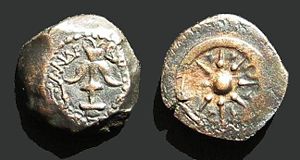
The coinage of Alexander Jannaeus is characteristic of the early Jewish coinage in that it avoided human or animal representations, in opposition to the surrounding Greek, and later Roman types of the period. Jewish coinage instead focused on symbols, either natural, such as the palm tree, the pomegranatePomegranate
The pomegranate , Punica granatum, is a fruit-bearing deciduous shrub or small tree growing between five and eight meters tall.Native to the area of modern day Iran, the pomegranate has been cultivated in the Caucasus since ancient times. From there it spread to Asian areas such as the Caucasus as...
or the star, or man-made, such as the Temple
Temple in Jerusalem
The Temple in Jerusalem or Holy Temple , refers to one of a series of structures which were historically located on the Temple Mount in the Old City of Jerusalem, the current site of the Dome of the Rock. Historically, these successive temples stood at this location and functioned as the centre of...
, the Menorah, trumpets or cornucopia
Cornucopia
The cornucopia or horn of plenty is a symbol of abundance and nourishment, commonly a large horn-shaped container overflowing with produce, flowers, nuts, other edibles, or wealth in some form...
.
Bronze
Bronze is a metal alloy consisting primarily of copper, usually with tin as the main additive. It is hard and brittle, and it was particularly significant in antiquity, so much so that the Bronze Age was named after the metal...
"Widow's mite" coins, in combination with the widespread Seleucid numismatic symbol of the anchor. Depending on the make, the star symbol can be shown with straight spokes connected to the outside circle, in a style rather indicative of a wheel. On others, the spokes can have a more "flame-like" shape, more indicative of the representation of a star within a diadem.
It is not clear what the wheel or star may exactly symbolize, and interpretations vary, from the morning star, to the sun or the heavens. The influence of some Persian symbols of a star within a diadem, or the eight-spoked Buddhist wheel (see the coins of the Indo-Greek king Menander I
Menander I
Menander I Soter "The Saviour" was one of the rulers of the Indo-Greek Kingdom from either 165 or 155 BC to 130 BC ....
with this symbol) have also been suggested. The eight-spoked Macedonian star (a variation of which is the Vergina Sun
Vergina Sun
The Vergina Sun — also known as the Star of Vergina, Macedonian star, or Argead Star — is the name given to a symbol of a stylised star or sun with sixteen rays. It was unearthed in 1977 during excavations in Vergina, in the northern Greek region of Macedonia, by archaeologist Manolis Andronikos...
), emblem of the royal Argead dynasty
Argead dynasty
The Argead dynasty was an ancient Greek royal house. They were the ruling dynasty of Macedonia from about 700 to 310 BC. Their tradition, as described in ancient Greek historiography, traced their origins to Argos, in southern Greece...
and the ancient kingdom of Macedon
Macedon
Macedonia or Macedon was an ancient kingdom, centered in the northeastern part of the Greek peninsula, bordered by Epirus to the west, Paeonia to the north, the region of Thrace to the east and Thessaly to the south....
ia, within a Hellenistic diadem
Diadem (personal wear)
A diadem is a type of crown, specifically an ornamental headband worn by Eastern monarchs and others as a badge of royalty. The word derives from the Greek "διάδημα" , "band" or "fillet", from "διαδέω" , "I bind round", or "I fasten"....
symbolizing royalty (many of the coins depict a small knot with two ends on top of the diadem), seem to be the most probable source for this symbol.
The most likely explanation is that the symbol is a star encased in a diadem and it is a religious explanation. Biblical law forbids the making of graven images (especially see Deuteronomy 4:16,23), yet the image of a monarch is a staple of Hellenistic coins. In place of an image of himself, therefore, it is likely that Alexander Jannaeus chose a star, in keeping with Numbers 24:17, “A star rises from Jacob, a scepter comes forth from Israel.” This verse generally was seen as a biblical support for monarchy (and specifically as support for a Davidic monarchy). Jannaeus, however, could have seen it as an image of his achievements, if not his own rule. This is how the rest of Numbers 24:17 and verses 18 and 19 continue: The star, it says, “smashes the brow of Moab, the foundation of all children of Seth. Edom becomes a possession, yea, Seir a possession of its enemies; but Israel is triumphant. A victor issues from Jacob to wipe out what is left of Ir.” Considering Jannaeus’ conquests—creating a kingdom that rivaled those of David and Solomon and may have even exceeded those—the “star” envisioned in the prophecy of Balaam in Numbers was a perfect match for him.
In literature
Alexander Jannaeus is the main character of the novel The King of Flesh and Blood, by IsraelIsrael
The State of Israel is a parliamentary republic located in the Middle East, along the eastern shore of the Mediterranean Sea...
i novelist Moshe Shamir
Moshe Shamir
Moshe Shamir was an Israeli author, playwright, opinion writer, and public figure.-Biography:...
.
Other sources
- "Jewish symbols on ancient Jewish coins" Paul Romanoff, New York American Israel Numismatic Association, 1971.
- This article incorporates some content from the public domain 1911 edition of The New Century Book of Facts published by the King-Richardson Company, Springfield, Massachusetts. (This reference gives a death date of 78 BC, but consensus seems to be 76 BC.)