

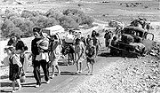
Palestinian refugee

Encyclopedia
| Total 2008 population (including descendants): | 4.62 million |
|---|---|
| UNRWA estimated refugees from 1947: | 711,000 |
| Regions with significant populations: | Gaza Strip Gaza Strip thumb|Gaza city skylineThe Gaza Strip lies on the Eastern coast of the Mediterranean Sea. The Strip borders Egypt on the southwest and Israel on the south, east and north. It is about long, and between 6 and 12 kilometres wide, with a total area of... , Israel Israel The State of Israel is a parliamentary republic located in the Middle East, along the eastern shore of the Mediterranean Sea... (sometimes known as present absentees), Jordan Jordan Jordan , officially the Hashemite Kingdom of Jordan , Al-Mamlaka al-Urduniyya al-Hashemiyya) is a kingdom on the East Bank of the River Jordan. The country borders Saudi Arabia to the east and south-east, Iraq to the north-east, Syria to the north and the West Bank and Israel to the west, sharing... , West Bank West Bank The West Bank ) of the Jordan River is the landlocked geographical eastern part of the Palestinian territories located in Western Asia. To the west, north, and south, the West Bank shares borders with the state of Israel. To the east, across the Jordan River, lies the Hashemite Kingdom of Jordan... , Lebanon Lebanon Lebanon , officially the Republic of LebanonRepublic of Lebanon is the most common term used by Lebanese government agencies. The term Lebanese Republic, a literal translation of the official Arabic and French names that is not used in today's world. Arabic is the most common language spoken among... , Syria Syria Syria , officially the Syrian Arab Republic , is a country in Western Asia, bordering Lebanon and the Mediterranean Sea to the West, Turkey to the north, Iraq to the east, Jordan to the south, and Israel to the southwest.... |
| Languages: | Arabic Arabic language Arabic is a name applied to the descendants of the Classical Arabic language of the 6th century AD, used most prominently in the Quran, the Islamic Holy Book... |
| Religions: | Sunni Islam Sunni Islam Sunni Islam is the largest branch of Islam. Sunni Muslims are referred to in Arabic as ʾAhl ūs-Sunnah wa āl-Ǧamāʿah or ʾAhl ūs-Sunnah for short; in English, they are known as Sunni Muslims, Sunnis or Sunnites.... , Greek Orthodoxy, Greek Catholicism, other forms of Christianity Christianity Christianity is a monotheistic religion based on the life and teachings of Jesus as presented in canonical gospels and other New Testament writings... |
Palestinian refugees or Palestine refugees are the people and their descendants, predominantly Palestinian Arabic-speakers
Palestinian people
The Palestinian people, also referred to as Palestinians or Palestinian Arabs , are an Arabic-speaking people with origins in Palestine. Despite various wars and exoduses, roughly one third of the world's Palestinian population continues to reside in the area encompassing the West Bank, the Gaza...
, who fled or were expelled from their homes during and after the 1948 Palestine War
1948 Palestine war
The 1948 Palestine war refers to the events in the British Mandate of Palestine between the United Nations vote on the partition plan on November 30, 1947, to the end of the first Arab-Israeli war on July 20, 1949.The war is divided into two phases:...
, within that part of the British Mandate of Palestine, that after that war became the territory of the State of Israel, and Egypt and Jordan who took control of the Gaza Strip
Gaza Strip
thumb|Gaza city skylineThe Gaza Strip lies on the Eastern coast of the Mediterranean Sea. The Strip borders Egypt on the southwest and Israel on the south, east and north. It is about long, and between 6 and 12 kilometres wide, with a total area of...
and the West Bank
West Bank
The West Bank ) of the Jordan River is the landlocked geographical eastern part of the Palestinian territories located in Western Asia. To the west, north, and south, the West Bank shares borders with the state of Israel. To the east, across the Jordan River, lies the Hashemite Kingdom of Jordan...
respectively.
The United Nations Relief and Works Agency (UNRWA), an organ of the United Nations
United Nations
The United Nations is an international organization whose stated aims are facilitating cooperation in international law, international security, economic development, social progress, human rights, and achievement of world peace...
created to aid the displaced from the Arab-Israeli wars, defines a Palestinian refugee as a person "whose normal place of residence was Palestine
Palestine
Palestine is a conventional name, among others, used to describe the geographic region between the Mediterranean Sea and the Jordan River, and various adjoining lands....
between June 1946 and May 1948, who lost both their homes and means of livelihood as a result of the 1948 Arab-Israeli conflict". UNRWA's definition of a Palestinian refugee also covers the descendants of persons who became refugees in 1948 regardless whether they reside in areas designated as refugee camps or in other permanent communities.
Descendants of Palestinian refugees under the authority of the UNRWA are, like “Nansen Passport” and “Certificate of Eligibility” holders (the documents issued those displaced by World War II) and UNHCR refugees are granted the same refugee status as their parent.
Based on the UNRWA definition, the number of Palestine refugees has grown from 711,000 in 1950 to 4.7 million registered with the UN in 2010.
Some displaced Palestinians resettled in other countries where their situation is often precarious. Many retained the refugee status and continue to reside in refugee camps, including in the Palestinian territories
Palestinian territories
The Palestinian territories comprise the West Bank and the Gaza Strip. Since the Palestinian Declaration of Independence in 1988, the region is today recognized by three-quarters of the world's countries as the State of Palestine or simply Palestine, although this status is not recognized by the...
. Palestinian refugees and their descendants form a sizable portion of the Palestinian diaspora
Palestinian diaspora
Palestinian diaspora is a term used to describe Palestinians living outside of historic Palestine - an area today known as Israel and the Palestinian territories or the West Bank, and the Gaza Strip...
.
Refugees from 1948 War
1948 Palestine war
The 1948 Palestine war refers to the events in the British Mandate of Palestine between the United Nations vote on the partition plan on November 30, 1947, to the end of the first Arab-Israeli war on July 20, 1949.The war is divided into two phases:...
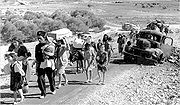
, around 750,000 out of 900,000 Palestinian Arabs fled or were expelled from the territories that became the State of Israel. The causes and responsibilities of the exodus are a matter of controversy among historians and commentators of the conflict.
Whereas historians now agree on most of the events of that period, there remains disagreement as to whether the exodus was the result of a plan designed before or during the war by Zionist leaders or was an unintended consequence of the war.
Stephen Glazer summarizes the position of Zionist historians, notably Schechtman, Kohn, Jon Kymche and Syrkin, as saying that:
"...the Arabs in Palestine were asked to stay and live as citizens in the Jewish state. Instead, they chose to leave, either because they were unwilling to live with the Jews, or because they expected an Arab military victory which would annihilate the Zionists. They thought they could leave temporarily and return at their leisure. Later, an additional claim was put forth, namely that the Palestinians were ordered to leave, with radio broadcasts instructing them to quit their homes".
Between December 1947 and March 1948, around 100,000 Palestinian Arabs fled. Among them were many from the higher and middle classes from the cities, who left voluntarily, expecting to return when the Arab states took control of the country. When the Haganah
Haganah
Haganah was a Jewish paramilitary organization in what was then the British Mandate of Palestine from 1920 to 1948, which later became the core of the Israel Defense Forces.- Origins :...
went on the offensive, between April and July, a further 250,000 to 300,000 Palestinian Arabs left or were expelled, mainly from the towns of Haifa, Tiberias, Beit-Shean, Safed
Safed
Safed , is a city in the Northern District of Israel. Located at an elevation of , Safed is the highest city in the Galilee and of Israel. Due to its high elevation, Safed experiences warm summers and cold, often snowy, winters...
, Jaffa
Jaffa
Jaffa is an ancient port city believed to be one of the oldest in the world. Jaffa was incorporated with Tel Aviv creating the city of Tel Aviv-Yafo, Israel. Jaffa is famous for its association with the biblical story of the prophet Jonah.-Etymology:...
and Acre
Acre, Israel
Acre , is a city in the Western Galilee region of northern Israel at the northern extremity of Haifa Bay. Acre is one of the oldest continuously inhabited sites in the country....
, which lost more than 90 percent of their Arab inhabitants. Expulsions took place in many towns and villages, particularly along the Tel-Aviv-Jerusalem road and in Eastern Galilee
Galilee
Galilee , is a large region in northern Israel which overlaps with much of the administrative North District of the country. Traditionally divided into Upper Galilee , Lower Galilee , and Western Galilee , extending from Dan to the north, at the base of Mount Hermon, along Mount Lebanon to the...
.
About 50,000-70,000 inhabitants of Lydda and Ramle were expelled towards Ramallah
Ramallah
Ramallah is a Palestinian city in the central West Bank located 10 kilometers north of Jerusalem, adjacent to al-Bireh. It currently serves as the de facto administrative capital of the Palestinian National Authority...
by the Israel Defence Force during Operation Danny
Operation Danny
Operation Danny was an Israeli military offensive launched at the end of the first truce of the 1948 Arab-Israeli War. The objectives were to capture territory east of Tel Aviv and then to push inland and relieve the Jewish population and forces in Jerusalem...
, and most others during operations of the IDF in its rear areas. During Operation Dekel
Operation Dekel
Operation Dekel , was the largest offensive in the north of Israel after the first truce of the 1948 Arab-Israeli War. It was carried out by the 7th Armoured Brigade, a battalion from the Carmeli Brigade along with some elements from the Golani Brigade between 8–18 July. Its objective was to...
, the Arabs of Nazareth
Nazareth
Nazareth is the largest city in the North District of Israel. Known as "the Arab capital of Israel," the population is made up predominantly of Palestinian Arab citizens of Israel...
and South Galilee were allowed to remain in their homes. Today they form the core of the Arab Israeli population. From October to November 1948, the IDF launched Operation Yoav
Operation Yoav
Operation Yoav was an Israeli military operation carried out from 15–22 October 1948 in the Negev Desert, during the 1948 Arab-Israeli War. Its goal was to drive a wedge between the Egyptian forces along the coast and the Beersheba–Hebron–Jerusalem road and ultimately to conquer the whole Negev...
to remove Egyptian forces from the Negev
Negev
The Negev is a desert and semidesert region of southern Israel. The Arabs, including the native Bedouin population of the region, refer to the desert as al-Naqab. The origin of the word Neghebh is from the Hebrew root denoting 'dry'...
and Operation Hiram
Operation Hiram
Operation Hiram was a military operation conducted by the Israel Defense Forces during the 1948 Arab-Israeli War. It was led by General Moshe Carmel, and aimed at capturing the upper Galilee region from the Arab Liberation Army forces led by Fawzi al-Qawuqji and a Syrian battalion...
to remove the Arab Liberation Army
Arab Liberation Army
The Arab Liberation Army , also translated as Arab Salvation Army, was an army of volunteers from Arab countries led by Fawzi al-Qawuqji...
from North Galilee during which at least nine massacres of Arabs were carried out by IDF soldiers. These events generated an exodus of 200,000 to 220,000 Palestinian Arabs. Here, Arabs fled fearing atrocities or were expelled if they had not fled. After the war, from 1948 to 1950, the IDF expelled around 30,000 to 40,000 Arabs from the borderlands of the new Israeli state.
Refugees from Six-Day War
As a result of the Six-Day WarSix-Day War
The Six-Day War , also known as the June War, 1967 Arab-Israeli War, or Third Arab-Israeli War, was fought between June 5 and 10, 1967, by Israel and the neighboring states of Egypt , Jordan, and Syria...
, around 280,000 to 325,000 Palestinians fled the territories occupied by Israel, including the demolished Palestinian villages of Imwas
Imwas
Imwas was a Palestinian Arab village located southeast of the city of Ramla and from Jerusalem in the Latrun salient of the West Bank. Often identified with the biblical Emmaus, over the course of two millennia, Imwas was intermittently inhabited and was ruled by the Romans , Arab caliphates,...
, Yalo
Yalo
Yalo was a Palestinian Arab village located 13 kilometres southeast of Ramla. Identified by Edward Robinson as the ancient Canaanite city of Aijalon, after the 1948 Arab-Israeli war, Jordan formally annexed Yalo along with the rest of the West Bank...
, Bayt Nuba, Surit, Beit Awwa
Beit Awwa
Beit Awwa is a Palestinian town in the Hebron Governorate in the southern West Bank, located 22 kilometers west of Hebron and 4 kilometers west of Dura. According to the Palestinian Central Bureau of Statistics, Beit Awwa had a population of 8,064 inhabitants in 2007...
, Beit Mirsem, Shuyukh, Jiftlik, Agarith and Huseirat, and the "emptying" of the refugee camps of ʿAqabat Jabr and ʿEin Sulṭān.
Refugees from Kuwait (1991)
1991 Palestinian exodus from Kuwait took place at the end of the Gulf WarGulf War
The Persian Gulf War , commonly referred to as simply the Gulf War, was a war waged by a U.N.-authorized coalition force from 34 nations led by the United States, against Iraq in response to Iraq's invasion and annexation of Kuwait.The war is also known under other names, such as the First Gulf...
, when Kuwait
Kuwait
The State of Kuwait is a sovereign Arab state situated in the north-east of the Arabian Peninsula in Western Asia. It is bordered by Saudi Arabia to the south at Khafji, and Iraq to the north at Basra. It lies on the north-western shore of the Persian Gulf. The name Kuwait is derived from the...
expelled some 450,000 Palestinians. Kuwait expulsion policy, which led to this exodus, was a response to alignment of Palestinian leader Yasser Arafat
Yasser Arafat
Mohammed Yasser Abdel Rahman Abdel Raouf Arafat al-Qudwa al-Husseini , popularly known as Yasser Arafat or by his kunya Abu Ammar , was a Palestinian leader and a Laureate of the Nobel Prize. He was Chairman of the Palestine Liberation Organization , President of the Palestinian National Authority...
and the PLO with Saddam Hussein
Saddam Hussein
Saddam Hussein Abd al-Majid al-Tikriti was the fifth President of Iraq, serving in this capacity from 16 July 1979 until 9 April 2003...
, who had earlier invaded Kuwait. The exodus took place during one week in March 1991, following Kuwait's liberation from Iraq
Iraq
Iraq ; officially the Republic of Iraq is a country in Western Asia spanning most of the northwestern end of the Zagros mountain range, the eastern part of the Syrian Desert and the northern part of the Arabian Desert....
i occupation.
Prior to the exodus, Palestinians made up about 30% of Kuwait's population
Demographics of Kuwait
This article is about the demographic features of the population of Kuwait, including population density, ethnicity, education level, health of the populace, economic status, religious affiliations and other aspects of the population....
of 2.2 million . By 2006 only a few had returned to Kuwait and today the number of Palestinians living in Kuwait is less than 40,000 (under 3% of the population).
UNRWA definition
Whereas most refugees are the concern of the UN High Commissioner for Refugees (UNHCR), most Palestinian refugees - those in the West BankWest Bank
The West Bank ) of the Jordan River is the landlocked geographical eastern part of the Palestinian territories located in Western Asia. To the west, north, and south, the West Bank shares borders with the state of Israel. To the east, across the Jordan River, lies the Hashemite Kingdom of Jordan...
, Gaza Strip
Gaza Strip
thumb|Gaza city skylineThe Gaza Strip lies on the Eastern coast of the Mediterranean Sea. The Strip borders Egypt on the southwest and Israel on the south, east and north. It is about long, and between 6 and 12 kilometres wide, with a total area of...
, Jordan
Jordan
Jordan , officially the Hashemite Kingdom of Jordan , Al-Mamlaka al-Urduniyya al-Hashemiyya) is a kingdom on the East Bank of the River Jordan. The country borders Saudi Arabia to the east and south-east, Iraq to the north-east, Syria to the north and the West Bank and Israel to the west, sharing...
, Lebanon
Lebanon
Lebanon , officially the Republic of LebanonRepublic of Lebanon is the most common term used by Lebanese government agencies. The term Lebanese Republic, a literal translation of the official Arabic and French names that is not used in today's world. Arabic is the most common language spoken among...
,and Syria
Syria
Syria , officially the Syrian Arab Republic , is a country in Western Asia, bordering Lebanon and the Mediterranean Sea to the West, Turkey to the north, Iraq to the east, Jordan to the south, and Israel to the southwest....
, - come under the older body UNRWA
United Nations Relief and Works Agency for Palestine Refugees in the Near East
United Nations Relief and Works Agency for Palestine Refugees in the Near East is a relief and human development agency, providing education, health care, social services and emergency aid to 5 million Palestine refugees living in Jordan, Lebanon and Syria, as well as in the West Bank and the Gaza...
. On 11 December 1948, UN Resolution 194
UN General Assembly Resolution 194
United Nations General Assembly Resolution 194 was passed on December 11, 1948, near the end of the 1948 Arab-Israeli War. The resolution expresses appreciation for the efforts of UN Envoy Folke Bernadotte after his assassination by members of the Zionist ultra-nationalist Lehi , headed by Yitzhak...
was passed. It called, among other things, for the return of refugees from Arab-Israeli hostilities then ongoing, although it did not specify only Arab refugees.
Resolution 302 (IV) of 8 December 1949, set up UNRWA specifically to deal with the Palestinian refugee problem. Palestinian refugees outside of UNRWA's area of operations do fall under UNHCR's mandate, however.
The United Nations never formally defined the term Palestinian refugee. The definition used in practice evolved independently of the UNHCR definition, established by the 1951 Convention Relating to the Status of Refugees
Convention Relating to the Status of Refugees
The United Nations Convention Relating to the Status of Refugees is an international convention that defines who is a refugee, and sets out the rights of individuals who are granted asylum and the responsibilities of nations that grant asylum. The Convention also sets out which people do not...
. The UNRWA defines a Palestine refugee as a person "whose normal place of residence was Palestine during the period 1 June 1946 to 15 May 1948, and who lost both home and means of livelihood as a result of the 1948, ands 1967 conflicts," This definition has generally only been applied to those living in one of the countries where UNRWA provides relief. The UNRWA also registers as refugees descendants in the male line of Palestine refugees, and persons in need of support who first became refugees as a result of the 1967 conflict. The UNRWA definition in practice is thus both more restrictive and more inclusive than the 1951 definition. For example, the definition excludes persons taking refuge in countries other than Jordan, Syria, Lebanon, the West Bank and the Gaza Strip, but includes descendants of refugees as well as the refugees themselves. In many cases UNHCR provides support for the children of refugees too.
Refugee statistics
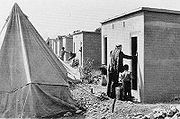
The number of Palestine refugees varies depending on the source. For 1948-49 refugees, for example, the Israeli government suggests a number as low as 520,000 as opposed to 850,000 by their Palestinian counterparts. As of January 2010, UNRWA cites 1,396,368 registered refugees in camps and 3,370,302 registered refugees not in camps.The number of Palestinian refugees by country according to UNRWA in January 2010 were as follows:
- Jordan 1,983,733
- Lebanon 425,640
- Syria 472,109
- West Bank 778,993
- Gaza Strip 1,106,195
Jordan refugees
1,951,603 Palestinian refugees are located in Jordan, of whom 338,000 are still living in refugee camps. Following Jordan's annexation of the West Bank, most Palestinian refugees were granted Jordanian citizenship. The percentage of Palestinian refugees living in refugee camps to those who settled outside the camps is the lowest of all UNRWA fields of operations. Palestinian refugees are allowed access to public services and healthcare, as a result, refugee camps are becoming more of poor city suburbs than refugee camps. Most refugees moved out of the camps to other parts of the country reducing the number of refugees in need of UNRWA services to only 338,000. This caused UNRWA to reduce the budget allocated to Palestinian refugee camps in Jordan. Former UNRWA chief-attorney James G. Lindsay says: "In Jordan, where 2 million Palestinian refugees live, all but 167,000 have citizenship, and are fully eligible for government services including education and health care." Lindsay suggests that eliminating services to refugees whose needs are subsidized by JordanJordan
Jordan , officially the Hashemite Kingdom of Jordan , Al-Mamlaka al-Urduniyya al-Hashemiyya) is a kingdom on the East Bank of the River Jordan. The country borders Saudi Arabia to the east and south-east, Iraq to the north-east, Syria to the north and the West Bank and Israel to the west, sharing...
"would reduce the refugee list by 40%."
Palestinians who moved from the West Bank
West Bank
The West Bank ) of the Jordan River is the landlocked geographical eastern part of the Palestinian territories located in Western Asia. To the west, north, and south, the West Bank shares borders with the state of Israel. To the east, across the Jordan River, lies the Hashemite Kingdom of Jordan...
(whether refugees or not) to Jordan, are issued yellow ID cards to distinguish them from the Palestinians of the "official 10 refugee camps" in Jordan. Since 1988, thousands of those yellow-ID card Palestinians had their Jordan
Jordan
Jordan , officially the Hashemite Kingdom of Jordan , Al-Mamlaka al-Urduniyya al-Hashemiyya) is a kingdom on the East Bank of the River Jordan. The country borders Saudi Arabia to the east and south-east, Iraq to the north-east, Syria to the north and the West Bank and Israel to the west, sharing...
ian citizenship revoked in order to prevent the possibility that they might become permanent residents of the country. Jordan's Interior Minister Nayef al-Kadi said
"Our goal is to prevent Israel from emptying the Palestinian territories of their original inhabitants," the minister explained, confirming that the kingdom had begun revoking the citizenship of Palestinians.
"We should be thanked for taking this measure," he said. "We are fulfilling our national duty because Israel wants to expel the Palestinians from their homeland."
It is estimated that over 40,000 Palestinians have been affected in the preceding months.
India
The first group of Palestinian refugees from Iraq arrived in India in March 2006. Generally, they were unable to find work in India as they spoke only Arabic though some found employment with UNHCR's non-governmental partners. All of them were provided with free access to governmental hospitals. Of the 165 Palestinian refugees from Iraq in India, 137 of them found clearance for resettlement in Sweden.Lebanon
Over 400,000 Palestinian refugees live in Lebanon, who are deprived of certain basic rights. Lebanon barred Palestinian refugees from 73 job categories including professions such as medicine, law and engineering. They are not allowed to own property, and even need a special permit to leave their refugee camps. Unlike other foreigners in Lebanon, they are denied access to the Lebanese health care system. The Lebanese government refused to grant them work permits or permission to own land. The number of restrictions has been mounting since 1990. In June 2005, however, the government of Lebanon removed some work restrictions for a few Lebanese-born Palestinians, enabling them to apply for work permits and work in the private sector. In a 2007 study, Amnesty InternationalAmnesty International
Amnesty International is an international non-governmental organisation whose stated mission is "to conduct research and generate action to prevent and end grave abuses of human rights, and to demand justice for those whose rights have been violated."Following a publication of Peter Benenson's...
denounced the "appalling social and economic condition" of Palestinians in Lebanon.
Lebanon gave citizenship to about 50,000 Christian Palestinian refugees during the 1950s and 1960s. In the mid-1990s, about 60,000 refugees who were Shiite Muslim majority were granted citizenship. This caused a protest from Maronite authorities, leading to citizenship being given to all the Palestinian Christian refugees who were not already citizens. There are about 350,000 non-citizen Palestinian refugees in Lebanon.
The Lebanese Parliament is divided on granting Palestinian rights. While many Lebanese parties call for improving the civil rights of Palestinian refugees, others raise concerns of naturalizing the mainly Muslim population and the disruption this might cause to Lebanon’s fragile sectarian balance.
According to writer and researcher Mudar Zahran, a Jordanian of Palestinian heritage, the media chose to deliberately ignore the conditions of the Palestinians living in Lebanese refugee camps, and that the "tendency to blame Israel for everything" has provided Arab leaders an excuse to deliberately ignore the human rights of the Palestinian in their countries.
Positions on the problem and right of return
On 11 December 1948 the General Assembly discussed Bernadotte's report and resolved: "that refugees wishing to return to their homes and live at peace with their neighbour should be permitted to do so at the earliest practicable date." This resolution has been annually re-affirmed by the General Assembly, but General Assembly resolutions are non-binding and Israel argues that the "live in peace" condition has not been met and has therefore prevented the return of any refugees.Israeli views
The Israeli declaration of independence appealed "to the Arab inhabitants of the State of Israel to preserve peace and participate in the upbuilding of the State on the basis of full and equal citizenship". Similarly the Jewish Agency had promised to the UN before the Declaration that Palestinian Arabs would become full citizens of the State of Israel. The Israeli Knesset (parliament) does not consider the Declaration to have the power of law, and Israel does not in practice consider the refugees to be Israeli citizens. The 1947 Partition Plan determined citizenship based on residency, such that Arabs and Jews residing in Palestine but not in Jerusalem would obtain citizenship in the state in which they are resident. Professor of Law at Boston University Susan Akram, Omar BarghoutiOmar Barghouti
Omar Barghouti is a founding committee member of the Palestinian Campaign for the Academic and Cultural Boycott of Israel who is currently studying for a masters degree in philosophy at Tel Aviv University...
and Ilan Pappé
Ilan Pappé
Ilan Pappé is a professor with the College of Social Sciences and International Studies at the University of Exeter in the UK, director of the university's European Centre for Palestine Studies, co-director of the Exeter Centre for Ethno-Political Studies, and political activist...
have argued that Palestinian refugees from the envisioned Jewish State were entitled to normal Israeli citizenship based on laws of state succession.
Arab states
The Arab LeagueArab League
The Arab League , officially called the League of Arab States , is a regional organisation of Arab states in North and Northeast Africa, and Southwest Asia . It was formed in Cairo on 22 March 1945 with six members: Egypt, Iraq, Transjordan , Lebanon, Saudi Arabia, and Syria. Yemen joined as a...
has instructed its members to deny citizenship to Palestinian Arab refugees (or their descendants) "to avoid dissolution of their identity and protect their right to return to their homeland".
Tashbih Sayyed, a fellow of the Foundation for Defense of Democracies
Foundation for Defense of Democracies
The Foundation for Defense of Democracies describes itself as a non-profit, non-partisan policy institute "working to defend free nations against their enemies". It was founded shortly after the September 11, 2001, attacks to address what it regards as the "threat facing America, Israel and the...
, criticized Arab nations of making the children and grandchildren of Palestinian refugees second class citizens in Lebanon
Lebanon
Lebanon , officially the Republic of LebanonRepublic of Lebanon is the most common term used by Lebanese government agencies. The term Lebanese Republic, a literal translation of the official Arabic and French names that is not used in today's world. Arabic is the most common language spoken among...
, Syria
Syria
Syria , officially the Syrian Arab Republic , is a country in Western Asia, bordering Lebanon and the Mediterranean Sea to the West, Turkey to the north, Iraq to the east, Jordan to the south, and Israel to the southwest....
, or the Gulf States
Arab states of the Persian Gulf
"Arab states of the Persian Gulf" or "Arab Persian Gulf states" or "Persian Gulf Arab states" or "Arabic Persian Gulf states" or "Arab States of The Gulf", are terms that refer to the six Arab states of Saudi Arabia, United Arab Emirates, Qatar, Kuwait, Bahrain and Oman, bordering the Persian Gulf....
, and said that the refugees "cling to the illusion that defeating the Jews will restore their dignity".
Palestinian views
Palestinian refugees claim a right of returnPalestinian right of return
The Palestinian right of return is a political position or principle asserting that Palestinian refugees, both first-generation refugees and their descendants, have a right to return, and a right to the property they or their forebears left or which they were forced to leave in what is now Israel...
. Their claim is based on Article 13 of the Universal Declaration of Human Rights
Universal Declaration of Human Rights
The Universal Declaration of Human Rights is a declaration adopted by the United Nations General Assembly . The Declaration arose directly from the experience of the Second World War and represents the first global expression of rights to which all human beings are inherently entitled...
(UDHR), which declares that "Everyone has the right to leave any country including his own, and to return to his country", although it has been argued that the term only applies to citizens or nationals of that country. Although all Arab League
Arab League
The Arab League , officially called the League of Arab States , is a regional organisation of Arab states in North and Northeast Africa, and Southwest Asia . It was formed in Cairo on 22 March 1945 with six members: Egypt, Iraq, Transjordan , Lebanon, Saudi Arabia, and Syria. Yemen joined as a...
members at the time- Egypt
Egypt
Egypt , officially the Arab Republic of Egypt, Arabic: , is a country mainly in North Africa, with the Sinai Peninsula forming a land bridge in Southwest Asia. Egypt is thus a transcontinental country, and a major power in Africa, the Mediterranean Basin, the Middle East and the Muslim world...
, Iraq
Iraq
Iraq ; officially the Republic of Iraq is a country in Western Asia spanning most of the northwestern end of the Zagros mountain range, the eastern part of the Syrian Desert and the northern part of the Arabian Desert....
, Lebanon
Lebanon
Lebanon , officially the Republic of LebanonRepublic of Lebanon is the most common term used by Lebanese government agencies. The term Lebanese Republic, a literal translation of the official Arabic and French names that is not used in today's world. Arabic is the most common language spoken among...
, Saudi Arabia
Saudi Arabia
The Kingdom of Saudi Arabia , commonly known in British English as Saudi Arabia and in Arabic as as-Sa‘ūdiyyah , is the largest state in Western Asia by land area, constituting the bulk of the Arabian Peninsula, and the second-largest in the Arab World...
, Syria
Syria
Syria , officially the Syrian Arab Republic , is a country in Western Asia, bordering Lebanon and the Mediterranean Sea to the West, Turkey to the north, Iraq to the east, Jordan to the south, and Israel to the southwest....
, and Yemen
Yemen
The Republic of Yemen , commonly known as Yemen , is a country located in the Middle East, occupying the southwestern to southern end of the Arabian Peninsula. It is bordered by Saudi Arabia to the north, the Red Sea to the west, and Oman to the east....
- voted against the resolution, they also cite article 11 of United Nations General Assembly
United Nations General Assembly
For two articles dealing with membership in the General Assembly, see:* General Assembly members* General Assembly observersThe United Nations General Assembly is one of the five principal organs of the United Nations and the only one in which all member nations have equal representation...
Resolution 194
UN General Assembly Resolution 194
United Nations General Assembly Resolution 194 was passed on December 11, 1948, near the end of the 1948 Arab-Israeli War. The resolution expresses appreciation for the efforts of UN Envoy Folke Bernadotte after his assassination by members of the Zionist ultra-nationalist Lehi , headed by Yitzhak...
, which "Resolves that the refugees wishing to return to their homes and live at peace with their neighbors should be permitted to do so at the earliest practicable date, and that compensation should be paid for the property of those choosing not to return [...]." However Resolution 194 is a nonbinding assembly resolution, and it is currently a matter of dispute whether the resolution referred only to refugees in 1948, or additionally to their descendants.
The Palestinian National Authority
Palestinian National Authority
The Palestinian Authority is the administrative organization established to govern parts of the West Bank and Gaza Strip...
supports this claim, and has been prepared to negotiate its implementation at the various peace talks. Both Fatah
Fatah
Fataḥ is a major Palestinian political party and the largest faction of the Palestine Liberation Organization , a multi-party confederation. In Palestinian politics it is on the left-wing of the spectrum; it is mainly nationalist, although not predominantly socialist. Its official goals are found...
and Hamas
Hamas
Hamas is the Palestinian Sunni Islamic or Islamist political party that governs the Gaza Strip. Hamas also has a military wing, the Izz ad-Din al-Qassam Brigades...
hold a strong position for a right of return, with Fatah being prepared to give ground on the issue while Hamas is not.
However, a report in Lebanon’s Daily Star newspaper in which Abdullah Muhammad Ibrahim Abdullah, the Palestinian ambassador to Lebanon and the chairman of the Palestinian Legislative Council's Political and Parliamentary Affairs committees, said the proposed future Palestinian state would not be issuing Palestinian passports to refugees – even refugees living in the West Bank and Gaza.
The Oslo Accords
Upon signing the Oslo AccordsOslo Accords
The Oslo Accords, officially called the Declaration of Principles on Interim Self-Government Arrangements or Declaration of Principles , was an attempt to resolve the ongoing Palestinian-Israeli conflict...
in 1993, Israel, the EU and the US recognized Fatah
Fatah
Fataḥ is a major Palestinian political party and the largest faction of the Palestine Liberation Organization , a multi-party confederation. In Palestinian politics it is on the left-wing of the spectrum; it is mainly nationalist, although not predominantly socialist. Its official goals are found...
as the legitimate representative of the Palestinian Arabs. In return, Yasser Arafat
Yasser Arafat
Mohammed Yasser Abdel Rahman Abdel Raouf Arafat al-Qudwa al-Husseini , popularly known as Yasser Arafat or by his kunya Abu Ammar , was a Palestinian leader and a Laureate of the Nobel Prize. He was Chairman of the Palestine Liberation Organization , President of the Palestinian National Authority...
recognized the State of Israel and renounced terrorism. At the time, the accords were celebrated as an historic breakthrough. In accordance with these agreements, the Palestinian Arab refugees began to be governed by an autonomous Palestinian Authority
Palestinian National Authority
The Palestinian Authority is the administrative organization established to govern parts of the West Bank and Gaza Strip...
, and the parties agreed to negotiate the permanent status of the refugees, as early as 1996. However, events have halted the phasing process and made the likelihood of a future sovereign Palestinian state uncertain.. In another development, a rift developed between Fatah in the West-Bank and Hamas in Gaza after Hamas
Hamas
Hamas is the Palestinian Sunni Islamic or Islamist political party that governs the Gaza Strip. Hamas also has a military wing, the Izz ad-Din al-Qassam Brigades...
won the 2006 elections
Palestinian legislative election, 2006
On January 25, 2006, elections were held for the Palestinian Legislative Council , the legislature of the Palestinian National Authority . Notwithstanding the 2005 municipal elections and the January 9, 2005 presidential election, this was the first election to the PLC since 1996; subsequent...
. Among other differences, Fatah officially recognizes the Oslo Accords with Israel, whereas Hamas does not.
See also
- Estimates of the Palestinian Refugee flight of 1948Estimates of the Palestinian Refugee flight of 1948This article lists the various interim and final United Nations estimates for the number of Palestinian people who fled or were expelled from the area that became part of the State of Israel after the 1948 Arab-Israeli war...
- List of villages depopulated during the 1948 Arab-Israeli war
- Jewish exodus from Arab and Muslim countries
- Refugees of the 2011 Libyan civil warRefugees of the 2011 Libyan civil warRefugees of the 2011 Libyan civil war are the people, predominantly Libyans, who fled or were expelled from their homes during the 2011 Libyan civil war, from within the borders of Libya to the neighbouring states of Tunisia, Egypt and Chad, as well as to European countries across the Mediterranean...
- Refugees of the 2011 Syrian uprisingRefugees of the 2011 Syrian uprisingRefugees of the 2011 Syrian uprising or Syrian refugees relates to populations which fled Syria since April 2011, with the escalation of the 2011 Syrian uprising...
- Sahrawi refugee camps
- Kurdish refugeesKurdish refugeesThe problem of Kurdish refugees and displaced has been created over the 20th century in the Middle East, and continues to loom today. Displacements of Kurds had already been happening within the Ottoman Empire, on pretext of local rebellions' suppression, over the period of its domination of the...
Further reading
- Bowker, Robert P. G. (2003). Palestinian Refugees: Mythology, Identity, and the Search for Peace. Lynne Rienner Publishers. ISBN 1-58826-202-2
- Gelber, Yoav (2006). Palestine 1948. Sussex Academic Press. ISBN 1-84519-075-0.
- Gerson, Allan (1978). Israel, the West Bank and International Law. Routledge. ISBN 0-7146-3091-8
- McDowall, David (1989). Palestine and Israel: The Uprising and Beyond. I.B.Tauris. ISBN 1-85043-289-9.
- Morris, Benny (2003). The Birth of the Palestinian Refugee Problem Revisited. Cambridge: Cambridge University PressCambridge University PressCambridge University Press is the publishing business of the University of Cambridge. Granted letters patent by Henry VIII in 1534, it is the world's oldest publishing house, and the second largest university press in the world...
. ISBN 0-521-00967-7 - Morris, Benny, 1948: A History of the First Arab-Israeli War, (2009) Yale University Press. ISBN 9780300151121
- Reiter, Yitzhak, National Minority, Regional Majority: Palestinian Arabs Versus Jews in Israel (Syracuse Studies on Peace and Conflict Resolution), (2009) Syracuse Univ Press (Sd). ISBN 9780815632306
- Pappe, Ilan (2006). The Ethnic Cleansing of Palestine, London and New York: Oneworld, 2006. ISBN 1-85168-467-0
- Segev, Tom (2007) 1967 Israel, The War and the Year that Transformed the Middle East Little Brown ISBN 978-0-316-72478-4
- Seliktar, Ofira (2002). Divided We Stand: American Jews, Israel, and the Peace Process. Praeger/Greenwood. ISBN 0-275-97408-1
- Jewish exodus from Arab landsJewish exodus from Arab landsThe Jewish exodus from Arab and Muslim countries was a mass departure, flight and expulsion of Jews, primarily of Sephardi and Mizrahi background, from Arab and Muslim countries, from 1948 until the early 1970s...