

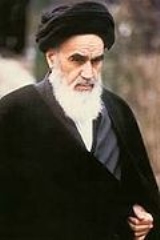
Supreme Leader of Iran

Encyclopedia
The Supreme Leader of Iran (Persian
: , Rahbare Mo'azzame Enghelab, lit. Leader of the Revolution, or , Maghame Rahbari, lit. Leadership Authority) is the highest ranking political and religious authority
in the Islamic Republic
of Iran
. The post was established by the constitution in accordance with the concept of Guardianship of the Islamic Jurists. The title "Supreme" Leader (Persian
: , Rahbare Moazzam) is often used as a sign of respect; however, this terminology is not found in the constitution of Iran, which simply referred to the "Leader" (rahbar).
The leader is more powerful than the President of Iran
and appoints the heads of many powerful posts in the military, the civil government, and the judiciary.
In its history, the Islamic Republic has had two Supreme Leaders: Ruhollah Khomeini
, who held the position from 1979 until his death in 1989, and Ali Khamenei
, who has held the position since succeeding Khomeini.
, which is also in charge of overseeing the armed forces (Army, Revolutionary Guards, Police), and control of state broadcast and others (see below). The head of the Judicial branch (in Persian: قوه قضائیه) is also directly appointed by him.
The President of Iran
, who is elected by universal suffrage, is the Executive President (Head of government
). In 1989, the Prime Minister of Iran
's office was merged with the President's office to form the current post of President of Iran. However, certain executive powers, such as command of the armed forces and declaration of war and peace, remain in the hands of the Supreme Leader. Furthermore the Supreme Leader can even dismiss the president and prevent the legitimation of any law (appointed by assembly) by the institutions under his control, the Guardian Council
and the Expediency Council.
More powerful than the President of Iran
, the Leader appoints the heads of many powerful posts: the commanders of the armed forces
, the director of the national radio and television network
, the heads of the major religious foundations
, the prayer leaders in city mosques, and the members of national security councils
dealing with defence and foreign affairs. He also appoints the chief judge, the chief prosecutor, special tribunals and, with the help of the chief judge, the 12 jurists of the Guardian Council
– the powerful body that decides both what bills may become law and who may run for president or parliament
.
It was the Constitution that afforded the Supreme Leader a multitude of powers. Article 4 of the new constitution stated that “all civil, criminal, financial, economic, administrative, cultural, military, political, and all other statutes and regulations (must) be keeping with Islamic measures;…the Islamic legal scholars of the watch council (shura yi nigahban) will keep watch over this.” It is made very clear that the new form of government defined by the constitution will involve the clergy in every level. Furthermore, Article 5 solidifies the position of Supreme Leader where it states “during the absence of the removed twelfth Imam – may God hasten his return! – government and leadership of the community in the Islamic Republic of Iran belong to the rightful God fearing… legal scholar (Faqih) who is recognized and acknowledged as the Islamic leader by the majority of the population.” Article 107 in the constitution mentions Ayatollah Khomeini by name and praises him as the most learned and talented leader for emulation (marja-i taqlid). Khomeini’s consolidated as much power as possible within the government. The clergy was also involved in the government and oversaw the affairs of many governmental branches on a daily basis. The responsibilities of the Supreme Leader are vaguely stated into the constitution thus any ‘violation’ by the Supreme Leader would be dismissed almost immediately. As the rest of the clergy governed affairs on a daily basis, the Supreme Leader is capable of mandating a new decision as per the concept of Vilayat-e Faqih. (Halm, 120-121)
Khomeini appealed to the masses, during the pre-1979 period, by referring to them as the oppressed and with charisma and political ability was tremendously successful. He became a very popular role model for Shiites and also had some appeal to the much larger Sunni population. The Faqih should be able to have a stronghold on the Shiite population and guide them even at a global level. The striking power of the Faqih was compared to Lenin and Trotsky’s image of “Russia as the springboard country of what was meant to be a global communist revolution.”
or lived in Iraq.
Khoei was not the only one to challenge the Supreme Leader. Ayatollah Rafsanjani, recognized for his liberal attitude and President of Iran in the 1990s, withdrew funding from the ulema and factions such as Lebanon’s Hezbollah to improve the economic conditions of Iran. Khamenei recognized Rafsanjani’s challenge to the ulema but also realized the desperate economic issue in Iran. (Esposito, 211) The biggest challenge to both Khomeini and Khamenei, however, was Ayatollah Montazeri. Montazeri was placed under house arrest even though he was Khomeini’s right hand man during the Iranian Revolution. In the early years of the revolution, Montazeri gained much approval to be the next Supreme Leader but was forced to resign due to the concern he raised about a number of human rights violations in Iran. (Esposito, 211) In essence, both Rafsanjani and Montazeri alluded that by having complete control over all the affairs of the country, the Supreme leader should be held accountable for all the flaws whether political, economical, or social, a feat that could only be accomplished only by the Imams.
Persian language
Persian is an Iranian language within the Indo-Iranian branch of the Indo-European languages. It is primarily spoken in Iran, Afghanistan, Tajikistan and countries which historically came under Persian influence...
: , Rahbare Mo'azzame Enghelab, lit. Leader of the Revolution, or , Maghame Rahbari, lit. Leadership Authority) is the highest ranking political and religious authority
Supreme leader
A supreme leader typically refers to a figure in the highest leadership position of an entity, group, organization, or state, who exercises strong or all-powerful authority over it. In religion, the supreme leader or supreme leaders is God or Gods...
in the Islamic Republic
Islamic republic
Islamic republic is the name given to several states in the Muslim world including the Islamic Republics of Pakistan, Iran, Afghanistan, and Mauritania. Pakistan adopted the title under the constitution of 1956. Mauritania adopted it on 28 November 1958. Iran adopted it after the 1979 Iranian...
of Iran
Iran
Iran , officially the Islamic Republic of Iran , is a country in Southern and Western Asia. The name "Iran" has been in use natively since the Sassanian era and came into use internationally in 1935, before which the country was known to the Western world as Persia...
. The post was established by the constitution in accordance with the concept of Guardianship of the Islamic Jurists. The title "Supreme" Leader (Persian
Persian language
Persian is an Iranian language within the Indo-Iranian branch of the Indo-European languages. It is primarily spoken in Iran, Afghanistan, Tajikistan and countries which historically came under Persian influence...
: , Rahbare Moazzam) is often used as a sign of respect; however, this terminology is not found in the constitution of Iran, which simply referred to the "Leader" (rahbar).
The leader is more powerful than the President of Iran
President of Iran
The President of Iran is the highest popularly elected official in, and the head of government of the Islamic Republic of Iran; although subordinate to the Supreme Leader of Iran, who functions as the country's head of state...
and appoints the heads of many powerful posts in the military, the civil government, and the judiciary.
In its history, the Islamic Republic has had two Supreme Leaders: Ruhollah Khomeini
Ruhollah Khomeini
Grand Ayatollah Sayyed Ruhollah Musavi Khomeini was an Iranian religious leader and politician, and leader of the 1979 Iranian Revolution which saw the overthrow of Mohammad Reza Pahlavi, the Shah of Iran...
, who held the position from 1979 until his death in 1989, and Ali Khamenei
Ali Khamenei
Ayatollah Seyed Ali Hoseyni Khāmene’i is the Supreme Leader of Iran and the figurative head of the Muslim conservative establishment in Iran and Twelver Shi'a marja...
, who has held the position since succeeding Khomeini.
Mandate and status
The Supreme Leader is elected by the Assembly of ExpertsAssembly of Experts
The Assembly of Experts of Iran , also translated as Council of Experts, is a deliberative body of 86 Mujtahids that is charged with electing and removing the Supreme Leader of Iran and supervising his activities.Members of the assembly are elected from a government-screened list of candidates by...
, which is also in charge of overseeing the armed forces (Army, Revolutionary Guards, Police), and control of state broadcast and others (see below). The head of the Judicial branch (in Persian: قوه قضائیه) is also directly appointed by him.
The President of Iran
President of Iran
The President of Iran is the highest popularly elected official in, and the head of government of the Islamic Republic of Iran; although subordinate to the Supreme Leader of Iran, who functions as the country's head of state...
, who is elected by universal suffrage, is the Executive President (Head of government
Head of government
Head of government is the chief officer of the executive branch of a government, often presiding over a cabinet. In a parliamentary system, the head of government is often styled prime minister, chief minister, premier, etc...
). In 1989, the Prime Minister of Iran
Prime Minister of Iran
Prime Minister of Iran was a political post in Iran that had existed during several different periods of time starting with the Qajar era until its most recent revival from 1979 to 1989 following the Iranian Revolution.-Prime Ministers of Qajar era:In the Qajar era, prime ministers were known by...
's office was merged with the President's office to form the current post of President of Iran. However, certain executive powers, such as command of the armed forces and declaration of war and peace, remain in the hands of the Supreme Leader. Furthermore the Supreme Leader can even dismiss the president and prevent the legitimation of any law (appointed by assembly) by the institutions under his control, the Guardian Council
Guardian Council
The Guardian Council of the Constitution , also known as the Guardian Council or Council of Guardians, is an appointed and constitutionally-mandated 12-member council that wields considerable power and influence in the Islamic Republic of Iran....
and the Expediency Council.
More powerful than the President of Iran
President of Iran
The President of Iran is the highest popularly elected official in, and the head of government of the Islamic Republic of Iran; although subordinate to the Supreme Leader of Iran, who functions as the country's head of state...
, the Leader appoints the heads of many powerful posts: the commanders of the armed forces
Military of Iran
The Armed Forces of the Islamic Republic of Iran include the IRIA and the IRGC and the Police Force .These forces total about 545,000 active personnel . All branches of armed forces fall under the command of General Headquarters of Armed Forces...
, the director of the national radio and television network
Islamic Republic of Iran Broadcasting
Islamic Republic of Iran Broadcaster, or IRIB, , formerly called the National Iranian Radio and Television until the Islamic revolution of 1979, is a giant Iranian corporation in control of radio and television which is among the largest media organizations in Asia and Pacific region, and a regular...
, the heads of the major religious foundations
Bonyad
Bonyads are charitable trusts in Iran that play a significant role in Iran's non-petroleum economy, controlling an estimated 20% of Iran's GDP. Exempt from taxes, they have been called "bloated", and "a major weakness of Iran’s economy", and criticized for reaping "huge subsidies from government",...
, the prayer leaders in city mosques, and the members of national security councils
Supreme National Security Council
Supreme National Security Council is the national security council of the Islamic Republic of Iran, the current secretary of which is Saeed Jalili. This institution was founded during the 1989 revision of the constitution...
dealing with defence and foreign affairs. He also appoints the chief judge, the chief prosecutor, special tribunals and, with the help of the chief judge, the 12 jurists of the Guardian Council
Guardian Council
The Guardian Council of the Constitution , also known as the Guardian Council or Council of Guardians, is an appointed and constitutionally-mandated 12-member council that wields considerable power and influence in the Islamic Republic of Iran....
– the powerful body that decides both what bills may become law and who may run for president or parliament
Majlis of Iran
The National Consultative Assembly of Iran , also called The Iranian Parliament or People's House, is the national legislative body of Iran...
.
Incorporation of Supreme Leader into the Iranian Constitution
The new position of Supreme Leader needed boundaries which were established through the vague understandings of Khomeini’s book Islamic Government (Hukumat-e Islami). A referendum was held in March, a month after Khomeini’s return from exile, which asked whether an Islamic Republic should be established in Iran. The people voted strongly for an Islamic Republic and many pushed for “the people’s sovereignty to be replaced by the absolute sovereignty of God, and that Khomeini’s concept of the ‘government of the legal scholar’ (Vilayat-e Faqih) be made the principle of the constitution.” (Halm,119) Following this landslide victory Khomeini, the constitution of Iran of 1906 was declared invalid and a new constitution for an Islamic state was created and ratified by referendum during the first week of December in 1979. The new constitution consisted primarily of the ideas Khomeini presented in his work Islamic Government.It was the Constitution that afforded the Supreme Leader a multitude of powers. Article 4 of the new constitution stated that “all civil, criminal, financial, economic, administrative, cultural, military, political, and all other statutes and regulations (must) be keeping with Islamic measures;…the Islamic legal scholars of the watch council (shura yi nigahban) will keep watch over this.” It is made very clear that the new form of government defined by the constitution will involve the clergy in every level. Furthermore, Article 5 solidifies the position of Supreme Leader where it states “during the absence of the removed twelfth Imam – may God hasten his return! – government and leadership of the community in the Islamic Republic of Iran belong to the rightful God fearing… legal scholar (Faqih) who is recognized and acknowledged as the Islamic leader by the majority of the population.” Article 107 in the constitution mentions Ayatollah Khomeini by name and praises him as the most learned and talented leader for emulation (marja-i taqlid). Khomeini’s consolidated as much power as possible within the government. The clergy was also involved in the government and oversaw the affairs of many governmental branches on a daily basis. The responsibilities of the Supreme Leader are vaguely stated into the constitution thus any ‘violation’ by the Supreme Leader would be dismissed almost immediately. As the rest of the clergy governed affairs on a daily basis, the Supreme Leader is capable of mandating a new decision as per the concept of Vilayat-e Faqih. (Halm, 120-121)
Guardianship of the Jurist (Velayat-e faghih)
The constitution of Iran combines concepts of both democracy and theocracy, theocracy in the form of Khomeini's concept of vilayat-e faqih. According to Khomeini, allegiance, in absence of the twelfth Imam, had to be given to the current vilayat-e faqih. Observers of the Shiite faith select the faqih by method of emulation (taqlid) of the jurist. In this new system, the jurist now oversees all governmental affairs. The “congregation rather than the hierarchy decided how prominent the ayatollah was” thus allowing the public to possibly limit the influence of the Faqih. The complete control exercised by the Faqih was not to be limited to the Iranian Revolution. According to Seyyed Vali Nasr, Khomeini intended the Iranian Revolution to be the first step to a much larger Islamic revolution.Khomeini appealed to the masses, during the pre-1979 period, by referring to them as the oppressed and with charisma and political ability was tremendously successful. He became a very popular role model for Shiites and also had some appeal to the much larger Sunni population. The Faqih should be able to have a stronghold on the Shiite population and guide them even at a global level. The striking power of the Faqih was compared to Lenin and Trotsky’s image of “Russia as the springboard country of what was meant to be a global communist revolution.”
Challenges to Supreme Leader
From the reemergence of the old ideology of vilayat-e faqih, many clerics have criticized both Khomeini and his successor Khamenei for two reasons. Firstly, the position of Supreme Leader has been criticized for its active participation in daily political affairs. This contrasts greatly with the quietist views held by the renowned Grand Ayatollah al-Khoei of Iraq, his successor Grand Ayatollah Sistani, and by the well respected Ayatollah Haeri Yazdi – Khomeini’s teacher. Second, the powers held by the Supreme Leader and participation in all aspects of life by a scholar should have been a position solely for the Twelfth Imam. Mahmoud Ahmadinejad had to make clear after his election that the country needs to work to hasten the return of the real leader of Iran – the Twelfth Imam. (Nasr, 133) Khoei’s appreciation for a quiet life removed him from being the kind of leader Khomeini became but he still had devout followers who made pilgrimage to NajafNajaf
Najaf is a city in Iraq about 160 km south of Baghdad. Its estimated population in 2008 is 560,000 people. It is the capital of Najaf Governorate...
or lived in Iraq.
Khoei was not the only one to challenge the Supreme Leader. Ayatollah Rafsanjani, recognized for his liberal attitude and President of Iran in the 1990s, withdrew funding from the ulema and factions such as Lebanon’s Hezbollah to improve the economic conditions of Iran. Khamenei recognized Rafsanjani’s challenge to the ulema but also realized the desperate economic issue in Iran. (Esposito, 211) The biggest challenge to both Khomeini and Khamenei, however, was Ayatollah Montazeri. Montazeri was placed under house arrest even though he was Khomeini’s right hand man during the Iranian Revolution. In the early years of the revolution, Montazeri gained much approval to be the next Supreme Leader but was forced to resign due to the concern he raised about a number of human rights violations in Iran. (Esposito, 211) In essence, both Rafsanjani and Montazeri alluded that by having complete control over all the affairs of the country, the Supreme leader should be held accountable for all the flaws whether political, economical, or social, a feat that could only be accomplished only by the Imams.
Functions and duties of the Supreme Leader
- Delineation of the general policies of the Islamic Republic of Iran after consultation with the Nation's Expediency Discernment CouncilExpediency Discernment CouncilThe Expediency Discernment Council of the System is an administrative assembly appointed by the Supreme Leader and was created upon the revision to the Constitution of the Islamic Republic of Iran on 6 February 1988...
. - Supervision over the proper execution of the general policies of the systems.
- Issuing decrees for national referendums.
- Assuming supreme command of the armed forcesMilitary of IranThe Armed Forces of the Islamic Republic of Iran include the IRIA and the IRGC and the Police Force .These forces total about 545,000 active personnel . All branches of armed forces fall under the command of General Headquarters of Armed Forces...
. - Declaration of war and peace, and the mobilization of the armed forces.
- Appointment, dismissal, and acceptance of resignationResignationA resignation is the formal act of giving up or quitting one's office or position. It can also refer to the act of admitting defeat in a game like chess, indicated by the resigning player declaring "I resign", turning his king on its side, extending his hand, or stopping the chess clock...
of:- the fuqaha'FaqihA Faqīh is an expert in fiqh, or, Islamic jurisprudence.A faqih is an expert in Islamic Law, and, as such, the word Faqih can literally be generally translated as Jurist.- The definition of Fiqh and its relation to the Faqih:...
on the Guardian Council. - the supreme judicial authority of the country.
- the head of the radio and television networkIslamic Republic of Iran BroadcastingIslamic Republic of Iran Broadcaster, or IRIB, , formerly called the National Iranian Radio and Television until the Islamic revolution of 1979, is a giant Iranian corporation in control of radio and television which is among the largest media organizations in Asia and Pacific region, and a regular...
of the Islamic Republic of Iran. - the chief of the joint staff.
- the chief commander of the armed forces of the country
- the supreme commanders of the armed forces.
- the fuqaha'
- Resolving differences between the three wings of the armed forces and regulation of their relations.
- Resolving the problems, which cannot be solved by conventional methods, through the Nation's Expediency Council.
- Signing the decree formalizing the elections in IranElections in IranIran elects on national level a head of state and head of government , a legislature , and an "Assembly of Experts" . Also City and Village Council elections are held every four years throughout the country. The president is elected for a four-year term by the people...
for the President of the Republic by the people. - Dismissal of the President of the Republic, with due regard for the interests of the country, after the Supreme CourtSupreme courtA supreme court is the highest court within the hierarchy of many legal jurisdictions. Other descriptions for such courts include court of last resort, instance court, judgment court, high court, or apex court...
holds him guiltGuiltGuilt is the state of being responsible for the commission of an offense. It is also a cognitive or an emotional experience that occurs when a person realizes or believes—accurately or not—that he or she has violated a moral standard, and bears significant responsibility for that...
y of the violation of his constitutional duties, or after a vote of the Islamic Consultative Assembly (Parliament) testifying to his incompetence on the basis of Article 89 of the Constitution. - Pardoning or reducing the sentences of convicts, within the framework of Islamic criteria, on a recommendation (to that effect) from the head of the JudiciaryJudicial system of IranA nationwide judicial system in Iran was first implemented and established by Abdolhossein Teymourtash under Reza Shah, with further changes during the second Pahlavi era....
. The Leader may delegate part of his duties and powers to another person.
List of Supreme Leaders of the Islamic Republic of Iran (1979-Present)
| Name | Picture | Born-Died | Took office | Left office | Party |
|---|---|---|---|---|---|
| Grand Ayatollah Sayyid Sayyid Sayyid is an honorific title, it denotes males accepted as descendants of the Islamic prophet Muhammad through his grandsons, Hasan ibn Ali and Husain ibn Ali, sons of the prophet's daughter Fatima Zahra and his son-in-law Ali ibn Abi Talib.Daughters of sayyids are given the titles Sayyida,... Ruhollah Mousavi Khomeini Ruhollah Khomeini Grand Ayatollah Sayyed Ruhollah Musavi Khomeini was an Iranian religious leader and politician, and leader of the 1979 Iranian Revolution which saw the overthrow of Mohammad Reza Pahlavi, the Shah of Iran... |
1902–1989 | 3 December 1979 | 3 June 1989 | None | |
| Ayatollah Ayatollah Ayatollah is a high ranking title given to Usuli Twelver Shī‘ah clerics. Those who carry the title are experts in Islamic studies such as jurisprudence, ethics, and philosophy and usually teach in Islamic seminaries. The next lower clerical rank is Hojatoleslam wal-muslemin... Sayyid Sayyid Sayyid is an honorific title, it denotes males accepted as descendants of the Islamic prophet Muhammad through his grandsons, Hasan ibn Ali and Husain ibn Ali, sons of the prophet's daughter Fatima Zahra and his son-in-law Ali ibn Abi Talib.Daughters of sayyids are given the titles Sayyida,... Ali Hoseyni Khamenei Ali Khamenei Ayatollah Seyed Ali Hoseyni Khāmene’i is the Supreme Leader of Iran and the figurative head of the Muslim conservative establishment in Iran and Twelver Shi'a marja... |
1939– | 4 June 1989 | Incumbent | Combatant Clergy Association | |
See also
- Politics of IranPolitics of IranThe politics of Iran take place in a framework of theocracy guided by an Islamist ideology. The December 1979 constitution, and its 1989 amendment, define the political, economic, and social order of the Islamic Republic of Iran, declaring that Shi'a Islam of the Twelver school of thought is...
- Constitution of Islamic Republic of IranConstitution of Islamic Republic of IranThe Constitution of the Islamic Republic of Iran was adopted by referendum on October 24, 1979, and went into force on December 3 of that year, replacing the Constitution of 1906. It was amended on July 28, 1989. The constitution has been called a "hybrid" of "authoritarian, theocratic and...
- BonyadBonyadBonyads are charitable trusts in Iran that play a significant role in Iran's non-petroleum economy, controlling an estimated 20% of Iran's GDP. Exempt from taxes, they have been called "bloated", and "a major weakness of Iran’s economy", and criticized for reaping "huge subsidies from government",...