

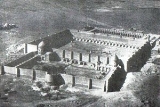
Kufa

Encyclopedia
Kufa is a city in Iraq
, about 170 kilometres (105.6 mi) south of Baghdad
, and 10 kilometres (6.2 mi) northeast of Najaf
. It is located on the banks of the Euphrates River
. The estimated population in 2003 was 110,000.
Along with Samarra
, Karbala
, Kadhimiya and Najaf
, Kufa is one of five Iraqi cities that are of great importance to Shia Muslims. The city was the final capital of ʿAlī ibn Abī Ṭālib
, and was founded within the first hundred years of the 622 Hijra
.
The city contains the Great Mosque of Kufa, one of the earliest mosques in Islam, built in the 7th century.
province. See Middle Bih-Kavad
.
ʻUmar ibn Khattāb
, conquer Iraq
and begin ruling Suristan
around 637.
became the second caliph
in 634. After the Arab victory against the East Roman Empire
at Battle of Yarmouk
in 636, Kūfah was founded and given its name in 637–638 CE, about the same time as Basra
. The Companion of the Prophet
Saʻd ibn Abī Waqqas
founded it as an encampment adjacent to the Lakhmid Arab city of al-Hīrah, and incorporated it as a city of seven divisions. The city was alternately known to non-Arabs as Hīrah and Aqulah before the consolidations of ʻAbdu l-Mālik in 691.
(637–651) at Mahoze
/ al-Madā'in "The Two Cities" (Ctesiphon
-Seleucia
); the Kūfans succeeded and carried off the gates of Mahoze that year.
The tribes which came to Kūfah afterward tended to be Arabs of the Yemen
, Hijaz and Najd
, such as the Azd
ī and Kindī
; there were also increasing numbers of mawālī
or "foreign clients" who immigrated from Persia when their lands were overrun. None of these could or would claim to be descended from Ishmael
as did the ruling Quraysh.
's governor was distributing the spoils of war unfairly. In 642, ʻUmar summoned Saʻd to Medina
with his accusers. Despite finding Sa'd to be innocent, ʻUmar deposed Saʻd to avert ill feelings.
At first, ʻUmar appointed Ammar ibn Yasir
and secondly Basra's first Governor Abū Mūsā al-Ashʻarī
; but the Kūfan instigators accepted neither. ʻUmar and the Kūfans finally agreed on al-Mughīra ibn Shuʻbah
.
replaced Mughira with Walid ibn Uqba
in 645.
While this was going on, the Arabs were continuing their conquest of western Persia under Uthman ibn hakam from Tawwaj, but late in the 640s these forces suffered setbacks.
, which Uthman approved seeking to please all.
Kufa remained a source of instigations albeit from a minority. In 656 when the Egyptian instigators, in co-operation with those in Kufa, marched onto the Caliph Uthman in Medina
, Abu Musa counselled the instigators to no avail.
. In order to manage the Military frontiers more efficiently, Ali shifted the capital from Medina to Kufa.
The people of Syria and their Governor, Muawiyah
, who was in search to seize the initiative himself used the confusion caused by the assassination of Caliph Uthman and being disturbed by the brutal assassination of the Caliph Uthman at the hands of the few Kufan and Egyptian instigators, demanded retribution. Ali did not disagree except at the timing of the retribution as those instigators held tremendous power and had allinged themselves within the Ali's army in his region after the assassination of the Caliph. In an emotionally charged atmosphere, misunderstandings developed between Ali's camp and that of the Syrians and Muawiyah's refusal to give allegiance to Ali as the Caliph without Ali avenging Uthman first eventually, led to war.
Eventually, Ali was killed in the mihrab of the great mosque of Kufa by Ibn Muljim; a traitor to Ali who was convinced to murder him by a beautiful woman whom he wanted to marry. To commit her condition, Ibn Muljim was told to murder Ali while praying, where Ali was hit by a poisonous sword as he was doing his sajdah.
, who were previously unhappy with Hasan's peace treaty with Muawiyah, now became increasingly noticeable creating a movement of rebellion against yet another Caliph. The new Governor, Ziyad ibn Abihi, was equally firm and up to the challenge posed by the rebels among the Kufans.
. With a history of assassinations, rebellions were dealt with firmly such as those by Al-Mukhtar
(on behalf of Ibn al-Hanifiya). Many Kufans also supported the mutiny of `Abd al-Rahman ibn Muhammad ibn Ash`ath in 699–702 against al-Hajjaj but were defeated by al-Hajjaj. Some say, the Governors of Kufa or Basra, from Ziyad ibn Abihi to his son, Ubaydullah ibn Ziyad, to al-Hajjaj, were understandably firm given the frequent uprisings and assassinations (e.g. of Ali). However, it cannot be denied that al-Hajjaj, and before him, Ubaydullah ibn Ziyad ibn Abihi, were indeed very severe, and even cruel, against the rebels of Kufa especially and of Basra to a lesser extent.
. Under the Umayyad and early `Abbasid decades, Kufa's importance gradually shifted from caliphal politics to Islamic theory and practice.
notes that by contrast with Medina
and to a lesser extent Syria
, in Iraq
there was no unbroken Muslim
or Ishmael
ite population dating back to the prophet Muhammad
's time. Therefore Maliki
(and Azwa'i) appeals to the practice (amal) of the community could not apply. Instead the people of Iraq relied upon those Companions of the Muhammad who settled there, and upon such factions from the Hijaz whom they respected most. A primary founder of a Sunni school of thought, Abu Hanifa, was a Kufan who had supported Zayd's rebellion in the 730s; and his jurisprudence was systematised and defended against non-Iraqi rivals (starting with Maliki
sm) by other Kufans, such as al-Shaybani.
Shirazi
's "Tabaqat
", which Hallaq labels "an important early biographical work dedicated to jurists", covered 84 "towering figures" of Islamic jurisprudence; to which Kufa provided 20. It was therefore a center surpassed only by Medina
(22), although Basra
came close (17). Kufans could claim that the more prominent of Muhammad's Companions had called that city home: not only Ibn Abu Waqqas, Abu Musa
, and Ali
; but also Abd Allah ibn Mas'ud
, Salman the Persian
, Ammar ibn Yasir
, and Huzayfa ibn Yaman. Among its jurists prior to Abu Hanifa, Hallaq singles out Sa'id ibn Jubayr
, Ibrahim al-Nakha`i, and Hammad ibn Abi Sulayman; and considers Amir al-Sha`bi a pioneer in the science of judicial precedent.
Additionally, Shi'a Imams like Muhammad al-Baqir
and his son Jafar al-Sadiq made decisions from Medina that contributed to the law of Kufa; and to this day Shi`ite law follows their example. Abu Hanifa too learnt from al-Baqir and especially al-Sadiq. As a result, while Hanafi
sm is doctrinally Sunni, in practical terms Hanafi law is closer to Imami law than either is to the Medina-based schools of Malik
, Shafi`i, and Ibn Hanbal.
Kufa was also among the first centers of Qur'anic interpretation
, which Kufans credited to the exegete Mujahid (until he escaped to Mecca in 702). It further recorded general traditions as Hadith
; in the 9th century, Yahya ibn `Abd al-Hamid al-Himmani compiled many of these into a Musnad
.
Given Kufa's opposition to Damascus
, Kufan traditionists had their own take on Umayyad history. The historian Abu Mikhnaf
al-Azdi (d. 774) compiled their accounts into a rival history, which became popular under Abbasid
rule. This history does not survive but later historians like Tabari quoted from it extensively.
Kufa is also where the kufic script
was developed, the earliest script of the Arabic language
. As the scholar al-Qalqashandi maintained, "The Arabic script [khatt] is the one which is now known as Kufic. From it evolved all the present hands." The angular script which later came to be known as Kufic had its origin about a century earlier than the founding of the town of Kufa, according to Moritz in the Encyclopaedia of Islam
. The kufic script was derived from one of the four pre-Islamic Arabic scripts, the one called al-Hiri (used in Hira
). (The other three were al-Anbari (from Anbar
), al-Makki (from Mecca
) and al-Madani (from Medina
)). The famous author of the Kitab al-Fihrist, an index of Arabic books, Ibn al-Nadim
(died ca. 999), was the first to use the word 'kufic' to characterize this script, which reached a state is decorative perfection in the 8th century, when surah
s were used to decorate ceramics, for representations of nature were strictly forbidden under the Islamic regime.
In the first decades of Islam, Kufa was prominent in literacy and politics, it was founded before Uthman (whom Ibn Shihab al-Zuhri
among others credited with the canonisation of the Qur'an's text), and it was opposed to the central authorities of Medina and Damascus. From the perspective of 8th-century CE (2nd-century AH) Medina and Damascus, Kufa was associated with "variant" readings and interpretations of the Qur'an, typically in the name of Ibn Mas'ud and often (it was claimed) read from the pulpit as if they were part of the Qur'an itself. It became said that Uthman had sent an exemplar of the text to Kufa, but that it was burnt during the wars of Mukhtar
and Ibn Zubayr. Al-Hajjaj restored or at any rate promulgated the standard text under Abd al-Malik, castigating even the memory of Abd Allah ibn Mas'ud as "Ibn
Umm
Abd
(son of a slave's mother)". But a faction in Kufa preserved the readings "of `Abd Allah / Ibn Mas`ud", whence Mujahid and his fellow mujtahids compiled them along with other readings and interpretations. From there these readings entered the vast repository of Near Eastern hadith, ultimately to be written down into collections of hadith and tafsir.
Presently, Kufa and Najaf
have joined into a single urban area that is mostly commonly known to the outside world simply as Najaf.
, is one of the earliest mosques in Islam. It was constructed in the middle of the 7th century after the Caliph Omar
established the city. The mosque contains the remains of Muslim ibn ‘Aqīl
—first cousin of Husayn ibn ‘Alī
, his companion Hānī ibn ‘Urwa
, and the revolutionary Mukhtār al-Thaqafī
.
Masjid al-Kufa in Kūfā, Iraq—contains the tombs of Muslim ibn ‘Aqīl
, Hānī ibn ‘Urwa
, and Mukhtār al-Thaqafī
. The Mosque also contains many important sites relating to the Prophets and ‘Alī
, including the place where he was fatally struck on the head while in Sujood
The tomb of Zayd ibn ‘Alī
in Kūfā, Iraq
Masjid al-Hannaanah in Kūfā, Iraq—contains some of the skin of Husayn ibn ‘Alī
which was ripped off of him post-mortem by the aggressors of Karbalā
.
The House of ‘Alī
in Kūfā, Iraq
Tomb of Maytham at-Tammār
in Kufa, Iraq
Tomb of Kumayl ibn Ziyad
in Kufa, Iraq
The final Imām, considered to be alive and in occultation
, has the Masjid al-Sahlah associated with him.
Iraq
Iraq ; officially the Republic of Iraq is a country in Western Asia spanning most of the northwestern end of the Zagros mountain range, the eastern part of the Syrian Desert and the northern part of the Arabian Desert....
, about 170 kilometres (105.6 mi) south of Baghdad
Baghdad
Baghdad is the capital of Iraq, as well as the coterminous Baghdad Governorate. The population of Baghdad in 2011 is approximately 7,216,040...
, and 10 kilometres (6.2 mi) northeast of Najaf
Najaf
Najaf is a city in Iraq about 160 km south of Baghdad. Its estimated population in 2008 is 560,000 people. It is the capital of Najaf Governorate...
. It is located on the banks of the Euphrates River
Euphrates
The Euphrates is the longest and one of the most historically important rivers of Western Asia. Together with the Tigris, it is one of the two defining rivers of Mesopotamia...
. The estimated population in 2003 was 110,000.
Along with Samarra
Samarra
Sāmarrā is a city in Iraq. It stands on the east bank of the Tigris in the Salah ad-Din Governorate, north of Baghdad and, in 2003, had an estimated population of 348,700....
, Karbala
Karbala
Karbala is a city in Iraq, located about southwest of Baghdad. Karbala is the capital of Karbala Governorate, and has an estimated population of 572,300 people ....
, Kadhimiya and Najaf
Najaf
Najaf is a city in Iraq about 160 km south of Baghdad. Its estimated population in 2008 is 560,000 people. It is the capital of Najaf Governorate...
, Kufa is one of five Iraqi cities that are of great importance to Shia Muslims. The city was the final capital of ʿAlī ibn Abī Ṭālib
Ali
' |Ramaḍān]], 40 AH; approximately October 23, 598 or 600 or March 17, 599 – January 27, 661).His father's name was Abu Talib. Ali was also the cousin and son-in-law of the Islamic prophet Muhammad, and ruled over the Islamic Caliphate from 656 to 661, and was the first male convert to Islam...
, and was founded within the first hundred years of the 622 Hijra
Hijra (Islam)
The Hijra is the migration or journey of the Islamic prophet Muhammad and his followers from Mecca to Medina in 622 CE. Alternate spellings of this Arabic word are Hijrah, Hijrat or Hegira, the latter following the spelling rules of Latin.- Hijra of Muhammad :In September 622, warned of a plot to...
.
The city contains the Great Mosque of Kufa, one of the earliest mosques in Islam, built in the 7th century.
History of Al-Kufa
Under the Sassanid Persian Empire
Ruled by Sassanian Empire as part of SuristanSuristan
Suristan was used as a name in two senses during the Sassanid Persian Empire 226 to 651 AD.It was used to designate the Persian province of Surestan, roughly the same as today's Syria, as opposed to Asuristan, which was a separate province in northern and central Iraq, south east Turkey and north...
province. See Middle Bih-Kavad
Middle Bih-Kavad
Middle Bih-Kavad was one of the Persian provinces during the Sassanid era. It encompassed all of today's cities of Najaf and Kufa in Iraq.-Source:Mohammadi-yi Malayeri, M.: Dil-i Iranshahr, Tehran 1357 Hsh. ....
.
Caliph Umar's era (637–644)
The Arabs, led by CaliphCaliph
The Caliph is the head of state in a Caliphate, and the title for the ruler of the Islamic Ummah, an Islamic community ruled by the Shari'ah. It is a transcribed version of the Arabic word which means "successor" or "representative"...
ʻUmar ibn Khattāb
Umar
`Umar ibn al-Khattāb c. 2 November , was a leading companion and adviser to the Islamic prophet Muhammad who later became the second Muslim Caliph after Muhammad's death....
, conquer Iraq
Iraq
Iraq ; officially the Republic of Iraq is a country in Western Asia spanning most of the northwestern end of the Zagros mountain range, the eastern part of the Syrian Desert and the northern part of the Arabian Desert....
and begin ruling Suristan
Suristan
Suristan was used as a name in two senses during the Sassanid Persian Empire 226 to 651 AD.It was used to designate the Persian province of Surestan, roughly the same as today's Syria, as opposed to Asuristan, which was a separate province in northern and central Iraq, south east Turkey and north...
around 637.
Founded by Saʻd under the directions of Caliph Umar ibn Khattab (637)
ʻUmar ibn KhattābUmar
`Umar ibn al-Khattāb c. 2 November , was a leading companion and adviser to the Islamic prophet Muhammad who later became the second Muslim Caliph after Muhammad's death....
became the second caliph
Caliph
The Caliph is the head of state in a Caliphate, and the title for the ruler of the Islamic Ummah, an Islamic community ruled by the Shari'ah. It is a transcribed version of the Arabic word which means "successor" or "representative"...
in 634. After the Arab victory against the East Roman Empire
Byzantine Empire
The Byzantine Empire was the Eastern Roman Empire during the periods of Late Antiquity and the Middle Ages, centred on the capital of Constantinople. Known simply as the Roman Empire or Romania to its inhabitants and neighbours, the Empire was the direct continuation of the Ancient Roman State...
at Battle of Yarmouk
Battle of Yarmouk
The Battle of Yarmouk was a major battle between the Muslim Arab forces of the Rashidun Caliphate and the armies of the East Roman-Byzantine Empire. The battle consisted of a series of engagements that lasted for six days in August 636, near the Yarmouk River, along what is today the border...
in 636, Kūfah was founded and given its name in 637–638 CE, about the same time as Basra
Basra
Basra is the capital of Basra Governorate, in southern Iraq near Kuwait and Iran. It had an estimated population of two million as of 2009...
. The Companion of the Prophet
Sahaba
In Islam, the ' were the companions, disciples, scribes and family of the Islamic prophet...
Saʻd ibn Abī Waqqas
Sa`d ibn Abi Waqqas
Saad ibn Abī Waqqās was an early convert to Islam in 610-11 and one of the important companions of the Islamic prophet Muhammad. Sa'd was the seventeenth person to embrace Islam at the age of seventeen...
founded it as an encampment adjacent to the Lakhmid Arab city of al-Hīrah, and incorporated it as a city of seven divisions. The city was alternately known to non-Arabs as Hīrah and Aqulah before the consolidations of ʻAbdu l-Mālik in 691.
Islamic conquest of Persia (638)
As of 638, it was a base for those Arab armies which were fighting the Sassanid PersiansIslamic conquest of Persia
The Muslim conquest of Persia led to the end of the Sassanid Empire in 644, the fall of Sassanid dynasty in 651 and the eventual decline of the Zoroastrian religion in Persia...
(637–651) at Mahoze
Al-Mada'in
Al-Mada'in, meaning "The cities", is the name given to an ancient metropolis formed by Ctesiphon and Seleucia on opposite sides of the Tigris River in present-day Iraq...
/ al-Madā'in "The Two Cities" (Ctesiphon
Ctesiphon
Ctesiphon, the imperial capital of the Parthian Arsacids and of the Persian Sassanids, was one of the great cities of ancient Mesopotamia.The ruins of the city are located on the east bank of the Tigris, across the river from the Hellenistic city of Seleucia...
-Seleucia
Seleucia on the Tigris
Seleucia , also known as Seleucia on the Tigris, was one of the great cities of the world during Hellenistic and Roman times. It stood in Mesopotamia, on the west bank of the Tigris River, opposite the smaller town of Ctesiphon, in present day Babil Governorate, Iraq.-Seleucid empire:Seleucia,...
); the Kūfans succeeded and carried off the gates of Mahoze that year.
The tribes which came to Kūfah afterward tended to be Arabs of the Yemen
Yemen
The Republic of Yemen , commonly known as Yemen , is a country located in the Middle East, occupying the southwestern to southern end of the Arabian Peninsula. It is bordered by Saudi Arabia to the north, the Red Sea to the west, and Oman to the east....
, Hijaz and Najd
Najd
Najd or Nejd , literally Highland, is the central region of the Arabian Peninsula.-Boundaries :The Arabic word nejd literally means "upland" and was once applied to a variety of regions within the Arabian Peninsula...
, such as the Azd
Azd
The Azd or Al Azd, are an Arabian tribe. They were a branch of the Kahlan tribe, which was one of the two branches of Qahtan the other being Himyar.In the ancient times, they inhabited Ma'rib, the capital city of the Sabaean Kingdom in modern-day Yemen...
ī and Kindī
Kindah
The kingdom of Kindah was a vassal kingdom which ruled from Qaryah dhat Kahl in Nejd, Central Arabia . The kingdom controlled much of the northern Arabian peninsula in the 4th and 5th centuries AD.-Origin:...
; there were also increasing numbers of mawālī
Mawali
Mawali or mawālá is a term in Classical Arabic used to address non-Arab Muslims.The term gained prominence in the centuries following the early Arab Muslim conquests in the 7th century, as many non-Arabs such as Persians, Egyptians, and Turks converted to Islam...
or "foreign clients" who immigrated from Persia when their lands were overrun. None of these could or would claim to be descended from Ishmael
Ishmael
Ishmael is a figure in the Hebrew Bible and the Qur'an, and was Abraham's first born child according to Jews, Christians and Muslims. Ishmael was born of Abraham's marriage to Sarah's handmaiden Hagar...
as did the ruling Quraysh.
Saʻd deposed (642)
In the 640s, the Kūfan commons agitated that the Caliph ʻUmarUmar
`Umar ibn al-Khattāb c. 2 November , was a leading companion and adviser to the Islamic prophet Muhammad who later became the second Muslim Caliph after Muhammad's death....
's governor was distributing the spoils of war unfairly. In 642, ʻUmar summoned Saʻd to Medina
Medina
Medina , or ; also transliterated as Madinah, or madinat al-nabi "the city of the prophet") is a city in the Hejaz region of western Saudi Arabia, and serves as the capital of the Al Madinah Province. It is the second holiest city in Islam, and the burial place of the Islamic Prophet Muhammad, and...
with his accusers. Despite finding Sa'd to be innocent, ʻUmar deposed Saʻd to avert ill feelings.
At first, ʻUmar appointed Ammar ibn Yasir
Ammar ibn Yasir
ʻAmmār ibn Yāsir al-Ansi was one of the companions of the Islamic prophet Muhammad. He was one of the Muhajirun, and referred to as by Shia Muslims as one of the Four Companions....
and secondly Basra's first Governor Abū Mūsā al-Ashʻarī
Abu-Musa al-Asha'ari
Abu-Musa Abd-Allah ibn Qays al-Ash'ari, better known as Abu Musa al-Ashari was a companion of the prophet Muhammad and important figure in early Islamic history...
; but the Kūfan instigators accepted neither. ʻUmar and the Kūfans finally agreed on al-Mughīra ibn Shuʻbah
Mughira ibn Shu'ba
al-Mughīrah ibn Shuʿbah ibn Abī ʿĀmir ibn Masʿūd ath-Thaqafī was one of the more prominent companions of Muhammad.-Muqawqis:Mughira had a dialogue with both Muqawqis, Vicegerent of Egypt and Caesar.Mughira was impressed by the dialogue with Muqawqis...
.
Governor Walid (645)
Following Umar's death (644), his successor UthmanUthman
Uthman ibn Affan was one of the companions of Islamic prophet, Muhammad. He played a major role in early Islamic history as the third Sunni Rashidun or Rightly Guided Caliph....
replaced Mughira with Walid ibn Uqba
Walid ibn Uqba
Walid ibn Uqba was one of the companions of Muhammad.-Family:He was the son of Uqbah ibn Abu Mu'ayt, a man who tried to kill Muhammad and finally died as a non-Muslim, and thus the brother of Umm Kulthum bint Uqba...
in 645.
While this was going on, the Arabs were continuing their conquest of western Persia under Uthman ibn hakam from Tawwaj, but late in the 640s these forces suffered setbacks.
Setbacks, governor Abu Musa (650–654)
Uthman in 650 reorganised the Iranian frontier; both Basra and Kufa received new governors (Sa'id ibn al-A'as in Kufa's case), and the east came under Basra's command while north of that remained under Kufa's. The few but noticeable trouble makers in Kufa sought in 654 and had Sa'ed deposed Sa'id and instead showed satisfaction with the return of Abu MusaAbu-Musa al-Asha'ari
Abu-Musa Abd-Allah ibn Qays al-Ash'ari, better known as Abu Musa al-Ashari was a companion of the prophet Muhammad and important figure in early Islamic history...
, which Uthman approved seeking to please all.
Kufa remained a source of instigations albeit from a minority. In 656 when the Egyptian instigators, in co-operation with those in Kufa, marched onto the Caliph Uthman in Medina
Medina
Medina , or ; also transliterated as Madinah, or madinat al-nabi "the city of the prophet") is a city in the Hejaz region of western Saudi Arabia, and serves as the capital of the Al Madinah Province. It is the second holiest city in Islam, and the burial place of the Islamic Prophet Muhammad, and...
, Abu Musa counselled the instigators to no avail.
Capital of Fourth Caliph Ali (656)
Upon Uthman's murder by the Kufan instigators, governor Abu Musa attempted to restore a non-violent atmosphere in Kufa. The Muslims in Medina and elsewhere supported the right of Ali ibn Abu Talib to the caliphateCaliphate
The term caliphate, "dominion of a caliph " , refers to the first system of government established in Islam and represented the political unity of the Muslim Ummah...
. In order to manage the Military frontiers more efficiently, Ali shifted the capital from Medina to Kufa.
The people of Syria and their Governor, Muawiyah
Muawiyah I
Muawiyah I was the first Caliph of the Umayyad Dynasty. After the conquest of Mecca by the Muslims, Muawiyah's family converted to Islam. Muawiyah is brother-in-law to Muhammad who married his sister Ramlah bint Abi-Sufyan in 1AH...
, who was in search to seize the initiative himself used the confusion caused by the assassination of Caliph Uthman and being disturbed by the brutal assassination of the Caliph Uthman at the hands of the few Kufan and Egyptian instigators, demanded retribution. Ali did not disagree except at the timing of the retribution as those instigators held tremendous power and had allinged themselves within the Ali's army in his region after the assassination of the Caliph. In an emotionally charged atmosphere, misunderstandings developed between Ali's camp and that of the Syrians and Muawiyah's refusal to give allegiance to Ali as the Caliph without Ali avenging Uthman first eventually, led to war.
Eventually, Ali was killed in the mihrab of the great mosque of Kufa by Ibn Muljim; a traitor to Ali who was convinced to murder him by a beautiful woman whom he wanted to marry. To commit her condition, Ibn Muljim was told to murder Ali while praying, where Ali was hit by a poisonous sword as he was doing his sajdah.
Governor Mughira (661)
In Kufa, Mu`awiyah reinstalled Mughira, a notable Companion of the Prophet Muhammad, acceptable and loved by all parties in Kufa.Governor Ziyad (670)
Mughira died in about 670. Mu`awiyah then appointed Ziyad ibn Abihi as the Governor of Kufa. After the death of Mughirah in Kufa and of Hasan in Medina, some, such as Hujr ibn AdiHujr ibn Adi
Hujr ibn Adi was a supporter of Ali ibn Abi talib, he and his companions were killed by Muawiya I for refusing to Curse Ali. Hujr asked that his son be killed before he did so that he will be sure that his son stayed on the love of Ali and will not be affected by his death.-Character and...
, who were previously unhappy with Hasan's peace treaty with Muawiyah, now became increasingly noticeable creating a movement of rebellion against yet another Caliph. The new Governor, Ziyad ibn Abihi, was equally firm and up to the challenge posed by the rebels among the Kufans.
Umayyad era revolts (699–694)
Throughout the Umayyad era, as was the case since the inception of the City by Umar ibn Khattab, there were those among Kufa's inhabitants who were rebellious against the ruling Caliph be that Ali himself or an Ummayad Caliph. Kufans turned to Husayn ibn ‘Alī, grandson of the prophet, as their leader after the death of Muawia, but turned on Husayn ibn ‘Alī and formed an army which massacred him and his family and companions in the battle of karbalaKarbala
Karbala is a city in Iraq, located about southwest of Baghdad. Karbala is the capital of Karbala Governorate, and has an estimated population of 572,300 people ....
. With a history of assassinations, rebellions were dealt with firmly such as those by Al-Mukhtar
Al-Mukhtar
al-Mukhtār ibn Abī ‘Ubayd Allah al-Thaqafī was an early Islamic revolutionary who led an abortive rebellion against the Umayyad Caliphs after the death of Husayn ibn Ali at the Battle of Karbala.-Life:...
(on behalf of Ibn al-Hanifiya). Many Kufans also supported the mutiny of `Abd al-Rahman ibn Muhammad ibn Ash`ath in 699–702 against al-Hajjaj but were defeated by al-Hajjaj. Some say, the Governors of Kufa or Basra, from Ziyad ibn Abihi to his son, Ubaydullah ibn Ziyad, to al-Hajjaj, were understandably firm given the frequent uprisings and assassinations (e.g. of Ali). However, it cannot be denied that al-Hajjaj, and before him, Ubaydullah ibn Ziyad ibn Abihi, were indeed very severe, and even cruel, against the rebels of Kufa especially and of Basra to a lesser extent.
Abbasid era (749)
In 749, the `Abbasids took Kufa and made it their capital. In 762, they moved their seat to BaghdadBaghdad
Baghdad is the capital of Iraq, as well as the coterminous Baghdad Governorate. The population of Baghdad in 2011 is approximately 7,216,040...
. Under the Umayyad and early `Abbasid decades, Kufa's importance gradually shifted from caliphal politics to Islamic theory and practice.
Kufa in Islamic theology and scholarship
Wael HallaqWael Hallaq
Wael B. Hallaq is currently the Avalon Foundation Professor in the Humanities at Columbia University and is currently acting as the Director of Graduate Studies at the Department of Middle Eastern, South Asian, and African Studies. After a Ph.D...
notes that by contrast with Medina
Medina
Medina , or ; also transliterated as Madinah, or madinat al-nabi "the city of the prophet") is a city in the Hejaz region of western Saudi Arabia, and serves as the capital of the Al Madinah Province. It is the second holiest city in Islam, and the burial place of the Islamic Prophet Muhammad, and...
and to a lesser extent Syria
Syria
Syria , officially the Syrian Arab Republic , is a country in Western Asia, bordering Lebanon and the Mediterranean Sea to the West, Turkey to the north, Iraq to the east, Jordan to the south, and Israel to the southwest....
, in Iraq
Iraq
Iraq ; officially the Republic of Iraq is a country in Western Asia spanning most of the northwestern end of the Zagros mountain range, the eastern part of the Syrian Desert and the northern part of the Arabian Desert....
there was no unbroken Muslim
Muslim
A Muslim, also spelled Moslem, is an adherent of Islam, a monotheistic, Abrahamic religion based on the Quran, which Muslims consider the verbatim word of God as revealed to prophet Muhammad. "Muslim" is the Arabic term for "submitter" .Muslims believe that God is one and incomparable...
or Ishmael
Ishmael
Ishmael is a figure in the Hebrew Bible and the Qur'an, and was Abraham's first born child according to Jews, Christians and Muslims. Ishmael was born of Abraham's marriage to Sarah's handmaiden Hagar...
ite population dating back to the prophet Muhammad
Muhammad
Muhammad |ligature]] at U+FDF4 ;Arabic pronunciation varies regionally; the first vowel ranges from ~~; the second and the last vowel: ~~~. There are dialects which have no stress. In Egypt, it is pronounced not in religious contexts...
's time. Therefore Maliki
Maliki
The ' madhhab is one of the schools of Fiqh or religious law within Sunni Islam. It is the second-largest of the four schools, followed by approximately 25% of Muslims, mostly in North Africa, West Africa, the United Arab Emirates, Kuwait, and in some parts of Saudi Arabia...
(and Azwa'i) appeals to the practice (amal) of the community could not apply. Instead the people of Iraq relied upon those Companions of the Muhammad who settled there, and upon such factions from the Hijaz whom they respected most. A primary founder of a Sunni school of thought, Abu Hanifa, was a Kufan who had supported Zayd's rebellion in the 730s; and his jurisprudence was systematised and defended against non-Iraqi rivals (starting with Maliki
Maliki
The ' madhhab is one of the schools of Fiqh or religious law within Sunni Islam. It is the second-largest of the four schools, followed by approximately 25% of Muslims, mostly in North Africa, West Africa, the United Arab Emirates, Kuwait, and in some parts of Saudi Arabia...
sm) by other Kufans, such as al-Shaybani.
Shirazi
Shirazi
- People :*Shirazi , a social group among the Swahili people of East Africa*Grand Ayatollah Mirza Hassan Shirazi, the leading marja of his time, and is widely known for his 1891 fatwa against the usage of tobacco...
's "Tabaqat
Tabaqat
Tabaqat is a genre of Islamic biographical literature that is organized according to the century in which the notable individuals lived...
", which Hallaq labels "an important early biographical work dedicated to jurists", covered 84 "towering figures" of Islamic jurisprudence; to which Kufa provided 20. It was therefore a center surpassed only by Medina
Medina
Medina , or ; also transliterated as Madinah, or madinat al-nabi "the city of the prophet") is a city in the Hejaz region of western Saudi Arabia, and serves as the capital of the Al Madinah Province. It is the second holiest city in Islam, and the burial place of the Islamic Prophet Muhammad, and...
(22), although Basra
Basra
Basra is the capital of Basra Governorate, in southern Iraq near Kuwait and Iran. It had an estimated population of two million as of 2009...
came close (17). Kufans could claim that the more prominent of Muhammad's Companions had called that city home: not only Ibn Abu Waqqas, Abu Musa
Abu Musa
Abu Musa is a 12-km² island in the eastern Persian Gulf, part of a six-island archipelago near the entrance to the Strait of Hormuz. The island is administered by Iran as part of the Iranian province of Hormozgan, but is also claimed by the United Arab Emirates .Abu Musa's inhabitants call it...
, and Ali
Ali
' |Ramaḍān]], 40 AH; approximately October 23, 598 or 600 or March 17, 599 – January 27, 661).His father's name was Abu Talib. Ali was also the cousin and son-in-law of the Islamic prophet Muhammad, and ruled over the Islamic Caliphate from 656 to 661, and was the first male convert to Islam...
; but also Abd Allah ibn Mas'ud
Abd Allah ibn Mas'ud
Abdullah ibn Masud was one of the first converts to Islam after Muhammad started preaching in Mecca. He remained one of the closest companions of Muhammad during his lifetime....
, Salman the Persian
Salman the Persian
Salman the Persian or Salman al Farisi was one of Muhammad's companions.During some of his later meetings with the other Sahaba, he was referred to as Abu Abdullah .-Birth place:...
, Ammar ibn Yasir
Ammar ibn Yasir
ʻAmmār ibn Yāsir al-Ansi was one of the companions of the Islamic prophet Muhammad. He was one of the Muhajirun, and referred to as by Shia Muslims as one of the Four Companions....
, and Huzayfa ibn Yaman. Among its jurists prior to Abu Hanifa, Hallaq singles out Sa'id ibn Jubayr
Sa'id ibn Jubayr
Sa'id bin Jubayr , also known as Abū Muhammad, was originally from Kufa, in modern-day Iraq. He was regarded as one of the leading members of the Tabi‘in and was counted by Sheikh al-Tusi as one of the companions of the fourth Imam, Ali ibn Husayn...
, Ibrahim al-Nakha`i, and Hammad ibn Abi Sulayman; and considers Amir al-Sha`bi a pioneer in the science of judicial precedent.
Additionally, Shi'a Imams like Muhammad al-Baqir
Muhammad al-Baqir
Muḥammad ibn ‘Alī al-Bāqir was the Fifth Imām to the Twelver Shi‘a and Fourth Imām to the Ismā‘īlī Shī‘a. His father was the previous Imām, ‘Alī ibn Ḥusayn, and his mother was Fatimah bint al-Hasan...
and his son Jafar al-Sadiq made decisions from Medina that contributed to the law of Kufa; and to this day Shi`ite law follows their example. Abu Hanifa too learnt from al-Baqir and especially al-Sadiq. As a result, while Hanafi
Hanafi
The Hanafi school is one of the four Madhhab in jurisprudence within Sunni Islam. The Hanafi madhhab is named after the Persian scholar Abu Hanifa an-Nu‘man ibn Thābit , a Tabi‘i whose legal views were preserved primarily by his two most important disciples, Abu Yusuf and Muhammad al-Shaybani...
sm is doctrinally Sunni, in practical terms Hanafi law is closer to Imami law than either is to the Medina-based schools of Malik
Malik
Malik is an Arabic word meaning "king, chieftain".It has been adopted in various other, mainly Islamized or Arabized, Asian languages for their ruling princes and to render kings elsewhere. It is also sometimes used in derived meanings...
, Shafi`i, and Ibn Hanbal.
Kufa was also among the first centers of Qur'anic interpretation
Tafsir
Tafseer is the Arabic word for exegesis or commentary, usually of the Qur'an. Ta'wīl is a subset of tafsir and refers to esoteric or mystical interpretation. An author of tafsir is a mufassir .- Etymology :...
, which Kufans credited to the exegete Mujahid (until he escaped to Mecca in 702). It further recorded general traditions as Hadith
Hadith
The term Hadīth is used to denote a saying or an act or tacit approval or criticism ascribed either validly or invalidly to the Islamic prophet Muhammad....
; in the 9th century, Yahya ibn `Abd al-Hamid al-Himmani compiled many of these into a Musnad
Musnad
Musnad may refer to:*South Arabian alphabet*Musnad hadith*Musnad Ahmad ibn Hanbal...
.
Given Kufa's opposition to Damascus
Damascus
Damascus , commonly known in Syria as Al Sham , and as the City of Jasmine , is the capital and the second largest city of Syria after Aleppo, both are part of the country's 14 governorates. In addition to being one of the oldest continuously inhabited cities in the world, Damascus is a major...
, Kufan traditionists had their own take on Umayyad history. The historian Abu Mikhnaf
Abu Mikhnaf
Abi Mekhnaf was a classical Shia Muslim historian from the 8th century. He lived in Kufa and died in . He attributes to Shiism by some Rijal scholars but it's doubtful and not accepted with all of them. However his works represent great tendency to Ali and his sons Hasan and Husayn.-Style:In...
al-Azdi (d. 774) compiled their accounts into a rival history, which became popular under Abbasid
Abbasid
The Abbasid Caliphate or, more simply, the Abbasids , was the third of the Islamic caliphates. It was ruled by the Abbasid dynasty of caliphs, who built their capital in Baghdad after overthrowing the Umayyad caliphate from all but the al-Andalus region....
rule. This history does not survive but later historians like Tabari quoted from it extensively.
Kufa is also where the kufic script
Kufic
Kufic is the oldest calligraphic form of the various Arabic scripts and consists of a modified form of the old Nabataean script. Its name is derived from the city of Kufa, Iraq, although it was known in Mesopotamia at least 100 years before the foundation of Kufa. At the time of the emergence of...
was developed, the earliest script of the Arabic language
Arabic language
Arabic is a name applied to the descendants of the Classical Arabic language of the 6th century AD, used most prominently in the Quran, the Islamic Holy Book...
. As the scholar al-Qalqashandi maintained, "The Arabic script [khatt] is the one which is now known as Kufic. From it evolved all the present hands." The angular script which later came to be known as Kufic had its origin about a century earlier than the founding of the town of Kufa, according to Moritz in the Encyclopaedia of Islam
Encyclopaedia of Islam
The Encyclopaedia of Islam is an encyclopaedia of the academic discipline of Islamic studies. It embraces articles on distinguished Muslims of every age and land, on tribes and dynasties, on the crafts and sciences, on political and religious institutions, on the geography, ethnography, flora and...
. The kufic script was derived from one of the four pre-Islamic Arabic scripts, the one called al-Hiri (used in Hira
Hira
Hira or the Cave of Hira is a cave about from Mecca, on the mountain named Jabal Al-Nūr in the Hejaz region of present day Saudi Arabia...
). (The other three were al-Anbari (from Anbar
Anbar
Anbar was a town in Iraq, at lat. 33 deg. 22' N., long. 43 deg. 49' E, on the east bank of the Euphrates, just south of the Nahr 'Isa, or Sakhlawieh canal, the northernmost of the canals connecting that river with the Tigris.-History:...
), al-Makki (from Mecca
Mecca
Mecca is a city in the Hijaz and the capital of Makkah province in Saudi Arabia. The city is located inland from Jeddah in a narrow valley at a height of above sea level...
) and al-Madani (from Medina
Medina
Medina , or ; also transliterated as Madinah, or madinat al-nabi "the city of the prophet") is a city in the Hejaz region of western Saudi Arabia, and serves as the capital of the Al Madinah Province. It is the second holiest city in Islam, and the burial place of the Islamic Prophet Muhammad, and...
)). The famous author of the Kitab al-Fihrist, an index of Arabic books, Ibn al-Nadim
Ibn al-Nadim
Abu'l-Faraj Muhammad bin Is'hāq al-Nadim , whose father was known as al-Warrāq was a Shia Muslim scholar and bibliographer. Some scholars regard him as a Persian, but this is not certain. He is famous as the author of the Kitāb al-Fihrist...
(died ca. 999), was the first to use the word 'kufic' to characterize this script, which reached a state is decorative perfection in the 8th century, when surah
Sura
A sura is a division of the Qur'an, often referred to as a chapter. The term chapter is sometimes avoided, as the suras are of unequal length; the shortest sura has only three ayat while the longest contains 286 ayat...
s were used to decorate ceramics, for representations of nature were strictly forbidden under the Islamic regime.
In the first decades of Islam, Kufa was prominent in literacy and politics, it was founded before Uthman (whom Ibn Shihab al-Zuhri
Ibn Shihab al-Zuhri
For the geographer from Al-Andalus see Mohammed Ibn Abu Bakr al-ZuhriMuhammad ibn Muslim ibn Ubaydullah ibn Shihab al-Zuhri , usually called simply Ibn Shihab or al-Zuhri...
among others credited with the canonisation of the Qur'an's text), and it was opposed to the central authorities of Medina and Damascus. From the perspective of 8th-century CE (2nd-century AH) Medina and Damascus, Kufa was associated with "variant" readings and interpretations of the Qur'an, typically in the name of Ibn Mas'ud and often (it was claimed) read from the pulpit as if they were part of the Qur'an itself. It became said that Uthman had sent an exemplar of the text to Kufa, but that it was burnt during the wars of Mukhtar
Mukhtar
Mukhtar meaning "chosen" in Arabic, refers to the head of a village or mahalle in many Arab countries as well as in Turkey and Cyprus. The name refers to the fact that mukhtars are usually selected by some consensual or participatory method, often involving an election. Mukhtar is also a common...
and Ibn Zubayr. Al-Hajjaj restored or at any rate promulgated the standard text under Abd al-Malik, castigating even the memory of Abd Allah ibn Mas'ud as "Ibn
IBN
IBN or ibn may refer to:In general* ibn, patronymic in Arabic personal names * IBN code page , a Nordic language code page under MS-DOS...
Umm
UMM
UMM may refer to:* UN/CEFACT's Modeling Methodology , a business process modeling methodology of the United Nations* UMM , a metal works factory and former Portuguese automobile manufacturer* U.M.M., a portuguese EBM band...
Abd
Abd (Arabic)
Abd is an Arabic word meaning one who is totally subordinated; a slave or a servant.Abid is a given name meaning "worshipper". It is based on the Arabic word "Ibadah", i.e. worship...
(son of a slave's mother)". But a faction in Kufa preserved the readings "of `Abd Allah / Ibn Mas`ud", whence Mujahid and his fellow mujtahids compiled them along with other readings and interpretations. From there these readings entered the vast repository of Near Eastern hadith, ultimately to be written down into collections of hadith and tafsir.
Post-Abbasid history
Kufa began to come under constant attack in the 11th century and eventually shrunk and lost its importance. Over the last century, the population of Kufa has begun to grow again. It continues to be an important pilgrimage site for Shi`ite Muslims.Presently, Kufa and Najaf
Najaf
Najaf is a city in Iraq about 160 km south of Baghdad. Its estimated population in 2008 is 560,000 people. It is the capital of Najaf Governorate...
have joined into a single urban area that is mostly commonly known to the outside world simply as Najaf.
Places
The Great Mosque of Kufa or Masjid al-Kūfa , or "Masjid al-Aazam" located in Kūfa, IraqIraq
Iraq ; officially the Republic of Iraq is a country in Western Asia spanning most of the northwestern end of the Zagros mountain range, the eastern part of the Syrian Desert and the northern part of the Arabian Desert....
, is one of the earliest mosques in Islam. It was constructed in the middle of the 7th century after the Caliph Omar
Omar
Omar can refer to:-Name:* Omar , including a list of people with the given name or surname Omar, Omer or Umar as well-Places:* Omar, Konar, a village in Afghanistan...
established the city. The mosque contains the remains of Muslim ibn ‘Aqīl
Muslim ibn Aqeel
Muslim ibn Aqeel, or Muslim ibn Aqil, was the cousin of Hasan ibn Ali and Husayn ibn Ali, and the son of Aqeel ibn Abu Talib. Muslim ibn Aqeel was sent ahead as an envoy to Kufa to see if the people could be trusted to be loyal to the Imam Husayn. He sent word back saying that the people of Kufa...
—first cousin of Husayn ibn ‘Alī
Husayn ibn Ali
Hussein ibn ‘Alī ibn Abī Ṭālib was the son of ‘Alī ibn Abī Ṭālib and Fātimah Zahrā...
, his companion Hānī ibn ‘Urwa
Hani ibn Urwa
Ibn Ziyad summoned a retainer, Ma'qil, who he tasked to act a spy and pretend he was a Shi'a in order to locate the whereabouts of Muslim ibn Aqeel. With 3,000 dirhams in his hand and by falsely convincing Muslim ibn Awsaja al-Asadi of his sincerity, Ma'qil was invited into the presence of Muslim...
, and the revolutionary Mukhtār al-Thaqafī
Al-Mukhtar
al-Mukhtār ibn Abī ‘Ubayd Allah al-Thaqafī was an early Islamic revolutionary who led an abortive rebellion against the Umayyad Caliphs after the death of Husayn ibn Ali at the Battle of Karbala.-Life:...
.
Masjid al-Kufa in Kūfā, Iraq—contains the tombs of Muslim ibn ‘Aqīl
Muslim ibn Aqeel
Muslim ibn Aqeel, or Muslim ibn Aqil, was the cousin of Hasan ibn Ali and Husayn ibn Ali, and the son of Aqeel ibn Abu Talib. Muslim ibn Aqeel was sent ahead as an envoy to Kufa to see if the people could be trusted to be loyal to the Imam Husayn. He sent word back saying that the people of Kufa...
, Hānī ibn ‘Urwa
Hani ibn Urwa
Ibn Ziyad summoned a retainer, Ma'qil, who he tasked to act a spy and pretend he was a Shi'a in order to locate the whereabouts of Muslim ibn Aqeel. With 3,000 dirhams in his hand and by falsely convincing Muslim ibn Awsaja al-Asadi of his sincerity, Ma'qil was invited into the presence of Muslim...
, and Mukhtār al-Thaqafī
Al-Mukhtar
al-Mukhtār ibn Abī ‘Ubayd Allah al-Thaqafī was an early Islamic revolutionary who led an abortive rebellion against the Umayyad Caliphs after the death of Husayn ibn Ali at the Battle of Karbala.-Life:...
. The Mosque also contains many important sites relating to the Prophets and ‘Alī
Shi'a view of Ali
This article discusses Orthodox Shi'a sources on the biography of ‘Alī ibn Abī Tālib , the cousin and son-in-law to Prophet Muhammad, member of the Prophet's Ahl al-Bayt and third Caliph....
, including the place where he was fatally struck on the head while in Sujood
Prostration
Prostration is the placement of the body in a reverentially or submissively prone position. Major world religions employ prostration either as a means of embodying reverence for a noble person, persons or doctrine, or as an act of submissiveness to a supreme being or beings...
The tomb of Zayd ibn ‘Alī
Zayd ibn Ali
Zayd ibn ‘Alī was the grandson of Husayn ibn Alī, the grandson of Muhammad. Zayd was born in Medina in 695. His father was the Shī‘ah Imam ‘Alī ibn Husayn "Zayn al-Abidīn"...
in Kūfā, Iraq
Masjid al-Hannaanah in Kūfā, Iraq—contains some of the skin of Husayn ibn ‘Alī
Husayn ibn Ali
Hussein ibn ‘Alī ibn Abī Ṭālib was the son of ‘Alī ibn Abī Ṭālib and Fātimah Zahrā...
which was ripped off of him post-mortem by the aggressors of Karbalā
Battle of Karbala
The Battle of Karbala took place on Muharram 10, in the year 61 of the Islamic calendar in Karbala, in present day Iraq. On one side of the highly uneven battle were a small group of supporters and relatives of Muhammad's grandson Husain ibn Ali, and on the other was a large military detachment...
.
The House of ‘Alī
Shi'a view of Ali
This article discusses Orthodox Shi'a sources on the biography of ‘Alī ibn Abī Tālib , the cousin and son-in-law to Prophet Muhammad, member of the Prophet's Ahl al-Bayt and third Caliph....
in Kūfā, Iraq
Tomb of Maytham at-Tammār
Meesam Tammar
Maytham ibn Yahyā at-Tammār was a slave belonging to a woman of Banu Asad. Ali ibn Abi Talib purchased this slave from the woman and set him free in the way of Allah...
in Kufa, Iraq
Tomb of Kumayl ibn Ziyad
Kumayl ibn Ziyad
Kumayl bin Ziyad an-Nakha'i a companion of Muhammad, and later Ali, the final Sunni Rashidun Caliph and first Shi'a Imam. He is best known for the du'a or supplication in the Shi'a anthologies that bears his name, du'a al-Kumayl ....
in Kufa, Iraq
The final Imām, considered to be alive and in occultation
The Occultation
The Occultation in Shia Islam refers to a belief that the messianic figure, or Mahdi, who in Shi'i thought is an infallible male descendant of the founder of Islam, Muhammad, was born but disappeared, and will one day return and fill the world with justice. Some Shi'is, such as the Zaidi and...
, has the Masjid al-Sahlah associated with him.
People related to Kufa
- ʿAlī ibn Abī ṬālibAli' |Ramaḍān]], 40 AH; approximately October 23, 598 or 600 or March 17, 599 – January 27, 661).His father's name was Abu Talib. Ali was also the cousin and son-in-law of the Islamic prophet Muhammad, and ruled over the Islamic Caliphate from 656 to 661, and was the first male convert to Islam...
– Governor - Husayn ibn ʿAlī ibn Abī Ṭālib – Battle of KarbalaBattle of KarbalaThe Battle of Karbala took place on Muharram 10, in the year 61 of the Islamic calendar in Karbala, in present day Iraq. On one side of the highly uneven battle were a small group of supporters and relatives of Muhammad's grandson Husain ibn Ali, and on the other was a large military detachment...
- Yaqub ibn Ishaq al-Kindi – theologian
- Abu Hanifa
- Sufyan al-Thawri
- Alqama ibn Qays
- Abd Allah ibn Mas'udAbd Allah ibn Mas'udAbdullah ibn Masud was one of the first converts to Islam after Muhammad started preaching in Mecca. He remained one of the closest companions of Muhammad during his lifetime....
- Al-Aswad ibn YazidAl-Aswad ibn YazidAl-Aswad ibn Yazid was a well-known scholar from among the taba'een and pupil of Abd-Allah ibn Mas'udHe was one of the narrators of hadith.-References:...
- Masruq ibn al-Ajda'Masruq ibn al-Ajda'Masruq ibn al-Ajda was a well-known and respected tabi'i , jurist and muĥaddith . Chiefly a resident of Kufa he was among the many students of Abdullah ibn Mas'ud...
See also
- Great Mosque (Kufa)Great Mosque (Kufa)The Great Mosque of Kufa, or Masjid al-Kūfa ,or Masjid-al-Azam located in Kūfa, Iraq, is one of the earliest mosques in Islam. The mosque, built in the 7th century, contains the remains of Muslim ibn ‘Aqīl - first cousin of Husayn ibn ‘Alī, his companion Hānī ibn ‘Urwa, and the revolutionary...
- Al-HirahAl-HirahAl Hīra was an ancient city located south of al-Kufah in south-central Iraq.- Middle Ages:Al Hīra was a significant city in pre-Islamic Arab history. Originally a military encampment, in the 5th and 6th centuries CE it became the capital of the Lakhmids.The Arabs were migrating into the Near East...
- Shiism
- Ghurabiyya Shia