

Animal worship

Encyclopedia
Animal worship refers to religious rituals involving animals, especially in pre-modern societies, such as the glorification of animal deities, or animal sacrifice
.
The origins of animal worship have been the subject of many theories. The classical author Diodorus explained the origin of animal-worship by recalling the myth in which the gods, supposedly threatened by giants, hid under the guise of animals. The people then naturally began to worship the animals that their gods had disguised themselves as and continued this act even after the gods returned to their normal state (Lubbock, 2005, p. 252). In 1906, Weissenborn suggested that animal worship resulted from man’s natural curiosity. Primitive man would observe an animal that had a unique trait and the inexplicability of this trait would appeal to man’s curiosity (Weissenborn, 1906b, p. 282). Wonder resulted from primitive man’s observations of this distinctive trait and this wonder eventually induced adoration. Thus, primitive man worshipped animals that had inimitable traits (Weissenborn, 1906b, p. 282). Lubbock put forward a more recent view. Lubbock proposed that animal-worship originated from family names. In societies, families would name themselves and their children after certain animals and eventually came to hold that animal above other animals. Eventually, these opinions turned into deep respect and evolved into fully developed worship of the family animal (Lubbock, 2005, p. 253). The belief that an animal is sacred frequently results in dietary laws
prohibiting their consumption. As well as holding certain animals to be sacred, religions have also adopted the opposite attitude, that certain animals are unclean
.
The idea that divinity embodies itself in animals, such as a deity incarnate, and then lives on earth among human beings is disregarded by Abrahamic religions (Morris, 2000, p. 26). In churches such as Independent Assemblies of God and Pentecostal, animals have very little religious significance (Schoffeleers, 1985; Peltzer, 1987; Qtd. in Morris, 2000, p. 25). Animals have become less and less important and symbolic in cult rituals and religion, especially among African cultures, as Christianity and Islamic religions have spread. (Morris, 2000, p. 24).
The Egyptian pantheon
was especially fond of zoomorphism, with many animals sacred to particular deities—cat
s to Bastet, ibis
es and baboon
s to Thoth
, crocodile
s to Sebek and Ra
, fish to Set
, mongoose
, shrew
and bird
s to Horus
, dogs and jackal
s to Anubis
, serpents and eel
s to Atum
, beetle
s to Khepera, bulls to Apis
. Animals were often mummified
as a result of these beliefs.
Animal cults may be classified in two ways:
enjoys a large measure of respect from all cultures that come in contact with it, which shows itself in apologies and in festivals in its honour. Bear worship
is found in a number of religions, including Finnish paganism.The most notable ceremonies involving bears are found in East Asia.
There is a festival among the Nivkhs that takes the form of a celebration in honour of a recently dead kinsman, to whom the spirit of the bear is sent. There have been some attempts to revive the practice.
There is a good deal of evidence to connect the Greek goddess Artemis
with a cult of the bear. Girls danced as "bears" in her honour, and might not marry before undergoing this ceremony. According to mythology, the goddess once transformed a nymph
into a bear and then into the constellation Ursa Major
.
The bear is traditionally associated with Bern, Switzerland
. It is believed that the city's name derives from the Germanic word for "bears" (Bären in German
) and a bear is featured on the city's flag and coat of arm. In 1832 a statue of the Celtic
bear goddess Artio
was dug up there.
The existence of an ancient bear cult among Neanderthals in the Middle Paleolithic period has been a topic of discussion spurred by archaeological findings (Wunn, 2000, p. 434-435). Ancient bear bones have been discovered in several different caves and their peculiar arrangement are believed by some archaeologists to be evidence of a bear cult during the Paleolithic era. (Wunn, 2000, p. 435). However, others argue that the placement of these remains, whether it appears to be an identified pattern or not, is due to natural causes such as wind, sediment, or water (Wunn, 2000, p. 437-438).
 The Ainu people
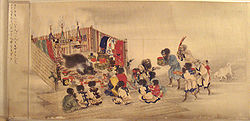
, who live on select islands in the Japanese archipelago, call the bear “kamui” in their language, which translates to mean god. While many other animals are considered to be gods in the Ainu culture, the bear is the head of the gods (Kindaichi, 1949, p. 345). For the Ainu, when the gods visit the world of man, they don fur and claws and take on the physical appearance of an animal. Usually, however, when the term “kamui” is used, it essentially means a bear (Kindaichi, 1949, p. 345). The Ainu people willingly and thankfully ate the bear as they believed that the disguise (the flesh and fur) of any god was a gift to the home that the god chose to visit (Kindaichi, 1949, p. 348).
The first emperor of the last dynasty of Vietnam is believed to be rescued by a whale when his ship was capsized in a storm. After unifying the country, he sainted the whale who came to his rescue, which is known today as "Đông Hải phúc thần" (the deity of Fortune in the East sea).
A prevalent whale
cult in Japan occurs around the coastal area. There are cemeteries with memorial stones dedicated to the whales which were hunted and killed to feed the people (Naumann, 1974, p. 4).
Buddhist epitaphs mark these stones which implore that Buddha be reborn as a whale (Naumann, 1974, p. 4). Along with these memorials, there is evidence that whale embryos, found in a deceased mother’s womb, were extracted and buried with the same respect as a human being (Naumann, 1974, p. 5). For certain shrines, the bones of a perished whale were also deposited in the area (Naumann, 1974, p. 5).
In Alaska, there were certain tribes that had ceremonial tributes to pieces of a whale after it was captured in a hunt (Lantis 1938, p. 445). Some tribes brought the hump, the fins, or the nose of the whale into their camps or the whaler’s house. These parts were meant to represent the entirety of the whale and were honored as such during the festival (Lantis 1938, p. 445). The bones of a whale, however, were also given ritual treatment. The Alaskan tribes that participated in such acts believed that their rituals protected the whale’s soul from injury and it could then be free to return to the sea (Lantis 1938, p. 445).
In the book Moby Dick can be found a longer description of the symbolism of the whale.
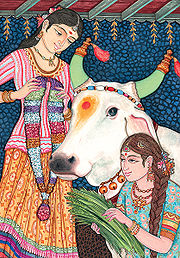 Many religions have considered cattle to be sacred, most famously Hinduism
, but also Zoroastrianism
, and ancient Greek
and Egyptian religion. Cattle and buffalo are respected by many pastoral peoples that rely on the animals for sustenance and the killing of an ox is a sacrificial function.
The Toda of southern India
abstain from the flesh of their domestic animal, the buffalo. However, once a year they sacrifice a bull calf, which is eaten in the forest by the adult males. The buffalo plays an important part in many Toda rituals. These buffalo are currently endangered.
Conspicuous among Egyptian animal cults was that of the bull, Apis
. It was distinguished by certain marks, and when the old Apis died a new one was sought. The finder was rewarded, and the bull underwent four months' education at Nilopolis
. Its birthday was celebrated once a year when oxen, which had to be pure white, were sacrificed to it. Women were forbidden to approach it when once its education was finished. Oracles were obtained from it in various ways. After death it was mummified and buried in a rock-tomb. Less widespread was the cult of the Mnevis, also consecrated to Osiris
.
Similar observances are found in our own day on the Upper Nile
. The Nuba
and Nuer revere cattle. The Angoni of Central Africa and the Sakalava
of Madagascar keep sacred bulls. In India
respect for the cow is widespread, but is of post-Vedic origin; there is little actual worship, but the products of the cow are important in magic.
While there are several animals that are worshipped in India, the supreme position is held by the cow (Margul, 1968, p. 63). The humped zebu, a breed of cow, is central to the religion of Hinduism (Margul, 1968, p. 63). Mythological legends have supported the sanctity of the zebu throughout India (Margul, 1968, p. 64). Such myths have included the creation of a divine cow mother and a cow heaven by the God, Brahma
and Prithu
, the sovereign of the universe, created the earth’s vegetation, edible fruits and vegetables, disguised as a cow (Margul, 1968, p. 64).
According to Tadeusz Margul, observations of the Hindu religion and the cow has led to a misunderstanding that Hindi have a servile relationship with the zebu, giving prayers and offerings to it daily. Typically, however, only during the Cow Holiday, an annual event, is the cow the recipient of such practices (Margul, 1968, p. 65). Margul suggests that sanctity of the cow is based on four foundations: abstaining from cow slaughter, abstaining from beef consumption, control of breeding and ownership, and belief in purification qualities of cow products (milk, curd, ghee, dung, and urine) (Margul, 1968, p. 65-66).
, the god of Thebes, Egypt
, was represented as ram-headed. His worshippers held the ram to be sacred, however, it was sacrificed once a year. Its fleece formed the clothing of the idol. Another Egyptian ram-headed god was Banebdjed, a form of Osiris
.
 Silenus
, the Satyr
s and the Faun
s were either capriform or had some part of their bodies shaped like that of a goat. In northern Europe the wood spirit, Leszi
, is believed to have a goat's horns, ears and legs. In Africa the Bijago people are said to have a goat as their principal divinity. A deity known as the Goat of Mendes
is associated with the pentagram
.
In Greece, Italy, and Egypt, the goat was worshipped in both goat form and phallic form (Neave 1988, p. 8). This type of worship has sometimes been said to have originated from the goat’s increased sex drive. One male goat was capable of fertilizing 150 females (Neave 1988, p. 8). The Greek god Pan
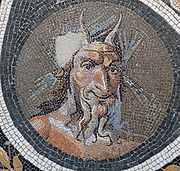
was depicted as having goat characteristics, such as hooves, horns, and a beard. Along with Pan, the goat was closely related to Dionysus during the Roman era (Neave 1988, p. 8). To honor Dionysus, Romans would tear apart a goat and eat it alive. The goat was commonly associated with dark arts and the devil. This association was amplified in Europe during the Middle Ages (Neave 1988, p. 8).
Excavations in Central Asia have revealed ancient ritual goat-burial that show a religious significance of the goat predominantly in the Afghanistan area (Sidky 1990, p. 286). These findings have been used as evidence for a goat-cult of Asia originating either in the Neolithic or Bronze Ages (Sidky 1990, p. 286). An example of a goat-burial finding was discovered on the Oxus River. Along these banks, a Neanderthal grave was excavated surrounded by several pairs of goat horns, suggesting significance of goats in Central Asian religion (Sidky 1990, p. 286).
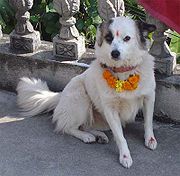 Dogs have a major religious significance among the Hindu
s in Nepal
and some parts of India
. The dogs are worshipped as a part of a five-day Tihar festival that falls roughly in November every year. In Hinduism
, it is believed that the dog is a messenger of Yama
, the god of death, and dogs guard the doors of Heaven
. Socially, they are believed to be the protectors of our homes and lives. So, in order to please the dogs they are going to meet at Heaven's doors after death, so they would be allowed in Heaven, people mark the 14th day of the lunar cycle in November as Kukur-tihar, as known in Nepali language for the dog's day. This is a day when the dog is worshipped by applying tika
(the holy vermilion dot), incense sticks and garlanded generally with marigold
flower.
Actual dog
worship is uncommon. The Nosarii of western Asia are said to worship a dog. The Karang
of Java had a cult of the red dog, each family keeping one in the house. According to one authority the dogs are images of wood which are worshipped after the death of a member of the family and burnt after a thousand days. In Nepal
it is said that dogs are worshipped at the festival called Khicha Puja. Among the Harranians dogs were sacred, but this was rather as brothers of the mystae.
has been practiced by a number of Indo-European
and Turkic peoples
. There is some reason to believe that Poseidon
, like other water gods, was originally conceived under the form of a horse
. In the cave of Phigalia
Demeter
was, according to popular tradition, represented with the head and mane of a horse, possibly a relic of the time when a non-specialized corn-spirit
bore this form. Her priests were called Poloi (Greek
for "colts") in Laconia
. The mule and the horse are sacred to the Roman god Consus
. In Gaul
(France) we find a horse-goddess, Epona
. There are also traces of a horse-god, Rudiobus
. Hayagriva
is a horse-headed deity that appears in both Hinduism
and Buddhism
. The Gonds in India worship a horse-god, Koda Pen, in the form of a shapeless stone, but it is not clear that the horse is regarded as divine. The horse or mare is a common form of the corn-spirit in Europe.
Among the Balkan culture, swaddling an unmarried person in a horse-girth is a typical ritual. It is thought that the sexual potency of the horse is passed to the individual wrapped in its girth (Vukanović 1980, p. 112). Along with the Balkan swaddling, Virgil’s Aeneid bases the founding of the great city of Carthage upon a horse (Qtd. in Brown 1950, p. 32). When the Phoenicians dug up a horse head from the ground they decided to build their city (Carthage) upon that spot because the horse was a sign of success (Qtd. in Brown 1950, p. 32). Thus, Brown argued that the horse was sacred to the Phoenician people (Brown 1950, p. 32).
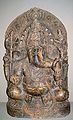 In Thailand
it is believed that a white elephant
may contain the soul of a dead person, perhaps a Buddha. When one is taken the capturer is rewarded and the animal brought to the king to be kept ever afterwards. It cannot be bought or sold. It is baptized and fêted and mourned for like a human being at its death. In some parts of Indo-China the belief is that the soul of the elephant may injure people after death; it is therefore fêted by a whole village. In Cambodia
it is held to bring luck to the kingdom. The cult of the white elephant is also found at Ennarea in southern Ethiopia
. In India, the popular Hindu god Ganesha
has the head of an elephant and a torso of a human.
In Surat
, unmarried Anāvil girls participate in a holiday referred to as Alunām (Naik, 1958, p. 393). This holiday is to honor the goddess Pārvatī
. During this celebration, a clay elephant is prepared (most likely to celebrate Pārvatī
's creation of Ganesha
from a paste of either tumeric or sandalwood
). Every day, the unmarried women worship this elephant by dancing, singing songs, and abstaining from eating salt. On the final day of Alunām, the clay elephant is immersed in some body of water (Naik, 1958, p. 393).
Certain cultures also used elephant figurines to display the animal’s importance. There was evidence of an ancient elephant cult in Sumatra
(Schnitger, 1938, p. 41). Stone elephant figurines were built as “seats of the souls” in the Sumatran culture (Schnitger, 1938, p. 41). In North Borneo
, however, wooden elephant figurines were placed on the top of a bamboo pole. This bamboo pole was only erected after the tribe chief had collected a certain number of human heads (Schnitger, 1938, p. 41).
 In North America the Algonquian
tribes had as their chief deity a "mighty great hare
" to whom they went at death. According to one account he lived in the east, according to another in the north. In his anthropomorphized form he was known as Menabosho
or Michabo.
The deer is important in the mythology of many peoples. To the Greeks it was sacred to the goddess Artemis
, while in Hinduism
it is linked to the goddess Saraswati
. The deer also held spiritual significance to the pastoralist cultures of the Eurasian Steppe
. The golden stag figurine found in the Pazyryk burials is one of the most famous pieces of Scythian art.
In Altaic mythology
of the Turkic
and Mongolian peoples, the wolf is a revered animal. The shamanic Turkic peoples even believed they were descendants of wolves in Turkic legends. The legend of Asena
is an old Turkic myth that tells of how the Turkic people were created. In Northern China a small Turkic village was raided by Chinese soldiers, but one small baby was left behind. An old she-wolf with a sky-blue mane named Asena found the baby and nursed him, then the she-wolf gave birth to half wolf, half human cubs therefore the Turkic people were born. Also in Turkic mythology it is believed that a gray wolf showed the Turks the way out of their legendary homeland Ergenekon
, which allowed them to spread and conquer their neighbours.
Both Zeus
and Apollo were associated with the wolf by the Greeks, but it is not clear that this implies a previous cult of the wolf.
In Western culture, the most obvious example is the symbolism of Rome's foundation, and the use of wolves in totemic imagery.
is widely found in West Africa. Among the Ashanti people a man who kills one is liable to be put to death; no leopard skin may be exposed to view, but a stuffed leopard is worshiped. On the Gold Coast a leopard hunter who has killed his victim is carried round the town behind the body of the leopard; he may not speak, must besmear himself so as to look like a leopard and imitate its movements. In Loango
a prince's cap is put upon the head of a dead leopard, and dances are held in its honour.
During the Egyptian Twenty-sixth Dynasty people began mummifying particular animal species as offerings to the god whom the species represented. Millions of mummified cat
s, birds, and other creatures were buried at temples honoring Egyptian deities. Worshippers paid the priests of a particular deity to obtain and mummify an animal and the mummy was placed in a cemetery near the god's cult center.
The lion
was associated with the Egyptian deities Horus
, Nefertum, Ra
and Sekhmet
. There was a lion-god at Baalbek
. The pre-Islamic Arabs had a lion-god, Yaghuth
. In modern Africa we find a lion-idol among the Balonda. The lion was also sacred to Hebat
, the mother goddess
of the Hurrians
.
In Judaism
the patriarch Jacob refers to his son Judah as a Gur Aryeh גּוּר אַרְיֵה יְהוּדָה, a "Young Lion" (Genesis 49:9) when blessing him. Thus the Lion of Judah
started to be reverenced in some others abrahamic cults, symbolising their prophets, as such as Jesus
and Haile Selassie I, the ras Tafari.
In Mesoamerica the jaguar
was revered as a symbol of fertility and warriorship among the Aztec
, Maya
and Olmec
, and had an important role in shamanism.
Of great importance in Chinese myth and culture, the tiger
is one of the 12 Chinese zodiac
animals. Also in various Chinese art
and martial art, the tiger is depicted as an earth symbol and equal rival of the Chinese dragon
- the two representing matter and spirit respectively. The White Tiger
is one of the Four Symbols
of the Chinese constellation
s. It is sometimes called the White Tiger of the West (西方白虎), and it represents the west
and the autumn season.
The tiger replaces the lion as King of the Beasts in cultures of eastern Asia, representing royalty, fearlessness and wrath.
Some cultures that celebrated tiger worship are still represented contemporarily. In the suburbs of Kunming
, China, there is a tourist attraction where the tiger worship of the Yi is displayed for visitors. This attraction called the Solar Calendar Square is complete with a growling tiger statue, measuring to be five meters high (Harrell & Yongxiang 2003, p. 380). In Chuxiong of China, a similar attraction exists. A tiger totem is presented for tourists; the totem portrays the Yi belief of the tiger setting the entire world in motion. A tiger dance of the Shuangbai County is also performed at such places explaining the history of the Yi and their worship of tigers (Harrell & Yongxiang 2003, p. 380).
Along with these tourist attractions that display historical practices of the Yi, there is also additional evidence for tiger worship. Tigers were found depicted on small stones. These stones were pierced and worn as amulets, suggesting that the tiger had a certain power of protection for its wearer (Waterbury 1952, p. 76). The Queen Mother deity of the west, Hsi Wang Mu, sometimes possessed a tail of a tiger in her depictions and, like the tiger, was associated with the mountains (Waterbury 1952, p. 76). The tiger was also a deity for both the Tungus and the Black Pottery people (Waterbury 1952, p. 80).
The tiger is associated with the Hindu
deities Shiva
and Durga
. In Pokhara
, Nepal the tiger festival is known as Bagh Jatra. Celebrants dance disguised as tigers and "hunted". The Warali tribe of Maharashtra
, India
worship Waghia the lord of tigers in the form of a shapeless stone. In Hanoi
and Manchuria
tiger-gods are also found.
, is a prominent figure.He is a deity born as the reincarnation of Lord Shiva, the god of destruction. In orthodox villages monkeys are safe from harm. Monkeys are said to be worshipped in Togo
. At Porto Novo, in French West Africa, twins have tutelary spirits in the shape of small monkeys.
is the chief deity of the Tlingit people of Alaska
. All over that region it is the chief figure in a group of myths, fulfilling the office of a culture hero who brings the light, gives fire to mankind, and so on. A raven story from the Puget Sound
region describes the "Raven" as having originally lived in the land of spirits (literally bird land) that existed before the world of humans. One day the Raven became so bored with bird land that he flew away, carrying a stone in his beak. When the Raven became tired of carrying the stone and dropped it, the stone fell into the ocean and expanded until it formed the firmament on which humans now live.
In the creator role, and in the Raven's role as the totem
and ancestor of one of the four northwest clan houses, the Raven is often addressed as Grandfather Raven. It is not clear whether this form of address is intended to refer to a creator
Raven who is different from the trickster
Raven, or if it is just a vain attempt to encourage the trickster spirit to act respectably.
Together with the eagle-hawk the crow plays a great part in the mythology of southeastern Australia
. Ravens also play a part in some European mythologies, such as in the Celtic
and Germanic
Religions, where they were connected to Bran
and the Morrigan
in the former and Woden
in the latter.
as a god, but it was technically the messenger of the people’s Supreme God (Waterbury 1952, p. 62). There were rituals that involved the hawk when the natives wished to make decisions about certain events, such as journeys from home, major agricultural work, and war (Waterbury 1952, p. 62). In North Borneo
we seem to see the evolution of a god in the three stages of the cult of the hawk among the Kenyahs, the Kayans and the sea Dyaks. The Kenyahs will not kill it, address to it thanks for assistance, and formally consult it before leaving home on an expedition. It seems, however, to be regarded as the messenger of the supreme god Balli Penyalong. The Kayans have a hawk-god, Laki Neho, but seem to regard the hawk as the servant of the chief god, Laki Tenangan. Singalang Burong, the hawk-god of the Dyaks, is completely anthropomorphized. He is god of omens and ruler of the omen birds, but the hawk is not his messenger. For he never leaves his house. Stories are, however, told of his attending feasts in human form and flying away in hawk form when all was over.
According to Florance Waterbury, hawk worship was universal (Waterbury 1952, p. 26). This particular bird was “a heavenly deity; its wings were the sky, the sun and moon were its eyes” (Waterbury 1952, p. 26). The hawk is commonly associated with the Egyptian god Horus
. The souls of former pharaohs were the followers of Horus and therefore, the hawk (Waterbury 1952, p. 26). Horus was depicted by the Egyptians as a human body with a hawk head after the Fourth and Fifth Dynasty, but before that he was represented as a hawk (Waterbury 1952, p. 27).
Egypt was not the only location of hawk worshippers. There were several other cultures which held the hawk in high regard. The hawk was a deity on the island of Hawaii and symbolized swift justice (Waterbury 1952, p. 62). Along with the lone island from the Hawaiian archipelago, the Fiji islands also had some tribes who worshipped a hawk god (Waterbury 1952, p. 62).
until the 1860s there was a Tangata manu
(Bird man) cult which has left us Paintings and Petroglyphs of Birdmen (half men half Frigate birds). The cult involved an annual race to collect the first Sooty Tern
egg of the season from the islet of Moto Iti
and take it to Orongo
.
The Frigate Bird Cult is thought to have originated in the Solomon Islands before immigrating to Easter Island where it became obsolete (Balfour 1917, p. 374). The Frigate-Bird was a representation of the god Make-make
, the god of the seabird’s egg on Easter Island (Balfour 1917, p. 374).

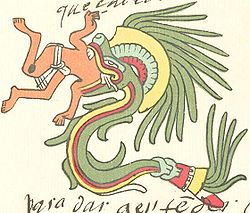 The worship of the serpent is found in many parts of the Old World
, and in the Americas.
In India Snake worship
refers to the high status of snake
s in Hindu mythology
. Over a large part of India there are carved representations of cobras (nagas) or stones as substitutes. To these human food and flowers are offered and lights are burned before the shrines. Among the Dravidians a cobra which is accidentally killed is burned like a human being; no one would kill one intentionally. The serpent-god's image is carried in an annual procession by a celibate priestess.
At one time there were many prevalent different renditions of the serpent cult located in India. In Northern India, a masculine version of the serpent named Nagaraja and known as the “king of the serpents” was worshipped. Instead of the “king of the serpents,” actual live snakes were worshipped in South India (Bhattacharyya 1965, p. 1). The Manasa-cult in Bengal, India, however, was dedicated to the anthropomorphic serpent goddess, Manasa
(Bhattacharyya 1965, p. 1).
In Africa the chief centre of serpent
worship was Dahomey
. but the cult of the python seems to have been of exotic origin, dating back to the first quarter of the 17th century. By the conquest of Whydah the Dahomeyans were brought in contact with a people of serpent worshippers, and ended by adopting from them the beliefs which they at first despised. At Whydah, the chief centre, there is a serpent temple, tenanted by some fifty snakes. Every python of the danh-gbi kind must be treated with respect, and death is the penalty for killing one, even by accident. Danh-gbi has numerous wives, who until 1857 took part in a public procession from which the profane crowd was excluded; a python was carried round the town in a hammock, perhaps as a ceremony for the expulsion of evils. The rainbow-god of the Ashanti was also conceived to have the form of a snake. His messenger was said to be a small variety of boa. but only certain individuals, not the whole species, were sacred. In many parts of Africa the serpent is looked upon as the incarnation of deceased relatives. Among the Amazulu, as among the Betsileo
of Madagascar, certain species are assigned as the abode of certain classes. The Maasai, on the other hand, regard each species as the habitat of a particular family of the tribe.
The Ancient Egyptians worshiped a number of snake gods, including Apophis
and Set
, and the Sumerians before them had a serpent god Ningizzida.
In America some of the Native American
tribes give reverence to the rattlesnake as grandfather and king of snakes who is able to give fair winds or cause tempest. Among the Hopi
of Arizona
the serpent figures largely in one of the dances. The rattlesnake was worshipped in the Natchez
temple of the sun and the Aztec
deity Quetzalcoatl
was a feathered serpent-god. In many MesoAmerican cultures, the serpent was regarded as a portal between two worlds. The tribes of Peru
are said to have adored great snakes in the pre-Inca days and in Chile
the Mapuche
made a serpent figure in their deluge beliefs.
Serpent worship was well known in ancient Europe. There does not appear to be much ground for supposing that Aesculapius was a serpent-god in spite of his connection with serpents. On the other hand, we learn from Herodotus
of the great serpent which defended the citadel of Athens
. The Roman genius loci took the form of a serpent where a snake was kept and fed with milk in the temple of Potrimpos, an old Slavonic god. The ancient Greeks also featured the Gorgons and Medusa
in their mythology.
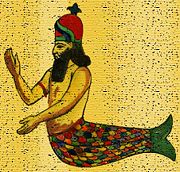 According to the Jewish scholar Rashi
, the Canaan
ite god Dagon
was a fish god. This tradition may have originated here, with a misinterpretation, but recently uncovered relief
s suggest a fish-god with human head and hands was worshipped by people who wore fish-skins.
Supposedly, there were sacred fish in the temples of Apollo
and Aphrodite
in Greece
, which may point to a fish cult. The goddess at Ashkelon
, Atargatis
was depicted as half woman, half fish, and according to Xenophon
the fish of the Chalus
were regarded as gods.
In Japan, there was a deity called Ebisu-gami who, according to Sakurada Katsunori, was widely revered by fishing communities and industries (Qtd. in Naumann, 1974, p. 1). Ebisu, in later traditions, normally appeared in the form of a fisherman holding a fishing pole and carrying a red tai (a perch), but would sometimes take the form of a whale, shark, human corpse, or rock (Naumann, 1974, p. 1). The general image of Ebisu, however, appears to be the whale or the shark, according to Sakurada (Qtd. in Naumann, 1974, p. 2).
During Ebisu-gami festivals, there have been legends told of strange fish creatures which have arrived and been considered sacred. Examples of such fish creatures include familiar species of fish with multiple tails (Naumann, 1974, p. 2). Sometimes these fish were considered to be simply an offering to the deity. Other times, however, they were considered to be Ebisu himself, visiting on the festival day (Naumann, 1974, p. 2).
The praying mantis
and the caterpillar, Ngo, are the incarnations of Cagn
, a prominent figure in Bushman
mythology. It was called the "Hottentots' god" by early European settlers.
The cult of the lizard
is most prominent in the Pacific, where it appears as an incarnation of Tangaloa. In Easter Island
a form of the house-god is the lizard. It is also a tutelary deity in Madagascar
.
.
Bird
s are especially common in this role, as by their faculty of flight they offer themselves to the interpretation as messengers between the celestial and human spheres. Augury was a highly developed practice of telling the future from the flight of birds in Classical Antiquity
. The dove
appears as an oracular animal in the story of Noah
, and also in Thisbe in Boeotia
there was a dove-oracle of Zeus
. Animal imagery was also often employed in the oracular utterances
in Ancient Greece.
In Chinese traditional religion, the tortoise
is an oracular animal.
Notable oracular animals of the modern period include Lady Wonder
, Punxsutawney Phil
, Maggie the Monkey
, Lazdeika the Crab
, Paul the Octopus
and Sonny Wool
.
An example of animal spirits in Shamanism comes from the Yenisei Ostiaks culture. During a healing procedure, a shaman invokes a number of animal spirits to help him. The spirits arrive and enter his body. The shaman is not possessed by these spirits; he is free to expel them at any time (Waida, 1983, p. 223). His body begins to leap all over the place, symbolizing that his soul is rising, leaving the earth and going up to the sky. It is a bird spirit that is lifting him through the atmosphere and he cries for it to take him higher so he can see further. According to Adolf Friedrich, at this point the shaman’s essence has, in fact, transformed into the bird spirit that crossed the threshold into his body (Waida, 1983, p. 223). He finally spots what he is looking for, the soul of his ill patient. Still assisting him, the animal spirits carry the shaman to the patient’s soul. The shaman retrieves it and returns the soul to its rightful place, healing the patient. Without the presence of animal spirits, the shaman could not have accomplished such a feat (Waida, 1983, p. 231).
In the Inner Eurasian religion, the transformation of a shaman’s essence into an animal spirit is referred to as “becoming animal” (Baldick 2000, p. 167). The importance of animals in this shamanic religion is shown by the capabilities that animals grant to human beings. Without the assistance of animals, humans from Inner Eurasia were not capable of reaching the sky, traveling rapidly throughout the earth, or going beneath the earth’s outer crust, all of which were important activities to the culture (Baldick 2000, p. 167). Heaven was not attainable for a person without the assistance of an eagle. Because of the eagle, an animal, the Inner Eurasians believed that they were capable of achieving their after-life and living in the home of their ancestors and Supreme God after their departure from the earth (Baldick 2000, p. 167). Heaven was represented by the people in assemblies of animals, usually grouped in sevens or nines (Baldick 2000, p. 167). When participating in hunting or warfare, Inner Eurasians also took on animal qualities because they believed it would increase their success (Baldick 2000, p. 167). Animals were a central part of this religion (Baldick 2000, p. 167).
, or refraining from the destruction of life (Regenstein 1991, p. 234). According to Buddhist belief, humans do not deserve preferential treatment over other living beings. Thus, the world is not specifically meant for human use and should be shared equally amongst all creatures (Epstein 1990). Buddhists recognize that all animals are sentient and are capable of feeling pain, grief, fear, happiness, and hunger (Regenstein 1991, p. 234-235). The Dalai Lama
once said “Even ants and other insects will run away from danger... They have intelligence and want to live too. Why should we harm them?” (Qtd. in Regenstein 1991, p. 235). Not believing in inflicting harm on any living, sentient being, some Buddhists also follow a vegetarian diet to avoid causing pain to animals (Regenstein 1991, p. 238).
Avoiding the destruction of life can affect aspects beyond a Buddhist’s diet, such as travel plans. In order to avoid crushing any living thing, be it plant, insect, or animal, some Buddhist monk
s do not travel during rainy seasons (Regenstein 1991, p. 236). Originally, shortly after Buddhism was first founded, monks traveled during all seasons, but public opinion changed this. The people protested that so much life was crushed and destroyed when monks traveled during the wet season. As a result, monks were required to seek shelter during this season and abstain from journeys (Chapple 1993, p. 22).
Living creatures, including humans, culminate to form one large, united life-force in the Buddhist religion. Buddhists, therefore, believe that to harm another living creature is to, in fact, harm yourself as all life-forms are interrelated (Regenstein 1991, p. 237). There are many parables that depict humans sacrificing their lives so that an animal may live. A jataka
, or previous incarnation story, tells how the Buddha, (upon hearing the distraught cries of a lioness struggling to feed her hungry cubs), leapt from a cliff and smashed his body to death as an offering, so that she could feed his flesh to them (Chapple 1993, p. 22).
, the founder of Jainism
, believed that the only way to be released from the cycle of life (birth, death, and then rebirth), one must follow, like Buddhists, ahimsa and not harm any living creature (Regenstein 1991, p. 229). Some Jains will carry a broom with them and sweep their path as they walk to avoid stepping on any living creature. Jains will also wear masks over their mouths to prevent swallowing insects and inspect their fruit for worms. The fruit inspection is not, however, because of their aversion of worms, but for the protection of the worms themselves (Regenstein 1991, p. 229-230). Jains are also only allowed to eat during daylight hours, when their vision is not restricted, so that they avoid eating insects or other small creatures that could possibly be in their food (Regenstein 1991, p. 230).
Jainism includes a lay form which is somewhat less restrictive (Regenstein 1991, p. 231). Basically lay Jains must distinguish between what forms of violence are necessary and unnecessary, but do not have to abstain entirely (Vallely 2002, p. 5). This results in avoiding all forms of hunting, tilling the soil (tilling involved disturbing creatures embedded in the earth), and brewing (brewing involved using living organisms such as yeasts) (Regenstein 1991, p. 231).
Food will never be prepared especially for them. They beg for food from others believing that because the food was prepared for someone else, they are not the cause of violence towards living creatures (Vallely 2002, p. 5).
Lay Jains, who have the financial capacity, will visit animal markets and buy/rescue animals destined for slaughter for the good that it does. (Regenstein 1991, p. 232).
is the primary religion of India (Regenstein 1991, p. 221). Hinduism has evolved over several centuries with vedic times when there was no restriction on animal worship and also animal consumption for food, to later Buddhist and Jain influence that led to the concept of non violence and animal respect and consideration, ahimsa (non-violence) is a major concept in Hindu belief (Regenstein 1991, p. 223). Humans and animals are one family and therefore, humans should treat all living creatures with respect and kindness. Pets are often treated as if they are truly members of the family (Regenstein 1991, p. 223-224).
There are some exceptions to ahimsa in Hinduism. While Hindu belief forbids the slaughter of animals for human sustenance, animal sacrifice was an accepted ritual in some parts of India (Regenstein 1991, p. 225). An explanation for this supposed paradox is that a sacrificial animal is not really considered to be an animal, but a symbol. Thus, when the animal is sacrificed, they are sacrificing the symbol and not the animal (Regenstein 1991, p. 226). The killing of an animal for human pleasure or lavishness is prohibited. An example of such lavishness would be hunting for pleasure, a fur coat made from animal skin, etc. (Regenstein 1991, p. 226).
Animal sacrifice
Animal sacrifice is the ritual killing of an animal as part of a religion. It is practised by many religions as a means of appeasing a god or gods or changing the course of nature...
.
The origins of animal worship have been the subject of many theories. The classical author Diodorus explained the origin of animal-worship by recalling the myth in which the gods, supposedly threatened by giants, hid under the guise of animals. The people then naturally began to worship the animals that their gods had disguised themselves as and continued this act even after the gods returned to their normal state (Lubbock, 2005, p. 252). In 1906, Weissenborn suggested that animal worship resulted from man’s natural curiosity. Primitive man would observe an animal that had a unique trait and the inexplicability of this trait would appeal to man’s curiosity (Weissenborn, 1906b, p. 282). Wonder resulted from primitive man’s observations of this distinctive trait and this wonder eventually induced adoration. Thus, primitive man worshipped animals that had inimitable traits (Weissenborn, 1906b, p. 282). Lubbock put forward a more recent view. Lubbock proposed that animal-worship originated from family names. In societies, families would name themselves and their children after certain animals and eventually came to hold that animal above other animals. Eventually, these opinions turned into deep respect and evolved into fully developed worship of the family animal (Lubbock, 2005, p. 253). The belief that an animal is sacred frequently results in dietary laws
Taboo food and drink
Taboo food and drink are food and beverages which people abstain from consuming for religious, cultural or hygienic reasons. Many food taboos forbid the meat of a particular animal, including mammals, rodents, reptiles, amphibians, bony fish, and crustaceans...
prohibiting their consumption. As well as holding certain animals to be sacred, religions have also adopted the opposite attitude, that certain animals are unclean
Unclean animals
Unclean animals, in some religions, are animals whose consumption or handling is labeled a taboo. According to these religion's dogmas, persons who handle such animals may need to purify themselves to get rid of their uncleanness.-Judaism:...
.
The idea that divinity embodies itself in animals, such as a deity incarnate, and then lives on earth among human beings is disregarded by Abrahamic religions (Morris, 2000, p. 26). In churches such as Independent Assemblies of God and Pentecostal, animals have very little religious significance (Schoffeleers, 1985; Peltzer, 1987; Qtd. in Morris, 2000, p. 25). Animals have become less and less important and symbolic in cult rituals and religion, especially among African cultures, as Christianity and Islamic religions have spread. (Morris, 2000, p. 24).
The Egyptian pantheon
Egyptian pantheon
The Egyptian pantheon consisted of the many gods worshipped by the Ancient Egyptians. A number of major deities are addressed as the creator of the cosmos. These include Atum, Ra, Amun and Ptah amongst others, as well as composite forms of these gods such as Amun-Ra. This was not seen as...
was especially fond of zoomorphism, with many animals sacred to particular deities—cat
Cat
The cat , also known as the domestic cat or housecat to distinguish it from other felids and felines, is a small, usually furry, domesticated, carnivorous mammal that is valued by humans for its companionship and for its ability to hunt vermin and household pests...
s to Bastet, ibis
Ibis
The ibises are a group of long-legged wading birds in the family Threskiornithidae....
es and baboon
Baboon
Baboons are African and Arabian Old World monkeys belonging to the genus Papio, part of the subfamily Cercopithecinae. There are five species, which are some of the largest non-hominoid members of the primate order; only the mandrill and the drill are larger...
s to Thoth
Thoth
Thoth was considered one of the more important deities of the Egyptian pantheon. In art, he was often depicted as a man with the head of an ibis or a baboon, animals sacred to him. His feminine counterpart was Seshat...
, crocodile
Crocodile
A crocodile is any species belonging to the family Crocodylidae . The term can also be used more loosely to include all extant members of the order Crocodilia: i.e...
s to Sebek and Ra
Ra
Ra is the ancient Egyptian sun god. By the Fifth Dynasty he had become a major deity in ancient Egyptian religion, identified primarily with the mid-day sun...
, fish to Set
Set (mythology)
Set was in Ancient Egyptian religion, a god of the desert, storms, and foreigners. In later myths he was also the god of darkness, and chaos...
, mongoose
Mongoose
Mongoose are a family of 33 living species of small carnivorans from southern Eurasia and mainland Africa. Four additional species from Madagascar in the subfamily Galidiinae, which were previously classified in this family, are also referred to as "mongooses" or "mongoose-like"...
, shrew
Shrew
A shrew or shrew mouse is a small molelike mammal classified in the order Soricomorpha. True shrews are also not to be confused with West Indies shrews, treeshrews, otter shrews, or elephant shrews, which belong to different families or orders.Although its external appearance is generally that of...
and bird
Bird
Birds are feathered, winged, bipedal, endothermic , egg-laying, vertebrate animals. Around 10,000 living species and 188 families makes them the most speciose class of tetrapod vertebrates. They inhabit ecosystems across the globe, from the Arctic to the Antarctic. Extant birds range in size from...
s to Horus
Horus
Horus is one of the oldest and most significant deities in the Ancient Egyptian religion, who was worshipped from at least the late Predynastic period through to Greco-Roman times. Different forms of Horus are recorded in history and these are treated as distinct gods by Egyptologists...
, dogs and jackal
Jackal
Although the word jackal has been historically used to refer to many small- to medium-sized species of the wolf genus of mammals, Canis, today it most properly and commonly refers to three species: the black-backed jackal and the side-striped jackal of sub-Saharan Africa, and the golden jackal of...
s to Anubis
Anubis
Anubis is the Greek name for a jackal-headed god associated with mummification and the afterlife in ancient Egyptian religion. In the ancient Egyptian language, Anubis is known as Inpu . According to the Akkadian transcription in the Amarna letters, Anubis' name was vocalized as Anapa...
, serpents and eel
Eel
Eels are an order of fish, which consists of four suborders, 20 families, 111 genera and approximately 800 species. Most eels are predators...
s to Atum
Atum
Atum, sometimes rendered as Atem or Tem, is an important deity in Egyptian mythology.- Name :Atum's name is thought to be derived from the word 'tem' which means to complete or finish. Thus he has been interpreted as being the 'complete one' and also the finisher of the world, which he returns to...
, beetle
Beetle
Coleoptera is an order of insects commonly called beetles. The word "coleoptera" is from the Greek , koleos, "sheath"; and , pteron, "wing", thus "sheathed wing". Coleoptera contains more species than any other order, constituting almost 25% of all known life-forms...
s to Khepera, bulls to Apis
Apis (Egyptian mythology)
In Egyptian mythology, Apis or Hapis , was a bull-deity worshipped in the Memphis region.According to Manetho, his worship was instituted by Kaiechos of the Second Dynasty. Hape is named on very early monuments, but little is known of the divine animal before the New Kingdom...
. Animals were often mummified
Animal mummies
Animal mummies were started by Egyptians. They mummified various animals. an enormous part of Egyptian culture, not only in their role as food and pets, but also for religious reasons...
as a result of these beliefs.
Classification of animal cults
When a god is respected or worshipped by means of a representative animal, an animal cult is formed (Teeter et al., 2002, p. 355). Such cults may result from early man's awareness of his essential equality with animals (Raglan, 1935, p. 331). Given this fundamental equality, it was just as reasonable for them to represent their gods in animal form (Gilbert, Qtd. in Raglan, 1935, p. 331).Animal cults may be classified in two ways:
- according to their outward form;
- according to their inward meaning, which may of course undergo transformations.
By outward form
There are two broad divisions:- all animals of a given species are sacred, perhaps owing to the impossibility of distinguishing the sacred few from the profane crowd; (Sacred-profane dichotomySacred-profane dichotomyFrench sociologist Émile Durkheim considered the dichotomy between the sacred and the profane to be the central characteristic of religion: "religion is a unified system of beliefs and practices relative to sacred things, that is to say, things set apart and forbidden." In Durkheim's theory, the...
) - one or a fixed number of a species are sacred. It is probable that the first of these forms is the primary one and the second in most cases a development from it due to
- the influence of other individual cults,
- anthropomorphic tendencies,
- the influence of chieftainship, hereditary and otherwise,
- annual sacrifice of the sacred animal and mystical ideas connected therewith,
- syncretismSyncretismSyncretism is the combining of different beliefs, often while melding practices of various schools of thought. The term means "combining", but see below for the origin of the word...
, due either to unity of function or to a philosophical unification, - the desire to do honour to the species in the person of one of its members, and possibly other less easily traceable causes.
By inward meaning
Treating cults according to their meaning, which is not necessarily identical with the cause which first led to the deification of the animal in question, we can classify them under ten specific heads:- Pastoral cults: The pastoral type falls into two sub-types, in which the species is spared and sometimes receives special honour at intervals in the person of an individual. (See Cattle, Buffalo, below.)
- Hunting cults: In hunting cults the species is habitually killed, but occasionally honoured in the person of a single individual, or each slaughtered animal receives divine honours. (See Bear, below.)
- Dangerous or noxious animals: The cult of dangerous animals is due to the fear that the soul of the slain beast may take vengeance on the hunter, to a desire to placate the rest of the species. (See Leopard, below.)
- Animals regarded as human souls or their embodiment:Animals are frequently regarded as the abode, temporary or permanent, of the souls of the dead, sometimes as the actual souls of the dead. Respect for them is due to two main reasons: the kinsmen of the dead desire to preserve the goodwill of their dead relatives and they wish at the same time to secure that their kinsmen are not molested and caused to undergo unnecessary suffering. (See Elephant, below.)
- Totemistic cults: One of the most widely found modes of showing respect to animals is known as totemism (see totemTotemA totem is a stipulated ancestor of a group of people, such as a family, clan, group, lineage, or tribe.Totems support larger groups than the individual person. In kinship and descent, if the apical ancestor of a clan is nonhuman, it is called a totem...
), where a particular animal is seen as sacred to an individual or group, but except in decadent forms there is but little positive worship. In Central Australia, however, the rites of the Wollunqua totem group are directed towards placating this mythical animal, and cannot be termed anything but religious ceremonies. In secret societies we find bodies of men grouped together with a single tutelary animal; the individual, in the same way, acquires the nagual or individual totem, sometimes by ceremonies of the nature of the bloodbond. While an individual's or group's totem is sacred to them, it would not be sacred to another individual or group. By contrast, sacred animals in other religions are thus seen as sacred to the gods, and thus to all humanity, rather than particular individuals or tribes, even though only those sharing this belief will acknowledge their sacredness. - Cults of nature and vegetation spiritsVegetation deityA vegetation deity is a nature deity whose disappearance and reappearance, or life, death and rebirth, embodies the growth cycle of plants. In nature worship, the deity can be a god or goddess with the ability to regenerate itself. A vegetation deity is often a fertility deity...
: Spirits of the landscape such as vegetation, rain and the earth in many parts of the world, such as Europe, Chine and Mesoamerica are conceived in animal form. (See Goat, Serpent below.) - Cults of ominous animals:The ominous (in the sense of being an omen) animal or bird may develop into a deity. (See Hawk, below.)
- Cults of animals associated with zoomorphic deities: It is commonly assumed that the animals associated with certain deities are sacred because the god was originally zoomorphic or theriomorphic (shapeshifting) ; this is doubtless the case in certain instances; but Apollo Smintheus, Dionysus Bassareus and other examples seem to show that the god may have been appealed to for help and thus become associated with the animals from whom he protected the crops, and so on.
- Cults of animals used in magic: The use of animals in magic may sometimes give rise to a kind of respect for them, but this is of a negative nature. See, however, articles by Preuss in Globus, vol. lxvii., in which he maintains that animals of magical influence are elevated into divinities.
Bear
The bearBear
Bears are mammals of the family Ursidae. Bears are classified as caniforms, or doglike carnivorans, with the pinnipeds being their closest living relatives. Although there are only eight living species of bear, they are widespread, appearing in a wide variety of habitats throughout the Northern...
enjoys a large measure of respect from all cultures that come in contact with it, which shows itself in apologies and in festivals in its honour. Bear worship
Bear worship
Bear worship is the religious practice of the worshiping of bears found in many North American and North Eurasian ethnic circumpolar religions such as the Sami, Nivkh, Ainu, and pre-Christian Finns...
is found in a number of religions, including Finnish paganism.The most notable ceremonies involving bears are found in East Asia.
There is a festival among the Nivkhs that takes the form of a celebration in honour of a recently dead kinsman, to whom the spirit of the bear is sent. There have been some attempts to revive the practice.
There is a good deal of evidence to connect the Greek goddess Artemis
Artemis
Artemis was one of the most widely venerated of the Ancient Greek deities. Her Roman equivalent is Diana. Some scholars believe that the name and indeed the goddess herself was originally pre-Greek. Homer refers to her as Artemis Agrotera, Potnia Theron: "Artemis of the wildland, Mistress of Animals"...
with a cult of the bear. Girls danced as "bears" in her honour, and might not marry before undergoing this ceremony. According to mythology, the goddess once transformed a nymph
Nymph
A nymph in Greek mythology is a female minor nature deity typically associated with a particular location or landform. Different from gods, nymphs are generally regarded as divine spirits who animate nature, and are usually depicted as beautiful, young nubile maidens who love to dance and sing;...
into a bear and then into the constellation Ursa Major
Ursa Major
Ursa Major , also known as the Great Bear, is a constellation visible throughout the year in most of the northern hemisphere. It can best be seen in April...
.
The bear is traditionally associated with Bern, Switzerland
Switzerland
Switzerland name of one of the Swiss cantons. ; ; ; or ), in its full name the Swiss Confederation , is a federal republic consisting of 26 cantons, with Bern as the seat of the federal authorities. The country is situated in Western Europe,Or Central Europe depending on the definition....
. It is believed that the city's name derives from the Germanic word for "bears" (Bären in German
German language
German is a West Germanic language, related to and classified alongside English and Dutch. With an estimated 90 – 98 million native speakers, German is one of the world's major languages and is the most widely-spoken first language in the European Union....
) and a bear is featured on the city's flag and coat of arm. In 1832 a statue of the Celtic
Celtic mythology
Celtic mythology is the mythology of Celtic polytheism, apparently the religion of the Iron Age Celts. Like other Iron Age Europeans, the early Celts maintained a polytheistic mythology and religious structure...
bear goddess Artio
Artio
Artio was a Celtic bear goddess. Evidence of her worship has notably been found at Bern whose name according to legend is derived from the word Bär, "bear".-Representations and inscriptions:...
was dug up there.
The existence of an ancient bear cult among Neanderthals in the Middle Paleolithic period has been a topic of discussion spurred by archaeological findings (Wunn, 2000, p. 434-435). Ancient bear bones have been discovered in several different caves and their peculiar arrangement are believed by some archaeologists to be evidence of a bear cult during the Paleolithic era. (Wunn, 2000, p. 435). However, others argue that the placement of these remains, whether it appears to be an identified pattern or not, is due to natural causes such as wind, sediment, or water (Wunn, 2000, p. 437-438).
Ainu people
The , also called Aynu, Aino , and in historical texts Ezo , are indigenous people or groups in Japan and Russia. Historically they spoke the Ainu language and related varieties and lived in Hokkaidō, the Kuril Islands, and much of Sakhalin...
, who live on select islands in the Japanese archipelago, call the bear “kamui” in their language, which translates to mean god. While many other animals are considered to be gods in the Ainu culture, the bear is the head of the gods (Kindaichi, 1949, p. 345). For the Ainu, when the gods visit the world of man, they don fur and claws and take on the physical appearance of an animal. Usually, however, when the term “kamui” is used, it essentially means a bear (Kindaichi, 1949, p. 345). The Ainu people willingly and thankfully ate the bear as they believed that the disguise (the flesh and fur) of any god was a gift to the home that the god chose to visit (Kindaichi, 1949, p. 348).
Whale
In middle and South Vietnam coastal area, whale is considered sacred creature, who bring lucks and prosperity to fishermen. They are respectfully addressed as "the Lord". Coastal villages often hold funerals for beached whales, their remains are buried and skeletons are collected to be revered.The first emperor of the last dynasty of Vietnam is believed to be rescued by a whale when his ship was capsized in a storm. After unifying the country, he sainted the whale who came to his rescue, which is known today as "Đông Hải phúc thần" (the deity of Fortune in the East sea).
A prevalent whale
Whale
Whale is the common name for various marine mammals of the order Cetacea. The term whale sometimes refers to all cetaceans, but more often it excludes dolphins and porpoises, which belong to suborder Odontoceti . This suborder also includes the sperm whale, killer whale, pilot whale, and beluga...
cult in Japan occurs around the coastal area. There are cemeteries with memorial stones dedicated to the whales which were hunted and killed to feed the people (Naumann, 1974, p. 4).
Buddhist epitaphs mark these stones which implore that Buddha be reborn as a whale (Naumann, 1974, p. 4). Along with these memorials, there is evidence that whale embryos, found in a deceased mother’s womb, were extracted and buried with the same respect as a human being (Naumann, 1974, p. 5). For certain shrines, the bones of a perished whale were also deposited in the area (Naumann, 1974, p. 5).
In Alaska, there were certain tribes that had ceremonial tributes to pieces of a whale after it was captured in a hunt (Lantis 1938, p. 445). Some tribes brought the hump, the fins, or the nose of the whale into their camps or the whaler’s house. These parts were meant to represent the entirety of the whale and were honored as such during the festival (Lantis 1938, p. 445). The bones of a whale, however, were also given ritual treatment. The Alaskan tribes that participated in such acts believed that their rituals protected the whale’s soul from injury and it could then be free to return to the sea (Lantis 1938, p. 445).
In the book Moby Dick can be found a longer description of the symbolism of the whale.
Cattle and buffalo
Hinduism
Hinduism is the predominant and indigenous religious tradition of the Indian Subcontinent. Hinduism is known to its followers as , amongst many other expressions...
, but also Zoroastrianism
Zoroastrianism
Zoroastrianism is a religion and philosophy based on the teachings of prophet Zoroaster and was formerly among the world's largest religions. It was probably founded some time before the 6th century BCE in Greater Iran.In Zoroastrianism, the Creator Ahura Mazda is all good, and no evil...
, and ancient Greek
Ancient Greek religion
Greek religion encompasses the collection of beliefs and rituals practiced in ancient Greece in the form of both popular public religion and cult practices. These different groups varied enough for it to be possible to speak of Greek religions or "cults" in the plural, though most of them shared...
and Egyptian religion. Cattle and buffalo are respected by many pastoral peoples that rely on the animals for sustenance and the killing of an ox is a sacrificial function.
The Toda of southern India
India
India , officially the Republic of India , is a country in South Asia. It is the seventh-largest country by geographical area, the second-most populous country with over 1.2 billion people, and the most populous democracy in the world...
abstain from the flesh of their domestic animal, the buffalo. However, once a year they sacrifice a bull calf, which is eaten in the forest by the adult males. The buffalo plays an important part in many Toda rituals. These buffalo are currently endangered.
Conspicuous among Egyptian animal cults was that of the bull, Apis
APIS
APIS may refer to:*Advance Passenger Information System*Armour Piercing Incendiary Shells...
. It was distinguished by certain marks, and when the old Apis died a new one was sought. The finder was rewarded, and the bull underwent four months' education at Nilopolis
Nilopolis
Nilopolis or Delas was a city in Egypt situated on the left bank of the Nile, about forty-seven miles from Memphis.It is a Roman Catholic titular bishopric and a suffragan of the metropolitan of Oxyrynchos, in Egypt.-History:...
. Its birthday was celebrated once a year when oxen, which had to be pure white, were sacrificed to it. Women were forbidden to approach it when once its education was finished. Oracles were obtained from it in various ways. After death it was mummified and buried in a rock-tomb. Less widespread was the cult of the Mnevis, also consecrated to Osiris
Osiris
Osiris is an Egyptian god, usually identified as the god of the afterlife, the underworld and the dead. He is classically depicted as a green-skinned man with a pharaoh's beard, partially mummy-wrapped at the legs, wearing a distinctive crown with two large ostrich feathers at either side, and...
.
Similar observances are found in our own day on the Upper Nile
Nile
The Nile is a major north-flowing river in North Africa, generally regarded as the longest river in the world. It is long. It runs through the ten countries of Sudan, South Sudan, Burundi, Rwanda, Democratic Republic of the Congo, Tanzania, Kenya, Ethiopia, Uganda and Egypt.The Nile has two major...
. The Nuba
Nuba
Nuba is a collective term used here for the peoples who inhabit the Nuba Mountains, in Sudan, Africa. Although the term is used to describe them as if they composed a single group, the Nuba are multiple distinct peoples and speak different languages...
and Nuer revere cattle. The Angoni of Central Africa and the Sakalava
Sakalava
The Sakalava are an ethnic group of Madagascar numbering approximately 700,000 in population. Their name means "people of the long valleys." They occupy the Western edge of the island from Toliara in the south to Sambirano in the north. The Sakalava denominate a number of smaller ethnic groups...
of Madagascar keep sacred bulls. In India
India
India , officially the Republic of India , is a country in South Asia. It is the seventh-largest country by geographical area, the second-most populous country with over 1.2 billion people, and the most populous democracy in the world...
respect for the cow is widespread, but is of post-Vedic origin; there is little actual worship, but the products of the cow are important in magic.
While there are several animals that are worshipped in India, the supreme position is held by the cow (Margul, 1968, p. 63). The humped zebu, a breed of cow, is central to the religion of Hinduism (Margul, 1968, p. 63). Mythological legends have supported the sanctity of the zebu throughout India (Margul, 1968, p. 64). Such myths have included the creation of a divine cow mother and a cow heaven by the God, Brahma
Brahma
Brahma is the Hindu god of creation and one of the Trimurti, the others being Vishnu and Shiva. According to the Brahma Purana, he is the father of Mānu, and from Mānu all human beings are descended. In the Ramayana and the...
and Prithu
Prithu
According to Hindu mythology, Prithu is a sovereign , named in the Vedic scriptures and considered an Avatar of the preserver god—Vishnu. He is also called Pruthu, Prithi and Prithu Vainya, literally, Prithu — the son of Vena...
, the sovereign of the universe, created the earth’s vegetation, edible fruits and vegetables, disguised as a cow (Margul, 1968, p. 64).
According to Tadeusz Margul, observations of the Hindu religion and the cow has led to a misunderstanding that Hindi have a servile relationship with the zebu, giving prayers and offerings to it daily. Typically, however, only during the Cow Holiday, an annual event, is the cow the recipient of such practices (Margul, 1968, p. 65). Margul suggests that sanctity of the cow is based on four foundations: abstaining from cow slaughter, abstaining from beef consumption, control of breeding and ownership, and belief in purification qualities of cow products (milk, curd, ghee, dung, and urine) (Margul, 1968, p. 65-66).
Sheep
Only in Africa do we find a sheep-god proper. AmunAmun
Amun, reconstructed Egyptian Yamānu , was a god in Egyptian mythology who in the form of Amun-Ra became the focus of the most complex system of theology in Ancient Egypt...
, the god of Thebes, Egypt
Thebes, Egypt
Thebes is the Greek name for a city in Ancient Egypt located about 800 km south of the Mediterranean, on the east bank of the river Nile within the modern city of Luxor. The Theban Necropolis is situated nearby on the west bank of the Nile.-History:...
, was represented as ram-headed. His worshippers held the ram to be sacred, however, it was sacrificed once a year. Its fleece formed the clothing of the idol. Another Egyptian ram-headed god was Banebdjed, a form of Osiris
Osiris
Osiris is an Egyptian god, usually identified as the god of the afterlife, the underworld and the dead. He is classically depicted as a green-skinned man with a pharaoh's beard, partially mummy-wrapped at the legs, wearing a distinctive crown with two large ostrich feathers at either side, and...
.
Goat
Silenus
In Greek mythology, Silenus was a companion and tutor to the wine god Dionysus.-Evolution of the character:The original Silenus resembled a folklore man of the forest with the ears of a horse and sometimes also the tail and legs of a horse...
, the Satyr
Satyr
In Greek mythology, satyrs are a troop of male companions of Pan and Dionysus — "satyresses" were a late invention of poets — that roamed the woods and mountains. In myths they are often associated with pipe-playing....
s and the Faun
Faun
The faun is a rustic forest god or place-spirit of Roman mythology often associated with Greek satyrs and the Greek god Pan.-Origins:...
s were either capriform or had some part of their bodies shaped like that of a goat. In northern Europe the wood spirit, Leszi
Leszi
The Leshy or Lesovik is a male woodland spirit in Slavic mythology who protects wild animals and forests. There are also leshachikha/leszachka and leshonky...
, is believed to have a goat's horns, ears and legs. In Africa the Bijago people are said to have a goat as their principal divinity. A deity known as the Goat of Mendes
Mendes
Mendes , the Greek name of the Ancient Egyptian city of Djedet, also known in Ancient Egypt as Per-Banebdjedet and Anpet, is known today as Tell El-Ruba ....
is associated with the pentagram
Pentagram
A pentagram is the shape of a five-pointed star drawn with five straight strokes...
.
In Greece, Italy, and Egypt, the goat was worshipped in both goat form and phallic form (Neave 1988, p. 8). This type of worship has sometimes been said to have originated from the goat’s increased sex drive. One male goat was capable of fertilizing 150 females (Neave 1988, p. 8). The Greek god Pan
Pan (mythology)
Pan , in Greek religion and mythology, is the god of the wild, shepherds and flocks, nature, of mountain wilds, hunting and rustic music, as well as the companion of the nymphs. His name originates within the Greek language, from the word paein , meaning "to pasture." He has the hindquarters, legs,...
was depicted as having goat characteristics, such as hooves, horns, and a beard. Along with Pan, the goat was closely related to Dionysus during the Roman era (Neave 1988, p. 8). To honor Dionysus, Romans would tear apart a goat and eat it alive. The goat was commonly associated with dark arts and the devil. This association was amplified in Europe during the Middle Ages (Neave 1988, p. 8).
Excavations in Central Asia have revealed ancient ritual goat-burial that show a religious significance of the goat predominantly in the Afghanistan area (Sidky 1990, p. 286). These findings have been used as evidence for a goat-cult of Asia originating either in the Neolithic or Bronze Ages (Sidky 1990, p. 286). An example of a goat-burial finding was discovered on the Oxus River. Along these banks, a Neanderthal grave was excavated surrounded by several pairs of goat horns, suggesting significance of goats in Central Asian religion (Sidky 1990, p. 286).
Dog
Hindu
Hindu refers to an identity associated with the philosophical, religious and cultural systems that are indigenous to the Indian subcontinent. As used in the Constitution of India, the word "Hindu" is also attributed to all persons professing any Indian religion...
s in Nepal
Nepal
Nepal , officially the Federal Democratic Republic of Nepal, is a landlocked sovereign state located in South Asia. It is located in the Himalayas and bordered to the north by the People's Republic of China, and to the south, east, and west by the Republic of India...
and some parts of India
India
India , officially the Republic of India , is a country in South Asia. It is the seventh-largest country by geographical area, the second-most populous country with over 1.2 billion people, and the most populous democracy in the world...
. The dogs are worshipped as a part of a five-day Tihar festival that falls roughly in November every year. In Hinduism
Hinduism
Hinduism is the predominant and indigenous religious tradition of the Indian Subcontinent. Hinduism is known to its followers as , amongst many other expressions...
, it is believed that the dog is a messenger of Yama
Yama
Yama , also known as Yamarāja in India and Nepal, Shinje in Tibet, Yanluowang or simply Yan in China, Yeomla Daewang in South Korea and Enma Dai-Ō in Japan, is the lord of death, in Hinduism and then adopted into Buddhism and then further into Chinese mythology and Japanese mythology. First...
, the god of death, and dogs guard the doors of Heaven
Heaven
Heaven, the Heavens or Seven Heavens, is a common religious cosmological or metaphysical term for the physical or transcendent place from which heavenly beings originate, are enthroned or inhabit...
. Socially, they are believed to be the protectors of our homes and lives. So, in order to please the dogs they are going to meet at Heaven's doors after death, so they would be allowed in Heaven, people mark the 14th day of the lunar cycle in November as Kukur-tihar, as known in Nepali language for the dog's day. This is a day when the dog is worshipped by applying tika
Tilaka
200px|thumb|right|Indian woman with tilaka and [[Bindi |bindi]]In Hinduism, the tilaka or tika or tilak is a mark worn on the forehead and other parts of the body...
(the holy vermilion dot), incense sticks and garlanded generally with marigold
Tagetes
Tagetes is a genus of 56 species of annual and perennial mostly herbaceous plants in the sunflower family . The genus is native to North and South America, but some species have become naturalized around the world. One species, T...
flower.
Actual dog
Dog
The domestic dog is a domesticated form of the gray wolf, a member of the Canidae family of the order Carnivora. The term is used for both feral and pet varieties. The dog may have been the first animal to be domesticated, and has been the most widely kept working, hunting, and companion animal in...
worship is uncommon. The Nosarii of western Asia are said to worship a dog. The Karang
Karang Jiwo
Karang Jiwo is a village lying in the estuary of the Solo River, in the Lamongan regency.The name of the village is divided in two parts, karang meaning "courtyard" and jiwo, "soul". The village's history was largely influenced by the Majapahit empire....
of Java had a cult of the red dog, each family keeping one in the house. According to one authority the dogs are images of wood which are worshipped after the death of a member of the family and burnt after a thousand days. In Nepal
Nepal
Nepal , officially the Federal Democratic Republic of Nepal, is a landlocked sovereign state located in South Asia. It is located in the Himalayas and bordered to the north by the People's Republic of China, and to the south, east, and west by the Republic of India...
it is said that dogs are worshipped at the festival called Khicha Puja. Among the Harranians dogs were sacred, but this was rather as brothers of the mystae.
Horse
Horse worshipHorse worship
Horse worship is a pagan practice that existed in Europe in the Iron Age and perhaps the Bronze Age. The horse was seen as divine, as a sacred animal associated with a particular deity, or as a totem animal impersonating the king or warrior. Horse cults and horse sacrifice were originally a feature...
has been practiced by a number of Indo-European
Proto-Indo-Europeans
The Proto-Indo-Europeans were the speakers of the Proto-Indo-European language , a reconstructed prehistoric language of Eurasia.Knowledge of them comes chiefly from the linguistic reconstruction, along with material evidence from archaeology and archaeogenetics...
and Turkic peoples
Turkic peoples
The Turkic peoples are peoples residing in northern, central and western Asia, southern Siberia and northwestern China and parts of eastern Europe. They speak languages belonging to the Turkic language family. They share, to varying degrees, certain cultural traits and historical backgrounds...
. There is some reason to believe that Poseidon
Poseidon
Poseidon was the god of the sea, and, as "Earth-Shaker," of the earthquakes in Greek mythology. The name of the sea-god Nethuns in Etruscan was adopted in Latin for Neptune in Roman mythology: both were sea gods analogous to Poseidon...
, like other water gods, was originally conceived under the form of a horse
Horse
The horse is one of two extant subspecies of Equus ferus, or the wild horse. It is a single-hooved mammal belonging to the taxonomic family Equidae. The horse has evolved over the past 45 to 55 million years from a small multi-toed creature into the large, single-toed animal of today...
. In the cave of Phigalia
Phigalia
Phigalia or Phigaleia is an ancient Greek city in the south-west corner of Arcadia. It is also the present name of a nearby modern village, known up to the early 20th century as Pavlitsa . In modern geography it is located in the southeastern Elis Prefecture...
Demeter
Demeter
In Greek mythology, Demeter is the goddess of the harvest, who presided over grains, the fertility of the earth, and the seasons . Her common surnames are Sito as the giver of food or corn/grain and Thesmophoros as a mark of the civilized existence of agricultural society...
was, according to popular tradition, represented with the head and mane of a horse, possibly a relic of the time when a non-specialized corn-spirit
Vegetation deity
A vegetation deity is a nature deity whose disappearance and reappearance, or life, death and rebirth, embodies the growth cycle of plants. In nature worship, the deity can be a god or goddess with the ability to regenerate itself. A vegetation deity is often a fertility deity...
bore this form. Her priests were called Poloi (Greek
Greek language
Greek is an independent branch of the Indo-European family of languages. Native to the southern Balkans, it has the longest documented history of any Indo-European language, spanning 34 centuries of written records. Its writing system has been the Greek alphabet for the majority of its history;...
for "colts") in Laconia
Laconia
Laconia , also known as Lacedaemonia, is one of the regional units of Greece. It is part of the region of Peloponnese. It is situated in the southeastern part of the Peloponnese peninsula. Its administrative capital is Sparti...
. The mule and the horse are sacred to the Roman god Consus
Consus
In ancient Roman religion, the god Consus was the protector of grains and storage bins , and as such was represented by a grain seed....
. In Gaul
Gaul
Gaul was a region of Western Europe during the Iron Age and Roman era, encompassing present day France, Luxembourg and Belgium, most of Switzerland, the western part of Northern Italy, as well as the parts of the Netherlands and Germany on the left bank of the Rhine. The Gauls were the speakers of...
(France) we find a horse-goddess, Epona
Epona
In Gallo-Roman religion, Epona was a protector of horses, donkeys, and mules. She was particularly a goddess of fertility, as shown by her attributes of a patera, cornucopia, ears of grain and the presence of foals in some sculptures suggested that the goddess and her horses were leaders of the...
. There are also traces of a horse-god, Rudiobus
Rudiobus
Rudiobus is a Celtic god known only from a single inscription, on a bronze figurine of a prancing horse: "sacred to the god Rudiobus". This figurine is one a group found at Neuvy-En-Sullias . Horses were linked to many other Celtic deities, including the sky-god and the Celtic version of Mars...
. Hayagriva
Hayagriva
Hayagriva is a horse-headed deity that appears in both Hinduism and Buddhism.-Hinduism:...
is a horse-headed deity that appears in both Hinduism
Hinduism
Hinduism is the predominant and indigenous religious tradition of the Indian Subcontinent. Hinduism is known to its followers as , amongst many other expressions...
and Buddhism
Buddhism
Buddhism is a religion and philosophy encompassing a variety of traditions, beliefs and practices, largely based on teachings attributed to Siddhartha Gautama, commonly known as the Buddha . The Buddha lived and taught in the northeastern Indian subcontinent some time between the 6th and 4th...
. The Gonds in India worship a horse-god, Koda Pen, in the form of a shapeless stone, but it is not clear that the horse is regarded as divine. The horse or mare is a common form of the corn-spirit in Europe.
Among the Balkan culture, swaddling an unmarried person in a horse-girth is a typical ritual. It is thought that the sexual potency of the horse is passed to the individual wrapped in its girth (Vukanović 1980, p. 112). Along with the Balkan swaddling, Virgil’s Aeneid bases the founding of the great city of Carthage upon a horse (Qtd. in Brown 1950, p. 32). When the Phoenicians dug up a horse head from the ground they decided to build their city (Carthage) upon that spot because the horse was a sign of success (Qtd. in Brown 1950, p. 32). Thus, Brown argued that the horse was sacred to the Phoenician people (Brown 1950, p. 32).
Elephant
Thailand
Thailand , officially the Kingdom of Thailand , formerly known as Siam , is a country located at the centre of the Indochina peninsula and Southeast Asia. It is bordered to the north by Burma and Laos, to the east by Laos and Cambodia, to the south by the Gulf of Thailand and Malaysia, and to the...
it is believed that a white elephant
Elephant
Elephants are large land mammals in two extant genera of the family Elephantidae: Elephas and Loxodonta, with the third genus Mammuthus extinct...
may contain the soul of a dead person, perhaps a Buddha. When one is taken the capturer is rewarded and the animal brought to the king to be kept ever afterwards. It cannot be bought or sold. It is baptized and fêted and mourned for like a human being at its death. In some parts of Indo-China the belief is that the soul of the elephant may injure people after death; it is therefore fêted by a whole village. In Cambodia
Cambodia
Cambodia , officially known as the Kingdom of Cambodia, is a country located in the southern portion of the Indochina Peninsula in Southeast Asia...
it is held to bring luck to the kingdom. The cult of the white elephant is also found at Ennarea in southern Ethiopia
Ethiopia
Ethiopia , officially known as the Federal Democratic Republic of Ethiopia, is a country located in the Horn of Africa. It is the second-most populous nation in Africa, with over 82 million inhabitants, and the tenth-largest by area, occupying 1,100,000 km2...
. In India, the popular Hindu god Ganesha
Ganesha
Ganesha , also spelled Ganesa or Ganesh, also known as Ganapati , Vinayaka , and Pillaiyar , is one of the deities best-known and most widely worshipped in the Hindu pantheon. His image is found throughout India and Nepal. Hindu sects worship him regardless of affiliations...
has the head of an elephant and a torso of a human.
In Surat
Surat
Surat , also known as Suryapur, is the commercial capital city of the Indian state of Gujarat. Surat is India's Eighth most populous city and Ninth-most populous urban agglomeration. It is also administrative capital of Surat district and one of the fastest growing cities in India. The city proper...
, unmarried Anāvil girls participate in a holiday referred to as Alunām (Naik, 1958, p. 393). This holiday is to honor the goddess Pārvatī
Parvati
Parvati is a Hindu goddess. Parvati is Shakti, the wife of Shiva and the gentle aspect of Mahadevi, the Great Goddess...
. During this celebration, a clay elephant is prepared (most likely to celebrate Pārvatī
Parvati
Parvati is a Hindu goddess. Parvati is Shakti, the wife of Shiva and the gentle aspect of Mahadevi, the Great Goddess...
's creation of Ganesha
Ganesha
Ganesha , also spelled Ganesa or Ganesh, also known as Ganapati , Vinayaka , and Pillaiyar , is one of the deities best-known and most widely worshipped in the Hindu pantheon. His image is found throughout India and Nepal. Hindu sects worship him regardless of affiliations...
from a paste of either tumeric or sandalwood
Sandalwood
Sandalwood is the name of a class of fragrant woods from trees in the genus Santalum. The woods are heavy, yellow, and fine-grained, and unlike many other aromatic woods they retain their fragrance for decades. As well as using the harvested and cut wood in-situ, essential oils are also extracted...
). Every day, the unmarried women worship this elephant by dancing, singing songs, and abstaining from eating salt. On the final day of Alunām, the clay elephant is immersed in some body of water (Naik, 1958, p. 393).
Certain cultures also used elephant figurines to display the animal’s importance. There was evidence of an ancient elephant cult in Sumatra
Sumatra
Sumatra is an island in western Indonesia, westernmost of the Sunda Islands. It is the largest island entirely in Indonesia , and the sixth largest island in the world at 473,481 km2 with a population of 50,365,538...
(Schnitger, 1938, p. 41). Stone elephant figurines were built as “seats of the souls” in the Sumatran culture (Schnitger, 1938, p. 41). In North Borneo
North Borneo
North Borneo was a British protectorate under the sovereign North Borneo Chartered Company from 1882 to 1946. After the war it became a crown colony of Great Britain from 1946 to 1963, known in this time as British North Borneo. It is located on the northeastern end of the island of Borneo. It is...
, however, wooden elephant figurines were placed on the top of a bamboo pole. This bamboo pole was only erected after the tribe chief had collected a certain number of human heads (Schnitger, 1938, p. 41).
Wild mammals
Algonquian peoples
The Algonquian are one of the most populous and widespread North American native language groups, with tribes originally numbering in the hundreds. Today hundreds of thousands of individuals identify with various Algonquian peoples...
tribes had as their chief deity a "mighty great hare
Hare
Hares and jackrabbits are leporids belonging to the genus Lepus. Hares less than one year old are called leverets. Four species commonly known as types of hare are classified outside of Lepus: the hispid hare , and three species known as red rock hares .Hares are very fast-moving...
" to whom they went at death. According to one account he lived in the east, according to another in the north. In his anthropomorphized form he was known as Menabosho
Nanabozho
In Anishinaabe mythology, particularly among the Ojibwa, Nanabozho is a spirit, and figures prominently in their storytelling, including the story of the world's creation. Nanabozho is the Ojibwe trickster figure and culture hero...
or Michabo.
The deer is important in the mythology of many peoples. To the Greeks it was sacred to the goddess Artemis
Artemis
Artemis was one of the most widely venerated of the Ancient Greek deities. Her Roman equivalent is Diana. Some scholars believe that the name and indeed the goddess herself was originally pre-Greek. Homer refers to her as Artemis Agrotera, Potnia Theron: "Artemis of the wildland, Mistress of Animals"...
, while in Hinduism
Hinduism
Hinduism is the predominant and indigenous religious tradition of the Indian Subcontinent. Hinduism is known to its followers as , amongst many other expressions...
it is linked to the goddess Saraswati
Saraswati
In Hinduism Saraswati , is the goddess of knowledge, music, arts, science and technology. She is the consort of Brahma, also revered as His Shakti....
. The deer also held spiritual significance to the pastoralist cultures of the Eurasian Steppe
Eurasian Steppe
The Eurasian Steppe is the vast steppe ecoregion of Eurasia in the Temperate grasslands, savannas, and shrublands Biome. It stretches from Hungary to Mongolia...
. The golden stag figurine found in the Pazyryk burials is one of the most famous pieces of Scythian art.
Tiger
In many parts of Vietnam, tiger is a revered creature. In each village, there might be a tiger temple. This worshiping practice might have stem from the fear of tigers used to raid human settlements in the ancient time. Tigers are admired for their great strength, ferocity and grace. Tiger is also considered a guardian deity. Tiger statutes are usually seen at the entrance of temples and palaces, keeping evil spirits from entering those places.Wolf
The cult of the wolf is frequently found among the tutelary deities of North American dancing or secret societies. The Tlingit had a god, Khanukh, whose name means "wolf," and worshipped a wolf-headed image.In Altaic mythology
Altaic mythology
The mythologies of the Turkic and Mongol peoples are related and have exerted strong influence on one another. Both groups of peoples qualify as Eurasian nomads and have been in close contact throughout history, especially in the context of the medieval Turco-Mongol empire.The oldest mythological...
of the Turkic
Turkic peoples
The Turkic peoples are peoples residing in northern, central and western Asia, southern Siberia and northwestern China and parts of eastern Europe. They speak languages belonging to the Turkic language family. They share, to varying degrees, certain cultural traits and historical backgrounds...
and Mongolian peoples, the wolf is a revered animal. The shamanic Turkic peoples even believed they were descendants of wolves in Turkic legends. The legend of Asena
Asena
Asena is the name of one of the ten sons, whom mythical female wolf gave birth to, in old Turkic mythology. It is associated with a Göktürk ethnogenic myth "full of shamanic symbolism"...
is an old Turkic myth that tells of how the Turkic people were created. In Northern China a small Turkic village was raided by Chinese soldiers, but one small baby was left behind. An old she-wolf with a sky-blue mane named Asena found the baby and nursed him, then the she-wolf gave birth to half wolf, half human cubs therefore the Turkic people were born. Also in Turkic mythology it is believed that a gray wolf showed the Turks the way out of their legendary homeland Ergenekon
Ergenekon (legendary place)
Ergenekon is the name of the place where Nekuz and Qiyan and their wives escaped to, and who were the original Mongols in Jāmiʿ al-tawārīkh written by Rashid-al-Din Hamadani at the beginning of the 14th century...
, which allowed them to spread and conquer their neighbours.
Both Zeus
Zeus
In the ancient Greek religion, Zeus was the "Father of Gods and men" who ruled the Olympians of Mount Olympus as a father ruled the family. He was the god of sky and thunder in Greek mythology. His Roman counterpart is Jupiter and his Etruscan counterpart is Tinia.Zeus was the child of Cronus...
and Apollo were associated with the wolf by the Greeks, but it is not clear that this implies a previous cult of the wolf.
In Western culture, the most obvious example is the symbolism of Rome's foundation, and the use of wolves in totemic imagery.
Cats
The cult of the leopardLeopard
The leopard , Panthera pardus, is a member of the Felidae family and the smallest of the four "big cats" in the genus Panthera, the other three being the tiger, lion, and jaguar. The leopard was once distributed across eastern and southern Asia and Africa, from Siberia to South Africa, but its...
is widely found in West Africa. Among the Ashanti people a man who kills one is liable to be put to death; no leopard skin may be exposed to view, but a stuffed leopard is worshiped. On the Gold Coast a leopard hunter who has killed his victim is carried round the town behind the body of the leopard; he may not speak, must besmear himself so as to look like a leopard and imitate its movements. In Loango
Loango
Loango may refer to:* Loango National Park, a national park in Western Gabon* Petit Loango, a town in Gabon* Kingdom of Loango, a pre-colonial state in what is now the Republic of Congo* Loango, a schooner wrecked in 1909 at St Ives, Cornwall...
a prince's cap is put upon the head of a dead leopard, and dances are held in its honour.
During the Egyptian Twenty-sixth Dynasty people began mummifying particular animal species as offerings to the god whom the species represented. Millions of mummified cat
Cat
The cat , also known as the domestic cat or housecat to distinguish it from other felids and felines, is a small, usually furry, domesticated, carnivorous mammal that is valued by humans for its companionship and for its ability to hunt vermin and household pests...
s, birds, and other creatures were buried at temples honoring Egyptian deities. Worshippers paid the priests of a particular deity to obtain and mummify an animal and the mummy was placed in a cemetery near the god's cult center.
The lion
Lion
The lion is one of the four big cats in the genus Panthera, and a member of the family Felidae. With some males exceeding 250 kg in weight, it is the second-largest living cat after the tiger...
was associated with the Egyptian deities Horus
Horus
Horus is one of the oldest and most significant deities in the Ancient Egyptian religion, who was worshipped from at least the late Predynastic period through to Greco-Roman times. Different forms of Horus are recorded in history and these are treated as distinct gods by Egyptologists...
, Nefertum, Ra
Ra
Ra is the ancient Egyptian sun god. By the Fifth Dynasty he had become a major deity in ancient Egyptian religion, identified primarily with the mid-day sun...
and Sekhmet
Sekhmet
In Egyptian mythology, Sekhmet , was originally the warrior goddess as well as goddess of healing for Upper Egypt. She is depicted as a lioness, the fiercest hunter known to the Egyptians. It was said that her breath created the desert...
. There was a lion-god at Baalbek
Baalbek
Baalbek is a town in the Beqaa Valley of Lebanon, altitude , situated east of the Litani River. It is famous for its exquisitely detailed yet monumentally scaled temple ruins of the Roman period, when Baalbek, then known as Heliopolis, was one of the largest sanctuaries in the Empire...
. The pre-Islamic Arabs had a lion-god, Yaghuth
Yaghuth
Yaghūth is an idol referred to in the Qur'an as a god of the era of the Prophet Noah:And they say: By no means leave your gods, nor leave Wadd, nor Suwa'; nor Yaghuth, and Ya'uq and Nasr....
. In modern Africa we find a lion-idol among the Balonda. The lion was also sacred to Hebat
Hebat
Hebat, also transcribed Kheba or Khepat, was the mother goddess of the Hurrians, known as "the mother of all living".- Family :Hebat is the consort of Teshub and the mother of Sarruma. Originally, as Kheba or "Kubau" it is thought she may have had a Southern Mesopotamian origin, being the divinised...
, the mother goddess
Mother goddess
Mother goddess is a term used to refer to a goddess who represents motherhood, fertility, creation or embodies the bounty of the Earth. When equated with the Earth or the natural world such goddesses are sometimes referred to as Mother Earth or as the Earth Mother.Many different goddesses have...
of the Hurrians
Hurrians
The Hurrians were a people of the Ancient Near East who lived in Northern Mesopotamia and adjacent regions during the Bronze Age.The largest and most influential Hurrian nation was the kingdom of Mitanni. The population of the Hittite Empire in Anatolia to a large part consisted of Hurrians, and...
.
In Judaism
Judaism
Judaism ) is the "religion, philosophy, and way of life" of the Jewish people...
the patriarch Jacob refers to his son Judah as a Gur Aryeh גּוּר אַרְיֵה יְהוּדָה, a "Young Lion" (Genesis 49:9) when blessing him. Thus the Lion of Judah
Lion of Judah
The Lion of Judah was the symbol of the Israelite tribe of Judah in the Book of Genesis of the Hebrew Bible .-Lion of Judah and Judaism:...
started to be reverenced in some others abrahamic cults, symbolising their prophets, as such as Jesus
Jesus
Jesus of Nazareth , commonly referred to as Jesus Christ or simply as Jesus or Christ, is the central figure of Christianity...
and Haile Selassie I, the ras Tafari.
In Mesoamerica the jaguar
Jaguars in Mesoamerican culture
The representation of jaguars in Mesoamerican cultures has a long history, with iconographic examples dating back to at least the mid-Formative period of Mesoamerican chronology. The jaguar is an animal with a prominent association and appearance in the cultures and belief systems of pre-Columbian...
was revered as a symbol of fertility and warriorship among the Aztec
Aztec
The Aztec people were certain ethnic groups of central Mexico, particularly those groups who spoke the Nahuatl language and who dominated large parts of Mesoamerica in the 14th, 15th and 16th centuries, a period referred to as the late post-classic period in Mesoamerican chronology.Aztec is the...
, Maya
Maya civilization
The Maya is a Mesoamerican civilization, noted for the only known fully developed written language of the pre-Columbian Americas, as well as for its art, architecture, and mathematical and astronomical systems. Initially established during the Pre-Classic period The Maya is a Mesoamerican...
and Olmec
Olmec
The Olmec were the first major Pre-Columbian civilization in Mexico. They lived in the tropical lowlands of south-central Mexico, in the modern-day states of Veracruz and Tabasco....
, and had an important role in shamanism.
Of great importance in Chinese myth and culture, the tiger
Tiger (zodiac)
The Tiger , is one of the 12-year cycle of animals which appear in the Chinese zodiac related to the Chinese calendar. The Year of the Tiger is associated with the earthly branch symbol 寅.- Years and the Five Elements :...
is one of the 12 Chinese zodiac
Chinese astrology
Chinese astrology is based on the traditional astronomy and calendars. The development of Chinese astrology is tied to that of astronomy, which came to flourish during the Han Dynasty ....
animals. Also in various Chinese art
Chinese art
Chinese art is visual art that, whether ancient or modern, originated in or is practiced in China or by Chinese artists or performers. Early so-called "stone age art" dates back to 10,000 BC, mostly consisting of simple pottery and sculptures. This early period was followed by a series of art...
and martial art, the tiger is depicted as an earth symbol and equal rival of the Chinese dragon
Chinese dragon
Chinese dragons are legendary creatures in Chinese mythology and folklore, with mythic counterparts among Japanese, Korean, Vietnamese, Bhutanese, Western and Turkic dragons. In Chinese art, dragons are typically portrayed as long, scaled, serpentine creatures with four legs...
- the two representing matter and spirit respectively. The White Tiger
White Tiger (Chinese constellation)
The White Tiger is one of the Four Symbols of the Chinese constellations. It is sometimes called the White Tiger of the West , and is known as Baihu in Chinese, Byakko in Japanese, Baekho in Korean and Bạch Hổ in Vietnamese...
is one of the Four Symbols
Four Symbols (Chinese constellation)
The Four Symbols are four mythological creatures in the Chinese constellations. They are:*Azure Dragon of the East *Vermilion Bird of the South *White Tiger of the West *Black Tortoise of the North...
of the Chinese constellation
Chinese constellation
Chinese constellations are the way the ancient Chinese grouped the stars. They are very different from the modern IAU recognized constellations. This is because the IAU was based on Greco-Roman astronomy instead of Chinese astronomy....
s. It is sometimes called the White Tiger of the West (西方白虎), and it represents the west
West
West is a noun, adjective, or adverb indicating direction or geography.West is one of the four cardinal directions or compass points. It is the opposite of east and is perpendicular to north and south.By convention, the left side of a map is west....
and the autumn season.
The tiger replaces the lion as King of the Beasts in cultures of eastern Asia, representing royalty, fearlessness and wrath.
Some cultures that celebrated tiger worship are still represented contemporarily. In the suburbs of Kunming
Kunming
' is the capital and largest city of Yunnan Province in Southwest China. It was known as Yunnan-Fou until the 1920s. A prefecture-level city, it is the political, economic, communications and cultural centre of Yunnan, and is the seat of the provincial government...
, China, there is a tourist attraction where the tiger worship of the Yi is displayed for visitors. This attraction called the Solar Calendar Square is complete with a growling tiger statue, measuring to be five meters high (Harrell & Yongxiang 2003, p. 380). In Chuxiong of China, a similar attraction exists. A tiger totem is presented for tourists; the totem portrays the Yi belief of the tiger setting the entire world in motion. A tiger dance of the Shuangbai County is also performed at such places explaining the history of the Yi and their worship of tigers (Harrell & Yongxiang 2003, p. 380).
Along with these tourist attractions that display historical practices of the Yi, there is also additional evidence for tiger worship. Tigers were found depicted on small stones. These stones were pierced and worn as amulets, suggesting that the tiger had a certain power of protection for its wearer (Waterbury 1952, p. 76). The Queen Mother deity of the west, Hsi Wang Mu, sometimes possessed a tail of a tiger in her depictions and, like the tiger, was associated with the mountains (Waterbury 1952, p. 76). The tiger was also a deity for both the Tungus and the Black Pottery people (Waterbury 1952, p. 80).
The tiger is associated with the Hindu
Hindu
Hindu refers to an identity associated with the philosophical, religious and cultural systems that are indigenous to the Indian subcontinent. As used in the Constitution of India, the word "Hindu" is also attributed to all persons professing any Indian religion...
deities Shiva
Shiva
Shiva is a major Hindu deity, and is the destroyer god or transformer among the Trimurti, the Hindu Trinity of the primary aspects of the divine. God Shiva is a yogi who has notice of everything that happens in the world and is the main aspect of life. Yet one with great power lives a life of a...
and Durga
Durga
For the 1985 Hindi Film of Rajesh Khanna see DurgaaIn Hinduism, Durga ; ; meaning "the inaccessible" or "the invincible"; , durga) or Maa Durga "one who can redeem in situations of utmost distress" is a form of Devi, the supremely radiant goddess, depicted as having eighteen arms, riding a lion...
. In Pokhara
Pokhara
Pokhara Sub-Metropolitan City is the second largest city of Nepal. Pokhara is city of close to 350,000 inhabitants in central Nepal located at 28.25°N, 83.99°E, which is the centre of the country from east to west or from north to south, 198 km west of Kathmandu or 90 km west of Mugling, and...
, Nepal the tiger festival is known as Bagh Jatra. Celebrants dance disguised as tigers and "hunted". The Warali tribe of Maharashtra
Maharashtra
Maharashtra is a state located in India. It is the second most populous after Uttar Pradesh and third largest state by area in India...
, India
India
India , officially the Republic of India , is a country in South Asia. It is the seventh-largest country by geographical area, the second-most populous country with over 1.2 billion people, and the most populous democracy in the world...
worship Waghia the lord of tigers in the form of a shapeless stone. In Hanoi
Hanoi
Hanoi , is the capital of Vietnam and the country's second largest city. Its population in 2009 was estimated at 2.6 million for urban districts, 6.5 million for the metropolitan jurisdiction. From 1010 until 1802, it was the most important political centre of Vietnam...
and Manchuria
Manchuria
Manchuria is a historical name given to a large geographic region in northeast Asia. Depending on the definition of its extent, Manchuria usually falls entirely within the People's Republic of China, or is sometimes divided between China and Russia. The region is commonly referred to as Northeast...
tiger-gods are also found.
Monkey
In India the monkey-servant of God, HanumanHanuman
Hanuman , is a Hindu deity, who is an ardent devotee of Rama, a central character in the Indian epic Ramayana and one of the dearest devotees of lord Rama. A general among the vanaras, an ape-like race of forest-dwellers, Hanuman is an incarnation of the divine and a disciple of Lord Rama in the...
, is a prominent figure.He is a deity born as the reincarnation of Lord Shiva, the god of destruction. In orthodox villages monkeys are safe from harm. Monkeys are said to be worshipped in Togo
Togo
Togo, officially the Togolese Republic , is a country in West Africa bordered by Ghana to the west, Benin to the east and Burkina Faso to the north. It extends south to the Gulf of Guinea, on which the capital Lomé is located. Togo covers an area of approximately with a population of approximately...
. At Porto Novo, in French West Africa, twins have tutelary spirits in the shape of small monkeys.
Crow/Raven
The RavenRaven
Raven is the common name given to several larger-bodied members of the genus Corvus—but in Europe and North America the Common Raven is normally implied...
is the chief deity of the Tlingit people of Alaska
Alaska
Alaska is the largest state in the United States by area. It is situated in the northwest extremity of the North American continent, with Canada to the east, the Arctic Ocean to the north, and the Pacific Ocean to the west and south, with Russia further west across the Bering Strait...
. All over that region it is the chief figure in a group of myths, fulfilling the office of a culture hero who brings the light, gives fire to mankind, and so on. A raven story from the Puget Sound
Puget Sound
Puget Sound is a sound in the U.S. state of Washington. It is a complex estuarine system of interconnected marine waterways and basins, with one major and one minor connection to the Strait of Juan de Fuca and the Pacific Ocean — Admiralty Inlet being the major connection and...
region describes the "Raven" as having originally lived in the land of spirits (literally bird land) that existed before the world of humans. One day the Raven became so bored with bird land that he flew away, carrying a stone in his beak. When the Raven became tired of carrying the stone and dropped it, the stone fell into the ocean and expanded until it formed the firmament on which humans now live.
In the creator role, and in the Raven's role as the totem
Totem
A totem is a stipulated ancestor of a group of people, such as a family, clan, group, lineage, or tribe.Totems support larger groups than the individual person. In kinship and descent, if the apical ancestor of a clan is nonhuman, it is called a totem...
and ancestor of one of the four northwest clan houses, the Raven is often addressed as Grandfather Raven. It is not clear whether this form of address is intended to refer to a creator
Creator deity
A creator deity is a deity responsible for the creation of the world . In monotheism, the single God is often also the creator deity, while polytheistic traditions may or may not have creator deities...
Raven who is different from the trickster
Trickster
In mythology, and in the study of folklore and religion, a trickster is a god, goddess, spirit, man, woman, or anthropomorphic animal who plays tricks or otherwise disobeys normal rules and conventional behavior. It is suggested by Hansen that the term "Trickster" was probably first used in this...
Raven, or if it is just a vain attempt to encourage the trickster spirit to act respectably.
Together with the eagle-hawk the crow plays a great part in the mythology of southeastern Australia
Australia
Australia , officially the Commonwealth of Australia, is a country in the Southern Hemisphere comprising the mainland of the Australian continent, the island of Tasmania, and numerous smaller islands in the Indian and Pacific Oceans. It is the world's sixth-largest country by total area...
. Ravens also play a part in some European mythologies, such as in the Celtic
Celtic mythology
Celtic mythology is the mythology of Celtic polytheism, apparently the religion of the Iron Age Celts. Like other Iron Age Europeans, the early Celts maintained a polytheistic mythology and religious structure...
and Germanic
Germanic peoples
The Germanic peoples are an Indo-European ethno-linguistic group of Northern European origin, identified by their use of the Indo-European Germanic languages which diversified out of Proto-Germanic during the Pre-Roman Iron Age.Originating about 1800 BCE from the Corded Ware Culture on the North...
Religions, where they were connected to Bran
Bran the Blessed
Brân the Blessed is a giant and king of Britain in Welsh mythology. He appears in several of the Welsh Triads, but his most significant role is in the Second Branch of the Mabinogi, Branwen ferch Llŷr. He is a son of Llŷr and Penarddun, and the brother of Brânwen, Manawydan, Nisien and Efnysien...
and the Morrigan
Morrígan
The Morrígan or Mórrígan , also written as Morrígu or in the plural as Morrígna, and spelt Morríghan or Mór-Ríoghain in Modern Irish, is a figure from Irish mythology who appears to have once been a goddess, although she is not explicitly referred to as such in the texts.The Morrigan is a goddess...
in the former and Woden
Woden
Woden or Wodan is a major deity of Anglo-Saxon and Continental Germanic polytheism. Together with his Norse counterpart Odin, Woden represents a development of the Proto-Germanic god *Wōdanaz....
in the latter.
Hawk
North Borneo treated the hawkHawk
The term hawk can be used in several ways:* In strict usage in Australia and Africa, to mean any of the species in the subfamily Accipitrinae, which comprises the genera Accipiter, Micronisus, Melierax, Urotriorchis and Megatriorchis. The large and widespread Accipiter genus includes goshawks,...
as a god, but it was technically the messenger of the people’s Supreme God (Waterbury 1952, p. 62). There were rituals that involved the hawk when the natives wished to make decisions about certain events, such as journeys from home, major agricultural work, and war (Waterbury 1952, p. 62). In North Borneo
Borneo
Borneo is the third largest island in the world and is located north of Java Island, Indonesia, at the geographic centre of Maritime Southeast Asia....
we seem to see the evolution of a god in the three stages of the cult of the hawk among the Kenyahs, the Kayans and the sea Dyaks. The Kenyahs will not kill it, address to it thanks for assistance, and formally consult it before leaving home on an expedition. It seems, however, to be regarded as the messenger of the supreme god Balli Penyalong. The Kayans have a hawk-god, Laki Neho, but seem to regard the hawk as the servant of the chief god, Laki Tenangan. Singalang Burong, the hawk-god of the Dyaks, is completely anthropomorphized. He is god of omens and ruler of the omen birds, but the hawk is not his messenger. For he never leaves his house. Stories are, however, told of his attending feasts in human form and flying away in hawk form when all was over.
According to Florance Waterbury, hawk worship was universal (Waterbury 1952, p. 26). This particular bird was “a heavenly deity; its wings were the sky, the sun and moon were its eyes” (Waterbury 1952, p. 26). The hawk is commonly associated with the Egyptian god Horus
Horus
Horus is one of the oldest and most significant deities in the Ancient Egyptian religion, who was worshipped from at least the late Predynastic period through to Greco-Roman times. Different forms of Horus are recorded in history and these are treated as distinct gods by Egyptologists...
. The souls of former pharaohs were the followers of Horus and therefore, the hawk (Waterbury 1952, p. 26). Horus was depicted by the Egyptians as a human body with a hawk head after the Fourth and Fifth Dynasty, but before that he was represented as a hawk (Waterbury 1952, p. 27).
Egypt was not the only location of hawk worshippers. There were several other cultures which held the hawk in high regard. The hawk was a deity on the island of Hawaii and symbolized swift justice (Waterbury 1952, p. 62). Along with the lone island from the Hawaiian archipelago, the Fiji islands also had some tribes who worshipped a hawk god (Waterbury 1952, p. 62).
Frigate Bird
On Easter IslandEaster Island
Easter Island is a Polynesian island in the southeastern Pacific Ocean, at the southeasternmost point of the Polynesian triangle. A special territory of Chile that was annexed in 1888, Easter Island is famous for its 887 extant monumental statues, called moai, created by the early Rapanui people...
until the 1860s there was a Tangata manu
Tangata manu
The Tangata manu , was the winner of a traditional competition on Rapa Nui . The ritual was an annual competition to collect the first Sooty Tern egg of the season from the islet of Motu Nui, swim back to Rapa Nui and climb the sea cliff of Rano Kau to the clifftop village of Orongo.-Myth:In the...
(Bird man) cult which has left us Paintings and Petroglyphs of Birdmen (half men half Frigate birds). The cult involved an annual race to collect the first Sooty Tern
Sooty Tern
The Sooty Tern, Onychoprion fuscatus , is a seabird of the tern family . It is a bird of the tropical oceans, breeding on islands throughout the equatorial zone. Colloquially, it is known as the Wideawake Tern or just wideawake...
egg of the season from the islet of Moto Iti
Motu Iti (Rapa Nui)
This is about an islet off Easter Island not Motu Iti Motu Iti, or Little island is a small uninhabited islet near Motu Nui, about a mile from Rano Kau on the south western corner of Easter Island, a Chilean island in the Pacific....
and take it to Orongo
Orongo
‘Orongo is a stone village and ceremonial centre at the southwestern tip of Rapa Nui . The first half of the ceremonial village's 53 stone masonry houses were investigated and restored in 1974 by American archaeologist William Mulloy...
.
The Frigate Bird Cult is thought to have originated in the Solomon Islands before immigrating to Easter Island where it became obsolete (Balfour 1917, p. 374). The Frigate-Bird was a representation of the god Make-make
Makemake (mythology)
Makemake in the Rapa Nui mythology of Easter Island, was the creator of humanity, the god of fertility and the chief god of the "Tangata manu" or bird-man cult .He is a frequent subject of the island's Petroglyphs.-In Astronomy:The trans-Neptunian...
, the god of the seabird’s egg on Easter Island (Balfour 1917, p. 374).
Serpent
Old World
The Old World consists of those parts of the world known to classical antiquity and the European Middle Ages. It is used in the context of, and contrast with, the "New World" ....
, and in the Americas.
In India Snake worship
Snake worship
The worship of serpent deities is present in several old cultures, particularly in religion and mythology, where snakes were seen as entities of strength and renewal.-Hindu mythology:...
refers to the high status of snake
Snake
Snakes are elongate, legless, carnivorous reptiles of the suborder Serpentes that can be distinguished from legless lizards by their lack of eyelids and external ears. Like all squamates, snakes are ectothermic, amniote vertebrates covered in overlapping scales...
s in Hindu mythology
Hindu mythology
Hindu religious literature is the large body of traditional narratives related to Hinduism, notably as contained in Sanskrit literature, such as the Sanskrit epics and the Puranas. As such, it is a subset of Nepali and Indian culture...
. Over a large part of India there are carved representations of cobras (nagas) or stones as substitutes. To these human food and flowers are offered and lights are burned before the shrines. Among the Dravidians a cobra which is accidentally killed is burned like a human being; no one would kill one intentionally. The serpent-god's image is carried in an annual procession by a celibate priestess.
At one time there were many prevalent different renditions of the serpent cult located in India. In Northern India, a masculine version of the serpent named Nagaraja and known as the “king of the serpents” was worshipped. Instead of the “king of the serpents,” actual live snakes were worshipped in South India (Bhattacharyya 1965, p. 1). The Manasa-cult in Bengal, India, however, was dedicated to the anthropomorphic serpent goddess, Manasa
Manasa
Manasa is a Hindu folk goddess of snakes, worshipped mainly in Bengal and other parts of northeastern India, chiefly for the prevention and cure of snakebite and also for fertility and prosperity. Manasa is the sister of Vasuki, king of Nāgas and wife of sage Jagatkāru...
(Bhattacharyya 1965, p. 1).
In Africa the chief centre of serpent
Serpent (symbolism)
Serpent in Latin means: Rory Collins :&, in turn, from the Biblical Hebrew word of: "saraf" with root letters of: which refers to something burning-as, the pain of poisonous snake's bite was likened to internal burning.This word is commonly used in a specifically mythic or religious context,...
worship was Dahomey
Dahomey
Dahomey was a country in west Africa in what is now the Republic of Benin. The Kingdom of Dahomey was a powerful west African state that was founded in the seventeenth century and survived until 1894. From 1894 until 1960 Dahomey was a part of French West Africa. The independent Republic of Dahomey...
. but the cult of the python seems to have been of exotic origin, dating back to the first quarter of the 17th century. By the conquest of Whydah the Dahomeyans were brought in contact with a people of serpent worshippers, and ended by adopting from them the beliefs which they at first despised. At Whydah, the chief centre, there is a serpent temple, tenanted by some fifty snakes. Every python of the danh-gbi kind must be treated with respect, and death is the penalty for killing one, even by accident. Danh-gbi has numerous wives, who until 1857 took part in a public procession from which the profane crowd was excluded; a python was carried round the town in a hammock, perhaps as a ceremony for the expulsion of evils. The rainbow-god of the Ashanti was also conceived to have the form of a snake. His messenger was said to be a small variety of boa. but only certain individuals, not the whole species, were sacred. In many parts of Africa the serpent is looked upon as the incarnation of deceased relatives. Among the Amazulu, as among the Betsileo
Betsileo
The Betsileo are a highland ethnic group of Madagascar, the third largest in terms of population, numbering around 1.5 million and making up about 12.1 percent of the population. Their name means "The Many Invincible Ones" which they chose for themselves after the failed invasion of Ramitraho...
of Madagascar, certain species are assigned as the abode of certain classes. The Maasai, on the other hand, regard each species as the habitat of a particular family of the tribe.
The Ancient Egyptians worshiped a number of snake gods, including Apophis
Apophis
Apophis may refer to:* Apep, an Ancient Egyptian mythological demon, in Greek known as Apophis* Apepi , a Hyksos pharaoh of Lower Egypt* 99942 Apophis, a near-Earth asteroid...
and Set
Set (mythology)
Set was in Ancient Egyptian religion, a god of the desert, storms, and foreigners. In later myths he was also the god of darkness, and chaos...
, and the Sumerians before them had a serpent god Ningizzida.
In America some of the Native American
Indigenous peoples of the Americas
The indigenous peoples of the Americas are the pre-Columbian inhabitants of North and South America, their descendants and other ethnic groups who are identified with those peoples. Indigenous peoples are known in Canada as Aboriginal peoples, and in the United States as Native Americans...
tribes give reverence to the rattlesnake as grandfather and king of snakes who is able to give fair winds or cause tempest. Among the Hopi
Hopi
The Hopi are a federally recognized tribe of indigenous Native American people, who primarily live on the Hopi Reservation in northeastern Arizona. The Hopi area according to the 2000 census has a population of 6,946 people. Their Hopi language is one of the 30 of the Uto-Aztecan language...
of Arizona
Arizona
Arizona ; is a state located in the southwestern region of the United States. It is also part of the western United States and the mountain west. The capital and largest city is Phoenix...
the serpent figures largely in one of the dances. The rattlesnake was worshipped in the Natchez
Natchez people
The Natchez are a Native American people who originally lived in the Natchez Bluffs area, near the present-day city of Natchez, Mississippi. They spoke a language isolate that has no known close relatives, although it may be very distantly related to the Muskogean languages of the Creek...
temple of the sun and the Aztec
Aztec
The Aztec people were certain ethnic groups of central Mexico, particularly those groups who spoke the Nahuatl language and who dominated large parts of Mesoamerica in the 14th, 15th and 16th centuries, a period referred to as the late post-classic period in Mesoamerican chronology.Aztec is the...
deity Quetzalcoatl
Quetzalcoatl
Quetzalcoatl is a Mesoamerican deity whose name comes from the Nahuatl language and has the meaning of "feathered serpent". The worship of a feathered serpent deity is first documented in Teotihuacan in the first century BCE or first century CE...
was a feathered serpent-god. In many MesoAmerican cultures, the serpent was regarded as a portal between two worlds. The tribes of Peru
Peru
Peru , officially the Republic of Peru , is a country in western South America. It is bordered on the north by Ecuador and Colombia, on the east by Brazil, on the southeast by Bolivia, on the south by Chile, and on the west by the Pacific Ocean....
are said to have adored great snakes in the pre-Inca days and in Chile
Chile
Chile ,officially the Republic of Chile , is a country in South America occupying a long, narrow coastal strip between the Andes mountains to the east and the Pacific Ocean to the west. It borders Peru to the north, Bolivia to the northeast, Argentina to the east, and the Drake Passage in the far...
the Mapuche
Mapuche
The Mapuche are a group of indigenous inhabitants of south-central Chile and southwestern Argentina. They constitute a wide-ranging ethnicity composed of various groups who shared a common social, religious and economic structure, as well as a common linguistic heritage. Their influence extended...
made a serpent figure in their deluge beliefs.
Serpent worship was well known in ancient Europe. There does not appear to be much ground for supposing that Aesculapius was a serpent-god in spite of his connection with serpents. On the other hand, we learn from Herodotus
Herodotus
Herodotus was an ancient Greek historian who was born in Halicarnassus, Caria and lived in the 5th century BC . He has been called the "Father of History", and was the first historian known to collect his materials systematically, test their accuracy to a certain extent and arrange them in a...
of the great serpent which defended the citadel of Athens
Athens
Athens , is the capital and largest city of Greece. Athens dominates the Attica region and is one of the world's oldest cities, as its recorded history spans around 3,400 years. Classical Athens was a powerful city-state...
. The Roman genius loci took the form of a serpent where a snake was kept and fed with milk in the temple of Potrimpos, an old Slavonic god. The ancient Greeks also featured the Gorgons and Medusa
Medusa
In Greek mythology Medusa , " guardian, protectress") was a Gorgon, a chthonic monster, and a daughter of Phorcys and Ceto. The author Hyginus, interposes a generation and gives Medusa another chthonic pair as parents. Gazing directly upon her would turn onlookers to stone...
in their mythology.
Fish
Rashi
Shlomo Yitzhaki , or in Latin Salomon Isaacides, and today generally known by the acronym Rashi , was a medieval French rabbi famed as the author of a comprehensive commentary on the Talmud, as well as a comprehensive commentary on the Tanakh...
, the Canaan
Canaan
Canaan is a historical region roughly corresponding to modern-day Israel, Palestine, Lebanon, and the western parts of Jordan...
ite god Dagon
Dagon
Dagon was originally an Assyro-Babylonian fertility god who evolved into a major northwest Semitic god, reportedly of grain and fish and/or fishing...
was a fish god. This tradition may have originated here, with a misinterpretation, but recently uncovered relief
Relief
Relief is a sculptural technique. The term relief is from the Latin verb levo, to raise. To create a sculpture in relief is thus to give the impression that the sculpted material has been raised above the background plane...
s suggest a fish-god with human head and hands was worshipped by people who wore fish-skins.
Supposedly, there were sacred fish in the temples of Apollo
Apollo
Apollo is one of the most important and complex of the Olympian deities in Greek and Roman mythology...
and Aphrodite
Aphrodite
Aphrodite is the Greek goddess of love, beauty, pleasure, and procreation.Her Roman equivalent is the goddess .Historically, her cult in Greece was imported from, or influenced by, the cult of Astarte in Phoenicia....
in Greece
Greece
Greece , officially the Hellenic Republic , and historically Hellas or the Republic of Greece in English, is a country in southeastern Europe....
, which may point to a fish cult. The goddess at Ashkelon
Ashkelon
Ashkelon is a coastal city in the South District of Israel on the Mediterranean coast, south of Tel Aviv, and north of the border with the Gaza Strip. The ancient seaport of Ashkelon dates back to the Neolithic Age...
, Atargatis
Atargatis
Atargatis, in Aramaic ‘Atar‘atah, was a Syrian deity, " great goddess of northern Syria" ,"the great mistress of the North Syrian lands" Rostovtseff called her, commonly known to the ancient Greeks by a shortened form of the name, Aphrodite Derceto or Derketo and as Dea Syria, "Goddess of Syria"...
was depicted as half woman, half fish, and according to Xenophon
Xenophon
Xenophon , son of Gryllus, of the deme Erchia of Athens, also known as Xenophon of Athens, was a Greek historian, soldier, mercenary, philosopher and a contemporary and admirer of Socrates...
the fish of the Chalus
Chalus
Chalus can refer to:* Châlus, a commune in the Haute-Vienne département of France* Chalus, Puy-de-Dôme, a commune in the Puy-de-Dôme département of France* Chalus, Iran, a city in Mazandaran province of Iran...
were regarded as gods.
In Japan, there was a deity called Ebisu-gami who, according to Sakurada Katsunori, was widely revered by fishing communities and industries (Qtd. in Naumann, 1974, p. 1). Ebisu, in later traditions, normally appeared in the form of a fisherman holding a fishing pole and carrying a red tai (a perch), but would sometimes take the form of a whale, shark, human corpse, or rock (Naumann, 1974, p. 1). The general image of Ebisu, however, appears to be the whale or the shark, according to Sakurada (Qtd. in Naumann, 1974, p. 2).
During Ebisu-gami festivals, there have been legends told of strange fish creatures which have arrived and been considered sacred. Examples of such fish creatures include familiar species of fish with multiple tails (Naumann, 1974, p. 2). Sometimes these fish were considered to be simply an offering to the deity. Other times, however, they were considered to be Ebisu himself, visiting on the festival day (Naumann, 1974, p. 2).
The praying mantis
Mantis
Mantis is the common name of any insect in the order Mantodea, also commonly known as praying mantises. The word itself means "prophet" in Latin and Greek...
and the caterpillar, Ngo, are the incarnations of Cagn
Cagn
Cagn is the supreme god of the Bushmen of southern Africa. He is the first being and the creator of the world. He is a trickster god who can shape shift, most often into the praying mantis.-Shapeshifting:...
, a prominent figure in Bushman
Bushmen
The indigenous people of Southern Africa, whose territory spans most areas of South Africa, Zimbabwe, Lesotho, Mozambique, Swaziland, Botswana, Namibia, and Angola, are variously referred to as Bushmen, San, Sho, Barwa, Kung, or Khwe...
mythology. It was called the "Hottentots' god" by early European settlers.
The cult of the lizard
Lizard
Lizards are a widespread group of squamate reptiles, with nearly 3800 species, ranging across all continents except Antarctica as well as most oceanic island chains...
is most prominent in the Pacific, where it appears as an incarnation of Tangaloa. In Easter Island
Easter Island
Easter Island is a Polynesian island in the southeastern Pacific Ocean, at the southeasternmost point of the Polynesian triangle. A special territory of Chile that was annexed in 1888, Easter Island is famous for its 887 extant monumental statues, called moai, created by the early Rapanui people...
a form of the house-god is the lizard. It is also a tutelary deity in Madagascar
Madagascar
The Republic of Madagascar is an island country located in the Indian Ocean off the southeastern coast of Africa...
.
Oracular animals
Animals are frequently used for the purposes of divinationDivination
Divination is the attempt to gain insight into a question or situation by way of an occultic standardized process or ritual...
.
Bird
Bird
Birds are feathered, winged, bipedal, endothermic , egg-laying, vertebrate animals. Around 10,000 living species and 188 families makes them the most speciose class of tetrapod vertebrates. They inhabit ecosystems across the globe, from the Arctic to the Antarctic. Extant birds range in size from...
s are especially common in this role, as by their faculty of flight they offer themselves to the interpretation as messengers between the celestial and human spheres. Augury was a highly developed practice of telling the future from the flight of birds in Classical Antiquity
Classical antiquity
Classical antiquity is a broad term for a long period of cultural history centered on the Mediterranean Sea, comprising the interlocking civilizations of ancient Greece and ancient Rome, collectively known as the Greco-Roman world...
. The dove
Dove
Pigeons and doves constitute the bird family Columbidae within the order Columbiformes, which include some 300 species of near passerines. In general terms "dove" and "pigeon" are used somewhat interchangeably...
appears as an oracular animal in the story of Noah
Noah
Noah was, according to the Hebrew Bible, the tenth and last of the antediluvian Patriarchs. The biblical story of Noah is contained in chapters 6–9 of the book of Genesis, where he saves his family and representatives of all animals from the flood by constructing an ark...
, and also in Thisbe in Boeotia
Boeotia
Boeotia, also spelled Beotia and Bœotia , is one of the regional units of Greece. It is part of the region of Central Greece. It was also a region of ancient Greece. Its capital is Livadeia, the second largest city being Thebes.-Geography:...
there was a dove-oracle of Zeus
Zeus
In the ancient Greek religion, Zeus was the "Father of Gods and men" who ruled the Olympians of Mount Olympus as a father ruled the family. He was the god of sky and thunder in Greek mythology. His Roman counterpart is Jupiter and his Etruscan counterpart is Tinia.Zeus was the child of Cronus...
. Animal imagery was also often employed in the oracular utterances
Oracle
In Classical Antiquity, an oracle was a person or agency considered to be a source of wise counsel or prophetic predictions or precognition of the future, inspired by the gods. As such it is a form of divination....
in Ancient Greece.
In Chinese traditional religion, the tortoise
Tortoise
Tortoises are a family of land-dwelling reptiles of the order of turtles . Like their marine cousins, the sea turtles, tortoises are shielded from predators by a shell. The top part of the shell is the carapace, the underside is the plastron, and the two are connected by the bridge. The tortoise...
is an oracular animal.
Notable oracular animals of the modern period include Lady Wonder
Lady Wonder
Lady Wonder was a horse that was purported to have psychic abilities. Over 150 thousand people came to consult the horse at the price of three questions for one dollar...
, Punxsutawney Phil
Punxsutawney Phil
Punxsutawney Phil is a groundhog resident of Punxsutawney, Pennsylvania. On February 2 of each year, the town of Punxsutawney celebrates the beloved groundhog with a festive atmosphere of music and food...
, Maggie the Monkey
Maggie the Monkey
Maggie the Monkey, also Maggie the Macaque is a Crab-eating Macaque from the Bowmanville Zoo renowned for her predictions in the Stanley Cup Playoffs....
, Lazdeika the Crab
Lazdeika the Crab
Lazdeika the Crab is a rainbow crab from Lithuania. The crab was used by Delfi.lt web portal as an oracle to predict the outcomes of each of the Lithuania national basketball team matches in the EuroBasket 2011.- Predictions :- External links :*...
, Paul the Octopus
Paul the Octopus
Paul the Octopus was a common octopus from Weymouth, England. Paul lived in a tank at a commercial attraction, the Sea Life Centre in Oberhausen, Germany and became internationally famous after his feeding behaviour was used to correctly predict the winner of each of the Germany national football...
and Sonny Wool
Sonny Wool
Sonny Wool is a sheep from the North Island of New Zealand. Born in Dannevirke circa 2008, he is named after All Black Sonny Bill Williams. He has become famous since his feeding behaviour has been used to correctly predict the winner of each of the New Zealand national rugby union team's matches...
.
Shamanism and animals
Animals were an important aspect of the Shaman religion in Central Asia. Also known as “assistant spirits,” “guardian spirits,” and “helping spirits,” animal spirits are an integral part of a shaman’s work. The more animal spirits a shaman had under his control, the more powerful the shaman (Waida, 1983, p. 228-229). When a shaman set out to journey spiritually to the outer world, animals were a key component, assisting him in his work. There were three primary reasons for a shaman to take such a journey: to find a lost soul, to bring an animal spirit to the high gods, or to lead a soul to its new resting place in the underworld. All of these were extremely important to followers of shamanism and animals were extremely important in facilitating the shaman’s efforts (Waida, 1983, p. 231).An example of animal spirits in Shamanism comes from the Yenisei Ostiaks culture. During a healing procedure, a shaman invokes a number of animal spirits to help him. The spirits arrive and enter his body. The shaman is not possessed by these spirits; he is free to expel them at any time (Waida, 1983, p. 223). His body begins to leap all over the place, symbolizing that his soul is rising, leaving the earth and going up to the sky. It is a bird spirit that is lifting him through the atmosphere and he cries for it to take him higher so he can see further. According to Adolf Friedrich, at this point the shaman’s essence has, in fact, transformed into the bird spirit that crossed the threshold into his body (Waida, 1983, p. 223). He finally spots what he is looking for, the soul of his ill patient. Still assisting him, the animal spirits carry the shaman to the patient’s soul. The shaman retrieves it and returns the soul to its rightful place, healing the patient. Without the presence of animal spirits, the shaman could not have accomplished such a feat (Waida, 1983, p. 231).
In the Inner Eurasian religion, the transformation of a shaman’s essence into an animal spirit is referred to as “becoming animal” (Baldick 2000, p. 167). The importance of animals in this shamanic religion is shown by the capabilities that animals grant to human beings. Without the assistance of animals, humans from Inner Eurasia were not capable of reaching the sky, traveling rapidly throughout the earth, or going beneath the earth’s outer crust, all of which were important activities to the culture (Baldick 2000, p. 167). Heaven was not attainable for a person without the assistance of an eagle. Because of the eagle, an animal, the Inner Eurasians believed that they were capable of achieving their after-life and living in the home of their ancestors and Supreme God after their departure from the earth (Baldick 2000, p. 167). Heaven was represented by the people in assemblies of animals, usually grouped in sevens or nines (Baldick 2000, p. 167). When participating in hunting or warfare, Inner Eurasians also took on animal qualities because they believed it would increase their success (Baldick 2000, p. 167). Animals were a central part of this religion (Baldick 2000, p. 167).
Buddhism
One of the most important sanctions of the Buddhist faith is the concept of ahimsaAhimsa
Ahimsa is a term meaning to do no harm . The word is derived from the Sanskrit root hims – to strike; himsa is injury or harm, a-himsa is the opposite of this, i.e. non harming or nonviolence. It is an important tenet of the Indian religions...
, or refraining from the destruction of life (Regenstein 1991, p. 234). According to Buddhist belief, humans do not deserve preferential treatment over other living beings. Thus, the world is not specifically meant for human use and should be shared equally amongst all creatures (Epstein 1990). Buddhists recognize that all animals are sentient and are capable of feeling pain, grief, fear, happiness, and hunger (Regenstein 1991, p. 234-235). The Dalai Lama
Dalai Lama
The Dalai Lama is a high lama in the Gelug or "Yellow Hat" branch of Tibetan Buddhism. The name is a combination of the Mongolian word далай meaning "Ocean" and the Tibetan word bla-ma meaning "teacher"...
once said “Even ants and other insects will run away from danger... They have intelligence and want to live too. Why should we harm them?” (Qtd. in Regenstein 1991, p. 235). Not believing in inflicting harm on any living, sentient being, some Buddhists also follow a vegetarian diet to avoid causing pain to animals (Regenstein 1991, p. 238).
Avoiding the destruction of life can affect aspects beyond a Buddhist’s diet, such as travel plans. In order to avoid crushing any living thing, be it plant, insect, or animal, some Buddhist monk
Monk
A monk is a person who practices religious asceticism, living either alone or with any number of monks, while always maintaining some degree of physical separation from those not sharing the same purpose...
s do not travel during rainy seasons (Regenstein 1991, p. 236). Originally, shortly after Buddhism was first founded, monks traveled during all seasons, but public opinion changed this. The people protested that so much life was crushed and destroyed when monks traveled during the wet season. As a result, monks were required to seek shelter during this season and abstain from journeys (Chapple 1993, p. 22).
Living creatures, including humans, culminate to form one large, united life-force in the Buddhist religion. Buddhists, therefore, believe that to harm another living creature is to, in fact, harm yourself as all life-forms are interrelated (Regenstein 1991, p. 237). There are many parables that depict humans sacrificing their lives so that an animal may live. A jataka
Jataka
The Jātakas refer to a voluminous body of literature native to India concerning the previous births of the Buddha....
, or previous incarnation story, tells how the Buddha, (upon hearing the distraught cries of a lioness struggling to feed her hungry cubs), leapt from a cliff and smashed his body to death as an offering, so that she could feed his flesh to them (Chapple 1993, p. 22).
Jainism
MahaviraMahavira
Mahāvīra is the name most commonly used to refer to the Indian sage Vardhamāna who established what are today considered to be the central tenets of Jainism. According to Jain tradition, he was the 24th and the last Tirthankara. In Tamil, he is referred to as Arukaṉ or Arukadevan...
, the founder of Jainism
Jainism
Jainism is an Indian religion that prescribes a path of non-violence towards all living beings. Its philosophy and practice emphasize the necessity of self-effort to move the soul towards divine consciousness and liberation. Any soul that has conquered its own inner enemies and achieved the state...
, believed that the only way to be released from the cycle of life (birth, death, and then rebirth), one must follow, like Buddhists, ahimsa and not harm any living creature (Regenstein 1991, p. 229). Some Jains will carry a broom with them and sweep their path as they walk to avoid stepping on any living creature. Jains will also wear masks over their mouths to prevent swallowing insects and inspect their fruit for worms. The fruit inspection is not, however, because of their aversion of worms, but for the protection of the worms themselves (Regenstein 1991, p. 229-230). Jains are also only allowed to eat during daylight hours, when their vision is not restricted, so that they avoid eating insects or other small creatures that could possibly be in their food (Regenstein 1991, p. 230).
Jainism includes a lay form which is somewhat less restrictive (Regenstein 1991, p. 231). Basically lay Jains must distinguish between what forms of violence are necessary and unnecessary, but do not have to abstain entirely (Vallely 2002, p. 5). This results in avoiding all forms of hunting, tilling the soil (tilling involved disturbing creatures embedded in the earth), and brewing (brewing involved using living organisms such as yeasts) (Regenstein 1991, p. 231).
Food will never be prepared especially for them. They beg for food from others believing that because the food was prepared for someone else, they are not the cause of violence towards living creatures (Vallely 2002, p. 5).
Lay Jains, who have the financial capacity, will visit animal markets and buy/rescue animals destined for slaughter for the good that it does. (Regenstein 1991, p. 232).
Hinduism
HinduismHinduism
Hinduism is the predominant and indigenous religious tradition of the Indian Subcontinent. Hinduism is known to its followers as , amongst many other expressions...
is the primary religion of India (Regenstein 1991, p. 221). Hinduism has evolved over several centuries with vedic times when there was no restriction on animal worship and also animal consumption for food, to later Buddhist and Jain influence that led to the concept of non violence and animal respect and consideration, ahimsa (non-violence) is a major concept in Hindu belief (Regenstein 1991, p. 223). Humans and animals are one family and therefore, humans should treat all living creatures with respect and kindness. Pets are often treated as if they are truly members of the family (Regenstein 1991, p. 223-224).
There are some exceptions to ahimsa in Hinduism. While Hindu belief forbids the slaughter of animals for human sustenance, animal sacrifice was an accepted ritual in some parts of India (Regenstein 1991, p. 225). An explanation for this supposed paradox is that a sacrificial animal is not really considered to be an animal, but a symbol. Thus, when the animal is sacrificed, they are sacrificing the symbol and not the animal (Regenstein 1991, p. 226). The killing of an animal for human pleasure or lavishness is prohibited. An example of such lavishness would be hunting for pleasure, a fur coat made from animal skin, etc. (Regenstein 1991, p. 226).
See also
- Animal sacrificeAnimal sacrificeAnimal sacrifice is the ritual killing of an animal as part of a religion. It is practised by many religions as a means of appeasing a god or gods or changing the course of nature...
- TotemismTotemismTotemism is a system of belief in which humans are said to have kinship or a mystical relationship with a spirit-being, such as an animal or plant...
- AnimismAnimismAnimism refers to the belief that non-human entities are spiritual beings, or at least embody some kind of life-principle....
- TotemTotemA totem is a stipulated ancestor of a group of people, such as a family, clan, group, lineage, or tribe.Totems support larger groups than the individual person. In kinship and descent, if the apical ancestor of a clan is nonhuman, it is called a totem...
- Moral status of animals in the ancient worldMoral status of animals in the ancient worldThe 21st-century debates about animal welfare and animal rights can be traced back to the ancient world. The idea that the use of animals by humans—for food, clothing, entertainment, and as research subjects—is morally acceptable, springs mainly from two sources.First, there is the idea...
- Animal welfareAnimal welfareAnimal welfare is the physical and psychological well-being of animals.The term animal welfare can also mean human concern for animal welfare or a position in a debate on animal ethics and animal rights...
- Animal-assisted therapyAnimal-Assisted TherapyAnimal-assisted therapy is a relatively new field of study, although the human-animal bond has existed for thousands of years. AAT is a type of therapy that involves animals as a form of treatment. The goal of AAT is to improve a patient’s social, emotional, or cognitive functioning...
- Animal assisted interventionsAnimal assisted interventionsAnimal-assisted interventions are therapeutic processes that intentionally include or involve animals as part of the process. Animal-Assisted Therapy, Animal-Assisted Activities, and service animals are some examples of animal assisted interventions....
- Nature worshipNature worshipNature worship describes a variety of religious, spiritual and devotional practices that focus on natural phenomenon. A nature deity can be in charge of nature, the biosphere, the cosmos or the universe. Nature worship can be found in panentheism, pantheism, deism, polytheism, animism, totemism,...