
All Topics  
Atum


   Email Print
   Bookmark   Link


Atum


Atum (alternatively spelled Tem, Temu, Tum, and Atem) is an important deity
Deity

A deity is a postulated preternatural or supernatural immortal being, who may be thought of as holy, divinity, or sacred, held in high regard, and respected by human beings....
 in Egyptian mythology
Egyptian mythology

Ancient Egyptian religion encompasses the various religious beliefs and rituals practiced in ancient Egypt over at least 3,000 years, from the Predynastic Egypt until the adoption of Coptic Christianity in the early centuries Common Era....
, whose cult centred on the city of Heliopolis
Heliopolis (ancient)

Heliopolis , meaning sun-city, was one of the most ancient cities of Egypt, and capital of the 13th Lower Egyptian Nome . Its name also refers to an unrelated Heliopolis of Cairo, also known as ??? ???????, Masr al-gidedah ....
. His name is thought to be derived from the word 'tem' which means to complete or finish. Thus he has been interpreted as being the 'complete one' and also the finisher of the world, which he returns to watery chaos at the end of the creative cycle.


Discussion
Ask a question about 'Atum'
Start a new discussion about 'Atum'
Answer questions from other users
Full Discussion Forum


Encyclopedia


Atum (alternatively spelled Tem, Temu, Tum, and Atem) is an important deity
Deity

A deity is a postulated preternatural or supernatural immortal being, who may be thought of as holy, divinity, or sacred, held in high regard, and respected by human beings....
 in Egyptian mythology
Egyptian mythology

Ancient Egyptian religion encompasses the various religious beliefs and rituals practiced in ancient Egypt over at least 3,000 years, from the Predynastic Egypt until the adoption of Coptic Christianity in the early centuries Common Era....
, whose cult centred on the city of Heliopolis
Heliopolis (ancient)

Heliopolis , meaning sun-city, was one of the most ancient cities of Egypt, and capital of the 13th Lower Egyptian Nome . Its name also refers to an unrelated Heliopolis of Cairo, also known as ??? ???????, Masr al-gidedah ....
. His name is thought to be derived from the word 'tem' which means to complete or finish. Thus he has been interpreted as being the 'complete one' and also the finisher of the world, which he returns to watery chaos at the end of the creative cycle. As creator he was seen as the underlying substance of the world, the deities and all things being made of his flesh or alternatively being his ka
Ka

Ka may refer to:* IATA code of Dragonair*Ka , Egyptian ruler*Ka River, in Nigeria* Titled expressive works:** K? , stage show** Ka, video game a.k.a....
.

Atum is one of the most important and frequently mentioned deities from earliest times, as evidenced by his prominence in the Pyramid Texts
Pyramid Texts

The Pyramid Texts are a collection of Ancient Egypt religious text from the time of the Old Kingdom. The pyramid texts are the oldest known religious texts in the world....
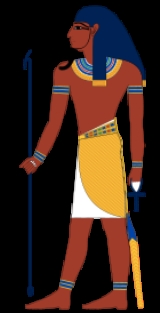
, where he is portrayed as both a creator and father to the king. He is usually depicted as a man wearing either the royal head-cloth or the dual white and red crown of Upper Egypt
Upper Egypt

File:Ancient Egypt map-en.svgUpper Egypt is a narrow strip of land that extends from the Cataracts of the Nile section of Upper Egypt, between El-Ayait and Asyut is sometimes known as Middle Egypt....
, and Lower Egypt
Lower Egypt

Lower Egypt is the northern-most section of Egypt. It refers to the Fertile Crescent Nile Delta region, which stretches from the area between El-Aiyat and Zawyet Dahshur, south of modern-day Cairo, and the Mediterranean Sea....
, reinforcing his connection with kingship. Sometimes he also is shown as a serpent
Serpent (symbolism)

Serpent is a word of Latin origin that is commonly used in a specifically mythology or religion context, signifying a snake that is to be regarded not as a mundane natural phenomenon nor as an object of scientific zoology, but as the bearer of some symbolic value....
, the form which he returns to at the end of the creative cycle and also occasionally as a mongoose
Mongoose

A mongoose is a member of the family Herpestidae , a family of small, cat-like Carnivoras.The word mongoose is derived from the Marathi language name mangus "mongoose", perhaps ultimately from Dravidian languages ....
, lion
Lion

The lion is a member of the family Felidae and one of four big cats in the genus Panthera. With exceptionally large males exceeding 250 kg in weight, it is the second-largest living cat after the tiger....
, bull
Bull

A bull is an adult male of various large mammal species including elk, moose, bovinae , elephants, whales, pinniped, and sea lions.Things...
, lizard
Lizard

Lizards are a large and widespread group of squamate reptiles, with nearly 5,000 species, ranging across all continents except Antarctica as well as most oceanic island chains....
, or ape
Ape

An ape is any member of the Hominoidea superfamily of primates. In less scientific language, it has various meanings, although it often excludes humans....
.

In the Heliopolitan Ennead
Ennead

Ennead , an ancient Greek translation of the Egyptian word, Pesedjet, consists of a grouping of nine deity, most often appearing in the context of Egyptian mythology....
 cosmogony
Cosmogony

Cosmogony, or cosmogeny, is any theory concerning the coming into existence or origin of the universe, or about how reality came to be. The word comes from the Greek ??s??????a , from ??s??? "cosmos, the world", and the root of ?????a? / ?????a "to be born, come about"....
 established in the sixth dynasty
Sixth dynasty of Egypt

The Third, Fourth, Fifth and Sixth Dynasties of History of Egypt are often combined under the title "Old Kingdom"....
, he was considered to be the first god, having created himself, sitting on a mound (benben
Benben

Benben or Ben-ben, in Egyptian mythology, or more specifically in the Heliopolitan tradition, was the mound that arose from the primordial waters, Naunet, and on which the creator god Atum settled....
) (or identified with the mound itself), from the primordial waters (Nu
Naunet

"Nu " redirects here. For other uses, see Nu.In Egyptian mythology, Nu is the deification of the primordial watery abyss. In the Ogdoad cosmogony, the name means abyss....
). Early myths state that Atum created the god Shu
Shu (Egyptian deity)

In Egyptian mythology, Shu is one of the primordial gods, a personification of air, one of the Ennead of Heliopolis . He was created by Atum from his breath, resulting from an act of masturbation or autofellatio in the city of Heliopolis....
 and goddess Tefnut
Tefnut

In Egyptian mythology, Tefnut is a goddess of water and fertility, indeed her name means moist waters . She was created by Atum from his mucus, a mythology that may be related to the alternative translation of her name - spat waters....
 from spitting or from his semen
Semen

Semen is an organic fluid, also known as seminal fluid, that usually contains spermatozoon....
 by masturbation
Masturbation

Masturbation refers to sexual stimulation, especially of one's own sex organ , often to the point of orgasm. The stimulation can be performed manually, by other types of bodily contact , by use of objects or tools, or by some combination of these methods....
 in the city of Annu (the Egyptian name for Heliopolis), a belief strongly associated with Atum's nature as an hermaphrodite
Hermaphrodite

A hermaphrodite is an organism having both male and female reproductive organs. In many species, hermaphroditism is a common part of the life-cycle, enabling a form of sexual reproduction in which partners are not separated into distinct male and female types of individual....
 (hence his name meaning completeness). Strictly, the myth states that Atum ejaculated
Ejaculation

Ejaculation is the ejecting of semen from the penis, and is usually accompanied by orgasm. It is usually the result of sexual stimulation. Rarely, it is due to prostatic disease....
 his semen into his mouth, impregnating himself, possibly indicating autofellatio
Autofellatio

File:01011674c.jpgAutofellatio is the act of Oral sex of one's own penis as a form of masturbation....
, which has led many to misinterpret (Via euphemism
Euphemism

A euphemism is a substitution of an agreeable or less offensive expression in place of one that may offend or suggest something unpleasant to the listener, or in the case of #Doublespeak, to make it less troublesome for the speaker....
 or Bowdlerization) the myth as indicating creation from mucus
Mucus

In vertebrates, mucus is a slippery secretion produced by, and covering, mucous membranes. It is a viscous colloid containing antiseptic enzymes and immunoglobulins that serves to protect Epithelium in the respiratory,...
.

Iusaaset grandmother of deities


Another belief held that Shu and Tefnut were created by Atum having sexual intercourse
Sexual intercourse

Sexual intercourse, also known as copulation or coitus, commonly refers to the act in which the Penis enters the Vagina. The two entities may be of opposite sexes or not, or they may be hermaphrodite, as is the case with snails....
 with a goddess, referred to as Iusaaset
Egyptian pantheon

Most Egyptologists today side with Sir Flinders Petrie that Egyptian religion was strictly polytheistic. His contemporary adversary, E. A. Wallis Budge, however, thought Egyptian religion to be primarily monotheistic where all the gods and goddesses were aspects of the God Ra, similar to the Trinity in Christianity and devas in Hinduism....
(also spelt Juesaes, Ausaas, Iusas, and Jusas, and in Greek as Saosis), meaning the great one who comes forth. She was described as his shadow
Shadow

File:Shadow, Ronald Reagan Building - Washington, D.C..jpgA shadow is an area where direct light from a light source cannot reach due to obstruction by an object....
. Consequently, Iusaaset was seen as the mother and grandmother of the gods. The strength, hardiness
Hardiness (plants)

Hardiness of plants is a term used to describe their ability to survive adverse growing conditions. It is usually limited to discussions of climatic adversity....
, medical properties, and edibility, led the acacia
Acacia

Acacia is a genus of shrubs and trees belonging to the subfamily Mimosoideae of the family Fabaceae, first described in Africa by the Sweden botanist Carolus Linnaeus in 1773....
 tree to be considered the tree of life
Tree of life

The concept of a many-branched tree illustrating the idea that all life on earth is related has been used in tree of life , religion, philosophy, mythology and other areas....
, and thus the oldest, which was situated close to, and north of, Heliopolis
Heliopolis (ancient)

Heliopolis , meaning sun-city, was one of the most ancient cities of Egypt, and capital of the 13th Lower Egyptian Nome . Its name also refers to an unrelated Heliopolis of Cairo, also known as ??? ???????, Masr al-gidedah ....
, was said to be the birthplace of the deities. Thus, as the mother and grandmother, of the deities, Iusaaset was said to own this tree.

In the Old Kingdom
Old Kingdom

The Old Kingdom is the name commonly given to that period in the 3rd millennium BCE when Ancient Egypt attained its first continuous peak of civilization in complexity and achievement ? this was the first of three so-called "Kingdom" periods, which mark the high points of civilization in the lower Nile Valley ....
 the Egyptians believed that Atum lifted the dead king's soul from his pyramid to the starry heavens.. By the time of the New Kingdom, the Atum mythos, merged in the Egyptian pantheon
Egyptian pantheon

Most Egyptologists today side with Sir Flinders Petrie that Egyptian religion was strictly polytheistic. His contemporary adversary, E. A. Wallis Budge, however, thought Egyptian religion to be primarily monotheistic where all the gods and goddesses were aspects of the God Ra, similar to the Trinity in Christianity and devas in Hinduism....
 with that of Ra
Ra

Ra is an ancient Egyptian Solar deity . By the Fifth dynasty of Egypt he became a major deity in ancient Egyptian religion, identified primarily with the noon, with other deities representing other positions of the sun....
, who was also the creator and a solar deity
Solar deity

A Solar Deity , is a deity who represents the sun, or an aspect of it. People have worshiped these for all of recorded history. Hence, many beliefs have formed around this worship, such as the "missing sun" found in many cultures ....
, their two identities were joined into Atum-Ra. But as Ra was the whole sun, and Atum became to be seen as the sun when it sets (depicted as an old man leaning on his staff), while Khepera was seen as the sun when it was rising.

External links