
All Topics  
Horus

 
Horus

   Email Print
   Bookmark   Link


Horus


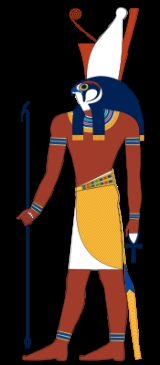
Horus is a god of the Ancient Egyptian religion, most commonly known by the Greek
Greek language

Greek is an Indo-European languages native to the southern Balkan peninsula, the language of the Greek people. It forms an independent branch within Indo-European....
 version Horus, of the Egyptian
Egyptian language

Egyptian is a branch of the Afro-Asiatic languages language family along with the Chadic languages, Berber languages, Semitic languages, Cushitic languages and possibly Omotic languages languages....
 Heru/Har. Horus was an ancient and important deity. He was also the son of Isis
ISIS

ISIS is an industry standard interface for technologies, developed by Pixel Translations in 1990 .ISIS is an open standard for scanner control and a complete image-processing framework....
 and Osiris
Osiris

Osiris was an Egyptian mythology, usually called the god of the Afterlife.Osiris is one of the oldest gods for whom records have been found; one of the oldest known attestations of his name is on the Palermo Stone of around 2500 BC....
. Some details of the character are changed or intermixed with other characters throughout the different dynasties and Egyptian cults and religions. For example, when Heru (Horus) fuses with Ra the Sun God, he becomes Ra-Horakhty.

The Eye of Horus
Eye of Horus

The Eye of Horus or is an ancient Egyptian symbol of protection and royal power from deities, in this case from Horus or Ra. The symbol is seen on images of Horus' mother, Hathor, and on other deities associated with her....
 became an important Egyptian symbol of power.


Discussion
Ask a question about 'Horus'
Start a new discussion about 'Horus'
Answer questions from other users
Full Discussion Forum


Recent Posts


Encyclopedia


Horus is a god of the Ancient Egyptian religion, most commonly known by the Greek
Greek language

Greek is an Indo-European languages native to the southern Balkan peninsula, the language of the Greek people. It forms an independent branch within Indo-European....
 version Horus, of the Egyptian
Egyptian language

Egyptian is a branch of the Afro-Asiatic languages language family along with the Chadic languages, Berber languages, Semitic languages, Cushitic languages and possibly Omotic languages languages....
 Heru/Har. Horus was an ancient and important deity. He was also the son of Isis
ISIS

ISIS is an industry standard interface for technologies, developed by Pixel Translations in 1990 .ISIS is an open standard for scanner control and a complete image-processing framework....
 and Osiris
Osiris

Osiris was an Egyptian mythology, usually called the god of the Afterlife.Osiris is one of the oldest gods for whom records have been found; one of the oldest known attestations of his name is on the Palermo Stone of around 2500 BC....
. Some details of the character are changed or intermixed with other characters throughout the different dynasties and Egyptian cults and religions. For example, when Heru (Horus) fuses with Ra the Sun God, he becomes Ra-Horakhty.

The Eye of Horus
Eye of Horus

The Eye of Horus or is an ancient Egyptian symbol of protection and royal power from deities, in this case from Horus or Ra. The symbol is seen on images of Horus' mother, Hathor, and on other deities associated with her....
 became an important Egyptian symbol of power. Horus had a man's body and a falcon's head. Horus fought with Seth
Seth

Seth , in the Book of Genesis of the Hebrew Bible, is the third listed son of Adam and Eve and brother of Cain and Abel and is the only other son mentioned by name....
 for the throne of Egypt
Egypt

Egypt is a country mainly in North Africa, with the Sinai Peninsula forming a land bridge in Western Asia. Covering an area of about , Egypt borders the Mediterranean Sea to the north, the Gaza Strip and Israel to the northeast, the Red Sea to the east, Sudan to the south and Libya to the west....
. In this battle one of his eyes was injured and later it was healed by Hathor. This healing of the eye became a symbol of renewal. Horus united Egypt and bestowed divinity upon the pharaoh
Pharaoh

Pharaoh is a title used in many modern discussions of the ancient Egyptian rulers of all periods. In antiquity this title began to be used for the ruler who was the religious and political leader of united ancient Egypt, only during the New Kingdom, specifically, during the middle of the Eighteenth dynasty of Egypt....
s who were viewed as incarnations of Horus in life.

Origin of name

Horus is recorded in Egyptian hieroglyphs
Egyptian hieroglyphs

Egyptian hieroglyphs was a formal writing system used by the ancient Egyptians that contained a combination of logographic and alphabetic elements....
 as and is reconstructed to have been pronounced *, meaning "Falcon". As a description it has also typically been thought of as having the meaning "the distant one" or "one who is above, over" By Coptic
Coptic language

Coptic or Coptic Egyptian is the final stage of the Egyptian language, a northern Afro-Asiatic languages language spoken in Egypt until at least the seventeenth century....
 times, the name became Hor. It was adopted into Greek
Greek language

Greek is an Indo-European languages native to the southern Balkan peninsula, the language of the Greek people. It forms an independent branch within Indo-European....
 as Horos. The original name also survives in later Egyptian names such as Har-Si-Ese
Harsiese

* Harsiese A: An independent king in Upper Egypt during the 22nd Dynasty* Harsiese B: A High Priest of Amun from the end of Osorkon II's reign to Year 19 of Pedubast I....
 literally "Horus, son of Isis".

Mythology


Sky god

Horus was told by his mother, Isis, to protect the people of Egypt from Set, the god of the desert, storms and chaos.

Since he was god of the sky, Horus became depicted as a falcon
Falcon

A falcon is any species of bird of prey in the genus Falco. The word comes from their Latin name falco, related to Latin falx because of the shape of these birds' wings....
, or as a falcon-headed man, leading to Horus' name, (in Egyptian, Heru), which meant The distant one. As falcon he may be shown on the Narmer Palette
Narmer Palette

The Narmer Palette, also known as the Great Hierakonpolis Palette or the Palette of Narmer, is a significant Egyptian archeological find, dating from about the 31st century BC, and containing some of the earliest Egyptian hieroglyphsic inscriptions ever found....
 dating from the time of unification of upper and lower Egypt. Horus was also sometimes known as Nekheny (meaning falcon), although it has been proposed that Nekheny may have been another falcon-god, worshipped at Nekhen
Nekhen

Nekhen, was the religious and political capitol of Upper Egypt at the end of the Predynastic Egypt period and probably, also during the Early Dynastic Period of Egypt ....
 (city of the hawk), that became identified as Horus very early on. He was married to Hathor
Hathor

In Egyptian mythology, Hathor was originally a personification of the Milky Way, which was seen as the milk that flowed from the udders of a heavenly cow....
, the god of love. In this form, he was sometimes given the title Kemwer, meaning (the) great black (one).

As Horus was the son of Osiris, and god of the sky, he became closely associated with the Pharaoh of Lower Egypt (where Horus was worshipped), and became their patron. The association with the Pharaoh brought with it the idea that he was the son of Isis
ISIS

ISIS is an industry standard interface for technologies, developed by Pixel Translations in 1990 .ISIS is an open standard for scanner control and a complete image-processing framework....
, in her original form, who was regarded as a deification of the Queen.

Sun god

Since Horus was said to be the sky, he was considered to also contain the sun and moon. It became said that the sun was his right eye and the moon his left, and that they traversed the sky when he, a falcon, flew across it. Thus he became known as Harmerty - Horus of two eyes. Later, the reason that the moon was not as bright as the sun was explained by a tale, known as the contestings of Horus and Set, originating as a metaphor for the conquest of Upper Egypt
Upper Egypt

File:Ancient Egypt map-en.svgUpper Egypt is a narrow strip of land that extends from the Cataracts of the Nile section of Upper Egypt, between El-Ayait and Asyut is sometimes known as Middle Egypt....
 by Lower Egypt
Lower Egypt

Lower Egypt is the northern-most section of Egypt. It refers to the Fertile Crescent Nile Delta region, which stretches from the area between El-Aiyat and Zawyet Dahshur, south of modern-day Cairo, and the Mediterranean Sea....
 in about 3000 BC. In this tale, it was said that Set
Set (mythology)

In Ancient Egyptian religion, Set is an ancient god, who was originally the god of the desert, Storms, Darkness, and Chaos. Because of the developments in the Egyptian language over the 3,000 years that Set was worshipped, by the Greek period, the t in Seth was pronounced so indistinguishably from th that the Greeks spelled it a...
, the patron of Upper Egypt, and Horus, the patron of Lower Egypt, had battled for Egypt brutally, with neither side victorious, until eventually the gods sided with Horus (see below).

As Horus was the ultimate victor he became known as Harsiesis, Heru-ur or Har-Wer ( 'Horus the Great'), but more usually translated as Horus the Elder. In the struggle Set had lost a testicle, explaining why the desert, which Set represented, is infertile. Horus' left eye had also been gouged out, which explained why the moon, which it represented, was so weak compared to the sun.

It was also said that during a new-moon, Horus had become blinded and was titled Mekhenty-er-irty ( 'He who has no eyes'), while when the moon became visible again, he was re-titled Khenty-irty ( 'He who has eyes'). While blind, it was considered that Horus was quite dangerous, sometimes attacking his friends after mistaking them for enemies.

Horus was occasionally shown in art as a naked boy with a finger in his mouth sitting on a lotus with his mother. In the form of a youth, Horus was referred to as Neferhor. This is also spelled Nefer Hor, Nephoros or Nopheros meaning 'The Good Horus'.

War god

Horus was also said to be a war god and a hunter's god; since he was associated with the falcon. Thus he became a symbol of majesty and power as well as the model of the pharaohs. The pharaohs were said to be Horus in human form.

Furthermore Nemty (also a war god meaning "He who travels") was later identified as Horus.

Conqueror of Set

After Set
Set (mythology)

In Ancient Egyptian religion, Set is an ancient god, who was originally the god of the desert, Storms, Darkness, and Chaos. Because of the developments in the Egyptian language over the 3,000 years that Set was worshipped, by the Greek period, the t in Seth was pronounced so indistinguishably from th that the Greeks spelled it a...
 killed Osiris
Osiris

Osiris was an Egyptian mythology, usually called the god of the Afterlife.Osiris is one of the oldest gods for whom records have been found; one of the oldest known attestations of his name is on the Palermo Stone of around 2500 BC....
, Horus had many battles with Set, not only to avenge his father, but to choose the rightful ruler of Egypt. One scene stated how Horus was on the verge of killing Set; but his mother (and Set's sister), Isis, stopped him. Isis injured Horus, but eventually healed him.

By the Nineteenth dynasty
Nineteenth dynasty of Egypt

The Eighteenth, Nineteenth, and Twentieth Dynasties of ancient Egypt are often combined under the group title, New Kingdom....
, the enmity between Set and Horus, in which Horus had ripped off one of Set's testicles, was represented as a separate tale. According to Papyrus Chester-Beatty I
Chester Beatty Library

The Chester Beatty Library was established in Dublin, Ireland in 1950, to house the collections of mining magnate, Sir Alfred Chester Beatty. The present library, on the grounds of Dublin Castle, opened on February 7, 2000, the 125th anniversary of Sir Alfred's birth and was named European Museum of the Year Award in 2002....
, Set is depicted as trying to prove his dominance by seducing Horus and then having intercourse with him. However, Horus places his hand between his thighs and catches Set's semen, then subsequently throws it in the river, so that he may not be said to have been inseminated by Set. Horus then deliberately spreads his own semen on some lettuce, which was Set's favorite food (the Egyptians thought that lettuce was phallic). After Set has eaten the lettuce, they go to the gods to try to settle the argument over the rule of Egypt. The gods first listen to Set's claim of dominance over Horus, and call his semen forth, but it answers from the river, invalidating his claim. Then, the gods listen to Horus' claim of having dominated Set, and call his semen forth, and it answers from inside Set.

This myth, along with others, could be seen as an explanation of how the two kingdoms of Egypt (Upper and Lower) came to be united. Horus was seen as the God of Lower Egypt, and Set as the God of Upper Egypt (which happens to be south of the Delta region). In this myth, the respective Upper and Lower deities have a fight, through which Horus is the victor. However, some of Horus (representing Lower Egypt) enters into Set (Upper Egypt) thus explaining why Lower Egypt is dominant over the Upper Egyptians. Set's regions were then considered to be of the desert.

But the battle wasn't over yet, and the other gods were getting tired from over eighty years of fighting and challenges. Horus and Set challenged each other to a boat race, where they each raced in a boat made of stone. Horus and Set agreed, and the race started. But Horus had a secret weapon: his boat was made of wood, not stone. Set's boat, being made of heavy stone, sank, but Horus's didn't. Horus then won the race, and Set stepped down and officially gave Horus the throne of Egypt. But after the New Kingdom, Set still was considered Lord of the desert and its oases.

Heru-p-khart (Horus the Younger)

Horus the Younger, ??p????t?? to the Greeks, is represented in the form of a youth wearing a lock of hair (a sign of youth) on the right of his head. In addition, he usually wears the united crowns of Egypt. He is a form of the rising sun, representing its earliest light.

This is thought to be the original form of Horus. His name meaning 'high' or 'distant' reflects his sky nature.

Heru-ur (Horus the Elder)

Egypte Louvre 091 Aigle
In this form he represented the god of light and the husband of Hathor
Hathor

In Egyptian mythology, Hathor was originally a personification of the Milky Way, which was seen as the milk that flowed from the udders of a heavenly cow....
. He was one of the oldest gods of ancient Egypt. He became the patron of Nekhen (Heirakonpolis) and the first national god (God of the Kingdom). Later he also became the patron of the pharaohs, and was called the son of truth. He was seen as a great falcon with outstretched wings whose right eye was the sun and the left one was the moon.

See also

  • Heru-ra-ha
    Heru-ra-ha

    Heru-ra-ha is a composite deity within Thelema, a religion that began in 1904 with Aleister Crowley and his The Book of the Law. Heru-ra-ha is composed of Ra-Hoor-Khuit and Hoor-par-kraat....
  • Egyptian pantheon
    Egyptian pantheon

    Most Egyptologists today side with Sir Flinders Petrie that Egyptian religion was strictly polytheistic. His contemporary adversary, E. A. Wallis Budge, however, thought Egyptian religion to be primarily monotheistic where all the gods and goddesses were aspects of the God Ra, similar to the Trinity in Christianity and devas in Hinduism....
  • Myth of Osiris and Isis
  • Life-death-rebirth deity
    Life-death-rebirth deity

    The category life-death-rebirth deity also known as a "dying-and-rising" or "Resurrection" deity is a convenient means of classifying the many divinities in world mythology or religion who are born, suffer death, an eclipse, or other death-like experience, pass a phase in the underworld among the dead, and are subsequently reborn, in either a...


External links