

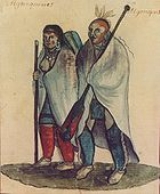
Algonquian peoples

Encyclopedia
The Algonquian are one of the most populous and widespread North America
n native
language groups, with tribe
s originally numbering in the hundreds. Today hundreds of thousands of individuals identify with various Algonquian peoples. This grouping consists of peoples that speak Algonquian languages
.
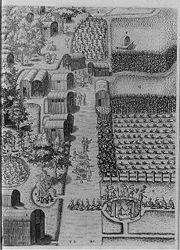 Before Europeans came into contact, most Algonquian settlements lived by hunting and fishing, although quite a few supplemented their diet by cultivating corn
, beans, squash
, and (particularly among the Ojibwe) wild rice
.
The Algonquians of New England
(who spoke Eastern Algonquian
) practiced a seasonal economy. The basic social unit
was the village of a few hundred people related by a kinship
structure. Villages were temporary and mobile. The people moved to locations of greatest natural food supply, often breaking into smaller units or recombining as the circumstances required. This custom resulted in a certain degree of cross-tribal mobility, especially in troubled times.
In warm weather, they constructed light wigwam
s for portability. In the winter, they erected the more substantial long houses
, in which more than one clan
could reside. They cached food supplies in more permanent, semi-subterranean structures.
In the spring, when the fish were spawning, the natives left the winter camps to build villages at coastal locations and waterfalls. In March they caught smelt in nets and weirs, moving about in birchbark canoe
s. In April they netted alewife
, sturgeon
and salmon
. In May they caught cod
with hook and line in the ocean
; and trout
, smelt, striped bass
and flounder
in the estuaries and streams. Putting out to sea, the men hunted whale
s, porpoise
s, walrus
es and seals
. The women and children gathered scallop
s, mussel
s, clam
s and crab
s, all the basis of menus in New England today.
From April through October, natives hunted migratory
birds and their eggs: Canada geese, brant
, mourning dove
s and others. In July and August they gathered strawberries
, raspberries
, blueberries
and nuts. In September they split into small groups and moved up the streams to the forest. There the men hunted beaver
, caribou, moose
and white-tailed deer
.
In December when the snows began, the people created larger winter camps in sheltered locations, where they built or reconstructed long houses. February and March were lean times. The tribes in southern New England and other northern latitudes had to rely on cached food. Northerners developed a practice of going hungry for several days at a time. Historians hypothesize that this practice kept the population down, according to Liebig’s law
. The northerners were food gatherers only.
The southern Algonquians of New England relied predominantly on slash-and-burn agriculture
. They cleared fields by burning for one or two years of cultivation, after which the village moved to another location. This is the reason the English
found the region relatively cleared and ready for planting. By using various kinds of native corn (maize), beans and squash
, southern New England natives were able to improve their diet to such a degree that their population increased and they reached a density of 287 people per square hundred miles, as opposed to 41 in the north.
Even with mobile crop rotation, southern villages were necessarily less mobile than northern. The natives continued their seasonal occupation but tended to move into fixed villages near their lands. They adjusted to the change partially by developing a gender-oriented division of labor. The women cultivated crops and the men fished and hunted.
Scholars estimate that by the year 1600, the indigenous population of New England had reached 70,000–100,000.
, New Jersey
, southeastern New York
, New Brunswick
, much of Canada
east of the Rocky Mountains
, Minnesota
, Wisconsin
, Michigan
, Illinois
, Indiana
, Iowa
, and were occasionally present in Kentucky
. They were most concentrated in the New England region. The homeland of the Algonquian peoples is not known. At the time of the European arrival, the hegemonic Iroquois
federation was regularly at war with Algonquian neighbours and forced other tribes out of Iroquois-occupied territories.
For about two centuries, Algonquians provided the main obstacles to the spread of Euro-American settlers, who concluded hundreds of peace treaties with them. Metacomet
, Cornstalk
, Tecumseh
and Pontiac
were leaders of Algonquian-speaking nations.
, Pequot
, Narragansett
, Wampanoag, Massachusett
, Nipmuck
, Pennacook
, Passamaquoddy
, and Quinnipiac
. The Abenaki tribe is located in Maine and eastern Quebec. These tribes practiced some agriculture. The Maliseet of Maine
, Quebec
and New Brunswick
, and the Mi'kmaq tribes of the Canadian Maritime provinces lived primarily on fishing. Further north are the Betsiamites
, Atikamekw
, Algonkin and Montagnais
/Naskapi
(Innu
). The Beothuk
people of Newfoundland are also believed to have been Algonquians, but their last known speaker died in the early 19th century. Few records of their language or culture remain.
, Potawatomi
, and a variety of Cree
groups lived in Minnesota
, Wisconsin
, Upper Michigan, Western Ontario and the Canadian Prairies
. The Arapaho
, Blackfoot
and Cheyenne
are indigenous to the Great Plains
.
, Illiniwek
, Kickapoo, Menominee
, Miami, and Sac and Fox, also known as the Sac and Fox Tribe and later known as the Meskwaki Indians lived throughout the present-day Midwest of the United States. Many were displaced over great distances through Indian removal
west of the Mississippi River
, to what is now Oklahoma
.
, who were among the first to encounter English colonists; Nanticoke
, Lenape
(Munsee
and Unami
speakers), Mahican
, Chicacoan, and Wicocomico
peoples.
and Arapaho
tribes.
North America
North America is a continent wholly within the Northern Hemisphere and almost wholly within the Western Hemisphere. It is also considered a northern subcontinent of the Americas...
n native
Indigenous peoples of the Americas
The indigenous peoples of the Americas are the pre-Columbian inhabitants of North and South America, their descendants and other ethnic groups who are identified with those peoples. Indigenous peoples are known in Canada as Aboriginal peoples, and in the United States as Native Americans...
language groups, with tribe
Tribe
A tribe, viewed historically or developmentally, consists of a social group existing before the development of, or outside of, states.Many anthropologists use the term tribal society to refer to societies organized largely on the basis of kinship, especially corporate descent groups .Some theorists...
s originally numbering in the hundreds. Today hundreds of thousands of individuals identify with various Algonquian peoples. This grouping consists of peoples that speak Algonquian languages
Algonquian languages
The Algonquian languages also Algonkian) are a subfamily of Native American languages which includes most of the languages in the Algic language family. The name of the Algonquian language family is distinguished from the orthographically similar Algonquin dialect of the Ojibwe language, which is a...
.
Pre-colonial period
Maize
Maize known in many English-speaking countries as corn or mielie/mealie, is a grain domesticated by indigenous peoples in Mesoamerica in prehistoric times. The leafy stalk produces ears which contain seeds called kernels. Though technically a grain, maize kernels are used in cooking as a vegetable...
, beans, squash
Squash (fruit)
Squashes generally refer to four species of the genus Cucurbita, also called marrows depending on variety or the nationality of the speaker...
, and (particularly among the Ojibwe) wild rice
Wild rice
Wild rice is four species of grasses forming the genus Zizania, and the grain which can be harvested from them. The grain was historically gathered and eaten in both North America and China...
.
The Algonquians of New England
New England
New England is a region in the northeastern corner of the United States consisting of the six states of Maine, New Hampshire, Vermont, Massachusetts, Rhode Island, and Connecticut...
(who spoke Eastern Algonquian
Eastern Algonquian languages
The Eastern Algonquian languages constitute a subgroup of the Algonquian languages. Prior to European contact, Eastern Algonquian consisted of at least seventeen languages collectively occupying the Atlantic coast of North America and adjacent inland areas, from the Canadian Maritime provinces to...
) practiced a seasonal economy. The basic social unit
Social unit
Social unit is a term used in sociology, anthropology, ethnology, and also in animal behaviour studies, zoology and biology to describe a social entity which is part of and participates in a larger social group or society....
was the village of a few hundred people related by a kinship
Kinship
Kinship is a relationship between any entities that share a genealogical origin, through either biological, cultural, or historical descent. And descent groups, lineages, etc. are treated in their own subsections....
structure. Villages were temporary and mobile. The people moved to locations of greatest natural food supply, often breaking into smaller units or recombining as the circumstances required. This custom resulted in a certain degree of cross-tribal mobility, especially in troubled times.
In warm weather, they constructed light wigwam
Wigwam
A wigwam or wickiup is a domed room dwelling used by certain Native American tribes. The term wickiup is generally used to label these kinds of dwellings in American Southwest and West. Wigwam is usually applied to these structures in the American Northeast...
s for portability. In the winter, they erected the more substantial long houses
Native American long house
Longhouses were built by native peoples in various parts of North America, sometimes reaching over but generally around wide. The dominant theory is that walls were made of sharpened and fire-hardened poles driven into the ground and the roof consisted of leaves and grass...
, in which more than one clan
Clan
A clan is a group of people united by actual or perceived kinship and descent. Even if lineage details are unknown, clan members may be organized around a founding member or apical ancestor. The kinship-based bonds may be symbolical, whereby the clan shares a "stipulated" common ancestor that is a...
could reside. They cached food supplies in more permanent, semi-subterranean structures.
In the spring, when the fish were spawning, the natives left the winter camps to build villages at coastal locations and waterfalls. In March they caught smelt in nets and weirs, moving about in birchbark canoe
Canoe
A canoe or Canadian canoe is a small narrow boat, typically human-powered, though it may also be powered by sails or small electric or gas motors. Canoes are usually pointed at both bow and stern and are normally open on top, but can be decked over A canoe (North American English) or Canadian...
s. In April they netted alewife
Alewife
The alewife is a species of herring. There are anadromous and landlocked forms. The landlocked form is also called a sawbelly or mooneye...
, sturgeon
Sturgeon
Sturgeon is the common name used for some 26 species of fish in the family Acipenseridae, including the genera Acipenser, Huso, Scaphirhynchus and Pseudoscaphirhynchus. The term includes over 20 species commonly referred to as sturgeon and several closely related species that have distinct common...
and salmon
Salmon
Salmon is the common name for several species of fish in the family Salmonidae. Several other fish in the same family are called trout; the difference is often said to be that salmon migrate and trout are resident, but this distinction does not strictly hold true...
. In May they caught cod
Cod
Cod is the common name for genus Gadus, belonging to the family Gadidae, and is also used in the common name for various other fishes. Cod is a popular food with a mild flavor, low fat content and a dense, flaky white flesh. Cod livers are processed to make cod liver oil, an important source of...
with hook and line in the ocean
Ocean
An ocean is a major body of saline water, and a principal component of the hydrosphere. Approximately 71% of the Earth's surface is covered by ocean, a continuous body of water that is customarily divided into several principal oceans and smaller seas.More than half of this area is over 3,000...
; and trout
Trout
Trout is the name for a number of species of freshwater and saltwater fish belonging to the Salmoninae subfamily of the family Salmonidae. Salmon belong to the same family as trout. Most salmon species spend almost all their lives in salt water...
, smelt, striped bass
Striped bass
The striped bass is the state fish of Maryland, Rhode Island, South Carolina, and the state saltwater fish of New York, Virginia, and New Hampshire...
and flounder
Flounder
The flounder is an ocean-dwelling flatfish species that is found in coastal lagoons and estuaries of the Northern Atlantic and Pacific Oceans.-Taxonomy:There are a number of geographical and taxonomical species to which flounder belong.*Western Atlantic...
in the estuaries and streams. Putting out to sea, the men hunted whale
Whale
Whale is the common name for various marine mammals of the order Cetacea. The term whale sometimes refers to all cetaceans, but more often it excludes dolphins and porpoises, which belong to suborder Odontoceti . This suborder also includes the sperm whale, killer whale, pilot whale, and beluga...
s, porpoise
Porpoise
Porpoises are small cetaceans of the family Phocoenidae; they are related to whales and dolphins. They are distinct from dolphins, although the word "porpoise" has been used to refer to any small dolphin, especially by sailors and fishermen...
s, walrus
Walrus
The walrus is a large flippered marine mammal with a discontinuous circumpolar distribution in the Arctic Ocean and sub-Arctic seas of the Northern Hemisphere. The walrus is the only living species in the Odobenidae family and Odobenus genus. It is subdivided into three subspecies: the Atlantic...
es and seals
Pinniped
Pinnipeds or fin-footed mammals are a widely distributed and diverse group of semiaquatic marine mammals comprising the families Odobenidae , Otariidae , and Phocidae .-Overview: Pinnipeds are typically sleek-bodied and barrel-shaped...
. The women and children gathered scallop
Scallop
A scallop is a marine bivalve mollusk of the family Pectinidae. Scallops are a cosmopolitan family, found in all of the world's oceans. Many scallops are highly prized as a food source...
s, mussel
Mussel
The common name mussel is used for members of several families of clams or bivalvia mollusca, from saltwater and freshwater habitats. These groups have in common a shell whose outline is elongated and asymmetrical compared with other edible clams, which are often more or less rounded or oval.The...
s, clam
Clam
The word "clam" can be applied to freshwater mussels, and other freshwater bivalves, as well as marine bivalves.In the United States, "clam" can be used in several different ways: one, as a general term covering all bivalve molluscs...
s and crab
Crab
True crabs are decapod crustaceans of the infraorder Brachyura, which typically have a very short projecting "tail" , or where the reduced abdomen is entirely hidden under the thorax...
s, all the basis of menus in New England today.
From April through October, natives hunted migratory
Bird migration
Bird migration is the regular seasonal journey undertaken by many species of birds. Bird movements include those made in response to changes in food availability, habitat or weather. Sometimes, journeys are not termed "true migration" because they are irregular or in only one direction...
birds and their eggs: Canada geese, brant
Brent Goose
The Brant or Brent Goose, Branta bernicla, is a species of goose of the genus Branta. The Black Brant is an American subspecies. The specific descriptor bernicla is from the same source as "barnacle" in Barnacle Goose, which looks similar but is not a close relation.-Appearance:The Brant Goose is...
, mourning dove
Mourning Dove
The Mourning Dove is a member of the dove family . The bird is also called the Turtle Dove or the American Mourning Dove or Rain Dove, and formerly was known as the Carolina Pigeon or Carolina Turtledove. It is one of the most abundant and widespread of all North American birds...
s and others. In July and August they gathered strawberries
Strawberry
Fragaria is a genus of flowering plants in the rose family, Rosaceae, commonly known as strawberries for their edible fruits. Although it is commonly thought that strawberries get their name from straw being used as a mulch in cultivating the plants, the etymology of the word is uncertain. There...
, raspberries
Raspberry
The raspberry or hindberry is the edible fruit of a multitude of plant species in the genus Rubus, most of which are in the subgenus Idaeobatus; the name also applies to these plants themselves...
, blueberries
Blueberry
Blueberries are flowering plants of the genus Vaccinium with dark-blue berries and are perennial...
and nuts. In September they split into small groups and moved up the streams to the forest. There the men hunted beaver
Beaver
The beaver is a primarily nocturnal, large, semi-aquatic rodent. Castor includes two extant species, North American Beaver and Eurasian Beaver . Beavers are known for building dams, canals, and lodges . They are the second-largest rodent in the world...
, caribou, moose
Moose
The moose or Eurasian elk is the largest extant species in the deer family. Moose are distinguished by the palmate antlers of the males; other members of the family have antlers with a dendritic configuration...
and white-tailed deer
White-tailed Deer
The white-tailed deer , also known as the Virginia deer or simply as the whitetail, is a medium-sized deer native to the United States , Canada, Mexico, Central America, and South America as far south as Peru...
.
In December when the snows began, the people created larger winter camps in sheltered locations, where they built or reconstructed long houses. February and March were lean times. The tribes in southern New England and other northern latitudes had to rely on cached food. Northerners developed a practice of going hungry for several days at a time. Historians hypothesize that this practice kept the population down, according to Liebig’s law
Liebig's law of the minimum
Liebig's Law of the Minimum, often simply called Liebig's Law or the Law of the Minimum, is a principle developed in agricultural science by Carl Sprengel and later popularized by Justus von Liebig...
. The northerners were food gatherers only.
The southern Algonquians of New England relied predominantly on slash-and-burn agriculture
Slash and burn
Slash-and-burn is an agricultural technique which involves cutting and burning of forests or woodlands to create fields. It is subsistence agriculture that typically uses little technology or other tools. It is typically part of shifting cultivation agriculture, and of transhumance livestock...
. They cleared fields by burning for one or two years of cultivation, after which the village moved to another location. This is the reason the English
England
England is a country that is part of the United Kingdom. It shares land borders with Scotland to the north and Wales to the west; the Irish Sea is to the north west, the Celtic Sea to the south west, with the North Sea to the east and the English Channel to the south separating it from continental...
found the region relatively cleared and ready for planting. By using various kinds of native corn (maize), beans and squash
Squash (fruit)
Squashes generally refer to four species of the genus Cucurbita, also called marrows depending on variety or the nationality of the speaker...
, southern New England natives were able to improve their diet to such a degree that their population increased and they reached a density of 287 people per square hundred miles, as opposed to 41 in the north.
Even with mobile crop rotation, southern villages were necessarily less mobile than northern. The natives continued their seasonal occupation but tended to move into fixed villages near their lands. They adjusted to the change partially by developing a gender-oriented division of labor. The women cultivated crops and the men fished and hunted.
Scholars estimate that by the year 1600, the indigenous population of New England had reached 70,000–100,000.
Colonial period
At the time of the first European settlements in North America, Algonquian tribes occupied what is now New EnglandNew England
New England is a region in the northeastern corner of the United States consisting of the six states of Maine, New Hampshire, Vermont, Massachusetts, Rhode Island, and Connecticut...
, New Jersey
New Jersey
New Jersey is a state in the Northeastern and Middle Atlantic regions of the United States. , its population was 8,791,894. It is bordered on the north and east by the state of New York, on the southeast and south by the Atlantic Ocean, on the west by Pennsylvania and on the southwest by Delaware...
, southeastern New York
New York
New York is a state in the Northeastern region of the United States. It is the nation's third most populous state. New York is bordered by New Jersey and Pennsylvania to the south, and by Connecticut, Massachusetts and Vermont to the east...
, New Brunswick
New Brunswick
New Brunswick is one of Canada's three Maritime provinces and is the only province in the federation that is constitutionally bilingual . The provincial capital is Fredericton and Saint John is the most populous city. Greater Moncton is the largest Census Metropolitan Area...
, much of Canada
Canada
Canada is a North American country consisting of ten provinces and three territories. Located in the northern part of the continent, it extends from the Atlantic Ocean in the east to the Pacific Ocean in the west, and northward into the Arctic Ocean...
east of the Rocky Mountains
Rocky Mountains
The Rocky Mountains are a major mountain range in western North America. The Rocky Mountains stretch more than from the northernmost part of British Columbia, in western Canada, to New Mexico, in the southwestern United States...
, Minnesota
Minnesota
Minnesota is a U.S. state located in the Midwestern United States. The twelfth largest state of the U.S., it is the twenty-first most populous, with 5.3 million residents. Minnesota was carved out of the eastern half of the Minnesota Territory and admitted to the Union as the thirty-second state...
, Wisconsin
Wisconsin
Wisconsin is a U.S. state located in the north-central United States and is part of the Midwest. It is bordered by Minnesota to the west, Iowa to the southwest, Illinois to the south, Lake Michigan to the east, Michigan to the northeast, and Lake Superior to the north. Wisconsin's capital is...
, Michigan
Michigan
Michigan is a U.S. state located in the Great Lakes Region of the United States of America. The name Michigan is the French form of the Ojibwa word mishigamaa, meaning "large water" or "large lake"....
, Illinois
Illinois
Illinois is the fifth-most populous state of the United States of America, and is often noted for being a microcosm of the entire country. With Chicago in the northeast, small industrial cities and great agricultural productivity in central and northern Illinois, and natural resources like coal,...
, Indiana
Indiana
Indiana is a US state, admitted to the United States as the 19th on December 11, 1816. It is located in the Midwestern United States and Great Lakes Region. With 6,483,802 residents, the state is ranked 15th in population and 16th in population density. Indiana is ranked 38th in land area and is...
, Iowa
Iowa
Iowa is a state located in the Midwestern United States, an area often referred to as the "American Heartland". It derives its name from the Ioway people, one of the many American Indian tribes that occupied the state at the time of European exploration. Iowa was a part of the French colony of New...
, and were occasionally present in Kentucky
Kentucky
The Commonwealth of Kentucky is a state located in the East Central United States of America. As classified by the United States Census Bureau, Kentucky is a Southern state, more specifically in the East South Central region. Kentucky is one of four U.S. states constituted as a commonwealth...
. They were most concentrated in the New England region. The homeland of the Algonquian peoples is not known. At the time of the European arrival, the hegemonic Iroquois
Iroquois
The Iroquois , also known as the Haudenosaunee or the "People of the Longhouse", are an association of several tribes of indigenous people of North America...
federation was regularly at war with Algonquian neighbours and forced other tribes out of Iroquois-occupied territories.
For about two centuries, Algonquians provided the main obstacles to the spread of Euro-American settlers, who concluded hundreds of peace treaties with them. Metacomet
Metacomet
Metacomet , also known as King Philip or Metacom, or occasionally Pometacom, was a war chief or sachem of the Wampanoag Indians and their leader in King Philip's War, a widespread Native American uprising against English colonists in New England.-Biography:Metacomet was the second son of Massasoit...
, Cornstalk
Cornstalk
Cornstalk was a prominent leader of the Shawnee nation just prior to the American Revolution. His name, Hokoleskwa, translates loosely into "stalk of corn" in English, and is spelled Colesqua in some accounts...
, Tecumseh
Tecumseh
Tecumseh was a Native American leader of the Shawnee and a large tribal confederacy which opposed the United States during Tecumseh's War and the War of 1812...
and Pontiac
Chief Pontiac
Pontiac or Obwandiyag , was an Ottawa leader who became famous for his role in Pontiac's Rebellion , an American Indian struggle against the British military occupation of the Great Lakes region following the British victory in the French and Indian War. Historians disagree about Pontiac's...
were leaders of Algonquian-speaking nations.
New England area
These tribes include MoheganMohegan
The Mohegan tribe is an Algonquian-speaking tribe that lives in the eastern upper Thames River valley of Connecticut. Mohegan translates to "People of the Wolf". At the time of European contact, the Mohegan and Pequot were one people, historically living in the lower Connecticut region...
, Pequot
Pequot
Pequot people are a tribe of Native Americans who, in the 17th century, inhabited much of what is now Connecticut. They were of the Algonquian language family. The Pequot War and Mystic massacre reduced the Pequot's sociopolitical influence in southern New England...
, Narragansett
Narragansett (tribe)
The Narragansett tribe are an Algonquian Native American tribe from Rhode Island. In 1983 they regained federal recognition as the Narragansett Indian Tribe of Rhode Island. In 2009, the United States Supreme Court ruled against their request that the Department of Interior take land into trust...
, Wampanoag, Massachusett
Massachusett
The Massachusett are a tribe of Native Americans who lived in areas surrounding Massachusetts Bay in what is now the Commonwealth of Massachusetts, in particular present-day Greater Boston; they spoke the Massachusett language...
, Nipmuck
Nipmuck
The Nipmuc are a group of Algonquian Indians native to Worcester County, Massachusetts, some parts of Northeastern CT, and NW RI, and the Northwestern and Western parts of Middlesex County, Massachusetts.-Name:...
, Pennacook
Pennacook
The Pennacook, also known by the names Merrimack and Pawtucket, were a North American people that primarily inhabited the Merrimack River valley of present-day New Hampshire and Massachusetts, as well as portions of southern Maine...
, Passamaquoddy
Passamaquoddy
The Passamaquoddy are the First Nations people who live in northeastern North America, primarily in Maine and New Brunswick....
, and Quinnipiac
Quinnipiac
This article is about the Native American nation. For the university, see Quinnipiac University.The Quinnipiac — rarely spelled Quinnipiack — is the English name for the Eansketambawg a Native American nation of the Algonquian family who inhabited the Wampanoki This article is about the Native...
. The Abenaki tribe is located in Maine and eastern Quebec. These tribes practiced some agriculture. The Maliseet of Maine
Maine
Maine is a state in the New England region of the northeastern United States, bordered by the Atlantic Ocean to the east and south, New Hampshire to the west, and the Canadian provinces of Quebec to the northwest and New Brunswick to the northeast. Maine is both the northernmost and easternmost...
, Quebec
Quebec
Quebec or is a province in east-central Canada. It is the only Canadian province with a predominantly French-speaking population and the only one whose sole official language is French at the provincial level....
and New Brunswick
New Brunswick
New Brunswick is one of Canada's three Maritime provinces and is the only province in the federation that is constitutionally bilingual . The provincial capital is Fredericton and Saint John is the most populous city. Greater Moncton is the largest Census Metropolitan Area...
, and the Mi'kmaq tribes of the Canadian Maritime provinces lived primarily on fishing. Further north are the Betsiamites
Innu
The Innu are the indigenous inhabitants of an area they refer to as Nitassinan , which comprises most of the northeastern portions of the provinces of Quebec and some western portions of Labrador...
, Atikamekw
Atikamekw
The Atikamekw are the indigenous inhabitants of the area they refer to as Nitaskinan , in the upper Saint-Maurice River valley of Quebec , Canada. Their population currently stands at around 4500. One of the main communities is Manawan, about northeast of Montreal. They have a tradition of...
, Algonkin and Montagnais
Innu
The Innu are the indigenous inhabitants of an area they refer to as Nitassinan , which comprises most of the northeastern portions of the provinces of Quebec and some western portions of Labrador...
/Naskapi
Naskapi
The Naskapi are the indigenous Innu inhabitants of an area they refer to as Nitassinan, which comprises most of what other Canadians refer to as eastern Quebec and Labrador, Canada....
(Innu
Innu
The Innu are the indigenous inhabitants of an area they refer to as Nitassinan , which comprises most of the northeastern portions of the provinces of Quebec and some western portions of Labrador...
). The Beothuk
Beothuk
The Beothuk were one of the aboriginal peoples in Canada. They lived on the island of Newfoundland at the time of European contact in the 15th and 16th centuries...
people of Newfoundland are also believed to have been Algonquians, but their last known speaker died in the early 19th century. Few records of their language or culture remain.
Upper west
Ojibwe/Chippewa, OttawaOttawa (tribe)
The Odawa or Ottawa, said to mean "traders," are a Native American and First Nations people. They are one of the Anishinaabeg, related to but distinct from the Ojibwe nation. Their original homelands are located on Manitoulin Island, near the northern shores of Lake Huron, on the Bruce Peninsula in...
, Potawatomi
Potawatomi
The Potawatomi are a Native American people of the upper Mississippi River region. They traditionally speak the Potawatomi language, a member of the Algonquian family. In the Potawatomi language, they generally call themselves Bodéwadmi, a name that means "keepers of the fire" and that was applied...
, and a variety of Cree
Cree
The Cree are one of the largest groups of First Nations / Native Americans in North America, with 200,000 members living in Canada. In Canada, the major proportion of Cree live north and west of Lake Superior, in Ontario, Manitoba, Saskatchewan, Alberta and the Northwest Territories, although...
groups lived in Minnesota
Minnesota
Minnesota is a U.S. state located in the Midwestern United States. The twelfth largest state of the U.S., it is the twenty-first most populous, with 5.3 million residents. Minnesota was carved out of the eastern half of the Minnesota Territory and admitted to the Union as the thirty-second state...
, Wisconsin
Wisconsin
Wisconsin is a U.S. state located in the north-central United States and is part of the Midwest. It is bordered by Minnesota to the west, Iowa to the southwest, Illinois to the south, Lake Michigan to the east, Michigan to the northeast, and Lake Superior to the north. Wisconsin's capital is...
, Upper Michigan, Western Ontario and the Canadian Prairies
Canadian Prairies
The Canadian Prairies is a region of Canada, specifically in western Canada, which may correspond to several different definitions, natural or political. Notably, the Prairie provinces or simply the Prairies comprise the provinces of Alberta, Saskatchewan, and Manitoba, as they are largely covered...
. The Arapaho
Arapaho
The Arapaho are a tribe of Native Americans historically living on the eastern plains of Colorado and Wyoming. They were close allies of the Cheyenne tribe and loosely aligned with the Sioux. Arapaho is an Algonquian language closely related to Gros Ventre, whose people are seen as an early...
, Blackfoot
Blackfoot
The Blackfoot Confederacy or Niitsítapi is the collective name of three First Nations in Alberta and one Native American tribe in Montana....
and Cheyenne
Cheyenne
Cheyenne are a Native American people of the Great Plains, who are of the Algonquian language family. The Cheyenne Nation is composed of two united tribes, the Só'taeo'o and the Tsétsêhéstâhese .The Cheyenne are thought to have branched off other tribes of Algonquian stock inhabiting lands...
are indigenous to the Great Plains
Great Plains
The Great Plains are a broad expanse of flat land, much of it covered in prairie, steppe and grassland, which lies west of the Mississippi River and east of the Rocky Mountains in the United States and Canada. This area covers parts of the U.S...
.
Midwest
The ShawneeShawnee
The Shawnee, Shaawanwaki, Shaawanooki and Shaawanowi lenaweeki, are an Algonquian-speaking people native to North America. Historically they inhabited the areas of Ohio, Virginia, West Virginia, Western Maryland, Kentucky, Indiana, and Pennsylvania...
, Illiniwek
Illiniwek
The Illinois Confederation, sometimes referred to as the Illiniwek or Illini, were a group of twelve to thirteen Native American tribes in the upper Mississippi River valley of North America...
, Kickapoo, Menominee
Menominee
Some placenames use other spellings, see also Menomonee and Menomonie.The Menominee are a nation of Native Americans living in Wisconsin. The Menominee, along with the Ho-Chunk, are the only tribes that are indigenous to what is now Wisconsin...
, Miami, and Sac and Fox, also known as the Sac and Fox Tribe and later known as the Meskwaki Indians lived throughout the present-day Midwest of the United States. Many were displaced over great distances through Indian removal
Indian Removal
Indian removal was a nineteenth century policy of the government of the United States to relocate Native American tribes living east of the Mississippi River to lands west of the river...
west of the Mississippi River
Mississippi River
The Mississippi River is the largest river system in North America. Flowing entirely in the United States, this river rises in western Minnesota and meanders slowly southwards for to the Mississippi River Delta at the Gulf of Mexico. With its many tributaries, the Mississippi's watershed drains...
, to what is now Oklahoma
Oklahoma
Oklahoma is a state located in the South Central region of the United States of America. With an estimated 3,751,351 residents as of the 2010 census and a land area of 68,667 square miles , Oklahoma is the 28th most populous and 20th-largest state...
.
Mid- and south-Atlantic areas
These were the traditional homes of the PowhatanPowhatan
The Powhatan is the name of a Virginia Indian confederation of tribes. It is estimated that there were about 14,000–21,000 of these native Powhatan people in eastern Virginia when the English settled Jamestown in 1607...
, who were among the first to encounter English colonists; Nanticoke
Nanticoke Indian Tribe
The Nanticoke people are an indigenous American Algonquian people, whose traditional homelands are in Chesapeake Bay and Delaware. Today they live in the northeast United States, especially Delaware; in Canada; and in Oklahoma.-History:...
, Lenape
Lenape
The Lenape are an Algonquian group of Native Americans of the Northeastern Woodlands. They are also called Delaware Indians. As a result of the American Revolutionary War and later Indian removals from the eastern United States, today the main groups live in Canada, where they are enrolled in the...
(Munsee
Munsee language
Munsee is an endangered language of the Eastern Algonquian subgroup of the Algonquian language family, itself a branch of the Algic language family. Munsee is one of the two Delaware languages...
and Unami
Unami language
Unami is an extinct Algonquian language formerly spoken by Lenape people in what is now the lower Hudson Valley area and New York Harbor area, New Jersey, Pennsylvania and Delaware, but later in Ontario and Oklahoma. It is one of the two Delaware languages, the other being Munsee...
speakers), Mahican
Mahican
The Mahican are an Eastern Algonquian Native American tribe, originally settling in the Hudson River Valley . After 1680, many moved to Stockbridge, Massachusetts. During the early 1820s and 1830s, most of the Mahican descendants migrated westward to northeastern Wisconsin...
, Chicacoan, and Wicocomico
Wicocomico
The Wicocomico, Wiccocomoco, Wighcocomoco, or Wicomico are an Algonquian-speaking tribe who lived in Northumberland County, Virginia, at the end and just slightly north of the Little Wicomico River. They were a fringe group in Powhatan’s Confederacy.-History:The Wicocomico people were encountered...
peoples.
Western areas
Algonquian people in the present states of Wyoming, Colorado, southwestern Nebraska and northwestern Kansas were ancestors to CheyenneCheyenne
Cheyenne are a Native American people of the Great Plains, who are of the Algonquian language family. The Cheyenne Nation is composed of two united tribes, the Só'taeo'o and the Tsétsêhéstâhese .The Cheyenne are thought to have branched off other tribes of Algonquian stock inhabiting lands...
and Arapaho
Arapaho
The Arapaho are a tribe of Native Americans historically living on the eastern plains of Colorado and Wyoming. They were close allies of the Cheyenne tribe and loosely aligned with the Sioux. Arapaho is an Algonquian language closely related to Gros Ventre, whose people are seen as an early...
tribes.
See also
- Algonquian languagesAlgonquian languagesThe Algonquian languages also Algonkian) are a subfamily of Native American languages which includes most of the languages in the Algic language family. The name of the Algonquian language family is distinguished from the orthographically similar Algonquin dialect of the Ojibwe language, which is a...
- Carolina Algonquian
- CroatanCroatanThe Croatan were a small Native American group living in the coastal areas of what is now North Carolina. They may have been a branch of the larger Roanoke people or allied with them....
- Great TrailGreat TrailThe Great Trail was a network of footpaths created by Algonquian and Iroquoian-speaking peoples prior to the arrival of European colonists in North America. It connected the Great Lakes region of Canada to New England and the mid-Atlantic...
- MassachusettMassachusettThe Massachusett are a tribe of Native Americans who lived in areas surrounding Massachusetts Bay in what is now the Commonwealth of Massachusetts, in particular present-day Greater Boston; they spoke the Massachusett language...
- NipmuckNipmuckThe Nipmuc are a group of Algonquian Indians native to Worcester County, Massachusetts, some parts of Northeastern CT, and NW RI, and the Northwestern and Western parts of Middlesex County, Massachusetts.-Name:...
- PamlicoPamlicoThe Pamlico were a Native American people of North Carolina. They spoke an Algonquian language also known as Pamlico or Carolina Algonquian.- Geography :...
- Roanoke tribe
- SiwanoySiwanoyThe Native American Siwanoy or Sinanoy were a band of Algonquian-speaking people, the Wappinger, in what is now the New York City area. By the mid-17th century, when their territory became hotly contested between Dutch and English colonial interests, the Siwanoy were settled along the East River...
- Wampanoag
Further reading
- Cappel, Constance, The Smallpox Genocide of the Odawa Tribe at L'Arbre Croche, 1763: The History of the Odawa People, Edwin Mellen press, 2007, ISBN 978-0-7734-5220-6
- Magocsi, Paul Robert (ed.), Encyclopedia of Canada's Peoples, Toronto, University of Toronto Press, 1999.
- Moondancer and Strong Woman, A Cultural History of the Native Peoples of Southern New England: Voices from Past and Present, Bauu Press, copyright 2007, ISBN 0-9721349-3-X
- Tooker, William Wallace, The Algonquian Series, Harper, 1901.