
Home      Discussion      Topics      Dictionary      Almanac
Signup       Login
Snake worship

Snake worship

Overview

The worship of serpent
Serpent (symbolism)
Serpent is a word of Latin origin that is commonly used in a specifically mythic or religious context, signifying a snake that is to be regarded not as a mundane natural phenomenon nor as an object of scientific zoology, but as the bearer of some potent symbolic value.-Cross-cultural symbolic...

deities is present in several old cultures, particularly in religion and mythology, where snake
Snake
Snakes are elongate legless carnivorous reptiles of the suborder Serpentes that can be distinguished from legless lizards by their lack of eyelids and external ears. Like all squamates, snakes are ectothermic amniote vertebrates covered in overlapping scales...

s were seen as entities of strength and renewal.


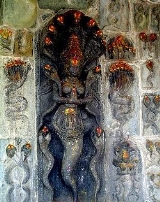
Snake worship refers to the high status of snakes or (nagas) in Hindu mythology
Hindu mythology
Hindu mythology is the large body of traditional narratives related to Hinduism, notably as contained in Sanskrit literature, such as the Sanskrit epics and the Puranas. As such, it is a subset of Indian mythology...

. (Sanskrit
Sanskrit
Sanskrit is a historical Indo-Aryan language, one of the liturgical languages of Hinduism and Buddhism, and one of the 22 official languages of India. It is also declared as a classical language by the government of India....

:) is the Sanskrit
Sanskrit
Sanskrit is a historical Indo-Aryan language, one of the liturgical languages of Hinduism and Buddhism, and one of the 22 official languages of India. It is also declared as a classical language by the government of India....

 and Pāli
Páli
- External links :* *...

 word for a deity or class of entity or being, taking the form of a very large snake, found in Hinduism
Hinduism
Hinduism is the predominant religion of the Indian subcontinent. Hinduism is often referred to as ', a Sanskrit phrase meaning "the eternal law", by its adherents. Generic "types" of Hinduism that attempt to accommodate a variety of complex views span folk and Vedic Hinduism to bhakti tradition, as...

 and Buddhism
Buddhism
Buddhism, as traditionally conceived, is a path of salvation attained through insight into the ultimate nature of reality. It encompasses a variety of traditions, beliefs and practices, largely based on teachings attributed to Siddhartha Gautama, commonly known as the Buddha...

.
Discussion
Ask a question about 'Snake worship'
Start a new discussion about 'Snake worship'
Answer questions from other users
Full Discussion Forum
 
Encyclopedia

The worship of serpent
Serpent (symbolism)
Serpent is a word of Latin origin that is commonly used in a specifically mythic or religious context, signifying a snake that is to be regarded not as a mundane natural phenomenon nor as an object of scientific zoology, but as the bearer of some potent symbolic value.-Cross-cultural symbolic...

deities is present in several old cultures, particularly in religion and mythology, where snake
Snake
Snakes are elongate legless carnivorous reptiles of the suborder Serpentes that can be distinguished from legless lizards by their lack of eyelids and external ears. Like all squamates, snakes are ectothermic amniote vertebrates covered in overlapping scales...

s were seen as entities of strength and renewal.

Hindu mythology


Snake worship refers to the high status of snakes or (nagas) in Hindu mythology
Hindu mythology
Hindu mythology is the large body of traditional narratives related to Hinduism, notably as contained in Sanskrit literature, such as the Sanskrit epics and the Puranas. As such, it is a subset of Indian mythology...

. (Sanskrit
Sanskrit
Sanskrit is a historical Indo-Aryan language, one of the liturgical languages of Hinduism and Buddhism, and one of the 22 official languages of India. It is also declared as a classical language by the government of India....

:) is the Sanskrit
Sanskrit
Sanskrit is a historical Indo-Aryan language, one of the liturgical languages of Hinduism and Buddhism, and one of the 22 official languages of India. It is also declared as a classical language by the government of India....

 and Pāli
Páli
- External links :* *...

 word for a deity or class of entity or being, taking the form of a very large snake, found in Hinduism
Hinduism
Hinduism is the predominant religion of the Indian subcontinent. Hinduism is often referred to as ', a Sanskrit phrase meaning "the eternal law", by its adherents. Generic "types" of Hinduism that attempt to accommodate a variety of complex views span folk and Vedic Hinduism to bhakti tradition, as...

 and Buddhism
Buddhism
Buddhism, as traditionally conceived, is a path of salvation attained through insight into the ultimate nature of reality. It encompasses a variety of traditions, beliefs and practices, largely based on teachings attributed to Siddhartha Gautama, commonly known as the Buddha...

. The use of the term nāga is often ambiguous, as the word may also refer, in similar contexts, to one of several human tribes known as or nicknamed "Nāgas"; to elephants; and to ordinary snakes, particularly the King Cobra
King Cobra
The King Cobra is the world's longest venomous snake, with a length that can be as large as about 5.6 m . This species is widespread throughout Southeast Asia and parts of India, and is found mostly in forested areas. Note that this species is highly aggressive and dangerous...

 and the Indian Cobra
Indian Cobra
Naja naja is a species of venomous snake native to the Indian subcontinent which includes present day Pakistan, India, Bangladesh and Sri lanka. It is the most famous of the Big Four, the four most venomous snakes of India for which a single polyvalent antivenom has been created. Like other...

, the latter of which is still called nāg in Hindi
Hindi
Standard Hindi, also known as High Hindi, Nagari Hindi or Literary Hindi is a standardised register of Hindi. It is one of the 22 languages with official status in India, and is used, along with English, for administration of the central government.Standard Hindi is a sanskritised register derived...

 and other languages of India. A female nāga is a nāgī. The Snake primarily represents rebirth, death and mortality, due to its casting of its skin and being symbolically "reborn". Over a large part of India there are carved representations of cobras or nagas or stones as substitutes. To these human food and flowers are offered and lights are burned before the shrines. Among the Dravidians a cobra which is accidentally killed is burned like a human being; no one would kill one intentionally. The serpent-god's image is carried in an annual procession by a celibate priestess.

At one time there were many prevalent different renditions of the serpent cult located in India. In Northern India, a masculine version of the serpent named Nagaraja and known as the “king of the serpents” was worshipped. Instead of the “king of the serpents,” actual live snakes were worshipped in South India (Bhattacharyya 1965, p. 1). The Manasa-cult in Bengal, India, however, was dedicated to the anthropomorphic serpent goddess, Manasa
Manasa
Manasa is a Hindu folk goddess of snakes, worshipped mainly in Bengal and other parts of northeastern India, chiefly for the prevention and cure of snakebite and also for fertility and prosperity. Manasa is the sister of Vasuki, king of Nāgas and wife of sage Jagatkāru...

 (Bhattacharyya 1965, p. 1).

Nāga
Naga
Naga or NAGA may refer to:* Nāga, a group of serpent deities in Hindu and Buddhist mythology.-People:* Naga people, an diverse ethnic identity in Northeast India* Naga , from Kashmir* Naga Regiment, of the Indian Army...

s form an important part of Hindu mythology. They play prominent roles in various legends:
  1. Shesha
    Shesha
    In Hindu tradition, Shesha or Adi-shesha is the king of all nagas, one of the primal beings of creation, and according to the Bhagavata Purana, an avatar of the Supreme God known as Sankarshan...

     (Adisesha, Sheshnaga, or the 1,000 headed snake) upholds the world on his many heads and is said to be used by Lord Vishnu to rest. Shesha also sheltered Lord Krishna from a thunderstorm during his birth.
  2. Vasuki
    Vasuki
    Vasuki is a Sanskrit name for a naga, one of the serpents of Buddhist and Hindu mythology. He is a great King of the nagas and has a gem on his head. Manasa, another naga is his sister...

     allowed himself to be coiled around Mount Mandara
    Mount Mandara
    - Overview :Mandaranchal is the name of a mountain which appears in the Samudra manthan episode in the Hindu Puranas, where it was used as a churning rod to churn the ocean of milk. The serpent, Vasuki offered to serve as the rope...

     by the Devas
    Deva (Hinduism)
    Deva is the Sanskrit word for "god, deity". It can be variously interpreted as a God, angel, spirit, celestial being, deity or any supernatural being of high excellence, and is thus comparable to the Hebrew Elohim...

     and Asuras to churn the milky ocean creating the ambrosia of immortality.
  3. Kaliya
    Kaliya
    Kaliya , in Hindu mythology, was the name of a poisonous Nāga living in the Yamuna River, in Vrindavan. The water of the Yamuna for four leagues all around him boiled and bubbled with poison...

     poisoned the Jamuna
    Jamuna
    Jamuna may refer to:* Jamuna , popular Telugu film actress* Jamuna Baruah, an Assamese actress* Jamuna River in Bangladesh. * Jamuna Bridge in Bangladesh...

     / Yamuna river where he lived. Krishna (Balakrishna / infant Krishna) subdued Kaliya by dancing on him and compelled him to leave the river.
  4. Manasa
    Manasa
    Manasa is a Hindu folk goddess of snakes, worshipped mainly in Bengal and other parts of northeastern India, chiefly for the prevention and cure of snakebite and also for fertility and prosperity. Manasa is the sister of Vasuki, king of Nāgas and wife of sage Jagatkāru...

     is the queen of the snakes. She is also referred to as Manasha or "Ma Manasha". "Ma" being the universal mother.
  5. Ananta
    Ananta
    Ananta is a Sanskrit word meaning "without end".It may refer to:*Ananta , one of the names of Vishnu.*Ananta Shesha, a serpent on which Vishnu lies.Ananta may also refer to:*Anantapur, a district of Andhra Pradesh, India....

     is the endless snake who circles the world.
  6. Padmanabha
    Padmanabha
    Padmanabha may refer to:* Padmanabha , one of the aspects of Vishnu or God with a lotus issuing from his navel. It appears as the 48th, 196th and 346th names in the Vishnu sahasranama...

     (or Padmaka) is the guardian snake of the south.
  7. Astika is half Brahmin
    Brahmin
    Brahmins have historically been the class of educators, scholars and preachers in Hinduism. They are considered as belonging to the "forward castes" of the four varnas of Hinduism....

     and half naga.
  8. Kulika


Lord Shiva also wears a snake around his neck

Nag panchami
Nag panchami
Nāga Panchamī is a Hindu festival celebrated by Hindus in most parts of India. It is celebrated on Panchami in Shravan month. On this day, people worship Nāga Devata . People go to temples and snake pits and worship the snakes. They offer milk and silver jewelry to the Cobras to protect them...

 is an important Hindu festival associated with snake worship which takes place of the fifth day of Shravana
Shravana
Shravana is the 22nd nakshatra or lunar mansion as used in Hindu astronomy and astrology. It belongs to the constellation Makara or Capricorn....

. Snake idols are offered gifts of milk and incense to help the worshipper to gain knowledge, wealth, and fame.

Different districts of Bengal celebrated the serpent in various ways. In the Bengal districts of East Mymensing, West Syhlet, and North Tippera, serpent-worship rituals were very similar, however (Bhattacharyya 1965, p. 5). On the very last day of the Bengali month Sravana (July-August), all of these districts celebrated serpent-worship each year (Bhattacharyya 1965, p. 5). Regardless of their class and station, every family during this time created a clay model of the serpent-deity – usually the serpent-goddess with two snakes spreading their hoods on her shoulders. The people worshipped this model at their homes and sacrificed a goat or a pigeon for the deity’s honor (Bhattacharyya 1965, p. 5). Before the clay goddess was submerged in water at the end of the festival, the clay snakes were taken from her shoulders. The people believed that the earth these snakes were made from cured illnesses, especially children’s diseases (Bhattacharyya 1965, p. 6).

These districts also worshipped an object know as a Karandi (Bhattacharyya 1965, p. 6).Resembling a small house made of cork, the Karandi is decorated with images of snakes, the snake goddess, and snake legends on its walls and roof (Bhattacharyya 1965, p. 6). The blood of the sacrificed animals was sprinkled on the Karandi and it also was submerged in the river at the end of the festival (Bhattacharyya 1965, p. 6).There are several more interesting examples of serpent-worship in India, see "The Serpent as the Folk-Deity in Bengal" for more information.

Cambodian mythology


Serpents, or nāga
Naga
Naga or NAGA may refer to:* Nāga, a group of serpent deities in Hindu and Buddhist mythology.-People:* Naga people, an diverse ethnic identity in Northeast India* Naga , from Kashmir* Naga Regiment, of the Indian Army...

s, play a particularly important role in Cambodia
Cambodia
The Kingdom of Cambodia , formerly known as Kampuchea , is a country in South East Asia with a population of over 14 million people. The kingdom's capital and largest city is Phnom Penh...

n mythology. A well-known story explains the emergence of the Khmer people
Khmer people
The Khmer people; ខ្មែរ ; are the predominant ethnic group in Cambodia, accounting for approximately 90% of the 14.8 million people in the country. They speak the Khmer language, which is part of the larger Mon-Khmer language family found throughout Southeast Asia...

 from the union of Indian and indigenous elements, the latter being represented as nāgas. According to the story, an Indian brahmana
Brahmana
The s are part of the Hindu śruti literature. They are commentaries on the four Vedas, detailing the proper performance of rituals....

 named Kaundinya came to Cambodia, which at the time was under the dominion of the naga king. The naga princess Soma
Soma
Soma , or Haoma , from Proto-Indo-Iranian *sauma-, was a ritual drink of importance among the early Indo-Iranians, and the later Vedic and greater Persian cultures. It is frequently mentioned in the Rigveda, whose Soma Mandala contains many hymns praising its energizing qualities...

 sallied forth to fight against the invader but was defeated. Presented with the option of marrying the victorious Kaundinya, Soma readily agreed to do so, and together they ruled the land. The Khmer people
Khmer people
The Khmer people; ខ្មែរ ; are the predominant ethnic group in Cambodia, accounting for approximately 90% of the 14.8 million people in the country. They speak the Khmer language, which is part of the larger Mon-Khmer language family found throughout Southeast Asia...

 are their descendants.

Ancient Near East


Ancient Mesopotamians and Semites believed that snakes were immortal because they could infinitely shed their skin and appear forever youthful, appearing in a fresh guise every time. http://columbia.thefreedictionary.com/snake+worship Before the arrival of the Israelites, snake cults were well established in Canaan
Canaan
Canaan is an ancient term for a region encompassing modern-day Israel and Lebanon, the Palestinian Territories, plus adjoining coastal lands and parts of Jordan, Syria and northeastern Egypt...

 in the Bronze Age
Bronze Age
The Bronze Age of a culture is the period when the most advanced metalworking in that culture utilised bronze. This could either have been based on the local smelting of copper and tin from ores, or trading for bronze from production areas elsewhere...

, for archaeologists have uncovered serpent cult objects in Bronze Age strata at several pre-Israelite cities in Canaan: two at Megiddo
Megiddo
Megiddo is a Hebrew place name that can refer to:* Tel Megiddo, site of an ancient city in northern Israel's Jezreel valley** Megiddo, Israel, a kibbutz in Israel** Megiddo Regional Council, a regional council in northern Israel...

, one at Gezer
Gezer
Gezer was a town in ancient Israel. Scholars believe that Gezer is Tel Gezer , a site around midway on the route between Jerusalem and Tel Aviv. Today the site is a national park in modern Israel....

, one in the sanctum sanctorum of the Area H temple at Hazor
Hazor
Hazor is the name of several places in the biblical and modern Israel:Biblical locations:* Tel Hazor, site of an ancient fortified city in the Upper Galilee, among the most important Caananite towns, and the largest ancient ruin in modern Israel and UNESCO World Heritage Site.* Hazor, A town in...

, and two at Shechem
Shechem
Shechem was a Canaanite city mentioned in the Amarna letters, and later became an Israelite city in...

.

in the surrounding region, serpent cult objects figured in other cultures. A late Bronze Age Hittite
Hittite
Hittite may refer to:*Hittites, ancient Anatolian people*Neo-Hittite states, Iron Age successors to the Hittite people located in modern Turkey and Syria*Hittite language, ancient Indo-European language...

 shrine in northern Syria contained a bronze statue of a god holding a serpent in one hand and a staff in the other. In sixth-century Babylon]] a pair of bronzer serpents flanked each of the four doorways of the temple of Esagila
Esagila
The Ésagila, a Sumerian name signifying "É whose top is lofty", was a temple dedicated to Marduk, the protector god of Babylon...

. At the Babylonian New Year's festival, the priest was to commission from a woodworker, a metalworker and a goldsmith two images one of which "shall hold in its left hand a snake of cedar, raising its right [hand] to the god Nabu
Nabu
Nabu is the Babylonian god of wisdom and writing, worshipped by Babylonians as the son of Marduk and his consort, Sarpanitum, and as the grandson of Ea. Nabu's consort was Tashmetum....

". At the tell of Tepe Gawra, at least seventeen Early Bronze Age Assyria
Assyria
Assyria was a civilization centered on the Upper Tigris river, in Mesopotamia , that came to rule regional empires a number of times in history. It was named for its original capital, the ancient city of Assur...

n bronze serpents were recovered.

Greek mythology


Serpents figured prominently in archaic Greek myths. According to some sources, Ophion
Ophion
In some versions of Greek mythology, Ophion , also called Ophioneus ruled the world with Eurynome before the two of them were cast down by Cronus and Rhea.-Sources:...

 ("serpent", a.k.a. Ophioneus), ruled the world with Eurynome before the two of them were cast down by Cronus and Rhea. The oracles of the Ancient Greeks were said to have been the continuation of the tradition begun with the worship of the Egyptian cobra goddess, Wadjet
Wadjet
In Egyptian mythology, Wadjet, or the Green One , was originally the ancient local goddess of the city of Dep, which became part of the city that the Egyptians named Per-Wadjet, House of Wadjet, and the...

.

The Minoan
Minoan civilization
The Minoan civilization was a Bronze Age civilization which arose on the island of Crete. The Minoan culture flourished from approximately 2700 to 1450 BC; afterwards, Mycenaean Greek culture became dominant at Minoan sites in Crete...

 Snake Goddess
Snake Goddess
Snake Goddess describes a number of figurines of a woman holding a snake in each hand found during excavation of Minoan archaeological sites in Crete dating from approximately 1600 BCE. By implication, the term 'goddess' also describes the deity depicted; although little more is known about her...

 brandished a serpent in either hand, perhaps evoking her role as source of wisdom, rather than her role as Mistress of the Animals (Potnia theron), with a leopard
Leopard
The leopard , Panthera pardus, is a member of the Felidae family and the smallest of the four "big cats" in the genus Panthera; the other three being the tiger, lion and jaguar...

 under each arm. She is a Minoan version of the Canaan
Canaan
Canaan is an ancient term for a region encompassing modern-day Israel and Lebanon, the Palestinian Territories, plus adjoining coastal lands and parts of Jordan, Syria and northeastern Egypt...

ite fertility goddess Asherah
Asherah
Asherah , in Semitic mythology, is a Semitic mother goddess, who appears in a number of ancient sources including Akkadian writings by the name of Ashratum/Ashratu and in Hittite as Asherdu or Ashertu or Aserdu or Asertu...

. It is not by accident that later the infant Heracles
Heracles
In Greek mythology, Heracles or Herakles , Alcides or Alcaeus , was a divine hero, the son of Zeus and Alcmene, foster son of Amphitryon and great-grandson of Perseus...

, a liminal hero on the threshold between the old ways and the new Olympian world, also brandished the two serpents that "threatened" him in his cradle. Classical Greeks did not perceive that the threat was merely the threat of wisdom. But the gesture is the same as that of the Cretan goddess.

Typhon
Typhon
Typhon , also Typheus/Typhoeus , Typhaon or Typhos is the final son of Gaia, fathered by Tartarus, and is the most deadly monster of Greek mythology. Typhon attempts to destroy Zeus at the will of Gaia, because Zeus had imprisoned the Titans...

 the enemy of the Olympian gods is described as a vast grisly monster with a hundred heads and a hundred serpents issuing from his thighs, who was conquered and cast into Tartarus
Tartarus
In classic mythology, below Heaven, Earth, and Pontus is Tartarus, or Tartaros . It is a deep, gloomy place, a pit, or an abyss used as a dungeon of torment and suffering that resides beneath the underworld. In the Gorgias, Plato wrote that souls were judged after death and those who received...

 by Zeus
Zeus
In Greek mythology, Zeus is the king of the gods, the ruler of Mount Olympus and the god of the sky and thunder. His symbols are the thunderbolt, eagle, bull, and oak. In addition to his Indo-European inheritance, the classical "cloud-gatherer" also derives certain iconographic traits from the...

, or confined beneath volcanic regions, where he is the cause of eruptions. Typhon is thus the chthonic figuration of volcanic forces. Amongst his children by Echidna are Cerberus
Cerberus
Cerberus, in Greek and Roman mythology, is a multi-headed hound which guards the gates of Hades, to prevent those who have crossed the river Styx from ever escaping...

 (a monstrous three-headed dog with a snake for a tail and a serpentine mane), the serpent tailed Chimaera
Chimera (mythology)
In Greek mythology, the Chimera was a monstrous fire-breathing creature of Lycia in Asia Minor, composed of the parts of multiple animals: upon the body of a lioness with a tail that terminated in a snake's head, the head of a goat arose on her back at the center of her spine...

, the serpent-like chthonic water beast Lernaean Hydra
Lernaean Hydra
In Greek mythology, the Lernaean Hydra In Greek mythology, the Lernaean Hydra In Greek mythology, the Lernaean Hydra (Greek: was an ancient nameless serpent-like chthonic water beast (as its name evinces) that possessed 9 heads— the poets mention more heads than the vase-painters could paint—...

 and the hundred-headed serpentine dragon Ladon
Ladon
Ladon may refer to:*Ladon , one of the dragons in Greek mythology*Ladon river in Arcadia, Greece*Ladon, Loiret, a commune in the Loiret département of France*Ladon, the dragon god in the video game Breath of Fire III...

. Both the Lernaean Hydra and Ladon were slain by Heracles
Heracles
In Greek mythology, Heracles or Herakles , Alcides or Alcaeus , was a divine hero, the son of Zeus and Alcmene, foster son of Amphitryon and great-grandson of Perseus...

.

Python was the earth-dragon of Delphi
Delphi
Delphi is both an archaeological site and a modern town in Greece on the south-western spur of Mount Parnassus in the valley of Phocis...

, she always was represented in the vase-paintings and by sculptors as a serpent. Pytho was the chthonic enemy of Apollo
Apollo
In Greek and Roman mythology, Apollo , is one of the most important and many-sided of the Olympian deities...

, who slew her and remade her former home his own oracle, the most famous in Classical Greece.

Amphisbaena
Amphisbaena
Amphisbaena , Amphisbaina, Amphisbene, Amphisboena, Amphisbona, Amphista, Amphivena, or Anphivena , a Greek word, from amphis, meaning "both ways", and bainein, meaning "to go", also called the Mother of Ants, is a mythological, ant-eating serpent with a head at each end...

 a Greek word, from amphis, meaning "both ways", and bainein, meaning "to go", also called the "Mother of Ants", is a mythological, ant-eating serpent with a head at each end. According to Greek mythology, the mythological amphisbaena was spawned from the blood that dripped from Medusa
Medusa
In Greek mythology, Medusa , "guardian, protectress") was a gorgon, a chthonic female monster; gazing directly upon her would turn onlookers to stone. She was beheaded by the hero Perseus, who thereafter used her head as a weapon until giving it to the goddess Athena to place on her shield...

 the Gorgon
Gorgon
In Greek mythology, the Gorgon was a terrifying female creature. While descriptions of Gorgons vary across Greek literature, the term commonly refers to any of three sisters who had hair of living, venomous snakes, and a horrifying gaze that turned those who beheld it to stone...

's head as Perseus
Perseus
Perseus , the legendary founder of Mycenae and of the Perseid dynasty there, was the first of the mythic heroes of Greek mythology whose exploits in defeating various archaic monsters provided the founding myths in the cult of the Twelve Olympians...

 flew over the Libyan Desert with her head in his hand.

Medusa and the other Gorgons were vicious female monsters with sharp fangs and hair of living, venomous snakes whose origins predate the written myths of Greece and who were the protectors of the most ancient ritual secrets. The Gorgons wore a belt of two intertwined serpents in the same configuration of the caduceus
Caduceus
__FORCETOC__ The caduceus ☤ is typically depicted as a short herald's staff entwined by two serpents in the form of a double helix, and is sometimes surmounted by wings. This staff was first borne by Iris, the messenger of Hera...

. The Gorgon was placed at the highest point and central of the relief on the Parthenon
Parthenon
The Parthenon is a temple of the Greek goddess Athena whom the people of Athens considered their protector. It was built in the 5th century BC on the Athenian Acropolis. It is the most important surviving building of Classical Greece, generally considered to be the culmination of the development...

.

Asclepius
Asclepius
Asclepius is the god of medicine and healing in ancient Greek religion. Asclepius represents the healing aspect of the medical arts; his daughters are Hygieia , Iaso , Aceso , Aglæa/Ægle , and Panacea...

, the son of Apollo and Koronis, learned the secrets of keeping death at bay after observing one serpent bringing another (which Asclepius himself had fatally wounded) healing herbs. To prevent the entire human race from becoming immortal under Asclepius's care, Zeus killed him with a bolt of lightning. Asclepius' death at the hands of Zeus illustrates man's inability to challenge the natural order that separates mortal men from the gods. In honor of Asclepius, snakes were often used in healing rituals. Non-poisonous snakes were left to crawl on the floor in dormitories where the sick and injured slept. In The Library
Bibliotheca (Pseudo-Apollodorus)
The Bibliotheca , in three books, provides a grand summary of traditional Greek mythology and heroic legends, "the most valuable mythographical work that has come down from ancient times," Aubrey Diller observed, whose "stultifying purpose" was neatly expressed in the epigram noted by Patriarch...

, Apollodorus
Apollodorus
Apollodorus of Athens son of Asclepiades, was a Greek scholar and grammarian. He was a pupil of Diogenes of Babylon, Panaetius the Stoic, and the grammarian Aristarchus of Samothrace...

 claimed that Athena
Athena
In Greek mythology, Athena is the goddess of wisdom, peace, warfare, strategy, handicrafts and reason, shrewd companion of heroes and the goddess of heroic endeavour...

 gave Asclepius a vial of blood from the Gorgons. Gorgon blood had magical properties: if taken from the left side of the Gorgon, it was a fatal poison; from the right side, the blood was capable of bringing the dead back to life. However Euripides
Euripides
Euripides was the lastof the three great tragedians of classical Athens . Ancient scholars thought that Euripides had written ninety-five plays, although four of those were probably written by Critias...

 wrote in his tragedy Ion
Ion (play)
Ion is an ancient Greek play by Euripides, thought to be written between 414 and 412 BC. It follows the orphan Ion in the discovery of his origins.-Background:...

 that the Athenian queen Creusa had inherited this vial from her ancestor Erichthonios, who was a snake himself and receiving the vial from Athena. In this version the blood of Medusa had the healing power while the lethal poison originated from Medusa's serpents.

Laocoön
Laocoön
Laocoön , the son of Acoetes is a figure in Greek mythology, a Trojan priest of Poseidon, , whose rules he had defied, either by marrying and having sons, or by having committed an impiety by making love with his wife in the presence of a cult image in a sanctuary...

 was allegedly a priest of Poseidon
Poseidon
In Greek mythology, Poseidon was the god of the sea and, as "Earth-Shaker," of earthquakes. The name of the sea-god Nethuns in Etruscan was adopted in Latin for Neptune in Roman mythology: both were sea gods analogous to Poseidon...

 (or of Apollo, by some accounts) at Troy
Troy
Troy is a legendary city and center of the Trojan War, as described in the Epic Cycle and especially in the Iliad, one of the two epic poems attributed to Homer...

; he was famous for warning the Trojans in vain against accepting the Trojan Horse from the Greeks, and for his subsequent divine execution. Poseidon (some say Athena
Athena
In Greek mythology, Athena is the goddess of wisdom, peace, warfare, strategy, handicrafts and reason, shrewd companion of heroes and the goddess of heroic endeavour...

), who was supporting the Greeks, subsequently sent sea-serpents to strangle Laocoön and his two sons, Antiphantes and Thymbraeus. Another tradition states that Apollo sent the serpents for an unrelated offense, and only unlucky timing caused the Trojans to misinterpret them as punishment for striking the Horse.

Olympias
Olympias
Olympias was a Greek princess of Epirus, daughter of king Neoptolemus I of Epirus, the fourth wife of the king of Macedonia, Philip II, and mother of Alexander the Great...

, the mother of Alexander the Great
Alexander the Great
Alexander III of Macedon, popularly known as Alexander the Great , was an Ancient Greek king of Macedon who created one of the largest empires in ancient history...

 and a princess of the primitive land of Epirus
Epirus (region)
Epirus is a geographical and historical region of Greece in southeastern Europe, currently divided between the periphery of Epirus in Greece and the prefectures of Gjirokastër, Vlorë, Berat, and Korçë in southern Albania.-Name & Etymology:...

, had the reputation of a snake-handler, and it was in serpent form that Zeus was said to have fathered Alexander upon her; tame snakes were still to be found at Macedonian Pella in the 2nd century AD (Lucian
Lucian
Lucian of Samosata was an Assyrian rhetorician, and satirist who wrote in the Greek language. He is noted for his witty and scoffing nature.-Biography:...

, Alexander the false prophet) and at Ostia a bas-relief shows paired coiled serpents flanking a dressed altar, symbols or embodiments of the Lares
Lares
Lares were ancient Roman deities protecting the house and the family, they were a form of household gods....

 of the household, worthy of veneration (Veyne 1987 illus p 211).

Aeetes
Aeëtes
In Greek mythology, Aeëtes was a son of the king-god Helios and the nymph Perseis , brother of Circe and Pasiphae, and father of Medea, Chalciope and Apsyrtus...

, the king of Colchis
Colchis
In ancient geography, Colchis or Kolkhis was an ancient Georgian , state kingdom and region in the Western Georgia , which played an important role in the ethnic and cultural formation of the Georgian nation and its subgroups...

 and father of the sorceress Medea
Medea
Medea is a woman in Greek mythology. She was the daughter of King Aeëtes of Colchis, niece of Circe, granddaughter of the sun god Helios, and later wife to the hero Jason, with whom she had two children: Mermeros and Pheres. In Euripides's play Medea, Jason leaves Medea when Creon, king of...

, possessed the Golden Fleece
Golden Fleece
In Greek mythology, the Golden Fleece is the fleece of the winged ram Chrysomallos . It figures in the tale of Jason and his band of Argonauts, who set out on a quest for the fleece in order to place Jason rightfully on the throne of Iolcus in Thessaly...

. He guarded it with a massive serpent that never slept. Medea, who had fallen in love with Jason
Jason
Jason was a late ancient Greek mythological figure, famous as the leader of the Argonauts and their quest for the Golden Fleece. He was the son of Aeson, the rightful king of Iolcus...

 of the Argonauts
Argonauts
In Greek mythology, the Argonauts were a band of heroes who, in the years before the Trojan War, accompanied Jason to Colchis in his quest to find the Golden Fleece. Their name comes from their ship, the Argo, which was named after its builder, Argus. "Argonauts", therefore, literally means...

, enchanted it to sleep so Jason could seize the Fleece.

See Lamia (mythology)
Lamia (mythology)
In ancient Greek mythology, Lamia was a beautiful queen of Libya who became a child-eating daemon. While the word lamia literally means large shark in Greek, Aristophanes claimed her name derived from the Greek word for gullet , referring to her habit of devouring children.Some accounts say she...

.

Ancient Europe


Serpent worship was well known in ancient Europe. There does not appear to be much ground for supposing that the roman god Aesculapius was a serpent-god in spite of his connection with serpents. On the other hand, we learn from Herodotus
Herodotus
Herodotus of Halicarnassus was a Greek historian who lived in the 5th century BC and is regarded as the "Father of History" in Western culture. He was the first historian known to collect his materials systematically, test their accuracy to a certain extent and arrange them in a...

 of the great serpent which defended the citadel of Athens
Athens
Athens , the capital and largest city of Greece, dominates the Attica periphery; as one of the world's oldest cities, its recorded history spans around 3,400 years....

. The Roman genius loci took the form of a serpent where a snake was kept and fed with milk in the temple of Potrimpos, an old Slavonic god. On the Iberian Peninsula there is evidence that before the introduction of Christianity, and perhaps more strongly before invasions of the Romans, Serpent-worship was part of local religion. To this day there are numerous traces in popular belief, especially in Germany, of respect for the snake, which seems to be a survival of ancestor worship, such as still exists among the Zulus and other tribes; the "house-snake," as it is called, cares for the cows and the children, and its appearance is an omen of death, and the life of a pair of house-snakes is often held to be bound up with that of the master and mistress themselves. Tradition says that one of the Gnostic sects known as the Ophites caused a tame serpent to coil round the sacramental bread and worshipped it as the representative of the Saviour.

Nordic mythology


Jörmungandr
Jörmungandr
Jörmungandr Jörmungandr Jörmungandr ' onMouseout='HidePop("36907")' href="http://www.absoluteastronomy.com/topics/Sea_serpent">sea serpent
Sea serpent
A sea serpent or sea dragon is a mythological sea monster either wholly or partly serpentine.Sightings of sea serpents have been reported for hundreds of years, and continue to be claimed today. Cryptozoologist Bruce Champagne identified more than 1,200 purported sea serpent sightings...

 of the Norse mythology
Norse mythology
Norse, North Germanic, or Scandinavian mythology comprises the myths of North Germanic pre-Christian religion.Most of the written sources for Norse mythology were assembled in medieval Iceland in Old Norse, notably as the Edda....

, the middle child of Loki
Loki
In Norse mythology, Loki is a god or jötunn . Loki's relation with the gods varies by source. Loki assists the gods, and sometimes causes problems for them. Loki is a shape shifter and in separate incidents he appears in the form of a salmon and a mare. Loki's positive relations with the gods ends...

 and the giantess Angrboða.

According to the Prose Edda
Prose Edda
The Prose Edda, also known as the Younger Edda, Snorri's Edda or simply Edda, is an Old Norse language Icelandic collection of four sections interspersed with excerpts from earlier skaldic and Eddic poetry containing tales from Norse mythology...

, Odin
Odin
Odin , is considered the chief god in Norse paganism and the ruler of Asgard. Homologous with the Anglo-Saxon Wōden and the Old High German Wotan, it is descended from Proto-Germanic *Wōđinaz or *Wōđanaz.The name Odin is generally accepted as the modern translation; although, in some cases, older...

 took Loki
Loki
In Norse mythology, Loki is a god or jötunn . Loki's relation with the gods varies by source. Loki assists the gods, and sometimes causes problems for them. Loki is a shape shifter and in separate incidents he appears in the form of a salmon and a mare. Loki's positive relations with the gods ends...

's three children, Fenrisúlfr
Fenrisulfr
In Norse mythology, Fenrir , Fenrisúlfr , Hróðvitnir , or Vánagandr is a monstrous wolf...

, Hel
Hel (being)
In Norse mythology, Hel is a being that presides over a realm of the same name, where she receives a portion of the dead. Hel is attested in the Poetic Edda, compiled in the 13th century from earlier traditional sources, and the Prose Edda, written in the 13th century by Snorri Sturluson...

 and Jörmungandr. He tossed Jörmungandr into the great ocean that encircles Midgard
Midgard
Midgard , is an old Germanic name for our world, the places inhabited by humans, with the literal meaning "middle enclosure".-Etymology:...

. The serpent grew so big that he was able to surround the Earth
Yggdrasil
In Norse mythology, Yggdrasil is the world tree. Yggdrasil is central in Norse cosmology, and around it exists Nine Worlds....

 and grasp his own tail, and as a result he earned the alternate name of the Midgard Serpent or World Serpent. Jörmungandr's arch enemy is the god Thor
Thor
Thor is the red-haired and bearded god of thunder in Germanic mythology and Germanic paganism, and its subsets: Norse paganism, Anglo-Saxon paganism and Continental Germanic paganism....

.

African mythology


In Africa the chief centre of serpent worship was Dahomey
Dahomey
Dahomey was the name of a country in west Africa now called the Republic of Benin. The Kingdom of Dahomey was a powerful west African state founded in the seventeenth century which survived until 1894. From 1894 until 1960 Dahomey was a part of French West Africa. The independent Republic of...

. but the cult of the python seems to have been of exotic origin, dating back to the first quarter of the 17th century. By the conquest of Whydah the Dahomeyans were brought in contact with a people of serpent worshippers, and ended by adopting from them the beliefs which they at first despised. At Whydah, the chief centre, there is a serpent temple, tenanted by some fifty snakes. Every python of the danh-gbi kind must be treated with respect, and death is the penalty for killing one, even by accident. Danh-gbi has numerous wives, who until 1857 took part in a public procession from which the profane crowd was excluded; a python was carried round the town in a hammock, perhaps as a ceremony for the expulsion of evils. The rainbow-god of the Ashanti was also conceived to have the form of a snake. His messenger was said to be a small variety of boa. but only certain individuals, not the whole species, were sacred. In many parts of Africa the serpent is looked upon as the incarnation of deceased relatives. Among the Amazulu, as among the Betsileo
Betsileo
The Betsileo are a highland ethnic group of Madagascar, the third largest in terms of population, numbering around one million. Their name means "The Many Invincible Ones" which they chose for themselves after the failed invasion of Ramitraho King of the Menabe kingdom in the early 19th...

 of Madagascar, certain species are assigned as the abode of certain classes. The Maasai
Maasai
The Maasai are an indigenous African ethnic group of semi-nomadic people located in Kenya and northern Tanzania. Due to their distinctive customs and dress and residence near the many game parks of East Africa, they are among the most well known of African ethnic groups...

, on the other hand, regard each species as the habitat of a particular family of the tribe.

Eva Meyerowitz wrote of an earthenware pot that was stored at the Museum of Achimota College in Gold Coast. The base of the neck of this pot is surrounded by the rainbow snake (Meyerowitz 1940, p. 48). The legend of this creature explains that the rainbow snake only emerged from its home when it was thirsty. Keeping its tail on the ground the snake would raise its head to the sky looking for the rain god. As it drank great quantities of water, the snake would spill some which would fall to the earth as rain (Meyerowitz 1940, p. 48).

There are four other snakes on the sides of this pot: Danh – gbi, the life giving snake, Li, for protection, Liwui, which was associated with Wu, god of the sea, and Fa, the messenger of the gods (Meyerowitz 1940, p. 48). The first three snakes Danh – gbi, Li, Liwui were all worshipped at Whydah, Dahomey where the serpent cult originated (Meyerowitz 1940, p. 48). For the Dahomeans, the spirit of the serpent was one to be feared as he was unforgiving (Nida & Smalley 1959, p. 17). They believed that the serpent spirit could manifest itself in any long, winding objects such as plant roots and animal nerves. They also believed it could manifest itself as the umbilical cord, making it a symbol of fertility and life (Nida & Smalley 1959, p. 17).

The Ancient Egyptians worshiped a number of snake gods, including Apophis
Apophis
Apophis may refer to:* Apep, an Ancient Egyptian demon, in Greek known as Apophis.* Apepi , a Hyksos pharaoh of Lower Egypt* 99942 Apophis, a near-Earth asteroid...

 and Set
Set (mythology)
In Ancient Egyptian mythology, Set is an ancient god, who was originally the god of the desert, Storms, Darkness, and Chaos...

, and the Sumerians before them had a serpent god Ningizzida.

Australian Aborigine mythology


In Australia, the Aboriginal people worship a huge python, known by a variety of names but universally referred to as the Rainbow Serpent, that was said to have created the landscape, embodied the spirit of fresh water and punished lawbreakers. The Aborigines in southwest Australia called the serpent the Waugyl, while the Warramunga of the east coast worshipped the mythical Wollunqua.

Native American mythology


In America some of the Native American
Indigenous peoples of the Americas
The indigenous peoples of the Americas are the pre-Columbian inhabitants of the Americas, their descendants, and many ethnic groups who identify with those peoples...

 tribes give reverence to the rattlesnake as grandfather and king of snakes who is able to give fair winds or cause tempest. Among the Hopi
Hopi
The Hopi are American Indians people who primarily live on the 12,635 km² Hopi Reservation in northeastern Arizona. The Hopi Reservation is entirely surrounded by the much larger Navajo Reservation. The two nations used to share the Navajo-Hopi Joint Use Area...

 of Arizona
Arizona
The State of Arizona is a state located in the southwestern region of the United States. The capital and largest city is Phoenix. The second largest city is Tucson, followed in size by the four Phoenix metropolitan area cities of Mesa, Glendale, Chandler, and Scottsdale.Arizona was the 48th and...

 the serpent figures largely in one of the dances. The rattlesnake was worshipped in the Natchez
Natchez
Natchez may refer to:* Natchez people, a Native American nation* Natchez language, the language of that tribe* Natchez, Mississippi, a town in the United States* Natchez Trace, a trail from Natchez, Mississippi to Nashville, Tennessee...

 temple of the sun and the Aztec
Aztec
The Aztec people were certain ethnic groups of central Mexico, particularly those groups who spoke the Nahuatl language and who dominated large parts of Mesoamerica in the 14th, 15th and 16th centuries, a period referred to as the Late post-Classic period in Mesoamerican chronology.Often the term...

 deity Quetzalcoatl
Quetzalcoatl
Quetzalcoatl is a Mesoamerican deity whose name comes from the Nahuatl language and has the meaning of "feathered-serpent".The worship of a feathered serpent deity is first documented in Teotihuacan in the Late Preclassic through the Early Classic period of Mesoamerican chronology - "Teotihuacan...

 was a feathered serpent-god. In many MesoAmerican cultures, the serpent was regarded as a portal between two worlds. The tribes of Peru
Peru
Peru , officially the Republic of Peru , is a country in western South America. It is bordered on the north by Ecuador and Colombia, on the east by Brazil, on the southeast by Bolivia, on the south by Chile, and on the west by the Pacific Ocean.Peruvian territory was home to the Norte Chico...

 are said to have adored great snakes in the pre-Inca days and in Chile
Chile
Chile, officially the Republic of Chile , is a country in South America occupying a long, narrow coastal strip between the Andes mountains to the east and the Pacific Ocean to the west. It borders Peru to the north, Bolivia to the northeast, Argentina to the east, and the Drake Passage in the far...

 the Mapuche
Mapuche
The Mapuche are the indigenous inhabitants of Central and Southern Chile and Southern Argentina. They were known as Araucanians by the Spaniards. This is now considered pejorative by the people and the term Mapuche is the one most often used by people in conversation...

 made a serpent figure in their deluge beliefs. The Mound Builders associated great mystical value to the serpent, as the Serpent Mound
Serpent Mound
The Great Serpent Mound is a 1,330-foot-long, three-foot-high prehistoric effigy mound located on a plateau of the Serpent Mound crater along Ohio Brush Creek in Adams County, Ohio. Maintained within a park by the Ohio Historical Society, it has been designated a National Historic Landmark by the...

 demonstrates, though we are unable to unravel the particular associations.

Snake handling in Christianity


Contemporary Christian culture identifies the snake as a symbol of evil, tempting Adam and Eve into the fall of man. Snake handling
Snake handling
Snake handling or serpent handling is a religious ritual in a small number of Pentecostal churches in the U.S., usually characterized as rural and Holiness. The practice began in the early 20th century in Appalachia, spreading to mostly coal mining towns. The practice plays only a small part of...

is a religious ritual
Ritual
A ritual is a set of actions, performed mainly for their symbolic value, which is prescribed by a religion or by the traditions of a community. The term usually excludes actions which are arbitrarily chosen by the performers, or dictated purely by logic, chance, necessity, etc..A ritual may be...

 in a small number of Christian
Christianity
Christianity is a monotheistic religion based on the life and teachings of Jesus of Nazareth as presented by the revelations in the New Testament....

 churches in the U.S., usually characterized as rural
Rural
Rural areas are large and isolated areas of a country, often with low population density.About 91 percent of the rural population now earn salaried incomes, often in urban areas...

 and Pentecostal
Pentecostalism
Pentecostalism is a renewal movement within Christianity that places special emphasis on a direct personal experience of God through the baptism in the Holy Spirit which is evidenced by speaking in tongues. The term Pentecostal is derived from Pentecost, a Greek term describing the Jewish Feast of...

, particularly the Church of God with Signs Following
Church of God with Signs Following
The Church of God with Signs Following is the name applied to Pentecostal Holiness churches that practice snake handling and drinking poison in worship services, based on an interpretation of the following biblical passage:...

. Practitioners believe it dates to antiquity and quote the Bible
Bible
The Bible contains the central religious texts of Judaism and Christianity. Modern Judaism generally recognizes a single set of canonical books known as the Tanakh, or Hebrew Bible, as it is written almost entirely in the Hebrew language, with some small portions in Aramaic...

 to support the practice, especially:
"They shall take up serpents; and if they drink any deadly thing, it shall not hurt them; they shall lay hands on the sick, and they shall recover." (Mark 16:18)

"Behold, I give unto you power to tread on serpents and scorpions, and over all the power of the enemy: and nothing shall by any means hurt you." (Luke 10:19)

Other snake gods

  • Aušlavis
  • Damballah
  • Degei
    Degei
    In Fijian mythology, Degei is a snake-god. He judges newly-dead souls after they pass through one of two caves: Cibaciba or Drakulu. A few he sends to paradise, Burotu...

  • Nagaradhane
    Nagaradhane
    Nagaradhane is a form of snake worship which, along with Bhuta Kola, is one of the unique traditions prevalent in coastal districts of Dakshina Kannada , Udupi and kasargod alternatively known as Tulu Nadu- Origin of Nagaradhane :...

  • Nehebkau
    Nehebkau
    In Egyptian mythology, Nehebkau was originally the explanation of the cause of binding of Ka and Ba after death. Thus his name, which means brings together Ka...

  • Ningizzida
  • Rainbow Serpent
    Rainbow Serpent
    The Rainbow Serpent is a common motif in the art & mythology of Aboriginal Australia.The Rainbow Serpent is seen as the inhabitant of permanent waterholes and is in control of life's most precious resource, water. He is the underlying Aboriginal mythology for the famous Outback "bunyip"...

  • Ratumaibulu
    Ratumaibulu
    In the mythology of Fiji, Ratumaibulu is a god of great importance who presides over agriculture. In the month called Vula-i-Ratumaibulu, he comes from Bulu, the world of spirits, to make the breadfruit and other fruit trees blossom and yield fruit...

  • Set (serpent god)
    Set (Serpent God)
    Set is the name of a fictional demon-god within the continuities of Conan the Barbarian and Marvel Universe.He is apparently an amalgam of the name of the Egyptian god Set and the appearance and characteristics of the Egyptian monster Apep and the Greek mythological figure the Lernaean Hydra. This...

  • Minoan Snake Goddess
    Snake Goddess
    Snake Goddess describes a number of figurines of a woman holding a snake in each hand found during excavation of Minoan archaeological sites in Crete dating from approximately 1600 BCE. By implication, the term 'goddess' also describes the deity depicted; although little more is known about her...

  • Quetzalcoatl
    Quetzalcoatl
    Quetzalcoatl is a Mesoamerican deity whose name comes from the Nahuatl language and has the meaning of "feathered-serpent".The worship of a feathered serpent deity is first documented in Teotihuacan in the Late Preclassic through the Early Classic period of Mesoamerican chronology - "Teotihuacan...

  • Ungud
    Ungud
    In Australian Aboriginal mythology, Ungud is a snake god who is sometimes male and sometimes female. He is associated with rainbows and the fertility and erections of the tribe's shamans....

  • Wollunqua
    Wollunqua
    In Australian aboriginal mythology, Wollunqua is a snake-god of rain and fertility, who emerged from a watering hole in the Murschison Mountains. He is said to be many miles long....

  • Zombi (African god)
    Zombi (African god)
    Zombi is the name of a snake-deity in some cults of West African Vodun and Haitian Vodou . Zombi is a Creole word, thought to be derived from Nzambi, supreme god of the Bacongo people of Angola. The deity is connected with water and appears in different impersonations, one being Zombi-Damballah,...


See also

  • Animal worship
    Animal worship
    Animal worship refers to religious rituals involving animals, especially in pre-modern societies, such as the glorification of animal deities, or animal sacrifice.The origins of animal worship have been the subject of many theories...

  • Naga (mythology)
  • Serpent (symbolism)
    Serpent (symbolism)
    Serpent is a word of Latin origin that is commonly used in a specifically mythic or religious context, signifying a snake that is to be regarded not as a mundane natural phenomenon nor as an object of scientific zoology, but as the bearer of some potent symbolic value.-Cross-cultural symbolic...

  • Snake Shyam
    Snake Shyam
    M.S. Balasubramania, popularly known as Snake Shyam, is a snake enthusiast, wildlife conservationist and lecturer in Mysore, India. Though not a trained herpetologist, he is known throughout the Mysore region as a "naturalist on wheels". Shyam rescues and rehabilitates snakes and educates the...

  • Sarpa Kavu
    Sarpa Kavu
    Sarpa Kavu is a small traditional forest seen in Kerala state of South India. This untouched small forest usually have idols of Naga Devatas and Naga Devas and people would worship them. This was part of Nagaaradhana which was prevalent among keralites during past centuries...


External links